anaheim-gazette 1880-05-29
Scanned page
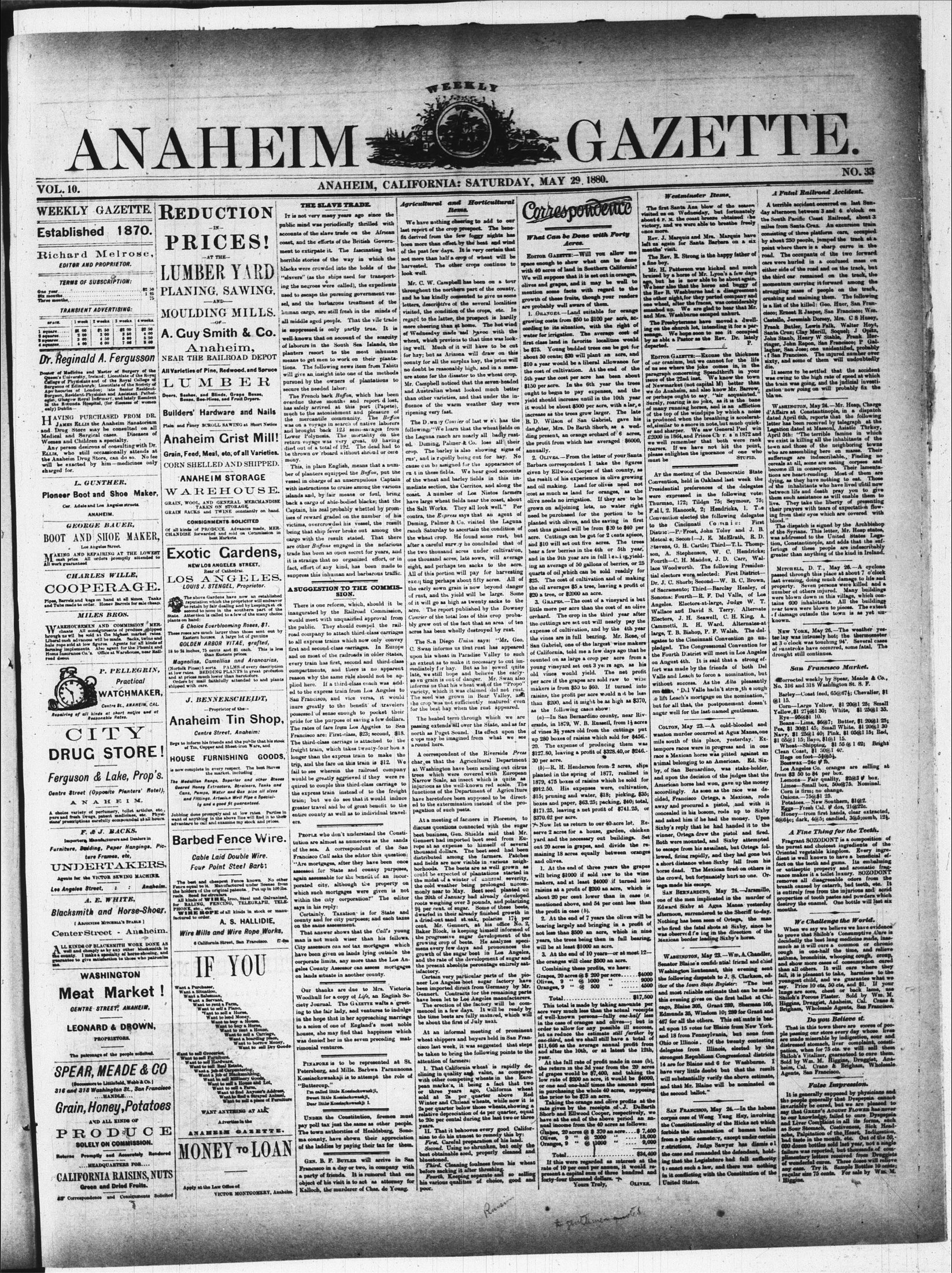
Searchable text
ANAHEIM
VOL. 10.
WEEKLY GAZETTE.
Established 1870.
Richard Melrose,
EDITOR AND PROPRIETOR.
TERMS OF SUBSCRIPTION:
One year... $2.50
Six months... 1.25
Three months... 75
TRANSIENT ADVERTISING:
SPACE.
1 square... $1.00
2 squares... $1.50
3 squares... $2.00
4 squares... $2.50
Dr. Reginald A. Fergusson
Doctor of Medicine and Master of Surgery of the Queen's University, Ireland; Licentiate of the Royal College of Physicians and of the Royal College of Surgeons of Edinburgh; Licentiate of the Society of Appreciaries of London; Late Senior Resident-Surgon, Resident-Physician and Assistant Pathologist; Glasgow Royal Infirmary, and likely Resident in the Rotunda Hospital, (for diseases of women only) Dublin.
HAVING PURCHASED FROM DR. JAMES ELLIS the Anaheim Sanatorium and Drug Store may be consulted on all Medical and Surgical cases. Diseases of Women and Children a specialty.
Any person desirous of consulting with Dr. ELLIS, who still occasionally attends at the Anaheim Drug Store, can do so. No fee will be exacted by him—medicines only charged for.
REDUCTION IN PRICES!
AT THE LUMBER YARD PLANING, SAWING, AND MOULDING MILLS.
A. Guy Smith & Co.
Anaheim,
NEAR THE RAILROAD DEPOT
All Varieties of Pine, Redwood, and Spruce
LUMBER
Deers, Seahors, and Blinds, Grape Boxes,
Boxes, Bee-Hives, and Fruit Dryers.
Builders' Hardware and Nails
Plain and Fancy SCROLL SAWING at Short Notice
Anaheim Crist Mill!
Grain, Feed, Meal, etc., of all Varieties.
CORN SHELLED AND SHIPPED.
THE SLAVE TRANSITION
It is not very many years after public mind was periodically accounted of the slave trade out coast, and the efforts of the Bent to extirpate it. The horrible stories of the way blacks were crowded into the "slavera" (as the ships used ing the negroes were called), used to escape the pursuing gossip, and the barbarous treason human cargo, are still fresh in all middle aged people. This is suppressed is only partly well-known that on account of laborers in the South South planters resort to the means to get men to work or tions. The following news will give an insight into one pursued by the owners of secure the needed labor:
The French bark Buffon, overdue three months and has safely arrived at this much to the astonishment that the mercantile community was on a voyage in search of and brought back 123 seafarer Lower Polynesia. The man return voyage was very good died out of a total of 192. be thrown overboard without money.
This, in plain English, mber of planters equipped th
HAVING PURCHASED FROM DR. JAMES ELLIS the Anaheim Sanatorium and Drug Store may be consulted on all Medical and Surgical cases. Diseases of Women and Children a specialty.
Any person desirous of consulting with Dr. Ellis, who still occasionally attends at the Anaheim Drug Store, can do so. No fee will be exacted by him—medicines only charged for.
L. GUNTHER.
Ploneer Boot and Shoe Maker,
Cer. Adelaide and Los Angeles streets.
ANAHEIM.
GEORGE BAUER,
BOOT AND SHOE MAKER,
Los Angeles Street.
MAKING AND REPAIRING AT THE LOWEST cash price. All orders promptly attended to All work guaranteed.
CHARLES WILLE,
COOPERAGE.
Pipes, Barrels and kegs on hand at all times. Tanks and Tubs made to order. Honey Barrels for sale cheap.
MILES BROS.
WAREHOUSEMEN AND COMMISSION MERCHANTS. All consignments of produce shipped through us will be sold at the highest market rates. Liberal cash advances will be made. Sacks, twine and hale rope sold at low figures. Agents for all kinds of farming implements. Also agent for the Phonix and Home Insurance Co.'s. Office at Warehouse, near Railroad denot.
P. PELLEGRIN,
Practical WATCHMAKER,
Centre St., ANAHEIM, CAL.
Repairing of all kinds at short notice and at Reasonable Rates.
CITY DRUG STORE!
Ferguson & Lake, Prop's.
Ontree Street (Opposite Planters' Hotel),
ANAHEIM.
A choice variety of perfumery, toilet articles, etc., pure and fresh Drugs, patent medicines, etc. Physicians' prescriptions carefully compounded at all hours.
F. & J. BACKS.
Importers, Manufacturers and Dealers in Furniture, Bedding, Paper Hangings, Picture Frames, etc.
UNDERTAKERS.
Agents for the VICTOR SEWING MACHINE.
Los Angeles Street, : Anaheim.
LUMBER
Deers, Sheshes, and Blinds, Grape Boxes,
Boxes, Bee-Hives, and Fruit Dryers.
Builders' Hardware and Nails
Plain and Fancy SCROLL SAWING at Short Notice
Anaheim Crist Mill!
Grain, Feed, Meal, eto, of all Varieties.
CORN SHELLED AND SHIPPED.
ANAHEIM STORAGE
WAREHOUSE.
GRAIN, WOOL, AND GENERAL MERCHANDISE TAKEN ON STORAGE.
GRAIN RACKS and TWINE constantly on hand.
CONSIGNMENTS SOLICITED
Of all kinds of PRODUCE. Advances made, MERCHANDISE forwarded and sold on Commission in best Markets.
Exotic Gardens,
NEW LOS ANGELES STREET,
Rear of Cathedral.
LOS ANGELES.
LOUIS J. STENGEL, Proprietor.
The above Gardens have now an established reputation which the proprietor will endeavor to retain by fair dealing and by keepings at ek second to hone in the southern part of the State. Attention is called to a few of the many choice plants on hand:
5 Choice Everblooming Roses, $1.
These roses are much larger than those sent out by Eastern houses. A large lot of genuine GOLDEN ARBOR VITAE, grafted, 18 to 24 inches, 75 cents and $1 each. This is less than Eastern prices.
Magnolias, Camellias and Arancarias, (Norfolk Pines) 15 sorts. PALMS of every description at low rates. BEDDING PLANTS in great profusion and at prices much lower than heretofore.
Orders by mail faithfully attended to and plants shipped with care.
J. BENNEKSCHIDT,
Proprietor of the Anaheim Tin Shop,
Centre Street, Anaheim:
Begs to inform his friends and the public that his stock of Tin, Copper and Sheet-Iron Ware, and HOUSE FURNISHING GOODS,
is now complete in every respect. The best Stoves the market, including.
The Medallion Range, Superior and other Stevens Geared Honey Extractors, Strainers, Tanks and Cans, Pumps, Water and Gas pipe all sizes and Fittings. Artesian Well Pipe a Specialty and a good fit guaranteed.
Jobbing done promptly and at low rates. Parties in want of anything in the above line will find it to their advantage to call and examine my stock and prices.
Barbed Fence Wire.
Cable Laid Double Wire.
Four Point Steel Bart;
The best and cheapest Fences known. No other Fence equal to it. Manufactured under license from the holders of the original patents. Put up in 100 lb reels. Send for circulars.
PEOPLE who don't understand are almost as number of the sea. A correspondent Francisco Call asks the "Are mortgages, after this assessed for State and again assessable for the porated city, although which such mortgages within the city corpora..."
ANAHEIM.
A choice variety of perfumery, toilet articles, etc., pure and fresh Drugs, patent medicines, etc. Physicians' prescriptions carefully compounded at all hours.
F. & J. BACKS.
Importers, Manufacturers and Dealers in Furniture, Bedding, Paper Hangings, Picture Frames, etc,
UNDERTAKERS,
Agents for the VICTOR SEWING MACHINE
Los Angeles Street, : Anaheim.
A. E. WHITE,
Blacksmith and Horse-Shoer,
[ ADJOINING MITCHELL'S STABLE ]
CenterStreet - Anaheim.
ALL KINDS OF BLACKSMITH WORK DONE AS well and cheaply as by any other blacksmith in the county. I make a specialty of horse-shoing, and guarantee to give satisfaction to those who patronize me.
WASHINGTON
Meat Market!
CENTRE STREET, ANAHEIM,
LEONARD & DROWN,
PROPRIETORS.
The patronage of the people solicited.
SPEAR, MEADE & CO
(Successors to Littlefield, Webb & Co.)
316 and 318 Washington St., San Francisco
HANDLE.....
Grain, Honey, Potatoes
AND ALL KINDS OF PRODUCE
SOLELY ON COMMISSION.
Returns Promptly and Accurately Rendered
...HEADQUARTERS FOR...
CALIFORNIA RAISINS, NUTS
Green and Dried Fruits.
Correspondence and Consignments Solicited
Barbed Fence Wire.
Cable Laid Double Wire.
Four Point Steel Bart;
The best and cheapest Fence known. No other Fence equal to it. Manufactured under license from the holders of the original patents. Put up in 100 lbs. reels. Send for circulars.
All kinds of WIRE, Iron, Steel and Galvanized, for BALING, FENCING, TELEGRAPH, TELEPHONE, etc., etc.
WIRE ROPE of all kinds in stock or manufactured to order.
A. S. HALLIDIE,
Wire Mills and Wire Rope Works,
6 California Street, San Francisco.
IF YOU
Want a Purchaser,
Want a Situation,
Want a Salesman,
Want a Servant,
Want to rent a Farm,
Want to sell a Piano,
Want to sell a Horse,
Want to lend Money,
Want to buy a House,
Want to buy a Horse,
Want to rent a House,
Want to sell a Carriage,
Want a boarding place,
Want to borrow Money,
Want to sell Dry Goods
Want to sell Groceries,
Want to sell Furniture,
Want to sell Hardware,
Want to sell Real Estate,
Want a Job of Carpentering,
Want a Job of Blacksmithing,
Want to sell Millinery Goods,
Want to sell a House and Lot,
Want to sell a Farm,
Want to Find Anyone's Address,
Want to Find a Strayed Animal,
Want to sell a piece of Furniture
WANT ANYTHING AT ALL
Advertise in the
ANAHEIM GAZETTE.
MONEY TO LOAN
Apply at the Law Office of
VICTOR MONTGOMERY, Anaheim.
WEEKLY
GAZI
ANAHEIM, CALIFORNIA: SATURDAY, MAY 29, 1880.
THE SLAVE TRADE.
It is not very many years ago since the public mind was periodically thrilled with accounts of the slave trade on the African coast, and the efforts of the British Government to extirpate it. The fascinating but horrible stories of the way in which the blacks were crowded into the holds of the "slavers" (as the ships used for transporting the negroes were called), the expedients used to escape the pursuing government vessel, and the barbarous treatment of the human cargo, are still fresh in the minds of all middle aged people. That the vile trade is suppressed is only partly true. It is well-known that on account of the scarcity of laborers in the South Sea Islands, the planters resort to the most inhuman means to get men to work on their plantations. The following news item from Tahiti will give an insight into one of the methods pursued by the owners of plantations to secure the needed labor:
The French bark Buffon, which has been overdue three months and reported lost, has safely arrived at this port (Papete), much to the astonishment and pleasure of the mercantile community. The Buffon was on a voyage in search of native laborers and brought back 123 semi-savages from Lower Polynesia. The mortality on the return voyage was very great, 69 having died out of a total of 192. The dead had to be thrown overboard without shroud or cere mony.
This, in plain English, means that a number of planters equipped the Buffon, put the Agricultural and Horticultural Items.
We have nothing cheering to add to our last report of the crop prospect. The benefit derived from the few foggy nights has been more than offset by the heat and wind of the past few days. It is very certain that not more than half a crop of wheat will be harvested. The other crops continue to look well.
Mr. C. W. Campbell has been on a tour throughout the northern part of the county, and he has kindly consented to give us some letters, descriptive of the several localities visited, the condition of the crops, etc. In regard to the latter, the prospect is hardly more cheering than at home. The hot wind of Wednesday made and havoc with the wheat, which previous to that time was looking well. Much of it will have to be cut for hay; but as Arizona will draw on this county for all the surplus hay, the price will no doubt be reasonably high, and in a measure atone for the disaster to the wheat crop. Mr. Campbell noticed that the seven-headed and Australian wheat looked much better than other varieties, and that under the influence of the warm weather they were ripening very fast.
The Downy Courier of last week has the followings: "We learn that the wheat fields on the Laguna ranch are nearly all badly rusted. Deming, Palmer & Co. lose all their crop. The barley is also showing signs of rust", and is rapidly being cut for hay. No cause can be assigned for the appearance of rust in these fields. We hear good accounts
Correspondence
What Can Be Done with Forty Acres.
EDITOR GAZETTE:—Will you allow me space enough to show what can be done with 40 acres of land in Southern California? We will suppose that it is set out in oranges, olives and grapes, and it may be well to mention some facts with regard to the growth of these fruits, though your readers are probably well aware of them.
1. ORANGES.—Land suitable for orange growing costs from $50 to $100 per acre, according to its situation, with the right of water for irrigation. The average cost of first class land in favorite localities would be $75. Young budded trees can be got for about 50 cents; $30 will plant an acre, and $10 a year would be a liberal allowance for the cost of cultivation. At the end of the 5th year the cost per acre has been about $150 per acre. In the 6th year the trees ought to begin to pay expenses, and the yield should increase until in the 10th year it would be about $500 per acre, with a larvae increase as the trees grow larger. The late B. D. Wilson of San Gabriel, gave his daughter, Mrs. De Barth Shorb, as a wedding present, an orange orchard of 6 acres, the profit from which has averaged $6000 annually.
2. OLIVES.—From the letter of your Santa Barbara correspondent I take the figures given by Ellwood Cooper of that county, as
ASUGGESTION TO THE COMMISSION.
There is one reform, which should it be inaugurated by the Railroad Commission, would meet with unqualified approval from the public. They should compel the railroad company to attach third-class carriages to all express trains which now only convey first and second-class carriages. In Europe and on most of the railroads in older States, every train has first, second and third-class compartments, and there is no apparent reason why the same rule should not be applied here. If a third-class coach was added to the express train from Los Angeles to San Francisco, and vice versa, it would inure greatly to the benefit of travelers possessed of sense enough to pocket their pride for the purpose of saving a few dollars. The rates of fare from Los Angeles to San Francisco are: First-class, $23; second, $18. The third-class carriage is attached to the freight train, which takes twenty-four hours longer than the express train to make the trip, and the fare on this train is $12. We fail to see wherein the railroad company would be greatly aggrieved if they were required to couple this third-class carriage to the express train instead of to the freight train; but we do see that it would induce greater travel and be of great benefit to the entire county as well as to individual travelers.
PEOPLE who don’t understand the Constitution are almost as numerous as the sands of the sea. A correspondent of the San Francisco Call asks the editor this question: “Are mortgages, after they have been once assessed for State and county purposes, again assessable for the benefit of an incorporated city, although the property on which such mortgages were given is not within the city corporation?” The editor will give an insight into one of the methods pursued by the owners of plantations to secure the needed labor:
The French bark Buffon, which has been overdue three months and report d lost, has safely arrived at this port (Papete), much to the astonishment and pleasure of the mercantile community. The Buffon was on a voyage in search of native laborers and brought back 123 semi-savages from Lower Polynesia. The mortality on the return voyage was very great, 69 having died out of a total of 192. The dead had to be thrown ov rboard without shroud or cere mony.
This, in plain English, means that a number of planters equipped the Buffon, put the vessel in charge of an unscrubulous Captain with instructions to cruise among the various islands and, by fair means or foul, bring back a cargo of able-bodied blacks; that the Captain, his zeal probably whetted by promises of reward graded on the number of his victims, overcrowded his vessel, the result being that ship fever broke out among the cargo with the result stated. That there are other Buffons engaged in the nefarious trade has been an open secret for years, and it is strange that no organized effort, or in fact, effort of any kind, has been made to suppress this inhuman and barbarous traffic.
A SUGGESTION TO THE COMMISSION.
The Downy Courier of last week has the following: “We learn that the wheat fields on the Laguna ranch are nearly all badly rusted. Deming, Palmer & Co. lose all their crop. The barley is also showing signs of rust”, and is rapidly being cut for hay. No cause can be assigned for the appearance of rust in these fields. We hear good accounts of the wheat and barley fields in this immediate section, the Cerritos, and along the coast. A number of Los Nietos farmers have large wheat fields near the coast, about the Salt Works. They all look well.” Per contra, the Epress says that an agent of Deming, Palmer & Co. visited the Laguna ranch Saturday to ascertain the condition of the wheat crop. He found some rust, but after a careful survey he concluded that of the two thousand acres under cultivation, one thousand acres, late sown, will average eight, and perhaps ten sacks to the acre. All of this portion will pay for harvesting excepting perhaps about fifty acres. All of the early sown grain is now beyond danger of rust, and the yield will be large. Some of it will go as high as twenty sacks to the acre. The report published by the Downey Courier of the total loss of this crop probably grew out of the fact that an area of ten acres has been wholly destroyed by rust.
The San Diego Union says: “Mr. Geo. C. Swan informs us that rust has appeared upon his wheat in Paradise Valley to such an exteut as to make it necessary to cut immediately for hay. But as he sowed quite late, we still hope and believe the early-sov grain is out of danger. Mr. Swan also informs us that his wheat was of the “Propo” variety, which it was claimed did not rust. The seed was grown in Bear Valley, and the crop was not sufficiently matured even for the best hay when the rust appeared.
The heated term through which we are passing extends all over the State, and as far north as Puget Sound. Its effect upon the crops may be imagined from what we see around here.
A correspondent of the Riverside Press charges that the Agricultural Department at Washington have been sending out citrus trees which were covered with European Narrow Scale, an insect which is quite as injurious as the well-known red scale. The functions of the Department of Agriculture have heretofore been supposed to be directed to the extermination instead of the propagation of such pests.
At a meeting of farmers in Florence, to discuss questions connected with the sugar beet business, Gen. Shields said that Mr. Gennert had imported beet seed from Europe at an expense to himself of several thousand dollars. The beet seed had been distributed among the farmers. Patches and fields are now visible in various neighborhoods. The beets are as well grown as could be expected of plantations started in midst of a winter of unusual severity, the cold weather being prolonged uncommonly near to May. Beet seed planted on the 20th of January had already developed 5th year the cost per acre has been about $150 per acre. In the 6th year the trees ought to begin to pay expenses, and the yield should increase until in the 10th year it would be about $500 per acre, with a larvae increase as the trees grow larger. The late B. D. Wilson of San Gabriel, gave his daughter, Mrs. De Barth Shorb, as a wedding present, an orange orchard of 6 acres, the profit from which has averaged $6000 annually.
2. Olives.-From the letter of your Santa Barbara correspondent I take the figures given by Ellwood Cooper of that county, as the result of his experience in olive growing and oil making. Land for olives need not cost as much as land for oranges, as the olive needs no irrigation. If they are to be grown on adjoining lots, no water right need be purchased for the portion to be planted with olives, and the saving in first cost thus gained will be from $20 to $40 per acre. Cuttings can be got for 2 cents apiece, and $10 will set out five acres. The trees bear a few berries in the 4th or 5th year, and in the 9th year are in full leaching, yielding an average of 50 gallons of berries, or 25 quarts of oil which can be sold readily for $25. The cost of cultivation and of making the oil averages $5 a tree, leaving a profit of $20 a tree, or $2000 an acre.
3. GRAPES.-The cost of a vineyard is but little more per acre than the cost of an olive orchard. The crop in the third year after the cuttings are set out will nearly pay the expense of cultivation, and by the 4th year the vines are in full bearing. Mr. Rose, of San Gabriel, one of the largest wine makers of California, told me a few days ago that he counted on as large a crop per acre from a young vineyard set out 3 years ago, as his old vines would yield. The net profit per acre if the grapes are sold raw to wine makers is from $50 to $60. If turned into raisins, the profit per acre would not be less than $200, and it might be as high as $370, as the following cases show:
(a)—In San Bernardino county, near Riverside, in 1879, W.B. Russell, from 1/4 acres of vines 3/4 years old from its cuttings put up 280 boxes of raisins which sold for $456.20. The expense of producing them was $127.80, leaving a profit of $328.40, or $246.30 per acre.
(b)—R.H. Henderson from 2 acres, ships planted in the spring of 1877, realized in 1879, 475 boxes of raisins which he sold for $912.50. His expenses were cultivation; $15; pruning and water; $18; picking; $35; boxes and paper; $63.25; packing; $40; total; $171.25; leaving a net profit of $741.25, or $370.62 per acre.
Now let us return to our 40-acre lot. Reserve 2 acres for a house, garden, chicken yard and the necessary out buildings. Set out 20 acres in grapes, and divide the remaining 18 acres equally between oranges and olives.
1. At the end of three years the grapes will bring $1000 if sold raw to the wine makers, and at least $4000 if turned into raisins at a profit of $200 an acre, which is about 20 per cent lower than in case (a).
People who don't understand the Constitution are almost as numerous as the sands of the sea. A correspondent of the San Francisco Call asks the editor this question: "Are mortgages, after they have been once assessed for State and county purposes, again assessable for the benefit of an incorporated city, although the property on which such mortgages were given is not within the city corporation?" The editor says in his reply:
Certainly. Taxation is for State and county and for city purposes; and each taxes on the same assessment.
That answer shows that the Call's young man is not much wiser than his fellows. City assessors can not tax mortgages which have been given on lands lying outside the corporate limits, any more than the Los Angeles County Assessor can assess mortgages on lands situated in another county.
Our thanks are due to Mrs. Victoria Woodhull for a copy of Life, an English Society Journal. The Gazette wafts a greeting to the fair lady, and ventures to indulge in the hope that in her approaching marriage to a son of one of England's most noble houses, she may find that happiness which was denied her in the seven preceding matrimonial ventures.
Pinafore is to be represented at St. Petersburg, and Mille. Barbwa Parnunoona Kossiackowaskaji is to attempt the role of "Buttercup."
I'm called little Kossiackowaskaji, Sweet little Kossiackowaskaji, Dear little Kossiackowaskaji I.
Under the Constitution, firemen must pay poll tax just the same as other people. The town authorities of Healdsburg, Sonoma county, have shown their appreciation of the laddies by paying their tax for them.
Gen. B. F. Butler will arrive in San Francisco in a day or two, in company with a party of friends. It is rumored that one object of his visit is to act as attorney for Kaloch, the murderer of Chas. de Young.
At a meeting of farmers in Florence, to discuss questions connected with the sugar beet business, Gen. Shields said that Mr. Gennert had imported beet seed from Europe at an expense to himself of several thousand dollars. The beet seed had been distributed among the farmers. Patches and fields are now visible in various neighborhoods. The beets are as well grown as could be expected of plantations started in the midst of a winter of unusual severity, the cold weather being prolonged uncommonly near to May. Beet seed planted on the 20th of January had already developed roots weighing over 3 pounds, and polarizing 9½ per cent. of sugar. Some of these beets, dwarfed in their already finished growth in a dried-out sand stalk, polarize 17½ per cent. Mr. Gennert, at his office No. 2, Baker Block, is keeping himself informed of the progressive sugar development of the growing crop of beets. He analyzes specimens every few days and pronounces the growth of the sugar beet in Los Angeles, and the rate of the development of sugar and the present absolute percentage entirely satisfactory.
Certain very particular parts of the pioneer Los Angeles beet sugar factory have been imported direct from Germany by Mr. Gennert. Contracts for the remaining parts have been let to Los Angeles manufacturers.
The erection of the factory will be commenced in a few days. It will be ready by the time beets are fully matured, which will be about the first of July next.
At an informal meeting of prominent wheat shippers and buyers held in San Francisco last week, it was suggested that steps be taken to bring the following points to the attention of farmers:
1. That California wheat is rapidly declining in quality and value, as compared with other competing wheats in the European markets, it being a fact that two or three years ago, California wheat sold at 2½ per quarter above Red Winter and Chilean wheats, while now it is 2½ per quarter below those wheats, showing a relative depreciation of 4½ per quarter, equal to 20¢ per cent during the last two or three years.
II. That it behooves every good Californian to do his utmost to remedy this by:
First. Careful preparation of his land.
Second. Using no abrunken, but only the best obtainable seed, properly cleaned and bluestoned.
Third. Cleaning foulness from his wheat before sacking it after threshing.
Fourth. Keeping separate and so selling his various qualities of choice, good and poor.
Now let us return to our 40-acre lot. Reserve 2 acres for a house, garden, chicken yard and the necessary out buildings. Set out 20 acres in grapes, and divide the remaining 18 acres equally between oranges and olives.
1. At the end of three years the grapes will bring $1000 if sold raw to the wine makers, and at least $4000 if turned into raisins at a profit of $200 an acre, which is about 20 per cent lower than in case (a) mentioned above, and 54 per cent less than the profit in case (b).
2. At the end of 7 years the olives will be bearing largely and bringing in a profit of not less than $500 an acre, which in nine years, the trees being then in full bearing, will be at least $1000 an acre.
3. At the end of 10 years—or at most 12—the oranges will clear $500 an acre.
Combining these profits, we have:
Grapes, 20 acres @ $200 per acre.....$4000
Olives, 9 " @ 1000 " .....9000
Oranges, 9 " @ 500 " .....4500
Total.....$17,500
This total is made by taking amounts per acre very much less than the actual receipts of well-known persons—fully one-half less in the case of oranges and olives—and in order to allow for any possible ill success, let us reduce the estimate still further by one-third, and we shall still have a total of $11,665 as the average annual profit from and after the 10th, or at latest the 12th year.
At the full rate of profit made in case (b), the return in the 3d year from the 20 acres of grapes would be $7,400, and taking the low rate of $200 an acre, it would be $4000, or one and one-half times the amount spent in purchasing the whole 40 acres, supposing the price to be $75 an acre.
Taking the orange and olive profits at the rate given by the receipts of J. DeBarth Shorb and Ellwood Cooper, respectively, we have at the end of the above period an annual income from the 40 acres as follows:
Grapes, 20 acres @ $370 an acre.....$7,400
Olives, 9 " @ 2000 " .....18,000
Oranges, 9 " @ 1000 " .....9,000
Total.....$34,400
If this were regarded as interest at the rate of 10 per cent per annum, it would represent a capital sum of three hundred and forty-four thousand dollars.
Yours Truly,
Oliver.
GAZETTE.
NO. 33
Westminster Items.
The first Santa Ana blow of the season visited us on Wednesday, but fortunately about 4 p.m. the coast breaze obtained the victory, and we were able to breathe freely once more.
Rev. J. Marquis and Mrs. Marquis have left us again for Santa Barbara on a six months' visit.
The Rev. R. Strong is the happy father of a fine boy.
Mr. H. Patterson was kicked and much bruised by a horse of Mr. Lyon's a few days ago, but he is now able to be about again. We hear also that the horse and buggy of the Rev B. Washburne had a disagreement the other night, for they parted company and one wheel, after the fraces, was considerably smashed up. We are glad to hear that Mr. and Mrs. Washburne escaped unhurt.
The Presbyterians have moved a dwelling on the church lot, intending it for a parsonage. We hope soon to see it occupied by as able a Pastor as the Rev. Dr. lately departed.
EDITOR GAZETTE:—Excuse the thickness of our cranium, but we cannot for the life of us see where the joke comes in, in the paragraph concerning Spendthrift in your issue of the 22nd inst. We know the town of Newmarket (not capital M) better than we do Anabeim, and also know Mr. Barrow, or perhaps ought to say "air acquainted."
Surely, roaring is no joke, as it is the bane of many running horses, and is an affliction of the top of the windpipe by which a noise is produced when the breathing is accelerated, similar to a snore in note, but much quicker and sharper. We saw General Peel win £2000 in 1864, and Prince Chr. s in 1872 and we well remember that both were rank roarers. If we have not hit the point, please enlighten the ignorance of one who must be STUPID.
A Patrol Railroad Accident.
A terrible accident occurred on last Sunday afternoon between 3 and 4 o'clock on the South Pacific Coast Railroad, about 3 miles from Santa Cruz. An excursion train consisting of three platform cars, occupied by about 250 people, jumped the track at a point where there is a sharp curve in the road. The occupants of the two forward cars were hurled in a confused mass on either side of the road and on the track, but the third car remained on the track, the momentum carrying it forward among the struggling mass of people on the track, crushing and maiming them. The following is a list of the killed: Geo. Huer, San Francisco; Ernest R Jasper, San Francisco; Win. Castallo, Jeremiah Dorsay, Mrs. C S Hussey, Frank Butler, Lewis Falk, Walter Hoyt, Santa Cruz; Clay Merill, Soquel; J Opitz, John Staub, Henry W Stahle, Frank Herringer, John Repon, San Francisco; P Gallagher, San Jose; one unidentified, probably of San Francisco. The injured number over sixty, and some of them will undoubtedly die.
It seems to be settled that the accident was owing to the high rate of speed at which the train was going, and the judicial investigation now going on will probably fix the blame.
WASHINGTON, May 24.—Mr. Heap, Charge d'Affairs at Constantinople, in a dispatch dated April 6th, reports that the following letter has been received by telegraph at the Legation dated at Massoul, Asiatic Thrkey, April 5th: "The terrible famine in which we exist is killing all the inhabitants of the town and those of the neighboring towns who are assembling here on masses. Their sufferings are indescribable." Finding no cereals at all, some are eating corpses and become ill in consequence. Their lamentations are heart-rending. Most of them are
At the meeting of the Democratic State Convention, held in Oakland last week the Presidential preferences of the delegates were expressed in the following vote: Thurman, 172; Tilden 75; Seymour, 75; Feli, 2; Hancock, 2; Hendricka, 1. The Convention elected the following delegates to the Cincinnati Convention: First District—P. Frost, John Toley and J. B. Metcalfe; Second—J. E. McElrath, R. D. Stevens, G. H. Cartle; Third—T. L. Thompson, A. Stephenson, W. C. Hendricks; Fourth—C. H. Maidox, J. D. Carr, Wallace Woodworth. The following Presidential electors were selected: First District—Dr. J. C. Shorb; Second—W. B. C. Brown, of Sacramento; Third—Barclay Henley, of Sonoma; Fourth—R. F. Del Valle, of Los Angeles. Electors-at-large, Judge W. T. Wallace and David S. Terry. Alternate Electors, J. H. Seawell, C. H. King, A. Cammetti, R. H. Ward. Alternates-at-large, T. B. Bishop, P. F. Walsh. The delegates to the Cincinnati Convention go unpledged. The Congressional Convention for the Fourth District will meet in Los Angeles on August 4th. It is said that a strong effort was made by the friends of both Del Valle and Leach to force a nomination, but without success. As the Alta pleasantly renamed 'Del Valle hadn't strenched so lift Leach's mortgage on the nomination,' but for all that, the postponement doesn't augur well for the last-named gentleman.
Colton, May 23.-A cold-blooded and wanton murder occurred at Agus Mansa, one mile south of this place, yesterday. Extempore races were in progress and in one race a Mexican horse was pitted against an animal belonging to an American. Ed. Sixby, of San Bernardino, was stake-holder, and upon the decision of the judges that the American horse had won, gave up the money accordingly. As soon as the race was decided, Francisco Ortega, a Mexican, rode away and procured a pistol, and with it concealed in his bosom, rode up to Sixby and asked him if he had the money. Upon Sixby's reply that he had handed it to the winner, Ortega drew the pistol and fired. Both were mounted, and Sixby attempted to escape from his assailant, but Ortega followed, firing rapidly, and they had gone but a short distance when Sixby fell from his horse dead. The Mexican fired on others in the crowd, but fortunately hurt no one. Ortega made his escape.
San Bernardino, May 24.-Jaramillo, one of the men implicated in the murder of issue of the 22nd instat.
We know the town of Newmarket (not capital M) better than we do Anaheim, and also know Mr. Barrow, or perhaps ought to say "air acquainted." Surely, roaring is no joke, as it is the bane of many running horses, and is an affliction of the top of the windpipe by which a noise is produced when the breathing is accelerated, similar to a snore in note, but much quicker and sharper. We saw General Peel win £2000 in 1864, and Prince Chr.s n 1872 and we well remember that both were rank roarers. If we have not hit the point, please enlighten the ignorance of one who must be STUFID.
WASHINGTON, May 24.-Mr. Heap, Charge d'Affairs at Constantinople, in a dispatch dated April 6th, reports that the following letter has been received by telegraph at the Legation dated at Massoul, Aniatic Turkey, April 5th: "The terrible famine in which we exist is killing all the inhabitants of the town and those of the neighboring towns who are assembling here on masse. Their sufferings are indescribable... Finding no cereals at all, some are eating corpse and become ill in consequence. Their lamentations are heart-rending. Most of them are dying, as they have nothing to eat. Those of the inhabitants who have lived until now between life and death pray you to give them such assistance as will enable them to live. They take the liberty of presenting their prayers with tears of expectation flowing from their eyes which are covered with blood."
The dispatch is signed by the Archbishop of the Syrians. This letter, Mr. Heap states, was addressed to the United States Legislature, Constantinople, and adds that the sufferings of these people are indescribably greater than anything of the kind in Ireland.
MITCHELL, D.T., May 26.-A cyclone passed through this place at about 7 o'clock last evening, doing much damage to life and property. Seven persons were killed and a number of others injured. Many buildings were blown down in this village, which contains 600 inhabitants. All the buildings near town were blown to pieces. The extent of damage outside the town is as yet unknown.
NEW YORK, May 26.-The weather yesterday was intensely hot; the thermometer at 3 o'clock was touching 94°. Several cases of panstroke have occurred, some fatal. The drought still continues.
SAN FRANCISCO Market.
Corrected weekly by Spear, Meade & Co., No. 316 and 318 Washington St. S.F.
Barley—Coast feed, 65@67½; Chevalier, $1 @1 15.
Corn—Large Yellow, $1 20@1 25; Small Yellow,$1 27@1 30; White,$1 25@1 35.
Rye–95@$1 10.
Beans—Lima,$6@7; Butter,$1 20@1 25;
Pea,$1 30@1 45; Small White,$1 20@1 30
Navy,$1 25@1 40; Pink,$1 05@1 15; Bed,$1 05@1 15;
Wheat—Shipping,$1 55@1 62; Bright Clean Coast,$1 30@1 40.
Hogs on foot–5@5½.
Boswax–24c $10.
Los Angeles Co.oranges are selling at from $3 50 to $4 per box.
Lemons—Fair quality,$2@3 $0 box.
Limes—Small box,$50@75.Nominal.
Corn is firm; no change.
Onions–75@$1 25.
Potatoes—New Southern,$1@2.
Eggs—Fresh Cal.$0 dox,$2@22c.
Honey—from first hands.clear extracted,$6@6½; dark,$4@5; candied,$3@5comb,$12½.
A Fine Thing for the Teeth.
Fragrant SOZODONT is a composition of the purest and choicest ingredients of the Oriental vegetable kingdom. Every ingredient is well known to have a beneficial effect on the teeth and gums. Its embalming or antiseptic property and aromatic fragrance makes it a toilet luxury. SOZODONT removes all disagreeable odors from the breath caused by catarrh, bad teeth, etc. It is entirely free from the injurious and acid properties of tooth pastes and powders which
A Fine Thing for the Teeth.
Fragrant SOZODONT is a composition of the purest and choiceest ingredients of the Oriental vegetable kingdom. Every ingredient is well known to have a beneficial effect on the teeth and gums. Its embalming or antiseptic property and aromatic fragrance makes it a toilet luxury. SOZODONT removes all disagreeable odors from the breath caused by catarrh, bad teeth, etc. It is entirely free from the injurious and acrid properties of tooth pastes and powders which destroy the enamel. One bottle will last six months.
We Challenge the World.
When we say we believe we have evidence to prove that Shiloh's Consumptive Cure is decidedly the best lung medicine made, in much as it will cure a common or chronic cough in one-half the time, and relieve asthma, bronchitis, whooping cough, croup, and show more cases of consumption cured than all others. It will cure where they fail, it is pleasant to take, harmless to the youngest child, and we guarantee what we say. Price 10 cts, 50 cts, and $1. If your lungs are sore, chest or back lame, use Shiloh's Porous Plaster. Sold by Wm. M. Higgins, Druggist, Anaheim, Cal. Crane & Brigham, Wholesale Agents, San Francisco.
Do you Believe it?
That in this town there are scores of people passing our store every day whose lives are made miserable by indigestion, sour and distressed stomach, liver complaint, constipation, when for 75 cts. we will sell them Shiloh's Vitalizer, guaranteed to cure them. Sold by Wm. M. Higgins, Druggist, Anaheim, Cal. Crane & Brigham, Wholesale Agents, San Francisco.
False Impression.
It is generally supposed by physicians and the people generally that Dyspepsia cannot invariably be cured, but we are pleased to say that Green's August Flower has never to our knowledge failed to cure Dyspepsia and Liver Complaint in all its forms, such as Sour Stomach, Costiveness, Sick Headache, Palpitation of the Heart, Indigestion, bad tests in the month, etc. Out of the 50,-000 dozen bottles sold last year, not a single failure was reported, but thousands of complimentary letters received from Druggists of wonderful curas. Three doses will relieve any case. Try it. Sample Bottles 10 cents; regular size 75 cents. For sale by Wm. M. Higgins.