anaheim-gazette 1880-05-01
Scanned page
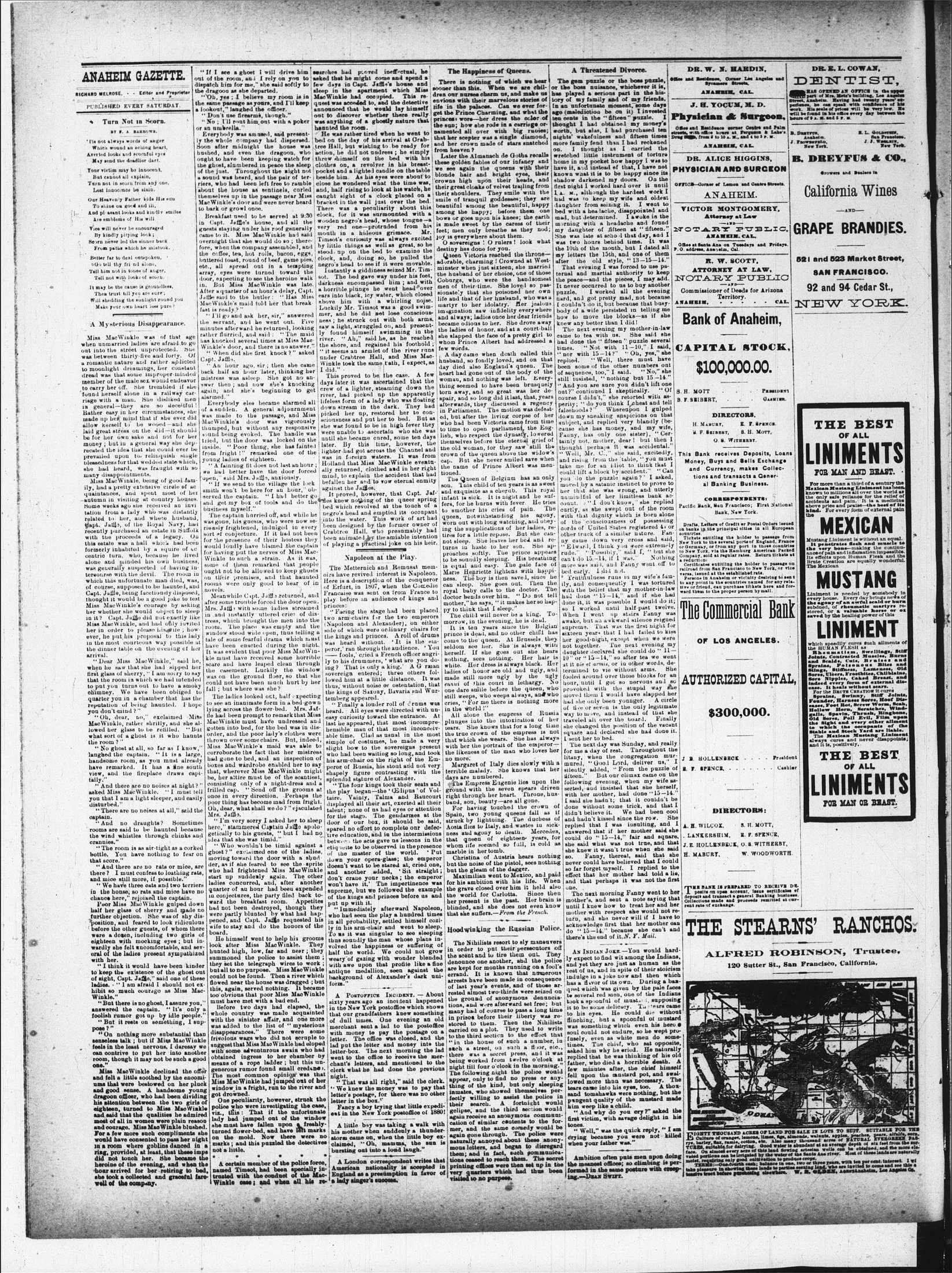
Searchable text
ANAHEIM GAZETTE.
RICHARD MELROSE. - Editor and Proprietor
PUBLISHED EVERY SATURDAY.
Turn Not in Scorn.
BY P. A. BARBOWS.
"Its not always words of anger
Which wound an aching heart,
Averted looks and scornful eyes
May send the deadlier dart.
Your victim may be innocent,
But cannot all explain,
Turn not in scorn from any one,
Lost innocence be slain.
Our Heavenly Father kids His sun
To shine on good and ill,
And pleasant looks and kindly smiles
Are emblems of His will.
Vice will never be encouraged
By kindly pitying look;
Scorn never led the sinner back
From paths which he mistook.
Better far to deal outspoken,
Go tell thy friend alone,
Tell him not in bones of anger,
Tell not with looks of scorn.
It may be the cause is groundless,
Then trust till you are sure;
Will shedding the sunlight round you
Make your own heart loss pure?
A Mysterious Disappearance.
Miss MacWinkle was of that age when unmarried ladies are afraid to go out into the street unprotected. She was between thirty-five and forty. Of a romantic nature and rather addicted to moonlight dreamings, her constant dread was that some improper-minded member of the male sex would endeavor to carry her off. She trembled if she found herself alone in a railway carriage with a man. She disliked men in general—they are so deceitful! Rather easy in her circumstances, she made up her mind that if she ever did allow kerself to be wooed—and she laid great stress on the did—it should be for her own sake and not for her money; but in a general way she depredated the idea that she could ever be prevailed upon to relinquish single blessedness for that wedded state which, she had heard, was fraught with so many disappointments.
"If I see a ghost I will drive him out of the room, and I rely on you to dispatch him for me," she said softly to the dragoon as she departed.
"Oh, yes; I believe my room is in the same passage as yours, and I'll keep a lookout," langhed the officer.
"Don't use firearms, though."
"No; I'll rout him out with a poker or an umbrella."
Everybody was amused, and presently the whole company had dispersed. Soon after midnight the house was hushed, and even the dragoon, who ought to have been keeping watch for the ghost, slumbered in peace the sleep of the just. Throughout the night not a sound was heard, and the pair of terriers, who had been left free to ramble about the house as sentinels, curled themselves up in the passage near Miss MacWinkle's door and were never heard to bark or growl once.
Breakfast used to be served at 9:30 in Capt. Jaffle's house, and all the guests staying under his roof generally came to it. Miss MacWinkle had said overnight that she would do so; therefore, when the company assembled, and the coffee, tea, hot rolls, bacon, eggs, buttered toast, round of beef, game pies, etc., all spread out in a tempting array, eyes were turned toward the door, expecting to see the heroine walk in. But Miss MacWinkle was late. After a quarter of an hour's delay, Capt. Jaffle said to the butler: "Has Miss MacWinkle's maid told her that breakfast is ready?"
"I'll go and ask her, sir," answered the servant, and he went out. Five minutes afterward he returned, looking rather flurried, and said: "The maid has knocked several times at Miss MacWinkle's door, and there is no answer."
"When did she first knock?" asked Capt. Jaffle.
An hour ago, sir; then she came back half an hour later, thinking her mistress was asleep. She got no answer then; and now she's knocking again; and she's beginning to get alarmed.
Everybody else became alarmed all of a sudden. A general adjournment was made to the passage, and Miss MacWinkle's door was vigorously thumped, but without any responsive sound being evoked. The handle was tried, but the door was locked on the inside. "Poor thing, she has fainted from fright!" remarked one of the young ladies of eighteen.
"A fainting fit does not last an hour; we had better have the door forced searches had asked that he might few days in C眠 sleep in the MacWinkle hall quest was accessed announced that out to discover was anything haunted the reel.
He was rathen bed on the dark tree Hall, but action, he did threw himself clothes on, and pocket and a beside him. Close he wounded, half rising caught sight bracket in the There was no clock, for it wooden negro very red oak mouth in a Timsoot's curry by little thing stood up on clock, and, negro's head.
Instantly a lot. The best darkness ended a horrible plains into black above him Luckily Mr. mer, and her ness; he struck saw a light, only found river. "Ah the shore, and it seems an under Crabtree Winkle took I did." This proved days later it crew of a li river, had lifeless form down stream picked her scionsness as she was found were unable until she be later. By lighter-had was in fore Holland that ally returned
Miss MacWinkle, being of good family, had a pretty extensive circle of acquaintances, and spent most of her autumn in visiting at country houses. Some weeks ago she received an invitation from a lady who was distantly related to her, and whose husband, Capt. Jaffle, of the Royal Navy, had recently purchased an estate in Suffolk with the proceeds of a legacy. On this estate was a hall which had been formerly inhabited by a squire of six centric turn, who, because he lived alone and minded his own business, was generally suspected of having intercourse with the devil. The room in which this unfortunate man died, was of course, supposed to be haunted, and Capt. Jaffle, being facetiously disposed, thought it would be a good joke to test Miss MacWinkle's courage by asking her whether she would object to sleep in it? Capt. Jaffle did not exactly like Miss MacWinkle, and had only invited her in order to please his wife; however, he put his proposal to this lady in the most courteous way possible at the dinner table on the evening of her arrival.
"Dear Miss MacWinkle," said he, when he saw that she had sipped her first glass of sherry, "I am sorry to say that the room is which we had intended to put you turns out to have a smoky chimney. We have been obliged to quarter you in a chamber that has the reputation of being haunted. I hope you don't mind?"
"Oh, dear, no," exclaimed Miss MacWinkle, rather shrilly, and she allowed her glass to be refilled. "But what sort of a ghost is it who haunts the room?"
"No ghost at all, so far as I know," laughed the captain. "It is a large, handsome room, as you must already have remarked. It has a fine south view, and the fireplace draws capitally."
"And there are no noises at night?" asked Miss MacWinkle. "I must tell you that I am a light sleeper, and easily disturbed."
"There are no noises at all," said the captain.
"And no draughts? Sometimes rooms are said to be haunted because the wind whistles through chinks and crannies."
"The room is as air-tight as a corked bottle. You have nothing to fear on that score."
"And there are no rats or mice, are there? I must confess to loathing rats, and mice still more, if possible."
"We have three cats and two terriers in the house, so rats and mice have no chance here." rejoined the captain.
mistress was asleep. She got no answer then; and now she's knocking again; and she's beginning to get alarmed."
Everybody else became alarmed all of a sudden. A general adjournment was made to the passage, and Miss MacWinkle's door was vigorously thumped, but without any responsive sound being evoked. The handle was tried, but the door was locked on the inside. "Poor thing, she has fainted from fright!" remarked one of the young ladies of eighteen.
"A fainting fit does not last an hour; we had better have the door forced open," said Mrs. Jaffle, anxiously.
"If we send to the village the locksmith won't be here for an hour," observed the captain. "I had better go and get my box of tools and do the business myself."
The captain hurried off, and while he was gone, his guests, who were now seriously frightened, indulged in every sort of conjecture. If it had not been for the presence of their hostess they would loudly have blamed the captain for having put the nerves of Miss MacWinkle to such a strain. As it was, some of them remarked that people ought not to be allowed to keep ghosts on their premises, and that haunted rooms were only good to hear of in novels.
Meanwhile Capt. Jaffle returned, and after some trouble forced the door open. Mrs. Jaffle with some ladies streamed in and instantly uttered cries of distress, which brought the men into the room. The place was empty and the window stood wide open, thus telling a tale of some fearful drama which must have been enacted during the night. It was evident that poor Miss MacWinkle must have received some horrible scare and have leaped clean through the casement. Luckily the window was on the ground floor, so that she could not have been much hurt by her fall; but where was she?
The ladies looked out, half expecting to see an inanimate form in a bed-gown lying across the flower-bed. Mrs. Jaffle had been prompt to remark that Miss MacWinkle must have undressed and gotten into bed, for the bed was in disorder, and the poor lady's clothes were thrown over some chairs. But, indeed, Miss MacWinkle's maid was able to corroborate the fact that her mistress had gone to bed, and an inspection of boxes and wardrobe enabled her to say that, wherever Miss MacWinkle might be, her attire must be of the scantiest, consisting only of a night-dress and a frilled cap. "Send off the grooms at once in every direction. Perhaps the poor thing has become mad from fright. Oh, dear, what shall we do?" ejaculated Mrs. Jaffle.
"I'm very sorry I asked her to sleep here," stammered Captain Jaffle apologetically to his guests, "but I had no idea that she was timid."
Who wouldn't be timid against a ghost? exclaimed one of the ladies, moving toward the door with a shudder, as if she feared to see the sprite who had frightened Miss MacWinkle start up suddenly again. The other ladies concurred, and, after another quarter of an hour had been expended in conjectures, the party filed back to dread was that some improper-minded member of the male sex would endeavor to carry her off. She trembled if she found herself alone in a railway carriage with a man. She disliked men in general—they are so deceitful! Rather easy in her circumstances, she made up her mind that if she ever did allow herself to be wooed—and she laid great stress on the did—it should be for her own sake and not for her money; but in a general way she depraved the idea that she could ever be prevailed upon to relinquish single blessedness for that wedded state which, she had heard, was fraught with so many disappointments.
Miss MacWinkle, being of good family, had a pretty extensive circle of acquaintances, and spent most of her autumn in visiting at country houses. Some weeks ago she received an invitation from a lady who was distantly related to her, and whose husband, Capt. Jaffle, of the Royal Navy, had recently purchased an estate in Suffolk with the proceeds of a legacy. On this estate was a hall which had been formerly inhabited by a squire of six centric turn, who, because he lived alone and minded his own business, was generally suspected of having interscourse with the devil. The room in which this unfortunate man died, was of course, supposed to be haunted, and Capt. Jaffle, being facetiously disposed, thought it would be a good joke to test Miss MacWinkle's courage by asking her whether she would object to sleep in it? Capt. Jaffle did not exactly like Miss MacWinkle, and had only invited her in order to please his wife; however, he put his proposal to this lady in the most courteous way possible at the dinner table on the evening of her arrival.
"Dear Miss MacWinkle," said he when he saw that she had sipped her first glass of sherry," I am sorry to say that the room is which we had intended to put you turns out to have a smoky chimney. We have been obliged to quarter you in a chamber that has the reputation of being haunted. I hope you don't mind?"
"Oh dear, no," exclaimed Miss MacWinkle, rather shrilly, and she allowed her glass to be refilled. "But what sort of a ghost is it who haunts the room?"
"No ghost at all, so far as I know," laughed the captain. "It is a large, handsome room, as you must already have remarked. It has a fine south view, and the fireplace draws capitally."
"And there are no noises at night?" asked Miss MacWinkle. "I must tell you that I am a light sleeper, and easily disturbed."
"There are no noises at all," said the captain.
"And no draughts? Sometimes rooms are said to be haunted because the wind whistles through chinks and crannies."
"The room is as air-tight as a corked bottle. You have nothing to fear on that score."
"And there are no rats or mice, are there? I must confess to loathing rats, and mice still more, if possible."
"We have three cats and two terriers in the house, so rats and mice have no chance here." rejoined the captain.
mistress was asleep. She got no answer then; and now she's knocking again; and she's beginning to get alarmed."
Everybody else became alarmed all of a sudden. A general adjournment was made to the passage, and Miss MacWinkle's door was vigorously thumped, but without any responsive sound being evoked. The handle was tried, but the door was locked on the inside. "Poor thing, she has fainted from fright!" remarked one of the young ladies of eighteen.
"A fainting fit does not last an hour; we had better have the door forced open," said Mrs. Jaffle, anxiously.
"If we send to the village the locksmith won't be here for an hour," observed the captain. "I had better go and get my box of tools and do the business myself."
The captain hurried off, and while he was gone, his guests, who were now seriously frightened, indulged in every sort of conjecture. If it had not been for the presence of their hostess they would loudly have blamed the captain for having put the nerves of Miss MacWinkle to such a strain. As it was, some of them remarked that people ought not to be allowed to keep ghosts on their premises, and that haunted rooms were only good to hear of in novels.
Meanwhile Capt. Jaffle returned, and after some trouble forced the door open. Mrs. Jaffle with some ladies streamed in and instantly uttered cries of distress, which brought the men into the room. The place was empty and the window stood wide open; thus telling a tale of some fearful drama which must have been enacted during the night. It was evident that poor Miss MacWinkle must have received some horrible scare and have leaped clean through the casement. Luckily the window was on the ground floor, so that she could not have been much hurt by her fall; but where was she?
The ladies looked out, half expecting to see an inanimate form in a bed-gown lying across the flower-bed. Mrs. Jaffle had been prompt to remark that Miss MacWinkle must have undressed and gotten into bed for the bed was in disorder, and the poor lady's clothes were thrown over some chairs. But, indeed,Miss MacWinkle's maid was able to corroborate the fact that her mistress had gone to bed,and an inspection of boxes and wardrobe enabled her to say that,wherever Miss MacWinkle might be,her attire must be of the scantiest,consisting only of a night-dress and a frilled cap." Send off the grooms at once in every direction. Perhaps the poor thing has become mad from fright. Oh,dear,what shall we do?" ejaculated Mrs. Jaffle.
"I'm very sorry I asked her to sleep here," stammered Captain Jaffle apologetically to his guests,"but I had no idea that she was timid."
Who wouldn't be timid against a ghost? exclaimed one of the ladies,moving toward the door with a shudder,as if she feared to see the sprite who had frightened Miss MacWinkle start up suddenly again. The other ladies concurred,and,after another quarter of an hour had been expended in conjectures,the party filed back to dread was that some improper-minded member of the male sex would endeavor to carry her off. She trembled if she found herself alone in a railway carriage with a man. She disliked men in general—they are so deceitful! Rather easy curious last he apprehensible mans ability time.simple of slight bow who had bled his arm-chair perosof B shapeplyt thre splendid s
"The foe tthe play baiteire.Va displayed its talent; nor for the stetho down your doesn't wander another o'trash o'wra supreme,sof kthe king
There are no noises at all," said the captain.
And no draughts? Sometimes rooms are said to be haunted because the wind whistles through chinks and crannies."
The room is as air-tight as a corked bottle. You have nothing to fear on that score."
And there are no rats or mice, are there? I must confess to loathing rats, and mice still more, if possible."
We have three cats and two terriers in the house, so rats and mice have no chance here," rejoined the captain.
Poor Miss MacWinkle gulped down half her glass of sherry and made no further objection. She was of shy disposition, and feared to look ridiculous before the other guests, of whom there were a dozen, including two girls of eighteen with mocking eyes; but inwardly she felt uncomfortable, and several of the ladies present sympathized with her.
"I think it would have been kinder to keep the existence of the ghost out of sight, Capt. Jaffle," said one of these ladies. "I am afraid I should not exhibit so much courage as Miss MacWinkle."
But there is no ghost, I assure you," answered the captain. "It's only a foolish rumor got up by idle people."
But it rests on something, I suppose?
On nothing more substantial than senseless talk; but if Miss MacWinkle feels in the least nervous, I daresay we can contrive to put her into another room, though it may not be such a good one."
Miss MacWinkle declined the offer and felt a little soothed by the encomiums that were bestowed on her pluck and good sense. A handsome young dragon officer, who had been dividing his attention between the two girls of eighteen, turned to Miss MacWinkle and said that the qualities he admired most of all in women were plain reason and courage. Miss MacWinkle blushed. For a few more such compliments she would have consented to pass her night in a room where goblins danced in a ring, provided, at least, that these imps did not touch her. She became the heroine of the evening, and when the hour arrived for her retiring to bed, she took a collected and graceful farewell of the company.
I'm very sorry I asked her to sleep here," stammered Captain Jaffle apologetically to his guests, "but I had no idea that she was timid."
Who wouldn't be timid against a ghost?" exclaimed one of the ladies, moving toward the door with a shudder, as if she feared to see the sprite who had frightened Miss MacWinkle start up suddenly again. The other ladies concurred, and, after another quarter of an hour had been expended in conjectures, the party filed back toward the breakfast room. Appetites had not been destroyed, though they were partly blunted by what had happened, and Capt. Jaffle requested his wife to stay and do the honors of the board.
He himself went to help his grooms look after Miss MacWinkle. They hunted high, low, far and near; they summoned the police to assist them; they set the telegraph wires to work; but all to no purpose. Miss MacWinkle could not be found. Then a river which flowed near the house was dragged; but this, again, served nothing. It became too obvious that poor Miss MacWinkle must have met with a bad end.
Before two days had elapsed, the whole country was made acquainted with the sinister affair, and one more was added to the list of "mysterious disappearances." There were some frivolous wags who did not scruple to suggest that Miss MacWinkle had eloped with some adventurous swain who had obtained ingress to her chamber by means of a rope ladder; but this ungenerous rumor found small credence. The most common opinion was that Miss MacWinkle had jumped out of her window in a fright, run to the river and got drowned.
One peculiarity, however, struck the police who were investigating the case, viz., this: That if the unfortunate lady had jumped out of the window she must have fallen upon a freshly-turned flower-bed, and have left marks on the mold. Now there were no marks; and this puzzled the detectives not a little.
A certain member of the police force, named Timot, had been specially intrusted with the conduct of the MacWinkle case; and when all his re-
drive him on you to and softly to
room is in and I'll keep
with a poker
and presentdispersed.
house was
gogoon, who
wag watch for
the sleep
neight not
repair of terbe to ramble
hels, curled
near Miss
never heard
waved at 9:30
and all the
of generally
hole had said
so so; therebumbled, and
beacon, eggs,
game pies,
a tempting
toward the
heroine walk
he was late.
Muddelay, Capt.
"Has Miss
that break"
answered out. Five
nosed, looking
"The maid
that Miss Macne answer."
"Clock?" asked
then she came
thinking her
got no annals knocking
thing to get
alarmed all
adjournment
time, and Miss
vigorously
my responsive
handle was
ocked on the
has fainted
one of the
last an hour;
door forced
searches had proved ineffecual, he asked that he might come and spend a few days in Capt. Jaffla's house and sleep in the apartment which Miss MacWinkle had occupied. This request was acceded to, and the detective announced that he would lay himself out to discover whether there really was anything of a ghostly nature that haunted the room.
He was rather tired when he went to bed on the day of his arrival at Crabtree Hall, but wishing to be ready for action, he did not undress; he simply threw himself on the bed with his clothes on, a revolver in his breast-pocket and a lighted candle on the table beside him. As his eyes were about to close he wondered what the time was, and half rising to look at his watch, he caught sight of a clock placed on a bracket in the wall just over the bed. There was a peculiarity about this clock, for it was surmounted with a wooden negro's head, whose tongue—a very red one—protruded from his mouth in a hideous grimace. Mr. Timset's curiosity was always excited by little things as well as great, so he stood up on the bed to examine the clock, and, doing so, he pulled the negro's head to see if it were movable.
Instantly a giddiness seized Mr. Timset. The bed gave way under his feet, darkness encompassed him; and with a horrible plunge he went head-over ears into black, icy water, which closed above him with a whirling noise. Luckily Mr. Timset was a good swimmer, and he did not lose consciousness; he struck out with both arms, saw a light, struggled on, and presently found himself swimming in the river.
"Ah," said he, as he reached the shore, and regained his foothold; "it seems an armlet of the river runs under Crabtree Hall, and Miss MacWinkle took the same rath, I expect, as I did."
This proved to be the case. A few days later it was ascertained that the crew of a lighter, steaming down the river, had picked up the apparently lifeless form of a lady who was floating down stream in the dark. They had picked her up, restored her to consciousness and put her to bed. But as she was found to be in high fever they were unable to ascertain who she was until she became cured, some ten days later. By this time, however, the lighter had got across the Channel and was in foreign waters. It was from Holland that Miss MacWinkle eventually returned, clothed and in her right mind to cramble the accident that had
The Happiness of Queens.
There is nothing of which we hear sooner than this. When we are children our nurses charm us, and make us envious with their marvelous stories of life in the palaces. Can we ever forget the Prince Charming, and what the princess wore—her dress the color of the sun; how she rode in a carriage ornamented all over with big ruotes; that her scepter was a single diamond, and her crown made of stars snatched from heaven?
Later the Almanach de Gotha recalls these golden fables of our infancy and we see again the queens with their blonde hair and bright eyes, their crowns high upon their heads, and their great cloaks of velvet trailing from their shoulders. They smile with the smile of tranquil goddesses; they are beautiful among the beautiful, happy among the happy; before them one bows or goes upon his knees; the earth is made sweet by the caress of their feet; men only breathe as they nod; joy is everywhere about them.
O sovereigns! O rulers! look what destiny has done for you.
Queen Victoria reached the throne—adorable, charming! Crowned at Westminster when just sixteen, she married the husband of her choice, one of those Coburgs, who were the handsomest men of their time. She loved so passionately that she poisoned her own life and that of her husband, who was a martyr to her idolatry. Her jealous imagination saw infidelity everywhere and always; ladies once her dear friends became odious to her. She drove away the ladies of honor, and at a court-ball she slapped the face of a pretty girl to whom Prince Albert had addressed a few words.
A day came when death called this husband, so fondly loved, and on that day died also England's queen. The heart had gone out of the body of the woman, and nothing was left. Everything seemed to have been brusquely torn away, and so great was her despair, and so long did it last, that years afterwards, they discussed a regency in Parliament. The motion was defeated, but after the living corpse of her who had been Victoria came from time to time to open parliament, the English, who respect the dynasty, lowered themselves before the eternal grief of the old woman, for they saw still the crown of the queen above the widow's cap. But she never smiled save when the name of Prince Albert was mentioned.
A Threatened Divorce.
The gem puzzle or the boss puzzle, or the boss nuisance, whichever it is, has played a serious part in the history of my family and of my friends. In an unfortunate moment, some days ago (malediction be on it) I invested ten cents in the "fifteen" puzzle. I thought I had obtained my money's worth, but alas, I had purchased ten nights' wakefulness and fifteen times more family fond thus I had reckoned on. I thought as I carried the wretched little instrument of torture home in my pocket how happy I was to have it, and instead ef that, I have not known want it is to be happy since its shadow darkened my doors. On the first night I worked hard over it until 14.M., although the hardest work I had was to keep my wife and oldest daughter from seizing it. I went to bed with a healache, disappointed and mad, but determined. I awoke in the morning with a headache and found my daughter of fifteen at "fifteen." She was late at school that day, and I was two hours behind time. It was the 10th of the month, but I dated all my letters the 15th, and one of them after the old style," "13-15-14."
That evening I was forced to use paternal and martial authority to keep the peace—and the pieces, I may add. It never occurred to us to buy another puzzle. I worked all the evening hard, and got pretty mad, not because I couldn't do it, but because that busy-body of a wife persisted in telling me how to move the blocks—as if she knew any better than I did!
The next evening my mother-in-law came to tea with us. She said she had done the "fifteen" puzzle several times. "Not with 11-10," I said, "nor with 15-14?" "Oh, yes," she replied. "Well, there must have been some of other numbers out of sequence, too," I said. "No," she still insisted, "noting but 15-14." "And you are sure you didn't lift one out?" continued I skeptically. "Of course I didn't," she retorted with asperity; "do you think I cheat and tell falsehoods?" Whereupon I gulped down my sneaking suspicions on that subject, and replied very blandly (because she has money, and my wife, Fanny, has only one sister), "Certainly not, mother, dear! but then I thought perhaps it was accidental." "Well, Mr. C.," she said, excitedly, and rising from the table," you must take me for an illiot to think that I could lift a block by accident." "Can
This proved to be the case. A few days later it was ascertained that the crew of a lighter, steaming down the river, had picked up the apparently lifeless form of a lady who was floating down stream in the dark. They had picked her up, restored her to consciousness and put her to bed. But as she was found to be in high fever they were unable to ascertain who she was until she became cured, some ten days later. By this time, however, the lighter had got across the Channel and was in foreign waters. It was from Holland that Miss MacWinkle eventually returned, clothed and in her right mind, to explain the accident that had fallen her and to vow eternal enmity against the Jailes.
It proved, however, that Capt. Jaffles knew nothing of the queer spring bed which revolved at the touch of a negro's head and emptied its occupant into the water. This work of art had been designed by the former owner of Crabtree Hall, who presumably had been animated by the amiable intention of playing a practical joke on his heir.
Napoleon at the Play.
The Metternich and Remusat memoirs have revived interest in Napoleon. Here is a description of the conqueror of Erfurt, in 1807, when the Comedie Française was sent on from France to play before an audience of kings and princes:
"Facing the stage had been placed two arm-chairs for the two emperors (Napoleon and Alexander), on either side of which were ordinary chairs for the kings and princes. A roll of drums was heard without. 'It is the emperor,' ran through the audience. 'You — fools,' cried a French officer angrily to his drummers, 'what are you doing? That is only a king.' A G raman sovereign entered; three others followed him at a little distance. It was thus, without noise or ostentation, that the kings of Saxony, Bavaria and Wurtemberg appeared.
Finally a louder roll of drums was heard. All eyes were directed with uneasy curiosity toward the entrance. At last he appeared, that most incomprehensible man of that most inconceivable time. Clad as usual in the most simple of costumes, he made a very slight bow to the sovereign present who had been waiting so long, and took his arm-chair on the right of the Emperor of Russia, his stout and not very shapely figure contrasting with the splendid stature of Alexander.
"The four kings took their seats and the play began—the 'Elipus' of Voltaire. Vainly, Talma and Baucourt displayed all their art, exerted all their talent; none of us had eyes or attention for the stage. The gendarmes at the door of our box, it should be said, spared no effort to complete our defective education, and in the intermissions between the acts gave us lessons in the etiquette to be observed in the presence of the master of the world. 'Put down your opera-glass; the emperor doesn't want to be stared at, cried one, and another added,' Sit straight; don't crane your necks; the emperor won't have it.' The impertinence was supreme, but we followed the example of the kings and princes before us and last night."
The Queen of Belgium has an only son. This child of ten years is as sweet and exquisite as a cherub. This royal infant is sick. It is night and he suffers, for he burns with fever. He tries to smother his cries of pain. The queen, notwithstanding his agony, worn out with long watching, and obeying the supplications of her ladies, retires for a little repose. But she cannot sleep. She leaves her bed and returns in haste to her son. She approaches softly. The prince appears to be soundly sleeping. His breathing is equal and easy. The pale face of Marie Henriette lightens with happiness. The boy is then saved, since he can sleep. She goes out. Then the royal baby calls to the doctor. The doctor bends over him. "Do not tell mother," he says, "it makes her so happy to think that I sleep."
The child will never be a king. Tomorrow, in the evening, he is dead.
It is ten years since the Belgian prince is dead, and no other child has come to the queen. At Brussels, they seldom see her. She is always with herself. If she goes out she hears nothing, sees nothing. Her hair is white. Her dress is always black. Her ladies of honor are old and ugly, and made still more ugly by the ugly enniu of this court in lethargy. No one dare smile before the queen, who still weeps, who weeps always, and who cries. "For me there is nothing more in the world!"
All alone the empress of Russia plunges into the intoxication of her tears. She knows that for a long time the true crown of the emperor is not that which she wears. She has always with her portrait of the emperor—the likeness of the man who loves her no more.
Margaret of Italy dies slowly with a terrible malady. She knows that her days are numbered.
The Empress Eugenie lies upon the ground with the seven spears driven right through her heart. Throne, husband, son, beauty—are all gone.
For having touched the crown of Spain, two young queens fall as if struck by lightning. The duchess of Aosta flies to Italy, and wastes in sickness and agony to death. Mercedes, that queen of eighteen years, for whom life seemed so full, is cold as marble in her tomb.
Christina of Austria hears nothing but the noise of the pistol, sees nothing but the gleam of the dagger.
Maximilian went to Mexico, and paid for his ambition with his life. When the grave closed over him it held also the world for Carlotta. Since then he brain is gone.
Hearn had gone out of the city woman, and nothing was left. Everything seemed to have been brusquely torn away, and so great was her despair, and so long did it last, that years afterwards, they discussed a regency in Parliament.
The motion was defeated, but after the living corpse of her who had been Victoria came from time to time to open parliament, the English, who respect the dynasty, lowered themselves before the eternal grief of the old woman, for they saw still the crown of the queen above the widow's cap. But she never smiled save when the name of Prince Albert was mentioned.
The Queen of Belgium has an only son. This child of ten years is as sweet and exquisite as a cherub. This royal infant is sick. It is night and he suffers, for he burns with fever. He tries to smother his cries of pain. The queen, notwithstanding his agony, worn out with long watching, and obeying the supplications of her ladies, retires for a little repose. But she cannot sleep. She leaves her bed and returns in haste to her son. She approaches softly. The prince appears to be soundly sleeping. His breathing is equal and easy. The pale face of Marie Henriette lightens with happiness. The boy is then saved, since he can sleep. She goes out. Then the royal baby calls to the doctor. The doctor bends over him. "Do not tell mother," he says, "it makes her so happy to think that I sleep."
The child will never be a king. Tomorrow, in the evening, he is dead.
It is ten years since the Belgian prince is dead, and no other child has come to the queen. At Brussels, they seldom see her. She is always with herself. If she goes out she hears nothing, sees nothing. Her hair is white. Her dress is always black. Her ladies of honor are old and ugly, and made still more ugly by the ugly enniu of this court in lethargy. No one dare smile before the queen, who still weeps, who weeps always, and who cries." For me there is nothing more in the world!
All alone the empress of Russia plunges into the intoxication of her tears. She knows that for a long time the true crown of the emperor is not that which she wears. She has always with her portrait of the emperor—the likeness of the man who loves her no more.
Margaret of Italy dies slowly with a terrible malady. She knows that her days are numbered.
The Empress Eugenie lies upon the ground with the seven spears driven right through her heart. Throne, husband, son, beauty—are all gone.
For having touched the crown of Spain, two young queens fall as if struck by lightning. The duchess of Aosta flies to Italy, and wastes in sickness and agony to death. Mercedes, that queen of eighteen years, for whom life seemed so full, is cold as marble in her tomb.
Christina of Austria hears nothing but the noise of the pistol, sees nothing but the gleam of the dagger.
Maximilian went to Mexico, and paid for his ambition with his life. When the grave closed over him it held also the world for Carlotta. Since then he brain is gone.
Hearn had gone out of the city woman, and nothing was left. Everything seemed to have been brusquely torn away, and so great was her despair, and so long did it last, that years afterwards, they discussed a regency in Parliament.
The motion was defeated, but after the living corpse of her who had been Victoria came from time to open parliament, the English, who respect the dynasty, lowered themselves before the eternal grief of the old woman, for they saw still the crown of the queen above the widow's cap. But she never smiled save when the name of Prince Albert was mentioned.
The Queen of Belgium has an only son. This child of ten years is as sweet and exquisite as a cherub. This royal infant is sick. It is night and he suffers, for he burns with fever. He tries to smother his cries of pain. The queen, notwithstanding his agony, worn out with long watching, and obeying the supplications of her ladies, retires for a little repose. But she cannot sleep. She leaves her bed and returns in haste to her son. She approaches softly. The prince appears to be soundly sleeping. His breathing is equal and easy. The pale face of Marie Henriette lightens with happiness. The boy is then saved, since he can sleep. She goes out. Then the royal baby calls to the doctor. The doctor bends over him. "Do not tell mother," he says, "it makes her so happy to think that I sleep."
The child will never be a king. Tomorrow, in the evening, he is dead.
It is ten years since the Belgian prince is dead, and no other child has come to the queen. At Brussels, they seldom see her. She is always with herself. If she goes out she hears nothing, sees nothing. Her hair is white. Her dress is always black. Her ladies of honor are old and ugly, and made still more ugly by the ugly enniu of this court in lethargy. No one dare smile before the queen, who still weeps, who weeps always,and who cries." For me there is nothing more in the world!
All alone the empress of Russia plunges into the intoxication of her tears. She knows that for a long time the true crown of the emperor is not that which she wears. She has always with her portrait of the emperor—the likeness of the man who loves her no more.
Margaret of Italy dies slowly with a terrible malady. She knows that her days are numbered.
The Empress Eugenia lies upon the ground with the seven spears driven right through her heart. Throne,husband,son,beauty—are all gone.
For having touchedthe crownofSpain,twoyoungqueensfallasifstruckbylightning.TheduchessofAostafliestoItaly,andwastesin sicknessandagonyto death.Mercedes,thequeenofeighteenyears,forswhomlife seemedsofulliscoldasmarbleintomb.
ChristinaofAustriahearsnothingbutthenoiseofthepistol,seeingnothingbutthegleamofthedagger.MaximilianwenttoMexico,andpaidforhisambitionwithhislife.WherethegraveclosedoverhimitheldalsotheworldforCarlotta.Sincethenh脑isnumbered.
The Empress Eugenia lies uponthegroundwiththesepparmsdrivenrightthroughherheart.Throne,husband,son,beauty—areallgone.
For having触摸the crownofSpain,twoyoungqueensfallasifstruckbylightning.TheduchessofAostafliestoItaly,andwastesin sicknessandagonyto death.Mercedes,thequeenofeighteenyears,forswhomlife seemedsofulliscoldasmarbleintomb.
ChristinaofAustriahearsnothingbutthenoiseofthepistol,sseeingnothingbutthegleamofthedagger.MaximilianwenttoMexico,andpaidforhisambitionwithhislife.WherethegraveclosedoverhimitheldalsotheworldforCarlotta.Sincethenh脑isnumbered.
The Empress Eugenia lies uponthegroundwiththesepparmsdrivenrightthroughherheart.Throne,husband,son,beauty—areallgone.
For having触摸the crownofSpain,twoyoungqueensfallasifstruckbylightning.TheduchessofAostafliestoItaly,andwastesin sicknessandagonyto death.Mercedes,thequeenofeighteenyears,forswhomlife seemedsofulliscoldasmarbleintomb.
ChristinaofAustriahearsnothingbutthenoiseofthepistol,sseeingnothingbutthegleamofthedagger.MaximilianwenttoMexico,andpaidforhisambitionwithhislife.WherethegraveclosedoverhimitheldalsotheworldforCarlotta.Sincethenh脑isnumbered.
The Empress Eugenia lies uponthegroundwiththesepparmsdrivenrightthroughherheart.Throne,husband,son,beauty—areallgone.
For having触摸the crownofSpain,twoyoungqueensfallasifstruckbylightning.TheduchessofAostafliestoItaly,andwastesin sicknessandagonyto death.Mercedes,thequeenofeighteenyears,forswhomlife seemedsofulliscoldasmarbleintomb.
ChristinaofAustriahearsnothingbutthenoiseofthepistol,sseeingnothingbutthegleamofthedagger.MaximilianwenttoMexico,andpaidforhisambitionwithhislife.WherethegraveclosedoverhimitheldalsotheworldforCarlotta.Sincethenh脑isnumbered.
The Empress Eugenia lies uponthegroundwiththesepparmsdrivenrightthroughherheart.Throne,husband,son,beauty—areallgone.
For having触摸the crownofSpain,twoyoungqueensfallasifstruckbylightning.TheduchessofAostafliestoItaly,andwastesin sicknessandagonyto death.Mercedes,thequeenofeighteenyears,forswhomlife seemedsoFulliscoldasmarbleintomb.
ChristinaofAustriahearsnothingbutthenoiseofthepistol,sseeingnothingbutthegleamofthedagger.MaximilianwenttoMexico,andpaidforhisambitionwithhislife.WherethegraveclosedoverhimitheldalsotheworldforCarlotta.Sincethenh脑isnumbered.
The Empress Eugenia lies uponthegroundwiththesepparmsdrivenrightthroughherheart.Throne,husband,son,beauty—areallgone.
For having触摸the crownofSpain,twoyoungqueensfallasifstruckbylightning.TheduchessofAostafliestoItaly,andwastesin sicknessandagonyto death.Mercedes,thequeenofeighteenyears,forswhomlife seemedsoFulliscoldasmarbleintomb.
ChristinaofAustriahearsnothingbutthenoiseofthepistol,sseeingnothingbutthegleamofthedagger.MaximilianwenttoMexico,andpaidforhisambitionwithhislife.WherethegraveclosedoverhimitheldalsotheworldforCarlotta.Sincethenh脑isnumbered.
The Empress Eugenia lies uponthegroundwiththesepparmsdrivenrightthroughherheart.Throne,husband,son,beauty—areallgone.
For having触摸the crownofSpain,twoyoungqueensfallasifstruckbylightning.TheduchessofAostafliestoItaly,andwastesin sicknessandagonyto death.Mercedes,thequeenofeighteenyears,forswhomlife seemedsoFulliscoldasmarbleintomb.
ChristinaofAustriahearsnothingbutthenoiseofthepistol,sseeingnothingbutthegleamofthedagger.MaximilianwenttoMexico,andpaidforhisambitionwithhislife.WherethegraveclosedoverhimitheldalsotheworldforCarlotta.Sincethenh脑isnumbered.
The Empress Eugenia lies uponthegroundwiththesepparmsdrivenrightthroughherheart.Throne,husband,son,beauty—areallgone.
For having触摸the crownofSpain,twoyoungqueensfallasifstruckbylightning.TheduchessofAostafliestoItaly,andwastesin sicknessandagonyto death.Mercedes,thequeenofeighteenyears,forswhomlife seemedsoFulliscoldasmarbleintomb.
ChristinaofAustriahearsnothingbutthenoiseofthepistol,sseeingnothingbutthegleamofthedagger.MaximilianwenttoMexico,andpaidforhisambitionwithhislife.WherethegraveclosedoverhimitheldalsotheworldforCarlotta.Sincethenh脑isnumbered.
The Empress Eugenia lies uponthegroundwiththesepparmsdrivenrightthroughherheart.Throne,husband,son,beauty—areallgone.
For having触摸the crownofSpain,twoyoungqueensfallasifstruckbylightning.TheduchessofAostafliestoItaly,andwastesin sicknessandagonyto death.Mercedes,thequeenOfeighteenyears,forswhomlife seemedsoFulliscoldasmarbleintomb.
ChristinaofAustriahearsnothingbutthenoiseofthepistol,sseeingnothingbutthegleamofthedagger.MaximilianwenttoMexico,andpaidforhisambitionwithhislife.WherethegraveclosedoverhimitheldalsotheworldforCarlotta.Sincethenh脑isnumbered.
The Empress Eugenia lies uponthegroundwiththesepparmsdrivenrightthroughherheart.Throne,husband,son,beauty—areallgone.
For having触摸the crownofSpain,twoyoungqueensfallasifstruckbylightning.TheduchessofAostafliestoItaly,andwastesin sicknessandagonyto death.Mercedes,thequeenOfeighteenyears,forswhomlife seemedsoFulliscoldasmarbleintomb.
ChristinaofAustriahearsnothingbutthenoiseofthepistol,sseeingnothingbutthegleamofthedagger.MaximilianwenttoMexico,andpaidforhisambitionwithhislife.WherethegraveclosedoverhimitheldalsotheworldforCarlotta.Sincethenh脑isnumbered.
The Empress Eugenia lies uponthegroundwiththesepparmsdrivenrightthroughherheart.Throne,husband,son,beauty—areallgone.
For having触摸the crownofSpain,twoyoungqueensfallasifstruckbylightning.TheduchessofAostafliestoItaly,andwastesin sicknessandagonyto death.Mercedes,thequeenOfeighteenyears,forswhomlife seemedsoFulliscoldasmarbleintomb.
ChristinaofAustriahearsnothingbutthenoiseofthepistol,sseeingnothingbutthegleamofthedagger.MaximilianwenttoMexico,andpaidforhisambitionwithhislife.WherethegraveclosedoverhimitheldalsotheworldforCarlotta.Sincethenh脑isnumbered.
The Empress Eugenia lies uponthegroundwiththesepparmsdrivenrightthroughherheart.Throne,husband,son,beauty—areallgone.
For having触摸the crownofSpain,twoyoungqueensfallasifstruckbylightning.TheduchessofAostafliestoItaly,andwastesin sicknessandagonyto death.Mercedes,thequeenOfeighteenyears,forswhomlife seemedsoFulliscoldasmarbleintomb.
ChristinaofAustriahearsnothing但她没有意识到她的声音和表情。她的声音和表情是如此生动而有趣,她的情感是如此强烈而真实。她的声音和表情是如此动人而有力。她的声音和表情是如此愉快而亲切。她的声音和表情是如此愉快而愉快。她的声音和表情是如此愉快而愉快。她的声音和表情是如此愉快而愉快。她的声音和表情是如此愉快而愉快。她的声音和表情是如此愉快而愉快。她的声音和表情是如此愉快而愉快。她的声音和表情是如此愉快而愉快。她的声音和表情是如此愉快而愉快。她的声音和表情是如此愉快而愉快。她的声音和表情是如此愉快而快乐。她的声音和表情是如此快乐和她的声音和表情是如此快乐和她声音和表情是如此快乐和她声音和表情是如此快乐和她声音和表情是如此快乐和她声音和表情是如此快乐和她声音和表情是如此快乐和她声音和表情是如此快乐和她声音和表情是如此快乐和她声音和表情是如此快乐和她声音和表情是如此快乐和她声音和表情是如此快乐和她声音和表情是如此快乐和她声音和表情是如此快乐和她声音和表情是如此快乐和她声音和她声音和她声音和她声音和她声音和她声音和她声音和她声音和她声音和她声音和她声音和她声音和她声音和她声音和她声音和她声音和她声音和她声音和她声音和她声音和她声音和她声音和她声音和她声音和她声音和她声音和她声音和她声音和她声音和她声音和她声音和她声音和她声音和她声音和她声音.她声音和她声音.她声音和她声音.她声音.她声音.她声音.她音.她音.她音.她音.她音.她音.她音.她音.她音.她音.她音.她音.她音.她音.她音.她音.她音.她音.她音.她音.她音.她音.她音.她音.她音.她音.她音.她音.她音.她音.她音.她音.她音.她音.她音.她音.她音.她音.她音.她音.她音.她音.她音.她音.她音.她音.她音.她音.她音.她音.她音.她音.她音.她音.她音.她音.她音.她音.她音.她音.她音.她音.她音.她音.她音.她音.她音乐.他音乐.他音乐.他音乐.他音乐.他音乐.他音乐.他音乐.他音乐.他音乐.他音乐.他音乐.他音乐.他音乐.他音乐.他音乐.他音乐.他音乐.他音乐.他音乐.他音乐.他音乐.他音乐.他音乐.他音乐.他音乐.他音乐.他音乐.他音乐.他音乐.他音乐.他音乐.他音乐.他音乐.他音乐.他音乐.他音乐.他音乐.他音乐.他音乐.他音乐.他音乐.他音乐.他音乐.他音乐.他音乐.他音乐.他音乐.他音乐.他音乐.他音乐.他音乐.他音乐.他音乐.他音乐.他音乐.他音乐.他们 music.他们 music.他们 music.他们 music.他们 music.他们 music.他们 music.他们 music.他们 music.他们 music.他们 music.他们 music.他们 music.他们 music.他们 music.他们 music.他们 music.他们 music.他们 music.他们 music.他们 music.他们 music.他们 music.他们 music.他们 music.他们 music.他们 music.他们 music.他们 music.他们 music.他们 music.他们 music.他们usic.他们 music.他们 music.他们 music.他们 music.他们 music.他们 music.他们 music.他们Music.他们 Music.他们 Music.他们 Music.他们 Music.他们 Music.他们 Music.他们 Music.他们 Music.他们 Music.他们 Music.他们 Music.他们 Music.他们 Music.他们 Music.他们 Music.他们 Music.他们 Music.他们 Music.他们 Music.他们 Music.他们 Music.他们 Music.他们 Music.他们 Music.他们 Music.他们 Music.他们 Music.他们 Music.他们 Music.他们 Music.他们 Music.他们 Music.你Music.你Music.你Music.你Music.你Music.你Music.你Music.你Music.你Music.你Music.你Music.你Music.你Music.你Music.你Music.你Music.你Music.你Music.你Music.你Music.你Music.你Music.你Music.你Music.你Music.你Music.你Music.你Music.你Music.你Music.你Music.你Music.你Music.你Music.你Music.你Music.你Music.你Music.你Music.你Music.你Music.你Music.你Music.你Music.你Music.你Music.你Music.你Music.你Music你Music你Music你Music你Music你Music你Music你Music你Music你Music你Music你Music你Music你Music你Music你Music你Music你Music你Music你Music你Music你Music你Music你Music你Music你Music你Music你Music你Music你Music你Music你Music你Music你Music你Music你Music你 Music你 Music你 Music你 Music你 Music你 Music你 Music你 Music你 Music你 Music你 Music你 Music你 Music你 Music你 Music你 Music你 Music你 Music你 Music你 Music你 Music你 Music你 Music你 Music你 Music你 Music你 Music你 Music你 Music你 Music你 Music你 Music你 Music你 Music你想你想你想你想你想你想你想你想想想想要想要想要想要想要想要想要想要想要想要想要想要想要想要想要想要想要想要想要想要想要想要想要想要想要想要想要想要想要想要想要想要想要想要想要需要的需要需要的需要需要的需要需要的需要需要的需要需要的需要需要的需要需要的需要需要的需要需要的需要需要的需要需要的需要需要的需要需要的需要需要的需要需要的需要需要的需要需要的需要需要的需要需要的需要需要的需要需要的需要需要的需要需要的需要需要的需要需要的需要需要的需要需要的需要需要的需要需要的需要需要的需要需要的需要需要的需要需要的需要需要的需要需求的能够能够能够能够能够能够能够能够能够能够能够能够能够能够能够能够能够能够能够能够能够能够能够能够能够能够能够能够能够能够能够能够能够,能够,能够,能够,能够,能够,能够,能够,能够,能够,能够,能够,能够,能够,能够,能够,能够,能够,能够,能够,能够,能够,能够,能够,能够,能够,能够,能够,能够,能够,能够,能够,能够,能够,能够,能够,能够,能够,能够,能够,能够,能够,能够,能够,能够,能够,能够,能够,能够,能够,能够,能够,能够,能够,能够,能够,能够,能够,能够,能够,能够,能够,能够,使得使得使得使得使得使得使得使得使得使得使得使得使得使得使得使得使得使得使得使得使得使得使得使得使得使得使得使得使得使得使得使得使得使得使得使得使得使得使得使得使得使得使得使得使得使得使得使得使得使得使得使得使得使得懂得懂得懂得懂得懂得懂得懂得懂得懂得懂得懂得懂得懂得懂得懂得懂得懂得懂得懂得懂得懂得懂得懂得懂得懂得懂得懂得懂得懂得懂得懂得懂得懂得懂得懂得懂得懂得
help his grooms Winkle. They and near; they to assist them; wires to work; Miss MacWinkle en a river which was dragged; but ing. It became Miss MacWinkle had end.
elapsed, the made acquainted, and one more of "mysterious were some not scruple toinkle had eloped swain who had chamber by ear; but this unsmall credence opinion was that pumped out of her to the river and ever, struck the gating case, the unfortunate of the window upon a freshly-have left marks there were no and the detectives
the police force, seen specially innot of the Machen all his redisplay all their art, exerted all their talent; none of us had eyes or attention for the stage. Thegendarmes at the door of our box, it should be said, spared no effort to complete our defective education, and in the intermissions between the acts gave us lessons in the etiquette to be observed in the presence of the master of the world. 'Put down your opera-glass; the emperor doesn't want to be stared at, cried one, and another added, 'Sit straight; don't crane your necks; the emperor won't have it.' The impertinence was supreme, but we followed the example of the kings and princes before us and put up with it.
"Immediately afterward Napoleon, who had seen the play a hundred times in all probability, settled himself cozily in his arm-chair and went to sleep. To us it was singular to see sleeping thus soundly the man whose plans involved the happiness or suffering of half the world. We could not grow weary of gazing with wonder blended with awe upon that profile like a fine antique medallion, seen against the background of Alexander's dark uniform."
A Postoffice Incident. — About sixty years ago an incident happened in the New York postoffice which shows that our grandfathers knew something of dull times. One evening an old merchant sent a lad to the postoffice with money to pay the postage on a letter. The office was closed, and the lad put the letter and money into the letter-box. The next morning the lad went to the office to receive the merchant's letters, and mentioned to the clerk what he had done the previous night.
"That was all right," said the clerk. "We knew the money was to pay that letter's postage, for there was no other letter in the box."
Fancy a boy trying that little expedient in the New York postoffice of 1880!
A little boy was taking a walk with his mother when suddenly a thunderstorm came on, when the little boy exclaimed, "Oh, mamma, the sun is bursting out into a loud laugh."
A London correspondent writes that American nationality is accepted in England as a presumption in favor of a lady singer's success.
For having touched the crown of Spain, two young queens fall as if struck by lightning. The duchess of Aosta flies to Italy, and wastes in sickness and agony to death. Mercedes, that queen of eighteen-years, for whom life seemed so full, is cold as marble in her tomb.
Christina of Austria hears nothing but the noise of the pistol, sees nothing but the gleam of the dagger.
Maximilian went to Mexico, and paid for his ambition with his life. When the grave closed over him it held also the world for Carlotta. Since then her present is the past. Her brain is blinded, and she does not even know that she suffers.—From the French.
Hoodwinking the Russian Police.
The Nihilists resort to sly maneuvers in order to put their persecutors off the scent and to tire them out. They denounce one another, and the police are kept for months running on a fool's errand. It is known that numerous arrests have been made in consequence of last year's events, and of those arrested almost two-thirds were seized on the ground of anonymous denunciations, and were afterward set free; but many had of course to pass a long time in prison before their liberty was restored to them. Then the Nihilists carried on a plot. They used to write to the third section to the effect that "in the house of such a number, in such a street, on such a floor, etc., there was a secret press, and it was being worked from twelve o'clock at night till four o'clock in the morning." The following night the police would appear, only to find no press or anything of the kind, but only sleeping inmates, who showed themselves perfectly willing to assist the police in their search. A fortnight would gelapse, and the third section would again receive an anonymous communication of similar contents to the former, and the same comedy would be again gone through. The police were naturally annoyed about these anonymous letters, and began to disregard them; and in fact, such communications ceased to reach them. The secret printing offices were then set up in the very quarters which had thus been visited to no purpose.
I said she hadn't; that it couldn't do without some trick, and that didn't believe it. We had been cooed and hadn't kissed since the row. She replied that I was insulting, and I answered that if her mother said she could do "15-14," fair and square she said what was not true, and that she knew it wasn't true when she saw so. Fanny, thereat, said that she never could have believed that I could so far forget myself. I replied to her effect that her mother had told her and that perhaps it was not the first one.
The next morning Fanny went to her mother's, and sent a note saying that until I knew how to treat her and her mother with respect she would not turn, and she never will if I have acknowledged first that her mother did do "15-14," because she can't answer there's end of it. N.Y.Mail.
AN INDIAN Joke.—You would hardly expect to find wit among the Indians; and yet they are just as human as to rest of us, and in spite of their stoic indulge in a joke now and then what has a flavor of its own. During a quiet which was given by the pale Indian took a spoonful of mustard, supposed it to be some delicacy. The tears came to his eyes. He could die with flinching, but a spoonful of mustard was something which even his soul could not endure, so he wept pusely, even as white men do soon times. The chief, who sat oppose asked him why he cried. He natural replied that he was thinking of his father, who died a horrible death. few minutes after, the chief himself fell upon the mustard pot, and swallowed more than was necessary. Tears came into his eyes, too. Athe sand tomahawks were nothing, but a pungent quality of the mustard man weep like a child.
"And why do you cry?" asked first victim, with savage delight in tones.
Well," was the quick reply," I crying because you were not killed when your father was."
Ambition often puts men upon doing the meanest offices; so climbing is formed in the same posture with creeping.-Dean Swift.
Dr. W. N. Hardin,
Office and Residence, Corner Los Angeles and Sycamore Streets,
Anaheim, Cal.
J. H. Yocum, M. D.
Physician & Surgeon,
Office and Residence corner Centre and Palm streets, with office hours at Pergamon & Lake's Drug Store, from 8 to 10 a.m., and 4 to 5 p.m.
Anaheim, Cal.
Dr. Alice Higgins,
Physician and Surgeon
Office—Corner of Lemon and Centre Streets.
Anaheim.
VICTOR Montgomery,
Attorney at Law
Notary Public,
Anaheim, Cal.
Office at Santa Ana on Tuesday and Fridays.
P.O. address, Anaheim, Cal.
R. W. Scott,
Attorney at Law.
Notary Public
Commissioner of Deeds for Arizona Territory.
Anaheim, Cal.
Bank of Anaheim,
Capital Stock,
$100,000.00.
S. H. Mott President
B. F. Shibert Cashier
Directors:
H. Mabury E. F. Spence
B. F. Shibert S. H. Mott
O. B. Witherby
This Bank receives Deposits, Loans Money, Buys and Sells Exchange and Currency, makes Collec-
THE BEST OF ALL
LINIMENTS
FOR MAN AND BEAST.
THE BEST OF ALL LINIMENTS FOR MAN AND BEAST.
For more than a third of a century the Mexican Mustang Liniment has been known to millions all over the world as the only safe reliance for the relief of accidents and pain. It is a medicine above price and praise—the best of its kind. For every form of external pain the MEXICAN Mustang Liniment is without an equal. It penetrates flesh and muscle to the very bone—making the continuance of pain and inflammation impossible. Its effects upon Human Fleas and the Brute Creation are equally wonderful. The Mexican MUSTANG Liniment is needed by somebody in every house. Every day brings news of the agony of an awful scald or burn subdued, of rheumatic martyrs restored, or a valuable horse or ox saved by the healing power of this LINIMENT which speedily cures such alliments of the HUMAN FLESH as Rheumatism, Swellings, Stiff Joints, Contracted Muscles, Burns and Scalds, Cuts, Bruises and Sprains, Poisonous Bites and Stings, Stiffness, Lameness, Old Sores, Ulcers, Frostbites, Chalblains, Sore Nipples, Caked Breast, and indeed every form of external disease. It heals without scarr.
For the BRUTE CREATION it cures Spruits, Swinny, Stiff Joints, Founder, Harness Sores, Hoof Diseases, Foot Rot, Screw Worm, Scab, Hollow Horn, Seratches, Windgalls, Spavin, Thrush, Ringbone, Old Sores, Poll Evil, Film upon the Sight and every other alliment to which the occupants of the Stable and Stock Yard are liable.
The Mexican Mustang Liniment always cures and never disappoints; and it is, positively.
THE BEST OF ALL LINIMENTS FOR MAN OR BEAST.
S. H. MOTT
PRESIDENT
B. F. SEIBERT,
CASHIER.
DIRECTORS:
H. MABURY,
E. F. SPENCE.
B. H. MOTT,
O. B. WITHERBY.
This Bank receives Deposits, Loans Money, Buys and Sells Exchange and Currency, makes Collections and transacts a General Banking Business.
CORRESPONDENTS:
Pacific Bank, San Francisco; First National Bank, New York.
Drafts, Letters of Credit or Postal Orders issued on banks in the principal cities in all European countries.
Tickets entitling the holder to passage from New York to the several ports of England, France or Germany, or from any port in those countries to New York, via the Hamburg American Packed Company, sold at regular rates. Return tickets at a reduction.
Certificates entitling the holder to passage on railroad from San Francisco to New York, or vice versa, issued at the established rate.
Persons in Anaheim or vicinity desiring to sent to any point in the countries named for any relative or friend, can purchase tickets here and forward them to the proper person by mail.
The Commercial Bank
OF LOS ANGELES.
AUTHORIZED CAPITAL,
$300,000.
J. B. HOLLENBECK
President
E. F. SPENCE,
Casbler
DIRECTORS:
A. H. WILCOX,
S. H. MOTT,
LANKERSHIM,
E. F. SPENCE,
J. E. HOLLENBECK,
O. S. WITHERBY,
H. MABURY,
W. WOODWORTH.
DIRECTORS:
A. H. WILCOX, S. H. MOTT,
LANKERSHIM, E. F. SPENCE,
J. E. HOLLENBECK, O. S. WITHERBY,
H. MABURY, W. WOODWORTH.
THE BANK IS PREPARED TO RECEIVE DEPOSITS ON OPEN ACCOUNT, ISSUE CERTIFICATES OF DEPOSITS AND TRANSACT A GENERAL BANKING BUSINESS. Collections made and proceeds remitted at current rate of exchange.
THE STEARNS' RANCHOS.
ALFRED ROBINSON, Trustee,
120 Sutter St., San Francisco, California.
EIGHTY THOUSAND ACRES OF LAND FOR SALE IN LOTS TO SUITABLE FOR THE Culture of oranges, lemons, limes, figs, almonds, walnuts, apples, peaches, pears, alfalfa, corn, rye, barley, flax, ramie, cotton, etc. Also many thousand acres of NATURAL EVEVERGREEN PASTURES, suitable for dairying. Good water is abundant at an average depth of six feet from the surface. On almost every acre of this land flowing artesian wells can be obtained, and the more elevated portions can be irrigated by the water of the Santa Ana river. Most of these lands are naturally moist, requiring only good cultivation to produce crops.
TERMS: One-fourth cash; balance in one, two or three years, with ten per cent. interest. I will take pleasure in showing these lands to parties seeking land, who are invited to come and see this attractive trust before purchasing elsewhere. W. R. OLDEN, Agency Anaheim, Los Angeles Co.