anaheim-gazette 1880-05-01
Scanned page
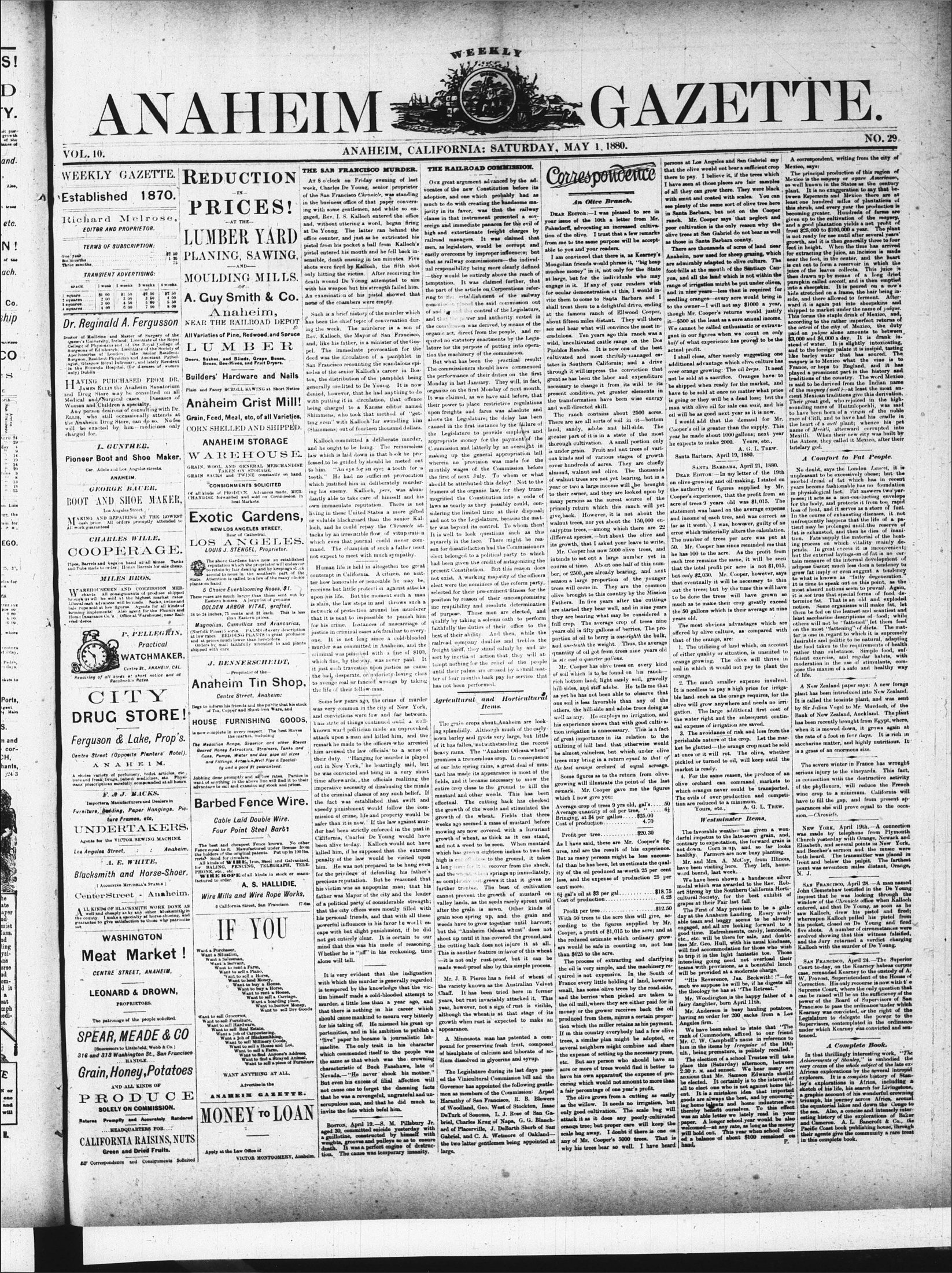
Searchable text
ANAHEIM
VOL. 10.
WEEKLY GAZETTE.
Established 1870.
Richard Melrose,
EDITOR AND PROPRIETOR.
TERMS OF SUBSCRIPTION:
One year $250
Bar months 1-30
Three months 75
TRANSIENT ADVERTISING:
APACK
1 week $1.00
2 weeks $1.50
3 weeks $2.00
4 weeks $2.50
squares $2.00
squares $2.00
squares $3.00
squares $4.00
Dr. Reginald A. Fergusson
Doctor of Medicine and Master of Surgery of the Queen's University, Ireland; Licentiate of the Royal College of Physicians and of the Royal College of Surgeons of Edinburgh; Licentiate of the Society of Apothecaries of London; Late Senior Resident-Surgeon, Resident Physician and Assistant Pathologist, Glasgow Royal Infirmary; and lately Resident in the Rotunda Hospital (for diseases of women only) Dublin.
HAVING PURCHASED FROM DR. JAMES ELLIS the Anaheim Sanatorium and Drug Store may be consulted on all Medical and Surgical cases. Diseases of Women and Children a specialty.
Any person desirous of consulting with Dr. Ellis, who still occasionally attends at the Anaheim Drug Store, can do so. No fee will be exacted by him—medicines only charged for.
L. GUNTHER.
Pioneer Boot and Shoe Maker,
Cer. Adelaide and Los Angeles streets.
REDUCTION IN PRICES!
AT THE LUMBER YARD PLANING, SAWING, AND MOULDING MILLS.
OF
A. Guy Smith & Co.
Anaheim,
NEAR THE RAILROAD DEPOT
All Varieties of Pine, Redwood, and Spruce LUMBER
Doors, Sashes, and Blinds, Grape Boxes, Boxes, Bee-Hives, and Fruit Dryers.
Builders' Hardware and Nails
Plain and Fancy SCROLL SAWING at Short Notice
Anaheim Grist Mill!
Grain, Feed, Meal, etc., of all Varieties.
CORN SHELLED AND SHIPPED.
ANAHEIM STORAGE WAREHOUSE.
GRAIN, WOOL, AND GENERAL MERCHANDISE TAKEN ON STORAGE.
HAVING PURCHASED FROM DR. JAMES ELLIS the Anaheim Sanatorium and Drug Store may be consulted on all Medical and Surgical cases. Diseases of Women and Children a specialty.
Any person desirous of consulting with Dr. Ellis, who still occasionally attends at the Anaheim Drug Store, can do so. No fee will be exacted by him—medicines only charged for.
L. GUNTHER,
Pioneer Boot and Shoe Maker,
Cer. Adele and Los Angeles streets.
ANAHEIM.
GEORGE BAUER,
BOOT AND SHOE MAKER,
Los Angeles Street.
MAKING AND REPAIRING AT THE LOWEST cash price. All orders promptly attended to. All work guaranteed.
CHARLES WILLE,
COOPERAGE.
Tipes, Barrels and keyes on hand at all times. Tanks and Tubes made to order. Honey Barrels for sale cheap.
MILES BROS.
WAREHOUSEMEN AND COMMISSION MERCHANTS. All consignments of produce shipped through us will be sold at the highest market rates. Liberal cash advances will be made. Sacks, twine and bale rope sold at low figures. Agents for all kinds of farming implementa. Also agent for the Phoenix and Home Insurance Co.'s Office at Warehouse, near Railroad deroos.
P. PELLEGRIN,
Practical WATCHMAKER,
Centre St., Anaheim, Cal.
Repairing of all kinds at short notice and at Reashnable Rates.
CITY DRUG STORE!
Ferguson & Lake, Prop's.
Centre Street (Opposite Planters' Hotel).
ANAHEIM.
A choice variety of perfumery, toilet articles, etc., pure and fresh Drugs, patent medicines, etc. Physicians prescriptions carefully compounded at all hours.
F. & J. BACKS.
Importers, Manufacturers and Dealers in Furniture, Bedding, Paper Hangings, Picture Frames, etc.
UNDERTAKERS,
Agents for the VICTOR SEWING MACHINE.
Los Angeles Street, : Anaheim.
A. E. WHITE,
Blacksmith and Horse-Shoer,
[ ADJOINING MITCHELL'S STABLE ]
Center Street - Anaheim.
Builders’ Hardware and Nails
Plain and Fancy SCROLL SAWING at Short Notice
Anaheim Crist Mill!
Grain, Feed, Meal, etc, of all Varieties.
CORN SHELLED AND SHIPPED.
ANAHEIM STORAGE
WAREHOUSE.
GRAIN, WOOL, AND GENERAL MERCHANDISE TAKEN ON STORAGE.
GRAIN SACKS and TWINE constantly on hand.
CONSIGNMENTS SOLICITED
Of all kinds of PRODUCE. Advances made, MERCHANTABILITY forwarded and sold on Commission in best Markets.
Exotic Gardens,
NEW LOS ANGELES STREET.
Rear of Cathedral.
LOS ANGELES.
LOUIS J. STENGEL, Proprietor.
The above Gardens have now an established reputation which the proprietor will endeavor to retain by fair dealing and by keeping stocks second to none in the southern part of the State. Attention is called to a few of the many choice plants on hand:
5 Choice Everblooming Roses, $1.
These roses are much larger than those sent out by Eastern houses. A large lot of genuine GOLDEN ARBOR VITAE, grafted,
18 to 24 inches, 75 cents and $1 each. This is less than Eastern prices.
Magnolias, Camellias and Arancarias,
(Nortfolk Pins) 5 sorts. PAULS of every description at low rates. BEDDING PLANTS in great profusion and at prices much lower than heretofore.
Orders by mail faithfully attended to and plants shipped with care.
J. BENNERSCHEIDT,
Proprietor of the Anaheim Tin Shop,
Centre Street, Anaheim:
Begs to inform his friends and the public that his stock of Tin, Copper and Sheet-Iron Ware, and HOUSE FURNISHING GOODS,
is now complete in every respect. The best Stoves the market, including
The Medallion Range, Superior and other Stoves Geared Honey Extractors, Stainers, Tanks and Cans, Pumps, Water and Gas pipe all sizes and Fittings. Artistry Well Pipe a Specialty and a good fit guaranteed.
Jobbing done promptly and at low rates. Parties in want of anything in the above line will find it to their advantage to call and examine my stock and prices.
Barbed Fence Wire.
Cable Laid Double Wire.
Four Point Steel Bartz
The best and cheapest Fence known. No other Fence equal to it. Manufactured under license from the holders of the original patents. Put up in 100 lbs. reels' Send for circulars.
All kinds of WIRE, Iron, Steel and Galvanized, for BALING, FENCING, TELEGRAPH, TELEPHONE, etc., etc.
WIRE ROPE of all kinds in stock or manufactured to order.
A. S. HALLIDIE,
Wire Mills and Wire Rope Works,
Human life is hindered in California how honorable receives but little upon his life. Be is slain, the law s network of protection that it is next to for his crime. Justice in criminal one. It is not murder was commuted criminal was punished which fine, by the it just such travel the bad, desperate to avenge real or the life of their
Some few years was very common and convictions of the criminal o the fact was speedy punishment mission of crime safer than it is nor had been st California. China been alive to-day killed him, if he penalty of the him. He was for the privilege precious repurchase his victim was May father was May
WASHINGTON
Meat Market!
CENTRE STREET, ANAHEIM,
LEONARD & DROWN,
PROPRIETORS.
The patronage of the people solicited.
SPEAR, MEADE & CO
[Successors to Littlefield, Webb & Co.]
316 and 318 Washington St., San Francisco
HANDLE...
Grain, Honey, Potatoes
AND ALL KINDS OF PRODUCE SOLELY ON COMMISSION.
Returns Promptly and Accurately Rendered
...HEADQUARTERS FOR...
CALIFORNIA RAISINS, NUTS
Green and Dried Fruits.
Correspondence and Consignments Solicited
Barbed Fence Wire.
Cable Laid Double Wire.
Four Point Steel Barb
The best and cheapest Fence known. No other Fence equal to it. Manufactured under license from the holders of the original patents. Put up in 100 lbs. reel. Send for circulars.
All kinds of WIRE, Iron, Steel and Galvanized, for BALING, FENCING, TELEGRAPH, TELEPHONE, etc., etc.
WIRE ROPE of all kinds in stock or manufactured to order.
A. S. HALLIDIE,
Wire Mills and Wire Rope Works,
6 California Street, San Francisco.
IF YOU
Want a Purchaser,
Want a Situation,
Want a Salesman,
Want a Servant,
Want to rent a Farm,
Want to sell a Piano,
Want to sell a Horse,
Want to lend Money,
Want to buy a House,
Want to buy a House,
Want to rent a House,
Want to sell a Carriage,
Want a boarding place,
Want to borrow Money,
Want to sell Dry Goods
Want to sell Groceries,
Want to sell Furniture,
Want to sell Hardware,
Want to sell Real Estate,
Want a job of Carpentering,
Want a job of Blacksmithing,
Want to sell Millinery Goods,
Want to sell a House and Lot,
Want to sell a Farm,
Want to find Anyone's Address,
Want to find a Strayed Animal,
Want to sell a piece of Furniture
WANT ANYTHING AT ALL.
Advertise in the ANAHEIM GAZETTE.
MONEY TO LOAN
Apply at the Law Office of VICTOR MONTOOMERY, Anaheim.
WEEKLY
EIM GA
ANAHEIM, CALIFORNIA: SATURDAY, MAY 1, 1880.
THE SAN FRANCISCO MURDER.
At 8 o'clock on Friday evening of last week, Charles De Young, senior proprietor of the San Francisco Chronicle, was standing in the business office of that paper conversing with some gentlemen, and while so engaged, Rev. I. S. Kalloch entered the office and, without uttering a word, began firing at De Young. The latter ran behind the office counter, and just as he extricated his pistol from his pocket a ball from Kalloch's pistol entered his mouth and he fell back insensible, death ensuing in ten minutes. Five shots were fired by Kalloch, the fifth shot only hitting the victim. After receiving his death wound De Young attempted to aim with his weapon but his strength failed him. An examination of his pistol showed that none of the chambers were empty.
Such is a brief history of the murder which has been the chief topic of conversation during the week. The murderer is a son of Rev. Kalloch, the Mayor of San Francisco, and, like his father, is a minister of the Gospel. The immediate provocation for the deed was the circulation of a pamphlet in San Francisco recounting the scandalous episodes of the senior Kalloch's career in Boston, the distribution of the pamphlet being generally credited to De Young. It is now denied, however, that he had anything to do with putting it in circulation, that offence being charged to a Kansas editor named Shimmens, who took that method of "getting even" with Kalloch for swindling him (Shimmens) out of fourteen thousand dollars.
Kalloch committed a deliberate murder, and he ought to be hung. The remorseless law which is laid down in that book he professed to be guided by should be meted out to him. "An eye for an eye; a tooth for a tooth; efficient preparation."
THE RAILROAD COMMISSION.
One great argument advanced by the advocates of the new Constitution before its adoption, and one which probably had as much to do with creating the handsome majority in its favor, was that the railway clause in that instrument presented a sovereign and immediate panacea for the evil of high and extortionary freight charges by railroad managers. It was claimed that men, as legislators, would be corrupt and easily overcome by improper influences; but that as railway commissioners—the individual responsibility being more clearly defined—they would be entirely above the reach of temptation. It was claimed further, that the part of the article on Corporations referring to the establishment of the railway commission placed the said commission out of and beyond the control of the Legislature, and that the power and authority vested in the commission was derived, by means of the organic act, direct from the people, and required no statutory enactments by the Legislature for the purpose of putting into operation the machinery of the commission.
But what has been the practical result? The commissioners should have commenced the performance of their duties on the first Monday in last January. They will, in fact, organize on the first Monday of next month. It was claimed, as we have said before, that their power to place restrictive regulations upon freights and fares was absolute and above the Legislature; the delay has been caused in the first instance by the failure of the Legislature to provide employees and appropriate money for the payment of the Commission and latterly by an oversight in making up the general appropriation bill wherein no provision was made for the monthly wages of the Commission before To whom or what
Correspondence
An Olive Branch.
DEAR EDITOR:—I was pleased to see in your issue of the 10th a letter from Mr. Pohndorff, advocating an increased cultivation of the olive. I trust that a few remarks from me to the same purpose will be acceptable to you and your readers.
I am convinced that there is, as Kearney's Mongolian friends would phrase it, "big heap muchee money" in it, not only for the State at large, but for the individuals who may engage in it. If any of your readers wish for ocular demonstration of this, I would invite them to come to Santa Barbara and I shall treat them to a delightful drive, ending at the famous ranch of Ellwood Cooper, about fifteen miles distant. They will there see and bear what will convince the most incredulous. Ten years ago this ranch was a wild, uncultivated cattle range on the Dos Pueblos Rancho. It is now one of the best cultivated and most thriftily-managed estates in Southern California; and a drive through it will impress the conviction that great as has been the labor and expenditure necessary to change it from its wild to its present condition, yet greater elements in the transformation have been wise energy and well-directed skill.
The ranch contains about 2500 acres. There are all sorts of soil in it—bottom land, sandy, adobe and hill-side. The greater part of it is in a state of the most thorough cultivation. A small portion only is under grain. Fruit and nut trees of various kinds and of various stages of growth cover hundreds of acres. They are chiefly almond, walnut and olive. The thousands
Kalloch committed a deliberate murder, and he ought to be hung. The remorseless law which laid down in that book he professed to be guided by should be meted out to him. "An eye for an eye; a tooth for a tooth." He had no sufficient provocation which justified him in deliberately murdering his enemy. Kalloch, perse, was abundantly able to take care of himself and his own immaculate reputation. There is not living in these United States a more gifted or voluble blackguard than the senior Kalloch, and he could repay the Chronicle attacks by an irresistible flow of vitupiration which even that journal could never command. The champion of such a father need not expect to meet with much sympathy.
Human life is held in altogether too great contempt in California. A citizen, no matter how honorable or peaceable he may be, receives but little protection against attacks upon his life. But the moment such a man is slain, the law steps in and throws such a network of protection around his murderer that it is next to impossible to punish him for his crime. Instances of miscarriage of justice in criminal cases are familiar to everyone. It is not long since a cold-blooded murder was committed in Anaheim, and the criminal was punished with a fine of $100, which fine, by the way, was never paid. It just such travesties upon justice as cause the bad, desperate, or notoriety-loving class to avenge real or fancied wrongs by taking the life of their fellow-man.
Some few years ago, the crime of murder was very common in the city of New York, and convictions were few and far between. This state of things continued until a well-known ward politician made an unprovoked attack upon a man and killed him, and the remark he made to the officers who arrested him aroused the law officials' to a sense of their duty. "Hanging for murder is played out in New York," he boastingly said, but he was convicted and hung in a very short time afterwards, the officials realizing the imperative necessity of disabusing the minds of the criminal classes of any such belief. If the fact was established that swift and speedy punishment would follow the commission of crime, life and property would be safer than it is now. If the law against murder had been strictly enforced in the past in California, Charles De Young would have been alive to-day. Kalloch would not have killed him, if he supposed that the extreme penalty of the law would be visited upon him. He was not prepared to be hung even for the privilege of defending his father's precious reputation. But he reasoned that his victim was an unpopular man; that his father was Mayor of the city and the leader the performance of their duties on the first Monday in last January. They will, in fact, organize on the first Monday of next month. It was claimed, as we have said before, that their power to place restrictive regulations upon freights and fares was absolute and above the Legislature; the delay has been caused in the first instance by the failure of the Legislature to provide employees and appropriate money for the payment of the Commission and latterly by an oversight in making up the general appropriation bill wherein no provision was made for the monthly wages of the Commission before the first of next July. To whom or what should be attributed this delay? Not to the framers of the organic law, for they transmogrified the Constitution into a code of laws as nearly as they possibly could, considering the limited time at their disposal; and not to the Legislature, because the matter was beyond its control. To whom then? It is well to look questions such as this squarely in the face. There might be reason for dissatisfaction had the Commissioners elect belonged to a political party to which had been given the credit of antagonizing the present Constitution. But this reason does not exist. A working majority of the officers elect were the nominees of the reform party, selected for their pre-eminent fitness for the position by reason of their uncompromising incruptibility and resolute determination of purpose. These men are elected, and qualify by taking a solemn oath to perform faithfully the duties of their office to the best of their ability. And then, while the railroad company doubles and trebles the freight tariff, they stand calmly by and assert by inertia of action that they will attempt nothing for the relief of the people until their palms are crossed by a small matter of four months back pay for service that has not been performed.
Agricultural and Horticultural Items.
The grain crops about Anaheim are looking splendidly. Although much of the early-sown barley and gyesis very large, but little of it has fallen, notwithstanding the recent heavy rains. The "Anaheim Ollessa wheat" promises a tremendous crop. In consequence of our late spring rains, a great deal of mustard has made its appearance in most of the fields, and it became necessary to mow the entire crop close to the ground to kill the mustard and other weeds. This has been effectual. The cutting back has checked the growth of the weeds and stimulated the growth of the wheat. Fields that three weeks ago seemed a mass of mustard before mowing are now covered with a luxuriant growth of wheat, as thick as it can stand, and not a weed to be seen. When mustard which has grown eighteen inches to two feet high is cut off close to the ground, it takes a long time for it to recover from the shock, and the wheat which springs up immediately, so completely out-grows it that it gives no further trouble. The best of cultivation cannot prevent the growth of mustard on great as has been the labor and expenditure necessary to change it from its wild to its present condition, yet greater elements in the transformation have been wise energy and well-directed skill.
The ranch contains about 2500 acres. There are all sorts of soil in it—bottom land, sandy, adobe and hill-side. The greater part of it is in a state of the most thorough cultivation. A small portion only is under grain. Fruit and nut trees of various kinds and of various stages of growth cover hundreds of acres. They are chiefly almond, walnut and olive. The thousands of walnut trees are not yet bearing, but in a year or two a large income will be brought to their owner, and they are looked upon by many persons as the surest source of the princely return which this ranch will yet give back. However, it is not about the walnut trees, nor yet about the 150,000 cacao nuts trees—among which there are 22 different species—but about the olive and its growth, that I asked your leave to write.
Mr. Cooper has now 5000 olive trees, and intends to set out a large number yet in course of time. About one-half of this number, or 2500, are already bearing, and next season a large proportion of the younger trees will come in. They are the common olive brought to this country by the Mission Fathers. In five years after the cuttings are started they bear well, and in nine years they are bearing what may be considered a full crop. The average crop of trees nine years old is fifty gallons of berries. The proportion of oil to berry is one-eighth the bulk, and one-tenth the weight. Thus, the average quantity of oil got from trees nine years old is six and a-quarter gallons.
Mr. Cooper has olive trees on every kind of soil which is to be found on his ranch—rich bottom land, light sandy soil, gravelly hillsides, and stiff adobe. He tells me that as yet he has not been able to observe that one soil is less favorable than any of the others, the hill-side and adobe trees doing as well as any. He employs no irrigation, and his experience snows that with good cultivation irrigation is unnecessary. This is a fact of great importance in its relation to the utilizing of hill land that otherwise would be almost valueless, but which under olive trees may bring in a return equal to that of the best orange orchard of equal acreage.
Some figures as to the return from olive-growing will illustrate the point of the last remark. Mr. Cooper gave me the figures which I now give you:
Average crop of trees 9 yrs old, gal's... 50
Average quantity of oil per tree,... 64
Bringing at $4 per gallon... $25.00
Cost of production... 4.70
Profit per tree... $20.30
As I have said, these are Mr. Cooper's figures, and are the result of his experience. But as many persons might be less successful than he has been, let us estimate the quality of the oil produced as worth 25 per cent less, and the expense of production 25 per cent more:
64 gal's oil at $3 per gal... $18.75
62.5
the fact was established that swift and speedy punishment would follow the commission of crime, life and property would be safer than it is now. If the law against murder had been strictly enforced in the past in California, Charles De Young would have been alive to-day. Kalloch would not have killed him, if he supposed that the extreme penalty of the law would be visited upon him. He was not prepared to be hung even for the privilege of defending his father's precious reputation. But he reasoned that his victim was an unpopular man; that his father was Mayor of the city and the leader of a political party of considerable strength; that the city offices were mostly filled with his personal friends, and that with all these powerful influences in his favor he would escape with but slight punishment, if he did not get entirely clear. It is certain to our mind that this was his mode of reasoning. Whether he is "off" in his reckoning, time alone will tell.
It is very evident that the indignation with which the murder is generally regarded is tempered by the knowledge that the victim himself made a cold-blooded attempt to murder, a little less than a year ago, and that there is nothing in his career which should cause mankind to mourn very bitterly for his taking off. He misused his great opportunities, and in his ambition to publish a "live" paper he became a journalistic Ishmaelite. The only trait in his character which commended itself to the people was the same as that which was the crowning characteristic of Beck Fanshawe, late of Nevada,—"He never shook his mother." But even his excess of filial affection will not cause one to forget the damning facts that he was a revengeful, ungrateful and unscrupulous man, and that he did much to invite the fate which befell him.
Boston, April 19.—S. M. Pillsbury Jr. aged 30, committed suicide yesterday with a guillotine, constructed by himself with weights, grooves and pulleys so as to ensure death. It was a perfect engine of destruction. The cause was temporary insanity.
The cutting back has checked the growth of the weeds and stimulated the growth of the wheat. Fields that three weeks ago seemed a mass of mustard before mowing are now covered with a luxuriant growth of wheat, as thick as it can stand, and not a weed to be seen. When mustard which has grown eighteen inches to two feet high is cut off close to the ground, it takes a long time for it to recover from the shock, and the wheat which springs up immediately, so completely out-grows it that it gives no further tremble. The best of cultivation cannot prevent the growth of mustard on valley lands, as the seeds rarely sprout until after the grain is sown. Other kinds of grain soon spring up, and the grain and weeds have to grow together until harvest; but the "Anaheim Odessa wheat" does not shoot up until it has covered the ground, and the cutting back does not injure it at all. This is another feature in favor of this wheat—it is not only rust-proof, but it can be made weed-proof also by this simple process.
Mr. J. B. Pierce has a field of wheat of the variety known as the Australian Velvet Chaff. It has been tried here in former years, but rust invariably attacked it. This year, however, not a sign of rust is visible, although the wheat is at that stage of its growth when rust is expected to make an appearance.
A Minnesota man has patented a compound for preserving fresh fruit, composed of bisulphate of calcium and biborate of sodium dissolved in glycerine and syrup.
The Legislature during its last days passed the Vinicultural Commission bill and the Governor has appointed the following gentlemen as members of the Commission: Arpad Harazzy of San Francisco, R. B. Blowers of Woodland, Geo. West of Stockton, Isaac DeTurk of Sonoma, L. J. Rose of San Gabriel, Charles Krug of Napa, G. G. Blanchard of Placerville, J. DeBarth Shorb of San Gabriel, and C. A. Wetmore of Oakland—the two latter gentlemen being appointed at large.
Average crop of trees 9 yrs old, gal's...50 Average quantity of oil per tree,"...64 Bringing, at $4 per gallon...$25.00 Cost of production...4.70
Profit per tree...$20.30 As I have said, these are Mr. Cooper's figures, and are the result of his experience. But as many persons might be less successful than he has been, let us estimate the quality of the oil produced as worth 25 per cent less, and the expense of production 25 per cent more:
64 gal's oil at $3 per gal...$18.75 Cost of production...6.25
Profit per tree...$12.50 With 50 trees to the acre this will give, according to the figures supplied by Mr. Cooper, a profit of $1,015 to the acre; and at the reduced estimate which ordinary growers would be safe in counting on, not less than $625 to the acre.
The process of extracting and clarifying the oil is very simple, and the machinery required is not expensive. In the South of France every little holding of land, however small, has some olive trees by the road-side, and the berries when picked are taken to the oil mill, where they are either paid for in money or the grower receives back the oil produced from them, minus a certain proportion which the miller retains as his payment. If in this country everybody had a few olive trees, a similar plan might be adopted, on several neighbors might combine and share the expense of setting up the necessary press, etc. But any person who should have an acre or more of trees would find it better to have his own apparatus, the expense of procuring which would not amount to more than a fair percentage of one year's profit.
The olive grows from a cutting as easily as the willow. It needs no irrigation, but only good cultivation. The scale bug will attack it as it does any poorly-cultivated orange tree; but proper care will keep the scale bug away. I doubt if there is one or any of Mr. Cooper's 5000 trees. That is why his trees bear so well. I have heard
GAZETTE.
NO. 29
A correspondent, writing from the city of Mexico, says:
The principal production of this region of Mexico is the maguey or agave Americana, as well known in the States as the century plant. It is no exaggeration to say that between Esperanza and Mexico there are at least one hundred miles of plantations of this shrub, and every year the production is becoming greater. Hundreds of farms are given up to the cultivation of the maguey, and a good plantation yields a not profit of from $25,000 to $100,000 a year. The plant is not ready for use until after several years' growth, and it is then generally three to four feet in height. When the time has arrived for extracting the juice, an incision is made near the foot, in the center, and the heart is cut out to form a reservoir in which the juice of the leaves collects. This juice is then drawn up by means of a long dried pumpkin called acocotl, and is then emptied into a sheepskin. It is poured on a cow's hide stretched on a frame, the hair being inside, and there allowed to ferment. Afterward it is again put into sheepskins and shipped to market under the name of pulque. This forms the staple drink of Mexico, and according to the rather imperfect returns of the octroi of the city of Mexico, the duty paid on pulque alone amounts to between $3,000 and $4,000 a day. It is drank instead of water. It is slightly intoxicating, and to the foreign palate it is insipid, tasting like barley water that has soured. The maguey is to Mexico what the vine is to France, or hops to England, and it has played a prominent part in the history and traditions of the country. The word Mexico is said to be derived from the Indian name of the maguey (metl) at least the most ancient Mexican traditions give this derivation. Their great god, who rejoiced in the high-sounding name of Huitzilopchli, was said to have been born of a virgin of the noble race of Citli, and to have had his cradle in the heart of a metl plant; whence his pet name Mecitli, afterward corrupted into Mexitli. When their new city was built by the Aztecs, they called it Mexico, after their tutelary god.
A Comfort to Fat People.
No doubt, says the London Lancet, it is important to be excessively obese; but the
not be sold at a sacrifice. Oranges have to be shipped when ready for the market, and have to be sold at once no matter what price is going or they will be a dead loss; but the man with olive oil for sale can wait, and his oil will be as good next year as it is now.
I would add that the demand for Mr. Cooper's oil is greater than the supply. This year he made about 1000 gallons; next year he expects to make 2000. Yours, etc.,
A. G. L. TREW.
Santa Barbara, April 19, 1880.
SANTA BARBARA, April 21, 1880.
DEAR EDITOR: In my letter of the 19th on olive-growing and oil-making, I stated on the authority of figures supplied by Mr. Cooper's experience, that the profit from an acre of trees 9 years old was $1,015. The statement was based on the average expense and income of each tree, and was correct as far as it went. I was, however, guilty of an error which materially alters the calculation. The number of trees per acre was put at 50. Mr. Cooper has since reminded me that he has 100 to the acre. As the profit from each tree remains the same, it will be seen that the total profit per acre is not $1,015, but only $2,030. Mr. Cooper, however, says that eventually it will be necessary to thin out the trees; but by the time this will have to be done the trees will have grown so much as to make their crop greatly exceed the 50 gallons which is their average at nine years old.
The most obvious advantages which are offered by olive culture, as compared with that of the orange, are:
1. The utilizing of land which, on account of either quality or situation, is unaided to orange growing. The olive will thrive in soil in which it would not pay to plant the orange.
2. The much smaller expense involved. It is needless to pay a high price for irrigable land such as the orange requires, for the olive will grow anywhere and needs no irrigation. The large additional first cost of the water right and the subsequent continual expense of irrigation are saved.
3. The avoidance of risk and loss from the perishable nature of the crop. Let the market be glutted—the orange crop must be sold at once or it will rot. The olive, whether pickled or turned to oil, will keep until the market is ready.
4. For the same reason, the produce of an olive orchard can command markets to which oranges never could be transported. The evils of over-production and competition are reduced to a minimum.
Yours, etc., A. G. L. TREW.
Westminster Items.
The favorable weather has given a wonderful impetus to the late-sown grain, and contrary to expectation, the forward grain is not down. Corn is up, and so far looks healthy. Farmers are now busy planting.
Mr. and Mrs. A. McCoy, from Illinois, have been visiting here. They left, homeward bound, last week.
We have been shown a handsome silver medal which was awarded to the Rev. Robert Strong by the Southern California Horticultural Society, for the best exhibit of traditions of the country. The word Mexico is said to be derived from the Indian name of the maguey (mell) at least the most ancient Mexican traditions give this derivation. Their great god, who rejoiced in the highounding name of Huitzilopochli, was said to have been born of a virgin of the noble race of Cilii, and to have had his cradle in the heart of a mell plant; whence his pet name of Meitli, afterward corrupted into Mexitli. When their new city was built by the Aztecs, they called it Mexico, after their tutelary god.
A Comfort to Fat People.
No doubt, says the London Lauret, it is unpleasant to be excessively obese; but the morbid dread of fat which has in recent years become fashionable has no foundation in physiological fact. Fat answers two purposes: it acts as a non-conducting envelope for the body, and protects it from too rapid loss of heat, and it serves as a store of fuel. In the course of exhausting diseases, it not unfrequently happens that the life of a patient may be prolonged until the reserve of fat is exhausted, and then he dies of insatiation. Fats supply the material of the heating process on which vitality mainly depends. In great excess it is inconvenient; but the external layings-on-of-fat is no certain measure of the internal development of adipose tissue; much less does a tendency to grow fat imply or even suggest a tendency to what is known as "fatty degeneration." It is time to speak out on this point, as the most absurd notions seem to prevail. Again, it is not true that special forms of food determine fat. That is an old and exploded notion. Some organisms will make fat, let them be fed on the leanest and scantiest and least saccharine descriptions of food; while others will not be "fattened" let them feed on the most "fattening" of diets. The matter is one in regard to which it is supremely desirable and politic to be natural, adapting the food taken to the requirements of health rather than substance. Simple food, sufficient exercise, and regular habits, with moderation in the use of stimulants, compose the maxim of a safe and healthy way of life.
A New Zealand paper says: A new forage plant has been introduced into New Zealand. It is called the teosinte plant, and was sent by Sir Julius Vogel to Mr. Murdoch, of the Bank of New Zealand, Auckland. The plant has been recently brought from Egypt, where, when it is mowed down, it grows again at the rate of a foot in four days. It is rich in saccharine matter, and highly nutritious. It is a grass of an enormous size.
The severe winter in France has wrought serious injury to the vineyards. This fact, in connection with the destructive activity of the phylloxera, will reduce the French wine crop to a minimum. California will have to fill the gap, and from present appearances she will prove equal to the occasion.
New York, April 19th.-A connection was made by telephone from Plymouth Church yesterday with Orange, Newark and Elizabeth, and several points in New York, and Beecher's sermon and the music were both heard. The transmitter was placed in front and below the pulpit. The farthest point was seventeen miles distant, Orange, N.J.
San Francisco, April 28.-A man named John Clemetshaw testified in De Young inquiry that he was looking through the tutelary god.
Westminster Items.
The favorable weather has given a wonderful impetus to the late-sown grain, and contrary to expectation, the forward grain is not down. Corn is up, and so far looks healthy. Farmers are now busy planting.
Mr. and Mrs. A. McCoy, from Illinois, have been visiting here. They left, homeward bound, last week.
We have been shown a handsome silver medal which was awarded to the Rev. Robert Strong by the Southern California Horticultural Society, for the best exhibit of grapes at their Fair last fall.
The First of May promises to be a galabay at the Anaheim Landing. Every available team and buggy seems to be already engaged, and all are looking forward to a good time. Refreshments, candy, lemonade, etc., will be there for sale, and doubtless Mr. Geo. Hull, with his usual kindness, will find accommodation for those who wish to trip it in the light fantastic toe. Those intending going need not overload their teams with provisions, as a bountiful lunch will be provided at a moderate charge.
"His Reverence, Jas. Beckwith!"—for such we suppose he will be, if he digests all the theology he has at "The Retreat."
Mr. Woodington is the happy father of a fairy daughter, born April 11th.
Mr. Anderson is busy hauling potatoes, having an order for 200 sacks from a Los Angeles firm.
We have been asked to state that "The rank of Commodore, affixed to our friend Mr. C. W. Campbell's name in reference to him in the items by Irregular of the 10th ult., being premature, is politely recalled."
The election of a school Trustee will take place this (Saturday) afternoon, between 2:30 p.m. and sunset. We hear many are anxious that Mr. Samson Edwards should be elected. It certainly is to the interest of all to elect one who is not against home talent. It is a mistaken idea that imported goods are always the best, and by encouraging home talents and home industries we thereby benefit ourselves. To this effect was an able letter we lately read in your paper. A longer school year would be also welcomed—at any rate, as long as the money will hold out. This year when school closed a balance of about $100 remained on hand.
New York, April 19th.—A connection was made by telephone from Plymouth Church yesterday with Orange, Newark and Elizabeth, and several points in New York, and Beecher's sermon and the music were both heard. The transmitter was placed in front and below the pulpit. The farthest point was seventeen miles distant, Orange, N. J.
San Francisco, April 28.—A man named John Clemetshaw testified in the De Young inquest that he was looking through the window of the Chronicle office when Kalloch entered, and that De Young, as soon as he saw Kalloch, drew his pistol and fired; whereupon Kalloch pulled his pistol from his pocket, closed on De Young and fired five shots. A number of circumstances were evolved showing that this witness falsified, and the Jury returned a verdict charging Kalloch with the murder of De Young.
San Francisco, April 24.—The Superior Court to-day, on the Kearney habea corpus case, remanded Kearney to the custody of A. W. Provost, Superintendent of the House of Correction. His only recourse is now with the Supreme Court, where the only question that can be raised will be on the sufficiency of the power of the Board of Supervisors of San Francisco to pass the ordinance under which Kearney was convicted, or the right of the Legislature to delegate the power to the Supervisors, contemplated in the ordinance under which Kearney was convicted and sentenced.
A Complete Book.
In that thrillingly interesting work, "The Achievements of Stanley," is embodied the very cream of the whole subject of the late ex-African explorations by the several intrepid explorers. It is a complete history of Stanley's explorations in Africa, including a sketch of his life, his search for Livingstone, a graphic account of his wonderful crowning triumph, his journey across Africa, around the equatorial lakes and down the Congo to the sea. Also, a concise and intensely interesting history of the explorations of Baker and Cameron. A. L. Bancroft & Co., the Pacific Coast book publishing house, through their agents give the community a rare treat in this complete book.