anaheim-gazette 1880-01-24
Scanned page
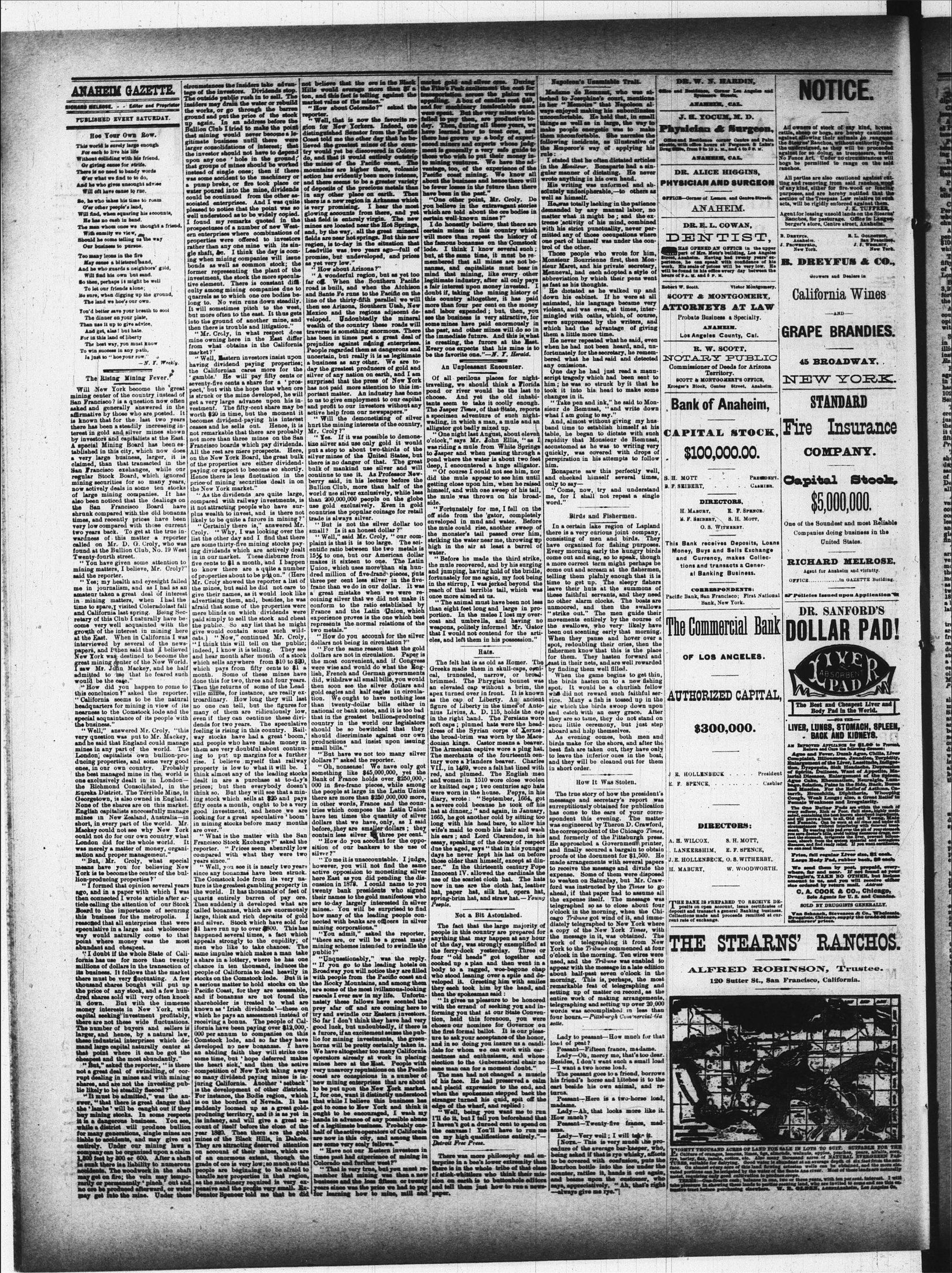
Searchable text
ANAHEIM GAZETTE.
RICHARD MELROSE. - Editor and Proprietor
PUBLISHED EVERY SATURDAY.
Hoe Your Own Row.
This world is surely large enough
For each to live his life
Without colliding with his friend.
Or giving cause for strife.
There is no need to bandy words
Over what we find to do,
And he who gives unsought advice
Will oft have cause to rue.
So, he who takes his time to roam
Over other people's land,
Will find, when squaring his accounts,
He has no cash in hand.
The man whom once we thought a friend,
With enmity we view,
Should he come telling us the way
Our business to pursue.
Too many leons in the fire
May cause a blistered hand,
And he who guards a neighbors' gold,
Will find his own but sand.
So then, perhaps it might be well
To let our friends alone;
He sure, when digging up the ground,
The land we hoe's our own.
You'd better save your breath to cool
The dinner on your plate,
Than use it up to give advice,
And get, alas! but hate.
For in this land of liberty
The best way, you must know
To win success in any path,
Is just to "hoe your row."
N. Y. Weekly.
The Rising Mining Fever.
Will New York become the great mining center of the country instead of San Francisco? is a question now often asked and generally answered in the affirmative by those who are posted. It is known that for the last two years there has been a steadily increasing interest in gold and silver mines shown by investors and capitalists at the East. A special Mining Board has been established in this city, which now does a very large business, larger, it is claimed, than that transacted in the San Francisco exchanges, while our district board which ignored circumstances the insiders take advantage of the investors. Dividends stop. The outside public rush in to sell. The insiders may drain the water or rebuild the works, or go through the barren ground and put the price of the stock up again. In an address before the Bullion Club I tried to make the point that mining would never become a legitimate business until there were larger consolidations of interest; that the investor should not have to depend upon anyone 'hole in the ground'; that groups of mines should be worked instead of single ones; then if there was some accident to the machinery or a pump breke, or fire took place or water poured into the mine, dividends could be continued from the other associated enterprises. And I was quite pleased to notice that the point was so well understood as to be widely copied. I found my remarks quoted in the prospectuses of a number of new Western enterprises where combinations of properties were offered to investors rather than any one mine with its single shaft, so. I think the day is coming when mining companies will issue bonds as well as common stock; the former representing the plant of the investment, the stock the more speculative element. There is constant difficulty among mining companies due to quarrels as to which one ore bodies belong to. No vein runs down steadily. It will sometimes pitch to the west, but more often to the east. It thus gets into the ground of another mine, and then there is trouble and litigation."
"Mr. Croly, in what respect does mine owning here in the East differ from what obtains in the California market?"
"Well, Eastern investors insist upon having dividend paying properties; the Californian cares more for the 'gamble.' He will pay fifty cents or seventy-five cents a share for a 'prospect,' but with the hope that when ore is struck or the mine developed, he will get a very large advance upon his investment. The fifty-cent share may be worth $20 in time, but the moment it becomes dividend-paying his interest ceases and he sells out. Hence, it is not remarkable that there are probably not more than three mines on the San Francisco boards which pay dividends. All the rest are mere prospects. Here, on the New York Board, the great bulk of the properties are either dividend-paying or expect to become so shortly.
not believe that Hills would average ton, and this fact is market value of the "How about Co reporter."
"Well, that is a region for New York distinguished Seneca Coast told me the lieved the greatest cry would yet be do, and that it won the mines of the mountains are his action has evident and there seems to of deposits of them in any other place there is a new regio is very promising glowing accounts that field is entrant mines are located and by the way, fields are near hot region, is to-day Leadville was two promise, but unseen as yet very low."
"How about A "A wonderful far off. When road is built, and and Sante Fe run line of the thirty then see Arizona Mexico and they developed. Undo wealth of the county traverse is sometime has been in times prejudice against People regarded uncertain, but rea business as an day the greatest silver of any nation surprised that there has not paid most important matter. To us to give empire and profit to our active help from "Will the d hurt the mining in Mr. Croly?""
"Yes. If it wize silver and used put a stop to abil silver mines of th there is no danger bulk of mankind continue to use."
Will New York become the great mining center of the country instead of San Francisco? is a question now often asked and generally answered in the affirmative by those who are posted. It is known that for the last two years there has been a steadily increasing interest in gold and silver mines shown by investors and capitalists at the East. A special Mining Board has been established in this city, which now does a very large business, larger, it is claimed, than that transacted in the San Francisco exchanges, while our regular Stock Board, which ignored mining securities for so many years, now actively deals in some ten stocks of large mining companies. It has also been noticed that the dealings on the San Francisco Board have shrunk compared with the old bonanza times, and recently prices have been very low compared with those current two years back. To get at the true inwardness of this matter a reporter called on Mr. D. G. Croly, who was found at the Bullion Club, No. 19 West Twenty-fourth street.
"You have given some attention to mining matters, I believe, Mr. Croly?" said the reporter.
"Yes; my health and eyesight failed me in journalism, and as I had as an amateur taken a great deal of interest in mining matters, when I had the time to spare, I visited Coleradolast fall and California last spring. Being Secretary of this Club I naturally have become very well acquainted with the growth of the interest in mining here at the East. When in California I was interviewed by several of the newspapers, and I then said that I believed New York was destined to become the great mining center of the New World. I saw Mr. John Mackey, and he half admitted to me that he feared such would be the case."
"How did you happen to come to this conclusion?" asked the reporter. "California seems to be the natural headquarters for mining in view of its nearness to the Comstock lode and the special acquaintance of its people with the business."
"Well," answered Mr. Croly, "this very question was put to Mr. Mackey, and he said that England could manage mines in any part of the world. The London; capitalists own bullion-producing properties, and some very good ones, in our own country. Probably the best managed mine in the world is one exclusively dealt in in London—the Richmond Consolidated, in the Eureka District. The Terrible Mine, in Georgetown, is also owned in England. None of the shares are on this market. English capitalists successfully manage mines in New Zealand, Australia—in short, in every part of the world. Mr. Mackey could not see why New York could not do for our own country what London did for the whole world. It was merely a matter of money, organization and proper management."
But, Mr. Croly, what special means have you for believing New York is to become the center of the bullion-producing properties?
"I formed that opinion several years ago, and in a paper with which I was then connected I wrote article after ar-
'gamble.' He will pay fifty cents or seventy-five cents a share for a 'prospect,' but with the hope that when ore is struck or the mine developed, he will get a very large advance upon his investment. The fifty-cent share may be worth $20 in time, but the moment it becomes dividend-paying his interest ceases and he sells out. Hence, it is not remarkable that there are probably not more than three mines on the San Francisco boards which pay dividends. All the rest are mere prospects. Here, on the New York Board, the great bulk of the properties are either dividend-paying or expect to become so shortly. Hence there is less fluctuation in the price-of-mining securities dealt in on the New York market."
"As the dividends are quite large, compared with railway investments, is it not attracting people who have surplus wealth to invest, and is there not likely to be quite a furore in mining?"
"Certainly there is," answered Mr. Croly.
"Why, I was looking over the list the other day and I find that there are some thirty-five mining stocks paying dividends which are actively dealt in in our market. These disburse from five cents to $1 a month, and I happen to know there are a quite number of properties about to be put on." (Here Mr. Croly showed the reporter a list of the mines, but said he did not care to give their names, as it would look like advertising them, and, besides, he was afraid that some of the properties were mere blinds on which dividends were paid simply to sell the stock and cheat the public. So any list that he might give would contain some such wild-cats.) "Now," continued Mr. Croly,
"I think this will tell on the public; indeed, I know it is telling. They see and hear month after month of a stock which sells anywhere from $10 to $30, which pays from fifty cents to $1 a month. Some of these mines have done this for two, three and four years. Then the returns of some of the Leadville mines, for instance, are really extraordinary. How long they will last no one can tell, but the figures for many of them are ridiculously low, even if they can continue these dividends for two years. The speculative feeling is rising in this country. Railway stocks have had a great 'boom,' and people who have made money in them are very doubtful about continuing to put up margins for a further rise. I believe myself that railway property is low to what it will be. I think almost any of the leading stocks dealt in are a purchase at to-day's prices; but then everybody doesn't think so. But they will see that a mining stock which sells at $25 and pays fifty cents a month, ought to be a very good investment, and hence we are looking for a great speculative 'boom' in mining stocks before many months are over."
"What is the matter with the San Francisco Stock Exchange?" asked the reporter.
"Prices seem absurdly low compared with what they were two years since."
"Well, you see it is nearly two years since any bonanzas have been struck. The Comstock lode from its very nature is the greatest gambling property in the world. It has thousands of feet of quartz entirely barren of pay ore."
"Silver of any nature surprised that there has not paid more portant matter. To us give empathy and profit to our active help from me."
"Will the dull hurt the mining industry Mr. Croly?"
"Yes. If it wiltize silver and use put a stop to abil silver mines of there is no danger bulk of mankind continue to use berry said, in Bullion Club, most world use silver than 200,000,000 use gold exclusive countries the poorest trade is always small? Is it an plaint is that it entific ratio between 15% to one, but makes it sixteen Union, which uses dred million of three per cent franc than we do a great mistal coining silver that conform to France and this experience proves represents them two metals."
"How do your dollars not being For the sain dollars are not in the most convex were wise and lish French and did withdraws then soon seen gold eagles and tion. We ought than twenty-national or bank that in the greatest country in th should be so should disminute productions and small bills."
"But have your dollars?" asked Oh, nonsense something like Bank of France 000 in five-franc the people at last there are more in other words tries which con have ten times dollars that we before, they are contain less si? How do you sition of our silver?"
"To me it is however, you active opposition here East as ye cussion in 1878 twenty bank their names to
Georgetown, is also owned in England. None of the shares are on this market. English capitalists successfully manage mines in New Zealand, Australia—in short, in every part of the world. Mr. Mackey could not do for our own country what London did for the whole world. It was merely a matter of money, organization and proper management."
"But, Mr. Croly, what special means have you for believing New York is to become the center of the bullion-producing properties?"
"I formed that opinion several years ago, and in a paper with which I was then connected I wrote article after article calling the attention of our Stock Board to the importance of securing this business for the metropolis. I reasoned that all enterprises that were speculative in a large and wholesome way would naturally come to that point where money was the most abundant and cheapest.
"I doubt if the whole State of California has use for more than twenty millions of dollars in the transaction of its business. It follows that the market there must be very fluctuating. A few thousand shares bought will put up the price of any stock, and a few hundred shares sold will very often knock it down. But with the immense money interests in New York, with capital seeking investment profitably, there are not these wide fluctuations. The number of buyers and sellers is larger, and hence, by a natural law, these industrial interprises which demand large capital naturally center at that point where it can be got the cheapest and the most abundantly."
"But," asked the reporter, "is there not a great deal of swindling, of corrupt dealing in mines and with mining shares, and are not the investing public likely to be steadily fleeced?"
"It must be admitted," was the answer, "that there is great danger that the 'lamba' will be caught out if they buy mining stocks. In some respects it is a dangerous business. You see, while a district will produce bullion for many generations, single mines are liable to accidents, and may give out entirely. Under our mining laws a company can be organized upon a claim 1,500 feet by 200 or 600. After a shaft is sunk there is a liability to numerous accidents. The woodwork in the shaft may get on fire; the vein may temporarily or permanently 'pinch' out and no ore be produced afterward, or water may get into the mine. Under these
ing stock which sells at $20 and pays fifty cents a month, ought to be a very good investment, and hence we are looking for a great speculative 'boom' in mining stocks before many months are over."
"What is the matter with the San Francisco Stock Exchange?" asked the reporter. "Prices seem absurdly low compared with what they were two years since."
"Well, you see it is nearly two years since any bonanzas have been struck. The Comstock lode from its very nature is the greatest gambling property in the world. It has thousands of feet of quartz entirely barren of pay ore. Then suddenly it developed what are called bonanzas, which are enormously large, thick and rich deposits of gold and silver. Stock which have sold for $1 have run up to over $800. This has happened several times, a fact which appeals strongly to the cupidity; of men who like to take chances. The same impulse which makes a man take a share in a lottery, where he has one chance in ten thousand, induces the people of California to deal heavily in stocks on the Comstock lode. But it is a serious matter to hold stocks on the Pacific Coast, for they are assessable, and if bonanzas are not found the shareholder is treated to what are known as 'Irish dividends'—these on which he pays an assessment instead of receiving a bonus. The people of California have been paying over $12,000,000 per annum to companies on this Comstock lode, and so far they have developed no new bonanzas. I have an abiding faith they will strike one some time, but 'hope deferred makes the heart sick,' and then the active competition of New York taking away so many dividend paying mines is injuring California. Another 'setback' is the development of other districts.
For instance, the Bodie region, which is on the borders of Nevada. It has suddenly loomed up as a great gold-producing territory, and it is as yet in its infancy, and will give a great account of itself before the close of the year 1890. Then there are the gold mines of the Black Hills, in Dakota. They are attracting deserved attention on account of their mines, which are of an enormous extent, though the grade of ore is very low; so much so that people are beginning to be afraid to handle new properties in that region, as the machinery required is very expensive and the profits very small. Ex-Senator Spencer told me that he did
not believe that the ore in the Black Hills would average more than $1 ton, and this fact is telling against the market value of the mines."
"How about Colorado?" asked the reporter.
"Well, that is now the favorite region for New Yorkers. Indeed, one distinguished Senator from the Pacific Coast told me the other day that he believed the greatest mines of the country would yet be discovered in Colorado, and that it would entirely outstrip the mines of the Pacific coast. The mountains are higher there, volcanic action has evidently been more intense, and there seems to be a greater variety of deposits of the precious metals than in any other place on earth. Then there is a new region in Arkansas which is very promising. I hear the most glowing accounts from there, and yet that field is entirely virgin. The new mines are located near the Hot Springs, and by the way, all the great mineral fields are near hot springs. But this new region, is to-day in the situation that Leadville was two years ago—full of promise, but undeveloped, and prices yet very low."
"How about Arizona?"
"A wonderful region, but as yet too far off. When the Southern Pacific road is built, and when the Atchison and Sante Fe runs to the Pacific on the line of the thirty-fifth parallel we will then see Arizona, Southern Utah, New Mexico and the regions adjacent developed. Undoubtedly the mineral wealth of the country these roads will traverse is something enormous. There has been in times past a great deal of prejudice against mining enterprises. People regarded them as dangerous and uncertain, but really it is as legitimate a business as any other. We are today the greatest producers of gold and silver of any nation on earth, and I am surprised that the press of New York has not paid more attention to this important matter. An industry has come to us to give employment to our capital and profit to our investors without any active help from our newspapers."
"Will the demonetizing of silver hurt the mining interests of the country, Mr. Croly?"
"Yes. If it was possible to demonize silver and use only gold it would put a stop to about two-thirds of the silver mines of the United States, but there is no danger of that. The great bulk of mankind use silver and will continue to use it." As Professor Newmarket gold and silver ones. During the Pike's Peak excitement the cost for transportation across the plains was appalling. A box of candles cost $40, and for machinery inscalculable sums were spent. But the very mines which failed to pay then, are productive today. Then, during all these years, we have learned how to treat ores, and there has grown up a body of experienced miners and experts whose judgment is generally a very safe guide to those who wish to put their money into mining ventures. We have the advantage, too, of the experience of the Pacific coast mining. We know all about the business and hence there will be fewer losses in the future than there have been in the past."
"One other point, Mr. Croly. Do you believe in the extravagant stories which are told about the ore bodies in certain well-known mines?"
I do honestly believe that there are certain mines in this country which will more than repeat the history of the famous bonanas on the Comstock lode. I think I know several such; but, at the same time, it must be remembered that all mines are not bonanas, and capitalists must bear in mind that mining, like every other legitimate industry, after all only pays a fair interest upon money invested. I doubt if, taking the mining history of this country altogether, it has paid more than four per cent on the money and labor expended; but, then, you see the business is very attractive, for some mines have paid enormously in the past, and other mines will do so in the immediate future. And this is what is creating, the furore at the East. Every one expects that his mine is to be the favorite one."—N. Y. Herald.
An Unpleasant Encounter.
Of all perilous places for night-traveling, we should think a Florida pond or river would be the last to choose. And yet the old inhabitants seem to take it coolly enough. The Jasper Times, of that State, reports a specimen adventure of such night-wading, in which a man, a mule and an alligator got badly mixed up.
"One night last August, about eleven o'clock," says Mr. John Ellis, "as I was riding a mule from White Springs to Jasper and when passing through a pond where the water is about two feet deep, I encountered a huge alligator."
Of course I could not see him, nor Napoléon's Unamiable Trait.
Madame de Remnaut, who was attached to Josephine's court, mentions in her "Memoirs" that Napoleon always enjoyed making his subordinates uncomfortable. He held that, in small things as well as in large, the way to make people energetic was to make them uncomfortable. She narrates the following incidents, as illustrative of the Emperor's way of applying his rule:
I stated that he often dictated articles in the Moniteur. Bonaparte had a singular manner of dictating. He never wrote anything in his own hand.
His writing was unformed and absolutely undecipherable,—to others as well as himself.
He was totally lacking in the patience demanded by any manual labor, no matter what it might be; and the extreme 'activity of his mind,' combined with his strict punctuality, never permitted any of those occupations where one part of himself was under the control of the other.
Those people who wrote for him, Monsieur Bourrienne first, then Monsieur Maret, and his private secretary, Menneval, had each adopted a style of abbreviation by which their pens went as fast as his thoughts.
He dictated as he walked up and down his cabinet. If he were at all animated, his language became very violent, and was even at times, intermingled with oaths, which, of course, were suppressed by the writers, and which had the advantage of giving them a little more time.
He never repeated what he said, even when he had not been heard, and unfortunately for the secretary, he remembered what he had said and detected any omissions.
One day he had just read a manuscript tragedy which had been sent to him; he was so struck by it that he took it into his head to make some changes in it.
"Take pen and ink," he said to Monsieur de Bemusat, "and write down what I am going to say."
And, almost without giving my husband time to establish himself at his table, he began to dictate with such rapidity that Monsieur de Bemusat, accustomed as he was to writing very quickly, was covered with drops of perspiration in his attempts to follow him.
Bonaparte saw this perfectly well,
```
silver of any nation on earth, and I am surprised that the press of New York has not paid more attention to this important matter. An industry has come to us to give employment to our capital and profit to our investors without any active help from our newspapers."
"Will the demonetizing of silver hurt the mining interests of the country, Mr. Croly?"
"Yes. If it was possible to demonize silver and use only gold it would put a stop to about two-thirds of the silver mines of the United States, but there is no danger of that. The great bulk of mankind use silver and will continue to use it. As Professor Newberry said, in his lecture before the Bullion Club, more than half of the world use silver exclusively, while less than 200,000,000 people on the globe use gold exclusively. Even in gold countries the popular coinage for retail trade is always silver.
"But is not the silver dollar too small? Is it an honest dollar?"
"Well," said Mr. Croly, "our complaint is that it is too large. The scientific ratio between the two metals is 15% to one, but our American dollar makes it sixteen to one. The Latin Union, which uses more than six hundred million of five-franc pieces, puts three per cent less silver in the five franc we do in our dollar. It was a great mistake when we were recoining silver that we did not make it conform to the ratio established by France and the Latin Union, which experience proves is the one which best represents the normal relations of the two metals."
"How do you account for the silver dollars not being in circulation?"
"For the same reason that the gold dollars are not in circulation. Paper is the most convenient, and if Congress were wise and would do what the English, French and German governments did, withdraw all small bills, you would then soon see the silver dollars and gold eagles and half eagles in circulation. We ought to have nothing less than twenty-dollar bills either in national or bank notes, and it is too bad that in the greatest bullion-producing country in the world our legislators should be so bewitched that they should discriminate against our own productions and insist upon issuing small bills."
"But have we not too many silver dollars?" asked the reporter.
"Oh, nonsense! We have only got something like $45,000,000, yet the Bank of France holds over $250,000,-000 in five-franc pieces, while among the people at large in the Latin Union there are more than $250,000,000 more in other words, France and the countries which compose the Latin Union have ten times the quantity of silver dollars that we have, only, as I said before, they are smaller dollars; they contain less silver in three per cent."
"How do you account for the opposition of our bankers to the use of silver?"
"To me it is unaccountable. I judge, however, you will not find the same active opposition to monetizing silver here East as you did pending the discussion in 1878. I could name to you twenty bank presidents who signed their names to the gold manifestoes whoOf all perilous places for night-traveling, we should think a Florida pond or river would be the last to choose. And yet the old inhabitants seem to take it coolly enough. The Pasper Times, of that State, reports a specimen adventure of such night-wading, in which a man, a mule and an alligator got badly mixed up.
"One night last August, about eleven o'clock," says Mr. John Ellis, "as I was riding a mule from White Springs to Jasper and when passing through a pond where the water is about two feet deep, I encountered a huge alligator.
"Of course I could not see him, nor did the mule appear to see him until getting close upon him, when he raised himself, and with one sweep of his tail, the mule was thrown on his broad-side.
"Fortunately for me, I fell on the off side from the gator, completely enveloped in mud and water. Before the mule could rise, another sweep of the monster's tail passed over him, striking the water near me, throwing up high in the air at least a barrel of water.
"Before he made the third strike, the mule recovered, and by his surging and jumping, having hold of the bridle, fortunately for me again, my foot being in the stirrup, I was jerked beyond the reach of that terrible tail, which was once more aimed at us.
"The animal must have been not less than eight feet long and large in proportion. In the melee I lost my overcoat and umbrella, and having no weapons, politely informed Mr.' Gator that I would not contend for the articles, and left them in his possession."
Hats.
The felt hat is as old as Homer. The Greeks made them in skull-caps, conical, truncated, narrow, or broad-brimmed. The Phrygian bonnet was an elevated cap without a brim, the apex turned over in front. It is known as the cap of Liberty. An ancient figure of Liberty in the times of Antonius Livius A. D. 115, holds the cap in the right hand. The Persians wore soft caps; plumed hats were head-dress of the Syrian corps of Xerxes; the broad-brim was worn by the Macedonian kings. Castor means a beaver. The Armenian captive wore a plug hat. The merchants of the fourteenth century wore a Flanders beaver. Charles VII., in 1469, wore a felt hat lined with red, and plumed. The English men and women in 1510 wore close woolen or knitted caps; two centuries ago hats were worn in the house. Pepys, in his diary, wrote: "September, 1664, got a severe cold because he took off his hat at dinner." and again, in January, 1665, he got another cold by sitting too long with his head bare; to allow his wife's maid to comb his hair and wash his ears; and Lord Clarendon, in his essay, speaking of the decay of respect due the aged, says "that in his younger days he never kept his hat on before those older than himself, except at dinner." In the thirteenth century Pope Innocent IV. allowed the cardinals the use of the scarlet cloth hat. The hats now in use are the cloth hat, leather hat, paper hat, silk hat, opera hat, spring-brim hat and straw hat.
Of all perilous places for night-traveling, we should think a Florida pond or river would be the last to choose. And yet the old inhabitants seem to take it coolly enough. The Pasper Times, of that State, reports a specimen adventure of such night-wading, in which a man, a mule and an alligator got badly mixed up.
"One night last August, about eleven o'clock," says Mr. John Ellis, "as I was riding a mule from White Springs to Jasper and when passing through a pond where the water is about two feet deep, I encountered a huge alligator.
"Of course I could not see him, nor did the mule appear to see him until getting close upon him, when he raised himself, and with one sweep of his tail, the mule was thrown on his broad-side.
"Fortunately for me, I fell on the off side from the 'gator,' completely enveloped in mud and water. Before the mule could rise another sweep of the monster's tail passed over him, striking the water near me, throwing up high in the air at least a barrel of water.
"Before he made the third strike, the mule recovered, and by his surging and jumping having hold of the bridle, fortunately for me again, my foot being in the stirrup, I was jerked beyond the reach of that terrible tail, which was once more aimed at us.
"The animal must have been not less than eight feet long and large in proportion. In the melee I lost my overcoat and umbrella, and having no weapons, politely informed Mr.' Gator that I would not contend for the articles,and left them in his possession."
Birds and Fishermen.
In a certain lake region of Lapland there is a very curious joint company, consisting of men and birds. They have organized for fishing purposes. Every morning early the hungry birds come out and sing, so to speak, though a more correct term might perhaps be come out and scream at the fishermen,telling them plainly enough that it is time to get up. The sleepy fishers leave their huts at the summons of these faithful servants,and they need no other alarm clocks. The boats are unmoored,and thenthe swallows "strike out." The men guide their movements entirely by the course of the swallowswho very likely have been out scenting early that morning. When they pause and hover over a spot,redoubling their cries,the fishermen know that this is the place for them. They hasten forward and east in their nets,and are well rewarded by finding them well filled.
When the game begins to get thin,the birds hasten on to a new fishing spot. It would be a churlish fellow who did not reward such faithful service.Many a fish is tossed up in air which the birds swoop down upon and catch with an easy grace.After they are so tame,they do not stand on such little ceremony,but just step aboard and help themselves.
As evening comes,both men and birds make for the shore,and after the best fish are taken out,they have only to leave the inferior ones in the boat,and they will be cleaned out for them in short order.
How It Was Stolen.
The true story of how the president's message and secretary's report was surreptiously obtained for publication has come to the ears of your correspondent this evening.The matter was engineered by Theron D.Crawford,the correspondent ofthe Chicago Times,and formerly ofthe Pittsburgh press.He approached a Government printer,and finally secured a bargain to obtain proofs ofthe document for$1,\text{500}.He made arrangements with several papers to receive the message and dividethe expense.Some of them were disposed to weaken on Saturday,但Mr.Crawford was instructed bytheTimesto go aheadif that paper had to assume allthe expense itself.The message was
two years in struck, very naproperty in of feet of pay ore,
what are enormously of gold the sold for
This has act which acidity; of places. The man take he has one reduces the heavily in But it is kinks on the assessable, found the what are these on instead of mole of Cali $12,000, on this they have I have strike one used makes the active away lines is in 'setback' district, which It has great gold- yet in great accese of the gold in Dakota attention which are though the much so that afraid to that region, very exsmall. Ex- at he did there are more than $200,000, see more in other words, France and the countries which compose the Latin Union have ten times the quantity of silver dollars that we have, only, as I said before, they are smaller dollars; they contain less silver by three per cent."
"How do you account for the opposition of our bankers to the use of silver?"
"To me it is unaccountable. I judge, however, you will not find the same active opposition to monetizing silver here East as you did pending the discussion in 1878. I could name to you twenty bank presidents who signed their names to the gold manifestoes who are to-day largely interested in silver mines. You will be surprised to find how many of the leading people connected with banks are officers in silver mining corporations."
"You admit," asked the reporter, "there are, or will be a great many mining schemes intended to swindle the public?"
"Unquestionably," was the reply.
"If you go to the leading hotels on Broadway you will notice they are filled with people from the Pacific coast and the Rocky Mountains, and among them are some of the most ivillanous-looking rascals I ever saw in my life. Unfortunately these fellows have scented the prey afar off and are coming here to try and swindle our Eastern investors. So far I don't think they have had very good luck, but undoubtedly, if there is a furore, if an excitement seizes the public for mining investments, the greenhorns will be pretty certainly taken in. We have altogether too many California operators already at work in placing mines here at the East. People with very unsavory reputations on the Pacific coast are conspicuous in a number of new mining enterprises that are about to be put upon the New York market. I, for one, want it distinctly understood that while I believe this business has got to come to New York and think it ought to be encouraged, I wash my hands in advance of any possible abuse of a legitimate business. Probably one-half of the active operators of California are now in this city, and among them are some very scaly fallows."
"Have not our Eastern investors in times past had experience of mining in Colorado and further west?"
"That is very true, but you must remember that mining was then a new business and the loss fifteen or twenty years since was the price we had to pay for learning how to mine, mill and diary, wrote: "September, 1904, got a severe cold because he took off his hat at dinner.;" and again, in January, 1665, he got another cold by sitting too long with his head bare, to allow his wife's maid to comb his hair and wash his ears; and Lord Clarendon, in his essay, speaking of the decay of respect due the aged, says "that in his younger days he never kept his hat on before those older than himself, except at dinner." In the thirteenth century Pope Innocent IV allowed the cardinals the use of the scarlet cloth hat. The hats now in use are the cloth hat, leather hat, paper hat, silk hat, opera hat, spring-brim hat, and straw hat.—Young People.
Not a Bit Astonished.
The fact that the large majority of people in this country are prepared for anything that may happen at any hour of the day, was strongly exemplified at the ferry-dock yesterday. Three or four "old heads" got together and cooked up a plan and then went in a body to a ragged, woe-begone chap who stood leaning over a spile and developed it. Greeting him with smiles they each took him by the hand, and then the spokesman said:
"It gives us pleasure to be honored with the errand of seeking you and informing you that at our State Convention, held this forenoon, you were chosen our nominee for Governor on the first formal ballot. It is our pleasure to ask your acceptance of the honor, and in so doing you insure us a candidate for whom we can work with earnestness and enthusiasm, and whose election to the Gubernatorial chair no same man can for a moment doubt."
The man had not changed a muscle of his face. He had preserved a calm and placid expression to the end, and when the spokesman stepped back the stranger turned his quid, spit off the edge of the wharf, and replied:
"Well, being you want me to run I'll do it, but I tell you beforehand that I haven't got a durned cent to spend on the canvas! You'll have to run me on my high qualifications entirely."—Detroit Free Press.
There was more philosophy and enterprise in a bee's lower extremity than there is in the whole tribe of that class of stick-whittlers who think their mission on earth is to buttonhole editors and tell them just how to run a newspaper.
message and secretary's report was surreptiously obtained for publication has come to the ears of your correspondent this evening. The matter was engineered by Theron D. Crawford, the correspondent of the Chicago Times, and formerly of the Pittsburgh press. He approached a Government printer, and finally secured a bargain to obtain proofs of the document for $1,500. He made arrangements with several papers to receive the message and divide the expense. Some of them were disposed to weaken on Saturday, but Mr. Crawford was instructed by the Times to go ahead, if that paper had to assume all the expense itself. The message was telegraphed so as to close about four o'clock in the morning, when the Chicago Tribune got wind of it, and immediately telegraphed to New York where a copy of the New York Times, with the message in it, was obtained. The work of telegraphing it from New York to the Tribune commenced at four o'clock in the morning. Ten wires were used, and the Tribune was enabled to appear with the message in a late edition about half-past seven o'clock in the morning. This is perhaps, the most remarkable feat of telegraphing and setting up of matter on record, as the entire work of making arrangements, telegraphing and setting up over 20,000 words was accomplished in less than four hours.—Pittsburgh Commercial-Ga sette.
Lady to peasant—How much for that load of peat?
Peasant—Fifteen francs, madame.
Lady—Oh, mercy me, that's too dear. Besides, I don't want such a small load—I want a two horse load.
The peasant goes to a friend, borrows his friend's horse and hitches it to the cart beside his own animal, and returns.
Peasant—Here is a two-horse load, madame.
Lady—Ah, that looks more like it. How much?
Peasant—Twenty-five francs, madame.
Lady—Very well; I will take it.
[Noze.] This is very much the procedure of the average bar-keeper, who being asked if that is rye whisky, affects to be covered with confusion, puts the Bourbon bottle into the ice under the counter, rattles it, hands it out again, and beams upon the customer, who says, appreciatively," Ah, that's right—always give me rye."]
DR. W. N. HARDIN,
Office and Bentham, Corner Los Angeles and
Anaheim, Cal.
J. H. YOCUM, M. D.
Physician & Surgeon,
Office and Bedside corner Centre and Palm
streets, with office hours at Purgison & Lahir's
Drug Office, from 9 to 10 a.m., and 4 to 6 p.m.
Anaheim, Cal.
DR. ALICE HIGGINS,
PHYSICIAN AND SURGEON
OFFICE—Corner of Lemon and Centre Streets.
Anaheim.
DR. E. L. COWAN,
DENTIST,
HAS OPENED AN OFFICE in the upper
part of Mrs. Meta's building, Los Angeles
Street, Anaheim. Having had twenty years' expenence, he can speak with confidence of his
work. His scale of prices will be very low. He
will be found in his office every day between the
hours of 9 a.m. and 5 p.m.
Robert W. Scott.
Victor Montgomery.
SCOTT & MONTGOMERY,
ATTORNEYS AT LAW
Probate Business a Specialty.
Anaheim.
Los Angeles County, Cal.
R. W. SCOTT,
NOTARY PUBLIC
Commissioner of Deeds for Arizona Territory.
SCOTT & MONTGOMERY'S OFFICE,
Kroeger's Block, Center Street, Anaheim.
Bank of Anaheim,
CAPITAL STOCK,
$100,000.00.
NOTICE.
All owners of stock of any kind, horses
cattle, sheep or hogs, are hereby cautioned
against allowing their animals go rangeland
the Stearns' Ranchos, without authority from
the undersigned, as they will be proceeded
against for so doing, as trespassers, under
No Fence Act. Under no circumstances will
hogs be permitted to range on the said
ranchos.
All parties are also cautioned against cutting and removing from said ranchos wood
of any kind, either for fire-wood or fencing
purposes, and are hereby notified that the
section of the Treepass Law relative to such
acts, will be rigidly enforced against them.
J. K. TUFFREER,
Agent for leasing unsold lands on the Stearns'
Ranchos, for pasturage. Office in Langenberger's store, Centre street, Anaheim.
B. DREYFUS,
Anaheim.
B. L. GOLDSTEIN,
San Francisco.
J. POWERNELD,
New York.
B. DREYFUS & CO.,
Growers and Dealers in
California Wines
AND
GRAPE BRANDIES.
45 BROADWAY,
NEW YORK.
STANDARD
Fire Insurance COMPANY.
Bank of Anaheim,
CAPITAL STOCK,
$100,000.00.
S. H. MOTT
PRESIDENT.
B. F. SEIBERT,
CASHIER.
DIRECTORS:
H. MABURY,
E. F. SPENCE.
E. F. SEIBERT,
S. H. MOTT,
O. S. WITHERBY.
This Bank receives Deposits, Loans Money, Buys and Sells Exchange and Currency, makes Collections and transacts a General Banking Business.
CORRESPONDENTS:
Pacific Bank, San Francisco; First National Bank, New York.
The Commercial Bank
OF LOS ANGELES.
AUTHORIZED CAPITAL,
$300,000.
J. E. HOLLENBECK
President
E. F. SPENCE,
Cashier
DIRECTORS:
A. H. WILCOX,
S. H. MOTT,
LANKERSHIM,
E. F. SPENCE,
J. E. HOLLENBECK, O. S. WITHERBY,
H. MABURY,
W. WOODWORTH.
NEW YORK.
STANDARD
Fire Insurance COMPANY.
Capital Stock,
$5,000,000.
One of the Soundest and most Reliable Companies doing business in the United States.
RICHARD MELROSE.
Agent for Anaheim and vicinity.
OFFICE...in GAZETTE Building.
Policies Issued upon Application
DR. SANFORD'S
DOLLAR PAD!
LIVER
ABSORBENT
PAD
The Best and Cheapest Liver and Body Pad in the World.
FOR THE
LIVER, LUNGS, STOMACH, SPLEEN,
BACK AND KIDNEYS.
An Improved Appliance for $1.60 to Prevent Believe and Gure the following diseases:
Ague and Fever, Dumb Agne, Chilla, Liver Complaint, Billiousness, Jaundice, Tortility, Enlargement of the Liver, Leastitude, Indigestion, Dyspnea, Sick Headache, Depression of Spirits, Dullness, Want of Appetite, Malarial Diseases, Enlargement of the Spine, Ague Cake, Rheumatism, Neurighbors, Lymphage, Sedation, Pain in the Side Roots, Bones and Muscles.
For the Relief of Arthritis, Carritis, Brucellosis, Diphtheria, Whipping Cough, Weak Lungs; also, a Great Relief in Female Weakness and Irregularity.
The One Dollar Pads are within the reach of every suffuser, Rich or Poor, full size, highly medicated, containing the best known absorbent ingredients, and will prove a boon to all Old and Young Men and Females.
Can be worn at all times and under all stresses without irritating with external treatment.
By wearing this pad over the pit of your stomach you save doctor's bills, avoid taking excessive drugs, correct the stomach, invigorate the liver, prevent billions of abscesses, absorb from the system material and contagious disease, and find ready relief. If you want certification we can send them.
Price, full regular Liver size, $1 each.
Large Body Pad, rubber book, $2 each.
We send them by post, prepaid everywhere far and near. If not found at your Druggist, TAKE NO OTHER, but include amount to us, and you will receive either size ordered by return mail.
Address:
C. A. COOK & CO., Chicago,
Sole Agents for U.S. and Canada.
DIRECTORS:
A. H. WILCOX. S. H. MOTT,
LANKERSHIM, E. F. SPENCE,
J. E. HOLLENBECK, O. S. WITHERBY,
H. MABURY, W. WOODWORTH.
THE BANK IS PREPARED TO RECEIVE DEPOSITS ON OPEN ACCOUNT, ISSUE CERTIFICATES OF DEPOSIT AND TRANSACT A GENERAL BANKING BUSINESS. Collections made and proceeds remitted at current rate of exchange.
THE STEARNS' RANCHOS.
ALFRED ROBINSON, Trustee.
120 Sutter St., San Francisco, California.
EIGHTY THOUSAND ACRES OF LAND FOR SALE IN LOTS TO SUIT. SUITABLE FOR THE Culture of oranges, lemons, limes, figs, almonds, walnuts, apples, pears, grapes, alfalfa, corn, rye, barley, flax, ramie, cotton, etc. Also many thousand acres of NATURAL EVERGREEN PATTERNS suitable for dairying. Good water is abundant at an average depth of six feet from the surface. On almost every acre of this land flowing artesian wells can be obtained, and the more elevated portions can be irrigated by the water of the Santa Ana river. Most of these lands are naturally moist, requiring only good cultivation to produce crops.
TREES—One-fourth cash; balances in one, two or three years, with ten per cent. interest. I will take pleasure in showing these lands to parties seeking land, who are invited to come and see this extensive trust before purchasing elsewhere. W. E. OLDEN, Aaron Anahaim, Los Angeles Co.