anaheim-gazette 1880-01-24
Scanned page
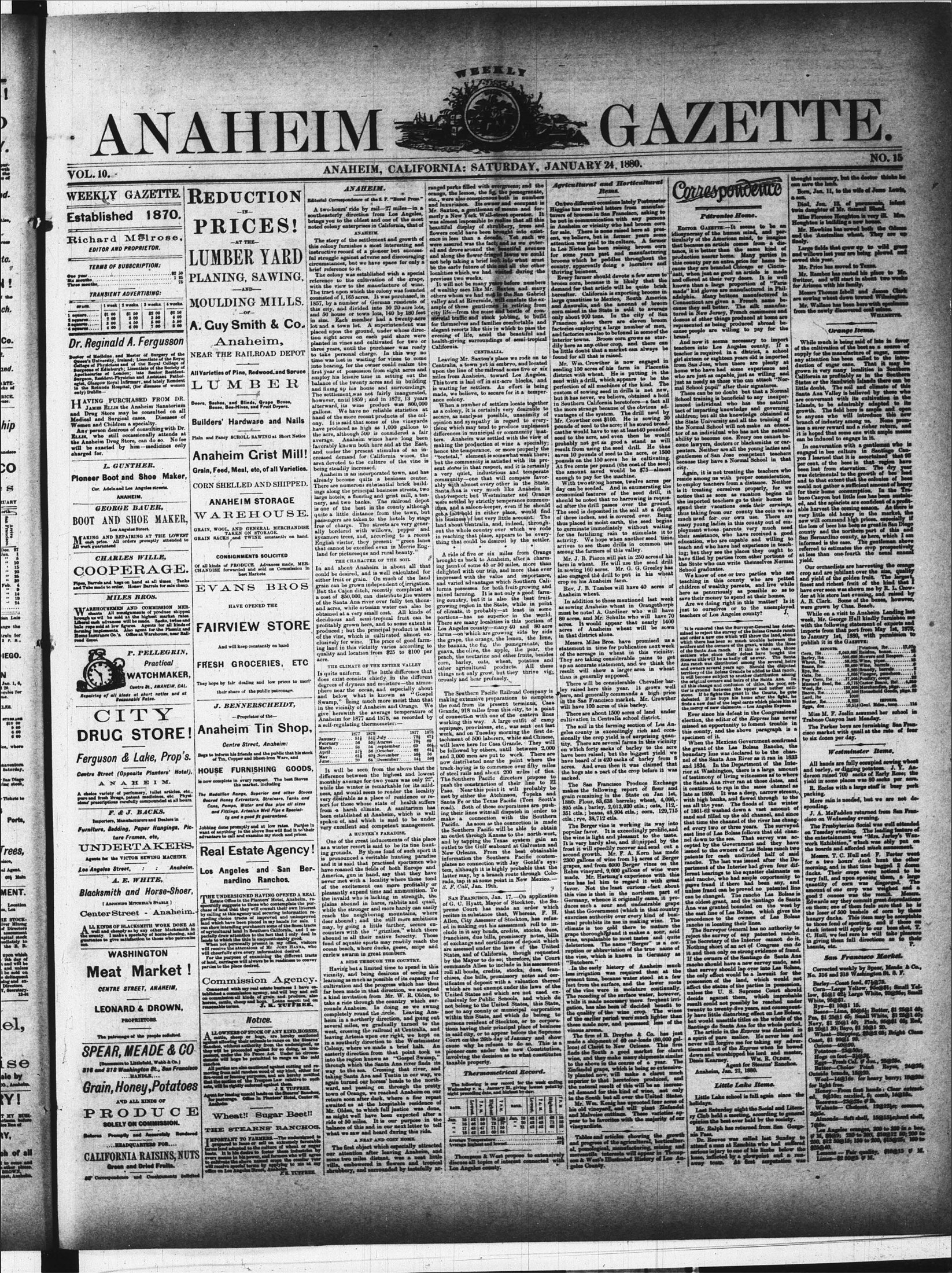
Searchable text
ANAHEIM
VOL. 10.
WEEKLY GAZETTE.
Established 1870.
Richard Melrose,
EDITOR AND PROPRIETOR.
TERMS OF SUBSCRIPTION:
One year.....$2 50
Six months.....1 25
Three months.....75
TRANSIENT ADVERTISING:
SPACE.
1 week
2 weeks
3 weeks
4 weeks.
1 square.....$1 00
2 squares.....2 00
3 squares.....2 00
4 squares.....4 00
5 squares.....4 00
6 squares.....6 00
Dr. Reginald A. Fergusson
Doctor of Medicine and Master of Surgery of the Queen's University, Ireland; Licentiate of the Royal College of Physicians and of the Royal College of Surgeons of Edinburgh; Licentiate of the Society of Apothearies of London; late Senior Resident-Surgeon, Resident-Physician and Assistant Pathologist, Glasgow Royal Infirmary, and lately Remendent in the Rotunda Hospital, (for diseases of women only) Dublin.
HAVING PURCHASED FROM DR. JAMES ELLIS the Anaheim Sanatorium and Drug Store may be consulted on all Medical and Surgical cases. Diseases of Women and Children a speciality.
Any person desirous of consulting with Dr. Ellis, who still occasionally attends at the Anaheim Drug Store, can do so. No fee will be exacted by him—medicines only charged for.
L. GUNTHER.
REDUCTION IN PRICES!
AT THE LUMBER YARD PLANING, SAWING, AND MOULDING MILLS.
OF
A. Guy Smith & Co.
Anaheim,
NEAR THE RAILROAD DEPOT
All Varieties of Pine, Redwood, and Spruce LUMBER
Doors, Sashes, and Blinds, Grape Boxes, Boxes, Bee-Hives, and Fruit Dryers.
Builders' Hardware and Nails
Plain and Fancy SCROLL SAWING at Short Notice
Anaheim Crist Mill!
Grain, Feed, Meal, etc., of all Varieties.
HAVING PURCHASED FROM DR. JAMES ELLIS the Anaheim Sanatorium and Drug Store may be consulted on all Medical and Surgical cases. Diseases of Women and Children a specialty.
Any person desirous of consulting with Dr. Ellis, who still occasionally attends at the Anaheim Drug Store, can do so. No fee will be exacted by him—medicines only charged for.
L. GUNTHER,
Pioneer Boot and Shoe Maker,
Cor. Adele and Los Angeles streets.
ANAHEIM.
GEORGE BAUER,
BOOT AND SHOE MAKER,
Los Angeles Street.
MAKING AND REPAIRING AT THE LOWEST mash price. All orders promptly attended to All work guaranteed.
CHARLES WILLE,
COOPERAGE.
Pipes, Barrels and kegs on hand at all times. Tanks and Tube made to order. Honev Barrels for sale cheap.
MILES BROS.
WAREHOUSEMEN AND COMMISSION MERCHANTS. All consignments of produce shipped through us will be sold at the highest market rates. Liberal cash advances will be made. Sacks, twine and bale rope sold at low figures. Agents for all kinds of forming implements. Also agent for the Phoenix and Home Insurance Co.'s. Office at Warehouse, near Railroad deset.
P. PELLEGRIN,
Practical WATCHMAKER,
Centre St., ANAHEIM, CAL.
Repairing of all kinds at short notice and at Reasonable Rates.
CITY DRUG STORE!
Ferguson & Lake, Prop's.
Centre Street (Opposite Planters' Hotel).
ANAHEIM.
A choice variety of perfumery, toilet articles, etc., pure and fresh Drugs, patent medicines, etc. Physiotherapies carefully compounded at all hours.
F. & J. BACKS.
Importers, Manufacturers and Dealers in Furniture, Bedding, Paper Hangings, Picture Frames, etc,
UNDERTAKERS,
Agents for the VICTOR SEWING MACHINE.
Los Angeles Street, : Anaheim.
A. E. WHITE,
Blacksmith and Horse-Shoer,
ALL VARIETIES OF PINE, NOCHESTER
LUMBER
Deers, Bees, and Blinds, Grape Boxes,
Boxes, Bee-Hives, and Fruit Dryers.
Builders' Hardware and Nails
Plain and Fancy SCROLL SAWING at Short Notice
Anaheim Crist Mill!
Grain, Feed, Meal, etc, of all Varieties.
CORN SHELLED AND SHIPPED.
ANAHEIM STORAGE
WAREHOUSE.
GRAIN, WOOL, AND GENERAL MERCHANDISE TAKEN ON STORAGE.
GRAIN RACKS and TWINE constantly on hand.
CONSIGNMENTS SOLICITED
Of all kinds of PRODUCE. Advances made, MERCHANDISE forwarded and sold on Commission in best Markets.
EVANS BROS
HAVE OPENED THE FAIRVIEW STORE
And will keep constantly on hand
FRESH GROCERIES, ETC
They hope by fair dealing and low prices to merit their share of the public patronage.
J. BENNERSCHEIDT,
Proprietor of the Anaheim Tin Shop,
Centre Street, Anaheim:
Begs to inform his friends and the public that his stock of Tin, Copper and Sheet-Iron Ware, and HOUSE FURNISHING GOODS,
is now complete in every respect. The best Stoves the market, including
The Medallion Range, Superior and other Stoves Geared Honey Extractors, Strainers, Tanks and Cans, Pumps, Water and Gas pipe all sizes and Fittings. Artesian Well Pipe a Specialty and a good fit guaranteed.
Jobbing done promptly and at low rates. Parties in want of anything in the above line will find it to their advantage to call and examine my stock and prices.
Real Estate Agency!
Los Angeles and San Bernardino Ranchos.
THE UNDERSIGNED HAVING OPENED A REAL
EMPLOY his leisure balance of the two and fixing up his The settlement w however, until 18 afterward, its w gallons. We have band of the more ony. It is said that have produced ad the acre, although average. Anah favorably known and under the creased demand area devoted to being steadily in Anaheim is already become There are numerous things along the large hotels, a fiffinery, and two livery, and two is one of the few quite a little d passengers are free of charge. ally bordered sycamore trees, English visitor that cannot be e land for picture.
THE CHART In and about could be desired either fruit or grain can be grown But the Cajon cost of $50,000 of the Santa Ana and acres, while obtained at a very deciduous and profitably grown produced; but of the vine, which clusively for wir ing land in this quality and local acre.
THE CLIMATE Is quite uniform does exist conde degrees of dryness there near the and below we Swamp," being in the vicinity give herewith Anaheim for live a self-regulating January February March April May June.
It will be difference between monthly averages while the windiness, and woolly desirable sort for those from a harsh been established spoken of, and very excellent One of the less as a winter rearing grounds is pronounced and it is said have roamed America, gun never met wit of the exciting pleasantly ex
F. & J. BACKS.
Importers, Manufacturers and Dealers in
Furniture, Bedding, Paper Hangings, Picture Frames, etc,
UNDERTAKERS,
Agents for the VICTOR SEWING MACHINE.
Los Angeles Street, : Anaheim.
A. E. WHITE,
Blacksmith and Horse-Shoer,
[ ADJOINING MITCHELL'S STABLE ]
Center Street - Anaheim.
ALL KINDS OF BLACKSMITH WORK DONE AS well and cheaply as by any other blacksmith in the county. I make a specialty of horse-shoeing, and guarantees to give satisfaction to those who patronize me.
WASHINGTON
Meat Market!
CENTRE STREET, ANAHEIM,
LEONARD & DROWN,
PROPRIETORS.
The patronage of the people solicited.
SPEAR, MEADE & CO
(Successors to Littlefield, Webb & Co.)
316 and 318 Washington St., San Francisco
HANDLE....
Grain, Honey, Potatoes
AND ALL KINDS OF PRODUCE
SOLELY ON COMMISSION.
Rather promptly and accurately handled
....HEADQUARTERS FOR....
CALIFORNIA RAISINS, NUTS
Green and Dried Fruits.
Correspondence and Concerns Solicited
Real Estate Agency!
Los Angeles and San Bernardino Ranchos.
THE UNDERSIGNED HAVING OPENED A REAL
Estate Office in the Planters' Hotel, Anaheim, respectfully suggest to those who contemplate the purchase of land that they will consult their own interest by calling at this agency and securing information regarding choice tracts of improved and unimproved land which have been placed in my hands for sale. I can show intending purchasers some of the finest tracts of agricultural land in Southern California, and I especially draw attention to the fact that I only deal in lands to which the title is unquestionably good.
When not personally present in my office, visitors will receive the attentions of Mr. John Hanxia, who will cheerfully give every information desired.
For the purpose of examining the different tracts of land, carriages will always be in readiness to convey parties to the place desired.
Commission Agency.
Connected with my real estate business I have established a commission agency, and will buy and sell on commission all kinds of grain and produce, also horses, cattle, sheep and hogs. Loans negotiated on reasonable terms.
J. K. TUFFREE.
Notice.
ALL OWNERS OF STOCK OF ANY KIND, HORSES, cattle, sheep or hogs, are hereby cautioned against allowing their animals to range on the Stearns' Ranches, without authority from the undersigned, so they will be proceeded against for so doing, as trespassers, under the No Punce Act. Under no circumstances will hogs be permitted to range on the said ranches.
All parts are also cautioned against cutting and removing from said ranches wood of any kind, either for firewood or fencing purposes, and are hereby notified that the station of the Tregan Law relative to such acts will be rigidly enforced against them.
Agent for landing unpaid lands on the Stearns' Ranches, for pestura. Office in Planters' Hotel, Center St. Anaheim.
Wheat!! Sugar Beet!!
THE STEARNS' RANCHOS.
IMPORTANT TO FARMERS—The undersigned is prepared to lease or sell on extremely favorable terms hand adapted to the culture of wheat or sugar beets. It is his desire to foster these industries by every means he power, and farmers who will agree to cultivate the above manure from the comber year will receive special terms by applying to me at my office on Los Angeles Street, Anaheim.
J. K. TUFFREE.
ANAHEIM, CALIFORNIA: SATURDAY, JANUARY 24, 1880.
ANAHEIM.
Editorial Correspondence of the S. F. "Rural Press."
A two-hours' ride by rail—27 miles—in a southeasterly direction from Los Angeles, brings you to the oldest and one of the most noted colony enterprises in California, that of ANAHEIM.
The story of the settlement and growth of this colony furnishes a most interesting and instructive record of a pioneer but successful struggle against adverse and discouraging circumstances, but we have space for only a brief reference to it.
The colony was established with a special reference to the cultivation of the grape, with the view to the manufacture of wine. The tract upon which the colony was founded consisted of 1,165 acres. It was purchased, in 1857, by a number of German residents of this city, and divided into 50 20-acre lots, and 50 house or town lots, 140 by 180 feet in size. Each member had a twenty-acre lot and a town lot. A superintendent was placed upon the ground, under whose direction eight acres on each paid share were planted in vines and cultivated for two or three years, until the purchaser was ready to take personal charge. In this way no time was lost in waiting for vines to come into bearing, for the owner could realize the first year of possession from eight acres and employ his leisure time in setting out the balance of the twenty acres and in building and fixing up his house and surroundings. The settlement was not fairly inaugurated, however, until 1859; and in 1872, 13 years afterward, its wine product was 800,000 gallons. We have no reliable statistics at hand of the more recent products of the colony. It is said that some of the vineyards have produced as high as 1,000 gallons to the acre, although 500 is considered a fair average. Anaheim wines have long been favorably known both here and at the East, and under the present stimulus of an increased demand for California wines, the area devoted to the culture of the vine is being steadily increased.
ANAHEIM is an incorporated town, and has ranged parks filled with evergreens; and the orange, the lemon, the fig, the pomegranate, etc., were also conspicuous both in numbers and luxuriance. Its owner and occupant is Mr. Saxton, a gentleman of means and formerly a New York Wall-street operator. It was almost impossible to realize that all this beautiful display of shrubbery, trees and flowers could have been brought into existence in less than a decade. Yet such we were assured was the fact; and as we entered and drove around the beautiful avenues and along the flower-fringed lawns we could not help taking a brief look into what must be the early future of this and all the other localities which we had visited during the previous two weeks.
It will not be many years before numbers of wealthy men like Mr. Saxton and many others whom we had met in the San Gabriel valley and at Riverside, will emulate the example of these gentlemen in retiring from city life—from the noise and bustle of commercial traffic and stock jobbing, to build for themselves and families comfortable and elegant resorts like this in which to pass the evening of life, amid the beautiful and health-giving surroundings of semi-tropical California.
CENTRALIA.
Leaving Mr. Saxton's place we rode on to Centralia, a town yet in embryo, and located upon the line of the railroad some five or six miles from Anaheim, toward Los Angeles. This town is laid off in six-acre blocks, and is waiting for settlers. An effort is being made, we believe, to secure for it a temperance colony.
When a number of settlers locate together as a colony, it is certainly very desirable to secure, as nearly as possible, unanimity of opinion and sympathy in regard to everything which may tend to produce unpleasant differences in municipal or community matters. Anaheim was settled with the view of making the production of wine a specialty; hence the temperance, or more properly the "teetotal," element is somewhat weak there; but the community is satisfied with its present status in that respect, and it is certainly a very quiet, industrious and temperate agricultural and horticultural items.
On two different occasions lately Postmaster Higgins has received letters from manufacturers of brooms in San Francisco, asking to be put in communication with any persons in Anaheim or vicinity who had broom corn for sale. There is none raised here at present, we believe, but in former years some attention was paid to its culture. A farmer in Los Nietos has been raising broom corn for some years past and manufacturing brooms which he peddles throughout the county, apparently doing a lucrative and thriving business.
Every farmer should devote a few acres to broom corn, because it is likely that the demand for that article will be quite brisk hereafter. California is exporting brooms in large quantities to Mexico, South America and Australia, and the amount of broom corn raised in the State is said to average only about 900 tons. In the city of San Francisco alone there are eleven broom factories employing a large number of men, and factories are also to be found in some of the interior towns. Broom corn grows as sturdily here as any other crop, and there can be little doubt that a market can always be found for all that is raised.
Mr. Wm. Crowther is now engaged in seeding 150 acres of his farm in Placentia district with wheat. He is putting in the seed with a drill, which appears to be the perfection of all machines of the kind. The custom of sowing seed in drills is not new, but it has never, we believe, obtained a hold in Southern California heretofore—a fact all the more strange because of the obvious advantages of the system. The drill used by Mr. Crowther cost $100. He is sowing 30 pounds of seed to the acre; if he sowed broadcasthe would have to use at least 40 pounds of seed to the acre, and even then he would probably not get as good a stand as will result from using the seed drill. He thus saves 10 pounds of seed to the acre, or 1500 pounds on the 150 acres he is cultivating. At five cents per pound (the cost of the seed) the amount saved would be $75—almost
employ his leisure time in setting out the balance of the twenty acres and in building and fixing up his house and surroundings. The settlement was not fairly inaugurated, however, until 1859; and in 1872, 13 years afterward, its wine product was 800,000 gallons. We have no reliable statistics at hand of the more recent products of the colony. It is said that some of the vineyards have produced as high as 1,000 gallons to the acre, although 500 is considered a fair average. Anaheim wines have long been favorably known both here and at the East, and under the present stimulus of an increased demand for California wines, the area devoted to the culture of the vine is being steadily increased.
Anaheim is an incorporated town, and has already become quite a business center. There are numerous substantial brick buildings along the principal business streets, two large hotels, a flouring and grist mill, a tannery, and two banks. The railroad depot is one of the best in the county although quite a little distance from the town, but passengers are taken to the hotels by stage free of charge. The streets are very generally bordered with willows, pepper and sycamore trees, and, according to a recent English visitor, they present "green lanes that cannot be excelled even in Merrie England for picturesque and rural beauty."
THE CHARACTER OF THE SOIL
In and about Anaheim is about all that can be desired, and is well calculated for either fruit or grain. On much of the land grain can be grown independent of irrigation. But the Cajon ditch, recently completed at a cost of $50,000, can distribute the waters of the Santa Ana river over fully ten thousand acres, while artesian water can also be obtained at a very small cost. All kinds of deciduous and semi-tropical fruit can be profitably grown here, and to some extent is produced; but the principal product is that of the vine, which is cultivated almost exclusively for wine. The price of good farming land in this vicinity varies according to quality and location from $25 to $100 per acre.
THE CLIMATE OF THE ENTIRE VALLEY
Is quite uniform. The little difference that does exist consists chiefly in the different degrees of dryness and moisture—the atmosphere near the ocean, and especially about and below what is known as "Gospel Swamp," being much more moist than that in the vicinity of Anaheim and Orange. We give herewith the average temperature of Anaheim for 1877 and 1878, as recorded by a self-regulating thermometer:
It will be seen from the above that the difference between the highest and lowest monthly average for two years was only 22%, while the winter is remarkable for its mildness, and would seem to render the locality very desirable as a place of residence or resort for those whose state of health suffers from a harsh climate. A sanitarium has been established at Anaheim, which is well spoken of, and which is said to be under very excellent and competent management.
A HUNTER'S PARADISE
One of the great inducements of this place as a winter resort is said to be its fine hunting grounds. By those fond of such sport it is pronounced a veritable hunting paradise and it is said that practised sportmen who have roamed the fields of both Europe and America, gun in hand, say that they have never met with a locality where those tond of the excitement can more profitably or pleasantly expend time and ammunition. To the invalid who is lacking in strength, the miles from Anaheim, toward Los Angeles. This town is laid off in six-acre blocks, and is waiting for settlers. An effort is being made, we believe, to secure for it a temperance colony.
When a number of settlers locate together as a colony, it is certainly very desirable to secure, as nearly as possible, unanimity of opinion and sympathy in regard to everything which may tend to produce unpleasant differences in municipal or community matters. Anaheim was settled with the view of making the production of wine a specialty; hence the temperance, or more properly the "teetotal," element is somewhat weak there; but the community is satisfied with its present status in that respect, and it is certainly a very quiet, industrious and temperate community—one that will compare favorably with almost every other in the State. Santa Ana is very much like Anaheim in that respect; but Westminster and Orange were settled by strictly temperance communities, and a saloon-keeper, even if he should get a foot hold in either place, would find his business of but very little account. The land about Centralia, and indeed, throughout the whole country over which we rode in reaching that place, appears to be every thing that could be desired by the settler.
A ride of five or six miles from Orange brought us back to Anaheim, after a charming jaunt of some 45 or 50 miles, more than delighted with our trip, and more than ever impressed with the value and importance, and varied advantages which Southern California possesses for both fruit-growing and mixed farming. It is not only a good farming country, but it is also the best fruiting region in the State, while in point of climate, it probably—at least in some portions—has no superior in the world. There are many localities in this portion of Los Angeles county—many 40 and 80-acre farms—on which are growing side by side the grape, the orange, the lemon, the lime, the banana, the fig, the pomegranate, the guava, the olive, the apple, the Pear, the peach, the nectarine and other fruits, besides corn, barley, oats, wheat, potatoes and other agricultural products. All these things not only grow, but they thrive vigorously and bear profusely.
The Southern Pacific Railroad Company is making extensive preparations to complete the road from its present terminus, Casa Grande, 918 miles from this city, to a point of connection with one of the eastern lines working this way. A large outfit of camp equipment, provisions, etc., was sent out last week, and on Tuesday morning the first detachment of 500 laborers, white and Chinese will leave here for Casa Grande. They will be followed by others, until between 2,000 and 3,000 men are put to work. There are now distributed near the point where the track-laying is to commence over fifty miles of steel rails and about 200 miles of ties. The Southern Pacific directors propose to push the construction of their line to El Paso. Near this point it will probably be met by either the Atchinson, Topeka and Santa Fe or the Texas Pacific (Tom Scott's road). Both of these corporations are pushing their lines within all dispatch in order to make a connection with the Southern Pacific. As soon as the connection is made the Southern Pacific will be able to obtain an outlet through Kansas to the north-west, and by typping the Texas system gain an outlet to the Gulf seaboard at Galveston and New Orleans. From the best obtainable information the Southern Pacific contemplates no connection with Jay Gould's system, although it is highly probable that the latter may, by a branch route through Colorado, tap it at some point in New Mexico.
SAN FRANCISCO, Jan. 19.
With two strong horses, twelve acres per day can be seeded. And in enumerating the economical features of the seed drill, it should be noted that no harrowing is required after the drill passes over the ground. The seed is deposited in the soil at a depth of three inches, and is covered over. Being thus placed in moist earth, the seed begins to germinate immediately without waiting for the fertilizing rain to stimulate it to activity. We hope when another seed time arrives to see these drills in common use among the farmers of this valley.
Mr. J. B. Pierce will put in 250 acres of his farm in wheat. He will use the seed drill in sowing 160 acres. Mr. G. G. Greeley has also engaged the drill to put in his wheat crop on his Anaheim farm.
Rev. J. B. Tombes will have 40 acres of Anaheim wheat.
In addition to those mentioned last week as sowing Anaheim wheat in Orangethorp must be noted A. Gardiner who will have 80 acres, and Mr Schulte who will have 70 acres. It would appear that nearly 1400 acres of Anaheim wheat will be sown in that district alone.
Messra. Miles Bros. have promised us a statement in time for publication next week of the acreage in wheat in this vicinity. They are taking considerable pains to get up an accurate statement, and we think that result will show a larger area in wheat than is generally supposed.
There will be considerable Chevalier bays raised here this year. It grows well here,and generally commands a high price in the San Francisco market. Mr. Crowthet will have 100 acres of this barley.
There are about 1500 acres of land under cultivation in Centralia school district.
The soil in the farming section of Los Angeles county is exceedingly rich and occasionally the crop yield is of surprising quantity. There are several farms in this vicinity on which forty sacks of barley to the acre have been raised; but the biggest yield have heard of is 420 sacks of barley from anaconda. And even then it was claimed that the hogs ate a part of the crop before it was sacked.
The San Francisco Produce Exchange makes the following report of flour and grain remaining in the State on Jan lst: 1880: Flour, 83,638 barrels; wheat, 4,09695 cts.; barley, 2,013,920 cts.; oats, 112315 cts.; beans, 48,904 cts.; corn, 129795 cts.; rye, 38,712 cts.
The Berger vine is working its way into popular favor. It is exceedingly prolific,andthe wine is light and pleasant to taste It is very hardy also,and if slipped by frost it will speedily recover and send out second growth.Mr F.A.Korn has mailed 2300 grains of wine from 15 acres of Berggraps,and from 6000 Berger vines on The Kehm vineyard,nine thousand gallons of wine made.Mr Hartung's experience with this vine has led him to regard it with great favor.Not the least curious fact about this vine is that in the northern part Germany whence it originally came.it
A HUNTER'S PARADISE.
One of the great inducements of this place as a winter resort is said to be its fine hunting grounds. By those fond of such sport it is pronounced a veritable hunting paradise and it is said that practised sportsmen who have roamed the fields of both Europe and America, gun in hand, say that they have never met with a locality where those tond of the excitement can more profitably or pleasantly expend time and ammunition. To the invalid who is lacking in strength, the plains abound in hares, rabbits and quail, while the stronger and more hardy can easily reach the neighboring mountains, where deer abound; and the still more ambitious may, by going a little farther, secure encounters with the "grizzlies," which there abound in all their native ferocity. Those fond of aquatic sports may readily reach the ocean beach, where ducks, geese, snippe and curlew swarm in great numbers.
A RIDE THROUGH THE COUNTRY.
Having but a limited time to spend in this vicinity, and being desirous of seeing and learning as much as possible of its capacity for cultivation and the progress which has thus far been made in that direction, we accepted a kind invitation from Mr. W. R. Olden, to take a ride through the country which surrounds Anaheim. In doing so we swung completely round the circle. Leaving Anaheim in a northerly direction, and going out several miles, we gradually turned to the west, crossing the railroad at Centralia, and leaving Artesa upon our right, we kept on in a southerly direction to the Westminster Colony, where we made a brief halt. An easterly direction from that point took us into the region known as "Gospel Swamp," through which the Santa Ana river finds its way to the sea. Crossing that river, and taking Santa Ana and Tustin in our way, we again turned our horses' heads to the northward, and passing on through the pretty town of Orange, we reached Anaheim on our return soon after dark, where a fine repeat awaited us at the hospitable residence of Mr. Olden, to which full justice was done, as might well have been expected after a ride of 50 miles. It is our purpose in the balance of this and in our next letter to tell what we saw and heard during this ride.
A NEAT AND COSY HOME.
The first object which especially attracted our attention after leaving Anaheim, and some two miles distant, was a neat little villa, embowered in flowers and tropical shrubbery, and surrounded by tastefully ar-
Santa Fe or the Texas Pacific (Tom Scott's road). Both of these corporations are pushing their lines with all dispatch in order to make a connection with the Southern Pacific. As soon as the connection is made the Southern Pacific will be able to obtain an outlet through Kansas to the north-west, and by tapping the Texas system gain an outlet to the Gulf seaboard at Galveston and New Orleans. From the best obtainable information the Southern Pacific contemplates no connection with Jay Gould's system, although it is highly probable that the latter may, by a branch route through Colorado, tap it at some point in New Mexico.—S. F. Call, Jan. 19th.
SAN FRANCISCO, Jan. 17.—On application of G. C. Hyatt, Mayor of Stockton, the Supreme Court has made an order which recites in substance that, Whereas, F. H. Allen, City Assessor of Stockton, has refused in making out his assessment roll to include in it any bonds, stocks, dues, franchises, due bills, promissory notes and certificates of deposit with a valuation thereof which are not exempt under the laws of the United States and which are not used exclusively for Public Schools, and which do not belong to the United States, this State, nor to any county or municipal corporation within this State, and which do belong to persons resident of Stockton, or to corporations having their principal place of business in said city, or to appear before the Supreme Court on the 26th day of January and show cause why he refuses to do so. This is a pioneer case under the new Constitution, involving the decision as to what constitutes taxable property.
Thermometrical Record.
The following is our record for the week ending Wednesday p.m., January 21, giving lowest point night preceding data, and highest by day:
DATE
Jan. 15 52 59 75 88 Jan. 19 42 42 68 55
" " 16 46 50 73 87 " " 20 43 43 71 58
" " 17 45 47 71 55 " " 21 42 42 60 55
" " 15 42 42 60 54
Average Temperature.....54
Average highest and lowest.....57
Thompson & West propose to extensively discuss all topics of interest connected with Los Angeles county.
The Berger vine is working its way into popular favor. It is exceedingly prolific, and the wine is light and pleasant to the taste. It is very hardy also, and if nipped by the frost it will speedily recover and send out second growth. Mr. F. A. Korn has made 2300 gallons of wine from 1½ acres of Berger grapes, and from 6000 Berger vines on the Kehm vineyard, 9,000 gallons of wine were made. Mr. Hartung's experience with the vine has led him to regard it with great favor. Not the least curious fact about this vine is that in the northern part of Germany, whence it originally came, it produces such a sour and undesirable grape that the Government (which in that country exercises authority over every kind of business) prohibits its use in making wine. The climate is too cold there to mature the grape thoroughly; and it makes a sour, sweet, unpalatable to most tastes and quail deleterious. The name "Berger" is a corruption or abbreviation of the true name of the vine, which is known in Germany ("Butheera").
In the early history of Anaheim less irrigation was required than at present time because water stood at a feet from the surface, and the lower row of the vine were in moisture continue. The receding of the surface water, however while it made necessary more frequent irrigation, has also been of decided benefit in quality of the wine crop. The winemaking of the earlier period were much lighter than those made now, and possessed less of vinous aroma.
The firm of B. Dreyfus & Co. has made a shipment of 40 car-loads (80,000 lone) of Claret to New Orleans. This finds the South a good market for clive wine, and they make many shipments similar to the above in the course of a year.
Zinfandel grape, which is being so extensively planted now, will make a claret wine superior to that heretofore produced, the natural result of this will be an increased demand for this kind of wine, not only in the South but all over the United States.
Mr. Wm. Konig has uprooted four acres his old vineyard, and will plant Zinfandel and Malvoise cuttings. These varieties pear to be favorites with the majority of vineyardists.
Tables and articles showing the growth and progress of the agricultural, horticultural, pomological, manufacturing, mining mercantile interests will appear in The sun & West's Illustrated History of Los Angeles County.
GAZETTE.
Y 24, 1880. NO. 15
Correspondence
Patronise Home.
EDITOR GAZETTE:—It seems to be an idiosyncrasy of the human mind, and particularly of the American mind, to imagine that because an article comes from a distance, it is better than the same kind of production nearer home. Many parties in this county pay an extra price for hams because they are branded Chicago or Cincinnati, when just as good an article is made and offered at their very doors. It is well known than a large proportion of "Paris made" kid gloves are manufactured in Philadelphia. Many buttons manufactured in Connecticut are given a French name because they sell better. The silk manufactured in New Jersey, French cannimores and dozens of other things produced at home are represented as being produced abroad because people are willing to pay for the brand.
And now it seems necessary to import teachers into Los Angeles county. If a teacher is required in a district, a school girl sixteen or eighteen years old is imported from San Jose, when there are plenty at home who have had some experience and who are just as capable, just as willing and just as needy as those who can attach "Normal School pupil" after their signatures.
There can be no doubt but that a Normal School training is beneficial to any inexperienced individual who has the natural tact of imparting knowledge and governing children; but all the knowledge obtained at the State University and all the training of the Normal School will not make an educator of an individual who has not the natural ability to become one. Every one cannot become lawyers, doctors or blackamiths or carpenters. Neither are all the young ladies and gentlemen of San Jose competent teachers because they have a Normal School in that city.
Again, it is not treating the teachers who thought necessary, but the doctor thinks he can save the him.
Born, Jan. 11, to the wife of Jemele Lewis, a son.
Died, Jan. 12, of pneumonia, infant twin daughter of Mr. Samuel Blind.
Miss Florence Houghton is very ill. Mrs. Houghton is building a new house.
Mr. Hawkins has sowed both the Oranges and the Australian wheat. They are up finally.
Large fields that grow up to wild grass and willows last year are being plowed and sowed this year.
Mr. Price has moved to Texas.
Mr. Rambos has rented his place to Mr. Switzer, and will start in about two weeks for Arizona with his family.
Messrs Thomas Isbell and James Clark are sowing wheat down toward Wilmington.
Mr. Wallace has been here with openness from the newly discovered coal mines.
WELLNETTE.
Orange Items.
While much is being said of late in favor of the cultivation of the best as a source of supply for the manufacture of sugar, access any attention has been called to the introduction of sugar cane. That it may be grown in very many localities in Southern California as profitably as in the southern States or the Sandwich Islands there can be little doubt. The soil and climate of this Santa Ana Valley is believed by those who are conversant with its cultivation in the Islands, to be admirably adapted to its growth. The field here is ample and open to anyone who will introduce this new branch of industry among us. None promises a surer reward and a richer return, and it is hoped that some one with ample means can be induced to engage in it.
In conversation with a gentleman who is engaged in bee culture in Santiago Canyon I learned that it is ascertained that 90 per cent. of the bees in that region have been lost from starvation. The dry year was detrimental to the growth of bee feed
He is putting in the machines of the kind. The seed in drills is not new, we believe, obtained a hold of California heretofore—a fact all because of the obvious advantage. The drill used by most $100. He is sowing 30 to the acre; if he sowed broadly to use at least 40 pounds of corn and even then he would just as good a stand as will bring the seed drill. He thus had of seed to the acre, or 1500 to 1550 acres he is cultivating. For pound (the cost of the seed) would be $75—almost for the machine.
Long horses, twelve acres per hectare. And in enumerating the acres of the seed drill, it is that no harrowing is required passes over the ground. Occasionally rain to stimulate it to cope when another seed time these drills in common use occurs of this valley.
Force will put in 250 acres of his land. He will use the seed drill acres. Mr. G. G. Greeley has the drill to put in his wheat aheim farm.
Bombes will have 40 acres of land.
No those mentioned last week hein wheat in Orangethorpe A. Gardiner who will have Mr. Schulte who will have 70 yield appear that nearly 1400 hein wheat will be sown alone.
Has Bros. have promised us a time for publication next week in wheat in this vicinity. Being considerable pains to get statement, and we think the show a larger area in wheat really supposed.
More considerable Chevalier barre this year. It grows well generally commands a high price Francisco market. Mr. Crowther acres of this barley.
About 1500 acres of land under Centralia school district.
The farming section of Los Angeles exceedingly rich and occa-crop yield is of surprising quan-ere several farms in this vicinity sacks of barley to the acre seed; but the biggest yield we is 420 sacks of barley from 8 even then it was claimed that part of the crop before it was Francisco Produce Exchange following report of flour and ing in the State on Jan lst, 83,638 barrels; wheat, 4,096; levy, 2,013,920 ctls; oats, 112-na, 48,904 ctls; corn, 129,715 712 ctls.
Vine is working its way into it. It is exceedingly prolific, and right and pleasant to the taste.甜 also, and if nipped by the specially recover and send out a shn. Mr. F. A. Korn has made of wine from 1½ acres of Berger from 6000 Berger vines on the ord, 9,000 gallons of wine were Hartung's experience with this him to regard it with great the least curious fact about that in the northern part of chance it originally came, it pro-
It is exceedingly prolific, right and pleasant to the taste. Body also, and if nipped by the speedily recover and send out a bch. Mr. F. A. Korn has made of wine from 1½ acres of Berger from 6000 Berger vines on the third, 9,000 gallons of wine were Hartung's experience with this him to regard it with great interest the least curious fact about that in the northern part of influence it originally came, it proves sour and undesirable grape government (which in that country authority over every kind of business its use in making wine. The too cold there to mature the nightly and it makes a sour, acid stable to most tastes and quite abbreviation of the true name of which is known in Germany as history of Anaheim much longer was required than at the time, because water stood at a few feet the surface, and the lower roots were in moisture continually. Of the surface water, however, the necessary more frequent irrigation been of decided benefit to the wine crop. The wines later period were much lighter than now, and possessed less of the ana.
Of B. Dreyfus & Co. has just moment of 40 car-loads (80,000 gallons) to New Orleans. This firm south a good market for claret may make many shipments similar in the course of a year. The rape, which is being so extensive now, will make a claret much that heretofore produced, and result of this will be an increase for this kind of wine, not only but all over the United States. Konig has uprooted four acres of hayard, and will plant Zinfandel vine cuttings. These varieties appeal favorites with the majority of our customers.
And articles showing the growth areas of the agricultural, horticultural, manufacturing, mining and interests will appear in Thompson's Illustrated History of Los Angeles.
Little Lake Items.
Little Lake school is full again since the holidays.
Last Saturday night the Social and Literary Club held a meeting, according to general opinion the best ever held by the society.
Mr. Ralph has returned from San Gorgonia Pass.
Dr. Reeves was called last Sunday to attend a man at Ranchita who had suffered serious injury to one of his limbs below the knee, inflicted by a pawpoint and a runaway team. At first amputation was More rain is needed, but we are not responding.
J. A. McFadden returned from San Francisco on Wednesday evening.
The Presbyterian Social was well attended on Tuesday evening. The leading feature of the entertainment was "Mrs. Jarley's Waxwork Exhibition," which was able put on the boards and afforded much amusement.
Messrs. T. C. Hull and P. Porter went for a two hours' duck hunt the other morning, and in that time bagged $2 dozen ducks. Their crops were noticed to be very full, and upon opening them, a large quantity of corn was disgorged. The amount of one crop was weighed and a good 2 ounces was the result. Messrs. Edwards say they commit great depredations on them; one of them feels sure that he is the loser of 500 bushels of corn by these hungry ducks. This item may be acceptable to those fond of sporting, and if those on duck intent will apply to our home shot, T. C. Hull, we feel sure he will take pleasure in giving them full directions as to their haunts, etc.
San Francisco Market.
Corrected weekly by Spear, Manda & Co., No. 316 and 318 Washington St. S. P.
Barley—Coast feed, 671@75.
Corn—Large Yellow, 95c@81; Small Yellow, $1@102; Large White, 90c@9a; Small White, 95c@81.
Bye—$110@115.
Beans—Lima, $5@61; Butter, $125@140; Peas, $125@145; Small White, $125@140; Navy, $125@140; Pink, 95c@81; Red, $120@120; Bayo, $110@120.
Wheat—Shipping, $2@205; Bright Clean Coast, $190@195.
Onions—40@90.
Potatoes—25@50c;
Hogs on foot—31@22.
Eggs—Fresh Calc. $4 don.; 26@25a.
Butter—Choice Point Hayon, 24@25a; Outside brands, 15@20.
Wool—14@16c for heavy burry; 18@20c for light free.
Honey—From first hands: Clear extracted, 9@10c; cashed; 8; comb, 14@18c.
Beewax—23@25e @hb.
Walnuts—Chaiestet, 12@12jc; common, 2@5e.
Almonds—Soft shell, 15@15jc; hard shell, 7@8c.
Los Angeles crungen, 200 to 350 in a box, @M, @9@9; 250 to 300, @10@1250; 200 to 250, $1250@15; 150 to 200, @15@25; 150 to $25@40.
Lemonne — Fair quality, @M. Limice—$29@@5 @M.