anaheim-gazette 1879-11-28
Scanned page
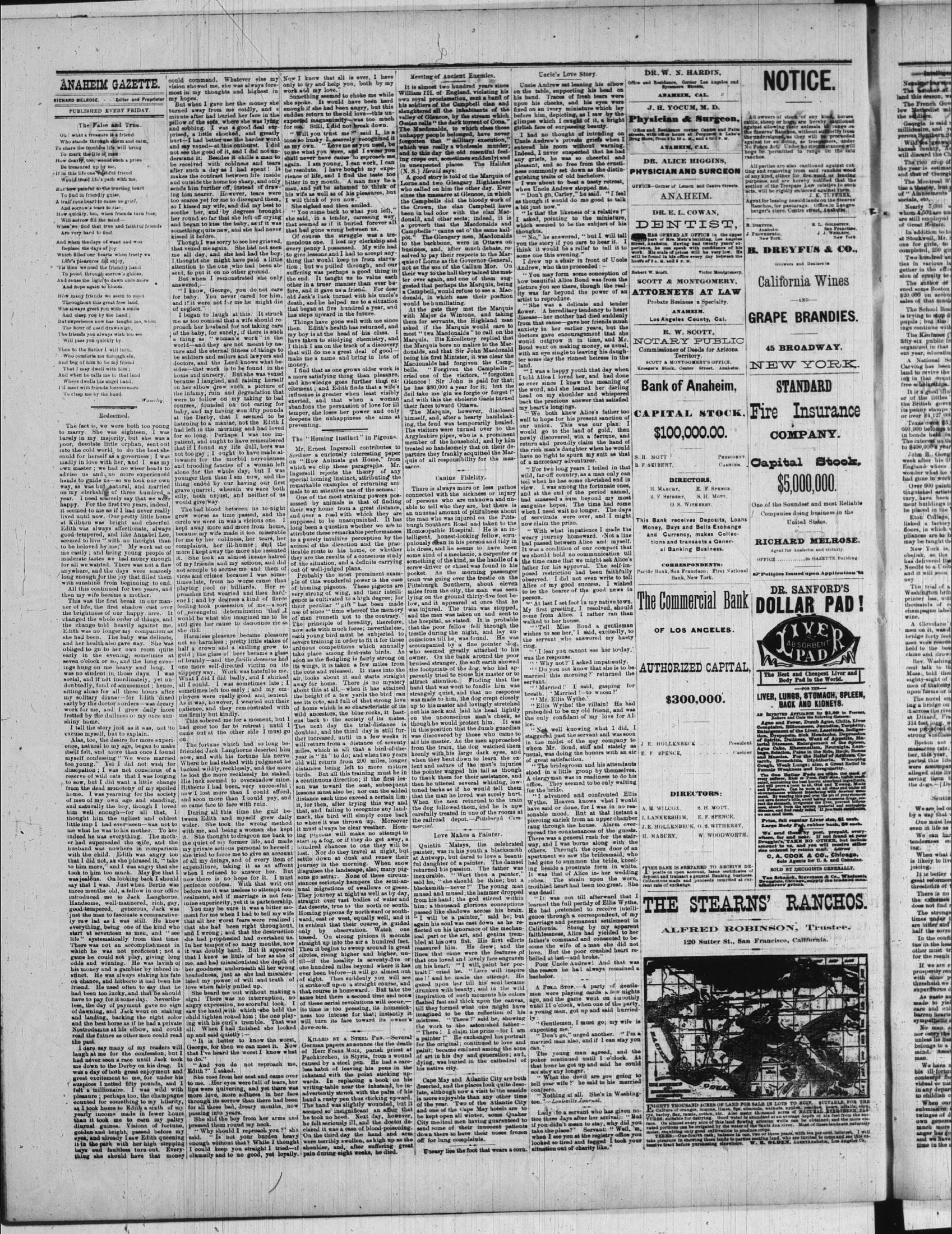
Searchable text
ANAHEIM GAZETTE.
RICHARD MELROSE. Editor and Proprietor
PUBLISHED EVERY FRIDAY.
The False and True.
Oh! what a treasure is a friend
Who stands through storm and calm,
To share the troubles life will bring
To mark the life of man:
How dearly, too, would such a prize
Be treasured up by me,
If in this life one worthful friend
Would treat life's path with me.
But how painful to the trusting heart
To find in friendly guise,
A trait runs heart to cause us grief,
And sorrow's tears to rise;
How quickly, too, when friends turn foes,
Will sorrow fill the mind—
When we find that true and faithful friends
Are very hard to find.
And when the days of want and woe
Replace the days of joy
Which filled our hearts when freely we
Life's pleasures did enjoy,
Tis then we need the friendly hand
To point through sorrow's gloom,
And cause the light to dawn once more
And hope again to bloom.
How many friends we seem to meet
Throughout this great free land,
Who always greet you with a smile
And clasp you by the hand;
But experience now has taught me, when
The hour of need draws nigh,
The friends you always wish too see
Will pass you quickly by.
Then to the Savior I will turn,
Who comforts me through sin,
And beg of him to be my friend
That I may dwell with him;
And when he calls me to that land
Where dwells his angel band,
I'll meet with friends forevermore
To clasp me by the hand.
Waserley
Redeemed.
The fact is, we were both too young to marry. She was eighteen, I was barely in my majority, but she was a poor, desolate little orphan, sent out into the cold world, to do the best she could for herself as a governess; I was could command. Whatever else my vision showed me, she was always foremost in my thoughts and highest in my hopes.
But when I gave her the money she turned away from me coldly, and a minute after had buried her face in the pillow of the sofa, where she was lying and sobbing. I was a good deal surprised, a little shocked, and greatly hurt—I had better use the harder word and say vexed—at this outburst. I did not see the good of it, and I did not understand it. Besides it chills a man to be received with coldness and tears after such a day as I had spent. It makes the contrast between life inside and outside the home too sharp, and only sends him further off, instead of drawing him nearer. However, tears were too scarce yet for me to disregard them, so I kissed my wife, and did my best to soothe her, and by degrees brought her round so far that she left off crying and began to kiss the baby, as if it was something quite new, and she had never kissed it before.
Though I was sorry to see her grieved, that vexed me again. She had not seen me all day, and she had had the boy. I thought she might have paid a little attention to the one who had been absent, to put it on no other ground.
But when I remonstrated she only answered,
"I know, George, you do not care for baby. You never cared for him, and if it were not for me he might die of neglect."
I began to laugh at this. It struck me as too comical that a wife should reproach her husband for not taking care of the baby, for surely, if there is such a thing as "woman's work" in the world—and they are not meant by nature and the eternal fitness of things to be soldiers and sailors and lawyers and doctors, and the Lord knows what besides—that work is to be found in the home and nursery. But she was vexed because I laughed, and raising herself on her elbow drew such a picture of the infamy, ruin and degradation that were to follow on my taking to bad courses, founded on not caring for baby, and my having won fifty pounds at the Derby, that I seemed to be listening to a maniac, not the Edith I had left in the morning and had loved for so long. Perhaps I was too impatient, and ought to have remembered that if I found my life dull, hers was not too gay; I ought to have made allowance for the morbid nervousness.
Now I know that all is only to try and help you work and my love."
Something seemed to change she spoke. It would have enough if she had been an sudden return to the old life expected magnanimity—for me. Still, I did not.
"Will you trust me?"
tone so husky I scarceely as my own. "Love me as to me what you were, and shall never have cause to again. I am young, I can be resolute. I have borne rience of life, and I find bitter in my mouth. A man, and yet be ashamed his wife as well as of his wife. I will think of you now."
She sighed and then said,
"You come back to wife said, in a tender mood that seemed as if it hurried that had gone wrong better.
Of course the struggle mended one. I lost my every penny I possessed; to give lessons and I had thing that would keep us tion; but we pulled thrust suffering was perhaps at the end. It taught us other in a truer manner fore,and it gave us a friend old Jack's luck turned w death, and he helped me that began at five hundred has steps upward in the things have gone well then. Edith's health had my boy is at the head of have taken to studying that I think I am on the track that will do me a great make me a name and buy money.
I find that as one grows a more satisfying thing and knowledge goes from citement; and Edith finds influence is greater when exerted, and that which abandons the persuasion temper, she loses her pep deepens the unhappiness preventing."
Redeemed.
The fact is, we were both too young to marry. She was eighteen, I was barely in my majority, but she was a poor, desolate little orphan, sent out into the cold world to do the best she could for herself as a governess; I was madly in love with her, and I was my own master; we had no wiser heads to advise us and no more experienced hands to guide us—so we took our own way, as was but natural, and married on my clerkship of three hundred a year. I need scarcely say that we were happy. For the first two years, indeed, it seemed to me as if I had never really lived until now. Our pretty little home at Kilburn was bright and cheerful. Edith was always affectionate, always good-tempered, and like Annabel Lee, seemed to live "with no thought than to be beloved by me;" My work sat on me easily; and being young people of moderate tastes we had money enough for all we wanted. There was not a flaw anywhere, and the days were scarcely long enough for the joy that filled them with sunshine from beginning to end.
All this continued for two years, and then my wife became a mother.
This was the first break in our manner of life, the first shadow cast over the brightness of our happy love. It changed the whole order of things, and the change told heavily against me. Edith was no longer my companion as she had been. The baby was delicate, and her health also gave way. She was obliged to go to her own room quite early in the evening, sometimes at seven o'clock or so, and the long evenings hung on me heavy and long. I was no student in those days. I was social, and if not inordinately, yet undoubtedly, fond of amusement; hence, sitting alone for all these hours after my solitary dinner—for Edith dined early by the doctor's orders—was dreary work for me, and I grew daily more fretted by the dullness or my once sunshiny home.
I tell the story just as it was, not to excuse myself, but to explain.
Alas, too, the desire for more experience, natural to my age, began to make itself felt, and more than once I found myself confessing "We were married too young." Yet I did not wish for dissipation; I was not conscious of a reserve of wild oats that I was longing to sow, but I did want a little change from the dead monotony of my spoiled home. I was yearning for the society of men of my own age and standing, and naturally the boy, though I loved him well enough—for all that, I thought him the ugliest and oddest little imp I had ever seen—was not to me what he was to his mother. To her indeed he was everything. The mother had superseded the wife, and the husband was nowhere in comparison with the child. Edith was angry too that I did not, as she phrased it, "take to him more," and I was angry that she took to him too much. Maybe that I doctors, and the Lord knows what besides—that work is to be found in the home and nursery. But she was vexed because I laughed, and raising herself on her elbow drew such a picture of the infamy, ruin and degradation that were to follow on my taking to bad courses, founded on not caring for baby, and my having won fifty pounds at the Derby, that I seemed to be listening to a maniac, not the Edith I had left in the morning and had loved for so long. Perhaps I was too impatient, and ought to have remembered that if I found my life dull, hers was not too gay; I ought to have made allowance for the morbid nervousness and brooding fancies of a woman left alone for the whole day, but I was younger then than I am now, and the thing ended by our having our first grave quarrel, wherein we were both silly, both unjust, and neither of us would give way.
The bad blood between us to-night grew worse as time passed, and the circle we were in was a vicious one. I kept away more and more from home, because my wife made it too miserable for me by her coldness, her tears, her complaints, her ill-humor; and the more I kept away the more she resented it. She took an almost insane hatred of my friends and my actions, and did not scramble to accuse me and them of vices and crimes because I was sometimes late, from no worse cause than playing pool or billiards. Her reproaches first wearied and then hardened; and by degrees a kind of fierce feeling took possession of me—a sort of revengeful determination that I would be what she imagined me to be and give her cause to denounce me as she did.
Harmless pleasure became pleasure not so harmless; pretty little stakes of half a crown and a shilling grew to gold; the glass of beer became a glass of brandy—and the facilis decensus had one more self-directed victim on its slippery way. Work was hateful to me. What I did I did badly, and I shirked all I could. I was sometimes late; I sometimes left too early; and my employers were really good and lenient. As it was, however, I wearied out their patience, and they remonstrated with me firmly but kindly.
This sobered me for a moment, but I had gone too far to retreat; until I came out at the other side I must go on.
The fortune which had so long befriended Jack Langhorne deserted him now, and with his fortune his nerve. Where he had staked with judgment he backed wildly, recklessly, and the more he lost the more recklessly he staked. His luck seemed to overshadow mine. Hitherto I had been very succes-sful; now I lost more than I could afford, and soon more than I could pay, and so came face to face with ruin.
During all this time the gulf between Edith and myself grew daily wider. She took the wrong method with me, and being a woman she kept it. She thought to dragcon me back to the quiet of my former life, and made my private actions personal to herself; she tried to force me to give an account of all my doings, and of every item of expenditure, taking it as an afront when I refused to answer her. But
The "Homing Instinct"
Mr. Ernest Ingersoll Scribner a curiously intrigued "How Animals get which we clip these pigs Ingersoll rejects the special homing instinct remarkable examples ofmals to an attentive user.
One of the most striking ssexes by animals is their way home from a land over a road with supposed to be unacquired long been a question who attribute these remarks to a purely intuitive pet animal of the direction ticable route to his home they are the results of a of the situation, and an out of well-judged plan.
Probably the most plea of this wonderful pigeons. They very strong of wing, agence is cultivated to ad their peculiar "gift" use of since "time when of man runneth not."
The principle of her now acts with much for each young bird must severe training in order arduous competitions take place among first soon as the fledglings its wings, it is taken at the cote and released air looks about it away for home. Then about this at all—when the height of a few yea see its cote, and full o off home which is so c wild ancestors,the b ens back to the socia The next day tha doubled,and the thirther increased,t until will return from a di miles,which is all th year is "fit"to do;and old will return from distances being left birds.But all this tru a continuous direction son was toward their lessons must also be; distance each time exe it,for then,after try that,and failing to r mark,the bird will fi where it was throw it must always be cleaned pigeons will mast start in a fog,或if tha hundred chances lo lost.Nor do they settle down at dusk journey in the morris disguises the landsea
reserve of wild oats that I was longing to sow, but I did want a little change from the dead monotony of my spoiled home. I was yearning for the society of men of my own age and standing, and naturally the boy, though I loved him well enough—for all that, I thought him the ugliest and oddest little imp I had ever seen—was not to me what he was to his mother. To her indeed he was everything. The mother had superseded the wife, and the husband was nowhere in comparison with the child. Edith was angry too that I did not, as she phrased it, "take to him more," and I was angry that she took to him too much. May be that I was jealous. On looking back I should say that I was. Just when Bertie was three months old, a fellow in our office introduced me to Jack Langhorne. Handsome, well-mannered, rich, gay, good-tempered, generous, Jack was just the man to fascinate a comparatively raw lad as I was still. He knew everything, being one of the kind who start at seventeen as men, and "see life" systematically from that time. There was not an accomplishment in which he was not proficient; not a game he could not play, giving long odds and winning. He was lavish of his money and a gambler by inbred instinct. He was always staking his fate on chance, and hitherto it had been his friend. He used often to say that he had been too lucky, and that he should have to pay for it some day. Nevertheless, the day of payment gave no sign of dawning, and Jack went on staking and landing, backing the right color and the best horse as if he had a private Nostrodamus at his elbow, and could read the future as other men could read the past.
I dare say many of my readers will laugh at me for the confession, but I had never seen a race until Jack took me down to the Derby on his drag. It was a day of both great enjoyment and great excitement to me, for under his auspices I netted fifty pounds, and I felt a millionaire. I was wild with pleasure; perhaps too, the champagne counted for something to my hilarity, as I took home to Edith a sixth of my yearly income made in fewer hours than it took me to earn my paltry diurnal guinea. Visions of fortune, golden and bright, passed before my eyes, and already I saw Edith queening it in the park with her high stepping bays and faultless turn-out. Everything she should have that money
His luck seemed to overshadow mine. Hitherto I had been, very succesful; now I lost more than I could afford, and soon more than I could pay, and so came face to face with ruin.
During all this time the gulf between Edith and myself grew daily wider. She took the wrong method with me, and being a woman she kept it. She thought to drage on me back to the quiet of my former life, and made my private actions personal to herself; she tried to force me to give an account of all my doings, and of every item of expenditure, taking it as an affront when I refused to answer her. But now there is no hope for it. I must perforce confess. With that writ out before me it was useless to attempt concealment, and if marriage is not feminine superiority, yet it is partenership.
You may be sure it was a bitter moment for me when I had to tell my wife that all her worst fears were realized; that she had been right throughout, and I wrong; and that the destruction she had prophesied had overtaken us. In her temper of so many months, now it was doubly hard. But it appeared that I knew as little of her as she of me, and had miscalonated the depth of her goodness underneath all her wrong headedness, just as she had miscalculated my power of will and truth of love when fairly pulled up.
She heard me out without making a sign! There was no interruption, no angry expression, no scornful look. I saw the hand with which she held the child tighten round him; the one playing with his curl's tremble. That was all. When I had finished she looked up and said quietly:—
"It is better to know the worst, George, for then we can meet it. Now that I've heard the worst I know what to do."
"And you do not reproach me, Edith?" I asked.
She rose from her seat and came over to me. Her eyes were full of tears, her lips were quivering, and yet there was more love, more softness in her face through its sorrow than there had been for all these bad, dreary months, now passing into years.
She slid the boy from her arms and pressed them round my neck.
"Why should I reproach you?" she said. "Is not your burden heavy enough without that? While I thought I could keep you straight I tried—if clumsily and to no good, yet loyally.
Killed by a Sharp German papers analyst of Herr Franz Moltz Puchkirchen, in Saxony caused by a steel pin less habit of leaving inkstand with the wards. In replacement writing-table near advertently struck hand a rusty pen thaThe hand was slight seemed so insignificant he took no heed.he felt seriously ill clared it was a case.On the third day they were terribly swollen shoulder,and,a pain during eight w
Now I know that all is ever, I have only to try and help you, both by my work and my love."
Something seemed to choke me while she spoke. It would have been hard enough if she had been angry, but this sudden return to the old love—this unexpected magnanimity—was too much for me. Still, I did not break down.
"Will you trust me?" said I, in a tone so husky I scarcely recognized it as my own. "Love me as you used, be to me what you were, and I swear you shall never have cause to reproach me again. I am young, I can work, I can be resolute. I have bought my experience of life, and I find the taste too bitter in my mouth. A man may be a man, and yet be ashamed to think of his wife as well as of his pleasures, but I will think of you now."
She sighed and then smiled.
"You come back to what you left," she said, in a tender, caressing way, that seemed as if it buried forever all that had gone wrong between us.
Of course the struggle was a tremendous one. I lost my clerkship and every penny I possessed. My wife had to give lessons and I had to accept anything that would keep us from starvation; but we pulled through, and our suffering was perhaps a good thing in the end. It taught us to value each other in a truer manner than ever before, and it gave us a friend. For dear old Jack's luck turned with his uncle's death, and he helped me to a situation that began at five hundred a year, and has steps upward in the future.
Things have gone well with me since then. Edith's health has returned, and my boy is at the head of his class. I have taken to studying chemistry, and I think I am on the track of a discovery that will do me a great deal of good—make me a name and bring in lots of money.
I find that as one grows older work is a more satisfying thing than pleasure, and knowledge goes further than excitement; and Edith finds that a wife's influence is greater when least visibly exerted, and that when a woman abandons the persuasion of love for ill temper, she loses her power and only deepens the unhappiness she aims at preventing.
The "Homing Instinct" in Pigeons.
Mr. Ernest Ingersoll contributes to Scribner a curiously interesting paper about How Animals get Home." from Meeting of Ancient Enemies.
It is almost two hundred years since William III. of England, violating his own royal proclamation, sent a band of his soldiers of the Campbell clan and slaughtered all the inhabitants of the valley of Glencoe, by the stream which Ossian calls "the dark torrent of Cona." The Macdonalds, to which class those unhappy people belonged, have never forgotten that "military execution," which was really a wholesale murder; and to this day the old resentful feeling crops out, sometimes suddenly and in unexpected places. The Halifax (N.S.) Herald says:
A good story is told of the Marquis of Lorne and two Glengary Highlanders who called on him the other day. Ever since the massacre at Glencoe, in which the Campbells did the bloody work of the Crown, the clan Campbell have been in bad odor with the clan' Macdonald, and other sects; indeed, it is a proverb that the Macdonalds and Campbells "canna eat o' the same kailpot." The Glengary men, Macdonalds to the backbone, were in Ottawa on business, and after much debate, resolved to pay their respects to the Marquis of Lorne as the Governor-General, not as the son of the Callum Mor. On their way to the hall they talked the matter over again, and one of them suggested that perhaps the Marquis, being a Campbell, would refuse to see a Macdonald, in which ease their position would be humiliating.
At the gate they met the Marquis with Major de Wintons, and taking them for servants, the Highland man asked if the Marquis would care to meet "twa Macdonalds" to call on the Marquis. His Excellency replied that the Marquis bore no malice to the Macdonalds, and that Sir John Macdonald being his first Minister, it was clear the Macdonalds had forgiven the Campbells.
"Forgiven the Campbells!" cried one of the visitors, "forgotten Glencoe! Sir John is paid for that; he has $80,000 a year for it; but the deil take me 'gin we forgie or forget!" and with this the ebolerie Gaels turned their faces toward Ottawa.
The Marquis, however, disclosed himself, and, after a hearty handshaking, the feud was temporarily healed. The visitors were turned over to the Argyleshire piper, who is a prominent member of the household, and by him treated so handsomely that on their departure they frankly acquitted the Marquis of all responsibility for the massele's Love Story.
Uncle Andrew sat leaning his elbow on the table, supporting his head on his hand. Traces of fresh tears were upon his cheeks, and his eyes were fixed on an ivory miniature which lay before him, depicting, as I saw by the glimpse which I caught of it, a bright girlish face of surpassing beauty.
I had no thought of intruding on Uncle Andrew's private griefs when I entered his room without warning. Indeed, I never suspected that he had any griefs, he was so cheerful and pleasant, and so free from the crustiness commonly set down as the distinguishing traits of old bachelors.
I was about to beat a hasty retreat, when Uncle Andrew stopped me.
"Don't go, Carley," he said. "I feel as though it would do me good to talk a bit just now."
"Is that the likeness of a relative?" I asked, pointing to the miniature, which seemed to be the subject of his thoughts.
"No," he answered, "but I will tell you the story if you care to hear it. I think it would be a relief to tell it to some one this evening."
I drew up a chair in front of Uncle Andrew, who thus proceeded:
"You may form some conception of how beautiful Alice Bond was from the picture you see there, though the reality was far beyond the power of an artist to reproduce.
She was a delicate and tender flower. A hereditary tendency to heart disease—her mother had died suddenly from that cause—gave her friends much anxiety in her earlier years, but the doctors gave encouragement that she would outgrow it in time, and Mr. Bond went on making money, as usual, with an eye single to leaving his daughter some day the richest heiress in the land.
"I was a happy youth that day when I told Alice I loved her, and had done so ever since I knew the meaning of the word, and she leaned her darling head on my shoulder and whispered back the precious answer that satisfied my heart's longings."
"We both knew Alice's father too well to hope for his present sanction of our union. This was our plan: I would go to the land of gold, then newly discovered, win a fortune, and return and proudly claim the hand of the rich man's daughter when he would have no right to spurn my suit as that..."
I find that as one grows older work is a more satisfying thing than pleasure and knowledge goes further than excitement; and Edith finds that a wife's influence is greater when least visibly exerted, and that when a woman abandons the persuasion of love for ill temper, she loses her power and only deepens the unhappiness she aims at preventing.
The "Homing Instinct" in Pigeons.
Mr. Ernest Ingersoll contributes to Scribner a curiously interesting paper on "How Animals get Home," from which we clip these paragraphs. Mr. Ingersoll rejects the theory of any special homing instinct, attributing the remarkable examples of returning animals to an attentive use of the senses.
One of the most striking powers possessed by animals is that of finding their way home from a great distance, and over a road with which they are supposed to be unacquainted. It has long been a question whether we are to attribute these remarkable performances to a purely intuitive perception by the animal of the direction and the practicable route to his home, or whether they are the results of a conscious study of the situation, and a definite carrying out of well-judged plans.
Probably the most prominent example of this wonderful power is the case of homing pigeons. These pigeons are very strong of wing, and their intelligence is cultivated to a high degree; for their peculiar "gift" has been made use of since "time whereof the memory of man runneth not to the contrary." The principle of heredity, therefore, now acts with much force; nevertheless, each young bird must be subjected to severe training in order to fit it for those arduous competitions which annually take place among first-rate birds. As soon as the fledglings is fairly strong on its wings, it is taken a few miles from the cote and released. It rises into the air, looks about it and starts straight away for home. There is no mystery about this at all,—when it has attained the height of a few yards the bird can see its cote, and full of that strong love of home which is so characteristic of its wild ancestors, the blue-rocks, it hastens back to the society of its mates.
The next day the trial-distance is doubled, and the third day is still further increased, until in a few weeks it will return from a distance of seventy miles, which is all that a bird-of-the year is "fit" to do; and when two years old will return from 200 miles, longer distances being left to more mature birds. But all this training must be in a continuous direction; if the first lesson was toward the east, subsequent lessons must also be; nor can the added distance each time exceed a certain limit, for then, after trying this way and that, and failing to recognize any landmark, the bird will simply come back to where it was thrown up. Moreover it must always be clear weather. Homing pigeons will make no attempt to start in a fog, or if they do get away, a hundred chances to one will be lost. Nor do they travel at night, but settle down at dusk and renew their journey in the morning. When snow disguises the landscape, also, many piglets had forgiven the Campbells. "Forgiven the Campbells!" cried one of the visitors, "forgotten Glencoe! Sir John is paid for that; he has $80,000 a year for it; but the deil take me 'gin we forgie or forget!" and with this the choleric Gaels turned their faces toward Ottawa.
The Marquis, however, disclosed himself, and after a hearty handshaking, the fend was temporarily healed. The visitors were turned over to the Argyleshire piper, who is a prominent member of the household, and by him treated so handsomely that on their departure they frankly acquitted the Marquis of all responsibility for the massacre.
Canine Fidelity.
There is always more or less pathos connected with the sickness or injury of persons who are unknown and unable to tell who they are, but there is an unusual amount of pitifulness about the man who was injured on the Pittsburgh Southern Road and taken to the Homeopathic Hospital. He is an intelligent, honest-looking fellow, scrubulous clean in his person and tidy in his dress, and he seems to have been some kind of a mechanic, a carpenter or something of the kind, as the handle of a screwdriver or chisel was found in his pocket. As the morning passenger train was going over the trestle on the Pittsburgh Southern, about eleven miles from the city, the man was seen lying on the ground thirty-five feet below, and it appeared at once that he was injured. The train was stopped, and the man was taken on and sent to the hospital, as stated. It is probable that the poor fellow fell through the trestle during the night, and lay unconscious till he was found. He was accompanied by a fine pointer dog, who seemed greatly attached to his owner. On the bank around the poor brusied stranger, the soft earth showed the footprints of the dog, who had apparently tried to rouse his master or to attract attention. Finding that the hand that was wont to fondle him was strangely quiet, and that no response was made to him, the dog crept closely up to his master and lovingly stretched out his neck and laid his head lightly on the unconscious man's cheek, as though he would protect him. It was in this position that the dumb guardian was discovered by those who came to aid his master. As the men approached from the train, the dog watched them keenly with his large dark eyes, and when they bent down to learn the extent and nature of the man's injuries the pointer wagged his tail as though to thank them for their assistance, and then he uttered several whining, low-toned barks as if he would tell them that the man he loved was sorely hurt. When the men returned to the train the dog followed them, and he is now carefully treated in one of the rooms at the railroad depot.—Pittsburgh Commercial.
Love Makes a Painter.
Quintin Matsys, the celebrated painter, was in his youth a blacksmith at Antwerp, but dared to love a beautiful daughter of a painter. The damsel returned his passion. The father was
"I was a happy youth that day when I told Alice I loved her, and had done so ever since I knew the meaning of the word, and she leaned her darling head on my shoulder and whispered back the precious answer that satisfied my heart's longings.
"We both knew Alice's father too well to hope for his present sanction of our union. This was our plan: I would go to the land of gold, then newly discovered, win a fortune, and return and proudly claim the hand of the rich man's daughter when he would have no right to spurn my suit as that of a mercenary adventurer."
"For two long years I soiled in that wild, far-off country, as a man only can toll when he has some cherished end in view. I was among the fortunate ones, and at the end of the period named, had amassed a sum beyond my most sanguine hopes. The time had come when I need wait no longer. The days of servitude were over, and I might now claim the prize.
"With what impatience I made the weary journey homeward. Not a line had passed between Alice and myself. It was a condition of our compact that we should hold no communication till the time came that we might ask Alice's father for his approval. The self-imposed restriction had been faithfully observed. I did not even write to tell Alice of my good success. I wished to be the bearer of the good news in person."
At last I set foot in my native town. My first greeting, I resolved, should come from Alice. I rather ran than walked to her house.
"Tell Miss Bond a gentleman wishes to see her," I said, excitedly, to the servant who answered my hasty ring.
"I fear you cannot see her to-day," was the response.
"Why not? I asked impatiently.
"Do you not know that she is to be married this morning?" returned the servant.
"Married!" I said, gasping for breath. 'Married!'—to whom?
"Mr. Ellis Wythe."
"Ellis Wythe!'the villain! He had pretended to be my old friend,and was the only confidant of my love for Alice.
"Not well knowing what I did," staggered past the servant and was soon in the midst of the gay company to whom Mr. Bond, stiff and stately as usual, was doing the honors with an air of great satisfaction.
"The bridgroom and his attendants stood in a little group by themselves. A clergyman was in readiness to do his office. They seemed to be only waiting for the bride."
"I advanced and confronted Ellis Wythe. Heaven knows what I would have said or done.for I was in no reasonable mood.Rut at that instant a piercing sarie from an upper chamber rang through the house.Alarm overspread the countenances of the guests. There was a general rush for the stairway,and I was borne along with the others. Through the open door of an apartment we saw the bridesmaid,who had gone to summon the bride,kneeling beside a prostrate form in white."
KILLED BY A STEEL PEN.—Several German papers announce the death of Herr Franz Mozz, parish priest at Puchkirchen, in Styria, from a wound caused by a steel pen. He had a careless habit of leaving his pens in the inkstand with the point sticking upwards. In replacing a book on his writing-table near the inkstand, he advertently struck with the palms of his hand a rusty pen thus sticking upward. The hand was slightly wounded, but it seemed so insignificant an affair that he took no heed. Next day, however, he felt seriously ill, and the doctor declared it was a case of blood-poisoning. On the third day the hand and arm were terribly swollen, as high up as the shoulder, and, after suffering great pain during eight weeks, he died.
Uneasy lies the foot that wears a corn.
Love Makes a Painter.
Quintin Matsys, the celebrated painter, was in his youth a blacksmith at Antwerp, but dared to love a beautiful daughter of a painter. The damsel returned his passion. The father was inexorable. "Wert thou a painter," said he, "she should be thine; but a blacksmith—never!" The young man mused and mused; the hammer dropped from his hand; the god stirred within him; a thousand glorious conceptions passed like shadows across his brain. "I will be a painter," said he; but again his soul was cast down as he reflected on his ignorance of the mechanical part or the art, and genius trembled at his own flat. His first efforts reassured him. He drew; and the lines that came were the features of that one loved and lovely face engraven on his heart. "I will, paint her portrait!" cried he. "Love will inspire me!" and he made the attempt. He gazed upon her till his soul became drunken with beauty; and in the wild inspiration of such moments his colors flashed fast and thick upon the canvas, till they formed what one might have imagined to be the reflection of his mistress. "There!" said he, showing the work to the astonished father—"There! I claim the prize—for I am a painter!" He exchanged his portrait for the original; continued to love and paint; became eminent among the sons of art in his day and generation; and, dying, was buried in the cathedral of his native city.
Cape May and Atlantic City are both deserted, and the places look quite desolate, although now a visit to the seaside is more enjoyable than any other time of the year. "Two of the Atlantic City medical men having guaranteed to send some of their innocent patients down there to have their noses frozen off for lung complaints."
A clergyman was in readiness to do his office. They seemed to be only waiting for the bride.
"I advanced and confronted Ellis Wythe. Heaven knows what I would have said or done, for I was in no reasonable mood. But at that instant a piercing srirk from an upper chamber rang through the house. Alarm overspread the countenances of the guests. There was a general rush for the stairway, and I was borne along with the others. Through the open door of an apartment we saw the bridesmaid, who had gone to summon the bride, kneeling beside a prostrate form in white. It was that of Alice in her wedding robes. The strain upon the worn, troubled heart had been too great. She was dead!
"It was not till afterward that I learned the full perfidy of Ellis Wythe. He had pretended to receive intelligence through a correspondent, of my marriage and permanent settlement in California. Stung by my apparent faithlessness, Alice had yielded to her father's command and consented to become the wife of a man she did not love. But the poor crushed heart rebelled at last—and broke."
Poor Uncle Andrew! And that was the reason he had always remained a bachelor.
A Full Stop.—A party of gentlemen were playing cards a few nights ago, and the game went on smoothly until 11 o'clock, when one of the party, a young man, got up and said hurriedly:
"Gentlemen, I must go; my wife is expecting me."
"Don't go," urged another. "I'm a married man also, and if I can stay you can."
The young man agreed, and the poker continued until 1 o'clock. At that hour he got up and said he could not stay any longer.
"What the devil are you going to tell your wife?" he said to his married confrere.
"Nothing at all. She's in Washington."—Louiseville Journal.
Lady (to a servant who has given notice three days after her arrival): "But if you didn't mean to stay, why did you take the place?" Servant: "Well,'m, when I see you at the registry office you looked so tired and fagged I took your situation out of charity like."
DR. W. N. HARDIN,
Office and Residence, Corner Los Angeles and
Bryanmore Streets.
ANAHEIM, CAL.
J. H. YOCUM, M. D.
Physician & Surgeon.
Office and Residence corner Centre and Palm
streets, with office hours at Pergussi & Lake's
Drug Store, from 9 to 10 A.M., and 4 to 5 P.M.
ANAHEIM, CAL.
DR. ALICE HIGGINS,
PHYSICIAN AND SURGEON
OFFICE—Corner of Lemon and Centre Streets.
ANAHEIM.
DR. E. L. COWAN,
DENTIST,
HAS OPENED AN OFFICE in the upper
part of Mrs. Metra's building, Los Angeles
Street, Anaheim. Having had twenty years' expience, he can speak with confidence of his
work. His scale of prices will be very low. He
will be found in his office every day between the
hours of 9 A.M. and 5 P.M.
Robert W. Scott.
Victor Montgomery.
SCOTT & MONTGOMERY,
ATTORNEYS AT LAW
Probate Business a Specialty.
ANAHEIM.
Los Angeles County, Cal.
R. W. SCOTT,
NOTARY PUBLIC
Commissioner of Deeds for Arizona Territory.
SCOTT & MONTGOMERY'S OFFICE,
Kroeger's Block, Center Street, Anaheim.
Bank of Anaheim,
CAPITAL STOCK.
$100,000.00.
S. H. MOTT
PRESIDENT.
NOTICE.
All owners of stock of any kind, horses
cattle, sheep or hogs, are hereby cautioned
against allowing their animals to range on
the Stearns' Ranchos, without authority from
the undersigned, as they will be proceeded
against for so doing, as trespassers, under
No Fence Act. Under no circumstances will
hogs be permitted to range on the said
ranchos.
All parties are also cautioned against cutting and removing from said ranchoes wood
of any kind, either for fire-wood or fencing
purposes, and are hereby notified that the
section of the Trespass Law relative to such
acts, will be rigidly enforced against them.
J. K. TUFFREE,
Agent for leasing unsold lands on the Stearns'
Ranchos, for pasturage. Office in Langen
berger's store, Centre street, Anaheim.
B. DREYFUS,
Anaheim.
N. L. GOLDSTEIN,
San Francisco.
J. POWERSPELD,
New York.
New York
B. DREYFUS & CO.,
Growers and Dealers in
California Wines
AND
GRAPE BRANDIES.
45 BROADWAY.
NEW YORK.
STANDARD
Fire Insurance COMPANY.
Bank of Anaheim,
CAPITAL STOCK.
$100,000.00.
S. H. MOTT
PRESIDENT.
B. F. SEIBERT.
CASHIER.
DIRECTORS.
H. MABURY,
E. F. SPENCE.
H. F. SEIBERT,
S. H. MOTT.
O. S. WITHERBY.
This Bank receives Deposits, Loans Money, Buys and Sells Exchange and Currency, makes Collections and transacts a General Banking Business.
CORRESPONDENTS:
Pacific Bank, San Francisco; First National Bank, New York.
The Commercial Bank
OF LOS ANCELES.
AUTHORIZED CAPITAL,
$300,000.
J. E. HOLLENBECK
President
E. F. SPENCE,
Cashier
DIRECTORS:
A. H. WILCOX,
S. H. MOTT,
L. LANKERSHIM,
E. F. SPENCE,
J. E. HOLLENBECK, O. S. WITHERBY,
H. MABURY,
W. WOODWORTH.
NEW YORK.
STANDARD Fire Insurance COMPANY.
Capital Stock,
$5,000,000.
One of the Soundest and most Reliable Companies doing business in the United States.
RICHARD MELROSE.
Agent for Anaheim and vicinity.
OFFICE ... In GAZETTE Building.
Policies Issued upon Application
DR. SANFORD'S DOLLAR PAD!
LIVER ABSORBENT PAD
The Best and Cheapest Liver and Body Pad in the World.
FOR THE LIVER, LUNGS, STOMACH, SPLEEN, BACK AND KIDNEYS.
AN IMPROVED APPLIANCE for $1,00 to prevent Relief and Ours the following diseases:
Ague and Fever, Dumb Ague, Chilla, Liver Complaint, Billiousness, Jaundice, Tordidity, Enlargement of the Liver, Lasitude, Indigestion, Dysppepsia, Sick Headache, Depression of Spirits, Duliness, Want of Appetite, Malarial Diseases, Enlargement of the System, Ague Cake, Rheumatism, Nausea, Lumage, Sedation, Palms in the Side, Back, Burns and Muscles.
For the Helof of Asthma, Catarrh, Bronchitis, Diaphtheria, Whoooping Cough, Weak Lung; also, a Great Relief in Female Weakness and Irregularity.
The One Dollar Pads are within the mask of every wound, Bank or Poor; full size, highly insulated, containing the best known absorbent ingredients, and will prove a boon to all Old and Young Males and Females.
Can be worn at all times and with all circumstances without Illness with external treatment.
This pad over the pit of your stomach you save doctor's bills, avoid taking nonsense drugs, rest the stomach, invigorate the liver, prevent biliousness, absorb from the system malaria and contagious diseases, and find ready relief.
If you want assistance we can send them by post, prepaid everywhere, far and near. If not found at your Druggist's TAKE NO OTHER, but include amount to us, and you will receive affair size ordered by return mail.
C. A. COOK & CO., Chicago,
Sole Agents for U.S. and Canada.
SOLD BY DRUGGISTS GENERALLY.
DIRECTORS:
A. H. WILCOX, S. H. MOTT,
L. LANKERSHIM, E. F. SPENCE,
J. E. HOLLENBECK, O. S. WITHERBY,
H. MABURY, W. WOODWORTH.
THE BANK IS PREPARED TO RECIVE DEPOSITS ON OPEN ACCOUNT, ISSUE CERTIFICATES OF DEPOSIT AND TRANSACT A GENERAL BANKING BUSINESS. COLLECTIONS MADE AND PROCEDURES REMITTED AT CURRENT RATE OF EXCHANGE.
THE STEARNS' RANCHOS.
ALFRED ROBINSON, Trustee.
120 Sutter St., San Francisco, California.
EIGHTY THOUSAND ACRES OF LAND FOR SALE IN LOTS TO SUIT. SUITABLE FOR THE Culture of oranges, lemons, limes, figs, almonds, walnuts, apples, pears, alfalfa, corn, rye, barley, fax, ramie, cotton, etc. Also many thousand acres of NATURE EVERGREEN PASTURES, suitable for dairying. Good water is abundant at an average depth of six feet from the surface. On almost every acre of this land flowing artesian wells can be obtained; and the more elevated portions can be irrigated by the water of the Santa Ana river. Most of these lands are naturally moist, requiring only good cultivation to produce crops.
TERMS—One-fourth cash; balance in one, two or three years, with ten percent interest. I will take pleasure in showing these lands to parties seeking land, who are invited to come and see this extensive tract before purchasing elsewhere. W. H. OLDEN, AUXPRAnahstm, Los Angeles Co.