anaheim-gazette 1879-11-28
Scanned page
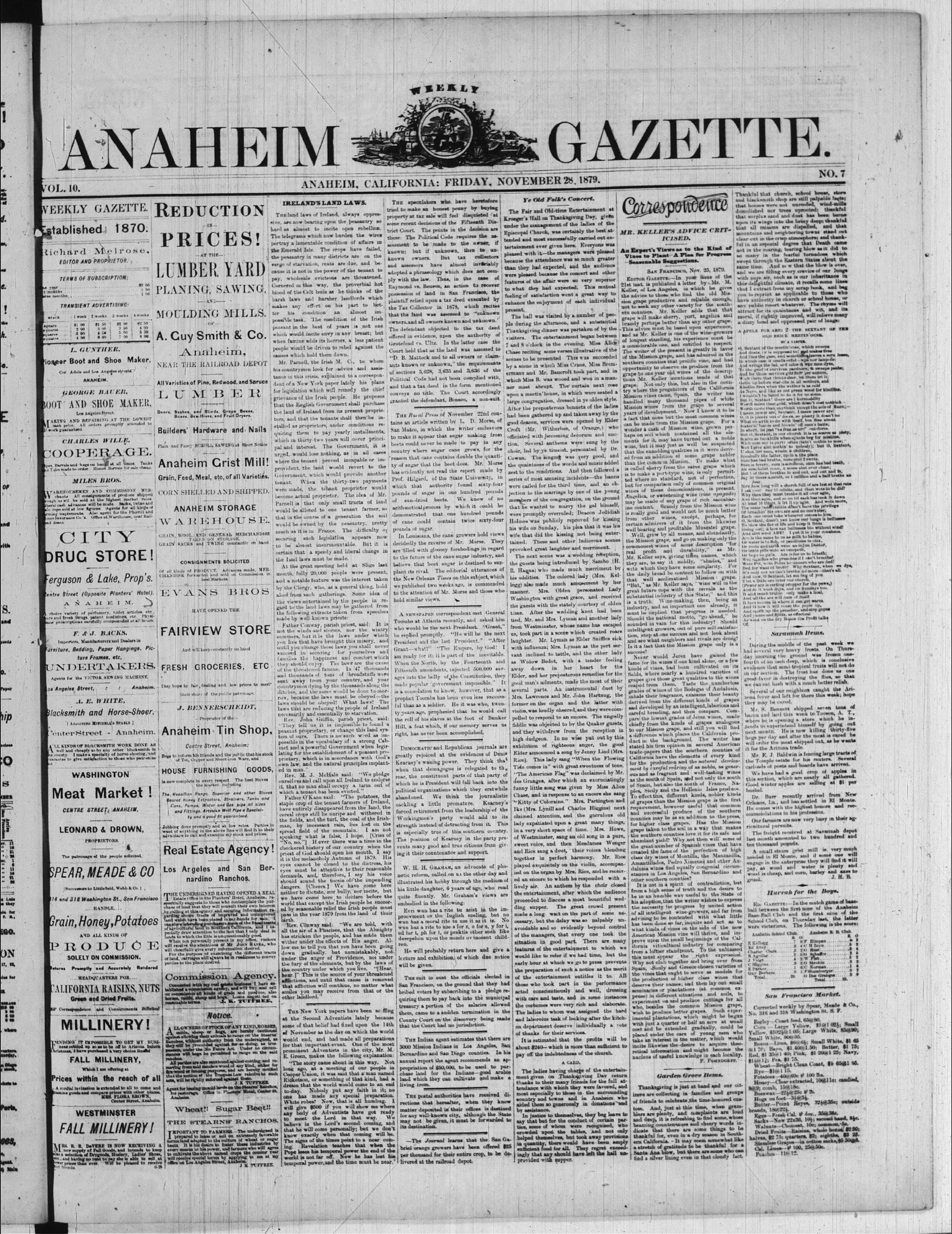
Searchable text
ANAHEIM
VOL. 10.
WEEKLY GAZETTE.
Established 1870.
Richard Melrose,
EDITOR AND PROPRIETOR.
TERMS OF SUBSCRIPTION:
One year ... $3.00
Two months ... $1.50
Three months ... $1.00
TRANSIENT ADVERTISING:
L. GUNTHER.
Pioneer Boot and Shoe Maker.
Cor. Adele and Los Angeles streets.
ANAHEIM.
GEORGE BAUER,
BOOT AND SHOE MAKER.
Los Angeles Street.
MAKING AND REPAIRING AT THE LOWEST
cash price. All orders promptly attended to
all work guaranteed.
CHARLES WILLE.
COOPERAGE.
REDUCTION
IN PRICES!
AT THE
LUMBER YARD
PLANING, SAWING,
AND
MOULDING MILLS.
OF
A. Guy Smith & Co.
Anaheim,
NEAR THE RAILROAD DEPOT
All Varieties of Pine, Redwood, and Spruce
LUMBER
Doors, Sashes, and Blinds, Grape Boxes,
Boxes, Bee Hives, and Fruit Dryers.
Builders' Hardware and Nails
Plain and Fanery SCROLL SAWING at Short Notice
IRELAND'S LAND LAWS
The land laws of Ireland, always sive, are now bearing upon the peasant as almost to incite open The telegrams which now burden portray a lamentable condition of the Emerald Isle. The crops have the peasant in many districts and verge of starvation, rents are due cause it is not in the power of the pay, wholesale evictions are to Cornered in this way, the prov blood of the Celt boils as he thinks harsh laws and harsher landlords makes any effort on his parter his condition an all possible task. The condition of peasant in the best of years which would incite envy in any when famine adds its horrors, a people would be driven to rebel causes which hold them down.
Mr. Parnell, the Irish M. C., his countrymen look for advice in this crisis, explained to a student of a New York paper lately for legislation which will remedy grievance of the Irish people. He that the English Government share the land of Ireland from its presidents, and that the tenants shall stalled as proprietors, under requiring them to pay yearly in which in thirty-two years will capital and interest. The Governments urged, would lose nothing, as in
GEORGE BAUER,
BOOT AND SHOE MAKER.
Los Angeles Street.
MAKING AND REPAIRING AT THE LOWEST
m cash price. All orders promptly attended to
all work guaranteed.
CHARLES WILLE.
COOPERAGE.
Tapes, Barrels and kegs on hand at all times. Tanks
and Tales made to order. Honey Barrels for sale cheap.
MILES BROS.
WAREHOUSEMEN AND COMMISSION MERCHants. All consignments of produce shipped
through will be sold at the highest market rates.
Barrels and advances will be made. Snacks, twine and
rope sold at low figures. Agents for all kinds of
arming implements. Also agent for the Phoenix and
Home Insurance Co.'s. Office at Warehouse, near Railroad does.
CITY
DRUG STORE!
Ferguson & Lake, Prop's.
Centre Street (Opposite Planters' Hotel).
ANAHEIM.
A choice variety of perfumery, toilet articles, etc,
ture and fresh drinks, patent medicines, etc. Physi学 prescriptions carefully compounded at all hours.
F. & J. BACKS.
Importers, Manufacturers and Dealers in
Furniture, Bedding, Paper Hangings. Picture Frames, etc,
UNDERTAKERS.
Agents for the VICTOR SEWING MACHINE.
Los Angeles Street, : Anaheim.
A. E. WHITE,
Blacksmith and Horse-Shoer,
[ANJOINING MITCHELL'S STABLE]
Center Street - Anaheim.
ALL KINDS OF BLACKSMITH WORK DONE AS
well and cheaply as by any other blacksmith in
the county. I make a specialty of horse-shoeing, and
guarantee to give satisfaction to those who patronize
WASHINGTON
Meat Market!
CENTRE STREET; ANAHEIM,
LEONARD & DROWN,
PROPRIETORS.
The patronage of the people solicited.
NEAR THE RAILROAD DEPOSIT
All Varieties of Pine, Redwood, and Spruce
LUMBER
Doors, Sashes, and Blinds, Grape Boxes,
Boxes, Bee-Hives, and Fruit Dryers.
Builders' Hardware and Nails
Plain and Fancy SCROLL SAWING at Short Notice
Anaheim Grist Mill!
Grain, Feed, Meal, etc, of all Varieties.
CORN SHELLED AND SHIPPED.
ANAHEIM STORAGE
WAREHOUSE.
GRAIN, WOOL AND GENERAL MERCHANDISE
TAKEN ON STORAGE.
GRAIN SACKS and TWINE constantly on hand.
CONSIGNMENTS SOLICITED
Of all kinds of PRODUCE. Advances made, MERCHANDISE forwarded, and sold on Commission in best Markets.
EVANS BROS
HAVE OPENED THE
FAIRVIEW STORE
And will keep constantly on hand
FRESH GROCERIES, ETC
They hope by fair, dealing and low prices to merit
their share of the public patronage.
J. BENNERSCHEIDT,
Proprietor of the
Anaheim Tin Shop,
Centre Street, Anaheim:
Begs to inform his friends and the public that his stock
of Tin, Copper and Sheet-Iron Ware, and
HOUSE FURNISHING GOODS,
is now complete in every respect. The best Stoves
the market, including
The Medallion Range, Superior and other Stoves
Beared Honey Extractors, Strainers, Tanks and
Cans, Pumps, Water and Gas pipe all sizes
and Fittings. Artesian Well Pipe a Specialty
and a good fit guaranteed.
Jobbing done promptly and at low rates. Parties in
want of anything in the above line will find it to their
advantage to call and examine my stock and prices.
Real Estate Agency!
Los Angeles and San Ber-
Meat Market!
CENTRE STREET; ANAHEIM,
LEONARD & DROWN,
PROPRIETORS.
The patronage of the people solicited.
SPEAR, MEADE & CO
[Successors to Littlefield, Webb & Co.]
316 and 318 Washington St., San Francisco
HANDLE...
Grain, Honey, Potatoes
AND ALL KINDS OF
PRODUCE
SOLELY ON COMMISSION.
Returns Promptly and Accurately Rendered
HEADQUARTERS FOR...
CALIFORNIA RAISINS, NUTS
Green and Dried Fruits.
Correspondence and Consignments SoNeited
MILLINERY!
FINDING IT IMPOSSIBLE TO GET MY BUSIness settled up so as to be off to Arizona before
Christmas, I have purchased a very choice lineal
FALL MILLINERY,
Which I am offering at
Prices within the reach of all
A cordial invitation is extended to all to come and
amine goods and compare prices with other places.
MRS. R. R. DEVERE IS NOW RECKIVING A
new supply of Fall Goods, and intends to keep
also a selection of Drygoods, Hosiery, Ladies' Shoes,
note, and having no rent to pay she is able to sell at
lower prices than ever. Will be pleased to receive
best friends.
Real Estate Agency!
Los Angeles and San Bernardino Ranchos.
THE UNDERSIGNED HAVING OPENED A REAL
Estate Office in the Planters' Hotel, Anaheim, respectively suggests to those who contemplate the purchase of land that they will consult their own interest by calling at this agency and securing information regarding shope tracts of improved and unimproved land which have been placed in my hands for sale. I can show intended purchasers some of the finest tracts of agricultural land in Southern California, and I especially draw attention to the fact that I only deal in lands to which the title is unquestionably good.
When not personally present in my office, visitors will receive the attentions of Mr. John Hanra, who will cheerfully give every information desired.
For the purpose of examining the different tracts of land, carriages will always be in readiness to convey parties to the place desired.
Commission Agency.
Connected with my real estate business I have established a commission agency, and will buy and sell on commissions all kinds of grain and produce, also horses, cattle, sheep and hogs. Loans negotiated on reasonable terms.
Notice.
ALLOWNERS OF STOCK OF ANY KIND,HORSES,
cattle, sheep or hogs, are hereby cautioned against allowing their animals to range on the Stearns' Ranches, without authority from the undersigned, as they will be proceeded against for so doing, as trespassers, under the No Fence Act. Under no circumstances will hogs be permitted to range on the said ranches.
All parties are also cautioned against cutting and removing from said ranches wood of any kind, either for firewood or fencing purposes, and are hereby notified that the section of the Trusses Law relative to such acts, will be rigidly endorsed against them.
J. K. TUFFREE.
Agent for leasing manifold lands on the Stearns' Ranches,
los pastureage. Office in Planters' Hotel, Center St.
Anaheim.
Wheat!! Sugar Beet!!
THE STEARNS' RANCHOS.
IMPORTANT TO FARMERS.—The undersigned is prepared to lease or sell on extremely favorable terms land adapted to the culture of wheat or sugar beets. It is his desire to foster these industries by every means in his power, and farmers who will agree to cultivate the above named crops the coming year will receive special terms by applying to me at my office on Los Angeles Street, Anaheim.
J. K. TUFFREE.
Rev. M. J. McHaie said: ourselves and call upon all Ireland it, that no man shall occupy any which a tenant has been evicted.
Father O'Kane said: "The staple crop of the tenant farmer have entirely disappeared from cereal crops still lie unripe and the fields, and the turf, the cow-man, by incessant rain, he spread field of the mountain speaking what is false, I have 'No, no.'] If ever there was checkered history of our countriest priest of God should open his eyes cannot be closed to the eyes must be attentive to the demands, and, therefore, I should sound the tones of dangers. [Cheers.] We have neither to dictate, nor bully, nor we have come here to declare world that except the Irish people by seasonable relief the Irish pass in the year 1879 from the birth.
Rev. Conway said: "We are all the air of a Pharisee, that has stricken the people, and he wither under the effects of Hallow me to tell you that you have down gradually, but unmute under the anger of Providence the fury of the elements, but the country under which you hear." This is the source of your afflictions, and until that can afford that affliction will continue, my smiles you may receive from other landlord."
The New York papers have at the Second Adventists some of that belief had fixed it of November as the day on which would end, and had made it for that important event. Our prominent Adventists in the E. Green, makes the following:
"The story came about in long ago, at a meeting of Cooper Union, it was said that Rickettson, or something of the dream that the world would do today. Nobody put any one has made any special White robes! Now, that is will give $500 if you will any body of Adventists he to meet the Lord in the believe in the Lord's second that he will come personally know exactly when that occurs. The signs of the times point ing. Revelation teaches Pope loses his temporal power world is not far off. Now his temporal power,and the time..."
IRELAND'S LAND LAWS.
The land laws of Ireland, always oppressive, are now bearing upon the peasantry so as almost to incite open rebellion. The telegrams which now burden the wires tray a lamentable condition of affairs in Emerald Isle. The crops have failed, peasantry in many districts are on the edge of starvation, rents are due, and because it is not in the power of the tenant to pay, wholesale evictions are threatened, centered in this way, the proverbial hot blood of the Celt boils as he thinks of the Irish laws and harsher landlords which takes any effort on his part to bet his condition an almost impossible task. The condition of the Irish masstant in the best of years is not one which would incite envy in any breast; but when famine adds its horrors, a less patient people would be driven to rebel against the houses which hold them down.
Mr. Parnell, the Irish M. C., to whom countrymen look for advice and assistance in this crisis, explained to a correspondent of a New York paper lately his plans legislation which will remedy the chief deviance of the Irish people. He proposes that the English Government shall purchase the land of Ireland from its present proprietors, and that the tenants shall then be installed as proprietors, under conditions requiring them to pay yearly installments, which in thirty-two years will cover principal and interest. The Government, it is urged, would lose nothing, as in all cases that the tenant proved incapable or immei-
The speculators who have heretofore tried to make an honest penny by buying property at tax sale will feel disquieted at some recent decisions of the Fifteenth District Court. The points in the decision are these: The Political Code requires the assessment to be made to the owner, if known; but if unknown, then to unknown owners. But tax collectors and assessors have almost invariably adopted a phraseology which does not comply with the law. Thus, in the case of Raymond vs. Benson, an action to recover possession of land in San Francisco, the plaintiff relied upon a tax deed executed by the Tax Collector in 1878, which recites that the land was assessed to "unknown owners, and all owners known and unknown." The defendant objected to the tax deed offered in evidence, upon the authority of Grotefend vs. Ultz. In the latter case the Court held that as the land was assessed to "D. B. Mattock and to all owners or claimants known or unknown," the requirements of sections 3,628, 3,635 and 3,636 of the Political Code had not been complied with, and that a tax deed in the form mentioned conveys no title. The Court accordingly granted the defendant, Benson, a non-suit.
The Rural Press of November 22nd contains an article written by L. D. Morse, of San Mateo, in which the writer endeavors to make it appear that sugar making from beets could never be made to pay in any country where sugar cane grows, for the reason that cane contains double the quanti-
Ye Old Folk's Concert.
The Fair and Old-time Entertainment at Kroeger's Hall on Thanksgiving Day, given under the management of the ladies of the Episcopal Church, was certainly the best attended and most successfully carried out entertainment ever given here. Everyone was pleased with it—the managers were pleased because the attendance was so much greater than they had expected, and the audience were pleased because the concert and other features of the affair were so very superior to what they had expected. This mutual feeling of satisfaction went a great way to enhance the enjoyment of each individual present.
The hall was visited by a number of people during the afternoon, and a substantial Thanksgiving dinner was partaken by the visitors. The entertainment began between 7 and 8 o'clock in the evening. Miss Alice Chase reciting some verses illustrative of the scenes to be presented. This was succeeded by a scene in which Miss Crane, Miss Bremermann and Mr. Bancroft took part, and in which Miss B. was woofed won in a manner most abrupt. The curtain next rose upon a meetin' house, in which were seated a large congregation, dressed in ye olden style. After the preposterous bonnets of the ladies had been gathered up and taken away by the good deacon, services were opened by Elder Croft (Mr. Witherbee, of Orange,) who officiated with becoming decorum andunction. Several anthems were sung by the choir, led by ye timeist, personated by Dr. Cowan. The singing was very good, and
At the great meeting held at Sligo last month, fully 20,000 people were present, and a notable feature was the interest taken by the Clergy, who, as a general thing, hold loot from such gatherings. Some idea of the views entertained by the people in regard to the land laws may be gathered from the following extracts taken from speeches made by well-known priests:
Father Conway, parish priest, said: It is not the winds and storms, nor the wintry summers, but it is the laws under which you live that have brought this misery, and until you change these laws you shall never succeed in securing for yourselves and families the happiness and comfort which they should enjoy. The laws are the cause of the threatened famine. In 47 thousands and thousands of tons of breadstuff were sent away from your country, and your countrymen dying by the thousands along the ditches, and the same would be done to morrow, because the laws must be obeyed—the laws should be obeyed! What laws? The laws that are reducing the people of Ireland necessarily and essentially to starvation.
Rev. John Griffin, parish priest, said: "They tell us it is impossible to found a peasant propriety, or change this land system of ours. There is no such word as impossible in the vocabulary of a strong Cabinet and a powerful Government when legislating for the establishment of a peasant proprietary, which is in accordance with God's own law, and the natural principles implanted in man."
Rev. M. J. McHale said: "We pledge ourselves and call upon all Ireland to endorse it, that no man shall occupy a farm out of which a tenant has been evicted."
Father O'Kane said: "The potatoes, the staple crop of the tenant farmers of Ireland, have entirely disappeared from the land, the cereal crops still lie unripe and withered in the fields, and the turf, the coal of the Irishman, by incessant rain, has lost on the spread field of the mountain. I am not speaking what is false, I hope. [Cries of 'No, no.'] If ever there was a time in the checkered history of our country when the priest of God should open his mouth, I say it is the melancholy Autumn of 1879. His eyes cannot be closed to the distress, his eyes must be attentive to their reasonable ants known or unknown," the requirements of sections 3,628, 3,635 and 3,636 of the Political Code had not been complied with, and that a tax deed in the form mentioned conveys no title. The Court accordingly granted the defendant, Benson, a non-suit.
The Rural Press of November 22nd contains an article written by L. D. Morse, of San Mateo, in which the writer endeavors to make it appear that sugar making from beets could never be paid to any country where sugar cane grows, for the reason that cane contains double the quantity of sugar that the beet does. Mr. Morse has evidently not read the report made by Prof. Hilgard, of the State University, in which that authority found sixty-four pounds of sugar in one hundred pounds of sun-dried beets. We know of no arithmetical process by which it could be demonstrated that one hundred pounds of cane could contain twice sixty-four pounds of sugar.
In Louisiana, the cane growers hold views decidedly the reverse of Mr. Morse. They are filled with gloomy forebodings in regard to the future of the cane sugar industry, and believe that beet sugar is destined to supplant its rival. The editorial utterances of the New Orleans Times on this subject, which we published two weeks ago, is commended to the attention of Mr. Morse and those who hold similar views.
A NEWSPAPER correspondent met General Toombs at Atlanta recently, and asked him who would be the next President. "Grant," he replied promptly. "He will be the next President and the last President." "After Grant—what?" "The Empire, by God! I am ready for it; it is part of the inevitable. When the North, by the Fourteenth and Fifteenth amendments, injected 500,000 savages into the belly of the Constitution, they made popular government impossible." It is a consolation to know, however, that as a prophet Toombs has been even less successful than as a soldier. He it was who, twenty years ago, prophesied that he would call the roll of his slaves at the foot of Bunker Hill, a feat which, if our memory serves us right, has never been accomplished.
DEMOCRATIC and Republican journals are greatly rejoiced at the evidences of Denis Kearney's waning power. They think that when that demagogue is relegated to the rear, the constituent parts of that party of which he is President will fall back into the political organizations which they erstwhile abandoned. We think the journalistic cackling a little premature. Kearney's forced retirement from the leadership of the Workingmen's party would add to its strength instead of detracting it. This is especially true of this southern country. The position of Kearney in the party prevents many good and true citizens from giving it their countenance and support.
W. H. H. Graham, an advocate of pho-
by a scene in which Miss Crane, Miss Bremermann and Mr. Bancroft took part, and in which Miss B. was wooped and won in a manner most abrupt. The curtain next rose upon a meetin' house, in which were seated a large congregation, dressed in ye olden style. After the preposterous bonnets of the ladies had been gathered up and taken away by the good deacon, services were opened by Elder Croft (Mr. Witherbee, of Orange) who officiated with becoming decorum andunction. Several anthems were sung by the choir, led by ye timeist, personaged by Dr.Cowan. The singing was very good, and the quaintness of the words and music added zest to the renditions. And then followed a series of most amusing incidents—the bans were called for the third time, and an objection to the marriage by one of young members of the congregation, on the ground that he wanted to marry the gal himself, were promptly overruled; Deacon Jedidiah Holmes was publicly reproved for kissing his wife on Sunday, his plea that it was his wife that did the kissing not being entertained. These and other ludicrous scenes provoked great laughter and merriment.
The next scene was a wedding reception, the guests being introduced by Sambo (H. R.Hagna) who made much merriment by his oddities. The colored lady (Mrs.Kelogg) also made much amusement by her manner. Mrs.Olden personated Lady Washington with great grace, and received the guests with the stately courtesy of old time. After the wedding knot had been tied, Mr. and Mrs.Lyman and another lady from Westminster, whose name has escaped us, took part in a scene which created roars laughter. Mr.Lyman as Elder Sniffles sick with influenza; Mrs.Lyman as the pert servant inclined to tattle, and the other lady as Widow Bedot, with a tender feeling away down in her heart for the Elder, and her preposterous remedies for the good man's ailments, made the most of their several parts. An instrumental duet by Mrs.Lawrence and Mr.John Hartung, former on the organ and the latter with violin, was loudly cheered; they were compelled to respond to an encore. The ungoily fiddle was objected to by the Quaker guests, and they withdrew from the reception in high dudgeon. In no wise put out by this exhibition of righteous anger, the good Elder announced a song by Jenny Lind (Mrs.Rice). This lady sang "When the Flowing Tide comes in" with great sweetness of tone. "The American Flag" was declaimed by Mr.Dras Granges, after which an exorciatingly funny little song was given by Miss Alice Chase, and in response to an encore she sang "Kitty of Coloraine." Mrs.Partington and Ike (Mrs.Lynill and Charlie Higgins) next claimed attention, and the garrulous old lady expatiated upon a great many things, in a very short space of time. Mrs.Howe, of Westminster, sang an old song in a pure,sweet voice, and then Mesdames Wenger and Rice sang a duet,their voices blending together in perfect harmony.Mr.Rice played exquisitely on the violin,accompanied by the organ by Mrs.Rice,and he receiv-
Key. M. J. McHale said: "We pledge ourselves and call upon all Ireland to endorse it, that no man shall occupy a farm out of which a tenant has been evicted."
Father O'Kane said: "The potatoes, the staple crop of the tenant farmers of Ireland, have entirely disappeared from the land, the cereal crops still lie unripe and withered in the fields, and the turf, the coal of the Irishman, by incessant rain, lies lost on the spread field of the mountain. I am not speaking what is false, I hope. [Cries of 'No, no.'] If ever there was a time in the checkered history of our country when the priest of God should open his mouth, I say it is the melancholy Autumn of 1879. His eyes cannot be closed to the distress, his eyes must be attentive to their reasonable demands, and, therefore, I say his voice should sound the tectonics of the impending dangers. [Cheers.] We have come here neither to dictate, nor bully, nor incite, but we have come here to declare before the world that except the Irish people be succeeded by seasonable relief the Irish people must pass in the year 1879 from the land of their birth.
Rev. Conway said: "We are told, with all the air of a Pharisee, that the Almighty has stricken the people, and has made them wither under the effects of His anger. Allow me to tell you that you have been going down gradually, but unmistakably, not under the anger of Providence, not under the fury of the elements, but by the laws of the country under which you live." "[Hear, hear.] This is the source of your threatened afflictions, and until that cause is removed that affliction will continue, no matter what smiles you may receive from that or the other landlord."
The New York papers have been scouting at the Second Adventists lately because some of that belief had fixed upon the 14th of November as the day on which the world would end, and had made all preparations for that important event. One of the most prominent Adventists in the city, Mr. M. E. Green, makes the following explanation:
"The story came about in this way. Not long ago, at a meeting of our people in Cooper Union, it was said that a man named Rickettson, or something of that kind, had a dream that the world would come to an end to-day. Nobody put any faith in it; no one has made any special preparation. White robes? Now, that is all humbug. I will give $500 if you will show me where any body of Adventists have got ready to meet the Lord in that way. We believe in the Lord's second coming, and that he will come personally; but we don't know exactly when that coming will be. The signs of the times point to a near coming. Revelation teaches that when the Pope loses his temporal power the end of the world is not far off. Now he has lost his temporal power, and the time must be near."
W. H. H. Graham, an advocate of phonetic reform, called on us the other day and illustrated his hobby through the medium of his little daughter, 6 years of age, who read quite fluently. Mr. Graham's views are embodied in the following:
Evriw wun haz a rite tu assist in the improvement ov the Inglish speling, but no wun haz a moral rite tu uze it az it iz. No wun haz a rite to uze s for z, o for u, y for i, ed for t, ph for l, or praktis other such like desepson upon the mindz ov inosent children.
He will probably return here and give a lecture and exhibition, of which due notice will be given.
The suit to oust the officials elected in San Francisco, on the ground that they had bribed voters by subscribing to a pledge requiring them to pay back into the municipal treasury a portion of the salaries allowed them, came to a sudden termination in the County Court on the discovery being made that the Court had no jurisdiction.
The Indian agent estimates that there are 3000 Mission Indians in Los Angeles, San Bernardino and San Diego counties. In his annual report the agent recommends an appropriation of $50,000, to be used to purchase land for the Indians—good arable land which they can cultivate and make a living from.
The postal authorities have received directions that hereafter, when they know matter deposited in their offices is destined for any well-known city, although the State may not be given, it must be forwarded to its destination.
The Journal learns that the San Gabriel orange growers have been offered $25 per thousand for their entire crop, to be delivered at the railroad depot.
The American flag was decimated by des Granges, after which an excruciatingly funny little song was given by Miss Alice Chase, and in response to an encore she sang "Kitty of Coloraine." Mrs. Partington and Ike (Mrs. Lynill and Charlie Higgins) next claimed attention, and the garrulous old lady expatiated upon a great many things, in a very short space of time. Mrs. Howe, of Westminster, sang an old song in a pure sweet voice, and then Mesdames Wenger and Rice sang a duet, their voices blending together in perfect harmony. Mr. Rice played exquisitely on the violin, accompanied on the organ by Mrs. Rice, and he received an encore to which he responded with a lively air. An anthem by the choir closed the entertainment, after which the audience proceeded to discuss a most bountiful wedding supper. The great crowd present made a long wait on the part of some necessary, but the delay was so palpably unavoidable and so evidently beyond control of the managers, that every one took the situation in good part. There are many features of the entertainment to which we would like to refer if we had time, but the early hour at which we go to press prevents the preparation of such a notice as the merit of the entertainment entitles it to. All those who took part in the performance acted conscientiously and well, dressing with care and taste, and in some instances costumes were very rich and elaborate. The ladies to whom was assigned the hard laborious task of looking after the kitchen department deserve individually a vote of thanks for their services.
It is estimated that the profits will be about $240—which is more than sufficient to pay off the indebtedness of the church.
A card.
The ladies having charge of the entertainment given on Thanksgiving Day return thanks to their many friends for the full attendance with which they were favored, and most especially to those in the surrounding country and towns and in Anaheim who aided them so generously in donations and by assistance.
In justice to themselves, they beg leave to say that but for the conduct of certain parties, some of whom were recognized, who crowded upon the tables, and not only helped themselves, but took away provisions in quantity, there would have been amply sufficient food for all. They regret exceedingly that any should have left the hall unprovided with supper.
Gardens
Thanksgiving citizens are collecting of friends to celebrate tom. And, just blers are plenty; and deep, it is also beaming counterculture that tha thankful for even California. A stretch of grape Santa Ana blows find a silver limb
AZETTE.
NO. 7
Correspondence
MR. KELLER'S ADVICE CRITICISED.
An Expert's Views as to the Kind of Vines to Plant - A Plea for Progress - Seasonable Suggestions.
SAN FRANCISCO, Nov. 25, 1879.
EDITOR GAZETTE:—In your issue of the 21st inst. is published a letter by Mr. M. Keller, of Los Angeles, in which he gives the advice to those who find the old Mission grape productive and reliable enough, not to seek any other variety for the southern counties. Mr. Keller adds that grape will make sherry, port, angelica and brandy perhaps better than any other grape. This advice must be based upon experience, and as Mr. Keller is one of the wine-growers of longest standing, his experience must be a considerable one, and entitled to respect. The writer of the present is greatly in favor of the Mission grape, and has admired in the southern counties that prolific vine, and had opportunity to observe its produce from the grape to one year old wines of the descriptors Mr. Keller mentions made of that grape. Not only this, but also in the country where the progenitors of the California Mission vines came, Spain, the writer has handled many thousand pipes of white Mission wines from the grape to several years of development. Now I know it to be a fact that none but the most common wines can be made from the Mission grape. For a wonder a cask of Mission wine, grown perhaps on soil which contained all the elements for it, may have turned out a noble wine, but it may just as well be suspected that the ennobling qualities in it were derived from an addition of some grape nobler
Thankful that church, school house, store and blacksmith shop are still palpable facts; that houses were not unroofed, wind-mills demolished nor trees uprooted; thankful that surplus sand and dust has been borne upon its wings into the briny deep; thankful that all misms are dispelled, and that mountains and neighboring towns stand out clear-cut in the crisp atmosphere; and thankful in an especial degree that Death came not in the roaring, tearing blow as it did to so many in the fearful tornadoes which swept through the Eastern States about the same time. And now that the blow is over, and we are filling every crevice of our lungs with pump air, such as is our inheritance in this delightful climate, it recalls some lines that I extract from my scrap book, and bag you to reprint as applicable to those who have authority in church or school house, or any public resort whatever. The rhyme will attract for its quaintness and wit, and its moral, if rightly improved, will relieve many a dizzy head and oppressed pair of lungs:
A PELE FOR ARE: 2- THE SEXTANT OF THE OLD BRICK MEETIN' OUSK.
BY A GAZETTER.
O. Sextant of the meetin' ouse, which sweeps And duds, or is supposed to! and makes fires And lites the grass, and sometimes leaves a seru house, In which case it smells orful—win nor lamp-file: And wrings the bel, and takes a wet men dyes: To the grief of serviven partners; & sweeps pauls: And for those services gifts $100 per annum, Wish them that thinks deer, let them tri it; Getin up before star-lite in all wethers, and Kindlin fires when the wether is as cold As Nero, and like as not green wood for kindlings. I wouldn't be hired to do it for no some. But O. Sextant' there are I kermoddity Worth more than gold, which doesn't cost nothink—Worth more than any think except the sole of Mann;—I mean power are! Sextant; I mean power are! O. It is plenty out of doors, so plenty it doesn't ho What on arth to do with itself, but flies about Seatin' haws as and blowin' off men's hats; In short, its jest "as free as are" out-dores. But O. Sextant, in our church it is as scarce as plenty, Source as bankbills whenajunta beg for mishina. Witch sum say is party often (taint nothin to me; Wot I give aint nothin' to poleddy); but O. Sextant, U shot 500 men, winnih & children. Specially the latter, up in a title place. Sun has bad breaths, nothesint 2 swete.
During the middle of the past week we had several very heavy frosts. On Thursday morning the ground was frozen one-fourth of an inch deep, which is conclusive evidence that semi-tropical fruits will not do in our section. The frost has done us one great favor in destroying the flies, so that we can eat hash with a much better relish.
Several of our neighbors caught the Arizona fever and left for there this week; hope they may be cured.
Mr. S. Bennett shipped seven tons of lichen and lard this week to Tucson, A. T., where he is opening a store which he intends to superintend himself by going out next month. He is now killing thirty-five hogs per day and after the meat is cured he will order the meat shipped out, as he wants it for the Arizona trade.
Mr. E. J. Baldwin is fencing large tracts of the Temple estate for his renters. Several carloads of posts and boards have arrived.
We have had a good crop of apples in this section, which are nearly all gathered. Good winter apples are selling at $1 per bushel.
Dr. Burr recently arrived from New Orleans, Ia., and has settled in El Monte. He comes with the highest honors and recommendations in his profession.
Our farmers are now very busy in their agricultural pursuits.
The freight received at Savannah depot last month amounted to two hundred and ten thousand pounds.
A small steam grist mill is very much needed in El Monte, and if some one will engage in the enterprise they will find it will pay, as wood and water is plenty and corn berries and axes to
Miss Alice is she sang in Kingston and Higgins) next curulous old many things, Mrs. Howe, in a pure, Wenger blending Mr. Rice accompanies and he receivied with a hoir closed the audience countiful wedd present some nec palpably uncond control took the which we but the less prevents as the merit it to. All performance well, dressing instances elaborate. And the hard over the kitch-ally a vote will be sufficient to chureh.
Garden Grove Items.
Thanksgiving is just at hand and our citizens are collecting in families and groups of friends to celebrate the time-honored custom. And, just at this time, when grammers are plenty, and complaints are load and deep, it is refreshing to find some, whose beaming countenances and cheery words indicate that there are some things to be thankful for, even in a dry season in Southern California. It may seem somewhat like a stretch of gratitude to be thankful for a Santa Ana blow, but there are some who can find a silver lining even in that cloudy fact.
We have made this section, which are nearly all gathered. Good winter apples are selling at $1 per bushel.
Dr. Burr recently arrived from New Orleans, La., and has settled in El Monte. He comes with the highest honors and recommendations in his profession.
Our farmers are now very busy in their agricultural pursuits.
The freight received at Savannah depot last month amounted to two hundred and ten thousand pounds.
A small steam grist mill is very much needed in El Monte, and if some one will engage in the enterprise they will find it will pay, as wood and water is plenty and wood is cheap, and corn, barley and axes to grind.
J. H. B.
Hurrah for the Boys.
Ed. GAZETTE:—In the match game of baseball between the first nine of the Anaheim Base-Ball Club and the first nine of the School Club, on Thursday last, the latter were victorious. The following is the score:
Anaheim School Club
R O R O
E Kellogg 7 9 F Rimpau 4 3
El Evey 3 4 C H Zeyn 5 2
Charlie Clark 2 2 O Rost 4 4
R Aguilar 2 5 G Schaffer 2 5
J Voigt 4 3 W Phish 5 2
C Higgins 3 2 O Strobin 2 2
E Parker 1 6 C Norman 1 4
Guy Barham 5 1 F Shamburger 0 2
Total 20 O Des Granges 2 0
San Francisco Market.
Corrected weekly by Spear, Meade & Co., No. 316 and 318 Washington St. S. F.
Barley—Coast feed, 65@80.
Corn—Large Yellow, $1@1.02½; Small Yellow, $102½@1.05; Large White, 85@90; Small White, 90@95.
Beans—Lima, $6@6½; Small White, $165@1.7€; Bayo, $1.40@1.50; Butter, $175; Red, $135@1.40; Pink, $120@1.25; Navy, $1¼@1½; Pea, $175.
Wheat—Bright Clean Coast, $165@1.85.
Rye—$1@1.15.
Potatoes—40@60¢ @100 lb.
Honey—Clear extracted, 10@11¢; candied, @9; comb, 15@18¢.
Beeswax—22½@25¢ @B.
Hogs on foot—3¼@3¼¢.
Butter—Point Reyes, 32½@35¢; outside brands, 18@22½¢.
Eggs—Fresh Cal. ¥ doz., 35@38¢.
Sacks—New 22x36, 10½; second hand, $4¢.
Walnuts—Choiceest, 10¢; common, $6¢.
Dried Fruits—Raisins, whole boxes, $250;
halves, $275; quarters, $3; eighths, $325.
Steelless Grapes—in cotton sacks, $550@8.
Cal. Limes—¥ 100, 25@50¢.
Peaches—11@12.