anaheim-gazette 1879-11-21
Scanned page
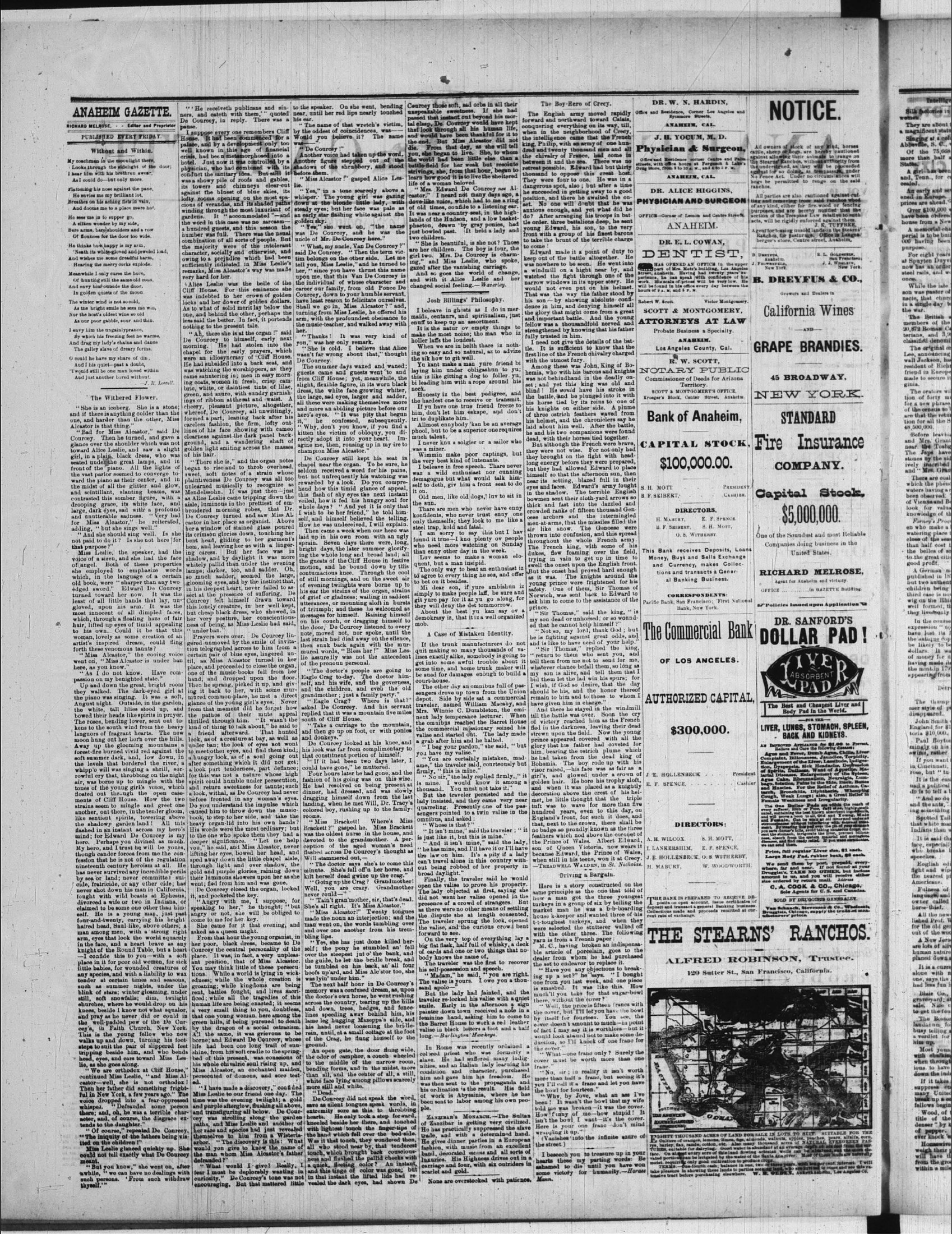
Searchable text
ANAHEIM GAZETTE.
RICHARD MELROSE. Editor and Proprietor
PUBLISHED EVERY FRIDAY.
Without and Within.
My coachman in the moonlight there,
Looks through the sidelight of the door;
I hear him with his brethren swear,
As I could do—but only more.
Flattening his nose against the pane,
He invites me my brilliant lot,
Breathes on his aching fists in vain,
And dooms me to a place mere hot.
He sees me in to supper go,
A silken wonder by my side,
Bare arms, bare shoulders and a row
Of flounces for the door too wide.
He thinks how happy is my arm,
'Neath its white-gloved and jeweled load,
And wishes me some dreadful harm,
Hearing the merry corks explode.
Meanwhile I only curse the bore,
Of hunting still the same old coon,
And envy hinside the door,
In golden quieta of the moon.
The winter wind is not so cold,
As the bright smile he sees me win,
Nor the host's oldest wine so old
As our poor gabble, sour and thin.
I envy him the ungainly prance,
By which his freezing feet he warms,
And drag my lady's chains and dance
The galley slave of dreary forms.
O could he have my share of din,
And I his quiet—past a doubt,
Twould still be one man loved within
And just another bored without.
J. R. Lovell.
The Withered Flower.
"She is an iceberg. She is a stone; and if there is anything colder than the one, and harder than the other, Miss Alcastor is that thing."
"Bad for Miss Alcastor," said De Courcy. Then he turned, and gave a glance over the shoulder which was not toward Alice Leslie, and saw a slight girl, in a plain, black dress, who was
"'He receiveth publicans and sinners, and eateth with them,'" quoted De Courcy, in reply. There was a pause.
I suppose every one remembers Cliff House. It had been commenced for a palace, and by a development only too well known in this age of financial crisis, had been metamorphosed into a hotel. Just now it was controlled by a physician, who had combined with its conduct the sanitary idea. But still it was a showy pile of roofs and gables, its towers and chimneys clear-cut against the bluest of blue skies, its lofty rooms opening on the most spacious of verandas, and its shaded paths winding through the most luxuriant of gardens. It "accommodated"—and the word in this case was no sarcasm—a hundred guests, and this season the humber was full. There was the usual combination of all sorts of people. But the majority were of the intolerant character, socially and otherwise, and owing to a prejudice which had been sufficiently indicated in Miss Leslie's remarks, Miss Alcastor's way was made very hard for her.
Alice Leslie was the belle of the Cliff House. For this eminence she was indebted to her crown of golden locks and her dower of golden dollars. As to what of solid merit lay below the one, and behind the other, perhaps the less said the better. In fact, it portends nothing to the present tale.
"Ah, there she is at the organ!" said De Courcy to himself, early morning. He had stolen into the chapel for the early prayers, which were an idiosyncrasy of Cliff House. He had subsided into a back seat, and was watching the worshippers, as they came sauntering in; men in easy morning coats, women in fresh, crisp cambric, white, or daintiest tints of lilac, green, and azure, with sundry garnishings of ribbon at throat and waist. A cheery, pleasant picture, altogether, whereof, De Courcy, all unwittingly, formed a part, leaning back after his careless fashion, the firm, lofty outlines of his face showing with cameo clearness against the dark panel background, and a wandering shaft of golden light smiting across the masses of his hair.
To the speaker. On shine near, until her red lippe his ear.
"The name of that by the oddest of coincidence Would you believe it was——"
"De Coursey!"
Another voice had told Another figure stepped shadows of the shrub before them.
"Miss Alcastor!" gave lie.
"Yes," in a tone whisper. The young down at the blonde steady eyes; but her face an early star flashing with golden sky.
"Yes," she went on as De Courcy, an uncle of Mr. De Courcy.
"What, my uncle," said De Courcy. "Tim belongs on the other tell you, Miss Leslie," her, "since you have upon me, that this W is the individual of which career our family, from Courcey, down to you have least reason to fear Shall we go in, Miss turning from Miss Leslie arm, with the profound music-teacher, and her."
"Thanks! It was you," was her only rejoice.
"She is cold. I wasn't far wrong about De Courcy.
The summer days were guests came and guild from Cliff House; yet slight, flexible figures dress, the white face large, sad eyes, las all these were making and more an abiding hero's eyes." "It was it," he confessed.
"Why, don't you know kitten the victim of rectly adopt it into agine me, then, roused champion Miss Alcastor."
De Courcy still
The Withered Flower.
"She is an iceberg. She is a stone; and if there is anything colder than the one, and harder than the other, Miss Alcastor is that thing."
"Bad for Miss Alcastor," said De Courcey. Then he turned, and gave a glance over the shoulder which was not toward Alice Leslie, and saw a slight girl, in a plain, black dress, who was seated under the great lamps, and in front of the piano. All the lights of the vast parlor seemed to converge toward the piano as their center, and in the midst of all the glitter and glow, and scintillant, slanting beams, was contrasted this somber figure, with a drooping grace, its white face, and large, dark eyes, sad with a profound and unutterable sadness. "Very bad for Miss Alcastor," he reiterated, adding, "but she sings well."
"And she should sing well. Is she not paid to do it? Is she not here for that purpose?"
Miss Leslie, the speaker, had the voice of a siren, and she had the face of angel. Both of these properties she employed to emphasize words which, in the language of a certain old book, were "sharper than any two-edged sword." Edward De Courcey turned toward her now. It was the least of all little hands that lay, ungloved, upon his arm. It was the most innocent of all dimpled faces, which, through a floating haze of fair hair, lifted up eyes of timid appealing to his own. Could it be that this woman, lovely as some creation of an artist's inspired dream, could fling forth these venomous taunts?
"Miss Alcastor," the cooing voice went on, "Miss Alcastor is under ban here, as you know."
"As I do not know. Have compassion on my benighted state."
Up and down the great, bright room they walked. The dark-eyed girl at the piano was singing. It was a soft, August night. Outside, in the garden, the white, tall lilies stood up, and bowed their heads like spirits in prayer. The roses, bending lower, sent out tokens to the south wind from the heavy languors of fragrant hearts. The new moon hung out her horn over the hills. Away up the glooming mountains a forest-fire burned vivid red against the soft summer dark, and low down, in the levels that bordered the river, a whipp'o will was singing a shrill, sorrowful cry that throbbbing on the night air, was borne up to mingle with the tones of the young girl's voice, which floated out through the open casements of Cliff House. How the two strains seem to mingle and greet another, out there, in the tender gloom, like sentient spirits, towering above the shadowy garden land! All this flashed in an instant across my hero's mind; for Edward De Courcey is my hero. Perhaps you divined as much. My hero, and I trust he will be yours, though candor forces me from the confession that he is not of the regulation nineteenth century heroism at all. He has never survived any incredible perils
He had subsided into a back seat, and was watching the worshippers, as they came sauntering in; men in easy morning coats, women in fresh, crisp cambric, white, or daintiest tints of liliae, green, and azure, with sundry garnishings of ribbon at throat and waist. A cheery, pleasant picture, altogether, whereof, De Courcey, all unwittingly, formed a part, leaning back after his careless fashion, the firm, lofty outlines of his face showing with cameo clearness against the dark panel background, and a wandering shaft of golden light smiling across the masses of his hair.
"There she is," and to the organ notes began to rise and to throb overhead, sweet, soft notes of a strain whose plaintiveness De Courcey was all too unlearned musically to recognize as Mendelssohn. It was just then—just as Alice Leslie came tripping down the aisle, luminous in the prettiest of embroidered morning robes, that Dr. De Courcey turned and saw Miss Alcastor in her place as organist. Above her window of stained glass poured its crimson glories down, touching her bent head, gliding to her garment's hem, and leaving her as with a lingering caress. But her face was in shadow, and by daylight it was more whitely pallid than under the evening lamps; darker, too, and sadder. Oh, so much sadder, seemed the large, glooming eyes, and by the instinct that, in his deepest heart, never failed to assert at the presence of suffering. De Courcey felt himself drawn toward this lonely creature, in her well kept, but cheap black dress, who showed in her very posture, her conscientiousness of being, as Miss Leslie had said,
"under ban."
Prayers were over. De Courcey lingered unmoved by the smile of invitation telegraphed across to him from a certain pair of blue eyes, lingered until, as Miss Alcastor turned in her place, and proceeded to close the organ, one of the music-books fell from her hand, and dropped upon the floor. Then he sprang, picked it up, and giving it back to her, with some murmured common-place, he met a direct glance of the young girl's eyes. Never from that moment did he forget how the pathos of their mute appeal thrilled through him. "It wasn't the kind of thing to talk about," he said to a friend afterward. That hunted look, as of a creature at bay, as well as under ban; the look of eyes not wont to meet other eyes, and find them kind; a hungry look, as of a soul going out after something which it did not get; a look part tenderness, part defiance; for this was not a nature whose high spirit could humble under persecution, and return sweetness for taunts; such a look, withal, as De Courcey had never before fronted in any woman's eyes. Do you understand the impulse which caused him to throw down the music-book, to step to her side, and take the heavy organ-lid into his own hands? His words were the most ordinary; but to the one who spoke them they had a deeper significance. "Let me help you," he said, and Miss Alcastor never lifting her eyes, bowed her head, and sped away down the little chapel aisle through light and over shadow,the gold and purple glories raining down
The summer days we guests came and gutted from Cliff House; yet slight flexible figures dress,the white facethe large,sad eyes,the all these were makingand more an abiding hero's eyes. "It was it," he confessed."Why,don't you knit kitten the victim of rectly adopt it into agine me then,rouse champion Miss Alcastor.
De Courcey still chapel near the organ seldom received a wilt but not unfrequently rewarded by a look.hend how this timid this flash of shy eye veiled,how it fed his whole days?" "AndI wish to be her frie self,and himself beHow he was undecided.
Then came a week laid up in his own spain.Seven days bright days,the late ingthe whole long timeguests of the Clim motion,and he bo contumacious knee.of still mornings,a sort of evening twilightshis ear the strains o'of grief or gladness utterances,或mount of triumph,and tha messages for himselfon his couch.or dthe door,De Cource note,moved not,nast last strain had died then sunk back againmured words,"Ble lie assurelly wasof the pronoun pers
"The doctor's pity Eagle Crag to-dayself,and his wife,and the children.grandmother ;justEagle Crag?"asked De Courcey replied that it was south of Cliff Hour.
"Take a carriageand then go up onand donkeys."
De Courcey looked his look was far from that constituent point."If it had beencould have gone,"
Four hours later fashion of his goingHe had resolved o'dinner,had dress dragging himself landingwhen he m colored boy,rushing rooms.
"Miss Brackett Brackett?" gaspedwas the oldest nurse devoted to the greciption of the slave flashed across De Gwill stammered on"
"The doctor say minute.She's fell
rowful cry that, throbbing on the night air, was borne up to mingle with the tones of the young girl's voice, which floated out through the open casements of Cliff House. How the two strains seem to mingle and greet one another, out there, in the tender gloom, like sentient spirits, towering above the shadowy garden land! All this flashed in an instant across my hero's mind; for Edward De Courcey is my hero. Perhaps you divined as much. My hero, and I trust he will be yours, though candor forces from me the confession that he is not of the regulation nineteenth century heroism at all. He has never survived any incredible perils by sea or land; never commit suicide, fratricide, or any other cide; has never shot down his man in California, fought with wild beasts at Ephesus, divorced a wife or two in Indiana, or claimed to be some one other than himself. He is a young man, just past four-and-twenty, carrying his bright haired head, Saul-like, above others; a man among men, with a strong right arm, eyes that look the world squarely in the face, and a heart brave as any knight of the Round Table, but a heart—I confide this to you—with a soft place in it for poor old women, for sick little babies, for wounded creatures of any species, and with a liability to wax tender at certain times and seasons, such as summer nights, under the blink of stars; winter gloaming, under still, soft snowfalls; dim, twilight churches, where he would drop on his knees, beside I know not what squalor, and pray as he never did or could in the well-padded pew of the De Courcy's, in Faith Church, New York. This is the young fellow who now walks up and down, turning his footsteps to suit the pair of slippered feet tripping beside him, and who bends head, eyes, and ears toward Miss Leslie, as she goes along.
"We are orthodox at Cliff House," continued Miss Leslie, "and Miss Alcastor—well, she is not orthodox! Then her father did something frightful in New York, a few years ago." The voice dropped into a fear-oppressed whisper. "Defrauded some person there; and, oh, he was a terrible character, and, of course, the disgrace extends to the daughter."
"Of course," repeated De Courcey. "The iniquity of the fathers being visited on the children!"
Miss Leslie glanced quickly up. She could not tell exactly what De Courcey meant.
"But you know," she went on, after awhile, "we can have no dealings with such persons. 'From such withdraw thyself.'"
"I have made a discovery," confided Miss Leslie to our friend one day. The time was the evening twilight; a gold and purple afterglow, flushing all above, and transfiguring all below. De Courcy was strolling along the garden paths, and Miss Leslie and another of her race and species had just revealed themselves to him from a Wisteria arbor. "The discovery is this: What would you give to know the name of the man whom Miss Alcastor's father defrauded?"
"What would I give? Really, I fear I must be deplorably wanting in curiosity." De Courcy's tone was not encouraging. But that mattered little for this was not a nature whose high spirit could humble under persecution, and return sweetness for taunts; such a look, withal, as De Coursey had never before fronted in any woman's eyes. Do you understand the impulse which caused him to throw down the music-book, to step to her side, and take the heavy organ-lid into his own hands? His words were the most ordinary; but to the one who spoke them they had a deeper significance. "Let me help you," he said, and Miss Alcastor, never lifting her eyes, bowed her head, and sped away down the little chapel aisle, through light and over shadow, the gold and purple glories raining down their luminous showers upon her as she went; fled from him and was gone.
De Coursey closed the organ, locked it, and pocketed the key.
"Angry with me, I suppose, for speaking to her," he thought; "but angry or not, she will be obliged to come to me for her key.
She came for it that evening, and asked as a queen might.
From that hour the young organist, in her poor, black dress, became to De Coursey the central personality of the place. It was, in fact, a very unpleasant position, that of Miss Alcastor. You may think little of these persecutions. While a world is lying in wickedness; while the whole creation is groaning; while kingdoms are being rent, battles fought, and lives sacrificed; while all the tragedies of this human life are being enacted; it seems a very small thing to you, doubtless, that one young woman here among the green hills, if being pursued to death by the dragon of a social ostracism. All the same, it was grievous to be borne; and Edward De Coursey, whose life had been one long trail of sunshine, from his soft cradle to the spring-bed of this present, was conscious of his whole chivalric soul rising up, and Miss Alcastor, an enchanted maiden, persecuted of demons, and sore tested.
"I have made a discovery," confided Miss Leslie to our friend one day. The time was the evening twilight; a gold and purple afterglow, flushing all above, and transfiguring all below. De Courcy was strolling along the garden paths, and Miss Leslie and another of her race and species had just revealed themselves to him from a Wisteria arbor. "The discovery is this: What would you give to know the name of the man whom Miss Alcastor's father defrauded?"
"What would I give? Really, I fear I must be deplorably wanting in curiosity." De Coursey's tone was not encouraging. But that mattered little for this was not a nature whose high spirit could humble under persecution, and return sweetness for taunts; such a look, withal, as De Coursey had never before fronted in any woman's eyes. Do you understand the impulse which caused him to throw down the music-book, to step to her side, and take the heavy organ-lid into his own hands? His words were the most ordinary; but to the one who spoke them they had a deeper significance. "Let me help you," he said, and Miss Alcastor, never lifting her eyes, bowed her head, and sped away down the little chapel aisle, through light and over shadow, the gold and purple glories raining down their luminous showers upon her as she went; fled from him and was gone.
De Coursey closed the organ, locked it, and pocketed the key.
"Angry with me, I suppose, for speaking to her," he thought; "but angry or not, she will be obliged to come to me for her key.
She came for it that evening, and asked as a queen might.
From that hour the young organist, in her poor, black dress, became to De Coursey the central personality of the place. It was in fact, a very unpleasant position, that of Miss Alcastor. You may think little of these persecutions. While a world is lying in wickedness; while the whole creation is groaning; while kingdoms are being rent, battles fought, and lives sacrificed; while all the tragedies of this human life are being enacted; it seems a very small thing to you, doubtless, that one young woman here among the green hills, if being pursued to death by the dragon of a social ostracism. All the same, it was grievous to be borne; and Edward De Coursey whose life had been one long trail of sunshine from his soft cradle to the spring-bed of this present was conscious of his whole chivalric soul rising up,and Miss Alcastor an enchanted maiden,persecuted of demons,and sore test ed.
"I have made a discovery," confided Miss Leslie to our friend one day. The time was the evening twilight; a gold and purple afterglow,flushing all above,and transfiguring all below. De Courcy was strolling along the garden paths,and Miss Leslie and another of her race和specieshadjustrevealedthemselvestohimfromaWisteriaarbor.“The discoveryisthis:WhatwouldyougivetoknowthenameofthemanwhomMissAlcastortfatherdefrauded?”
"WhatwouldIgive?Really.IfearImustbedeplorablywantingincuriosity."DeCourcy'stonewasnotencouraging.Butthatmatteredlittleforthiswasnota naturewhosehighspiritcouldhumbleunderpersecution,andreturnsweetnessfortaunts;suchalookwithal,aDeCourcyhadneverfrontedinanywoman'seyes.Doyouunderstandtheimpulsewhichcausedhimtothrowdownthemusic-book,tosteptoherside,andtaketheheavyorgan-lidintohisownhands?Hiswordswerethemostordinary;buttotheonewhospokethemtheyhadadeepersignificance.“Letmehelpyou,”hesaid,andMissAlcastoryneverlifthereye,bowedherhead,andspedawaydownthelittlechapelaisle,thelightandovershiestheguide,theletthertumbledontherhoofsupard,andwaslyn'underinghim.Thenexthalfhensmemorywasaconthedoctor'sownhairacrossthecountryanddowntrees,Linespeedingawlassleghugginghishandneverleainuntilstathimground.Anopengate,fateotheodorfcompheto.themiddleoceanbendingforms,aunthanall,andthewhitefacelyingamorestandwhitelittle.”
"Dead."
DeCourcydidsaveassilenttonestremitysoreheart.HeonlykneeledbesidehertwithlightesttouchthehandwhichfellWasitthat touchallwhostoodnewwatchwhichbrownnessandflushedaquick,focetingandthistingoffininstantthenevaledthedark
to the speaker. On she went, bending near, until her red lips nearly touched his ear.
"The name of that wretch's victim, by the oddest of coincidences, was—— Would you believe it? The name was——"
"De Courcy!"
Another voice had taken up the word. Another figure stepped out of the shadows of the shrubbery, and stood before them.
"Miss Alcastor!" gasped Alice Leslie.
"Yes," in a tone scarcely above a whisper. The young girl was gazing down at the blonde little lady, with steady eyes; but her face was pale as an early star flashing white against the golden sky.
"Yes," she went on, "the name was De Courcy, and he was the uncle of Mr. De Courcy here."
"What, my uncle, Van De Courcy?" said De Courcy. "Then the term victim belongs on the other side. Let me tell you, Miss Leslie," and he turned to her, "since you have thrust this name upon me, that this Van De Courcy is the individual of whose character and career our family, from old Ponce De Courcy, down to your humble servant, have least reason to felicitate ourselves. Shall we go in, Miss Alcastor?" and, turning from Miss Leslie, he offered his arm, with the profoundest obeisance to the music-teacher, and walked away with her.
"Thanks! It was very kind of you," was her only remark.
"She is cold. I believe that Alice wasn't far wrong about that," thought De Courcy.
The summer days waxed and waned; guests came and guests went to and from Cliff House; yet, meanwhile, the slight, flexible figure, in its worn black dress, the white face growing whiter, the large, sad eyes, larger and sadder, all these were making themselves more and more an abiding picture before our hero's eyes. "It was pity that begun it," he confessed, subsequently.
"Why, don't you know, if you find a kitten the victim of obloquy, you directly adopt it into your heart. Imagine me, then, rousing up in my ire to champion Miss Alcastor."
De Courcy still kept his seat in Courcy those soft, sad orbs in all their unspeakable sweetness. If she had passed that instant out beyond his mortal elapse, De Courcy would have kept that look through all his human life, and would have been thankful for it to the end. But Miss Alcastor did not die. From that day, as she will tell you, she began to live. She, to whom the world had been little else than a battle-field for her weak but resolute strivings, she, from that hour, began to learn how good it is to live the sheltered life of a woman beloved.
"Mrs. Edward De Courcy nes Alcastor," I heard not many days ago, a dove-like voice, which had to me a ring of old times, confide to a listening ear. It was near a country-seat, in the highlands of the Hudson, and a low basket-phaeton, deawn by gray ponies, had just bowled past. It held a lady and two children.
"She is beautiful, is she not? Those are her children. The boy is four, the girl two. Mrs. De Courcy is charming," and Miss Leslie, who spoke, gazed after the vanishing carriage.
And so goes the world of change, and with it Alice Leslie and her changed social feeling.—Waverley.
Josh Billings' Philosophy.
I believe in ghosts as I do in mermaids, centaurs, and spiritualism, just enuff to keep up an assortment.
It iz the natur ov empty things to make the most noize; tho man who iz holler laffs the loudest.
When we are in helth thare iz nothing so eazy and so natural, az to advize the sik how to git well.
Yu kant make a man yure friend bi laying him under obligashun to yu; this iz like gitting a dog to foller yu, bi leading him with a rope around his neck.
Honesty iz the best pedigree, and the hardest one to receive or transmit.
If yu have one true friend freeze to him, don't let him escape, and don't tri to duplikate him.
Allmost ennybody 'kan be an average phool, but to be a superior one requires much talent.
I never knu a solgier or a sailor who was a mizer.
Wimmin make poor captings, but the very best kind of latentions.
The Boy-Hero of Crecy.
The English army moved rapidly forward and northward toward Calais, conquering everything on its way, till when in the neighborhood of Crecy, the intelligence came that the French king. Philip, with an army of one hundred and twenty thousand men and all the chivalry of France, had come in between it and the sea. There was no retreat possible. Edward had but thirty thousand to oppose this great host. They were four to one. He was in a dangerous spot; also; but after a time he succeeded in getting away to a good position, and there he awaited the onset. No one will doubt that he was anxious enough, and yet what did he do? After arranging his troops in battle order, three battalions deep, he sent young Edward, his son, to the very front with a group of his finest barons to take the brunt of the terrible charge to come!
Edward made it a point of duty to keep out of the battle altogether. He was nowhere to be seen. He went into a windmill on a hight near by, and watched the fight through one of the narrow windows in its upper story. He would not even put on his helmet. That was the way the father stood by his son—by showing absolute confidence in him, and denying himself all the glory that might come from a great and important battle. And the young fellow was a thousandfold nerved and strengthened by knowing that his father fully trusted in him.
I need not give the details of the battle. It is sufficient to know that the first line of the French chivalry charged with the utmost fury.
Among these was John, King of Bohemia, who with his barons and knights was not behindhand in the deadly onset; and yet this king was old and blind! He would have his stroke in the battle, and he plunged into it with his horse tied by its reins to one of his knights on either side. A plume of three ostrich feathers waved from his helmet, and the chroniclers say he laid about him well. After the battle, he and his two companions were found dead, with their horses tied together.
But although the French were brave, they were not wise. For not only had they brought on the fight with head-
The summer days waxed and waned; guests came and guests went to and from Cliff House; yet, meanwhile, the slight, flexible figure, in its worn black dress, the white face growing whiter, the large, sad eyes, larger andadder, all these were making themselves more and more an abiding picture before our hero's eyes. "It was pity that begun it," he confessed, subsequently.
"Why, don't you know, if you find a kitten the victim of obloquy, you directly adopt it into your heart. Imagine me, then, rousing up in my ire to champion Miss Alcastor."
De Courcey still kept his seat in chapel near the organ. To be sure, he seldom received a word for his pains, but not unfrequently his watching was rewarded by a look. Do you comprehend how this timid glance of appeal, this flash of shy eyes the next instant veiled, how it fed his hungry soul for whole days? "And yet it is only that I wish to be her friend," he told himself, and himself believed the telling. How he was undeceived, I will explain.
Then came a week when our hero was laid up in his own room with an ugly sprain. Seven days there were, long, bright days, the later summer glorifying the whole long and broad land; all the guests of the Cliff House in festive motion, and he bound down by this contumacious knee. Through the cool of still mornings, and on the sweet air of evening twilights were borne up to his ear the strains of the organ, strains of grief or gladness; wailing in saddest utterances, or mounting aloft in bursts of triumph, and these welcomed as messages for himself. Raising himself on his couch, or dragging himself to the door, De Courcey listened to every note, moved not, nor spoke, until the last strain had died away on the silence, then sunk back again with the murmured words, "Bless her!" Miss Leslie assuredly was not the antecedent of the pronoun personal.
"The doctor's people are going to Eagle Crag to-day. The doctor himself, and his wife, and the governess, and the children, and even the old grandmother; just a family party."
"Eagle Crag?" Where is that? asked De Courcey. And his servant replied that it was a mountain five miles south of Cliff House.
"Take a carriage to the mountain, and then go up on foot, or with ponies and donkeys."
De Courcey looked at his knee, and his look was far from complimentary to that constituent portion of himself.
"If it had been two days later, I could have gone," he muttered.
Four hours later he had gone, and the fashion of his going was on this wise. He had resolved on being present at dinner, had dressed, and was slowly dragging himself down from the last landing, when he met Will, Dr. Tracy's colored boy, rushing up to the family rooms.
"Miss Brackett! Where's Miss Brackett?" gasped he. Miss Brackett was the oldest nurse in the house, and devoted to the grandmother. A perception of the aged woman's need flashed across De Courcey's thought as Will stammered out,
"The doctor says she's to come this minute. She's fall off her horse, and Yu kant make a man yure friend of laying him under obligashun to yu; this z like gitting a dog to foller yu, bi leading him with a rope around his neck.
Honesty iz the best pedigree, and the hardest one to receive or transmit.
If Yu have one true friend freeze to do him, don't let him escape, and don't tri to duplikate him.
Allmost ennodybody kan be an average phool, but to be a superior one requires much talent.
I never knu a solgier or a sailor who was a mizer.
Wimmin make poor captings, but the very best kind of lutenants.
I believe in free speech. Thare never waz a wild enthusiasm nor cunning demagogue but what would talk himself to deth, giv him a front seat to do it on.
Old men, like old dogs!, luv to sit in the sun.
Thare are men who never have enny konfidents, who never trust enny one only themselves; they look to me like a steel trap, kold and fatal.
I am sorry to say this but I have found it true—I kno plenty ov people who need more watching on Sunday than enny other day in the week.
Luv seems to make a woman eloquent, but a man insipid.
The only way to beat an enthusiast iz to agree to every thing he sez, and offer to bet on it besides.
Mi dear son, if yure ambishun iz simply to make people laff, be sure and git yure pay for it az yu go along, for they will deny the det tomorrow.
About the best yu can say ov a demokrasy iz, that it iz a well organized mob.
A Case of Mistaken Identity.
If the trunk manufacturers do not quit making so many thousands of valises exactly alike, somebody is going to get into some awful trouble about it some time, and some trunk maker will be sued for damages enough to build a court-house.
The other day an omnibus full of passengers drove up town from the Union depot. Side by side sat a commercial traveler, named William Macaby, and Mrs. Winnie C. Dumbleton, the eminent lady temperance lecturer. When the omnibus reached the Barret House the commercial missionary seized his valise and started out. The lady made a grab after him and he halted.
"I beg your pardon," she said, "but you have my valise."
"You are certainly mistaken, madame," the traveler said, courteously but firmly, "this is mine."
"No sir," the lady replied firmly," it is mine. I would know it among a thousand. You must not take it."
But the traveler persisted and the lady insisted, and they came very near quarreling. Presently one of the passengers pointed to a twin valise in the omnibus, and asked:
"Whose is that?
"It isn't mine," said the traveler; "it is just like it, but this is mine."
"And it isn't mine," said the lady," he has mine, and I'll have it or I'll have the law on him. It's a pity if a lady can't travel alone in this country without being robbed of her property inAmong these was John, King of Bohemia, who with his barons and knights was not behindhand in the deadly onset; and yet this king was old and blind! He would have his stroke in the battle, and he plunged into it with his horse tied by its reins to one of his knights on either side. A plume of three ostrich feathers waved from his helmet, and the chroniclers say he laid about him well. After the battle, he and his two companions were found dead, with their horses tied together.
But although the French were brave they were not wise. For not only had they brought on the fight with head-long energy before they were prepared, but they had allowed Edward to place himself so that the afternoon sun, then near its setting, blazed full in their eyes and faces. Edward's army fought in the shadow. The terrible English bowmen sent their cloth-yard arrows so thick and fast into the dazzled crowded ranks of fifteen thousand Genese archers and the intermingled men-at-arms, that the missiles filled the air like snow. The Genoese were thrown into confusion,and this spread throughout the whole French army. The French king, with some of his dukes,flew foaming over the field trying in vain to get up in time to swell the onset upon the English front. But the onset had proved hard enough as it was. The knights around the young prince were frightened for his safety. One of them,Sir Thomas of Norwich was sent back to Edward to ask him to come to the assistance of the prince.
"Sir Thomas," said the king," is my son dead or unhorsed; or so wound-ed that he cannot help himself?"
Not so,my lord thank God; but he is fighting against great odds,and is like to have need of your help."
Sir Thomas," replied the king,"return to them who sent you,and tell them from me not to send for me whatever chance befall them,solo as my son is alive,and tell them that I bid them let the lad win his spurs;for I wish,如果God so desire,the day should be his,and the honor thereof remain to him and to those to whom I have given him in charge."
And there he stayed in the windmill till the battle was over. Soon the cry of victory reached him as the French fled in the darkness leaving their dead strewn upon the field.Now the young prince appeared covered with all the glory that his father had coveted for him,bearing the ostrich plume which he had taken from the dead king of Bohemia.The boy rode up with his visor raised,-his face was as fair as a girl's,and glowed under a crown of golden hair.Here bore his trophy aloft,and when it was placed as a knightly decoration above the crest of his helmet,here little thought that the triple tuft was to wave for more than five hundred years,even to this day.on England's front,forsuch it does,and that,next to the crown,these shall be no badge so proudly known as the three feathers which nod above the coronet of the Prince of Wales.Albert Edward,son of Queen Victoria,now wears it because Edward,the Prince of Wales,when still in his teens,won it at Crecy.-TREADWELL WALDEN,在 St. Nicholas.
fashion of his going was on this wise. He had resolved on being present at dinner, had dressed, and was slowly dragging himself down from the last landing, when he met Will, Dr. Tracy's colored boy, rushing up to the family rooms.
"Miss Brackett! Where's Miss Brackett?" gasped he. Miss Brackett was the oldest nurse in the house, and devoted to the grandmother. A perception of the aged woman's need flashed across De Courcey's thought as Will stammered out,
"The doctor says she's to come this minute. She's fell off her horse, and kilt herself dead gwine up the crag."
"Going up the Crag? Grandmother! Well, you are crazy. Grandmother never could—"
"Tain't gran'mother, sir, that's dead. She's all right. It's Miss Alcastor."
"Miss Alcastor!" Twenty tongues made the noun an interjection; and the man went on, the words tumbling over and over one another from his trembling lips.
"Yes, she has just done killed herself; the pony he stumbled an' fell over the steepest jut o' the bank, and the guide, he let the bridle break, and he tumbled on his back, an' all four hoofs up'ard, and Miss Ale'stor too, she was lynin' under him."
The next half hour in De Courcey's memory was a confused dream, as upon the doctor's own horse, he went rushing across the country, tearing up the hills and down, trees, hedges, and fence-lines speeding away behind him, his lame leg hugging Mazeppa's side, and his hand never loosening the bridle-rein, until, at a small cottage at the foot of the Orag, he flung himself to the ground.
An open gate, the door flung wide, the odor of camphor, a couch wheeled to the middle of the narrow room, bending forms, and in the midst, more than all, and the center of all, a still, white face lying among pillows scarcely more still and white.
"Dead."
De Courcey did not speak the word, save as silent tongues speak words, in extremity sore as this to throbbing hearts. He only took a step forward, kneeled beside her there, and touched with lightest touch the finger-tips of the hand which fell over the bed-side. Was it that touch, they wondered then, all who stood near by, that tenderest touch, which brought back consciousness and flushed the pallid cheeks with a quick, fleeting color? An instant, and this tinge of color was gone; but in that instant the lifted lids had revealed the dark eyes, had shown De
"No sir," the lady replied firmly., "it is mine. I would know it among a thousand. You must not take it."
But the traveler persisted and the lady insisted, and they came very near quarreling. Presently one of the passengers pointed to a twin valise in the omnibus, and asked:
"Whose is that?"
"It isn't mine," said the traveler; "it is just like it, but this is mine."
And it isn't mine," said the lady, "he has mine, and I'll have it or I'll have the law on him. It's a pity if a lady can't travel alone in this country without being robbed of her property in broad daylight."
Finally, the traveler said he would open the valise to prove his property. The lady objected at first, saying she did not want her valise opened in the presence of a crowd of strangers. But as there were no other means of settling the dispute she at length consented, The traveler sprung the lock, opened the valise, and the curious crowd bent forward to see.
On the very top of everything lay a big flat flask, half full of whisky, a deck of cards and one or two things that nobody knows the name of.
The traveler was the first to recover his self-possession and speech.
"Madam," he said, "you are right. The valise is yours. I owe you a thousand apolo—"
But the lady had fainted, and the traveler re-locked his valise with a quiet smile. Early in the afternoon a sign painter down town received a note in a feminine hand, asking him to come to the Barret House to work a red leather valise in black letters a foot and a half long.—Burlington Hawke.
In Rome was recently ordained a colored priest who was formerly a slave. He had suffered many indignities, and an Italian lady learning his condition and character, purchased him and gave him his freedom. He was then sent to the propaganda and his ordination is the result. His field of work is Abysainia, where he has been sent to labor among his own people.
Zanzibar's Monarch.—The Sultan of Zanzibar is getting very civilized. He has practically suppressed the slave trade, and with a determined hand. He gives dinner parties in a European fashion, with music from an excellent band, decorated means and all sorts of luxuries. His Highness drives out in a carriage and four, with six outriders in scarlet and gold.
None are overstocked with patience.
Here is a story constructed on the same principle as the one that told of how a man got the three youngest turkeys in a group of six by telling the market man he was a b-b-boarding house k-keeper and wanted three of his t-toughest turkeys, and when they were selected the stutterer walked off with the other three. The following yarn is from a French paper:
M. C., having broken an indispensable article of porcelain, goes to the dealer from whom he had purchased the set to endeavor to replace it.
Have you any objections to breaking up a set?" he says. "I bought one from you last week, and one piece is smashed. It was like this. How much'll you take for that sugar-bowl there, without the cover?
Weill, the price is fifteen francs with the cover, but I'll let you have the bowl by itself for fourteen. You see, the cover doesn't amount to much—in point of fact I may say it is worthless—but it would look alright not to make some deduction, so I'll knock off one franc for the cover."
What—one franc only? Surely the cover must be worth more than one franc.
No air; in reality it isn't worth more than half a franc, but seeing it's you I'll call it a franc and let you have the bowl for fourteen."
Why, by Jove, what an ass I've been! It wasn't the bowl that my wife told me was broken—it was the cover. How funny of me—how stupid! It isn't the bowl I want—it's the cover. Here is your one franc—don't mind wrapping it up."
(Vanishes into the infinite azure of the street.)
DR. W. N. HARDIN,
Office and Residence, Corner Los Angeles and Sycamore Streets.
ANAHEIM, CAL.
J. H. YOCUM, M. D.
Physician & Surgeon,
Office and Residence corner Centre and Palm streets, with office hours at Ferguson & Lake's Drug Store, from 9 to 10 A.M., and 4 to 5 P.M.
ANAHEIM, CAL.
DR. ALICE HIGGINS,
PHYSICIAN AND SURGEON
OFFICE—Corner of Lemon and Centre Streets.
ANAHEIM.
DR. E. L. COWAN,
DENTIST,
HAS OPENED AN OFFICE in the upper part of Mrs. Metz's building, Los Angeles Street, Anaheim. Having had twenty years' experience, he can speak with confidence of his work. His scale of prices will be very low. He will be found in his office every day between the hours of 9 A.M. and 5 P.M.
Robert W. Scott, Victor Montgomery.
SCOTT & MONTGOMERY, ATTORNEYS AT LAW
Probate Business a Specialty.
ANAHEIM.
Los Angeles County, Cal.
R. W. SCOTT,
NOTARY PUBLIC
Commissioner of Deeds for Arizona Territory.
SCOTT & MONTGOMERY'S OFFICE,
Kroeger's Block, Center Street, Anaheim.
Bank of Anaheim,
CAPITAL STOCK,
$100,000.00
NOTICE.
All owners of stock of any kind, horses cattle, sheep or hogs are hereby cautioned against allowing their animals to range on the Stearns' Ranchos, without authority from the undersigned, as they will be proceeded against for so doing, as trespasses under No Fence Act. Under no circumstances will hogs be permitted to range on the said ranchos.
All parties are also cautioned against cutting and removing them said ranchos wind of any kind, either for fire-wood or fencing purposes, and are hereby notified that the section of the Trespass Law relative to such acts, will be rigidly enforced against them.
J. K. TUFFREE,
Agent for leasing unsold landson the Stearns' Ranchos, for pasturage, Office in Langueberger's store, Centre street, Anaheim,
B. DREYFUS & CO.,
Growers and Dealers in
California Wines
AND
GRAPE BRANDIES.
45 BROADWAY,
NEW YORK.
STANDARD
Fire Insurance
NOTARY PUBLIC
Commissioner of Deeds for Arizona Territory.
SCOTT & MONTGOMERY'S OFFICE.
Kroeger's Block, Center Street, Anaheim.
Bank of Anaheim,
CAPITAL STOCK,
$100,000.00.
S. H. MOTT
PRESIDENT.
B. F. SEIBERT;
CASHIER.
DIRECTORS:
H. MABURY,
E. F. SPENCE.
B. F. SEIBERT,
S. H. MOTT,
O. S. WITHERBY.
This Bank receives Deposits, Loans Money, Buys and Sells Exchange and Currency, makes Collections and transacts a General Banking Business.
CORRESPONDENTS:
Pacific Bank, San Francisco; First National Bank, New York.
The Commercial Bank
OF LOS ANGELES.
AUTHORIZED CAPITAL,
$300,000.
J. E. HOLLENBECK
President
E. F. SPENCE,
Cashier
DIRECTORS:
A. H. WILCOX
S. H. MOTT,
I. LANKERSHIM,
E. F. SPENCE,
J. E. HOLLENBECK, O. S. WITHERBY,
H. MABURY,
W. WOODWORTH.
45 BROADWAY,
NEW YORK.
STANDARD Fire Insurance COMPANY.
Capital Stock,
$5,000,000.
One of the Soundest and most Reliable Companies doing business in the United States.
RICHARD MELROSE,
Agent for Anaheim and vicinity.
OFFICE ... In GAZETTE Building.
Policies Issued upon Application
DR. SANFORD'S DOLLAR PAD!
LIVER ABSORBENT PAD
The Best and Cheapest Liver and Body Pad in the World.
FOR THE LIVER, LUNGS, STOMACH, SPLEEN, BACK AND KIDNEYS.
An Improved Appliance for $1.00 to Prevent Kelpie and Ours the following diseases:
Agus and Fever, Dumb Agus, Chills, Liver Complaint, Billouiness, Jaundice, Tortidity, Enlargement of the Liver, Lasitude, Indigestion, Dyspepsia, Sick Headache, Depression of Spirits, Dullness, Want of Apples, Malaria Diseases, Enlargement of the Spleen, Ague Cake, Rheumatism, Neuralgia, Lumbarage, Sedation, Pains in the Side, Back, Bees and Muscles.
For the Relief of Asthma, Cararthr, Bronchitis, Diphtheria, Whipping Cough, Weak Lungs; also, a Great Relief in Female Weakness and Irregularity.
The One Dollar Pads are within the reach of every sufferer, Rich or Poor, full size, particularly containing the best known absorbent ingredients, and will prove a boon to all Old and Young Males and Females. Can be worn at all times with standard strapping without additional wear and tear.
Be aware this pad over the pit of your stomach you save doctor's bills, avoid taking nauseous drugs, correct the stomach, invigorate the liver, prevent biliousness, absorb from the epithelial surface and find ready relief. If you want certification we can send them.
Price, full regular Liver size, $1 each.
Large Body Pad, rubber back, $2 each.
We send them by post, prepaid everywhere, far and near. If not found at your residence of Richard friend in Europe made to secure it ginia.
The orators wish tion of forty men for a new phrase of the census to be that the return for all the 48,500,000.
Before leaving Mrs. Grant near the Toosh The Japs have stones by the side lively inscribed and "Mrs. Grant"
There are coal which the pheno waters having a rare been observed." Of Vienna and Berk look for valuable knowledge of the Forney's Prognosis who make a b watering place close of the season than half cost to the belles of so to the great cities good profit.
A German man published in 1878 but two authentic children being third case is now wig on the Rhine well formed; they live only in Detroit.
The thumpmer style of disappeared.
John Smith of England for $10,000.
Paul Boyton mingly on his swimsuit, rather.
If you want in Cincinnati rose, but "tu" It is the easiest nail a political do is to tell a story "And so do and the ants," ing something Spotted Tail that white man Indians than wilt It is said that face, especially who breaks his speeches.
English edit fight and wipe
DIRECTORS:
A. H. WILCOX
S. H. MOTT,
I. LANKERSHIM,
E. F. SPENCE,
J. E. HOLLENBECK, O. S. WITHERBY,
H. MABURY, W. WOODWORTH.
THE BANK IS PREPARED TO RECEIVE DEPOSITS on open account, issue certificates of deposit and transact a general Banking business. Collections made and proceeds remitted at current rate of exchange.
THE STEARNS' RANCHOS.
ALFRED ROBINSON, Trustee.
120 Sutter St., San Francisco, California.
EIGHTY THOUSAND ACRES OF LAND FOR SALE IN LOTS TO SUIT. SUITABLE FOR THE Culture of oranges, lemons, limes, figs, almonds, walnuts, apples, peaches, pears, alfalfa, corn, rye, barley, flax, ramie, cotton, etc. Also many thousand acres of NATURAL EVENGREEN PASTURES suitable for dairying. Good water is abundant at an average depth of six feet from the surface. On almost every acre of this land flowing astesian wells can be ablarned, and the more elevated portions can be irrigated by the water of the Santa Ana river. Most of these lands are naturally moist, requiring only good cultivation to produce crops.
TERMS: One-fourth cash; balance in one, two or three years, with ten per cent interest. I will take pleasure in showing these lands to parties seeking land, who are invited to come and see this extensive tract before purchasing elsewhere. W. E. OLDEN, Auckland, Low Angles Co.