anaheim-gazette 1879-09-05
Scanned page
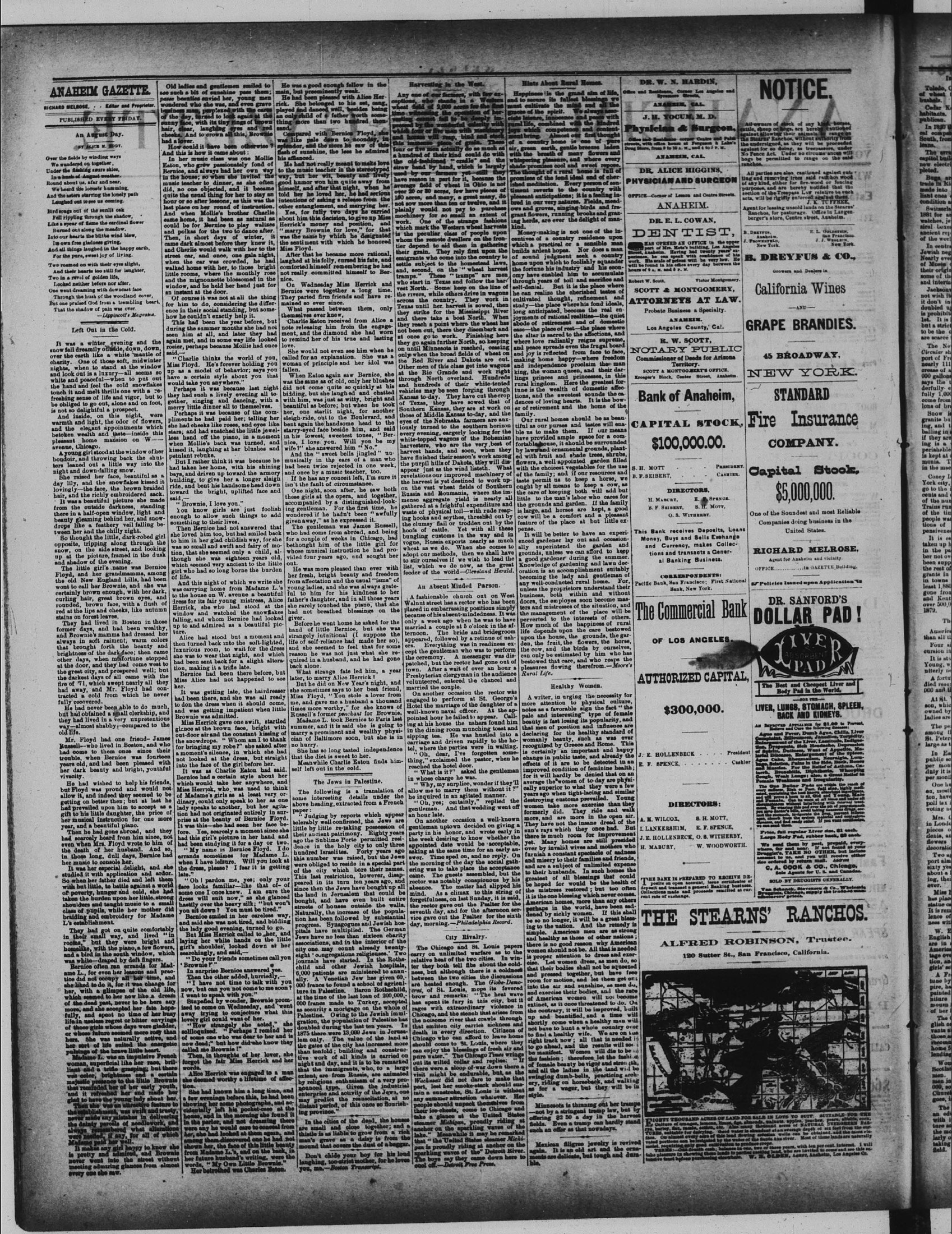
Searchable text
ANAHEIM GAZETTE
RICHARD MELROSE, Editor and Proprietor.
PUBLISHED EVERY FRIDAY.
An August Day.
BY JASON M. BODY.
Over the fields by winding ways
We wandered on together,
Under the flashing sunrise skies,
In a hush of August weather.
Round about us, afar and near,
We heard the locust humming,
And the asters starring the lonely path
Laughed out to see us coming.
Bird songs out of the sunlit oak
Fell rippling through the shadow,
Like a spear of flame the cardinal flower
Burned out along the meadow.
Into our hearts the blithe wind blew,
Its own free gladness giving.
And all things laughed in the happy earth,
For the pure, sweet joy of living.
Two roamed on with their eyes alight,
And their hearts too still for laughter,
Two in a revel of golden life,
Looked neither before nor after.
One went dreaming with downcast face
Through the hush of the woodland cover,
But one praised God from a trembling heart,
That the shadow of pain was over.
— Lippincott's Magazine.
Left Out in the Cold.
It was a winter evening and the snow fell dreamily outside, down, down, over the earth like a white mantle of charity. One of those soft, midwinter nights, when to stand at the window and look out is a luxury—all seems so white and peaceful—when to put out the hand and feel the cold snowflakes touch it and melt thrills one with a refreshing sense of life and vigor, but to be obliged to go out, alone and on foot, is not so delightful a prospect.
And inside, on this night, were warmth and light, the odor of flowers, and the elegant appointments which betoken wealth and taste—inside this pleasant home mansion on W—avenue, Chicago.
A young girl stood at the window of her bonjour, and throwing back the shut-
Old ladies and gentlemen smiled to see such a bit of sunshine pass them; passer beauties envied her, young men wondered who she was, and even grave business man, perplexed with the care of the day, turned to look again at the sunny face, with its tiny rings of brown hair, clear, laughing eyes and red cheeks. And to crown all this, Brownie had a lover.
How could it have been otherwise? And this is how it came about:
In her music class was one Mollie Eaton, who grew passionately fond of Bernice, and always had her own way in the house; so when she invited the music teacher to dinner, as she often did, no one objected, and it became quite the usual thing for her to stay an hour or so after lessons, as this was the last place on her round of instruction. And when Mollie’s brother Charlie came home, it had been as natural as could be for Bernice to play waltzes and polkas for the two to dance after. Then, in short days of winter, it came dark almost before they knew it, and Charlie would walk with her to the street car, and once, one gala night, when the car was crowded, he had walked home with her, to those bright little rooms, where the monthly rose and the magnonnette blossomed in the window, and he held her hand just for an instant at the door.
Of course it was not at all the thing for him to do, considering the difference in their social standing, but somehow he couldn’t exactly help it.
This had been the year before, but during the summer months she had not seen him at all, and later they had again met, and in some way life looked rosier, perhaps because Mollie had once said,
"Charlie thinks the world of you, Miss Floyd. He’s forever holding you up as a model of behavior; says you have a certain style about you that would take you anywhere."
Perhaps it was because last night they had such a lively evening all together, singing and dancing, with a merry little dinner all to themselves.
Perhaps it was because of the compliments he had paid her; telling her she had cheeks like roses, and eyes like stars; and had snatched the little jewelless hand off the piano, in a moment when Mollie’s back was turned, and kissed it, laughing at her blushes and petulant rebuke.
He was a good enough fellow main, but presumably weak. He had been pleased with hisrick. She belonged to his played and danced well, best an only child of a father wishing more than two husbands.
Compared with Bernice was like pale dawn to my splendor, and the more he flash of sunshine, the less his afflianced.
He had not really meant to to music teacher in the way, but her wit, beauty good humor won him quite himself, and after that night told her he loved her, he intentions of asking a release other entanglement, and me Yes, for fully two days about him this decision, to Herrick’s money and poil “marry Brownie for love was the name by which he the sentiment with which Miss Floyd.
After that he became much laughed at his folly, cursed comforted himself remember not really committed him nice.
On Wednesday Miss Bernice were together as They parted firm friends smained so ever since.
What passed between themselves ever knew.
Charlie Eaton received note releasing him from ment, and the diamond also to remind her of his true love.
She would not even see called for an explanation. woman of principle and fallen.
When Eaton again saw was the same as of old, only did not come quite so bidding, but she laughed with him, was just as beautiful as before; but w her one starlit night, sleigh-ride, out to the B bent again the handsome starry-eyed face beside him in his lowest, sweetest nice I love you. Will wife?” she answered him
And the “sweet bells may appear in the ears
On this night, were warmth and light, the odor of flowers, and the elegant appointments which betoken wealth and taste—inside this pleasant home mansion on W—avenue, Chicago.
A young girl stood at the window of her bondoir, and throwing back the shutters leaned out a little way into the night and down-falling snow.
She raised her face, beautiful as a day lily, and the snowflakes kissed it lovingly—the face, the brown braided hair, and the richly embroidered sack.
It was a beautiful picture she made from the outside darkness, standing there in a half-open window, light and beauty gleaming behind her, and snow-drops like a feathery veil falling between her and the chilly night.
So thought the little, dark-robed girl opposite, tripping along through the snow, on the side street, and looking up at the picture, framed in the duck and shadow of the evening.
The little girl's name was Bernice Floyd, and her grandmamma, among the old New England hills, had been wont to call her Brownie, and she was certainly brown enough, with her dark, curling hair, great brown eyes, and rounded, brown face, with a flush of red at the lips and cheeks, like autumn stains on forest leaves.
They had lived in Boston in those former days, and had been wealthy, and Brownie's mamma had dressed her always in soft raiment; warm colors that brought forth the beauty and brightness of the dark face; then came other days, when misfortune stopped at the door, and they had come west to the great city, and prospered well; but the darkest days of all came with the fire of 71, which swept nearly all they had away, and Mr. Floyd had contracted a cold from which he never fully recovered.
He had never been able to do much, but had obtained a small clerkship, and they had lived in a very unpretentious way—almost shabby—compared to the old life.
Mr. Floyd had one friend—James Russell—who lived in Boston, and who had come to them once since their trouble, when Bernice was fourteen years old, and had been pleased with her dark beauty and bright, youthful vivacity.
He had wished to help his friends, but Floyd was proud and would not allow it, and indeed they seemed to be getting on better then; but at last he had prevailed upon him to accept as a gift to his little daughter, the price of her musical instruction for one more year, and a beautiful piano.
Then he had gone abroad, and they had scarcely heard from him since, not even when Mrs. Floyd wrote to him of the death of her husband. And so, in those long, dull days, Bernice had her music to console her.
It was her especial delight, and she Miss Floyd. He's forever holding you up as a model of behavior; says you have a certain style about you that would take you anywhere."
Perhaps it was because last night they had such a lively evening all together, singing and dancing, with a merry little dinner all to themselves.
Perhaps it was because of the compliments he had paid her; telling her she had cheeks like roses, and eyes like stars; and had snatched the little jewelless hand off the piano, in a moment when Mollie's back was turned, and kissed it, laughing at her blushes and petulant rebuke.
But I rather think it was because he had taken her home, with his shining bays, and driven up toward the armory building, to give her a longer sleigh ride, and bent his handsome head down toward the bright, uplifted face and said,
"Brownie, I love you."
You know girls are just foolish enough to allow such things to add something to their lives.
Then Bernice had not answered that she loved him too, but had smiled back to him in her glad childish way; for she was so small and swift and fairy of motion, that she seemed only a child, although she was eighteen years old, which seemed very ancient to the little girl who had so long borne the burden of life.
And this night of which we write she was carrying home from Madame L.'s to the house on W. avenue a beautiful dress for its fair young mistress, Alice Herrick, she who had stood at the window and watched the snowflakes falling, and whom Bernice had looked up to and admired as a beautiful picture.
Alice had stood but a moment and then turned back into the soft-lighted luxurious room, to wait for the dress she was to wear that night, and which had been sent back for a alight alteration, making it a trifle late.
Bernice had been there before, but Miss Alice had not happened to see her.
It was getting late, the hairdresser had been there, and she was all ready to don the dress when it should come, and was getting impatient when little Brownie was admitted.
Miss Herrick gave one swift, startled glance at the brown face, bright with out-door air and the constant kissing of the snowdrops. "Whom am I to thank for bringing my robe?" she asked after a moment's silence, in which she had not looked at the dress, but straight into the face of the girl before her.
It was as Charlie Eaton had said. Bernice had a certain style about her which would take her anywhere, and Miss Herrick, who was used to think of Madame's girls as at least very ordinary, could only speak to her as one lady speaks to another, but her agitation had not originated entirely in surprise at the beauty of Bernice Floyd. It was this—she had seen her face before. Yes, scarcely a moment since she had this girl's picture in her hand and had been studying it for a day or two.
My name is Bernice Floyd. I do errands sometimes for Madame L. when I have leisure. Will you look at the dress, please? I fear it is getting
When Eaton again saw was the same as of old, only did not come quite so bidding but she laughed with him; was just as witful beautiful as before; but wheren one starlit night,sleigh-ride, out to the Bent again the handsome starry-eyed face beside him in his lowest sweetest nice. I love you. Will wife?" she answered him.
And the "sweet bells" musically in the ears owed been twice rejected by once by a music teacher.
If he has any conceit he isn't the fault of circumstances.
One night soon after these girls at the opera accompanied by a disting gentleman. For them wondered if he hadn’t given away," as he expresses.
The gentleman was J who had come from abroad for a couple of weeks in bethought him of the whose musical instruction vided four years ago,and out.
He was more pleased to hear fresh,bright beauty from affectation and the young ladies,and she was ful to him for his father’s daughter,and in she rarely touched the girl had not breathed blee giver.
Before he went home he hand of little Bernice strangely intuitional (life of self-reliance had)and she seemed to feel reason he was not just quired in a husband,and back alone.
What strange fate later,tomarry Alice H
But he did on New York she sometimes says to her Miss Floyd,"You stop me,and gave me a hush times more worthy,"for Russell's former pench
Madame L. took Bernice summer,and it is said marry a prominent and cian of Baltimore soon no hurry.
She has so long tasted that the diet is sweet to Meanwhile Charlie B self left out in the colo
He had wished to help his friends, but Floyd was proud and would not allow it, and indeed they seemed to be getting on better then; but at last he had prevailed upon him to accept as a gift to his little daughter, the price of her musical instruction for one more year, and a beautiful piano.
Then he had gone abroad, and they had scarcely heard from him since, not even when Mrs. Floyd wrote to him of the death of her husband. And so, in those long, dull days, Bernice had her music to console her.
It was her especial delight, and she studied it with application and ardor. So when her father died and left them with but little, to battle against a world of poverty, hunger and cold, she had taken the burden upon her little, strong shoulders and taught music to a small class of pupils, while her mother did braiding and embroidery for Madame L's establishment.
They had got on quite comfortably in their small way, and lived "in rooms," but they were bright and homelike, with the piano, a few flowers, and a bird in the south window, which was white—draped by deft fingers.
Bernice often ran errands for Madame L., for even her lessons and practice did not occupy all her time, and she liked to do it, for it was change for her, with a glimpse of the old life, which seemed to her now like a dream of the dead past, never to be here any more, and she accepted her fate hopefully, and spent no time of her busy life in useless regret or bitter envyings of those girls whose days were gladder, or whose future seemed more rosy than here. She was naturally active, and her sort of life suited the energetic pulsations of the brave little heart.
Madame L. was an impulsive French woman, superficial like her race, brilliant and a trifle grasping; but there was color, brightness and a certain majestic presence to the little Brownie that reminded her of her early youth, and it refreshed her and made her glad to have the young lady about her.
Then she was an attractive feature to the establishment, was swift and trusty, never made any mistakes in delivering the daisy parcel of needlework, and always remembered what alterations were needed, if any, for all of which Madame paid her well.
It makes any girl happy to know she is pretty and admired, and Brownie never went into the street without meeting admiring glances from almost every one she saw.
Bernice had a certain style about her which would take her anywhere, and Miss Herrick, who was used to think of Madame's girls as at least very ordinary, could only speak to her as one lady speaks to another, but her agitation had not originated entirely in surprise at the beauty of Bernice Floyd. It was this—she had seen her face before. Yes, scarcely a moment since she had this girl's picture in her hand and had been studying it for a day or two.
"My name is Bernice Floyd. I do errands sometimes for Madame L. when I have leisure. Will you look at the dress, please? I fear it is getting late."
"Oh! pardon me, yes; only your face looks familiar—like that of some one I once knew. I am sure the dress will suit now," as she glanced hastily over the heavy silk; "but won't you sit down? You must be tired."
Bernice smiled in her careless way, and said she was not tired, and bidding the lady good evening, turned to go.
But Miss Herrick called to her, and laying her white hands on the little girl's shoulder, looked down at her searchingly, and said,
"Do your friends sometimes call you 'Brownie'?"
In surprise Bernice answered yes.
Then the other added, hurriedly,
"I have not time to talk with you now, but can you not come to me soon? I want to speak with you."
Stupefied by wonder, Brownie promised to come on Wednesday, and went trying to conjecture what this lovely girl could want of her.
"How strangely she acted," she soliloquized. "Perhaps I remind her of some one who was dear to her and is now dead;" but how did she know they called me Brownie!
Then, in thoughts of her lover, she forgot the fair Miss Herrick and her words.
Alice Herrick was engaged to a man she deemed worthy a lifetime of affection.
She had known him a long time, and a few evenings before this, he had been showing her some photographs, and accidentally left his pocket-case at the house, and in the morning she found it in the porch, and not dreaming there were any he would care to conceal from her; she had looked at them again, and among them discovered one he had not shown her; the face of this little beauty from Madame L.'s, and on the back, in her future husband's writing, were the words, "My Own Little Brownie."
Her betrothed was Charles Eaton.
He was a good enough fellow in the main, but presumably weak.
He had been pleased with Alice Herrick. She belonged to his set, using clayed and danced well, besides being an only child of a father worth something more than two hundred thousand.
Compared with Bernice Floyd, she was like pale dawn to noonday, in unfavor, and the more he saw of this lash of sunshine, the less he admired his affluence.
He had not really meant to make love to the music teacher in the stereotyped way, but her wit, beauty and lively good humor won him quite away from himself, and after that night, when he told her he loved her, he had serious intentions of asking a release from the other entanglement, and marrying her.
Yes, for fully two days he carried about him this decision, to give up Miss Herrick's money and position, and "marry Brownie for love," for that was the name by which he designated the sentiment with which he honored Miss Floyd.
After that he became more rational, laughed at his folly, cursed his fate, and comforted himself remembering he had not really committed himself to Bernice.
On Wednesday Miss Herrick and Bernice were together a long time. They parted firm friends and have remained so ever since.
What passed between them, only themselves ever knew,
Charlie Eaton received from Alice a note releasing him from the engagement, and the diamond she had worn to remind her of his true and lasting love.
She would not even see him when he called for an explanation. She was a woman of principle and her idol was fallen.
When Eaton again saw Bernice, she was the same as of old, only her blushes did not come quite so quickly at his bidding, but she laughed and chatted with him, was just as witty, bright and beautiful as before; but when he took her, one starlit night, for another stealth-ride, out to the Boulevard, and bent again the handsome head to the starry-eyed face beside him, and said in his lowest, sweetest tones, "Bernice, I love you. Will you be my wife?" she answered him "No."
And the "sweet bells jingled" unusually in the ears of a man who
Harvesting in the West.
Any one of our farmers, with few exceptions, who stands in a Western wheat field of 2,000 acres for the first time witnessing the operation of harvest cannot fall to be deeply impressed by the wonderful extent with which four or five men with machinery and horses will reap, bind and stack this immense piece of grain. These four or five men actually do as much as a hundred of their hind could do with the old-fashioned "cradle" and the straw band by hand, which is largely used by our farmers yet—still they have reason in part for it, because the average field of wheat in Ohio is not over 20 or 30 acres, few have pieces of 160 acres, and many, a great many, do not sow more than ten or twelve, and it plainly would not pay to purchase machinery for so small an extent of work. One of the strange fashions which mark the Western wheat harvests is the peculiar class of people upon whom the remote dwellers on the frontier depend to aid them in gathering their grain. They rely first upon the emigrants who come into the country to settle subject to the homestead laws, and second, on the "wheat harvest tramps." These "tramps" are men who start in Texas and follow the harvest North. Some keep on the line of the rivers, while others drive in wagons across the country. They work in Texas until her harvest is sowed, then they strike for the Mississippi River and there take a boat North. When they reach a point where the wheat has not been cut, there they disembark and at once go to work. Finishing here they go again further North, so keeping on until Minnesota is reached, ceasing only when the broad fields of wheat on the Red River and Dakota are cut. Other men of this class get into wagons at the Rio Grande and work right through North overland. Hundreds and hundreds of their white-tented vehicles may be seen forging through Kansas to-day. They have cut the crop of Texas, they have sowed that of Southern Kansas, they are at work on those of Middle Kansas to-day, and the eyes of the Nebraska farmers are anxiously turned to the southern horizon every evening, eagerly looking for the white-topped wagons of the Bohemian harvesters, who are the very best of harvest hands, and soon, when they have finished their season's work among
Happiness is the grand aim of life, and to secure its fullest blessings we must cultivate the mind and all the graces of the spirit. We always associate leisure, innocence and peace with rural life, combined with the kindred joys which competence and contentment bring. Almost our first thought of a country home is one of pure air, green earth, gentle breezes laden with the breath of many flowers and whispering pleasure, and where every shade promises cool and sweet repose. The thought of a rural home is full of promises of the fond ideal and of cherished meditation. Every person of sentiment reverts to the country with pleasant anticipations; it is a feeling inbred in our very natures. Fields, meadows and groves, singing-birds and fragrant flowers, running brooks and grazing herds, are ever the delight of mankind.
Money-making is not one of the incentives of a country residence upon which a practical or a sensible man builds ardent hopes. Nor does a man of sound judgment seek a country home upon which to foolishly squander the fortune his industry and his economy have enabled him to accumulate through years of toil and sacrifice and self-denial. But it is the place where he can realize the cherished tastes of enlitivated thought, refinement and study—the place where his fond ideals, long anticipated, become the real enjoyments of rational realities—the quiet abode of retirement and of domestic ease—the place of rest—the place where the altar is sacred to the affections, and where love radiantly reigns supreme, and peace spreads even the frugal board and joy is reflected from face to face, making home happy—where freedom and independence proclaim the man king, the woman queen, and their darlings princesses and princesses, in this rural kingdom. Here the greatest fortune is the wealth of domestic affections, and the sweetest sounds the cadenades of loving hearts. It is the bower of retirement and the home of the family.
Our rural homes should be as beautiful as our purses and tastes will enable us to make them. If our means have provided ample space for a comfortable house, it should be surrounded by lawns or ornamental grounds, planted with fruit and shade trees, shrubs,
DR. W.
Office and Residence
NYC
ANAMERICAN STREETS
OFFICE-CORNER OF ANANAMERICAN STREETS
ANAMERICAN STREETS
OFFICE-CORNER OF ANANAMERICAN STREETS
DR. ALICI PHYSICIAN
OFFICE-CORNER OF ANANAMERICAN STREETS
OFFICE-CORNER OF ANANAMERICAN STREETS
DR. ALICI PHYSICIAN
OFFICE-CORNER OF ANANAMERICAN STREETS
DR. ALICI PHYSICIAN
OFFICE-CORNER OF ANANAMERICAN STREETS
DR. ALICI PHYSICIAN
OFFICE-CORNER OF ANANAMERICAN STREETS
DR. ALICI PHYSICIAN
OFFICE-CORNER OF ANANAMERICAN STREETS
DR. ALICI PHYSICIAN
OFFICE-CORNER OF ANANAMERICAN STREETS
DR. ALICI PHYSICIAN
OFFICE-CORNER OF ANANAMERICAN STREETS
DR. ALICI PHYSICIAN
OFFICE-CORNER OF ANANAMERICAN STREETS
DR. ALICI PHYSICIAN
OFFICE-CORNER OF ANANAMERICAN STREETS
DR. ALICI PHYSICIAN
OFFICE-CORNER OF ANANAMERICAN STREETS
DR. ALICI PHYSICIAN
OFFICE-CORNER OF ANANAMERICAN STREETS
DR. ALICI PHYSICIAN
OFFICE-CORNER OF ANANAMERICAN STREETS
DR. ALICI PHYSICIAN
OFFICE-CORNER OF ANANAMERICAN STREETS
DR. ALICI PHYSICIAN
OFFICE-CORNER OF ANANAMERICAN STREETS
DR. ALICI PHYSICIAN
OFFICE-CORNER OF ANANAMERICAN STREETS
DR. ALICI PHYSICIAN
OFFICE-CORNER OF ANANAMERICAN STREETS
DR. ALICI PHYSICIAN
OFFICE-CORNER OF ANANAMERICAN STREETS
DR. ALICI PHYSICIAN
OFFICE-CORNER OF ANANAMERICAN STREETS
DR. ALICI PHYSician
OFFICE-CORNER OF ANANAMERICAN STREETS
DR. ALICI PHYSician
OFFICE-CORNER OF ANANAMERICAN STREETS
DR. ALICI PHYSician
OFFICE-CORNER OF ANANAMERICAN STREETS
DR. ALICI PHYSician
OFFICE-CORNER OF ANANAMERICAN STREETS
DR. ALICI PHYSician
OFFICE-CORNER OF ANANAMERICAN STREETS
DR. ALICI PHYSician
OFFICE-CORNER OF ANANAMERICAN STREETS
DR. ALICI PHYSician
OFFICE-CORNER OF ANANAMERICAN STREETS
DR. ALICI PHYSician
OFFICE-CORNER OF ANANAMERICAN STREETS
DR. ALICI PHYSician
OFFICE-CORNER OF ANANAMERICAN STREETS
DR. ALICI PHYSician
OFFICE-CORNER OF ANANAMERICAN STREETS
DR. ALICI PHYSician
OFFICE-CORNER OF ANANAMERICAN STREETS
DR. ALICI PHYSician
OFFICE-CORNER OF ANANAMERICAN STREETS
DR. ALICI PHYSician
OFFICE-CORNER OF ANANAMERICAN STREETS
DR. ALICI PHYSician
OFFICE-CORNER OF ANANAMERICan STREETS
DR. ALICI PHYSician
OFFICE-CORNER OF ANAnAmERican STREETS
DR. ALICI PHYSician
OFFICE-CORNER OF AnAnAmERican STREETS
DR. ALICI PHYSician
OFFICE-CORNER Of AnAnAmERican STREETS
DR. ALICI Physician
Office-corner Of AnAnAmErican Streets
Dr.W.
Office And Residence
NYC
J.H.Y.O.
Physician
Office And Residence
NYC
Dr.E.
PHYSician
Office And Residence
NYC
R.W.
NOTARIE Commissions
SCOTT & MCGROOK'S Block
Bank o
CAPITAL $100
When Eaton again saw Bernice, she was the same as of old, only her blushes did not come quite so quickly at his bidding, but she laughed and chatted with him, was just as witty, bright and beautiful as before; but when he took her, one starlit night, for another sleigh-ride, out to the Boulevard, and bent again the handsome head to the starry-eyed face beside him, and said in his lowest, sweetest tones, "Bernice, I love you. Will you be my wife?" she answered him "No."
And the "sweet bells jingled" unmusically in the ears of a man who had been twice rejected in one week, and once by a music teacher, too.
If he has any conceit left, I'm sure it isn't the fault of circumstance.
One night, soon after, he saw both these girls at the opera, and together, accompanied by a distinguished-looking gentleman. For the first time, he wondered if he hadn't been "awfully given away," as he expressed it.
The gentleman was James Russell, who had come from abroad, and being for a couple of weeks in Chicago, had bethought him of the little girl for whose musical instruction he had provided four years ago, and sought her out.
He was more pleased than ever with her fresh, bright beauty and freedom from affectation and the usual "isms" of young ladies, and she was always grateful to him for his kindness to her father's daughter, and in all those years she rarely touched the piano, that she had not breathed blessings on the giver.
Before he went home he asked for the hand of little Bernice, but she was strangely intuitive (I suppose the life of self-reliance had made her so), and she seemed to feel that for some reason he was not just what she required in a husband, and he had gone back alone.
What strange fate led him, a year later, to marry Alice Herrick!
But he did on New Year's night, and she sometimes says to her best friend, Miss Floyd, "You stole a lover from me, and gave me a husband a thousand times more worthy," for she knows of Russell's former penchant for Brownie.
Madame L. took Bernice to Paris last summer, and it is said she is going to marry a prominent and wealthy physician of Baltimore soon, but she is in no hurry.
She has so long tasted independence that the diet is sweet to her.
Meanwhile Charlie Eaton finds himself left out in the cold.
The Jews in Palestine.
The following is a translation of some interesting details under the above heading, extracted from a French paper:
"Judging by reports which appear tolerably well confirmed, the Jews are little by little re-taking possession of their ancient patrimony. Eighty years ago the Sublime Porte permitted residence in the holy city to only three hundred Israelites. Forty years ago this number was raised, but the Jews were obliged to reside in a special part of the city which bore their names.
Other men of this class get into wagons at the Rio Grande and work right through North overland. Hundreds and hundreds of their white-tented vehicles may be seen foraging through Kansas to-day. They have cut the crop of Texas, they have sowed that of Southern Kansas, they are at work on those of Middle Kansas to-day, and the eyes of the Nebraska farmers are anxiously turned to the southern horizon every evening, eagerly looking for the white-topped wagons of the Bohemian harvesters, who are the very best of harvest hands, and soon, when they have finished their season's work among the purpil hills of Dakota, they will disappear just as the wind listeth. What revelations our improved machinery of the harvest is yet destined to work upon the vast wheat fields of Southern Russia and Moumania, where the immense aggregate yield is nearly all gathered at a frightful expenditure and waste of physical soil—with rude reaping hooks and scythes, threshed out by the clumsy flail or trodden out by the hoofs of cattle. Yet with all these bungling customs in the way and in vogue, Russia exports nearly as much wheat as we do. When she comes to adopt our methods, then we shall have to stir ourselves if we wish to lead the list, which we do now, as the great feeder of the world—Cleveland Herald.
An Absent Minded Parson.
A fashionable church out on West Walnut street has a rector who has been placed in embarrassing positions simply because of his absent-mindedness. It was only a week ago when he was to have married a couple at 5 o'clock in the afternoon. The bride and bridegroom appeared, followed by a retinue of ushers. Everything was in readiness except the gentleman who was to perform the ceremony. A messenger was dispatched, but the rector had gone out of town. After a wait of over an hour a Presbyterian clergyman in the audience volunteered, entered the chancel and married the couple.
On another occasion the rector was engaged to perform at St. George's Hotel the marriage of the daughter of a well-known naval officer. At the appointed hour he failed to appear. Calling at his house the ushers found him in the dining room munching toast and sipping tea. He was hustled into a carriage and driven rapidly to the hotel, where the parties were in waiting.
"Oh dear, I've forgotten something," exclaimed the pastor, when he reached the hotel door.
"What is it?" asked the gentleman in whose charge he was.
"Why, my surplice, wonder if they'll allow me to marry them without it?" he inquired in an agitated manner.
"Oh yes; certainly," replied the gentleman. And that wedding went off an hour late.
On another occasion a well-known gentleman uptown decided on giving a party in his honor, and wrote early in the week desiring to know whether the appointed date would be acceptable, asking at the same time for an early answer. Time sped on, and no reply. On the morning of the day the social gathering was to take place the acceptance and independence proclaiming the man king, the woman queen, and their daring princes and princesses, in this rural kingdom. Here the greatest fortune is the wealth of domestic affections, and the sweetest sounds the cadenes of loving hearts. It is the bower of retirement and the home of the family.
Our rural homes should be as beautiful as our purses and tastes will enable us to make them. If our means have provided ample space for a comfortable house, it should be surrounded by lawn and ornamental grounds, planted with fruit and shade trees, shrubs flowers, a well-appointed garden filled with the choice vegetables for the use of the family; and if our resources and taste permit us to keep a horse, we ought by all means to keep a cow, as the care of keeping both will add but little to the man's labor who cares for the grounds and garden. If the family is large, and horses are kept, a good cow will be a comfort and a pleasant feature of the place at but little expense.
It will be better to have an experienced gardener lay out and occasionally superintend the garden and grounds, unless we can afford to keep a good gardener during the summer. Knowledge of gardening and lawn decoration is an accomplishment suitably becoming the lady and gentleman of any well-conducted rural home. For unless the proprietors understand their business, both within and without doors, the employees soon become masters and mistresses of the situation, and the management of the place will be perverted to the interests of others. How much of the happiness of rural life depends upon the care bestowed upon the house, the grounds, the garden, the fruit, the flowers, the horse, the cow, and the birds by ourselves can only be estimated by him who has bestowed that care, and who reaps the pleasures flowing therefrom.—Moore's Rural Life.
Healthy Women.
A writer, in urging the necessity for more attention to physical culture, notes as a favorable sign the fact "the pale and interesting" type of female beauty is fast losing its popularity, and that men of position and influence are declaring for the healthy standard of womanly beauty, such as was ever recognized by Greece and Rome. This is certainly an important and happy change in public taste, and already the effects of it are to be detected in an improved condition of feminine health; for it will hardly be denied that on an average "women of to-day are physically superior to what they were a few years ago when tight-lacing and similar destroying customs provailed. Young women take more exercise than they formerly did. They ride and walk more, and are more in the open air. They have not the insane dread of the sun's rays which they once had. But there is much room for improvement yet. Many homes are still presided over by invalid wives and mothers who furnish a constant spectacle of sadness and misery to their families and friends, and are a subject of unlimited expense to their husbands. In such homes the
The Jews in Palestine.
The following is a translation of some interesting details under the above heading, extracted from a French paper:
"Judging by reports which appear tolerably well confirmed, the Jews are little by little re-taking possession of their ancient patrimony. Eighty years ago the Sublime Porte permitted residence in the holy city to only three hundred Israelites. Forty years ago this number was raised, but the Jews were obliged to reside in a special part of the city which bore their names. This last restriction, however, disappeared in its turn ten years ago, and since then the Jews have bought up all the land in Jerusalem that could be bought, and have even built entire streets of houses outside the walls. Naturally, the increase of the population has been followed by substantial progress. Synagogues and Jewish hospitals have multiplied. The German Jews have no less than sixteen charity associations, and in the interior of the city one may count already twenty-eight congregations religieuses." Two journals have started. In the Rothschild and other Jewish hospitals, 6,000 patients are ministered to annually. A Venetian Jew has given 60,000 francs to found a school of agriculture in Palestine. Baron Rothschild, at the time of the last loan of 200,000,000 francs made to Turkey, accepted as security a mortgage on the whole of Palestine. Owing to the Jewish immigration, the population of Palestine has doubled during the last ten years. In 1875 there were 13,000 Jews in Jerusalem only. The value of the land at the gates of the city has increased more than tenfold; building and constructive work of all kinds is carried on night and day, and it is to be remarked that the immigrants, who, to a large extent, are from Russia, are animated by religious enthusiasm of a very pronounced type. Given the industrial enterprise and activity of the Jews, one may predict the resuscitation, at no distant period, of this once so flourishing province."
In the cities of the dead, the houses are small and close together; and a thistle is as liable to grow from a rich man's grave as a daisy is from the mound that covers the dust of a boggar.
Don't chide your boy for his loud laughing, too strict mother, for he loves you, ma.—Boston Transcript.
"Why, my surplice, wonder if they'll allow me to marry them without it?" he inquired in an agitated manner.
"Oh, yes," replied the gentleman. And that wedding went off an hour late.
On another occasion a well-known gentleman uptown decided on giving a party in his honor, and wrote early in the week desiring to know whether the appointed date would be acceptable, asking at the same time for an early answer. Time sped on, and no reply. On the morning of the day the social gathering was to take place the acceptance came. The guests assembled, but the rector was notably conspicuous by his absence. The matter had slipped his mind. As a climax to this string of forgetfulness, on last Sunday, it is said, the rector gave out the Psalter for the seventh day, and for the afternoon service gave out the Psalter for the sixth day, morning.—Philadelphia Record.
City Rivalry.
The Chicago and St. Louis papers carry on unlimited warfare as to the relative heat of the two cities. In winter they both tell fibs about the coldness, but although there is a coldness between the two cities the discussions are heated enough. The Globe-Democrat, of St. Louis, mops its fevered brow and remarks: "The heat wave has spent its fury in this city, but it rages with extraordinary violence in Chicago, and the stench that arises from the noisome river that crawls through that smitten city carries sickness and death in every direction. Citizens of Chicago who can afford to leave home should come to St. Louis, where they can enjoy the blessings of fresh air and pure water." The Chicago Times wrings out its wilted collar and replies: "If there were a sleop-of-war down there a visit might be endurable, but, as the Wachusett did not dare to make that port, lost her smoke-stack should sustain a sunstroke, St. Louis is without any summer attraction whatever. Her people should unpack themselves from their ice chests, come to Chicago and take a glance at the United States steamer Michigan, proudly riding at anchor on the sparkling waves of the lake." Meanwhile it may be remarked that "the United States steamer Michigan is proudly riding at anchor on the sparkling waves of the Detroit River. The boys say they came down here to cool off."—Detroit Free Press.
for it will hardly be denied that on an average the women of to-day are physically superior to what they were a few years ago when tight-lacing and similar destroying customs prevailed. Young women take more exercise than they formerly did. They ride and walk more, and are more in the open air. They have not the insane dread of the sun's rays which they once had. But there is much room for improvement yet. Many homes are still presided over by invalid wives and mothers who furnish a constant spectacle of sadness and misery to their families and friends, and are a subject of unlimited expense to their husbands. In such homes the greatest of all blessings that could be hoped for would be the health of the mistress restored; but too often it is the one blessing which never comes. American homes, more than any others perhaps in the world, have been added by sickly women. If this shall be so no longer, it will be a great blessing to the nation. And the remedy is simple. American men are as strong and healthy as those of other nations; there is no good reason why American women should not be. All that is needed is proper attention to dress and exercise. Let women dress, as men do, so that their bodies shall not be squeezed and pressed together, but have free room for motion, and let them get out into the air and sunshine, as men do, and exercise their bodies, and the race of American women will not become extinct, as it once threatened to do. On the contrary, it will be improved, built up and beautified, and a time will shortly come when a healthy man will not have to hunt a whole country over to find a healthy wife. We are on our right track now; all that is needed is to go ahead, and the results will soon be manifest. Women will die to be fashion; therefore let the fashion of female beauty be vigor and strength, and all the ladies in the land will be swinging dumb-bells, practicing archery, riding on horseback, and walking as for a wager, but they will be in style.
Minnesota is thinning out her trumps—not by a stringent trump law, but by offering $250 a day in the harvest fields. Even a trump can hardly stand such an offer as that nowadays.
Mexican filigree jewelry is revived again. It is an old art and the ornaments are delicate, but tough and durable.
DR. W. N. HARDIN,
Office and Residence, Corner Los Angeles and
Anaheim Streets.
J. H. YOCUM, M. D.
Physician & Surgeon,
Office and Residence corner Centre and Paint
stores, with office hours at Ferguson & Lake's
Drug Store, from 9 to 10 A.M., and 4 to 5 P.M.
Anaheim, Cal.
DR. ALICE HIGGINS,
PHYSICIAN AND SURGEON
OFFICE—Corner of Lemon and Centre Streets.
ANAHEIM.
DR. E. L. COWAN,
DENTIST,
HAS OPENED AN OFFICE in the upper
part of Mrs. Metas's building, Los Angeles
Street, Anaheim. Having had twenty years' expience, he can speak with confidence of his
work. His scale of prices will be very low. He
will be found in his office every day between the
hours of 9 A.M. and 5 P.M.
Robert W. Scott.
Victor Montgomery.
SCOTT & MONTGOMERY,
ATTORNEYS AT LAW.
Probate Business a Specialty.
Anaheim.
Los Angeles County,' Cal.
R. W. SCOTT,
NOTARY PUBLIC
Commissioner of Deeds for Arizona Territory.
SCOTT & MONTGOMERY'S OFFICE,
Krogerer's Block, Center Street, Anaheim.
Bank of Anaheim,
CAPITAL STOCK,
$100,000.00.
NOTICE.
All owners of stock of any kind, horses,
cattle, sheep or hogs, are hereby cautioned
against allowing their animals in range on
the Stearns' Ranchos, without authority from
the undersigned, as they will be proceeded
against for so doing, as trespassers, under
No Fence Act. Under no circumspects will
hogs be permitted to range on the said
ranchos.
All parties are also cautioned against cutting and removing from said ranchos wood
of any kind, either for fire-wood or fencing
purposes, and are hereby notified that the
section of the Treepass Law relative to such
acts, will be rigidly enforced against them.
Agent for leasing unsold lands on the Stearns'
Ranchos, for pasturage. Office in Langenberger's store, Centre street, Anaheim.
B. DREYFUS.
E. L. GOLDSTEIN,
Anaheim.
San Francisco.
J. FROWENFIELD,
New York.
New York.
B. DREYFUS & CO.,
Growers and Dealers in
California Wines
AND
GRAPE BRANDIES.
45 BROADWAY.
NEW YORK.
STANDARD
Fire Insurance COMPANY.
Territory.
SCOTT & MONTGOMERY'S OFFICE,
Kroeger's Block, Center Street, Anaheim.
Bank of Anaheim,
CAPITAL STOCK,
$100,000.00.
S. H. MOTT President.
B. F. SEIBERT, Cashier.
DIRECTORS:
H. MABURY, E. A. SPENCE.
B. F. SEIBERT, S. H. MOTT,
O. S. WITHERBY.
This Bank receives Deposits, Loans Money, Buys and Sells Exchange and Currency, makes Collections and transacts a General Banking Business.
CORRESPONDENTS:
Pacific Bank, San Francisco; First National Bank, New York.
The Commercial Bank
OF LOS ANGELES.
AUTHORIZED CAPITAL,
$300,000.
J. E. HOLLENBECK President
E. F. SPENCE, Cashler
DIRECTORS:
A. M. WILCOX, S. H. MOTT,
I. LANKERSHIM, E. F. SPENCE,
J. E. HOLLENBECK, O. S. WITHERBY,
H. MABURY, W. WOODWORTH.
NEW YORK.
STANDARD Fire Insurance COMPANY.
Capital Stock,
$5,000,000.
One of the Soundest and most Reliable Companies doing business in the United States.
RICHARD MELROSE.
Agent for Anaheim and vicinity.
OFFICE...in GAZETTE Building.
Policies Issued upon Application to DR. SANFORD'S DOLLAR PAD!
The Best and Cheapest Liver and Body Pad in the World.
FOR THE LIVER, LUNGS, STOMACH, SPLEEN, BACK AND KIDNEYS.
AN REPROVED APPLIANCE for $1.00 to Prevent Believe and Ours the following diseases:
Agua and Fever, Dumb Ague, Chilla, Liver Damage, Bilionism, Jaundice, Torsipidity, Malnutrition of the Liver, Lasitude, Indigestion of the Liver, Dulness, Want of Appetite, Material Disease, Enlargement of the Spleen, Ague Cola, Rheumatism, Neuralgia, Lumbar Pain, Palsis in the Side, Back, Bones and Muscles.
For the Relief of Asthma, Cararthur, Bronchitis, Diphtheria, Whopping Cough, Weak Lung); also, a Great Relief in Female Weight and Irregularity.
The One Dollar Pads are within the reach of every sufferer: Rich or Poor; Full size; highly profiled; containing the best images shown herewith; and will prove a best to all Old and Young; Male and Female.
Can be worn at all times and under all circumstances without interfering with internal treatment.
By wearing this pad over the pit of your mouth you save doctor's bills; avoid taking medicine without the starch; for example the liver prevents bilium disease; and find ready mild. If you want考证,we can send them.
Price: full regular Liver size; $1 each.
Large Body Pad; rubber back; $2 each.
We send them by post, prepaid everywhere far and near. If not found at your Drugger's TAKE NO OTHER, but incense amount to us, and you will receive either size ordered by return mail.
Address: C. A. COOK & CO., Chicago,
America than all the Four states curation in It is strong Young, well utterly new A fortune died recently 000 and last At St. son which owned by ladies are The per among the St. Peter large as In East public society per month daily it is per monitor One bu en, most ton have poll tax voting Mrs. C in London pieces of denia, and flowers decoration Two ag port almost sixty years
DIRECTORS:
A. M. WILCOX, S. H. MOTT,
I. LANKERSHIM, E. F. SPENCE,
J. E. HOLLENBECK, O. S. WITHERBY,
H. MABURY, W. WOODWORTH.
THE BANK IS PREPARED TO RECEIVE DEPOSITS ON OPEN ACCOUNT, ISSUE CERTIFICATES OF DEPENT AND TRANSACT A GENERAL BANKING BUSINESS. COLLECTIONS MADE AND PROCEED REMITTED AT CURRENT RATE OF EXCHANGE.
THE STEARNS' RANCHOS.
ALFRED ROBINSON, Trustee.
120 Sutter St., San Francisco, California.
EIGHTY THOUSAND ACRES OF LAND FOR SALE IN LOTS TO SUIT. SUITABLE FOR THE Culture of oranges, lemons, limes, figs, almonds, walnuts, apples, peaches, pears, almonds, corn, rye, harley, figs, ramble, eden, etc. Also among thousand acres of NATURAL EVENGREEN PATTERNS, suitable for drying. Good water is abundant at an average depth of six feet from the surface. On almost every area of this land flowing estates wells can be obtained, and the more elevated portions can be irrigated by the water of the Santa Ana river. Most of these lands are naturally moist, requiring only good cultivation to produce crops.
TERMS: One-fourth cash; balances in one, two or three years, with ten per cent interest. I will take pleasure in showing these lands to partisan cashing land, who are invited to come and see this attractive tenant before purchasing elsewhere. W. H. OLDEN, ALEXZ ANAHEIM, Los Angeles Co.