anaheim-gazette 1879-09-05
Scanned page
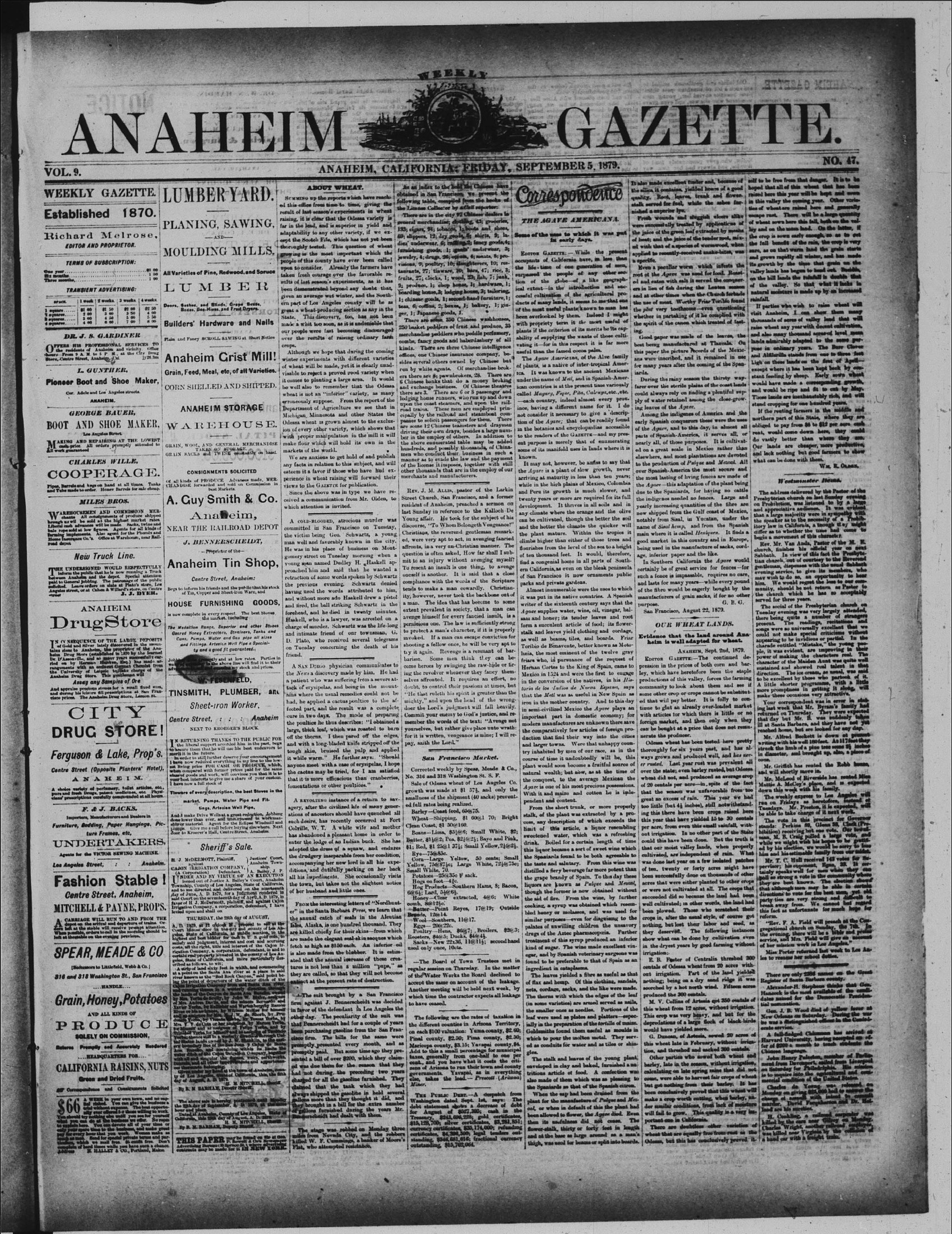
Searchable text
ANAHEIM
VOL. 9.
WEEKLY GAZETTE.
Established 1870.
Richard Melrose,
EDITOR AND PROPRIETOR.
TERMS OF SUBSCRIPTION:
One year.....$3.00
Six months.....1.50
Three months.....1.00
TRANSIENT ADVERTISING:
SPACE
1 square.....$1.00
2 squares.....2.00
3 squares.....3.00
4 squares.....4.00
5 squares.....4.00
6 squares.....4.00
7 squares.....4.00
8 squares.....4.00
DR. J. S. GARDINER
OFFERS HIS PROFESSIONAL SERVICES TO the residents of Anaheim and virginia. Office hours: From 9 A.M. to 5 P.M., at the City Drug Store, Centre Street, Anaheim, Cal.
jy26.3m
L. GUNTHER,
Pioneer Boot and Shoe Maker,
Cor. Adele and Los Angeles streets.
ANAHEIM.
GEORGE BAUER,
BOOT AND SHOE MAKER,
Los Angeles Street.
MAKING AND REPAIRING AT THE LOWEST cash price. All orders promptly attended to all work guaranteed.
LUMBER YARD.
PLANING, SAWING,
AND MOULDING MILLS.
All Varieties of Pine, Redwood, and Spruce
LUMBER
Deors, Bashes, and Blinds, Grape Boxes,
Boxes, Bee-Hives, and Fruit Dryers.
Builders' Hardware and Nails
Plain and fancy SCROLL SAWING at Short Notice
Anaheim Grist Mill!
Grain, Feed, Meal, etc., of all Varieties.
CORN SHELLED AND SHIPPED.
ANAHEIM STORAGE
WAREHOUSE.
GRAIN, WOOL, AND GENERAL MERCHANDISE TAKEN ON STORAGE.
GRAIN BACKS and TWINE constantly on hand.
ABOUT WHEAT
Summing up the reports which led this office from time to time result of last season's experiment raising, it is clear that the Old far in the lead, and is superior adaptability to any other variety except the Scotch Fife, which has thoroughly tested. This question growing is the most important people of this county have ever upon to consider. Already they taken fresh courage over the suits of last season's experiment been demonstrated beyond and given an average wet winter,ern part of Los Angeles county great a wheat-producing section State. This discovery, too, made a whit too soon, as it is our people were fast becoming over the results of raising crops.
Although we hope that during winter experiments with different of wheat will be made, yet it visable to reject a proved good it comes to planting a large area well also to remember the wheat is not an "inferior" variety erroneously suppose. From the Department of Agriculture Michigan, Minnesota and other Odessa wheat is grown almostion of every other variety, with proper manipulation in make flour which will hold markets of the world.
We are anxious to get hold
L. GUNTHER,
Pioneer Boot and Shoe Maker,
Cor. Adele and Los Angeles streets.
ANAHEIM.
GEORGE BAUER,
BOOT AND SHOE MAKER,
Los Angeles Street.
MAKING AND REPAIRING AT THE LOWEST
cash-price. All orders promptly attended to
all work guaranteed.
CHARLES WILLE,
COOPERAGE.
Pipes, Barrels and keys on hand at all times. Tanks
and Tubes made to order. Honev Barrels for sale cheap.
MILES BROS.
WAREHOUSEMEN AND COMMISSION MERCHANTS. All conglaints of produce shipped through us will be sold at the highest market rates. Liberal cash advances will be made. Sacks, twine and bale rope sold at low figures. Agents for all kinds of farming implements. Also agent for the Phoenix and Home Insurance Co.'s. Office at Warehouse, near Railroad depot.
New Truck Line.
THE UNDERSIGNED WOULD RESPECTFULLY inform the public that he is now running a Truck between Anaheim and the depot. Special attention paid to General Jobbing. The patronage of the public solicited. Leave order on slate at Plato's store, Los Angeles street, or at Cahen & Willard's store, on Centre street.
ANAHEIM
Drug Store
IN CONSEQUENCE OF THE LARGE DEPOSITS of Gold and Silver lately discovered in the mountains close to Anaheim, the proprietor of the Anaheim Drug Store (established in 1870 by the learned Dr. D'Assonville, and no many years successfully carried on by Hermann Hanken, Eq.) has made arrangements with an eminent German Chemist from the University of Leipzig to take charge of the Anaheim Drug Store. This gentleman will Assay any Samples of Ore And appraise precious stones for a small fixed sum, and during his leisure fill prescriptions at San Francisco prices. The Anaheim Drug Store, Lemon St.
CITY DRUG STORE!
Ferguson & Lake, Prop's.
Centre Street (Opposite Plantera' Hotel),
ANAHEIM.
A choice variety of perfumery, toilet articles, etc., pure and fresh Drugs, patent medicines, etc. Physicians' prescriptions carefully compounded at all hours.
F. & J. BACKS.
Importers, Manufacturers and Dealers in Furniture, Bedding, Paper Hangings, Picture Frames, etc,
UNDERTAKERS.
Agents for the VICTOR SEWING MACHINE.
Los Angeles Street, : : Anaheim.
Grain, Feed, Meal, etc., of all Varieties.
CORN SHELLED AND SHIPPED.
ANAHEIM STORAGE
WAREHOUSE.
GRAIN, WOOL, AND GENERAL MERCHANDISE
TAKES ON STORAGE.
GRAIN SACKS and TWINE constantly on hand.
CONSIGNMENTS SOLICITED
Of all kinds of PRODUCE. Advances made, MERCHANTABILITY forwarded and sold on Commission in best Markets.
A. Guy Smith & Co.
Anaheim,
NEAR THE RAILROAD DEPOT
J. BENNERSCHEIDT,
Propriator of the
Anaheim Tin Shop,
Centre Street, Anaheim:
Begs to inform his friends and the public that his stock of Tin, Copper and Sheet-Iron Ware, and HOUSE FURNISHING GOODS,
is now complete in every respect. The best Stoves the market, including
The Medallion Range, Superior and other Stoves Genared Honey Extractors, Strainers, Tanks and Cans, Pumps, Water and Gas pipe all sizes and Fittings. Artesian Well Pipe a Speciality and a good fit guaranteed.
Jobber is currently at low rates. Parties in warehouse are in the above line will find it to their advantage if they can furnish my stock and prices.
W. FESENFELD,
TINSMITH, PLUMBER, and
Sheet-Iron Worker.
Centre Street, : : Anaheim
NEXT TO KROEGER'S BLOCK.
IN RETURNING THANKS TO THE PUBLIC FOR the liberal support accorded him in the past, begs to assure them that he will use his best endeavors to merit it in the future.
In order to still further deserve your encouragement I have now reduced everything in my line to the lowest living price FOR CASH OR PRODUCE, which when compared with former prices paid for the same class of goods and work, will convince you that it is to your best interests to give me a share of your custom. I have now a full stock of Tinware of every description, the best Stoves in the market. Pumps, Water Pipe and Fittings. Artesian Well Pipe.
And I make Drive Wells at a great reduction. Jobbing done lower than ever, and thus improved in workmanship or material. Agent for the Eclipse Windmill and pumps. Give me a call before buying elsewhere. Next door to Kroever's Hall, Centre Street, Anaheim.
Sheriff's Sale.
H. J. McDERMott, Plaintiff,
against CAJON IRRIGATION COMPANY.
Defendant.
Justices' Court,
Anheim Township.
A. Bailey, J.P.
of wheat will be made, yet it visibly able to reject a proved seed it comes to planting a large area be well also to remember that wheat is not an "inferior" variety erroneously suppose. From Department of Agriculture Michigan, Minnesota and other Odessa wheat is grown almost ion of every other variety, with proper manipulation in make flour which will hold in markets of the world.
We are anxious to get hold any facts in relation to this esteem it a favor if those who perience in wheat raising will views to the Gazette for publication.
Since the above was in type received a communication from which attention is invited.
A COLD-BLOODED, atrocition committed in San Francisco the victim being Geo. Scherman well and favorably known He was in his place of business gomery street on Tuesday morning man named Dudley proached him and said that retraction of some words spared the previous evening. Having used the words attentive and without more ado Haskell and fired, the ball striking Forehead, and he died in Haskell, who is a lawyer, charge of murder. Schwartz and intimate friend of our D. Plato, who received se on Tuesday concerning th friend.
A SAN DIEGO physician the News a discovery made a patient who was suffering tack of erysipelas, and beingains where the usual remedy had, he applied a cactus pooled part, and the result cure in two days. The mae the poultice he thus describe large, thick leaf, which was off the thorns. I then parade and with a long-bladed knight tough skin, bruised the ptit while warm." He further anyone meet with a case of the cactus may be tried, for that it is more efficacious fomentations or other poultry.
A REVOLTING instance of agery, after the civilized hations of ancestors should have such desire, has recently Colville, W.T. A white has abandoned a pleasant enter the lodge of an Indian adopted the dress of a squirrel the drudgery inseparable for accompanying her new lordditions, and dutifully pack
Fashion Stable!
Centre Street, Anaheim,
MITCHELL & PAYNE, PROPS.
A CARRIAGE WILL RUN TO AND FROM THE depot on the arrival and departure of trains. Orders left at the stable will receive prompt attention. When possible, orders to call in the morning should be left at the stable on the evening previous.
SPEAR, MEADE & CO
[Succonsors to Littlefield, Webb & Co.]
310 and 318 Washington St., San Francisco
...HANDLE.....
Grain, Honey, Potatoes
AND ALL KINDS OF
PRODUCE
SOLELY ON COMMISSION,
Returns Promptly and Accurately Rendered
...HEADQUARTERS FOR...
CALIFORNIA RAISINS, NUTS
Green and Dried Fruits.
Correspondence and Concurrences Sollicited
$66
A WEEK in your own town, and no capital raised. You can give the business a trial without expense. The best opportunity ever offered for those willing to work. You should try nothing else until you see for yourself what you can do at the business we offer. No reason to explain here. You can devote all of your time or only your spare time to the business, and make great pay for every hour that you work. Women make an ample man. Stand for special private terms and particulars, which we mail free. Do not complain of hard times while you have such a chance. Address: M. HALLET & CO., Portland, Maine.
Sheriff's Sale.
H. J. McDERMOTT, Plaintiff,
against CAJON IRRIGATION COMPANY,
(A Corporation)
Defendant.
UNDER AND BY VIRTUE OF AN EXECUTION
issued out of Justice A. Bailey's Court, Anaheim Township, County of Los Angeles, State of California, and to me directed and delivered on the nineteenth day of June, A.D. 1879, for a judgment rendered in said Court on the seventeenth day of April, A.D. 1879, in favor of H. J. McDermott, plaintiff, and against Cajon Irrigation Company, a corporation, defendant, I have levied upon and shall on THURSDAY, the 22nd day of AUGUST,
A. D. 1879, at 12 o'clock M., proceed to sell at the Court House door in the city and county of Los Angeles, State of California, at public auction, to the highest and best bidder for cash in U.S. gold coin, to satisfy said judgment, interest and cost and accruing costs, all the right, title and interest of the Cajon Irrigation Company, a corporation, defendant, in and to certain real property situated in the county of Los Angeles, State of California, and more particularly described as follows, to wit:
A strip of land sixty feet in width, and commencing at a point on the Santa Ana river at a place in said river known as the "Red Rock Canyon," said point being the point of departure of the water ditch of the Cajon Irrigation Company from Santa Ana River, and running them in a westerly direction through the hands of the Canyon de Santa Ana Bancada, owned by Mrs. Yorba de Scullery, by John W. Batha, assignee of Mrs. Andrena Davila, and the mines Bernardo and Navier Yorba, by Ballister and Wartenberger Ramon Rivas or his frances, by William McLane for himself and an assignee for Mrs. J.W. de Shorb, by Prudencia Yorba, by Virginia Batha, by Tomas Yorba, by Mrs. K.Y. de Coin or her assistant, by Marion Yorba, for himself and an assignee of Felpe Yorba, and by Trinidad Yorba for himself and an assignee of Tustino Yorba; chance still in a westerly direction through United States lands owned by A. W. Shanklin, to the eastern boundary line of the last Jean de Santa Ana Bancado, and containing within its limits the water ditch of the Cajon Irrigation Company together with all and singular the fames, weirs, earthworks tunnels, and all other improvements and appartments thereunto belonging.
Given under my hand at the town of Anaheim, county of Los Angeles, state of California, this fifth day of August, A.D. 1879.
H. M. MITCHELL, Sheriff.
By R. M. BARHAM, Deputy Sheriff.
The above sale is hereby presented until Monday the 22nd day of September, A.D. 1879, at the same hour and place.
Dated at Anaheim, County of Los Angeles, state of California, this 5th day of August, A.D. 1879.
H. M. MITCHELL, Sheriff.
This paper may be found on file at Omaha Advertising Bureau (19 street S.), where advertising contracts may be made for $15 IN NEW YORK.
ABOUT WHEAT.
Summing up the reports which have reached this office from time to time, giving the result of last season's experiments in wheat raising, it is clear that the Odessa variety is far in the lead, and is superior in yield and adaptability to any other variety, if we except the Scotch Fife, which has not yet been thoroughly tested. This question of wheat growing is the most important which the people of this county have ever been called upon to consider. Already the farmers have taken fresh courage over the favorable results of last season's experiments, as it has been demonstrated beyond any doubt that, given an average wet winter, and the Southern part of Los Angeles county will be as great a wheat-producing section as any in the State. This discovery, too, has not been made a whit too soon, as it is undeniable that our people were fast becoming discouraged over the results of raising ordinary farm crops.
Although we hope that during the coming winter experiments with different varieties of wheat will be made, yet it is clearly unadvisable to reject a proved good variety when it comes to planting a large area. It would be well also to remember that the Odessa wheat is not an "inferior" variety, as many erroneously suppose. From the report of the Department of Agriculture we see that in Michigan, Minnesota and other States the Odessa wheat is grown almost to the exclusion of every other variety, which shows that with proper manipulation in the mill it will make flour which will hold its own in the markets of the world.
We are anxious to get hold of and publish
As an index to the hold the Chinese have obtained in San Francisco, we present the following table, compiled from the books of the License Collector by a Call reporter:
There are in the city 97 Chinese dealers in general merchandise; clothing, 43; groceries, 133; cigars, 94; tobacco, 1; boots and shoes, 69; shippers, 12; dry goods, 6; shirts, 9; ladies' underwear, 6; raffling, 2; fancy goods, 4; furnishing goods, 1; ginsh' underwear, 3; jewelry, 4; drugs, 26; opium, 4; meats, 8; provisions, 9; poultry, 10; slaughterers, 10; restaurants, 27; tinware, 10; bars, 47; rice, 3; fruits, 27; clocks, 1; wood, 22; fish, 7; junk, 2; produce, 1; chop house, 1; hardware, 1; boarding house, 3; lodging house, 3; tailoring, 1; chinese goods, 1; second-hand furniture, 1; teas, 6; coffins, 2; boxes, 1; bakery, 1; jinger, 1; Japanese goods, 1.
There are some 350 Chinese washhouses, 250 basket peddlers of fruit and produce, 35 merchandise peddlers who peddle perfumery, combs, fancy goods and haberdashery of all kinds. There are three Chinese intelligence offices, one Chinese insurance company, besides several others owned by Chinese but run by white agents. Of merchandise brokers there are 8; pawnbrokers, 28. There are 6 Chinese banks that do a money broking and exchange business. Of Chinese剧院 there are 3. There are 6 or 8 passenger and lodging house runners, who run up and down upon the coast steamers, and upon the railroad trains. These men are employed principally by the railroad and steamboat companies to solicit passengers for them. There are some 12 Chinese teamsters and draymen driving their own drays, besides a large number in the employ of others. In addition to the above enumerated table may be added hundreds, and possibly thousands, of China-men who conduct their business in such a manner as to evade the law and the payment.
Correspondence
THE AGAVE AMERICANA.
Some of the uses to which it was put in early days.
EDITOR GAZETTE: — While the present occupants of California have, in less than the life-time of one generation of men, surpassed the people of any other section of the globe—of a like geographical extent—in the introduction and successful cultivation of the agricultural products of many lands, it seems to me that one of the most useful plants known to man has been overlooked by them. Indeed I might with propriety term it the most useful of plants if the criterion of its merits be its capability of supplying the wants of those cultivating it—for in this respect it is far more useful than the famed cocoa palm.
The Agave Americana, of the Alve family of plants, is a native of inter-tropical America. It was known to the ancient Mexicans under the name of Meil, and in Spanish-American countries is at the present time variously called Maguey, Feque, Pita, Caleruga, etc., etc.—each country indeed almost every province having a different name for it. I do not consider it necessary to give a description of the Agave; that can be readily found in the botanics and encyclopaedias accessible to the readers of the Gazette—and my present purpose is merely that of enumerating some of its manifold uses in lands where it is known.
of wheat will be made, yet it is clearly unavailable to reject a proved good variety when it comes to planting a large area. It would be well also to remember that the Odessa wheat is not an "inferior" variety, as many erroneously suppose. From the report of the Department of Agriculture we see that in Michigan, Minnesota and other States the Odessa wheat is grown almost to the exclusion of every other variety, which shows that with proper manipulation in the mill it will make flour which will hold its own in the markets of the world.
We are anxious to get hold of and publish any facts in relation to this subject, and will esteem it a favor if those who have had experience in wheat raising will forward their views to the Gazette for publication.
Since the above was in type we have received a communication from Mr. Olden, to which attention is invited.
A cold-blooded, atrocious murder was committed in San Francisco on Tuesday, the victim being Geo. Schwartz, a young man well and favorably known in the city. He was in his place of business on Montgomery street on Tuesday morning when a young man named Dudley H. Haskell approached him and said that he wanted a retraction of some words spoken by Schwartz the previous evening. Schwartz denied having used the words attributed to him, and without more ado Haskell drew a pistol and fired, the ball striking Schwartz in the forehead, and he died in twenty minutes. Haskell, who is a lawyer, was arrested on a charge of murder. Schwartz was the life-long and intimate friend of our townman, G. D. Plato, who received several telegrams on Tuesday concerning the death of his friend.
A San Diego physician communicates to the News a discovery made by him. He had a patient who was suffering from a severe attack of erysipelas, and being in the mountains where the usual remedies could not be had, he applied a cactus poultice to the affected part, and the result was a complete cure in two days. The mode of preparing the poulice he thus describes: "I obtained a large, thick leaf, which was roasted to burn off the thorns. I then pared off the edges, and with a long-bladed knife stripped off the tough skin, bruised the pulp and applied it while warm." He further says: "Should anyone meet with a case of erysipelas, I hope the cactus may be tried, for I am satisfied that it is more efficacious than cranberries, fomentations or other poultices."
A revolting instance of a return to savagery, after the civilized life of many generations of ancestors should have quenched all such desire, has recently occurred at Fort Colville, W. T. A white wife and mother has abandoned a pleasant home in order to enter the lodge of an Indian buck. She has adopted the dress of a squaw, and endures the drudgery inseparable from her condition, accompanying her new lord in all his expeditions, and dutifully packing on her back
Rev. J. M. Allis, pastor of the Larkin Street Church, San Francisco, and a former resident of Anaheim, preached a sermon on last Sunday in reference to the Kalloch-De Young affair. He took for the subject of his discourse, "To Whom Belongeth Vengeance?" Christians, the reverend gentleman remarked, were very apt to act, in avenging fancied affronts, in a very un-Christian manner. The question is often asked, How far shall I submit to an injury without avenging myself? To resent an insult is one thing, to avenge oneself another. It is said that a close compliance with the words of the Scripture tends to make a man cowardly. Christianity, however, never took the backbone out of a man. The idea that has become to some extent prevalent in society, that a man can avenge himself for every fancied insult, is a pernicious one. The law is sufficiently strong to protect a man's character, if it is properly invoked. If a man can escape conviction for shooting a fellow once, he will be very apt to try it again. Revenge is a remnant of barbarism. Some men think they can become heroes by swinging the raw-hide or tiring the revolver whenever they fancy themselves affronted. It requires an effort, no doubt, to control their passions at times, but "He that ruleth his spirit is greater than the mighty," and upon the head of the wrongdoer the Lord's judgment will fall heavily. Commit your enemy to God's justice, and remember the words of the text: "Avenge not yourselves, but rather give place unto wrath; for it is written, vengeance is mine; I will repay, saith the Lord."
San Francisco Market.
Corrected weekly by Speaz, Mende & Co., No. 316 and 318 Washington St. S.F.
Sale of Odessa wheat of Los Angeles Co. growth was made at $1 57¢; and only the smallness of the shipment (40 sacks) prevented full rates being realized.
Barley—Coast feed, 65@75.
Wheat—Shipping, $1 60@1 70; Bright Clean Coast, $1 50@160.
Beans—Lima, $5½@6; Small White, $2; Butter, $1½@2; Pea, $2¼@2½; Bayo and Pink, $1; Red, $1 25@1 37½; Small Yellow, $2¼@2½; Rye—75@85c.
Corn—Large Yellow, 50 cents; Small Yellow, 75@7½c; Large White, 72½@75c; Small White, 70.
It was known to the ancient Mexicans under the name of Meel, and in Spanish-American countries is at the present time variously called Magney, Faque, Pita, Calruga, etc., etc., each country indeed almost every province, having a different name for it. I do not consider it necessary to give a description of the Agave; that can be readily found in the botanics and encyclopaedias accessible to the readers of the Gazette—and my present purpose is merely that of enumerating some of its manifold uses in lands where it is known.
It may not, however, be amiss to say that the Agave is a plant of slow growth, never arriving at maturity in less than ten years; while in the high plains of Mexico, Colombia and Peru its growth is much slower, and twenty years or more are required for its full development. It thrives in all soils and in any climate where the orange and the olive can be cultivated, though the better the soil and the hotter the climate the quicker will the plant mature. Within the tropics it climbs higher than either of those trees and flourishes from the level of the sea to a height of ten thousand feet. It would therefore find a congenial home in all parts of Southern California, as even on the bleak peninsula of San Francisco it now ornamentals public parks and private gardens.
Almost innumerable were the uses to which it was put in its native countries. A Spanish writer of sixteenth century says that the Agave supplies water, wine, oil, vinegar, balam and honey; its tender leaves and root form a succulent article of food; its flower-stalk and leaves yield clothing and cordage, as well as beams, tiles, and boards. Friar Toribio de Benavente, better known as Motolinia, the most eminent of the twelve gray friars who, in pursuance of the request of Hernan Cortes to the King of Spain, came to Mexico in 1524 and were first to engage in the conversion of the natives in his Historia de los Indios de Nueva España, says that the Meel was as useful in New Spain as iron in the mother country. And to this day in semi-civilized Mexico the Agave plays an important part in domestic economy; for modern manufactures are unknown there save the comparatively few articles of foreign production that find their way into the cities and larger towns. Were that unhappy country inhabited by men of our race, as in the course of time it undoubtedly will be, this plant would soon become a fruitful source of natural wealth; but now, as at the time of the conquest, to the average Mexican the Agave is one of his most precious possessions. With it and maize and cotton he is independent and content.
From the short trunk, or more properly stalk, of the plant was extracted by a process, any description of which exceeds the limit of this article, a liquor resembling sweetened water which was a refreshing drink. Boiled for a certain length of time this liquor became a sort of sweet wine which the Spaniards found to be both agreeable to taste and salutary. From this wine was distilled a fiery beverage far more potent than of wheat will be made, yet it is clearly unavailable to reject a proved good variety when it comes to planting a large area. It would be well also to remember that the Odessa wheat is grown almost to the exclusion of every other variety, which shows that with proper manipulation in the mill it will make flour which will hold its own in the markets of the world.
We are anxious to get hold of and publish any facts in relation to this subject, and will esteem it a favor if those who have had experience in wheat raising will forward their views to the Gazette for publication.
Since the above was in type we have received a communication from Mr. Olden, to which attention is invited.
A cold-blooded, atrocious murder was committed in San Francisco on Tuesday,the victim being Geo. Schwartz,a young man well and favorably known in the city.Hewan in his place of business on Montgomery street on Tuesday morning when a young man named Dudley H. Haskell approached him and said that he wanted a retraction of some words spoken by Schwartzthe previous evening. Schwartz denied having used the words attributed to him,and without more ado Haskell drew a pistol and fired,the ball striking Schwartzin the forehead,and he died in twenty minutes.Huskellwho is a lawyer.was arrested ona charge of murder.Schwartzwasthelife-longandintimatefriendofourtownaman,G.D.Plattowhoreceivedseveraltelegramsontuesdayconcerningthedeathofthefriend.
A San Diego physician communicatestotheNewsadiscoverymadebyhim.Hewadatpatientwhosew sufferingfromasevereattackoferysipelas,andbeinginthemountainswheretheusualremediescouldnotbehad,happlieda cactuspoulticetotheaffectpart,andtheresultwasacompletecureintwodays.Themodeofpreparingthepuilticehethusdescribes:"Iobtainedalarge,tleickleafwhichwasroastedtoburnoffthethorns.Ithenparedofftheedges,andwithalongbladedknifestrippedofftheoughskin,bruisedthepulpandappieditwhilewarm."Hefurthersays:"Shouldanyonemeetwithacaseoferysipelas,iHopecactusmaybetried,forsIm satisfiedthatitismoreefficaciousthantranberries,fomentationsorotherpoults."
A revolting instance of a return to savagery, after the civilized life of many generations of ancestors should have quenched all such desire, has recently occurred at Fort Colville, W. T. A white wife and mother has abandoned a pleasant home in order to enter the lodge of an Indian buck. She has adopted the dress of a squaw, and endures the drudgery inseparable from her condition, accompanying her new lord in all his expeditions, and dutifully packing on her back all his impellimenta. She occasionally visits the town, but takes not the slightest notice of her husband and little ones.
From the interesting letters of "Nordhunter" in the Santa Barbara Press, we learn that the annual catch of seals in the Aleutian Isles, Alaska, is one hundred thousand. They are killed chiefly for their skins—from which are made the elegant seal-skin sacques which fetch as high as $150 each. An inferior oil is also made from the blubber. It is estimated that the annual increase of these creatures is not less than a million "pups," as they are called, so that they will not become extinct at the present rate of destruction.
The suit brought by a San Francisco firm against J. Bennerscheidt was decided in favor of the defendant in Los Angeles the other day. The peculiarity of the suit was that Pennerscheidt had for a couple of years been purchasing gasoline from the San Francisco firm. The bills for the same were promptly presented every month, and as promptly paid. But some time ago they presented a bill of over $200, which they claimed was due them for the reason that they had not during the preceding two years charged for all the gasoline furnished. They claimed that the tank which they had always shipped the gasoline in held several gallons more than they thought it did, and they brought in a bill for the extra number of gallons furnished during the years Mr. Bennerscheidt had dealt with them.
The stage was rebled on Monday three miles from Nevada City, and the robbers killed W. F. Cummings, a banker of Moore's Flat, who attempted resistance.
Sale of Odessa wheat of Los Angeles Co. growth was made at $1 57½, and only the smallness of the shipment (40 sacks) prevented full rates being realized.
Barley—Coast feed, 65@75.
Wheat—Shipping, $1 60@1 70; Bright Clean Coast, $1 50@160.
Beans—Lima, $5½@6; Small White, $2; Butter, $1½@2; Pea, $2¼@2½; Bayo and Pink, $1; Red, $1 25@1 37½; Small Yellow, $2¼@2½.
Rye—75@85c.
Corn—Large Yellow, 50 cents; Small Yellow, 75@87½c; Large White, 72½@75c; Small White, 70.
Potatoes—25@35c V sack.
Hogs on foot—4¾c.
Hog Products—Southern Hams, 8; Bacon, 6@6½; Lard, 5¼@6½.
Honey—Clear extracted, 4@6; White comb, 8@12½c.
Batter—Point Reyes, 17@19; Outside Brands, 12@14.
Wool—Southern, 11@17.
Eggs—20@22c.
Poultry—Hens, $6@7; Breilers, $2¾; Roosters, $4@5; Ducks, $4@4½.
Sacks—New 22x36, 11@11½; second hand used only once, 10cts.
The Board of Town Trustees met in regular session on Thursday. In the matter of the Water Works the Board declined to accept the same on account of the leakage. Another meeting will be held next week, by which time the contractor expects all leakage to have ceased.
The following are the rates of taxation in the different counties in Arizona Territory, on each $100 valuation: Yuma county, $2.69; Pinal county, $2.50; Pima county, $2.50; Maricopa county, $3.15; Yavapai county,$4.Add to this a small percentage for municipal taxes generally from one-half to one per cent., and you have what it costs the citizens of Arizona to run their town and county governments. Yavapai, as in everything else, takes the lead.- Precott (Arizona) Miner.
The Public Debt.-A despatch from Washington dated Sept. 1st says: The debt statement shows a decrease of debt for August of $527,395; cash in the Treasury,$243,696,228; gold certificates,$15,128,700; silver certificates,$3,281,851; currency certificates,$35,174,000; refunding certificates,$4,398,500; legal tender outstanding,$246,681,016; fractional currency outstanding,$15,762,064.
The leaves yielded a fibre as useful as that of flax and hemp. Of this clothina, sandals, nets, cordage, sacks, and the like were made. The thorns with which the edges of the leaf (in some varieties) are armed served as nails, the smaller ones as needles. Portions of the leaf were used as plates and platters—especially in the preparation of the tortilla of maize. Goldsmiths found them useful as moulds in which to pour the molten metal. They served as conduits for water and as tiles or shingles.
The stalk and leaves of the young plant enveloped in clay and baked, furished a nutritious article of food. A confection was also made of them which was as pleasing to the Spaniards as that of the Spanish citron.
When the sap had been drained from the plant for the manufacture of Pulque and Mezcal, or when in default of this the plant had been allowed to flower,the Aguee died. Even then its usefulness did not cease.The flower-stalk, thirty or forty feet in length and at the base as large around as a man's thigh, was used for beams or split into boards.
Wheat did not exceed 20 centals of Oats out irrigation nothing; because it was not succeeded well cultivated crops in after nothing but they deserve show what o'er in the dryess irrigation:
E. B. Penalties of Oats out irrigation nothing; because it was not succeeded well cultivated crops in after nothing but they deserve show what o'er in the dryess irrigation:
M. V. Corn this wheat tainted something were got most been concluited make a crop der similar will fail to portant ones there as wheat that Odessa buys
AZETTE.
1879. NO. 47.
It also made excellent tender and, because of the silica it contains, yielded house of a good quality. Root, leaves, trunk and flower-stalk served for fuel, while the subs furnished a superior lye.
Fresh wounds and sluggish closes alike were successfully treated by applications of the juice of the green leaf extracted by means of heat; and the juice of the tender root, mixed with that of a species of wormwood, when applied to recently-received snake-bites, was a specific.
Even a peculiar worm which infests the root of the Agave was used for local Roast-ed and eaten with salt it served the conquerors in lieu of fish during the Lenten season and at other times when the Church forbade the use of meat. Worthy Priar-Toribfo found the plot very toothsome—even questioning whether in partaking of it he complied with the spirit of the canon which treated of fasting.
Good paper was made of the leaves, the best being manufactured at Tlaxcala. On this paper the picture Records of the Mexicans were inscribed, and it remained in use for many years after the coming of the Spaniards.
During the rainy season the thirsty wayfarer over the sterile plains of the coast lands could always rely on finding a plentiful supply of water retained among the close-growing leaves of the Agave.
Among the indigenees of America and the early Spanish conquerors these were the uses of the Agave, and to this day, in almost all parts of Spanish-America, it serves all, or nearly all, of those purposes. It is cultivated on a great scale in Mexico rather than elsewhere, and most plantations are devoted all to be free from that danger. It is to be hoped that all of this wheat that has been raised here this year will be kept and grown in this valley the coming year. Other varieties of wheat are raised here and generally escape rust. There will be a large quantity of wheat sown here this fall, both on the valley and on the main land. On the latter, if the crop is sown early enough, so as to get the full benefit of the rain, the crop is very sure, as on that warm hand the grain starts and grows rapidly all winter, and has made its growth by the time that grain on the valley lands has begun to hand out. Buddhism on the hill lands the rainfall is double that of the valley. So that what it hacks in natural moisture is made up by an increased rainfall.
If parties who wish to raise wheat will visit Anaheim, I can show them many thousands of acres of valley land that will raise wheat any year with decent cultivation, and also many thousand acres of level man lands admirably adapted to the same purpose in ordinary years. The Dura Chuer and Alfilarilla stands from one to three feet high on these lands on the first of April—except where it has been kept back by constant feeding by sheep. Early sow wheat would have made a corresponding growth, and would be ripe and fit to cut by May. These lands are inexhaustibly rich, and will stand cropping for one hundred years.
If the renting farmers in the middle and northern part of this Stata, where they are obliged to pay from $6 to $12 per acre each rent, would come down here, they would do vastly better than where they are. Our lands are cheaper, more productive, and lack nothing but good farmers to show what can be done with them.
During the rainy season the thirsty way farer over the sterile plains of the coast hands could always rely on finding a plentiful supply of water retained among the close-growing leaves of the Agave.
Among the indigences of America and the early Spanish conquerors these were the uses of the Agave, and to this day, in almost all parts of Spanish-America, it serves all, or nearly all, of those purposes. It is cultivated on a great scale in Mexico rather than elsewhere, and most plantations are devoted to the production of Pulque and Mezcal. All over Spanish-America the most secure and the most lasting of living fences are made of the Agave—this adaptation of the plant being due to the Spaniards, for having no cattle the indigenous needed no fences. Large and yearly increasing quantities of the fibre are now shipped from the Gulf coast of Mexico, notably from Sisal, in Yucatan, under the name of Sisal hemp, and from the Spanish main where it is called Heniquen. It finds a good market in this country and in Europe, being used in the manufacture of sacks, cordage, inferior paper and the like.
In Southern California the Agave would certainly be of great service for fences—for such a fence is impassable, requires no care, and lasts for many years—while every pound of the fibre would be eagerly bought by the manufacturers of grain sacks, if for no other purpose.
San Francisco, August 22, 1879.
OUR WHEAT LANDS.
Evidence that the land around Anaheim is well adapted for wheat.
ANAHEIM, Sept. 2nd, 1879.
EDITOR GAZETTE:—The continued depression in the prices of both corn and barley, which have heretofore been the staple productions of this valley, forces the farming community to look about them and see if some other crop or crops cannot be substituted that will pay better. It is folly to continue to glut an already over-loaded market with articles tor which there is little or no foreign market, and then only when they can be bought at a price that does not remunerate the producer.
Odessa wheat has been tested—here pretty thoroughly for six years past, and has always grown and produced well, and has never rusted. Last year rust was prevalent all over the state; even harley rusted, but Odessa wheat did not, and produced an average crop of 20 centals per acre—in spite of the fact that the season was unfavorable from too great an excess of rain. This year we had too little (but 4½ inches), still notwithstanding this there have been crops raised here this year that have yielded 15 to 30 centals per acre, from even this small rainfall, without irrigation. In no other part of the State could this have been done. But the truth is that our moist valley lands, when properly cultivated, are independent of rain. What was done last year on a few isolated patches of ten, twenty or forty acres might have except where it has been kept back by constant feeding by sheep. Early sow wheat would have made a corresponding growth, and would be ripe and fit to eat by May. These lands are inexhaustibly rich, and will stand cropping for one hundred years.
If the renting farmers in the middle and northern part of this State, where they are obliged to pay from $8 to $12 per acre each rent, would come down here, they could do vastly better than where they are. Our lands are cheaper, more productive, and lack nothing but good farmers to show what can be done with them.
Mr. R. Olden.
Westminster Items.
The address delivered by the Pastor of the Presbyterian church on last Sunday evening on Prohibition, was listened to by a large and appreciative audience. It was evident that a large majority were in sympathy with the speaker as to the necessity of a Probity law in California, a though it might differ as to whether the time had come to begin a movement of this character.
Rev. Mr. Van Anda, Pastor of the M. K. church, finishes his official year on next Sabbath. In view of this fact the Presbyterian church out of courtesy to the Hoverend gentleman, dispenses with the usual Sabbath evening service, to give its members, who may wish to do so, an opportunity to hear him. We would regret the loss to our community, should not return as Pastor to the church which he has so acceptably served for three years.
The social of the Presbyterian church on Tuesday evening was very largely attended, there being quite a number of strangers present. The readings, recitations and songs were so universally excellent that we could not make special criticisms without appearing to be invidious or partial. In the charade entitled "Mistake," the young people, it was evident, are improving in their power of making the characters real. The character of the Maiden Aunt was quite well sustained and showed real talent in that direction. The ice cream, as usual, was said to be excellent by those who partook of it. A little shorter programme, with a little more promptness in getting it along, will make these occasions very attractive.
Your correspondent was in error in stating last week that Mr. Byram's family had returned on Thursday. They were expected that day but Mr. B. was suddenly taken ill at Santa Barbara, and they have not yet reached home, but are looked for any day.
Mr. Alfred Beckett is down at premature writing with his well 180 feet. At 117 feet they struck the limb of a pine tree some 8 inches in diameter, and brought up also a piece of cone.
Mr. Griffith has rented the Robb house, and will shortly move in.
Mr. McLeod of Riverside has rented Miss Mattie A. McCoy's place, and is expected down this week with his family.
The weekly express to Los Angeles will run on Fridays as heretofore instead of Tuesdays. Mr. Preston, it is expected, will be able to take charge of it next week.
The vote in this precinct for Governor stands: Perkins 89, Glenn 88, Clark (Prohibition) receiving but one vote. Our townman, M. B. Craig pulled a large vote, and while we might wish his hopes to be gratified by his election, we would be sorry to lose him and his estimable family from our masters.
Mr. T. C. Hull received 143 votes for supervisor; his suitor, Egan, 22. It curiously speaks well for men when they can
Mexican the
possessions.
be is indle
more properly
detected by a proch
exceeds the
nuror resembling
has a refreshing
length of time
sweet wine which
agreeable to
this wine was
more potent than
to this day these
Mexico and Mexcal,
tainted without
minute, by further
and which resemnal was used for
disguising to the
unsavory
specia. Further
an inferior
excellent vinery surgeons was
of Spain as an
useful as that
clothing, sandals,
like were made.
edges of the leaf
served as nail,
Portions of the
platters—espectartilla of maine.
as moulds in
total. They servas tiles or shinas tiles or shinyoung plant,
furnished a nuconfection was
as pleasing to
Spanish citron.
trained from the
Pulque and Mexcal
the plant had
died. Even
not cease.
The very feet in length
round as a man's
split into boards.
wheat did not, and produced an average crop of 20 centals per acre—in spite of the fact that the season was unfavorable from too great an excess of rain. This year we had too little (but 4½ inches), still notwithstanding this there have been crops raised here this year that have yielded 15 to 30 centals per acre, from even this small rainfall, without irrigation. In no other part of the State could this have been done. But the truth is that our moist valley lands, when properly cultivated, are independent of rain. What was done last year on a few isolated patches of ten, twenty or forty acres might have successfully done on thousands of other acres that were either planted to other crops or were not cultivated at all. The crops that succeeded did so because the land had been well cultivated; in other words, the land had been plowed. Those who scratched their crops in, after the usual style, of course got nothing, but lost their labor and seed, as they deserved. The following instances show what can be done by cultivation even in the dryest years by good farming without irrigation:
E. B. Foster of Centralia threshed 300 centals of Odessa wheat from 20 acres without irrigation. Part of the land yielded nothing; being on a dry sand ridge it was scorched by a hot north wind. Fifteen acres produced the 300 centals.
M. V. Collins of Artesia got 350 centals of this wheat from 12 acres, without irrigation. This crop was very heavy, and but for the depreciations of a large flock of black-birds would have yielded more.
G. Duncan, of Artesia, sowed 20 acres of this wheat late in February, without irrigation, and threshed and sacked 300 centals.
Other parties who sowed both wheat and barley, late in the season, without irrigation, calculating on late spring rains that did not come, were able to harvest fair crops of wheat but got nothing from their barley. It has been conclusively proved that this wheat will make a crop worth cutting, when barley, under similar conditions, from lack of moisture will fail to grow. This quality is a very important one in California.
There are doubtless other variations of wheat that are equally free from rust in the Olans, but this has conclusively proved it.
Mr. McLeod of Riverside has rented Miss Mattie A. McCoy's place, and is expected down this week with his family.
The weekly express to Los Angeles will run on Fridays as heretofore, instead of Tuesdays. Mr. Preston, it is expected, will be able to take charge of it next work.
The vote in this precinct for Governor stands: Perkins 89, Glenn 88, Clark (Prohibition) receiving but one vote. Our bewilder, M. B. Craig polled a large vote, and while we might wish his hopes to be gratified by his election, we would be sorry to lose him and his estimable family from our toilet.
Mr. T. C. Hull received 143 votes for supervisor; his opponent, Egan, 23. It certainly speaks well for now when they can pull so strong a vote in the community where they are best known. The elections showed that although men may be able in certain directions to vote for the best man, yet old party ties are very strong and difficult to break away from. We cannot but regard this fact as unfortunate for much hope for reform.
"Rev. F. A. Field will preach at the Congregational church on Sunday, the 7th. In the evening, there will be a bible and praise service, and Mrs. Field will give an account of her mission work in Los Angeles."
Miss Porter returned last week to Los Angeles to resume her school duties.
There are only 236 names on the Grant Register of Santa Barbara county.
Alexander-H. Stephens thinks that Gen. Hancock is the most available of the candidates named for the Democratic Presidential nomination.
Gen. J. B. Wood died of yellow fever at New Orleans on Saturday. During the war he was a distinguished officer in the Civilian service.
A full-fledged Columbia has arrived at Harvard University, having escaped an offer of $200 a month to teach students the Chinese language.
John Henry Puleston, member of Parliament from Devonport, sailed from Liverpool on Saturday for Philadelphia. His mission is to acquire into the agricultural and commercial condition of the United States.
Charles da Young was released on Monday on giving $25,000 half to ensure the charge of assault with intent to commit murder. David Parquhartson and Dr. Holland are his sureties.
H. Conkling, a railroad carpenter was killed by the crew near Gilroy on Monday. Charles Wright, another railroad employee, was killed near Virginia by the collision of a hand car with a freight train.