anaheim-gazette 1879-04-26
Scanned page
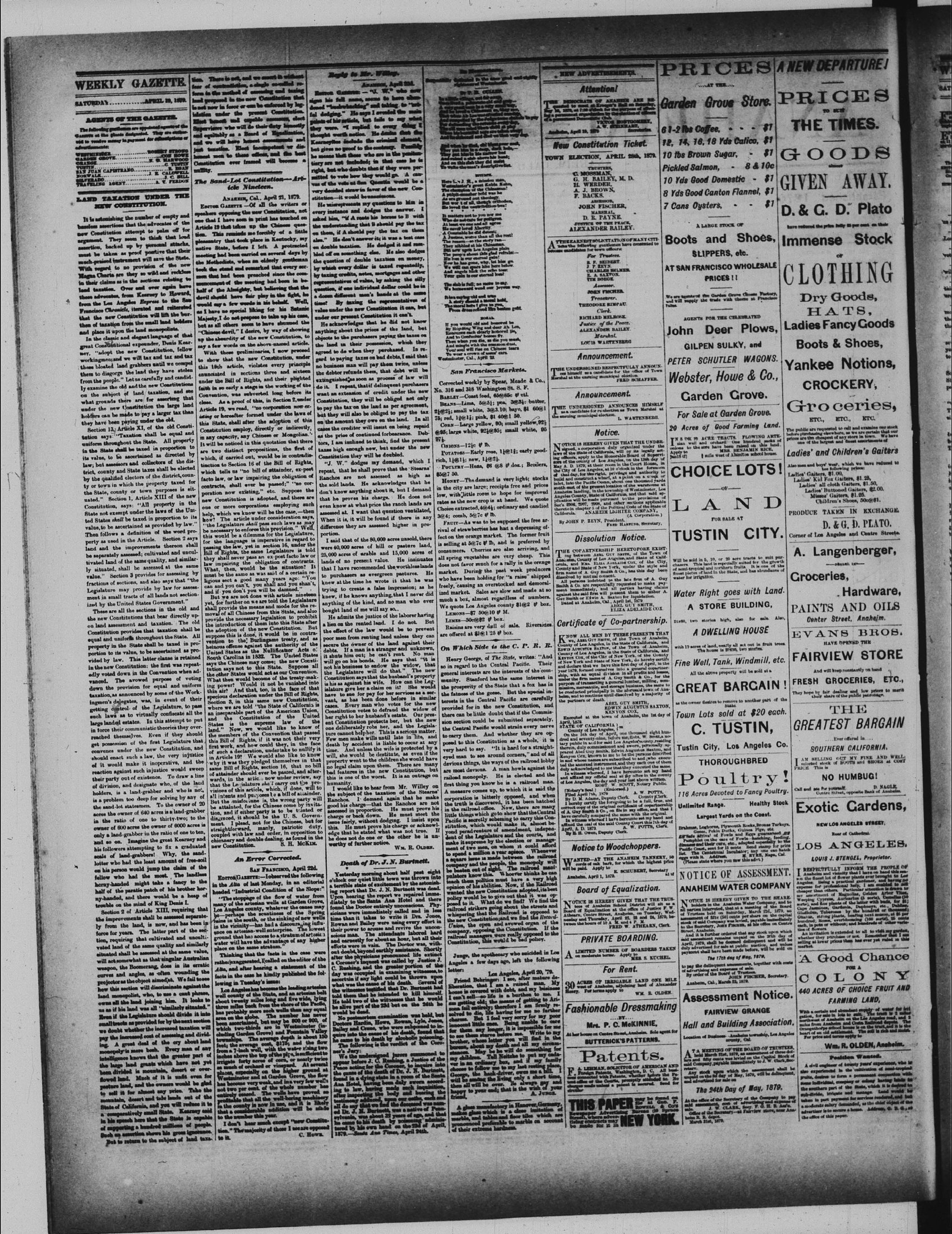
Searchable text
WEEKLY GAZETTE.
SATURDAY...APRIL 29, 1878.
AGENTS OF THE GAZETTE.
The following gentlemen are appointed agents of the Gazette at the philadelphia district. They are authorized to receive money in payment for advertisements or advertisements:
WHITINGER ... ROBERT STRONG
GARDEN CROVE ... JON HOWE
ORANGE ... N. W. MARWOOD
TURTLE ... C. TUSTIN
BAN JUAN CAPISTRANO ... R. DSAW
NORWALK ... J. E. CALAWELL
SILVERADO ... J. C. BILL
TRAVELING AGENT ... A. T. PERDON
LAND TAXATION UNDER THE NEW CONSTITUTION.
It is astonishing the number of empty and blemish assertions that the advocates of the new Constitution attempt to palm off for argument. They seem to think that loud assertion, backed up by personal attacks, must be taken as proof positive that their much-praised instrument will save the State. With regard to no provision of the new Magna Charta are they so wild and reckless in their claims as in the sections relating to land taxation. Over and over again have them advocates, from Kearney to Howard, from the Los Angeles Express to the San Francisco Chronicle, iterated and reiterated that the new Constitution will lift the burden of taxation from the small land holders and place it upon the land monopolists.
In the classic and elegant language of that great Constitutional expounder, Denis Kearney, "adopt the new Constitution, fellow workingmen; and we will tax and tax and tax those bloated land grabbers until we compel them to disgorge the land they have stolen from the people." Let us carefully and candidly examine the old and the new Constitutions on the subject of land taxation, and see what grounds there are for asserting that under the new Constitution the large land holders can be made to pay a larger tax than they have been paying under the old.
Section 13, Article XI, of the old Constitution says: "Taxation shall be equal and uniform throughout the State. All property in the State shall be taxed in proportion to its value, to be ascertained as directed by this law."
There is not, and we must it without fear of contradiction, a simple so-called reform in the method of amending and taxing land prepared in the new Constitution that is not now in force or can be enforced by legislation under the present Constitution. Most benefited and capable senators, elect Supervisors who will do their duty honestly and equitably as a Board of Equalization, and we will have honest amendments and just taxation. Elect incompetent or dishonest men to these offices, and the best Constitution ever framed will become a nuity.
The Band-Lot Constitution—Article Nineteen.
ANAKEIR, Cal., April 21, 1879.
EDITION GAZETTE — Of all the writers or speakers opposing the new Constitution, not one that I have seen in print has touched on Article 19 that takes up the Chinese question. This reminds me forcibly of a little plausantry that took place in Kentucky, my native State, before I left. A protracted meeting had been carried on several days by the Methodists, when an elderly gentleman took the stand and remarked that every servant that had been preached since the commencement of the meeting had been in half of the Almighty, but believing that the devil should have fair play in the fight, he would say a few words in his behalf. Well, as I have no special liking for his Satanic Majesty, I do not propose to take up his case, but as all others seem to have shunned the "Chinese devil," I desire, by way of showing up the absurdity of the new Constitution, to say a few words on the above-named article.
With these preliminaries, I now proceed to show that the new Constitution, under this 19th article, violates every principle enunciated in sections three and sixteen under the Bill of Rights, and their plighted faith in so early a stage in the working of the Convention, was subverted long before its close. As a proof of this, in Section 2, under Article 19, we read, "no corporation now existing or hereafter formed under the laws of this State, shall after the adoption of this Constitution employ, directly or indirectly, in any capacity, any Chinese or Mongolian." It will be noticed in this quotation that there are two distinct propositions, the first of which, if carried out, would be in contradiction with our full name denoted "bankwharfed dodging." His points of his article they were. "I am thought worth no Kearney titles but gives no proof he means that the tiary are not fini right, but who doesmitted to vote he was of the vote at very decided structure—it would He misrepresents every instance and asked him, "if Atheist understand on them, if A she also." He don't on double taxation bled off on sometime the question of why which every by taxing credit representatives question, if one has a dozen different time? By tax value under the law under our presence He acknowledged anything about objects to the public land in that agreed to do what gardd to paying no business man the debtor refuses extinguished;as do it. I repeat want an extension Constitution, tha to pay the tax o but they will al on the amount cases the credit as the price of f tors, I am inviol taxes high enough Constitution tha
these bloated land grabbers until we compel them to disgorge the land they have stolen from the people." Let us carefully and candidly examine the old and the new Constitutions on the subject of land taxation, and see what grounds there are for asserting that under the new Constitution the large land holders can be made to pay a larger tax than they have been paying under the old.
Section 13, Article XI, of the old Constitution says: "Taxation shall be equal and uniform throughout the State. All property in the State shall be taxed in proportion to its value, to be ascertained as directed by law; but assessors and collectors of the district, county and State taxes shall be elected by the qualified electors of the district, county or town in which the property taxed for the State, county or town purposes is situated." Section 1, Article XIII of the new Constitution, says: "All property in the State not exempt under the laws of the United States shall be taxed in proportion to its value, to be ascertained as provided by law."
Then follows a definition of the word property as used in the Article. Section 2 says land and the improvements thereon shall be separately assessed; cultivated and unculivated land of the same quality, and similarly situated, shall be assessed at the same value." Section 3 provides for assessing by fractions of sections, and also says that "the Legislature may provide by law for assessment in small tracts of all lands not sectionized by the United States Government."
These are all the sections in the old and the new Constitutions that bear directly upon land assessment and taxation. The old Constitution provides that taxation shall be equal and uniform throughout the State. All property in the State shall be taxed in proportion to its value, to be ascertained as provided by law. This latter clause is retained in the new Constitution: the first was repeatedly voted down in the Convention when advanced. The avowed purpose of voting down the provision for equal and uniform taxation, as announced by some of the Workingmen's delegates, was, in event of their getting control of the Legislature, to pass such laws as to virtually confiscate all the large landed estates. In this attempt to put in force their communistic theories they overreached themselves. Even if they should get possession of the first Legislature that convenes under the new Constitution, and should enact such a law, the very injustice of it would make it imperative, and the reaction against such injustice would sweep their party out of existence. To draw a line of division, and designate who, of the land holders, is a land-grabber and who is not, is a problem too deep for solving by any of the sand-lot statesmen. To the owner of 20 acres the owner of 640 acres is a land-grabber in the ratio of one to thirty-two; to the owner of 600 acres the owner of 6000 acres is only a land-grabber in the ratio of one to ten, and so on. Imagine the great Kearney and his followers attempting to fix a graduated scale of land-grabbers! Why, the sand-lotter who had the least amount of free-soil on his person would jump the claim of this 19th article, violates every principle enunciated in sections three and sixteen under the Bill of Rights, and their plight faith in so early a stage in the working of the Convention, was subverted long before its close. As a proof of this, in Section 2, under Article 19, we read, "no corporation now existing or hereafter formed under the laws of this State, shall after the adoption of this Constitution employ, directly or indirectly, in any capacity, any Chinese or Mongolian." It will be noticed in this quotation that there are two distinct propositions, the first of which, if carried out, would be in contradiction to Section 16 of the Bill of Rights, which tells us "no bill of attainder, ex-post facto law, or law impairing the obligation of contracts, shall ever be passed;" "no corporation now existing," etc. Suppose the new Constitution is adopted, and there are one or more corporations employing such help, which we know will be the case—then how? The article under consideration says, "the Legislature shall pass such laws as may be necessary to enforce this provision." Well, this would be a dilemma for the Legislature, for the language is imperative in regard to passing the law, yet in section 16, under the Bill of Rights, the same Legislature is told they shall never pass an ex-post facto law or law impairing the obligation of contracts. What then would be the situation? It must be the same as was said of a certain religious sect a good many years ago: "You can and you can't, you shall and you shan't, and if you don't you will be damned."
But we are not done with article nineteen yet, for further on we are told the Legislature shall provide the means and mode for the removal of all Chinese from this State, and also provide the necessary legislation to prohibit the introduction of them into this State after the adoption of the new Constitution. But suppose this is done, it would be in contravention to the' Burlingame treaty, and as heinous offense against the authority of the United States as the Nullificator Acts of South Carolina in 1832. The United States says the Chinese may come; the new Constitution says not to this State. Suppose all other States would act as our Convention. What then would become of the treaty-making power? Would it not be vanished into thin air? And that, too, in the face of that specious declaration under the Bill of Rights, Section 3, in this same new Constitution, where we are told "the State of California is an inseparable part of the American Union, and the Constitution of the United States is the supreme law of the land." Now, we would like to know of the members of the Convention that passed this Bill of Rights, if it was not their very first work, and how could they, in the face of such a declaration, undertake to nullify it in Article 19? We would also like to know why it was they pledged themselves in that same Bill of Rights, section 16, that no bill of attainder should ever be passed, and afterwards, in the article now under review, say that the Legislature shall carry out the provisions of this article, which if done, will to all intents and purposes to a bill of attainder. But the misfortune is, the wrong party will be attainted for the Chinese come by invitation, and if either party is to be tainted or disgraced, it should be the U.S. Government. I plead, not for the Chinese, but for straightforward manly patriotic duty, coupled with law and order, in opposition to chicanery and double dealing, as found in the new Constitution.
S. H. McKim.
An Error Corrected.
San Francisco April 22d.
To draw a line of division, and designate who, of the land holders, is a land-grabber and who is not, is a problem too deep for solving by any of the sand-lot statesmen. To the owner of 20 acres the owner of 640 acres is a land-grabber in the ratio of one to thirty-two; to the owner of 600 acres the owner of 6000 acres is only a land-grabber in the ratio of one to ten, and so on. Imagine the great Kearney and his followers attempting to fix a graduated scale of land-grabbers! Why, the sand-lotter who had the least amount of free-soil on his person would jump the claim of the fellow who had the most. The landless horny-handed might take a fancy to the half of the paratie patch of his brother horny-handed, and there would be a heap of trouble on the mind of King Denis I.
Section 2 of Article XIII, requiring that the improvements shall be assessed separately from the land, is now, and has been in force for years. The latter part of the section, requiring that cultivated and uncultivated land of the same quality and similarly situated shall be assessed at the same value, will act somewhat as that singular Australian weapon, the Boomerang, does in its erratic curves and angles, as often wounding the projector as the object aimed at. We fail to see how this section will discriminate against the land monopolist, who, to use a cant phrase, owns all the land joining him. It looks to us as if his land was all "similarly situated."
Even if the Legislature should divide it into small tracts as provided for by the next section we doubt whether the increased taxation will pay the increased cost of amassing and dividing. A great deal of the cry about land monopoly is more bosh. Every man of any intelligence knows that the greater part of the large land grants which have not yet been divided is mountain, desert or overflowed land. Much of it is unfit even for pasture land, and the owners would be glad to sell it for almost any price. Take the mountain, desert and tide lands out of the State of California, and you will reduce it to a comparatively small State. Kearney said in his speech here that the State is capable of supporting a hundred millions of people. Such an assertion shows his gross ignorance.
But to return to the subject of land taxa,
An Error Corrected.
San Francisco, April 22d.
Editor: Garrett—I observed the following in the Alta of last Monday, in an editorial headed "Industrial Condition of the Slope:"
"The stoppage of the flow of water from many of the artesian wells at Garden Grove, Los Angeles county, whatever the cause may be—perhaps the scantiness of the Spring fains in the south, or the sinking of new wells in the vicinity—has had a discouraging influence on artesian-well enterprise. The lowest ground that has access to a stratum of artesian water will have the advantage of any higher place on the same stratum."
Thinking that the facts in the case were rather exaggerated, I called on the editor of the Alta, and after hearing a statement of the facts in the case he kindly published the following in Tuesday's issue:
Los Angeles has become the leading artesian well county of the State, and an artesian belt about twenty miles long and five wide, lying three miles back from the shore of the Pacific, has probably more such wells than any equal area on the globe. The number has never been ascertained, but may be 800 or 900, of which two-thirds are in Westminster (including Garden Grove) and Fountain Valley townships. The average depth is about 150 feet; the average cost, $175; and the flow from a 7-inch well, with the water rising two inches above the top of the pipe, is sufficient to irrigate forty acres of corn, or nearly twice as much of orchard or vineyard. At several places, especially on the higher ground at Westminster and at Garden Grove, the flow has become very weak, and in very few wells not two per cent. of the whole number has entirely ceased. The wells have proved so profitable that all the well-boring machinery in the county is now in use, and it is likely that a considerable addition will be made to the number this year.
I don't hear much except "new Constitution." The majority of those I see are opposed to it.
C. Howe.
Reply to Mr. Willow.
Anamnesis, April 28th.
Boston Gazette: — "U. W." who now signs his full name, means to have them dened "bushwhacking" and taking to "total dodging." He says I avoided the main points of his article, but fails to say what they were. I replied to every thing I thought worth notice. He denies that the Kearneyites include the criminal element, but gives no proof to the contrary. Possibly he means that those who are in the penitentiary are not included; in that case he is right, but who doubts that if they were permitted to vote how they would go. A canvas of the vote at San Quentin would be a very decided straw in favor of the new Constitution—it would be unanimous.
He misrepresents my questions to him in every instance and dodges the answer. I asked him, "If A rents his horses to B with the understanding that B should pay the tax on them, if A should pay the tax on them also." He don't answer it; it was a test case on double taxation. He dodged it and rammed off on something else. He also dodges the question of double taxation on money, by which every dollar is taxed repeatedly, by taxing credits, notes, mortgages and other representatives of value, by asking the silly question, if one individual dollar could be in a dozen different men's hands at the same time? By taxing the representatives of value under the new Constitution it can, but under our present Constitution it can't.
He acknowledges that he did not know anything about the prices of the land, but objects to the purchasers paying the taxes on the land in their possession, which they agreed to do when they purchased. In regard to paying taxes on bad debts, I said that no business man will pay them twice, unless the debtor refunds them, that debt will be extinguished as soon as process of law will do it. I repeat, that if delinquent purchasers want an extension of credit under the new Constitution, they will be obliged not only to pay the tax on the land as per agreement, but they will also be obliged to pay the tax on the amount they owe on the land. In all cases the creditor will insist on being repaid as the price of continued forcance. Debtors, I am inclined to think, find the present taxes high enough new, but under the new Constitution they will be doubled.
San Francisco Markets.
Corrected weekly by Spear, Meade & Co., No. 316 and 318 Washington St. S. F.
Barley—Coast feed, 65@85c ¢ ctl.
Beans—Lima, 5@5½; pca, 3@8½; butter, 2½@2½; small white, 3@3.10; bayo, $1 60@175; red, 1½@1½; pink, $1 40@150.
Corn—Large yellow, 90; small yellow, 92½@95; large white, 92½@95; small white, 95@97½.
Onions—12½¢ ¢ lb.
Potatoes—Early rose, 1½@1½; early goodrich, 1¼@1¼; new, 1½@2½.
New Advertements.
Attention!
THE DEMOCRAT OF ANAMNESIS ARE REQUESTED TO MUST AT KREGER'S HALL ON SATURDAY May 14, 1878, at 7:30 o'clock for the purpose of offering a permanent organization by the election of officers of a permanent Democratic Club.
VICTOR MOSTGOVERNY,
A.W.SCHINHAFT,
Andhamen, April 15, 1879
New Constitution Ticket.
TOWN ELECTION, APRIL 28th, 1879.
TRUSTEES,
C. MOSSMAN,
G. H. BAILEY, M. D.
H. WERDER,
A. J. BROWN,
F. BACKS.
ASSENOR,
JOHN FISCHER,
MARSHAL,
D. R. PAYNE.
JUSTICE OF THE PEACE,
ALEXANDER BAILEY.
ATTHEARNEST SOLICITATION OF MANY CITIENTES THE FOLLOWING gentlemen have consented to become candidates for town officers:
For Trustees.
R. F. SEIBERT.
J. P. ZEYN.
CHARLES HILMER.
E. A. SAYTON.
TIM BOEOK.
Assensor,
JOHN FISCHER.
Treneur.
THEODORE RIMPAU.
Clerk.
RICHARD MELROSE.
Justice of the Peace.
ALEXANDER BAILEY.
Marshal.
LOUIS WARTENBERG
Announcement.
THE UNDERSIGNED RESPECTFULLY ANNOUNCES himself as a candidate for the office of Town Marshal at the ensuing municipal election.
PRED SCHAFFER.
Announcement.
THE UNDERSIGNED ANNOUNCES HIMSELF as a candidate for re-election as Town Marshal at the ensuing municipal election.
L WARTENBERG.
Notice.
NOTICE IS HEREBY GIVEN THAT THE UNDERSIGNED, a corporation duly organized under the laws of the State of California, will by its legally acting officers, apply to the Honorable Board of Supervisory.
no business man will pay them twice, unless the debtor refunds them, that debt will be extinguished as soon as process of law will do it. I repeat, that if delinquent purchasers want an extension of credit under the new Constitution, they will be obliged not only to pay the tax on the land as per agreement, but they will also be obliged to pay the tax on the amount they owe on the land. In all cases the creditor will insist on being repaid as the price of continued forbearance. Debtors, I am inclined to think, find the present taxes high enough now, but under the new Constitution they will be doubled.
"J. W." dodges my demand, which I repeat, that he shall prove that the Stearns' Ranchos are not assessed as high as the sold lands. He acknowledges that he don't know anything about it, but I demand that he proves his charge. He does not even know at what price the ranch lands are assessed at. I want that question ventilated, When it is, it will be found if there is any difference they are assessed higher in proportion.
I said that of the 80,000 acres unsold, there were 40,000 acres of hill or pasture land, 25,000 acres of arable and 15,000 acres of lands of no present value. He insinuates that I have recommended the worthless lands to purchasers as evergreen pastures. He knew at the time he wrote it that he was trying to create a false impression; as he knew, if he knows anything, that I never did anything of the kind, and no man who ever bought land of me will say so.
He admits the justice of the laborer having a lien on the rented land. I do not. But the effect of the law would be to prevent poor men from renting land unless they can secure the owner of the land against their debts. If a man is a stranger and unknown, it shuits him out; he can't rent. No man will go on his bonds. He says that "it is not his business to endow the widow, that the Legislature will do that." The new Constitution says that the husband's property is his against his wife. How can the Legislature give her a claim on it? She would have to sue for pay for her services as a servant, as has been done before in similar cases. Every man who votes for the new Constitution votes to defray the widow of her right to her husband's estate. Our present Constitution protects her, but the new one deliberately robs her, and the Legislature cannot helpher. This is a serious matter. Few men make wills until late in life, and death by accident is liable to occur at any time. And unless the wife is protected by a will, she would be destitute, as even if the property went to the children she would have no legal claim upon them. There are many bad features in the new Constitution, but this is one of the worst. It is an outrage on humanity.
I would like to hear from Mr. Willey on the subject of the taxation of the Stearns' Ranchos. I demand again that he make good his charge—that the Ranchos are not assessed in proportion. He must prove his charge or back down. He must meet the issue fairly, without dodging. I insist upon this. He must prove his charge or acknowledge that he stated what was not true. If he does not do one or the other he is unworthy of further notice.
San Francisco Markets.
Corrected weekly by Spear, Meade & Co., No. 316 and 318 Washington St. S. F.
Barley—Coast feed, 65@8c @ctl.
Beans—Lima, 5@5½; praa, 3@8½; butter, 2@2½; small white, 3@3.10; bayo, $1 60@175; red, 1@1½; pink, $1 40@150.
Corn—Large yellow, 90; small yellow, 92@95; large white, 92@95; small white, 95@97.
Onions—12½c @lb.
Potatoes—Early rose, 1½@1½; early goodrich, 1¼@1½; new, 1½@2½.
Poultry—Hena, $8 @8 @dox.; Broilers,$5@750.
Honey—The demand is very light; stocks in the city are large; receipts free and prices low, with little room to hope for improved rates as the new crop is at hand. We quote Choice extracted,4@4½; ordinary and candied3@4; comb, 5@7c @lb.
Fruit—As was to be supposed the free arrival of strawberries has had a depressing effect on the orange market. The former fruit is selling at 5@7c @lb, and is preferred by consumers. Cherries are also arriving, and all spring vegetables are very cheap. This does not favor much for a rally in the orange market. During the past week producers who have been holding for "a raise" shipped freely, causing an overstocked and demoralized market. Sales are slow and made at so much a box, almost regardless of numbers. We quote Los Angeles county $1@2 @box.
Lemons—$7 50@10 @M.
Limes—50c@2 @box.
Raisins are very dull of sale. Riversides are offered at $1@125 @box.
On Which Side is the C. P. R. E.
Henry George, of The State, writes: "And so in regard to the Central Pacific. Their general interests are the interests of the community. Stanford has the same interest in the prosperity of the State that a fox has in the fatness of the geese. But the special interests in the Central Pacific are carefully provided for in the new Constitution, and there can be little doubt that if the Commission section could be submitted separately, the Central Pacific would strain every nerve to carry them. And whether they are opposed to this Constitution as a whole, it is very hard to say." "It is hard for a straight-eyed man to see around corners," and of all devious things, the ways of the railroad lobby are most devious. A man howls against the railroad monopoly. He is elected and the first thing you know he is a railroad man. A measure comes up, to which it is said the corporation is bitterly opposed, and when the truth is discovered, it has been hatched in the railroad office. Now, there are many little things which go to show that the Central Pacific is secretly scheming to carry this Constitution, which would make it almost beyond peradventure of amendment, independent of the Legislature and the courts, and make it supreme by the election or management of two men, on whom it could afford to spend a million a year apiece. Whenever a square issue is made between the railroad company and the people, the monopoly will be beaten out of sight. The railroad mani-
Notice is hereby given that THE UNDERSIGNED RESPECTFULLY ANNOUNCES himself as a candidate for the office of Town Marshal at the existing municipal election.
Announcement.
THE UNDERSIGNED ANNOUNCES HIMSELF as a candidate for re-election as Town Marshal at the ensuing municipal election.
Notice
NOTICE IS HEREBY GIVEN THAT THE UNDERSIGNED ANNOUNCES HIMSELF as a candidate for re-election as Town Marshal at the ensuing municipal election.
Dissolution Notice.
THE COPARTNERSHIP HERETOFORE EXISTING between AARL GUY Smith, of the Town of Anaheim, County of Los Angeles, and State of California,and EWIN AURCHIE BAXTER,of the Town of Anaheim,County and State of New York,the foreseen and firm name of A.Guy Smith & Co.,has this day been disallowed by mutual consent.
All persons indicted to the late firm of A.Guy Smith & Co.,are respectfully requested to make payment immediately,and all parties having claims against the said firm will present them to either A.Guy Smith or Edwin A.Saxton for liquidation.
Dated at Anaheim,Cal., April lst, 1879.
ABEL GUY SMITH,
ELIZA ADELAIDE COX.
Certificate of Co-partnership.
KNOW ALL MEN BY THESE PRESENTS THAT we,AARL GUY Smith.ofthe Town of Anaheim,County of Los Angeles.in,the State of California,and EWIN AURCHIE BAXTER.ofthe Town of Anaheim,County and State of California,and KENYON COX.ofthe City of New York,the foreseen and firm name of A.Guy Smith & Co.,has this day been disallowed by mutual consent.
All persons indicted to the late firm of A.Guy Smith & Co.,are respectfully requested to make payment immediately,and all parties having claims against the said firm will present them to either A.Guy Smith or Edwin A.Saxton for liquidation.
Dated at Anaheim,Cal., April lst, 1879.
ABEL GUY SMITH,
ELIZA ADELAIDE COX.
Notice to Woodchoppers.
WANTED—AT THEANAHEIM TANNERY,SCORED OF OAK BARK FOR THE MAIL BOOK AND MAINTAINED IN THE STATE OF CALIFORNIA.
[Notary's Seal.] Endorsed.
Filed April 7th,b 1879
By D.M.Adams,Deputy Clerk.
I hereby certify the foregoing to be a full fee,and correct copy of the original certificate of cooperorship of A.Guy Smith & Co.,on file in my office,and I have carefully compared the same with the original.
In witness whereof I have hereunto set my hand and affixed the seal of the said County Court this 7th day of April,A.D.1879.W.POTTS,Clerk.
By E.H.Owen,Deputy Clerk.
Death of Dr. J. N. Burtnett.
Yesterday morning about half past eight o'clock our quiet little town was thrown into a terrible state of excitement by the astonishing report that Dr. J. N. Burtnett was dead. Upon hearing the report we repaired immediately to the Santa Ana Hotel and there found the Doctor entirely unconscious. Physicians were immediately called and in less time than it takes to write it Dra. Jones, Rowan and Bailey were using every effort in their power to arouse and revive the unconscious man. The attendants labored hard and earnestly for about an hour, but all their efforts were in vain. The Doctor was, without doubt, beyond earthly assistance. Shortly after the physicians pronounced life extinct a Coroner's inquest was called by Justice J. C. Rushing, and the greater portion of the day was occupied in examining witnesses, to ascertain if any light could be thrown upon what was the cause of his death. Several of the witnesses testified that Dr. Burtnett had told them that he intended to kill himself. He told two of the witnesses that he would be alive part of the 23d but on the 24th he would be dead.
No postmortem examination was held, but Doctors Hardin, Howe, Rowan, Lyle, Jones, Bailey and Crane, who were subpoenaed to inquire into the cause of his death, found that he came to his death by alcoholic poisoning.
The following is the verdict of the Coroner's Jurry:
We the undersigned jurors summoned to appear before J. C. Rushing, a Justice of the Peace acting for the Coroner, to inquire into the cause of the death of Dr. J. N. Burtnett, found in a dying state in a room of the Santa Ana Hotel, having been duly sworn according to law, having made such inquisition, after inspecting the body and bearing the testimony addressed upon our ears, each and all do say that we find the deceased was named Dr. J. N. Burtnett, was a native of Pennsylvania, was about 22 years of age, and that he came to his death by poisoning administered by his own hand on the 23d of April, 1879.—Sandra Ann Times, April 24th.
He is elected and the first thing you know he is a railroad man. A measure comes up, to which it is said the corporation is bitterly opposed, and when the truth is discovered, it has been batched in the railroad office. Now, there are many little things which go to show that the Central Pacific is secretly scheming to carry this Constitution, which would make it almost beyond paradise of amendment, independent of the Legislature and the courts, and make it supreme by the election or management of two men, on whom it could afford to spend a million a year apiece. Whenever a square issue is made between the railroad company and the people, the monopoly will be beaten out of sight. The railroad manipulators know this. Whoever thinks he can teach them politics must have a very high opinion of his abilities. Now, if the Railroad wanted the new Constitution adopted, its best policy would be to give out that it was opposed to it. What do we find? We find the railroad strikers going about the streets and whispering that the Railroad is opposed to the new Constitution; and we find the Record Union, the open and avowed organ of the company, opposing the Constitution. If the railroad managers were really opposed to the Constitution, this would be bad policy.
Junge, the apothecary who suicided in Los Angeles a few days ago, left the following letter:
Los Angeles, April 20, 179.
Friend Behringer: I see, after mature deliberation, that I am a ruined man. My house is covered with debt, and my business I can't sell—so life is a burthen to me. I am getting old; the means of getting to Arizona fail entirely; therefore I am firmly resolved to die, life having for me no further charms. But I feel very sorry for my poor innocent little man. Being unable to care for them any longer, it is impossible for me to see them starve before me. Write to my brother, whose letter you will find in the bureau, about my death and all my circumstances. May be he will do something for my children. Tell Neitzke to put my cadaver in an ordinary box, and if my family choose to follow me to my last resting place, George, the hack-driver, owes me a bill. I will be among the living only a short time, then all will be over. Be always gay and happy to your end; that is the wish of your friend,
A glass manufactory in Hanover, Germany, makes glass which is a close imitation of marble, and tablet and floor tikes which are pronounced preferable to marble on account of their extreme hardness.
Notice to Woodchoppers.
WANTED—AT THE ANAHEIM TANNERY, 50 cords of oak bark, for which the highest price will be paid. Apply to
K SCHUBERT, Secretary
Anahaim, April 1, 1879.
Board of Equalization.
NOTICE IS HEREBY GIVEN THAT THE TRUSTees of Anahaim School District will sit as Board of Equalization at the office of Justice W. M Athernn, Centre Street, Anahaim, on Tuesday, Wednesday and Thursday, April 22, 23 and 24, 1979; be twined at hours of 10 A.M. and 4 P.M.
FRED W. ATHEARN, Clerk.
PRIVATE BOARDING.
A LIMITED NUMBER OF BOARDERS TAKE ON moderate terms. Apply to
MRS. S. KUCHEL.
For Rent.
30 ACRES OF IRRIGABLE LAND ONE MILE west of Anahaim, adjoinning land of Alexander Henry. For terms apply to
WM. R. OLDEN.
Fashionable Dressmaking
Mrs. P. C. McKINNIE,
At her house on Centre Street, Anahaim. Sole agent for BUTTERICK'S PATTERNS.
Patents.
F. A. LEHMAN, SOLICITOR OF AMERICAN ARTS,
Foreign Patents Washington, D.C., All bows connected with Patents whether before the last office of the Courts, promptly attended to charges made unless a patent is secured. Send objection.
THIS PAPER may be found on file at GEO.
ROWELL & CO.
Newspaper Advertising Bureau (10 Spruce Street), where advertising contracts may be made for it in NEW YORK
PRICES
AT THE
Garden Grove Store.
61-2 Tbs Coffee, - $1
12, 14, 16, 18 Yds Calico, $1
10 Tbs Brown Sugar, - $1
Pickled Salmon, - 8 & 10c
10 Yds Good Domestic - $1
8 Yds Good Canton Flannel, $1
7 Cans Oysters, - $1
A LARGE STOCK OF
Boots and Shoes,
SLIPPERS, etc.
AT SAN FRANCISCO WHOLESALE
PRICES II
We are agents of the Garden Grove Climate Factory,
and will supply the trade with cheese at Francisco Palm.
AGENTS FOR THE CELEBRATED
John Deer Plows,
GILPEN SULKY, and
PETER SCHUTLER WAGONS.
Webster, Howe & Co.,
Garden Grove.
For Sale at Garden Grove.
20 Acres of Good Farming Land.
IN 8 OK 19 ACRE TRACTS. FLOWING ARTESIAN well and orchard. One hundred sacks of
onions to the arre have been raised on this land.
Apply to
MRS. BENJAMIN RICK,
mile west of Alamitos school house.
A NEW DEPARTURE!
PRICES
TO SEE
THE TIMES.
GOODS
GIVEN AWAY.
D. & G. D. Plato
Immense Stock
or
CLOTHING
Dry Goods,
HATS,
Ladies Fancy Goods
Boots & Shoes,
Yankee Notions,
CROCKERY,
Groceries,
ETC., ETC., ETC.
The public are requested to call and examine our stock before purchasing elsewhere, as we are certain that our prices are the cheapest of any store in town. We have one of the largest and finest amortments of Ladies' and Children's Gaiters
WEBSTER, HOWE & CO., Garden Grove.
For Sale at Garden Grove.
20 Acres of Good Farming Land.
IN 5 OK TO ACRE TRACTS. FLOWING ARTE- sian well and orchard. One hundred sacks of onions to the acre have been raised on this land. Apply to MRS. BENJAMIN RICE.
mile west of Alamitos school house.
CHOICE LOTS!
OF
LAND
FOR SALE AT
TUSTIN CITY.
Will be sold in 5, 10, or 20 acre tracts to suit purchasers. This land is especially suited for the growth of semi-tropical and northern fruits. It is one of the finest pieces of land in the State, and has abundance of water for irrigation.
Water Right goes with Land.
A STORE BUILDING,
21x60, two stories high, also for sale. Also,
A DWELLING HOUSE
with 15 acres of land, nearly all set out in fruit trees.
The house is 2000, two stories.
Fine Well, Tank, Windmill, etc.
All the above property will be sold at a
GREAT BARGAIN!
as the owner desires to remove to another part of the State.
Town Lots sold at $20 each.
C. TUSTIN,
Tustin City, Los Angeles Co.
THOROUGHBRED
Poultry!
116 Acres Devoted to Fancy Poultry.
Unlimited Range.
Healthy Stock
Largest Yards on the Coast.
Brahmae, Leghorne, Plymouth Rocks, Bronze Turkeys.
Geese, Pekin Ducks, Guinea Pigs, etc.
Safe arrival of Fowls and Eggs guaranteed.
Pamphlet on the care of Fowls - catching, feeding, disease and their cure, etc., adapted especially to the Pacific Coast, sent for 15 cents. Send stamp for price list. The Centennial Incubator; any one can hatch eggs with it. Address: M. BYRE, Napa, Cal.
(Please state where you saw this advt.)
Poultry!
116 Acres Devoted to Fancy Poultry.
Unlimited Range.
Healthy Stock
Largest Yards on the Coast.
NOTICE OF ASSESSMENT.
ANAHEIM WATER COMPANY
NOTICE IS HEREBY GIVEN TO THE SHAREholders in the Anaheim Water Company, and to all parties interested, that at a meeting of the Board of Trustees held on Saturday, March 22d, 1879, an assessment of fifty (50) cents per share on the capital stock of said Company was levied, payable immediately to the Secretary, John Fincham, at his office on Centre Street, Anaheim.
And it is further ordered that any stock upon which said assessment remains unpaid on the 28th day of April, 1879, shall be deemed delinquent and will be duly advertised for sale at public auction, and unless payment shall have been made before, will be sold on The 17th day of May, 1879,
to pay the delinquent assessments, together with costs of advertising and expenses of sale.
By order of the Board of Trustees.
JOHN FISCHER, Secretary.
Anahiem, Cal., March 22, 1879.
Assessment Notice.
FAIRVIEW GRANGE
Hall and Building Association.
Location of Business - Anaheim township, Los Angeles county, Cal.
At a Meeting of the Board of Trustees, held March 21st, 1879, an assessment of three dollars and fifty cents was levied on the Capital Stock of said Company, payable immediately to J. W. Clark, Secretary.
Any stock upon which the assessment shall be unpaid on the 3rd day of May, 1879, will be delinquent, and advertised for sale on The 24th Day of May, 1879.
As the office of the Secretary of the Company to pay said assessment, cost of advertising and expense of sale,
J. W. CLARK, Secy. P. G. H. R. Amft.
Office of the Secretary—at Fairview store, near Anaheim R. R. depot.
March 21st, 1879.
NO HUMBUG!
Call and see for yourself.
D. NAGLE.
Centre Street, opposite Bank of Anaheim.
Exotic Gardens,
NEW LOS ANGELES STREET,
Rear of Cathedral.
LOS ANGELES.
LOUIS J. STENGEL, Proprietor.
RESPECTFULLY INFORM THE PEOPLE OF Anaheim and vicinity that I have on hand this season the finest lot of flower plants ever brought to Los Angeles. Being a practical gardener, and having no expense for professional help, I am enabled to sell cheaper than others. Particular attention is drawn to my assortment of Magnolias, Golden Arbor Vines, Weeping Cypress, Auricularis (5 sorts), Camellia (20 sorts), and fine plants of the latter with buds, for $1; Cape Jasmine, Gardenia, Daphneys, etc., Dahliae, Gladiolus, Tuberous by the hundred or thousand; Ghavas, strong plants, bearing next season, at 50 per hundred; Homes, overblooming (100 sorts), 25 cents each; in pots or without; and hundreds of other varieties of flowers.
An invitation is extended to all to visit my garden whether they purchase or not. Remember that I am selling at lower prices than has ever yet ruled in this market.
A Good Chance FOR A COLONY
440 ACRES OF CHOICE FRUIT AND FARMING LAND,
With a certain and abundant supply of water for irrigation, for sale in lots to sell. The truth is 2 miles northwest of Anaheim on the Los Angeles road, and 2 miles from Anaheim and Costa Hallroad depot. The Orangutan school house is on the trail, and it is the heart of an old settlement. The mill is rich and modest. For price and terms apply to
Wm. R. OLDEN, Anaheim.
Posthum Wanted.
A civil engineer of twenty years' experience, who is also experienced in the cultivation of semi-tropical fruits, desires to form a permanent conjunction with some individual company or edging having hands in the southern part of the State, which it is desired to sub-divide, irrigate and manage. Land would be taken in part payments for services rendered, and but a moderate salary demanded, as the chief obligant of the advertiser is to secure a home. Addrum, G. B. G., as the office of this paper.