anaheim-gazette 1878-03-30
Scanned page
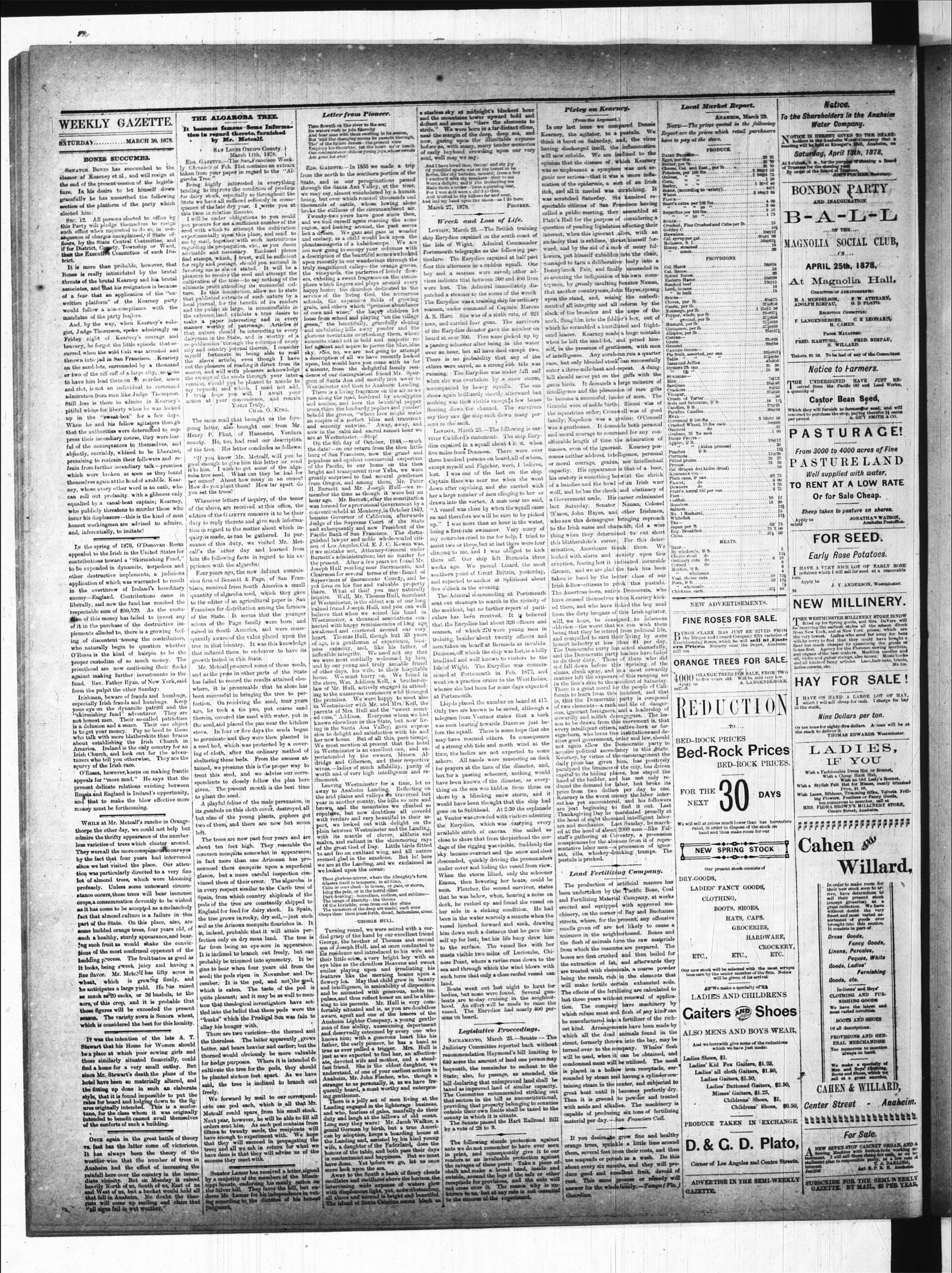
Searchable text
WEEKLY GAZETTE.
SATURDAY...MARCH 30, 1878.
BONES SUCCUMBS.
Senator Bones has succumbed to the clamor of Kearney et al., and will resign at the end of the present session of the legislature. In his desire to let himself down gracefully he has unearthed the following section of the platform of the party which elected him:
Sec. 12. All persons elected to office by this Party will pledge themselves to resign such office when requested to do so, in consequence of charges unexplained; if State officers, by the State Central Committee, and if for District, County, Township or Ward, then the Executive Committee of such District.
It is more than probable, however, that Bones is really intimidated by the brutal threats of the brutal Kearney and his brutal associates, and that his resignation is because of a fear that an application of the "unwritten platform" of the Kearney party would follow a non-compliance with the mandates of the party leaders.
And, by the way, when Kearney's eulogist, Judge Thompson, spoke admiringly on Friday night of Kearney's courage and bravery, he forgot the little episode that occurred when the wild Celt was arrested and thrown into jail in San Francisco. Kearney on the sand-lots, surrounded by a thousand or two of the riff-raff of a large city, anxious to have him lead them on to murder, arson and riot, is not an individual to command admiration from men like Judge Thompson. Still less is there to admire in Kearney's pitiful whine for liberty when he was locked up in the "sweat-box" for a few days. When he and his fellow agitators though that the authorities were determined to suppress their incendiary course, they were fearful of the consequences to themselves, and abjectly, curriably, whined to be liberated, promising to restrain their followers and refrain from further incendiary talk—promises which were broken as soon as they found
THE ALGAROBA TREE.
It becomes famous Some Information in regard thereto, furnished by Mr. Metcalf.
SAN LOUIS OBISPO COUNTY.
March 11th, 1878.
Eds. Gazette—The San Francisco Weekly Chronicle of Feb. 21st contains an extract taken from your paper in regard to the "Algaroba Tree."
Being highly interested in everything tending to improve the condition of produce for dairy stock, especially as throughout the State we have all suffered seriously in consequence of the late dry year, I write you at this time in relation thereto.
I will be under obligations to you could you procure for me a sufficient number of the seed with which to attempt the cultivation experimentally upon this place, and send to me by mail, together with such instructions regarding its propagation, etc., as you deem advisable and necessary. Enclosed please find stamps, which, I trust, will be sufficient for reply and postage, should you succeed in favoring me as above stated. It will be a pleasure to receive the seed and attempt the cultivation of the tree—to say nothing of the ultimate profit attending its successful culture. In this connection, allow me to state that published extracts of such nature by a local journal, for the benefit of its readers and the public at large, is commendable in the extreme land exhibits a true desire to make a paper interesting and in every manner worthy of patronage.
Articles of that nature should be interesting to every dairyman in the State, and is worthy of a re-publication through the columns of every city and country journal therein. I consider myself fortunate in being able to read the above article, even though I have not the pleasure of reading it direct from its source, and will with pleasure acknowledge the receipt of the seeds through your intervention, should you be pleased to accede to my request; and which, I need not add, I truly hope you will. I await your action at your convenience, and remain Your Truly.
CHAS. O. KING.
The same mail that brought us the foregoing letter also brought one from Mr. Henry P. Flint, of Hueneme, Ventura county. He, too, had read our description of the tree. His letter concludes as follows:
“If you know Mr. Metcalf, will you be good enough to give him this letter or send it to him. I wish to get some of the algaic tree seed. What can they be had for
In the spring of 1876, O'Donovan-Rossa appealed to the Irish in the United States for contributions toward a "Skirmishing Fund," to be expended in dynamite, torpedoes and other destructive implements, a judicious application of which was warranted to result in the overthrow of Ireland's hereditary enemy—England. Contributions came in liberally, and now the fund has reached the respectable sum of $50,529. As the custodian of this money has failed to invest any of it in the purchase of the destructive implements alluded to, there is a growing feeling of discontent among the contributors, who naturally begin to question whether O'Rossa is the kind of hairpin to be the proper custodian of so much money. The priesthood are now cautioning their flocks against making further investments in the fund. Rev. Father Ryan, of New York, said from the pulpit the other Sunday:
Irishmen, beware of frauds and humbugs, especially Irish frauds and humbugs. Keep your eye on the dynamite patriot and the "skirmishing fund" adventurer. They are not honest men. Their so-called patriotism is a delusion and a snare. Their one object is to get your money. Pay no heed to those who talk with more blatherskite than brains about establishing the Irish Church in America. Ireland is the only country for an Irish Church, and look out for the adventurers who tell you otherwise. They are the squirvy of the Irish race.
O'Rossa, however, keeps on making frantic appeals for "more mud." He says that the present delicate relations existing between Russia and England is Ireland's opportunity, and that to make the blow effective more money must be forthcoming.
While at Mr. Metcalf's ranch in Orange-thorpe the other day, we could not help but admire the thrifty appearance of the numberless varieties of trees which cluster around. They were all the more conspicuous to our eyes by the fact that four years had intervened since we last visited the place. Our attention was particularly directed to a very fine lot of almond trees, which were blooming profusely. Unless some untoward circumstance occurs, these trees will bear immense or two of the rhinum of a large city to have him lead them on murder, arson and riot, is not an individual to command admiration from men like Judge Thompson. Still less is there to admire in Kearney's pitiful whine for liberty when he was locked up in the "sweat-box" for a few days. When he and his fellow agitators though that the authorities were determined to suppress their incendiary course, they were fearful of the consequences to themselves, and abjectly, curriedly, whined to be liberated, promising to restrain their followers and refrain from further incendiary talk—promises which were broken as soon as they found themselves again at the head of a rabble. Kearney, whose every other word is an oath, who can roll out profanity, with a glibness only equalled by a canal-boat captain; Kearney, who publicly threatens to murder those who incur his displeasure—this is the kind of man honest workingmen are advised to admire, and, inferentially, to imitate!
The same mail that brought us the foregoing letter, also brought one from Mr. Henry P. Flint, of Hueneme, Ventura county. He, too, had read our description of the tree. His letter concludes as follows:
"If you know Mr. Metcalf, will you be good enough to give him this letter or send it to him. I wish to get some of the algaroba tree seed. What can they be had for per ounce! About how many in an ounce? How do you plant them? How far apart do you set the trees?
Whenever letters of inquiry, of the tenor of the above, are received at this office, the editors of the Gazette conceive it to be their duty to reply thereto and give such information in regard to the matter about which inquiry is made, as can be gathered. In puissance of this duty, we visited Mr. Metcalf's the other day and learned from him the following facts in regard to his experience with the algaroba:
Four years ago, the now defunct commission firm of Bennett & Page, of San Francisco, received from South America a small quantity of algaroba seed, which they gave to the editor of an agricultural paper in San Francisco for distribution among the farmers of the State. It seems that the younger scions of the Page family were born and raised in South America, and were consequently aware of the value placed upon the tree in that country. It was this knowledge that induced them to endeavor to have its growth tested in this State.
Mr. Metcalf procured some of these seeds, and as the press in other parts of the State has failed to record the results attained elsewhere, it is presumable that he alone has been successful in bringing the tree to perfection. On receiving the seed, four years ago, he took a tin pan, put coarse sand therein, covered the sand with water, put in the seed, and placed the pan near the kitchen stove. In four or five days the seeds began to germinate and they were then planted in a seed bed, which was protected by a covering of cloth, after the ordinary method of sheltering these beds. From the success attained, we presume this is the proper way to treat this seed, and we advise our correspondents to closely follow the plan here given. The present month is the best time to plant the seed.
A playful feline of the male persuasion, in its gambols on this cloth cover, destroyed all but nine of the young plants, gophers got two of them, and there are now but seven left.
The trees are now past four years and are about ten feet high. They resemble the common mezquite somewhat in appearance; in fact more than one Arizonan has pronounced them mezquite upon a superficial glance, but a more careful inspection convinced them of their error. The algaroba is in every respect similar to the Carib tree of Spain, from which country shiploads of the
dence of our distinguisher geon of Santa Ana Westminster and there is a living tree pass along the road and acacia; and here trees there hold the groves; an empire of a perfume now in the calm area at Westminster.
On the 6th day after the date—on our burg of San Francisco populous and opulent of the Pacific, too bright and transparent greatly surprised from Oregon and H. Burnett and H member the time hour ago. Mr. Burge was formed for apiece convention held at became Governor Judge of the Supreme Court and subsequently Pacific Bank of San Francisco lawyer and zen of Los Angeles if we mistake not Burnett's administration present. After Joseph Hull reside Chairman for several Supervisors of San Jose lives on his fiesta there. What often inquire Well, B of Westminster, in valued friend Josie believe that where Westminster are nected with happy awakened and crescent Thomas age of age, is a gentleness capacity inflexible integrity we were most concerned by our young of other days here. We must store Wm., law of Mr. Hull, ing to the numerals the premises. W in Westminster parents of Mrs., ed cuss," Addisso known elsewhere ing in the Santa Clara sion to delight at her new home. We must mention in Westminster perintended by dridge and Gilwives—ladies worth and worth upon leaving Westminster away to Anahale arid plains a year in another brown, and ther repulsive; but with verdure appear we looked plain between W with its main malva, and radiate of the great Goa and fro on ene seemed glad in we are at the Lake we looked upon
While at Mr. Metcalf's ranch in Orange-thorpe the other day, we could not help but admire the thrifty appearance of the numberless varieties of trees which cluster around. They were all the more conspicuous to our eyes by the fact that four years had intervened since we last visited the place. Our attention was particularly directed to a very fine lot of almond trees, which were blooming profusely. Unless some untoward circumstance occurs, these trees will bear immense crops, a consummation devoutly to be wished as it has come to be accepted as a melancholy fact that almond culture is a failure in this part of the State. On this place, also, are some budded orange trees, four years old, of such a healthy, sturdy appearance, and bearing such fruit as would shake the convictions of the most confirmed opponent of the budding process. The fruit tastes as good as it looks, being sweet, juicy and having a fine flavor. Mr. Metcalf has fifty acres in wheat, which is growing finely, and he anticipates a large yield. He has raised as much as 20 sacks, or 36 bushels, to the acre, of this crop, and it is probable that these figures will be exceeded the present season. The variety sown is Sonora wheat, which is considered the best for this locality.
It was the intention of the late A. T. Stawart that his Home for Women should be a place at which poor sewing girls and those similarly situated financially, could find a home for a very small outlay. But since Mr. Stewart's death the plans of the hotel have been so materially altered, and the fitting up done in such an elaborate style, that it is found impossible to put the rates for board and lodging down to the figures originally intended. This is a misfortune, for the class whom it was originally intended to benefit cannot avail themselves of the comforts of such a building.
Once again in the great battle of theory va fast has the latter come off victorious. It has always been the theory of the weather-wise that the number of trees in Anaheim had the effect of increasing the rainfall here over the country in the immediate vicinity. But on Monday it rained heavily North of us, South of us, East of us and West of us, but a bucket would hold all that fell in Anaheim. No doubt the theories will come up smiling and claim that "all signs fail in wet weather."
A playful feline of the male persuasion, in its gambols on this cloth cover, destroyed all but nine of the young plants, gophers got two of them, and there are now but seven left.
The trees are now past four years and are about ten feet high. They resemble the common mezquite somewhat in appearance; in fact more than one Arizona has pronounced them mezquite upon a superficial glance, but a more careful inspection convinced them of their error. The algaroba is in every respect similar to the Carib tree of Spain, from which country shiploads of the pods of the tree are constantly shipped to England for feed for dairy stock. In Spain, the tree grows in rocky, dry soil—just such soil as the Arizona mezquite flourishes in. It is indeed, probable that it will attain perfection only on dry mesa land. The tree is far from being an eye-sore in appearance. It is inclined to branch out freely, but can probably be trimmed into symmetry. It begins to bear when four years old from the seed; the pools ripen in November and December. It is the pod, and not the seed, which is eaten. The taste of the pod is quite pleasant; and it may be as well to mention that theological investigators have settled into the belief that these pods were the "husks" which the Prodigal Son was fain to allay his hunger with.
There are two varieties—the thorned and the thornless. The latter apparently grows better, and bears heavier and earlier; but the thorned would obviously be more valuable for hedge purposes. Where it is intended to cultivate the tree for the pods, they should be planted sixteen feet apart. As we have said, the tree is inclined to branch out freely.
We forward by mail to our correspondents one pod each, which is all that Mr. Metcalf could spare from his small stock. Next year, however, he will be able to fill all orders sent him. As each pod contains from fifteen to twenty seeds, the recipients will have enough to experiment with. We hope that they will succeed in propagating the tree; and all we ask in return for what we have done is that they will advise us of the success they meet with.
Senator Lamar has received a letter signed by a majority of the members of the Mississippi Senate, endorsing his manly action on the Silver bill. They favor the bill, but endorse Mr. Lamar for his independence in voting according to the dictates of his honest judgment.
Turning round dial grasp of the George, the brother of Joseph his residence at their little science eye blue as they smile playing features like flowery leaf and intelligent and be animal pulses, and thus sing to his pals fortably situating aware agent Anaheim Light man of fine age and deserved knows him; wife father; the easy true as ever just as we exertate devoted fast friend understand; Anaheim; Mr stranger to us frequently hear gentleman.
There is a Landing engender who feel duty and laud Long may then genial German can by adopting the Landing wife, a dangler honors of those in contentment have done more look no further away from us.
Away to oceans and intervening with diaphragm all above and The island
Letter from Pioneer.
Time floweth on like river to the sea;
Its waters roth to join Earnily
And bear man with them swelling in ice course,
But 'mid the changing scenes he passeth through,
The' of the future dream—the present view
Employy his thought; yet the heart never looseth
One remembrance of those young joys, whose sweets
Are gone for ever!
Eds. Gazette:—In 1855 we made a trip
from the north to the southern portion of the
State, and in our peregrinations passed
through the Santa Ana Valley, at the time,
we may say, almost uninhabited by a human
being, but over which roamed thousands and
thousands of cattle, whose lowing alone
broke the stillness of the circumambient air.
Twenty-two years have gone since then,
and we find ourselves again roaming the same
region, and looking around, the past seems
but a dream. We gaze and gaze in wonder
and ectacy, as a child would look upon the
phantasmagoria of a kaleidoscope. We are
not now going to occupy your columns with
a description of the beautiful scenes we looked
upon recently in our wanderings through the
truly magnificent valley—the orange groves,
the vineyards, the parterres of lovely flowers,
exhaling a sweet fragrance on the atmosphere which lingers and plays around every happy home; the churches dedicated to the service of the living God, the numerous schools, the expansive fields of growing grain, and others which "promise abundance of corn and wine;" the happy children let loose from school and playing "on the village green," the beautifully, gracefully sloping and undulating hills away yonder and the glorious mountains overlooking them, whose summits stand out in bold and majestic relief against and aspire to pierce the blue, blue sky. No, no, we are not going to attempt a description of all we have recently looked upon, but would have you come with us for a minute, from the delightful family residence of our distinguished friend Mr. Spurgeon of Santa Ana and merrily trot away to Westminster and then to Anaheim Landing.
There is a living fragrance on the air as we pass along the road, bordered by eucalyptus and acacias, and here the beautiful pepper trees, there the lombardy poplars and yonder behold the groves, "where love might make an empire of a perfect bliss and transport and security entwine." Away, away, and now in the calm and sacred sunset hour we are at Westminster.—Stop!
On the 6th day of October, 1848,—mark the date!—on our return from the then little burg of San Francisco, now the grand and populous and opulent commercial emporium of the Pacific, to our home on the then bright and transparent river Yuba, we were a starless sky at midnight's blackest hour and the mountains tower upward bold and defiant and seem to "dare the elements to strife." We were born in a far distant clime, near the margin of the deep, deep sea, and now, gazing upon the illimitable expanse before us, with many, many tender memories of early boyhood crowding upon our very soul, well may we say:
And I have loved them, Ocean! and my joy Of youthful sports was on thy breast to be Borne, like thy bubbles, onward; from a boy I wanton'd with thy breakers—they to me Were a delight; and if the freshening sea Made them a terrier—was a pleasing fear, For I was soilt were a child to there. And trusted to thy billows far and near, And laid my hand upon thy mane—as I do here.
March 27, 1878.
Pixley on Kearney.
[From the Argentinian.]
In our last issue we compared Dennis Kearney, the agitator, to a pustule. We think it burst on Saturday, and, the virus having discharged itself, the inflammation will now subside. We are inclined to the opinion that the disease of which Kearney was so unpleasant a symptom was not organic nor serious—that it was a mere infiltration of the epidermis, a sort of an Irish itch, and all it needed was scratching. It was scratched Saturday. Six hundred respectable citizens of San Francisco having called a public meeting, they assembled at Platt's Hall for the purpose of considering a question of pending legislation affecting their interest, when this ignorant alien, with an audacity that is sublime, thrust himself forward; and by the aid of a mob of noisy followers, put himself unbidden into the chair, managed to turn a deliberative body into a Donnybrook Fair, and finally succeeded in so arising the indignation of his own countrymen, by grossly insulting Senator Nunan, that another countryman John Hayes sprang upon the stand, and, seizing the embodiment of all integrity and all reform by the slack of the breeches and the nape of the neck, flung him into the fiddler's box, out of which he scrambled a humiliated and frightened leader. Kearney made a huge mistake when he left the sand-lot, and pitted himself in, in the presence of gentlemen, with men of intelligence. Any scrubbean run a quarter race, but only blooded stock can successfully enter a three-mile-heat-and-repeat. A dung-hill should never put on the gaffs with the game birds. It demands a large measure of intelligence and the possession of rare gifts to become a successful leader of men. The Gracechi were of noble birth; Rienzi was of the equestrian order; Cromwell was of good family; Napoleon was a genius; O'Connell was a gentleman. It demands both personal and moral courage to command for any considerable length of time the admiration of masses, even of the ignorant. Kearney possesses neither address, intelligence, personal or moral courage, genius, nor intellectual capacity. His appearance is that of a boor,
London March 25.—The British training ship Eurydice capsized on the south coast of the Isle of Wight. Admiral Commander Portsmouth telegraphs us the following particulars: The Eurydice capsized at half past four this afternoon in a sudden squall. One boy and a seaman were saved; other advises indicate that between 300 and 400 lives were lost. The Admiral immediately dispatched a steamer to the scene of the wreck. The Eurydice was a training ship for ordinary seamen, under command of Captain Marcus A. S. Hare. She was of a sixth rate, of 921 tons, and carried four guns. The survivors of the Eurydice disaster gave the number on board at over 300. Five were picked up by a passing schooner after being in the water over an hour, but all have died except two. There is no probability that any of the others were said, as a strong ebb tide was running. The Eurydice was under full sail when she was overtaken by a snow storm, accompanied by heavy squalls. The sun shone again brilliantly shortly afterward but nothing was then visible except a few boxes floating down the channel. The survivors say they saw the ship suck down many persons as she sank.
London March 25.—The following is survivor Culiford's statement: The ship Eurydice capsized in a squall about 4 P.M. when five miles from Donnose. There were over three hundred persons on board, all of whom except myself and Flgtcher, were I believe lost. I was one of the last on the ship.
The tenor office, the be their information which in purp Mr. Metined from his ex-commission San Francisco a small they gave in San the farmers he younger born and were consec upon the knowledge to have its these seeds, the Stateained else alone has been to per-tour years coarse sand later, put in the kitchen seeds began planted in by a cover-method of success ataper way to our corre-plan here the best time persuasion, in destroyed all gophers got but seven years and are resemble the appearance; man has pro-lease a superficial inspection con-sider algaroba is Carib tree of loads of the
Thou glorious mirror, where the Almighty's form Glasses itself in tempests; in all time, Calm or convulsed—in breeze, scale, or storm, Iding the pole, or in the torrid climate, or storm, Dark-heaving—boundless endless, and sublime—leaving Westminster for a time, let us away to Anaheim Landing. Reflecting on the arid plains and valleys we traversed last year in another county, the hills so sere and brown, and the mountains we climbed so repulsive, but now doubtless all covered with verdure and very beautiful in their aspect, we looked out with delight on the plain between Westminster and the Landing, with its mantle of clover, alileria and malva, and radiant in the shimmering rays of the great God of Day. Little birds flitted to and fro on exultant wing, and all nature seemed glad in the sunshine. But lo! here we are at the Landing, and we exclaimed as we looked upon the ocean:
The storm lifted, only the schooner Emma, then lowering her boats, could be seen. Fletcher, the second survivor, states that he was below, when, hearing a noise on hill should never put on the giffs with the game birds. It demands a large measure of intelligence and the possession of rare gifts to become a successful leader of men. The Gracechi were of noble birth. Rienzi was of the equestrian order; Cromwell was of good family; Napoleon was a genius; O'Connell was a gentleman. It demands both personal and moral courage to command for any considerable length of time the admiration of masses, even of the ignorant. Kearney possesses neither address, intelligence, personal or moral courage, genius, nor intellectual capacity. His appearance is that of a boor, his oratory is something betwixt the shriek of a banshee and the howl of an Irish wierolf, and he has the cheek and obstinacy of a Government mule. His career culminated last Saturday. Senator Nanan, Colonel Wason, John Hayes, and other Irishmen who saw this demagogue bringing reproach to the Irish name and character, did a wise thing when they determined to cut short this blatherakite's career. For this determination, Americans thank them. We looked with alarm and anxiety upon this eruption, fearing lest it indicated incurable disease, and we are glad the task has been taken in hand by the better class of our Irish fellow-citizens to prick this pustule.
The American-born, native Democrats, who have crossed themselves when Kearney kicked them, and who have licked the bog mud from the dirty brogans of this Irish agitator, will, we hope, be consigned to infamous oblivion—the worst that we can wish them being that they be retired from political life, and compelled to earn their living by some honest industry at less than $1 per day. The Democratic party has acted shamefully, and the Democratic party leaders have failed to do their duty. Those of them who did not fall down before this uprising of the slums, slunk away, and in a most cowardly manner left the exposure of this rampaging ass in the lion's skin to the accident of Saturday. There is a great moral for the people of California to learn from this incident, and that is, that the Democratic party is composed of two elements—a rank and file of dangerous, ignorant foreigners, and a leadership of cowardly and selfish demagogues. The lesson to be drawn from this movement is that every intelligent citizen native-born or foreign-born, who loves free institutions and desires good government, order and law, should not again allow the Democratic party to acquire political ascendance in this State. Kearney, by virtue of the encouragement the daily press has given him, has positively paralyzed the business of the city, has driven capital to its hiding places, has stayed the hand of the builder, and has not only reduced the demand for labor, but broke its price from two dollars per day to one. Kearney is the worst enemy the labor interest has yet encountered, and his followers are just beginning to find it out. Last Thanksgiving Day he marshaled proudly at the head of eight thousand intelligent laborers and mechanics. Last Sunday, he marched at the head of about 2000 men—like Falstaff's gathering at Coventry, a procession conspicuous for the absence from it of representative labor men—a procession of ignorant, illie, whiskey-drinking tramps. The pustule is pricked.
Land Fertilizing Company.
The production of artificial manure has been undertaken by the Pacific Bone, Coal and Fertilizing Company, at works
The production of artificial manure has been undertaken by the Pacific Bone, Coal and Fertilizing Material Company, at works erected and equipped with approved machinery, on the corner of Bay and Buchanan streets, where, for the present, any offensive smells given off are not likely to cause a nuisance in the neighborhood. Bones and the flesh of animals form the raw materials from which the manures are prepared. The bones are first crushed and then boiled for the extraction of fat, and afterwards they are treated with chemicals, a coarse powder being the result, rich in the elements that will make fertile certain exhausted soils. The effects of the fertilizing are calculated to last three years without renewal of application. The company have machinery which refuse meat and flesh of any kind can be manufactured into a fertilizer of the richest kind. Arrangements have been made by which all the dead animals found in the street, formerly thrown into the bay, may be turned over to the company. Whales' flesh will be used, when it can be obtained, and condemned meat will be utilized. The meat is placed in a hollow iron receptacle, surrounded by steam and having a cylinder containing steam in the center, and subjected to great heat until it becomes perfectly dry. Then it is ground to powder and treated with acids and alkalies. The machinery capable of producing six tons of fertilizing material per day.—San Francisco Call.
If you desire to grow fine and healthy orange trees, sprinkle a little lime around them, several feet from their roots, and then use soapsuds or potash as a wash. Do this about every six months, and they will produce good and excellent fruit, devoid of rust. This same process or remedy will answer for the whole family.—Tampa (Florida) Guardian.
A Kearney.
We compared Dennis Miller to a pustule. We Saturday, and the virus itself, the inflammation we are inclined to the case of which Kearney symptom was not or that it was a mere inflammation, a sort of an Irish odor was scratching. It Friday. Six hundred re- San Francisco having assembled at purpose of considering a legislation affecting their nomant alien, with an time, thrast himself for a mob of noisy follower into the chair, deliberative body into a land finally succeeded in formation of his own counsulting Senator Nunan, man, John Hayes, sprang seizing the embodi- and all reform by the laws and the nape of the fidiller's box, out of a humiliated and frightened made a huge mistake and lot, and pitted him of gentlemen, with men they scrubbean run a quarter stock can successfully eat-and-repeat. A dung-ent on the guffs with the demands a large measure of possession of rare gifts useful leader of men. The whole birth; Rienzi was of war; Cromwell was of good was a genius; O'Connell It demands both personal to command for any con- time the admiration of the ignorant. Kearney possess, intelligence, personal genius, nor intellectual appearance is that of a boor, but the shrink Local Market Report.
ANAHEIM, March 29.
NOTE—The prices quoted in the following Report are the prices which retail purchasers have to pay at the store.
PRODUCE
Dairy Produce—
Eggs, per doz. 20 25
Butter, per lb. 25 70
Cheese, Cal. and East., per lb. 25 70
Potatoes, per 100 lbs. 2 00@173
Onions, " " 1 50@173
Corn, " " 1 50
Barley, " " 1 30@140
Boans (according to variety). @5
Wheat. 2 00@2 05
Flour—
Starr's extra per 100 lbs. 4 00
" " 50 " 2 00
Superfine per 100 lbs. 3 50
" " 50 " 1 75
Sugar—
Crushed, Fine Crushed and Cube per lb. 15
Golden C. 18
Hawaiian. 10@12
Cal. syrup per gal. 90@1 00
Molasses, S. I. 50@62
Honey, strained. 15
comb. 20
PROVISIONS
Cal. Hams. 10@18
Cal. Bacon. 18
Spiced Bacon. 20
Eastern Hams. 18@20
Smoked beef. 12@15
Lard, in cans. 18
" in bulk. 15
Spices—
Cloves, per lb. 65@75
Cassio, per lb. 37@50
Nutmege, per lb. 1 25@1 50
Pepper, whole, per lb. 28@37"
ground, per lb. 37@50
Mustard, per lb. 37@50
Cinnamon, per lb. 37@50
Allpice, per lb. 25@37]
Corper—
Green. 25@35
Ground. 20@50
CANNED GOODS—
Pie fruit, assorted, per can. 33@57}
Table " " " " " " " " " " " " " "
Jams and Jellies. 45@50
Oysters 2b can. 25 30
" Ib." 15 20
SUNDRIES—
Rice. 7@12
Sardines. 28@40
Crackers. 8@15
Vinegar. 37@50
Cream of Tartar. 50
Soda and Saleratus, $ B. . . . . . . . . . . . . . . . . . . . . . . . . . . . . . . . . . . . . . . . . . . . . . . . . .
Candles, $ B. . . . . . . . . . . . . . . . . . . . . . . . . . . . . . . . . . . . . . . . . . . . . .
Paraffine Candles. 30@60
MEAL—
Cornmeal @100 lbs. 2 50@3 00
Cracked Wheat, 10-lbs sack. 50@60
Oatmeal do. 87
Graham, 25 lbs sack. 1 00
DIED FRUITS—
Apples, $ B. ..... (Alden process) ..... 20
" " (Alden process) ..... 12]
Peaches, $ B. ..... (Alden process) ..... 12]
Currants.. ..... 10@20
Pitted plums.. ..... 20 25
Prunes.. ..... 15 20
Cal Grapes do (Alden dried) ..... 10
Notice.
To the Shareholders in the Anaheim Water Company.
NOTICE IS HEREBY GIVEN TO THE SHARE-holders in the Anaheim Water Company that a meeting will be held at Krowger's Hall, Anaheim, on Saturday, April 18th, 1878,
At 3 o'clock, P.M., for the purpose of electing a Board of Trustees for the ensuing year.
By order of the Board of Trustees.
JOHN FISCHER, Secretary.
BONBON PARTY AND INAUGURATION
B-A-L-L .... OF THE.... MAGNOLIA SOCIAL CLUB,
APRIL 25th, 1878,
At Magnolia Hall.
COMMITTEE OF ARRANGEMENTS:
M.A.MENDELSON, F.W.ATHEARN,
ADOLPH RIMPAU,
G.D.PLATO.
RECEPTION COMMITTER:
F.LANGENBERGER,
C.N LEONARD,
H.CAHEN.
FLOOR MANAGER:
FRED.HARTUNG,
FRED.RIMPAU,
N.WILLARD.
Tickets, $1.50. To be had of any of the Committee.
Notice to Farmers.
THE UNDERSIGNED HAVE JUST REceived from the Pacific Oil and Lead Works,a quantity of Castor Bean Seed,
Which they will furnish to farmers for seed,and will contract to purchase the crop,paying therefor $3 cents per pound.
A.GUY SMITH & CO.
PASTURAGE!
From 3000 to 4000 acres of Fine PASTURE LAND Well supplied with water.
NEW ADVERTISEMENTS.
FINE ROSES FOR SALE.
BYRON CLARK HAS JUST REEIVED FROM THE DINGEE and CONARD COMPANY fifty varieties of Everblooming Roses, which he will sell at ENSER PRICES. Nursery near the Depot, Anaheim m27-1m
ORANGE TREES FOR SALE.
4000 ORANGE TREES FOR SALE, FROM TWO to five years old. Will be sold very low. Apply to m27-3m
REDUCTION
...TO...
BED-ROCK PRICES
Bed-Rock Prices
BED-ROCK PRICES.
FOR THE NEXT 30 DAYS
We will sell at prices much lower than has heretofore ruled, in order to dispose of the stock on hand and thus make room for our
NEW SPRING STOCK
Our present stock consists of
DRY-GOODS,
LADIES' FANCY GOODS,
CLOTHING.
THE UNDERSIGNED HAVE JUST REceived from the Pacific Oil and Lead Works, a quantity of Castor Bean Seed.
Which they will furnish to farmers for seed, and will contract to purchase the crop, paying therefor $3 cents per pound.
PASTURAGE!
From 3000 to 4000 acres of Fine PASTURE LAND
Well supplied with water,
TO RENT AT A LOW RATE
Or for Sale Cheap.
Sheep taken to pasture on shares.
Apply to JONATHAN WATSON, Anaheim Postoffice.
FOR SEED.
Early Rose Potatoes.
I HAVE A VERY NICE LOT OF EARLY ROSE potatoes which I will sell for seed at a reasonable rate.
Apply to J.Y. ANDERSON, Westminster.
NEW MILLINERY.
THE WESTMINSTER MILLINERY STORE IS NOW fitted up for Spring goods, and Mrs. DeVere will be receiving the earliest styles all the season direct from New York, and at New York prices; which are the very lowest. Ladies who send far away for hats will be sorry to find that they could have bought a finer hat cheaper by examining the goods at home first. Agency for the Florence sowing machine, and organs of the best makers. Machine needles and oil, violin and guitar strings, also muscus. Music books and all kinds of fancy articles. Lace, hair-nets, braids, ladies corsets, etc.
HAY FOR SALE!
I HAVE ON HAND A LARGE LOT OF HAY, which I will sell cheap for cash. I charge for hay at the stack.
Nine Dollars per ton.
Or ten tons for eighty-five dollars. A man will be at the stack to deliver it.
LADIES, IF YOU
Wish a Fashionable Dress Hat or Bonnet,
Wish a Cheap Hask Hat,
Wish an Old Lady's Bonnet,
Wish a Stylish Felt Hat for Misses, neatly trimmed Price, $1.60.
Wish Laces, Ribbons, Trimming Silks, Velveta. Frilling Flowers, Feathers or Fancy Goods, too numerous to mention, call at MRS. FLORA BROWN'S MILLINERY STORE, Centre Street, Anaheim.
Cahen Willard,
In order to make room for their new stock soon to arrive, have determined to sell their present stock
NEXT
We will sell at prices much lower than has heretofore ruled, in order to dispose of the stock on hand and thus make room for our
NEW SPRING STOCK
Our present stock consists of
DRY-GOODS,
LADIES' FANCY GOODS,
CLOTHING,
BOOTS. SHOES,
HATS, CAPS.
GROCERIES,
HARDWARE,
CROCKERY,
ETC., ETC., ETC.
Our new stock will be selected with the most scrupulous care by the senior member of the firm. Notice will be given of its arrival.
We make a specialty of
LADIES AND CHILDRENS
Gaiters AND Shoes
ALSO MENS AND BOYS WEAR,
And we herewith give some of the reductions which we have just made:
Ladies Shoes, $1.
Ladies' Kid Fox Gaiters, $1.25.
Ladies' all cloth Gaiters, $1.50.
Ladies Gaiters, $1.50.
Ladies' Buttoned Gaiters, $2.50.
Misses' Gaiters, $1.25.
Childrens' Shoes, $1.
Childrens' Shoes, $0.50.
PRODUCE TAKEN IN EXCHANGE.
D. & G. D. Plato,
Corner of Los Angeles and Centre Streets.
ADVERTISE IN THE SEMI-WEEKLY GAZETTE.
In order to make room for their new stock soon to arrive, have determined to sell their present stock (except groceries) at a great reduction. We have without doubt the very finest and most varied assortment of goods ever brought into this section.
Dress Goods,
Fancy Goods,
Linens, Percales,
Peques, White
Goods, Ladies'
Furniating
Goods, etc.
In Gent's and Boys'
CLOTHING AND FURNISHING GOODS
We have the latest and most varied novelties.
BOOTS AND SHoes
Of all descriptions.
PROVISIONS AND GENERAL MERCHANDISE
Too numerous to mention always on hand.
We make a specialty of Men and Boys' Clothing, Boots and Shoes, which we sell at a great sacrifice.
CAHEN & WILLARD,
Center Street - Anaheim.
For Sale.
A NEW SEVEN-STOP CABINET ORGAN, AND A Sewing Machine with button-hole working attachment. I will sell these cheap for cash, or on installment plan to responsible party, at a low rate of interest.
T.A.DARLING,
Act. S.P.R.H. Anaheim.
SUBSCRIBE FOR THE SEMI-WEEKLY GAZETTE, BY MAIL, $6 PER YEAR.