anaheim-gazette 1878-03-30
Scanned page
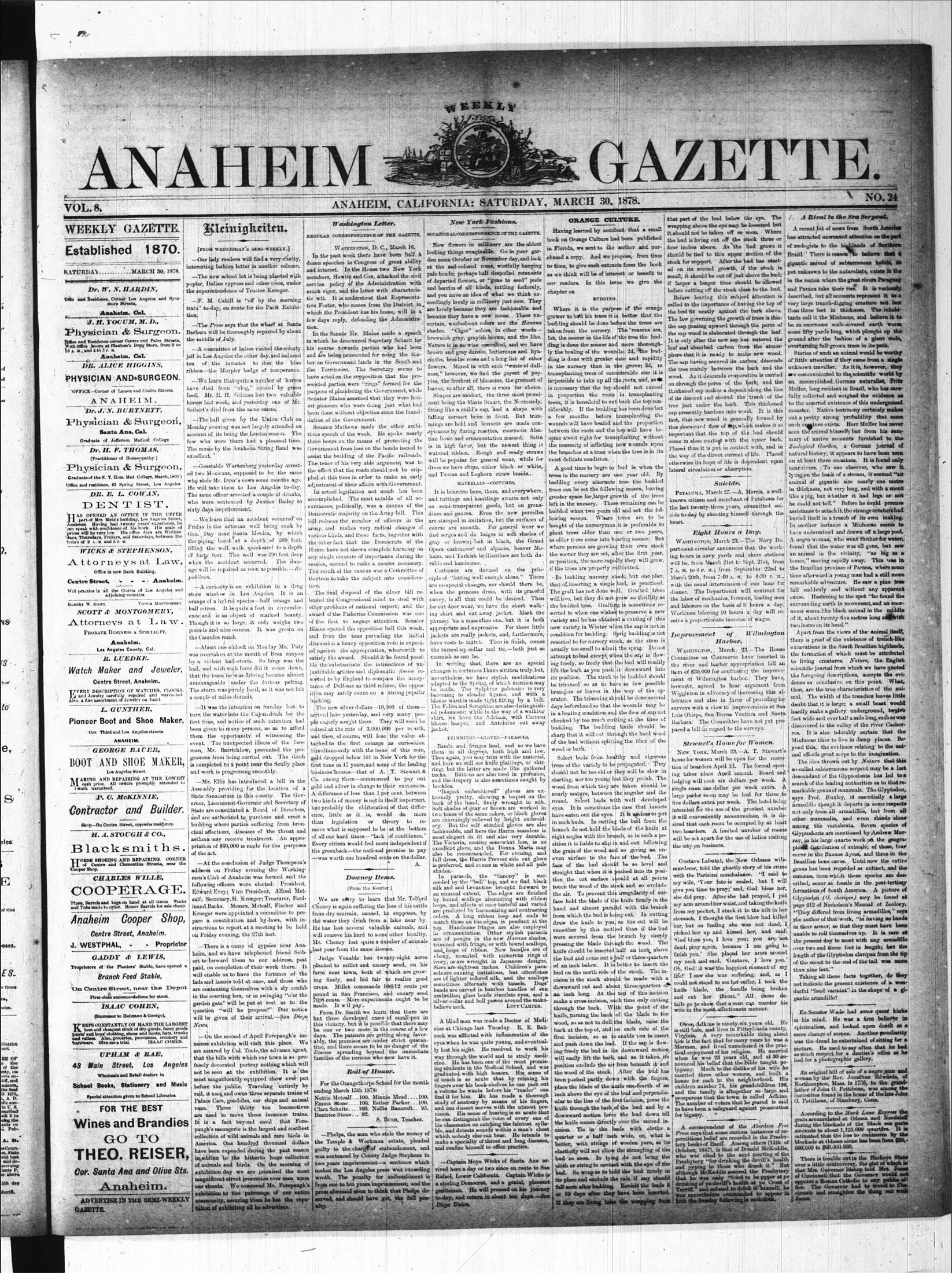
Searchable text
ANAHEIM
VOL. 8.
WEEKLY GAZETTE.
Established 1870.
SATURDAY...MARCH 30, 1878.
Dr. W. N. HARDIN,
Office and Residence, Corner Los Angeles and Sycamore Streets,
Anaheim. Cal.
J. H. YOCUM, M. D., Physician & Surgeon.
Office and Residence owner Centre and Palm Streets, With office hours at Blanken's Drug Store, from 9 to 10 A.M., and 4 to 5 P.M.
Anaheim. Cal.
DR. ALICE HIGGINS,
PHYSICIAN AND SURGEON.
OFFICE—Corner of Lemon and Centre Streets.
ANAHEIM.
Dr. J. N. BURTNETT,
Physician & Surgeon,
Santa Ana, Cal.
Graduate of Jefferson Medical College
Dr. H. F. THOMAS,
(Practitioner of Homoeopathy.)
Physician & Surgeon,
Kleinigkeiten.
[FROM WEDNESDAY'S SEMI-WEEKLY.]
Our lady readers will find a very chatty, interesting fashion letter in another column.
The new school lot is being planted with poplar, Italian cypress and other trees, under the supermtendence of Trustee Kroeger.
F. M. Cahill is "off by the morning train" to-day, en route for the Paris Exhibition.
The Press says that the wharf at Santa Barbara will be thoroughly repaired by about the middle of July.
A committee of ladies visited the county jail in Los Angeles the other day, and induced ten of the inmates to don the blue ribbon—the Murphy badge of temperance.
We learn that quite a number of horses have died from "clog," caused by green feed. Mr. R. H. Gilman lost two valuable horses last week, and yesterday one of Mr. Seibert's died from the same cause.
The ball given by the Union Club on Monday evening was not largely attended on account of its being the Lenten season. The few who were there had a pleasant time. The music by the Anaheim String Band was excellent.
Constable Wartenberg yesterday arrested two Mexicans, supposed to be the same
WASHINGTON
In the past week dozen speeches in G and interest. In the members, Hewitt a service policy of much vigor, and thie tic wit. It is undeive Foster, who co which the President few days reply, de tion.
In the Senate Min in which he denoun his course towards and are being prose ber on Government fhe Territories.
have acted on the se secuted parties wee purpose of plunderi Senator Blaine ass ist pioneers who w been done without dation of the Gov e Senator Mathew tious speech of the three hours on the Government from h assist the building The tenor of his ve effect that the
PHYSICIAN AND SURGEON.
OFFICE—Corner of Lemen and Centre Streets.
ANAHEIM.
Dr. J. N. BURTNETT,
Physician & Surgeon,
Santa Ana, Cal.
Graduate of Jefferson Medical College
Dr. H. F. THOMAS,
(Practitioner of Homopathy.)
Physician & Surgeon,
Graduate of the N. Y. Hom Med College, March, 1869.
Office and residence, 63 Spring Street, Los Angeles.
DR. E. L. COWAN,
DENTIST,
HAS OPENED AN OFFICE IN THE UPPER part of Mrs. Metz's building, Los Angeles Street, Anaheim. Having had twenty years' experience, he can speak with confidence of his work. His scale of prices will be very low. His office days are Wednesdays, Thursdays, Fridays, and Saturdays, between the hours of 9 A.M. and 5 P.M.
WICKS & STEPHENSON,
Attorneys at Law,
Office in new Bank Building.
Centre Street, Anaheim.
Will practice in all the Courts of Los Angeles and adjoining counties.
ROBERT W. SCOTT. VICTOR MONTGOMERY.
SCOTT & MONTGOMERY,
Attorneys at Law.
PROBATE BUSINESS A SPECIALTY.
Anaheim.
Los Angeles County, Cal.
R. LUEDKE.
Watch Maker and Jeweler,
Centre Street, Anaheim.
EVERY DESCRIPTION OF WATCHES, CLOCKS, and Jewelry carefully repaired and warranted. Also, a fine assortment of Jewelry on hand.
L. GUNTHER,
Pioneer Boot and Shoe Maker,
Cor. Third and Los Angeles streets.
ANAHEIM.
GEORGE BAUER,
BOOT AND SHOE MAKER,
Los Angeles Street.
MAKING AND REPAIRING AT THE LOWEST cash price. All orders promptly attended to I work guaranteed.
P. C. McKINNIE,
Contractor and Builder.
Shop—On Centre Street, opposite residence.
H. A. STOUGH & CO., Blacksmiths.
HORSE SHOEING AND REPAIRING. CORNER of Centre and Clementina Streets, near the Cooper Shop.
CHARLES WILLE,
COOPERAGE.
We learn that quite a number of horses have died from "clog," caused by green feed. Mr. R. H. Gilman lost two valuable horses last week, and yesterday one of Mr. Seibert's died from the same cause.
The ball given by the Union Club on Monday evening was not largely attended on account of its being the Lenten season. The few who were there had a pleasant time. The music by the Anaheim String Band was excellent.
Constable Wartenberg yesterday arrested two Mexicans, supposed to be the same who stole Mr. Dyer's cows some months ago. He will take them to Los Angeles to-day. The same officer arrested a couple of drunks, who were sentenced by Justice Bailey to sixty days imprisonment.
We learn that an accident occurred on Friday in the artesian well being sunk by Gen. Day near Santa Monica, by which the piping burst at a depth of 260 feet, filling the well with quicksand to a depth of forty feet. The well was 290 feet deep when the accident occurred. The damage will be repaired as soon as possible.
A curiosity is on exhibition in a drug store window in Los Angeles. It is an orange of a hybrid species—half orange and half citron. It is quite a foot in circumference and is an object of marked beauty. Though it is so large, it only weighs two pounds and nine ounces. It was grown on the Canulos ranch.
About one oclock on Monday Mr. Paty was overtaken at the mouth of Brea canyon by a violent hailstorm. So large was the hail, and with such force did it come down, that the team he was driving became almost unmanageable under the furious pelting. The storm was purely local, as it was not felt a couple of miles distant.
It was the intention on Sunday last to turn the water into the Cajon ditch for the first time, and notice of such intention had been given to many persons, so as to afford them the opportunity of witnessing the event. The unexpected illness of the foreman, Mr. Barricklow, prevented the programme from being carried out. The ditch is completed to a point near the Seullly place and work is progressing smoothly.
Mr. Ellis has introduced a bill in the Assembly providing for the location of a State Sanatorium in this county. The Governor, Lieutenant-Governor and Secretary of State are constituted a Board of Directors, and are authorized to purchase and erect a building where parties suffering from bronchial affections, diseases of the throat and asthma may receive treatment. An appropriation of $60,000 is made for the purposes of the act.
At the conclusion of Judge Thompson's address on Friday evening the Workingmen's Club of Anaheim was formed and the following officers were elected: President, Edward Evey; Vice President, Alfred Metcalf; Secretary H. Kroeger; Treasurer, Ferd-
Senator Mathewwittious speech of the three hours on the Government from his assist the building.
The tenor of his veil the effect that he pled at this time in adjustment of their In actual legislation accomplished. The currances, political Democratic major bill reduces the new army, and makes various kinds, and the other fact that House have not shied any single measure session seemed to The result of the thirteen to take their tion.
The final disposal leased the Congress other problems of the Fisher of the first to ex Blaine opened them and from the to discussion a heavy ed against the app satisfy the awardable the substantia justifiable artifice sorted to by English tance of Delfossae ition may safely or backing.
The new silver arrived here yestedie eagerly sought coined at the rate and then, of course tached to the fir Simultaneously we gold dropped below first time in 17 ye business houses Co. among them gold and silver in A difference of less two kinds of money but probably there ence, little as than legislation move what is sup of all our hard time Every citizen worlthe greenback—twas worth one
Contractor and Builder.
Shop—On Centre Street, opposite residence.
H. A. STOUGH & CO., Blacksmiths.
HORSE SHOEING AND REPAIRING. CORNER of Centre and Clementina Streets, near the Cooper Shop.
CHARLES WILLE, COOPERAGE.
Pipes, Barrels and kegs on hand at all times. Tanks and Tubs made to order. Honey Barrels for sale cheap.
Anaheim Cooper Shop,
Centre Street, Anaheim.
J. WESTPHAL, - Proprietor
GADDY & LEWIS,
Proprietors of the Planters' Stable, have opened a Branch Feed Stable,
On Centre Street, near the Depot First-class accommodations for stock.
ISAAC COHEN,
(Successor to Helmann & George).
KEEPS CONSTANTLY ON HAND THE LARGEST best and cheapest stock of dry-goods, fancy goods prents' and boys' clothing, shoes and boots, hats, trunks and values. Also, groceries, provisions, crockery and hardware. Give me a trial. ISAAC COHEN.
UPHAM & RAE,
43 Main Street, Los Angeles
Wholesale and Retail dealers in School Books, Stationery and Music
Special attention given to School Libraries.
FOR THE BEST Wines and Brandies GO TO THEO. REISER,
Cor. Santa Ana and Olive Sts. Anaheim.
ADVERTISE IN THE SEMI-WEEKLY GAZETTE.
WEEKLY
ANAHEIM, CALIFORNIA: SATURDAY, MARCH 30, 1878.
Washington Letter.
REGULAR CORRESPONDENCE OF THE GAZETTE.
WASHINGTON, D.C., March 16.
In the past week there have been half a dozen speeches in Congress of great ability and interest. In the House two New York members, Hewitt and Cox, attacked the civil service policy of the Administration with much vigor, and the latter with characteristic wit. It is understood that Representative Foster, who comes from the District in which the President has his home, will in a few days reply, defending the Administration.
In the Senate Sir. Blaine made a speech in which he denounced Secretary Schurz for his course towards parties who had been and are being prosecuted for using the timber on Government lands in the South and the Territories. The Secretary seems to have acted on the supposition that the prosecuted parties were "rings" formed for the purpose of plandering the Government, while Senator Blaine assumed that they were honest pioneers who were doing just what had been done without objection since the foundation of the Government.
Senator Mathews made the other ambitious speech of the week. He spoke nearly three hours on the means of protecting the Government from loss on the bonds issued to assist the building of the Pacific railroads. The tenor of his very able argument was to the effect that the roads should not be crippled.
New York Fashions.
OCCASIONAL CORRESPONDENCE OF THE GAZETTE.
New flowers in millinery are the oldest looking things imaginable. Go in your garden some October or November day, and look at the sad-colored roses, wistfully hanging pale heads; perhaps half despoiled remnants of departed flowers, or "gone to seed" pods and berries of all kinds, rattling forlornly, and you have an idea of what we think exceedingly lovely in millinery just now. They are lovely because they are fashionable and because they have a new name. These uncertain, washed-out colors are the Havana shades. "Cigar" colors, in other words—brownish gray, grayish brown, and the like. Nature is in no wise consulted, and we have brown and gray daisies, buttercups and hyacinths, bespales roses and a long list of other flowers. Mixed in with such "waste of dullness," however, we find the gayest of popies, the freshest of blossoms, the greenest of leaves, so after all, there is room for choice.
Shapes are modest, the three most prominent being the Marie Stuart, the Normandy, fitting like a child's cap, and a shape with falling coronet brim in front. But trimmings are bold and bonnets are made conspicuous by flaring rosettes, enormous Alsatian bows and ornamentation massed. Satin is in high favor, but the newest thing is watered ribbon. Rough and ready straws will be popular for general wear, while for dress we have chips, either black or white, and Tuscan and Leghorn straw braids.
ORANGE CULTURE.
Having learned by accident that a small book on Orange Culture had been published in Florida, we sent to the author and purchased a copy. And we propose, from time to time, to give such extracts from the book as we think will be of interest or benefit to our readers. In this issue we give the chapter on
BUDDING.
Where it is the purpose of the orange grower to bud his trees it is better that the budding should be done before the trees are taken from the nursery. The reasons are, first, the sooner in the life of the tree the budding is done the sooner and more thoroughly the healing of the wounds; second, the budding is done with greater ease and rapidity in the nursery than in the grove; third, it is necessary that the top should not exceed in proportion the roots in transplanting trees, it is beneficial to cut back the top considerably. If the budding has been done but a few months before transplanting the wounds will have healed and the proportion between the roots and the top will have become about right for transplanting without the necessity of inflicting new wounds upon the branches at a time when the tree is in its most delicate condition.
A good time to begin to bud is when the trees in the nursery are one year old. By
have acted on the supposition that the prosecuted parties were "rings" formed for the purpose of plundering the Government, while Senator Blaine assumed that they were honest pioneers who were doing just what had been done without objection since the foundation of the Government.
Senator Mathews made the other ambitious speech of the week. He spoke nearly three hours on the means of protecting the Government from loss to the bonds issued to assist the building of the Pacific railroads. The tenor of his very able argument was to the effect that the roads should not be crippled at this time in order to make an early adjustment of their affairs with Government.
In actual legislation not much has been accomplished. The most notable of all occurrences, politically, was a caucus of the Democratic majority on the Army bill. This bill reduces the number of officers in the army, and makes very radical changes of various kinds, and these facts, together with the other fact that the Democrats of the House have not shown complete harmony on any single measure of importance during the session, seemed to make a caucus necessary. The result of the caucus was a Committee of thirteen to take the subject into consideration.
The final disposal of the silver bill released the Congressional mind to deal with other problems of national import; and the award of the Fisheries Commission was one of the first to engage attention. Senator Blaine opened the opposition ball this week, and from the tone pervading the initial discussion a heavy opposition vote is expected against the appropriation, wherewith to satisfy the award. Should it be found possible the substantiate the intimations of unjustifiable artifice and diplomatic finesse reported by England to compass the acceptance of Delfosse as third referee, the opposition may safely count on a strong popular backing.
The new silver dollars—10,000 of them—arrived here yesterday, and very many people eagerly sought them. They will soon be coined at the rate of 3,000,000 per month, and then, of course, will lose the value attached to the first coinage as curiosities. Simultaneously with the issue of this coin, gold dropped below 101 in New York for the first time in 17 years, and some of the leading business houses—that of A. T. Stewart & Co. among them—commenced to pay out gold and silver in change to their customers. A difference of less than 1 per cent. between two kinds of money is not in itself important, but probably the obliteration of that difference, little as it is, would do more than legislation or theory to remove what is supposed to be at the bottom of all our hard times—"lack of confidence." Every citizen would feel more independent if the greenback—the national promise to pay—was worth one hundred cents on the dollar.
A.
Downey Items.
[From the Courier.]
We are sorry to learn that Mr. Telford has acted on the supposition that the prosecuted parties were "rings" formed for the purpose of plundering the Government, while Senator Blaine assumed that they were honest pioneers who were doing just what had been done without objection since the foundation of the Government.
Senator Mathews made the other ambitious speech of the week. He spoke nearly three hours on the means of protecting the Government from loss to the bonds issued to assist the building of the Pacific railroads. The tenor of his very able argument was to the effect that the roads should not be crippled at this time in order to make an early adjustment of their affairs with Government.
In actual legislation not much has been accomplished. The most notable of all occurrances, politically, was a caucus of the Democratic majority on the Army bill. This bill reduces the number of officers in the army, and makes very radical changes of various kinds, and these facts, together with the other fact that the Democrats of the House have not shown complete harmony on any single measure of importance during the session, seemed to make a caucus necessary. The result of the caucus was a Committee of thirteen to take the subject into consideration.
The final disposal of the silver bill released the Congressional mind to deal with other problems of national import; and the award of the Fisheries Commission was one of the first to engage attention. Senator Blaine opened the opposition ball this week, and from the tone pervading the initial discussion a heavy opposition vote is expected against the appropriation, wherewith to satisfy the award. Should it be found possible the substantiate the intimations of unjustifiable artifice and diplomatic finesse reported by England to compass the acceptance of Delfosse as third referee, the opposition may safely count on a strong popular backing.
The new silver dollars—10,000 of them—arrived here yesterday, and very many people eagerly sought them. They will soon be coined at the rate of 3,000,000 per month, and then, of course, will lose the value attached to the first coinage as curiosities. Simultaneously with the issue of this coin, gold dropped below 101 in New York for the first time in 17 years, and some of the leading business houses—that of A. T. Stewart & Co. among them—commenced to pay out gold and silver in change to their customers. A difference of less than 1 per cent. between two kinds of money is not in itself important, but probably the obliteration of that difference, little as it is, would do more than legislation or theory to remove what is supposed to be at the bottom of all our hard times—"lack of confidence."
Every citizen would feel more independent if the greenback—the national promise to pay—was worth one hundred cents on the dollar.
A.
Downey Items.
[From the Courier.]
Downey Items.
[From the Courier.]
We are sorry to learn that Mr. Telford Cheney is again suffering the loss of his cattle from dry mrurain, caused, he supposes, by the water they drink from a lake near by. He has lost several valuable animals, and will remove his herd to some other locality. Mr. Cheney lost quite a number of animals last year from the same disease.
Judge Venable has twenty-eight acres planted to millet and canary seed, on his farm near town, both of which are growing finely, and bid fair to realize good crops. Millet commands 10@12 cents per pound in San Francisco, and canary seed 7@8 cents. More experiments ought to be made. It will pay.
From Dr. Smith we learn that there are but three developed cases of small-pox in this vicinity, but it is possible that there may be one or two more in the course of a few days. The patients are getting along favorably, the premises are under strict quarantine, and there seems to be no danger of the disease spreading beyond the immediate families of the persons who now have it.
Roll of Honor.
For the Orangethorpe School for the month ending March 15th 1878:
Nettie Metcalf...100. Minnie Mead...100. Emma Stone...100. Esther Parker...100. Clara Schulte...100. Nellie Bancroft...95. Beatrice Stone...92.
S. Bush, Teacher.
—Phelps, the man who stole the money of the Temple & Workman estate, pleaded guilty to the charge of embezzlement, and was sentenced by County Judge Stephens to two years imprisonment—a sentence which makes the Los Angeles press wax exceeding wrot. The penalty for embezzlement is from one to ten years imprisonment; and the press aforesaid seem to think that Phelps deserved, and should have got, the full penalty.
Captain Moye Wicks of Santa Ana arrived here a day or two since en route to San Rafael, Lower California. Captain Wicks is a sterling Democrat, and a genial, pleasant gentleman. He will proceed on his journey to-day, and return in about ten days.—San Diego Union.
In parasols, the "canopy" is succeeded by the "bell" top, and we find black silk and Levantine brought forward to an unusual extent. The edges are finished by bound scallops alternating with ribbon loops, and effects at once tasteful and varied are produced by harmonizing and contrasting colors. A long ribbon loop and ends to match those on the edges, is pendant at the top. Handsome fringes are also employed in ornamentation. Other stylish parasols are of ponges in the new Harana shades, trimmed with fringe, or with bound scallops, and loops of ribbon. New handles are of ebony, mounted with numerous rings of ivory, or are wrought in Japanese designs. Sizes are eighteen inches. Children's parasols are cunning imitations, but oftentimes are of lighter colored silk, and the scallops sometimes alternate with tassels. Dogs' heads are carved in bamboo handles of sun umbrellas; glass beads simulate eyes, and a silver collar and bell passes around the make-believe neck.
Lucy Carter.
A blind man was made a Doctor of Medicine at Chicago last Tuesday. R. E. Babcock was afflicted with inflammation of the eyes when he was quite young, and eventually lost his sight. He resolved to work his way through the world and to study medicine. He has been one of the most promising students in the Medical School, and was graduated with high honors. His sense of touch is so acute that by running his fingers over his book-shelves he can pick out a volume he wants before his "reader" can find it for him. He has made a thorough study of anatomy by means of his fingers, and can dissect nerves with the utmost precision. His sense of hearing is so acute that he can distinguish the voice of every one of his classmates on catching the faintest syllable, and detects sounds within a man's chest which nobody else can hear. He intends to make a specialty of throat and lung diseases, and confine himself to office practice.
After the bud has been pushed partly down with the fingers, place the blade of the knife one-fourth of an inch above the eye of the bud and perpendicular to the line of the first incision, press the knife through the bark of the bud and by a downward motion force the bud down till the knife comes directly over the second incision. Tie in the buds with cloths a quarter or a half inch wide, or what is better, with strings of woolen yarn, as its elasticity will not allow the strangling of the bud so soon. In tying do not bring the cloth or string in contact with the eye of the bud. So wrap as to hold the bud monly in its place and exclude the rain if any should fall soon after budding. Revisit the buds 8 or 10 days after they have been inserted. If they are living take the wrapping from
GAZETTE.
30, 1878.
CULTURE.
Any accident that a small culture had been published to the author and purposed we propose, from time extracts from the book of interest or benefit to this issue we give theUDDING.
The purpose of the orange trees it is better that the bud done before the trees are nursery. The reasons are, the life of the tree the bud-boner and more thorough-wound; 2d, the bud-greater ease and rapidity than in the grove; 3d, much of considerable size it is up all the roots, and, as the top should not exceed the roots in transplanting it to cut back the top budding has been done but before transplanting the sealed and the proportion and the top will have become transplanting without detecting new wounds upon time when the tree is in its position.
begin to bud is when the are one year old. By that part of the bud below the eye. The wrapping above the eye may be loosened but it should not be taken off so soon. Where the bud is living cut off the stock three or four inches above. As the bud grows it should be tied to this upper section of the stock for support. After the bud has started on its second growth, if the stock is small, it should be cut off just above the bud; if larger a longer time should be allowed before cutting off the stock close to the bud.
Before leaving this subject attention is called to the importance of having the top of the bud fit neatly against the bark above. The law governing the growth of trees is this: the sap passing upward through the pores of the sap wood is elaborated through the leaf. It is only after the new sap has entered the leaf and absorbed carbon from the atmosphere that it is ready to make new wood. The sap having secured its carbon descends the tree mainly between the bark and the wood. As it descends evaporation is carried on through the pores of the bark, and the thickened sap makes a deposit along the line of its descent and around the trunk of the tree just under the bark. This thickened sap presently hardens into wood. It is this fact, that new wood is generally formed by this downward flow of sap, which makes it so important that the top of the bud should come in close contact with the upper bark. Placed thus it is put in contact with, and in the way of the direct current of life. Placed otherwise its hope of life is dependent upon lateral circulation or absorption.
A Rival to the Sea Serpent.
A recent bit of news from South America has attracted unwonted attention on the part of zoologists to the highlands of Southern Brazil. There is reason to believe that a gigantic animal of subterranean habits, as yet unknown to the naturalists, exists in the in the region where the great rivers Paraguay and Parana take their rise. It is variously described, but all accounts represent it as a very large trench-digging creature not less than three feet in thickness. The inhabitants call it the Minhocao, and believe it to be an enormous scale-covered earth worm some fifty yards long, which ploughs up the ground after the fashion of a giant mole, overturning full-grown trees in its path.
Stories of such an animal would be worthy of little attention if they came from a single unknown traveller. As it is, however, they are communicated to the scientific world by an accomplished German naturalist, Fritz Muller, long resident in Brazil, who has carefully collected and weighed the evidence as to the asserted existence of this underground monster. Native testimony certainly makes out a pretty strong probability that some such creature exists. Herr Muller has never seen the animal himself; but from his summary of native accounts furnished to the Zoological Garden, a German journal of natural history, it appears to have been seen on at least three occasions. It is found only near rivers. To one observer, who saw it being on the bank of a stream, seemed "an
begin to bud is when the tree are one year old. By terminate tree the budded following season, leaving larger growth of the trees. Those remaining can be years old and set the tolWhere trees are to be everyman it is preferable to than one or two years, into bearing sooner. But growing their own stock set, after the first year, more rapidly they will grow properly cultivated.
nursery stock, but one plan, single bud, is practiced. done well. Grafted trees do not grow so thriftily as Grafting is sometimes rewished to preserve a new obtained a cutting of this winter when the sap is not in being. Sprig budding is not nursery stock, as the stem is not admit the sprig. Do not accept when the sap is flowy that the bud will readily push it downward into stock to be budded should have as few possible ties in the way of the opening should be done several times that the wounds may be caused and the flow of sap not much cutting at the time of budding knife should be cut through the hard wood splitting the fiber of the healthy and vigorous tree to propagated. They old or they will be slow in youngest they perish. The they are taken should be between the angular and the ends with well developed times the case that insects are eyes. It is useless to put cutting the bud from the blade of the knife at the branch, as in such a poo slip in and out following wood and so giving an unintended irregularity of surface should at all points of the stock and so exclude this irregularity of survival.
from healthy and vigorous tree to propagated. They old or they will be slow in youngest they perish. The they are taken should be between the angular and the ends with well developed times the case that insects are eyes. It is useless to put cutting the bud from the blade of the knife at the branch, as in such a poo slip in and out following wood and so give an unintended irregularity of surface
Gustave Labutat, the New Orleans wife-murderer, told the ghastly story of his crime with the Parisian nonchalance. "I said to my wife, 'Your fate is sealed, but I will give you time to pray;' and God bless her, she did pray. After she had prayed, I put my arm around her waist, and taking the knife from my pocket, I stuck it to the nilt in her stomach. I thought the first blow had killed her, but on finding she was not dead, I picked her up and kissed her, and said: 'God bless you, I love you; you are not dead; pray again, because I am going to finish you.' She placed her arms around my neck and said, 'Gustave, I love you.' Oh, God! it was the happiest moment of my life? I saw she was suffering, and, as I could not stand to see her suffer, I took the knife blade, the handle being broken and cut her throat." All these details go to show that a man can murder his wife in the most affectionate manner.
Owen Adkins is ninety-six years old. He is still hale, and lives in Pittsburgh county, Virginia. A very remarkable thing about him is the fact that for many years he was a Mormon, and lived unmolested in the practical enjoyment of his religion. He married when he was 23 years old, and at 30 announced his belief that the Bible taught polygamy. Much to the dislike of his wife he married three other women, and built a house for each in the neighborhood. His children number 74, his grandchildren 196, and the family is altogether so large and prosperous that the town is called Adkins. The number of voters that he geared is said to have been a safeguard against prosecution for bigamy.
A correspondent of the Aberdeen Free Press says that some curious instances of superstitious belief are recorded in the Presbytery books of Banff. Among others (14th of October, 1647), is that of Donald McKeddie, who was cited to the next meeting of the Presbytery "for drinking the devil's health and pyping to those who drank it." But although McKeddie assured the Presbytery that he was only "feied to be pyper at ye drinking of ya devill's health at ye Cross of Turriff," and refused to drink it himself, he was nevertheless commanded to appear in kirk the Sunday following in sackcloth.
There is trouble out in the Buckeye State over a little controversy, the gist of which is that Mrs. Governor Bishop told Mrs. Jones of Cincinnati that the Governor would not appoint a Roman Catholic to any public office. The Governor had to travel to Cincinnati and straighten the thing out with Jones.