anaheim-gazette 1878-02-02
Scanned page
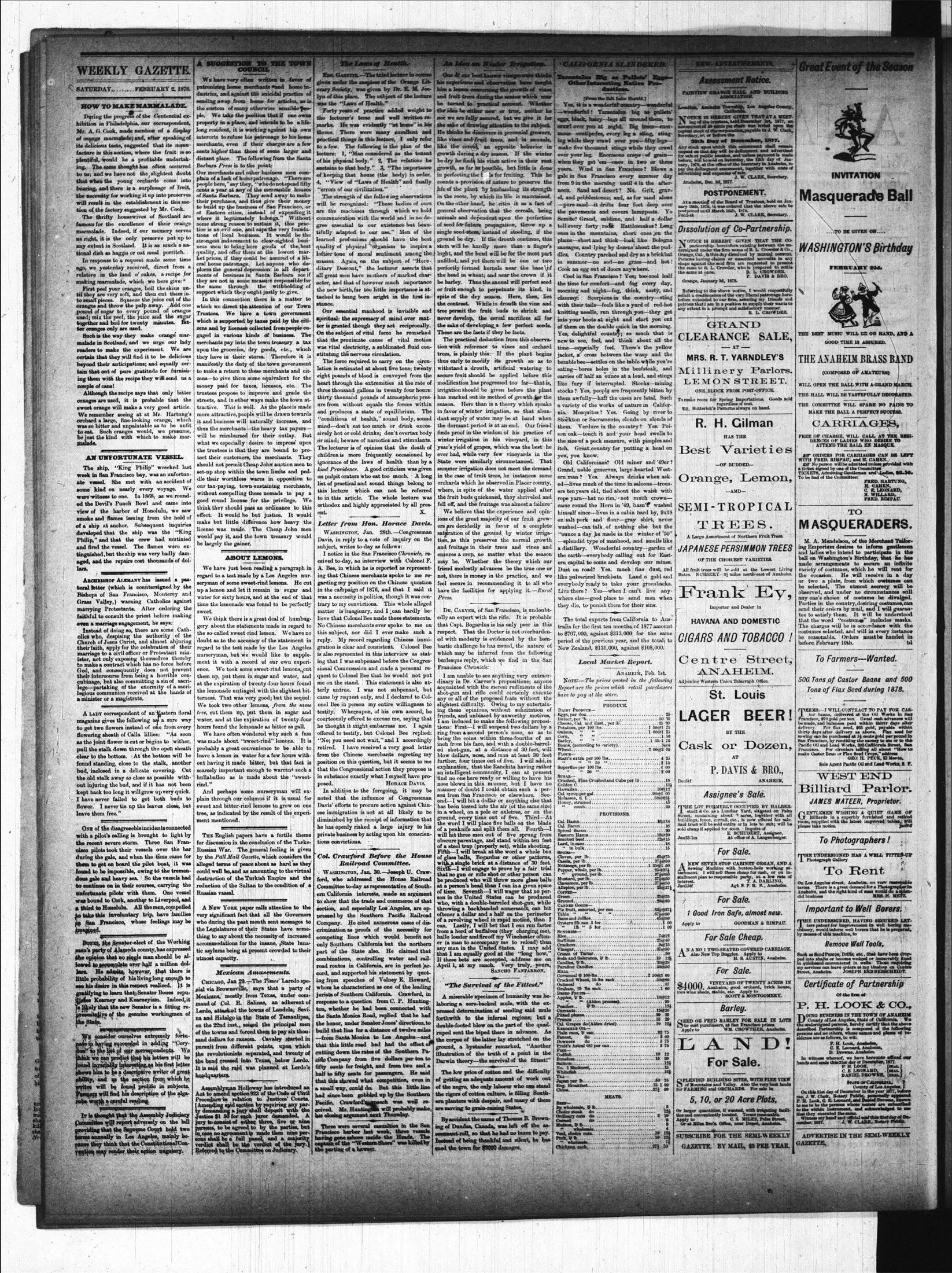
Searchable text
WEEKLY GAZETTE
SATURDAY... FEBRUARY 2, 1578.
HOW TO MAKE MARMALADE.
During the progress of the Centennial exhibition in Philadelphia, our correspondent, Mr. A. G. Cook, made mention of a display of orange marmalade; and, after speaking of its delicious taste, suggested that its manufacture in this section, where the fruit is so plentiful, would be a profitable undertaking. The same thought has often occurred to us; and we have not the slightest doubt that when the young orchards come into bearing, and there is a surplusage of fruit, the necessity for working it up into preserves will result in the establishment in this section of the factory suggested by Mr. Cook.
The thrifty housewives of Scotland are famous for the excellence of their orange marmalade. Indeed, if our memory serves us right, it is the only preserve put up to any extent in Scotland. It is as much a national dish as haggis or oat meal porridge.
In response to a request made some time ago, we yesterday received, direct from a relative in the land o' cakes, a recipe for making marmalade, which we here give:
First peel your oranges, boil the skins until they are very soft, and then cut them into small pieces. Squeeze the juice out of the oranges and throw the pulp away. Add one pound of sugar to every pound of oranges used; mix the peel, the juice and the sugar together and boil for twenty minutes. Bitter oranges only are used.
Such is the way they make orange marmalade in Scotland, and we urge our lady readers to make the experiment. We are certain that they will find it to be delicious beyond their anticipations; and equally certain that out of pure gratitude for furnishing them with the recipe they will send us a couple of cane!
Although the recipe says that only bitter oranges are used, it is probable that the sweet orange will make a very good article.
We remember seeing at at Mr. Hartung's orchard a large, fine-looking orange, which was so bitter and unpalatable as to be unfit to eat. Such oranges would, we presume, be just the kind with which to make marmalade.
AN UNFORTUNATE VESSEL.
The ship, "King Philip" wrecked last week in San Francisco bay was an unfortunate event.
ING them with the recipe they will send us a couple of cans!
Although the recipe says that only bitter oranges are used, it is probable that the sweet orange will make a very good article. We remember seeing at Mr. Hartung's orchard a large, fine-looking orange, which was so bitter and unpalatable as to be unfit to eat. Such oranges would, we presume, be just the kind with which to make marmalade.
AN UNFORTUNATE VESSEL.
The ship, "King Philip" wrecked last week in San Francisco bay, was an unfortunate vessel. She met with an accident of some kind on nearly every voyage. We were witness to one. In 1868, as we rounded the Devil's Punch Bowl and came into view of the harbor of Honolulu, we saw smoke and flames issuing from the hold of a ship at anchor. Subsequent inquiries developed that the ship was the "King Philip," and that the crew had mutinied and fired the vessel. The flames were extinguished, but the ship was very badly damaged, and the repairs cost thousands of dollars.
ARCHBISHOP ALEMANY has issued a pastoral letter (which is countersigned by the Bishop of San Francisco, Monterey and Grass Valley,) warning Catholics against marrying Protestants. After ordering the faithful to consult the priest before making even a marriage engagement, he says:
Instead of doing so, there are some Catholics who, despising the authority of the Church of Jesus Christ, and almost abjuring their faith, apply for the celebration of their marriage to a civil officer or Protestant minister, not only exposing themselves thereby to make a contract which has no force before God, and consequently does not prevent their intercourse from being a horrible concubination, but also committing a sin of sacrilege—partaking of the enormity of a sacrilegious communion received at the hands of a minister or a magistrate.
A LADY correspondent of an Eastern floral magazine gives the following as a sure way to get two flowers instead of one from every flowering sheath of Calla lillies: "As soon as the joint flower is cut or begins to wither, pull the stalk down through the open sheath clear to the bottom. At the bottom will be found standing, close to the stalk, another bud, inclosed in a delicate covering. Cut the old stalk away as close as possible without injuring the bud, and if it has not been kept back too long it will grow up very quick. I have never failed to get both buds to flower. I never tie up the leaves close, but leave them free."
One of the disagreeable incidents connected with a pilot's calling is brought to light by the recent severe storm. Three San Francisco pilots took their vessels over the bar during the gale, and when the time came for them to get on board the pilot boat, it was found to be impossible, owing to the tremendous gale and heavy sea. So the vessels had to continue on in their courses, carrying the unfortunate pilots with them. One vessel—to give them some equivalent for the money paid for taxes, licenses, etc. The trustees propose to improve and grade the streets, and in other ways make the town attractive. This is well. As the place is made more attractive, people will be drawn towards it and business will naturally increase, and thus the merchants—the heavy tax payers—will be reimbursed for their outlay. But what we especially desire to impress upon the trustees is that they are bound to protect their customers, the merchants. They should not permit Cheap John auction men to set-up shop within the town limits and peddle their worthless wares in opposition to our tax-paying, town-sustaining merchants, without compelling these nomads to pay a good round license for the privilege. We think they should pass an ordinance to this effect. It would be but justice. It would make but little difference how heavy the license was made. The Cheap John men would pay it, and the town treasury would be largely the gainer.
ABOUT LEMONS.
We have just been reading a paragraph in regard to a test made by a Los Angeles nurseryman of some sweet-rind lemons. He cut up a lemon and let it remain in sugar and water for sixty hours, and at the end of that time the lemonade was found to be perfectly sweet.
We think there is a great deal of humbuggy about the statements made in regard to the so-called sweet-rind lemon. We have no doubt as to the accuracy of the statement in regard to the test made by the Los Angeles nurseryman, but we would like to supplement it with a record of our own experience. We took some sweet-rind lemons, cut them up, put them in sugar and water, and at the expiration of twenty-four hours found the lemonade untended with the slightest bitterness. That was very good; but the sequel: We took two other lemons, from the same tree, cut them up, put them in sugar and water, and at the expiration of twenty-four hours found the lemonade as bitter as gall.
We have often wondered why such a fuss was made about "sweet-rind" lemons. It is probably a great convenience to be able to leave a lemon in water for a few hours without having it made bitter, but that fact is scarcely important enough to warrant such a hullabuloo as is made about the "sweet-rind."
And perhaps some nurseryman will explain through our columns if it is usual for sweet and bitter-rind lemons to grow on one tree, as indicated by the result of the experiment mentioned.
THE English papers have a fertile theme for discussion in the conclusion of the Turko-Russian War. The general feeling is given by the *Pall Mall Gazette*, which considers the alleged terms of peace about as hard as they could well be, and as amounting to the virtual destruction of the Turkish Empire and the reduction of the Sultan to the condition of a Russian vassal.
eight pounds of heart through three thousand thirty thousand ure from without and produces "conditions of mind—don't sensively hot or cold or mind; beware The lecturer is most ignorance of this kind Providence on pulpit orator list of practical this lecture to in this article orthodox and benent.
Letter from
WASHINGTON Davis, in reply subject writes,
I notice in this received to-day,
A. Bee, in which ing that Chinese gardening my pose in the campaign was a necessity trary to my concern is imag lie that Colon.
No Chinese men this subject, no reply. My recitation is clear is also representing that I was a personal Commissar quest to Colon me on the standerly untrue. came by request onel Bee in peretitity. Where courteously offered he thought it may offered to testi No; you need retired. I have from the China position on this that the Congress in substance exposed.
In addition noted that tha Davis' efforts tese immigration diminished by he has openly m private business convictions conviction.
Col. Crauford
WASHINGTON Ford, who add Committee to-dern California
One of the disagreeable incidents connected with a pilot's calling is brought to light by the recent severe storm. Three San Francisco pilots took their vessels over the bar during the gale, and when the time came for them to get on board the pilot boat, it was found to be impossible, owing to the tremendous gale and heavy sea. So the vessels had to continue on in their courses, carrying the unfortunate pilots with them. One vessel was bound to Cork, another to Liverpool, and a third to Honolulu. All the men, compelled to take this involuntary trip, have families in San Francisco, whose feelings may be imagined.
Boyles, the Senator-elect of the Working man's party of Alameda county, has expressed the opinion that no single man should be allowed to accumulate over half a million dollars. He admits, however, that there is little probability of his living long enough to see his desire in this respect realized. It is gratifying to learn that Senator Bones repudiates Kearney and Kearneyism. Indeed, it is likely that the new Senator is a fitting representative of the genuine workingmen of the State.
We consider ourselves extremely fortunate in having succeeded in adding "Corydon" to the list of our correspondents. We think we can predict that his letters will be found invariably interesting, as his first letter shows him to be a descriptive writer of great ability, and as the section from which he writes will be found prolific in subjects. Partners will find his description of the algaroba worth a careful reading.
It is thought that the Assembly Judiciary Committee will report adversely on the bill providing that the Supreme Court hold two terms annually in Los Angeles, mainly because they think that the Constitutional Convention may render their action nagatory.
The English papers have a fertile theme for discussion in the conclusion of the Turko-Russian War. The general feeling is given by the Pall Mall Gazette, which considers the alleged terms of peace about as hard as they could well be, and as amounting to the virtual destruction of the Turkish Empire and the reduction of the Sultan to the condition of a Russian vassal.
A New York paper calls attention to the very significant fact that all the Governors who during the past month sent messages to the Legislatures of their States have something to say about the necessity of increased accommodations for the insane, State lunatic asylums being at present crowded to their utmost capacity.
Mexican Amusements.
Chicago, Jan 29. — The Times' Laredo special via Brownsville, says that a party of Mexicans, mostly from Texas, under command of Col. R. Salinas, an adherent of Lerdo, attacked the towns of Laudela; Sevina and Hidalgo in the State of Tamaulipas, on the 22nd inst., seized the principal men of the towns and forced them to pay six thousand dollars for ransom. Cavalry started in pursuit from different points, upon which the revolutionists separated, and twenty of the band crossed into Texas, below Lerdo. It is said the raid was planned at Lerdo's headquarters.
Assemblyman Holloway has introduced an Act to amend section 923 of the Code of Civil Procedure in relation to Justices' Courts. [Amending said section by requiring any party demanding a jury shall deposit with the Justice $150 for each juror demanded. A jury to consist of either three, five or nine persons, to be agreed to by the parties, but in case no agreement is made then nine persons shall be a full panel, and a majority verdict shall be the verdict of the jury.] Referred to the Committee on Judiciary.
There were some Francisco harbor having gone ashore captain of the "the parting of a
THE TOWE
in favor of home in general practice of articles, as is sensible people if one owns to be a life-vest his own to his home trees are a few larger and from the Santa men come "There are not spend fifty hundred houses way to make their money Francisco, or expending it." Without this pracvery founda should be the highest business of the best lowest married of a librarian who deall departbara soe if responsible for upholding of to give.
matter to our Town government by the citi- from people en- business. The treasury a tax etc., which therefore it is goveramentrants and citi- lent for the etc. The old grade the town at- place is made dawn towards increase, and tax payers—outlay. But impress upon sound to pro- prants. They action men to its and ped-
The Laws of Health.
Em. Gazette.—The third lecture in course given under the suspices of the Orange Literary Society, was given by Dr. E. M. Joslyn of this place. The subject of the lecture was the "Laws of Health."
Forty years of practice added weight to the lecturer's tera and well written remarks. He was evidently "at home" in his theme. There were many excellent and practical things in this lecture, I only refer to a few. The following is the plan of the lecture: 1, "Man considered as the tenant of his physical body." 2, The relations he sustains to that body." 3, "The importance of keeping that house (the body) in order. 4, "View of "Laws of Health" and finally "errors of our civilization."
The strength of the following observations will be recognized: "These bodies of ours are the machines through which we hold communication with the world and in no degree essential to our existence but beautifully adapted to our use." Men of the learned professions should have the best quality of physical organism to inspire a loftier tone of moral sentiment among the masses. Again, on the subject of "Hereditary Descent," the lecturer asserts that all great men have mothers of marked character, and that of however much importance the new birth, far too little importance is attached to being born aright in the first instance.
Our essential manhood is invisible and spiritual: the supremacy of mind over matter is granted though they act reciprocally. On the subject of vital force he remarked that the proximate cause of vital motion was vital electricity, a sublimated fluid constituting the nervous circulation.
The force required to carry on the circulation is estimated at about five tons; twenty eight pounds of blood is conveyed from the heart through the extremities at the rate of three thousand gallons in twenty four hours; thirty thousand pounds of atmospheric pressure from without equals the forces within and produces a state of equilibrium. The "conditions of health," sound body, sound mind—don't eat too much or drink excessively hot or cold drinks; don't overtax body or mind; beware of narcotics and stimulants. The lecturer is of opinion that the death of children is more frequently occasioned by ignorance of the laws of health than by a kind Providence. A good criticism was given
An Idea on Winter Irrigation.
One of our best known vinegrowers thinks his experience and observation have taught him a lesson concerning the growth of vines and fruit trees during the season which may be turned to practical account. Whether the idea be either new or true, neither he nor we are fully assured, but we give it for the sake of drawing attention to the subject. He thinks he discovers in perennial growers, like vines and fruit trees, and in annuals, like the cereal, an opposite behavior in growth during a dry season. If the winter be dry he finds his vines active in their root growth, as far as possible, but little is done in perfecting the lily for fruiting. This he counts a provision of nature to preserve the life of the plant by hashing its strength in the roots, by which its life is maintained.
On the other hand, he cities it as a fact of general observation that the cereals, being annuals and dependent upon the perfection of seed for future propagation, throw up a single seed-stem, instead of stooling, if the ground be dry. If the drouth continue, this stem will be hardly more than a finger's height, and the head will be for the most part unfilled, and yet there will be one or two perfectly formed kernels near the base of the head in wheat; and near the crown if it be barley. Thus the annual will perfect seed or fruit enough to perpetuate its kind, in spite of the dry season. Here, then, lies the contrast. While in drouth the vine and tree permit the fruit buds to shrink and never develop, the cereal sacrifices all for the sake of developing a few perfect seeds. These are the facts if they be facts.
The practical deduction from this observation with reference to vines and orchard trees, is plainly this: If the plant begins thus early to modify its growth so as to withstand a drought, artificial watering to secure fruit should be applied before this modification has progressed too far—that is, irrigation should be given before the plant has marked out its method of growth for the season. Here than is a theory which speaks in favor of winter irrigation, so that abundant supply of water may be at hand when the dormant period is at an end. Our friend finds proof in the wisdom of his practice of winter irrigation in his vineyard, in this year's yield of grapes, which was the best he ever had, while very few vineyards in the State were similarly circumstanced. That summer irrigation does not meet the demand in case of fruit trees he instances.
CALIFORNIA SLANDERED.
Tarantalus Big as Pullata' Egg—Other Interesting Native Productions.
[From the Salt Lake Herald.]
Yes, it is a wonderful country—wonderful! Tarantalus big as pullets' eggs, black, hairy—legs all around them, to crawl over you at night. Big trees—enormous—centipedes, every leg a sting, stinging while they crawl over you—fifty legs—make five thousand stings while they crawl over your leg. Enormous crops of grain—when they get 'em—once in two or three years. Wind in San Francisco? Blows a gale in San Francisco every summer day from 9 in the morning until 4 in afternoon. Sand and desert? No. Grit, gravel, and pebblestones; and, as for sand alone—pure sand—it drifts four feet deep over the pavements and covers lampposts. Yo Semite? Grand, sublime, and half a dollar toll every forty rook Kattlesnakes? Long ones in the mountains, short ones on the plains—short and thick—look like Bologna sausages, and lying by dozens about the puddle. Country parched and dry as a brickhat in summer—no sod—no grass—and hot! Cook an egg out of doors anywhere.
Cool in San Francisco? Yes; too cool half the time for comfort—and fog every day, morning and night—fog, thick, nasty, and clammy. Scorpions in the country—sting with their tails—feels like a yard of red-hot knitting needle, run through you—they get into your boots at night and start you out of them on the double quick in the morning. Yes, delightful country; so much that is new to see, feel, and think about all the time—especially feel. There's yellow jacket, a cross between the wasp and the bumblebee—settles on the table while you're eating—bores holes in the beefsteak, and carries off half an ounce at a load, and stings like fury if interrupted. Stocks—mining stocks? Yes, people are frequently bitten by them awfully—half the cases are fatal. Such a variety of the works of nature in California. Mosquitos? Yes. Going by river to Stockton or Sacramento, clouds on clouds of them. Verdure in the country? Yes. Poison oak—touch it and your head swells to size of a peck measure, with pimples and itch. Great country for putting a head on you, you know.
Old Californians? Old miner and '49er? Grand, noble generous, large-hearted West-
Letter from Hon. Horace Davis.
WASHINGTON, Jan. 28th.—Congressman Davis, in reply to a vote of inquiry on the subject, writes to-day as follows:
I notice in the San Francisco Chronicle, received to-day, an interview with Colonel F. A. Bee, in which he is reported as representing that Chinese merchants spoke to me regarding my position on the Chinese question in the campaign of 1876, and that I said it was a necessity in politics, though it was contrary to my convictions. This whole alleged matter is imaginary, and I can hardly believe that Colonel Bee made these statements. No Chinese merchants ever spoke to me on this subject, nor did I ever make such a reply. My record regarding Chinese immigration is clear and consistent. Colonel Bee is also represented in this interview as stating that I was subpenaed before the Congressional Commission and made a personal request to Colonel Bee that he would not put me on the stand. This statement is also utterly untrue. I was not subpenaed, but came by request only, and I declared Colonel Bee in person my entire willingness to testify. Whersupon, of his own accord, he courteously offered to excuse me, saying that he thought it might embarrass me. I again offered to testify, but Colonel Bee replied: "No; you need not wait," and I accordingly retired. I have received a very good letter from the Chinese merchants regretting my position on this question, but it seems to me that the Congressional action they propose is in substance exactly what I myself have proposed.
HORACE DAVIS.
In addition to the foregoing, it may be noted that the influence of Congressman Davis' efforts to procure action against Chinese immigration is not at all likely to be diminished by the receipt of information that he has openly risked a large injury to his private business by acting upon his conscientious convictions.
Col. Crauford Before the House Railroad Committee.
WASHINGTON, Jan. 30.—Joseph U. Crawford, who addressed the House Railroad Committee to-day as representative of Southern California interests, made an argument
secure fruit should be applied before this modification has progressed too far—that is, irrigation should be given before the plant has marked out its method of growth for the season. Here than is a theory which speaks in favor of winter irrigation, so that abundant supply of water may be at hand when the dormant period is at an end. Our friend finds proof in the wisdom of his practice of winter irrigation in his vineyard, in this year's yield of grapes, which was the best he ever had, while few vineyards in the State were similarly circumstanced. That summer irrigation does not meet the demand in the case of fruit trees, he instances some orchards which he observed in Placer county, where, in spite of the water applied after the fruit buds quickened, they shriveled and fell off, and the fruitage was almost a failure.
We believe that the experience and opinions of the great majority of our fruit growers are decidedly in favor of a complete saturation of the ground by winter irrigation, as this preserves the normal growth and fruiture in their trees and vines and ensures a crop, no matter what the season may be. Whether the theory which our friend modestly advances be the true one or not, there is money in the practice, and we feel secure in recommending it to all who have the facilities for applying it.—Rural Press.
DR. CARVER, of San Francisco, is undoubtedly an expert with the rifle. It is probable that Capt. Bogardus is his only peer in this respect. That the Doctor is not overburdened with modesty is evidenced by the bombastic challenge he has issued, the nature of which may be inferred from the following burlesque reply, which we find in the San Francisco Chronicle:
I am unable to see anything very extraordinary in Dr. Carver's propositions; anyone acquainted with the merest rudiments of the shot-gun and rifle could certainly execute any or all of the proposed feats without the slightest difficulty. Owing to my entertaining these opinions, without solicitation of friends, and unbiased by unworthy motives, I am induced to make the following propositions: First—I will suspend two dollars by a ring from a second person's nose, so as to bring the coins within three-fourths of an inch from his face, and with a double-barrelled shot-gun, at a distance of 30 feet, will blow dollars, nose, and man at least 30 feet further, four times out of five. I will add, in explanation, that the Ranchita having rather an intelligent community, I can at present find no one here ready or willing to have his nose blown in this manner, but I have no manner of doubt I could obtain such a person from San Francisco or elsewhere. Second—I will hit a dollar or anything else that has been tossed into the air (of the same size) in a wheel, on a pole or axletree, or on the ground, every time out of five. Third—At the word I will place five balls on the blade of a penknife and split them all. Fourth—I will hit three men out of five sprung from obscure parentage, and stand within ten feet of a steel trap (properly set), while shooting.Fifth—I will break at the word a whole box of glass balls, Bogardus or other patterns, with a single brick at a distance of 30 feet.Sixth—I will engage to prove by a fair trial that no gun or rifle shot or other person can be produced who will throw more glass balls at a person's head than I can in a given space of time.Seventh—I will wager that no person in the United States can be produced secure fruit should be applied before this modification has progressed too far—that is, irrigation should be given before the plant has marked out its method of growth for the season.Here than is a theory which speaks in favor of winter irrigation, so that abundant supply of water may be at hand when the dormant period is at an end. Our friend finds proof in the wisdom of his practice of winter irrigation in his vineyard, in this year's yield of grapes, which was the best he ever had, while few vineyards in the State were similarly circumstanced. That summer irrigation does not meet the demand in the case of fruit trees, he instances some orchards which he observed in Placer county, where, in spite of the water applied after the fruit buds quickened, they shriveled and fell off, and the fruitage was almost a failure.
We believe that the experience and opinions of the great majority of our fruit growers are decidedly in favor of a complete saturation of the ground by winter irrigation, as this preserves the normal growth and fruiture in their trees and vines and ensures a crop, no matter what the season may be. Whether the theory which our friend modestly advances be the true one or not, there is money in the practice, and we feel secure in recommending it to all who have the facilities for applying it.—Rural Press.
Dr. Carver, of San Francisco, is undoubtedly an expert with the rifle. It is probable that Capt. Bogardus is his only peer in this respect. That the Doctor is not overburdened with modesty is evidenced by the bombastic challenge he has issued, the nature of which may be inferred from the following burlesque reply, which we find in the San Francisco Chronicle:
I am unable to see anything very extraordinary in Dr. Carver's propositions; anyone acquainted with the merest rudiments of the shot-gun and rifle could certainly execute any or all of the proposed feats without the slightest difficulty. Owing to my entertaining these opinions, without solicitation of friends, and unbiased by unworthy motives, I am induced to make the following propositions: First—I will suspend two dollars by a ring from a second person's nose, so as to bring the coins within three-fourths of an inch from his face, and with a double-barrelled shot-gun, at a distance of 30 feet further, four times out of five. I will add, in explanation, that the Ranchita having rather an intelligent community, I can at present find no one here ready or willing to have his nose blown in this manner, but I have no manner of doubt I could obtain such a person from San Francisco or elsewhere. Second—I will hit a dollar or anything else that has been tossed into the air (of the same size) in a wheel, on a pole or axletree, or on the ground, every time out of five. Third—At the word I will place five balls on the blade of a penknife and split them all. Fourth—I will hit three men out of five sprung from obscure parentage, and stand within ten feet of a steel trap (properly set), while shooting.Fifth—I will break at the word a whole box of glass balls, Bogardus or other patterns, with a single brick at a distance of 30 feet.Sixth—I will engage to prove by a fair trial that no gun or rifle shot or other person can be produced who will throw more glass balls at a person's head than I can in a given space of time.Seventh—I will wager that no person in the United States can be produced secure fruit should be applied before this modification has progressed too far—that is,irrigation should be given before the plant has marked out its method of growth for the season.Here than is a theory which speaks in favor of winter irrigation in his vineyard, in this year's yield of grapes,which was the best he ever had,while few vineyards in the State were similarly circumstanced. That summer irrigation does not meet the demand in the case of fruit trees,he instances some orchards which he observed in Placer county,where,在 spite of the water applied after the fruit buds quickened,they shriveled and fell off,and the fruitage was almost a failure.
We believe that the experience and opinions of the great majority of our fruit growers are decidedly in favor of a complete saturation of the ground by winter irrigation,as this preserves the normal growth and fruiture in their trees and vines and ensures a crop,no matter what the season may be. Whether the theory which our friend modestly advances be the true one or not,there is money in the practice,and we feel secure in recommending it to all who have the facilities for applying it.—Rural Press.
Starr's extra per 100 lbs.
50
50
50
Starr's extra per 100 lbs.
45
50
50
Superfine per 100 lbs.
40
50
Sugar
Crushed,Fine Crushed and Cube per lb.
15
Golden C.
15
Hawaiian
10
10
Cal syruper gal.
10
10
Molasses
50
50
Horry strained
15
comb.
20
Provisions.
Cal.Hans.
15
18
Cal.Bacon.
18
Spiced Bacon.
20
Eastern Hams.
18
20
Smoked beef.
12
15
Lard.in cans.
18
in bulk.
15
Cloves.per lb.
65
75
Cassia.per lb.
37
65
Nutmegs.per lb.
15
25
Pepper whole.per lb.
25
25
ground.per lb.
37
65
Mustard.per lb.
37
65
Cinnamon.per lb.
25
25
Allspice.per lb.
25
25
Coffee.
25
25
Green.
25
25
Col. Crawford Before the House Railroad Committee.
WASHINGTON, Jan. 30.—Joseph U. Crawford, who addressed the House Railroad Committee to-day as representative of Southern California interests, made an argument to show that the trade and commerce of that section, and especially Los Angeles, are oppressed by the Southern Pacific Railroad Company. He cited numerous cases of discrimination as proofs of the necessity for competing lines which would benefit not only Southern California but the northern part of the State also. He claimed that combinations, controlling water and railroad routes in California, are in perfect accord, and supported his statement by quoting from speeches of Volney E. Howard, whom he characterized as one of the leading jurists of Southern California. Crawford, in response to a question from C. P. Huntington, whether he had been connected with the Santa Monica Road, replied that he had the honor, under Senator Jones’ directions, to build that line for a distance of twelve miles—from Santa Monica to Los Angeles—and that this little road had had the effect of cutting down the rates of the Southern Pacific Company from five dollars per ton to fifty cents for freight, and from two and a half to fifty cents for passengers. He said that this showed what competition, even in a small way, could do. But this little line had since been gobbled up by the Southern Pacific, Crawford’s speech was well received. Mr. Huntington will probably make his closing argument next Thursday.
There were several casualties in the San Francisco harbor last week, three vessels having gone ashore inside the Heads. The captain of the “Western Shore” was killed by the parting of a hawser.
“The Survival of the Fittest.”
A miserable specimen of humanity was laboring a sore-backed mule, with the expressed determination of sending said mule forthwith to the infernal regions; but a double-footed blow on the part of the quadruped sent the biped there in advance. As the corpse of the latter lay stretched on the ground, a bystander remarked, “Another illustration of the truth of a point in the Darwin theory—the survival of the fittest!”
The low price of cotton and the difficulty of getting an adequate amount of work out of the negro, the only laborer who can stand the rigors of cotton culture, is filling Southern planters with despair, and many of them are moving to grain-raising States.
By accident the name of Thomas B. Brownning of Dundas, Canada, was left off the assessment roll, so that he had no taxes to pay. Instead of being thankful and silent, he has ended the town for $3000 damages.
NEW ADVERTISEMENTS.
Assessment Notice.
FAIRVIEW GRANGE HALL AND BUILDING ASSOCIATION.
Location, Anaheim Township, Los Angeles County, California.
NOTICE IS HEREBY GIVEN THAT AT A MEETING of the trustees, held December 1st, 1877, an assessment of 60 cents per share was levied upon the capital stock of the corporation, payable to J. W. Clark, Secretary, or before the 29th Day of December, 1877.
Any stock upon which this assessment shall remain unpaid on that day will be delinquent and advertised for sale at public auction, and unless payment is made before, will be sold on Saturday, the 13th day of January, 1878, at the office of the Secretary in Anaheim, to pay the delinquent assessment, together with costs of advertising and expenses of sale.
J. W. CLARK, Secretary.
Anaheim, Dec. 3d, 1877.
POSTPONEMENT.
At a meeting of the Board of Trustees, held on January 19th, 1878, it was ordered that the above sale be postponed until March 16th, 1878.
Feb. 4t.
Dissolution of Co-Partnership.
NOTICE IS HEREBY GIVEN THAT THE CO-partnership herefore existing between the undersigned under the firm name of R. L. Crowder & Co., Orange, Cal., is this day dissolved by mutual consent. Persons having claims or unsettled accounts in any shape against the said firm are requested to present the same to R. L. Crowder, who is prepared to settle the same at once.
R. L. CROWDER
P. DAVIS & BRO.
Orange, January 31, 1878.
Referring to the above notice, I would respectfully solicit a continuance of the vary liberal patronage hereof extended to our firm, assuring my friends and patrons that I am in a position to supply their wants to any extent in a prompt and satisfactory manner.
R. L. CROWDER.
GRAND CLEARANCE SALE,
AT
MRS. R. T. YARNDLEY'S
Millinery Parlors.
LEMON STREET.
ONE BLOCK FROM POST-OFFICE.
To make room for Spring Importations. Goods sold regardless of cost.
Kn. Butterick's Patterns always on hand.
R. H. Gilman
HAS THE
Best Varieties
OF BUDDED—
Great Event of the Season
INVITATION
Masquerade Ball
...TO BE GIVEN ON....
WASHINGTON'S Birthday
FEBRUARY 29th.
THE BEST MUSIC WILL DE ON HAND, AND A GOOD TIME IS ASSURED.
THE ANAHEIM BRASS BAND
(COMPOSED OF AMATEURS)
WILL OPEN THE BALL WITH A GRAND MARCH.
THE HALL WILL BE TASTEFULLY DECORATED.
THE COMMITTEE WILL SPARE NO PAINS TO MAKE THE BALL A PERFECT SUCCESS.
CARRIAGES,
FREE OF CHARGE, WILL CALL AT THE RESIDENCES OF LADIES WHO DESIRE TO ATTEND THE BALL EN MASQUE.
ORDERS FOR CARRIAGES CAN BE LEFT WITH FRED, RIMPAU, and H. CAHEN.
No person will be admitted unless provided with a ticket signed by one of the Committees.
TICKETS, Admitting Gentleman and Ladies, $2.50.
LEMON STREET.
ONE BLOCK FROM POST-OFFICE.
To make room for Spring Importations. Goods sold regardless of cost.
KS. Butterick's Patterns always on hand.
R. H. Gilman
HAS THE
Best Varieties
OF BUDDED—
Orange, Lemon,
AMD—
SEMI-TROPICAL
TREES.
A Large Assortment of Northern Fruit Trees.
JAPANESE PERSIMMON TREES
OF THE CHOICEST VARIETIES.
All fruit trees will be sold at the Lowest Living Rates. NURSERY—3½ miles north-east of Anaheim.
Frank Ey,
Importer and Dealer in
HAVANA AND DOMESTIC
CIGARS AND TOBACCO !
Centre Street,
ANAHEIM.
Adjoining Western Union Telegraph Office.
St. Louis
LAGER BEER!
BY THE
Cask or Dozen,
AT
P. DAVIS & BRO.,
ANAHEIM,
Assignee's Sale.
THE LOT FORMERLY OCCUPIED BY HALBERSTADT & Co. as a Lumber Yard, situated on Palm Street, containing about 9 acres, together with all buildings, fence, corrall, etc., is now offered for sale. Said tract will be sold entire or in lots to suit; will be sold cheap if applied for soon. Inquire of E. SCHUBERT, Assignee,
Jan23-1m
At office of A. Langenberger.
For Sale.
A NEW SEVEN-STOP CABINET ORGAN, AND A Sewing Machine with button-hole working attachment. I will sell these cheap for cash, or on installment plan to responsible party, at a low rate of interest.
T. A. DARLING,
Jan15f
For Sale.
WILL OPEN THE BALL WITH A GRAND MARCH.
THE HALL WILL BE TASTEFULLY DECORATED.
THE COMMITTEE WILL SPARE NO PAINS TO MAKE THE BALL A PERFECT SUCCESS.
CARRIAGES,
FREE OF CHARGE, WILL CALL AT THE RESIDENCES OF LADIES WHO DESIRE TO ATTEND THE BALL EN MASQUE.
ORDERS FOR CARRIAGES CAN BE LEFT WITH FRED. RIMPAU, and H. CAHEN.
No person will be admitted unless provided with a ticket signed by one of the Committees
TICKETS, Admitting Gentleman and Ladies, $2.50.
To be bad of the Committee:
FRED. HARTUNG,
H. CAHEN,
C. E. LEONARD,
N. WILLARD,
FRED. RIMPAU.
TO
MASQUERADERS.
M. A. Mendelson, of the Merchant Tailoring Emporium desires to inform gentlemen and ladies who intend to participate in the ball on Washington's Birthday, that he has made arrangements to secure an infinite variety of costumes, which he will rent for the occasion. He will receive in a day or two a plate, from which costumes can be selected. The utmost secrecy will be observed, and under no circumstances will any one's choice of costume be divulged. Parties in the country, desiring costumes, can send their orders by mail, and I will guarantee to satisfy them. It will be understood that the word "costumes" includes masks. The charges will be in accordance with the costumes selected, and will in every instance be reasonable. Orders must be handed in before February 10th.
To Farmers---Wanted.
500 Tons of Castor Beans and 500 Tons of Flax Seed during 1878.
TERMS: I WILL CONTRACT TO PAY FOR CASTOIR beans, delivered at the Oil Works in San Francisco, $70 gold per ton. Usual cash advance will be made, and balances paid within thirty days after delivery. For flax seed, $65 gold, payable within thirty days after delivery as above. Flax seed for sowing can be purchased at 3½ cents gold per pound in San Francisco, by remitting the money to me or to the Pacific Oil and Lead Works, 202 California Street, San Francisco. For circulators telling all about "How to make Castor Bean or Flax Seed Crops," address GEO. H. PECK, El Monte.
Sole Agent Pacific Oil and Lead Works, S. P.
WEST END
Billiard Parlor.
JAMES MATEER, Proprietor.
GENTLEMEN WISHING A QUIET GAME OF Billiards in a superbly furnished and retired room, supplied with the latest improved tables, will please take notice.
To Photographers!
THE UNDERSIGNED HAS A WELL FITTED-UP Photograph Gallery
To Rent
On Los Angeles street, Anaheim, on very reasonable terms. There is a great demand for a Photographer in Anaheim, and the right kind of man would do a splendid business.
THE LOT FORMERLY OCCUPIED BY HALBERSTADT & CO. AS A LUMBER YARD, situated on Palm Street, containing about 9 acres, together with all buildings, fence, corral, etc., is now offered for sale. Said tract will be sold entire or in lots to suit; will be sold cheap if applied for soon. Inquire of E. SCHUBERT, Assignee, At office of A. Langenberger.
For Sale.
A NEW SEVEN-STOP CABINET ORGAN, AND A Sewing Machine with button-hole working attachment. I will sell these cheap for cash, or on installment plan to responsible party, at a low rate of interest.
T. A. DARLING,
Jan15th
Agt S. P. R. R., Anaheim.
For Sale.
1 Good Iron Safe, almost new.
Apply to GOODMAN & RIMPAU.
For Sale Cheap.
A NO 1 TWO-SEATED COVERED CARRIAGE. Also New Top Bugles. Apply to H. S. AUSTIN, Anaheim.
For Sale.
$4000. VINEYARD OF TWENTY ACRES IN Anaheim, good orchard, brick house, two wine sheds, stable, etc. Apply to SCOTT & MONTGOMERY.
Barley.
SEED OR FEED BAKLEY FOR SALE IN LOTS TO suit purchasers, at San Francisco prices. Apply to WM. CROWTHER, Anaheim.
LAND!
For Sale.
PLENDID BUILDING SITES, WITH FINE VIEW OF Mountains and Valley. Also the very best lands for FARMING and ORCHARDS. For sale in
5, 10, or 20 Acre Plots,
Or larger quantities, if wanted, with irrigating facilities and conveniently located. Terms reasonable. Apply to C. S. MILES, Palm Street, Or at Miles Bro's Office, near Depot, Anaheim.
SUBSCRIBE FOR THE SEMI-WEEKLY GAZETTE. BY MAIL, $3 PER YEAR.
JAMES MATEER, Proprietor.
GENTLEMEN WISHING A QUIET GAME OF BILLIONS in a superbly furnished and retired room, supplied with the latest improved tables, will please take notice.
To Photographers!
THE UNDERSIGNED HAS A WELL FITTED-UP Photograph Gallery
To Rent
On Los Angeles street, Anaheim, on very reasonable terms. There is a great demand for a Photographer in Anaheim, and the right kind of man would do a well-did business.
Important to Well Borers:
THE UNDERSIGNED, HAVING SECURED LETTERS patent for improvement in well boring machinery, would inform well borers that he is prepared by means of this machine, to Remove Well Tools,
Such as Sand Pumps, Drills, etc., that have been dropped into shafts or become wedged or immovably fixed in quickand encountered in wells. Those requiring my services can leave orders at my timshop on Centre Street, Anaheim.
JOSEPH BENNERSCHELT.
Certificate of Partnership
Of the firm of P. H. LOOK & CO., DOING BUSINESS IN THE TOWN OF ANAHEIM County of Los Angeles, State of California. We the underigned persons hereby certify that the above described Partnership is composed of the following persons and no others, whose names and places of residence are as follows, to wit:
P. H. Look, Anaheim,
C. E. Leonard, Anaheim,
D. Drowne, Anaheim.
In witness whereof, we have hereunto affixed our hands and seals this 31st day of December, 1877.
P. H. LOOK,
C. E. LEONARD,
DANIEL DROWEK,
STATE OF CALIFORNIA,
County of Los Angeles.
On this 31st day of December in the year 1877, before me, J.W. Clark, Notary Public, personally appeared P.H.Look, C.E.Lonard,and Daniel Drowne,known to me to be the persons whose names are subscribed to the within instrument,and acknowledged to me that they executed the same.
Witness my hand and official seal this 31st day of December, 1877.
J.W.CLARK.Notary Public.
ADVERTISE IN THE SEMI-WEEKLY GAZETTE.