anaheim-gazette 1878-02-02
Scanned page
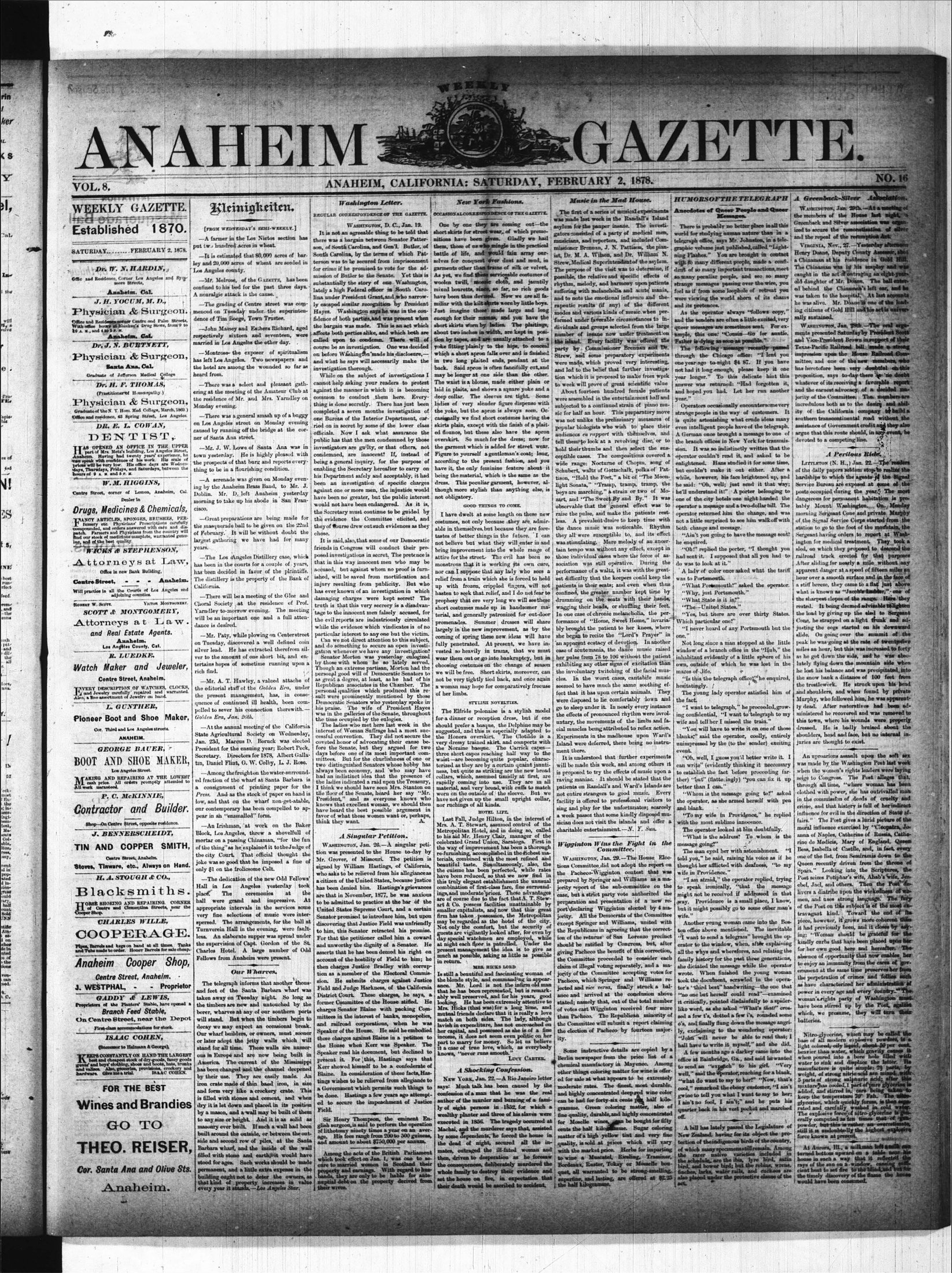
Searchable text
ANAHEIM
VOL. 8.
WEEKLY GAZETTE.
Established 1870.
SATURDAY... FEBRUARY 2, 1878.
Dr. W. N. HARDIN,
Office and Residence, Corner Los Angeles and Sycamore Streets,
Anaheim, Cal.
J. H. YOCUM, M. D., Physician & Surgeon.
Office and Residence corner Centre on Palm Streets, With office hours at Blankan's Drug Store, from 9 to 10 A.M., and 4 to 5 P.M.
Anaheim, Cal.
Dr. J. N. BURTNETT, Physician & Surgeon,
Santa Ana, Cal.
Graduate of Jefferson Medical College
Dr. H. F. THOMAS,
(Practitioner of Homopathy.)
Physician & Surgeon,
Graduate of the N. Y. Hom Med College, March, 1860.
Office and residence, 63 Spring Street, Los Angeles.
DR. E. L. COWAN,
DENTIST,
HAS OPENED AN OFFICE IN THE UPPER part of Mrs. Meta's building, Los Angeles Street, Anaheim. Having had twenty years' experience, he can speak with confidence of his work. His scale of prices will be very low. His office days are Wednesdays, Thursdays, Fridays, and Saturdays, between the hours of 9 A.M. and 6 P.M.
Kleinigkeiten.
[FROM WEDNESDAY'S SEMI-WEEKLY.]
—A farmer in the Los Nietos section has put two hundred acres in wheat.
—It is estimated that 80,000 acres of barley and 20,000 acres of wheat are seeded in Los Angeles county.
—Mr. Melrose, of the Gazette, has been confined to his bed for the past three days. A neuralgie attack is the cause.
—The grading of Centre street was commenced on Tuesday under the superintendence of Tim Boege, Town Trustee.
—John Massey and Esthera Richard, aged respectively sixteen and seventeen, were married in Los Angeles the other day.
—Montrose—the exposer of spiritualism has left Los Angeles. Two newspapers and the hotel are among the wounded so far as heard from.
—There was a select and pleasant gathering at the meeting of the Amateur Club at the residence of Mr. and Mrs. Yarnalley on Monday evening.
—There was a general smash up of a buggy on Los Angeles street on Monday evening caused by running off the bridge at the corner of Santa Ana street.
—Mr. J. W. Lowe of Santa Ana was in town yesterday. He is highly pleased with the prospects of that burg and reports everything to be in a flourishing condition.
Washington
REGULAR CORRECTION
It is not an age there was a bargain son, of South Carolina, South Carolina was to be for crime if he pission of Butler substantially theres lately a high Fedina under President Washington escaped similar Hayes. Washington silence of both parties called upon to course be an invocation before Washington and what he says investigation theres one Bureau of theried on in secret officials. Now public has that investigators are condemned, are being a general enabling the Sec
Dr. H. F. THOMAS,
(Practitioner of Homopathy.)
Physician & Surgeon,
Graduate of the N.Y.Hom.Med College, March, 1862.
Office and residence, 63 Spring Street, Los Angeles.
DR. E. L. COWAN,
DENTIST,
Has opened an office in the upper part of Mrs. Meta's building, Los Angeles Street, Anaheim. Having had twenty years' experience, he was speak with confidence of his work. His scale of practice will be very low. His office days are Wednesdays, Thursdays, Fridays, and Saturdays, between the hours of 9 A.M. and 6 P.M.
W. M. HIGGINS,
Centre Street, corner of Lemon, Anaheim, Cal.
Dealer in Drugs, Medicines & Chemicals.
FANCY ARTICLES, SPONGES, BRUSHES, PERfumery etc. Physicians' Prescriptions carefully compounded, and orders answered with care and dispatch. Farmers and Physicians from the country will find our stock of medicines complete, warranted genuine, and of the best quality.
WICKS & STEPHENSON,
Attorneys at Law,
Office in new Bank Building.
Centre Street, Anaheim.
Will practice in all the Courts of Los Angeles and adjoining counties.
ROBERT W. SCOTT.
Victor Montgomery.
SCOTT & MONTGOMERY,
Attorneys at Law.
and Real Estate Agents.
Anaheim.
Los Angeles County, Cal.
R. LUEDKE.
Watch Maker and Jeweler,
Centre Street, Anaheim.
Every description of watches, clocks, and jewelry carefully repaired and warranted. Also a fine assortment of jewelry on hand.
L. GUNTHER,
Ploneer Boot and Shoe Maker,
Cor. Third and Los Angeles streets.
ANAHEIM.
GEORGE BAUER,
BOOT AND SHOE MAKER,
Los Angeles Street.
MAKING AND REPAIRING AT THE LOWEST cash price. All orders promptly attended to. All work guaranteed.
P. C. McKINNIE,
Contractor and Builder.
Shop—On Centre Street, opposite residence.
J. BENNERSCHEIDT,
TIN AND COPPER SMITH,
Centre Street, Anaheim.
Stoves, Tinware, etc., Always on Hand.
H. A. STOUGH & CO.
Blacksmiths.
There was a select and pleasant gathering at the meeting of the Amateur Club at the residence of Mr. and Mrs. Yarndley on Monday evening.
There was a general smash up of a buggy on Los Angeles street on Monday evening caused by running off the bridge at the corner of Santa Ana street.
Mr. J. W. Lowe of Santa Ana was in town yesterday. He is highly pleased with the prospects of that burg and reports everything to be in a flourishing condition.
A serenade was given on Monday evening by the Anaheim Brass Band, to Mr. J. Doblin. Mr. D. left Anaheim yesterday morning to take up his abode in San Francisco.
Great preparations are being made for the masquerade ball to be given on the 22nd of February. It will be without doubt the largest gathering we have had for many years.
The Los Angeles Distillery case, which has been in the courts for a couple of years, has been decided in favor of the plaintiffs. The distillery is the property of the Bank of California.
There will be a meeting of the Glee and Choral Society at the residence of Prof. Yarndley to-morrow evening. The meeting will be an important one and a full attendance is desired.
Mr. Paty, while plowing on Centerstreet on Tuesday, discovered a well defined coin silver lead. He has extracted therefrom silver to the amount of one short bit, and entertains hopes of sometime running upon a rich find.
Mr. A. T. Hawley, a valued attache of the editorial staff of the Golden Era, under the present management, has, in consequence of continued ill health, been compelled to sever his connection therewith—Golden Era, Jan. 20th.
At the annual meeting of the California State Agricultural Society on Wednesday, Jan. 23d, Marcus D. Boruck was elected President for the ensuing year; Robert Peck, Secretary. Directors for 1878, Albert Gallatin, Daniel Flint, G.W.Colby,L.J.Rose.
Among the freight on the water-surrounded fraction of the wharf at Santa Barbara is a consignment of printing paper for the Press. And as the stock of paper on hand is low, and that on the wharf non-get-atable, our contemporary has been compelled to appear in an "enamalled" form.
An Irishman, at work on the Baker Block, Los Angeles, threw a shovelfull of mortar on a passing Chinaman,"for the fun of the thing" as he explained it to the Judge of the city Court. That official thought the joke was so good that he imposed a fine of only $1 on the frolicsome Celt.
The dedication of the new Odd Fellows' Hall in Los Angeles yesterday took place. The ceremonies at the heard from.
While on this cannot help asking against the mankind common to conceive is done second completed a seven Bureau of the tried on in secret officials. Now public has that investigators are condemned, are being a general enabling the Securities Department been an invest against one or more have been no great would not have been the Secretary must evidence that they of course chose.
It is said also friends in Congress posed investigation that in this way accused but aggrieved will be seen injury resulting has ever known damaging charge truth is that this tage to the innocent the evil reports while the evident particular interest Can we not dig and do something gation whenever Senator Morty by those with ww Though an extra personal good was as great a degree Republican asses personal qualities suit were promised Democratic Senate his praise. There was in the galler time occupied The ladies who interest of Woman successful convention coveted honor ofore the Senate days before one mittees But if two distinguish always been ecched an indistinct the ladies indicate I think we should the floor of the President," and knows that exec have heard the favor of what they want.
A Sir
WASHINGTON was present Mr. Grover, or signed by William who asks to be a citizen of the has been denied are that in Nov
Contractor and Builder.
Shop—On Centre Street, opposite residence.
J. BENNERSCHEIDT,
TIN AND COPPER SMITH,
Centre Street, Anaheim.
Stoves, Tinware, etc., Always on Hand.
H. A. STOUGH & CO.
Blacksmiths.
HORSE SHOEING AND REPAIRING. CORNER OF Centre and Clementina Streets, near the Cooper Shop.
CHARLES WILLE,
COOPERAGE.
Pipes, Barrels and kegs on hand at all times. Tanks and Tubs made to order. Honey Barrels for sale cheap.
Anaheim Cooper Shop,
Centre Street, Anaheim.
J. WESTPHAL, - Proprietor
GADDY & LEWIS,
Proprietors of the Planters' Stable, have opened a Branch Feed Stable, On Centre Street, near the Depot First-class accommodations for stock.
ISAAC COHEN,
(Successor to Hainmann & George).
KEEPS CONSTANTLY ON HAND THE LARGEST best and cheapest stock of dry goods, fancy goods gente' and boys' clothing, shoes and boots, hate, trunks and valises. Also, groceries, provisions, crockery and hardware. Give me a trial. ISAAC COHEN.
FOR THE BEST
Wines and Brandies
GO TO
THEO. REISER,
Cor. Santa Ana and Olive Sts.
Anaheim.
WASHINGTON Letter.
REGULAR CORRESPONDENCE OF THE GAZETTE.
WASHINGTON, D.C., Jan. 19.
It is not an agreeable thing to be told that there was a bargain between Senator Patterson, of South Carolina, and Gen'l Butler, of South Carolina, by the terms of which Patterson was to be secured from imprisonment for crime if he promised to vote for the admission of Butler to the Senate. Yet this is substantially the story of one Washington, lately a high Federal officer in South Carolina under President Grant, and who narrowly escaped similar recognition by President Hayes. Washington says he was in the confidence of both parties, and was present when the bargain was made. This is an act which affects both parties alike, and which both are called upon to condemn. There will of course be an investigation. One was decided on before Washington made his disclosure—and what he says will necessarily make the investigation thorough.
While on the subject of investigations I cannot help asking your readers to protest against the manner in which it is becoming common to conduct them here. Everything is done secretly. There has just been completed a seven months investigation of one Bureau of the Interior Department, carried on in secret by some of the lower class officials. Now I ask what assurance the public has that the men condemned by those investigators are guilty, or that others, not condemned, are innocent? If, instead of being a general inquiry, for the purpose of enabling the Secretary hereafter to carry on his duties of office and accountability it had been superintendent of the Gazette.
New York Fashions.
OCCASIONAL CORRESPONDENCE OF THE GAZETTE.
One by one they are coming out—the short skirts for street wear, of which premonitions have been given. Gladly we hail them, those of us who mingle in the practical battle of life, and would fain array ourselves for conquest over dust and mud, in garments other than trains of silk or velvet. As yet, we find these serviceable costumes of woolen twill, mosaic cloth, and jauntily mixed bouretta, since, so far, no rich goods have been thus devised. Now we are all familiar with the kilt skirts worn by little boys. Just imagine these made large and long enough for their mamas, and you have the short skirts worn by ladies. The plaitings, about two inches in width, are kept in position by tapes, and are usually attached to a yoke fitting plainly to the hips, to conceal which a short apron falls over and is finished in two long plaited ends, pendant at the back. Said apron is often fanciful cut, and may be longer at one side than the other. The waist is a blouse, made either plain or laid in plaits, and shows a square yoke and a deep collar. The sleeves are tight. Some ladies of very slender figure dispense with the yoke, but the apron is always seen. Occasionally we find short costumes having the skirts plain, except with the finish of a plaited flounce, but these also have the apron overskirt. So much for the dress; now for the garment which is added for street wear. Figure to yourself a gentleman's coat; long, according to the present fashion, and you have it, the only feminine feature about it
Music in the Mad House.
The first of a series of musical experiments was made last week in the Randall's Island asylum for the pauper insane. The investigators consisted of a party of medical men, musicians, and reporters, and included Commissioner Brannan, J. N. Pattison, the pianist, Dr. M. A. Wilson, and Dr. William N. Strew, Medical Superintendant of the asylum. The purpose of the visit was to determine, if possible, the relative and specific effects of rhythm, melody, and harmony upon patients suffering with melancholia and acute mania, and to note the emotional influence and therapeutic results (if any) of the different modes and various kinds of music when performed under favorable circumstances to individuals and groups selected from the large number of insane now under treatment on the island. Every facility was offered the party by Commissioner Brennan and Dr. Strew, and some preparatory experiments were made, which proved very interesting, and led to the belief that further investigation which it is proposed to make from week to week will prove of great scientific value.
About fourteen hundred female patients were assembled in the entertainment hall and subjected to a continued strain of piano music for half an hour. This preparatory move was not unlike the preliminary measures of popular biologists who wish to place their audiences en rapport with themselves, and tell them to look at a revolving disc, or to hold their thumbs and then select the susceptible cases. The compositions covered a wide range: Nocturne of Chopm, song of Schubert, waltz of Gottschalk, polka of Pat-
While on the subject of investigations I cannot help asking your readers to protest against the manner in which it is becoming common to conduct them here. Everything is done secretly. There has just been completed a seven months investigation of one Bureau of the Interior Department, carried in secret by some of the lower class officials. Now I ask what assurance the public has that the men condemned by those investigators are guilty, or that others, not condemned, are innocent? If, instead of being a general inquiry, for the purpose of enabling the Secretary hereafter to carry on his Department safely and acceptably, it had been an investigation of specific charges against one or more men, the injustice would have been no greater, but the public interest would not have been endangered. As it is, the Secretary must continue to be guided by the evidence the Committee elicited, and they of Course drew out such evidences as they chose.
It is said, also, that some of our Democratic friends in Congress will conduct their proposed investigations in secret. The pretence is that in this way innocent men who may be accused, but against whom no proof is furnished, will be saved from mortification and injury resulting from publicity. But who has ever known of an investigation in which damaging charges were kept secret? The truth is that this very secrecy is a disadvantage to the innocent men falsely accused, for the evil reports are industriously circulated while the evidence which vindicates is of no particular interest to any one but the victim.
Can we not direct attention to this subject, and do something to secure an open investigation whenever we have any investigation?
Senator Morton was yesterday eulogized by those with whom he so lately served. Though an extreme partisan, Morton had the personal good will of Democratic Senators to as great a degree, at least, as he had of his Republican associates in the Chamber. The personal qualities which produced this result were prominently mentioned by those Democratic Senators who yesterday spoke in his praise. The wife of President Hayes was in the galleries of the Senate, throughout the time occupied by the enologies.
The ladies who met here last week in the interest of Woman Suffrage had a most successful convention. They did not secure the coveted honor of advocating their cause before the Senate, but they argued for two days before one of its most important committees. But for the charliness of one or two distinguished Senators whose hobby has always been economy, and who may have had an indistinct idea that the presence of the ladies indicated a raid upon the Treasury, I think we should have seen Mrs. Stanton on the floor of the Senate, heard her say "Mr. President," and as everyone knows who knows that excellent woman, we should then have heard the best possible argument in favor of what these women want or, perhaps, think they want.
A Singular Petition.
WASHINGTON, Jan. 26.—A singular petition was presented to the House to-day by Mr. Grover, of Missouri. The petition is signed by William Hastings, of California, who asks to be relieved from his allegiance as a citizen of the United States, because justice has been denied him. Hastings's grievances are that in November, 1877, he was anxious
While on the subject of investigations I cannot help asking your readers to protest against the manner in which it is becoming common to conduct them here. Everything is done secretly. There has just been completed a seven months investigation of one Bureau of the Interior Department, carried in secret by some of the lower class officials. Now I ask what assurance the public has that the men condemned by those investigators are guilty, or that others, not condemned, are innocent? If, instead of being a general inquiry, for the purpose of enabling the Secretary hereafter to carry on his Department safely and acceptably, it had been an investigation of specific charges against one or more men, the injustide would have been no greater, but the public interest would not have been endangered. As it is, the Secretary must continue to be guided by the evidence the Committee elicited, and they of Course drew out such evidences as they chose.
It is said, also, that some of our Democratic friends in Congress will conduct their proposed investigations in secret. The pretence is that in this way innocent men who may be accused, but against whom no proof is furnished, will be saved from mortification and injury resulting from publicity. But who has ever known of an investigation in which damaging charges were kept secret? The truth is that this very secrecy is a disadvantage to the innocent men falsely accused, for the evil reports are industriously circulated while the evidence which vindicates is of no particular interest to any one but the victim.
Can we not direct attention to this subject, and do something to secure an open investigation whenever we have any investigation?
Senator Morton was yesterday eulogized by those with whom he so lately served. Though an extreme partisan, Morton had the personal good will of Democratic Senators to as great a degree, at least, as he had of his Republican associates in the Chamber. The personal qualities which produced this result were prominently mentioned by those Democratic Senators who yesterday spoke in his praise. The wife of President Hayes was in the galleries of the Senate, throughout the time occupied by the enologies.
The ladies who met here last week in the interest of Woman Suffrage had a most successful convention. They did not secure the coveted honor of advocating their cause before the Senate, but they argued for two days before one of its most important committees. But for the charliness of one or two distinguished Senators whose hobby has always been economy, and who may have had an indistinct idea that the presence of the ladies indicated a raid upon the Treasury, I think we should have seen Mrs. Stanton on the floor of the Senate, heard her say "Mr. President," and as everyone knows who knows that excellent woman, we should then have heard the best possible argument in favor of what these women want or, perhaps, think they want.
A Singular Petition.
WASHINGTON, Jan. 26.—A singular petition was presented to the House to-day by Mr. Grover, of Missouri. The petition is signed by William Hastings, of California, who asks to be relieved from his allegiance as a citizen of the United States, because justice has been denied him. Hastings's grievances are that in November, 1877, he was anxious
While on the subject of investigations I cannot help asking your readers to protest against the manner in which it is becoming common to conduct them here. Everything is done secretly. There has just been completed a seven months investigation of one Bureau of the Interior Department, carried in secret by some of the lower class officials. Now I ask what assurance the public has that the men condemned by those investigators are guilty, or that others, not condemned, are innocent? If, instead of being a general inquiry, for the purpose of enabling the Secretary hereafter to carry on his Department safely and acceptably, it had been an investigation of specific charges against one or more men, the injustide would have been no greater, but the public interest would not have been endangered. As it is, the Secretary must continue to be guided by the evidence the Committee elicited, and they of Course drew out such evidences as they chose.
It is said, also, that some of our Democratic friends in Congress will conduct their proposed investigations in secret. The pretence is that in this way innocent men who may be accused, but against whom no proof is furnished, will be saved from mortification and injury resulting from publicity. But who has ever known of an investigation in which damaging charges were kept secret? The truth is that this very secrecy is a disadvantage to the innocent men falsely accused, for the evil reports are industriously circulated while the evidence which vindicates is of no particular interest to any one but the victim.
Can we not direct attention to this subject, and do something to secure an open investigation whenever we have any investigation?
Senator Morton was yesterday eulogized by those with whom he so lately served. Though an extreme partisan, Morton had the personal good will of Democratic Senators to as great a degree, at least, as he had of his Republican associates in the Chamber. The personal qualities which produced this result were prominently mentioned by those Democratic Senators who yesterday spoke in his praise. The wife of President Hayes was in the galleries of the Senate, throughout the time occupied by the enologies.
The ladies who met here last week in the interest of Woman Suffrage had a most successful convention. They did not secure the coveted honor of advocating their cause before the Senate, but they argued for two days before one of its most important committees. But for the charliness of one or two distinguished Senators whose hobby has always been economy, and who may have had an indistinct idea that the presence of the ladies indicated a raid upon the Treasury, I think we should have seen Mrs. Stanton on the floor of the Senate, heard her say "Mr. President," and as everyone knows who knows that excellent woman, we should then have heard the best possible argument in favor of what these women want or, perhaps, think they want.
A Singular Petition.
WASHINGTON, Jan. 26.—A singular petition was presented to the House to-day by Mr. Grover, of Missouri. The petition is signed by William Hastings, of California, who asks to be relieved from his allegiance as a citizen of the United States, because justice has been denied him. Hastings's grievances are that in November, 1877, he was anxious
While on the subject of investigations I cannot help asking your readers to protest against the manner in which it is becoming common to conduct them here. Everything is done secretly. There has just been completed a seven months investigation of one Bureau of the Interior Department, carried in secret by some of the lower class officials. Now I ask what assurance the public has that the men condemned by those investigators are guilty, or that others, not condemned, are innocent? If, instead of being a general inquiry, for the purpose of enabling the Secretary hereafter to carry on his Department safely and acceptably, it had been an investigation of specific charges against one or more men,the injustide would have been no greater,but the public interest would not have been endangered. As it is,the Secretary must continue to be guided by the evidence the Committee elicited,and they of Course drew out such evidences as they chose.
It is said,also,that some of our Democratic friends in Congress will conduct their proposed investigations in secret. The pretence is that in this way innocent men who may be accused,but against whom no proof is furnished,will be saved from mortification and injury resulting from publicity. But who has ever known of an investigation in which damaging charges were kept secret? The truth is that this very secrecy is a disadvantage to the innocent men falsely accused,for the evil reports are industriously circulated while the evidence which vindicates is of no particular interest to any one but the victim.
Can we not direct attention to this subject,and do something to secure an open investigation whenever we have any investigation?
Senator Morton was yesterday eulogized by those with whom he so lately served. Though an extreme partisan,Morton had the personal good will of Democratic Senators to as great a degree,at least,as he had of his Republican associates in the Chamber. The personal qualities which produced this result were prominently mentioned by those Democratic Senators who yesterday spoke in his praise. The wife of President Hayes was in the galleries of the Senate,throughout the time occupied by the enologies.
The ladies who met here last week in the interest of Woman Suffrage had a most successful convention. They did not secure the coveted honor of advocating their cause before the Senate,but they argued for two days before one of its most important committees. But for the charliness of one or two distinguished Senators whose hobby has always been economy,and who may have had an indistinct idea that the presence of the ladies indicated a raid upon the Treasury,I think we should have seen Mrs. Stanton on the floor of the Senate,held her say "Mr. President," and as everyone knows who knows that excellent woman,we should then have heard the best possible argument in favor of what these women want or,perhaps,think they want.
A Singular Petition.
WASHINGTON,Jan.26.—A singular petition was presented tothe Houseto-daybyMr.Grover,ofMissouri.Thepetitionis signedbyWilliamHastings,ofCaliforniawhoaskstobe relievedfromhisallegianceasa citizenoftheUnitedStates,becausejusticehasbeendeniedhim.Hastings'sgrievancesarethatinNovember,1877,bewasanxious
While onthesubjectof investigationsIcannothelpaskingyourreaderstostrupthemattowakeffectwouldraisethepulse,andmakethepatientsrestless.Aprevalentdesiretokeeptimewithdancemusicwasnoticeable.Rhythmtheyallwere susceptibleto,andits effectwasstimulating.Meremelodyofanuncertaintempowaswithoutanyeffectexceptinthoseindividualcaseswheretheforceofassociationwasstilloperative.Duringtheperformanceofawaltzitwaswiththegreatestdifficultythatthekeeperscouldthepatientsinthese seats;andevenwhenthisconfined,thegreaternumberkepttimedbydrummingontheseatswiththeirhands.waggingtheheadsorshufflingthefeet.Inonecaseofchronicmelancholia,theperformance"Home,SweetHome",invariablybroughtthepatienttoherkneeswherebegantocrecitethe"Lord'SPrayerin'anapparentecestacyofdevotion.Inanothercaseofacutemania,the舞 musicraisedherpulsefrom78to106withoutthepatientexhibitinganyothersignsofexcitationthaninvoluntarytwitchingofthefacialmuscles.Intheworstcases,cantabilemusicseemedtohavemuchthesamesoothingeffectthatithasupon certainanimals.Theweredisposedtoliecomfortablydownandgotosleepunderit.Innearlyeveryinstancefotheffectsofpronouncedrhythmwereinvoluntary,themovementsofthelimbsandfacialmusclesbeingattributedtoreflexaction.ExperimentsinthemadhouseupWard'sIslandweredeferred,therebeingnoinstrumentthere.
Itisunderstoodthatfurtherexperimentswillbemadethisweek,andamongothersitismosedtotrytheeffectsofmusicupoaravagingmaniac.Iitshouldbe statedthatpatientsonRandall'sandWard'sIslandsarenotentirestrangerstogoodmusic.Everyfacilityisofferedtoprofessionalvisitorstosingandplayfortheunfortunate;scarceallyaweekpassesthatsomekindlydisposedmusiciandoesnotvisittheislandsandoffercharitableentertainment.N.Y.Sun.
WiggintonWinsTheFightInTheCommittee.
WASHINGTON,Jan.29.—TheHouseElectionsCommitteedidnotadoptthereportonPacheco-WiggintoncontestthatwaspreparedbySpringerandWilliamsasamajorreportofthesub-committeeonthecase,但a strict party vote authorized.TheWiggintonWinsTheFightInTheCommittee.
WASHINGTON,Jan.29.—TheHouseElectionsCommitteedidnotadoptthereportonPacheco-WiggintoncontestthatwaspreparedbySpringerandWilliamsasamajorreportofthesub-committeeonthecase,但a strict party vote authorized.TheWiggintonWinsTheFightInTheCommittee.
WASHINGTON,Jan.29.—TheHouseElectionsCommitteedidnotadoptthereportonPacheco-WiggintoncontestthatwaspreparedbySpringerandWilliamsasamajorreportofthesub-committeeonthecase,但a strict party vote authorized.TheWiggintonWinsTheFightInTheCommittee.
WASHINGTON,Jan.29.—TheHouseElectionsCommitteedidnotadoptthereportonPacheco-WiggintoncontestthatwaspreparedbySpringerandWilliamsasamajorreportofthesub-committeeonthecase,但a strict party vote authorized.TheWiggintonWinsTheFightInTheCommittee.
WASHINGTON,Jan.29.—TheHouseElectionsCommitteedidnotadoptthereportonPacheco-WiggintoncontestthatwaspreparedbySpringerandWilliamsasamajorreportofthesub-committeeonthecase,但a strict party vote authorized.TheWiggintonWinsTheFightInTheCommittee.
WASHINGTON,Jan.29.—TheHouseElectionsCommitteedidnotadoptthereportonPacheco-WiggintoncontestthatwaspreparedbySpringerandWilliamsasamajorreportofthesub-committeeonthecase,但a strict party vote authorized.TheWiggintonWinsTheFightInTheCommittee.
WASHINGTON,Jan.29.—TheHouseElectionsCommitteedidnotadoptthereportonPacheco-WiggintoncontestthatwaspreparedbySpringerandWilliamsasamajorreportofthesub-committeeonthecase,但a strict party vote authorized.TheWiggintonWinsTheFightInTheCommittee.
WASHINGTON,Jan.29.—TheHouseElectionsCommitteedidnotadoptthereportonPacheco-WiggintoncontestthatwaspreparedbySpringerandWilliamsasamajorreportofthesub-committeeonthecase,但a strict party vote authorized.TheWiggintonWinsTheFightInTheCommittee.
WASHINGTON,Jan.29.—TheHouseElectionsCommitteedidnotadoptthereportonPacheco-WiggintoncontestthatwaspreparedbySpringerandWilliamsasamajorreportofthesub-committeeonthecase,但a strict party vote authorized.TheWiggintonWinsTheFightInTheCommittee.
WASHINGTON,Jan.29.—TheHouseElectionsCommitteedidnotadoptthereportonPacheco-WiggintoncontestthatwaspreparedbySpringerandWilliamsasamajorreportofthesub-committeeonthecase,但a strict party vote authorized.TheWiggintonWinsTheFightInTheCommittee.
WASHINGTON,Jan.29.—TheHouseElectionsCommitteedidnotadoptthe报论onPacheco-WiggintoncontestthatwaspreparedbySpringerandWilliamsasamajorreportofthesub-committeeonthecase,但a strict party vote authorized.TheWiggintonWinsTheFightInTheCommittee.
WASHINGTON,Jan.29.—TheHouseElectionsCommitteedidnotadoptthe报论onPacheco-WiggintoncontestthatwaspreparedbySpringerandWilliamsasamajorreportofthesub-committeeonthecase,但a strict party vote authorized.TheWiggintonWinsTheFightInTheCommittee.
WASHINGTON,Jan.29.—TheHouseElectionsCommitteedidnotadoptthe报论onPacheco-WiggintoncontestthatwaspreparedbySpringerandWilliamsasamajorreportofthesub-committeeonthecase,但a strict party vote authorized.TheWiggintonWinsTheFightInTheCommittee.
WASHINGTON,Jan.29.—TheHouseElectionsCommitteedidnotadoptthe报论onPacheco-WiggintoncontestthatwaspreparedbySpringerandWilliamsasamajorreportofthesub-committeeonthecase,但a strict party vote authorized.TheWiggintonWinsTheFightInTheCommittee.
WASHINGTON,Jan.29.—TheHouseElectionsCommitteedidnotadoptthe报论onPacheco-WiggintoncontestthatwaspreparedbySpringerandWilliamsasamajorreportofthesub-committeeonthecase,但a strict party vote authorized.TheWiggintonWinsTheFightInTheCommittee.
WASHINGTON,Jan.29.—TheHouseElectionsCommitteedidnotadoptthe报论onPacheco-WiggintoncontestthatwaspreparedbySpringerandWilliamsasamajorreportofthesub-committeeonthecase,但a strict party vote authorized.TheWiggintonWinsTheFightInTheCommittee.
WASHINGTON,Jan.29.—TheHouseElectionsCommitteedidnotadoptthe报论onPacheco-WiggintoncontestthatwaspreparedbySpringerandWilliamsasa major reportofthe sub-committee onthe case,但a strict party vote authorized.TheWiggintonWinsTheFightInTheCommittee.
WASHINGTON,Jan.29.—TheHouseElectionsCommitteedidnotadoptthe报论onPacheco-WiggintoncontestthatwaspreparedbySpringerandWilliamsasa major reportofthe sub-committee onthe case,但a strict party vote authorized.TheWiggintonWinsTheFightInTheCommittee.
WASHINGTON,Jan.29.—TheHouseElectionsCommitteedidnotadoptthe报论onPacheco-WiggintoncontestthatwaspreparedbySpringerandWilliamsasa major reportofthe sub-committee onthe case,但a strict party vote authorized.TheWiggintonWinsTheFightInTheCommittee.
WASHINGTON,Jan.29.—TheHouseElectionsCommitteedidnotadoptthe报论onPacheco-Wigg汀容的报告是公开的。
A Singular Petition.
WASHINGTON, Jan. 26.—A singular petition was presented to the House to-day by Mr. Grover, of Missouri. The petition is signed by William Hastings, of California, who asks to be relieved from his allegiance as a citizen of the United States, because justice has been denied him. Hastings's grievances are that in November, 1877, he was anxious to be admitted to practice at the bar of the United States Supreme Court, and a certain Senator promised to introduce him, but upon discovering that Justice Field was unfriendly to him, this Senator retracted his promise. For that the petitioner called him a coward and unworthy the dignity of a Senator. He asserts that he has been denied his right on account of the hostility of Field to him; he then charges Justice Bradley with corruption as a member of the Electoral Commission. He submits charges against Justice Field and Judge Harkness, of the California District Court. These charges, he says, a former Committee of the House stifled. He charges Senator Blaine with packing Committees in the interest of banks, monopolies, and railroad corporations, when he was Speaker of the House. He said he embodied these charges against Blaine in a petition to the House when Kerr was Speaker. The Speaker read his document, but declined to present it. For this, Hastings says that Kerr showed himself to be a confederate of Blaine. In consideration of these facts, Hastings wishes to be relieved from allegiance to a Government which permits such things to be done. Hastings a few years ago attempted to secure the impeachment of Justice Field.
Sir Henry Thompson, the eminent English surgeon, is said to perform the operation of lithotomy ninety times a year on an average. His fees range from 200 to 500 guineas, and amount to about $750,000 per annum.
Among the acts of the British Parliament which took effect on Jan. 1, was one to secure to married women in Scotland their property and earnings. With regard to husbands, they are only to be liable for ante-nuptial debt on the property derived from their wives.
Last Fall, Judge Hilton, in the interest of Mrs. A. T. Stewart, assumed control of the Metropolitan Hotel, and in doing so, called to his aid Mr. Henry Clair, manager of the celebrated Grand Union, Saratoga. First in the way of improvement has been a thorough re-furnishing, accomplished in the frichest materials, combined with the most refined and beautiful taste. Simultaneously, also, the cuisine has been perfected, while rates have been reduced, so that we now find in this truly elegant establishment the unusual combination of first-class fare, fine surroundings, and moderate prices. These advantages are of course due to the fact that A. T. Stewart & Co. possess facilities unattainable by smaller capitalists, and now that this great firm has taken possession, the Metropolitan may be regarded as the hotel of the city. Not only the comfort, but the security of guests are vigilantly looked after, for even by day special watchmen are employed, while at night each floor is patrolled. Under the present management the idea is to give as much as possible, asking as little as possible in return.
MRS. HICKS LORD
Is still a beautiful and fascinating woman of the blonde style, and commanding in appearance. Mr. Lord is not the infirm old man that he has been represented, but is remarkably well preserved, and for his years, good looking. He has been extremely attentive to Mrs. Hicks (that was) for a long time, and mutual friends declare that it is really a love match on both sides. The lady, although lavish in expenditure, has not encroached on her capital, and possessed as she is of a fine income, it does not seem even politic on her part to marry for money. So let us believe it a case of true love, which, as everybody knows, "never runs smooth."
LUCY CARTER.
A Shocking Confession.
New York, Jan. 22.—A Rio Janeiro letter says: Much talk has been caused by the confession of a man that he was the real author of the murder and burning of a family of eight persons in 1852, for which a wealthy planter and three of his slaves were executed in 1856. The tragedy occurred at Machai, and the murderer says that, assisted by some dependents, he forced the house in the dead of night, secured all the inmates, outraged the ill-fated woman and then, driven to desperation as he foresaw the consequences, deliberately murdered the whole family to destroy their evidence and set the house on fire, in expectation that their death would be ascribed to accident,
facility is offered to professional visitors to sing and play for the unfortunates; scarcely a week passes that some kindly disposed musician does not visit the islands and offer a charitable entertainment.—N. Y. Sun.
Wigginton Wins the Fight in the Committee.
Washington, Jan. 29.—The House Elections Committee did not adopt the report on the Pacheco-Wigginton contest that was prepared by Springer and Williams as a majority report of the sub-committee on the case, but a strict party vote authorized the preparation and presentation of a new report declaring Wigginton elected by 4 majority. All the Democrats of the Committee except Springer and Williams, united with the Republicans in agreeing that the correction of the returns of San Lorenzo precinct should be ratified by Congress, but, after giving Pacheco the benefit of this correction, the Committee proceeded to consider each claim of illegal voting separately, and a majority of the Committee accepting votes for Pacheco, which Springer and Williams rejected and vice versa, finally struck a balance and arrived at the conclusion above stated; namely that, out of the total number of votes cast Wigginton received four more than Pacheco. The Republican minority of the Committee will submit a report claiming the election of Pacheco by fourteen majority.
Some instructive details are copied by a Berlin newspaper from the price list of a chemical manufactory in Mayence. Among other things coloring matter for wine is offered for sale at what appears to be extremely moderate rates. The finest, most durable, and highly concentrated deepened wine color can be had for forty-six cents per half kilogramme. Green coloring matter, also of fine quality, durable, and highly concentrated for Moselle wines can be bought for fifty cents the half kilogramme. Sugar coloring matter of a high yellow tint and very fine quality is sold at prices which will vary with the market price. Herbs for imparting to wine a Muscatel, Ricaling, Traminer, Bordeaux, Ruster, Tokay or Moselle bouquet all warranted to be strong-smelling, superfine, and lasting are offered at $2.25 the half kilogramme.
GAZETTE.
February 2, 1878. NO. 16
In the Mad House.
series of musical experiments took in the Randall's Island theater insane. The investigation of a party of medical men, reporters, and included Compton, J. N. Pattison, the pianist Wilson, and Dr. William N. Superintendent of the asylum. The visit was to determine if active and specific effects of and harmony upon patients' relanchilia and acute mania, emotional influence and the (if any) of the different kinds of music when pervading circumstances to induce groups selected from the large one now under treatment on the facility was offered the Commissioner Brennan and Dr. The preparatory experiments which proved very interesting, belief that further investiga-proposed to make from week five of great scientific value in hundred female patients in the entertainment hall and continued strain of piano muur. This preparatory move the preliminary measures of who wish to place their support with themselves, and at a revolving disc, or to obs and then select the sus-The compositions covered a octurne of Chopin, song of Gottschalk, polka of PatHUMORSOFTHE TELEGRAPH
Anecdotes of Queer People and Queer Messages.
There is probably no better place in all this world for studying human nature than in a telegraph office, says Mr. Johnston, in a telegraphic volume just published, called "Lightning Flashes." You are brought in contact with so many different people, made a confident of so many important transactions, meet so many peculiar people, and see so many strange messages passing over the wire, you feel as if from some loophole of retreat you were viewing the world shorn of its shams and its pretences.
As the operator always "follows copy," and the senders are often a little excited, very queer messages are sometimes sent. For example, this one: "Cousin—Go for auntie. Father is dying as soon as possible."
The following message recently passed through the Chicago office: "I lent you one year ago to-night $4 87. If you have not had it long enough, please keep it one year longer." To this delicate hint this answer was returned: "Had forgotten it, and hoped you had. Let her run another year."
Operators occasionally encountersome very strange people in the way of customers. It is quite astonishing what crude ideas many even intelligent people have of the telegraph. A German once brought a message to one of the branch offices in New York for transmission. It was so indistinctly written that the operator couldn't read it, and asked to be enlightened. Hans studied it for some time, but couldn't make it out either. After a
A Greenback-Silver Association.
WASHINGTON, Jan. 29th. At a meeting of the members of the House last night, a Greenback and Silver association was organized to secure the remonestization of silver and the repeal of the resumption Act.
VIRGINIA, Nov., 27. Yesterday afternoon Henry Doane, Deputy County Assessor, shot a Chinaman at his residence in Gold Hill. The Chinaman was in his employ and was caught in the act of outraging an eight-year-old daughter of Mr. Doane. The ball entered behind the Chinaman's left ear, and he was taken to the hospital. At last accounts he was alive. Mr. Doane is one of the leading citizens of Gold Hill and his act is universally sustained.
WASHINGTON, Jan. 28th. The oral arguments presented Saturday by President Scott and Vice-President Brown in support of their Texas-Pacific Railroad bill made a strong impression upon the House Railroad Committee, and one of the new members who has heretofore been very doubtful on this proposition, says to-day there is no doubt whatever of its receiving a favorable report and the earnest advocacy of a decided majority of the Committee. The members are incredulous both as to the desire and ability of the California company to build a southern transcontinental road without the assistance of Government credit and they also argue that this route should, in any event, be devoted to a competing line.
A Perilous Ride.
LITTLETON (N. H.,) Jan. 22. The readers of the daily papers seldom stop to realize
proposed to make from week
of great scientific value
on hundred female patients
in the entertainment hall and
continued strain of piano mubour. This preparatory move
the preliminary measures of
who wish to place their
support with themselves, and
work at a revolving disc, or to
bos and then select the susspectable to, and its effect
Mere melody of an uncertain without any effect, except in
cases where the force of asstill operative. During the
waltz, it was with the great that the keepers could keep the
seats; and even when thus
greater number kept time by
the seats with their hands,
neceda, or shuffling their feet,
chronic melancholia, the personal patient to her knees, where
write the "Lord's Prayer" in
tacy of devotion. In another
mania, the dance music raised
to 106 without the patient
other signs of excitation than
twitching of the facial musiworst cases, cantabile music
much the same soothing effusion certain animals. They
do lie comfortably down and
wear it. In nearly every instance
announced rhythm were involuments of the limbs and faning attributed to reflex action,
the madhouse upon Ward's
merred, there being no instrument that further experiments
was week, and among others it
may the effects of music upon a
It should be stated that the
madall's and Ward's Islands are
regers to good music. Every
ad to professional visitors to
or the unfortunates; scarcely
that some kindly disposed musivisit the islands and offer a
attainment.—N. Y. Sun.
Wins the Fight in the Committee.
Jan. 29. — The House Elecdid not adopt the report on
Vigginton contest that was
ringer and Williams as a material sub-committee on the
party vote authorized the
To this delicate hint this answer was returned: "Had forgotten it,
and hoped you had. Let her run another year."
Operators occasionally encountersome very strange people in the way of customers. It is quite astonishing what crude ideas many even intelligent people have of the telegraph. A German once brought a message to one of the branch offices in New York for transmission. It was so indistinctly written that the operator couldn't read it, and asked to be lightened. Hana studied it for some time, but couldn't make it out either. After a while, however, his face brightened up, and he said: "Oh, well; just send it that way; he'll understand it!" A porter belonging to one of the city hotels one night handed the operator a message and a two-dollar bill. The operator returned him the change, and was not a little surprised to see him walk off with both change and message.
"Ain't you going to have the message sent? he enquired.
"Oh!" replied the porter, "I thought you had sent it. I supposed that all you had to do was to look at it."
A lady of color once asked what the tariff was to Portsmouth.
"What Portsmouth?" asked the operator.
"Why, just Portsmouth."
"What State is it in?"
"The—United States."
"Yes, but there are over thirty States. Which particular one?"
"I never heard of any Portsmouth but the one."
Not long since a man stopped at the little window of a branch office in the "Hub," the inhabitant evidently of a little sphere of his own, outside of which he was lost in the mazes of life.
"Is this the telegraph office?" he enquired, hesitatingly.
The young lady operator satisfied him of the fact.
"I want to telegraph," he proceeded, growing confidential, "I want to telegraph to my wife and tell her I missed the train."
"You will have to write it on one of those blanks;" said the operator, coolly, entirely unimpressed by the (to the sender) exciting event.
"Oh, well, I guess you'd better write it. I can write" (evidently thinking it necessary to establish the fact before proceeding farther) "but" (flatteringly) "you can fix it up better than I can."
"Whom is the message going to?" asked the operator, as she armed herself with pen and blank.
"To my wife in Providence," he replied with the most sublime innocence.
The operator looked at him doubtfully.
"What is the address? To whom is the message going?"
The man eyed her with astonishment. "I told you," he said, raising his voice as if he thought her afflicted with deafness, "to my wife in Providence."
"I am attaid," the operator replied, trying to speak ironically, "that the message might not be received if addressed in that year longer." To this delicate hint this answer was returned: "Had forgotten it, and hoped you had. Let her run another year."
Operators occasionally encountersome very strange people in the way of customers. It is quite astonishing what crude ideas many even intelligent people have of the telegraph. A German once brought a message to one of the branch offices in New York for transmission. It was so indistinctly written that the operator couldn't read it, and asked to be lightened. Hana studied it for some time, but couldn't make it out either. After a while, however, his face brightened up, and he said: "Oh, well; just send it that way; he'll understand it!" A porter belonging to one of the city hotels one night handed the operator a message and a two-dollar bill. The operator returned him the change, and was not a little surprised to see him walk off with both change and message.
"Ain't you going to have the message sent? he enquired.
"Oh!" replied the porter, "I thought you had sent it. I supposed that all you had to do was to look at it."
A lady of color once asked what the tariff was to Portsmouth.
"What Portsmouth?" asked the operator.
"Why, just Portsmouth."
"What State is it in?"
"The—United States."
"Yes, but there are over thirty States. Which particular one?"
"I never heard of any Portsmouth but the one."
Not long since a man stopped at the little window of a branch office in the "Hub," the inhabitant evidently of a little sphere of his own, outside of which he was lost in the mazes of life.
"Is this the telegraph office?" he enquired, hesitatingly.
The young lady operator satisfied him of the fact.
"I want to telegraph," he proceeded, growing confidential, "I want to telegraph to my wife and tell her I missed the train."
"You will have to write it on one of those blanks;" said the operator, coolly, entirely unimpressed by the (to the sender) exciting event.
"Oh, well, I guess you'd better write it. I can write" (evidently thinking it necessary to establish the fact before proceeding farther) "but" (flatteringly) "you can fix it up better than I can."
"Whom is the message going to?" asked the operator, as she armed herself with pen and blank.
"To my wife in Providence," he replied with the most sublime innocence.
The operator looked at him doubtfully.
"What is the address? To whom is the message going?"
The man eyed her with astonishment. "I told you," he said, raising his voice as if he thought her afflicted with deafness, "to my wife in Providence."
"I am attaid," the operator replied, trying to speak ironically, "that the message might not be received if addressed in that year longer." To this delicate hint this answer was returned: "Had forgotten it, and hoped you had. Let her run another year."
Operators occasionally encountersome very strange people in the way of customers. It is quite astonishing what crude ideas many even intelligent people have of the telegraph. A German once brought a message to one of the branch offices in New York for transmission. It was so indistinctly written that the operator couldn't read it, and asked to be lightened. Hana studied it for some time, but couldn’t make it out either. After a while, however, his face brightened up, and he said: "Oh, well; just send it that way; he’ll understand it!" A porter belonging to one of the city hotels one night handed the operator a message and a two-dollar bill. The operator returned him the change, and was not a little surprised to see him walk off with both change and message.
"Ain’t you going to have the message sent? he enquired.
"Oh!" replied the porter, "I thought you had sent it. I supposed that all you had to do was to look at it."
A lady of color once asked what the tariff was to Portsmouth.
“What Portsmouth?” asked the operator.
“Why, just Portsmouth.”
“What State is it in?”
“The—United States.”
“Yes, but there are over thirty States. Which particular one?”
“I never heard of any Portsmouth but the one.”
Not long since a man stopped at the little window of a branch office in the “Hub,” the inhabitant evidently of a little sphere of his own, outside of which he was lost in the mazes of life.
“Is this the telegraph office?” he enquired, hesitatingly.
The young lady operator satisfied him of the fact.
“I want to telegraph,” he proceeded, growing confidential, “I want to telegraph to my wife and tell her I missed the train.”
“You will have to write it on one of those blanks!” said the operator, coolly, entirely unimpressed by the (to the sender) exciting event.
“Oh well, I guess you'd better write it. I can write” (evidently thinking it necessary to establish the fact before proceeding farther) “but” (flatteringly) “you can fix it up better than I can.”
Whom is the message going to?” asked the operator, as she armed herself with pen and blank.
“To my wife in Providence,” he replied with the most sublime innocence.
The operator looked at him doubtfully.
“What is the address? To whom is the message going?”
The man eyed her with astonishment. “I told you,” he said, raising his voice as if he thought her afflicted with deafness, “to my wife in Providence.”
“I am attaid,” the operator replied, trying to speak ironically, “that the message might not be received if addressed in that year longer.” To this delicate hint this answer was returned: "Had forgotten it, and hoped you had. Let her run another year."
Operators occasionally encountersome very strange people in the way of customers. It is quite astonishing what crude ideas many even intelligent people have of the telegraph. A German once brought a message to one of the branch offices in New York for transmission. It was so indistinctly written that the operator couldn’t read it but could’t make it out either. After a while, however, his face brightened up, and he said: "Oh, well; just send it that way; he’ll understand it!" A porter belonging to one of the city hotels one night handed the operator a message and a two-dollar bill. The operator returned him the change, and was not a little surprised to see him walk off with both change and message.
"Ain’t you going to have the message sent? he enquired.
"Oh!" replied the porter, "I thought you had sent它! I supposed that all you had to do was to look at它!"
A lady of color once asked what the tariff was to Portsmouth.
“What Portsmouth?” asked the operator.
“Why, just Portsmouth.”
“What State is it in?”
“The—United States.”
“Yes, but there are over thirty States. Which particular one?”
“I never heard of any Portsmouth but the one.”
Not long since a man stopped at the little window of a branch office in the “Hub,” the inhabitant evidently of a little sphere of his own, outside of which he was lost in the mazes of life.
“Is this the telegraph office?” he enquired, hesitatingly.
The young lady operator satisfied him of the fact.
“I want to telegraph,” he proceeded, growing confidential, “I want to telegraph to my wife and tell her I missed the train.”
“You will have to write it on one of those blanks!” said the operator, coolly, entirely unimpressed by the (to the sender) exciting event.
“Oh well, I guess you'd better write it. I can write” (evidently thinking it necessary to establish the fact before proceeding farther) “but” (flatteringly) “you can fix it up better than I can.”
Whom is the message going to?” asked the operator, as she armed herself with pen and blank.
“To my wife in Providence,” he replied with the most sublime innocence.
The operator looked at him doubtfully.
“What is the address? To whom is the message going?”
The man eyed her with astonishment. “I told you,” he said, raising his voice as if he thought her afflicted with deafness, “to my wife in Providence.”
“I am attaid,”the operator replied trying to speak ironically,“thatthemessagemightnotbereceivedifaddressedinthatyearlong.” To this delicate hint this answer was returned: "Had forgotten它! It has been administered he recovered and was removed to this town where his wounds were properly dressed He is badly bruised about these shoulders head and face but no internal injuries are thought to exist.
An uproarious assault uponthe soft sex was made bythe Washington Post last week whenthe women's rights leaders were laying seige to Congress.The Post alleges that through all time,"where woman has been clothed with power,she has outrivalled maninthe commission of deeds of cruelty and crime,and that history is full of her indirect influence for evil inthe direction of State affairs." The Post gives a lurid picture ofthe moral influence exercised by "Cleopatra,Joanna of Naples,Catherine of Russia,Catharine de Medicis,Mary of England,Queen Bess,Isabella of Castile,and,in facteveryoneofthelistfromSemiramisdowntotheQueen recently driven fromthe throneofSpain." Looking intothe Scriptures,thePostseizesPotiphar'swife,Ahab'swifeJerebel,Jael,andothers.ThePostdeliversadistribeuponthewickednessofwomenandnacestronglanguage.Thefury
Wins the Fight in the Committee.
Jan. 29.—The House Elecdies did not adopt the report on Wigginton contest that was
Sringer and Williams as a material sub-committee on the
party vote authorized the
presentation of a new revocation by 4 materials Democrats of the Committee
and Williams, united with
their agreement that the corretions of San Lorenzo precinct
by Concress, but, after
the benefit of this correction,
proceeded to consider each
voting separately, and a material committee accepting votes for
Springer and Williams reversa, finally struck a balanced at the conclusion above
that, out of the total number
Wigginton received four more
The Republican minority of
will submit a report claiming
Pacheco by fourteen major
Active details are copied by a
referrer from the price list of a
factory in Mayence. Among
coloring matter for wine is offerment that appears to be extremely
fine. The finest, most durable,
centrated deep red wine color
forty-six cents per half kilodenor coloring matter, also of
durable, and highly concentrated
wines, can be bought for fifty
kilograms. Sugar coloring
in yellow tint and very fine
at prices which will vary
at price. Herbs for imparting
mascatel, Rissling, Traminer,
older, Tokay or Mousse bounished to be strong-smelling,
lasting, are offered at $2.25
quatreme.
A bill has lately passed the Legislature of New Zealand, having for its object the protection of the indigenous birds of the country,
of which many specimens still remain. Among the rarer native varieties included in the schedule, are the ibis, lyre bird, satin bird, and bower bird; but the robins, wrens,
finches, larks, water rails, and ducks are also placed under the protective clause of the act.
To my wife in Providence," he replied
with the most sublime innocence.
The operator looked at him doubtfully.
"What is the address? To whom is the message going?"
The man eyed her with astonishment. "I told you," he said, raising his voice as if he thought her afflicted with deafness, "to my wife in Providence."
"I am afraid," the operator replied, trying to speak ironically, "that the message might not be received if addressed in that way. Providence is a small place, I know, but it might possibly go to some other man's wife."
Another young woman came into the Boston office above mentioned. The inevitable "I want to send a telegram" brought the operator to the window, when, after explaining all the whys and wherefores, and relating the family history for the past three generations, she dictated the message while the operator wrote. When finished the young woman took the document, scrawled in the operator's "third best" handwriting—the one that "no one but herself could read"—examined it critically, pointed disdainfully to a spider-like word, as she asked "What's that?" crossed a few t's, dotted a few i's, rounded some o's, and finally flung down the message angrily, exclaiming to the wondering operator: "John will never be able to read that; I hall have to write it myself," and she did.
A few months ago a darkey came into the office at Rainbridge, Ga., and said he wanted to send an "expetch" to his girl. "Very well," said the operator, reaching for a blank, "what do want to say to her?" "Now, that's cool." remarked the ebony customer, "I ain't gwine to tell you what I want to say to her; I ain't no fool, I ain't;" and he puts his quarter back in his vest pocket and marched off.
Nitro-glycerine, which may be called the base of all modern explosive powders, is a light colored, oily liquid, about 50 per cent. heavier than water, which gravity causes it when poured into a bore hole filled with water to sink and displace the latter. Its manufacture is quite simple: 23 parts by weight, of strong nitric acid are mixed with 5 parts of strong sulphuric acid; after this mixture has cooled, I part of pure glycerine is added, and stirred in; care being taken to keep the temperature 70 Fah. The nitro-glycerine, which quickly forms, is then separated and carefully washed in cold water. The explosive force of nitro-glycerine is generally computed as ten times that of gunpowder, but this is rather an overestimate, still it is undoubtedly the highest explosive force known at present.
At Aurora, Ill., a milkman left a milk can turned bottom up on a table near his house in such a way that it reflected the rays of the sun on a window, causing efficient heat to set fire to the blind, and but for the timely discovery of the flame the house would have been consumed.