anaheim-gazette 1877-11-17
Scanned page
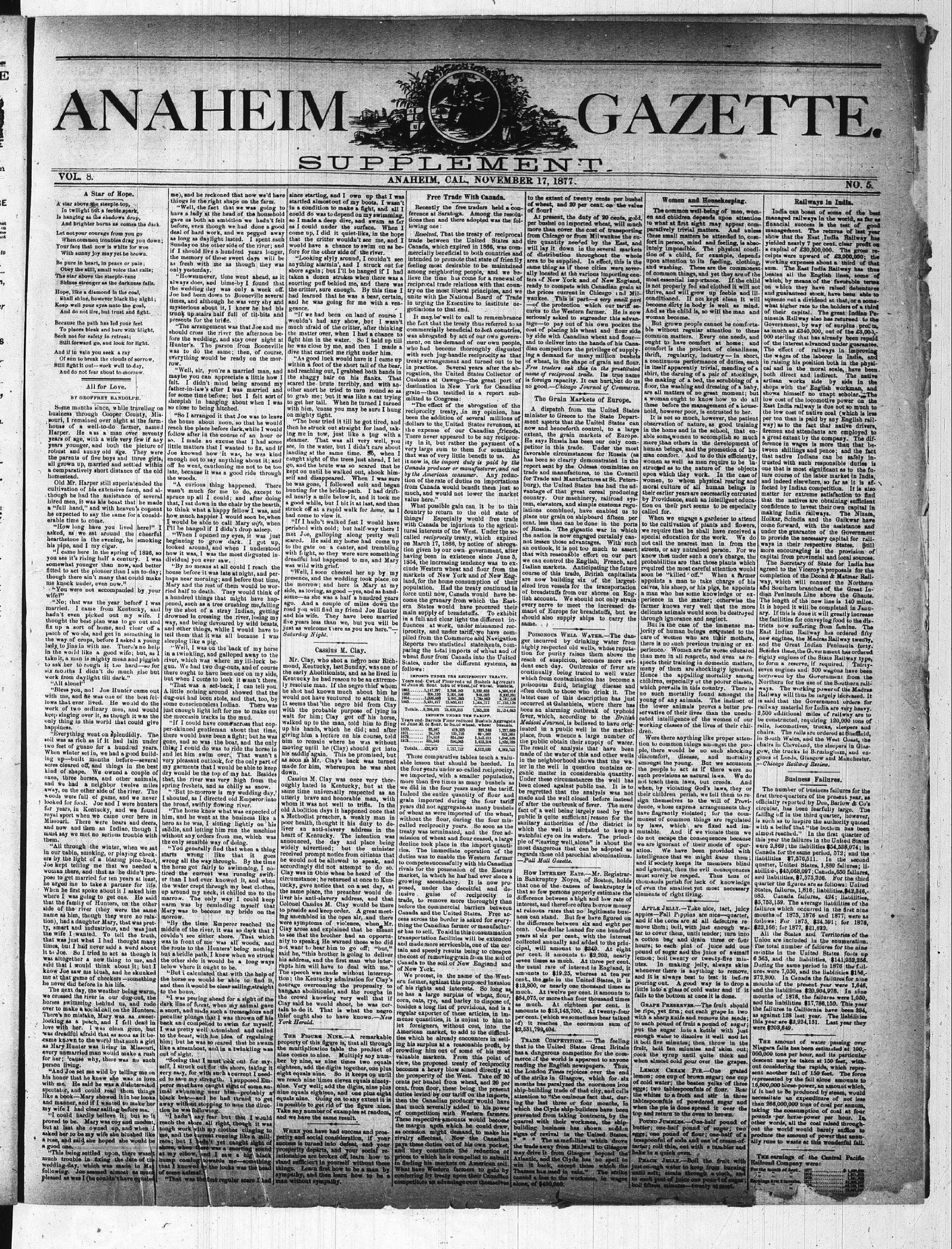
Searchable text
ANAHEIM
VOL. 8.
A Star of Hope.
A star above the steeple-top,
In twilight but a feeble spark,
Is hanging as the shadows drop,
And brighter burns as comes the dark.
Let not your courage from you go
When common troubles drag you down;
Your face that now is white for woe
With sunny joy may yet be brown.
Be pure in heart, in peace or pain;
Obey the still, small voice that calls;
The star above the steeple-vane
Shines stronger as the darkness falls.
Hope, like a diamond in the coal,
Shall shine, however black the night;
Keep well your eyes unto the goal,
And do not tire, but trust and fight.
Because the path has led your feet
To places bleak and bare with blight,
Seek not for safety in retreat;
Still forward go, and look for light.
And if in vain you seek a ray
Of sun to break the clouds of sorrow,
Still fight it out—work well to-day,
And do not fear about to-morrow.
All for Love.
BY GEOFFREY RANDOLPH.
Some months since, while traveling on business through Cooper County, Missouri, I remained over night at the farm-house of a well-to-do farmer, named Harper. He was a man over seventy years of age, with a wife very few if any years younger, and both the picture of robust and sunny old age. They were the parents of five boys and three girls, all grown up, married and settled within me), and he reckoned that now we'd have things in the right shape on the farm.
"Well, the fact that we was going to have a lady at the head of the household gave us both an ambition we hadn't felt before, even though we had done a good deal of hard work, and we pegged away as long as daylight lasted. I spent each Sunday on the other side of the river; and if I should live a hundred years longer, the memory of those sweet days will be as fresh with me as though they was only yesterday.
"Howsumever, time went ahead, as it always does, and bime-by I found that the wedding day was only a week off. Joe had been down to Booneville several times, and although he was very shy and mysterious about it, I knew he had his trunk up stairs half full of tit-bits and presents for the bride.
"The arrangement was that Joe and me should cross the river the afternoon before the wedding, and stay over night at Hunter's. The parson from Booneville was to do the same; then, of course, everything would be ready on the morrow.
"Well, sir, you're a married man, and maybe you can appreciate a little how I felt. I didn't mind being around my father-in-law's after I was married and for some time before; but I felt sort of sheepish in hanging about when I was so close to being hitched.
"So I arranged it that Joe was to leave the house about noon, so that he would reach the place before dark, while I would follow after in the course of an hour or so. I made an excuse that I had some little matters that I wanted to fix, and if Joe knowed how it was, he was kind enough not to say anything about it; and off he went caviating me."
since starting, and I owed startled almost out of me in a condition to make so I made a deep dive, as I could under the air come up, I did it quietly that the critter would have a chance to fore for the other side of it.
"Looking slyly around anything alarmin', and shore again; but I'll be taken a dozen strokes snorting puff behind me the critter, sure enough. Had learned that he was and he was going for geance.
"If we had been on wouldn't had any show much afraid of the critter matter over, when I fight him in the water. He was close by me, and dive that carried me right.
"As good luck would lie within a foot of the shore and reaching out, I grabbed the shaggy hair on his scared the brute terrible other snort he tried to to grab me; but it was to get her tail. When he with him,'cause you may on mighty tight.
"The bear tried it till then he struck out straight ing me in tow, just like steamer. That was all see, in the water, but I landed at the same time caught sight of the trees go, and the brute was."
All for Love.
BY GEOFFREY RANDOLPH.
Some months since, while traveling on business through Cooper County, Missouri, I remained over night at the farmhouse of a well-to-do farmer, named Harper. He was a man over seventy years of age, with a wife very few if any years younger, and both the picture of robust and sunny old age. They were the parents of five boys and three girls, all grown up, married and settled within a comparatively short distance of the old homestead.
Old Mr. Harper still superintended the cultivation of his extensive farm, and although he had the assistance of several hired men, it was his boast that he made a "full hand," and with heaven's consent he expected to say the same for a considerable time to come.
"How long have you lived here?" I asked, as we sat around the cheerful hearthstone in the evening, he smoking his pipe, and I my cigar.
"I came here in the spring of 1826, so you see it's rising half a century. I was somewhat younger than now, and better fitted to act the pioneer than I am to-day; though there ain't many that could make me knock under, even now."
"You were not accompanied by your wife?"
"No; that was the year before I was married. I came from Kentucky, and hadn't even picked out my wife. I thought the best plan was to go out and fix up a sort of home, and clear off a patch of woods, and get in something in the way of crops, before I asked a young lady to jine in with me. There's no help in the world like a good wife; but, as I take it, a man is mighty mean and piggish to ask her to rough it too hard—so for six months I didn't do much else but work from daylight till dark."
"All alone?"
"Bless you, no! Joe Hunter came out with me, and he was one of the best fellows that ever lived. He would do the work of two ordinary men, and would keep singing over it, as though it was the only thing in this world that could give happiness.
Everything went on splendidly. The soil was as rich as if it had lain under two feet of guano for a hundred years. When winter set in, we had a good building up—built months before—several acres cleared off, and things in the best kind of shape. We owned a couple of oxen, three horses, and other animals, and we had a neighbor twelve miles away, on the other side of the river. The woods were full of game, and we never looked for food. Joe and I were hunters for years, in Kentucky, and we found royal sport when we came over here in Missouri. There were bears and deer, and now and then an Indian, though I must say we met no serious trouble with them.
"All through the winter, when we sat in our cabin, smoking, or playing checkers by the light of a blazing pine-knot, Joe kept telling me that we needed a woman there, and that as he didn't propose to get married for ten years at least,
"Well, sir, you're a married man, and maybe you can appreciate a little how I felt. I didn't mind being around my father-in-law's after I was married and for some time before; but I felt sort of sheepish in hanging about when I was so close to being hitched.
"So I arranged it that Joe was to leave the house about noon, so that he would reach the place before dark, while I would follow after in the course of an hour or so. I made an excuse that I had some little matters that I wanted to fix, and if Joe knowed how it was, he was kind enough not to say anything about it; and off he went, cautioning me not to be too late, because it was a good ride through the woods.
"A curious thing happened. There wasn't much for me to do, except to spruce up all I could; and after doing that, I sat down in the chair by the hearth, to think what a happy fellow I was, and how much happier I would soon be, when I would be able to call Mary wife, when I'll be hanged if I didn't drop asleep.
"When I opened my eyes, it was just beginning to grow dark. I got up, looked around, and when I understood how it was, I was the most disgusted individual you ever saw.
"By no means at all could I reach the house before it was late at night, and perhaps near morning; and before that time, Mary and the rest of them would be worried half to death. They would think of a hundred things that might have happened, such as a tree crushing me falling by the shot of a stray Indian, getting drowned in crossing the river, losing my way, and being devoured by wild beasts, and other things, while I would have to tell them that it was all because I was sleeping like a pig.
"Well, I was on the back of my horse in a twinkling, and galloped away to the river, which was where my ill-luck began. We had two dug-outs, and of course there ought to have been one on my side, but when I come to look it wasn't there.
"That was a set-back, I can tell you. A little noising around showed that the dug-out had been stole, and that, too, by some conscienceless Indian. There was just enough light left for me to make out the moccasin tracks in the mud.
"If I could have come across that copper-skinned gentleman about that time, there would have been a fight; but he was gone, and so was the boat, and the only thing I could do was to ride the horse in and let him swim over. That wasn't a very pleasant outlook, for the only part of my garments that I would be able to keep dry would be the top of my hat. Besides that, the river was very high from the spring freshets, and as chilly as snow.
"But to-morrow is my wedding day,' I shouted, as I directed old Emperor into the broad, swiftly flowing river.
"The horse knew what was expected of him, and he went at the business like a hero as he was; I sitting lightly on his saddle, and letting him run the machine without any orders from me, which was the only sensible way of doing.
"You generally find that when a thing starts wrong like that it goes wrong all the way through. By the time the horse got fairly to swimming, I noticed the current was running swifter than I had ever known it, and when reaching out, I grabbed the shaggy hair on his scared the brute terrible other snort he tried to tug grab me; but it was not to get her tail. When he had with him 'cause you may on mighty tight.
"The bear tried it till he then struck out straight ing me in tow, just like steamer. That was all she see, in the water, but I did landing at the same time caught sight of the trees go, and the brute was so kept on until he walked on self and disappeared. Whee he was gone, I followed him hunting for the bridle-pathed nearly a mile below it a good while, but I hit it struck off at a rapid walk had come to view it.
"If I hadn't walked fast perished with cold; but he met Joe, galloping along scared. He said my horse to the gate on a canter; with flight, so they were dreadful had happened to was wild with grief.
"Well, I soon cheered me presence, and the wedding the morrow; and here in side as loving, as good — yome—as she was a half ago. And a couple of me road you will find my friend and his wife. They have five years less than we, but just as welcome there as ye Saturday Night."
and we had a neighbor twelve miles away, on the other side of the river. The woods were full of game, and we never looked for food. Joe and I were hunters for years, in Kentucky, and we found royal sport when we came over here in Missouri. There were bears and deer, and now and then an Indian, though I must say we met no serious trouble with them.
"All through the winter, when we sat in our cabin, smoking, or playing checkers by the light of a blazing pine-knot, Joe kept telling me that we needed a woman there, and that as he didn't propose to get married for ten years at least, he urged me to take a partner for life. When he first spoke about it I asked him where I was going to get one. He said that the family of Hunters, on the other side of the river (they were the same name as him, though they were no relation), had a daughter Mary, that was pretty, smart and industrious, and was just the wife I wanted. To tell the truth, that was just what I had thought many times, but I had never said a word about it to Joe. So I tried to act as though it was altogether a new thing to me, and said that I would think about it; but I know Joe saw me blush, and he skunked me at that game of checkers—something he never did before in his life.
The next day, the weather being warm, we crossed the river in our dug-out, the horses swimming behind us, and rode over to make a social call on the Hunters. There's no mistake, Mary was as sweet-looking as a peach, and I fell dead in love with her. I was clean gone, but was dreadful afraid that as soon as it became known to the world that such a girl as Mary Hunter was living in Missouri, every unmarried man would make a rush for her; 'cause why, there was no such person living.
"And Joe set me wild by telling me on his honor that he knew she was in love with me. He said he was a disinterested spectator, and could read them things like a book—Mary showed it in her looks and manner, and if I wanted to make her my wife I had clear sailing before me.
"I could hardly believe it; but so it proved to be. Mary was coy and modest, but at last she owned up, and when I asked her to be my wife she blushed like a rose, and said she hoped she would be a good one.
"This being settled upon, there wasn't much trouble in fixing the date of the wedding-day, which was made in May following. Joe seemed almost as much pleased as was I (he couldn't have equaled spring freshets, and as chilly as snow.
"But to-morrow is my wedding day," I shouted, as I directed old Emperor into the broad, swiftly flowing river.
"The horse knew what was expected of him, and he went at the business like a hero as he was, sitting lightly on his saddle, and letting him run the machine without any orders from me, which was the only sensible way of doing.
"You generally find that when a thing starts wrong like that it goes wrong all the way through. By the time the horse got fairly to swimming, I noticed the current was running swifter than I had ever known it, and when the water crept through my best clothes, up around my neck, it chilled me to the marrow. The only way I could keep warm was by reminding myself that Mary was to become my bride on the morrow.
"By the time Emperor reached the middle of the river, it was so dark that I couldn't see either shore. That which was in front of me was all woods, and the route to the Hunters' being nothing but a bridle path, I knew when we struck the other side it would be a long ways below where it ought to be.
"But I calculated that with the help of the horse we would be able to find it, and then it would be clear sailing straight to the house.
"I was peering ahead for a sight of the dark line of forest, when my animal gave a snort, and made such a tremendous and peculiar plunge that I was thrown off his back and compelled to swim for myself. I was pretty well astonished and called to the beast, with the idea of regaining him; but he was so scared that he swam like a steambost, and in a twinkling was out of sight.
"Seeing that I must look out for myself, I struck out for the shore, taking it very easy, for with such a current I needed to save my strength. I supposed Emperor must have caught sight of some animal swimming near him—probably a black bear—and he had turned to get away without stopping to note the direction he was following.
"I hadn't any fear but that I would reach the shore all right, though it was tough work with my clothes clinging to me, and the current running like a millrace; but I hadn't yet caught sight of shore, when there was a snorting sound at my elbow, and I saw a big black hump coming towards me—something that I knew by the looks was the head of some animal."
"That was the first regular scar I had roughly hated in Kentucky; same time universally resented utterly brave and honorable whom it was not well to old Abolition days it happened—a Methodist preacher, a poor health health; thought it his liver an anti-slavery aid heart of Kentucky. The announcement, the day and widely advertised; but received prompt notice from he would not be allowed accordingly did not attend Clay was in Ohio when he circumstance; he returned after tucky; gave notice that on the same place, the preacher liver his anti-slavery address Colonel Cassius M. Clay wished to preside and keep order.
ing assembled in the open area were symptoms of violence Clay arose and explained tha to see that the brother had nity to speak. He warned not want to hear him to go said he, "this brother is going his address, and the first man rupts him will have to deal The speech was made with tion; the Kentucky admiration courage overcoming the p hang an abolitionist; and thie crowd knowing very Clay said he would shoot tain to do it. That is what thief ought also to have k York Herald."
IM GAZE
SUPPLEMENT.
ANAHEIM, CAL., NOVEMBER 17, 1877.
since starting, and I own up that I was startled almost out of my boots. I wasn't in a condition to make a fight, and all I could do was to depend on my swimming, so I made a deep dive, and swam as far as I could under the surface. When I come up, I did it quiet-like, in the hope that the critter wouldn't see me, and I would have a chance to swim on as before for the other side of the river.
"Looking slyly around, I couldn't see anything alarmin', and I struck out for shore again; but I'll be hanged if I had taken a dozen strokes when there was a snorting puff behind me, and there was the critter, sure enough. By this time I had learned that he was a bear, certain, and he was going for me with a vengeance.
"If we had been on land of course I wouldn't had any show, but I wasn't much afraid of the critter, after thinking the matter over, when I had a chance to fight him in the water. So I held up till he was close by me, and then I made a dive that carried me right under him.
"As good luck would have it I came up within a foot of the short tail of the bear, and reaching out, I grabbed both hands in the shaggy hair on his flanks. That scared the brute terribly, and with another snort he tried to turn round so as to grab me; but it was like a cat trying to get her tail. When he turned I turned with him,'cause you may be sure I hung on mighty tight.
"The bear tried it till he got tired, and then he struck out straight for land, taking me in tow, just like a tug with a steamer. That was all very well, you see, in the water, but I didn't care about landing at the same time. So, when I caught sight of the trees just ahead, I let go, and the brute was so scared that he
Free Trade With Canada.
Recently the free traders held a conference at Saratoga. Among the resolutions then and there adopted was the following one:
Resolved, That the treaty of reciprocal trade between the United States and Canada, which expired in 1866, was commercially beneficial to both countries and intended to promote that state of friendly feeling most desirable to be maintained among neighboring people, and we believe the time has come for a renewal of reciprocal trade relations with that country on the most liberal principles, and we unite with the National Board of Trade in urging the Executive to institute negotiations to that end.
It may be well to call to remembrance the fact that the treaty thus referred to as commercially beneficial to both countries, was abrogated by act of our own government, on the demand of our own people, who had become thoroughly disgusted with such jug-handle reciprocity as that treaty arrangement and turned out to be in practice. Several years after the abrogation, the United States Collector of Customs at Oswego—the great port of destination in New York for Canadian grain—thus testified in a report submitted to Congress:
"The effect of the abrogation of the reciprocity treaty, in my opinion, has been the addition of several millions of dollars to the United States revenues, at the expense of our Canadian friends. There never appeared to be any reciprocity in it, but rather the payment of a very large sum to them for something that was of very little benefit to us. As it now is, the import duty is paid by the Grain Markets of Europe.
A dispatch from the United States minister to Greece to the State Department asserts that the United States can now and henceforth control, to a large extent, the grain markets of Europe. He says Russia has been our only competitor in this trade. Under the most favorable circumstances for Russia (as has been so clearly demonstrated in the report sent by the Odessa committee."
and reaching out, I grabbed both hands in the shaggy hair on his flanks. That scared the brute terribly, and with another snort he tried to turn round so as to grab me; but it was like a cat trying to get her tail. When he turned I turned with him, 'cause you may be sure I hung on mighty tight.
"The bear tried it till he got tired, and then he struck out straight for land, taking me in tow, just like a tug with a steamer. That was all very well, you see, in the water, but I didn't care about landing at the same time. So, when I caught sight of the trees just ahead, I let go, and the brute was so scared that he kept on until he walked out, shook himself and disappeared. When I was sure he was gone, I followed suit and began hunting for the bridle-path. I had drifted nearly a mile below it, and it took me a good while, but I hit it at last, and then struck off at a rapid walk for home, as I had come to view it.
"If I hadn't walked fast I would have perished with cold; but half-way there I met Joe, galloping along pretty well scared. He said my horse had come up to the gate on a canter, and trembling with flight, so they were sure something dreadful had happened to me, and Mary was wild with grief.
"Well, I soon cheered her up by my presence, and the wedding took place on the morrow; and here is Mary at my side, and loving; and good —yes,and as handsome—as she was a half a hundred years ago. And a couple of miles down the road you will find my friend Joe Hunter and his wife. They have been married five years less than we, but you will be just as welcome there as you are here."—Saturday Night.
Cassius M. Clay.
Mr. Clay, who shot a negro near Richmond, Kentucky, last Sunday, was one of the early Abolitionists, and as he lived in Kentucky he had reason to be an extremely resolute man. If the negro thief whom he shot had known much about him he would not have ventured to attack him. It seems that the negro bid from Clay with the probable purpose of lying in wait for him; Clay got off his horse, walked up to the man, told him to fling up his hands, which he did; and after giving him a lecture on his course, told him to remain where he was without moving until he (Clay) should get into his saddle again. This he promised, but as soon as Mr. Clay's back was turned made for him, whereupon he was shot down.
Cassius M. Clay was once very thoroughly hated in Kentucky, but at the same time universally respected as an utterly brave and honorable man, with whom it was not well to trifle. In the old Abolition days it happened once that a Methodist preacher, a weakly man in poor health, thought it his duty to deliver an anti-slavery address in the heart of Kentucky. The intention was announced, the day and place being widely advertised; but the minister received prompt notice from citizens that he would not be allowed to speak, and accordingly did not attempt to do so. Clay was in Ohio when he heard of the circumstance; he returned at once to Ken-
Several years after the abrogation, the United States Collector of Customs at Oswego—the great port destination in New York for Canadian grain—thus testified in a report submitted to Congress:
"The effect of the abrogation of the reciprocity treaty, in my opinion, has been the addition of several millions of dollars to the United States revenues, at the expense of our Canadian friends. There never appeared to be any reciprocity in it, but rather the payment of a very large sum to them for something that was of very little benefit to us. As it now is, the import duty is paid by the Canada producer or manufacturer, and not by the American consumer. Any reduction of the rate of duties on importations from Canada would benefit them just so much, and would not lower the market value here."
What possible gain can it be to this country to return to the old state of things? Especially would free trade with Canada be injurious to the agricultural interests of the West. Under the so-called reciprocity treaty, which expired on March 17, 1866, by notice of abrogation given by our own government, after having been in existence since June 5, 1854, the increasing tendency was to exclude Western wheat and flour from the markets of New York and of New England, for the home consumption of their population. Had the treaty continued in force until now, Canada would have become the granary from which the Eastern States would have procured their main supply of breadstuffs. To exhibit in a full and clear light the different influences at work, under misnamed reciprocity, and under tariff, we have compiled from the Commerce and Navigation Reports two statistical statements, comparing the total imports of wheat and of wheat flour from Canada into the United States, under the different systems, as follows:
IMPORTS UNDER THE RECIPROCITY TREATY.
Years end: Carrie Flour reduced Bushels Aggregate ed June 30. hour: ton of wheat(of wheat bushels).
1862: 1,147,297 3,346,283 3,220,633 6,566,916
1863: 806,199 2,301,296 919,053 3,300,391
1864: 1,008,198 2,941,296 1,790,563 4,782,391
1865: 5,431,477 1850,411 1,304,171 17,155,128
Totals: 3,398,831 24,439,335 7345,208 3154663
These comparative tables teach a valuable lesson that should be heeded. In the four years under so-called reciprocity, we imported, with a smaller population, more than five times as many bushels as we did in the four years under the tariff. Indeed the entire quantity of flour and grain imported during the four tariff years did not aggregate as many bushels of wheat as were imported of the wheat without the flour during the four miscalled reciprocity years. So soon as the treaty was terminated, and the free admission of wheat and flour ceased,a large decline took place in the import quantities. The immediate operation of the duties was to enable the Western farmer to compete successfully with his Canadian rivals for the possession of the Eastern market,在whichhehashad eversincea growing ascendance.
Free traders ask thus in the prostituted name of reciprocal trade. Its true name is foreign rapacity.It can hurtbutdo us no good.-Chicago Journal of Commerce.
The Grain Markets of Europe.
A dispatch from the United States minister to Greece to the State Department asserts that the United States can now and henceforth control,tothe large extent,the grain markets of Europe.He says Russia has been our only competitor in this trade.Underthe most favorable circumstances for Russia(as has been so clearly demonstratedinthe report sentbytheOdessa committee on trade and manufactures,the Council for Trade and Manufacturesat St.Petersburg),theUnitedStateshashadtheadvantageofthatgreatcerealproducingcountry.Ourmachinery,railroad system,elevators,andsimplecustom regulations combined,haveenabledustoparegulargrainonshipboardfifteenpercent.lessthancanbe doneintheportsofRussia.Thegiganticwarinwhichthenationisnowengagedcertainly cannotlessenthoseadvantages.Withsuchanoutlook.itisnottomuchtoassertthatwithreasonableeffortonourpartwecancontroltheEnglish,French,andItalianmarkets.Anticipatingthefuturecourseofthistrade,Britishcapitalistsarenowbuilding sixofthelargest-sizediron vesselsforthetransportationofbreadstuffsfromoureshoresonEnglishaccount.Weshouldnotonly straineverynervetomeettheincreaseddemandofEuropeford breadstuffs,但weshouldalsosupplyshipstocarrythesame.
Poisonous Well Water.-The danger incurred by drinking water from highlyrespectedoldwellswhoreputationforpurityraisesthemabovethereachofsuspicion,becomesmoreevidenteachday.Outbreaksoffeverarecontinuallybeingtracedtowellwaterwhichfromcontaminationhasbecomeapoisonousfluid,bringingdiseaseandoffenth deathto thosewhodrinkit.ThelatestcaseofthisdescriptionhasjustoccurredatGalashielswheretherebeanalarmingoutbreaktyphoidfeverwhichaccordingtotheBritishMedicalJournal.isbelievedtohaveoriginatedinapublicwellinthemarketplace.fromwhencealargenumberofthepublicobtainthesupplyofwater.Theresultofanalysisthathavebeenmadeofthewaterofthisandotherwellsinthenearhoodshowsthattheraterinthewellinquestioncontainsorganicmatterinconsiderablequantity.Underthesecircumstancesthewellhasbeenclosedagainstpublicuse.Iitistobetregrettedthattheanalysiswasnotmadeandthewellclosedbeforeinstadefaftertheoutbreakoffever.Themerefactofawellbeinglargelyusedbythepublicisquitesufficientreasonforthesanitaryauthoritiesofthedistrictinwhichthewellis situatedtokeepawatchfuleyeonitswaters.Theprincipleof“leavingwellalone”isaboutthemost dangerousthatcanbeadoptasregards theseoldparochialabominations.-Pull Mall Gazette.
How Interest Eats.-Mr.RegistrarinBankruptcyNoyes.ofBostonholdsinthe intelligencetreatmentandignorant,must surelybeintroducedintheworkcliend.
Written on September 20th at 10:00am
The Figure Nine.—A remarkable property of this figure is that all through the multiplication table the product of nine comes to nine. Multiply any number by nine, as nine times two equals eighteen, add the digits together, one plus eight equals nine. So it keeps on until we reach nine times eleven equals ninety-nine. Very well; add the digits, nine plus nine equals eighteen, and one plus eight equals nine. Going on to any extent it is impossible to get rid of the figure nine. Take any number of examples at random, and we have the same result.
When you have had success and prosperity and social consideration, if your success is turned into defeat, and your prosperity departs, and your social relationships are broken off, learn how to stand sufficient in yourself without these things. Learn first how to be a man by sympathy, and then learn how to be a man without sympathy.
Indeed the entire quantity of flour and grain imported during the four tariff years did not aggregate as many bushels of wheat as were imported of the wheat, without the flour, during the four miscalled reciprocity years. So soon as the treaty was terminated, and the free admission of wheat and flour ceased, a large decline took place in the import quantities. The immediate operation of the duties was to enable the Western farmer to compete successfully with his Canadian rivals for the possession of the Eastern market, in which he has had ever since a growing ascendancy. It is now proposed, under the deceitful and delusive guise of reciprocity in trade, to remove more thoroughly than before the commercial barriers between Canada and the United States. Free access across the border is asked for everything the Canadian farmer or manufacturer has to sell. To aid in this consummation transportation facilities will be extended and made more serviceable, one of the certain and speedy results being to cheapen the cost of removing grain from the soil of Canada to the soil of New England and of New York.
We protest, in the name of the Western farmer, against this proposed invasion of his rights and interests. So long as he has a large surplus of wheat, flour, corn, oats, rye, and barley to dispose of, besides a long list of provisions, and is a regular exporter of these articles, in immense quantities, it is unjust to him to let foreigners, without cost, into the American market, to add to the difficulties which he already encounters in selling his surplus at a reasonable profit, by crowding him out of some of his most valuable markets. From this point of view, the proposed treaty of reciprocity becomes a heavy blow aimed directly at the prosperity of the West. Take off 20 cents per bushel from wheat, and 20 per cent from flour, these being the present duties levied by our tariff on the imports, then the Canadian producer would have that much severally added to his power of competition with Western farmers. These respective amounts would become the margin upon which he could draw, as occasion might demand, to make his rivalry effectual. Now the Canadian pays these duties out of his own pocket, and they constitute the reduction of prices to which he is compelled to submit in finding his markets on American soil. What have Western farmers to gain by conferring by treaty upon their Canadian competitors an advantage over themselves we did in the four years under the tariff. Indeed the entire quantity of flour and grain imported during the four tariff years did not aggregate as many bushels of wheat as were imported of the wheat, without the flour, during the four miscalled reciprocity years. So soon as the treaty was terminated, and the free admission of wheat and flour ceased, a large decline took place in the import quantities. The immediate operation of the duties was to enable the Western farmer to compete successfully with his Canadian rivals for the possession of the Eastern market, in which he has had ever since a growing ascendancy. It is now proposed, under the deceitful and delusive guise of reciprocity in trade, to remove more thoroughly than before the commercial barriers between Canada and the United States. Free access across the border is asked for everything the Canadian farmer or manufacturer has to sell. To aid in this consummation transportation facilities will be extended and made more serviceable, one of the certain and speedy results being to cheapen the cost of removing grain from the soil of Canada to the soil of New England and of New York.
We protest, in the name of the Western farmer, against this proposed invasion of his rights and interests. So long as he has a large surplus of wheat, flour, corn, oats, rye, and barley to dispose of, besides a long list of provisions, and is a regular exporter of these articles, in immense quantities, it is unjust to him to let foreigners, without cost, into the American market, to add to the difficulties which he already encounters in selling his surplus at a reasonable profit, by crowding him out of some of his most valuable markets. From this point of view, the proposed treaty of reciprocity becomes a heavy blow aimed directly at the prosperity of the West. Take off 20 cents per bushel from wheat, and 20 per cent from flour, these being the present duties levied by our tariff on the imports, then the Canadian producer would have that much severally added to his power of competition with Western farmers. These respective amounts would become the margin upon which he could draw, as occasion might demand, to make his rivalry effectual. Now the Canadian pays these duties out of his own pocket, and they constitute the reduction of prices to which he is compelled to submit in finding his markets on American soil. What have Western farmers to gain by conferring by treaty upon their Canadian competitors an advantage over themselves we did in the four years under the tariff. Indeed the entire quantity of flour and grain imported during the four tariff years did not aggregate as many bushels of wheat as were imported of the wheat, without the flour, during the four miscalled reciprocity years. So soon as the treaty was terminated, and the free admission of wheat and flour ceased, a large decline took place in the import quantities. The immediate operation of the duties was to enable the Western farmer to compete successfully with his Canadian rivals for the possession of the Eastern market, in which he has had ever since a growing ascendancy. It is now proposed, under the deceitful and delusive guise of reciprocity in trade, to remove more thoroughly than before the commercial barriers between Canada and the United States. Free access across the border is asked for everythingthe Canadian farmer or manufacturer has to sell.To aid in this consummation transportation facilities will be extended and made more serviceable oneofthecertainandspeedyresultsbeingtocheapenethecostofremovinggrainfromthesoilofCanadatothesoilofNewEnglandandofNewYork.
How Interest Eats.—Mr. Registrar in Bankruptcy Noyes, of Boston, holds that one ofthecausesofbankruptcyisthatsofewpersonsproperlyestimatethedifferencebetweenahighandlowrateofinterest,andthereforeoftenborrowmoneyatruinousratesthatnolegitimatebusinesscanstand.Butfewhavefiguredonthedifferencebetweensixandeightpercent.One dollarloanforonehundredyearsat sixpercent.withtheinterestcollectedannuallyandaddedtotheprincipalwillamountto$340.At eightpercent.itamountsto$2,203,nearlyseventimesasmuch.Atthreepercent.theusualrateofinterestinEngland.itamountsto$19.25 whereasattenpercent,therateintheUnitedStates.itis$13,800ornearlyone thousandtimesasmuch.Attwelvepercent.itamountsto$84,075.ormorethanfourthousandtimesasmuch.Ateighteenpercent.itamountsto$15,145,700.(whichwesometimeshear talkedof)itreachestheenormoussumof$2,551,799,404.
Trade Competition.—The feeling thatintheUnitedStatesGreatBritainhasadangerouscompetitorforthecommerceoftheworldisapparenttoanyonereadingtheEnglishnewspapers.TheLondonTimesjoicesovertheendofthestrikeinGlasgowwhichfor sixmonthshasparalyzedtheenormousironship-buildingtradeofthatcity,andcallscattentionto"theominousfactthat,duringthelastthreeorfourmonths.inwhichtheClydeship-buildershavebeenpreventedfromtakingcontractsbythequarrelwiththeirworkmen,theship-buildingbusinesshassoundsignsofrevivalintheUnitedStates.*ThesamefollieswhichdrovethetradeawayfromMillwalltoGlasgowmaydriveitfromGlasgowbeyondtheAtlantic,andtheClydehasno spelltowinitbackexceptthosewhichtheThameshasusedin vain."Thestrikecausedalosstotheworkmen.inwagesalone.of$400,000.
Apple Jelly apples—Fallandifthenmove them;tertertocovertheacute cottonbaghours;tocouplepoundofsugerlemon;boilthreats.Inm whenever thereanditisalwayspouringout.littleintoagretsfallstotheboil.
Grape Prices be ripe,yetfinishwithasharpknocktoeachpoundputthesugarenoughwateritboilfiveminifruit,boolten cookthesyrupwhenalmostcook.
Apple Jelly just enough water;stricttoeachpistoffoilfifteenmini
GAZETTE.
NO. 5.
Women and Housekeeping.
The common well-being of men, women and children depends upon attention to what at first sight may appear comparatively trivial matters. And unless these small matters be attended to, comfort in person, mind and feeling, is absolutely impossible. The physical condition of a child, for example, depends upon attention to its feeding, clothing, and washing. These are the commonest of common things, and yet they are of the most essential importance. If the child is not properly fed and clothed it will not thrive, and will grow up feeble and ill-conditioned. If not kept clean it will become dirty in body is well as mind. And as the child is, so will the man and woman become.
But grown people cannot be comfortable without regular attention to these common matters. Every one needs, and ought to have comfort at home; and comfort is the product of cleanliness, thrift, regularity, industry—in short, a continuous performance of duties, each in itself apparently trivial, mending of a shirt, the darning of a pair of stockings, the making of a bed, the scrubbing of a floor, the washing and dressing of a baby, are all matters of no great moment; but a woman ought to know how to do all these before the management of a household, however poor, is entrusted to her.
It is not so much, however, the patient observation of nature, as good training in the home and in the school, that enable some women to accomplish so much more than others in the development of human beings, and the promotion of human comfort. And to do this efficiently, women as well as men require to be In-
Railways in India.
India can boast of some of the best managed railways in the world, as far as financial success is the test of good management. The returns of last year show that the East India Railway has yielded nearly 7 per cent clear profit on a capital of £30,500,000. The gross receipts were upward of £3,000,000; the working expenses about a third of that sum. The East India Railway has thus beaten all the English lines, some of which, by means of the favorable terms on which they have raised debentures and guaranteed stock, have been able to squeeze out a dividend at that, or a somewhat higher rate to the holders of a third of their capital. The great Indian Peninsula Railway also has returned to the Government, by way of surplus profits, as much as £340,000, out of the £3,000,000 sterling that has already been repaid of the interest advanced under guarantee. The effect of railways in improving the wages of the laborer in India, and in raising his position both in the physical and in the moral scale, have been both direct and indirect. The native artisan works side by side in the shops with the English workman, and shows himself no unapt scholar. The low cost of the locomotive power on the East India railway is due not so much to the low cost of native coal (which is less per ton than is paid by any English railway) as to the fact that native drivers, firemen and attendants are employed to a great extent by the company. The difference in wages is more than that between shillings and pence; and the fact that native Indians can be safely intrusted with such responsible duties is
United States State Department stated States can control to a large extent of Europe. Our only commander the most for Russia (as illustrated in the committee on the Council at St. Petersburg had the adverse producing railroad systems customs regulations enabled us to ward fifteen per cent in the ports war in which certainly can be such to assert on our part French, and putting the future Irish capitalists of the largest transportation moors on England not only strain increased destuffs, but we will carry the water.
The damming water from whose reputation above the moors more evils of fever are so well water has become a disease and drink it. The situation has just there there has lack of typhoid the British to have originated the market number of people of water that the waits contains orrible quantity. The well has cause. It is to thesis was not before instead far. The mere caused by the reason for the district in and to keep a The principle about the adopted as abominations.
Registrar Boston, holds
It is not so much, however, the patient observation of nature, as good training in the home and in the school, that enable some women to accomplish so much more than others in the development of human beings, and the promotion of human comfort. And to do this efficiently, women as well as men require to be instructed as to the nature of the objects upon which they work. In the case of women, to whom physical rearing and moral culture of all human beings in their earlier years are necessarily entrusted by Providence, such an intelligent education on their part seems to be especially called for.
When we engage a gardener to attend to the cultivation of plants and flowers, we require that he shall have received a special education for the work. We do not call the nearest man in from the streets, or any untrained person. For we know that under such a one's charge, the probabilities are that those plants which required the most careful attention would soon be "killed off." When a farmer appoints a man to take charge of his calves, his sheep, or his pigs, he appoints a man who has some knowledge or experience in the matter; otherwise the farmer knows very well that the more delicate animals would soon be destroyed through ignorance and neglect.
But is the case of the immense majority of human beings entrusted to the care of women who are their mothers, there is no such previous training or experience. Women are far worse educated than men in all respects, and even as respects their training in domestic matters, many of them are shockingly ignorant. Hence the appalling mortality among children, especially of the poorer classes, which prevails in this country. There is no such mortality found amongst the young of any animals. The instinct of the lower animals proves a better preservative of their lives than the uneducated intelligence of the women of our working classes of the lives of their children.
Were there anything like proper attention to common things amongst the people, there would be no such shocking discomfort, disease, and mortality amongst the young. But we accustom the people to act as if there were no such provisions as natural laws. We do not teach them laws, but creeds. And when, by violating God's laws, they or their children perish, we tell them to resign themselves to the will of Providence, whose express arrangements they have flagrantly violated; for the commonest of common things are regulated by laws, which are fixed and immutable. And if we violate them we do not escape the consequences because we are ignorant of their mode of operation. We have been provided with intelligence that we might know them; and if society keeps its members blind and ignorant, then the evil consequences must surely be reaped. Thus tens of thousands perish for lack of knowledge
The number of business failures for the first three-quarters of the present year, as officially reported by Den Barlow & Co's circular, has been fearfully large. The falling off in the third quarter, however, is such as to inspire the authority quoted with a belief that "the bottom has been almost reached." In the first quarter of this year the failures in the United States were 2,869; the liabilities $54,538,074; in Canada for the same period, 572; and the liabilities $7,576,511. In the second quarter, United States, 1,880 failures; liabilities $45,068,097; Canada, 650 failures; and liabilities $7,575,326. For the third quarter...
It is to
thesis was not
before instead
The mere
used by the
reason for the
district in
and to keep a
The principle
is about the
adopted as
abominations.
RegistrarBoston, holds
bankruptcy is
estimate the
low rate of
borrow money
estimate business figured on
eight per
one hundred
the interest
to the prinAt eight
203, nearly
three per cent.
England, it
at ten per
States, it is
and times as
amounts to
thousand times
per cent. It
twenty-four hear talked
busy sum of
Apple Jelly.—Take nice, tart, juicy apples—Fall Pippins are nice—quarter,
and if the cores are at all defective remove them; boil, with just enough water to cover them, until tender; turn into a cotton bag and drain three or four hours; to each pint of juice add one pound of sugar and the juice of a small lemon; boil twenty or twenty-five minutes. In making jelly, always skim whenever there is anything to remove, and it is always best to test it before pouring out. A good way is to drop a little into a glass of cold water and if it falls to the bottom at once it is done.
Grape Preserves.—The fruit should be ripe, yet firm; cut each grape in two with a sharp knife and remove the seeds; to each pound of fruit a pound of sugar; put the sugar into a kettle with just enough water to dissolve it well and let it boil five minutes; then throw in the fruit, boil ten minutes and skim out; cook the syrup until quite thick and when almost cold pour over the grapes.
Lemon Cream Pie.—One grated lemon; one cup of brown sugar; one cup of cold water; the beaten yolks of three eggs; two tablespoonfuls of flour. Beat the whites to a froth and stir in three tablespoonfuls of powdered sugar and when the pie is done spread it over the top and return to the oven to brown.
Pound Jumboes.—One-half pound of butter; one-half pound of sugar; two eggs; one pound of flour; one-half of a teaspoonful of soda and one of cream-of-tartar; roll thin, cut with a tumbler and bake in a quick oven.
Peach Jelly.—Boil the fruit with just enough water to keep from burning until soft; strain through a cloth, and to each pint of juice one pound of sugar; boil fifteen minutes—twenty at most.
The number of business failures for the first three-quarters of the present year, as officially reported by Den, Barlow & Co's circular, has been fearfully large. The falling off in the third quarter, however, is such as to inspire the authority quoted with a belief that "the bottom has been almost reached." In the first quarter of this year the failures in the United States were 2,869; the liabilities $54,538,074; in Canada for the same period, 572; and the liabilities $7,576,511. In the second quarter, United States, 1,880 failures; liabilities $45,068,097; Canada, 650 failures; and liabilities $7,575,326. For the third quarter the figures are as follows: United States, failures 1,816; liabilities $42,846,-085. Canada failures, 424; liabilities $5,753,159. The average liabilities of the failures which occurred in the first nine months of 1875, 1876 and 1877, were as follows: For 1875, $24.591; for 1876,$22.166; for 1877,$21.622.
All the States and Territories of the Union are included in the enumeration. The total number of failures for the nine months in the United States foots up 6,565, and the liabilities, $141,952,256. During the same period in 1876 the failures were 7,050, and the liabilities $156,-272,800. In Canada the failures for nine months of the present year were 1,646, and the liabilities $20,904,976. In nine months of 1876, the failures were 1,050, and the liabilities $17,786,150. This year the failures in California have been 224, as against 128 last year. The liabilities this year are $2,224,151. Last year they were $203,649.
The amount of water passing over Niagara falls has been estimated at 100,-000,000 tons per hour, and its particular descent may be taken at 150 feet without considering the rapids which represent another fall of 150 feet. The force represented by the fall alone amounts to 16,800,000 horse-power, an amount which if it had to be produced by steam would necessitate an expenditure of not less than 266,000,000 tons of coal per annum, taking the consumption of coal at four pounds per horse-power per hour. In other words, all the coal raised throughout the world would barely suffice to produce the amount of power that annually runs to waste at this wonderful fall.
The earnings of the Central Pacific Railroad Company were:
For the month of June 1877...