anaheim-gazette 1877-11-10
Scanned page
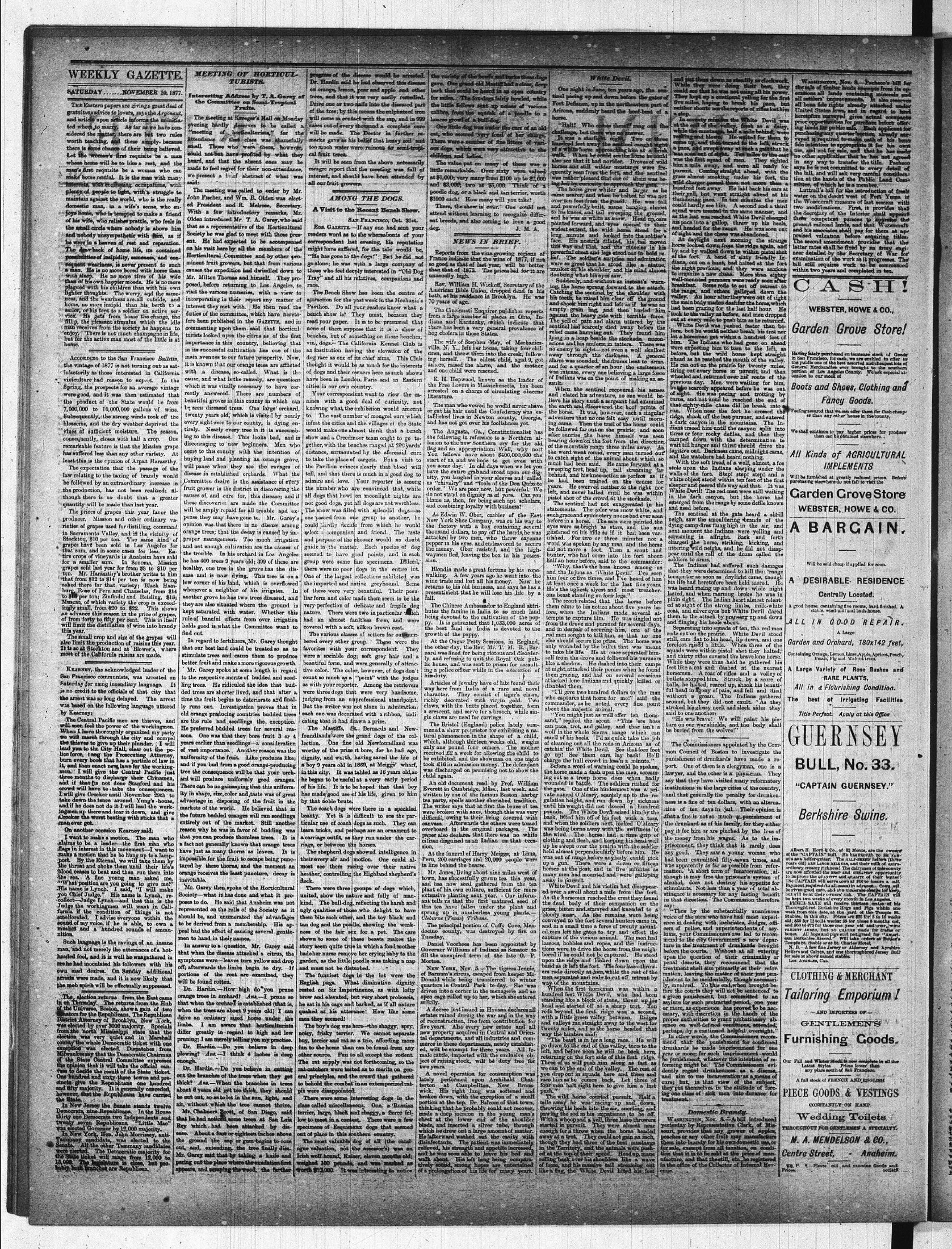
Searchable text
WEEKLY GAZETTE
SATURDAY... NOVEMBER 10, 1877.
The Eastern papers are giving a great deal of gratuitous advice to lovers, says the Argonaut, and article upon article informs the uninitiated whom so marry. As far as we have considered the matter, there are but two rules worth teaching, and these simply because there is some chance of their being believed. Let the woman's first requisite be a man whose home will be to him a rest, and the man's first requisite be a woman who can make home restful. It is the man with many interests, with including occupations, with plenty of people to fight, with a struggle to maintain against the world, who is the really domestic man, in a wife's sense, who enjoys home, who is tempted to make a friend of his wife, who relishes prattle, who feels in the small circle where nobody is above him and nobody unsympathetic with him, as if he were in a heaven of rest and reparation. The drawback of home life, its contained possibilities of insipidity, sameness, and consequent weariness, is never present to such a man. He is no more bored with home than with sleep. He no more tires of his wife than of his own happier moods. He is no more plagued with his children than with his own lighter thoughts. The worry, and the sameness, and the weariness are all outside, and home, no more insipid than his berth to a sailor, or his tent to a soldier on active service. He gets from home the change, the fillip, the pleasant stimulus which the idle man receives from the society he happens to enjoy. There is not much champagne in life, but for the active man most of the little is at home.
According to the San Francisco Bulletin, the vintage of 1877 is not turning out as satisfactorily as those interested in California viniculture had reason to expect. In the Spring, the prospects for an average vintage were good, and it was then estimated that the product of the State would be from 7,000,000 to 10,000,000 gallons of wine. Subsequently, the strong winds took off the blossoms, and the dry weather deprived the vines of sufficient moisture. The season, consequently, closes with half a crop. One remarkable feature is that the Mission grape has suffered less than any other variety. At least this is the opinion of Arpad Haraszty.
MEETING OF HORTICULTURISTS
Interesting Address by T. A. Garey of the Committee on Semi-Tropical Fruits.
The meeting at Kroeger's Hall on Monday evening hardly deserves to be called a "meeting of horticulturists," for the attendance of this class was shamefully small. Those who were there, however, could not but have profited by what they heard, and that the absent ones may be made to feel regret for their non-attendance, we present a brief abstract of what was said:
The meeting was called to order by Mr. John Fischer, and Wm. R. Olden was elected President and R. Melrose, Secretary. With a few introductory remarks, Mr. Olden introduced Mr. T. A. Garey, who said that as a representative of the Horticultural Society he was glad to meet with those present. He had expected to be accompanied on his visit here by all the members of the Horticultural Committee and by other prominent fruit growers, but that from various causes the expedition had dwindled down to Mr. Milton Thomas and himself. They proposed, before returning to Los Angeles, to visit the various nurseries, with a view to incorporating in their report any matter of interest they met with. He then read the duties of the committee, which have heretofore been published in the Gazette, and in commenting upon them said that horticulturists looked upon the citrus as of the first importance in this country, believing that in its successful cultivation lies one of the main avenues to our future prosperity. Now, it is known that our orange trees are afflicted with a disease, so-called. What is the cause, and what is the remedy, are questions which it was vitally necessary to have correctly answered. There are numbers of beautiful groves in this county in which can be seen diseased trees. One large orchard, twenty years old, which is visited by nearly every sight-seer to our county, is dying entirely. Nearly every tree in it is succumbing to this disease. This looks bad, and is discouraging to new beginners. Men who come to this county with the intention of buying land and planting an orange grove, will raise when they are the progress of the day.
Dr. Hardin said he on orange lemon trees, and that it Drive one or two of the tree; by this will come in certain cases out of every will be made. The marks gave as his too much water will cal fruit trees.
It will be seen meagre report that interest, and show all our fruit growers.
AMONG
A Visit to the SA
EDS. GAZETTE—readers word as to correspondent last might have suffered "He has gone to this go alone; he was those who feel deep Tray" and all his race.
The Bench Show attraction for the pavilion. Do all your bench show is? Read your paper.
None of them supply benches, but of some viz., dogs—The Cau institution having dog race as one of its thought it would be of dogs and their own been in London cities in our own co.
Your correspondence nines with a good knowing what the etc.
The vast number infest the cities and would make one ally show and a Creedm gether, with the best distance, surmountable to take the place of
infactorily as those interested in California vinification had reason to expect. In the Spring, the prospects for an average vintage were good, and it was then estimated that the product of the State would be from 7,000,000 to 10,000,000 gallons of wine. Subsequently, the strong winds took off the blossoms, and the dry weather deprived the vines of sufficient moisture. The season, consequently, closes with half a crop. One remarkable feature is that the Mission grape has suffered less than any other variety. At least this is the opinion of Arpad Haraszthy.
The expectation that the passage of the law relating to the taxing of brandy would be followed by an extraordinary increase in the production, has not been realized; although there is no doubt that a greater quantity will be made than last year.
The prices of grapes this year favor the producer. Mission and other ordinary varieties of grapes used for distilling, command in Sacramento Valley, and in the vicinity of Stockton, $10 per ton. The same kind of grapes have been sold in Los Angeles for that sum, and in some cases for less. Eutire crops of vineyards in Anaheim have sold for a smaller sum. In Sonoma, Mission grapes sold last year for from $8 to $10 per ton. Mr. Haraszthy's brother writes to him that from $12 to $14 per ton is now being asked there for that variety; Black Hamburg, Rose of Peru and Chasselas, from $14 to $16 per ton; Zinfindel and Reisling, $18; Muscat, of which variety the crop is exceedingly small, from $20 to $22. This shows an advance this season in the price of grapes, of from forty to fifty per cent. This in itself will limit the distillation of wine into brandy this year.
The small crop and size of the grapes will also limit the production of raisins this year. It is so at Stockton and at Blower's, where most of the California raisins are made.
Kearney, the acknowledged leader of the San Francisco communists, was arrested on Saturday for using incendiary language. It is no credit to the officials of that city that the arrest was so long delayed. The arrest was based on the following language uttered by Kearney:
The Central Pacific men are thieves, and will soon feel the power of the workingmen. When I have thoroughly organized my party we will march through the city and compel the thieves to give up their underlords. I will lead ye to the City Hall, clear out the police force, having the Prosecuting Attorney burn every book that has a particle of law in it, and then enact new laws for the workingmen. I will give the Central Pacific just three months to discharge their Chinamen, and if that is not done Stanford and his crowd will have to take the consequences. I will give Crocker until November 29th to take down the fence around Yung's house, and if he does not do it I will lead the workingmen up there and tear it down, and give Crocker the worst beating with sticks that a man ever got.
On another occasion Kearney said:
I want to make a motion. The man who claims to be a leader—the first man who flags in interest in this movement—I want to make a motion that he bung up to a lamp-post. By the Eternal, we will take them by the throat and choke them until their life's blood ceases to beat and then run them into the sea. A fine young man asked me with a disease, so-called. What is the cause, and what is the remedy, are questions which it was vitally necessary to have correctly answered. There are numbers of beautiful groves in this county in which can be seen diseased trees. One large orchard, twenty years old, which is visited by nearly every sight-seer to our county, is dying entirely. Nearly every tree in it is succumbing to this disease. This looks bad, and is discouraging to new beginners. Men who come to this county with the intention of buying land and planting an orange grove, will pause when they see the ravages of disease in established orchards. What the Committee desire is the assistance of every fruit grower in the district in discovering the causes of, and cure for, this disease; and if these discoveries are made the Committee will be amply repaid for all trouble and expense they may have gone to. Mr. Garey's opinion was that there is no disease among orange trees; that the decay is caused by improper management. Too much irrigation and not enough cultivation are the causes of the trouble. In his orchard in Los Angeles he has 400 trees 9 years old; 399 of these are healthy, one tree in the grove has the disease and is now dying. This tree is on a low corner of his land, which is overflowed whenever a neighbor of his irrigates. In another grove he has two trees diseased, and they are also situated where the ground is kept saturated with water. Whether this rule of baneful effects from over irrigation holds good is what the Committee want to find out.
In regard to fertilizers, Mr. Garey thought that our best land could be treated so as to stimulate trees and cause them to produce better fruit and make a more vigorous growth.
Mr. Garey spoke at some length in regard to the respective merits of budded and seedling trees. He ridiculed the idea that budded trees are shorter lived, and that after a time the fruit begins to deteriorate and finally runs out. Investigation proves that in old orange producing countries budded trees are the rule and seedlings the exception. He preferred budded trees for several reasons. One was that they bore fruit 3 or 4 years earlier than seedlings—a consideration of vast importance. Another reason was the uniformity of the fruit. Like produces like; and if you bud from a good orange-producing tree the consequence will be that your orchard will produce uniformly good oranges. There can be no gainsaying that this uniformity in shape, size, color and taste was of great advantage in disposing of the fruit in the markets of the world. He believed that in the future budded oranges will run seedlings entirely out of the market. Still another reason why he was in favor of budding was that you can produce thornless trees. It is a fact not generally known that orange trees have just as many thorns as leaves. It is impossible for the fruit to escape being punctured by these thorns, and the moment an orange receives the least puncture, decay is inevitable.
Your correspondence nines with a good knowing what they do. The vast number infest the cities and would make one ally show and a Creedmine gether, with the best distance, surmounting to take the place of the Pavilion evinces tell, and that there admire and love.
The number who answer all dogs that howl not good dogs, yet.
The show was filled one passed from one could hardly decide select a companion and purpose of the guide in the matter seemed to have group were some there were no poor One of the largest on the imported and num- of these were very liar form and color very perfection of nature. There were had an almost fast covered with a soft
The various classes bereal every other gr favorite with you were a sociable dog beautiful form,and tive color.The color count so much as a as with your reporters were three dogs that judging from an un But the writer was each one was decorating that it had dri-
The Mastiff,s found lands were lection.One fine worthy of the prize dignity,and worth,b a boy 9 years old in its city.it was he began to be useful of his life.它 is to be has made good use o by that noble brute.
The coach dogs we beauty.Yet it is oicular use of coach o learn tricks,and per carriage outfit,the rage.or between them.
The shepherd dogs their every air and most see them race heather,controlling t fleck.
On another occasion Kearney said:
I want to make a motion. The man who claims to be a leader—the first man who flags in interest in this movement—I want to make a motion that he hung up to a lamp-post. By the Eternal, we will take them by the throat and choke them until their life's blood ceases to beat and then run them into the sea. A fine young man asked me, "What position are you going to give me?"
His name is Lynch. I said, "I will make you Chief Judge." His name is Lynch, recollect—Judge Lynch—and that this is the Judge the workingmen will want in California if the condition of things is not ameliorated. I advise everyone within the sound of my voice, if he is able, to own a muket and a hundred rounds of ammunition.
Such language is the ravings of an insane man, and not merely the utterances of a hot-headed fool, and it is well he was gathered in are he had inoculated his followers with his own mad desires. On Sunday additional arrests were made, and it is now likely that the mob spirit will be effectually suppressed.
The election returns from the East came in on Thursday. The returns from the Hub of the Universe, Boston, show a gain of two electors for the Republican. The Republican District Attorney of Brooklyn, New York, was elected by over $500 majority. Specials from the north Mississippi state that the election was very quiet and in Marshall county the whole Democratic ticket with one exception was elected. Dispatches from Milwaukee say that the Democratic Chairman of the State Central Committee expresses the opinion that it will take the official canvass to decide the results of the State ticket. One hundred and sixty-three towns and districts give the Republicans one hundred and fifty majority. It is generally conceded, however, that the Republicans have carried the State.
In New Jersey the Senate stands twelve Democrats nine Republicans. In the House thirty-one Democrats two Independents and twenty-seven Republicans. "Little Mao" was elected Governor by 12,000 majority.
In New York Hon John Morrissey, anti-Tammany candidate, was elected to the Senate. All the other Tammany candidates were elected. The Democratic majority for the State ticket will range from 12,000 to 16,000. The legislature is also, but probably half branches are Republican.
There can be no gainsaying that this uniformity in shape, size, color and taste was of great advantage in disposing of the fruit in the markets of the world. He believed that in the future baddled oranges will run seedlings entirely out of the market. Still another reason why he was in favor of budding was that you can produce thornless trees. It is a fact not generally known that orange trees have just as many thorns as leaves. It is impossible for the fruit to escape being punctured by these thorns, and the moment an orange receives the least puncture, decay is inevitable.
Mr. Garey then spoke of the Horticultural Society—what it has done and what it proposes to do. He said that Anaheim was not represented on the rolls of the Society as it should be, and enumerated the advantages to be derived from a membership. His appeal had the effect of causing several gentlemen to hand in their names.
In answer to a question, Mr. Garey said that when the disease attacked a citrus, the symptoms were—leaves turn yellow and drop off; afterwards the limbs begin to dry. If portions of the root are examined, they will be found rotten.
Dr. Hardin—How high do you prune orange trees in orchard? Ans.-I prune so that when the orchard is established (that is, when the trees are about 9 years old) I can drive an ordinary sized horse under the limbs. I am aware that horticulturists differ greatly in regard to high and low pruning; I am merely telling you my practice.
Dr. Hardin—Do you believe in deep plowing? Ans.-I think 4 inches is deep enough.
Dr. Hardin—Do you believe in cutting out the branches of the trees when they get thick? Ans.-When the branches in trees about 8 years old get too thick, they should be cut out, so as to let in the sun, light, and air without which the tree cannot thrive.
Mr. Chalmers Scott, of San Diego, said that he had noticed some trees at San Luis Rey which had been attacked by disease. About a four or eighteen inches above the ground the sap or gum begins to ooze out, and extending, the tree finally dies. Mr. Garay said that by taking a knife and pacing out the place where the exudation first appears, and scraping the wood, the further there can be no gainsaying that this uniformity in shape, size, color and taste was of great advantage in disposing of the fruit in the markets of the world. He believed that in the future baddled oranges will run seedlings entirely out of the market. Still another reason why he was in favor of budding was that you can produce thornless trees. It is a fact not generally known that orange trees have just as many thorns as leaves. It is impossible for the fruit to escape being punctured by these thorns, and the moment an orange receives the least puncture, decay is inevitable.
Mr. Garey then spoke of the Horticultural Society—what it has done and what it proposes to do. He said that Anaheim was not represented on the rolls of the Society as it should be, and enumerated the advantages to be derived from a membership. His appeal had the effect of causing several gentlemen to hand in their names.
In answer to a question, Mr. Garey said that when the disease attacked a citrus, the symptoms were—leaves turn yellow and drop off; afterwards the limbs begin to dry. If portions of the root are examined, they will be found rotten.
Dr. Hardin—How high do you prune orange trees in orchard? Ans.-I prune so that when the orchard is established (that is, when the trees are about 9 years old) I can drive an ordinary sized horse under the limbs. I am aware that horticulturists differ greatly in regard to high and low pruning; I am merely telling you my practice.
Dr. Hardin—Do you believe in deep plowing? Ans.-I think 4 inches is deep enough.
Dr. Hardin—Do you believe in cutting out the branches of the trees when they get thick? Ans.-When the branches in trees about 8 years old get too thick, they should be cut out, so as to let in the sun, light, and air without which the tree cannot thrive.
Mr. Chalmers Scott, of San Diego, said that he had noticed some trees at San Luis Rey which had been attacked by disease. About a four or eighteen inches above the ground the sap or gum begins to ooze out, and extending, the tree finally dies. Mr. Garay said that by taking a knife and pacing out the place where the exudation first appears, and scraping the wood, the further there can be no gainsaying that this uniformity in shape, size, color and taste was of great advantage in disposing of the fruit in the markets of the world. He believed that in the future baddled oranges will run seedlings entirely out of the market. Still another reason why he was in favor of budding was that you can produce thornless trees. It is a fact not generally known that orange trees have just as many thorns as leaves. It is impossible for the fruit to escape being punctured by these thorns, and the moment an orange receives the least puncture, decay is inevitable.
Mr. Garey then spoke of the Horticultural Society—what it has done and what it proposes to do. He said that Anaheim was not represented on the rolls of the Society as it should be, and enumerated the advantages to be derived from a membership. His appeal had the effect of causing several gentlemen to hand in their names.
In answer to a question, Mr. Garey said that when the disease attacked a citrus, the symptoms were—leaves turn yellow and drop off; afterwards the limbs begin to dry. If portions of the root are examined, they will be found rotten.
Dr. Hardin—How high do you prune orange trees in orchard? Ans.-I prune so that when the orchard is established (that is, when the trees are about 9 years old) I can drive an ordinary sized horse under the limbs. I am aware that horticulturists differ greatly in regard to high and low pruning; I am merely telling you my practice.
Dr. Hardin—Do you believe in deep plowing? Ans.-I think 4 inches is deep enough.
Dr. Hardin—Do you believe in cutting out the branches of the trees when they get thick? Ans.-When the branches in trees about 8 years old get too thick, they should be cut out, so as to let in the sun, light, and air without which the tree cannot thrive.
Mr. Chalmers Scott, of San Diego, said that he had noticed some trees at San Luis Rey which had been attacked by disease. About a four or eighteen inches above the ground the sap or gum begins to ooze out, and extending, the tree finally dies. Mr. Garay said that by taking a knife and pacing out the place where the exudation first appears, and scraping the wood, the further there can be no gainsaying that this uniformity in shape, size, color and taste was of great advantage in disposing of the fruit in the markets of the world. He believed that in the future baddled oranges will run seedlings entirely out of the market. Still another reason why he was in favor of budding was that you can produce thornless trees. It is a fact not generally known that orange trees have just as many thorns as leaves. It is impossible for the fruit to escape being punctured by these thorns, and the moment an orange receives the least puncture, decay is inevitable.
Mr. Garey then spoke of the Horticultural Society—what it has done and what it proposes to do. He said that Anaheim was not represented on the rolls of the Society as it should be, and enumerated the advantages to be derived from a membership. His appeal had the effect of causing several gentlemen to hand in their names.
In answer to a question, Mr. Garey said that when the disease attacked a citrus, the symptoms were—leaves turn yellow and drop off; afterwards the limbs begin to dry. If portions of the root are examined, they will be found rotten.
Dr. Hardin—How high do you prune orange trees in orchard? Ans.-I prune so that when the orchard is established (that is, when the trees are about 9 years old) I can drive an ordinary sized horse under the limbs. I am aware that horticulturists differ greatly in regard to high and low pruning; I am merely telling you my practice.
Dr. Hardin—Do you believe in deep plowing? Ans.-I think 4 inches is deep enough.
Dr. Hardin—Do you believe in cutting out the branches ofthe trees when they get thick? Ans.-Whenthe branchesin treesabout8yearoldgettoothicktheyshouldbecutoutsoastotheinthecombatpitweredisappointed.
There were three gunnited,showthenarrkind.Thebull-doguglyqualitiesofthose them biteeachother,tandogandthepoornessofthefairsexhownotbisthestoryseemquitetruehadher Nurseremovegarden,asthelittlepainandmustnotbisthestoryseemquitetruehadher Nurseremovegarden,asthelittlepainandmustnotbisthestoryseemquitetruehadher Nurseremovegarden,asthelittlepainandmustnotbisthestoryseemquitetruehadher Nurseremovegarden,asthelittlepainandmustnotbisthestoryseemquitetruehadher Nurseremovegarden,asthelittlepainandmustnotbisthestoryseemquitetruehadher Nurseremovegarden,asthelittlepainandmustnotbisthestoryseemquitetruehadher Nurseremovegarden,asthelittlepainandmustnotbisthestoryseemquitetruehadher Nurseremovegarden,asthelittlepainandmustnotbisthestoryseemquitetruehadher Nurseremovegarden,asthelittlepainandmustnotbisthestoryseemquitetruehadher Nurseremovegarden,asthelittlepainandmustnotbisthestoryseemquitetruehadher Nurseremovegarden,asthelittlepainandmustnotbisthestoryseemquitetruehadher Nurse.removegarden,asthelittlepainandmustnotbisthestoryseemquitetruehadher Nurse.removegarden,asthelittlepainandmustnotbisthestoryseemquitetruehadher Nurse.removegarden,asthelittlepainandmustnotbisthestoryseemquitetruehadher Nurse.removegarden,asthelittlepainandmustnotbisthestoryseemquitetruehadher Nurse.removegarden,asthelittlepainandmustnotbisthestoryseemquitetruehadher Nurse.removegarden,asthelittlepainandmustnotbisthestoryseemquitetruehadher Nurse.removegarden,asthelittlepainandmustnotbisthestoryseemquitetruehadher Nurse.removegarden,asthelittlepainandmustnotbisthestoryseemquitetruehadher Nurse.removegarden,asthelittlepainandmustnotbisthestoryseemquitetruehadher Nurse.removegarden,asthelittlepainandmustnotbisthestoryseemquitetruehadher Nurse.removegarden,asthelittlepainandmustnotbisthestoryseemquitetruehadher Nurse.removegarden,asthelittlepainandmustnotbisthestoryseemquitetruehadher NurSE removegarden,asthelittlepainandmustnotbisthestoryseemquitetruehadher NurSE removegarden,asthelittlepainandmustnotbisthestoryseemquitetruehadher NurSE removegarden,asthelittlepainandmustnotbisthestoryseemquitetruehadher NurSE removegarden,asthelittlepainandmustnotbisthestoryseemquitetruehadher NurSE removegarden,asthelittlepainandmustnotbisthestoryseemquitetruehadher NurSE removegarden,asthelittlepainandmustnotbisthestoryseemquitetruehadher NurSE removegarden,asthelittlepainandmustnotbisthestoryseemquitetruehadher NurSE removegarden,asthelittlepainandmustnotbisthestoryseemquitetruehadher NurSE removegarden,asthelittlepainandmustnotbisthestoryseemquitetruehadher NurSE removegarden,asthelittlepainandmustnotbisthestoryseemquitetruehadher NurSE removegarden,asthelittlepainandmustnotbisthestoryseemquitetruehadher NurSE removegarden,asthelittlepainandmustnotbisthestoryseemquite truehadher NurSE removegarden,asthelittlepainandmustnotbisthestoryseemquite truehadher NurSE removegarden,asthelittlepainandmustnotbisthestoryseemquite truehadher NurSE removegarden,asthelittlepainandmustnotbisthestoryseemquice truehad her NurSE removegarden,asthelittlepainandmustnotbisthestoryseme truehad her NurSE removegarden,asthelittlepainandmustnotbisthestory seeme truehad her NurSE removegarden,asthelittlepainandmustnotbisthe stery seeme truehad her NurSE removegarden,asthelittlepainandmustnotbisthe stery seeme truehad her NurSE removegarden,asthelittlepainandmustnotbisthe stery seeme truehad her NurSE removegarden,asthelittlepainandmustnotbisthe stery seeme truehad her NurSE removegarden,asthelittlepainandmustnotbisthe stery seeme truehad her NurSE removegarden,asthelittlepainand must notbisthe stery seeme truehad her NurSE removegarden,asthelittlepainand must notbisthe stery seeme truelad her NurSE removegarden,asthelittlepainand must notbisthe stery seeme truelad her NurSE removegarden,asthelittlepainand must notbisthe stery seeme truelad her NurSE removegarden,asthelittlepainand must notbisthe stery seeme truelad her NurSE removegarden,asthelittlepainand must notbisthe stery seeme truelad her NurSE removegarden,asthelittle painsime truelad her NurSE removegarden,asthelittle painsime truelad her NurSE removegarten,asthelittle painsime truelad her NurSE removegarten,asthel little painsime truelad her NurSE removegarten,asthe litle painsime truelad her NurSE removegarten,as she litle painsime truelad her NurSE removegarten,as she litle painsime truelad her NurSE removegarten,as she litle painsime truelad her NurSE removegarten,as she litle painsime truelad her NurSE removegarten,as she litle painsime truelad her NurSE removegarten,as she litle painsime truelad her NurSE removegarten,asshell painsime truelad her NurSE removegarten,asshell painsime truelad her NurSERemove,garten,the litle painsime truelad her NurSE Remove,garten,the litle painsime truelad her NurSE Remove,garten,the litle painsime truelad her NurSE Remove,garten,the litle painsime truelad her NurSE Remove,garten,the litle painsime truelad her NurSE Remove,garten,the litle painsime truelad her NurSE Remove,garten,the litle painsime truelad her NursE Remove,garten,the litle painsime truelad her NursE Remove,garten,the litle painsime truelad her NursE Remove,garten,the litle painsime truelad her NursE Remove,garten,the litle painsime truelad her NursE Remove,garten,the litle painsime truelad her NursE Remove,garten,the litle painsime true lad her NursE Remove,garten,the litle painsime true lad her NursE Remove,garten,the litle painsime true lad her NursE Remove,garten,the litle painsime true lad her NursE Remove,garten,the litle painsime true lad her NursE Remove,garten,the litle painsime true lad her NursE Remove,garten,the litle painsime true lad her NursE Remove,garten,the litle painsime true lad his NursE Remove,garten,the litle painsime true lad his NursE Remove,garten,the litle painsime true lad his NursE Remove,garten,the ltitle painsime true lad his NursE Remove,garten,the ltitle paintsime true lad his NursE Remove,garten,the ltitle paintsime true lad his NursE Remove,garten,the ltitle paintsime true lad his NursE Remove,garten,the ltitle paintsime true lad his NursE Remove,garten,the ltitle paintsime true lad his NursE Remove,garten,the ltitle paintsime true lad his NursE Remove,garten,the ltitle paintsime true lad his NursE Remove,garten,the ltitle paintsimesthis NursE Remove,garten,the ltitle paintsimesthis NursE Remove,garten,the ltitle paintsimesthis NursE Remove,garten,the ltitle paintsimesthis NursE Remove,gaten,the ltitle paintsimesthis NursE Remove,gaten,the ltitle paintsimesthis NursE Remove,gaten,the ltitle paintsimesthis NursE Remove,gaten,the ltitle paintsimesthis NursE Remove,gaten,the ltitle paintsimesthis NursE Removethe ltitle paintsimesthis NursE Removethe ltitle paintsimesthis NursE Removethe ltitle paintsimesthis NursE Removethe ltitle paintsimesthis NursE Removethe ltitle paintsimesthis NursE Removethe ltitle paintsimesthis NursE Removethe ltitle paintsimesthis NursE Removethe ltitle paintsimesthis NursE Removethe L title paintsimesthis NursE Removethe L title paintsimesthis NursE Removethe L title paintsimesthis NursE Removethe L title paintsimesthis NursE Removethe L title paintsimesthis NursE Removethe L title paintsimesthis NursE Removethe L title paintsimesthis NursE Removethe L title paintsimesthis NursE Removethe L title Paintsimesthis NursE Removethe L title Paintsimesthis NursE Removethe L title Paintsimesthis NursE Removethe L title Paintsimesthis NursE Removethe L title Paintsimesthis NursE Removethe L title Paintsimesthis NursE Removethe L title Paintsimesthis NursE Removethe L title Paintsimesthis NursE Removethe L title Paintisimesthis NursE Removethe L title Paintisimesthis NursE Removethe L title Paintisimesthis NursingeRemovethe L title Paintisimesthis NursingeRemovethe L title Paintisimesthis NursingeRemovethe L title Paintisimesthis NursingeRemovethe L title Paintisimesthis NursingeRemovethe L title Paintisimesthis NursingeRemovethe L title Paintisimesthis NursingeRemovethe L title Paintisimesthis NursingeRemovethe L title Paintisimesthis NursingeRemovethe L title Paintisimmesthis NursingeRemovethe L title Paintisimmesthis NursingeRemovethe L title Paintisimmesthis NursingeRemovethe L title Paintisimmestthis NursingeRemovethe L title Paintisimmestthis NursingeRemovethe L title Paintisimmestthis NursingeRemovethe L title Paintisimmestthis NursingeRemovethe L title Paintisimmestthis NursingeRemovethe L title Paintisimmestthis NursingeRemovethe L title Paintisimmestthis NursingeRemovethe L title Paintisimmestthis NursingeRemovethereimmestthis NursingeRemovethereimmestthis NursingeRemovethereimmestthis NursingeRemOVethereimmestthis NursingeRemOVethereimmestthis NursingeRemOVethereimmestthis NursingeRemOVethereimmestthis NursingeRemOVethereimmestthis NursingeRemOVethereimmestthis NursingeRemOVethereimmestthis NursingeRemOVethereimmestthis NursingeRemOVethereimmestthis NursingeRemOVethereimmestthis NursingeRemOVethereimmestthis NursingeRemOVethereimmestermeststhis NursingeRemOVethereimmestermeststhis NursingeRemOVethereimmestermeststhis NursingeRemOVethereimmestermeststhis NursingeRemOVethereimmestermeststhis NursingeRemOVethereimmestermeststhis NursingeRemOVethereimmestermeststhis NursingeRemOVethereimmestermeststhis NursingeRemOVethereimmestermeststhis NursingeRemOVethereimmestermeststhis NursingeRemOVethereimmestermeststhis NursingeRemOVethereimmestermeststhis NursingeRemOVethereimmestermeststhis NursingeRemOVethereimmestermeststhis NursingeRemOVETHEREIMMESTS THIS NURSING EREMOTION IS THE BEST IN THE WORLD TO EXPAND THE FLOW OF THE NATURE'S WATER AND ROADS TO BE USED FOR CUSTOMIZATION AND DESIGNATION OF ITS ENVIRONMENTAL PROPERTIES AND RELIEFS FOR THE COMMON GOVERNMENT'S USE OF ITS ENVIRONMENTAL PROPERTIES AND RELIEFS FOR ITS ENVIRONMENTAL PROPERTIES AND RELIEFS FOR ITS ENVIRONMENTAL PROPERTIES AND RELIEFS FOR ITS ENVIRONMENTAL PROPERTIES AND RELIEFS FOR ITS ENVIRONMENTAL PROPERTIES AND RELIEFS FOR ITS ENVIRONMENTAL PROPERTIES AND RELIEFS FOR ITS ENVIRONMENTAL PROPERTIES AND RELIEFS FOR ITS ENVIRONMENTAL PROPERTIES AND RELIEFS FOR ITS ENVIRONMENTAL PROPERTIES AND RELIEFS FOR ITS ENVIRONMENTAL PROPERTIES AND RELIEFS FOR ITS ENVIRONMENTAL PROPERTIES AND RELIEFS FOR ITS ENVIRONMENTAL PROPERTIES AND RELIEFS FOR ITS ENVIRONMENTAL PROPERTIES AND RELIEFS FOR ITS ENVIRONMENTAL PROPERTIES AND RELIEFS FOR ITS ENVIRONMENTAL PROPERTIES AND RELIEFS FOR ITS ENVIRONMENTAL PROPERTIES AND RELIEFS FOR ITS ENVIRONMENTAL PROPERTIES AND RELIEFS FOR ITS ENVIRONMENTAL PROPERTIES AND RELIEFS FOR ITS ENVIRONMENTAL PROPERTIES AND RELIEFS FOR ITS ENVIRONMENTAL PROPERTIES AND RELIEFS FOR ITS ENVIRONMENTAL PROPERTIES AND RELIEFS FOR ITS ENVIRONMENTAL PROPERTIES AND RELIEFS FOR ITS ENVIRONMENTAL PROPERTIES AND RELIEFS FOR ITS ENVIRONMENTAL PROPERTIES AND RELIEFS FOR ITS ENVIRONMENTAL PROPERTIES AND RELIEFS FOR ITS ENVIRONMENTAL PROPERTIES AND RELIEFS FOR ITS ENVIRONMENTAL PROPERTIES AND RELIEFS FOR ITS ENVIRONMENTAL PROPERTIES AND RELIEFS FOR ITS ENVIRONMENTAL PROPERTIES AND RELIEFS FOR ITS ENVIRONMENTAL PROPERTIES AND RELIEFS FOR ITS ENVIRONMENTAL PROPERTIES AND RELIEFS FOR ITS ENVIRONMENTAL PROPERTIES AND RELIEFS FOR ITS ENVIRONMENTAL PROPERTIES AND R
progress of the disease would be arrested. Dr. Hamlin said he had observed this disease on orange, lemon, pear and apple and other trees, and that it was very easily remedied. Drive one or two nails into the diseased part of the tree; by this means the sulphate of iron will come in contact with the sap, and in 999 cases out of every thousand a complete cure will be made. The Doctor in further remarks gave his belief that heavy soil and too much water were ruinous to semi-tropical fruit trees.
It will be seen from the above necessarily meagre report that the meeting was full of interest, and should have been attended by all our fruit growers.
AMONG THE DOGS.
A Visit to the Recent Bench Show.
SAN FRANCISCO, Oct. 31st.
EDG. GAZETTE—If any one had sent your readers word as to the whenceabout of your correspondent last evening, his reputation might have suffered, for the tale would be, "He has gone to the dogs!" But he did not go alone; he was with a large company of those who feel deeply interested in "Old Dog Tray" and all his relatives, companions and race.
The Bench Show has been the centre of attraction for the past week in the Mechanic's Pavilion. Do all your readers know what a bench show is? They must, because they read your paper. It is to be presumed that none of them suppose that it is a show of benches, but of something on those benches, viz., doga—The California Kennel Club is an institution having the elevation of the dog race as one of its chief aims. This Club thought it would be as much for the interests of dogs and their owners here as such shows have been in London, Paris and in Eastern cities in our own country.
Your correspondent went to view the canines with a good deal of curiosity, not knowing what the exhibition would amount to. The vast number of mongrel curs which infest the cities and the villages of the State would make one almost think that a bench show and a Creedmoor team ought to go together, with the benches ranged at 200 yards' distance, surmounted by the aforesaid cura to take the place of targets. Pat a visit to the various of the horses and barks these dogs gave. One grand old Mastiff had a close, deep hark that could be heard in an open country for miles. The fox-dogs fairly howled, while the little fallows sent up noises of various caliber, from the squeak of a poodle to a horse growl of a bull-dog.
One little dog was under the care of an old cat, who seemed very fond of her charge. There were a number of fine litters of various dogs, which were very attractive to the children and ladies.
The value put on many of these was a little remarkable. Over sixty were valued at $1,000; very many from $100 up to $2,000 and $3,000; two at $5,000. Think of a poodle dog, or a black and tan terrier, worth $1000 each: How many will you take?
There, the show is over. One could not attend without learning to recognize different breeds, and also coming to love a good dog.
J. M. A.
NEWS IN BRIEF.
Reports from the vina-growing regions of France indicate that the wine of 1877, if not so good as that of last year, will be better than that of 1875. The prices bid for it are unusually high.
Rev. William H. Wickoff, Secretary of the American Bible Union, dropped dead in his bath, at his residence in Brooklyn. He was 70 years of age.
The Cincinnati Enquirer publishes reports from a large number of places in Ohio, Indiana and Kentucky, which indicate that there has been a very general prevalence of hog cholera in those States.
The wife of Stephen May, of Mechanicsville, N.Y., left her house, taking four children, and threw them into the creek, following herself. The eldest child, aged 9, got ashore, raised the alarm, and the mother and one child were rescued.
E. H. Hepwood, known as the Leader of the Free Lovers in Massachusetts, has been arrested on a charge of circulating obscene literature.
The man who vowed he would never shave or cut his hair until the Confederacy was established lives in Newton county, Georgia, and has not got over his foolishness yet.
The Augusta, Ga., Constitutionalist has the following in reference to a Northern allusion to the new Southern cry for the old flag and an appropriation: Well, why not? You fellows have about $400,000,000 the start of us, and we hope to get even with you some day. In old days we let live
White Devil.
One night in June, ten years ago, the initial pacing up and down before the gates of Fort Defiance, up in the northeastern part of Arizona, suddenly heard the loud-best of a horse.
"Halt! Who comes there?" rang out the challenge, but there was no answer.
It was a starlight night. Two or three hundred feet away the sentinel caught sight of a white horse approaching him at a brisk walk. When he could see the horse he could also see that it had norider. Droves of wild horses and still wilder mustangs were frequently seen from the fort; and the sentinel was rather pleased that one of them was being led by curiosity to approach the gate.
The horse grew whiter and larger as he came nearer, and when he halted he was not over ten feet from the guard. He was tall and powerfully built; mane hanging almost to his knees, and tail sweeping the ground, and he was as white as snow. Head up, ears pointed forward, and eyes opened to their widest extent, the wild horse stood for a long minute and looked into the soldier's face. His necrotis dilated, his tail moved this way and that, and the muscles in his powerful chest and legs stood out in hold relief. The soldier's surprise and admiination were so great that he stood like a status-musket on his shoulder, and his mind almost doubting what his eyes saw.
Suddenly, without an instant's warning, the horse sprang forward to the attack. Catching the sentinel by the shoulder with his teeth, he raised him clear off the ground and shook him right and left as if he was an empty grain bag, and then hurled him against the heavy gate with terrible force. The yell of pain and alarm uttered by the sentinel had scarcely died away before the relief came hurrying out. They found him lying in a heap beside the stockade, unconscious and his uniform in tattered. There was no enemy in sight—not even a wolf skulked away through the darkness. A general alarm was sounded; the drums beat to arms; and for a quarter of an hour the excitement was intense; every one believing a large force of Indians was on the point of making an assault.
When the sentinel recovered his senses and related his adventure, no one would believe his story until a sergeant had examined the earth and discovered the hoof prints of the horse. It was, however, such a singular adventure that no one felt easy until morning came. Then the trail of the horse could be followed far out on the prairie; and soon after sunrise the horse himself was seen bearing down on the fort from the direction of the mountain range three miles away. As the word went round, every man turned out to catch sight of the animal about which so much had been said. He came forward at
of dogs and their owners here as such shows have been in London, Paris and in Eastern cities in our own country.
Your correspondent went to view the canines with a good deal of curiosity, not knowing what the exhibition would amount to. The vast number of mongrel curs which infest the cities and the villages of the State would make one almost think that a bench show and a Creedmoor team ought to go together, with the benches ranged at 200 yards' distance, surmounted by the aforesaid curs to take the place of targets. Put a visit to the Pavilion evinces clearly that blood will tell, and that there is much in a good dog to admire and love. Your reporter is among the number who are convinced that, while all dogs that howl on moonlight nights are not good dogs, yet all dogs are not worthless. The show was filled with splendid dogs—as one passed from one group to another, he could hardly decide from which he would select a companion and friend. The taste and purpose of the chooser would no doubt guide in the matter. Each species of dog seemed to have good points, and in each group were some fine specimens. Indeed, there were no poor dogs in the entire lot. One of the largest collections exhibited was the imported and native greyhound. Some of these were very beautiful. Their peculiar form and color made them seem to be the very perfection of delicate and fragile dog nature. There were two in particular which had an almost faultless form, and were covered with a soft, silken brown coat.
The various classes of setters far outnumbered every other group. These were the favorites with your correspondent. They were a sociable dog; soft grey hair and a beautiful form, and were generally of attractive color. The color, however, of dogs don't count so much as a "point" with the judges as with your reporter. Among the retrievers were three dogs that were very handsome, judging from an unprofessional standpoint. But the writer was not alone in admiration: each one was decorated with a ribbon, indicating that it had drawn a prize.
The Mastiffs, St. Bernards and Newfoundlands were the grand dogs of the collection. One fine old Newfoundland was worthy of the prize it bore, for he had age, dignity, and worth, having saved the life of a boy 9 years old in 1869, at Meiggs’ wharf, in this city. It was tabled as 16 years old, so he began to be useful at a very early period of his life. It is to be hoped that that boy has made good use of his life, given to him by that noble brute.
The coach dogs were there in a speckled beauty. Yet it is difficult to see the particular use of coach dogs as such. They can learn tricks, and perhaps are an ornament to a carriage outfit, as they run under the carriage, or between the horses.
The shepherd dogs showed intelligence in their every air and motion. One could almost see them racing over their native heather, controlling the Highland shepherd’s flock.
E. H. Hepwood, known as the leader of the Free Lovers in Massachusetts, has been arrested on a charge of circulating obscene literature.
The man who vowed he would never shave or ent his hair until the Confederacy was established lives in Newton county, Georgia, and has not got over his foolishness yet.
The Augusta, Ga., Constitutionalist has the following in reference to a Northern allusion to the new Southern cry for the old flag and an appropriation: Well, why not? You fellows have about $400,000,000 the start of us, and we hope to get even with you some day. In old days when we let you have the entire grab and stood upon our dignity, you laughed in your sleeves and called us “chivalry” and “tools of the Don Quixote order.” We are poor now, but powerful. We do not stand on dignity as of yore. Can you blame us then, for being such apt scholars, and combining loyalty with business?
As Edwin W. Ober, cashier of the East New York Shoe Company, was on his way to the factory with a box containing several thousand dollars, to pay off the hands he was attacked by two men, who threw cayenne pepper in his eyes, and endeavored to secure the money. Ober resisted, and the highwaymen fled, leaving the box in his possession.
Blondin made a great fortune by his rope-walking. A few years ago he went into the wine trade and host all his money. Now he returns to his old business, and says he has a presentment that he will lose his life by a fall.
The Chinese Ambassador to England attributes the famine in India to so much land being devoted to the cultivation of the poppy. It is estimated that 1,033,000 acres of the best land in India is devoted to the growth of the poppy.
At the Ongar Petty Sessions, in England, the other day, the Rev. Mr. T. M. R. Barnard was lined for being riotous and disorderly, and refusing to quit the Royal Oak public house, and was sent to prison for assaulting a police officer while in the execution of his duty.
Articles of jewelry were of late found their way here from India of a rare and novel character. They consist of tiger’s claws, richly decorated with virgin gold. Two claws, with the butts placed together, form a crescent, and serve for a brooch, while single claws are used for carring.
The Bristol (England) police lately summoned a show proprietor for exhibiting a natural phenomenon in the shape of a child, although thirteen weeks old, weighs only one pound four ounces. The mother received £2 a week for allowing the child to be exhibited; and the showman on one night took £16 in admission money. The defendant was discharged on promising not to show the child again.
An old document read by Prof. William Everett in Cambridge, Mass., last week, and written by one of the famous Boston harbor tea party, spoils another cherished tradition. The writer says that at first the boxes of tea were broken with axes, though this was very difficult; owing to their being covered with canvass. Afterwards the others were tossed overboard in the original packages. The paper also declares that there was no white citizen disguised as an Indian on that occasion.
At the funeral of Harry Meiggs, at Lima, Peru, 200 carriages and 20,000 people were in line behind the hearse.
Mr. Jones, living about nine miles west of town, has successfully grown tea this year, and one child were rescued.
E. H. Hepwood, known as the leader of the Free Lovers in Massachusetts, has been arrested on a charge of circulating obscene literature.
The man who vowed he would never shave or ent his hair until the Confederacy was established lives in Newton county, Georgia, and has not got over his foolishness yet.
The Augusta, Ga., Constitutionalist has the following in reference to a Northern allusion to the new Southern cry for the old flag and an appropriation: Well, why not? You fellows have about $400,000,000 the start of us, and we hope to get even with you some day. In old days when we let you have the entire grab and stood upon our dignity, you laughed in your sleeves and called us “chivalry” and “tools of the Don Quixote order.” We are poor now, but powerful. We do not stand on dignity as of yore. Can you blame us then, for being such apt scholars, and combining loyalty with business?
As Edwin W. Ober, cashier of the East New York Shoe Company, was on his way to the factory with a box containing several thousand dollars, to pay off the hands he was attacked by two men, who threw cayenne pepper in his eyes, and endeavored to secure the money. Ober resisted, and the highwaymen fled, leaving the box in his possession.
Blondin made a great fortune by his rope-walking. A few years ago he went into the wine trade and host all his money. Now he returns to his old business, and says he has a presentment that he will lose his life by a fall.
The Chinese Ambassador to England attributes the famine in India to so much land being devoted to the cultivation of the poppy. It is estimated that 1,033,000 acres of the best land in India is devoted to the growth of the poppy.
At the Ongar Petty Sessions, in England, the other day, the Rev. Mr. T. M. R. Barnard was lined for being riotous and disorderly, and refusing to quit the Royal Oak public house, and was sent to prison for assaulting a police officer while in the execution of his duty.
Articles of jewelry were of late found their way here from India of a rare and novel character. They consist of tiger’s claws, richly decorated with virgin gold. Two claws, with the butts placed together, form a crescent, and serve for a brooch, while single claws are used for carring.
The Bristol (England) police lately summoned a show proprietor for exhibiting a natural phenomenon in the shape of a child, although thirteen weeks old, weighs only one pound four ounces. The mother received £2 a week for allowing the child to be exhibited; and the showman on one night took £16 in admission money. The defendant was discharged on promising not to show the child again.
An old document read by Prof. William Everett in Cambridge, Mass., last week,and written by one of the famous Boston harbor tea party,spoils another cherished tradition.The writer says that at firstthe boxesofteawerebrokenwithaxesthoughthiswasverydifficultowtherelengethouldenewoccasionstheattackedtheponieswhenhefoundthemgrazing,andhadonseveraloccasionstheattackedloneIndiansandquickkilledordisabledthem.
"I'll give two hundred dollars tothemanwhocapturesthathorseforme!" saidthe commander,theasnoteveryfinepointaboutthemajesticanimal.
"You might just as well offer ten thousands," repliedthe scout."Thiserehosscanpace,trot,andgallop,andtharisn'tawolfinthewholeSierrarangewhichcansmellofhisheels.I'dasquicktakethejobofcleaningoutalltheredsinArizonaasofcatchin'theWhiteDevil.Seethatforefootup!Seetheememslayback!He'llchargethehullcrowndinless'ninetee."
Beforeawordofwarningcouldbespoken,thehorsemadeadashuponthemcreenoutasattroophorsedoeswhenbadlywoundedinbattle.The Soldiersrushedforthegate.OOneofthehindernostwasaprivatenamedOMeary,searntuptotheregulationheight,andrundownbysicknessuntilhisweight didnotexceedahundredpounds.TheWhiteDevilsaizedhimbytheback.liftedhimoffhisfeetwithatoos,andwhenthe soldiersnextlookedOMearywasbeingborneawaywiththeswiftinessofthewind.Thehorsehadafirmgripofclothingandflesh,andkeepinghisheadwelluphe sweptovertheprairiewiththesoldierheldalmostperpendicularbeforehim.HewasoutofrangebeforeanybodycouldpickupagunTherewerea dozenor fifteenhorsesatthepost,andinfiveminutesasmanymenhadmountedandwere gallopingawayinpursuit."
It is to be hoped that that boy has made good use of his life, given to him by that noble brute.
The coach dogs were there in a speckled beauty. Yet it is difficult to see the particular use of coach dogs as such. They can learn tricks, and perhaps are an ornament to a carriage outfit, as they run under the carriage, or between the horses.
The shepherd dogs showed intelligence in their every air and motion. One could almost see them racing over their native heather, controlling the Highland shepherd's flock.
There were three groups of dogs which united, show the nature and folly of mankind. The bull-dog, reflecting the harsh and ugly qualities of those who delight to have them bite each other, and the toy black and tan dog and the poodle, showing the weakness of the fair sex for a pet. The care shown to some of these beasts makes the story seem quite true in which a fond mother had her nurse remove her crying baby to the garden, as the little poodle was taking a nap and must not be disturbed.
The funniest dogs in the lot were the English pugs. What diminutive dignity rested on Sir Impertinence, as with lofty brow and elevated, but very short proboscis, he sat in his cage and barked, as if all nature quaked at his utterance! How like some men they seemed!
The boy's dog was here—the shaggy, spry, noisy, frisky terrier. We cannot separate boy, terrier and rat as a trio, affording more fun to the home than can be found from any other source. Fun to all except the rodent. The rat supply was not forthcoming, so the rat-caterpillars were tested as to merits on general principles, and the crowd that gathered to behold the combat in an extemperated rat-pit were disappointed.
There were some interesting dogs in the class called miscellaneous. One, a Russian terrier, large, black and shaggy, a fierce fellow to meet in a contest. There were a few specimens of Equusanx dogs that seemed out of place in this southern country.
The most valuable dog of all (the catalogue valuation, not the assemur's) was an Irish wolf hound. Kainer, eleven months old; weighed 100 pounds, and was mushed as worth $10,000. It was interesting to notice
An old document read by Prof. William Everett in Cambridge, Mass., last week, and written by one of the famous Boston harbor tea party, spoils another cherished tradition.
The writer says that at first the boxes of tea were broken with axes, though this was very difficult, owing to their being covered with canvas. Afterwards the others were tossed overboard in the original packages. The paper also declares that there was no white citizen disguised as an Indian on that occasion.
At the funeral of Harry Meigge, at Lima, Peru, 200 carriages and 20,000 people were in line behind the hearse.
Mr. Jones, living about nine miles west of town, has successfully grown tea this year, and has now seed gathered from the tea plant of his own culture, sufficient for more extensive planting next year. Our informant tells us that the first matured seed of this tea have fallen under the plant and sprung up in numberless young plants.—Clebarne (Texas) Tribune.
The principal portion of Cuffy Cove, Mendocino county, was destroyed by fire on Tuesday.
Daniel Voorhoehs has been appointed by Governor Williams of Indiana as Senator to fill the unexpired term of the late O. P. Morton.
New York, Nov. 5.—The tigress Jennie, of Barnum's circus, escaped from keeper McDonald while being transferred to winter quarters in Central Park to-day. She was driven into a corner in the menagerie and an open cage rolled up to her, which she entered sulkily.
A decree just issued in Havana declares all estates ruined during the war and in the way of reconstruction, free from contribution for five years. Also every new estate and all new property acquired in Central and Oriental departments, and all industries and commerce in these departments, newly established, will be exempt for three years. All female cattle, imported with the exclusive object of raising stock, will be duty free for two years.
A novel operation for consumption was lately performed upon Archibald Chatterton at Campbellton, New Brunswick. His right lung was softened and broken down, with the exception of a small portion at the top. Dr. Balcom of that town, thinking that he probably could not recover, made a deep incision in the young man's chest at the lower end of the shoulder blade, and inserted a silver tube, through which he drew out a large amount of matter. He afterward washed out the cavity with disinfectants. The patient was immediately relieved, his strength and appetite increased, and he was soon able to leave his bed and walk alone. His left lung being comparatively sound, strong hopes are entertained of a prolongation of his life for many years.
One of the hindmost was a private named O'Meary, scarcely up to the regulation height, and run down by sickness until his weight did not exceed a hundred pounds. The White Devil seized him by the back, lifted him off his feet with a toss, and when the soldiers next looked O'Meary was being borne away with the swiftness of the wind. The horse had a firm grip of clothing and flesh, and keeping his head well up he swept over the prairie with the soldier held almost perpendicularly before him. He was out of range before anybody could pick up a gun. There were a dozen or fifteen horses at the post, and in five minutes as many men had mounted and were galloping away in pursuit.
White Devil and his victim had disappeared over a swell about a mile from the fort. As the horsemen reached the crest they found the dead body of their companion on the grass, bitten and stamped and kneaded to a bloody maur. As the remains were being conveyed to the fort several hunters came in, and in a small time a force of twenty mounted men left the gates to try and effect the capture of the vicious animal. The men had lashes, hobbles and ropes, and the instructions were to drive the horse from the neighbored if he could not be captured. He stood upon the ridge and looked down upon the band as it left the fort. The four hasso-throwers rode directly at him, while the rest of the men separated and rode to cut off retreat by way of the mountains.
When the first horseman was within a hundred feet White Devil, who had been standing like a block of stone, threw up his head and started off at a sharp trot. Ten rods beyond the first ridge was a second, with a little green valley between. Ridges and valleys ran straight away to the west for twenty miles, and as the horse headed that way the hunters said:
"The beast is in for a long race. He will go down to the end of this valley, turn to the left, and before noon he will be back here, returning on the fort side of this ridge. Three of us will push him along as fast as we can to the end of the valley. The rest of you drop out in squads here and there and race him as he comes back. Let three of four men halt right here to give him a last push."
The wild horse courteed pursuit. Half a mile away he was racing up and down, throwing his heels into the air, snorting, and pawing the sod in his impatience, to be off. With a whoopand a yell, three lassos throwers started in pursuit. They were almost near enough for a throw when the horse headed away at a trot. They could not gain an inch, though they had three of the best mustangs in the Territory, and the animals were pushed at the top of their speed. Head up mane rolling back over his shoulders like a wave of foam, and his massive tail streaming out like a flag, the White Devil lifted his feet
WHITE DEVIL.
A horse, ten years ago, the sentinel down before the gates of the northwestern part of the town heard the head-bust of a man there rang out the gate without answer. The horse was no answer. Two or three days later the sentinel caught sight approaching him at a brisk could see the horse he could not norider. Droves of wild wilder mustangs were freeway the fort, and the sentinel that one of them was begging to approach the gate. Whiter and larger as he when he halted he was not in the guard. He was tall, mane hanging almost trail sweeping the ground, white as snow. Head up, ears and eyes opened to their wild horses stood for a look into the soldier's dilated, his tail moved and the muscles in his legs stood out in hold surprise and alarm uttered by the only died away before the ring out. They found him inside the stockade, unconcerned in tatter. There was not even a wolf skulked into darkness. A general, the drums beat to arms, off an hour the excitement one believing a large force the point of making an initial recovered his senses adventure, no one would be a sergeant had examined covered the hoof prints of, however, such a singular one felt easy until morning the trail of the horse could on the prairie; and soon horse himself was seen the fort from the direction range three miles away. As and every man turned out the animal about which so far he came forward at a and put them down as steadily as clockwork. While they were doing their best they could see that he was not using all his power. They kept up a continual yelling for the first five miles, hoping to break his pace, but neither shouts nor reports of rifles fost him a step.
In seventy minutes the White Devil was at the end of the valley, fresh as a daisy, while the mustang, half a mile behind, were reeking and blown. He waited for them to come up, and then turned to the left, struck a pace, and swept away at each a gait that he was soon out of sight. Ten miles to the east was the first squad of men. They sighted him a mile away, and were all ready for pursuit. Coming straight ahead, with the grass almost smoking under his feet, the wild charger pursued them not more than a hundred feet away. He laid back his cars at their yell, but went straight ahead at his thundering pace. In ten minutes the men could hardly see him. A second and a third squad were treated in the same manner, and as the last was reached White Devil changed his pace into a gallop, throw up his heels, and headed for the range. He was soon out of sight and the chase was abandoned.
At daylight next morning the strange horse looked down from the ridge again, and by and by walked down to within pistol shot of the fort. A band of sixty friendly Indians, out on a hunt, had halted at the fort the night previous, and they were anxious to organize a new chase. More than eighty well-mounted partners were ready soon after breakfast. Some rode to cut off retreat to the range, and others galloped down the valley. An hour after they were out of tight the main body maden dash for the horse, which had been grazing for the last half hour. He took to the valley as before, and men dropped out at every mile to push him as he returned.
White Devil was pushed faster than before, but he would neither break his trot nor let a horseman get within a hundred feet of him. The Indians who had gone on ahead were expecting him to turn to the left, as before, but the wild horse kept straight ahead as he reached the month of the valley. He ran out on the prairie for twenty miles, tiring out every horse in pursuit, and then wheeled and returned over his route of the previous day. Men were waiting for him, but she scarcely appeared before he was out of sight. He was pacing and trotting by turns, and not until he reached the end of that eighty-mile chase did he break into run. When near the fort he crossed the ridge, shook off the last pursuer, and entered a dark canyon in the mountains. The Indians traced him until the caoyon split into three or four rocky defiles, and then they camped down with the determination to wait till hunger and thirst should drive the fugitive out. Darkness came, midnight came, and the watchers had heard nothing.
WASHINGTON, Nov. 8—Pacheco's bill for the sale of timber lands exempts from its operations all lands containing minerals and all settlers' improvements. It also reserves all bona fide rights already attached under United States laws, and in regard to land harebefore surveyed gives actual occupies prior opportunities for purchase before offering lands for public sale. Each applicant for purchasing any quarter section already surveyed is required to make cash of his home fide intention to appropriate it for his own use, and not for sale, and that he has made no other application that he has not agreed in any way to transfer the title. Pacheco says he is not committed to every detail of the bill, and will ask very careful consideration at the hands of the Public Land Committee, of which he is a member.
Luttrell's bill for the introduction of fresh water on the desert west of Port Yuma is the Wosencraft measure of last season with two modifications. First, it provides that the Secretary of the Interior shall appoint three competent persons to appraise the present railroad lands, and that Wosencraft and his associates shall pay for them at praised valuation before acquiring titles. The second amendment provides that the latter rates shall be fixed by an army engineer detailed by the Secretary of War for examination of the work as it progresses. The bill still requires work to be commenced within two years and completed in ten.
CASH!
WEBSTER, HOWE & CO.,
Garden Grove Store!
Having lately purchased an immense stock of Goods in than Francisco, for cash, we are enabled to offer to the public one of the best assorted and cheapest lots of General Merchandise ever brought to the southern portion of Los Angeles County. We ask special attention to our stock of Boots and Shoes, Clothing and Fancy Goods.
Feeling assured that we can offer them for Cash cheaper than any other house in the county.
We shall continue to pay higher prices for produce than can be obtained elsewhere.
All Kinds of AGRICULTURAL IMPLEMENTS?
Innel recovered his senses adventure, no one would be so singular one felt easy until morn- the trail of the horse could on the prairie; and soon horse himself was seen the fort from the direction three miles away. As kind, every man turned out the animal about which so did. He came forward at a set up, tail streaming far three action as perfect as if trained on the course for neither to the right nor until he was within crowd at the stockade.
Not exaggerated in his collar was snow white, and notory no one had ever seen The cars were pointed, the stars, and the sun as if it had been var- three minutes not a day any man, and the horse not. Then a scout and come into the fort about said to the commander: those known among us White Devil! Ive seen me, and I've heard of him for the last five years. Invest and most treacher- four legs."
That the horse before notice about five years be- Indians made several at- him. He was singled out pursued for several days, recurring him, one of the till him, so that no one prize. The horse was the bullet that was meant at once separated him and followed his pursuers dashed into their camps their ponies when he found and on several occasions and quickly killed or had dollars to the man force for me!" said the attacked every fine point animal.
Well offer ten thousand. "This ere hoss gallop, and thar isn't a terra range which can I'd as quick take the job the reds in Arizona as of Devil. See that fore foot ears lay back! He'll end in less'n a minute." Warning could be spoken, which upon the men, scream-orse does when badly The soldiers rushed for hindmost was a pri- scarcely up to the return down by sickness not exceeded a hundred Devil seized him by the of his feet with a toss, next looked O'Meary with the swiftness of nose had a firm grip of keeping his head well prairie with the soldier regularly before him. He are anybody could pick were a dozen or fifteen and in five minutes as tasted and were galloping
With the soft tread of a wolf, almost a foe stole upon the Indians sleeping under the walls of the fort. Step! step! step! and a white object stood within ten feet of the first sleeper and peered this way and that. It was White Devil! The red men were still waiting in the dark canyon, but the horse had emerged from the range by some defile known and used before.
The sentinel at the gate heard a shrill neigh, saw the amouldering brands of the dying camp-fires flung high in the air, and next moment the Indians were yelling and screaming in affright. Back and forth charged the horse, striking, kicking, uttering wild neighs, and he did not disappear until the roll of the drum called the soldiers to arms.
The Indians had suffered such damages that they were determined to kill that range tormentor as soon as daylight came, though his life had heretofore been held sacred. He was heard racing up and down while night lasted, and when morning broke he was in plain sight. The Indian heart almost relented at sight of the strong limbs, milk-white coat, and silver eyes but White Devil dared them to the attack by prancing up and down and flinging his heels about.
Separating into squads of ten, the red men rode out on the prairie. White Devil stood still, cars flat to his head, lip down, and one forefoot raised a little. When three of the squads were within pistol shot they halted; and thirty rifles covered the bravelone horse. While they were thus held he gathered his feet like a cat and dashed at the nearest horsemen. A roar of rifles and a volley of bullets stopped him. Struck by a score of balls, he halted, reared up, shook his beautiful head in agony of pain, and fell and died without a groan. The Indians gathered around, but they did not exult. As they stroked his glossy neck and sleek sides they said to one another:
"He was brave! We will paint his picture on our war shields, and the body shall be buried from the wolves!"
The Commissioners appointed by the Common Council of Boston to investigate the punishment of drunkards have made a report. One of them is a clergyman, one is a lawyer, and the other is a physician. They say that they have visited many reformatory institutions in the large cities of the country, and that generally the penalty for drunkenness is a fine of ten dollars, with an alternative of ten days in jail. Their opinion is that a fine is not so much a punishment of the drunkard as of his family, for they either pay it for him or are pinched by the loss of the money from his wages. As to the imprisonment, they think that it rarely does any good. They saw a young woman who had been committed fifty-seven times, and was apparently as far as possible from reformation. A short term of incarceration, although it may free the prisoner's system of alcohol, does not destroy his appetite for
Boots and Shoes, Clothing and Fancy Goods.
Feeling assured that we can offer them for Cash cheaper than any other house in the county.
We shall continue to pay higher prices for produce than can be obtained elsewhere.
All Kinds of AGRICULTURAL IMPLEMENTS
Will be furnished at greatly reduced prices. Before purchasing elsewhere do not fall to visit the Garden Grove Store WEBSTER, HOWE & CO.
A BARGAIN.
Will be sold cheap if applied for soon.
A DESIRABLE RESIDENCE Centrally Located.
A good house, containing five rooms, hard-finished. A stable, wind-mill and bath-house.
ALL IN GO-OD REPAIR.
A Large
Garden and Orchard, 180x142 feet,
Containing Orange, Lemon, Lime, Apple, Apricot, Peach, Peach, Flg and Walnut trees.
A Large Variety of Rose Bushes and RARE PLANTS,
All in a Flourishing Condition.
The best of Irrigating Facilities
Title Perfect. Apply at this Office
GUERNSEY
BULL, No. 33.
CAPTAIN GUERNSEY."
Berkshire Swine.
Albert H. Hoyt & Co., of E) Monte, are the owners of the "CAPTAIN" bull. He has proved to me vanessa as a heifer-gatherer. The half-breed heifers (three years old) are larger milkers, and their milk of extraordinary creamy richness! The dalrymnt of this county are now afforded the best cacao and chaplet opportunity to improve the quantity and quality of their butter! The CAPTAIN will serve cows at $10 to insure a calf.
"CAPTAIN GUERNSEY."
Berkshire Swine.
Albert H. Hoyt & Co., of El Monte, are the owners of the "CAPTAIN" bull. He has proved to be a better-getter. The half-sexed heifers (three years old) and large milkers, and their milk of extraordinary creaminess! The dairymen of this county are now afforded the best and cheapest opportunity to improve the quantity and quality of their butter! The CAPTAIN will serve cows at $10 to insure a calf. Payment required (in all cases) in advance. Cows will be given good care, and a moderate charge for keep, but will be at their owner's risk. The CAPTAIN will be kept two weeks of every month in Los Angeles.
PETER SAXE will receive thirteen orates of his Thoroughbred Berkshire Hogs and Pigs within one week from this date, at the yard of the Temple St. Stables. In this city. Prices are $25 for 5 to 10 weeks old; $30 for 12 to 14 weeks; 35 for those 6 months old, and $80 for 75 for those one year old and over, with no charge made for tractors or boxes. All hogs and pigs sold pedigree for "American Berkshire Record." Will take orders at Battle's Temple St. Stable or at St. Charles Hotel.
N. B.—A few fine Jersey or Alderney and Ayrshire Heifers and Calves, and one thoroughbred Jersey Bull for sale at above named stables.
Los Angeles, Cal.
CLOTHING & MERCHANT
Tailoring Emporium!
AND IMPORTERS OF
GENTLEMEN'S
Furnishing Goods.
Our Fall and Winter Stock is now complete in all the Latest Styles. Prices lower than any place south of San Francisco.
A full stock of FRENCH AND ENGLISH
PIECE GOODS & VESTINGS
CONSTANTLY ON HAND.
Wedding Toilets
THROUGHOUT FOR GENTLEMEN A SPECIALTY.
M. A. MENDEL8ON & CO., Centre Street, - Anaheim.
W. P. N.-Please call and examine Goods and Prices.