anaheim-gazette 1877-11-10
Scanned page
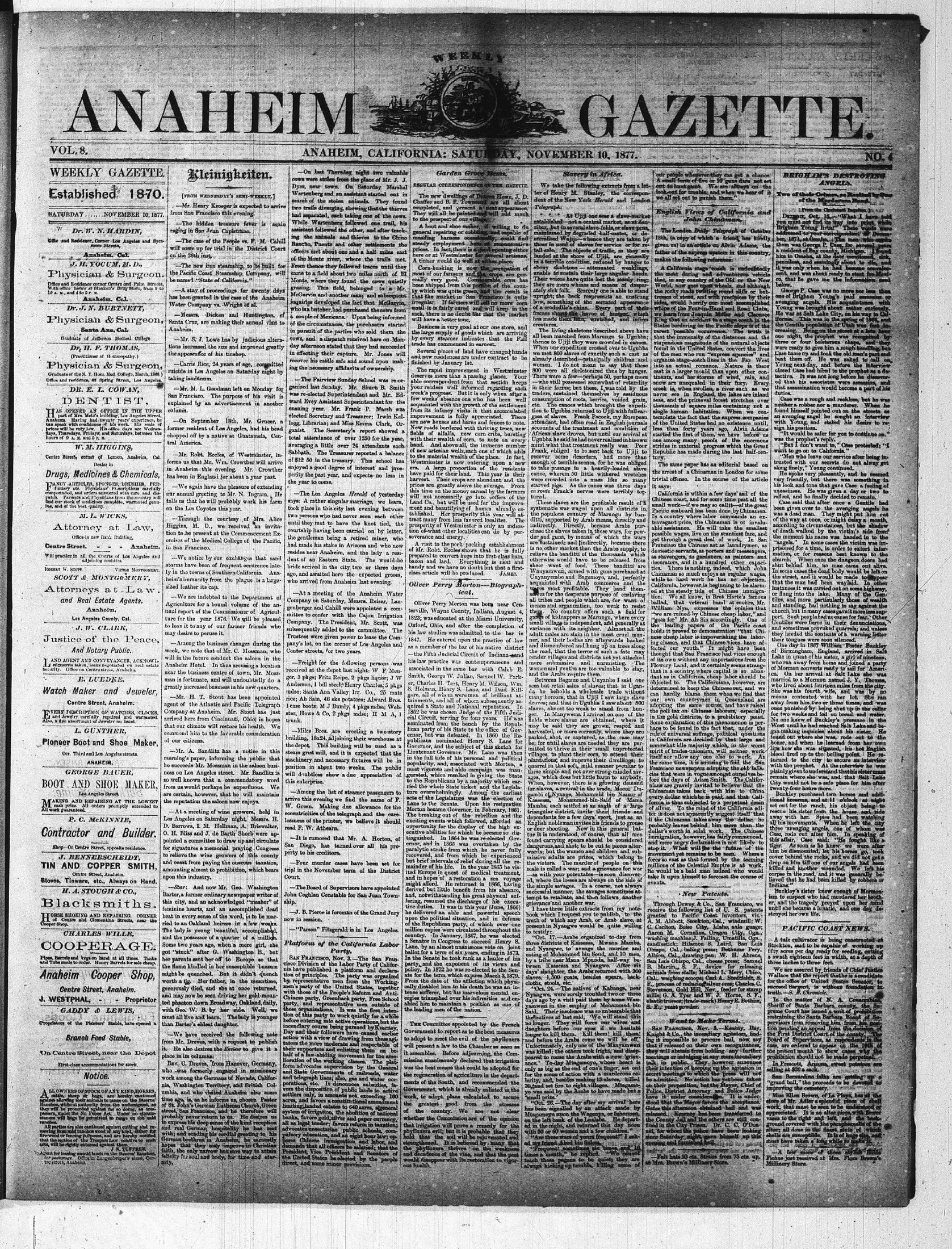
Searchable text
ANAHEIM
VOL. 8.
ANAHEIM
WEEKLY GAZETTE
Established 1870.
SATURDAY ... NOVEMBER 10, 1877.
Dr. W. N. HARDIN,
Office and Residence, Corner Los Angeles and Sycamore Streets,
Anaheim, Cal.
J. H. YOCUM, M. D., Physician & Surgeon.
Office and Residence corner Centre and Palm Streets, With office hours at Blanken's Drug Store, from 9 to 10 A.M., and 4 to 5 P.M.
Anaheim, Cal.
Dr. J. N. BURTNETT, Physician & Surgeon,
Santa Ana, Cal.
Graduate of Jefferson Medical College.
Dr. H. F. THOMAS,
(Practitioner of Homoeopathy.)
Physician & Surgeon,
Graduate of the N.Y.Hom.Med.College, March, 1860.
Office and residence, 63 Spring Street, Los Angeles.
DR. E. L. COWAN,
DENTIST,
HAS OPENED AN OFFICE IN THE UPPER part of Mrs. Metz's building, Los Angeles Street, Anaheim. Having had twenty years' experience, he can speak with confidence of his work. His scale of patients will be very low. His office days are Wednesdays, Thursdays, Fridays, and Saturdays, between the hours of 9 A.M. and 5 P.M.
W. M. HIGGINS,
Centre Street, corner of Lemon, Anaheim, Cal.
Dealer in.
Kleinigkeiten.
[FROM WEDNESDAY'S SEMI-WEEKLY.]
Mr. Henry Kroeger is expected to arrive from San Francisco this evening.
The hidden treasure fever is again raging in San Juan Capistrano.
The case of the People vs. F. M. Cahill will come up for trial in the District Court on the 28th inst.
The new iron steamship, to be built for the Pacific Coast Steamship Company, will be named "State of California."
A stay of proceedings for twenty days has been granted in the case of the Anaheim Water Company vs. Wright et al.
Messrs. Dicken and Huntington, of Santa Cruz, are making their annual visit to Anaheim.
Mr. S. J. Lowe has by judicious alterations increased the size and improved greatly the appearance of his tinshop.
Carrie Rice, 24 years of age, committed suicide in Los Angeles on Saturday night by taking laudanum.
Mr. M. L. Goodman left on Monday for San Francisco. The purpose of his visit is explained by an advertisement in another column.
On September 18th, Mr. Grucer, a former resident of Los Angeles, had his head chopped off by a native at Guatamela, Central America.
Mr. Robt. Eccles, of Westminster, informs us that Mr. Wm. Crowther will arrive
On last Thursday, cows were stolen from the Dyer, near town. On Wartenberg and an assailant followed the other ing the animals and the Rancho, Puente and other officers met about one an of the Monte river, where From thence they follow came to a field about two Monte, where they found grazing. This field, be McGarvin and another man inquiries developed the f who is a butcher, had parcel a couple of Mexicans. Of the circumstances, the in pursuit of the parties w cowa, and a dispatch race day afternoon stated that in effecting their capture recover his cattle safe and ing the necessary affidavit.
The Fairview Sunday organized last Sunday. Mr was re-elected Superintendent Evey Assistant Superintending year. Mr. Frank elected Secretary and Treasurer librarian; and Miss ganist. The Secretary's total attendance of over averaging a little over 2 Sabbath. The Treasurer of $12 50 in the treasury.
DR. E. L. COWAN,
DENTIST,
HAS OPENED AN OFFICE IN THE UPPER
part of Mrs. Metz's building, Los Angeles Street,
Anaheim. Having had twenty years' experience, he
can speak with confidence of his work. His scale of
poles will be very low. His office days are Wednesdays,
Thursday, Fridays, and Saturdays, between the
hours of 9 A.M. and 8 P.M.
W. M. HIGGINS,
Centre Street, corner of Lemon, Anaheim, Cal.
Dealer in
Drugs, Medicines & Chemicals,
FANCY ARTICLES, SPONGES, BRUSHES, PERfumery etc. Physicians' Prescriptions carefully
compounded, and orders answered with care and dispatch. Farmers and Physicians from the country will
find our stock of medicines complete, warranted genuine, and of the best quality.
M. L. WICKS,
Attorney at Law,
Office in new Bank Building,
Centre Street, - - Anaheim.
Will practice in all the Courts of Los Angeles and
adjoining counties.
HOBERT W. SCOTT.
VICTOR MONTOOMERY.
SCOTT & MONTGOMERY,
Attorneys at Law.
and Real Estate Agents.
Anaheim.
Los Angeles County, Cal.
J. W. CLARK,
Justice of the Peace,
And Notary Public.
LAND AGENT AND CONVEYANCER, ACKNOWLEDGEMENTS taken, loans negotiated on real estate security. Office on Centre street, Anaheim.
R. LUEDKE.
Watch Maker and Jeweler,
Centre Street, Anaheim:
EVERY DESCRIPTION OF WATCHES, CLOCKS,
and Jewelry carefully repaired and warranted.
Also, a fine assortment of Jewelry on land.
L. GUNTHER,
Pioneer Boot and Shoe Maker,
Cor. Third and Los Angeles streets.
ANAHEIM.
GEORGE BAUER,
BOOT AND SHOE MAKER,
Los Angeles Street.
MAKING AND REPAIRING AT THE LOWEST
cash price. All orders promptly attended to
All work guaranteed.
P. C. McKINNIE,
Contractor and Builder.
Shop—On Centre Street, opposite residence.
J. BENNERSCHEIDT,
TIN AND COPPER SMITH,
Centre Street, Anaheim.
Stoves, Tinware, etc.. Always on Hand.
Mr. M. L. Goodman left on Monday for San Francisco. The purpose of his visit is explained by an advertisement in another column.
On September 18th, Mr. Grucer, a former resident of Los Angeles, had his head chopped off by a native at Guatamela, Central America.
Mr. Robt. Eccles, of Westminster, informs us that Mr. Wm. Crowther will arrive in Anaheim this evening. Mr. Crowther has been in England for about a year past.
We again have the pleasure of extending our annual greeting to Mr. N. Ingram. He tells us that he will probably work his farm on the Los Coyotes this year.
Through the courtesy of Mrs. Alice Higgins, M. D., we received an invitation to be present at the Commencement Exercises of the Medical College of the Pacific, in San Francisco.
We notice by our exchanges that sand storms have been of frequent occurrence late in the towns of Southern California. Anaheim's immunity from the plague is a large-sized feather its cap.
We are indebted to the Department of Agriculture for a bound volume of the annual report of the Commissioner of Agriculture for the year 1876. We will be pleased to loan it to any of our farmer friends who may desire to peruse it.
Among the business changes during the week, we note that of Mr. C. Mossman, who will in the future conduct the saloon in the Anaheim Hotel. In thus securing a location near the business centre of town, Mr. Mossman is fortunate, and will undoubtedly do a greatly increased business in his new quarters.
Mr. H. T. Stout has been appointed agent of the Atlantic and Pacific Telegraph Company at Anaheim. Mr. Stout has just arrived here from Cincinnati, Ohio; in hopes that our climate will restore his health. We commend him to the favorable consideration of our citizens.
Mr. A. Bandlitz has a notice in this morning's paper, informing the public that he succeeds Mr. Mossman in the saloon business on Los Angeles street. Mr. Bandlitz is so well known that a commendatory word from us would perhaps be superfluous. We are certain, however, that he will maintain the reputation the saloon now enjoys.
At a meeting of wine growers, held in Los Angeles on Saturday night, Messrs. H. D. Barrows, I. M. Helliman, A. Briswalter, O. H. Bliss and J. de Barth Shorb were appointed a committee to draw up and circulate for signatures a memorial praying Congress to relieve the wine growers of this county and coast from paying the ouvres taxation, amounting almost to prohibition, which bears upon this industry.
The Fairview Sunday organized last Sunday. Mr was re-elected Superintendent ward Evey Assistant Superintendent enning year. Mr. Frank elected Secretary and Treasurer logg, Librarian; and Miss organist. The Secretary's total attendance of over averaging a little over 2 Sabbath. The Treasurer of $12 50 in the treasury enjoyed a good degree of perity the past year, and eased the year to come.
The Los Angeles Re says: A rather singular man took place in this city last two persons who had never until they met to have the courtship having been carried the gentleman being a re had made his stake in Arizona resides near Anaheim, and dent of an Eastern State bride arrived in the city t ago, and awaited here the who arrived from Anaheim.
At a meeting of the Company on Saturday, Meengenberger and Cahill were mittee to confer with the Company. The President subsequently added to the Trustees were given power pany's lot, on the corner o Center streets, for two years.
Freight for the follow received at the depot last merger, 3 pkgs; Fritz Reipe, 2 Anderson, 1 bell steel; Henndse; Santa Ana Valley Rice; Ah Sam, 46 sks potato 1 case boots; M J Bundy, 4 star Howe & Co, 2 pkgs n trunk.
Miles Bros. are crew building, 18x24, adjoining tha steam grist mill, and it is machinery and necessary fi position in about two w will doubtless show a du enterprise.
Among the list of steam arrive this evening we find W. Green. Making due eccentricities of the telegraph lessness of the printer, we read F. W. Athearn.
It is rumored that Mr San Diego, has turned o party to his creditors.
Four murder cases ha trial in the November term Court.
P. C. McKINNIE,
Contractor and Builder.
J. BENNERSCHEIDT,
TIN AND COPPER SMITH,
Centre Street, Anaheim.
H. A. STOUGH & CO., Blacksmiths.
HORSE SHOKING AND REPAIRING. CORNER of Centre and Clementina Streets, near the Cooper Shop.
CHARLES WILLE, COOPERAGE.
Pipes, Barrels and keys on hand at all times. Tanks and Tubes made to order. Honey barrels for sale cheap.
Anaheim Cooper Shop,
Centre Street, Anaheim.
J. WESTPHAL, - Proprietor
GADDY & LEWIS,
Proprietors of the Planters' Stable, have opened a Branch Feed Stable,
On Centre Street, near the Dopot First-class accommodations for stock.
Notice.
ALL OWNERS OF STOCK OF ANY KIND, HORSES, cattle, sheep or hogs, are hereby cautioned against allowing their animals to range on the Stearns' Ranchos, without authority from the undersigned, as they will be prosecuted against for so doing, as trespassers, under the No Fence Act. Under no circumstances will hogs be permitted to range on the said ranchos.
All parties are also cautioned against cutting and removing from said matchs wood of any kind, either for firewood or fencing purposes, and are hereby notified that the section of the Trussell Law relative to such acts, will be rigidly enforced against them.
J. K. TUFFREE
Agent for leasing unmold lands on the Stearns' Ranchos, for pasture. Office in Langenberger's store, Centre street, Anaheim.
WEEKLY
IM GAZI
ANAHEIM, CALIFORNIA: SATURDAY, NOVEMBER 10, 1877.
On last Thursday night two valuable cows were stolen from the place of Mr. J. J. Dyez, near town. On Saturday Marahal Wartenberg and an assistant started out in search of the stolen animals. They found two trails diverging, showing that the thieves had separated, each taking one of the cows. While Wartenberg followed one trail, his assistant followed the other, and after tracking the animals and thieves to the Chino Rancho, Puente and other settlements the officers met about one and a half miles east of the Monte river, where the trails met. From thence they followed traces until they came to a field about two miles north of El Monte, where they found the cows quietly grazing. This field belonged to a Mr. McGarvin and another man; and subsequent inquiries developed the fact that McGaryin, who is a butcher, had purchased the cows from a couple of Mexicans. Upon being informed of the circumstances, the purchasers started in pursuit of the parties who sold them the cows, and a dispatch received here on Monday afternoon stated that they had succeeded in effecting their capture. Mr. Jones will recover his cattle safe and sound upon making the necessary affidavits of ownership.
The Fairview Sunday School was re-organized last Sunday. Mr. Simon B. Smith was re-elected Superintendant and Mr. Edward Evey Assistant Superintendent for the ensuing year. Mr. Frank P. Marsh was elected Secretary and Treasurer; Irwin Kellogg, Librarian; and Mia Emma Clark, Organist. The Secretary's report showed a total attendance of over 1250 for the year, averaging a little over 24 attendants each Sabbath. The Treasurer reported a balance of $12 50 in the treasury. This school has
Garden Grove Hems.
REGULAR CORRESPONDENCE OF THE GAZETTE.
The new dwellings of Denom Howe, J. D. Chaffee and B. F. Townsend are all about completed, and present a next appearance. They will all be painted and will add much to the prospect of our village.
A boot and shoe maker, if willing to do general repair or cobbling, and capable of mending harms occasionally, could find steady employment here at remunerative prices. In fact, there is a good opening either here or at Westminster for several artisans. A tinner would do well at either place.
Corn-husking is now the occupation of most of our farmers and the crops are generally very good. Considerable corn has been shipped from this portion of the country which was quite green, and the result is that the market in San Francisco is quite irregular. If farmers will sell no more corn until it is fairly cured and will keep in the sack, there is no doubt but that the market will have a better tone.
Business is very good at our one store, and the large supply of goods which are arriving by every steamer indicates that the Fall trade has commenced in earnest.
Several pieces of land have changed hands and new residences are under contract to be finished by January 1st.
The rapid improvement in Westminster deserves more than a passing glance. Your able correspondent from that section keeps your readers well informed regarding each week's progress. But it is only when after a few weeks' absence one who has been well acquainted with the growth of the settlement from its infancy visits it that accumulated improvement is fully appreciated. There are new houses and barns and fences to note. New roads bordered with thriving trees, new fields of alfalfa, new corn crubs, bursting with their wealth of corn, to note on every hand. And above all, the immense number of new artesian wells, each one of which adds to the material wealth of the place. In fact, Westminster is now entering upon a new
Slavery in Africa.
We take the following extracts from a letter of Henry M. Stanley, the correspondent of the New York Herald and London Telegraph:
At Ujiji one sees a slave-market established—not a central market, as at Zanzibar, but in several slave-folds, or slave-pens maintained by degraded half-castes, or demoralised Weijiji—whence they are taken by those in need of slaves for service or for retail sale. The objects of traffic, as they are landed at the shore of Ujiji, are generally in a terrible condition, reduced by hunger to ebony skalectons — attenuated weaklings, unable to sustain their large angular heads. Their voices have quite lost the massy ring; they are mere whines and moans of desperately sick folk. Scarcely one is able to stand upright; the back represents an unstrung bow, something of the serrated appearance of a crocodile's chine. Every part of their frames shows the havoc of hunger, which has made them lean, wretched, and infirm creatures.
The living skeletons described above have all been marched from Marungun to Ugublia; thence to Ujiji they were crowded in canoes. When our expedition crossed over to Ugubba we met 800 slaves of exactly such a cast as already described—principally children and women. I do not mean to say that these 800 were all skeletonized thus by hunger. There were a few—perhaps 50, perhaps more—who still possess somewhat of rotundity in their forms; but these, I was told by the traders, sustained themselves by assiduous consumption of roots, berries, voided grain, etc. The canoes which brought the expedition to Ugubba returned to Ujiji with fuller-goes of slaves. Frank Pocock my European attendant, had often read in English journals accounts of the treatment and condition of African slave droves, but until our arrival at Ugubba he said he had never realized in his own mind what that treatment really was. Pour Frank obliged to be sent back to Ujiji to recover some deserters, had more than enough of terrible scenes, for he was obliged
The Fairview Sunday School was re-organized last Sunday. Mr. Simon B. Smith was re-elected Superintendent and Mr. Edward Evey Assistant Superintendent for the ensuing year. Mr. Frank P. Marsh was elected Secretary and Treasurer; Irwin Kellogg, Librarian; and Miss Emma Clark, Organist. The Secretary's report showed a total attendance of over 1250 for the year, averaging a little over 24 attendants each Sabbath. The Treasurer reported a balance of $12 50 in the treasury. This school has enjoyed a good degree of interest and prosperity the past year, and expects no less in the year to come.
The Angeles Herald of yesterday says: A rather singular marriage, we learn, took place in this city last evening between two persons who had never seen each other until they met to have the knot tied, the courtship having been carried on by letter, the gentleman being a retired miner, who had made his stake in Arizona and who now resides near Anaheim, and the lady a resident of an Eastern State. The would-be bride arrived in the city two or three days ago, and awaited here the expected groom, who arrived from Anaheim last evening.
At a meeting of the Anaheim Water Company on Saturday, Messrs. Reiser, Langenberger and Cahill were appointed a committee to confer with the Cajon Irrigation Company. The President, Mr. Scott, was subsequently added to the committee. The Trustees were given power to lease the Company’s lot, on the corner of Los Angeles and Center streets, for two years.
Freight for the following persons was received at the depot last night: W F Menger, 3 pkgs; Fritz Reipe, 2 pkgs liquor; J W Anderson, 1 bill steel; Henry Charles, 5 pkgs mdse; Santa Ana Valley Irr. Co., 25 mats rice; Ah Sam, 46 sks potatoes; Alward Bros. 1 case boots; M J Bundy, 4 pkgs mdse; Webstar, Howe & Co, 2 pkgs mdse; II M A, 1 trunk.
Miles Bros. are creating a two-story building, 18x24, adjoining their warehouse at the depot. This building will be used as a steam grist mill, and it is expected that the machinery and necessary fixtures will be in position in about two weeks. The public will doubtless show a due appreciation of this enterprise.
Among the list of steamer passengers to arrive this evening we find the name of F. W. Green. Making due allowance for the eccentricities of the telegraph and the carelessness of the printer, we believe it should read F. W. Athearn.
It is rumored that Mr. A. Horton, of San Diego, has turned over all his property to his creditors.
Four murder cases have been set for trial in the November term of the District Court.
The rapid improvement in Westminster deserves more than a passing glance. Your able correspondent from that section keeps your readers well informed regarding each week’s progress. But it is only when after a few weeks’ absence one who has been well acquainted with the growth of the settlement from its infancy visits it that accumulated improvement is fully appreciated. There are new houses and barns and fences to note. New roads bordered with thriving trees, new fields of alfalfa, new corn cribs, bursting with their wealth of corn, to note on every hand. And above all, the immense number of new artesian wells, each one of which adds to the material wealth of the place. In fact, Westminster is now entering upon a new era. A large proportion of the residents have paid for their land. This year is their harvest. Their crops are abundant and the prices are greatly above the average. From this time on the money earned by the farmers will not necessarily go into coffers of the Land Co., but will be used for the improvement and beautifying of homes already established. Her prosperity this year will attract many from less favored localites. The prosperity of Westminster is only an indication of what other localities can do by perseverance and energy.
A visit to the pork packing establishment of Mr. Robt. Eccles shows that he is fully prepared to convert hogs into first-class ham, bacon and lard. Everything is neat and handy and we have no doubt but that a first-class article will be produced.
Oliver Perry Morton—Biographical.
Oliver Perry Morton was born near Centerville, Wayne County, Indiana, August 4, 1823; was educated at the Miami University, Oxford, Ohio, and after the completion of his law studies was admitted to the bar in 1847. He entered upon the practice of law as a member of the bar of his native district—the Fifth Judicial Circuit of Indiana—and his law practice was contemporaneous and associated in the same bar with Caleb B. Smith, George W. Julian, Samuel W. Parker, Charles H. Test, Henry M. Wilson, Wm. S. Holman, Henry S. Lane, and Daid Killgore, all of whom were men of brilliant attainments, and all of whom subsequently acquired a State and National reputation. In 1852 he was chosen Judge of the Fifth Judicial Circuit, serving for four years. He was nominated from the bench by the Republican party of his State to the office of Governor, but was defeated. In 1860 the Republicans nominated Henry S. Lane for Governor, and the subject of this sketch for Lieutenant Governor. Mr. Lane was then in full title of his personal and political popularity, and associated with Morton, a most vigorous and able campaign was inaugurated when resulted in giving the State to the Republicans by a majority which carried the whole State ticket and the Legislature overwhelmingly. Among the earliest acts of the Legislature was the election of Lane to the Senate. Upon his resignation Morton became Governor, in February, 1861. The breaking out of the rebellion and the exciting events which followed afforded an opportunity for the display of the high executive abilities for which he became so distinguished. In 1864 he was re-elected Governor, and in 1865 was overtaken by the paralytic stroke from which he never fully recovered, and from which he experienced brief intervals of relief during all the remainder of his life. In the year 1865 he visited Europe in quest of medical treatment, and in hopes of a restoration a sea voyage.
800 were all skeletonized thus by hunger. There were a few—perhaps 50 perhaps more—who still possessed somewhat of rotundity in their forms; but these, I was told by the traders, sustained themselves by assiduous consumption of roots, berries, voided grain, etc. The canoes which brought the expedition to Ugubba returned to Ujiji with full cargoes of slaves. Frank Pocock, my European attendant, had often read in English journals accounts of the treatment and condition of African slave droves, but until our arrival at Ugubba he said he had never realized in his own mind what that treatment really was. Pour Frank, obliged to be sent back to Ujiji to recover some deserters, had more than enough of terrible scenes, for he was obliged to take passage in a heavily-loaded slave canoe, wherein 50 little withered wretches were crowded into a mass like so many starved pigs. As the canoe was three days en route Frank’s nerves were terribly tortured.
These slaves are the profitable result of a systematic war waged upon all districts in the populous country of Marungu by banditti, supported by Arab means directly and indirectly. Directly, because Arabs purchase the slaves taken in these wars, for powder and guns, by means of which the wars are sustained; and find directly, because there is no other market than the Arabs supply, to relieve the banditti of the thousands which otherwise would have to be released from shear want of food. These banditti are Wanyamwecz, armed with guns purchased at Unyanyembe and Bagomoyo, and perfectly acquainted with Arab commerce and the ways most profitable. They band themselves for the desperate purpose of enslaving all tribes and people which are, for want of means and organization, too weak to resist them. No country offers such a field for gangs of kilnappers as Marungu, where every small village is independent, and generally at variance with its neighbor. Almost all the adult males are slain in the most cruel manner, and their bodies are afterwards hacked and dismembered and hung up on trees along the road; that the terror of such a fate may render villages and districts not yet attacked more submissive and unreceiving. The women and youths are too valuable to slay, and the Arabs require them.
Between Bagamo and Unyanbe I said one sees but retail sales of slaves; that in Uganda he beholds a wholesale trade without many horrors; that in Ujiji I saw large slave droves; and that in Ugubla I saw about 800 slaves, almost too weak to stand from hunger. In Manywena I arrived on one of the fields where slaves are obtained, where it may be said they are grown, respeted and harvested, or more correctly, where they are parked, shot, or captured as as case may be; for until slaves are needed they are permitted to thrive in their small unprotected villages; to plant their corn; to attend their plantations; and improve their dwellings; to quarrel in that soft, mild manner peculiar to these simple and not over strong-minded savages, which does but little harm to anybody. When however, there is a growing demand for slaves, a revival in the trade, Moeni Dugambi of Nyange, Mohammid bin Nassur of Kaasseni Mohammed-bin-Said of Mama Mamba, each settled at an angle of a large triangular district; invite their friends and dependants for a few days’ sport; just as an English nobleman invites his friends to grouse or deer shooting. Now in this general battle it is understood, of course, that all men found carrying spears should be considered dangerous,and shot;to be cut to pieces afterwards;but the women and children and submissive adults are prizes,bwhich belong to the victors.The murder of people on this scale is called a war;and a graveance for war—as with your potentates—is soon discoveredwhere the losses are always on the side of
Among the list of steamer passengers to arrive this evening we find the name of F. W. Green. Making due allowance for the eccentricities of the telegraph and the carelessness of the printer, we believe it should read F. W. Athearn.
It is rumored that Mr. A. Horton, of San Diego, has turned over all his property to his creditors.
Four murder cases have been set for trial in the November term of the District Court.
The Board of Supervisors have appointed John Coghlan Constable for San Juan Township.
J. B. Pierce is foreman of the Grand Jury now in session.
"Parson" Fitzgerald is in Los Angeles.
Platform of the California Labor Party.
SAN FRANCISCO, Nov. 3.—The San Francisco Division of the Labor Party of California have published a platform and declaration of principles. The party was organized by representative men from the Workingmen's party of the United States, together with those of the People's Reform and Anti-Chinese party, Greenback party, Free School party, and representative men outside of these organizations. It was the first intention of this party to work quietly for a while before entering into active operations, but the incendiary course being pursued by Kearney, Day and their followers have caused earlier action with a view of drawing from these agitators the more moderate and respectable of their supporters and enlisting them on behalf of a law-abiding movement for the amelioration of the working classes. The platform advocates supervision by the General and State Governments of railroads, water and telegraph lines; also, gas and water corporations, etc. It denounces subsidies, favors the disposition of public lands to active settlers only, in amounts not exceeding 100 acres, and favors a constitutional amendment limiting landed estates to 640 acres, general system of irrigation, the abolition of national banks, favors gold, silver and paper currency, all as legal tender, favors reform in taxation; advocates unrestrian public schools, compulsory education, and an eight hour law; opposes Chinese immigration and labor; demands that all officers be salaried; that the President, Vice President and Senators of the United States be elected by the people direct, and some minor provisions.
The Committee appointed by the French Government to report as to the best measures to adopt to meet the evil of the phylloxera will present a law to the Chamber as soon as it assembles. Before adjourning, the Commission unanimously declared that irrigation was the best means that could be adopted for the regeneration of agriculture in the departments of the South, and recommended the Government, which is already enlisted in the work, to adopt plans calculated to secure the greatest good from the streams of the country. We are not clear whether the Commission are of the opinion that irrigation will prove a remedy for the phylloxera evil; but it is probable that they hold that the soil will be rejuvenated and strengthened. It is believed by many that the phylloxera thrives on the weakness and decadence of the vine, and that the pest would disappear with its restoration to vigorous health.
"Weakness sometimes six times and 10 times a month," he replied. "We cannot teach these pagans to be quiet; they are always kicking up trouble, killing some of slaves, a revival in the trade, Moeni Du gambi of Nyange, Mohammid bin Nassar of Kassessa, Mohammed-bin-Said of Mama Mamba, each settled at an angle of a large triangular district, invite their friends and dependants for a few days' sport, just as an English nobleman invites his friends to grouse or deer shooting. Now in this general battle it is understood, of course, that all men found carrying spears should be considered dangerous, and shot; to be cut to pieces afterwards; but the women and children and submissive adults are prizes, which belong to the victors. The murder of people on this scale is called a war; and a grievance for war—as with your potentates—is soon discovered, where the losses are always on the side of the simple savages. In a coarse, net always successful manner, the savages sometimes attempt to retaliate, and then follows another grievance and another war.
I have three little extracts from my notebook which I request you to publish, to the truth of which any Arab, or Arab slave, at present in Nyangwe would be quite willing to testify:
"Oct. 17.—Arabs organized to-day from three districts of Kassessa, Mwana Mamba, and Nyangwe, to avenge the murder and eating of Mohammed bin Soud, and 10 men, by a tribe near Mana Mpunda, half-way between Kassessa and Nyangwe. After six days' slaughter, the Arabs returned with 300 slaves, 1,500 goats, besides spears, backcloths, stools, etc."
"Oct. 24.—The natives of Kahanga, near Nyangwe, were sorely troubled two or three days ago by a visit paid them by some Wanyamwezi in the employ of Mohammed bin Said. Their insolence was so unbearable that the natives at last said: 'We will stand this no longer. They will force our wives and daughters before our eyes if we hesitate longer to kill them.' Kill them! kill them! and before the Arabs come we will be off." Unfortunately, only one of the Manyamwezi was killed; the others took fright, and disappeared to rouse the Arabs with a new grievance.* To-day Mtagamoyo, whose heart is only as big as the end of one's finger, set out for the scene of action with a murderous calerity, and besides making 15 slaves, killed 30,and set fire to eight villages. Mtagamoyo was said by the Arabs to have made but a small prize.
"Oct. 26.—The day after my arrival here has been signalled by an attack made by Mtagamoyo upon the Wagenya, or fishermen on the left bank of the Lualaha. He departed in the night, and returned this day noon with 50 or 60 women and a few children."
"Are these wars of yours frequent?" I asked my friend Ahad bin Salem.
"Frequent sometimes six times and 10 times a month," he replied. "We cannot teach these pagans to be quiet; they are always kicking up trouble, killing some of slaves."
GAZETTE.
10. 1877. NO. 4
Africa.
Extracts from a late-day, the correspondent Herald and London market.
A slave-market market, as at Zanzibar, folks, or slave-penna, half-castes, or devices they are taken by for service or for re-traffic, as they are Ujiji, are generally reduced by hunger to manned weaklings, large angular heads, most the manly ring, and moans of desperation one is able to stand contemptuous an unstrung inscrutated appearance Every part of their of hunger which watched, and infirm described above have maruṅtu to Ugubbia; crowded in canoes, saddled over to Ugubba not only such a cast as especially children and to say that these need thus by hunger. Ages 50, perhaps more unequal what of rotundity I was told by theselves by assiduous berries, voided grain, brought the expediency to Ujiji with full earcock, my European in English journals and condition of until our arrival at her realized in his own really was. Pour it back to Ujiji to had more than for he was obliged our people whenever they can get a chance. A small form of five or 10 guns dare not set out to hunt game. We are always on the look-out for trouble, and when we hear of it we all set out to punish them."
English Views of California and John Chinaman.
The London Daily Telegraph of October 18th, (a copy of which a friend has kindly given us) in an article on Alvin Adams, the father of the express system in this country, makes the following reference:
A California stage coach is undoubtedly the most daring and adventurous vehicle that, in any country of the Old or the New World, now goes upon wheels, and although the rocky roads twirting round olifis or buttresses of stone, and with precipices by their sides, would horrify our most accomplished whips of the Four-in-Hand and Road Clubs, we learn from Joaquin Miller and Clarence King that an accident to a stage coach in the States bordering on the Pacific slope is of the rare possible occurrence. The truth is that the immensity of the distances and the stupendous magnitude of the natural objects found in the United States, convert the lives of the men who run "express agencies" and organise stage-coach lines in the Far West into an actual romance. Nature is there cast in a larger mould than upon other continents, and her storms of wind, rain, and snow are unequaled in their fury. Every creek is when swollen, a river such as we never see in England, the lakes are inland seas, and the primeval forest stretches over thousands of square miles containing not a single human habitation. When we contemplate the fact that the express companies of the United States had no existence until less than forty years ago, Alvin Adams started the first of them, we have before us one among many proofs of the enormous strides in material progress which the Great Republic has made during the last half-century.
BRIGHAM'S DESTROYING ANGELS.
Two of their Orms, as Realtied by Quiz of the Murderer Hand.
From the Commandant Ingram.
Durgotz, Oct. 16—"What I have told you must not find its way into print while Brigham Young lived." These words were addressed to your correspondent 20 December, 1871, as Omaha. The man who engages them was George P. Case for several years a resident of Bay county, Michigan. I found him in Omaha, at the date mentioned, sick, penniless, and seemingly about to die, and it was only when he had become convulsive, and was about ready to start for Mexico, that he gave me the information used below.
George P. Case was no more nor less than one of Brigham Young's paid assassins or avenging angels. His acquaintance with Young was brought about rather curiously. He was at Salt Lake City, on his way to California. This was in the spring of 1895, and the Gentile population of Utah was fast increasing. Being on the street at a late hour one night, the prophet was recognized by three or four boisterous chaps, and they were ready to give him a rough handling. But Case came up and took the old man's part and beat them off. He was asked to call on Young next day, and before the interview closed Case had hired to the prophet as a detective. It was not long before he discovered that his associates were assassinating, and that assassination would become a part of his duties.
Case was a rough and reckless, but he was neither a robber nor a murderer. When he found himself pointed out on the streets as an avenging angel he sought an interview with Young, and stated his desire to resign his position.
"It would be safer for you to continue on," was the prophet's reply.
"But I don't want to," Case protested; "I want to go on to California."
"Men who leave our service after being trusted with our secrets do not always get
thus by hunger,
up 50, perhaps more
what of rotundity,
I was told by the
selves by assiduous
series, voided grain,
brought the expedition to Uijiji with fullearcock, my European
in English journals
and condition of
until our arrival at
her realized in hisown
really was. Poor
but back to Uijiji to
had more than
for he was obliged
gravily-loaded slave
withered wretches
as like so many
ones was three days
were terribly torroffitable result of a
on all districts in
Marungu by bamcanans, directly and
because Arabs purthese wars, for powof which the wars
actly, because there
are Arabs supply, to
thousands which
be released from
These banditti are
a guns purchased to
ayo, and perfectly
commerce and the
They band thempurpose of enslaving
which are, for want of
too weak to resist
such a field for
where every
attentive, and generally at
Almost all the
the most cruel manafterwards hacked
up on trees along
of such a fate may
not yet attacked unresisting.
The valuable to slay,
nanyanbo I said one
ves; that in Uganatrade without it I saw large slave
I saw about 800 stand from hanwad on one of the
obtained, where it
rown, reaped and
ply, where they are
as the case may
judged they are perminal unprotected,
to attend their
their dwellings; to
nanner peculiar to
strong-minded savharm to anybody.
In growing demand
trade, Moeni Duraid bin Nassur of
Said of Mama angle of a large their friends and sport, just as an as friends to grouse this general battle-race, that all men could be considered out to pieces after-children and subwhich belong to if people on thisagnovance for war is soon discover-rays on the side of
California is within a few days' sail of the Chinese coast, and for some time past all the small work—if we may so call it—of the great Pacific seaboard has been done by Chinamen.
In a country where labor commands an extravagant price, the Chinaman is of invaluable assistance. He will take the smallest possible wages, live on the scantiest fare, and get through a great deal of work. In San Francisco the Chinese act as laundrymen, as domestic servants, as porters and messengers, as scavengers, as gardeners, as painters and decorators, and in a hundred other capacities. There is nothing, indeed, which John Chinaman so much enjoys as regular wages, while to hard work he has no objection. California, however, is beginning to be alarmed at the steady tide of Chinese immigration. We all know, in Bret Harte's famous ballad, that veteran hand at euchre, Mr. William Nya, expresses the opinion that "we are rained by Chinese cheap labor," and "goes for" Mr. Ah Sin accordingly. One of the leading papers of the Pacific coast holds it proved to demonstration "that Chinese cheap labor is impoverishing the laboring classes, and that Chinese vices have affected our youth." It might have been thought that San Francisco had vices enough of its own without any importations from the Flowery Land, and it certainly seems strange that in a country where capital is so abundant as in California, cheap labor should be objected to. The Californians, however, are determined to keep the Chinese out, and we can hardly blame them when we find that our own countrymen in Queensland are adopting the same course, and have raised the poll tax on Chinese laborers, especially in the gold districts, to a prohibitory point. Some explanation of this phenomenon is perhaps to be found in the fact that, under the rule of universal suffrage, political questions in California are decided by that large and somewhat idle majority which, in the worst spirit of trades-unionism, will neither work itself nor allow any one else to work. At the same time, it is amusing to find the San Francisco newspapers adopting the old fallacies that were in vogue amongst ourselves before the days of Adam Smith. The Californians are gravely invited to believe that the Chinaman takes back with him to China every dollar which he is paid, and that California is thus subjected to a perpetual drain of silver. To the mind of the California editor it does not apparently suggest itself that if the Chinaman takes away the dollar, he probably leaves behind him more than the dollar's worth in solid work. The Chinese immigration, however, has fairly commenced, and mere angry declamation is not likely to stop it. What will be the future of the movement yet remains to be seen. Where a force so vast as that formed by the teeming millions of the Celestial Empire is at work, he would be a bold man indeed who would take it upon himself to forecast the course of events.
closed Case had hired to the prophet as a detective. It was not long before he discovered that his associates were assassinating, and that assassination would become a part of his duties.
Case was a rough and reckless, but he was neither a robber nor a murderer. When he found himself pointed out on the streets as an avenging angel he sought an interview with Young, and stated his desire to resign his position.
"It would be safer for you to continue on." was the prophet's reply.
"But I don't want to," Case protested; "I want to go on to California."
Men who leave our service after being entrusted with our secrets do not always get along finely," Young continued.
He spoke very pleasantly, and he seemed very friendly, but there was something in his look and tone that gave Case a feeling of uneasiness. He was given a day or two to reflect, and he finally decided to remain.
Case said that after once a Gentile had been given over to the avenging angels he was a dead man. They might put him out of the way at once, or might delay a month, according to circumstances, but the shadow of death walked by the victim's side from the moment his name was handed in to the "angels." In some cases the victim was imprisoned for a time, in order to extort information, or for reasons best known to the church. When once the dungeon doors had shut behind him, no man came out alive. In some cases the dead body would be left on the street, and it would be made to appear that the man had been waylaid. In other instances it was carried out on some highway, or flung into the lake. Many of the Gentiles, and more particularly those of wealth and standing, had nothing to say against the church; but in many cases gave it more less support. Such people had no cause for fear. Other Gentiles were fierce in their denunciations, and sometimes provoked quarrels; and unless they heeded the contents of a warning letter their tongues were soon silenced.
One day in 1867 William Foster Buckley of Birmingham, England, arrived in Salt Lake in quest of his sister, a girl of nineteen, who ran away from home and joined a party of Mormon converts ready to sail for America. On her arrival at Salt Lake she was married to a Mormon named J. Y. Thomas, who lived about fourteen miles from the city. She was his fourth wife, and was by no means contented with her lot. She ran away from him two or three times, and was once punished by being shut up in the cellar for two weeks and fed on bread and water. No one knew of Buckley's presence in the West until he had reached Salt Lake and began making inquiries about his sister. He found out where she was, rode out to the house, and when he learned from her own lips how she was situated, his hot English blood fired up to the boiling point. He returned to the city to secure an interview with the prophet. At the interview he was plainly given to understand that his sister must remain where she was, and that Salt Lake City would not be a safe place for him after twenty-four hours more.
Buckley purchased two horses and additional firearms, and at 10 o'clock at night set out for the ranch, his object being to rescue his sister from the house and side away with her. Spies had been watching all his movements. When he left the city three avenging angels, one of whom was Case, rode out after him. In speaking of this affair, Case said: "He fought like a tiger. As soon as he knew we were after him he dismounted, let his horses go; took cover behind the rocks; and we did not get a drop on him till one of our angels had been killed and another wounded. We left his corpse in the road; and it was generally believed that he had been killed by robbers or
New Patents.
Through Dewey & Co., San Francisco, we receive the following list of U. S. patents granted to Pacific Coast inventors, viz:
A. M. Abbott, Stockton, Cal., windmill; W. G. Carlton, Boise City, Idaho, axle gauge; Aaron M. Cornelius, Oregon City, Ogna, washing machine; J. Failing, Umatilla, Ogn., candlestick; Hilamon S. Laird, San Luis Obispo, Cal., baling press; Bethune Pery, Albion, Cal., drawing pen; W. H. Ahrens, San Luis Obispo, Cal., cheese press; Samuel B. Martin, S. F., device for releasing animals from stalls; Michael L. Mery, Chico, Cal., weighing scoops; Carl A. Stedtfeldt, S. F., process of reducing silver ores; Charles C. Stevenson, Gold Hill, Nev., feeder for stamp mills; G. A. Tyer and W. J. Horne, S. F., elastic trusses; (trade-mark) Henry E. Bothim, S. F., yeast powder.
Want to Make Terms.
San Francisco, Nov. 4—Kanny, Day, Knight & Co., the incendiary agitators, finding it impossible to procure bail, now say that if released on their own recognizances, they will abstain from holding any further meetings or indulging in any more incendiary talk in public. They however announce their intention of keeping up the agitation in secret meetings to which the press will not be admitted. No action has yet been taken on their proposition, but the Mayor, Chief of Police, District Attorney and Police Judge have it under consideration. It is understood that the Mayor favors the acceptance. Gates this afternoon obtained ball and was released. Kanney has been transferred to the County Jail and the others are still confined in the City Prison. Dr. C. C. O'Donnell, for whom the police have been looking since Saturday night, gave himself up this evening and furnished bail.
Felt had 50 cts. Strans from 75 cts. up at Mrs. Brown's Millinery Store.
Buckley purchased two horses and additional firearms, and at 11 o'clock at eight set out for the ranch, his object being to rescue his sister from the house and side away with her. Spies had been watching all his movements. When he left the city three avenging angels, one of whom was Case, rode out after him. In speaking of this affair, Case said: "He fought like a tiger. As soon as he knew we were after him he dismounted, let his horse go, took cover behind the rocks, and we did not get a drop on him till one of our angels had been killed and another wounded. We left his corpse in the road, and it was generally believed that he had been killed by robbers or Indians."
Buckley's sister knew enough of Mormonism to suspect who had murdered her brother, and the tragedy preyed upon her mind until she became a lunatic, and one day destroyed her own life.
PACIFIC COAST NEWS.
A tale cultivator is being constructed at Stockton, said to be capable of working up fifty acres per day ready for seeding, entiting a swath eighteen feet in width, at a depth of three inches to three-feet.
We are assured by friends of Chief Justice Wallace that the report that he is a candidate for the office of United States Senator, to succeed Sargent, is without foundation in truth.
S. F. Chronicle.
In the matter of N. A. Covarrubia, Sheriff of Santa Barbara county, the Supreme Court has issued a writ of prohibition restraining the Santa Barbara Board of Supervisors from removing him from his position pending an appeal from the decision of the First District Court of the county. The Board of Supervisors, as respondents in the case, are ordered to appear on the 19th of the present month to show cause why the prohibition should not be made perpetual.
In Prescott, Arizona, sweet potato am selling at $20 a sack.
San Bernardino folks are getting up a "grand hall," the proceeds to be devoted to improving the cemetery.
Miss Kellen Brown, of La Playa, has at the store of Mr. Adler a splendid piece of shell work, that must be seen to be understand or appreciated. It is an altar piece with fierer vases to the right and left, and the background covered with the paraphernalia of the altar; all done in the finest style of which shells are susceptible. It is of huge size and must have taken a long while to make it.
A few more of these styles Hilda Fichus just received at Mrs. Flora Brown's Millinery Store.