anaheim-gazette 1877-11-03
Scanned page
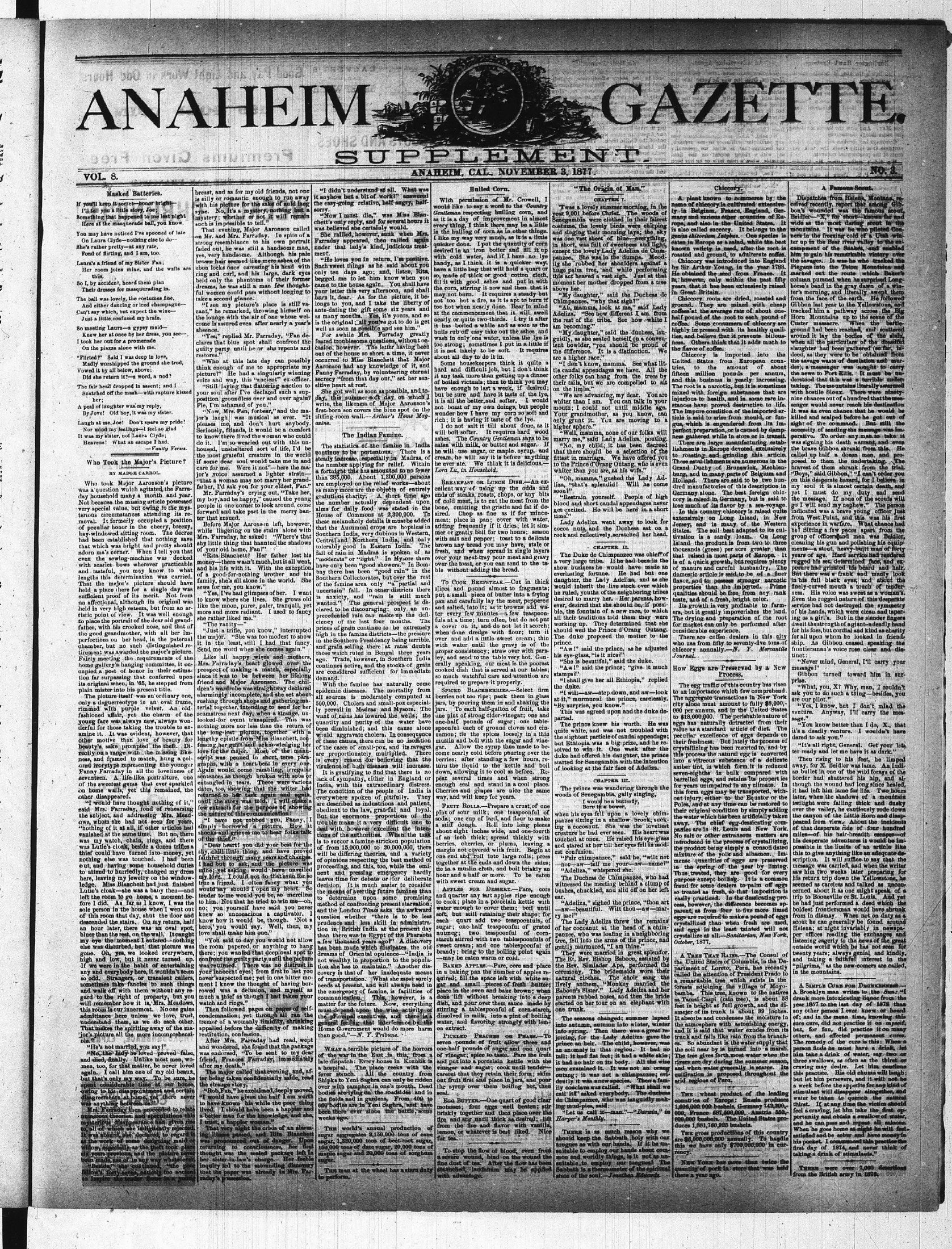
Searchable text
Masked Batteries.
If you'll keep it secret—honor bright—
I'll tell you a little story, Joe;
Something that happened to me last night
Here at the masquerade ball, you know.
You may have noticed I've spooned of late
On Laura Clyde—nothing else to do—
She's rather pretty—at any rate,
Fond of flirting, and I am, too.
Laura's a friend of my Sister Fan;
Her room joins mine, and the walls are thin.
So I, by accident, heard them plan
Their dresses for masquerading in.
The ball was lovely, the costumes fine,
And either dancing or ice champagne—
Can't say which, but expect the wine—
Just a little confused my brain.
So meeting Laura—a gypsy maid—
Knew her at once by her dress, you see—
I took her out for a promenade
On the plaza alone with me.
"Flirted?" Said I was deep in love,
Madly worshipped the ground she trod,
Vowed it by all below, above;
Did she return it?—a word, a nod?
The fair head dropped in assent; and I
Snatched off the mask—with rapture kissed her;
A peal of laughter was my reply,
By Jove! Old boy, it was my sister.
Laugh at me, Joe! Don't spare my pride!
Nor mind my feelings—I feel so glad
It was my sister, not Laura Clyde;
Heavens! What an escape I had.
—Vanity Verses.
Who Took the Major's Picture?
breast, and as for my old friends, not one is silly or romantic enough to run away with his picture for the sake of mild lang syne. No, it's a mystery, nothing but a mystery; whether or not it will remain such is impossible to tell."
That evening, Major Aaronson called on Mr. and Mrs. Farraday. In spite of a strong resemblance to his own portrait faded out, he was still a handsome man, yes, very handsome. Although his pale brown hair seemed like mere ashes of the ebon locks once caressing his head with ring and curl, and his large, dark eyes held only the phantoms of their former dreams, he was still a man few thoughtful women could pass without longing to take a second glance.
"I see my picture's place is still vacant," he remarked, throwing himself on the lounge with the air of one whose welcome is assured even after nearly a year's absence.
"Yes," replied Mr. Farraday, "Fan declares that blue spot shall confront the guilty party until he or she repents and restores."
"Who at this late day can possibly think enough of me to appropriate my picture?" He had a singularly winning voice and way, this "ancient" ex-officer.
"Still laying that flattering action to your soul after I've declared such a supposition groundless over and over again? Fie, I'm ashamed of you."
"Now, Mrs. Pan, forbear," and the major's laugh was musical as ever. "It pleases me and don't hurt anybody. Seriously, friends, it would be a comfort to know there lived the woman who could do it. I'm so wearied out with this unhoused, unsheltered sort of life, I'd be the most grateful creature in the world if some dear soul would take me in and
"I didn't nape it anyhow but the easy-going sorry.
"Now I muschett's only rep was believed al
She rallied, Farraday appealed under that la ment.
"He loves you Such sweet thing only ten days begged me to came to the ho your letter this burn it, dear longs to you ante-dating the as many months is the original well as soon as For awhile feared troubles casion, however out of the house occurred to M Aaronson had Fanny Farraday secrecy "from sive heart at She got well day, this sum write, the like first-born son o sitting-room w asine.
The statistic continue to be steady increase the number ar
Who Took the Major's Picture?
BY MADGE CARROL.
Who took Major Aaronson's picture was a question which agitated the Farraday household many a month and year. Not because the missing article possessed very special value, but owing to the mysterious circumstances attending its removal. It formerly occupied a position of peculiar honor in the cheery, breezy, bay-windowed sitting room. The decree had been established that nothing save that which was bright and pretty should adorn ma's corner. When I tell you that even the sewing-machine was decked with scarlet: bows wherever practicable and tasteful, you may know to what lengths this determination was carried. That the major's picture should have held a place there for a single day was sufficient proof of its merit. Not from an affectional, although its original was held in very high esteem, but from an artistic point of view. It was well enough to place the portrait of the dear old grandfather, with his crooked nose, and that of the good grandmother, with all her imperfections on her head, in the paternal chamber, but no such distinguished retirement was awarded the major's picture. Fairly meeting the requirements of the home gallery's hanging committee, it occupied a post of honor in their estimation far surpassing that conferred upon its original when, in '65, he stepped from plain mister into his present title.
The picture itself was an ordinary one, only a daguerreotype in an oval frame, rimmed with purple velvet. An old-fashioned affair, yet the charm of the young face was always new, always wonderful for those taking the trouble to examine it. It was evident, however, that other motive than love of beauty for beauty's sake prompted the theft. Directly on a range with the missing likeness, and framed to match, hung a colored ivorytype representing the younger Fanny Farraday in all the loveliness of seventeen. A life-like portraiture, one of the sweetest gems that ever sparkled on home walls, yet this remained, the other disappeared.
"I would have thought nothing of it," said Mrs. Farraday, fond of rehearsing the subject, and addressing Mrs. Meadows, whom she had not seen for years, "nothing of it at all, if other articles had vanished at the same time. But no, there was my watch, chain, rings, and there was Lutie's cloak, beside a dozen trifles a thief could have turned into money, yet nothing else was touched. I had been out, and having some household duties to attend to hurriedly, changed my dress here, leaving my jewelry on the window-
The statistic continue to be steady increase the number appended to fortnight than 385,000 are employed as many more gratitudous changes the number alms for daily House of Correspondence these melancholy that the Autumn Southern India Central and New tolerably good fall of rain in moderate or have only been bay there has a Southern College of the famine uncertain" fall is anxiety, wanted." The cleared to be de precedented reliance of the prices of grain high in the faeces in the Southern and grain selling those watch rupee. Trade, continues active are considered demand.
With the fast epidemic disease all sources is 500,000. Cholesty prevail in want of rains quantity and been diminish would aggravate these causes of the cases of are proportion is every reason virulence of bovine.
It is gratify lack of sympathy India, with the Condition everywhere spare described obedient to the But the enorgue trouble make deal with how tions of the avail is to succor a岁 of from 15,000 will be different of opinions re proceeding, annent and leaves time for
"I would have thought nothing of it," said Mrs. Farraday, fond of rehearsing the subject, and addressing Mrs. Meadows, whom she had not seen for years, "nothing of it at all, if other articles had vanished at the same time. But no, there was my watch, chain, rings, and there was Lutie's cloak, beside a dozen trifles a thief could have turned into money, yet nothing else was touched. I had been out, and having some household duties to attend to hurriedly, changed my dress here, leaving my jewelry on the windowledge. Miss Blanchett had just finished Lutie's cloak—she was a baby then—and left the room to go home, a moment before I did. As far as I know, I was the sole person in the house when I went out of this room that day, shut the door and descended the stairs. On my return, half an hour later, there was an oval spot, bluer than the rest, on the wall. It caught my eye the moment I entered—nothing else was disturbed, but that picture was gone. Oh, yes, we looked everywhere, high and low, but it never turned up. If we were in the habit of entertaining any and everybody here, it wouldn't seem so odd. Strangers, or transient callers, sometimes take fancies to such things and walk off with them without any regard to the right of property, but you will remember how it is, Mrs. Meadows, this room is our innermost. No one gains admittance here unless we love, trust, understand them, as we do each other. That makes the spiriting away of the major's picture all the more incomprehensible."
"He's not married, you say!"
"No, the lady be loved proved false, and died, finally. Unlike most men, women, too, for that matter, he never loved again. I call him one of my old beauties, but that's only my way. To be sure, he spent considerable time at our house, owing to his disappointment and certain disagreements at home; yet there never was anything between us."
Mrs. Farraday then proceeded to relate numerous theories and speculations this mysterious disappearance had given rise to, all of which she indignantly rejected. It was absurd, she declared, to regard it as the work of some designing maid or widow, especially as the theft took place six years previous, and the picture never been made use of in any way whatsoever.
"Beside," she continued, "the poor follows forty-seven annually too accustomed to impulse the tender flame in a young..."
After Mrs. Farraday had read, wept and wondered, she found that the package was endorsed, "To be sent to my dear friend, Frances Farraday, immediately after my death."
The major called that evening, and after being taken confidentially aside, read the strange story.
"Rob Fan," he exclaimed deeply moved, "I would have given the half I am worth to have known his while the poor thing lived. I should have been a happier and a better man for the knowledge, and she, I trust, a happier woman."
That very night the crisis of an alarming illness passed, and Rita Blanchett was pronounced out of danger. Upon returning to consciousness, her first thought was the sealed package left in her sister-in-law's charge. Her fiable inquiry led to the astounding discovery that the paper was already in Mrs. Farraday's possession.
EIM GA
SUPPLEMENT.
ANAHEIM, CAL. NOVEMBER 3, 1877.
"I didn't understand at all. What was it anyhow but a bit of work?" answered the easy-going relative, half-angry, half-sorry.
"Now I must die." was Miss Blanchett's only reply, and for several hours it was believed she certainly would.
She rallied, however, sunk when Mrs. Farraday appeared, then rallied again under that lady's kind, judicious treatment.
"He loves you in return, I'm positive. Such sweet things as he said about you only ten days ago; and, listen, Rita, begged me to let him know when you came to the house again. You shall have your letter this very afternoon, and shall burn it, dear. As for the picture, it belongs to you, and I take the liberty of ante-dating the gift some six years and as many months. Yes, it's yours, and so is the original; all you've got to do is get well as soon as possible and see him."
For awhile Mrs. Farraday greatly feared troublesome questions without occasion, however. The letter having been out of the house so short a time, it never occurred to Miss Blanchett that Major Aaronson had any knowledge of it, and Fanny Farraday, by volunteering eternal secrecy "from that day out," set her sensitive heart at rest.
She got well as soon as possible, and today, this summer-soft day on which I write, the likeness of Major Aaronson's first-born son covers the blue spot on the sitting-room wall.—Arthur's Home Magazine.
The Indian Famine.
The statistics of the famine in India continue to be portentous. There is a steady increase, especially in Madras, of the number applying for relief. Within
Hulled Corn.
With permission of Mr. Crowell, I would like to say a word to the Country Gentleman respecting hulling corn, and as it is a day of improvement in almost every thing, I think there may be a little in the hulling of corn as in other things. I like my way very much, as it is a little quicker done. I put the quantity of corn desired in an iron boiler and fill it up with cold water, and if I have no lye handy, as I think it is a quicker way, have a little bag that will hold a quart or so, made of thick or good cotton cloth, fill it with good ashes and put in with the corn, stirring it now and then that it may not burn. It requires a steady but not too hot a fire, as it is apt to burn if too hot when nearly done. Bear in mind at the commencement that it will swell nearly or quite two-thirds. I try it after it has boiled a while and as soon as the hulls rub off easy take out the ashes and wash in only one water, unless the lye is too strong; sometimes I put in a little if it is not likely to be soft. It requires about all day to do it in.
Some housekeepers think it quite a hard and difficult job, but I don't think it any task more than getting up a dinner of boiled victuals; then to think you may have enough to last a week, if desired; but be sure and have it taste of the lye, it is all the better,and softer. I would not boast of my own doings, but people wonder how I have my corn so soft and rich; it is having it taste of the lye.
I do not salt it till about done, as it will boil softer. It requires hard wood ashes. The Country Gentleman says to be eaten with milk, or butter and sugar. If he will use sugar, or maple, syrup, and cream, he will say it is before anything he ever ate. We think it is delicious.
"The Origin of Man."
CHAPTER I.
Twas a lovely summer morning, in the year 9,001 before Christ. The woods of Semegambia were clothed in their fairest costume, the lovely birds were chirping and singing their mourning lays; the sky was one vast sheet of blue—everything, in short, was full of sweetness and light, except the lovely Lady Adeliza de Chimpanzee. She was in the dumps. Moodly she rubbed her shoulders against a huge palm tree, and while performing this act heaved a vast sigh. Just at that moment her mother dropped from a tree above her.
"My daughter," said the Duchess de Chimpanzee, "why that sigh?"
"Ah, mamma, look at me," said Lady Adeliza. "See how different I am from the rest of the tribe. See how whites I am becoming."
"My daughter," said the duchess, languidly, as she seated herself on a convenient bowlder, "you should be proud of the difference. It is a distinction. We are a higher race."
"I don't know,mamma. See what little caudal appendages we have. All the other folks can hang from the trees by their tails, but we are compelled to sit on the limbs."
"We are advancing,my dear. You are whiter than I am. You can talk in your mouth; I could not until middle age. Your grandmother, as you know, can only grunt it. You are moving to a higher sphere."
"Well,mamma,none of our folks will marry me," said Lady Adeliza,pouting.
"No,我child;it has been decreed that there should be a selection of the fittest in marriage. We have offered you to the Prince d'Orang Outang,who is even
The Indian Famine.
The statistics of the famine in India continue to be portentous. There is a steady increase, especially in Madras, of the number applying for relief. Within a fortnight this has amounted to no fewer than 385,000. About 1,300,000 persons are employed on the relief works—about as many more are the objects of entirely gratuitous charity. A short time ago the number actually dependent upon alms for daily food was stated in the House of Commons at 2,300,000. To these melancholy details it must be added that the Autumnal crops are hopeless in Southern India, very dubious in Western, Central and Northern India, and only tolerably good in Eastern India. The fall of rain in Madras is spoken of as "moderate" or "light." In Myore there have only been "good showers." In Bombay there has been "good rain" in the Southern Collectorates, but over the rest of the famine area only a partial and uncertain fall. In other districts there is anxiety, and "rain is still much wanted." The general prospect is declared to be discouraging; only an unprecedented rain can make up the deficiency of the last four months. The prices of grain continue to be extremely high in the famine districts—the pressure in the Southern Presidency being terrible, and grain selling there at rates double those which ruled in Bengal three years ago. Trade, however, in Southern India continues active, and the stocks of grain are considered sufficient for immediate demand.
With the famine has naturally come epidemic diseases. The mortality from all sources is moderately computed at 500,000. Cholera and small-pox especially prevail in Madras and Myore. The want of rains has lowered the wells; the quantity and purity of the water have been diminished; and this cause alone would aggravate cholera. In consequence of these causes, there can be no isolation of the cases of small-pox, and its ravages are proportionately multiplied. There is every reason for believing that the virulence of both diseases will increase.
It is gratifying to find that there is no lack of sympathy, either in England or India, with this extraordinary distress. The condition of the people of Indis is everywhere spoken of pitifully. They are described as industrious and patient, obedient to the law, grateful and loyal. But the enormous proportions of the trouble make it a very difficult one to deal with, however excellent the intentions of the authorities. When the task is to succor a famine-stricken population of from 15,000,000 to 20,000,000, there will be differing theories, and a variety of opinions respecting the best method of proceeding, and this, too, while the eminent and pressing emergency hardly leaves time for debate or for deliberate hard and difficult job, but I don't think it any task more than getting up a dinner of boiled victuals; then to think you may have enough to last a week, if desired; but be sure and have it taste of the lye, it is all the better,and softer. I would not boast of my own doings,but people wonder how I have my corn so soft and rich; it is having it taste of the lye.
I do not salt it till about done, as it will boil softer. It requires hard wood ashes. The Country Gentleman says to be eaten with milk, or butter and sugar. If he will use sugar, or maple syrup, and cream, he will say it is before anything he ever ate. We think it is delicious.
Lora Lu, in Household.
BREAKFAST OR LUNCH DISH. An excellent way of using up the odds and ends of steaks, roasts, chops, or any bits of cold meat, is to cut the meat from the bone, omitting the gristle and fat if desired. Chop as fine as if for mincemeat; place in pan; cover with water, adding frequently if it dries; let it simmer or gently boil for two hours; season with salt and pepper; toast to a delicate brown any bread you may have, stale or fresh, and when spread in single layers over your meat-tray pour meat and gravy over the toast, or you can send to the table without adding the bread.
To Cook BEEFSTEAK. Cut in thick slices and pound almost to fragments; put a small piece of butter into a frying pan and carefully lay the meat, peppered and salted, into it; as it browns add water every few minutes—a few teaspoonfuls at a time; turn often, but do not put a cover on it, and do not let it scorch; when done dredge with flour; turn it over and add a little sweet cream; thin with water until the gravy is of the proper consistency; strew over with parsley, and send to the table very hot. Generally speaking, our meat is the poorest cooked dish that is served at our tables; so much watchful care and attention are required to prepare it properly.
SPICED BLACKBERRIES. Select firm berries not too ripe; pack them in glass jars, by pouring them in and shaking the jars. To each half-gallon of fruit, take one pint of strong cider-vinegar; one and one-half pounds of sugar; one table-spoonful each of ground cloves and cinnamon; tie the spices loosely in a thin muslin and boil with the sugar and vinegar. Allow the syrup thus made to become nearly cold before pouring over the berries; after standing a few hours, return the liquid to the kettle and boil down, allowing it to cool as before. Repeat several times and when strong enough seal and stand in a cool place. Cherries and grapes are nice same way, and will keep for years.
FRUIT ROLLS. Prepare a crust of one pint of sour milk; one teaspoonful of soda; one cup of lard, and flour to make a stiff dough. Roll into long pieces about eight inches wide, and one-fourth of an inch thick; spread thickly with berries, cherries, or plums, leaving a margin not covered with fruit. Begin at one end and roll into large rolls; press together at the ends and down the sides; tie in a muslin cloth, and boil briskly an hour and a half or more. To be eaten with sweet cream and sugar.
Fair chimpanzee," said he,"wilt not—not—aw—tell me—aw—name?"
Adeliza," whispered she.
The Duchess de Chimpanzee, who had
India, with this extraordinary distress. The condition of the people of India is everywhere spoken of pitifully. They are described as industrious and patient, obedient to the law, graffful and loyal. But the enormous proportions of the trouble make it a very difficult one to deal with, however excellent the intentions of the authorities. When the task is to succor a famine-stricken population of from 15,000,000 to 20,000,000, there will be differing theories, and a variety of opinions respecting the best method of proceeding, and this, too, while the eminent and pressing emergency hardly leaves time for debate or for deliberate decision. It is much easier to consider the means of averting future famines than to determine upon some promising method of confronting present starvation; and the London Times asks the awkward question whether "there is to be less prudence and less skill in administration in British India at the present day than there was in Egypt of the Pharaohs a few thousand years ago." A discovery has been made which dissipates the old dreams of Oriental opulence—"India is not wealthy in proportion to the population she has to maintain." Another discovery is that of her inadequate means of transportation. What she most sorely needs at present, and will always need in the emergency of famine, is facilities of communication. This, however, is a matter for the future. Now, everything must depend upon the wise activity of the principal executives, and there is a general feeling that interference by the Home Government would do more harm than good."—N. Y. Tribune.
What a terrible picture of the horrors of the war in the East is this, from a late dispatch: Every house in Kozniik is a hospital. The place reeks with the fever stench. All the country from Shipka to Yeni Saghra can only be ridden over with camphor in one's month. Dead bodies are lying on the roadsides and in the fields and in gardens. From 400 to 600 bodies are in Yeni Saghra, and have been there ever since the battle, some weeks ago.
The world's annual production of sugar aggregates 2,150,000 tons of cane sugar, 1,320,000 tons of beet-root sugar, 150,000 tons of date sugar, 20,000 tons of maple sugar and 20,000 tons of sorghum sugar.
The man at the wheel has a stern duty to perform.
Fruit Rolls.—Prepare a crust of one pint of sour milk; one teaspoonful of soda; one cup of lard, and flour to make a stiff dough. Roll into long pieces about eight inches wide, and one-fourth of an inch thick; spread thickly with berries, cherries, or plums, leaving a margin not covered with fruit. Begin at one end and roll into large rolls; press together at the ends and down the sides; tie in a mualin cloth, and boil briskly an hour and a half or more. To be eaten with sweet cream and sugar.
Apples for Dessert.—Pare, core and quarter any tart apples ripe enough to cook; place in a porcelain kettle with water enough to cover them; boil until soft, but still retaining their shape; for each quart add two teaspoonsfuls of sugar; one-half teaspoonful of grated nutmeg; two teaspoonful of corn-starch stirred with two tablespoonfuls of sweet cream; and one tablespoonful of brandy; bring to the boiling point again—may be eaten warm or cold.
Baked Apples.—Pare, core and place in a baking pan the number of apples required; fill the space left with white sugar and small pieces of fresh butter; place in the oven and bake brown; when done lift without breaking into a deep dish, and pour over them sauce made by stirring a tablespoonful of corn-starch, dissolved in milk, into a pint of boiling water, and flavoring strongly with lemon extract.
Pickled Peaches or Pears.—To seven pounds of fruit allow three and one-half pounds of sugar and one quart of vinegar; spice to taste. Pare the fruit and put into a porcelain kettle with the vinegar and sugar; cook until tender—careful that they retain their form; skim out fruit first and place in jars, and pour the syrup over them boiling hot, then seal.
Egg Butter.—One quart of good clear molasses; four eggs well beaten; stir briskly together and then place over the fire and stir until thick as desired; lift from the fire and flavor with vanilla, lemon, or whatever is best liked. Nice for tea.
To stop the flow of blood, even from a severe wound, bind on the wound the fine dust of tea. After the flow has been strained, landanum may be applied with advantage.
The prince was wandering through the woods of Senegambia, gaily singing,
I would be a butterfly,
Born in a bower,
when his eyes fell upon a lovely chimpanzee sitting in a shallow brook; sucking a coconut. She was the loveliest creature he had ever seen. His heart was touched at once. He raised his eye-glass and stared at her till her eyes fell in modest confusion.
"Fair chimpanzee," said he, "wilt not—not—aw-tell me your—aw-name?"
"Adeliza," whispered she.
The Duchess de Chimpanzee, who had witnessed the meeting behind a clump of bushes, chuckled, and slid off on her left ear.
"Adeliza," sighed the prince, "thon art—aw-beautiful. Wilt thou—aw-marry me!"
The Lady Adeliza threw the remains of her cocoanut at the head of a chimpanzee, who was loafing in a neighboring tree, fell into the arms of the prince, and gently murmured, "I am thine."
They were married in great splendor. The Rt. Rev. Bishop Baboon, assisted by the Rev. Simiander Ape, performed the ceremony. The bridemaids wore their natural clothes. The choir sang the lively anthem, "Monkey married the Baboon's Sister." Lady Adeliza and her parents rubbed noses, and then the bride started on her tour on an elephant with one trunk.
The seasons changed; summer lapped into autumn, autumn into winter, winter into spring. Then there was a great rejoicing for the Lady Adeliza gave the prince an heir. The child, however, was an anomaly in that regioe. It had no tail; it had flat feet; it had a white skin; it had no hair on its body. All the wise men examined it. It was not an orange outang; it was not a chimpanzee; evidently it was an new species. Then a family conclave was called. "What shall we call it?" asked everybody. The duchess de Chimpanzee, who was languidly making mud-pies, said:
"Let us call it—man."—"Darwin," in Harper's Monthly.
There is as much reason why we should keep the Sabbath holy with our tongues as with our hands. If it be unsuitable to employ our hands about common and worldly things, it is not as unsuitable to employ our tongues! The Sabbath is a thermometer of the spiritual state of the soul."—Jennathan Edwards.
GAZETTE.
NO. 3.
CHAPTER I.
By summer morning, in the
woods of
are clothed in their fairest
early birds were chirping
in morning lays; the sky
set of blue—everything,
all of sweetness and light,
by Lady Adeliza de Chimmas in the dumps. Mood
her shoulders against a
and while performing
a vast sigh. Just at that
other dropped from a tree
said the Duchess de
by that sigh!
I look at me," said Lady
how different I am from
tribe. See how white I
said the duchess, lanated herself on a convenyou should be proud of
It is a distinction. We
mamma. See what littudes we have. All the
chang from the trees by
we are compelled to sit
nancing, my dear. You are
un. You can talk in your
not until middle age.
other, as you know, can
You are moving to a
na, none of our folks will
Lady Adeliza, pouting.
old; it has been decreed
be a selection of the
age. We have offered you
Orang Outang, who is even
Chiccory.
A plant known to commerce by the
name of chiccory is cultivated extensively
in Belgium, France, England, Germany and various other countries of Europe.
It is also called succory. It belongs to the genus chicorium Indybus. One species is eaten in Europe as a salad, while the best known variety is used, after the root is roasted and ground, to adulterate coffee.
Chiccory was introduced into England by Sir Arthur Young, in the year 1788. He obtained the seed from France. It is however, only within the past fifty years that it has been extensively raised in Great Britain.
Chiccory roots are dried, roasted and ground. They are mixed with cheap coffees at the average rate of about one-half pound of the root to each pound of coffee. Some consumers of chiccory are highly impressed with its healthy qualities, and believe that it prevents biliousness. Others think that it adds much to the flavor of coffee.
Chiccory is imported into the United States from European countries, to the amount of about fifteen million pounds per annum, and this business is yearly increasing. The root is a narcotic, but it is sometimes mixed with foreign substances that are injurious to health, and in some rare instances have proved destructive to life. The impure condition of the imported article is said to arise from mould, or fungus, which is engendered from its imperfect preparation, or is caused by dampness gathered while in store or in transit.
There are large manufacturing establishments in Europe devoted exclusively to roasting and grinding this article. These establishments are numerous in the
A Famous Scout.
Dispatches from Helena, Montana, received recently, report that among Gibbon's wounded was the famous scout, Beidler—"X," for short—known far and wide as the most daring scout in the mountains. It was he who piloted Conners in the freezing cold of a Utah winter up in the Bear river valley to the encampment of the Snakes, and enabled him to gain his remarkable victory over the savages. It was he who tracked the Piegans into the Teton Mountains and marked out the route which Baker's column pursued when he surprised Longhorne's band in the gray dawn of a winter's morning, and literally swept them from the face of the earth. He followed Gibbon last year to the Yellowstone, and tracked him a pathway across the Big Horn Mountains up to the scene of the Custer massacre. When the battleground had been reached, and scattered around it lay the bodies of the shiit, when all the particulars of the dreadful slaughter had been gathered (so far, indeed, as they were to be obtained from the savage waste of desolation and murder), a messenger was sought to carry the news to Fort Ellis. It must be understood that this was a terrible undertaking. The mountains literally swarmed with hostile Sloux. There were ninety-nine chances out of a hundred that the messenger would never reach his destination. It was an even chance that he would be killed and scalped before he got out of sight of the command. But still the necessity of sending the message was imperative. To order any man to take it was signing his death warrant, and even the brave Gibbon shrank from this. He called up half a dozen men, and proposed to them the undertaking. The
Chimpanzee was chief of the tribe. If he had been in the one would have made an uncle. He had but one Lady Adeliza, and as she lived stock over which she was the neighbor tribes by her. Her parents, how that she should be, if possible of a new race, to which sons told them they were they determined that she Prince d'Orang Outang.posed the matter to the prince, as he adjusted it nice!"
sided the duke.
the prince; "give it much other all Ethiopia," replied step down, and aw—looked the prince, carelessly you know."
used upon and the duke denew his worth. He was not troubled with article of candal appendage; was a big prize, and he reait. One week after the and his daughter, the prince engambia with the intention the fair face of Adeliza.
was wandering through the cambia, gaily singing, did be a butterfly, bower,
well upon a lovely chimin a shallow brook, suckShe was the loveliest ever seen. His heart was fine. He raised his eye-glass till her eyes fell in modanzee," said he, "wilt not tell me your—name?" whispered she.
de Chimpanzee, who had made Chimpanzee, who had fifteen million pounds per annum, and this business in yearly increasing. The root is a narcotic, but it is sometimes mixed with foreign substances that are injurious to health, and in some rare instances have proved destructive to life. The impure condition of the imported article is said to arise from mould, or fungus, which is engendered from its imperfect preparation, or is caused by dampness gathered while in store or in transit.
There are large manufacturing establishments in Europe devoted exclusively to roasting and grinding this article. These establishments are numerous in the Grand Duchy of Brunswick, Mechlanburg, and in many parts of Belgium and Holland. There are said to be two hundred manufactories of this description in Germany alone. The best foreign chicory is raised in Germany, but is said to lose much of its flavor by a sea-voyage.
In this country chicory is raised quite extensively on Long Island, in New Jersey, and in many of the Western States. The soil best adapted to its cultivation is a sandy loam. On Long Island the product is from two to three thousands (green) per acre greater than that raised in most parts of Europe. It is of a quick growth, but requires plenty of manure and careful husbandry. The domestic article is said to be of a finer flavor, and to possess stronger narcotic properties than the imported. Prime qualities should be free from any rank taste, and of a fresh, bright color.
Its growth is very profitable to farmers, but it greatly impoverishes the land. The drying and preparation of the root for market can only be performed after considerable experience.
There are coffee dealers in this city who use from fifty to seventy-five tons of chicory annually.—N. Y. Mercantile Journal.
How Eggs are Preserved by a New Process.
The egg traffic of this country has risen to an importance which few comprehend. The aggregate transactions in New York city alone must amount to fully $8,000,-000 per annum, and in the United States to $18,000,000. The perishable nature of eggs has naturally distracted from their value as a standard article of diet. The peculiar excellence of eggs depends on their freshness. But lately the process of crystallizing has been resorted to, and by this process the natural egg is converted into a vitreous substance of a delicate amber tint, in which form it is reduced seven-eighthe in bulk compared with barrelled eggs, and retains its properties for years unimpaired in any climate. In this form eggs may be transported, without injury, either to the Equator or the Poles, and at any time can be restored to their original condition by simply adding the water which has been artificially taken away. The chief egg-dessicating companies are in St. Louis and New York. No salt or other extraneous matters are introduced in the process of crystallizing, the product being simply a consolidated mixture of the yolk and albumen. Imense quantities of eggs are preserved in the spring of the year by liming. Thus treated, they are good for every purpose except boiling. It is a common
Then rising to his feet, he limped away, for X. Beidler was lame. An Indian bullet in one of the wild forays of the border had shattered his hip, and although the wound had long since healed, it had left him lame for life. Two hours later, when the shadows of a mountain twilight were falling thick and dusky over the valley, he cautiously rode down the canyon of the Little Horn and disappeared from view. About the incidents of that desperate ride of four hundred miles—of his hair-breadth escapes—of his desperate adventures it would be impossible in the limits of an article like this to give anything like an adequate description. It will suffice to say that the message was carried, and when the writer saw him two weeks later preparing for his return trip down the Yellowstone, he
was wandering through the
grambia, gaily singing,
should be a butterfly,
in a bower,
well upon a lovely chimmina shallow brook, sucking. She was the loveliest
ever seen. His heart was
he raised his eye-glass
till her eyes fell in modmanzee," said he, "wilt not
me your—aw—name?"
Whispered she.
De Chimpanzee, who had
meeting behind a clump of
bed, and alid off on her left
ughed the prince, "thon art
ful. Wilt thou—aw—mardeliza threw the remains
at the head of a chimmina loafing in a neighboring
arms of the prince, and
fried, "I am thine."
Married in great splendor,
bishop Baboon, assisted by
sender Ape, performed the
bridemaids wore their
hares. The choir sang the
"Monkey married the"
Lady Adeliza and her
noses, and then the bride
tour on an elephant with
changed; summer laped
autumn into winter, winter
when there was a great release Lady Adeliza gave the
child, however, was
that region. It had no
feet; it had a white skin;
on its body. All the wise
it. It was not an orangnot a chimpanzee; evilnew species. Then a famhas called. "What shall we
everybody. The duckens,
who was languidly maksaid:
it—man."—"Darwin," in Italy.
as much reason why we
the Sabbath holy with our
hands. If it be unploy our hands about comply things, is it not as unpaying our tongues? The
marmometer of the spiritual
al.-Jonathan Edwards.
for years unimpaired in any climate. In this form eggs may be transported, without injury, either to the Equator or the Poles, and at any time can be restored to their original condition by simply adding the water which has been artificially taken away. The chief egg-dessicating companies are in St. Louis and New York. No salt or other extraneous matters are introduced in the process of crystallizing, the product being simply a consolided mixture of the yolk and albumen. Immense quantities of eggs are preserved in the spring of the year by liming. Thus treated, they are good for every purpose except boiling. It is a common fraud for some dealers to palm off eggs so treated as fresh, so that imposition is easily practiced. In the dessicating process, however, the difference becomes apparent, as from four to five more limed eggs are required to make a pound of eggs crystallized than when fresh are used, and eggs in the least tainted will not crystallize at all.—Sanitarian, New York, October, 1877.
A TREE THAT RAINS.—The Consul of the United States of Columbia, in the Department of Loreto, Peru, has recently called the attention of President Prado to a remarkable tree which exists in the forests adjoining the village of Moyobamba. This tree, known to the natives as Tamai-Caspi (rain tree), is about 58 feet in height at full growth, and the diameter of its trunk is about 39 inches. It absorbs and condenses the moisture in the atmosphere with astonishing energy, and it is said that water exudes from its trunk and falls like rain from the branches. So abundant is the water supply that the soil near by is turned into a marsh. The tree gives forth most water when the rivers are dry during the summer season, and when water generally is scarce. Its cultivation is proposed throughout the arid regions of Peru.
The wheat product of the leading countries of Europe: Russia produces 1,600,000,000 bushels, Germany 742,200,-000, France 687,500,000. Austria 550,-000,000 bushels. The United States produces 1,881,760,925 bushels.
The gross productions of this country are $6,000,000,000 annually. To handle this we have only $700,000,000 in currency.
New York has more than twice the quantity of park in store that was held there a year ago.
though the wound had long since healed,
it had left him lame for life. Two hours later, when the shadows of a mountain twilight were falling thick and dusky over the valley, he cautiously rode down the canyon of the Little Horn and disappeared from view. About the incidents of that desperate ride of four hundred miles—of his hair-breadth escapes—of his desperate adventures it would be impossible in the limits of an article like this to give anything like an adequate description. It will suffice to say that the message was carried, and when the writer saw him two weeks later preparing for his return trip down the Yellowstone, he seemed as careless and talked as unconcerned about it as one might speak of a trip to Booneville or St. Louis. And yet he had just performed a deed which the boldest frontiersman would have shrunk from in dismay. When not on duty as a scout he generally be found around Helena; at night invariably in newspaper offices reading the exchanges and listening eagerly to the news of the great outside world which he has not seen for twenty years; always genial and kindly, and taking a faithful interest in the "pilgrims," as the new-comers are called, in the mountains.
A SIMPLE CURE FOR DRUNKENNESS — A Brooklyn man writes to the Sun: "I drank more intoxicating liquor from the year 1857 to the last day of 1972 than any other person I ever knew or heard of; and in the mean time, knowing this cure, did not practice it on myself, but, for fun, did practice it on many others, and effected permanent cures. The remedy of the cure is this: When a person finds he must have a drink, let him take a drink of water, say two or three swallows, as often as the thirst or craving may desire. Let him continue this practice. His old chumma will laugh; but let him persevere, and it will not be a week before the appetite for any kind of stimulant will disappear altogether, and water be taken to quench the natural thirst. If at any time the victim should feel acvaving, let him take the first opportunity and obtain a swallow of water, and he can pass and repass all saloons. When he goes home at night he will feel satisfied and be sober and have money in his pocket. I commenced this practice the first day of 1874, and never think of taking a drink of stimulants."
There were over 1,000 deserts from the British army in 1976.