anaheim-gazette 1877-10-20
Scanned page
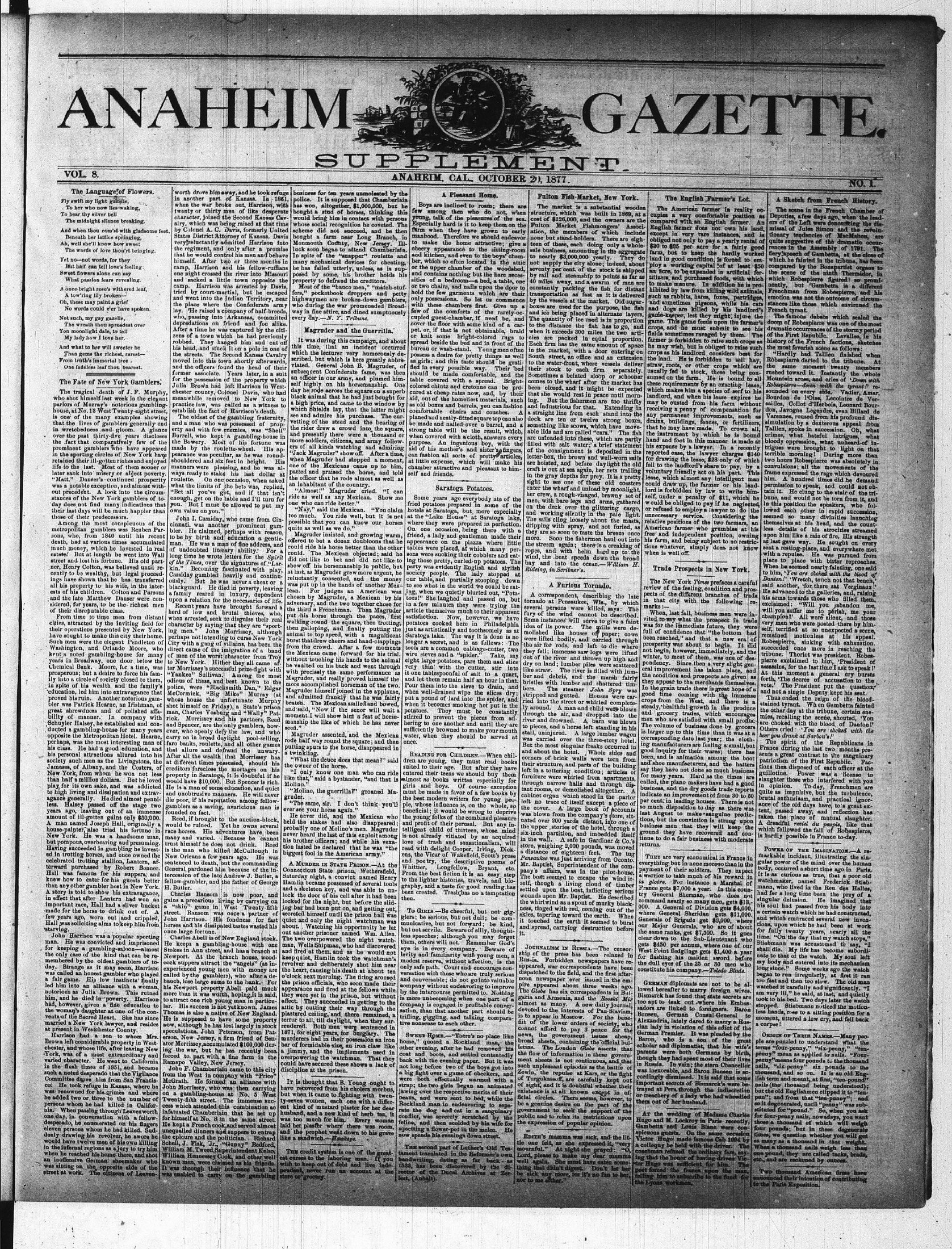
Searchable text
The Language of Flowers.
Fly swift my light gazelle,
To her who now lies waking,
To bear thy silver bell
The midnight silence breaking.
And when thou com'st with gladsome feet,
Beneath her lattice springing,
Ah, well she'll know how sweet
The words of love thou'rt bringing.
Yet no—not words, for they
But half can tell love's feeling:
Sweet flowers alone can say
What passion fears revealing.
A once-bright rose's wilthered leaf,
A tow'ring lily broken—
Oh, these may paint a grief
No words could e'er have spoken.
Not such, my gay gazelle,
The wreath thou spreadest over
Yon moonlight dale, to tell
My lady how I love her.
And what to her will sweeter be
Than gems the richest, rarest—
From truth's immortal tree
One fadeless leaf thou bearest.
The Fate of New York Gamblers.
The tragical death of J. F. Murphy,
who shot himself last week in the elegant parlors of Murray's notorious gambling-house, at No. 13 West Twenty-eight street,
is one of the many examples showing that the lives of gamblers generally end in wretchedness and gloom. A glance over the past thirty-five years discloses the fact that comparatively few of the prominent gamblers who have appeared in the sporting circles of New York have retained their ill-gotten riches and enjoyed worth drove him away, and he took refuge in another part of Kansas. In 1861, when the war broke out, Harrison, with twenty or thirty men of like desperate character, joined the Second Kansas Cavalry, which was being raised at that time by Colonel A. C. Davis, formerly United States District Attorney of Kansas. Davis very reluctantly admitted Harrison into the regiment, and only after a promise that he would control his men and behave himself. After two or three months in camp, Harrison and his fellow-ruffians one night crossed the river into Missouri and sacked a little town opposite the camp. Harrison was arrested by Davis, tried by court-martial, but he escaped and went into the Indian Territory, near the place where the Confederate army lay. He raised a company of half-breeds, who, passing into Arkansas, committed depredations on friend and foe alike. After a time he was captured by the citizens of a town which he had previously robbed. They hanged him and cut off his head, and stuck it on a pole in one of the streets. The Second Kansas Cavalry moved into this town shortly afterwards, and the officers found the head of their former associate. Years later, in a suit for the possession of the property which Julia Brown had left Harrison in Westchester county, Colonel Davis, who had meanwhile removed to New York to practice law, was called as a witness to establish the fact of Harrison's death.
The oldest of the gambling fraternity, and a man who was possessed of property and with few enemies, was "Shell" Burrell, who kept a gambling-house in the Bowery. Most of his fortune was made by the roulette-wheel. His appearance was peculiar, as he was round-shouldered and six feet in height. His business for ten years police. It is supposed has won, altogether, $ bought a stud of horse would bring him in cow whose social recognition scheme did not succeed bought a farm near Monmouth County, I luck soon began to attack In spite of the "anaphe many mechanical device he has failed utterly," posed by some, his property to defraud them.
Most of the "banco nfers," pocketbook drew highwaymen are broke who during the war prow way in fine attire, and every day.—N. Y. Trie
Magruder and tha
It was during this case this time, that an i which the lecturer very scribed, but which is h vlated. General John subsequent Confederate an officer in our army, self highly on his ho day he rode across the black animal that he ha a high price, and came which Shields lay, that see and admire his pu vetting of the steed and the rider drew a crowd and presently there were more soldiers, citizens, ers of all kinds watching "Jack Magruder" show when Magruder had sto
The Fate of New York Gamblers.
The tragical death of J. F. Murphy, who shot himself last week in the elegant parlors of Murray's notorious gambling house, at No. 13 West Twenty-eight street, is one of the many examples showing that the lives of gamblers generally end in wretchedness and gloom. A glance over the past thirty-five years discloses the fact that comparatively few of the prominent gamblers who have appeared in the sporting circles of New York have retained their ill-gotten riches and enjoyed life to the last. Most of them sooner or later sank into misery or object poverty.
"Matt." Daner's continued prosperity was a notable exception, and almost without precedent. A look into the circumstances of the New York gamblers of today does not find many indications that their last days will be much happier than those of their predecessors.
Among the most conspicuous of the metropolitan gamblers was Reuben Parsons, who, from 1840 until his recent death, had at various times accumulated much money, which he invested in real estate. But at length he went into Wall street and lost his fortune. His old partner, Henry Colton, was believed until recently to be wealthy, but legal proceedings have shown that he has transferred all his property to his wife, in the interests of his children. Colton and Parsons and the late Matthew Danser were considered, for years, to be the richest men of their disreputable class.
From time to time men from distant cities, attracted by the inviting field for their operations presented by New York, have sought to make this city their home. Such men were the elegant Pendleton of Washington, and Orlando Moore, who kept a noted gambling-house for many years in Broadway, one door below the Chemical Bank. Moore, for a time, was prosperous; but a desire to force his family into a circle of society closed to them, in spite of his wealth and the family's education, led him into extravagance that proved his ruin. Another notorious gambler was Patrick Hearne, an Irishman, of great shrewdness and of polished affability of manner. In company with Schuyler Halsey, he established and conducted a gambling-house for many years opposite the Metropolitan Hotel. Hearne, perhaps, was the most interesting man of his class. He had a good education, and his personal attractions allured into his society such men as the Livingstones, the Jameses, of Albany, and the Costers, of New York, from whom he won not less than half a million dollars. But he loved play for its own sake, and was addicted to high living and dissipation and extravagance generally. He died almost penniless. Halsey passed off the stage two years ago, leaving out of an immense amount of ill-gotten gains only $50,000.
A man named Joseph Hall, originally a house-painter, also tried his fortune in New York. He was a handsome man, but pompous, overbearing and presuming. Having succeeded in gambling he invested in trotting horses, and once owned the celebrated trotting stallion, Lantern, afterward purchased by Robert Bonner. Hall was famous for his suppers; and know how to cater for his guests better.
The oldest of the gambling fraternity, and a man who was possessed of property and with few enemies, was "Shell" Burrell, who kept a gambling-house in the Bowery. Most of his fortune was made by the roulette-wheel. His appearance was peculiar, as he was round-shouldered and six feet in height. His manners were pleasing, and he was always ready to stake his last dollar at roulette. On one occasion, when asked what the limits of the bets was, replied, "Bet all you've got, and if that isn't enough, get on the table and I'll turn for you. But I must be allowed to put my own value on you."
John I. Cassiday, who came from Cincinnati, was another prominent gambleer. He claimed, perhaps with reason, to be by birth and education a gentleman. He was a man of fine address, and of undoubted literary ability: For a long time he wrote letters for the Spirit of the Times, over the signatures of "Larkin." Becoming fascinated with play, Cassiday gambled heavily and continuously. But he was never a cheat or a blackguard. He died in poverty, leaving a family reared in luxury, dependent upon a relation for the necessities of life.
Recent years have brought forward a herd of low and brutal thieves, who, when arrested, seek to disguise their real character by saying that they are "sporting men." John Morrissey, although perhaps not intending to curse New York City with a gang of villains, has been the direct cause of the immigration of a band of men of the worst character from Troy to New York. Hither they all came after Morrissey's successful prize-fight with "Yankee" Sullivan. Among the most odious of these, and best known to the police, were "Blacksmith Dan," Edgar McCormick, "Big Mike" Murray (at whose house the unfortunate Murphy shot himself on Friday), a State's prison man, Charles Voaburg and "Wally" Patrick. Morrissey and his partners, Reed and Spencer, are the only gamblers, however, who openly defy the law, and who carry on in broad daylight pool-selling, faro banks, roulette, and all other games that allure and defraud the unwary. After all the wealth that Morrissey has at different times possessed, should his creditors foreclose the mortages on his property in Saratoga, it is doubtful if he would have $10,000. But Spencer is rich. He is a man of some education, and quiet and unobtrusive manners. He will never die poor, if his reputation among fellow gamblers as a saving, avaricious man is founded on fact.
Reed, if brought to the auction-block, would be ruined. Yet he owns several race horses. His adventures have been many and varied. Because he cannot trust himself he does not drink. Reed is the man who killed McCullough in New Orleans a few years ago. He was sentenced to death, but the commanding General pardoned him because of the intercession of the late Andrew J. Butler, a fellow-gambleer and the father of George
subsequent Confederates an officer in our army; self highly on his horse day he rode across the black animal that he had a high price; and came with which Shields lay; that see and admire his pufting of the steed and the rider drew a crowd; and presently there were more soldiers, citizens; ers of all kinds watching "Jack Magruder" show; when Magruder had stopped one of the Mexicans or patted and praised them; the officer that he rode in an inhabitant of the county.
"Almost!" Magruder ride as well as any Mexican one who can ride better.
"Nay," said the Mexican too much. You ride well possible that you can quite as well as we do."
Magruder insisted, and offered to bet a dozen dollars could ride his horse better could. The Mexican owner did not like to bet and showed off his horsemanship at last; as Magruder grew reluctantly consented; as was put up in the hands an Indian. For judges and chosen by Magruder, a adversary, and the two to the third a Frenchman.
Put his horse through walking-round the squash then galloping; and final animal to top speed; with burst that drew cheers and from the crowd. After the Mexican came forward without touching his hand he vaulted on his back and with precisely the same Magruder; and really pro- more accomplished horse Magruder himself joined him and admitted frankly that beaten. The Mexican smiled and said: "Now if she moment I will show him manship like of which seen."
Magruder assented; and rode half way round so putting spurs to the horse; a twinkling.
"What the deuce does this owner of the horse."
"I only know one man like that," said a bystander Molino."
"Molino, the guerrilla? gruder."
"The same, sir. I don't ever see your horse again."
He never did; and held the stakes had probably one of Molino's since he never heard the last of this his brother officers; and wition lasted he declared the biggest fool in the America...
play, for its own sake, and was addicted to high living and dissipation and extravagance generally. He died almost penniless. Halsey passed off the stage two years ago, leaving out of an immense amount of ill-gotten gains only $50,000. A man named Joseph Hall, originally a house-painter, also tried his fortune in New York. He was a handsome man, but pompous, overbearing and presuming. Having succeeded in gambling he invested in trotting horses, and once owned the celebrated trotting stallion, Lantern, afterward purchased by Robert Bonner. Hall was famous for his suppers, and knew how to cater for his guests better than any other gambler host in New York. A story is told to show his extravagance, in effect that after Lantern had won an important race, Hall had a silver bucket made for the horse to drink out of. A few years ago, worn out and crippled, Hall was soliciting alms to keep him from starving.
John Harrison was a popular sporting man. He was convicted and imprisoned for keeping a gambling-saloon—almost the only case of the kind that can be remembered by the oldest gamblers of today. Strange as it may seem, Harrison was called an honest gambler who played a fair game. His low instincts finally led him into an alliance with a woman, notorious as Julia Brown. This ruined him, and he died in poverty. Harrison had, however, given a fine education to the woman's daughter at one of the convents of the Sacred Heart. She has since married a New York lawyer, and resides at present in Westchester County.
Harrison had a son to whom Mrs. Brown left considerable property in Westchester, and whose life, after leaving New York, was of a most extraordinary and varied character. He went to California in the flush times of 1851, and became such a noted desperado that the Vigilance Committee drove him from San Francisco. He took refuge in Kansas, where he was renowned for his crimes and where he added two or three to the number of persons whom he had killed in California. When passing through Leavenworth one day, in conversation with a fellow-desperado, he enumerated on his fingers eleven persons whom he had killed. Suddenly drawing his revolver, he awore he would have twelve men of his own killing in the infernal regions as a jury to try him when he reached his home there, and shot an inoffensive German shoemaker who was sitting on the opposite side of the street at work. The citizens of Leavenwood is now poor, and gains a precarious living by carrying on a "skin" game in West Twenty-fifth street. Ransom was once a partner of John Harrison. His fondness for fast horses and his dissipated tastes wasted his once large fortune.
Charles Abell is of New England stock. He keeps a gambling-house with one Stokes in Ann street, and has a branch at Newport. At the branch house, wood-cock suppers attract the "angels" (as experienced young men with money are called by the gamblers), who after a debauch, lose large sums to the bank. For his Newport property Abell paid much more than it was worth, hoping it is said to attract one rich young man in particular. His success is not yet known. James Thomas is also a native of New England. He is supposed to have some property now, although he has lost largely in stock speculations. John Peterson, from Paterson, New Jersey, a firm friend of Senator Morrissey, accumulated $100,000 during the war, but he has recently been forced to part with a fine farm in the Ramapo Valley, New Jersey.
John F. Chamberlain came to this city from the West in company with "Price" McGrath. He formed an alliance with John Morrissey, who was then carrying on a gambling-house at No. 5 West Twenty-fifth street. The immense success which attended this combination so infatuated Chamberlain that he set up for himself at No. 8 in the same street. He kept a French cook, and served almost unequalled dinners and suppers to entrap the epileure and the politician. Richard Schell, J. Fik, Jr., "Gunny" Bedford, William M. Tweed, Superintendent Kelso, William Hennessy Cook, and other well-known men were claimed as his friends. It was through their influence that he was enabled to carry on the gambling.
He is a man of some education, and quiet and unobtrusive manners. He will never die poor, if his reputation among fellow-gamblers as a saving, avaricious man is founded on fact.
Reed, if brought to the auction-block, would be ruined. Yet he owns several race horses. His adventures have been many and varied. Because he cannot trust himself he does not drink. Reed is the man who killed McCullough in New Orleans a few years ago. He was sentenced to death, but the commanding General pardoned him because of the intercession of the late Andrew J. Butler, a fellow-gambler, and the father of George H. Butler.
Charles Ransom is now poor, and gains a precarious living by carrying on a "skin" game in West Twenty-fifth street. Ransom was once a partner of John Harrison. His fondness for fast horses and his dissipated tastes wasted his once large fortune.
Charles Abell is of New England stock. He keeps a gambling-house with one Stokes in Ann street, and has a branch at Newport. At the branch house, wood-cock suppers attract the "angels" (as experienced young men with money are called by the gamblers), who after a debauch, lose large sums to the bank. For his Newport property Abell paid much more than it was worth, hoping it is said to attract one rich young man in particular. His success is not yet known. James Thomas is also a native of New England. He is supposed to have some property now, although he has lost largely in stock speculations. John Peterson, from Paterson, New Jersey, a firm friend of Senator Morrissey, accumulated $100,000 during the war, but he has recently been forced to part with a fine farm in the Ramapo Valley, New Jersey.
John F. Chamberlain came to this city from the West in company with "Price" McGrath. He formed an alliance with John Morrissey, who was then carrying on a gambling-house at No. 5 West Twenty-fifth street. The immense success which attended this combination so infatuated Chamberlain that he set up for himself at No. 8 in the same street. He kept a French cook,and served almost unequalled dinners and suppers to entrap the epileure and the politician.
Richard Schell, J. Fik, Jr., "Gunny" Bedford, William M. Tweed,Superintendent Kelso William Hennessy Cook,and other wellknown men were claimed as his friends. It was through their influence that he was enabled to carry on the gambling.
He is a man of some education,and quiet and unobtrusive manners. He will never die poor, if his reputation among fellow-gamblers as a saving, avaricious man is founded on fact.
Reed, if brought to the auction-block,
would be ruined. Yet he owns several race horses.
His adventures have been many and varied.
Because he cannot trust himself he does not drink.
Reed is the man who killed McCullough in New Orleans a few years ago.
He was sentenced to death,但the commanding General pardoned him because of the intercession of the late Andrew J. Butler,a fellow-gambler,and the father of George H. Butler.
Charles Ransom is now poor,
and gains a precarious living by carrying on a "skin" game in West Twenty-fifth street.Ransom was once a partner of John Harrison.His fondness for fast horses and his dissipated tastes wasted his once large fortune.
Charles Abell is of New England stock.
He keeps a gambling-house with one Stokes in Ann street,and has a branch at Newport.At the branch house,wood-cock suppers attract the "angels"(as experienced young men with money are called by the gamblers),who after a debauch,Lose large sums to the bank.For his Newport property Abell paid much more than it was worth,hoping it is said to attract one rich young man in particular.His success is not yet known.James Thomas is also a native of New England.His supposed to have some property now although he has lost largely in stock speculations.John Peterson,从Paterson,新 Jersey,a firm friend of Senator Morrissey,accumulated $100,000 during the war,但he has recently been forced to part with a fine farm in the Ramapo Valley,新 Jersey.
John F. Chamberlain came to this city from the West in company with "Price" McGrath。他 formed an alliance with John Morrissey,他 was then carrying on a gambling-house at No. 5 West Twenty-fifth街.The immense success which attended this combination so infatuated Chamberlain that he set up for himself at No. 8在 same street。他 kept a French cook,and served almost unequalled dinners and suppers to entrap the epileure和the politician.Richard Schell,J.Fik,Jr.,"Gunny"Bedford,William M.Tweed,SuperintendentKelso,William Hennessy Cook,and other wellknownmen were claimed ashisfriends.它wasthrough their influencethathewasenabledtocarryonthegambling
He is a man of some education,and quiet and unobtrusive manners.他willneverdiepoor,ifhisreputationamongfellow-gamblersasa saving,avariciousmanisfoundonfact.
Reed,if broughttotheauction-block,
wouldberuined.YetheownseveredforthestakehadalsoprobablyoneofMolino'snereverheardthelastofthehisbrotherofficers;andwiltsitlongthelastofthehisbrotherofficers;andwiltsitlongthelastofthehisbrotherofficers;andwiltsitlongthelastofthehisbrotherofficers;andwiltsitlongthelastofthehisbrotherofficers;andwiltsitlongthelastofthehisbrotherofficers;andwiltsitlongthelastofthehisbrotherofficers;andwiltsitlongthelastofthehisbrotherofficers;andwiltsitlongthelastofthehisbrotherofficers;andwiltsitlongthelastofthehisbrotherofficers;andwiltsitlongthelastofthehisbrotherofficers;andwiltsitlongthelastofthehisbrotherofficers;andwiltsitlongthelastofthehisbrotherofficers;andwiltsitlongthelastofthehisbrotherofficers;andwiltsitlongthelastofthehisbrotherofficers;andwiltsitlongthelastofthehisbrotherofficors;andwiltsitlongthelastofthehisbrotherofficors;andwiltsitlongthelastofthehisbrotherofficors;andwiltsitlongthelastofthehisbrotherofficors;andwiltsitlongthelastofthehisbrotherofficors;andwiltsitlongthelastofthehisbrotherofficors;andwiltsitlongthelastofthehisbrotherofficors;andwiltsitlongthelastofthehisbrotherofficors;andwiltsitlongthelastofthehisbrotherofficors;andwiltsitlongthelastofthehisbrotherofficors;andwiltsitlongthelastofthehisbrotherofficors;andwiltsitlongthelastofthehisbrotherofficors;andwiltsitlongthelastofthehisbrotherofficors;andwiltsitlongthelastofthehisbrotherofficors;andwiltsitlongthelastofthehisbrotherofficors;andwiltsitlongthelastofthehisbrotherofficors;andwiltsitlongthelastofthehisbrotherofficors;andwiltsitlongthelastofthehisbrotherofficors;andwiltsitlongthelastofthehisbrotherofficors;andwiltsitlongthelastofthehisbrotherofficors;andwiltsitlongthelastofthehisbrotherofficors;andwiltsitlongthelastofthehisbrotherofficors;andwiltsitlongthelastofthehisbrotherofficors;andwiltsitlongthelastofthehisbrotherofficors;andwiltsitlongthelastofthehisbrotherofficors;andwiltsit长期tothehistoricalshootingatthispointinpresenttime.
It is thought that B.Youhave recoveredfrom hischairbutwhen它 cameto fightingty-seven women,eachoneentkindofmustardplasthusband,anda newkindofwastoo muchforhim.Ilaidherplasterwheretheyareandtheprophetwestdownlika sandwich.-Hawkkey.
The credit system is oneestcursesto-thelaboring wishtokeepoutof debtanpendant,neverrunanacoststoreor grocery."
IM GA
SUPPLEMENT.
ANAHEIM, CAL. OCTOBER 2), 1877.
business for ten years unmolested by the police. It is supposed that Chamberlain has won, altogether, $1,000,000, but he bought a sturd of horses, thinking this would bring him in contact with persons whose social recognition he coveted. The scheme did not succeed, and he then bought a farm near Long Branch, in Monmouth County, New Jersey. Illuck soon began to attend Chamberlain. In spite of the "snapper" roulette and many mechanical devices for cheating, he has failed utterly, unless, as is supposed by some, his brother holds his property to defraud the creditors.
Most of the "bauco men," "match-stuffers," pocketbook droppers and petty highwaymen are broken-down gamblers, who during the war promenaded Broadway in fine attire, and dined sumptuously every day.—N. Y. Tribune.
Magruder and the Guerrilla.
It was during this campaign, and about this time, that an incident occurred which the lecturer very humorously described, but which is here greatly abbreviated. General John B. Magruder, of subsequent Confederate fame, was then an officer in our army, and plumed himself highly on his horsemanship. One day he rode across the square on a superb black animal that he had just bought for a high price, and came to the window by which Shields lay, that the latter might see and admire his purchase. The curving of the steed and the bearing of the rider drew a crowd into the square, and presently there were a thousand or more soldiers, citizens, and army followers of all kinds watching and admiring "Jack Magruder" show off. After a time, when Magruder had stopped a moment, one of the Mexicans came up to him.
A Pleasant Home.
Boys are inclined to roam; there are few among them who do not, when young, talk of the pleasures of the sea. Especially hard is it to keep them on the farm when they have grown to early manhood. Therefore we should endeavor to make the home attractive; give a cheery appearance to the sitting-room and kitchen, and even to the boys' chamber, which so often located in the attic or the upper chamber of the woodshed, and contains nothing but the bare necessities of a bedroom—a bed, a table, one or two chairs, and nails upon the door to hold the few garments which are their only possessions. So let us commence with these chambers first. Give up a few of the comforts of the rarely-occupied guest-chamber, if need be, and cover the floor with some kind of a carpet, or, if that is not obtainable, braid or knit some bright-colored rugs to spread beside the bed and in front of the bureau or wash-stand. Young men often possess a desire for pretty things as well as girls; and this taste should be gratified in every possible way. Their bed should be made comfortable, and the table covered with a spread. Bright-colored chintz and cretonne can be procured at cheap rates now, and, by their aid, out of the homeliest materials, such as old boxes and barrels, you can fashion comfortable chairs and couches. A planed and neatly-fitted square top can also be made and nailed over a barrel, and a strong table will be the result, which, when covered with a cloth, answers every purpose. An ingenious boy, with the aid of his mother's and sister's fingers, can fashion all sorts of pretty articles, at little expense, which will make his business for ten years unmolested by the police. It is supposed that Chamberlain has won, altogether, $1,000,000, but he bought a sturd of horses, thinking this would bring him in contact with persons whose social recognition he coveted. The scheme did not succeed, and he then bought a farm near Long Branch, in Monmouth County, New Jersey. Illuck soon began to attend Chamberlain. In spite of the "snapper" roulette and many mechanical devices for cheating, he has failed utterly, unless, as is supposed by some, his brother holds his property to defraud the creditors.
Most of the "bauco men," "match-stuffers," pocketbook droppers and petty highwaymen are broken-down gamblers, who during the war promenaded Broadway in fine attire, and dined sumptuously every day.—N. Y. Tribune.
Magruder and the Guerrilla.
It was during this campaign, and about this time, that an incident occurred which the lecturer very humorously described, but which is here greatly abbreviated. General John B. Magruder, of subsequent Confederate fame, was then an officer in our army, and plumed himself highly on his horsemanship. One day he rode across the square on a superb black animal that he had just bought for a high price, and came to the window by which Shields lay, that the latter might see and admire his purchase. The curving of the steed and the bearing of the rider drew a crowd into the square, and presently there were a thousand or more soldiers, citizens, and army followers of all kinds watching and admiring "Jack Magruder" show off. After a time, when Magruder had stopped a moment, one of the Mexicans came up to him.
Fulton Fish-Market, New York.
The market is a substantial wooden structure, which was built in 1869, at a cost of $126,000, and the owners are the Fulton Market Fishmongera' Association, the members of which include none but stand-holders. There are eighteen of these each doing only a wholesale business, amounting in the aggregate to nearly $3,000,000 yearly. They do not supply the city alone; indeed, about seventy per cent. of the stock is shipped by rail and steamship to points as far as 40 miles away, and a swarm of men are constantly packing the fish for distant transportation as fast as it is delivered by the vessels at the market. Old sugar-boxes are used for the purpose,the fish and ice being placed in alternate layers. The quantity of ice used is in proportion to the distance the fish has to go,and when it exceeds 300 miles the two articles are packed in equal proportion. Each firm has the same amount of space in the market,with a door entering on South street,a office and an extension to the water-front where vessels deliver their stock to each firm separately.Sometimes a belated sloop or schooner comes to the wharf after the market has been closed,and it might be expected that she would rest in peace until morning. But the fishermen are too thrifty and industrious for that.Extending in a straight line from each stand into the dock are ten or twelve strong boxes,something like scowswhich have moveable lids and are called "cars." The fish are unloaded into thesewhich are partly filled with salt water;"a brief statement of the consignment is deposited in the letter-box,the brown and well-worn saills are hoisted,and before daylightthe old crops,and fields some farmer is he may wipe crops as lauded.The crops,and fields some farmer is he may wipe crops as lauded.The crops,and fields some farmer is he may wipe crops as lauded.The crops,and fields some farmer is he may wipe crops as lauded.The crops,and fields some farmer is he may wipe crops as lauded.The crops,and fields some farmer is he may wipe crops as lauded.The crops,and fields some farmer is he may wipe crops as lauded.The crops,and fields some farmer is he may wipe crops as lauded.The crops,and fields some farmer is he may wipe crops as lauded.The crops,and fields some farmer is he may wipe crops as lauded.The crops,and fields some farmer is he may wipe crops as lauded.The crops,and fields some farmer is he may wipe crops as lauded.The crops,and fields some farmer is he may wipe crops as lauded.The crops,and fields some farmer is he may wipe crops as lauded.The crops,and fields some farmer is he may wipe crops as lauded.The crops,and fields some farmer is he may wipe crops as lauded.The crops,and fields some farmer is he may wipe crops as lauded.The crops,and fields some farmer is he may wipe crops as lauded.The crops,and fields some farmer is he may wipe crops as lauded.The crops,and fields some farmer is he may wipe crops as lauded.The crops,and fields some farmer is he may wipe crops as lauded.The crops,and fields some farmer is he may wipe crops as lauded.The crops,and fields some farmer is he may wipe crops as lauded.The crops,and fields some farmer is he may wipe crops as lauded.The crops,and fields some farmer is he may wipe crops as lauded.The crops,and fields some farmer is he may wipe crops as lauded.The crops,and fields some farmer is he may wipe crops as lauded.The crops,and fields some farmer is he may wipe crops as lauded.The crops,and fields some farmer is he may wipe crops as lauded.The crops,and fields some farmer is he may wipe crops as lauded.The crops,and fields some farmer is he may wipe crops as lauded.The crops,and fields some farmer is he may wipe crops as lauded.The crops,and fields some farmer is he may wipe crops as lauded.The crops,and fields some farmer is he may wipe crops as lauded.The crops,and fields some farmer is he may wipe crops as lauded.The cropsonhe may wipe crops as lauded.The cropsonhe may wipe crops as lauded.The cropsonhe may wipe crops as lauded.The cropsonhe may wipe crops as lauded.The cropsonhe may wipe crops as lauded.The cropsonhe may wipe crops as lauded.The cropsonhe may wipe crops as lauded.The cropsonhe may wipe crops as lauded.The cropsonhe may wipe
subsequent Confederate fame, was then an officer in our army, and plumed himself highly on his horsemanship. One day he rode across the square on a superb black animal that he had just bought for a high price, and came to the window by which Shields lay, that the latter might see and admire his purchase. The curving of the steed and the bearing of the rider drew a crowd into the square, and presently there were a thousand or more soldiers, citizens, and army followers of all kinds watching and admiring "Jack Magruder" show off. After a time, when Magruder had stopped a moment, one of the Mexicans came up to him, patted and praised the horse, and told the officer that he rode almost as well as an inhabitant of the country.
"Almost!" Magruder cried. "I can ride as well as any Mexican. Show me one who can ride better."
"Nay," said the Mexican. "You claim too much. You ride well, but it is not possible that you can know our horses quite as well as we do."
Magruder insisted, and growing warm, offered to bet a dozen doubloons that he could ride his horse better than the other could. The Mexican objected; said he did not like to bet and did not like to show off his horsemanship in public, but at last, Magruder grew more urgent, he reluctantly consented, and the money was put up in the hands of another Mexican. For judges an American was chosen by Magruder, a Mexican by his adversary, and the two together chose for the third a Frenchman. Then Magruder put his horse through the paces, first walking round the square, then trotting, then galloping, and finally putting the animal to top speed, with a magnificent burst that drew cheers and hand-clappings from the crowd. After a few moments the Mexican came forward for his trial without touching his hands to the animal he vaulted on his back and went through with precisely the same performance as Magruder, and really proved himself the more accomplished horseman of the two. Magruder himself joined in the applause, and admitted frankly that he was fairly beaten. The Mexican smiled and bowed, and said, "Now if the senor will wait a moment I will show him a feat of horsemanship like of which he has never seen."
Magruder assented, and the Mexican rode half way round the square; and then putting spurs to the horse, disappeared in a twinkling.
"What the deuce does that mean?" said the owner of the horse.
"I only know one man who can ride like that," said a bystander, "and that is Molino."
"Molino, the guerrilla?" groaned Magruder.
"The same, sir. I don't think you'll ever see your horse again."
He never did, and the Mexican who held the stakes had also disappeared; probably one of Molino's men. Magruder never heard the last of this exploit among his brother officers; and while his vexation lasted he declared that he was "the biggest fool in the American army."
A Murder In State Prison.—At the Connecticut State prison, Wethersfield, Saturday night, a convict named Henry Hamlin became possessed of every possible way. Their bed should be made comfortable, and the table covered with a spread. Bright-colored chintz and cretonne can be procured at cheap rates now, and, by their aid, out of the homeliest materials, such as old boxes and barrels, you can fashion comfortable chairs and couches. A planed and neatly-fitted square top can also be made and nailed over a barrel, and a strong table will be the result, which, when covered with a cloth, answers every purpose. An ingenious boy, with the aid of his mother's and sister's fingers, can fashion all sorts of pretty articles, at little expense, which will make his chamber attractive and pleasant to himself and friends.
Saratoga Potatoes.
Some years ago everybody ate of the fried potatoes prepared in some of the hotels at Saratoga, but more especially at the "Lake House" at Saratoga lake, where they were prepared in perfection. On one occasion, being there with a friend, a lady and gentleman made their appearance on the piazza where little tables were placed, at which many persons were sucking their cobblers and eating those pretty, curled-up potatoes. The party was evidently English and stylish society people. The lady stopped at our table, and partially stooping down to see what in the world we could be eating, when we quietly blurted out, "Potatoes!" She laughed and passed on, but in a few minutes they were trying the article themselves much to their apparent satisfaction. Now, however, we have potatoes cooked here in Philadelphia just as artistically and toothsomely as at Saratoga lake. The way it is done is no longer a secret, and is as follows: The tools are a common cabbage-cutter, two wire sieves and a "spider." Take, say eight large potatoes, pare them and slice very thin with the cutter, stir into it one tablespoonful of salt to a quart, and let them remain half an hour in that. Pour them into the sieve to drain, and when well-drained wipe the slices dry; put a pound of lard into the spider, and when it becomes smoking hot put in the potatoes. They must be constantly stirred to prevent the pieces from adhering to one another and until they are sufficiently browned to make your mouth water, when they should be served at once.
READING FOR CHILDREN.—When children are young, they must read books suited to their age. But after they have entered their teens we should buy them almost no books written especially for girls and boys. Of course exception must be made in favor of a few books by the best modern writers for young people, whose influence is, on the whole, so beneficial; it would be wrong to deprive the young folks of the combined pleasure and profit of their perusal. But any intelligent child of thirteen, whose mind is not already viiated by an acquired love of trash and sensationalism, will read with delight Cooper, Irving, Dickens, the Vicar of Wakefield, Scott's prose and poetry, the descriptive poems of Whittier, Longfellow, Bryant, etc. From the best fiction it is an easy step to the lighter histories, travels, and bio-techniques of Oconto. Mr. Baptist, Superintendent of company's affairs, was in the pilot-house. The boat seemed to escape the wind it usually fills summed up these requests which may landlord may be able to receive any permits drains but that he may instruct handlers his expenses reported for drawing fall to voluntary lease which could draw lord is for self under would be refused unnecessary relative power American free and his farm actions when is wise.
A Furious Tornado.
A correspondent describing the late tornado at Pensaukee, Wis., by which several persons were killed says: The fury of the wind cannot be described. Some instances will serve to give a faint idea of its power. The mills were demolished like houses off paper; cows were lifted bodily, and carried through the air for rods, and left to die where they fell; immense saw logs were lifted out of the river and thrown up high and dry on land; lumber piles were scattered like straw. The river is filled with lumber and debris, and the marsh fairly bristles with lumber and shattered timbers. The steamer John Spry was stripped and gutted. Houses were carried into the street or whirled completely around. A man and child were blown through the air, and dropped into the river and drowned. A barn was blown to pieces, and a horse left standing in his stall, uninjured. A large lumber wagon was carried over the three-story hotel. But most singular freaks occurred in and about the hotel. Whole sides and corners of brick walls were torn from their structure,and parts of the building left in a tottering condition;articles of furniture were whirled from apartments,trough narrow halls and through distant rooms,或demolished altogether.A cabinet organ which stood in the parlor left no trace of itself except a piece of the cover.A large book of accounts was blown from the company's store,situated over 200 yards distant,into one of the upper stories of the hotel,thea six-inch partition,and imbedded itself in the wall.A safe in Gardiner & Co.'s store weighing 2,000 pounds was moved a distance of eighteen feet.The tug Pensaukee was just arriving from Oconto.Mr.Baptist,Superintendent of company's affairs,a was in the pilot-house.The boat seemed to escape the wind it usually fills summed up these requests which may landlord may be able to receive any permits drains but that he may instruct handlers his expenses reported for drawing fall to voluntary lease which could draw lord is for self under would be or refused unnecessary relative power American free and his farm,a his farm,a when is wise.
Trade
The New review of these aspects in that city marks:
When,Lawn vided to save was for that full of comeback prosperity not begin winter,pondency,eal improvethe conditions they appear.In the grain good time crops from steady,bear,and grocer men who are indicate an part cent so much disasters last August tions,but this business men ground theyinue to do returns.
THE ARE EVERYthing b paymentofa warrior tola glaire
Molino."
"Molino, the guerrilla?" groaned Magruder.
"The same, sir. I don't think you'll ever see your horse again."
He never did, and the Mexican who held the stakes had also disappeared; probably one of Molino's men. Magruder never heard the last of this exploit among his brother officers; and while his vexation lasted he declared that he was "the biggest fool in the American army."
A Murder in State Prison.—At the Connecticut State prison, Wethersfield, Saturday night, a convict named Henry Hamlin became possessed of several tools and a skeleton key, and was able to unlock the door of his cell after it had been locked for the night, but before the sliding bar had been put on, and getting out, secreted himself until the prison hall was quiet and only the night watchman was about. Watching his opportunity he let out another prisoner named Wm. Allen. The two overpowered the night watchman, Wells Shipman, who had discovered and fired at them, and as he would not keep quiet, Hamlin took the watchman's revolver and deliberately shot him near the heart, causing his death at about ten o'clock next morning. The firing aroused the prison officials, who soon made their appearance and fired at the fellows while they were yet in the prison, but without effect. They succeeded in getting to the attic by cutting their way through the plastered ceiling, and there remained, a terror to all, till daylight, when they surrendered. Both men were sentenced in 1871, for eight years, for burglary. The murders had in their possession an iron bar of formidable size, an iron claw like a jimmy, and the implements used in overpowering the watchman. That they could have secured these shows a lack of discipline at the prison.
It is thought that B. Young ought to have recovered from his cholera morbus, but when it came to fighting with twenty-seven women, each one with a different kind of mustard plaster for her dear husband, and a new kind of herb taz, it was too much for him. Every woman laid her plaster where there was room, and the prophet went down to his grave like a sandwich.—Hawkeye.
The credit system is one of the greatest curses to the laboring man. If you wish to keep out of debt and live independent, never run an account at the store or grocery.
Of course exception must be made in favor of a few books by the best modern writers for young people, whose influence is, on the whole, so beneficial; it would be wrong to deprive the young folks of the combined pleasure and profit of their perusal. But any intelligent child of thirteen, whose mind is not already vitiated by an acquired love of trash and sensationalism, will read with delight Cooper, Irving, Dickens, the Vicar of Wakefield, Scott's prose and poetry, the descriptive poems of Whittier, Longfellow, Bryant, etc. From the best fiction it is an easy step to the lighter histories, travels, and biography, and a taste for good reading has been created. Trash has no a temptation then.
To Girls.—Be cheerful, but not gigglers; be serious, but not dull; be communicative, but not forward; be kind, but not servile. Beware of silly, thoughtless speeches; although you may forget them, others will not. Remember God's eye is in every company. Beware of levity and familiarity with young men, a modest reserve, without affection, is the only safe path. Court and encourage conversation with those who are truly serious and conversable; do not go into valuable company without endeavoring to improve by the intercourse permitted to. Nothing is more unbecoming when one part of a company is engaged in profitable conversation, than that another part should be trifling, giggling, and talking comparative nonsense to each other.
Sweet Home.—"There's no place like home," quoted a Rockland man, the other evening, after he had removed his coat and boots, and settled contentedly back with the evening paper. But it was not long before two of the boys got into a big fight over a game of checkers, and were both effectually warmed with a strap; the two girls began an animated jawing over the respective merits of their beans, and were sent to bed, while the Rockland man in endeavoring to separate the dog and cat in a sanguinary conflict, was severely scratched by the feline, and then scolded by his wife for upsetting a flower-pot in the melen. He now spends his evenings down street.
The second part of Luther's Old Testament translated in the Reformer's own handwriting, dating as far back as 1523, has been discovered by the director of the Ducal Archives at Zerlest (Anhelt).
Journalism in Russia.—The censorship of the press has been relaxed in Russia. Forbidden newspapers have appeared, war correspondents have been dispatched to the field, and the first afternoon newspaper ever issued in the empire appeared about three weeks ago. The Globe has six correspondents in Bulgaria and Armenia, and the Rooski Mir almost as many. A new daily journal devoted to the interests of Pan-Slavism is to appear in Moscow. For the benefit of the lower orders of society, who cannot afford to pay 3 pence for the news, the government issues cheap, broad sheets containing the official bulletins. The London Globe asserts that the flow of information in these government sheets is not continuous, and that such unpleasant episodes as the battle of Zewin, the repulse at Kars, or the fight of Turgukassoff, are carefully kept out of sight, and it is doubtful whether their existence is at all known except in official circles. There seems however, to be a genuine desire on the part of the government to seek the support of the public and to relax its restrictions upon the expression of popular opinion.
Edwin's mamma was sick, and the little one felt as she expressed it: "very mournful." At night she prayed: "O Lord, please to make my dear mamma well again. She must have eaten something that didn't digest. Don't let her be sick any more; it's no fun to her nor to me either."
GAZETTE.
NO. 1.
At New York.
Abstantial wooden built in 1869, at a house owners are the mongers' Association which include there are eighting only a whole farm in the aggregate nearly. They do not indeed, about stock is shipped two points as far as warm of men are fish for distant market. Old sugar-purpose, the fish alternate layers is in proportion has to go, and makes the two artificial proportion. Amount of space door entering on and extension vessels deliver farm separately. Hop or schooner the market has right be expected peace until morning are too thrifty Extending in stand into the strong boxes, which have move-cars." The fish which are partly brief statement deposited in the well-worn sails daylight the old
The English Farmer's Lot.
The American farmer in reality occupies a very comfortable position as compared with an English farmer. An English farmer does not own his land, except in very rare instances, and is obliged not only to pay a yearly rental of $20 to $25 per acre for a fairly good farm, but to keep the hardly worked land in good condition, is forced to employ a working capital of at least $50 an acre, to be expended in artificial fertilizers, and purchased foods, with which to make manure. In addition he is prohibited by law from killing wild animals, such as rabbits, hares, foxes, partridges, and sometimes pigeons, while his cats and dogs are killed by his landlord's game-keeper, lest they might; injure the game. This game feeds upon the farmer's crops, and he must submit to see his fields sometimes ravaged by them. The farmer is forbidden to raise such crops as he may wish, but is obliged to raise such crops as his landlord considers best for the land. He is forbidden to sell hay, straw, roots, or other crops which are usually fed to stock, these being consumed on the farm. He is bound to all these requirements by an exacting lease, which makes him a species of serf to his landlord, and when his lease expires he may be ousted from his farm without receiving a penny of compensation for any permanent improvements, such as drains, buildings, fences, or fertilizers, that he may have made. To crown all, the instrument by which he is bound hand and foot in this manner is made at his expense by a lawyer. In a recently reported case, the lawyer charges $140 for drawing the lease; $28 only of which fell to the landlord's share to pay him.
A Sketch from French History.
The scene in the French Chamber of Deputies, a few days ago, when the leaders of the Left were denouncing the dismissal of Jules Simon and the revolutionary tendencies of MacMahon, are quite suggestive of the dramatic occurrences in the Assembly of 1791. The fiery speech of Gambetta, at the close of which he fauntled in the tribune, has been compared by the Bonapartist organs to the scene of the ninth Thermidor, in which Robespierre figured! so prominently, but 'Gambetta is a different Frenchman from Robespierre, and his emotion was not the outcome of circumstances like those which environed the French tyrant.
The famous debate which sealed the doom of Robespierre was one of the most dramatic occurrences of the stormy period of the First Republic. Lawallee, in his history of the French factions, sketches the most feverish scene as follows:
"Hardly had Tallien finished when Robespierre darted to the tribune. At the same moment twenty members rushed toward it. Instantly the whole Mountain arose, and cries of 'Down with Robespierre—down with the tyrant!' resounded on every side. Vadier, Amar, Bourdon de l'Oise, Lecointe de Versailles, Collot d'Herbola, Leonard Bourdon, Javogne Legendre, even Billard de Varennes, roused from his profound dissimulation by a dexterous appeal from Tallien, spoke in succession. Oh, what crimes, what hateful intrigues, what bloody oppression, what unheard-of intrigues were brought to light on that terrible morning! During more than two hours Robespierre was absolutely in convulsion."
Trade Prospects in New York.
The New York Times prefaces a careful review of the feeling, condition and prospects of the different branches of trade in that city with the following remarks:
When, last fall, business men were invited to say what the prospect in trade was for the immediate future, they were full of confidence that "the bottom had been reached," and that a new era of prosperity was about to begin. It did not begin, however, immediately, and the winter, to most of them, was one of despondency. Since then a very slight general improvement has taken place, and the condition and prospects are given as they appear to the merchants themselves. In the grain trade there is great hope of a good time coming with the immense crops from the West, and there is a steady, healthful growth in the produce and grocery trades, which encourages men who are satisfied with small profits. The volume of business done by grocers is larger up to this time than it was at a corresponding date last year; the clothing manufacturers are feeling a small, but good inquiry for their wares; there has been, and is animation among the boot and shoe manufacturers, and the hatters say they have not done so much business for many years. Hard as the times are called, the piano makers have had a good business, and the dry goods trade reports indicate an improvement of from 30 to 50 per cent: in leading houses. There is not so much disposition to day as there was last August to make sanguine predictions, but the conviction is strong upon business men that they will keep the ground they have recovered and continue to do a fair business with moderate returns.
They are very economical in France in everything but in none more so than in the payment of their soldiers. They expect a warrior to take much of his reward in la glaire. For instance, a Marquis of usually fed to stock, these being consumed on the farm. He is bound to all these requirements by an exact lease, which makes him a species of serf to his landlord, and when his lease expires he may be ousted from his farm without receiving a penny of compensation for any permanent improvements, such as drains, buildings, fences, or fertilizers, that he may have made. To crown all, the instrument by which he is bound hand and foot in this manner is made at his expense by a lawyer. In a recently reported case, the lawyer charges $140 for drawing the lease; $28 only of which fell to the landlord's share to pay, by a voluntary friendly act on his part. This lease, which almost any intelligent man could draw up, the farmer or his landlord is forbidden by law to write himself under a penalty of $11, which he would be obliged to pay if he neglected, or refused to employ a lawyer to do the unnecessary service. Considering the relative positions of the two farmers, an American farmer who grumbles at his free and independent position, owning his farm, and being subject to no restrictions whatever, simply does not know when is well off.
Trade Prospects in New York.
The New York Times prefaces a careful review of the feeling, condition and prospects of the different branches of trade in that city with the following remarks:
When, last fall, business men were invited to say what the prospect in trade was for the immediate future, they were full of confidence that "the bottom had been reached," and that a new era of prosperity was about to begin. It did not begin, however, immediately, and the winter, to most of them, was one of despondency. Since then a very slight general improvement has taken place, and the condition and prospects are given as they appear to the merchants themselves. In the grain trade there is great hope of a good time coming with the immense crops from the West, and there is a steady, healthful growth in the produce and grocery trades, which encourages men who are satisfied with small profits. The volume of business done by grocers is larger up to this time than it was at a corresponding date last year; the clothing manufacturers are feeling a small, but good inquiry for their wares; there has been, and is animation among the boot and shoe manufacturers, and the hatters say they have not done so much business for many years. Hard as the times are called, the piano makers have had a good business, and the dry goods trade reports indicate an improvement of from 30 to 50 per cent: in leading houses. There is not so much disposition to day as there was last August to make sanguine predictions, but the conviction is strong upon business men that they will keep the ground they have recovered and continue to do a fair business with moderate returns.
Power of the Imagination.-A remarkable incident, illustrating the singular power of the mind over the human body, occurred a short time ago in Paris. It is as curious as true, that a poor old watchmaker, named Frederick Stisha-
THEY are very economical in France in everything but in none more so than in the payment of their soldiers. They expect a warrior to take much of his reward in la gloire. For instance a Marshal of France gets $7,000 a year. In this country General Sherman, who does not command nearly so many men, gets $13,000. A General of Division gets $4,000, where General Sheridan gets $11,000. Generals of Brigade get $3,000, where our Major Generals, who are of about the same ranks, get $7,500. So it goes clear down to the Sub-Lieutenant who gets $450 per annum, where one of our West Point fledglings gets $1,400 a year for flashing his maiden sword before the dull eyes of the 25 or 30 men who constitute his company.—Toledo Blade.
GERMAN diplomats are not to be allowed hereafter to marry foreign wives. Bismarck has found that state secrets are too apt to leak out where his Embassadors are linked to foreigners. Baron Bunsen, German Consul-General to Alexandria, lately dared to marry a Russian lady in violation of this edict of the German Premier. It was pleaded by the Baron, who is a son of the great scholar and diplomatist, that his wife's parents were both Germans by birth, though they had spent most of their lives in Russia. In vain; the stern Chancellor was inexorable, and Baron Bunsen is accordingly dismissed. It is said that some important secrets of Bismarck's were betrayed at Pera through the indiscretion or treachery of a lady who had wheeled them out of her husband.
At the wedding of Madame Charles Hugo and M. Lockroy in Paris recently, Gambetta and Louis Blanc were conspicuous guests. On the same occasion Victor Hugo made famous Cab 1094 by a colloquy he held with the driver. The coachman refused the ordinary fare, saying that the honor of having driven Victor Hugo was sufficient for him. The post forced the frames upon the man, telling him to subscribe to the fund for the Lyons workman.
POWER OF THE IMAGINATION.—A remarkable incident, illustrating the singular power of the mind over the human body, occurred a short time ago in Paris. It is as curious as true, that a poor old watchmaker, named Frederick Stiebmann, who lived in the Reu des Halles, had for a long time been the prey of a singular delusion. He imagined that his soul had passed from his body into a certain watch which he had constructed, and which embraced several new inventions, upon which he had been at work for fully twenty years, nearly all the time. "On the day that my watch stops," Stiebmann was accustomed to say, "I shall die. My life has become subordinate to that of the watch. My soul left my body and entered into its mechanism long since." Some weeks ago the watch began to run irregularly, at first it ran too fast and then too slow. The old man watched it carefully and significantly. "I am very ill," he said, at last, and quietly took to his bed. Two days later the watch stopped. Stiebmann noticed the motionless hands, rose to a sitting position for a moment, uttered a low cry, and fell back a corpse!
ORIGIN OF THEIR NAMES.—Many people are puzzled to understand what the terms "four-penny," "six-penny," "ten-penny" mean as applied to nails. "Four-penny" means four pounds to the thousand nails, "six-penny" six pounds to the thousand, and so on. It is an old English term and meant at first, "ten-pound" nails (the thousand being understood); but the old Englishmen clipped it to "ten-pun"; and from that "ten-punny"; and so it degenerated, until "penny" was substituted for "pound." So, when you ask for four-penny nails, nowadays, you want those a thousand of which will weigh four pounds; but in these degenerate times, we question whether you will get as many as a thousand in that weight. When a thousand nails weigh less than one pound, they are called tacks, brads, etc., and are reckoned by ounces.
Two thousand American firms have announced their intention of contributing to the Paris Exposition.