anaheim-gazette 1877-10-13
Scanned page
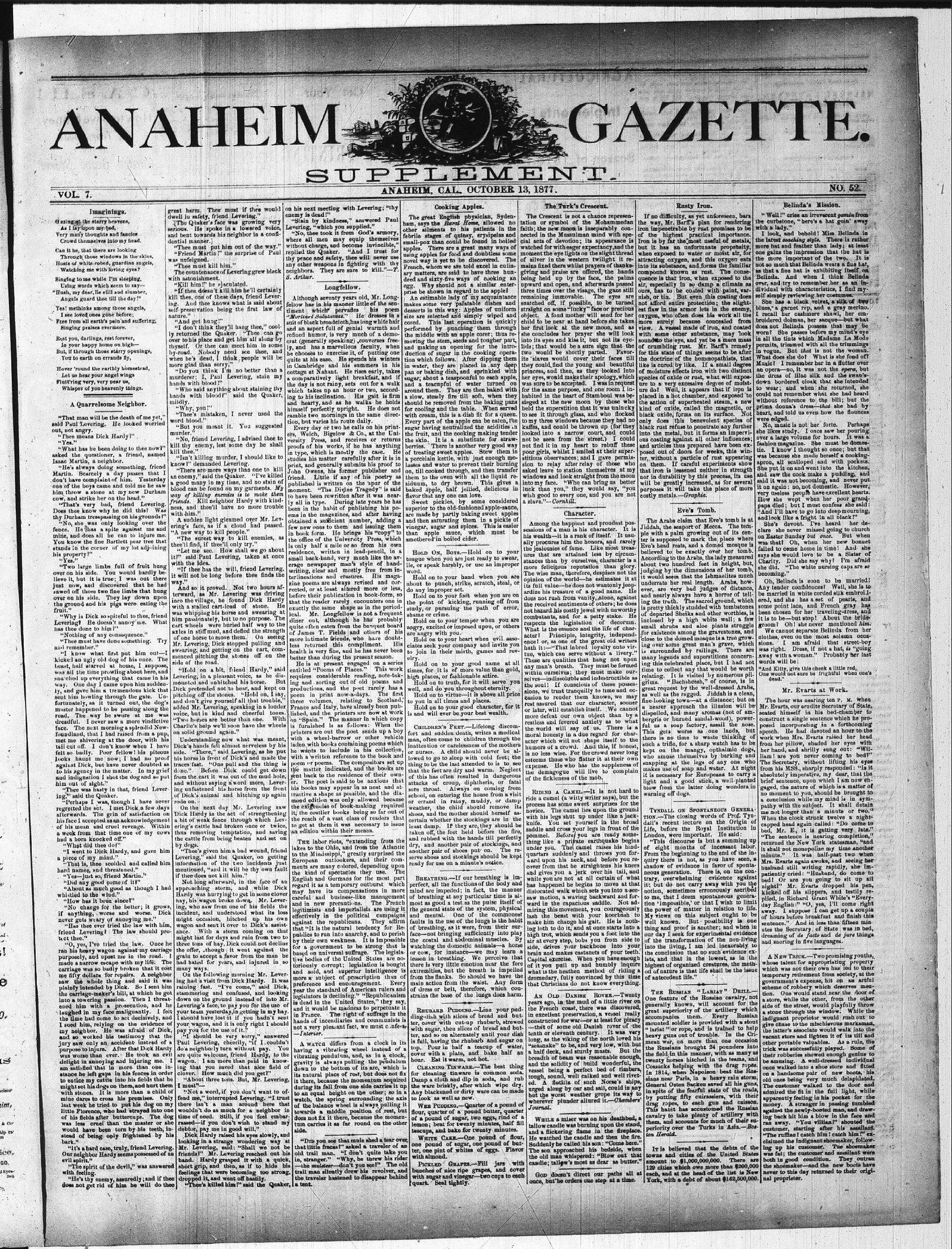
Searchable text
ANAHEIM
VOL 7.
Imaginations.
Gazing at the starry heavens,
As I lay upon my bed,
Very many thoughts and fancies
Crowd themselves into my head.
Can it be, that there are looking
Through those windows in the skies,
Hosts of white-robed, guardian angels,
Watching me with loving eyes?
Singing to me while I'm sleeping,
Using words which seem to say—
"Hush, my dear, lie still and slumber,
Angels guard thee till the day!"
Yes! methinks among those angels,
I see loved ones gone before;
Free from all earth's pain and suffering,
Singing praises evermore.
Rest you, darlings, rest forever,
In your happy home on high—
But, if through those starry openings,
You to earth on errands fly,
Hover 'round the earthly homestead,
Let us hear your angel wings
Flutt'ring very, very near us,
Whisper of yon heavenly things.
A Quarrelsome Neighbor.
"That man will be the death of me yet," said Paul Levering. He looked worried out, not angry.
"Thee means Dick Hardy?"
"Yes."
"What has he been doing to thee now?" asked the questioner, a friend, named Isaac Martin, a neighbor.
great harm. Thee must if thee would dwell in safety, friend Levering."
[The Qiaker's face was growing very serious. He spoke in a lowered voice, and bent towards his neighbor in a confidential manner.]
"Thee must put him out of the way."
"Friend Martin!" the surprise of Paul was unfeigned.
"Thee must kill him."
The countenance of Levering grew black with astonishment.
"Kill him!" he ejaculated.
"If thee doesn't kill him he'll certainly kill thee, one of these days, friend Levering. And thee knows what is said about self-preservation being the first law of nature."
"And get hung!"
"I don't think they'll hang thee," coolly returned the Quaker. "Thee can go over to his place and get him all along by thyself. Or thee can meet him in some by-road. Nobody need see thee, and when he's dead, I think people will be more glad than sorry."
"Do you think I'm no better than a murderer; I, Paul Levering, stain my hands with blood!"
"Who said anything about staining thy hands with blood?" said the Quaker, mildly.
"Why, you!"
"Thee's mistaken, I never used the word blood."
"But you meant it. You suggested murder."
"No, friend Levering, I advised thee to kill thy enemy, lest some day he shall kill thee."
"Isn't killing murder, I should like to know?" demanded Levering.
on his next meeting with an enemy is dead!
"Slain by kindness," Levering, "which you supNo, thee took it from where all men may equate without charge, and become replied the Quaker." "A thy peace and safety, then any other weapons in fight neighbors. They are surS. Arthur.
Longfellow
Although seventy years fellow has in his manner timent which pervade "Morttart Balutamus," suit of black broadcloth, hat and an aspect full of genial refined humor, is very mcrat (generally speaking) ly, and has a marvellous he chooses to exercise it quite at his ease. He spends in Cambridge and his cottage at Nahant. He is comparatively light but the day is not rainy, sets which takes up an hour ing to his inclination. He and hearty, and as he himself perfectly upright ramble two mornings in tion, but varies his route.
Every day or two he caers, Welch, Bigelow & university Press, and recovers proofs of his works, if in type, which is mostly studies his matter caref- print and generally sub
A Quarrelsome Neighbor.
"That man will be the death of me yet," said Paul Levering. He looked worried out, not angry.
"Thee means Dick Hardy?"
"Yes."
"What has he been doing to thee now?" asked the questioner, a friend, named Isaac Martin, a neighbor.
"He's always doing something, friend Martin. Scarcely a day passes that I don't have complaint of him. Yesterday one of the boys came and told me he saw him throw a stone at my new Durham cow, and strike her on the head."
"That's very bad, friend Levering. Does thee know why he did this? Was thy Durham trespassing on his grounds?"
"No, she was only looking over the fence. He has a spite against me and mine, and does all he can to injure me. You know the fine Bartlett pear tree that stands in the corner of my lot adjoining his property?"
"Yes."
"Two large limbs full of fruit hung over on his side. You would hardly believe it, but it is true; I was out there just now, and discovered that he had sawed off those two fine limbs that hung over on his side. They lay down upon the ground and his pigs were eating the fruit."
"Why is Dick so spiteful to thee, friend Levering? He doesn't annoy me. What has thee done to him?"
"Nothing of any consequence."
"Thee must have done something. Try and remember."
"I know what first put him out—I kicked an ugly old dog of his once. The beast, half starved at home, I suppose, was all the time prowling about here, and snatched up everything that came in his way. One day I came upon him suddenly, and gave him a tremendous kick that sent him howling through the gate. Unfortunately, as it turned out, the dog's master happened to be passing along the road. The way he swore at me was dreadful. I never saw a more vindictive face. The next morning a splendid Newfoundland, that I had raised from a pup, met me shivering at the door, with his tail cut off. I don't know when I have felt so badly. Poor fellow! his piteous looks haunt me now; I had no proof against Dick, but have never doubted as to his agency in the matter. In my grief and indignation I shot the dog and so put him out of sight."
"Thee was hasty in that, friend Levering," said the Quaker.
"Perhaps I was, though I have never regretted the act. I met Dick a few days afterwards. The grin of satisfaction on his face I accepted as an acknowledgement of his mean and cruel revenge. Within a week from that time one of my cows had a horn knocked off."
"What did thee do?"
"I went to Dick Hardy, and gave him a piece of my mind."
"That is, thee scolded and called him hard names, and threatened."
"Yes—just so, friend Martin."
"Did any good come of it?"
"Do you think I'm no better than a murderer; I, Paul Levering, stain my hands with blood?"
"Who said anything about staining thy hands with blood?" said the Quaker, mildly.
"Why, you!"
"Thee's mistaken, I never used the word blood."
"But you meant it. You suggested murder."
"No, friend Levering, I advised thee to kill thy enemy, lest some day he shall kill thee."
"Isn't killing murder, I should like to know!" demanded Levering.
“There are more ways than one to kill an enemy,” said the Quaker. “I've killed a good many in my time, and no stain of blood can be found on my garments. My way of killing enemies is to make them friends. Kill neighbor Hardy with kindness, and thee'll have no more trouble with him.”
A sudden light gleamed over Mr. Levering's face, as if a cloud had passed. "A new way to kill people."
"The surest way to kill enemies, as thee'll find, if thee'll only try."
"Let me see. How shall we go about it?" said Paul Levering, taken at once with the idea.
“If thee has the will, friend Levering, it will not be long before thee finds the way.”
And so it proved. Not two hours afterward, as Mr. Levering was driving into the village, he found Dick Hardy with a stalled cart-load of stone. He was whipping his horse and swearing at him passionately, but to no purpose. The cart wheels were buried halfway to the axles in stiff mud, and defied the strength of one horse to move them. On seeing Mr. Levering, Dick stopped pulling and swearing, and getting on the cart, commenced pitching the stones off on the side of the road.
“Hold on a bit, friend Hardy,” said Levering, in a pleasant voice, as he dismounted and unhitched his horse. But Dick pretended not to hear, and kept on pitching off the stones. “Hold on, I say, and don't give yourself all that trouble,” added Mr. Levering, speaking in a louder voice, but in kind and cheerful tones. “Two horses are better than one. With Charlie's help we'll soon have the wheels on solid ground again.”
Understanding now what was meant, Dick's hands fell almost nerveless by his side. "There," said Levering, as he put his horse in front of Dick's and made the traces fast. "One pull and the thing is done." Before Dick could get down from the cart it was out of the mud-hole, and without saying a word more, Levering unfastened his horse from the front of Dick's animal and hitching up again rode on.
On the next day Mr. Levering saw Dick Hardy in the act of strengthening a bit of weak fence through which Levering's cattle had broken once or twice, thus removing temptation, and saving the cattle from being beaten and set on by dogs.
"Thee's given him a bad wound, friend Levering," said the Quaker, on getting information of the two incidents just mentioned, "and it will be thy own fault if thee does not kill him."
Not long afterward, in the face of an comparatively light breeze which takes up an hour heading to his inclination. He and hearty, and as he himself perfectly upright ramble two mornings in motion, but varies his route.
Every day or two he carries Welch, Bigelow & versity Press, and receives proofs of his works; if he in type, which is mostly studies his matter carefully; print, and generally submits John Owens, his former friend. Little if any of his published is written on moment. "The Divine line has been rewritten all in type." During been in the habit of pups emms in the magazines; obtained a sufficient number few new ones to them in book form. He brings the office of the University is only half a mile or so residence; written in small back-hand; very erase newspaper man's writing; clear and most terlineations and erasure zine poems are always corrected; or at least altered before their publication; that the reader rarely exactly the same shape isical. Mr Longfellow diner out; although he quite often eaten from that of James T. Fields and more intimate friends; was less returned this coarse health is very fine; and better than during the period.
He is at present eng entitled "Poems of Places requires considerable ing and sorting out of productions; and the poet in print now-after three volumes; relating France and Italy; have also listed; and the printer on "Spain." The manner is furnished is as follows: printers are out the poets with a wheel-barrow laden with books contain he wants to include in with a written reference poem or poems. The matter indicated; a gent back to the residency. The poet is said to his books may appear in tactive a shape as possi mond edition was only for exigencies of book-it; the costlier books by reach of a vast claim to get at them it was in an edition within their
"Thee was hasty in that, friend Levering," said the Quaker.
"Perhaps I was, though I have never regretted the act. I met Dick a few days afterwards. The grin of satisfaction on his face I accepted as an acknowledgement of his mean and cruel revenge. Within a week from that time one of my cows had a horn knocked off."
"What did thee do?"
"I went to Dick Hardy, and gave him a piece of my mind."
"That is, thee scolded and called him hard names, and threatened."
"Yes—just so, friend Martin."
"Did any good come of it?"
"About as much good as though I had whistled to the wind."
"How has it been since?"
"No change for the better; it grows, if anything, worse and worse. Dick never gets weary of annoying me."
"Has thee ever tried the law with him, friend Levering? The law should protect thee."
"O, yes, I've tried the law. Once he ran his heavy wagon against my carriage purposely, and upset me in the road. I made a narrow escape with my life. The carriage was so badly broken that it cost me fifty dollars for repairs. A neighbor saw the whole thing and said it was plainly intended by Dick. So I sent him the carriage-maker's bill, at which he got into a towering passion. Then I threatened him with a prosecution, and he laughed in my face malignantly. I felt the time had come to act decisively, and I sued him, relying on the evidence of my neighbor. He was afraid of Dick, and so worked his testimony that the jury saw only an accident instead of a purpose to injure. After that Dick Hardy was worse than ever. He took an evil delight in annoying and injuring me. I am satisfied that in more than one instance he left gaps in his fences in order to entice my cattle into his fields that he might set his dogs on them, and hurt them with stones. It is more than a child of mine dares to cross his premises. Only last week he tried to put his dog on my little Florence, who had strayed into one of his fields after buttercups. The dog was less cruel than the master or she would have been torn by his teeth, instead of being only frightened by his bark."
"It's a hard case, truly, friend Levering. Our neighbor Hardy seems possessed of an evil spirit."
"The spirit of the devil," was answered with feeling.
"He's thy enemy, assuredly; and if thee does not get rid of him he will do thee and without saying a word more, Levering unflustered his horse from the front of Dick's animal and hitching up again rode on.
On the next day Mr. Levering saw Dick Hardy in the act of strengthening a bit of weak fence through which Levering's cattle had broken once or twice, thus removing temptation, and saving the cattle from being beaten and set on by dogs.
"Thee's given him a bad wound, friend Levering," said the Quaker, on getting information of the two incidents just mentioned, "and it will be thy own fault if thee does not kill him."
Not long afterward, in the face of an approaching storm, and while Dick Hardy was hurrying to get in some clover hay, his wagon broke down. Mr. Levering, who saw from one of his fields the incident, and understood what its loss might occasion, hitched up his own wagon and sent it over to Dick's assistance. With a storm coming on that might last for days and ruin from two to three tons of hay, Dick could not decline the offer, though it went against the grain to accept a favor from the man he had hated for years, and injured in so many ways.
On the following morning Mr. Levering had a visit from Dick Hardy. It was raining fast. "I've come," said Dick, stammering and confused, and looking down on the ground instead of into Mr. Levering's face, to pay you for the use of your team yesterday, in getting in my hay. I should have lost it if you hadn't sent your wagon, and it is only right I should pay you for the use of it."
"I should be very sorry," answered Paul Levering, cheerily, "if I couldn't do a neighborly turn without pay. You are quite welcome, friend Hardy, to the wagon. I am more than paid in knowing that you saved that nice field of clover. How much did you get?"
"About three tons. But, Mr. Levering, I must—
Not a word, if you don't want to offend me," interrupted Levering. "I trust there isn't a man around here that wouldn't do as much for a neighbor in time of need. Still, if you feel embarrassed—if you don't wish to stand my debtor, pay me in goodwill."
Dick Hardy raised his eyes slowly, and looking in a strange wondering way at Mr. Levering, said: "Shall we not be friendly?" Mr. Levering reached out his hand. Hardy grasped it with a quick, short grip, and then, as if to hide his feelings that were becoming too strong, dropped it, and went off hastily.
"Thee's killed him!" said the Quaker,
The labor riots, "excuses to the Ohio, and to the Mississippi," great European outlookers, ments are many colored the kind of spectacles English and Germans regard it as a temporary may have its compete careful and business—and in new precaution legitimists and imperfectly in the polis against the republican that "It is the natural publics to run into an analogy by their own weaknesses for a government to be based on universal sufficiency bodies of the United States toriously corrupt; legal and sold; and superior more a subject of preference and encounter year the standard of All legislators is declining; is dead in the United States; and it would be madness in France. The right hands of incendiaries not a very pleasant facet—Interior."
on his next meeting with Levering; "thy enemy is dead!"
"Slain by kindness," answered Paul Levering, "which you supplied."
"No, thee took it from God's armory, where all men may equip themselves without charge, and become invincible," replied the Quaker. "And I trust for thy peace and safety, thee will never use any other weapons in fighting with thy neighbors. They are sure to kill."—T. S. Arthur.
Longfellow.
Although seventy years old, Mr. Longfellow has in his manner little of the sentiment which pervades his poem "Mortture Solutamus." He dresses in a suit of black broadeloth, has long white hair and an aspect full of genial warmth and refined humor, is very much of a democrat (generally speaking), converses freely, and has a marvellous faculty, when he chooses to exercise it, of putting one quite at his ease. He spends his winters in Cambridge and his summers in his cottage at Nahant. He rises early, takes a comparatively light breakfast, and if the day is not rainy, sets out for a walk which takes up an hour or two, according to his inclination. His gait is firm and hearty, and as he walks he holds himself perfectly upright. He does not ramble two mornings in the same direction, but varies his route daily.
Every day or two he calls on his printers, Welch, Bigelow & Co., at the University Press, and receives or returns proofs of his works, if he has anything in type, which is mostly the case. He studies his matter carefully after it is in print and generally submits his proof to
Cooking Apples.
The great English physician, Sydenham, says the Bural Home, allowed no other ailments to his patients in the febrile stages of quinay, erysipelas and small-pox than could be found in boiled apples. There are a great many ways of using apples for food and doubtless some novel way is yet to be discovered. The French, whom we are told excel in culinary matters, are said to have three hundred and sixty-five ways of cooking an egg. Why should not a similar enterprise be shown in regard to the apple?
An estimable lady of my acquaintance makes some very palatable dishes and desserts in this way: Apples of uniform size are selected and simply wiped and coated. This last operation is quickly performed by punching them through the middle with an apple corer; thus removing the stem, seeds and tougher part, and making an opening for the introduction of sugar in the cooking operation which follows. After dipping them in water, they are placed in any deep pan or baking dish, and sprinkled with sugar, about a teaspoonful to each apple, and a teacupful of water turned on around them. They are then baked with a slow, steady fire till soft, when they should be removed from the baking pans for cooling and the table. When served with cream, this is a dish fit for a queen. Every part of the apple can be eaten, the sugar having neutralized the acidities in the fruit, and the cooking making tender the skin. It is a substitute for strawberries. There is another very good way of treating sweet apples. Stew them in a porcelain kettle, with just enough mozzarella and water to prevent their burning
The Turk's Crescent.
The Crescent is not a chance representation or symbol of the Mohammedan faith; the new moon is inseparably connected in the Musculman mind with special acts of devotion; its appearance is watched for with eager expectancy, and the moment the eye lights on the slight thread of silver in the western twilight it remains fixed there whilst prayers of thanksgiving and praise are offered, the hands being held up by the face, the palms upward and open, and afterwards passed three times over the visage, the gaze still remaining immovable. The eyes are snatched off, if possible, to be turned straight on some "lucky" face or precious object. A fond mother will send for her child to be near at hand before she takes her first look at the new moon, and as she concludes her prayer she will look into its eyes and kiss it, but not its eyelids; that would be a sure sign that the two would be shortly parted. Favorite slaves would cover their faces till they could find the young and beautiful princess, and then, as they looked into her eyes, would make their apology, which was sure to be accepted. I was in request for the same purpose, and one room inhabited in the heart of Stamboul was besieged at the new moon by those who held the superstition that it was unlucky to see it through glass, and who flocked to my three windows because they had no kaffees, and could be thrown up (for they looked into a narrow court, and could not be seen from the street.) I could not find it in my heart to rebuff these poor girls, whilst I smiled at their superstitious observances; and I gave permission to relay after relay of those who
If no difficulty the way, Mr. iron impenetrable of the high Iron is by fast but it has when exposed attracting ox into its substance is that air, especially ours, has to nish, or tin. Not afford en eat flaw in the oxygen, who more surely view. A veal with some sound to the crumbling for this state the doctrine like is cured of moisture species of oxure to a very doe. We placed in a lion action o kind of oxide black oxide only does black rust re into the meat coating and articles posed out of ter, without on them.
He is at present engaged on a series entitled “Poems of Places.” This work requires considerable reading, note-taking and sorting out of old poems and productions, and the poet rarely has a poem in print now-a-days. The first three volumes, relating to Scotland, France and Italy, have already been published, and the printers are now at work on “Spain.” The manner in which copy is furnished is as follows: When the printers are out the poet sends up a boy with a wheel-barrow or other vehicle laden with books containing poems which he wants to include in his collection, with a written reference to the book and poem or poems. The compositors set up the matter indicated, and the books are sent back to the residence of their owner. The poet is said to be anxious that his books may appear in as neat and attractive a shape as possible, and the diamond edition was only allowed because the exigencies of book-making required it; the costlier books being so far out of the reach of a vast class of readers that to get at them it was necessary to issue an edition within their means.
The labor riots, “extending from the lakes to the Ohio, and from the Atlantic to the Mississippi,” greatly surprised the European outlookers, and their comments are many colored, depending upon the kind of spectacles they use. The English and Germans for the most part cottage at Nahant. He rises early, takes a comparatively light breakfast, and if the day is not rainy, sets out for a walk which takes up an hour or two, according to his inclination. His gait is firm and hearty, and as he walks he holds himself perfectly upright. He does not ramble two mornings in the same direction, but varies his route daily.
Every day or two he calls on his printers, Welch, Bigelow & Co., at the University Press, and receives or returns proofs of his works, if he has anything in type, which is mostly the case. He studies his matter carefully after it is in print, and generally submits his proof to John Owens, his former publisher and friend. Little if any of his poetry as publishable is written on the spur of the moment. “The Divine Tragedy” is said to have been rewritten after it was nearly all in type. During late years he has been in the habit of publishing his poems in the magazines, and after having obtained a sufficient number, adding a few new ones to them and issuing them in book form. He brings his “copy” to the office of the University Press, which is only half a mile or so from his own residence, written in lead-pencil, in a small back-hand, very much like the average newspaper man’s style of handwriting, clear and mostly free from interlineations and erasures. His magazine poems are always revised and corrected, or at least altered more or less, before their publication in book-form, so that the reader rarely encounters one in exactly the same shape as in the periodical. Mr. Longfellow is not a frequent diner out, although he has probably quite often eaten from the banquet board of James T. Fields and others of his more intimate friends, who have doubtless returned this compliment. His health is very fine, and he has never been better than during the present season.
He is at present engaged on a series entitled “Poems of Places.” This work requires considerable reading, note-taking and sorting out of old poems and productions, and the poet rarely has a poem in print now-a-days. The first three volumes, relating to Scotland, France and Italy, have already been published, and the printers are now at work on “Spain.” The manner in which copy is furnished is as follows: When the printers are out the poet sends up a boy with a wheel-barrow or other vehicle laden with books containing poems which he wants to include in his collection, with a written reference to the book and poem or poems. The compositors set up the matter indicated, and the books are sent back to the residence of their owner. The poet is said to be anxious that his books may appear in as neat and attractive a shape as possible, and the diamond edition was only allowed because the exigencies of book-making required it; the costlier books being so far out of the reach of a vast class of readers that to get at them it was necessary to issue an edition within their means.
The labor riots, “extending from the lakes to the Ohio, and from the Atlantic to the Mississippi,” greatly surprised the European outlookers, and their comments are many colored, depending upon the kind of spectacles they use. The English and Germans for the most part pan or baking dish, and sprinkled with sugar, about a teaspoonful to each apple, and a teacupful of water turned on around them. They are then baked with a slow, steamy fire till soft, when they should be removed from the baking pans for cooling and the table. When served with cream, this is a dish fit for a queen. Every part of the apple can be eaten, the sugar having neutralized the acidities in the fruit, and the cooking making tender the skin. It is a substitute for strawberries. There is another very good way of treating sweet apples. Stew them in a porcelain kettle, with just enough mozzes and water to prevent their burning on, till cooked through, and then transfer them to the oven with all the liquid residuum, to dry brown. This gives a baked apple, half jellied, delicious in flavor that any one can love.
Sweet pickles, by some considered superior to the old-fashioned apple-sauce, are made by partly baking sweet apples and then saturating them in a pickle of vinegar, sugar and spices. This is easier than apple sauce, which must be smothered in boiled cider.
Hold On, Boys.-Hold on to your tongue when you are just ready to swear, lie, or speak harshly, or use an improper word.
Hold on to your hand when you are about to punch, strike, scratch, steal, or do any improper act.
Hold on to your foot when you are on the point of kicking, running off from study, or pursuing the path of error, shame or crime.
Hold on to your temper when you are angry, excited or imposed upon, or others are angry with you.
Hold on to your heart when evil associates seek your company and invite you to join in their mirth, games and revelry.
Hold on to your good name at all times, for it is of more value than gold, high places, or fashionable attire.
Hold on to truth, for it will serve you well, and do you throughout eternity.
Hold on to virtue—it is above all price to you in all times and places.
Hold on to your good character, for it is and will ever be your best wealth.
CHILDREN’S FEET.-Lifelong discomfort and sudden death writes a medical man, often come to children through the intention or carelessness of the mothers or nurses. A child should never be allowed to go to sleep with cold feet; the thing to be the last attended to is to see that the feet are dry and warm. Neglect of this has often resulted in dangerous attacks of croup, diphtheria, or fatal throat. Always on coming from school, on entering the house from a visit or errand in rainy, muddy, or damp weather, the child should remove its shoes, and the mother should herself ascertain whether the stockings are in the least damp. If they are, they should be taken off, the feet held before the fire, and rubbed with the hands till perfectly dry, and another pair of stockings, and another pair of shoes put on. The reserve shoes and stockings should be kept ready for use on a minute’s notice.
BREATHING.-If our breathing is imminent for their breathful endings into her eyes would make their apology which was sure to be accepted. I was in request for the same purpose, and one room I inhabited in the heart of Stamboul was besieged at the new moon by those held the superstition that it was unlucky to see it through glass, and who flocked to my three windows because they had no kaffees, and could be thrown up (for they looked into a narrow court, and could not be seen from the street.) I could not find it in my heart to rebuff these poor girls, whilst I smiled at their superstitious observances; and I gave permission to relay after relay of those who asked leave to station themselves at my windows and look straight from the moon into my face. “Who can bring us better luck than you,” they would say,“you wish good to every one,and you are not a slave.”-Cornhill.
Character.
Among the happiest and proudest possessions of a man is his character. It is his wealth-it is a rank of itself. It usually procures him the honors,and rarely the jealousies of fame. Like most treasures that are attained less by circumstances than by ourselves,character is a more felicitous reputation than glory.The wise man,therefore,despises not the opinion of the world-he estimates it at its full value-he does not wantonly jeopardize his treasure of a good name.He does not rush from vanity alone,against the received sentiments of others;he does not hazard his costly jewel with unworthy combatants,and for a petty stake. He respects the legislation of decorum. What is the essence and life of character? Principle,integrity,independence!or,as one of the great old writers hath it:-“That inbred loyalty unto virtue,which can serve without a livery.”These are qualities that hang not upon any man’s breath. They must be formed within ourselves;they must make ourselves-indissoluble and indestructible as the soul! If conscious of these possessions,we trust tranquilly to time and occasion to render them known,we may rest assured that our character,sooner or later,will establish itself. We cannot more defeat our own object than by a restless and fevered anxiety as to what the world will say of us. There is a moral honesty in a due regard for character which will not shape itself to the humours of a crowd.And this,if honest,is no less wise. For the crowd never long esteems those who flatter it at their own expense.He who has the suppleness of the demagogue will live to complain of the fickleness of the mob.
RIDING A CAMEL.-It is not hard to ride a camel (a witty writer says),but the process has some sweet surprises for the novice.The camel lies upon the ground with his legs shut up under like a jackknife.You set yourself in the broad saddle and cross your legs in front of the pommel.Before you are ready something like a private earthquake begins under you.The camel raises his bindquarters suddenly and throws you forward upon his neck,and before you recover from that he straightens his knees and gives you a jerk over his tail,and while you are not at all certain of what
The Arabian Jiddah,a plow with a pointer is support.Eve's head believed to Accounting to about two judging by it would seem underrate ever,are wavely pretty this of departed enclosed by small shrub for existence close tothe close tothe close many legendary this color time to colla relating.I grims.“I great request as well as tthe nearer a dispelled,a bergris or ful as a saiThis gets there is no such a trifle,kep on tha who amuse snappinga makes use it is necessary lightand blow from warningof
TYNDALION.-The dall's recent Life,before London.with“This dayof eight.From tha quirk there shadowoff neous genus trary,over
The labor riots, "extending from the lakes to the Ohio, and from the Atlantic to the Mississippi," greatly surprised the European outlookers, and their comments are many colored, depending upon the kind of spectacles they use. The English and Germans for the most part regard it as a temporary outburst which may have its compensations in more careful and business-like management and in new precautions. The French legitimists and imperialists are using it effectively in the political campaigns against the republicans. They affirm that "It is the natural tendency for Republics to run into anarchy, and to perish by their own weakness. It is impossible for a government to be strong that is based on universal suffrage. The legislative bodies of the United States are notoriously corrupt; legislation is bought and sold, and superior intelligence is more a subject of proscription than of preference and encouragement. Every year the standard of American rulers and legislators is declining." "Republicanism is dead in the United States," they say, and it would be madness to perpetuate it in France. The right of suffrage in the hands of incendiaries and communists is not a very pleasant fact, we must confess—Interior.
A watch differs from a clock in its having a vibrating wheel instead of a vibrating pendulum, and as in a clock, gravity is always pulling the pendulum down to the bottom of its arc, which is its natural place of rest, but does not fix it there, because the momentum acquired during its fall from one side carries it up to an equal height on the other; so in a watch, the spring surrounding the axis of the balance wheel is always pulling it towards a middle position of rest, but does not fix it there, because the momentum carries it as far round on the other side.
"Did you see that mule shed a tear over that little fracture?" asked a traveler of an old trail man. "I don't quite take you in, stranger." "Why, he threw his rider—the multeer—don't you see!" The old trail man silently drew his revolver, and the traveler hastened to disappear behind a tent.
BREATHING.—If our breathing is imperfect, all the functions of the body and mind are impeded; in fact, the manner of breathing at any particular time is almost as good a test as the pulse itself of the general state of the system, physical and mental. One of the commonest faults in the use of the lungs is the habit of breathing, as it were, from their surface—not bringing sufficiently into play the coastal and abdominal muscles. Watching the domestic animals—a horse or cow, for instance—we may learn a lesson in breathing. We perceive that there is very little emotion near the fore extremities, but the breath is impelled from the flanks. So should we have the main action from the waist. Any form of dress or belt, therefore, which constrains the base of the lungs does harm.
RHUBARB PUDDING.—Line your pudding-dish with slices of bread and butter, cover with cut-up rhubarb, strewed with sugar, then slices of bread and butter, and so on alternately until your dish is full, having rhubarb and sugar on top. Pour in half a teacup of water, cover with a plate, and bake half an hour. Eat it warm, not hot.
CLEANING TINWARE.—The best thing for cleaning tinware is common soda. Damp a cloth and dip in soda, and rub the ware briskly, after which wipe dry. Any blackened or dirty ware can be made to look as well as new.
WEB PUDDING.—Quarter of a pound of flour, quarter of a pound butter, quarter of a pound of sugar, two eggs, rind of a lemon; beat for twenty minutes, half fill taeas cups, and bake for twenty minutes.
WHITE CAKE.—One pound of flour, one pound of sugar, one pound of butter, one pint of whites of eggs. Flavor with almond.
PICKLED GRAPEES.—Fill jars with bunches of nice ripe grapes, and cover with sugar and vinegar—two cups to each quart. Seal tightly.
RIDING A CAMEL.—It is not hard to ride a camel (a witty writer says), but the process has some sweet surprises for the novice. The camel lies upon the ground with his legs shut up under like a jackknife. You set yourself in the broad saddle and cross your legs in front of the pommel. Before you are ready something like a private earthquake begins under you. The camel raises his hindquarters suddenly and throws you forward upon his neck, and before you recover from that he straightens his knees and gives you a jerk over his tail, and while you are not at all certain of what has happened he begins to move at that dislocated walk which sets you into a seesaw motion, a waving backward and forward in the capacious saddle. Not admiring this movement, you courageously lash the beast with your koorbash to make him change his gait. He is nothing loth to do it; and at once starts into a high trot, which sends you a foot into the air at every step, bobs you from side to side, drives your backbone into your brain and makes castanets of your teeth. Capital exercise. When you have enough of it you pull up and humbly inquire what is the heathen method of riding a dromedary, fully convinced by this time that Christians do not know everything.
AN OLD DANISH ROVER.—Twenty years ago, in the mud of a little river on the French coast, there was discovered, in excellent preservation, a vessel really constructed for war—or at least for piracy—that of some old Danish rover of the tenth or eleventh century. It was very long, as the viking of the north loved his "seasnake" to be, and very low, with but a half deck, and sturdy masts. But the breadth of beam was reasonable enough, and the solidity of build wonderful, the vessel being a perfect bed of timbers, tough, sound, well calked and well riveted. A flotilla of such Norse ships, urged along by oar and sail, could in any but the worst weather grope its way to wherever plunder allured it.—Chambers' Journal.
While a miser was on his deathbed, a tallow candle was burning upon the stand, and a flickering flame in the fireplace. He watched the candle and then the fire. Suddenly he called his son: "Come here." The son approached his bedside, when the old man whispered: "Blow out that candle; tallow's most as dear as butter."
God doesn't direct our paths all at once, but he orders one step at a time.
GAZETTE.
NO. 52
Rusty Iron.
If no difficulty, as yet unforeseen, bars the way, Mr. Barff's plan for rendering iron impenetrable by rust promises to be of the highest practical importance. Iron is by far the most useful of metals, but it has an unfortunate propensity, when exposed to water or moist air, for attracting oxygen, and this oxygen eats into its substance, and forms the familiar compound known as rust. The consequence is that iron, when exposed to the air, especially in so damp a climate as ours, has to be coated with paint, varnish, or tin. But even this coating does not afford entire protection; the slightest flaw in the armor lets in the enemy, oxygen, who often does his work all the more surely because concealed from view. A vessel made of iron, and coated with some other substance, may look sound to the eye, and yet be a mere mass of crumbling rust. Mr. Barff's remedy for this state of things seems to be after the doctrine of the homoeopathists, that like is cured by like. If a small degree of moisture effects iron with two distinct species of oxide or rust, what will exposure to a very excessive degree of moisture do? Well, it appears that if iron is placed in a hot chamber, and exposed to the action of superheated steam, a new kind of oxide, called the magnetic, or black oxide, forms on its surface. Not only does this benevolent species of black rust refuse to penetrate any further into the metal, but it forms an impervious coating against all other influences; and articles thus prepared have been exposed out of doors for weeks, this winter, without a particle of rust appearing on them. If careful experiments show
Belinda's Mission.
"Well!" cries an irreverent gambit from the curbstone, "here's a hat goin' away with a lady."
I look, and behold! Miss Belinda in the latest coaching style. There is rather more hat and feather than lady; at least one gains the impression that the hat is the more important of the two. It is not so much that Belinda wears a fine hat, as that a fine hat is exhibiting itself on Belinda. And when I think Belinda over, and try to remember her as an individual with characteristics, I find myself simply reviewing her costumes.
She has a black velvet, a silk of two blues," a garnet rep, and a gray merino. I recall her cashmere shawl, her embroidered dolman, her sacque—but what does not Belinda possess that may be worn? She passes before my mind's eye in all the tints which Madame La Mode permits, trimmed with all the trimmings in vogue. But that is not the woman. What does she do? What is she fond off Music? I remember her in a flutter over an opera—no, it was not the opera, but the dress of lilac silk and the swan's-down bordered cloak that she intended to wear; and when she returned, she could not remember what she had heard without reference to the bill; but the prima donna's dress—that she had by heart, and told us even how the flounces were edged.
No, music is not her forte. Perhaps she likes study. I once saw her pouring over a large volume for hours. It was a fashion magazine. She must be domestic. I know I thought so once; but that was because she made herself a cooking-appron, all scalloped and with pockets.
of moisture effects iron with two distinct species of oxide or rust, what will exposure to a very excessive degree of moisture do? Well, it appears that if iron is placed in a hot chamber, and exposed to the action of superheated steam, a new kind of oxide, called the magnetic, or black oxide, forms on its surface. Not only does this benevolent species of black rust refuse to penetrate any further into the metal, but it forms an impervious coating against all other influences; and articles thus prepared have been exposed out of doors for weeks, this winter, without a particle of rust appearing on them. If careful experiments show that iron is lessened neither in strength nor in durability by this process, its use will be greatly increased, as for several purposes it will take the place of more costly metals.—Graphic.
Eve's Tomb.
The Arabs claim that Eve's tomb is at Jiddah, the seaport of Mecca. The temple with a palm growing out of its center is supposed to mark the place where Eve's head rests, and a domed mosque is believed to be exactly over her tomb. According to the Arabs, the lady measured about two hundred feet in height, but judging by the dimensions of her tomb, it would seem that the Ishmaelites much underrate her real length. Arabs, however, are very bad judges of distance, and nearly always have a horror of telling the truth. The sacred ground, which is pretty thickly studded with tombstones of departed Sheiks and other worthless, is inclosed by a high white wall; a few small shrubs and aloe plants struggle for existence among the gravestones, and close to the domed mosque is a tree growing over some great man's grave, which is surrounded by railings. There are many legends and superstitions concerning this celebrated place, but I had not time to collect any that would be worth relating. It is visited by numerous pilgrims. "Bachsheesh," of course, is in great request by the well-dressed Arabs, as well as the ragged. Jiddah is a clean, fine-looking town—at a distance; but on a nearer approach the illusion will be dispelled, and many aromas (not of ambergris or burned sandal-wood), powerful as a soap factory, assail the nose. This gets worse as one lands, but there is no time to waste thinking of such a trifle, for a sharp watch has to be kept on the mangy, opthalmic dogs, who amuse themselves by barking and snapping at the legs of any one who makes use of soap and water. At night it is necessary for Europeans to carry a light and a good stick, a well-planted blow from the latter doing wonders in warning off dogs.
TYNDALL ON SPONTANEOUS GENERATION.—The closing words of Prof. Tyndall's recent lecture on the Origin of Life, before the Royal Institution in London, were important. He said:
"This discourse is but a summing up of eight months of incessant labor. From the beginning to the end of the inquiry there is not, as you have seen, a shadow of evidence in favor of spontaneous generation. There is, on the contrary, overwhelming evidence against an opera—no, it was not the opera, but the dress of lilac silk and the swan's down bordered cloak that she intended to wear; and when she returned, she could not remember what she had heard without reference to the bill; but the prima donna's dress—that she had by heart, and told us even how the flounces were edged.
No, music is not her forte. Perhaps she likes study. I once saw her pouring over a large volume for hours. It was a fashion magazine. She must be domestic. I know I thought so once; but that was because she made herself a cooking apron, all scalloped and with pockets. She put it on and went into the kitchen, and saw the cook make a pudding, and said it was not becoming, and never put it on again: no, not domestic. However, very useless people have excellent hearts. How she wept when her poor grandpa died; but I must confess she said: "And I'll have to go into deep mourning, and look like a fright in all black!"
She's devout. I've heard her declare she never missed going to church on Easter Sunday but once. But when was that? Oh, when her new bonnet failed to come home in time! And she says she would love to be a Sister of Charity. Did she say why? I'm afraid she did. "The white nursing caps are so becoming."
Oh, Belinda is soon to be married! Any tender confidences? Well, she is to be married in white corded silk embroidered, and she has a set of pearls, and some point lace, and French gray has been chosen for her traveling-dress, and it is to be—but stop! About the bride-groom? Oh! she never mentioned him.
We cannot separate Belinda from her clothes, even on the most solemn occasions. I am afraid that street-boy was right. Dress, if not a hat, is "going away with a woman." Probably her last words will be:
"And Kitty, give this cheek a little red,
One would not sure be frightful when one's dead."
Mr. Evarts at Work.
The hour was nearing ten p.m. when Mr. Evarts, our erudite Secretary of State, seated himself in his bed-chamber to construct a single sentence which he proposed incorporating in a forthcoming speech. He had devoted an hour to the work when Mrs. Evarts raised her head from her pillow, shaded her eyes with her hand, and shrilly sung out: "William! are you never coming to bed?" The Secretary, without lifting his eyes from his MSS., sharply responded: "Is it absolutely imperative, my dear, that the brief sentence upon which I am now engaged, the nature of which is a matter of no moment to you, should be brought to a conclusion while my mind is in sympathy with the subject. It shall detain me not longer than a minute or two." When the clock struck twelve a night-capped head again called: "Do come to bed, Mr. E., it is getting very late." The sentence is nearing completion," returned the New York statesman," and it shall not monopolize my time another minute." It was half-past two when Mrs. Evarts again awoke, and seeing her husband still writing rapidly, she impatiently cried: "Husband, do come to bed! Or are you going to sit up all
TYNDALL ON SPONTANEOUS GENERATION.—The closing words of Prof. Tyndall's recent lecture on the Origin of Life, before the Royal Institution in London, were important. He said:
"This discourse is but a summing up of eight months of incessant labor. From the beginning to the end of the inquiry there is not, as you have seen, a shadow of evidence in favor of spontaneous generation. There is, on the contrary, overwhelming evidence against it; but do not carry away with you the notion, sometimes erroneously ascribed to me, that I deem spontaneous generation 'impossible,' or that I wish to limit the power of matter in relation to life. My views on this subject ought to be well known. But possibility is one thing and proof is another; and when in our day I seek for experimental evidence of the transformation of the non-living into the living, I am led inexorably to the conclusion that no such evidence exists, and that in the lowest, as in the highest of organized creatures, the method of nature is that life shall be the issue of antecedent life."
THE RUSSIAN "LABIAT" DRILL.—One feature of the Russian cavalry, not generally known, will account for the great superiority of the artillery which accompanies them. Every Russian mounted soldier is provided with a stout "lariat" or rope, and is trained to help heavy guns out of trouble. In the Crimean war, on more than one occasion the Russians brought 24 pounders into the field. In this manner, with as many as twenty horses hitched in the teams, and Cossacks helping with the drag ropes. In 1814, when Napoleon beat the Russians near Paris, in a heavy rain storm, General Osten Sacken saved all his guns, in spite of the fearful state of the roads, by putting fifty cuirassiers, with their drag ropes, to each gun and caisson. This habit has accustomed the Russian cavalry to take plenty of artillery with them, and accounts for much of their superiority over the Turks in Asia.—Boston Herald.
It is believed that the debts of the towns and cities of the United States amount to $1,000,000,000. There are 129 cities which owe more than $200,000 each, and at the head of the list is New York, with a debt of about $162,500,000.
gaged, the nature of which is a matter of no moment to you, should be brought to a conclusion while my mind is in sympathy with the subject. It shall detain me not longer than a minute or two." When the clock struck twelve a night-capped head again called: "Do come to bed, Mr. E., it is getting very late." "The sentence is nearing completion," returned the New York statesman, "and it shall not monopolize my time another minute." It was half-past two when Mrs. Evarts again awoke, and seeing her husband still writing rapidly, she impatiently cried: "Husband, do come to bed! Or are you going to sit up all night?" Mr. Evarts dropped his pen, kicked off his slippers, and testily replied, in Richard Grant White's "Everyday English:" "O, yes, I'll come right away. I suppose I can get up a couple of hours before breakfast and finish this sentence." And in less than fifteen minutes the Secretary of State was in bed, dreaming of de facto and de jure things and snoring in five languages.
A NEW TRICK.—Two promising youths, whose talent for appropriating property which was not their own has led to their temporary retirement from society, at the government's expense, hit on an artful scheme of robbery which deserves mention. One would stand near the door of a store, while the other, from the other side of the street, would playfully throw a stone through the window. While the indignant proprietor would rush out to give chase to the mischievous marksmansman, the latter's associate would walk into the vacant store and lighten it of its till and other portable valuables. As a rule, the trick was successfully played. Some of their robberies showed enough genius to be amusing. A well-dressed individual once walked into a shoe store and fitted on a handsome pair of new boots, his old ones being very much delapidated. The customer walked to the door and admired the fit in the full light, while apparently feeling in his pocket for the money. A stranger in passing tumbled against the newly-booted man, and drawing back hit him a blow in the face and ran away. "You villian!" shouted the customer, starting after his assailant. "The ruffian! catch him! catch him!" exclaimed the indignant shoemaker, following up his customer. Tue shoemaker was fat; the customer and assailant were both in good condition. They outran the shoemaker—and the new boots have never to this day returned to their original proprieter.