anaheim-gazette 1877-10-13
Scanned page
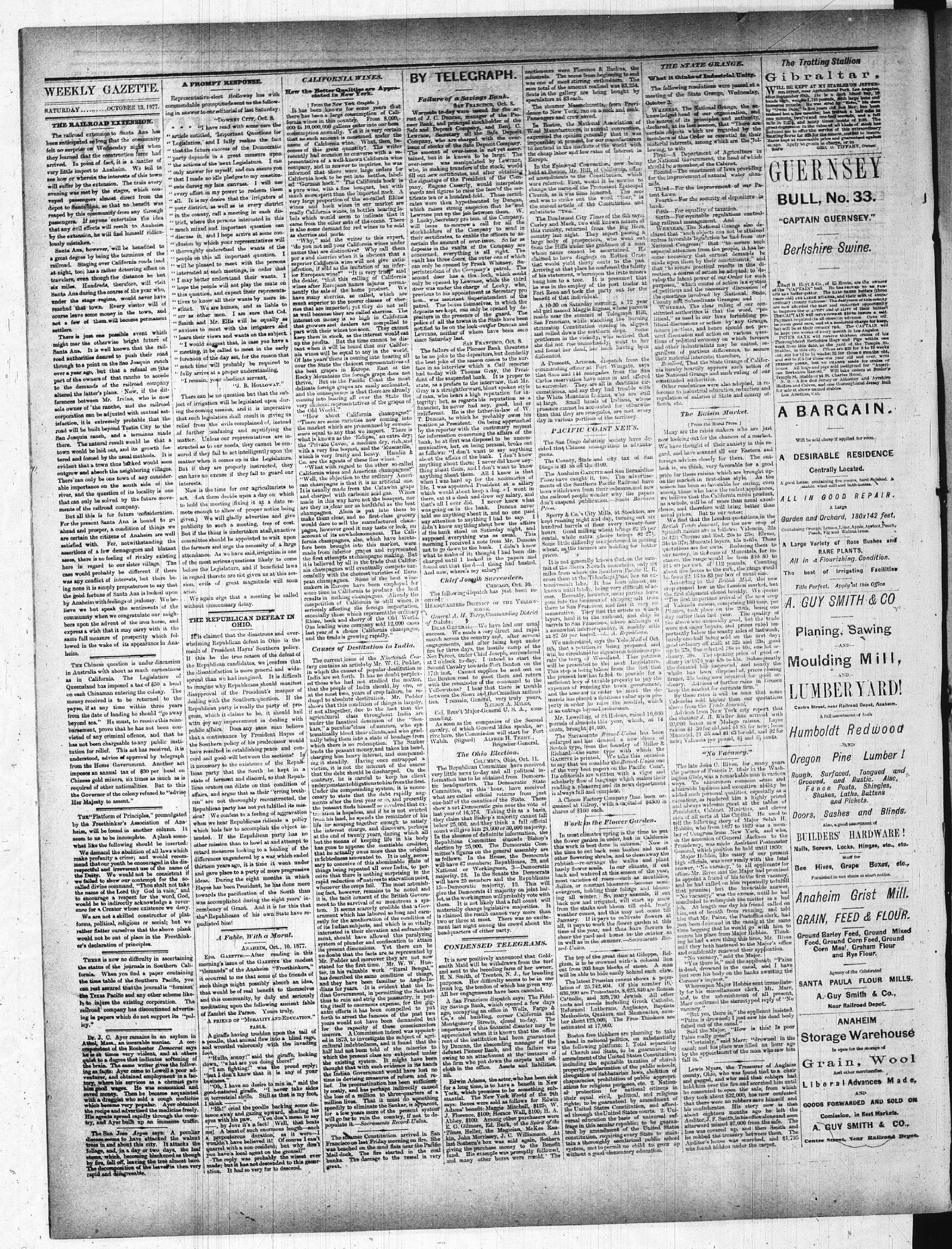
Searchable text
WEEKLY GAZETTE.
SATURDAY ... OCTOBER 13, 1877.
THE RAILROAD EXTENSION.
The railroad extension to Santa Ana has been anticipated so long that the community felt no surprise on Wednesday night when they learned that the construction force had arrived. In point of fact, it is a matter of very little import to Anaheim. We fail to see how or wherein the interests of this town will suffer by the extension. The train every evening was met by the stages, which conveyed passengers almost direct from the depot to Santa Ana, so that no benefit was reaped by this community from any through passengers. If anyone entertains the idea that any evil effects will result to Anaheim by the extension, he will find himself ridicuously mistaken.
Santa Ana, however, will be benefited to a great degree by being the terminus of the railroad. Staging over California roads (and at night, too) has a rather deterring effect on travelers, even though the distance be but six miles. Hundreds, therefore, will visit Santa Ana during the course of the year who, under the stage regime, would never have reached that town. Every visitor will of course leave some money in the town, and not a few of them will become permanent settlers.
There is just one possible event which might mar the otherwise bright future of Santa Ana. It is well known that the railroad authorities desired to push their road through to a point on the San Joaquin ranch over a year ago, but that a refusal on the part of the owners of that rancho to accede to the demands of the railroad company altered the latter's plans. Now, if the differences between Mr. Irvine, who is now sole owner of the rancho, and the railroad corporation can be adjusted with mutual satisfaction, it is extremely probable that the road will be built beyond Tustin City to the San Joaquin ranch, and a terminus made there. The natural result would be that a town would be laid out, and its growth fostered and forced by the usual methods. It is evident that a town thus backed would soon
A PROMPT RESPONSE.
Representative-elect Holloway has with commendable promptitude sent us the following in answer to our editorial of last Saturday:
"Downey City, Oct. 8.
"I have read with some care the article entitled 'Important Questions for Legislation,' and I fully realize the fact that the future success of the Democratic party depends in a great measure upon the actions of the next Legislature. I can only answer for myself, and can assure you that I made no idle pledges to my constituents during my late canvass. I will use every effort in my power to redeem them all. It is my desire that the irrigators of your district, as well as in every district in the county, call a meeting in each district, where the persons intercated in this much mixed and important question can discuss it, and I hope arrive at some conclusion by which your representatives will thoroughly understand the wants of the people on this all important question. I will be pleased to meet with the persons interested at such meetings, in order that I may better understand their wants. I hope the people will not play the mute on this question, and expect their representatives to know all their wants by mere instinct. We are human, and as liable to err as other men. I am sure that Col. Smith and Mr. Ellis will be equally anxious to meet with the irrigators and learn their views and wants on the subject.
"I would suggest that, in case you have a meeting, it be called to meet in the early forenoon of the day set, for the reason that much time will probably be required to fully arrive at a proper understanding,
"I remain, your obedient servant,
"J. B. HOLLOWAY."
There can be no question but that the subject of irrigation will be legislated upon during the coming session, and it is imperative that such legislation shall result in giving us relief from the evils complained of, instead of further confusing and mystifying the matter. Unless our representatives are instructed as to our needs, they cannot be censured if they fail to act intelligently upon the matter when it comes up in the Legislature.
CALIFORNIA
How the Better Quality elated in New York.
It has been known for there has been a large commercial wines in this country; 000 to 10,000,000 gallons of consumption annually. Yeah that no such amount is common name of California wine. Comes of this great quantity recently had occasion to co-presentative of a well-known company, and in answer to informed that there were California hook to be put into "German hook." That a pure wine, with a fine berry much more spirit than these very large proportion of wines and hook wines really California wines, indeed bells which would seem to come from the other side is also some demand for rosy sherries and ports.
"Why," said the writer "do you not sell your Californian names that are distinctive porous and sherries when in superior California wine inflection, if sold as the importer European wine?"
If the dealer, "that this cineries after European narration neatly the sale of the hose have many sherries, so much superior to the poorest that are imported; yes as well because they are so interest on money is so that growers and dealers part with their wines too keep them in stock, as they up profits. But then tant when it will be found thatnia wines will be equal Of late years there is concern over the State choice the best grapes in E.Rocky Mountains the furry thrive. But on the Pacific delicate foreign grapes and the consequence is coming into bearing all very chosen representative of the Old World."
"How about Californians there are some varieties which are purely equal to any what is known as the "Private Cuvée," with a very fine bouquet which is very fruity and Co. are the agents of t
The Chinese question is under discussion in Australia with about as much earnestness as in California. The Legislature of Queensland has imposed a tax of $50 a head on each Chinaman entering the colony. The money received is to be returned to the payee, if at any time within three years from the date of landing he should "go away beyond sea." He must, to receive this reimbursement, prove that he has not been convicted of any criminal offence, and that he has not been chargeable to any public institution for relief. This act has received, it is understood, advice of approval by telegraph from the Home Government. Another act imposes an annual tax of $30 per head on Chinese gold miners, six times as much as is required of other nationalities. But to this the Governor of the colony refused to "advise Her Majesty to assent."
The "Platform of Principles," promulgated by the Freethinker's Association of Anaheim, will be found in another column. It seem to us to be incomplete. A plank somewhat like the following should be inserted:
We demand the abolition of all laws which make profanity a crime; and would recommend that our youth be encouraged in the disrespectful and irreverent use of the name of the Daity. We would not be consistent if we failed to show our contempt for the so-called natural result would be that a town would be laid out, and its growth fostered and forced by the usual methods. It is evident that a town thus backed would soon outgrow and absorb the neighboring villages. There can only be one town of any considerable importance on the south side of the river, and the question of its locality is one that can only be solved by the future movements of the railroad company.
But all this is for future consideration. For the present Santa Ana is bound to go ahead and prosper, a condition of things we are certain the citizens of Anaheim are well satisfied with. For, notwithstanding the assertions of a few demagogues and blatant asses, there is no feeling of rivalry existing here in regard to our sister village. The case would probably be different if there was any conflict of interests, but there being none it is simply preposterous to say that the good fortune of Santa Ana is looked upon by Anaheim with feelings of jealousy. We believe we but speak the sentiments of the community when we congratulate our neighbors upon the advent of the iron horse, and express a wish that it may carry with it the same full measure of prosperity which followed in the wake of its appearance in Anaheim.
THE REPUBLICAN DEFEAT IN OHIO.
It is claimed that the disastrous and overwhelming Republican defeat in Ohio is the result of President Hayes' Southern policy. If this be the true reason of the defeat of the Republican candidates, we confess that the dissatisfaction is more general and widespread than we had imagined. It is difficult to imagine why Republicans should manifest disapproval of the President's manner of dealing with the Southern question. If the Republican party is really the party of progress, which it claims to be, it should hail with joy any improvement in dealing with public affairs. Does any same man believe that a continuance by President Hayes of the Southern policy of his predecessor would have resulted in establishing peace and concord and good-will between the sections? Is it necessary to the existence of the Republican party that the South be kept in a state of ferment and discord, so that Republican orators can dilate on that condition of affairs, and argue that as their "erring brethren" are not thoroughly reconstructed, the Republican party has not yet fulfilled its mission? We confess to a feeling of aggravation when we hear Republicans ridicule a policy which bids fair to accomplish the object intended. If the Republican party has no other mission than to howl at and attempt to retard measures looking to a healing of the differences engendered by a war which ended thirteen years ago, it is time it went under and gave place to a party of more progressive ideas. During the eight months in which fully arrive at a proper understanding,
"I remain, your obedient servant,
"J. B. HOLLOWAY."
There can be no question but that the subject of irrigation will be legislated upon during the coming session, and it is imperative that such legislation shall result in giving us relief from the evils complained of, instead of further confusing and mystifying the matter. Unless our representatives are instructed as to our needs, they cannot be censured if they fail to act intelligently upon the matter when it comes up in the Legislature. But if they are properly instructed, they can have no excuse if they fail to guard our interests.
Now is the time for our agriculturists to act. Let them decide upon a day on which to hold the meeting (fixing it at a date remote enough to allow of proper notice being given.) We will gladly advertise and give publicity to such a meeting, free of cost. But if the thing is undertaken at all, an active committee should be appointed to wait upon the farmers and urge the necessity of a large attendance. As we have said, irrigation is one of the most serious questions likely to come before the Legislature, and if beneficial laws in regard thereto are not given us at this session, evils of great magnitude will soon arise.
We again urge that a meeting be called without unnecessary delay.
THE REPUBLICAN DEFEAT IN OHIO.
It is claimed that the disastrous and overwhelming Republican defeat in Ohio is the result of President Hayes' Southern policy. If this be the true reason of the defeat of the Republican candidates, we confess that the dissatisfaction is more general and widespread than we had imagined. It is difficult to imagine why Republicans should manifest disapproval of the President's manner of dealing with the Southern question. If the Republican party is really the party of progress, which it claims to be, it should hail with joy any improvement in dealing with public affairs. Does any same man believe that a continuance by President Hayes of the Southern policy of his predecessor would have resulted in establishing peace and concord and good-will between the sections? Is it necessary to the existence of the Republican party that the South be kept in a state of ferment and discord, so that Republican orators can dilate on that condition of affairs, and argue that as their "erring brethren" are not thoroughly reconstructed, the Republican party has not yet fulfilled its mission? We confess to a feeling of aggravation when we hear Republicans ridicule a policy which bids fair to accomplish the object intended. If the Republican party has no other mission than to howl at and attempt to retard measures looking to a healing of the differences engendered by a war which ended thirteen years ago, it is time it went under and gave place to a party of more progressive ideas. During the eight months in which fully arrive at a proper understanding,
"I remain, your obedient servant,
"J. B. HOLLOWAY."
There can be no question but that the subject of irrigation will be legislated upon during the coming session, and it is imperative that such legislation shall result in giving us relief from the evils complained of, instead of further confusing and mystifying the matter. Unless our representatives are instructed as to our needs, they cannot be censured if they fail to act intelligently upon the matter when it comes up in the Legislature. But if they are properly instructed, they can have no excuse if they fail to guard our interests.
Now is the time for our agriculturists to act. Let them decide upon a day on which to hold the meeting (fixing it at a date remote enough to allow of proper notice being given.) We will gladly advertise and give publicity to such a meeting, free of cost. But if the thing is undertaken at all, an active committee should be appointed to wait upon the farmers and urge the necessity of a large attendance. As we have said, irrigation is one of the most serious questions likely to come before the Legislature, and if beneficial laws in regard thereto are not given us at this session, evils of great magnitude will soon arise.
We again urge that a meeting be called without unnecessary delay.
CAUSES OF DEFECTION
The current issue contains an artifact in which India are set forth; ed those who had thought that people at the most two, ye duced to absolute objection under the fanatic kars; a peculiar case termatically bleached byally bring them into which there is no lends the peasant charging him heavily victim; it is not that the debt shows contrary, he is under constant objection Under these cases afterthe fife peasant finds trication is hoped from his land, he life in scraping atthe end of twowe has gone to appear that he actually in indebtedness amsary to conceive things being repaiceive that there rapid reduction
The "Platform of Principles," promulgated by the Freethinker's Association of Anaheim, will be found in another column. It seems to us to be incomplete. A plank somewhat like the following should be inserted:
We demand the abolition of all laws which make profanity a crime; and would recommend that our youth be encouraged in the disrespectful and irreverent use of the name of the Deity. We would not be consistent if we failed to show our contempt for the so-called divine command, "Thou shalt not take the name of the Lord thy God in vain;" and to encourage a respect for the word, God, would be to indirectly acknowledge a reverence for a Creator whose existence we deny.
We are not a skilled constructor of platforms, political, religious or social; but we rather flatter ourselves that the above plank would not be out of place in the Freethinker's declaration of principles.
There is now no difficulty in ascertaining the status of the journals in Southern California. When you find a paper containing the time table of the Southern Pacific, you can rest assured that the journal is "forninst" the Texas Pacific and any other scheme likely to injure the existing corporation. The railroad company has discontinued advertising in papers which do not support its "policy."
Dr. J. C. Ayer remains in an asylum in Athol, Mass., an incurable maniac. A correspondent of the Rochester Democrat says he is at times very violent, and at others quiet to a degree that indicates softening of the brain. The same writer gives the following as facts: Ayer came to Lowell a poor adventurer, and obtained employment in a factory, where his services as a chemist gave him good wages. He was economical and saved money. Then he became acquainted with a druggist who sold a cough medicine which became very popular. Ayer obtained the recipe and advertised the medicine freely. His agents spread rapidly through the country, and Ayer built up an immense traffic.
The San Jose Argus says: A peculiar disease seems to have attacked the walnut trees in and about this city. It attacks the foliage, and, in a day or two days, the leaf stems, which becoming blackened as though by fire, fall off, leaving the tree almost bare. The decomposition of the leaves is then very rapid and disagreeable.
A Fable, With a Moral.
ANAHEIM, Oct., 10. 1877.
Eds. GAZETTE: After reading in this morning's issue of the Gazette the modest "demands" of the Anaheim "Freethinkers," it occurred to me that some of the friends of such things might possibly absorb an idea, that would be of real benefit to themselves and this community, by duly and seriously meditating upon the following ancient fable of Zambri the Parsce. Yours truly,
A FRIEND OF "MORALITY AND EDUCATION."
FABLE.
A giraffe having trodden upon the tail of a poodle, that animal flew into a blind rage, and wrestled valorously with the invading foot.
"Hullo, sonny!" said the giraffe, looking down, "what are you doing there?"
"I am fighting!" was the proud reply; "but I don't know that it is any of your business."
"Oh, I have no desire to mix in," said the good-natured giraffe. "I never take sides in terrestrial strife. Still as that is my foot, I think——"
"Eh!" cried the poodle backing some distance away and gazing upward, shading his eyes with his paw. "You don't mean to say——by Jove it's a fact! Well, that beats me! A beast of such enormous length—such a preposterous duration, as it were—I wouldn't have believed it! Of course I can't quarrel with a non-resident; but why don't you have a local agent on the ground?"
The reply was probably the wisest ever made; but it has not descended to this generation. It had so very far to descend.
CALIFORNIA WINES.
How the Better Qualities are Appreciated in New York.
[From the New York Graphic.]
It has been known for some years that there has been a large consumption of California wines in this country. From 8,000-10,000,000 gallons enter into our home consumption annually. Yet it is very certain that no such amount is consumed under the name of California wine. What, then, becomes of this great quantity? The writer recently had occasion to converse with a representative of a well-known California wine company, and in answer to inquiries, he was informed that there were large orders for California hock to be put into bottles, labeled "German hock." The California hock is a pure wine, with a fine bouquet, but with much more spirit than the imported hock. A very large proportion of the so-called Rhine wines and hock wines in our market are really California wines, in bottles bearing labels which would seem to indicate that it came from the other side of the ocean. There is also some demand for red wines to be sold as sherries and ports.
"Why," said the writer to this expert, "do you not sell your California wines under names that are distinctive? Why call them poris and sherries when it is obvious that a superior California wine will not give satisfaction, if sold as the imitation of an inferior European wine?" "It is very true," said the dealer, "that this calling of California wines after European names injures permanently the sale of the home product. We have many sherrites, so called, which are much superior to the poorer classes of sherries that are imported; yet they do not sell as well because they are called sherries. The interest on money is so high in California that growers and dealers are compelled to part with their wines too soon. They cannot keep them in stock, as the interest would eat up the profits. But the time cannot be distant when it will be found that our California wines will be equal to any in the world. Of late years there is coming into bearing all over the State the choicest representatives of the best grapes in Europe. East of the Rocky Mountains the foreign grape does not thrive. But on the Pacific Coast the most delicate foreign grapes are easily acclimated, and the consequence is that there are already coming into bearing all over the State the very choicest representatives of the grapes of the Old World."
"How about California champagne?" "There are some varieties now coming into the market which are pronounced by commotion equal to any that we import. There is what is known as the 'Eclipse,' an extra dry; the 'Private Cuvee,' a medium dry, rich, and with a very fine bouquet, and the 'Muscatille,' which is very fruity and heavy. Hamlin & Co. are the agents of these fine wines."
BY TELEGRAPH.
Failure of a Savings Bank.
SAN FRANCISCO, Oct. 8.
Warrants to-day were issued for the arrest of J. C. Duncan, manager of the Pioneer Bank, and principal stockholder of the Safe and Deposit Company, and Benj. C. Lewrane, Secretary off the Safe Deposit Company. The amount of over-issue is not yet asserted, but it is known to be large. The over-issue was manipulated by Lewrane, who, in making transfers of the stock, would fill out new certificates, and after obtaining the signature of the President of the Company, Engene Cassely, would interpolate words and figures to raise the face of the certificate ten or a hundred-fold. Those certificates were then hypothocated by Duncan, which raises strong suspicion that he and Lewrane put up the job between them. W. S. Lucky, Secretary pro tem, of the Company, will issue to-morrow a call for all the stockholders of the Company to send in their certificates, to enable the officers to ascertain the amount of over-issue. So far as deposits in the vanilla of the Company are concerned, everything is all right. The vault has three doors, the outer one of which can only be opened by Frank Whitney, Superintendent of the Company's patrol. The second door has a tin lock, which could only be opened by Lewrane, while the third door was under the charge of Lucky, who previous to his appointment as Secretary pro tem., was assistant Superintendent of the patrol. The boxes themselves, in which the deposits are kept, can only be opened by depositors in the presence of the guard. The police of all the towns in the State have been notified to be on the look-out for Duncan and Lewrane, neither of whom have been seen since Saturday last.
SAN FRANCISCO, Oct. 8.
The failure of the Pioneer Bank threatens to be no joke to the depositors, but decidedly the best joke of the season comes to the surface in an interview which a Call reporter had to-day with Thomas Gray, the President of the suspended bank. It is proper to state, as a preface to the interview, that Mr. Gray is a straightforward, blunt spoken style of man, who bears a high reputation for integrity; but, as regards his reputation as a financier, he never had any, good, bad or indifferent. He is the father-in-law of W. T. Duncan, to which he probably owes his position as President. On being approached by the reporter with the customary request for information concerning the affairs of the bank, he at first was disposed to be uncommunicative, but, on being pressed, broke out as follows: "I don't want to say anything about the affairs of the bank. I don't know anything about them; I never did know anyone."
A Prescott, Arizona, dispatch from the commanding officer at Fort Wingate, says that Saco and 143 renegades from the San Carlos reservation have come in and offered to surrender. They are all in destitute circumstances, and say they had trouble with White Mountain Indians, who are still at large. Small bands of Indiana, whose presence cannot be accounted for otherwise than that they are renegades, are met every day in various portions of the territory.
PACIFIC COAST NEWS.
The San Diego debating society have decided that Chinese immigration is advantageous.
The County, State and city tax of San Francisco
The current issue of the Nineteenth Century contains an article by Mr. W. G. Pedder, in which the causes of popular destination in India are set forth. It has no doubt perplexed those who had not studied the matter, that the people of India should, by one, or at the most two, years of crop failure, be reduced to absolute destitution. Mr. Pedder shows that this condition of things is largely, if not altogether, due to the fact that the agricultural class throughout India are under the fanatical domination of the "Soukars," a peculiar class of usurers, who systematically bleed their clients, and who gradually bring into a state of bondage from which there is no redemption. The Sauker lends the peasant money, and takes his bond, charging him heavy interest, and compounding it steadily. Having once entrapped a victim, it is not the interest of the usurer that the debt should be discharged. On the contrary, he is careful to keep his client underconstant obligations to him from the first. Under the system, it is unnecessary to state that the debt rapidly augments after the first year or so, and presently the peasant finds himself so involved that extinction is hopeless, and if he is not evicted from his land, he spends the remainder of his life in scraping together enough to satisfy the interest charge, and discovers perhaps at the end of twenty years, during which all but the means of keeping life in his body has gone to appease the insatiable creditor, that he actually owes more than the original indebtedness amounted to. It is only necessary to conceive of this abominable state of things being repeated all over India, to perceive that there is nothing surprising in the rapid reduction of natives to starvation point.
How about California champagne? There are some varieties now coming into the market which are pronounced by commas equal to any that we import. There is what is known as the "Eclipse," an extra dry; the "Private Cuvee," a medium dry, rich, and with a very fine bouquet, and the "Muscatille," which is very fruity and heavy. Hamlin & Co. are the agents of these fine wines.
What with regard to the other so-called California wines and American champagnes? Well, the objection to the ordinary American champagne is that it is an artificial one. It is usually made from the Catawba grape and charged with carbonic acid gas. Wines made in this way have not the bouquet, nor are they as clear nor as healthful as the best champagnes. Alum is put into them to make them clear, and no first-class grocery would dare to sell the manufactured champagne, however good it may taste or look, on account of its unwholesomeness. The California champagnes, also, which have heretofore been brought into this market, were made from inferior grapes and represented the first attempts at champagne making. But it is believed by all in the trade that California champagnes will eventually compete successfully with the choice varieties of European champagnes. Some of the best wine-makers in Europe have been employed for some time in California to produce the best results in making champagnes. Already the competition of California is still wines is seriously affecting the foreign importation, especially those which represent the ordinary Rhine, hook and sherry of the Old World. One leading wine company sold 12,000 cases last year of a choice California champagne, and the trade is growing rapidly."
Causes of Destitution in India.
The current issue of the Nineteenth Century contains an article by Mr. W. G. Pedder, in which the causes of popular destination in India are set forth. It has no doubt perplexed those who had not studied the matter, that the people of India should, by one, or at the most two, years of crop failure, be reduced to absolute destitution. Mr. Pedder shows that this condition of things is largely, if not altogether, due to the fact that the agricultural class throughout India are under the fanatical domination of the "Soukars," a peculiar class of usurers, who systematically bleed their clients,and who gradually bring into a state of bondage from which there is no redemption. The Sauker lends the peasant money,and takes his bond, charging him heavy interest,and compounding it steadily. Having once entrapped a victim, it is not the interest of the usurer that the debt should be discharged. On the contrary, he is careful to keep his client underconstant obligation to him from the first. Under the system, it is unnecessary to state that the debt rapidly augments after the first year or so,and presently the peasant finds himself so involved that extinction is hopeless, and if he is not evicted from his land, he spends the remainder of his life in scraping together enough to satisfy the interest charge,and discovers perhaps at the end of twenty years,during which all but the means of keeping life in his body has gone to appease the insatiable creditor, that he actually owes more than the original indebtedness amounted to. It is only necessary to conceive of this abominable state of things being repeated all over India, to perceive that there is nothing surprising in the rapid reduction of natives to starvation point,
How about California champagne? "There are some varieties now coming into the market which are pronounced by commas equal to any that we import. There is what is known as the 'Eclipse,' an extra dry; the 'Private Cuvee,' a medium dry, rich,and with a very fine bouquet,and the 'Muscatille,' which is very fruity and heavy. Hamlin & Co. are the agents of these fine wines."
What with regard to the other so-called California wines and American champagnes?" "Well,the objection to the ordinary American champagne is that it is an artificial one. It is usually made from the Catawba grape and charged with carbonic acid gas. Wines made in this way have not the bouquet,nor are they as clear nor as healthful as the best champagnes. Alum is put into them to make them clear,and no first-class grocery would dare to sell the manufactured champagne,however good it may taste or look.on account of its unwholesomeness.The California champagnes,也which have heretofore been brought into this market,were made from inferior grapes and representedthe first attempts at champagne making.But it is believed by all in the trade that California champagnes will eventually compete successfullywith the choice varieties of European champagnes.Some of the best wine-makers in Europe have been employed for some time in California to produce the best results in making champagnes.Alreadythe competition of California is still winesis seriously affectingthe foreign importationespecially those which representthe ordinary Rhine,hook and sherryofthe OldWorld.One leading wine company sold 12,000 cases last year of a choice California champagne,andthe trade is growing rapidly."
Causes of Destitution in India.
The current issue of the Nineteenth Century contains an article by Mr. W. G. Pedder, in which the causes of popular destination in India are set forth. It has no doubt perplexed those who had not studied the matter,that the people of India should,bye one,或atthemosttwo,yearsofcropfailure.be Reducedtoabsolutedestitution.Mr.Peddershowsthatthisconditionofthingss largelyifnotaltogether,due.tothefactthattheagriculturalclassthroughoutIndiaareunderthefanaticaldominationofthe"Soukars,"apeculiarclassofusurers,who系统icallybleedtheirclients,andwhograduallybringintoastateofbondagefromwhichthereisnoredemption.TheSaukerlendsthepeasantmoney,andtakeshisbondb charginghimheavyinterest,andcompoundingitsteadily.Havingonceentrappeda victim,它isnottheinterestoftheusurerthatthedebtshouldbedischarged.Onthecontrary,他iscarefultokeephissclientundergconstantobligationtohimfromthefirst.Underthesystem,它isunnecesarytostatethatthedebtrapidlyaugmentsafterthefirstyearorso,andpresentlythepeasantfindshimselfsoinvolvedthatextinctionishopeless,andifheisnotevictedfromhisland,他spendstheremainderofhislifeinc scrapingtogetherenoughtosatisfytheinterestcharge,anddiscoversepresentsattheendoftwentyyears,duringwhichallbutthemeansofkeepinglifeinhisbodyhasgonetoappeasetheinsatiablecreditor,该heactuallyowesmorethantheoriginalindebtednessamounttedto.它isonlynecessarytoconceiveofthisabominablestateofthingsembeingrepeatedalloverIndia,topercivethatthereisnothingsurprisingintherapidreductionnfativestotstarvationpoint,
Chief Joseph Surrenders.
CHICAGO.Oct.10.
The following dispatch has just been received:HEADQUARTERS DISTRICT OF THE YELLOWSTONE.
General A.H.H.Terry.CommandingDistrictofDakota:
DEARGENERAL—Wehavehadour usualsuccess.Wewadeverydirectandrap Marchacrossthecountryand,afterseverengagement,sandafterbeingkeptundirefireforthreedays,thehostilecampoftheNexPerces,underChiefJosephsurrenderedat2oclocktoday.I intendtostarttheSecondCavalrytowardsBortBentononthe17inst.Cannotsuppliesbe sentoutonBentonroadtouseitandreturnwiththeremainderofthecommandtotheYellowstone!I hearthatthereistroublebetweentheSiouxandtheCanadianauthorities.Iremain,General,verytrulyyours,NESONA.MILES,
Col.Brev'tMajor-GeneralU.S.A.,commanding.
As soon asthecompaniesoftheSecond cavalry.ofwhichGeneralMilesspeaks,arrivehere,theCommissionwillstartforFortWalsh.(Signed)ALFREDH.TERRY.
Brigadier-General.
The Ohio Election.
COLUMBUS.Ohio.Oct.11.
The Republican Committee have receivedvery littlenewsto-dayandallpoliticalinformationhastobeobtainedfromDemocraticheadquarters.TheDemocraticStateCommitteeupthishour,havereceivedwhatarecalledofficialreturnsfromjustone-halfofthecountiesofTheStateTheseshowanetDemocraticgainoverthevoteoflastyearof16,576.(Takingthisasa basi,theyclaimthatBishop'smajor cannotfallbelow25,000,andtheythinkafullofficialcountwillgiveh28,000or30,000major.Intheabsenceofdefiniteinformation,theRepublicanCommitteeconcedeBishop'selectionby25,000.TheDemocraticCommittee'sfiguresonthegeneralassemblyareasfollows:在TheHouse,theDemocratswillhave67members;Republicans,39,andNationalorWorkingmen,3—Democraticmajority,28.InTheSenate,theDemocratswillhave25membersandTheRepublicanswillhave25membersandTheRepublicanswillhave25membersandTheRepublicanswillhave25membersandTheRepublicanswillhave25membersandTheRepublicanswillhave25membersandTheRepublicanswillhave25membersandTheRepublicanswillhave25membersandTheRepublicanswillhave25membersandTheRepublicanswillhave25membersandTheRepublicanswillhave25membersandTheRepublicanswillhave25membersandTheRepublicanswillhave25membersandTheRepublicanswillhave25membersandTheRepublicanswillhave25membersandTheRepublicanswillhave25membersandTheRepublicanswillhave25membersandTheRepublicanswillhave25membersandTheRepublicanswillhave25 membersandTheRepublicanswillhave25membersandTheRepublicanswillhave25membersandTheRepublicanswillhave25membersandTheRepublicanswillhave25membersandTheRepublicanswillhave25membersandTheRepublicanswillhave25membersandTheRepublicanswillhave25membersandTheRepublicanswillhave25membersandTheRepublicanswillhave25membersandTheRepublicanswillhave25 membersandTheRepublicanswillhave25 members和TheRepublicans will have25 members和TheRepublicans will have25 members和TheRepublicans will have25 members和TheRepublicans will have25 members和TheRepublicans will have25 members和TheRepublicans will have25 members和TheRepublicans will have25 members和TheRepublicans will have25 members和TheRepublicans will have25 members和TheRepublicans will have25 members和TheRepublicans will have25 members和TheRepublicans will have25 members和TheRepublicans will have25 members和TheRepublicans will have25 members和TheRepublicans will have 25 members和TheRepublicans will have 25 members和TheRepublicans will have 25 members和TheRepublicans will have 25 members和TheRepublicans will have 25 members和TheRepublicans will have 25 members和TheRepublicans will have 25 members和TheRepublicans will have 25 members和TheRepublicans will have 25 members和TheRepublicans will have 25 members和TheRepublicans will have 25 members和THE RepUBLICANS
Mr.Lewelling.ofStHolena,raised10,000 poundsofalmondsthisyear,which,at14 cents,brought$1,400.
The SacramentoRecord-Unionhas been enlargedandhasdowninedafordsmithtypewithwhichtheGAZETTEisprinted.Wetakethisoccasiontay说thatweconsidertheRecord-UniononeoftheverybestpapersonthePacificCoast.Hiseditorialarewrittenwitha vigorandscholarlyflowoflanguagewhichmakesthereadingapleasure;anditsnewsdepartmentisalwaysfullandcomplete.ACheeseFactoryCompanyhasbeenorganizedatGilroy.withacapitalof$4500insharesof$100each.
WorkintheFlowerGarden.
Inmost climates springisthetimetoputflower gardeninorderbutinCaliforniathisworkisbestdoneinautumn.Nowistimetocutbackrosebashesandmostotherflowering shrubs,andtocleanawaythe rubbish'rearrangewalksandleplanthardly flower seeds.Inour climate,i cutback andwateredatthis seasonoftheyear,most varietiesof roses—suchasmonthlis,
Mannowholefordmuseumhereinthenewcitynowhereinthenewcitynowhereinthenewcitynowhereinthenewcitynowhereinthenewcitynowhereinthenewcitynowhereinthenewcitynowhereinthenewcitynowhereinthenewcitynowhereinthenewcitynowhereinthenewcitynowhereinthenewcitynowhereinthenewcitynowhereinthenewcitynowhereinthenewcitynowhereinthenewcitynowhereinthenewcitynowhereinthenewcitynowhereinthenewcitynowhereinthenewcitynowhereinthenewcitynowhereinthenewcitynowhereinthenewcitynowhereinthenewcitynowhereinthenewcitynowhereinthenewcitynowhereinthenewcitynowhereinthenewcitynowhereinthenewcitynowhereinthenewcitynowhereinthenewcitynowhereinthenewcitynowhereinthenewcitynowhereinthenewcitynowhereinthenewcitynowhereinthenewcitynowhereinthenewcitynowhereinthenewcitynowhereinthenewcitynowhereinthenewcitynowhereinthenewcitynowhereinthenewcitynowhereinthenewcitynowhereinthenewcitynowhereinthenewcitynowhereinthenewcitynowhereinthenewcitynowhereinthenewcitynowhereinthe new city now here int he new city now here int he new city now here int he new city now here int he new city now here int he new city now here int he new city now here int he new city now here int he new city now here int he new city now here int he new city now here int he new city now here int he new city now here int he new city now here int he new city now here int he new city now here int he new city now here int he new city now here int he new city now here int he new city now here int he new city now here int he new city now here int he new city now here int he new city now here int he new city now here int he new city now here int he new city now here int he new city now here int he new city now here int he new city now here int he new city now here int he new city now here int he new city now here int he new city now here int he new city now here int he new city now here int he new city now here int he new city now here int he new city now here int he new city now here int he new city now here int he new city nowHere Int He New City Now Here Int He New City Now Here Int He New City Now Here Int He New City Now Here Int He New City Now Here Int He New City Now Here Int He New City Now Here Int He New City Now Here Int He New City Now Here Int He New City Now Here Int He New City Now Here Int He New City Now Here Int He New City Now Here Int He New City Now Here Int He New City Now Here Int He New City Now Here Int He New City Now Here Int He New City Now Here Int He New City Now Here Int He New City Now Here Int He New City Now Here Int He New CityNowHereIntHeNewCityNowHereIntHeNewCityNowHereIntHeNewCityNowHereIntHeNewCityNowHereIntHeNewCityNowHereIntHeNewCityNowHereIntHeNewCityNowHereIntHeNewCityNowHereIntHeNewCityNowHereIntHeNewCityNowHereIntHeNewCityNowHereIntHeNewCityNowHereIntHeNewCityNowHereIntHeNewCityNowHereIntHeNewCityNowHereIntHeNewCityNowHereIntHeNewCityNowHereIntHeNewCityNowHereIntHeNewCityNowHereIntHeNewCityNowHereIntHeNewCityNowHereIntHeNewCityNowHereIntHeNewCityNowHereIntHeNewCityNowHereIntHeNewCityNowHereIntHeNewCityNowHereIntHeNewCityNowHereIntHeNewCityNowHereIntHeNewCityNowHereIntHeNewCityNowHereIntHeNewCityNowHereIntHeNewCityNowHereIntHeNewCityNowHereIntHeNewCityNowHereIntHeNewCityNowHereIntHeNewCityNowHereIntHeNewCityNowHereIntHeNewCityNowHereIntHeNewCityNowHereIntHeNewCityNowHereIntHeNewCityNowHereIntHeNewCityNowHereIntHeNewCityNowHereIntHeNewCityNowHereIntHeNewCityNowHereIntHeNewCityNowHereIntHeNewCityNowHereIntHeNewCityNowHereINTHE New City Now Here INT HE New City Now Here INT HE New City Now Here INT HE New City Now Here INT HE New City Now Here INT HE New City Now Here INT HE New City Now Here INT HE New City Now Here INT HE New City Now Here INT HE New City Now Here INT HE New City Now Here INT HE New City Now Here INT HE New City Now Here INT HE New City Now Here INT HE New City Now Here INT HE New City Now Here INT HE New City Now Here INT HE New City Now Here INT HE New City Now Here INT HE New City Now Here INT HE New City Now Here INT HE New City NoWhereINTHE New City NoWhereINTHE New City NoWhereINTHE New City NoWhereINTHE New City NoWhereINTHE New City NoWhereINTHE New City NoWhereINTHE New City NoWhereINTHE New City NoWhereINTHE New City NoWhereINTHE New City NoWhereINTHE New City NoWhereINTHE New City NoWhereINTHE New City NoWhereINTHE New City NoWhereINTHE New City NoWhereINTHE New City NoWhereINTHE New City NoWhereINTHE New City NoWhereINTHE New CityNoWhereINTHE New CityNoWhereINTHE New CityNoWhereINTHE New CityNoWhereINTHE New CityNoWhereINTHE New城市NoWhereINTHE 新城市No WhereINTHE 新城市No WhereINTHE 新城市No WhereINTHE 新城市No WhereINTHE 新城市No WhereINTHE 新城市No WhereINTHE 新城市No WhereINTHE 新城市No WhereINTHE 新城市No WhereINTHE 新城市No WhereINTHE 新城市No WhereINTHE 新城市No WhereINTHE 新城市No WhereINTHE 新城市No WhereINTHE 新城市No WhereINTHE 新城市No WhereINTHE 新城市No WhereINThresheningInThresheningInThresheningInThresheningInThresheningInThresheningInThresheningInThresheningInThresheningInThresheningInThresheningInThresheningInThresheningInThresheningInThresheningInThresheningInThresheningInThresheningInThresheningInThresheningInThresheningInThresheningInThresheningInThresheningInThresheningInThresheningInThresheningInThresheningInThresheningInThresheningInThresheningInThresheningInThresheningInThresheningInThresheningInThresheningInThresheningInThresheningInThresheningInThresheningInThresheningInThresheningInThresheningInThresheningInThresheningInThresheningInThresheningInThresheningInThreshening In Thresholding In Thresholding In Thresholding In Thresholding In Thresholding In Thresholding In Thresholding In Thresholding In Thresholding In Thresholding In Thresholding In Thresholding In Thresholding In Thresholding In Thresholding In Thresholding In Thresholding In Thresholding In Thresholding In Thresholding In Thresholding In Thresholding In Thresholding In Thresholding In Thresholding In Thresholding In Thresholding In Thresholding In Thresholding In Thresholding In Thresholding In Thresholding In Thresholding In Thresholding In Thresholding In Thresholding In Thresholding IN Thresholding IN Thresholding IN Thresholding IN Th thresholdING IN Th thresholdING IN Th thresholdING IN Th thresholdING IN Th thresholdING IN Th thresholdING IN Th thresholdING IN Th thresholdING IN Th thresholdING IN Th thresholdING IN Th thresholdING IN Th thresholdING IN Th thresholdING IN Th thresholdING IN Th thresholdING IN Th thresholdING IN Th thresholdING IN Th thresholdING IN Th thresholdING IN Th thresholdING IN Th thresholdING IN Th thresholdING IN Th thresholdING IN Th thresholdING IN Th thresholdING IN TH thresholdING IN TH thresholdING IN TH thresholdING IN TH thresholdING IN TH thresholdING IN TH thresholdING IN TH thresholdING IN TH thresholdING IN TH thresholdING IN TH thresholdING IN TH thresholdING IN TH thresholdING IN TH thresholdING IN TH thresholdING IN TH thresholdING IN TH thresholdING IN TH thresholdING IN TH thresholdING IN TH thresholdING IN TH thresholdING IN TH thresholdING IN TH thresholdING IN TH thresholdING IN TH thresholdING IN TH thresholdINGINTHresholdINGINTHresholdINGINTHresholdNINGINTHresholdNINGINTHresholdNINGINTHresholdNINGINTHresholdNINGINTHresholdNINGINTHresholdNINGINTHresholdNINGINTHresholdNINGINTHresholdNINGINTHresholdNINGINTHresholdNINGINTHresholdNINGINTHresholdNINGINTHresholdNINGINTHresholdNINGINTHThresholdNINGINTHresholdNINGINTHresholdNINGINTHresholdNINGINTHresholdNINGINTHresholdNINGINTHresholdNINGINTHThresholdNGINTHresholdNGINTHThresholdNGINTHThresholdNGINTHThresholdNGINTHThresholdNGINTHThresholdNGINTHThresholdNGINTHThresholdNGINTHThresholdNGINTHThresholdNGINTHThresholdNGINTHThresholdNGINTHThresholdNGINTHThresholdNGINTHThresholdNGINTHThresholdNGINTHThresholdNGINTHThresholdNGINTHThresholdNGINTHThresholdNGINTHThresholdNGINTHThresholdNGINTHThresholdNGINTHThresholdNGIGNTHThresholdNGIGNNTHThresholdNGIGNNTHThresholdNGIGNNTHThresholdNGIGNNNthThresholdNGIGNNNthThresholdNGIGNNNthThresholdNGIGNNNthThresholdNGIGNNNthThresholdNGIGNNNthThresholdNGIGNNNthThresholdNGIGNNNthThresholdNGIGNNNthThresholdNGIGNNNthThresholdNGIGNNNthThresholdNGIGNNNthThresholdNGIGNNNthThresholdNGIGNNNthThresholdNGIGNNNthThresholdNGIGNNNthThresholdNGIGNNNthThresholdNGIGNNNthThresholdNGIGNNNthThresholdNGIGNNNthThresholdNGIGNNNthThresholdNGIGNNNthThresholdNgIGNNNthThresholdNgIGNNNthThresholdNgIGNNNthThresholdNgIGNNNthThresholdNgIGNNNthThresholdNgIGNNNthThresholdNgIGNNNthThresholdNgIGNNNthThresholdNgIGNNNthThresholdNgIGNNNthThresholdNgIGNNNthThresholdNgIGNNNthThresholdNgIGNNNthThresholdNgIGNNNthThresholdNgIGNNNnthThresholdNgIGNNNnthThresholdNgIGNNNnthThresholdNgIGNNNnthThresholdNgIGNNNnthThresholdNgIGNNNnthThresholdNgIGNNNnthThresholdNgIGNNNnthThresholdNgIGNNNnthThresholdNgIGNNNnthThresholdNgIGNNNnthThresholdNgIGNNNnthThresholdNgIGGNNNnthThresholdNgIGGNNNnthThresholdNgIGGNNNnthThresholdNgIGGNNNnthThresholdNgIGGNNNnthThresholdNgIGGNNNnthThresholdNgIGGNNNnthThresholdNgIGGNNNnthThresholdNgIGGNNNnthThresholdNgIGGNNNnthThresholdNgIGGNNNnthThresholdNgIGGNNNnthThresholdNgIGGNNNnthThresholdNgIGGNNNnthThresholdNgIGGNnnnthThresholdNgIGGNnnnthThresholdNgIGGNnnnthThresholdNgIGGNnnnthThresholdNgIGGNnnnthTimeoutNgGNnnntimeout NgGNnnntimeout NgGNnnntimeout NgGNnnntimeout NgGNnnntimeout NgGNnnntimeout NgGNnnntimeout NgGNnnntimeout NgGNnnntimeout NgGNnnntimeout NgGNnnntimeout NgGNnnntimeout NgGNnnntimeout NgGNnnntimeout NgGNnnntimeout NgGNnnntimeout NgGNnnntimeout NgGNnnntimeout NgGNnnntimeout NgGNnnntimeout NgGNO nn timeout NgGNO nn timeout NgGNO nn timeout NgGNO nn timeout NgGNO nn timeout NgGNO nn timeout NgGNO nn timeout NgGNO nn timeout NgGNO nn timeout NgGNO nn timeout NgGNO nn timeout NgGNO nn timeout NgGNO nn timeout NgGNO nn timeout NgGNO nn timeout NgGNO nn timeout NgGNO nn timeout NgGNO nn timeout NgGNO nn timeout NgGNO nn timeout NGlONnnnn timeout NGlONnnnn timeout NGlONnnnn timeout NGlONnnnn timeout NGlONnnnn_timeout NGlONnnnn_timeout NGlONnnnn_timeout NGlONnnnn_timeout NGlONnnnn_timeout NGlONnnnn_timeout NGlONnnnn_timeout NGlONnnnn_timeout NGlONnnnn_timeout NGlONnnnn_timeout NGlONnnnn
Under the compounding system, it is unnecessary to state that the debt rapidly augments after the first year or so, and presently the peasant finds himself so involved that extinction is hopeless, and if he is not evicted from his land, he spends the remainder of his life in scraping together enough to satisfy the interest charge, and discovers perhaps at the end of twenty years, during which all but the means of keeping life in his body has gone to appraise the insatiable creditor, that he actually owes more than the original indebtedness amounted to. It is only necessary to conceive of this abominable state of things being repeated all over India, to perceive that there is nothing surprising in the rapid reduction of natives to starvation point, whenever the crops fail. The most astonishing fact, however, remains to be noted and it is, the tacit consent of the British Government to the survival of so monstrous a system. It seems scarcely credible that a Government which has labored so long and earnestly for the amelioration of the condition of its Indian subjects, and which is so vitally interested in their elevation and enfranchisement, should have allowed this paralyzing system of plunder and confiscation to attain its present dimensions. Yet there can be no doubt that the facts are, as represented by Mr. Pedder and moreover they are not now stated for the first time. Mr. W. W. Hunter, in his valuable work "Rural Bengal," has described the same condition of things, and they have been familiar to Anglo-Indians for years. It is evident that the Indian Government, in permitting the Saukars thus to ruin and strip the peasantry, is putting itself to enormous expense, for the gigantic efforts it has been compelled to put forth to arrest the famines of the past two years would not have been demanded but for the rapacity of these conscienceless usurers. A Commission indeed was appointed in 1875, to investigate the subject of agricultural indebtedness, and it found that the half had not been told of the miseries to which the present class are subjected under the existing system. It might have been thought that with such evidence in its hands the Indian Government would have lost no time in devising measures of reform and relief. Its procrastination has been sufficiently costly, and has perhaps indirectly caused the loss of a million to three-quarters of a million lives. That it must do something speedily to eliminate the Sankar, is apparent, for a few years more of the present system will go far to ruin the country, if not to depopulate it.—Sacramento Record-Union.
The steamer Constitution arrived in San Francisco on last Friday morning on fire. She was beached on the mud flats near the Pacific Mail dock. The fire started in the coal banks. The damage to the vessel is very great.
Committee, up this hour, have received what are called official returns from just one-half of the counties of the State. These show a net Democratic gain over the vote of last year of 16,576. Taking this as a basis, they claim that Bishop's majority cannot fall below 25,000, and they think a full official count will give him 28,000 or 30,000 majority. In the absence of definite information, the Republican Committee concede Bishop's election by 25,000. The Democratic Committee's figures on the general assembly are as follows:
In the House, the Democrats will have 67 members; Republicans, 39, and National or Workingmen, 3—Democratic majority, 28. In the Senate the Democrats will have 25 members and the Republicans 15—Democratic majority, 10. This will give the Democrats 41 majority on joint ballot, as the workingmen will probably vote with them. It is not likely that a full count will materially change legislative majorities. It is claimed the result cannot vary more than two or three at most. There was no excitation last night among the crowd about the headquarters of either party.
CONDENSED TELEGRAMS.
It is now positively announced that Goldsmith Maid will be withdrawn from the turf and sent to the breeding farm of her owner, H.N. Smith, of Trenton, N.J., for breeding purposes. Her difficulty seems to be in one front leg, the tendon of which has given way. All her engagements have been canceled.
A San Francisco dispatch says: The Fidelity Savings Bank, which opened a few days ago, occupying an office in Wells, Fargo & Co.'s old building, corner California and Montgomery Streets, closed to-day. The importance of this financial disaster may be appreciated when it is known that the office rent of the institution had been guaranteed by Duncan, the absconding manager of the defunct Pioneer Bank, and the failure was owing to an attachment at the instance of the firm who put down the carpets and oil cloth in the office. Assets and liabilities, nil.
Edwin Adams, the actor, who has been sick for a long time, is to have a benefit in New York, which promises to be something substantial. The New York World of the 9th says: Boxes were sold as follows for Edwin Adams' benefit: Maggie Mitchell, $125; W.J.Florence, $100; Horace Wall, $100; H.A.Abbey, $100. Among other purchasers were E.O.Gilmore, Ed.Buck, of the Spirit of the Times; Heller, the Magician; McKee Rankin; John Morrissey, J.C.Williamson. At last Sothern's box was sold again, Sothern giving the purchase money to the Benefit His example was promptly followed,and many other boxes were resold.
Work in the Flower Garden.
In most climates spring is the time to put flower garden in order, but in California this work is best done in autumn. Now is the time to cut back rose bushes and most other flowering shrubs, and to clean away the rubbish—rearrange the walks and plant hardly flower seeds. In our climate, if cut back and watered at this season of the year, most varieties of roses—such as monthlies,dailies,或 constant bloomers—become semi-evergreen,holding their foliage and blooming all winter. So,many annuals,iif cut back now and irrigated,会 start up new from the stalks and bloom till gold,frosty weather comes,and this may not come till January. If it pays to cultivate flowers at all,它 pays to work flower garden at this time of the year,and thus have flowers to cheer the yard and house in-thewinter as in well as inthe summer.-Sacramento Record-Union.
The top of the great dain at Gileppe,Belgium,是to be crowned with-a colossal lion cut from 203 huge blocks of stone.A man will be able to hide easily behind each claw.
The latest Prussian census shows a population of 25,742,404. Of this number 636,990 are Protestants,b 8,625,840 are Roman Catholic,and 339,790 Jewish.All other sects and creeds including Greek Catholic Reformed Lutherans,Anglicans,Methodists,Quakers,and Mennonites,number about 125,000.The Free Thinkers are estimated at 17,000.
Boston free thinkers are planning to take a hand in national politics.on substantially following platform:1.Total separation of Church and State.to be guaranteed by amendment ofthe United States Constitutionincludingthe equitable taxationof church property.secularizationofthepublicschoolabrogationof Sabhatarian lawsabolitionchaplainics.prohibitionofpublicapplicationsfor religiouspurposes,etc.2.National protection for national citizens their equal civil,political,and religious rights;to be guaranteed by amendmentoftheUnited States Constitution,andaffordingthroughtheUnitedStatescourts.2.Untersal educationthebasisof universal sfrageinthissecular republic;tobeguaranteedbyamendmentoftheUnitedStates constitution requiringeveryStatetomaintaina thoroughly secularized public schsystem,andto permitno childtogrowwithoutagoodelementeducation.
THE STATE GRANGE.
What it thinks of Industrial Unity.
The following resolutions were passed at a meeting of the State Grange, Wednesday, October 3.
WHEREAS, The National Grange, the acknowledged head of our organization, and the source of its principles and authority, declared, at its last session, that "There are certain objects which are regarded by the members of this Order as essential to their material interests, among which are the following, to wit:
First—A Department of Agriculture in the National Government, the head of which should be a member of the Cabinet.
Second—The enactment of laws providing for the improvement of natural water channels.
Third—For the improvement of our Patent Laws.
Fourth—For the security of depositors in bank.
Fifth—For equality of taxation.
Sixth—For equitable regulations controlling railroad management. And
WHEREAS, The National Grange also declared that "such objects can not be attained unless favorable legislation be had from our National Congress;" that "to secure such special attention from the people, it has become necessary that earnest demands be made upon them by their constituents;" and that "to secure practical results in this direction, a course of action be adopted to develop the latent power of our Order for such purposes," which course of action is a system of petitions and the necessary discussion of the questions involved by National, State County and Subordinate Granges; and
WHEREAS, The clear ruling of our constituted authorities is that the word, "political," as used in our laws for bidding political discussions or action by any Grange means partisan, and hence should not prevent discussion and action on various questions of political economy on which farmers and other industrialists may be united, regardless of partisan differences, to secure their material interests; therefore,
Resolved That the State Grange of California hereby heartily approve such action of the National Grange and such ruling of our constituted authorities.
Other resolutions were also adopted, in reference to industrial education, reduction and regulation of salaries of State and county officers, etc.
The Raisin Market.
[From the Rural Press.]
Many are the raisin makers who are just now looking out for the chances of a market. We have thought of their anxiety in this regard, and have scanned all our Eastern and foreign advices closely for them. The outfit think now favorable for a good
The Trotting Stallion
Gibraltar,
WILL BE KEPT AT MY STABLE ON JEFFERSON STREET, near Agricultural Park, Los Angeles, after September 26th. He is a dark blood hay, 10 hands high, weight 1,125 pounds, with large horns and immense muscles. He was stirred by "Echo," his dawn by "Owen Dale," is five years old last May; he has been trained but a few months, has trained a half mile in one minute, twelve and one-half seconds, and a full mile in 2:27, and many times inches of 24h. The great depression in the value of all kinds of stock has induced me to offer the service of this extraordinary trotting horse far $85 for the sapper, and $90 to insure Mares kept at reasonable price and guaranteed agility escapes. Apply to groovin in charge, or to GEO. O. TIPPANY, Owner.
GUERNSEY
BULL, No. 33.
"CAPTAIN GUERNSEY."
Berkshire Swine.
Albert H. Boyt & Co., of El Monte, are the owners of the "CAPTAIN" bull. He has proved to be parrots as a helper-gotter. The half-bred hefters (three years old) are labor milkers, and their milk of extraordinary creaminess! The dairymen of this county are now afforded the best and cheaper opportunity to improve the quantity and quality of their butter. The CAPTAIN will serve cows at $10 to insure a self-Payment required (in all cases) in advance. Cows will be even good care, and at a moderate charge for keepers, but will be at their owners' risk. The CAPTAIN will be kept two weeks of every month in Los Angeles.
PETER SAXE will receive thirteen crates of his Thoroughbred Berkshire Hogs and Pigs within one week from this date, at the yard of the Temple St. Stables, in this city. Prices are $25 for 8 to 10 weeks old; $80 for 12 to 14 weeks; $25 for those 6 months old; and $80 to $75 for those one year old and over, with permission-abbreviated. No change made for crates or boxes. All hogs and pigs sold postgreved for "American Berkshire Record." Will take orders at Butler's Temple St. Stable or at St. Charles Hotel.
N.B.-A few fine Jersey or Alderney and Ayrshire Helfers and Calves, and one thoroughbred Jersey hull for sale at above named sliders.
A BARGAIN.
Will be sold cheap if applied for soon.
A DESIRABLE RESIDENCE
The Raisin Market.
[From the Rural Press.]
Many are the raisin makers who are just now looking out for the chances of a market. We have thought of their anxiety in this regard, and have scanned all our Eastern and foreign advices closely for them. The outlook is, we think, very favorable for a good price for those raisins which are brought upon the market in first-class style. As the season has been so favorable for curing, even among those who have the rudest appliances, we believe that the California raisin product, as a whole, will be of more than usual excellence, and therefore will bring better than usual prices. But to our notes:
We find that the London quotations, in the British Trade Journal, for the new crop of Spanish raisins are as follows: Valencia, 32s to 42s; Chesapeake and Red, 20s to 23s; Elemne, 34s to 37s; Muscatel layers, 45s to 66s. These quotations are for owts. Reducing them to our money, in the case of Muscatels, for instance, the range would be from $10 80 to $15 60 per owt. of 112 pounds. Counting about five boxes to the owt., the range would be from $2 16 to $3 per box of usual size.
According to the British Mail, the new crop opened low in the London market, but the first shipment closed briskly. We quote: "The first important arrival of the new crop of Valencia raisins, comprising 160 tons, per Pizzeria, took place on the 20th, being one day earlier than last year. The quality of the above was unusually good, but the trade were not eager buyers, and prices ruled importantly below the scanty sales of last week, barely one-half being sold on the first day; good ordinary off stalk at 32s and 32s, good up to 37s, fine selected 36s to 40s, one lot ordinary, 30s. The opening price of good ordinary in 1875 was 43s to 45s. Subsequently the demand has improved, and nearly the whole has been disposed of, prices closing firmer, 33s being now required for good ordinary. Advices of further rains in Greece keep the market for currants firm."
By these rates it will be seen that some Valencia sold higher than our quotations above from the Trade Journal.
Advices from New York city report that the steamer J. B. Walker has arrived with 20,000 boxes new Malaga raisins. Layer raisins $1 39 for old, and $1 85 for new; loose Muscatel, $1.55 and $1.65 for old, and $2 for new; Valencia per pound, $81 and $5 cents.
"No Vacancy."
The late John C. Rives, for many years the partner of Francis P. Blair in the Washington Globe, was a remarkable man in various ways. To uncommon common sense and admirable business and executive ability he added such personal qualities, especially as a raconteur, as rendered him a highly prized and always welcome guest at the tables of Presidents, Cabinet Ministers, and clever men of all sorts at the Capitol. He used to tell the following story of Major Selah H. Hobbie, who from 1827 to 1829 was a member of Congress from New York, and who, on the accession of General Jackson to the Presidency, was made Assistant Postmaster General, which position he held until 1850:
Major Hobbie, like many of our present high officials, was ever ready with the fatal answer: "No vacancy," to all applicants for office-Mr. Rives said the Major had promised to appoint a friend of his to the first vacancy,
Furnished in any shape at short notice.
The great dain at Gileppe, Bel-crowned with a colossal lion image blocks of stone. A man hide easily behind each claw. Russian census shows a population of 2,404. Of this number 16,000 protestants, 8,625,840 are Roman Catholics, Lutherans, Anglicans, Baptists, nuns, and Memonites, numbers 339,790 Jewish. All other adults including Greek Catholic, Lutherans, Anglicans, Baptists, nuns, and Memonites, numbers 339,790 Jewish. All other adults including Greek Catholic, Lutherans, Anglicans, Baptists, nuns, and Memonites, numbers 339,790 Jewish.
Thinkers are planning to take national politics on substantially platform: 1. Total separation of State; to be guaranteed by the United States Constitution; equitable taxation of church pluralization of the public schools; Sabbatarian laws; abolition of prohibition of public appropriations purposes, etc. 2. Nation-building for national citizens in civil, political, and religious guarantees by amendment of States Constitution; and affordlance United States courts. 3. Unification the basis of universal sufficiency republic; to be guaranteed by amendment of States Constitution; requiring every State to maintain secularized public school permit no child to grow up good elementary education.
Lewis Myers, the Treasurer of Anglaize county, Ohio, who was found tied to a chair and gagged, and who said that robbers had held him over the fire and scorched him until he consented to open the safe, from which they took about $32,000, has now confessed that there were no robbers save himself and his confederates. His story now is that about eighteen months ago he left the Auditor, J.F. Smith, in his office alone and soon afterward missed $7,000 from the safe. The loss was covered up, and then Smith and he robbed the treasury between them. The Auditor's house was searched, and $1,795 was found hidden under the carpet.