anaheim-gazette 1877-10-13
Scanned page
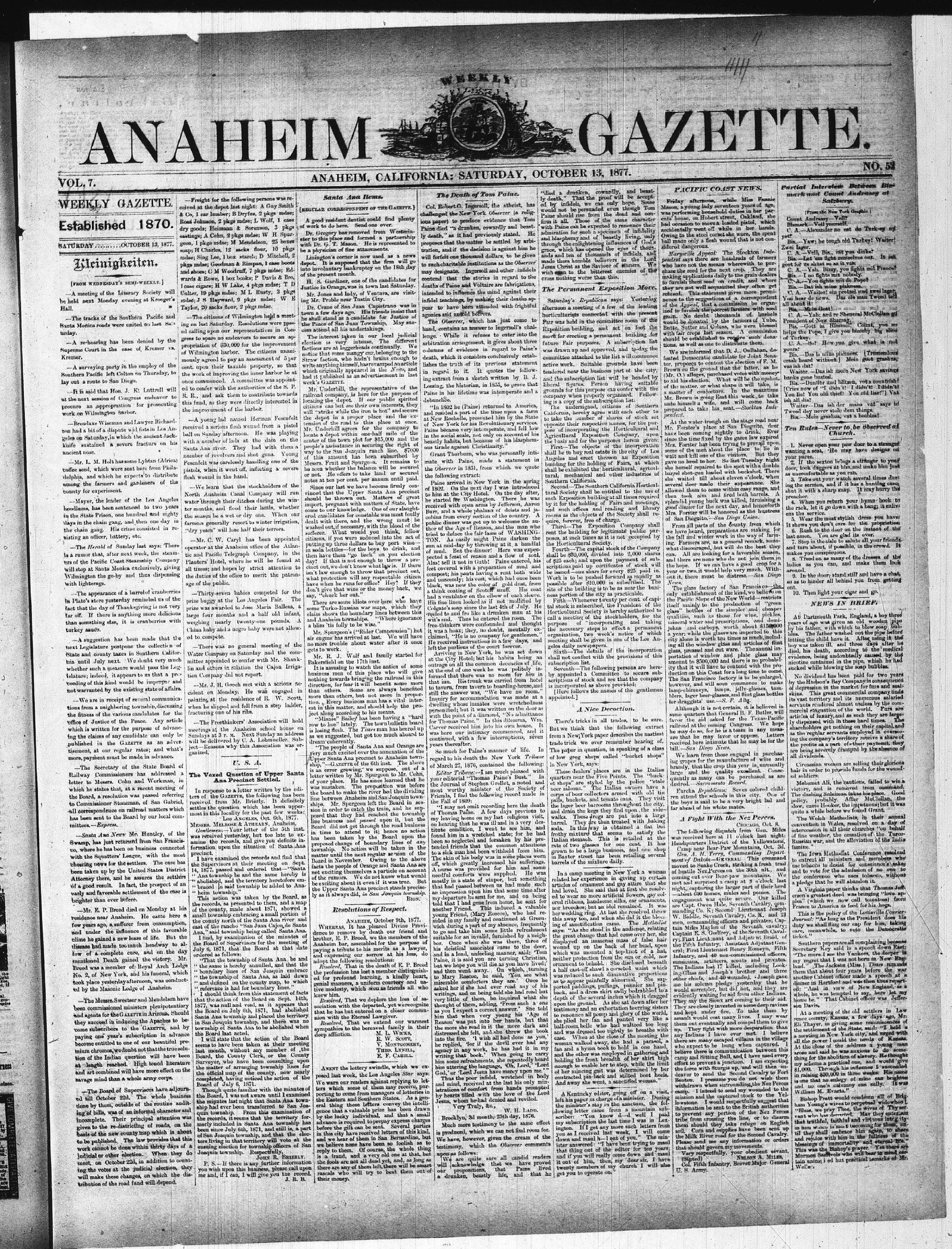
Searchable text
WEEKLY GAZETTE.
Established 1870.
SATURDAY...OCTOBER 13, 1877.
Steinigkeiten.
[FROM WEDNESDAY'S SEMI-WEEKLY.]
A meeting of the Literary Society will be held next Monday evening at Kroeger's Hall.
The tracks of the Southern Pacific and Santa Monica roads were united on last Saturday.
A re-hearing has been denied by the Supreme Court in the case of Kremer vs. Kremer.
A surveying party in the employ of the Southern Pacific left Colton on Thursday, to lay out a route to San Diego.
It is said that Hon. J. K. Luttrell will at the next session of Congress endeavor to procure an appropriation for prosecuting work on Wilmington harbor.
Broadaxe Wiseman and Lawyer Richardson had a bit of a dispute wid fists in Los Angeles on Saturday, in which the ancient Jackknife sustained a severe fracture on his ancient nose.
Mr. L. M. Holt has some Lybian (Africa)
Freight for the following persons was received at the depot last night: A Guy Smith & Co, 1 car lumber; B Dryfas, 2 pkgs mdse; Ross Johnson, 2 pkgs mdse; L Wolf, 1 case dry goods; Heimann & Sorenson, 3 pkgs castings; A Cohn, 2 pkgs mdse; W H Spurgeon, 1 pkgs mdse; M Mendelson, 25 boxes soap; H Charles, 12 sacks flour, 10 pkgs mdse; Sing Lee, 1 box starch; D Mitchell, 2 pkgs mdse; Goodman & Rimpan, 1 case boots and shoes; C M Woodruff, 7 pkgs mdse; Edwards & Rowe, 1 box books; P Davis & Bro, 1 case cigars; H W Lake, 4 pkgs mdse; T D Calter, 19 pkgs mdse; M L Rusty, 3 pkgs mdse; J S Hayward, 9 pkgs mdse; W E Taylor, 29 sacks flour, 2 pkgs mdse.
The citizens of Wilmington held a meeting on last Saturday. Resolutions were passed calling upon our representatives in Congress to spare no endeavors to secure an appropriation of $30,000 for the improvement of Wilmington harbor. The citizens unanimously agreed to pay an assessment of 5 per cent. upon their taxable property, so that the work of improving the inner harbor be at once commenced. A committee was appointed to confer with the authorities of the S. P. R. R., and ask them to contribute towards this fund, as they were directly interested in the improvement of the harbor.
A young lad named Herman Fesenfelt received a serious flesh wound from a pistol ball on Sunday afternoon. He was playing with a number of lads at the dain on the Santa Ana river. They had with them a number of revolvers and shot guns. Young Fesenfelt was carelessly handling one of the Santa Anita.
A good resident denies of work to do here.
Dr. Gregory has resigned to this place and will be a physician of fine.
Linington's corner is depot. It is supposed into involuntary bank of the present month.
H. S. Gardiner, on Justice in Orange, was Mr. Jones and lady ing Mr. Proble near T.
Dr. Crane of San J town a few days ago he shall stand as a cape the Peace of San Juancess attend all his un
The interest taken election is very infactions are at logger notice that some man Straw faction, who I write anything himself which originally appeared it published as a week's Gazette.
Mr. Underhill, the railroad company, is locating the depot. Citizens can but see will "strike while thie dept in a protension of the road to Mr. Underhill agrees locate a depot within center of the town people's assistance way to the San Joaquin of this amount ha Messrs. Fruit and S
A surveying party in the company of Southern Pacific left Colton on Thursday, to lay out a route to San Diego.
It is said that Hon. J. K. Luttrell will at the next session of Congress endeavor to procure an appropriation for prosecuting work on Wilmington harbor.
Broadaxe Wiseman and Lawyer Richardson had a bit of a dispute with fists in Los Angeles on Saturday, in which the ancient Jackknife sustained a severe fracture on his ancient nose.
Mr. L. M. Holt has some Lybian (Africa) coffee seed, which were sent here from Philadelphia, and which he expects to distribute among the farmers and gardeners of the county for experiment.
Mayer, the leader of the Los Angeles hoodlums, has been sentenced to two years in the State Prison, one hundred and eighty days in the chain gang, and then one day in the chain gang. His crime consisted in resisting an officer, battery, etc.
The Herald of Sunday last says: There is a rumor that, after next week, the steamers of the Pacific Coast Steamship Company will stop at Santa Monica exclusively, giving Wilmington the go-by and thus dispensing with lighterage.
The appearance of a barrel of cranberries in Plato's store yesterday reminded us of the fact that the day of Thanksgiving is not very far off. If there is anything more delicious than something else, it is cranberries with turkey sauce.
A suggestion has been made that the next Legislature postpone the collection of State and county taxes in Southern California until July next. We doubt very much whether such a measure would pass the Legislature; indeed, it appears to us that a proceeding of this kind would be improper and not warranted by the existing state of affairs.
We are in receipt of several communications from a neighboring township, discussing the fitness of the various candidates for the office of Justice of the Peace. Any article which is written for the purpose of advancing the claims of any candidate can only be published in the Gazette as an advertisement, at our regular rates; and what's more, payment must be made in advance.
The Secretary of the State Board of Railway Commissioners has addressed a letter to Messrs. Cohn and Workman, in which he states that, at a recent meeting of the Board, a resolution was passed referring to Commissioner Stoneman, of San Gabriel, all correspondence on railroad matters which has been sent to the Board by our local committees.—Express.
Santa Ana News: Mr. Huntley, of the Swamp, has just returned from San Francisco, where he has been on business connected with the Squatters' League, with the most cheering news for the settlers. The case has been taken up by the United States District Attorney there, and he assures the settlers
A young lad named Herman Fesenfelt received a serious flesh wound from a pistol ball on Sunday afternoon. He was playing with a number of lads at the dain on the Santa Ana river. They had with them a number of revolvers and shot guns. Young Fesenfelt was carelessly handling one of the pistols, when it went off, inflicting a severe flesh wound in the hand.
We learn that the stockholders of the North Anaheim Canal Company will run water through their ditches during the winter months, and flood their larals, whether the season be a wet or dry one. When our farmers generally resort to winter irrigation, "dry years" will lose half their terrors.
Mr. C. W. Caryl has been appointed operator at the Anaheim office of the Atlantic and Pacific Telegraph Company, in the Planters' Hotel, where he will be found at all times; and hopes by strict attention to the duties of the office to merit the patronage of the public.
Thirty-seven babies competed for the prize buggy at the Los Angeles Fair. The prize was awarded to Jose Maria Ballesa, a large four months and a half old infant, weighing nearly twenty-one pounds. A China baby and a negro baby were not allowed to compete.
There was no general meeting of the Water Company on Saturday and the committee appointed to confer with Mr. Shanklin and others in relation to the Cajon Irrigation Company did not report.
Mr. J. H. Gooch met with a serious accident on Monday. He was engaged in painting at the residence of R. W. Scott, when he slipped and fell from a step ladder, fracturing one of his ribs.
The Freethinkers' Association will hold meetings at the Anaheim school house on Sundays at 3 P.M. Next Sunday an address will be delivered by C. A. Lohmueller. Subject—Reasons why this Association was organized.
U.S.A.
The Vexed Question of Upper Santa Ana Precinct Sottled.
In response to a letter written by the editors of the Gazette, the following has been received from Mr. Brierly. It definitely settles the question which has been uppermost in this locality for past few weeks: Los Angeles, Oct. 6th, 1877.
MESSRS. MELROSE & ATHEARN, Anaheim,
Gentlemen: Your letter of the 5th inst., was received yesterday, but too late to examine the records, and give you definite information upon the situation of Santa Ana precinct.
I have examined the records and find that the Supervisors at their meeting on Sept. 14, 1877, passed and ordered that—"Santa Ana township be and the same hereby is abolished, and the territory heretofore em-
Mr. Underhill, the railroad company, is locating the depot citizens can but see will "strike while thieves in a protection of the road to Mr. Underhill agree locate a depot within center of the town people's assistance way to the San Joaquin of this amount have Messrs. Fruit and Sweet be seen whether they or not. He offers notes at ten per cent.
Since our last we convinced that the Upstream should be thrown into pregnant women come to our knowledge ered candidates for dealt with there, and washed out if necessary sufferer. What we citizens, if you were putting up three dozen in soda bottles—for then have them "go day? If that is not cinct out, we don't know isn't law enough to what protection will have when he runs don't give that win say," chuck her out.
There are some Turko-Russia claim shows the booth and Anaheim township a bliss 'tis folly to Mr. Spurgeon's (air engine has arrived no more trouble allows) to work.
Mr. R. J. Woolkersfield on the e It is amusing to business men of nothing towards direction, for fear than others. So more than others, tension Every business in this matter jeet along according "Minnie" Bailey row to hoe" lately is losing flesh. Thus as we suggested, dream coherently,
"The people of very much excited Upper Santa Ana ship,"—Gazette is an error growing letter written by Mr. of your place. He was mistaken. The board to make line between Anale ships. Mr. Spurgeon in order to pose that they line business and Board did not get in time to attend has been taken proposed change township. No matter until the Board in November facts the people do not exciting them of the rumors.
Santa Ana News: Mr. Huntley, of the Swamp, has just returned from San Francisco, where he has been on business connected with the Squatters' League, with the most cheering news for the settlers. The case has been taken up by the United States District Attorney there, and he assures the settlers of a good result. In fact, the prospect of an early and favorable settlement of the case is brighter than ever before.
Mr. E. P. Breed died on Monday at his residence near Anaheim. He came here a few years ago, a sufferer from consumption, and under the influence of this favorable climate he gained a new lease of life. But the disease had made too much headway to allow of a complete cure, and on the day mentioned Death gained the victory. Mr. Breed was a member of Royal Arch Lodge No. 2, of New York, and his funeral, which took place yesterday afternoon, was conducted by the Masonic Lodge of Anaheim.
The Messrs. Sweetser and Mendelson have been commissioned ministers plenipotentiary and agents for the Gazette in Arizona. Should they succeed in inducing the Apachos to become subscribers to the Gazette, and by paying one year's subscription in advance become entitled to one of our beautiful premium chromos, we doubt not that the true solution of the Indian question will have been at length reached. High-toued literature and art combined will have more effect on the savage mind than a whole army corps.
The Board of Supervisors have adjourned till October 22d. The whole business done by them, outside of the routine auditing of bills, was of an informal character and incomplete. Their principal attention was given to the re-districting of roads, on the basis of the new county map which is about to be published. The law provides that this work cannot be done within thirty days of a judicial or other election. When they do meet, on October 22d, in addition to counting the votes at the judicial election, they will make these changes, on which the distribution of the road fund will depend.
In response to a letter written by the editors of the Gazette, the following has been received from Mr. Brierly. It definitely settles the question which has been uppermost in this locality for the past few weeks; Los Angeles, Oct. 6th, 1877.
Messrs. Melrose & Athearn, Anaheim.
Gentlemen—Your letter of the 5th inst. was received yesterday, but too late to examine the records, and give you definite information upon the situation of Santa Ana precinct.
I have examined the records and find that the Supervisors at their meeting on Sept. 14, 1877, passed and ordered that—"Santa Ana township be and the same hereby is abolished, and the territory heretofore embraced in said township be added to Anaheim township."
This action was taken by the Board, as the records, as presented to them, and a map of the county, made about 1871, showed a small township embracing a small portion of the county north of the Santa Ana river and east of the rancho "San Juan Cajon de Santa Ana," said township being called Santa Ana.
I find, by examination of the minutes of the Board of Supervisors for the meeting of July 6, 1871, that the Board at that date ordered as follows:
"That the township of Santa Ana be and the same is hereby annulled, and that the boundary lines of San Joaquin embrace the township of Santa Ana, as laid down and defined on the county map, to which reference is had for boundary lines."
I should think from this statement of facts that the action of the Board on Sept. 14th, 1877, was null and void, as it appears that the Board on July 6th, 1871, had abolished Santa Ana township and placed the territory in San Joaquin township, and there was no township of Santa Ana to be abolished when the Board last acted.
I will state that the action of the Board seems to have been taken at their meeting last month, without any member of the Board, the County Clerk, or the County Surveyor, who have been consulting upon the matter of arranging township lines for the official map of the county, now nearly completed, having noticed the action of the Board of July 6th, 1871.
Though quite familiar with the minutes of the Board, I was not aware until I examined the minutes last night that Santa Ana township had ever been transferred to San Joaquin township. From this examination of the records, it seems that the territory formerly included in Santa Ana township has been since July 6th, 1871, and still is, a part of San Joaquin township, and that the electors living in that territory will vote at the ensuing election for township officers of San Joaquin township. Respectfully,
John R. Brierly.
P. S.—If there is any further information you wish upon this business, please call upon me and, if I can, I will give you the record.
J. R. B.
WEEKLY
EM GAZETE
ANAHEIM, CALIFORNIA: SATURDAY, OCTOBER 13, 1877.
Santa Ana Items.
[REGULAR CORRESPONDENT OF THE GAZETTE.]
A good resident dentist could find plenty of work to do here. Send one over.
Dr. Gregory has removed from Westminster to this place and formed a partnership with Dr. G. T. Mason. He is represented to be a physician of fine attainments.
Linington's corner is now used as a news depot. It is supposed that the firm will go into involuntary bankruptcy on the 18th day of the present month.
H. S. Gardiner, one of the candidates for Justice in Orange, was in town last Saturday.
Mr. Jones and lady, of Ventura, are visiting Mr. Prabble near Tustin City.
Dr. Crane of San Juan Capistrano was in town a few days ago. His friends insist that he shall stand as a candidate for Justice of the Peace of San Juan Township. May success attend all his undertakings.
The interest taken in our local judicial election is very intense. The different factions are at loggerheads continually. We notice that some mangy cur, belonging to the Straw faction, who hadn't brains enough to write anything himself, has revamped an article which originally appeared in the Newspaper, and had it published as an advertisement in last week's Gazette.
Mr. Underhill, the representative of the railroad company, is here for the purpose of locating the depot. If our public spirited citizens can but see their own interests, they will "strike while the iron is hot" and secure the depot in a proper place and the extension of the road to this place at once. Mr. Underhill agrees for the company to locate a depot within one-half mile of the center of the town plot for $15,000 and the people's assistance in securing the right of way to the San Joaquin ranch line. $7000 of this amount has been subscribed by Messrs Fruit and Spurgeon. It remains to
The Death of Tom Paine.
Col. Robert G. Ingersoll, the atheist, has challenged the New York Observer (a religious paper) to produce evidence that Tom Paine died "a drunken, cowardly and beastly death," as it had previously stated. He proposes that the matter be settled by arbitration, and if the decision is against him he will forfeit one thousand dollars, to be given to such charitable institutions as the Observer may designate. Ingersoll and other infidels contend that the stories in regard to the deaths of Paine and Voltaire are fabrications, intended to influence the mind against their infidel teachings, by making their deaths appear to have been attended with frightful agonies and unsold horrors.
The Observer, which has just come to hand, contains an answer to Ingersoll's challenge. While it refuses to enter into the arbitration arrangement, it gives about three columns of evidence in regard to Paine's death, which it considers conclusively establishes the truth of its previous statement in regard to it. It quotes the following extract from a sketch written by B. J. Lossing, the historian, in 1855, to prove that Paine in his lifetime was intemperate and a debaucheuse.
"In 1802 he (Paine) returned to America, and resided a part of the time upon a farm at New Rochelle, presented him by the State of New York for his Revolutionary services. Paine became very temperate, and fell low in the social scale, not only on account of his beastly habits, but because of his blasphemous tirade against Christianity."
Grant Thorburn, who was personally intimate with Paine, made a statement in "died a drunken, cowardly, and beastly death." That the proof will be accepted by infidels, we can only hope. Some would not be persuaded even though Tom Paine should rise from the dead and confirm it all. Those of the same character with Paine can be expected to renounce their admiration for such a specimen of infidelity and blasphemy and of beastly living, only through the caligraphic influences of God's grace, which has opened the eyes of thousands and ten of thousands of infidels, and made them humble believers in the Lord Jesus Christ as the Saviour of sinners. We wish unto the bitterest enemies of the cross nothing worse than this.
The Permanent Exposition More.
Saturday's Republican says: Yesterday afternoon a meeting of a few of the leading horticulturists connected with the present Fair was held in the committee room of the Exposition building, and set on foot the move for erecting a permanent building for future Fair purposes. A subscription list was drawn up and approved, and tp-day the committee attached to the list will commence active work. Suitable grounds have been tendered near the business part of the city, and the subscription list will be headed by liberal figures. Person having suitable grounds for this purpose can confer with the company when properly organized. Following is a copy of the subscription list:
The undersigned, citizens of Southern California, hereby agree with each other to take the number of shares of stock set opposite their respective names; for the purpose of incorporating the Horticultural and Agricultural Exposition Company, upon the basis and for the purposes herein given:
First—The objects of the incorporation shall be to buy real estate in the city of Los Angeles and erect thereon an Exposition building for the holding of Fairs, at which
Mr. Underhill, the representative of the railroad company, is here for the purpose of locating the depot. If our public spirited citizens can but see their own interests, they will "strike while the iron is hot" and secure the depot in a proper place and the extension of the road to this place at once. Mr. Underhill agrees for the company to locate a depot within one-half mile of the center of the town plot for $15,000 and the people's assistance in securing the right of way to the San Joaquin ranch line. $7000 of this amount has been subscribed by Messrs. Fruit and Spurgeon. It remains to be seen whether the balance will be secured or not. He offers to take land or secured notes at ten per cent. per annum until paid.
Since our last we have become firmly convinced that the Upper Santa Ana precinct should be thrown out. Matters of great import, pregnant with matters of State, have come to our knowledge. One of our slaughtered candidates for countable was most foully dealt with there, and the wrong must be washed out, if necessary, with the blood of the sufferer. What would you think, fellow citizens, if you were seduced into the act of putting up three dollars to buy port wine—in soda bottles—for the boys to drink, and then have them "go back" on your election day? If that is not enough to throw a precinct out, we don't know what law is. If there isn't law enough to throw that precinct out, what protection will any respectable citizen have when he runs for office? Hey? If they don't give that wine or the money back, we say, "chuck her out."
There are some idiots over here who have some Turko-Russian war maps, which they claim shows the boundary lines between this and Anaheim townships. "Where ignorance a bliss 'tis folly to be wise."
Mr. Spurgeon's ("Rider Compression") hot air engine has arrived at last. We will have no more trouble about water after it once gets to work.
Mr. R. J. Wolf and family started for Bakersfield on the 17th inst.
It is amusing to watch the antics of some business men of this place who will give nothing towards bringing the railroad in this direction, for fear it will benefit some more than others. Some are always benefited more than others, but not more in proportion. Every business man has a vital interest in this matter, and should help the project along according to his means.
"Minnie" Bailey has been having a "hard row to hoe" lately. The town bulletin board is losing flesh. The Times man has beered up as suggested, but got too much aboard to dream coherently.
"The people of Santa Ana and Orange are very much excited over the annexation of the Upper Santa Ana precinct to Anaheim township," — Gazette of the 6th inst.
The above is an error growing; we suppose, out of a letter written by Mr. Spurgeon to Mr. Cohn, of your place. He has since learned that he was mistaken. The proposition was before the board to make the river bed the dividing line between Anaheim and San Joaquin townships. Mr. Spurgeon left the Board in session in order to catch the train, and he supposed that they had reached the township line business and passed upon it, but the Board did not get through the road business in time to attend to it; hence no action has been taken by the Board upon the proposed change of boundary lines of any township. No action will be taken in the matter until the next regular session of the Board in November. Owing to the above facts the people of Orange and Santa Ana are not exciting themselves a particle on account of the rumors. We do not know what would bring about it even if it was true.
In regard to it. It quotes the following extract from a sketch written by B. J. Lossing, the historian, in 1855, to prove that Paine in his lifetime was intemperate and a debauchice.
"In 1802 he (Paine) returned to America, and resided a part of the time upon a farm at New Rochelle, presented him by the State of New York for his Revolutionary services. Paine became very intemperate, and fell low in the social scale, not only on account of his beastly habits, but because of his blasphemous tirade against Christianity."
Grant Thorburn, who was personally intimate with Paine, made a statement in the Observer in 1851, from which we quote the following extract:
Paine arrived in New York in the spring of 1802. On the next day I was introduced to him at the City Hotel. On the day after, he started for Washington. There he was received with open arms by Jefferson, Aaron Burr, and a whole phalanx of decists and jacobins from every section of the country. A public dinner was got up to welcome the author of the Age of Reason, and the man who tried to deface the fair fame of WASHINGTON. As easily might Paine darken the sun at mid-day by throwing at it, a handful of mud. But the dinner! Here was expected a feast of reason and a flow of soul. Alas! tell it not in Gath! Paine entered, his feet covered with a preparation of mud and compost; his pants having a rent both wide and unseemly; his vest, which had once been black, was now the color of gold dust, from a think coating of Scotch snuff. His coat had a ventilator on the elbow of each sleeve.
His fine linen looked as if not mollified by Colgate's soap since the last 4th of July. He reeled to and fro like a drunken man at his wit's end. Thus he entered the room. The free-thinkers were confounded and thought it was a hoax; they, no doubt, mentally exclaimed, "He is no company for gentlemen." He received instructions in a few days, and left the purlius of the court forever.
Arriving in New York, he was set down at the City Hotel; but his habits being an outrage on all the common decessions of life, at the end of one week he was politely informed that there was no room for him in that inn. His trunk was carried from hotel to tavern, from tavern to boarding-house, and still the answer was, "We have no room." Inquiry for accommodation was made at a dwelling whose inmates were wretchedness personified; but it was written on the door as with the point of a diamond, "No admittance for Thomas Paine." In this dilemma, Wm. Carver received him into his own house. It was here our intimacy commenced, and it continued, with a few interruptions, seven years thereafter.
So much for Paine's manner of life. In regard to his death the New York Tribune of March 27, 1876, contained the following:
Editor Tribuene: I am much pleased with your editorial "Thomas Paine's Bust." In the Journal of Stephen Grellet, a noted and most worthy minister of the Society of Friends, I find the following record made in the Fall of 1809:
"I may not omit recording here the death of Thomas Paine. A few days previous to my leaving home on my last religious visit, on hearing that he was ill and in a very desistite condition, I went to see him, and found him in a wretched state; for he had been so neglected and forsaken by his pretended friends that the common attentions to a sick man had been withheld from him. The skin of his body was in some places worn off, which greatly increased his sufferings. A nurse was provided for him and some needful comforts were supplied. He was mostly in a state of stupor, but something tendered near the business part of the city, and the subscription list will be headed by liberal figures. Person having suitable grounds for this purpose can confer with the company when properly organized. Following is a copy of the subscription list:
The undersigned, citizens of Southern California, hereby agree with each other to take the number of shares of stock set opposite their respective names; for the purpose of incorporating the Horticultural and Agricultural Exposition Company, upon the basis and for the purposes herein given:
First—the objects of the incorporation shall be to buy real estate in the city of Los Angeles and erect thence an Exposition building for the holding of Fairs, at which shall be exhibited the horticultural, agricultural, mechanical and other industries of Southern California.
Second—The Southern California Horticultural Society shall be entitled to use of such Exposition building at all times required by it for the holding of Fairs and meetings, and such offices and reading and library rooms as the objects of the Society shall require, forever, free of charge.
Third—The Exposition Company shall rent the building for legitimate public purposes, at such times as it is not occupied by Horticultural Society.
Fourth—The capital stock of The Company shall be $10,000 divided into 2,000 shares of $25 each; and upon the payment of subscriptions paid up certificates of stock will be issued—one share for every $25 paid in. Work is to be pushed forward as rapidly as possible after $10,000 is subscribed. The site of the building is to be as near the business portion of the city as practicable.
Fifth—Whenever twenty per cent. of capital stock is subscribed, the President of the Horticultural Society is hereby authorized to call a meeting of the stockholders; for the purpose of incorporating and takingthe necessary steps to effect a permanent organization, two weeks' notice of which meeting shall be given in one of the Los Angeles daily newspapers.
Sixth—The details of the incorporation shall not conflict with the provisions of this subscription list.
Seventh—The following persons are hereby appointed a Committee to secure subscriptions of stock and see that the company is incorporated as above provided:
[Here follows names of gentlemen appointed.]
Resolutions of Respect.
ANAHEIM, October 9th, 1877.
Whereas, It has pleased Divine Providence to remove by death our friend and brother, E. P. Breed, we the members of the Anaheim bar, assembled for the purpose of paying a tribute to his merits as a lawyer, and expressing our sorrow at his loss, do adopt the following resolutions:
Resolved, That in the death of E. P. Breed the profession has lost a member distinguished for profound learning, a kindly heart, genial manners, a uniform courtesy and native modesty, which won as friends all who knew him.
Resolved, That we deplore the loss of association with the departed, yet we recognize that he has but entered on a closer communion with the Eternal Lawgiver.
Resolved, That we extend our warmest sympathies to the bereaved family in their deep affliction.
M. L. WICKS,
R. W. SCOTT,
V. MONTGOMERY,
THEO. LYNILL,
E. F. CARILL.
Anent the lottery swindle, which we exposed last week, the Los Angeles Star says:
We warn our readers against replying to letters which some of them may receive, purporting to come from managers of lotteries in the Eastern and Southern States. As a general thing these letters convey the intelligence that a valuable prize has been drawn by the lucky individual, and that a small advance is required to prepay express charges before the gift can be sent. Several parties in this city have received letters of this kind, and we hear of them in San Bernardino, but we believe none have been so foolish as to reply to them. Of course, the whole thing is a fraud, and a very old one at that, but the fools are not all dead yet, and as long as there are any of them left, there will be smart rascals who will try to heat them out of their money.
W. H. LADD.
Brooklyn, 3d month; 25th day, 1876.
Much more testimony to the same effect is produced, which we can not find room for. We have, however, given the cream of the testimony, which the Observer comments upon as follows:
We are quite sure all candid readers will acknowledge that we have proved our propositions, that Paine lived a drunken, beastly life, and that he
The Italian owners have a corps of beer collectors armed with old tin pails, buckets, and tomato cans. They visit the lager beer barrooms throughout the city, and drain the kegs they find upon the sidewalks. These drags are put into a large barrel. They are then treated with baking soda. In this way is obtained a flat but frothy mixture that seems to satisfy the Italian stomach. This is retained at the rate of two glasses for one cent. It has grown to be a large business, and one shop in Baxter street has been retailing several barrels of the mixture daily.
In a camp meeting in New York a woman related her experience in giving up certain articles of ornament and gay attire that she had loved. She said that at first she resolved to wear no more artificial flowers, gay colored ribbons, handsome silks, ear ornaments, nor brooches; but an idol remained. It was her wedding ring. At last she resolved throw this away too, and when she did it the blessing of sanctification came. The Methodist says: "As she stood in the audience, relating the great change that had come over her, she displayed an immense mass of false hair wound up on the back of her head, upon which was mounted a top-knot of a hat, neither protection from the sun or cold, nor ornament to behold. She disclosed beneath a half cast-off shawl a corneted waist which was reduced to such diminutive proportions as to appear painfully abnormal. She supported paddlings, puffings, pannier and pinback, and a dress skirt sadly bedrabbled to a depth of the several inches which it dragged upon the ground. As she sat down after her testimony and an exhortation to erring sisters to renounce all pomp and glory of the world, she plied her fan and painted very like a ball-room belle who had waltzed too long and was dressed too tightly to breathe with ease. When at the close of the meeting the woman walked away, she had a parasol, a fan and a hymn book to hold in one hand, and the other was employed in gathering and holding the front breadth of her skirt high enough to enable her to step, while the limit of her mincing gait was determined by her contracted pin-back and stilted boot heels. And away she went, a sanctified woman."
A Kentucky editor, going off on a visit, left his paper on charge of a minister. During the minister's stay in the sanctum, the following letter came from a mountain subscriber: "You know d—d well I paid my subscription the last time I was in Lexington. If I get any more such letters from you as I received last week, I will come down and maul h—I out of you." The minister answered: "I have been trying to maul that thing out of the editor for ten years; and if you will really come down and maul it out of him, then my dear sir, I have twenty members of my church! I will also get you to operate on."
GAZETTE.
NO. 52
3, 1877.
PACIFIC COAST NEWS.
Friday afternoon, while Miss Fannie Mason, a young lady seventeen years of age, was performing household duties in her parents' house, on Hobert street, Oakland, she had occasion to move a loaded pistol, which accidentally went off while in her hands. Owing to the steel cornet she wore, the spent ball made only a flesh wound that is not considered dangerous.
Marysville Appeal: The Stockton Independent says there are hundreds of farmers who have not the means wherewith to purchase the seed for the next crop. They are making applications daily to the grain dealers to furnish them seed on credit, and where they are not well acquainted they often get refused. This statement gives more prominence to the suggestions of a correspondent of the Appeal, that a commission be organized to furnish the poorest farmers with seed grain. No doubt thousands of linchols would be donated by the farmers of Yuba, Butte, Sutter and Colusa, who were blessed with fair crops last season. A commission should be established to receive such donations, as well as one to distribute them.
We are informed that D. J., Oullahan, defeated Democratic candidate for Joint Senator, proposes to contest the election of F. M. Brown on the ground that the latter, as he (Mr. O.) alleges, purchased votes with money to aid his election. What will be the upshot of the matter, or what shape it will take, is a matter of conjecture. In the meantime Mr. Brown is going East this week to take unto himself a wife, and will come back prepared to take his seat—Stockton Independent.
At the water-trough on the stage road near Mr. Forster's place at San Diego, deer have been coming nightly to drink. Ever since the time fixed by the game law expired Mrs. Forster has been trying to prevail upon some of the men about the place to lie in wait and kill one of the visitors. But they gave no heed to her. So last Tuesday night
Partial Interview Between Bismark and Count Andrascy at Satzburg:
[From the New York Graphic]
Count Andrascy—Vell?
Bismark—Vell yourself.
C. A.—Alexander no eat do Turkey up yet?
Bis.—Yaw; he tough old Turkey! Waiter!
Zwei lager.
C. A.—Vell, Bis., vat you dinks?
Bis.—Let 'em fight mansives out. It all goot for us shiat so az it van.
C. A.—Yah, Bizzy, you fights mit France!
Bis.—I no fights mit nobody.
C. A.—You fights mit de Pope!
Bis.—Dat ich mine pianness.
C. A.—Waiter! ein pretzel und zwel lagern.
You hear de news. Das ole man Tweed tell all about it!
Bis.—Mein Gott!
C. A.—Yah; and re Sheneral McClallan gd President of New Sharsay.
Bis.—Gott in Himmel! Count, you no helps the Pope, I give you binley big alled of Turkey.
C. A.—So? How you give what is not yours?
Bis.—Das is nille pishiness. [Trumemlous crash heard without.] Mein goot grashus; vas ish dat?
Waiter.—Das ist more New York savings banks gone bustal.
Bis.—Duntiler and blitzen, vot a countrish! [Cries now of "I didn't! I didn't! You lie! You old thief!] Vah ish all dis?
Waiter.—Das ish der man vat says to Tweed day never stole dem things.
Bis.—Mein grashus, vat a beebles!
Ten Rules—Never to be observed at Church.
1. Never open your pow door to a stranger wanting a seat. He may have designs on your purse.
2. If the sexton brings a stranger to your
Brown on the ground that the latter, as Mr. O.) alleges, purchased votes with money to aid his election. What will be the upshot of the matter, or what shape it will take, is a matter of conjecture. In the meantime Mr. Brown is going East this week to take unto himself a wife, and will come back prepared to take his seat. Stockton Independent.
At the water-trough on the stage road near Mr. Forster's place at San Diego, deer have been coming nightly to drink. Ever since the time fixed by the game law expired Mrs. Forster has been trying to prevail upon some of the men about the place to lie in wait and kill one of the visitors. But they gave no heed to her. So last Tuesday night she herself repaired to the spot with a double barrel shot-gun loaded with buckshot. There she waited till about eleven o'clock, when several deer made their appearance. She allowed them to come within easy range, and then took aim and fired both barrels. A splendid young buck was killed, furnishing a good dinner for the next day, and henceforth Mrs. Forster will be honored as the huntress of San Diego Union.
From all parts of the county from which we have heard, preparations are making for the fall and winter work in the way of farming. Farmers are, as a general remark, somewhat discouraged, but will do the best they can. All are looking for a favorable season, and there are none who do not join them in the hope. If we can have a good crop for a year or two, it would help very much. Without it, there must be distress. San Diego News.
The glass factory of San Francisco—the only establishment of the kind, we believe on the Pacific Slope of the New World—restricts itself mainly to the production of "green glass" bottles of the simpler and cheaper qualities, such as those for wine, pickles, mineral water and prescriptions, and demijohns and carboys, worth about $150,000 a year; while the glassware imported to this city alone is worth ten times as much, including all the window glass and articles of flint glass, pressed and cut ware. The annual importation of window and plate glass may amount to $500,000 and there is no probability that it will have to contend with the production on this Coast for a long time to come. The San Francisco factory is to be enlarged, however, and will soon commence to make lamp-chimneys, lamps, jelly-glasses, tumblers, lager beer-glasses, and flint glass bottles for druggists' use. S. F. Alto.
Although it is not certain, it is believed in some quarters that General B. F. Butler, will favor the aid asked for the Texas-Pacific railroad at the coming Congress. We hope he may do so, for he is a team in any measure that he may favor or oppose. Letters received here intimate that he may be for the bill—San Diego News.
We learn from those engaged in purchasing grapes for the manufacture of wine and brandy, that the crop this year is unusually large and the quality excellent. Consequently as many can be purchased as are desired—Sacramento Record.
Eureka Republican: Seven colored children attend the schools in this city. One of the boys is said to be a very bright lad and far ahead of his white mates.
A Fight With the Nez Perces.
CHICAGO, Oct. 8.
The following dispatch from Gen. Miles was received here at 11 o'clock last night: Headquarters District of the Yellowstone Camp near Bear-Paw Mountains, Oct. 3d.
Gen. A. H. Terry, Commanding Department of Dakota—GENERAL: This command moved to Snake Creek, striking a fresh trail of hostile Nez Perces on the 39th alt., and coming out over Bear-paw mountains. We met and surprised a camp at 8 o'clock last
Waiter.-Das ish more New York savings banks gone bust.
Bis.-Dundell und blitzen, vot a countish! [Cries now of "I didn't! I didn't!] You lie! You old thief! You old liar!" Vat ish all dis!
Waiter-Das ish der man vat says to Tweed day never stole dem things.
Bis.-Mein grashus, vat a beebles!
Ten Rules—Never to be observed at Church.
1. Never open your pew door to a strangely wanting a seat. He may have designs on your purse.
2. If the sexton brings a stranger to your door, look daggers at him, and make him just as uncomfortable as you can.
3. Take out your watch several times during the sermon, and if it has a hunting case, shait it with a sharp snap. It may hurry this preacher.
4. When you return your hymn book to the rack, let it go down with a bang; it enlives the service.
5. Wear the most stylish dress you have! It shows you don't care for the proprieties.
6. Rush to the door on the instant of the last anun.
7. Stop in the aisle to salute all your friends and turn about, if possible, in the crowd. It makes you conspicuous.
8. Trend on as many of the dresses of the ladies as you can, and makes them look around.
9. In the door; stand still and have a chat; so as to hinder all behind you from getting out.
10. Then light your cigar and go.
NEWS IN BRIEF:
At Dartmouth Park, England, a boy three years of age was given an old wooden pipe by his father, with which to blow soap bubbles. The father washed out the pipe before letting the child have it. After using it the boy was taken ill, and three days after he died, his death according to the medical evidence, being undoubtedly caused by the nicotine contained in the pipe, which he had sucked while blowing the soap bubbles.
No dividend has been paid for two years by the Hudson's Bay Company in consequence of depression in the market for furs and sealskins. This great commercial company finds its vast territory and its numerous salaried servants rendered almost useless by the commercial stagnation of the world. Furs are articles of luxury, and as such they are largely dispensed with in these hard times. The shareholders get nothing on their capital, and as the regular servants employed in overseeing the company's territory receive a share of the profits as a part of their payment, they are being severely cramped by the absence of all dividends.
Circassian women are selling their glorious hair in order to provide funds for the wounded soldiers.
Mehemet Ali, the cautious, failed to win a victory, and is removed from command. The dashing Salaiman takes his place. Good policy, probably. After McChallan, the slow, canto Hooker, the impetuous; but it was quite a while before we found Grant.
The Welch Methodist Conference resolved to entreat all ministers and members who use tobacco to desist for conscience's sake; and to vote for the admission of no one to the conference who uses tobacco; without a plea that he will abandon it.
A Fight With the Nez Perces.
CHICAGO, Oct. 8.
The following dispatch from Gen. Miles was received here at 11 o'clock last night: Headquarters District of the Yellowstone, Camp near Bear-Paw Mountains, Oct. 2d. Gen. A. H. Terry, Commanding Department of Dakota—GENERAL. This command moved to Snake Creek, striking a fresh trail of hostile Nez Perces on the 30th nlt., and coming out over Bear-paw mountains. We met and surprised a camp at 8 o'clock last night, capturing the larger part of their herd—about 600 horses, mules and ponies. The engagement was quite severe. Our killed are Capt. Owen Hale, Seventh Cavalry, commanding Co. K; Second Lieutenant Joseph W. Bidille, Seventh Cavalry, Co. K, and 21 men, commanding officers and privates; Captain Miles Maylon of the Seventh cavalry; Captain E. S. Godfrey, of the Seventh Cavalry; First Lieutenant and Adjutant Braid, of the Fifth Infantry, Assistant Adjutant General; First Lieutenant Henry Romeyn, Fifth Infantry, and 40 non-comissioned officers, musicians, artificers, scouts and privatees. The Indians lost 17 killed, including Looking-Glass and Joseph's brother and three other chiefs, and 40 wounded. Joseph gave me his solan pledge yesterday that he would surrender, but did not, and they evidently waiting for aid from other Indians. They say the Sioux are coming to their aid. They are closely invested in some deep ravines and kept under fire. To take them by assault would cost many lives. I may wear them out eventually and compel them to give up. They fight with more desperation than any Indians I have ever met. I believe there are many escaped villains in the village who expect to be hung when captured. I believe there is communication between this camp and Sitting Bull, and I have used every effort to prevent a junction. I am expecting the force with Sturgis up, and will then endeavor to send the Second Cavalry to Fort Benton. I presume you do not wish them withdrawn when surrounding the Nez Perces camp. I intend to send my wounded to the Yellowstone. I would respectfully suggest that information be sent to the British authorities to prevent any portion of the Nez Perces tribe from crossing the line, or to disarm them should they take refuge on English soil. Corn and supplies have been sent up the Milk River road for the Second Cavalry. Please send me any information or orders that should govern my movements.
Very respectfully, your obedient sevant,
(Signed)
NELSON A. MILLS,
Col. Fifth Infantry, Brevet Major General U.S. Army.
Military history in New York during a period of significant conflict.
The Iowa Methodist Conference resolved to entreat all ministers and members who use tobacco to desist for conscience's sake and to vote for the admission of no one to the conference who uses tobacco without a pledge that he will abandon it.
A Virginia paper thinks that Thomas Jefferson's greatest deal was bringing "love apples" (which we now call tomatoes) from France to America as feed for his hogs.
This is the policy of the Louisville Courier-Journal: "As long as the President does his duty we shall fling our cap for him, taking care, meanwhils, to vote for Democratic ticket."
Southern papers are all complaining because Secretary Key said in a speech down East: "The more I see the Yankees, the deeper is my regret that I was not born in New England." The Jackson (Miss.) Times reminds them that about four years before the war another Cabinet officer made a speech at a dinner in Hartford and was then time reported: "And in view of New England, as a whole, he was tempted to say, here let my home be." That Cabinet officer was Jefferson Davis.
At a meeting of the old settlers in Lawrence county, Kansas, a few days ago, Mr. Eli Thayer, in giving some reminiscences of the settlement of the State, said: "I hold a meeting in New York city, and urged with all the power I could the needs of Kansas. At the close of the address a young man arose and said he was anxious to do something for the abolition of slavery. He thought my scheme a practical one, and would give $1,000. Through his influence I succeeded in raising $30,000 in three weeks. His name is one that no analogy of mine can brighten and no one's calumny can rally. It was William M. Evarts."
Bishop Pratt would condemn all of Brigham Young's wives to perpetual widowhood: "Bless, we pray Thee, the wives of Thy servant who has departed. May they entertain that truthful, faithful and virtuous integrity in him whom is most becoming for them, until they shall embrace him again, to share and rejoice with him in the fullness of the blessings of immortality and eternal life." This was the Bishop's prayer: Yet there are Mormon Saltwells who will bear in mind certain uninstilled but practical remarks of Mr. Wells."