anaheim-gazette 1877-10-06
Scanned page
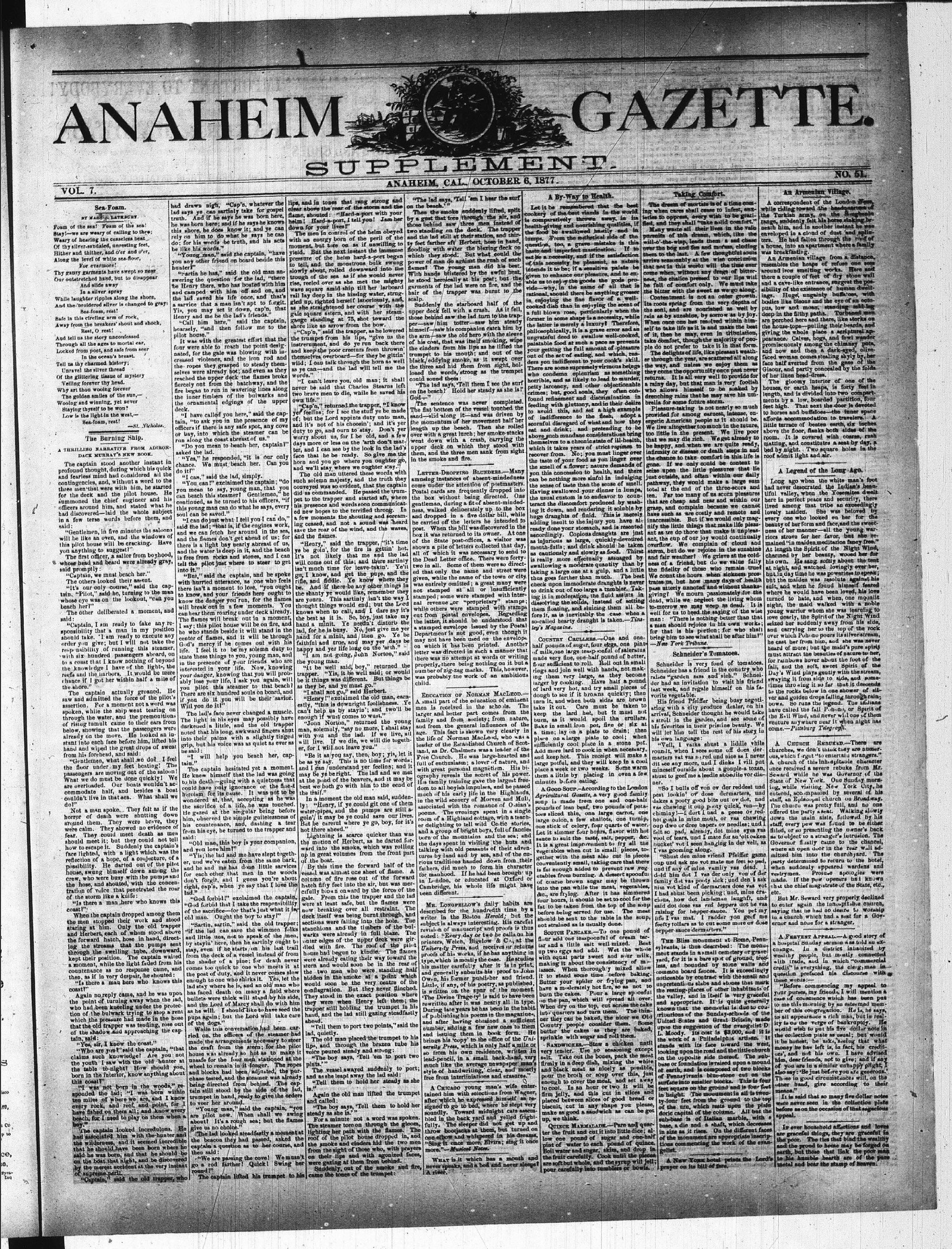
Searchable text
ANAHEIM
VOL. 7.
Sea-Foam.
BY MARY LATHBURY
Foam of the sea! Foam of the sea!
Stay!—we are weary of calling to thre;
Weary of hearing the ceaseless beat.
Of thy silver-sandaled, unresting feet,
Hither and thither, and o'er and o'er,
Along the level of white sea-floor,
For evermore!
Thy gauzy garments have swept so near
Our outstretched hand, but to disappear
And slide away
In a silver spray
While laughter ripples along the shore,
And the 'boldered silver is changed to gray:
Sea-foam, rest!
Safe in this circling arm of rock,
Away from the breakers' shout and shock,
Rest, O rest!
And tell us the story unconfessed
Through all the ages to mortal ear,
Locked from poet, and safe from seer
In the ocean's breast.
Tell us thy charmed history;
Unravel the silver thread
Of the glittering tissue of mystery
Veiling forever thy head.
Why art thon wooing forever
The golden smiles of the sun,—
Wooling and winning, yet never
Staying thyself to be won?
Low is the light in the west,—
Sea-foam, rest!
—St. Nicholas.
The Burning Ship.
A THRILLING NARRATIVE FROM ADIRONDACK MURRAY'S NEW BOOK.
The captain stood another instant in had drawn nigh, "Cap'n, whatever the lad says ye can sartily take for gospel truth. And if he says he was born here, he was born here; and if he says he knows this shore, he does know it; and ye can rely on him to do what he says he can do; for his words be truth, and his acts be like his words."
"Young man," said the captain, "have you any other friend on board beside this hunter?"
"Martin he has," said the old man answering the question for the lad, "there be Henry there, who has boasted with him and camped with him off and on, and the lad saved his life once, and that's a service that a man isn't apt to forgit. Yis, you may set it down, cap'n, that Henry and me be the lad's friends."
"Call him here," said the captain, hoarsely, "and then follow me to the pilot house."
It was with the greatest effort that the four were able to reach the point designated, for the gale was blowing with increased violence, and the iron rod and ropes they grasped to steady themselves were already hot; and even as they reached the upper deck the flames broke fiercely out from the hatchway, and the fire began to run in wavering lines along the inner timbers of the bulwarks and the ornamental edgings of the upper deck.
"I have called you here," said the captain, "to ask you in the presence of my officers if there is any safe spot, any cove or bay, into which the steamer can be run along the coast abreast of us."
"Do you mean to beach her, captain?" asked the lad.
"Yes," he responded, "it is our only chance. We must beach her. Can you lips, and in tones that clear above the rear of the flame, shouted: "Hard-held! Hard-a-port, I down for your lives!"
The men in control of with an energy born of moment, but toore on a yield. But the next insure pressure of the helm h to tell, and the monster slowly about, rolled down trough of the sea as if rise, reeled over as she wave square amid-ship rail lay deep in the his gled up, righted herself as she straightened her gale square astern, and gauge standing at 75', shore like an arrow from "Cap'n," said the trap the trumpet from his insterument, and do yand keep the poor creet themselves overboard—wild; I can talk through as ye can—and the lace words."
"I can't leave you, never be said that Ch two brave men to die, own life."
"Cap'n," returned the yer feelings; for I see thof; but the Lord appining and it's not of his choic duty to go, and ournt worry about us, for I days more or less on ther, and I can see by th face that he be ready horn and you go when
Unravel the silver thread
Of the glittering tissue of mystery
Vailing forever thy head
Why art thou wooing forever
The golden smiles of the sun,
Wooling and winning, yet never
Staying thyself to be won!
Low is the light in the west,
Sea-foam, rest!
St. Nicholas.
The Burning Ship.
A THRILLING NARRATIVE FROM ADIRONDACK MURRAY'S NEW BOOK.
The captain stood another instant in profound thought, during which his quick and fearless mind had considered all the contingencies, and without a word to the three men that were with him, he started for the deck and the pilot house. He summoned the chief engineer and his officers around him, and stated what he had discovered—laid the whole subject in a few terse words before them, and said:
"Gentlemen, in five minutes the saloons will be like an oven, and the windows of this pilot house will be cracking. Have you anything to suggest!"
The first officer, a sailor from boyhood, whose head and beard were already gray, said promptly:
"Captain, we must beach her."
The others looked their assent.
It's our only course," said the captain. "Pilot," said he, turning to the man whose eye was on the lookout, "can you beach her?"
The other deliberated a moment, and said:
"Captain, I am ready to fake any responsibility that a man in my position should take. I am ready to execute any order you give; but I will not take the responsibility of running this steamer, with six hundred passengers aboard, on to a coast that I know nothing of beyond the knowledge I have of the lights, the reefs and the harbors. It would be mere chance if I got her within half a mile of the shore."
The captain actually groaned. He saw and admitted the force of the pilot's assertion. For a moment not a word was spoken, while the ship went tearing on through the water, and the premonitions of rising tumult came to their ears from below, showing that the passengers were already on the move. He looked an instant into each face before him, lifted his hand and wiped the great drops of sweat from his forehead, and said:
"Gentlemen, what shall we do? I feel the floor under my feet heating! The passengers are moving out of the saloon! What we do must be done quickly! We are overloaded. Our boats wouldn't accommodate half, and besides a boat couldn't live in that sea. What shall we do?"
Not a man spoke. They felt as if the horror of death were shutting down around them. They were brave, they were calm. They showed no evidence of fear. They could meet death as men should meet it; but they could not tell how to escape it. Suddenly the captain's face lighted, with a light which was the reflection of a hope, of a conjecture, of a possibility. He darted out of the pilot house, swung himself down among the crew, who were busy with the pumps and selfes were already hot; and even as they reached the upper deck the flames broke fiercely out from the hatchway, and the fire began to run in wavering lines along the inner timbers of the bulwarks and the ornamental edgings of the upper deck.
"I have called you here," said the captain, "to ask you in the presence of my officers if there is any safe spot, any cove or bay, into which the steamer can be run along the coast abreast of us."
"Do you mean to beach her, captain?" asked the lad.
"Yes," he responded, "it is our only chance. We must beach her. Can you do it?"
"I can," said the lad, simply.
"You can!" exclaimed the captain; "do you mean to say, young man, that you can beach this steamer? Gentlemen," he continued, as he turned to his officers, "if this young man can do what he says, every soul can be saved."
"I can do just what I tell you I can do," said the lad; "that is, if the engines work, and we can fetch her around in the sea, and the flames don't get ahead of us; for there is a light bay nearly abreast of us, and the water is deep in it, and the beach is free from rocks and stones, and I can tell the pilot just where to steer to get into it."
"But," said the captain, and he spoke with hurried utterance, as one who feels there isn't a moment to lose, "you ought to know, and your friends here ought to know the danger you run, for the flames will break out in a few moments. You can hear them roaring under deck already. The flames will break out in a moment, I say; this pilot house will be on fire, and he who stands beside it will stand in the center of flames, and it will be through God's mercy if he comes out with his life. I feel it to be my solemn duty to state these things to you, young man, and in the presence of your friends who are interested in your life. Now, knowing your danger, knowing that you will probably lose your life, I ask you again, will you pilot this steamer to that beach? There are six hundred souls on board, and if you do it you will be their savior. Will you do it?"
The lad's face never changed a muscle. The light in his eyes may possibly have darkened a little, and the old trapper noted that his long awkward fingers shut into their palms with a slightly tinged grip, but his voice was as quiet as ever as he said:
"I will help you beach her, captain."
The captain hesitated yet a moment. He knew himself that the lad was going to his death—going with a quietness that could have only ignorance or the fine heroism for its cause. It was not to be wondered at, that, accepting as he was the sacrifice of a life, he was touched. He gazed at the singular being before him, observed the simple guilelessness of his countenance, and, dashing a tear from his eye, he turned to the trapper and said:
"Old man, this boy is your companion, and you love him!"
"Yis; the lad and me have slept together, und we've eaten from the same bark, and he and me has done little services for each other that men in the woods don't forget, and I guess you're about as ye can—and the lace words."
"I can't leave you, or never be said that Chie two brave men to die, or own life."
"Cap'n," returned the yer feelings; for I see that of; but the Lord appoinned it's not of his choice duty to go, and ourno to worry about us, for I days more or less on theret, and I can see by therace that he be ready horn and you go whenand we'll stay where we
The old man uttered such solemn majesty; he conveyed was so evident did as commanded. He pet to the trapper and his presence and words ed new hopes to the tea a few moments she shing ceased, and not save the roar of the winchand flames.
"Henry," said the ye be goin', for the thief It's not likely tha will come out of this; isn’t much time for goI know,and get rife,fiddle.Ye be.And if there bethe shanty ye would liare are younr. This sartt thought things wouldknows when to call,the best as it is.So hand a minit.Ye no lad,for he is busy.I hand for a minit,and faithful and true,and happy and yer life lon
"I am not going,a tho young man.
"It be well said,trapper." "Yis; it bebe it things was differas they be,and ye me"
"I shall not go,"said
"Henry!" exclamationestly,"this is downri cannot help us by stair enough if whist comew" "John Norton," "man,solemuly," "saywith you andthewill live.If we dieter,rfor I will not leavethebe it as you say,becas ye say.This iandI can understandmay be ye be right.atthe pond ofthebest we both gowiththe trail."
In a moment theoily: "Henry,yf ye owater-pipes,andthegoin'it may beyeBBut be careful whenhot there ahead."
Lightning is scarcethe motion of Herb ward into the smokeup in great volumesofthe boat.
By this time tha vessel was almost oncolumn of fire rose
Our boats wouldn't accommodate half, and besides a boat couldn't live in that sea. What shall we do?
Not a man spoke. They felt as if the horror of death were shutting down around them. They were brave, they were calm. They showed no evidence of fear. They could meet death as men should meet it; but they could not tell how to escape it. Suddenly the captain's face lighted, with a light which was the reflection of a hope, of a conjecture, of a possibility. He darted out of the pilot house, swung himself down among the crew, who were busy with the pumps and the hose, and shouted, with the concentration of voice that penetrated the roar of the storm like a knife:
"Is there a man here who knows this coast?"
When the captain dropped among them the men stopped their work and stood staring at him. Only the old trapper and Herbert, each of whom stood above the forward hatch, hose in hand, directing the streams that the pumps sent through the swelling tube, downward, kept their position. The captain waited a moment, while the light faded from his countenance as no response came, and then, as if in very despair, he shouted:
"Is there a man here who knows this coast?"
Again no reply came, and he was upon the point of turning away when the lad, who had been kneeling under the protection of the bulwark trying to stop a rent which the pressure had made in the hose that the old trapper was tending, rose out of the shadow and approaching the captain, said:
"Yes, sir, I know the coast."
"Who are you?" said the captain, "that claims such knowledge? Are you not the youth I saw with the old hunter at the table to-night? How should you, born in the interior, know anything about this coast?"
"I was not born in the woods," responded the lad; "I was born within ten miles of where we are, and I know every rock, and reef, and point, for I have flashed on them all; and know every beach, for I need to play on them when a boy."
The captain looked incredulous. He had associated him with the hunter and the wilderness, and it seemed incredible that he should have been born where he said he was born, and that he should be on the boat that night, and be discovered by the merest accident at the very instant of an prams peril.
"Captain," said the old trapper, who could have only ignorance or the finest heroism for its cause. It was not to be wondered at, that, accepting as he was the sacrifice of a life, he was touched. He gazed at the singular being before him, observed the simple guilelessness of his countenance, and, dashing a tear from his eye, he turned to the trapper and said:
"Old man, this boy is your companion, and you love him!"
"Yis; the lad and me have slept together, and we've eaten from the same bark, and he and me has done little services for each other that men in the woods don't forget, and I guess you're about right, cap'n, when ye say that I love the lad."
"God forbid!" exclaimed the captain,
"God forbid that I take the responsibility of the sacrifice—for that's just what it is old man. Ought the boy to stay?"
"Sartin, sartin," said the old trapper;
"if the lad can save the wimmen folks and little ones, not to speak of the men, by stayin' here, then he sartinly ought to stay, even if he starts on his last trail from the deck of a vessel instead of from the shader of a pine; for death never comes too quick to one who meets it at the post of duty, and it never comes slow enough to one who shirks it. Yes, let the lad stay where he is, and an old man who has faced death on many a field where bullets were thick will stand by his side, and the Lord of Marcy shall do with him as he will. I should like to have seed the pups again; but the Lord will take care of the dogs."
While this conversation had been carried on, the officers of the steamer had made the arrangements necessary to steer the craft from the stern; for the pilot house was already so hot as to make it unsafe for the four men stationed at the wheel to remain in it longer. The ropes and blocks had been adjusted, the purchase tested, and the steamer was already being directed from behind. The captain still stood by the side of the lad, trumpet in hand, ready to give the orders to veer her around.
"Young man," said the captain, "you are pilot now. When shall we swing about! It's a rough sea; but the flames give us no choice."
The lad looked steadfastly a moment at the beacon they had passed, asked the captain a question as to her course, and then said:
"We are passing the cove! We mustn't go a rod farther! Quick! Swing her round!"
The captain lifted his trumpet to his best we both go with the trail."
In a moment she oily: "Henry, if ye water-pipes, and thou goin't it may be ye But he careful when hot there ahead."
Lightning is scarce motion of Herb ward into smoke up in great volumes of the boat.
By this time she vessel was almost on column of fire rose hatch fifty feet into carefully bloomed on war gale. From this thigh were at least safe, now breaking over deck itself was being sections were falling stanchions and they warks were already outer edges of the dled with fire. The house had begun to were already eating stern and would so two men who hidden in the smok would soon be thief flagration. But they stood in they were when trapper still holding hand, and the lad ahead.
"Tell them to po lad, quietly."
The old man pla lips, and through voice peured stead.
"The boy says, pints."
The vessel away and as she leapt awa "Tell them to is."
Again the old man called:
"The boy says, steady as she is." For a minute The steamer torched lighting of the path tothe smoke and cliff fromthe sightof on their lips anwere gasing atthe Suddenly out camethe tones o
IM GAZ
SUPPLEMENT.
ANAHEIM, CAL. OCTOBER 6, 1877.
lips, and in tones that rang strong and clear above the rear of the storm and the flame, shouted: "Hard-a-port with your helm! Hard-a-port, I tell you! Jam her down for your lives!"
The men in control of the helm obeyed with an energy born of the peril of the moment, but tore on as if unwilling to yield. But the next instant the immense pressure of the helm hard-a-port began to tell, and the monatrous bulk swung slowly about, rolled downward into the trough of the sea as if she would never rise, reeled over as she met the mighty wave square amid-ship till her larboard rail lay deep in the hissing water, struggled up, righted herself laboriously, and, as she straightened her course with the gale square astern, and with her steam-gauge standing at 75, shot toward the shore like an arrow from the bow.
"Cap'n," said the trapper, as he lowered the trumpet from his lips, "give us the instrument, and do ye run back there and keep the poor creature from throwin' themselves overboard—for they be gitttin' wild; I can talk through the horn as well as ye can—and the lad will tell me the words."
"I can't leave you, old man; it shall never be said that Charles Stearns left two brave men to die, while he saved his own life."
"Cap'n," returned the trapper, "I know yer feelings; for I see the stuff ye be made of; but the Lord apppints duty unto man, and it's not of his choosin'; and it's yer duty to go, and ourn to stay. Don't yer worry about us, for I be old, and a few days more or less on the 'arth don't matter, and I can see by the look in the lad's face that he be ready. So give me the horn and you go where you oughter go,
"The lad says, Tell 'em I hear the surf on the beach."
Then the smoke suddenly lifted, split by a gust that torre through the air, and those behind saw three men instead of two standing on the deck. The trapper and the lad still at their station, and thirty feet farther afar Herbert, hose in hand, flooding with water the blazing deck on which they stood. But what could the power of man do against the rush of such flames? The young man did his best. With hands blistered by the awful heat, he stood heroically at his post; but the garments of the lad were on fire, and the hair of the trapper was burnt to the scalp.
Suddenly the starboard half of the upper deck fell with a crash. As it fell, those behind saw the lad turn to the trapper—saw him totter—saw him steady himself—saw his companion catch him by the arm—saw the old hero with the sleeve of his coat, that was itself smoking, wipe the cinders from his lips as he lifted the trumpet to his mouth; and out of the black, eddying smoke, as it swept over the three and hid them from sight, hollowed the words, strong as the trumpet could sound them:
"The lad says, Tell them I see the surf on the beach! Hold her stealth as she is! God—"
The sentence was never completed. The flat bottom of the vessel touched the sand—slid along it—and was driven by the momentum of her movement half her length up the beach. Then she rolled over with a great lurch; her smoke stacks went down with a crash, carrying the upper deck on which they stood with them, and the three men sank from sight in the smoke and fire.
A By-Way to Health.
Let it be remembered that the best cookery of the best viands in the world is comparatively throws away, in its health-giving and nourishing qualities, if the food be swallowed hastily and in lumps. From the mathematical side of the question, too, a grave mistake is this haste and imperfect mastication. If to eat be a necessity, and if the satisfaction of this necessity be pleasant, as nature intends it to be; if a sensitive palate be given to enhance our pleasure, and to enable us to enjoy the goods the gods provide—why. In the name of all that is rational, should there be anything grosser in enjoying the fine flavor of a well-cooked dish than in enjoying the scent of a full blown rose, particularly when the former in some shape is a necessity, while the latter is merely a luxury! Therefore, philosophically, it is a grave error and an ungrateful deed to swallow well-cooked, palatable food at such a pace as prevents your getting the full amount of pleasure out of the act of eating, and which renders you indifferent to your cook's skill. There are some supremely virtuous beings who condemn epicuria as something horrible, and as likely to lead to murder, petty larcency, and other objectionable crimes; but good souls, they often confound refinement and discrimination in feeding with gluttony, and in their desire to avoid this, and set a high example of indifference to the flesh, adopt a scornful disregard of what and how they eat and drink; and pretending to be above such mundane considerations bring themselves to a chronic state of ill-health, which it takes years of strict regimen to recover from. No; you must linger over the taste of your food as you linger over the smell of a flower; nature demands of...
"I can't leave you, old man; it shall never be said that Charles Stearns left two brave men to die, while he saved his own life."
"Cap'n," returned the trapper, "I know yer feelins; for I see the stuff ye be made of; but the Lord appints duty unto man, and it's not of his choosin'; and it's yer duty to go, and ourn to stay. Don't yer worry about us, for I be old, and a few days more or less on the 'arth don't matter, and I can see by the look in the lad's face that he be ready. So give me the horn and you go where you oughter go, and we'll stay, where we oughtter stay."
The old man uttered these words with such solemn majesty, and the truth they conveyed was so evident. He passed the trumpet to the trapper and started aft, where his presence and words soon communicated new hopes to the terrified throng. In a few moments the shouting and screaming ceased, and not a sound was heard save the roar of the wind, and the waves, and the flames.
"Henry," said the trapper, "it's time ye be gain', for the fire is gettin' hot. It's not likely that me and the lad will come out of this; and there sartinally isn't much time for leave-takin'. Ye'll go, I know, and get the pups, and the rifle, and fiddle. Ye know where they be. And if there be any other things in the shanty ye would like, remember they are yours. This sartinely isn't the way I thought things would end; but the Lord knows when to call, and I dare say it's the best as it is. So boy, just take my hand a minit. Ye needn't disturb the lad, for he is busy. No, jest give me yer hand for a minit, and then go. Ye be faithful and true, and may yer days be happy and yer life long on the 'arth."
"I am not going, John Norton," said the young man.
"It be well said, boy," returned the trapper. "Yis, it be well said; or would be it things different. But things be as they be, and ye must go."
"I shall not go," said Herbert.
"Henry!" exclaimed the old man, earnestly, "this is downright foolishness. Ye can't help us by stayin'; and two'll be enough if wust comes to wust."
"John Norton," returned the young man, solemnly, "say no more, I shall stay with you and the lad. If we live, all will live. If we die, we will die together, for I will not leave you."
"Be it as you say, then, boy; yis, let it be as ye say. This is no time for words; and I can understand yer feelings; and it may be ye right. The lad and we met at the pond of the beavers, and it may be best we both go with him to the cend of the trail."
In a moment the old man said, suddenly: "Henry, if ye could git one of them water pipes, and the pumps are still agoin'; it may be ye could save our lives. But he careful where ye go, boy, for it's hot there ahead."
Lightning is scarce quicker than was the motion of Herbert, as he darted forward into the smoke, which was rolling up in great volumes from the front part of the boat.
By this time the forward half of the vessel was almost one sheet of flame. A column of fire rose out of the forward three feet and meadow strong as the trumpet could sound them:
"The lad says, Tell them I see the surf on the beach! Hold her steady as she is! God—"
The sentence was never completed. The flat bottom of the vessel touched the sand—slid along it—and was driven by the momentum of her movement half her length up the beach. Then she rolled over with a great lurch; her smoke-stacks went down with a crash, carrying the upper deck on which they stood with them, and the three men sank from sight in the smoke and fire.
LETTER-DROPPING BLUNDERS—Many amusing instances of absent-mindedness come under the attention of postmasters. Postal cards are frequently dropped into the box without being directed. One gentleman, during a fit of absent-mindedness, walked deliberately up to the box and dropped in a five dollar bill, while he carried off the letters he intended to post. When the bill was discovered in the box it was returned to its owner. At one of the State post-offices, a visitor was shown a pile of letters collected that day, all of which it was necessary to send to the Dead Letter office. There were forty-two in all. Some of them were so directed that only the name and street were given, while the name of the town or city was entirely omitted; a great many were not stamped at all or insufficiently stamped; some were stamped with internal revenue or "proprietary" stamps; while others were stamped with stamps cut from postal envelopes. Regarding the latter, it should be understood that a stamped envelope issued by the Postal Department is not good; even though it may not have been used on the envelope on which it has been printed. Another letter was directed in such a manner that there was no attempt at words or writing properly; there being nothing on it but a number of zig-zag marks. This, however, was probably the work of an ambitious child.
EDUCATION OF NORMAN MACLEOD—A small part of the education of eminent men is received in the schools. The larger and better part comes from the family and from society; from nature, and from the general influences of the age. This fact is shown very clearly in the life of Norman MacLeod, who was a leader of the Established Church of Scotland, as Dr. Chalmers was a leader of the Free Church. He was large-hearted and full of enthusiasm; a lover of nature, and with great personal magnetism. His biography reveals the secret of his power. His family training gave the largest freedom to all boyish impulses, and he passed much of his early life in the Highlands, in the wild scenery of Morven and Mull, associated with the romance of Ossian's poems. The evenings spent in a single room of a Highland cottage, with a teacher delighting to tell wild Getic stories, and a group of bright boys, full of fancies born of the mountains and sea; and the days spent in visiting the huts and talking with old peasants of their adventures by land and sea, and of the curious traditions handed down from their fathers, did much to form his character for manhood. If he had been brought up in London, or educated at Oxford or there are some supramillionly vicious people who condemn epicuria as something horrible, and as likely to lead to murder, petty larcency, and other objectionable crimes; but good souls, they often confound refinement and discrimination in feeding with gluttony, and in their desire to avoid this, and set a high example of indifference to the flesh, adopt a scornful disregard of what and how they eat and drink; and pretending to be above such mundane considerations bring themselves to a chronic state of ill-health, which it takes years of strict regimen to recover from. No; you must linger over the taste of your food as you linger over the smell of a flower; nature demands of you this concession to health, and there can be nothing more sinful in indulging the sense of taste than the sense of smell. Having swallowed your dinner in lumps, the usual custom is to endeavor to counteract the discomfort produced by washing it down, and rendering it soluble by huge draughts of fluid. This is merely adding insult to the injury you have already done your stomach, and is resented accordingly. Copious draughts are just as injurious as large, quickly-devoured month-falls; and drink should be taken as cautiously and slowly as food. Thirst is really more effectually assuaged by swallowing a moderate quantity than by taking a large one at a gulp, and a little thus goes further than much. The best check upon immoderate draughts is never to drink out of too large a tumbler. Taking it in moderation, the fluid assists in dissolving the solids, instead of setting them floating, and slicing them all before it, as is inevitably the case when a so-called hearty draught is taken.
COUNTRY CRUELERS—One and one-half pounds of sugar, four eggs, one pint of milk, one large teapot-souffle of saleratus made very fine, one-half pound of butter, flour sufficient to roll. Roll out in small rings and join well with hands, not making them very large, as they become larger by cooking. Have half a pound of lard very hot, and try small pieces of dough to see if it browns quickly; then turn it, and when both sides are brown take it out. Care must be taken to keep the lard hot, but it must not burn, as it would spoil the crullers. Bake in small iron pot, five or six at a time; lay on a plate to drain; then place on a large plate to cool; when sufficiently cool place in a stone pot. Add more lard to cook in when necessary, and keep hot. This receipt will make a large potful, and they will keep in a cool place a week or two weeks. Some warm them a little by placing in oven a few minutes before eating.
A GOOD SOUP—According to the London Agricultural Gazette,a very good family soup is made from one and one-half pounds of lean beef,two pounds of potatoes sliced thin,一large carrot,一large onion,a few shallots,一one turnip,一one stick of celery,four quarts of water.Let it simmer four hours flavor with hot sauce to suit the taste,salt,p pepper,\nIt is a great improvement to try allthe vegetables when cut in small pieces,together withthe meat also cut in pieces conveniently small,taking care that there is fat enough added to prevent raw vegetables from burning.A dessert spoonfulof coarse brown sugar may be thrown
In a moment the old man said, suddenly: "Henry, if ye could git one of them water-pipes, and the pumps are still a goin', it may be ye could save our lives. But he careful where ye go, boy, for it's hot there ahead."
Lightning is scarce quicker than was the motion of Herbert, as he darted forward into the smoke, which was rolling up in great volumes from the front part of the boat.
By this time the forward half of the vessel was almost one sheet of flame. A column of fire rose out of the forward hatch fifty feet into the air, but was mercifully brown onward by the force of the gale. From this the trapper and the lad were at least safe, but the flames were now breaking over all restraint. The deck itself was being burnt through, and sections were falling into the hole. The stanchions and the timbers of the bulwarks were already in full blaze. The outer edges of the upper deck were girdled with fire. The roof of the pilot house had begun to kindle. The flames were already eating their way toward the stern and would soon be in the rear of the two men who were standing half hidden in the smoke at a point which would soon be the very centre of the conflagration. But they never flinched. They stood in the exact position where they were when Henry left them; the trapper still holding the trumpet in his hand, and the lad still gazing steadfastly ahead.
"Tell them to port two points," said the lad, quietly.
The old man placed the trumpet to his lips, and through the brazen tube his voice poured steady and strong:
"The boy says, 'Tell em to port two pints.'"
The vessel awayed suddenly to port; and as she leapt away the lad said:
"Tell them to hold her steady as she is."
Again the old man lifted the trumpet and called:
"The boy says, 'Tell them to hold her steady as she is.'"
For a minute not a word was spoken. The steamer tore on through the gloom, lighting her path with the flames. The roof of the pilot house dropped in, and the smoke and cinders hid the two men from the sight of those who, with prayers on their lips and with agonized faces, were gasging at them from behind.
Suddenly, out of the smoke and fire, came the tones of the trumpet:
A GOOD SOUP. According to the London Agricultural Gazette, a very good family soup is made from one and one-half pounds of lean beef, two pounds of potatoes sliced thin, one large carrot, one large onion, a few shallots, one turnip, one stick of celery, four quarts of water. Let it simmer four hours, flavor with hot sauce to suit the taste, salt, pepper, etc. It is a great improvement to fry all the vegetables when cut in small pieces, together with the meat also cut in pieces conveniently small, taking care that there is fat enough added to prevent raw vegetables from burning. A dessert spoonful of coarse brown sugar may be thrown into the pan while the meat, vegetables, &c., are frying. After it has simmered four hours, it should be set to cool for the fat to be taken from the top of the soup before being served for use. The meat should be sent to the table in the soup, not strained as is usually done.
SCOTCH PANCAKE. To one pound of flour add one teaspoonful of cream tartar and a little salt well mixed. Beat up two eggs and add. Wet the whole with equal parts sweet and sour milk, making it about the consistency of masasses. When thoroughly mixed allow it to stand some time before baking. Butter your spider or frying pan, and have a moderately hot fire, so as not to burn the cakes. Pour a large spoonful on the pan, which will spread all over. When dry on the top, cut across the cake into quarters and turn them. The thinner they can be baked, the nicer we Old Country people consider them. Some butter the cakes as they are baked, sprinkle with sugar and roll them.
SANDWICKES. Stew a chicken until very tender. Use no seasoning except salt. Take out the bones, pack the meat firmly in a deep dish, mixing the white and black meat as nicely as possible, pour the broth or soup over this, just enough to cover the meat, and set away to cool. In an hour or two it will be firm jelly, and this cut in slices and placed between slices of good bread or biscuit, cut in any shape you please, make as good a sandwich as can be got up, we think.
QUINCE MARMALADE. Paré and quarter the fruit and cut it into little dice; allow one pound of sugar and one-half pint of water to each pound of quince. Boil water and sugar, skim, and drop in the fruit carefully. Cook until the pieces are soft but wholes; and the syrup will jell; pour carefully into tumblers or bowls.
GAZETTE.
NO. 51
Health.
that the best is in the world away, in its living qualities, if hastily and in local side of the mistake is this occasion. If to the satisfaction of nature active palate be sure, and to enlarge the gods proof all that is anything grocer or of a well-being the scent of similarly when the necessity, while hurry! Therefore, have error and an low well-cooked, space as prevents count of pleasure and which, renour cook's skill. With virtuous beings as something lead to murder, their objectionable they often conspiration in and in their desire a high example of flesh, adopt a hat and how they pretending to be considerations bring state of ill-health, strict regimen to must linger over you linger over future demands of taking comfort.
The dream of mortals is of a time coming when cares shall come to infest, anxieties to oppress, every wish to be gratified, and they shall "take solid comfort."
Many waste all their lives in the vain pursuits of this dream, which, like the will-o'-the-wisp, leads them a sad chase over the bog and fen and moram, eluding them to the last. A few thoughtful souls arrive seasonably at the wise conclusion that not in this world will the time ever come when, without any drags of bitterness, the chalice pressed to our lips will be full of comfort only. We must take the bitter with the sweet as we go along.
Contentment is not an outer growth. Its roots spring from the very depths of the soul, and are nourished as well by rain as by sunshine, by sorrow as by joy. When once one has resolved within himself to take life as it is and make the best of it, then he may, even in tribulation, take comfort, though the majority of people do not prefer to take it in that form.
The delights of life, like pleasant weather through the year, are scattered all along the way, and unless we enjoy them as they come the opportunity once past never returns. It is all very well to provide for a rainy day, but that man is very foolish who allows himself to be soaked by drenching rains that he may save his umbrella for some future storm.
Pleasure-taking is not nearly so much provided for among earnest, intense, energetic American people as it should be. We live altogether too much in the future, too little in the present. We live poor that we may die rich. We get already to be happy, and when we are quite ready, infirmity or disease or death steps in and the chance to take comfort in this life is gone. If we only could be content to
An Armenian Village.
A correspondent of the London News, while riding toward the headquarters of the Turkish army, on the Sangbaks range, suddenly felt his horse sinking beneath him, and in another instant he was enveloped in a cloud of dust and splinters. He had fallen through the roof of a house into an apartment where a family was breakfasting.
An Armenian village from a distance, resembles the heaps of refuse one sees around iron smelting works. Here and there a couple of feet of dry stone wall and a cave-like entrance, suggest the possibility of the existence of human dwelling.
Huge, ungainly buffaloes, with bodies like bisons and the eye of an octopus, low and moan, standing mild-lag deep in the filthy paths. Turbaned men are perched here and there, like storks on the house-tops—pulling their beards, and giving the whole place a scriptural appearance. Calves, hogs, and fowl wander promiscuously among the chimney pots, and now and then a dark-syed, olive-faced woman comes stealing ably by her face halfverted from the gaze of the Glisour, and partly concealed by the folds of her linen head-dress.
The gloomy interior of one of the houses, or earth heaps, is forty feet in length, and is divided into two compartments by a low, boarded partition, four feet high. That next door is devoted to horses and buffaloes—the inner space affords accommodation to travelers. A little terrace of beaten earth, six inches above the floor, flanks both sides of the room. It is covered with coarse, rush matting, and constitutes a seat by day; a bed by night. Two square holes in the roof admit light and air.
One and one-eight, one pint, full of saleratus of pound of butter,
Roll out in small hands, not make as they become have half a pound very small pieces of beans quickly; then sides are brown must be taken to but it must not boil the crullers, five or six at ease to drain; then to cool; when in a stone pot, when necessary, receipt will make a will keep in a cool break. Some warm ing in oven a few
Schneider's Tomatoes.
Schneider is very fond of tomatoes. Schneider has a friend in the country who raises "garden sass and sich." Schneider had an invitation to visit his friend last week, and regale himself on his favorite vegetable.
His friend Pfeiffer being busy negotiating with a city produce dealer, on his arrival, Schneider thought he would take a stroll in the garden, and some of his favorites in their pristine beauty. We will let him tell the rest of his story in his own language:
"Vell, I vaiks shust a lidille while roundt, when I sees some off does dermarters vat vas so red and nice as I never dit see any more, and I dinks I vill put mineself outside about a gouple-a tozan, shust to geef me a leedle abbedite vor dinner.
So I bulls off von ov der reddest und pest lookin' ov dose dermarters, und dakes a pooty good bite out ov dot, und was chewing it oup pooty quick, ven-by chiminy! I dort I had a peese ov red hot goals in mine mout, or was chewing dwo ov dree bapers ov needles; und I felt so pad, already, dot mine eyes vas vool of tears, und I mate for an 'olt oaken bucket voul I seen hanging in der velt, as I was gooming along.
Shust den mine vriend Pfeiffer game up und ask me vot mate me feet so pad, und if any of mine vamily vas dead. I did him dot I vas der only von der family dot vau pooty sick; und den I ask
A Legend of the Long Ago.
Long ago when the white man's foot had never desecrated the Indian's hauntful valley, when the Yosemite dwelt here in perfect peace and security, there lived among that tribe an exceedingly lovely maiden. She was beloved by every one who looked on her for the beauty of her form and face, and the sweetness of her manner—all the young warriors strove for her favor, but she remained "in maiden meditation fancy free."
At length the Spirit of the Night Wind, charmed by her beauty, wooed her for his own. He sang softly about the tent at night, and watched lovingly over her, but in day time he was powerless to speak; but the maiden was resolute against his suit, and when he found himself feared where he would have been loved, his love turned to hate, and when one moonlit night, the maid walked with a noble young warrior whom she was learning to love dearly, the Spirit of the Night Wind seized her suddenly away from his side, and carrying her to the top of the rock over which Pohono pours its silver stream, he cast her from him, and she was never heard of more; but the maid's pure spirit must attract the beauties of nature to her, for rainbows hover about the foot of the fall, and the soft, sweet Spirit of the Day's Wind plays gently with the stream, swaying it from side to side, and sometimes throwing it so far that it descends to the rocks below in one shower of silver and golden drops falling through rain-bows. So runs the legend. The Indians have called the fall Pohono, or Spirit of the Evil Wind, and never will one of them venture anywhere near it when night has come.—Pittsburg Telegraph.
A Church Rebuked. There are churches, we don't think they are numerous, which forget "to entertain strangers." A church of this Inhospitable character once received a severe rebuke from Mr. Seward while he was Governor of the State of New York. One Sunday morning, while visiting New York City, he entered, accompanied by several of his staff, an Episcopal church on Broadway. The church was pretty full, and no one offered the party a seat. Walking slowly down the main aisle, followed by his staff, every pew was found to be either filled, or so presenting the owner's back as object to a stranger's intrusion. The Governor finally came to the chancel, where an open door in the rear wall admitted him into the churchyard. The party determined to return to the hotel, when suddenly appeared wardens and vestrymen. Proluse apologies were made. If the pew openers had known
So I bulls off von ov der reddest und pest lookin' ov dose dermarters, und dakes a pooty good bite out ov dot, und vas chewing it oup pooty quick, ven—by chiminy!—I dort I had a peese ov red hot goals in mine mout, or vas chewing up dwo or dree bapers ov needles; und I felt so pad, already, dot mine eyes vas vool of tears, und I mate for an 'olt oaken bucket' vot I seen hanging in der vell, as I vas gooming along.
Shust den mine vriend Pfeiffer game oup und ask me vot mate me feel so pad, und if any of mine vamily vas dead. I dold him dot I vas der only von of der family dot vas pooty slick; und den I ask him vot kind of dermarters dose vas vot I had shust been picking; und, mine cracious, how dot landaman laughft, and said dot dose vas red beppers dot he vas raising for bepper-sauce. You pet my life I vas mat. I radder you geef me feety tollars as to cut some more ov dose beeper-sauce dermarters."
The Bliss monument at Rome, Pennsylvania, is thus described: The monument stands in a small cemetery or graveyard, for it is a bare spot of ground, treeless, and bounded by stone walls and common board fences. It is exceedingly noticeable by contrast with the small and unpretentious slabs and stones that mark the resting-places of other inhabitants of the valley, and in itself is very graceful and appropriate. It is quite generally known that the memorial is due to contributions of the Sunday-school of the United States and Great Britain, made upon the suggestion of the evangelist D. L. Moody. Its cost is $3,000, and it is the work of a Philadelphia artisan. It stands with its face toward the west, looking upon the road and the little church on the opposite side thereof. The sub-base or foundation is raised upon a mound of earth, and is composed of two blocks of Pennsylvania blue-stone cut on the surface into smaller blocks. This is four feet square on the ground and is four feet in height. The monument in all is twenty-four feet from the ground to the top of the urn, which rests upon the plain doric capital of the column. All but the sub-base is of Italian marble, with a base, a die and a shaft, which decreases in size as it rises. On the different faces of the monument are appropriate inscriptions commencing the work of the evangelist.
A New York hotel prints the Lord's prayer on its bill of fare.
A FERMENT APPEAL — A good story of a hospital Sunday sermon was told an exchange. In a district inhabited by wealthy people, but mostly connected with trade, and in which "commercial credit" is everything, the clergyman in question prefaced his discourse with these words:
"Before commencing my appeal to your purses, my friends, I will mention a case of conscience which has been put to me this morning by an esteemed member of this congregation. He is, he says, to all appearance a rich man, but in reality is on the verge of bankruptcy. He would wish to put his five dollar note in the collection plate as usual; but would it be honest, he asks, seeing that what money he has left is, in fact, his creditors', and not his own. I have advised him, dear friends, not to give; and if any of you are in a similar unhappy plight, I also say: 'Be just before you are generous.' Those in good circumstances will, on the other hand, give according to their means."
It is said that so many five dollar notes were never seen in the collection plate before as on the occasion of that sagacious appeal.
In ever household affections and loves are graceful things, they are graceful in the poor. The ties that bind the wealthy and the proud to home may be forged on earth, but those that link the poor man to his humble hearth are of the pure metal and bear the stamp of heaven.