anaheim-gazette 1877-08-11
Scanned page
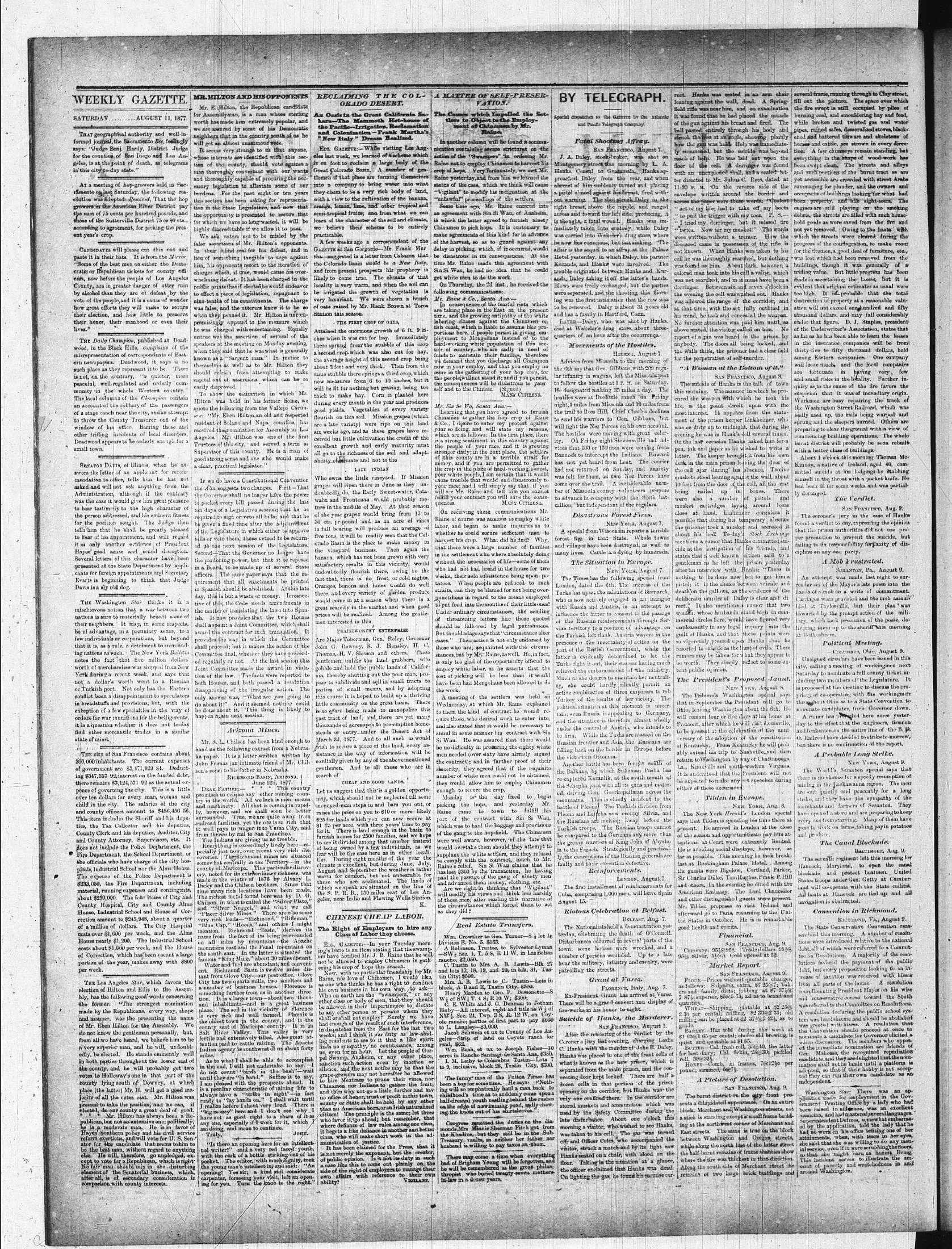
Searchable text
WEEKLY GAZETTE.
SATURDAY...AUGUST 11, 1877.
That geographical authority and well-informed journal, the Sacramento Bee, feelingly says: "Judge Benj. Hardy, District Judge for the counties of San Diego and Los Angeles, is at the point of death, as telegrams in this city to-day state."
At a meeting of hop-growers held in Sacramento on last Saturday, the following resolution was adopted: Noled, That the hop growers in the American River District pay the sum of 75 cents per hundred pounds, and those of the Sutterville District 75 or 80 etc., according to agreement, for picking the present year's crop.
Candidates will please cut this out and paste it in their hats. It is from the Mirror: "Some of the beat men on either the Democratic or Republican tickets for county officers, now before the people of Los Angeles County, are in greater danger of utter rain by alcohol than they are of defeat by the vote of the people, and it is a cause of wonder how great efforts they will make to secure their election, and how little to preserve their honor, their manhood or even their lives."
The Daily Champion, published at Deadwood, in the Black Hills, complains of the misrepresentation of correspondents of Eastern newspapers. Deadwood, it says is no such place as they represent it to be. There is not, on the contrary, "a quieter, more peaceful, well-regulated and orderly community in the whole Western country." The local column of the Champion contain an account of the robbery of the passengers of a stage coach near the city, and an attempt to throw the County Treasurer out of the window of his office. Barring these and other trifling incidents of local disorders, Deadwood appears to be orderly enough for a small town.
SEXATOR DAVID OF ILLINOIS when he anMR. HILTON AND HIS OPPONENTS
Mr. E. Hilton, the Republican candidate for Assemblyman, is a man whose sterling worth has made him extremely popular, and we are assured by some of his Democratic neighbors that in the country south of us he will get an almost unanimous vote.
It seems very strange to us that anyone whose interests are identified with this section of this county, should vote against a man thoroughly conversant with our wants and thoroughly capable of procuring the necessary legislation to alleviate some of our burdens. For the past eight or ten years this section has been asking for representation in the State Legislature; and now that the opportunity is presented to secure that for which we have so long waited, it will be highly discreditable if we allow it to pass.
We ask voters not to be misled by the false assertions of Mr. Hilton's opponents. In their blind zeal for his defeat, and in lieu of something tangible to urge against him, his opponents resort to the iteration of charges which, if true, would cause his overwhelming defeat. It has been charged in the public prints that if elected he would endeavor to effect a piece of legislation, repugnant to nineteenth of his constituents. The charge was false, and the utterers knew it to be so when they penned it. Mr. Hilton is uncompromisingly opposed to the measure which he was charged with entertaining. Equally untrue was the assertion of several of the speakers at the meeting on Monday evening, when they said that he was what is generally known as a "Sargent man." In justice to themselves as well as to Mr. Hilton they should refrain from attempting to make capital out of assertions which can be so easily disproved.
To show the excimation in which Mr. Hilton was held in his former home, we quote the following from the Vallejo Chronicle: "Mr. Eben Hilton, an old and respected resident of Solano and Napa counties, has received this nomination for Assembly in Los Angeles. Mr. Hilton was one of the first Trustees of this city, and served a term as Supervisor of this county. He is a man of good strong sense and one who would make a clear practical legislator."
RECLAIMED ORAL
An Oasis in the harbor—The Pacific—and Colonia "New Italy"
Eds. GAZETTE elas last week, we is on foot to re-Great Colorado thmen of that place into a company they claim to be with a view to the orange, lemon, semi-tropical fruit learn of the change we believe therel practicable.
A few weeks ago GAZETTE at San tha—suggested in the Colorado Bas and from present likely to come locality is very well irrigated thervery luxuriant oata raised by Station this season.
THE FIRST
Attained the ones chees when it was there sprung from a second crop while the average height about 3 feet and same stubble then now measures it will be fit for no thick to make during every moor good yields. We flourish on this are a late variety six weeks ago, asceived but little excellent growth all go to the rich ability of aliment
SENATOR DAVIS, of Illinois, when he answers the letter of an applicant for recommendation to office, tells him he has not asked and will not ask anything from the Administration, although if the contrary was the case it would give him great pleasure to bear testimony to the high character of the person addressed, and his eminent fitness for the position sought. The Judge then tells him that he shall be greatly pleased to fear of his appointment, and will regard it as only another evidence of President Hayes' good sense and sound discretion. Several letters of this character have been presented at the State Department by applicants for foreign appointments, and Secretary Evarts is beginning to think that Judge Davis is a sly old dog.
THE WASHINGTON STAR thinks it is a mischievous notion that a war between two nations is sure to materially benefit some of their neighbors. It may, in some respects, be of advantage, in a pecuniary sense, to a few individuals or corporations, but beyond that it is, as a rule, a detriment to surrounding nations as such. The New York Bulletin notes the fact that five million dollars worth of merchandise was shipped from New York during a recent week, and says that not a dollar's worth went to a Russian or Turkish port. Not only has the Eastern conflict been a disappointment to speculators in breadstuffs and provisions, but, with the exception of a few specialties in the way of orders for war munitions for the belligerents, it is a question whether it does not to-day find other mercantile trades in a similar state of mind.
The city of San Francisco contains about 300,000 inhabitants. The current expenses of government are $3,471,929.84. Deducting $347,357.92, interest on the funded debt, there remains $3,124,571.92 as the actual expense of governing the city. This is a little over ten dollars for every man, woman and child in the city. The salaries of the city and county officers amount to $486,456.56. This item includes the Sheriff and his deputies, the Tax Collector and his deputies, County Clerk and his deputies, Auditor City and County Attorney, Supervisors, etc. It does not include the Police Department, the Fire Department, the School Department, or the officials who have charge of the city hospitals. Industrial School nor the Alma House. The expense of the Police Department is such place as they represent it to be. There is not, on the contrary, "a quieter, more peaceful, well-regulated and orderly community in the whole Western country." The local columns of the Champion contain an account of the robbery of the passengers of a stage coach near the city, and an attempt to throw the County Treasurer out of the window of his office. Barring those and other trifling incidents of local disorders, Deadwood appears to be orderly enough for a small town.
IF we do have a Constitutional Convention the Alias suggests two changes. First—That the Governor shall no longer have the power to pocket every bill passed during the last ten days of a Legislative session; that he be required to sign or veto all bills; and that he be given a fixed time after the adjournment of the Legislature in which either to approve bills or veto them, those vetoed to be returned to the next session of the Legislature. Second—That the Governor no longer have the pardoning power, but that it be reposed in a Board, to be made up of several State officers. The same paper says that the requirement that all enactments be printed in Spanish should be abolished. At this late day, this is but a waste of money. Irrespective of this, the Code needs amendments in the matter of translating the laws into Spanish. It now provides that the two Houses shall appoint a Joint Committee, which shall award the contract for such translation. It provides the way in which the Committee shall proceed; but it makes the action of the Committee final, whether they have proceeded regularly or not. At the last session this Joint Committee made the award in violation of the law. The facts were reported to both Houses, and both passed a resolution disapproving of the irregular action. The only answer was, "What are you going to do about it?" And it seemed nothing could be done about it. This thing is likely to happen again next session.
Arizona Mines.
Mr. S. L. Chilson has been kind enough to hand us the following extract from a Nebraska paper. It is a letter written by John Furnas (an intimate friend of Mr. Chilson's son) to his father in Nebraska.
RICHMOND BASIN, ARIZONA.
June 22d, 1877.
DEAR FATHER:— This country promises to eclipse any other mining country in the world. All we lack is men, means and machinery. All that is coming in rapidly, however, and we shall soon be better surrounded. True, we are quite away from railroad facilities, yet the ore is so rich that it well pays to wagon it to Yuma City, and from thence by rail to San Francisco.
The Indians are giving us no trouble. Everything is exceedingly lively here—especially just now, over recent very rich discoveries. The Richmond mines are situated somewhat centrally in the Territory—in the county of Maricopa. This particular discovery, noted for its extraordinary richness, was made in the winter of 1876 by Alvany L.
Who owns these grapes will ripen doubtedly do; this wabe and Fronture in the middofthe year grape 30 cts. pr poundin full bearing five tons; it will orado Basin is thie vineyard banana, which has satisfactory resucced undoubtedly thie fact that; there Oranges, lemons there; and every would come in great scarcity in prices will be remen interested
PRAISE!
Are Major Tobee John G. Down Thomas, H.V. gentlemen, unlucky gobble and hold nia; thereby she pose to subdivide parties of small this course it is little community is no effort being vast tract of la thousands of acceeds or entry March 3d, 1877 wish to secure aistance in the cordially given gentlemen. An search of
CHEAP!
Let us suggest unity, which shows moneyed-man raises the price $25 for lands wi $1 25 per acre; for it. There is furnish homes ffi see it divided of being owned fear will be thie ties. During climate is excel August and Se warm for com those who ar
The Los Angeles Star, which favors the election of Hilton and Ellis to the Assembly, has the following good words concerning the former: "The strongest nomination made by the Republicans, every way, shape and manner, was the presenting the name of Mr. Eben Hilton for the Assembly. We do not know the gentleman personally, but, from all we have heard, we believe him to be a very superior man, and he will, undoubtedly, be elected. He stands eminently well in both parties throughout the lower end of the county, and he will probably get two votes to Holloway's one in that part of the county lying south of Downey, at which place (the latter) Mr. H. will get a good majority of all the votes cast. Mr. Hilton was pressed to take the position, and he can, if elected, do our county a great deal of good.
Mr. Hilton has always been a Republican, but not an extensive one; politically, he is a moderate man. He is in favor of Hayes' southern policy and his civil service reform exertions, and will vote for U.S. Senator for the candidate that seems to him to be the best man, without regard to anything else. He will, therefore, go unpledged, except to vote for a Republican, which is right: No fair man should mix in the disturbing element of the Senatorial business, which, after all, is of secondary consideration in comparison with county interests.
DEAR FATHER:—This country promises toclipse any other mining country in the world. All we lack is men, means and machinery. All that is coming in rapidly, however, and we shall soon be better surrounded. True, we are quite away from railroad facilities, yet the ore is so rich that it well pays to wagon it to Yuma City, and from thereby by rail to San Francisco.
The Indians are giving us no trouble.
Everything is exceedingly lively here—especially just now, over recent very rich discoveries. The Richmond mines are situated somewhat centrally in the Territory—in the county of Maricopa. This particular discovery, noted for its extraordinary richness, was made in the winter of 1876 by Alvany L. Dicky and the Chilson brothers. Since that time many rich locations have been made. The richest metal found here was by D. G. Chilson, in what is called the "Silver Plate," and "Silver Nugget," and what we call "Place Silver Mines." There are also some very rich leads—"Richmond," "Rifleman."
"Blue Cap," "Hoods," and others I might mention. Richmond "Basin," derives its name from the fact of its being surrounded on all sides by mountains—the Apache mountains east and the Penal mountains on the south-east. In the latter is situated the famous "King Mine," about 30 miles distant.
Water and fuel are abundant, and convenient. Richmond Basin is twelve miles distant from Glove City—our post office. Glove City has two quartz mills, two smelters and a number of business houses. Florence is something further from us in another direction. It is a larger town—about two thousand inhabitants—and is a great business place. The soil in the vicinity of Florence is very rich and well farmed. Phoenix is the oldest town in the county, and is the county seat of Maricopa county. It is in Salt River Valley. This valley is very fertile and extensively tilled. Also great attention paid to cattle raising. The Apache Indian agency is southwest of us about forty miles.
As to what I shall be able to accomplish in the end, I will not undertake to say: I do not count "birds in the bush"—wait until they are "in hand." Suffice it to say, I am pleased with the prospects ahead. It is a peculiar characteristic of mining life to always have a "strike in sight"—in fact ready to "lay hands on." I shall wait until I realize before I shout very loud. There is "big money" here and I don't see why I have not as good right to a share of it as any one, especially if I work for it, which I am doing, and mean to continue.
Truly,
"Is there an opening here for an intellectual writer?" said a very red faced youth, with the cork of a bottle sticking out of his pocket. The editor, with much dignity, took the young man's intellect in and said: "An opening! Yes air; a kind and considerate carpenter, forseeing your visit, left an opening for you. Turn the knob to the right."
Let us suggest a nice city which shows interest in public opinion or raises the price for lands worth $25 per acre; for it there is furnish homes for those divided of being owned fear will be threatened.
During climate change August and September warm for comings those who are which we speak the S.P.R.R.goles near India.
CHINESE
The Right of Class o
EDS. GAZETEING'S issue is an ers have notified not be allowed entering his crop o Now, with my Raine, nor love as one who thinks his own business Who on earth other class or be allowed in to any other person shall or shall not had enough of it in dispatches for weeks; and I ing residents tha finds no sympathy us, even for nipal Swamp. A sanction such silence, and the grape-growers to hire Mexico Chinazon now and then why no office of ho county or State than an American citizen! The who favor it where defiance it begets a like class, who will ministration o It has been not merely of public opinion a case like this side of the right own affairs ability?
RECLAIMING THE COLORADO DESERT.
An Oasis in the Great California Sahara—The Mammoth Hot-house of the Pacific-Irrigation, Reclamation and Colonization—Frank Murtha's "New Italy" Dream Realized.
EDS. GAZETTE: While visiting Los Angeles last week, we learned of a scheme which is on foot to reclaim a large body of the Great Colorado Basin. A number of gentlemen of that place are forming themselves into a company to bring water into what they claim to be a very rich body of land, with a view to the cultivation of the banana, orange, lemon, lime, and other tropical and semi-tropical fruits; and from what we can learn of the character of the soil and climate, we believe their scheme to be entirely practicable.
A few weeks ago a correspondent of the Gazette at San Gorgonio—Mr. Frank Murtha—suggested in a letter from Cabazon that the Colorado Basin would be a New Italy, and from present prospects his prophecy is likely to come true. The climate of that locality is very warm, and when the soil can be irrigated the growth of vegetation is very luxuriant. We were shown a bunch of oats raised by Mr. Hank Brown at Toros Station this season.
THE FIRST CROP OF OATS,
Attained the enormous growth of 6 ft. 9 inches when it was cut for hay. Immediately there sprung from the stubble of this crop a second crop which was also cut for hay, the average height of this second crop being about 3 feet and very thick. Then from the same stubble there springs a third crop, which now measures from 6 to 10 inches, but it will be fit for nothing but grazing, being too thick to make hay. Corn is planted here during every month in the year and produces good yields. Vegetables of every variety flourish on this soil. Mission grapes (which are a late variety) were ripe on this land six weeks ago, and as these grapes have received but little cultivation the credit of the excellent growth and early maturity must all go to the richness of the soil and adaptability of climate and not to the
A MATTER OF SELF-PRESERVATION.
The Cames which Impelled the Settlers to Object to the Employment of Chinamen by Mr. Raine.
In another column will be found a communication containing several strictures on the action of the "Swampers" in ordering Mr. Raine not to employ Chinamen to harvest his crop of hops. Very fortunately, we met Mr. Raine yesterday, and from him we learned the status of the case, which we think will cause "Vigilant" to modify his indignation at the "unlawful" proceedings of the settlers.
Some time ago, Mr. Raine entered into an agreement with Sin Si Wan, of Anaheim, in which the latter agreed to furnish ninety Chinamen to pick hops. It is customary to make agreements of this kind far in advance of the harvest, so as to guard against any delay in picking, which, if it occurred, would be disastrous in its consequences. At the time Mr. Raine made this agreement with Sin Si Wan, he had no idea that he could get white men to do the work.
On Thursday, the 2d inst., he received the following communications:
Mr. Raine & Co., Santa Ana:
In consequence of the fearful riots which are taking place in the East at the present time, and the growing antipathy of the white laboring classes against the Chinamen on this coast, which is liable to assume like proportions here, if people persist in giving employment to Mongolians instead of to the hard-working white population of this section of country, who are sadly in need of funds to maintain their families, therefore we demand that you discharge all Chinamen now in your employ, and that you employ no more in the gathering of your hop crop, for the people will not stand it; and if you persist, the consequences will be disastrous to yourself and to the Chinese.
(Signed)
MANY CITIZENS.
Mr. Sin Se Wo, Santa Ana:
Learning that you have agreed to furnish Chinamen to gather the hop crop of Kaine & Co., I desire to enter my protest against your so doing, and will state my reasons, which are as follows. In the first place, there is a strong sentiment in this country against the people of your race, and it is growing stronger daily; in the next place, the settlers of this county are in a terrible strait for money, and if you are permitted to gather
BY TELEGRAPH.
Special dispatch to the Galleria by the Atlantic and Pacific Telegraph Company.
Fatal Shooting Affray.
SAN FRANCISCO, August 7.
J. A. Daley, stock-broker, was shot on Montgomery street this morning by L. A. Hanks, Consul to Guatemala. Hanks approached Daley from the rear, and when abreast of him suddenly turned and placing a pistol almost against his breast, fired without warning. The shot struck Daley in the right breast, above the nipple, and ranged across and toward the left side, producing it is thought, a fatal wound. Hanks was immediately taken into custody while Daley was carried into Wakeler's drug store, where he now has conscious, but fast sinking. The affair is the sequel to an affray at the Palace Hotel yesterday, in which Daley, his partner Kurands, and Hanks were involved. The trouble originated between Kurands and Kurands, Daley taking it off the latter's hands. Blows were freely exchanged, but the parties were separated, and the shooting this morning was the first intimation that the row was to be renewed. Daley is about 34 years old and has a family in Hartford, Conn.
LATER—Daley, who was shot by Hanks died at Wakeler's drug store, about three-quarters of an hour after the occurrence.
Movements of the Hostiles.
HELENA, August 7.
Advices from Missoula to the morning of the 6th say that Gen. Gibbons, with 200 regular infantry in wagons, left Missoula post to follow the hostiles at 1 p.m. on Saturday. He designated miking 35 miles a day. The hostiles were at Doolittle ranch on Friday night, 5 miles from Missoula and 10 miles from the trail to Ross Hill. Chief Charles declines to send his warriors to Gen. Gibbons, but will fight the Nez Perces on his own account. The hostiles were moving with great celerity. On Friday night Stevonsville had advices that 100 or 150 men were coming from Bannock to intercept the Indians. Howard has not yet heard from Lent. The courier
Convention First—That the power last that he and that he journiefit to approve to be return-Legislature. Longer have been repoed several State that the re-printed At this late Irrespec-mentations in Spain two Houses which shall situation. It Committee section of the have proceeded session this day in viola-reported to resolution action. The one going to thing could is likely to enough to Nebraska written by Mr. Chilka. Arizona. 1877. This country counting coun-men, means ing in rapid-be better away from so rich that na City, and nisco trouble. Here—essay rich dis-situated story—in the peculiar discover-ness, was Alvany L.
LAZY INDIAN
Who owns the little vineyard. If Mission grapes will ripen there in June as they undoubtedly do, the Early Sweet-water, Catawba and Frontenau would probably mature in the middle of May. At that season of the year grapes would bring from 15 to 30 cta. pr pound and as an acre of vines in full bearing will produce an average of five tons, it will be readily seen that the Colorado Basin is the place to make money in the vineyard business. Then again the banana, which has not been grown with very satisfactory results in this vicinity, would undoubtedly flourish there, owing to the fact that, there is no frost, or cold nights. Oranges, lemons and limes would do well there, and every variety of garden produce would come in at a season when there is a great scarcity in the market and when good prices will be realized. Among the gentlemen interested in this.
PRAISEWORTHY ENTERPRISZ
Are Major Toberman, Gen. Roley, Governor John G. Downey, S. J. Hensley, H. C. Thomas, H. V. Slosson and others. These gentlemen, unlike the land grabbers, who gobble and hold the public lands of California, thereby shutting out the poor man, propose to subdivide and sell in small tracts to parties of small means, and by adopting this course it is hoped to build up a thriving little community on the great basin. There is no effort being made to monopolize this past tract of land, and there are yet many thousands of acres open to pre-emption home-steads or entry under the Desert Act of March 3d, 1877. And to all such as would wish to secure a piece of this land, every assistance in the way of information will be cordially given by any of the above mentioned gentlemen. And to all those who are in search of
CHEAP AND GOOD LANDS.
Let us suggest that this is a golden opportunity, which should not be neglected till some moneyed-man steps in and bars you out, or raises the price on you to $10 or more likely $25 for lands which you can now secure at $1 25 per acre, with three years' time to pay for it. There is land enough in the basin to furnish homes for 2500 families, and we hope to see it divided among that number instead of being owned by a few individuals, as we fear will be the case here as in other localities. During eight months of the year the climate is excellent, but during June, July, August and September the weather is rather warm for comfort, but not unbearable for those who are acclimated. The lands of
LAZY INDIAN
Who owns the little vineyard. If Mission grapes will ripen there in June as they undoubtedly do, the Early Sweet-water, Catawba and Frontenau would probably mature in the middle of May. At that season of the year grapes would bring from 15 to 30 cta. pr pound and as an acre of vines in full bearing will produce an average of five tons, it will be readily seen that the Colorado Basin is the place to make money in the vineyard business. Then again the banana, which has not been grown with very satisfactory results in this vicinity, would undoubtedly flourish there, owing to the fact that, there is no frost, or cold nights. Oranges, lemons and limes would do well there, and every variety of garden produce would come in at a season when there is a great scarcity in the market and when good prices will be realized. Among the gentlemen interested in this.
PRAISEWORTHY ENTERPRISZ
Are Major Toberman, Gen. Roley, Governor John G. Downey, S. J. Hensley, H. C. Thomas, H. V. Slosson and others. These gentlemen, unlike the land grabbers, who gobble and hold the public lands of California, thereby shutting out the poor man, propose to subdivide and sell in small tracts to parties of small means, and by adopting this course it is hoped to build up a thriving little community on the great basin. There is no effort being made to monopolize this past tract of land, and there are yet many thousands of acres open to pre-emption home-steads or entry under the Desert Act of March 3d, 1877. And to all such as would wish to secure a piece of this land, every assistance in the way of information will be cordially given by any of the above mentioned gentlemen. And to all those who are in search of
CHEAP AND GOOD LANDS.
Let us suggest that this is a golden opportunity, which should not be neglected till some moneyed-man steps in and bars you out, or raises the price on you to $10 or more likely $25 for lands which you can now secure at $1 25 per acre, with three years' time to pay for it. There is land enough in the basin to furnish homes for 2500 families, and we hope to see it divided among that number instead of being owned by a few individuals, as we fear will be the case here as in other localities. During eight months of the year the climate is excellent, but during June, July, August and September the weather is rather warm for comfort, but not unbearable for those who are acclimated. The lands of
LAZY INDIAN
Mr. Sin Se Wo, Santa Ana:
Learning that you have agreed to furnish Chinamen to gather the hop crop of Kaine & Co., I desire to enter my protest against your so doing, and will state my reasons, which are as follows: In the first place, there is a strong sentiment in this country against the people of your race, and it is growing stronger daily; in the next place, the settlers of this county are in a terrible strait for money, and if you are permitted to gather the crop in the place of hard-working honest, poor white people, I am certain that it would cause trouble that would end disastrously to your race; and I will simply say that if you will see Mr. Raine and tell him you cannot fulfill your contract you will save the consequences.
MANY CITIZENS.
On receiving these communications Mr. Raine of course was anxious to employ white labor, and began to make inquiries as to whether he could secure sufficient men to harvest his crop. What did he find? Why, that there were a large number of families in the settlement who where absolutely doing without the necessaries of life—some of them had not had bread in the house for two weeks their sole subsistence being upon potatoes. When people are reduced to such straits can they be blamed for not being over-punctilious in regard to the means employed to put food into their mouths of their little ones? Under ordinary circumstances,the sending of threatening letters like those quoted should be followed by legal punishment.But the old adage says that "circumstance alter cases." Their action is not only endorsed by those who are acquainted with the circumstances,buy by Mr. Raine as well.HoIn factis only too glad of the opportunity offered to employ white labor,aas he asserts thatthe cost of picking will be less than it would have been had Mongolians been allowed to do the work.
A meeting of the settlers was held on Wednesday; at which Mr. Raine explained to them the kind of contract he would require those who desired work to enter into,and also stated that it would be necessary to annul in some manner his contract with Sin Si Wau. He was assured that there would be no difficulty in procuring the eighty white men needed (over sixty have already signed the contract);and in further proof of their sincerity,they agreed that if the requisite number of white men could not be obtained,they would allow him to employ Chinamen enough to secure the crop.
Monday is*the day fixedto begin picking the hops,and yesterday Mr.Raine came to town to fulfill his part of the contract with Sin Si Wauwhich was to haul the baggage and provisions of the gang to the hop-field.The Chinamen were well aware,howeverofthe fate that would overtake them should they attempt to supplantthe white settlers,and they refused to comply with the contract,much to Mr.Raine's relief.Sin Si Wau claims that he has lost $300bythe transaction,having paidthe passage ofthe gangof ninety men and advanced them money clothing etc.
DISASTROUS FOREST FIRES.
NEW YORK,AUGUST 7.
A special from Wisconsin reports a terrible forest fire in that State.Whele towns and villages have destroyed,as well as many lives.Cattle are dying by hundreds.
THE SITATION IN EUROPE.
NEW YORK,AUGUST 7.
The Times has the following special from London,d datedthe 6th:The success ofthe Turkshas upsetthe calculations of Bismarckwho is now actively engaged in an intriguewith Russia and Austria,在an attemptto influencethe latterto consenttothe passageofthe Russian reinforcements through Servian territorytoa positionof advantage.onthe Turkishleft flank.Austriawayersinthe presenceo thеuncertaintyofactiononthepartoftheBritishGovernment;whilethe latteris evidentlydeterminedtolettheTurksfightitout,thesuccesshavingmuchreceivedtheembarassmentof"theministry.Muchasshe desirestomaintainherneutrality,shecouldhardlysilentlypermitanactivecombinationofthreeemperorstorobTurkeyoftheresultsofhervictory.Thepolitical situationatthis momentisuncertaint;evenRussiaisappealingtoGermany,andthe SituationisthereforealmostwhollyunderthecontrolofAustria whotheintendstobeimm.
WhiletheTusksaremassedontherussianfrontierandAsia,theRussiansarefallingbackontheborderinEuropebeforethevictoriousOttoman.
Another battle has been fought southofthe Balkans,byshuieman PashahasrecapturedKozanlik.atthesouthmouthoftheSchepkpapass.withallitsgunsandmaterial drivingGen.Gorkopollmanacrossthemountains.IschieledincidenttobethebattleOfPleona.TheTurkishdivisionfromPleonaandLofechanowoccupSilvia,andtheRussiansaremeltingawaybeforetheTurkishtroops.TheRussiantroopscannotbecomparedtotheGermansanymorethanthegreasywarriorsofKingJohnofAbysinha.totheFrench.Strategicallyandpractically,theconceptionsofRussiangeneralsarefaultyandtheirexecutiondefective.
REINFORCEMENTS.
LONDON,AUGUST 7.
Let us suggest that this is a golden opportunity, which should not be neglected till some money-man steps in and bars you out, or raises the price on you to $10 or more likely $25 for lands which you can now secure at $1 25 per acre, with three years' time to pay for it. There is land enough in the basin to furnish homes for 2500 families, and we hope to see it divided among that number instead of being owned by a few individuals, as we fear will be the case here as in other localities. During eight months of the year the climate is excellent, but during June, July, August and September the weather is rather warm for comfort, but not unbearable for those who are acclimated. The lands of which we speak are situated on the line of the S. P. R. R., 150 miles east of Los Angeles, near Indio and Flowing Wells Station.
CHINESE CHEAP LABOR.
The Right of Employers to hire any Class of Labor they choose.
EDS. GAZETTE:—In your Tuesday morning's issue is an item stating that the swampers have notified Mr. J. B. Raine that he will not be allowed to employ Chinamen in gathering his crop of hops this season.
Now, with no particular friendship for Mr. Raine, nor love of Chinamen, I would like, as one who thinks he has a right to conduct his own business in his own way, to ask—Who on earth are the "swampers," or any other class or body of men, that they should be allowed in their importence to dictate to any other person or persons whom they shall or shall not employ? Surely we have had enough of the result of such interference, in dispatches from the East for the last two weeks; and I think it our duty as law-abiding residents to see to it that a like spirit finds no sympathy, no countenance, among us, even for an hour. Let the people of Gospel Swamp, Anxheim, or any other place, sanction such action even by inaction or silence, and the next notice may be that the grape-growers may not hereafter be allowed to hire Mexicans to prune their vines, nor Chinamon nor Indiana to gather the fruit; and then why not go a little further and say no office of honor, trust or profit in this town, county or State shall be held by any other than an American born, or an Irish naturalized citizen. The principle is the same; let those who favor it, go ahead; but remember, that where defiance of law rules among one class, it begets a like defiance in another and better class, who will make short work in the administration of justice.
It has been claimed for the Press, that it is not merely the exponent, but the creator of public opinion. Is it not its duty in such a case like this to come out plainly on the side of the right of employers to manage their own affairs with reference to their own ability?
Monday is the day fixed to begin picking the hops, and yesterday Mr. Raine came to town to fulfill his part of the contract with Sin Si Wan, which was to haul the baggage and provisions of the gang to the hop-field. The Chinamen were well aware, however, of the fate that would overtake them should they attempt to supplant the white settlers, and they refused to comply with the contract, much to Mr. Raine's relief. Sin Si Wan claims that he has lost $300 by the transaction, he having paid the passage of the gang of ninety men and advanced them money, clothing, etc.
Are we right in thinking that "Vigilant" will modify his views and think less harshly of these men, after reading this narrative of the circumstances which forced them to act as they did?
Real Estate Transfers.
Wm. Crowther to Geo. Turner—S ½ lot 16 Division E. No. 5. $165.
A Robinson Trustee, to Sylvester Lyman—SW ¼ See. 1, T. 5 S, R 11 W, in Las Bolsas rancho, $2,080.
C. Trustin to Mrs. A. B. Lewis—Blk 27 and lots 17; 18, 19, and 20, in blk. 31, Tustin City; $500.
Mrs. A. B. Lewis to C. Trustin—Lots in block, A B and E, Tustin City, $500.
Henry Marden to Geo. P. Bessonette—S W ½ of SW ¼ T. 4 S; R 10 W; $300;
C. E. White and J. G. Denman to Jotham Bixby—All interest, right and title to W ½ of NW ¼ Sec. 24, Twp. S S, R 12 W, on Coyote rancho; parties of first part to pay $600 to L. Langley—$3,000.
Jacob Schwein et ux to County of Los Angeles—Strip of land on Coyote ranch for road, $62.
Wm. Bush, et ux to Joseph Fisher—10 acres in Rancho Santiago de Santa Ana, $380.
L. M. Leihy to Columbus Tustin—Lots 7 to 9, inclusive, block 28, Tustin City, $300.
The funny man of the Fulton Times has been a boy for sometime. He says: "Nothing will so emphatically haul a man back to childhood's time as to suddenly come upon a half-dressed youth nestling behind the rushes on the edge of a swimming pond, sally chewing the knots out of his shirtsleeves."
Congress admitted the duties on the diamond Mrs Minnie Sherman Fitch got from the Khedive, but they still lie in the Sub-Treasury vaults, as neither her father nor husband is willing to pay taxes on-them.
There may come a time when everything bad of Brigham Young will be forgotten, and he will be remembered as the great philanthropist who buried twenty-seven mothers-in-law in a dozen years.
Reinforcements.
LONDON, August 7.
The first installment of reinforcements for Cuba, comprising 1,000 men, will leave Spain August 15.
Riotous Celebration at Belfast.
Belfast, Aug. 7.
The Nationalists held a demonstration yesterday, celebrating the death of O'Connell. Disturbances occurred in several parts of the town; some houses were wrecked, and a number of persons wounded. Up to a late hour the military, infantry and cavalry were patrolling the streets.
Grant at Varez.
Florence, Italy, Aug. 7.
Ex-President Grant has arrived at Varez. There will be a grand concert and display of tire-works in his honor to night.
Suicide of Hanks, the Murderer.
San Francisco, August 1.
After the rendering of the verdict by the Coroner's jury last evening, charging Leslie C. Hanks with the murder of John E. Daley, Hanks was placed in one of the front cells of what is known as the new prison, which is separated from the main prison, and the connecting door kept locked. There are half a dozen cells in that portion of the prison opening on the corridor, but Hanks war-that only one confined there. In the corridor are stored muskets and ammunition which was used by the Safety Committee during the late disturbance. About one o'clock this morning a visitor who wished to see Hanks was taken to his cell. The gas was turned off; and Officer Coles who accompanied the visitor struck a match and by its light saw Hanks seated on a chair; with blood on the floor. Taking in the situation at a glance the officer exclaimed that Hanks was dead. On lighting the gas he found his surmise cor-
ELEGRAPH.
Shooting Affray.
San Francisco, August 7.
Stock-broker, was shot on this morning by L. A. to Guatemala. Hanks ap- from the rear, and when suddenly turned and placing against his breast, fired with the shot struck Daley in the face the nipple, and ranged the left side, producing it al wound. Hanks was im- into custody, while Daley Wakeley's drug store, whereious, but fast sinking. The aid to an affray at the Palace in which Daley, his partner Hanks were involved. The aid between Hanks and Kuring it off the latter's hands. By exchanged, but the parties and the shooting this morning that the row was Daley is about 34 years old in Hartford, Conn., who was shot by Hanks's drug store, about three-hour after the occurrence.
Units of the Hostiles.
Helena, August 7.
Missoula to the morning of Gen. Gibbons, with 200 regu-gons, left the Missoula post tiles at 1 p.m. on Saturday. Taking 35 miles a day. The Doolittle ranch on Friday on Missoula and 10 miles from Hill. Chief Charles declines doors to Gen. Gibbons, but Ziz Perces on his own account. Are moving with great celery night Stevensville had ad- 150 men were coming from accept the Indians. Howard Hardard from Leut. The courier rect. Hanks was seated in an arm chair leaning against the wall, dead. A Springfield rifle was near him, and on examination it was found that he had placed the muzzle of the gun against his breast and fired. The ball passed entirely through his body and struck the iron at an angle, showing plainly how the gun was held. Help was immediately summoned, but the suicide was beyond reach of help. He was laid out upon the floor of the cell. A derringer was found with an unexploded shell, and a sealed letter directed to Mr. Julius C. Rees, dated at 11:30 p.m. On the reverse side of the envelope written around the border and across the paper were these words: "Coolest act of my life; had to take off my boots to pull the trigger with my toes. P. S.—I tried my derringer, but it missed fire twice. Now for my musket!" The words were written without a tremor. How the deceased came in possession of the rifle is not known. When Hanks was taken to his cell he was thoroughly searched, but nothing was found on him. About dark, however, a colored man took into his cell a valise, which was not searched, and in it must have been a derringer. Between six and seven o'clock in the evening the cell was washed out. Hanks was allowed the range of the corridor, and at that time, with the act fully outlined in his mind, he took and concealed the weapon. No further attention was paid him until, as above stated, the visitor called on him. No report of a gun was heard in the prison by anybody. The doors all being locked, and the walls thick, the prisoner had a clear field for the perpetration of self-murder.
"A Woman at the Bottom of It."
SAN FRANCISCO, August 8.
The suicide of Hanks is the talk of town this morning. The manner in which he procured the weapon with which he took his life, is the point dwelt upon with the most interest. It appears from the statement of the prison keeper Linkheimer, who was on duty up to midnight, that during the evening he was in Hank's cell several times. On the last occasion Hanks asked him for a pen, ink and paper as he wished to write a letter. The keeper brought it from his own desk in the main prison leaving the door of several frames, running through to Clay street, fill out the picture. The space over which the fire swept is still occupied by piles of burning coal, and smouldering hay and feed, while broken and twisted gas and water pipes, ruined safes, damoralized stoves, blackened and battered tinware and skeletons of horses and cattle, are strwn in every direction. A few chimneys remain standing, but everything in the shape of wood-work has been swept clean. The streets and alleys and such portions of the burnt tract as are yet accessible are crowded with street Arabs rumaging for plunder, and the owners and occupants of buildings looking for what had been property, and little sight-scens. The engines are still playing on the smoking debris, the streets are filled with such household goods as were saved from the fire and not yet removed. Owing to the hastie with which the streets were cleared during the progress of the conflagration, to make room for the firemen, a good deal of furniture, etc., was lost which had been removed from the buildings, though it was generally of a triling value. But little progress has been made in ascertaining the losses, but it is evident that original estimates as usual were too high. It is probable that the total destruction of property at a reasonable valuation will not exceed one hundred and fifty thousand dollars, and may fall considerably under that figure. D. J. Staples, president of the Underwriter's Association, states that as far as he has been able to learn the losses in the insurance companies will be from thirty-five to fifty thousand dollars, held among Eastern companies. One company will loose much, and the local companies are fortunate in having very few and small risks in the locality. Further inquiry as to the cause of the fire favors the suspicion that it was of incendiary origin. Workmen are busy repairing the track of the Washington Street Railroad, which was badly used up, the rails being warped and sprung and the sleepers burned. Others are preparing to clear the ground with a view of commencing building operations. The whole burnt district will probably be soon rebuilt with a better class of buildings.
About 1 o'clock this morning Thomas McKinney, a native of Ireland, aged 40, com-
A Woman at the Bottom of it.
SAN FRANCISCO, August 8.
The suicide of Hanks is the talk of town this morning. The manner in which he procured the weapon with which he took his life, is the point dwelt upon with the most interest. It appears from the statement of the prison keeper Linkheimer, who was on duty up to midnight, that during the evening he was in Hank's cell several times. On the last occasion Hanks asked him for a pen, ink and paper as he wished to write a letter. The keeper brought it from his own desk in the main prison leaving the door of the cell ajar during his absence. Twelve mukets stood leaning against the wall, about 10 feet from the door of the cell, all the rest being nailed up in boxes. There were also a number of pistols and musket cartridges laying around loose close at hand. Linkheimer considers it possible that during his temporary absence the prisoner took a musket and secreted it about his bed. To-day's Stock Exchange mentions a rumor that Hanks committed suicide at the instigation of his friends, and states that a well-known citizen said to a gentleman as he left the prison yesterday after an interview with Hanks: "There is nothing to be done now but to get him a pistol; it is the choice between suicide and death on the gallows, as the evidence of the deliberate murder of Dalby is clear and direct." It also mentions a rumor that two women, whose husbands stand high in commercial circles here, would have figured very unpleasantly in any legal inquiry into the guilt of Hanks, and that these points were so vigorously pressed upon Hanks that he resorted to suicide as the least of evils. These rumors may be taken for what they appear to be worth. They simply reflect to some extent public opinion.
The President's Proposed Jaunt.
NEW YORK, August 8.
The Tribune's Washington special says that in September the President will go to Ohio leaving Washington about the 8th. He will remain four or five days at his home at Fremont, after which he will visit Louisville, to be present at the celebration of the anniversary of the adoption of the constitution of Kentucky. From Kentucky he will probably extend his trip to Nashville, and then return to Washington by way of Chattanooga, La., Knoxville and south-western Virginia. It is understood that the President will not be expected to make any set speeches during either of these excursions.
Tilden in Europe.
NEW YORK, Aug. 8.
The New York Herald's London special says that Tilden is spending his time there at present. He arrived in London at the close of the season and opportunity to pay him attention at Court were extremely limited. He is avoiding social displays, however, as far as possible. This morning he took breakfast at Buckingham Palace Hotel. Among the guests were Bigelow, Cortland, Parker, Sir Charles Dilke, Tom Hughes, Frank P. Hill are fortunate in having very few and small risks in the locality. Further inquiry as to the cause of the tire favors the suspicion that it was of incendiary origin. Workmen are busy repairing the track of the Washington Street Railroad, which was badly used up, the rails being warped and sprung and the sleepers burned. Others are preparing to clear the ground with a view of commencing building operations. The whole burnt district will probably be soon rebuilt with a better class of buildings.
About 1 o'clock this morning Thomas McKinney, a native of Ireland, aged 40, committed suicide at his lodgings by Mabbing himself in the threat with a pocket knife. He had been ill for some weeks and was partially deranged.
The Verdict.
SAN FRANCISCO, Aug. 9.
The coroner's jury in the case of Hanks found a verdict to day, expressing the opinion that the prison authorities did not use proper precaution to prevent the suicide, but failing to fix responsibility for laxity of discipline on any one party.
A Mob Frustrated.
SCRANTON, Pa., August 9.
An attempt was made last night to surrender six of the Mayor's late posse into the hands of a mob on a write of commitment. Carriages were provided and the mob assembled at Taylorville, but their plan was thwarted by the prompt action of the military, which took possession of the posse, delivering them up to the Sheriff this morning at Wilkesbarre.
Political Meeting.
COLUMBUS, Ohio, August 9.
Unsigned circulars have been issued in this city, calling a meeting of workingmen next Saturday to nominate a full county ticket including two members of the Legislature. It is proposed at the meeting to discuss the propriety of co-operating with the workingmen throughout Ohio as to a State Convention to nominate candidates from Governor down.
A rumor has prevailed here since yesterday to the effect that the engineers, firemen and brakemen on the entire line of the B. & O. Railroad have decided to striketo-morrow, but there is no confirmation of the report.
A Probable Long Strike.
NEW YORK, August 9.
The World's Scranton special says that there is no chance for a speedy resumption of mining in the Lackawanna region. The men are sort quietly and peaceably for a long strike, and they have the sympathy of the merchants and farmers of Scranton. They have opened a store and are preparing to keep every one from starving. Many of them have gone to work on farms, taking pay in potatoes and produce.
The Canal Blockade.
BALTIMORE, Aug. 9.
The seventh regiment left this morning for Hancock, Maryland, to open the canal blockade and protect boatmen. United States troops under Gen. Gotty at Cumber-
Tilden in Europe.
New York, Aug. 8.
The New York Herald's London special says that Tilden is spending his time there at present. He arrived in London at the close of the season and opportunity to pay him attention at Court were extremely limited. He is avoiding social displays, however, as far as possible. This morning he took breakfast at Buckingham Palace Hotel. Among the guests were Bigelow, Cortland, Parker, Sir Charles Dilke, Tom Hughes, Frank P. Hill and others. In the evening he dined with the American Embassy. The Lord Chancellor and other distinguished guests were present. Mr. Tilden proposes to visit Ireland and afterward go to Paris, returning to the United States in October. He is in remarkable good health and spirits.
Financial.
SAN FRANCISCO, Aug. 9.
Currency: 95½@95¢; Trade dollars 95½@95¢; Silver, 5½@5. Gold opened at 52¢.
Market Report.
SAN FRANCISCO, August 9.
Prices without quotable changes, as follows: Shipping, extra, $6 25@7; bakers and family, ditto; jobbing at $7 37½@7 87½; superior, $5@5 75, all as to brand and quantity.
Wheat—Shipping, quotable at $2 25@2 30 per cent; milling, $2 30@2 35; old milling can be placed at $2 37½@2 42½, as to grade.
BARLEY—Haz sold during the week at $1 60@1 65 per cent; choice old brewing, is quiet and quotable at $1 85.
BUTTER—Cal. fresh roll, 35@40, the latter for best dairy; Cal. firkin, 28@30; pickled roll, 30@32¾.
Honey—Comb, in frames, 7@12½ per pound; strained, 6@7¼.
A Picture of Desolation.
SAN FRANCISCO, Aug. 9.
The burnt district on the city front presents a dilapidated appearance. On an entire block, Merchant and Washington streets, not a stick is standing except a small frame building at the northwest corner of Merchant and East streets. The same is true on the block between Washington and Oregon streets, while along the north line of the latter street the half-burnt remains of frame shanties show where the fire was thickest in that direction. Along the south side of Merchant street the remains of two large brick buildings and mining in the backawanna region. The men are out quietly and peaceably for a long strike, and they have the sympathy of the merchants and farmers of Scranton. They have opened a store and are preparing to keep every one from starving. Many of them have gone to work on farms, taking pay in potatoes and produce.
The Canal Blockade.
BALTIMORE, Aug. 9.
The seventh regiment left this morning for Hancock, Maryland, to open the canal blockade and protect boatmen. United States troops under Gen. Getty at Cumberland will co-operate with the State militia. All boats at Hancock are tied up and all navigation is obstructed.
Convention in Richmond.
RICHMOND, Va., August 9.
The State Conservative Convention assembled this morning. A number of resolutions were introduced relative to the national debt, all of which were referred to a Committee on Resolutions. A majority of the resolutions favored the payment of the public debt, but every proposition looking to an increase of taxation was received with hisses from all parts of the house. A resolution complimenting President Hayes on his wise and conservative course toward the South was referred to the Committee on Resolutions. A resolution declaring the public school system was burdensome and should be abolished was greeted with hisses. A resolution that the Convention should proceed at once to nominate a candidate for Governor elicited a warm discussion. The members who opposed the immediate nomination are friends of Gen. Mahome, the recognized repudiation candidate, and they are delighted that the nomination shall not be made until a platform is adopted, so that if their hobby is not accepted they can run their own candidate as an independent.
Washington Star: There was an application made for employment in the Government Printing Office by a lady who had been raised in alliance, was an excellent musician, and had mastered several languages. Superintendent Defrees, somewhat embarrassed by the application, told the lady that he had no work in his office befitting one of her attainments, when, with tears in her eyes, she said that she was willing to do any menial service, even if it were scrubbing the floors, so that she might learn an honest living. This incident serves to illustrate the amount of poverty and wretchedness in aid around Washington.