anaheim-gazette 1877-08-11
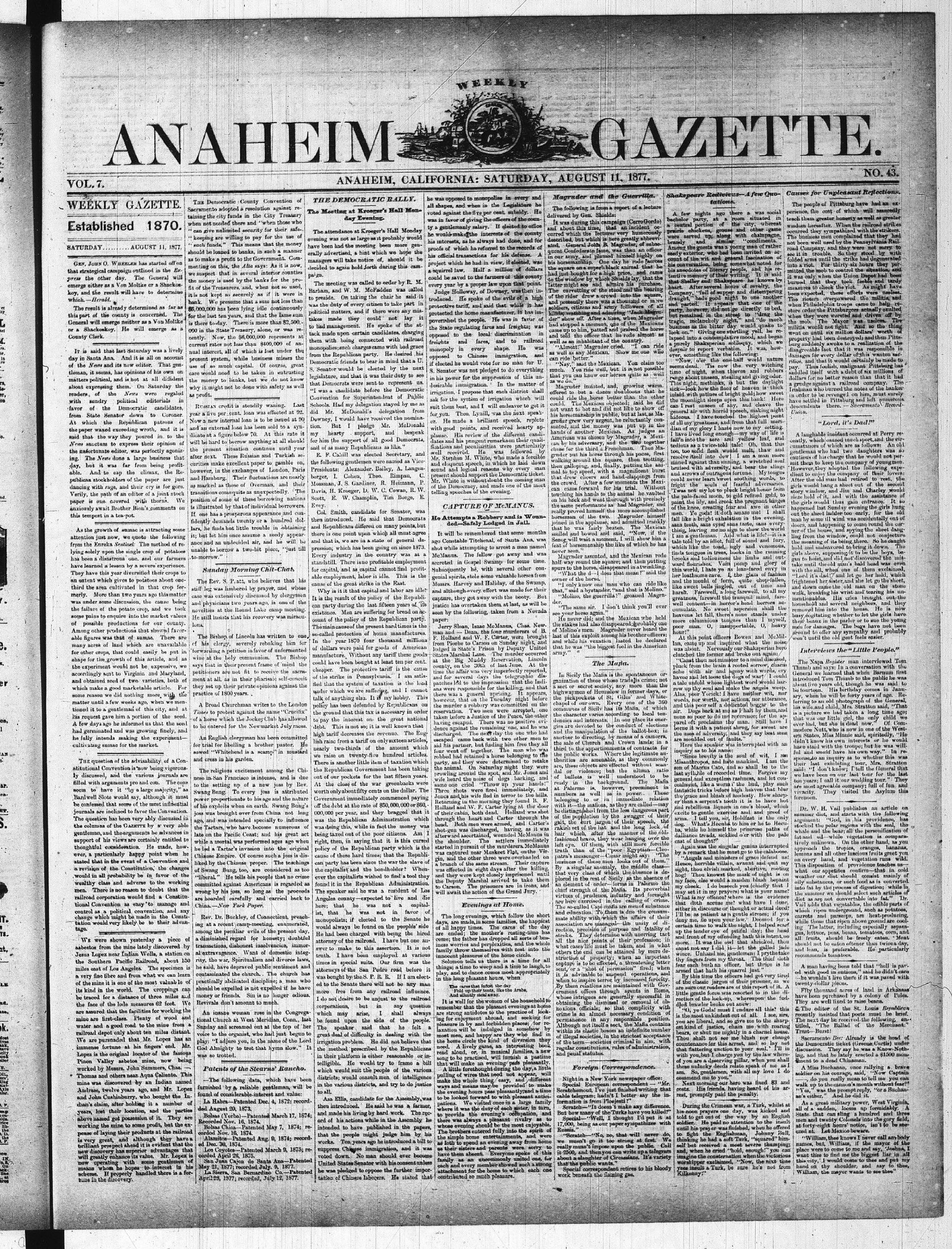
Scanned page
Searchable text
WEEKLY GAZETTE.
Established 1870.
SATURDAY... AUGUST 11, 1877.
GEN. JOHN O. WHEELER has started off on that strategical campaign outlined in the Express the other day. The General will emerge either as a Von Moltke or a Shackoskoy, and the result will have to determine which.—Herald.
The result is already determined as far as this part of the county is concerned. The General will emerge neither as a Von Moltke or a Shackoskoy. He will emerge as a County Clerk.
It is said that last Saturday was a lively day in Santa Ana. And it is all on account of the News and its new editor. That gentleman, it seems, has opinions of his own on matters political, and is not at all diffident about expressing them. On Saturday the readers of the News were regaled with sundry political editorials in favor of the Democratic candidates, from State Senator down to Coroner. At which the Republican patrons of the paper waxed exceeding wroth, and it is said that the way they poured in to the News sanctum to express their opinion of the unfortunate editor, was perfectly agonizing. The News done a large business that day, but it was far from being profit-
The Democratic County Convention of Sacramento adopted a resolution against retaining the city funds in the City Treasury when not needed there and "when those who can give unlimited security for their safety" keeping are willing to pay for the use of "such funds." This means that the money should be loaned to banks, in such a manner as to make a profit to the Government. Commenting on this, the Alla says: As it is now, we suspect that in several interior counties the money is used by the banks for the profit of the Treasurers, and, when not so used, it is not kept so securely as if it were in bank. We presume that a sum not less than $6,000,000 has been lying idle continuously for the last ten years, and that the same sum is there to-day. There is more than $2,500,000 in the State Treasury, alone, or was recently. Now, the $6,000,000 represents at current rates not less than $400,000 of annual interest, all of which is lost under the present system, while business misses the use of so much capital. Of course, great care would need to be taken in entrusting the money to banks, but we do not know why it might not be done with safety as well as profit.
Russian credit is steadily waning. Last year a five per cent. loan was effected at 92. Now a new internal loan is to be issued at 90 and an external loan has been sold to a syndicate at a figure below 70. At this rate it will be hard to borrow anything at all should the present situation continue until year after next. These Russian and Turkish securities make excellent paper to gamble on,
THE DEMO
The Meeting at day
The attendance evening was not as have been had the erally advertised, managers will take decided to again haign.
The meeting waived Barham, and W. M. to preside. On tae was the duty of every political matter, takes made thie to bad management tack made upon them with being monopolies; such cither from the Republic Democratic friend S. Senator would legislature, and tha that Democrats wi"I was a candidate Convention for S Schools. Had my did Mr. McDo Downey, I would tion. But I my hearty for him the suppo and of as many R E. F. Cahill w
As the growth of sumac is attracting some attention just now, we quote the following from the Eureka Sentinel: The method of relying solely upon the single crop of potatoes has been a disastrous one, and our farmers have learned a lesson by a severe experience. They have this year diversified their crops to an extent which gives to potatoes about one-third the area cultivated in that crop formerly. More than two years ago this matter was under some discussion, the cause being the failure of the potato crop, and we took some pains to enquire into the market values of possible productions for our county. Among other productions that showed favorable figures was that of sumac. There are many acres of land which are unavailable for other crops, that could easily be put in shape for the growth of this article, and as the experiment would not be expensive, we accordingly sent to Virginia and Maryland, and obtained seed of two varieties, both of which make a good marketable article. For some reason we did nothing more with the matter until a few weeks ago, when we mentioned it to a gentleman of this city, and at his request gave him a portion of the seed. A few days ago he informed us that the seed had germinated and was growing finely, and he fully intends making the experiment—cultivating sumac for the market.
The question of the advisability of a Constitutional Convention is now being vigorously discussed, and the various journals are filled with arguments pro and con. The cons seem to have it "by a large majority," as Bardwell Slote would say, although it must be confessed that some of the most influential journals are inclined to favor the Convention. The question has been very ably discussed in the columns of the Gazette by very able gentleman, and the arguments he advances in support of his views are certainly entitled to thoughtful consideration. He made, however, a particularly happy point when he stated that in the event of a Convention and a revision of the Constitution, the changes would in all probability be in favor of the wealthy class and adverse to the working man.
Russian credit is steadily waning. Last year a five percent loan was effected at 92. Now a new internal loan is to be issued at 90 and an external loan has been sold to a syndicate at a figure below 70. At this rate it will be hard to borrow anything at all should the present situation continue until year after next. These Russian and Turkish securities make excellent paper to gamble on, however, in the exchanges of London, Paris and Hamburg. Their fluctuations are nearly as marked as those of Overman, and their transitions come as unexpectedly. The position of some of these borrowing nations is illustrated by that of individual borrowers. If one has a prosperous appearance and confidently demands twenty or a hundred dollars, he finds but little trouble in obtaining it; but let him once assume a seedy appearance and an undecided air, and he will be unable to borrow a two-bit piece, "just till to-morrow."
Sunday Morning Chit-Chat
The Rev. S. P. att, who believes that his stiff leg was limbered by prayer, and whose case was extensively discussed by clergymen and physicians two years ago, is one of the novelties at the Round Lake camp meeting. He still insists that his recovery was miraculous.
The Bishop of Lincoln has written to one of his clergy, severely rebuking him for forwarding a petition in favor of unfermented wine at the holy communion. The Bishop says that in their present frame of mind the petitioners are not fit to receive the sacrament at all, as in their pliaristic self-conceit they set up their private opinions against the practice of 1800 years.
A Broad Churchman writes to the London Times to protest against the name "Crucifix" of a horse which the Jockey Club has allowed to enter for the Newmarket July races.
An English clergyman has been committed for trial for libelling a brother pastor. He sowed "Whitehead is a scamp" in mustard and cress in his garden.
The religious excitement among the Chinese in San Francisco is intense, and is due to the setting up of a new joss by Rev. Swang Bung. To every joss is attributed power proportionate to his age and the nature of his exploits when on earth. Swang Bung's joss was brought over from China not long ago, and was intended specially to influence the Tartars, who have become numerous of late on the Pacific Coast; and his great act while a mortal was performed ages ago when he led a Tartar's invasion into the original Chinese Empire. Of course such a joss is disliked by the Chinese proper. The teachings of Swang Bung, too, are considered as too liberal." He tells his people that no crime
S. Senator would legislature, and that that Democrats wished "I was a candidate Convention for S Schools. Had my wife did Mr. McDowney, I would tion. But I my hearty aid for him the supporter and of as many R E. F. Cahill will the following gentle Presidents: Alex berger, I. Cohen Mossman, J. S. G Davis, H. Kroeger Scott, E. W. C Evey.
Col. Smith, can then introduced and Republicans there is one point and that is, we are pressing; which he Every industry standstill. Therefor capital, and able employment cause of the greatest Why is it tha It is the result of can party during existence. Men are count of the police Themain cause so-called protection In the year 1875 of dollars were paid manufacture. We could have been cheaper. The part of the strike in filed that the system under which we talk of anything policy has been done the ground that we pay the interest debt. This is no high tariff decree lish raise from a nearly two-thirds we raise on two There is another Republican out of our pocket At the close of worth only about Government immortal off the debt at thie 000,000 per year was the Republic was doing this, being taxed out right, then, in a policy of the R cause of these h can party has been the capitalist an ever the capitalist
We were shown yesterday a piece of asbestos from the mine lately discovered by Jesus Lopez near Indian Wells, a station on the Southern Pacific Railroad, about 150 miles east of Los Angeles. The specimen is a very fine fibre and from what we can learn of the mine it is one of the most valuable of its kind in the world. The croppings can be traced for a distance of three miles and the face of the lode measures 62 feet. We are assured that the facilities for working the mine are first-class. Plenty of wood and water and a good road to the mine from a railroad depot only about ten miles distant. We are pursued that Mr. Lopez has an immense fortune at his fingers' end. Mr. Lopez is the original locator of the famous Pinon Valley asbestos mine, now being worked by Messra, John Summers, Chas. Thomas and others near Aqua Caliente. This mine was discovered by an Indian named Andrase, twelve years ago, and Mr. Lopez and John Cushinburry, who bought the Indian's claim, after holding it a number of years, lost their location, and the parties above named got possession of it. They are working the mine to some profit, but the expense of laying their products at the railroad is very great, and although they have a brilliant prospect ahead it is evident that the new discovery has superior advantages that will greatly enhance its value. Mr. Lopez is now operating with some gentlemen of means whom he hopes to interest in his scheme. If properly handled there is a fortune in the discovery.
Rev. Dr. Buckley, of Connecticut, preaching at a recent camp-meeting, enumerated among the peculiar evils of the present day, a diminished regard for honesty; doubtful transactions, dishonest insolvencies, immoral extravagance. Want of domestic integrity, the war, Spiritualism and divorce laws, he said, have deprived public sentiment and contaminated the church. The church has practically abdicated discipline; a man who should be expelled is not expelled if he have money or friends. Sin is no longer odious. Revivals don't amount to much.
An insane woman rose in the Congregational Church at West Meridian, Conn., last Sunday and screamed out at the top of her voice to the organist, who had just begun to play: "I adjure you, in the name of the Lord God Almighty to trot that hymn slow." It was so trotted.
Patents of the Stearns' Rancho.
The following data, which have been furnished by a reliable gentleman, will be found of considerable interest and value:
La Habra—Patented Dec. 4, 1872: recorded August 20, 1873.
Bolsas (Yorba)—Patented March 17, 1874; Recorded Nov. 16, 1874.
Bolsas Chica—Patented May 7, 1874; recorded Nov. 16, 1874.
Alamitas—Patented Aug. 9, 1874; recorded Dec. 30, 1874.
Los Coyotes—Patented March 9, 1875; recorded April 26, 1875.
San Juan Cajon de Santa Ana—Patented May 21, 1877; recorded July 9, 1877.
La Sierra, San Bernardino Co.—Patented April 29, 1877; recorded July 12, 1877.
WEEKLY
EIM-GA
ANAHEIM, CALIFORNIA: SATURDAY, AUGUST 11, 1877.
THE DEMOCRATIC RALLY.
The Meeting at Kroeger's Hall Monday evening was not as large as it probably would have been had the meeting been more generally advertised, a hint which we hope the managers will take notice of, should it be decided to again hold forth during this campaign.
The meeting was called to order by R. M. Barham, and W. M. McFadden was called to preside. On taking the chair he said it was the duty of every citizen to take part in political matters, and if there were any mistakes made they could not lay it to bad management. He spoke of the attack made upon certain candidates, charging them with being connected with railroad monopolies; such charges came with bad grace from the Republican party. He desired his Democratic friends to bear in mind that a U.S. Senator would be elected by the next legislature, and that it was their duty to see that Democrats were sent to represent us.
"I was a candidate before the Democratic Convention for Superintendent of Public Schools. Had my delegation stayed by me as did Mr. McDonald's delegation from Downey, I would have received the nomination. But I pledge Mr. McDonald my hearty support, and bespeak for him the support of all good Democrats, and of as many Republicans as like."
E. F. Cahill was elected Secretary, and the following gentlemen were named as Vice-President.
He was opposed to monopolies in every and all shapes, and when in the Legislature he voted against the five per cent subsidy. He was in favor of giving the officers of the county a gentlemanly salary. If elected to office he would make the interests of the county his interests, as he always had done, and for proofs of which he referred to the records of his official transactions for his defense. A project which he had in view, if elected, was a squirrel law. Half a million of dollars could be saved to the farmers of this county every year by a proper law upon that point.
Judge Holloway, of Downey, was then introduced. He spoke of the evils of a high protective tariff, and said that while it has protected the home manufacturer, it has impoverished the people. He was in favor of the State regulating fares and freights; was opposed to the local discrimination in freights and fares, and to railroad monopoly in every shape. He was opposed to Chinese immigration, and if elected he would vote for no man for U.S. Senator was not pledged to do everything in his power for the suppression of this undesirable immigration.
In the matter of irrigation, I propose that each district shall ask for the system of irrigation which will suit them best, and I will endeavor to get it for you. Theo. Lynnill, was the next speaker. He made a brilliant speech, replete with good points, and received hearty applause. His review of the different candidates and his pungent remarks on their qualifications and peculiarities were particularly well received. He was followed by Mr. Stephen M. White, who made a forcible and eloquent speech, in which he laid down Magruder and the Guerrilla.
The following is from a report of a lecture delivered by Gen. Shields:
It was during this campaign (CarroGordo) and about this time, that an incident occurred which the lecturer very humorously described, but which is here greatly abbreviated. General John B. Magruder, of subsequent Confederate faine, was then an officer in our army, and plumed himself highly on his horsemanship. One day he rode across the square on a superb black animal that he had just bought for a high price, and came to the window by which Shields lay, that the latter might see and admire his purchase.
The curveting of the steed and the hearing of the rider drew a crowd into the square, and presently there was a thousand or more soldiers, citizens and army followers of all kinds, watching and admiring "Jack Magruder" show off. After a time, when Magruder had stopped a moment, one of the Mexicans came up to him, patted and praised the horse and told the officer that he rode almost as well as an inhabitant of the country.
"Almost!" Magruder cried. "I can ride as well as any Mexican. Show me one who can ride better."
"Nay," said the Mexican. You claim too much. You ride well, but it is not possible that you can know our horses quite as well as we do."
Magruder insisted, and growing warm, offered to bet a dozen doubloons that he could ride the horse better than the other could. The Mexican objected; said he did not want to bet and did not like to show off his horsemanship in public, but at last, as Magruder grew very urgent, he reluctantly consented, and the money was put up in the hands of another Mexican. As judges an American was chosen by Magruder, a Mexican by his adversary, and the two together chose for the third Frenchman. Then Magruder put his horse through his paces, first walking around the square, then trotting, then galloping, and finally putting the ani-
S. Senator would be elected by the next legislature, and that it was their duty to see that Democrats were sent to represent us.
"I was a candidate before the Democratic Convention for Superintendent of Public Schools. Had my delegation stayed by me as did Mr. McDonald's delegation from Downey, I would have received the nomination. But I pledge Mr. McDonald my hearty support, and bespeak for him the support of all good Democrats, and of as many Republicans as like."
E. F. Cahill was elected Secretary, and the following gentlemen were named as Vice-Presidents: Alexander Bailey, A. Langenberger, I. Cohen, Theo. Rimpau, C. Mossman, J. S. Gardiner, R. Heimann, P. Davis, H. Kroeger, D. W. C. Cowan, R. W. Scott, E. W. Champlin, Tim Boege, E. Evey.
Col. Smith, candidate for Senator, was then introduced. He said that Democrats and Republicans differed on many points, but there is one point upon which all must agree and that is, we are in a state of general depression; which has been going since 1873. Every industry in the country was at a standstill. There is no profitable employment for capital, and as capital cannot find profitable employment, labor is idle. This is the cause of the great strike in the East.
Why is it it that capital and labor are idle? It is the result of the policy of the Republican party during the last fifteen years of its existence. Men are suffering for bread on account of the policy of the Republican party. The main cause of the present hard times is the so-called protection of home manufactures. In the year 1870 four thousand millions of dollars were paid for goods of American manufacture. Without any tariff these goods could have been bought at least ten per cent cheaper. The protective tariff is the cause of the strike in Pennsylvania. I am satisfied that the system of taxation is the load under which we are suffering, and I cannot talk of anything else. It is my hobby. This policy has been defended by Republicans on the ground that this tax is necessary in order to pay the interest on the great national debt. This is not so; it is well known that high tariff decreases the revenue. The English raise from a tariff on only sixteen articles, nearly two-thirds of the amount which we raise on twenty-five hundred articles. There is another little item of taxation which the Republican Government has been taking out of our pockets for the last fifteen years.
At the close of the war greenbacks were worth only about fifty cents on the dollar. The Government immediately commenced paying off the debt at the rate of $50,000,000 or $60,000,000 per year, and they bragged that it was the Republican Administration which was doing this, while in fact the money was being taxed out of the poor citizens. Am I right, then, in saying that it is this cursed policy of the Republican party which is the cause of these hard times; that the Republican party has been since the war the slave of the capitalist and the bondholder? When over the capitalists wished to find a tool they S. Senator was not pledged to do everything in his power for the suppression of this undesirable immigration. In the matter of irrigation, I propose that each district shall ask for the system of irrigation which will suit them best, and I will endeavor to get it for you. Theo. Lynn, was the next speaker. He made a brilliant speech, replete with good points, and received hearty applause. His review of the different candidates and his pungent remarks on their qualifications and peculiarities were particularly well received. He was followed by Mr. Stephen M. White, who made a forebite and eloquent speech, in which he laid down sound and logical reasons why every man present should support the Democratic ticket. Mr. White is without doubt the coming man of the Democracy, and made one of the most telling speeches of the evening.
CAPTURE OF McMANUS.
He Attempts a Robbery and is Wounded—Safely Lodged in Jail.
It will be remembered that some months ago Constable Titchenal, of Santa Ana, was shot while attempting to arrest a man named McManus. The fellow got away and was secreted in Gospel Swamp for some time. Subsequently he, with several other congenial spirits, stole some valuable horses from Messrs Harvey and Haliday, of the Swamp, and although every effort was made for their capture, they got away with the booty. But justice has overtaken them at last, as will be seen by the following, taken from a Nevada paper:
Jerry Sloan, Isaac McManus, Chas Newman and — Dean, the four murderers of B. F. Holland and W. F. Carter, were brought from Pioche to Carson on Sunday night, and lodged in State's Prison by Deputy United States Marshal Lane. The murder occurred at the Big Muddy Reservation Lincoln county, on the 30th of last June. At the time the affair was very imperfectly reported, and for several days the telegraphic dispatches led to the impression that the Indians were responsible for the killing, and that there was a general uprising. It appears, however, that on the Tuesday night before the murder a robbery was committed on the reservation. Two men were arrested, one taken before a Justice of the Peace, the other having escaped. There was no positive evidence against the remaining one, and he was discharged. The next day the one who had escaped came back with two other men to aid his partner, but finding him free they all four went off together. The man who was robbed had retained a horse belonging to the party, and they were determined to retake the animal. On Saturday night they were browning around the spot, and Mr. Jones and wife heard the noise of dogs barking, and some one cried "Throw up your hands!" Three shots were fired immediately, and Jones and his wife fled in terror to the hills. Returning in the morning they found B. F. Holland and W. F. Carter lying at the door of their cabin, both dead. Holland was shot through the heart and Carter through the head. Both men were armed, and Carter's shot-gun was discharged, having, as it was afterward ascertained, wounded McManus in the shoulder. The settlers immediately started in pursuit of the murderer McManus was captured near Muskeet Flat, on the Virgin, and the other three were overhauled on a branch of the same stream. Their capture was effected in eight days after the killing, and they were kept closely imprisoned until Deputy Marshal arrived to take them.
MAGRUDER insisted, and growing warm, offered to bet a dozen doubles than he could ride the horse better than the other could. The Mexican objected; said he did not want to bet and did not like to show off his horsemanship in public, but at last, as Magruder grew very urgent, he reluctantly consented, and the money was put up in the hands of another Mexican. As judges an American was chosen by Magruder, a Mexican by his adversary, and the two together chose for the third a Frenchman. Then Magruder put his horse through his paces first walking around the square, then trotting then galloping, and finally putting the animal to top speed with a magnificent burst that drew cheers and hand-clappings from the crowd. After a few moments the Mexican came forward for his trial. Without touching his hands to the animal he vaulted on his back and went thorough with precisely the same performance as had Magruder, and really proved himselfthe more accomplished horseman of the two. Magruder himself joined in the applause,and admitted frankly that he was fairly beaten.The Mexican smiled and bowed and said,"Now if the Senor will wait a moment.I will show him a feat of horsemanship like that he has never seen."Magruder assented,and the Mexican rode half way roundthe square;and then putting spurs tothe horse,disappeared in atwinkling."Whatthe d—doesthatmean?"saidthe ownerofthehorse.
"I only know one man who can ride like that,"saida bystander,"and thatis Molino."
"Molino,the guerrilla:"groanedMagruder.
"The same sir.I don't think you'll ever see your horse again."
He never did;andthe Mexicanwho heldthe stakeshad also disappeared;probablyoneofMolino'smen.Magruderneverheardthelastofthisexploitamonghisbrotheroffices;andwhilehisvexationlasthedeclaredthathewas"thebiggestfoolintheAmericanarm."
The Mafia.
In SicilytheMafiaisthespontaneousorganizationofthosewhosetradeiscrime;notasectorsecretsocthyanymorethanthehighwaymenHomowallowinformerdays,或pickpocketsofSt.Giles'andWhitechapelofourown.Everyoneofthe360communesofSicilyhasitsMafiaofwhichthecharactervariesaccordingtolocaltenndenciesandinterests.Inoneplaceitsenergiesaredevotedtotheconductofelectionsandthemanipulationoftheballot-box;在otherdirectingbymeansofacanrora,thesaleofChurchandCrownlands;在thirdoftheappointmentsofcontractsforthepublicworks.Wherethelegitimateauthoritiesareamenable.astheycommonlyare,theseobjectsareeffectwithoutscandalorviolence;buttheultima ratioofbulletsiswellunderstoodtobereadyinthebackground.TheMafiaatPalermois,howeverpreeminentinnumbersaswellasinpower..Thosebelongingtoorinimmediaterelationwithit—themaliosa,saytheyarecalled—maybedistinguishedfromthelessdangerpartofthepopulationbytheswaggerofthegait,thecurtjargonofthespeech,therakishsetofthehatandthelonglockofhairwhich,afterthemanneroftheold-fashionedbravo,theywearhangingoverthelefteye.Ofthemwith stillmoreforbleuthanthanofthe"poorEgyptian—Cleopatra'smessenger—Cesarmightsay:"Thebusinessofthesenomelookoutofthem."Bya singularanomaly,themiddleclass—thatveryclassofwhichtheabsencedeploredintherestofSicilyastheabsenceofmuch.Youridewell,butitisnotpossiblethatyouknowourshoreshquiteaswellaswedo."
CAPTUREOFMcMANUS.
HeAttemptsaRobberyandisWounded—SafelyLodgedinJail.
ItwillberememberedthatsomemonthsagoConstableTitchenal,ofSantaAnna,wasshotwhileattemptingtoarresta mannamedMcManus.ThefellowgotawayandwassecretedinGospelSwampforsometime.Subsequentlyhe,withseveralothercongenialspirits,stolesomevaluablehorsesfromMessrsHarvey和Haliday,oftheSwamp,andalthougheveryeffortwasmadefor theircapture,theygotawaywiththebooty。但justicehasovertakentheatlast.aswillbesecuredTherewasnopositiveevidenceagainsttheremainingone,andhewasdischarged.Thenextdaytheonewhohadescapedcamebackwithtwoothermentoaidhis partner,butfindhimfreetheyallfourwentoffogether.Themanwhowasrobbedhadretainedahorsebelongingtotheparty,andtheyweredeterminedtoretakethe动物.OnSaturdaynighttheywerebrowningaroundthespot,andMr.Jonesandwifeheardthenoiseofdogsbarking,andsomeonecried"Throwupyourhands!"Threeshotswerefiredimmediately,andJonesandhiswifefledinterrortothehills.ReturninginmorningtheyfoundB.F.HollandandW.F.Carterlyingatthedoorof theircabin,bothdead.HollandwasshotthroughheartandCarterthroughthead.Bothmenwerearmed,andCarter'sshot-gunwasdischarged,havingasitwasafterwardascertained.woundedMcManusinthereader.ThesettlersimmediatelystartedinpursuitofthemurdererMcManuscapturednearMuskeetFlat.ontheVirgin,andtheotherthreewereoverhauledonabbranchofthesamestream.Thecapturewaseffectedineightdaysafterthekilling,andtheywerekeptcloselyimprisoneduntilDeputyMarshalarrivedtotakethen
THE MAFIA.
In SicilytheMafiaisthespontaneousorganizationofthosewhosetradeiscrime;notasectorsecretsocthyanymorethanthehighwaymenHomowallowinformerdays,或pickpocketsofSt.Giles'andWhitechapelofourown.Everyoneofthe360communesofSicilyhasitsMafiaofwhichthecharactervariesaccordingtolocaltenndenciesandinterests.Inoneplaceitsenergiesaredevotedtotheconductofelectionsandthemanipulationoftheballot-box;在otherdirectingbymeansofacanrora,thesaleofChurchandCrownlands;在thirdoftheappointmentsofcontractsforthepublicworks.Wherethelegitimateauthoritiesareamenable.astheycommonlyare,theseobjectsareeffectwithoutscandalorviolence;buttheultima ratioofbulletsiswellunderstoodtobereadyinthebackground.TheMafiaatPalermois,howeverpreeminentinnumbersaswellasinpower..Thosebelongingtoorinimmediaterelationwithit—themaliosa,saytheyarecalled—maybedistinguishedfromthelessdangerpartofthepopulationbytheswaggerofthegait,thecurtjargonofthespeech,therakishsetofthehatandthelonglockofhairwhich,afterthemanneroftheold-fashionedbravo,theywearhangingoverthelefteye.Ofthemwith stillmoreforbleuthanthanofthe"poorEgyptian—Cleopatra'smessenger—Cesarmightsays:"Thebusinessofthesenomelookoutofthem."Bya singularanomaly,themiddleclass—thatveryclassofwhichtheabsencedeploredin-therestofSicilyastheabsenceofmuch.Youridewell,butitisnotpossiblethatyouknowourshoreshquiteaswellaswedo."
At the close of the war greenbacks were worth only about fifty cents on the dollar. The Government immediately commenced paying off the debt at the rate of $50,000,000 or $60,000,000 per year, and they bragged that it was the Republican Administration which was doing this, while in fact the money was being taxed out of the poor citizens. Am I right, then, in saying that it is this cursed policy of the Republican party which is the cause of these hard times; that the Republican party has been since the war the slave of the capitalist and the bondholder? When ever the capitalists wished to find a tool they found it in the Republican Administration. The speaker said he was a resident of Los Angeles county—expected to live and die here; that he was not a capitalist, that he was not in favor of monopolists; if elected to the Senate he would always be found on the peoples' side He had been charged with being the hired attorney of the railroad. I have but one answer to make to this assertion. It is not truth. I have been employed at various times in special suits. Our firm was the attorneys of the San Pedro road before it was bought by the S. P. R. R. If I am elected to the Senate there will not be any man more free from any railroad influence. I do not desire to be unjust to the railroad corporations, but in any question which may arise, I shall always be found upon the side of the people. The speaker said that he felt a great deal of difficulty in dealing with the irrigation problem. He did not believe that the method prescribed by the Republicans in their platform is either reasonable or intelligible. He would try to frame a bill which would suit the people of the various districts; would consult men of intelligence in the various districts, and try to do justice to all.
Asa Ellis, candidate for the Assembly, was then introduced. He said he was a farmer, and made his living by hard work. The record of his actions while in the Assembly he intended to have published in the papers, that the people might judge him by his works. Ten years ago he introduced a bill to suppress Chinese immigration, and it was voted down. No man should ever become United States Senator with his consent unless he was pledged to oppose the further importation of Chinese laborers. He stated that some one cried "Throw up your hands: Three shots were fired immediately, and Jones and his wife fled in terror to the hills. Returning in the morning they found B. F. Holland and W. F. Carter lying at the door of their cabin, both dead. Holland was shot through the heart and Carter through the head. Both men were armed, and Carter's shot-gun was discharged, having, as it was afterward ascertained, wounded McManns in the shoulder. The settlers immediately started in pursuit of the murderers. McManus was captured near Muskeet Flat, on the Virgin, and the other three were overhauled on a branch of the same stream. Their capture was effected in eight days after the killing, and they were kept closely imprisoned until the Deputy Marshal arrived to take them to Carson. The prisoners are in irons, and will await the action of the Grand Jury.
Evenings at Home.
The long evenings, which follow the short days, are made in some families, the happiest of all happy times. The cares of the day are ended; the mother's resting-time has come; the father has dropped all sorts of business worries and perplexities, and the whole family throw themselves with zezt into the innocent pleasures of the home circle.
Solomon tells us there is a time for all things; a time to weep and a time to laugh, to play, and to dance comes most appropriately in the long pleasant hours, when.
The cares that infest the day
Fold up their tents, like the Arabs, And silently steal away.
It is well for the women of the household to remember that the pleasant evenings at home are strong antidotes to the practice of looking for enjoyment abroad, and seeking for pleasure in by and forbidden places; for relaxation will be indulged in somehow by most men, and happy are they who find in the home circle the kind of diversion they need. A lively game, an interesting book read aloud, or, in musical families, a new song to be practised, will furnish a pastime that will make an evening pass pleasantly.
A little forethought during the day, a little pulling of wires that need not appear, will make the whole thing easy, and different ways and means may be provided to make the evening hours pass pleasantly; and time to be looked forward to with pleasant anticipations. We visited once in a large family where it was the duty of each sister; in turn, to provide the evening's occupation, and there was always a pleasant rivalry as to whose evening should be the most enjoyable. The brothers entered fully into the spirit of the simple home entertainments, and were as loth to spend an evening away from home as their sisters and parents were sorry to have them absent. Everyone spoke of this family as an uncommonly united one, for each and every member showed such a strong attachment for the home to which each one contributed so much pleasure.
Foreign Correspondence.
Night in a New York newspaper office:
Special European correspondent — "Mr. Scratchemouth. I've just finished writing that cable telegram; hadn't I better say the information is from Ploesesti?"
Scratch—"It doesn't make any difference. But how many of the Turks have you killed?"
Special—"Well, I thought I'd put it at 17,000, being as our paper sympathizes with Russia."
"Scratch—"No, no, that will never do, we mustn't go it too strong at first. We really mustn't impose upon the public. Call it 2500, and then you can write up a telegram about a slaughter of Circassians. It's variety that this public wants."
Special correspondent retires to his bloody work beneath the farming gas."
GAZETTE.
ST 11, 1877.
and the Guerrilla.
from a report of a lecture
Shields:
a campaign (CarroGordo)
that an incident occured very humorously
which is here greatly abbreviated.
B. Magruder, of subsefaine, was then an officer
claimed himself highly on
One day he rode fearless
through black animal that he
had high price, and cane
which Shields lay, that the
had admire his purchase.
The steed and the bearing
a crowd into the square,
was a thousand or more
and army followers of all
admiring "Jack Magruder"
a time, when Magruder
ment, one of the Mexicans
tatted and praised the horse
that he rode almost as
part of the country.
Rider cried. "I can ride
Mexican. Show me one who
Mexican. You claim too
well, but it is not possible
our horses quite as well
good, and growing warm.
dazen doubloons that he
three better than the other
can objected; said he did
and did not like to show off
in public, but at last, as Margent, he reluctantly consummey was put up in the
Mexican. As judges an
seen by Magruder, a Mexirary, and the two together
a Frenchman. Then Margent through his paces, first
the square, then trotting,
finally putting the ani-
Shakespeare Redivices—A few Quotations.
A few nights ago there a was social bachelor party, at a room situated in a central portion of the city, whereat prairie chickens, grouse and other game were served up, along with champagne, brandy and similar "condiments."
Among the guests was a young man of rather easy exterior, who had been invited on account of the wit and general fascination of his conversation, being somewhat noted for his anecdotes of literary people, and his retentive memory of their writing. It is said that Shalley and Shakespeare he knows by heart.
After several hours of revelry, the Company, "full of supper and distempering draught," bade good night to one another and parted. It appears that one of the party, however, did not go directly to bed, but remained in the street to "drang the tragic melancholy night," and "do much business as the bitter day would quake to look on." Giving one startling yell, he relapsed into a contemplative mood, and began a purely Shaksperian骠骐quoy, which we despair to report verbatim. It was, however, something like the following:
"Now, o'er the one-half world nature seems dead. Tis now the very witching time of night, when thioves and robbers range about unseen, stealing and giving odor. This night, methinks, is but the daylight sick—look how the floor of heaven is thick inlaid with patines of bright gold; how sweet the moonlight sleeps upon this bank! Here can I rest unseen of any, and cleave the general air with horrid speech, making night hideous. I have touched the highest point of all my greatness, and from that full meridian of my glory I hasten now to my setting.
I have lived long enough—my way of life is fall'n into the zero and yellow leaf, and tedious as a twice-told tale! Oh, that this too, too solid flesh would melt, thaw and resolve itself into dew! I am a man more sinned against than sinning, a wretched soul
Causes for Unpleasant Reflections.
The people of Pittsburg have had an experience, the cost of which will assuredly teach them greater honesty as well as greater wasdoan hereafter. When the railroad strikes occurred they sympathized with the strikers. The business men complained that they had not been well used by the Pennsylvania Railroad Company, and they were not sorry to see it in trouble. So they stood by with folded arms until the strike had degenerated into a riot. For thirty-six hours they permitted the mob to control the situation, and it was only when the Union Depot had been burned that they took feeble and tarly measures to check the riot. As might have been expected, these efforts were uneasy. The riots overpowered the militia, and when Philadelphia troops came to help restore order the Pittsburghs actually exulted when they were worried and driven off by the mob. The Mayor was uneasy. The militia would not fight. And so the thing went on until six million dollars' worth of property had been destroyed; and then Pittsburg suddenly awoke to a realization of this disagreeable fact that it was responsible in damages for every dollar of this wanton sacrifice, and that it would certainly be made to pay. Thus foolish, malignant Pittburg has saddled itself with a debt of six millions of dollars for no better reason than that it had a grudge against a railroad company. The Irishman who burned the notes of the banker in order to be revenged on him must surely have settled in Pittsburg and left numerous descendants there. — Sacramento Record-Union.
"Lord, it's Dad!"
A laughable incident occurred at Perry recently, which caused much sport, and the circumstances of which are as follows: An old gentleman who had two daughters was so cautious of his charge that he would not permit them to keep the company of young men.
"Lord, it's Dad!"
A laughable incident occurred at Perry recently, which caused much sport, and the circumstances of which are as follows: An old gentleman who had two daughters was so cautious of his charge that he would not permit them to keep the company of young men. However, they adopted the following expedient to enjoy the company of their lovers: After the old man had retired to rest, the girls would hang a sheet out of the second story window, and Jim and Charley would sieze hold of it, and with the assistance of the girls would thus gain entrance. It so happened last Sunday evening the girls hung out the sheet ladder too early; for the old man by some ill wind was accidentally out of doors, and happening to come round the corner of the house, and spying the sheet dangling from the window, could not conjecture the meaning of its being there. So he caught hold and endeavored to bring it down. The girls above, supposing it to be the boys, began to hoist, and did not discovered the mistake until the old man's bald head was even with the sill, when one of them exclaimed, "Lord it's dad!" and let go her hold, which frightened her sister, and she let go the sheet, and down came the old man on the stone walk, breaking his wrist and tearing his unmentionables. His cries brought out the household and several neighbors, and they removed him into the house. He is now busy coagulating whether to let the girls have their beaux in the parlor or to sue the young men for damages. The boys have not been around to offer any sympathy and probably won't until the old gent feels easier.
Interviews the "Little People."
The Napa Register man interviewed Tom Thumb and says: In a conversation with the General we learned that when Barnum first introduced Tom Thumb to the public he was about five years old, though he was said to be fourteen. His birthday comes in January, when he will be forty years of age. Referring to an old photograph of the General, his wife and child, Mrs. Stratton said, "That is a picture we had taken a long time ago; that was our little girl, the only child we ever had, but also is dead now." Of Commodore Nutt, who is now in one of the Western States, Miss Minnie said, spiritedly, "He didn't know his own interests or he would have staid with the troupe; but he was willful and would have his own way." In response to an inquiry as to whether this was their last exhibiting tour, Mrs. Stratton said: "I don't know; I tell the General that we have been on our last tour for the last ten years; I call it our wedding tour." They are most agreeable company; full of fun and vivacity. They visited the Asylum this foremost.
Dr. W. H. Vail publishes an article on summer diet, and starts with the following argument: "God, in his providence, has stocked the polar regions with the seal, the whale and the bear; all the personification of fat and oil—while vegetation is comparatively unknown. On the other hand, as you approach the tropics, oranges, bananas, lemons and all other luscious fruits greet you on every hand, and vegetation runs wild. This disposition of providence teaches us—what our appetites confirm—that in cold weather our diet should consist mainly of oily substances, or such food as is converted..."
The Mexican rode square; and then putting disappeared in a twinkling does that mean?" said the same man who can ride like lumber and admitted frankly beaten. The Mexican man said, "Now, if the moment, I will show him a ship like the likeness of which he has..."
The Mexican rode square; and then putting disappeared in a twinkling does that mean?" said the same man who can ride like lumber and admitted frankly beaten. The Mexican man said, "Now, if the moment, I will show him a ship like the likeness of which he has..."
The Mexican rode square; and then putting disappeared in a twinkling does that mean?" said the same man who can ride like lumber and admitted frankly beaten. The Mexican man said, "Now, if the moment, I will show him a ship like the likeness of which he has..."
The Mexican rode square; and then putting disappeared in a twinkling does that mean?" said the same man who can ride like lumber and admitted frankly beaten. The Mexican man said, "Now, if the moment, I will show him a ship like the likeness of which he has..."
The Mexican rode square; and then putting disappeared in a twinkling does that mean?" said the same man who can ride like lumber and admitted frankly beaten. The Mexican man said, "Now, if the moment, I will show him a ship like the likeness of which he has..."
The Mexican rode square; and then putting disappeared in a twinkling does that mean?" said the same man who can ride like lumber and admitted frankly beaten. The Mexican man said, "Now, if the moment, I will show him a ship like the likeness of which he has..."
The Mexican rode square; and then putting disappeared in a twinkling does that mean?" said the same man who can ride like lumber and admitted frankly beaten. The Mexican man said, "Now, if the moment, I will show him a ship like the likeness of which he has..."
The Mexican rode square; and then putting disappeared in a twinkling does that mean?" said the same man who can ride like lumber and admitted frankly beaten. The Mexican man said, "Now, if the moment, I will show him a ship like the likeness of which he has..."
The Mexican rode square; and then putting disappeared in a twinkling does that mean?" said the same man who can ride like lumber and admitted frankly beaten. The Mexican man said, "Now, if the moment, I will show him a ship like the likeness of which he has..."
The Mexican rode square; and then putting disappeared in a twinkling does that mean?" said the same man who can ride like lumber and admitted frankly beaten. The Mexican man said, "Now, if the moment, I will show him a ship like the likeness of which he has..."
The Mexican rode square; and then putting disappeared in a twinkling does that mean?" said the same man who can ride like lumber and admitted frankly beaten. The Mexican man said, "Now, if the moment, I will show him a ship like the likeness of which he has..."
The Mexican rode square; and then putting disappeared in a twinkling does that mean?" said the same man who can ride like lumber and admitted frankly beaten. The Mexican man said, "Now, if the moment, I will show him a ship like the likeness of which he has..."
The Mexican rode square; and then putting disappeared in a twinkling does that mean?" said the same man who can ride like lumber and admitted frankly beaten. The Mexican man said, "Now, if the moment, I will show him a ship like the likeness of which he has..."
The Mexican rode square; and then putting disappeared in a twinkling does that mean?" said the same man who can ride like lumber and admitted frankly beaten. The Mexican man said, "Now, if the moment, I will show him a ship like the likeness of which he has..."
The Mexican rode square; and then putting disappeared in a twinkling does that mean?" said the same man who can ride like lumber and admitted frankly beaten. The Mexican man said, "Now, if the moment, I will show him a ship like the likeness of which he has..."
The Mexican rode square; and then putting disappeared in a twinkling does that mean?" said the same man who can ride like lumber and admitted frankly beaten. The Mexican man said, "Now, if the moment, I will show him a ship like the likeness of which he has..."
The Mexican rode square; and then putting disappeared in a twinkling does that mean?" said the same man who can ride like lumber and admitted frankly beaten. The Mexican man said, "Now, if the moment, I will show him a ship like the likeness of which he has..."
The Mexican rode square; and then putting disappeared in a twinkling does that mean?" said the same man who can ride like lumber and admitted frankly beaten. The Mexican man said, "Now, if the moment, I will show him a ship like the likeness of which he has..."
The Mexican rode square; and then putting disappeared in a twinkling does that mean?" said the same man who can ride like lumber and admitted frankly beaten. The Mexican man说了:"Now,ifthe moment,Iwillshowhimacropheandthenputtingdisappearedinattwinklingsdoesthatmean?"saidthesamemanwhowcanridethemappearingwithoutscanneandthenputtingdisappearedinattwinklingsdoesthatmean?"saidthesamemanwhowcanridethemappearingwithoutscanneandthenputtingdisappearedinattwinklingsdoesthatmean?"saidthesamemanwhowcanridethemappearingwithoutscenneandthenputtingdisappearedinattwinklingsdoesthatmean?"saidthesamemanwhowcanridethemappearingwithoutscenneandthenputtingdisappearedinattwinklingsdoesthatmean?"saidthesamemanwhowcanridethemappearingwithoutscenneandthenputtingdisappearedinattwinklingsdoesthatmean?"saidthesamemanwhowcanridethemappearingwithoutscenneandthenputtingdisappearedinattwinklingsdoesthatmean?"saidthesamemanwhowcanridethemappearingwithoutscenneandthenputtingdisappearedinattwinklingsdoesthatmean"?saidthesamemanwhowcanridethemappearingwithoutscenneandthenputtingdisappearedinattwinklingsdoesthatmean"?saidthesamemanwhowcanridethemappearing withoutscenneandthenputtingdisappearedinattwinklingsdoesthatmean"?saidthesamemanwhowcanridethemappearing withoutscenneandthenputtingdisappearedinattwinklingsdoesthatmean"?saidthesamemanwhowcanridethemappearing withoutscenneandthenputtingdisappearedinattwinklingsdoesthatmean"?saidthesamemanwhowcanridethemappearing withoutscenneandthenputtingdisappearedinattwinklingsdoesthatmean"?saidthesamemanwhowcanridethemappearing withoutscenneandthenputtingdisappearedinattwinklingsdoesthatmean"?saidthesamemanwhowcanridethemappearing withoutscenneandthenputtingdisappearedinattwinklingsdoesthatmean"?saidthesamemanwhowcanridethemappearing withoutscenneandthenputtingdisappearedinattwinklingsdoesthatmean"?saidthesamemanwhowcanridethemappearing withoutscenneandthenputtingdisappearedinattwinklingsdoesthatmean"?saidthesamemanwhowcanridethemappearing withoutscenneandthenputtingdisappearedinattwinklingsdoesthatmean"?saidthesamemanwhowcanridethemappearing withoutscenneandthenputtingdisappearedinattwinklingsdoesthatmean"?saidthesamemanwhowcanridethemappearing withoutscenneandthenputtingdisappearedinattwinklingsdoesthatmean"?saidthesamemanwhowcanridethemappearing withoutscenneandthenputtingdisappearedinattwinklingsdoesthatmean"?saidthesamemanwhowcanridethemappearing withoutscenneandthenputtingdisappearedinattwinklingsdoesthatmean"?saidthesamemanwhowcanridethemappearing withoutscenneandthenputtingdisappearedinattwinklingsdoesthatmean"?saidthesamemanwhowcanridethem appearing withoutscenneandthenputtingdisappearedinattwinklingsdoesthatmean"?saidthesamemanwhowcanridethem appeering withoutscenneandthenputtingdisappearedinattwinklingsdoesthatmean"?saidthesamemanwhowcanridethem appeering withoutscenneandthenputtingdisappearedinattwinklingsdoesthatmean"?saidthesamemanwhowcanridethem appeering withoutscenneandthenputtingdisappearedinattwinklingsdoesthatmean"?saidthesamemanwhowcanridethem appeering withoutscenneandthenputtingdisappearedinattwinklingsdoesthatmean"?saidthesamemanwhowcanridethem appeering withoutscenneandthenputtingdisappearedinattwinklingsdoesthatmean"?saidthesamemanwhowcanridethem appeering withoutscenneandthenputtingdisappearedinattwinklingsdoesthatmean"?saidthesamemanwhowcanridethem appeering withoutscenneandthenputtingdisappointedinattwinklingsdoesthatmean"?saidthesamemanwhowcanridethem appeering withoutscenneandthenputtingdisappointedinattwinklingsdoesthatmean"?saidthesamemanwhowcanridethem appeering withoutscenneandthenputtingdisappointedinattwinklingsdoesthatmean"?saidthesamemanwhowcanridethem appeering withoutscenneandthenputtingdisappointedinattwinklingsdoesthatmean"?saidthesamemanwhowcanridethem appeering withoutscenneandthenputtingdisappointedinattwinklingsdoesthatmean"?saidthesamemanwhowcanridethem appeering withoutscenneandthenputtingdisappointedinattwinklingsdoesthatmean"?saidthesamemanwhowCan ridethem appeering withoutscenneandthenputtingdisappointedinattwinklingsdoesthatmean"?saidthesamemanwhowCan ridethem appeering withoutscenneandthenputtingdisappointedinattwinklingsdoesthatmean"?saidthesamemanwhowCan ridethem appeering withoutscenneandthenputtingdisappointedinattwinklingsdoesthatmean"?saidthesamemanwhowCan ridethem appeering withoutscenneandthenputtingdisappointedinattwinklingsdoes该句为:"Since brevity is soul of wit," I am Misanthropos,and hate manslind,"Vachevilepomfowl,"Vachevilepomfowl,"Vachevilepomfowl,"Vachevilepomfowl,"Vachevilepomfowl,"Vachevilepomfowl,"Vachevilepomfowl,"Vachevilepomfowl,"Vachevilepomfowl,"Vachevilepomfowl,"Vachevilepomfowl,"Vachevilepomfowl,"Vachevilepomfowl,"Vachevilepomfowl,"Vachevilepomfowl,"Vachevilepomfowl,"Vachevilepomfowl,"Vachevilepomfowl,"Vachevilepomfowl,"Vachevilepomfowl,"Vachevilepomfowl,"Vachevilepomfowl,"Vachevilepomfowl,"Vachevilepomfowl,"Vachevilepomfowl,"Vachevilepomfowl,"Vachevilepomfowl,"Vachevilepomfowl,"Vachevilepomfowl,"Vachevilepomfowl,"Vachevilepomfowl","Since brevity is soul of wit," I am Misanthropos,and hate manslind,"Vachevilepomfwl,"Vachevilepomfwl,"Vachevilepomfwl,"Vachevilepomfwl,"Vachevilepomfwl,"Vachevilepomfwl,"Vachevilepomfwl,"Vachevilesplombwl,"Vachevilesplombwl,"Vachevilesplombwl,"Vachevilesplombwl,"Vachevilesplombwl,"Vachevilesplombwl,"Vachevilesplombwl,"Vachevilesplombwl,"Vachevilesplombwl,"Vachevilesplombwl,"Vachevilesplombwl,"Vachevilesplombwl,"Vachevilesplombwl,"Vachevilesplombwl","Since brevity is soul of wit," I am Misanthropos,and hate manslind,"Vachevilesplombwl,"Vachevilesplombwl,"Vachevilesplombwl,"Vachevilesplombwl,"Vachevilesplombwl,"Vachevilesplombwl,"Vachesplombwl","Vachesplombwl","Vachesplombwl","Vachesplombwl","Vachesplombwl","Vachesplombwl","Vachesplombwl","Vachesplombwl","Vachesplombwl","Vachesplombwl","Vachesplombwl","Vachesplombwl","Vachesplombwl","Vachesplombwl","Vachesplombwl","Vachesplombwl","Vachesplombwl","Vsachinesplombwl","Vsachinesplombwl","Vsachinesplombwl","Vsachinesplombwl","Vsachinesplombwl","Vsachinesplombwl","Vsachinesplombwl","Vsachinesplombwl","Vsachinesplombwl","Vsachinesplombwl","Vsachinesplombwl","Vsachinesplombwl","Vsachinesplombwl","Vsachinesplombwl","Vsachinesplombwl","Vsachinesplombwl","Vsachinesplombwl","Vsachinesplombwl","Vsachinesplombwl","Vsachinesplombvl","Vsachinesplombvl","Vsachinesplombvl","Vsachinesplombvl","Vsachinesplombvl","Vsachinesplombvl","Vsachinesplombvl","Vsachinesplombvl","Vsachinesplombvl","Vsachinesplombvl","Vsachinesplombvl","Vsachinesplombvl","Vsachinesplombvl","Vsachinesplombvl","Vsachinesplombvl","VsachinesPloblvl","VsachinesPloblvl","VsachinesPloblvl":"Since brevity is soul of wit," I am Misanthropos,and hate manslind,”Vsachinesplombvl,”VsachinesPloblvl,”VsachinesPloblvl,”VsachinesPloblvl,”VsachinesPloblvl,”VsachinesPloblvl,”VsachinesPloblvl,”VsachinesPloblvl,”VsachinesPloblvl,”VsachinesPloblvl,”VsachinesPloblvl,”VsachinesPloblvl,”VsachinesPloblvl,”VsachinesPloblvl,”VSACHINESPLOBLIVELIVERIIVERIIVERIIVERIIVERIIVERIIVERIIVERIIVERIIVERIIVERIIVERIIVERIIVERIIVERIIVERIIVERIIVERIIVERIIVERIIVERIIVERIIVERIIVERIIVERIIVERIIVERIIVERIIVERIIVERIIVERIIVERIIVERIIVERIIVERIIVERIIVERIIVERIIVERIIVERIIVERIIVERIIVERIIVERIIVERIIVERIIVERIIVERII
however, preeminent in
well as in power. Those
war in immediate relation
loss, as they are called—may
from the less dangerous part
by the swagger of their
argon of their speech, the
that and the long lock of
letter the manner of the oldthey wear hanging over the
term, with still more forcible
the "poor Egyptian—CleoCesar might say: "The
se men looks out of them."
nominally, the middle class—
of which the absence is detat of Sicily as the absence of
terror—forms in Palermo the
the Mafia. Its proverbial
ence, industry and foresight
in the calling of crime.
the mafia are men of substance.
To them is due the consumwhich the affairs of their
managed—the unity of diof purpose and fatality of
determine with unerring tact
points of their profession; in
must be taken, and in what
can be attained by mere deperty; when an important
effected, a threatening letter
of persuasion" fire; when
to suspend operations, and
terror by increased ferocity.
are maintained with Govthrough agents in Rome,
are generally successful in
dismisal or removal of obso that complicity with
most necessary condition of
any responsible position.
self a sect, the Mafia contains
be bosom an indefinite number
as, in the strictest acceptance
societies criminal in aim, with
tions, rules of administration,
so that complicity with
most necessary condition of
any responsible position.
self a sect, the Mafia contains
be bosom an indefinite number
as, in the strictest acceptance
societies criminal in aim, with
tions, rules of administration,
so that complicity with most necessary condition of any responsible position.
self a sect, the Mafia contains
be bosom an indefinite number
as, in the strictest acceptance
societies criminal in aim, with
tions, rules of administration,
so that complicity with most necessary condition of any responsible position.
New York newspaper office:
peasant correspondent — "Mr.
I've just finished writing that
hadn't I better say the imPlojesti?"
doesn't make any difference.
of the Turks have you killed?"
well, I thought I'd put it at
our paper sympathizes with
No, no, that will never do,
it too strong at first. We
pose upon the public. Call
you can write up a telegram
of Circassians. It's variety
wants."
Dependent retires to his bloody
loving gas.
During the Crimean war, a Turk, whilst at his noon prayers one day, was kicked and told to get out of the way by an English soldier. He paid no attention to the insult until his prayer was finished, when he offered to fight the Englishman, Johnny Bull, thinking he had a soft Turk, "squared" himself but received a most severe thumping; and, when he cried "hold, enough!" you can imagine the consternation when the victorious worshipper exclaimed, "Now, the next time yess insults a Turk, be sure he's not from Kilkenny!"
Again was the singular genius interrupted by a remark that he must go to the calaboose.
"Angels and ministers of grace defend us!
Hence horrible villain, availant and quit my sight, thou elvish marked, abortive, rooting hog!
Thou knowst the mask of night is on my face, also would a maiden blush bepaint my check. I do beseech you (chicly that I may set it in my prayers) what is your name?
What is my offence? where is the evidence that doth accuse me? what have I done, either in discourse or thought or actual deed?
I'll be as patient as a gentle stream; if you deny me, lie upon your law. Doomed for a certain time to walk the night, I helped scarf up the tender eye of pitiful day; the head and front of my offending hath this intent, no more. It was the owl that shrieked, then gallt not say I did it—let the galled jade wince. Unhand me, gentlemen: I prythe take thy fingers from my throat. The thief doth fear eachbuch an officer, but thrice is he armed that hath his quarrel just."
By this time the officers had got very tired of the classic jargon of their prisoner, as we are sure our readers are of this report of it. A little gentle force was resorted to in the direction of the lock-up, whereupon the fuddled brawler broke out anew:
"O ye Goda! must I endure all this? this is the most unkindest cut of all. I see, sirs, you are liberal, and so give me to the sharpest kind of justice, chain me with roaring bears, or shut me nightly in a channel house. Thou shalt not see me blush nor change countenance for this arrest, and so lay not that flattering unction to your soul." I'll in with you, but I charge you by the law whereof you are a deserving pillar, when you shall these unucky deeds relate speak of me as I am. So, gentlemen, with all my love I do commend me to you."
Next morning our hero was fined $3 and costs. His friends, having heard of his arrest, promptly paid the penalty.
Dr. W. H. Vail publishes an article on summer diet, and starts with the following argument: "God, in his providence, has stocked the polar regions with the seal, the whale and the bear; all the personification of fat and oil—while vegetation is comparatively unknown. On the other hand, as you approach the tropics, oranges, bananas, lemons and all other luscious fruits greet you on every hand, and vegetation runs wild. This disposition of providence teaches us—what our appetites confirm—that in cold weather our diet should consist mainly of oily substances, or such food as is converted into fat by the process of digestion; while in the summer we should select such articles of diet as are not convertable into fak." Dr. Vail adds that vegetables, the edible parts of which ripen underground, such as potatoes, carrots and parsnips, are heat-producing; while those that ripen above ground are cooling. The latter, including especially asparagus, lettuce, peas, beans, tomatoes, corn, and all fruits, should be freely eaten. Meat should not be eaten oftener than twice a day, and lean is preferable. He particularly recommends tomatoes.
A man having been told that "hell is paved with good in cations," said he didn't care—he wouldn't live there if it was paved with twenty-dollar pieces.
Fifty thousand acres of land in Arkansas have been purchased by a colony of Poles. They are well fixed to raise beans.
The editor of the St. Louis Republican recently insisted that poets must be brief. The next day he received the following entitled, "The Ballad of the Merchant:" Trust—Burst!
Sacramento Bee: Already is the head of the Democratic ticket (Greene Curtis) under discussion. They say he was a Know-Nothing, and that he lately erected a $1500 monument to a dead Chinaman.
A Miss Buchanan, once rallying a brave soldier on his courage, said, "Now Captain——do you really mean to tell me you can walk up to the cannon's mouth without fear?" "Yes," was the prompt reply, "or a Buchanan's either." And he did it.
As a great military power, West Virginia all of a sudden looms up formidably. A State that can sling a hundred and three men and twenty Colonels into the gory field at forty-eight hours' notice, isn't to be squeezed at. Let Mexico beware.
"William,the knows I never call anybody names but William if the mayor of the place were to come to me and say," Joshna, I want these to find me the biggest liar in all this city; I would come to these and put my hand on thy shoulder; and say to these William,the mayor wants to see these."