anaheim-gazette 1877-03-31
Scanned page
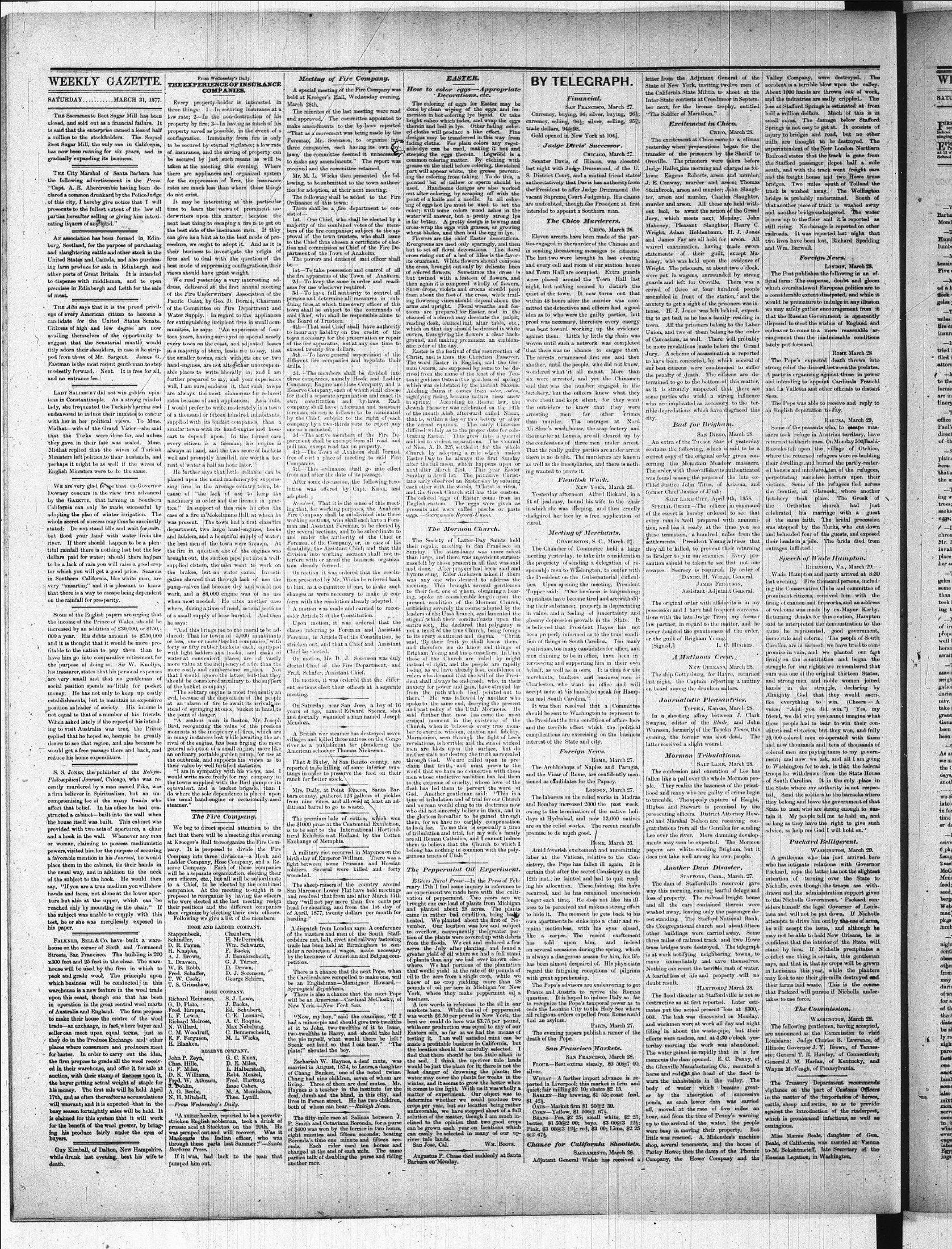
Searchable text
WEEKLY GAZETTE.
SATURDAY...MARCH 31, 1877.
The Sacramento Beet Sugar Mill has been closed, and sold out as a financial failure. It is said that the enterprise caused a loss of half a million to the stockholders. The Soquel Beet Sugar Mill, the only one in California, has now been running for six years, and is gradually expanding its business.
The City Marshal of Santa Barbara has the following advertisement in the Press: "Capt. A. R. Abercrombie having been declared a common drunkard by the Police Judge of this city, I hereby give notice that I will prosecute to the fullest extent of the law all parties hereafter selling or giving him intoxicating liquors of any kind."
As association has been formed in Edinburgh, Scotland, for the purpose of purchasing and slaughtering cattle and other stock in the United States and Canada, and also purchasing farm produce for sale in Edinburgh and other ports of Great Britain. It is intended to dispense with middlemen, and to open premises in Edinburgh and Leith for the sale of meat.
The Alta says that it is the proud privilege of every American citizen to become a candidate for the United States Senate. Citizens of high and low degree are now availing themselves of the opportunity to suggest that the Senatorial mantle would fitly adorn their shoulders, in case it be stripped from those of Mr. Sargent. James G. Eastman is the most recent gentleman to step modestly forward. Next. It is free for all, and no entrance fee.
LADY SALISBURY did not win golden opinions in Constantinople. As a strong minded lady, she frequented the Turkish harems and endeavored to induce their inmates to concur with her in her political views. To Mme. Midhat—wife of the Grand Vizier—she said that the Turks were done for, and unless they gave in their fate was sealed. Mme. Midhat replied that the wives of Turkish Ministers left politics to their husbands, and perhaps it might be as well if the wives of
From Wednesday's Daily.
THE EXPERIENCE OF INSURANCE COMPANIES.
Every property-holder is interested in three things: 1—In securing insurance at a low rate; 2—In the non-destruction of his property by fire; 3—In having as much of his property saved as possible, in the event of a conflagration. Immunity from fire is only to be secured by eternal vigilance; a low rate of insurance, and the saving of property can be secured by just such means as will be taken at the meeting this evening. Where there are appliances and organized system for the suppression of fires, the insurance rates are much less than where those things do not exist.
It may be interesting at this particular time to learn the views of prominent underwriters upon this matter, because the next best thing to escaping a fire is to get on the beat side of the insurance men. If they can give us a hint as to the best mode of procedure, we ought to adopt it. And as it is their business to investigate the origin of fires and to deal with the question of the best mode of suppressing conflagrations, their views should have great weight.
We read yesterday a very interesting address, delivered at the first annual meeting of the Fire Underwriters' Association of the Pacific Coast, by Geo. D. Dornin, Chairman of the Committee on Fire Department and Water Supply. In regard to the appliances for extinguishing incipient fires in small communities, he says: "An experience of fourteen years, having surveyed as special nearly every town on the coast, and adjusted losses in a majority of them, leads me to say, that the smaller towns, each with its one or two hand-engines, are not altogether unexceptionable places to write liberally in; and I am further prepared to say, and your experience will, I am sure, endorse it, that such towns are always the most clamorous for reduced rates because of such appliances. As a rule, I would prefer to write moderately in a town of a thousand or fifteen hundred inhabitants, supplied with its bucket companies, than a similar town with its hand-engine and hose-cart to depend upon. In the former case every citizen is a fireman; his engine is always at hand, and the two score of buckets well and promptly handled, are worth a torrent of water a half hour later."
LADY SALISBURY did not win golden opinions in Constantinople. As a strong minded lady, she frequented the Turkish harems and endeavored to induce their inmates to concur with her in her political views. To Mme. Midhat—wife of the Grand Vizier—the said that the Turks were done for, and unless they gave in their fate was sealed. Mme. Midhat replied that the wives of Turkish Ministers left politics to their husbands, and perhaps it might be as well if the wives of English Ministers were to do the same.
We are very glad to see that ex-Governor Downey concurs in the view first advanced by the Gazette, that farming in Southern California can only be made successful by adopting the plan of winter irrigation. The whole secret of success may thus be succinctly stated: Do not stand idle and wait for rain, but flood your land with water from the river. If there should happen to be a plentiful rainfall there is nothing lost but the few dollars paid for water; should there happen to be a lack of rain you will raise a good crop for which you will get a good price. Seasons in Southern California, like white men, are very "onsartin"; and it is pleasant to know that there is a way to escape being dependent on the rainfall for prosperity.
Some of the English papers are urging that the income of the Prince of Wales should be increased by an addition of £30,000, or $150,000 a year. His debts amount to $750,000 and it is thought that it would be more profitable to the nation to pay them than to have him go into comparative retirement for the purpose of doing so. Sir W. Knolls, his treasurer, states that his personal expenses are very small and that no gentleman of social position spends so little for pocket money. He has not only to keep up costly establishments, but to maintain an expensive position as leader of society. His income is not equal to that of a number of his friends. When asked lately if the report of his intending to visit Australia was true, the Prince replied that he hoped so, because he greatly desire to see that region, and also because he would get a free passage there and back, and reduce his home expenditure.
S. S. JONES, the publisher of the Religio-Philosophical Journal, Chicago, who was recently murdered by a man named Pike, was a firm believer in Spiritualism, but an uncompromising foe of the many franks who affect that belief. In his office he had constructed a cabinet—built into the wall when the house itself was built. This cabinet was provided with two sets of apertures, a chair and a hook in the wall. Whenever any man or woman, claiming to possess mediumistic powers, visited him for the purpose of securing a favorable mention in his Journal, he would place them in the cabinet, tie their hands in the usual way, and in addition tie the neck of the subject to the hook. He would then able places to write liberally in; and I am further prepared to say, and your experience will, I am sure, endorse it, that such towns are always the most clamorous for reduced rates because of such appliances. As a rule, I would prefer to write moderately in a town of a thousand or fifteen hundred inhabitants, supplied with its bucket companies, than a similar town with its hand-engine and hose-cart to depend upon. In the former case every citizen is a fireman; his engine is always at hand, and the two score of buckets well and promptly handled, are worth a torrent of water a half an hour later.
He further says that little reliance can be placed upon the usual machinery for suppressing fires in the average country town, because of “the lack of use to keep the machinery in order and the firemen in practice.” In support of this view he cites the case of a fire in Mokelumne Hill, at which he was present. The town had a first class fire department, two large hand-engines, hooks and ladders, and a bountiful supply of water; the best men of the town were firemen. At the fire in question one of the engines was brought out, the suction pipe put into a well-supplied eistern, the men went to work on the brakes, but no water came. Investigation showed that through lack of use the pump-valves had become dry and would not work, and a $6,000 engine was of no use when most needed. He cites another case where, during a time of need, several sections of a small supply of hose bursted. And then he says:
“And this brings me to the moral to be adduced: That for towns of 5,000 inhabitants or less, one or more bucket companies’ with forty or fifty rubber buckets each, equipped with light ladders and hooks, and casks of water at convenient places, are of vastly more value at the incipience of a fine than the more costly and cumbersome engines. Not that I would ignore the latter, but that they should be considered auxiliary to the support of the bucket company.
“The solitary engine is most frequently an evil, because of the disposition of the people at an alarm of fire to await its arrival instead of springing at once, bucket in hand, to the point of danger.
“A zealous man in Boston, Mr. Joseph Bird, recognizing the value of the precious moments at the incapacity of fires, which are in many instances lost while awaiting the arrival of the engine, has been urging the more general adoption of a small engine, more like an ordinary portable garden pump, for use at the outbreak, and supports his views as to their value by well fortified statistics.
“I am in sympathy with his views, and I would write more freely for my company in the towns supplied with the Bird pump or its equivalent, and a bucket brigade, than I do where the sole dependence is placed upon the usual hand-engine or occasionally used steamer.”
The Fire Company.
We beg to direct special attention to the fact that there will be a meeting this evening at Kroeger’s Hall to reorganize the Fire Company. It is proposed to divide the Fire Company into three divisions—a Hook and Ladder Company, Hose Company, and a Reserve Company. Each of these companies will be a separate organization, electing their own officers, etc., but all will be subordinate.
2d.-The members shall three companies, namely B Company, Engine and Hose Reserve Company, each of whom for itself a separate organization own constitution and company shall have a foreman chosen as follows: by the Chief, subject to company by a two-thirds vote one so nominated.
3d.-The active members partition shall be exempt from poll tax, except road tax or 4th—The Town of Anahi free of cost a place of mere Companies.
5th—This ordinance shall from after the date of its adoption.
Resolved,
That it is the seating that for working purposes Fire Company shall be subordinated working sections, who shall man and Assistant Foreman the several sections, and to under the authority Foreman of the Company, disability, the Assistant Chief division into working sections terfere with or annual the intention already formed.
On motion it was ordered presented by Mr. Wichlom to him, as a committee of changes as were necessary form with the resolution already formed.
A motion was made and sided Article 3 of the Constitution.
Upon motion it was clause referring to Foreman Foreman, in Article 3 of the stricken out, and that a Chief Chief be elected.
On motion, Mr. D. J. Slected Chief of the Fire Fred Schafer, Assistant Chief On motion it was ordered sections elect their office meeting.
On Saturday, near San Francisco years of age, named Edward A British war steamer had villages and killed three navy rivers as a publication for American schooner Thomas Flint & Bixby, of San Diego reported to be killing off sinks in order to preserve t ranch for better stock.
Mrs. Daily, at Point Rivers bara county, gathered 126 from nine vines; and allowed ditional barrel to go to waist.
The premium bale of coe $1000 prize at the Centre is to be sent to the International Exhibition at Holland Exchange of Memphis.
A military riot occurred birth-day of Emperor William fight between some Prussia soldiers. Several were killed wounded.
FALKNER, BELL & CO. have built a warehouse on the corner of Sixth and Townsend Streets, San Francisco. The building is 200 x 300 feet and 25 feet in clear. The warehouse will be used by the firm in which to pack and grade wool. The principle upon which business will be conducted in this warehouse is a new feature in the wool trade upon this coast, though one that has been in operation in the great central wool marts of Australia and England. The firm propose to make their house the centre of the wool trade—an exchange, in fact, where buyer and seller can meet upon equal terms, just as they do in the Produce Exchange and other places where consumers and producers meet for barter. In order to carry out the idea, the firm propose to grade all the wool received in their warehouse, and offer it for sale at auction, with their stamp of fineness upon it, the buyer getting actual weight of staple for his money. The first sale will be held April 17th, and as often thereafter as accumulations will warrant; and it is expected that in the busy season fortnightly sales will be held. It is claimed for this system that it will work for the benefit of the wool grower, by bringing his produce fairly under the eyes of buyers.
Guy Kimball, of Dalton, New Hampshire, while drunk last evening, beat his wife te death.
The Fire Company.
We beg to direct special attention to the fact that there will be a meeting this evening at Kroeger's Hall to reorganize the Fire Company. It is proposed to divide the Fire Company into three divisions—a Hook and Ladder Company, Hose Company, and a Reserve Company. Each of these companies will be a separate organization, electing their own officers, etc., but all will be subordinate to a Chief, to be elected by the combined companies. At the meeting to-night it is proposed to reorganize by having the officers who were elected at the last meeting resign their positions and the different companies then organize by electing their own officers.
Following we give a list of the members:
HOOK AND LADDER COMPANY.
Stappenbeck, Chambers.
Schindler, H. McDermott,
D. R. Payne, Wm. Schwartz,
H. Knapke, F. Backs,
A. J. Brown, J. Bennerscheidt,
L. Dravsen, G. J. Turner,
W. B. Robb, D. Drown,
Fred. Schaffer, D. J. Sorenson,
T. W. Cook, George Schirm,
T. S. Grimshaw.
HOSE COMPANY.
Richard Heimann, S. J. Lowe,
G. D. Plato, J. Backs,
Fred. Rimpan, Ed. Schubert,
L. F. Lewis, C. E. Leonard,
Richard Melrose, A. C. Roques,
N. Willard, Max Nebelung,
C. M. Woodruff, C. Bennerscheidt,
K. F. Ferguson, M. L. Weicks,
H. Blanken.
RESERVE COMPANY.
John P. Zeyn, G. C. Knox,
Chas. Hille, D. E. Miles,
G. F. Miles, I. Halberstadt,
D.K.Williams, Robt.Menzel,
Fred.W.Athearn, Fred.Hartung,
J.Doblin, Isaac Cohen,
A.G.Beebe, M.A.Mendelson,
N.H.Mitchell, Theo.Lynill.
From Wednesday's Daily.
"A sheep herder, reported to be a poverty-strikeen English nobleman, took a drink of prussie acid at Stockton on the 20th. He was pumped out and will recover. Was it Mackenzie the Indian officer, who was through these parts last Summer?" — Santa Barbara Press.
If it was bad luck to the man that pumped him out.
Mrs. Daily, at Point Rural bara county, gathered 126 g from nine vines, and allowed ditional barrel to go to wattle.
The premium bale of coarse $1000 prize at the Centre is to be sent to the International Exhibition at Holland Exchange of Memphis.
A military riot occurred birth-day of Emperor William fight between some Prussian soldiers. Several were wounded.
The sheep-raisers of the San Marcosor Lower Flat hatch and resolved that from and they "will not pay more than head for shearing, and from of April, 1877, twenty dollars herding."
A dispatch from London of the masters and men of ordshire nut, bolt rivet and trade has been held at Birth-sider a reduction of wages by the keenness of American petitors.
There is a chance that the Cardinals are compelled be an Englishman—Monsieur Springfield Republican.
There is also a chance that will be an American—Carol New York.
"Now, my boy," said tha had a mince-pie and should of it to John, two-twelfths two-twelfths to Harry, and the pie myself, what would Speak out loud so that I plate!" shouted the boy.
Zachariah W. Haynes married in August, 1874, to of Chang Bunker, one of Chang had nine children living Three of them are Haynes is a teacher in the deaf, dumb and the blind lives in Person street. He both of whom can hear.
The fifty-mile race at Se P.Smith and Octaviana Bay of $400 was won by the four eight minutes and fifteen Boronda's time one minute onds. Each rider used changed at the end of each parties talk of doubling the another race.
Meeting of Fire Company.
A special meeting of the Fire Company was held at Kroeger’s Hall, Wednesday evening, March 28th.
The minutes of the last meeting were read and approved. The committee appointed to make amendments to the by-laws reported "That as a movement was being made by the Foreman, Mr. Sorenson, to organize interthree companies, each having its own by-laws, the committee deemed it unnecessary to make any amendments." The report was received and the committee retained.
Mr. M. L. Wicks then presented the following, to be submitted to the town authorities for adoption, at their next meeting:
The following shall be added to the Fire Ordinance of this town:
There shall be a fire department to consist of—
1st—One Chief, who shall be elected by a majority of the combined votes of the members of the fire companies; subject to the approval of the town trustees, who shall issue to the Chief thus chosen a certificate of election and commission as Chief of the Fire Department of the Town of Anaheim.
The powers and duties of said officer shall be—
1st—To take possession and control of all the fire apparatus of the Town of Anaheim.
2d—To keep the same in order and readiness for use whenever required.
3d—To have full authority to control all persons and determine all measures in subduing fires, at which time every officer of this town shall be subject to the commands of said Chief, who shall be responsible alone to the Board of Trustees.
4th—That said Chief shall have authority to incur any liability on the credit of the town necessary for the preservation or repair of the fire apparatus, not at any one time to exceed twenty-five dollars.
5th—To have general supervision of the different fire companies and regulate their drills.
2d—The members shall be divided into three companies, namely Hook and Ladder Company, Engine and Hose Company, and a Reserve Company, each of which shall choose for itself a separate organization and enact its own constitution and by-laws. Each company shall have a foreman and assistant foreman, chosen as follows: to be nominated by the Chief, subject to the right of each company by a two-thirds vote to reject any one so nominated.
3d—The active members of the Fire Department shall be exempt from all road and poll tax, except road tax on property.
4th—The Town of Anaheim shall furnish free of cost a place of meeting to said Fire Companies.
EASTER.
How to color eggs—Appropriate Decorations, etc.
The coloring of eggs for Easter may be done by clean wiping of the eggs and immersion in hot coloring lye liquid. Or take bright calico which fades, and wrap the eggs therein and boil in lye. Other fading colored cloths will produce a like effect. Fine designs may be transferred in this way from fading cloths. For plain colors any vegetable dye can be used, making it hot and steeping the eggs therein. Logwood is a common coloring matter. By etching with grease on the shell before coloring, the etched part will appear white, the grease preventing the coloring from taking. To do this, a pointed bit of tallow or sperm should be used. Handsome designs are also worked out after coloring, by scraping off with the point of a knife and a needle. In all coloring of eggs hot lye must be used to set the color; with some colors wood ashes in the water will answer, but a pretty strong lye is far better. A pretty design is to wrap and cross-wrap the eggs with grasses, or growing wheat blades, and then boil the egg in lye.
Flowers are the chief Easter decorations. Evergreens are used only sparingly, and then but to set off floral decorations. The floral cross rising out of a bed of lilies is the favorite ornament. White flowers should compose the cross, brought out only by delicate lines of colored flowers. Sometimes the cross is but twined with a festoon of flowers, and then again it is composed wholly of flowers. Snow-drops, violets and crocus should peep from about the foot of the cross, while trailing flowering vines should depend about the arms and upright. Floral wreaths and festoons are prepared for Easter, and in the chancel of a church may decorate the pulpit, reading desk, chancel rail, altar table, etc., which on that day should be dressed in white covers, thus giving the flowers a clear background, and making prominent an emblematic color of the day.
Easter is the festival of the resurrection of Christ, and is thus the Christian Passover. The word Easter in English, and the German Ostern, are supposed by some to be derived from the name of the feast of the Teutonic goddess Ostera (the goddess of spring) which was celebrated by the ancient Saxons. Adelying claims it comes from oster, osten, signifying rising, because nature rises anew in spring. According to Mosse law, the Jewish Passover was celebrated on the 14th of month Abib, afterward called Nisan, that is, within a day or two before or after the vernal equinox. The early Churches differed widely as to the proper date for celebrating Easter. This grew into a quarrel and led to violent separations. The Council of Nice, A.D. 325, settled it for the whole Church by adopting a rule which makes Easter Day to be always the first Sunday after the full moon, which happens upon or BY TELEGRAPH.
Financial.
San Francisco, March 27.
Currency, buying, 96; silver, buying, 961;
currency, selling, 961; silver, selling, 952;
trade dollars, 94@98.
Gold opened in New York at 1047.
Judge Davis’ Successor.
Chicago, March 27.
Senator Davis, of Illinois, was closed last night with Judge Drummond, of the U.S. District Court, and a mutual friend states authoritatively that Davis has authority from the President to offer Judge Drummond the vacant Supreme Court Judgeship. His claims are undoubted, though the President at first intended to appoint a Southern man.
The Chico Murderers.
Chico, March 26.
Eleven arrests have been made of parties engaged in the murder of the Chinese and in sending threatening messages to citizens. The last two were brought in last evening and every cell and room of our station house and Town Hall are occupied. Extra guards were placed around the Town Hall last night, but nothing seemed to disturb the quiet of the town. It now turns out that within 48 hours after the murder was committed the detectives and officers had a good idea as to who were the guilty parties, but proof was necessary, therefore every energy was bent toward working up the evidence against them. Little by little chain was woven until such a network was completed that there was no chance to escape them. The arrests commenced first one and then another, until the people who did not know wondered what it all meant. More than six were arrested, and yet the Chinamen said that was the number engaged in the butchery, but the officers knew what they were about and kept silent, for they want the outsiders to know that they were arresting men for other crimes than murder. The outrages at Nord Ah Shue’s wash-house, the soap factory and the murder at Lemms are all cleared up by the confessions of three men under arrest. That really guilty parties are under arrest there is no doubt. The murders are known as well as the incendiaries, and there is noth-
2d. The members shall be divided into three companies, namely Hook and Ladder Company, Engine and Hose Company, and A Reserve Company, each of which shall choose for itself a separate organization and enact its own constitution and by laws. Each company shall have a foreman and assistant foreman, chosen as follows: to be nominated by the Chief, subject to the right of each company by a two-thirds vote to reject any one so nominated.
3d. The active members of the Fire Department shall be exempt from all road and poll tax, except road tax on property.
4th. The Town of Anaheim shall furnish free of cost a place of meeting to said Fire Companies.
5th. This ordinance shall go into effect from and after the date of its passage.
After some discussion, the following resolution was offered by Capt. Knox, and adopted:
Resolved, that it is the sense of this meeting that, for working purposes, the Anaheim Fire Company shall be subdivided into three working sections, who shall each have a Foreman and Assistant Foreman, to be elected by the several sections, and to be subordinate to and under the authority of the Chief or Foreman of the Company, or, in case of his disability, the Assistant Chief; and that this division into working sections shall not interfere with or annul the business organization already formed.
On motion it was ordered that the resolution presented by Mr. Wicks be referred back to him, as a committee of one, to make such changes as were necessary to make it conform with the resolution already adopted.
A motion was made and carried to reconsider Article 3 of the Constitution.
Upon motion, it was ordered that the clause referring to Foreman and Assistant Foreman, in Article 3 of the Constitution, be stricken out, and that a Chief and Assistant Chief be elected.
On motion, Mr. D. J. Sorenson was duly elected Chief of the Fire Department, and Fred Schafer, Assistant Chief.
On motion, it was ordered that the different sections elect their officers at a separate meeting.
On Saturday, near San Jose, a boy of 16 years of age, named Edward Spence, shot and mortally wounded a man named Joseph Mendoza.
A British war steamer has destroyed seven villages and killed three natives on the Congo river as a punishment for plundering the American schooner Thomas Nickerson.
Flint & Bixby, of San Benito county, are reported to be killing off some inferior mustangs in order to preserve the feed on their ranch for better stock.
Mrs. Daily, at Point Rincon, Santa Barbara county, gathered 126 gallons of pickles from nine vines, and allowed at least an additional barrel to go to waste.
The premium bale of cotton, which won the $1000 prize at the Centennial Exhibition, is to be sent to the International Horticultural Exhibition at Holland by the Cotton Exchange of Memphis.
A military riot occurred in Mayence on the birth-day of Emperor William. There was a fight between some Prussian and Hessian soldiers. Several were killed and forty wounded.
The Society of Latter-Day Saints held their regular meeting in San Francisco on Sunday. The attendance was more select than large, and there was an evident earnestness felt by those present in all that was said and done. After prayers had been said and hymns sung, Elder Anderson asked if there was any one who desired to address the meeting. This brought several gentlemen to their feet, one of whom, obtaining a hearing, spoke at considerable length upon the present condition of the Mormon Church, criticising severely the course adopted by the leaders of the Utah branch, and lamented the stigma which their conduct casts upon the entire sect. He declared that polygamy is not a tenet of the true Church, being foreign to its every sentiment and dogma. "Christ said, By their fruit ye shall know them, and therefore we do know sad things of Brigham Young and his counsellors. In Utah those of the Church are ruled by might instead of right, and the people are rapidly losing, as we have already lost, confidence in rulers who demand that will of the President shall always be endorsed; who, in their anxiety for power and gain, have strayed far from the path which God pointed out to them." He was followed by another who spoke to the same end, declaring the present and past policy of the Utah Mormons. He said further that now has come the most critical moment in the existence of the Church, when it behooves every true member to exercise wisdom, caution and fidelity. Mormonism, seen through the light of Lee's revelations, is horrible; and the sins of wicked men are blots upon the surface, but do neither stain nor destroy the truth as revealed through God. We are called upon to proclaim that truth, and must prove to the world that we have no connection with those men whose vindictive ambition has led them to the extreme cruelty, whose love of the flesh has led them to pervert the word of God. Another gentleman said: "This is a time of tribulation and of trial for our Church and no man would cling to its doctrines now who did not sincerely believe in them, and in the glorious hereafter to be gained through them, for we have no earthly compensation to look for. To me this is especially a time of tribulation and trial, for my wife's family are all Roman Catholics, and I cannot induce them to believe that the Church to which I belong has nothing in common with the polygamous tenets of Utah."
The Peppermint Oil Experiment.
Editors Rural Press:—In the Press of Feb-
Wondered what it all meant. More than six were arrested, and yet the Chinamen said that was the number engaged in the butchery, but the officers knew what they were about and kept silent, for they want the outsiders to know that they were arresting men for other crimes than murder. The outrages at Nord Ali Shue's wash house, the soap factory and the murder at Lemms, are all cleared up by the confessions of three men under arrest. That the really guilty parties are under arrest there is no doubt. The murderers are known as well as the incogniaries, and there is nothing wanted to prove it.
Fiendish Work.
New York, March 26.
Yesterday afternoon Alfred Rickard, in a fit of jealousy, bound his wife to the chair in which she was sleeping, and then cruelly disfigured her face by a free application of vitrol.
Meeting of Merchants.
Charleston, S.C., March 27.
The Chamber of Commerce held a large meeting yesterday, to take into consideration the propriety of sending a delegation of responsible men to Washington, to confer with the President on the Gubernatorial difficulties. Upon opening the meeting, President Tupper said: "Our business is languishing; capitalists have become tired and are withholding their substance; property is depreciating in value, and a feeling of uncertainty and gloomy depression prevails in the State. It is believed that President Hayes has not been properly informed as to the true condition of things in South Carolina. Too many politicians, too many candidates for office, and men claiming to be in office, have been interviewing and supporting him in their own behalf, as well as in ours. It is time for the merchants, bankers and business men of Charleston, who want no office and will accept none at his hands, to speak for Hampton and South Carolina."
It was then resolved that a Committee should be sent to Washington to represent to the President the true condition of affairs here and the terrible effect which the political complications are exercising on the business interest of the State and city.
Foreign News.
Rome, March 27.
The Archbishopsof Naples and Parugia, and the Vicar of Rome, are confidently mentioned as candidates for the Papacy.
London, March 27.
The laborers on the relief works in Madras and Bombay increased 2000the past week, owing to the termination of the native holidays at Hydrabad,and now 53,000 natives are on the relief works.The recent rainfalls promise to do much good.
Rome, March 26.
Amid feverish excitement and unremitting labor at the Vatican relative to the Consistory,the Pope has fallen ill again. It is certain that after the secret Consistory on the 12th inst.,he fainted and had to quit read-
Mrs. Daily, at Point Runcan, Santa Barbara county, gathered 126 gallons of pickles from nine vines, and allowed at least an additional barrel to go to waste.
The premium bale of cotton, which won the $1000 prize at the Centennial Exhibition, is to be sent to the International Horticultural Exhibition at Holland by the Cotton Exchange of Memphis.
A military riot occurred in Mayence on the birth-day of Emperor William. There was a fight between some Prussian and Hessian soldiers. Several were killed and forty wounded.
The sheep-raisers of the country around San Marcosor Lower Flat have held meetings and resolved that from and after March 15th they "will not pay more than five cents per head for shearing, and from the 1st day of April, 1877, twenty dollars per month for herding."
A dispatch from London says: A conference of the masters and men of the South Staffordshire nut, bolt, rivet and railway fastening trade has been held at Birmingham to consider a reduction of wages, made necessary by the keenness of American and Belgian competitors.
There is a chance that the next Pope, when the Cardinals are compelled to make one, will be an Englishman—Monsignor Howard—Springfield Republican.
There is also a chance that the next Pope will be an American—Cardinal McClosky, of New York.—New York Sun.
"Now, my boy," said the examiner, "If I had a mince-pie and should give two-twelfths of it to John, two-twelfths of it to Isaac, two-twelfths to Harry, and should take half the pie myself, what would there be left? Speak out loud so that I can hear." "The plate!" shouted the boy.
Zachariah W. Haynes, a deaf mute, was married in August, 1874, to Laura, a daughter of Chang Bunker, one of the noted twins. Chang had nine children, seven of whom are living. Three of them are deaf mutes. Mr. Haynes is a teacher in the institute for the deaf, dumb and the blind, in this city, and lives in Person street. He has two children, both of whom can hear.—Raleigh News.
The fifty-mile race at Salinas between J. P. Smith and Octaviana Boronda, for a purse of $400 was won by the former in two hours, eight minutes and fifteen seconds; beating Boronda's time one minute and fifteen seconds. Each rider used ten horses and changed at the end of each mile. The same parties talk of doubling the purse and riding another race.
Editors Rural Press: In the Press of February 17th I find some inquiry in reference to an experiment we made here with the cultivation of peppermint. Two years ago we brought one car-load of plants from Michigan and planted about 28 acres. The plants came in rather bad condition, being badly heated. We planted about the first of November. Our location was low and subject to overflow, consequently the greater portion of the plants were covered up with debris from the floods. We cut and reduced a few acres the July after planting, and found a greater yield of oil where we had a full stand of plants than any we had ever known elsewhere. We had portions of the plantation that would yield at the rate of 40 pounds of oil to the acre from a single crop, while we know of no crop yielding more than 28 pounds of oil per acre in Michigan or New York, where they make peppermint oil a business.
A few words in reference to the oil in our markets here. While the oil of peppermint was worth $6.50 per pound in New York, the best we could do here was $3.75 per pound, while our production was equal to any of our Eastern oils, so far as we had the means of testing it. I am well satisfied mint can be made a profitable business in California, but the location should be carefully selected. I find that there should be but little alkali in the soil. I think the up-river tule lands would be just the place for it; there is not the least danger of drowning the plants; the water may cover the plants for weeks in the winter, and it seems to grow the better when it comes to the light. With us it was wholly a matter of experiment. Our object was to determine whether we could produce two crops per year, but our location being rather unfavorable, we have stopped short of a full solution of the matter, though I am much inclined to the opinion that two good crops can be grown each year on locations which can easily be selected in many of our up-river tule lands.
San Jose, Cal.
Augustus P. Chase died suddenly at Santa Barbara on Monday.
London, March 27.
The laborers on the relief works in Madras and Bombay increased 2000 the past week, owing to the termination of the native holidays at Hydrabad, and now 53,000 natives are on the relief works. The recent rainfalls promise to do much good.
Bome, March 26.
Amid feverish excitement and unremitting labor at the Vatican, relative to the Consistory, the Pope has fallen ill again. It is certain that after the secret Consistory on the 12th inst., he fainted and had to quit reading his allocation. These fainting fits have recurred, and he has remained unconscious longer each time. He does not like his illness to be perceived and makes a strong effort to hide it. The moment he gets back to his own apartments he sinks into a chair and remains motionless, with his eyes closed, like a corpse. The recent excitement has told upon him, and indeed on several occasions during the spring, which is always a dangerous season for him, his life has been almost despaired of. His physicians regard the fatiguing receptions of pilgrims with great apprehension.
The Pope's advisors are endeavoring to get France and Austria to revive the Roman question. It is hoped to induce Italy so far to recognize the Pope's temporal power as to cede the Leonine City to the Holy See where all religious orders expelled from Rome could find an asylum.
Paris, March 27.
The evening papers publish a rumor of the death of the Pope.
San Francisco Markets.
SAN FRANCISCO, March 28.
FLOUR—Best extras steady, $6 50@7 00; silver.
WHEAT—A further import advance is reported in Liverpool; this market is firm and quiet; fair milling $2 10; choice $2 15.
BARLEY—Bay brewing, $1 55; coast feed, $1 42%.
OATS—Market firm $1 90@2 30.
CORN—Yellow, $1 50@1 67%.
BEANS—Pea, $2 25; small white, $2 25; butter, $1 50@2 00; bayo, $3 00@3 12%; pink, $3 00@3 12%; red, $3 00; Lima, $2 25 @2 47%.
Chance for California Shootists.
SACRAMENTO, March 28.
Adjutant General Walsh has received a
letter from the Adjutant General of the State of New York, inviting twelve men of the California State Militia to shoot at the Inter-State contests at Creedmoor in September next, for the bronze trophy, entitled "The Soldier of Marathon."
Excitement in Chico.
Chico, March 28.
The excitement at Chico came to a climax yesterday when preparations began for the transfer of the prisoners by the Sheriff to Oroville. The prisoners were taken before Judge Hallett this morning and charged as follows: Engene Roberts, arson and murder; J. E. Conway, murder and arson; Thomas Steinbrook, arson and murder; Charles Slaughter, murder and arson. All these are held without bail, to await the action of the Grand Jury, which meets next Monday. John Mahoney, Pleasant Slaughter, Henry C. Wright, Adam Holdenbaum, H. J. Jones and James Fay are all held for arson. All waived examination, having made sworn statements of their guilt, except Mahoney, who was held upon the evidence of Wright. The prisoners, at about two o'clock, were put in wagons, surrounded by strong guards and left for Oroville. There was a crowd of three or four hundred people assembled in front of the station, and the anxiety to get a sight of the prisoners was intense. H. J. Jones was left behind, expecting to get bail, as he has a family residing in town. All the prisoners belong to the Labor Union, and two of them belong to the order of Cancasians, as well. There will probably be more revelations made before the Grand Jury. A scheme of assassination is reported to have been concocted, by which several of our best citizens were condemned to suffer the penalty of death. The citizens are determined to go to the bottom of this matter, as it is strongly suspected that there are some parties who wield a strong influence who are implicated as accessory to the terrible depredations which have disgraced this city.
Bad for Brigham.
San Diego, March 28.
An extra of the Tucson Star of yesterday contains the following, which is said to be a correct copy of the original order given concerning the Mountain Meadow massacre.
Valley Company, were destroyed. The accident is a terrible blow upon the valley. About 1000 hands are thrown out of work, and the industries are sally crippled. The loss at Stafford Springs is estimated at from half a million dollars. Much of this is in small sums. The damage below Stafford Springs is not easy to get at. It consists of injury to bridges and road, but no other mills are thought to be destroyed. The superintendent of the New London Northern Railroad states that the track is gone from the Stafford passenger depot half a mile south, and with the track went freight cars and the freight house and two Hewe truss bridges. Two miles south of Tolland the track is washed away. The Wellington bridge is probably undermined. South of that another piece of track is washed away and another bridge endangered. The water is now up to the floor and it is reported as still rising. No damage is reported on other railroads. It was reported last night that two lives have been lost, Richard Spedding and Win Burwell.
Foreign News.
London, March 28.
The Post publishes the following in an official form: The suspense, doubt and gloom which overshallowed European politics are to a considerable extent dissipated, and while it would be premature to indulge in any illusion we may safely gather encouragement from it that the Russian Government is apparently disposed to meet the wishes of England and endeavor to come to a mere reasonable arrangement than the inadmissable conditions lately put forward.
Rome March 28
The Pope's expected death throws into strong relief the discord between the prelates. A party is organizing against those in power and intending to appoint Cardinals Franchi and La Valletta and other officials to distant Seees.
The Pope was able to receive and reply to an English deputation today.
Ragusa, March 29.
Some of the peasants who, to escape massacre took refuge in Austrian territory, have returned to their homes. On Monday 500,Bashi-Bazouks fell upon the village of Otchino, where the returned refugees were re-building their dwellings,and burned the partly-restored
Bad for Brigham.
SAN DIEGO, March 28.
An extra of the Tuition Star of yesterday contains the following, which is said to be a correct copy of the original order given concerning the Mountain Meadow massacre. The order, with three affidavits authenticated was found among the papers of the late Chief Justice John Titus, of Arizona, and former Chief Justice of Utah:
SALT LAKE CITY, April 9th, 1858.
SPECIAL ORDER—The officer in command of the escort is hereby ordered to see that every man is well prepared with ammunition, and has it ready at the time you see these teamsters, a hundred miles from the settlements. President Young advises that they all be killed, to prevent their returning to Bridger to join our enemies. Every precaution should be taken to see that not one escapes. Secrecy is required. By order of DANIEL H. WELLS, General.
JAMES PEROUSON,
Assistant Adjutant General.
The original order with affidavits is in my possession and I have had frequent conversations with the late Judge Titus; my former law partner, in regard to the matter, and he never doubted the genuineness of the order, or the guilt of Brigham Young.
[Signed.]
L. C. HUGHES.
A Mutinous Crew.
NEW ORLEANS, March 28.
The ship Gettysburg, for Havre, returned last night, the Captain reporting a mutiny on board among the drunken sailors.
Journalistic Pleasantries.
TOPEKA, Kansas, March 28.
In a shooting affray between J. Clark Swayne, editor of the Blade, and John Wureson, formerly of the Topeka Times, this evening, the former was shot dead. The latter received a slight wound.
Mormon Tribulations.
SALT LAKE, March 28.
The confession and execution of Lee has fallen like a pall over the whole Mormon people. They realize the baseness of the priesthood and many who are guilty of crime begin to tremble. The speedy capture of Haight, Higbee and Stewart is promised by the prosecuting officers. District Attorney Howard and Marshal Nelson are receiving congratulations from all the Gentiles for sending Lee over the river. More damning developments may soon be expected. The Mormon papers are white-washing Brigham, but it does not take well among his own people.
Another Dam Disaster.
STAFFORD, Conn., March 27.
The death of Staffordville was a strong reminder of the penalty of death. The citizens are determined to go to the bottom of this matter, as it is strongly suspected that there are some parties who wield a strong influence who are implicated as accessory to the terrible depredations which have disgraced this city.
RAGUSA, March 29.
Some of the peasants who, to escape massacre took refuge in Austrian territory, have returned to their homes. On Monday 500 Basil-Bazouks fell upon the village of Otchioo, where the returned refugees were re-building their dwellings and burned the partly-restored houses and murdered ten of the refugees, perpetrating nameless horrors upon their victims. Some of the refugees fled across the frontier, at Glamesk, where another batchery took place. The Greek of the Orthodox church had just celebrated his marriage with a guest of the same faith. The bridal procession was stopped by the Turks, who cut down and beheaded four of the guests, and exposed their heads in a pile. The bride died from outrages, inflicted.
Speech of Wade Hampton.
RICHMOND, Va., March 29.
Wade Hampton and party arrived at 8:30 last evening. Five thousand persons, including the Conservative Clubs and committee of prominent citizens, received him with the hiring of cannon and fireworks, and an address of welcome was made by ex-Mayor Kerby. Returning thanks for this ovation, Hampton said he interpreted the demonstration to cause he represented, good government, home rule and reform. The people of South Carolina are in earnest; we have tried to compromise in vain, and we planted our fact firmly on the constitution and began the struggle for our rights; we remembered that ours was one of the original thirteen States, and strong men and noble women joined hands in the struggle, declaring by Almighty God that they would sacrifice everything to win. (Cheers — A voice: "And you did win.") Yes, my friend, we did win; you cannot imagine what these people had to bear to win their constitutional victories, but they won, and fully 20,000 colored men co-operated with them and now thousands and tens of thousands of colored men are paying taxes to my government; and now we ask, and all I am going to Washington for to ask, is that the federal troops be withdrawn from the State House of South Carolina. It is the only place in the State where my authority is not respected. Send the soldiers to the barracks where they belong and leave the government of that State to men who are strong enough to sustain it. My people tell me to hold on, and so long as they have the right to give such advice, so help me God I will hold on."
Packard Belligerent.
WASHINGTON, March 29.
A gentleman who has just arrived here who has intimate relations with Governor Packard says the latter has not the slightest intention of turning over the State to
Another Dam Disaster.
STAFFORD, Conn., March 27.
The dam of Staffordville reservoir gave way this morning, causing fearful deluge and loss of property. The railroad freight house and all the cars contained therein were washed away, leaving only the passenger depot standing. The Stafford National Bank, the Congregational church and about fifteen other buildings were carried away. Some three miles of railroad track and two Howe truss bridges were destroyed. The telegraph is at work notifying neighboring towns, to move immediately and save themselves. Nothing can resist the terrible rush of water. A fearful loss of life and property will no doubt result.
HARTFORD March 28.
The flood disaster at Staffordville is not so destructive as at first reported. Later estimates put the actual present loss at $300,-000. The leak was discovered on Monday, and workmen were at work all day and night filling in about the waste-pipe, but their efforts were useless, and at 5:30 o'clock yesterday morning the work was abandoned. The water gained to rapidly that in a few moments the dam opened. E. C. Penny, of the Glenville Manufacturing Co., mounted a horse and rode at the head of the flood to warn the inhabitants in the valley. The body of water which became greater by the absorption of successive ponds, as each lower dam was carried off, moved at the rate of five miles an hour, and from the time of Penny's warning up to the arrival of the water, the people were busy in moving their property. But little was rescued. A Midlandes's machine shop, several tenements, and the house of Parley Howe; then the dams of the Phoenix Company, the Howe Company and the State where my authority is not respected. Send the soldiers to the barracks where they belong and leave the government of that State to men who are strong enough to sustain it. My people tell me to hold on, and so long as they have the right to give such advice, so help me God I will hold on."
Packard Belligerent.
WASHINGTON, March 29.
A gentleman who has just arrived here who has intimate relations with Governor Packard, says the latter has not the slightest intention of turning over the State to Nicholls, even though the troops are withdrawn and the administration support given to the Nicholls Government." Packard considers himself the legal Governor of Louisiana and will not be put down. If Nicholls attempts to drive him out by the use of arms, he will accept the issue, and although he may not be able to hold New Orleans, he is confident that the interior of the State will stand by him. If Nicholls precipitates a conflict one thing is certain, this gentleman says, and that is, that no crops will be grown in Louisiana this year, while the planters may look to see their gin-mills destroyed and their farms laid waste. This is the course that Packard will pursue if Nicholls undertakes to use force.
The Commission.
WASHINGTON, March 28.
The following gentlemen, having accepted, are announced as the Commission to visit Louisiana: Judge Charles B. Lawrence, of Illinois; Governor J. Y. Brown, of Tennessee; General T. R. Hawley, of Connecticut; General J. M. Harlan, of Kentucky, and Wayne McVeagh, of Pennsylvania.
The Treasury Department recommends vigilance on the part of Customs Officers in the matter of the importation of horses, cattle, sheep and swine, so as to provide against the introduction of the rinderpest, which is pronounced infectious, as well as contagious.
Miss Mamie Beale, daughter of Gen. Beale, of California, was married at Vienna to M. Bokehtmeteff, late Secretary of the Russian Legation, in Washington.