anaheim-gazette 1877-03-31
Scanned page
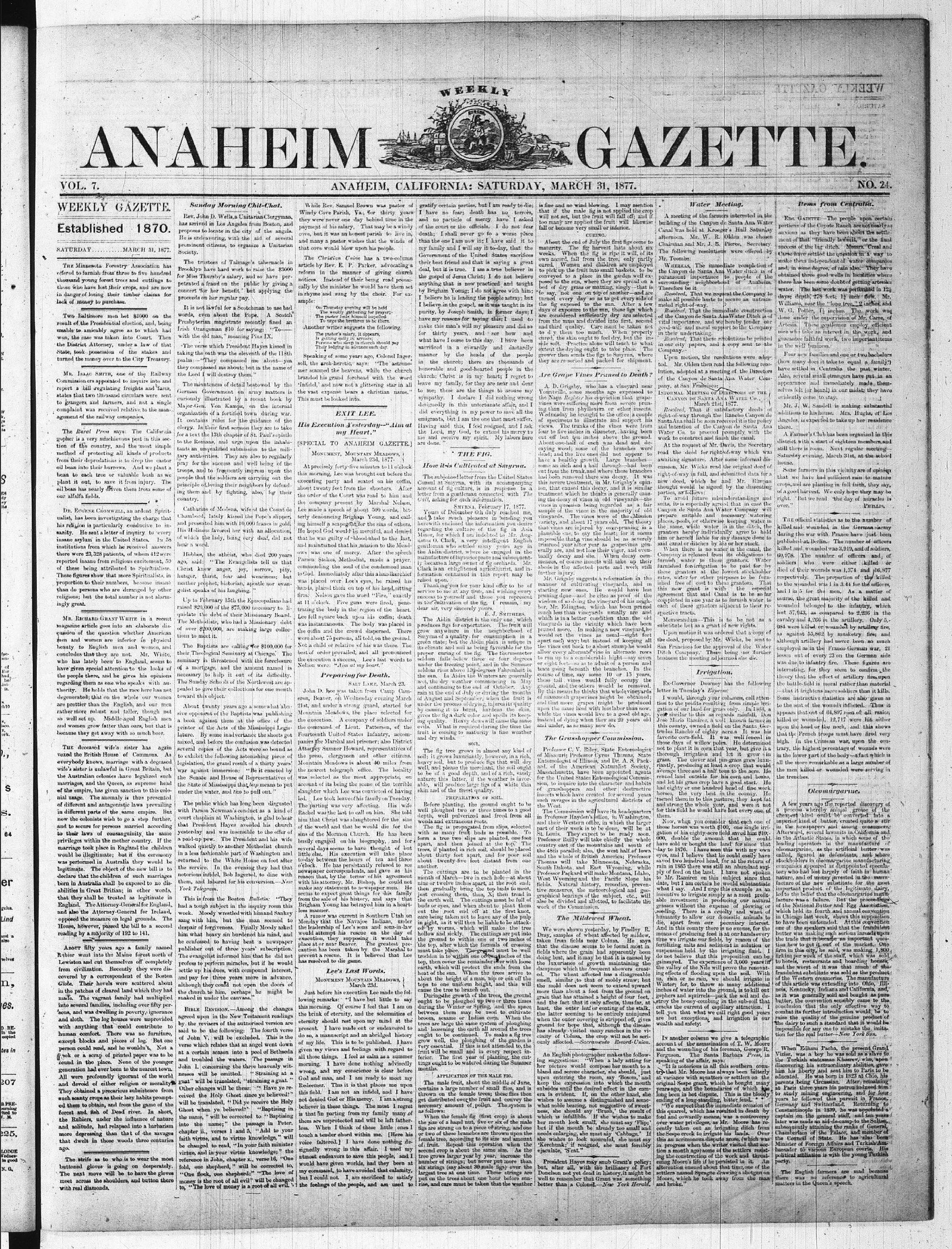
Searchable text
WEEKLY GAZETTE.
Established 1870.
SATURDAY...MARCH 31, 1877.
The Minnesota Forestry Association has offered to furnish from three to five hundred thousand young forest trees and cuttings to those who have lost their crops, and are now in danger of losing their timber claims for lack of money to purchase.
Two Baltimore men bet $1000 on the result of the Presidential election, and being unable to amicably agree as to which had won, the case was taken into Court. Then the District Attorney, under a law of that State, took possession of the stakes and turned the money over to the City Treasury.
Mr. Isaac Smith, one of the Railway Commissioners appointed to inquire into and report a bill regulating freights and fares, states that two thousand circulars were sent to grangers and farmers, and not a single complaint was received relative to the management of the railway companies.
The Rural Press says: The California gopher is a very mischievous pest in this section of the country, and the most simple method of protecting all kinds of products from their depredations is to drop the castor oil.
Mr. Isaac Smith, one of the Railway Commissioners appointed to inquire into and report a bill regulating freights and fares, states that two thousand circulars were sent to grangers and farmers, and not a single complaint was received relative to the management of the railway companies.
The Rural Press says: The California gopher is a very mischievous pest in this section of the country, and the most simple method of protecting all kinds of products from their depredations is to drop the castor oil bean into their burrows. And we plant a bean to each tree or valuable bush as we plant it out, to save it from injury. The oil bean has nearly driven them from some of our alfalfa fields.
Dr. Eugene Chomwell, an ardent Spiritualist, has been investigating the charge that his religion is particularly conducive to insanity. He sent a letter of inquiry to every insane asylum in the United States. In 58 institutions from which he received answers there were 23,328 patients, of whom 412 were reported insane from religious excitement, 59 of these being attributed to Spiritualism. These figures show that more Spiritualists, in proportion to their numbers, become insane than do persons who are deranged by other religions; but the total number is not alarmingly great.
Mr. Richard Grant White in a recent magazine article goes into an elaborate discussion of the question whether American men and women are inferior in physical beauty to English men and women, and concludes that they are not. Mr. White, who has lately been to England, seems to have given special attention to the looks of the people there, and he gives his opinions regarding them as one who speaks with authority. He holds that the race here has not degenerated; that on the whole our women are prettier than the English, and our men rather more robust and taller, though not so well set up. Middle-aged English men and women grow fatter than ours, but that is because they get away with so much beer.
The deceased wife's sister has again voxed the British House of Commons. As everybody knows, marriage with a deceased wife's sister is unlawful in Great Britain, but the Australian colonies have legalized such marriages, and the Queen, as supreme head of the empire, has given sanction to this colonial usage. The anomaly is thus presented of different and antagonistic laws prevailing in different parts of the same empire. But now the colonists wish to go a step further, and to secure for persons married according to their laws of consanguinity, the same privileges within the mother country. If the marriage took place in England the children would be illegitimate; but if the ceremony was performed in Australia they would be legitimate. The object of the new bill is to declare that the children of such marriages in Australia shall be exposed to no danger.
The minuteness of detail bestowed by the German Government on army matters is curiously illustrated by a recent book by Major-Gen. Von Kampz, on the internal organization of a fortified town during war. It contains rules for the guidance of the clergy. In their first sermon they are to take for a text the 13th chapter of St. Paul's epistle to the Romans, and urge upon the inhabitants an unqualified submission to the military authorities. They are also to regularly pray for the success and well-being of the troops, and to frequently impress upon the people that the soldiers are carrying out the principle of loving their neighbors by defending them and by fighting, also, for their country.
Catharine of Modena, wife of the Count de Chambord, lately kissed the Pope's slipper, and presented him with 10,000 francs in gold. His Holiness favored her with an allocation, of which the lady, being very deaf, did not hear a word.
Hobbes, the atheist, who died 200 years ago, said: "The Evangelists tell us that Christ knew anger, joy, sorrow, pity, hunger, thirst, fear and weariness; but neither prophet, historian, apostle nor evangelist speaks of his laughing."
Up to February 15th the Episcopalians had raised $20,000 of the $75,000 necessary to liquidate the debt of their Missionary Board. The Methodists, who had a Missionary debt of over $200,000, are making large collections to meet it.
The Baptists are calling for $100,000 for their Theological Seminary at Chicago.' The seminary is threatened with the foreclosure of a mortgage, and the amount named is necessary to help it out of its difficulty. The Sunday Schools of the Northwest are appealed to give their collections for one month toward this object.
About twenty years ago a somewhat abusive opponent of the Baptists was publishing a book against them at the office of the printer of the Acts of the Mississippi Legislature. By some inadvertence she sheets got mixed, and before the confusion was detected several copies of the Acts were so bound as to exhibit the following astonishing piece of legislation, the grand result of a thirty year's war against immersion: "Be it enacted by the Senate and House of Representatives of the State of Mississippi that help means to put under the water, and tizo to pull out."
The public which has long been disgusted with Parson Newman's conduct as a kind of court chaplain at Washington, is glad to hear that President Hayes avoided his church yesterday and was insensible to the offer of a paid-up pew. The President and his wife walked quietly to another Methodist church in a less fashionable part of Washington and returned to the White House on foot after the service. In the evening they had that notorious infidel, Bob Ingersol, to dine with them, and labored for his conversion — Nee
At precisely forty-five this morning Lee was executing party and about twenty feet from the order of the Court company present at Lee made a speech of utterly denouncing Brightening himself a scapegoat. He hoped God would be that he was guilty of theft and maintained that his owls was one of mercy. Parson Stokes, Method commending the soul to God. Immediately after he was placed over Lee hands, placed them on firam. Nelson gave them at 11 o'clock. Five guiding the body in this Lee fell square back up was instantaneous. The coffin and the crows were about 75 persons.
Not a child or relative best of order prevailed in execution a success. Nelson were: "Aim at"
Preparing
John D. Lee was takeneron Beaver, on Wednesday 21st, and under a strong Mountain Meadows,the execution.A commandof Lieutenant Fourteenth United States companiesthe MarshalandAttorney Sumner Howe,the press, clergymenMountain Meadowsisthe nearest telegraphwas selected asthe nextaccount ofitsbeingtheslaughterwhichLeewillled.LeekookleaveofThepartingwasveryRachelwasthelasttohimthatChristwasslovedoftheworldandthatsinsoftheMormonChurchbusilyengagedonhisseveraldaysseemstob littleelse.HisexecutiontodaybetweenthehouflockHehaspersisednewpapercorrespondedreasonthat,byletwithhisattorney.Mr
About fifty years ago a family named Rubier went into the Maine forest north of Lewiston and cut themselves off completely from civilization. Recently they were discovered by a correspondent of the Boston Globe. Their hovels were scattered about in the patches of cleared land which they had made. The vagrant family had multiplied into several families, including over fifty persons, and was dwelling in poverty, ignorance and sloth. The log houses were unprovided with anything that could contribute to human comfort. There was no furniture, except blocks and pieces of log. But one person could read, and he wouldn't. Not a book or a scrap of printed paper was to be found in the place. None of the younger generation had ever been to the nearest town. All were profoundly ignorant of the world and devoid of either religion or morality. They obtained a precarious subsistence from such scanty crops as their lazy habits prompted them to obtain, and from the game of the forest and fish of Dead river. In short, the Rubiers, under the influence of nature and solitude, had relapsed into a barbarism more depressing than that of the savages that dwelt in those woods three centuries ago.
The strife as to who is to wear the most buttoned gloves is going on desperately. The next move will be to have the gloves meet across the shoulders, and button there with real diamonds.
The public which has long been disgusted with Parson Newman's conduct as a kind of court chaplain at Washington, is glad to hear that President Hayes avoided his church yesterday and was insensible to the offer of a paid-up pew. The President and his wife walked quietly to another Methodist church in a less fashionable part of Washington and returned to the White House on foot after the service. In the evening they had that notorious infidel, Bob Ingersol, to dine with them, and labored for his conversion.—New York Telegram.
This is from the Boston Bulletin: "They had a tough subject in the inquiry room this week. Moody wrestled with him and Sankey sang with him, but the man seemed to despair of forgiveness. Fijally Moody asked him what heavy sin burdened his mind, and he confessed to having beat a newspaper publisher out of three years' subscription. The evangelist informed him that he did not profess to perform miracles, but if he would settle up his dues, with compound interest, and pay for three years more in advance, although they could not open the doors of the church to him, perhaps he might be snaked in under the canvass."
BIBLE REVISION.—Among the changes agreed upon in the New Testament readings by the revisers of the authorised version are said to be the following: The fourth verse of John V. will be excluded. This is the verse which relates that an angel went down at a certain season into a pool of Bethsaeda and troubled the waters. The passage in John I concerning the three heavenly witnesses will be omitted. "Straining at a gnat" will be translated, "straining a gnat." Other changes will be these: "Have ye received the Holy Ghost since ye believed?" will be translated, "Did ye receive the Holy Ghost when ye believed?" "Baptising in the name," will be corrected to "Baptising into the name;" the passage in Peter, chapter ii., verses 1 and 5, "Add to your faith virtue, and to virtue knowledge," will be changed to read, "In your faith minister virtue, and in your virtue knowledge;" the reference in John, chapter x., verse 16, "One fold, one shepherd," will be corrected to, "One flock, one shepherd;" "The love of money is the root of all evil" will be changed to, "The love of money is a root-of-all evil."
Lee's Law
MONUMENT MOUNT
MARK
Just before his executive lowing remarks: "I have this morning. Of course the brink of eternity, a eternity should rest until present. I have made do so, a manuscript and of my life. This is to give my views and feel all those things. I feel morning. I have done wrong, and my conscience God and man, and I Redeemer. This it is this field. I am not a not denied God or His believer in these things is that fin parting from them are unprotected less. When I think touch a tender chord voice faltered.] I have signed wrong in that most endeavors to save would have given work my command, to have but I could not. I am the feelings of the people...
WEEKLY
EIM GAZ
ANAHEIM, CALIFORNIA: SATURDAY, MARCH 31, 1877.
While Rev. Samuel Brown was pastor of Windy Cove Parish, Va., for thirty years they were never one day behind time in the payment of his salary. That may be a windy cove, but it was an honest parish to live in, and many a pastor wishes that the winds of that cove would blow upon his people.
The Christian Union has a two-column article by Rev. E. P. Parker, advocating a reform in the manner of giving church notices. Instead of their being read prosciably by the minister he would have them set in rhyme and sung by the choir. For example:
On Thursday evening will be held
The weekly gathering for prayer;
The pastor finds himself impelled
To urge the brethren to be there.
Another writer suggests the following.
The pastor's salary, it appears,
Is getting sady in arrears;
Persons who sleep in church should pay
Their lodging in advance each day.
Speaking of some years ago, Colonel Inger-soll, the arch-heretic, says: "The astronomer scanned the heavens, while the church branded his grand forehead with the word 'Infidel,' and now not a glittering star in all the vast expanse bears a christian name." This must be looked into.
EXIT LEE.
His Execution Yesterday—"Aim at my Heart."
[SPECIAL TO ANAHEIM GAZETTE.]
MONUMENT, MOUNTAIN MEADOWS,
March 23d, 1877
gratify certain parties, but I am ready to die; I have no fear; death has no terrors, and no particle of mercy have I asked of the court or the officials. I do not fear death; I shall never go to a worse place than the one I am now in; I have said it to my family and I will say it to-day, that the Government of the United States sacrifices their best friend and that is saying a great deal, but it is true. I am a true believer in the gospel of Jesus Christ; I do not believe anything that is now practiced and taught by Brigham Young; I do not agree with him; I believe he is leading the people astray; but I believe in the gospel, as it was taught in its purity, by Joseph Smith, in former days; I have my reasons for saying this; I used to make this man’s will my pleasure and did so for thirty years, and see how and what have I come to this day. I have been sacrificed in a cowardly and dastardly manner by the heads of the people in the church; there are thousands of honorable and good-hearted people in the church; Christ is in my heart; I regret to leave my family, for they are near and dear to me; these are the things to arouse my sympathy. I declare I did nothing wrong designedly in this unfortunate affair, and I did everything in my power to save all the emigrants, but I am the one that must suffer. Having said this, I feel resigned, and I ask the Lord, my God, to extend his mercy to me and receive my spirit. My labors here are done."
THE FIG.
How It Is Cultivated at Sunnyna
is fine and no wind blowing. I may mention that if the male fig is not applied the crop will not set, but the fruit will fall off; and if too many are applied the fruit will likewise fall or become very small or inferior.
CURING.
About the end of July the first figs come to maturity. The fig harvest lasts about six weeks. When the fig is ripe it will, of its own accord, fall from the tree, only partly cured. Women and children are employed to pick up the fruit into small baskets, to be conveyed to a place in the garden well exposed to the sun, where they are spread on a bed of dry grass or matting, singly—that is to say, not one on top of another—and are turned every day so as to get every side of the fig exposed to the sun. After a few days of exposure to the sun, those figs which are considered sufficiently dry are selected from the mass and divided into first, second and third quality. Care must be taken not to dry them too much. When properly cured, the skin ought to feel dry, but the inside soft. Practice alone will teach to what extent the drying ought to take place. The grower then sends the figs to Simyrna, where they are re-sorted and packed for shipment.
Are Grape Vines Pruned to Death?
A. D. Grigsby, who has a vineyard near Yountville, some months ago expressed to the Napa Register his conviction that grape-vines were suffering more from severe pruning than from phylloxera or other insects. Wednesday he brought to the office a couple of specimens to illustrate and support his views. The trunks of the vines were from four to five inches in diameter, having been cut off but ten inches above the ground. About one-half of each was dead and decaying wood; some of the branches were dead; and the live ones did not appear to have a healthy growth. Large branches—some an inch and a half through—had been
EXIT LEE.
His Execution Yesterday—“Aim at my Heart.”
[SPECIAL TO ANAHEIM GAZETTE.]
MONUMENT, MOUNTAIN MEADOWS, March 23rd, 1877
At precisely forty-five minutes to 11 o'clock this morning, Lee was brought out before the executing party and seated on his coffin, about twenty feet from the shooters. After the order of the Court was read to him and the company present by Marshal Nelson, Lee made a speech of about 500 words, bitterly denouncing Brigham Young, and calling himself a scapegoat for the sins of others. He hoped God would be merciful, and denied that he was guilty of blood-shed to the last, and maintained that his mission to the Meadows was one of mercy. After the speech Parson Stokes, Methodist, made a prayer, commending the soul of the condemned man to God. Immediately after this a handkerchief was placed over Lee's eyes, he raised his hands, placed them on top of his head, sitting firm. Nelson gave the word “Fire,” exactly at 11 o'clock. Five guns were fired, penetrating the body in the region of the heart. Lee fell square back upon his coffin; death was instantaneous. The body was placed in the coffin and the crowd dispersed. There were about 75 persons, all told, on the ground. Not a child or relative of his was there. The best of order prevailed, and all pronounced the execution a success. Lee's last words to Nelson were: “Aim at my heart.”
Preparing for Death.
SALT LAKE, March 23.
John D. Lee was taken from Camp Cameron, Beaver, on Wednesday evening March 21st, and under a strong guard, started for Mountain Meadows, the place selected for the execution. A company of soldiers under the command of Lieut. Patterson, of the Fourteenth United States Infantry, accompanies the Marshal and prisoner; also District Attorney Sumner Howard, representatives of the press, clergymen and other citizens. Mountain Meadows is about 40 miles from the nearest telegraph office. The locality was selected as the most appropriate, on account of its being the scene of the terrible slaughter which Lee was convicted of having led. Lee took leave of his family on Tuesday. The parting was very affecting. His wife Rachel was the last to call on him. She told him that Christ was slaughtered for the sins of the world and that he would die for the sins of the Mormon Church. He has been busily engaged on his biography, and for several days seems to have thought of but little else. His execution will take place today between the hours of ten and three o'clock. He has persistently refused to see newspaper correspondents, and gave as his reason that, by the terms of his agreement with his attorney, Mr. Bishop, he could not honorable and good-hearted people in the church; Christ is in my heart; I regret to leave my family, for they are near and dear to me; these are the things to arouse my sympathy. I declare I did nothing wrong designedly in this unfortunate affair, and I did everything in my power to save all the emigrants, but I am the one that must suffer. Having said this, I feel resigned, and I ask the Lord, my God, to extend his mercy to me and receive my spirit. My labors here are done."
THE FIG.
How it is Cultivated at Smyrna.
The subjoined letter from the United States Consul at Smyrna, with its accompanying account of fig culture, is in response to a letter from a gentleman connected with The Call, asking for such information.
SMYRNA, February 17, 1877.
Yours of December 6th duly reached me, and take much pleasure in sending you herewith enclosed the information you desire regarding the culture of the fig in Asia Minor, for which I am indebted to Mr. Augustus O. Clark, a very intelligent English gentleman who settled many years ago in the Aidin district, where he engaged in the manufacture of liquorice paste and subsequently became a large owner of fig orchards. Mr. Clark is an enlightened agriculturist, and information contained in this report may be relied upon.
Thanking you for your kind offer to be of service to me at any time, and wishing every success to yourself and those you represent in the cultivation of the fig, I remain, my dear sir, very sincerely yours.
E. J. Smithers.
The Aidin district is the only one which produces figs for exportation. The fruit will grow anywhere in the neighborhood of Smyrna—a quality for consumption in a green state; but the Aidin plain is unique in its climate and soil as being favorable for the proper curing of the fig. The thermometer seldom falls below three or four degrees under the freezing point, and in the Summer seldom rises above 130 degrees Fahrenheit in the sun. In Aidin the Winters are generally wet, the dry weather commencing in May and continuing to the end of October. Any rain at the end of July or during the months of August and September, when the fruit is under the process of drying, injures its quality by causing it to burst, hardens the skin, gives the fig a dark color and spoils its keeping quality. Heavy dews will cause the same evils. What is required during the time the fruit is coming to maturity is fine weather and dry winds.
SOIL.
The fig tree grows in almost any kind of soil; it grows luxuriantly, however, in a rich, heavy soil, but to produce figs that will dry well, and please the merchant, the soil ought to be of a good depth, and of a rich, sandy nature; this latter, if the weather is favorable, will produce large figs of a white thin skin and of the finest quality.
PREPARATION OF SOIL.
Before planting, the ground ought to be well ploughed two or three times to a good depth, well pulverized and freed from all weeds and extraneous roots.
The fig is propagated from slips, selected with as many fruit buds as possible. To form a tree two slips are planted, one foot apart, and then joined at the top. The trees, if planted in rich soil, should be placed about thirty feet apart, and for poor soil about twenty-five feet distant from one another.
The cuttings are to be planted in the month of March—two in each hole—at about nine inches in diameter at the root end.
Are Grape Vines Pruned to Death?
A. D. Grigsby, who has a vineyard near Yountville, some months ago expressed to the Napa Register his conviction that grape-vines were suffering more from severe pruning than from phylloxera or other insects. Wednesday he brought to the office a couple of specimens to illustrate and support his views. The trunks of the vines were from four to five inches in diameter, having been cut off but ten inches above the ground. About one-half of each was dead and decaying wood; some of the branches were dead; and the live ones did not appear to have a healthy growth. Large branches—some an inch and a half through—had been cut from the trunk,and where these branches had been removed there was decay. It was this severe treatment,mr. Grigsby's opinion that caused this decay,and it is similar treatment which he thinks is generally causing the decay of vines in old vineyards—the vines in question being regarded as a fair sample of the vines in the majority of old vineyards.The vines were of the Mission variety,and about 17 years old.The theory that vines are injured by over-pruning is a plausible one,towardthe least;for it seems impossible that vine should be as severely trimmed year after year as grapevines generally are,and not lose their vigor,and eventually decay and die. When decay commences,of course insects will take up their abode in the affected parts and work still further injury.
Mr. Grigsby suggests a reformation in the manner of cultivating vineyards,and in starting new ones.Here would have less pruning done—and he cites as proof of the wisdom of so doingthe vineyardofhis neighbor,Mr.Edingtonwhichhasbeenprunedmuchless than vineyardsusuallyareandwhichisinabetterconditionthantheoldvineyardsinthevicinitywhichhavebeenprunedmore.Inmakinganewvineyardhewouldsetthevinesas usual-eightfeetaparteachway;but insteadofkeepingallthevinesentbacktoashortstumphewouldallowevery alternate vineinalternaterowsrunuptoaconsiderablehight-saysevenoreightfeet-soastoadmitapersonandteamgoingbeneaththebranches.Inthecourseoftime,saysome10or15years,these tallvineswouldfullyoccupetheground,andtheotherswouldberemoved.BYthismeanshethinksthatwholevineyardsofmammouthgrapevinesmightobebtained;andthatmoregrapesmightbeproduceduponthesamelandwithlesslabornowwhilylevineswouldlivetoagoodoldage.insteadofdyingwhentheyare20yearsoldandunder.asso manynowdo.
The Grasshopper Commission.
Professor C.V.Riley.State Entomologistof Missouri;Professor CyrusThomas.StateEntomologistof Illinois,andDr.A.S.Packard.oftheAmericanNaturalistSociety,Massachusetts,havebeenappointedagentsfortheUnitedStatesEntomologicalCommission;toinquireintothecharacterandhabitsofgrasshoppersandotherdestructiveinsectswhichhavecreatedforeveryearssuchraviagesintheagriculturaldistrictsoftheWest.
The CommissionwillhavethepartquartersinProfessorHayden'soffice,在Washington,andtheirWesternoffice,在whihlther largerpartoftheworkistobedone,会beatSt.LouisTheyexpecttobeready soonProfessReillywilltakechieflythe wholecountryeastofthemountainsandsouthofthe48thparallel;also,thewesthalfIowaandthewholeBritishAmerica;ProfessorThomaswilltakeMinnesota,Nebraska,South Dakota,andEastWyoming,而ProfessPackardwillmakeMontana.Idaho WestWyomingandthePacificSlopehismercaisedfewdaysbeforeitwasdeployedfromhisattorney.Mrs.GriggsbywhohasavineyardnearYountville,somemonthsagoexpressedtotheNapaRegisterhisconvictionthatgrape-vineswere sufferingmorefromseverepruningthanfromphylloxeraorotherinsects.Wednesdayhe broughttotheofficeacoupleofspecimenstoillustrateandsupporthisviews.Thetrunksofthevineswerefromfourtofiveinchesindimension,havingbeencutoffbuttenin inchesabove,theground.Absolutelyrightnowthoughparticulartoesnthegrasswork.To suitsuits,Canyonsprepareplacesthesagrasseshimsaidcertaincompartmentehowmakespecimensofcourseinsectswilltakeup theirabodeintheaffectedpartsandworkstillfurtherinjury.
UponthedecisionSanDitchBusinessMuseum
Ex-lettertoJoseM.DitchbusinessMuseum
Ex-lettertoJoseM.DitchbusinessMuseum
Ex-lettertoJoseM.DitchbusinessMuseum
Ex-lettertoJoseM.DitchbusinessMuseum
Ex-lettertoJoseM.DitchbusinessMuseum
Ex-lettertoJoseM.DitchbusinessMuseum
Ex-lettertoJoseM.DitchbusinessMuseum
Ex-lettertoJoseM.DitchbusinessMuseum
Ex-lettertoJoseM.DitchbusinessMuseum
Ex-lettertoJoseM.DitchbusinessMuseum
Ex-lettertoJoseM.DitchbusinessMuseum
Ex-lettertoJoseM.DitchbusinessMuseum
Ex-lettertoJoseM.DitchbusinessMuseum
Ex-lettertoJoseM.DitchbusinessMuseum
Ex-lettertoJoseM.DitchbusinessMuseum
Ex-lettertoJoseM.DitchbusinessMuseum
Ex-lettertoJoseM.DitchbusinessMuseum
Ex-lettertoJoseM.DitchbusinessMuseum
Ex-lettertoJoseM.DitchbusinessMuseum
Ex-lettertoJoseM.DitchbusinessMuseum
Ex-lettertoJoseM.DitchbusinessMuseum
Ex-lettertoJoseM.DitchbusinessMuseum
Ex-lettertoJoseM.DitchbusinessMuseum
Ex-lettertoJoseM.DitchbusinessMuseum
Ex-lettertoJoseM.DitchbusinessMuseum
Ex-lettertoJoseM.DitchbusinessMuseum
Ex-lettertoJoseM.DitchbusinessMuseum
Ex-lettertoJoseM.DitchbusinessMuseum
Ex-lettertoJoseM.DitchbusinessMuseum
Ex-lettertoJoseM.DitchbusinessMuseum
Ex-lettertoJoseM.DitchbusinessMuseum
Ex-lettertoJoseM.DitchbusinessMuseum
Ex-lettertoJoseM.DitchbusinessMuseum
Ex-lettertoJoseM.DitchbusinessMuseum
Ex-lettertoJoseM.DitchbusinessMuseum
Ex-lettertoJoseM.DitchbusinessMuseum
Ex-lettertoJoseM.DitchbusinessMuseum
Ex-lettertoJoseM.DitchbusinessMuseum
Ex-lettertoJoseM.DitchbusinessMuseum
Ex-lettertoJoseM.DitchbusinessMuseum
Ex-lettertoJoseM.DitchbusinessMuseum
Ex-lettertoJoseM.DitchbusinessMuseum
Ex-lettertoJoseM.DitchbusinessMuseum
Ex-lettertoJoseM.DitchbusinessMuseum
Ex-lettertoJoseM.DichbusinessMuseum
Ex-lettertoJoseM.DichbusinessMuseum
Ex-lettertoJoseM.DichbusinessMuseum
Ex-lettertoJoseM.DichbusinessMuseum
Ex-lettertoJoseM.DichbusinessM Museum
Ex-lettertoJoseM.DichbusinessM Museum
Ex-lettertoJoseM.DichbusinessM Museum
Ex-lettertoJoseM.DichbusinessM Museum
Ex-lettertoJoseM.DichbusinessM Museum
Ex-lettertoJoseM.DichbusinessM Museum
Ex-lettertoJoseM.DichbusinessM Museum
Ex-lettertoJoseМДichbusinessМ Museum
Ex-letterтоЛ dichьбизнесМ музели М музели М музели М музели М музели М музели М музели М музели М музели М музели М музели М музели М музели М музели М музели М музели М музели М муз�i.М муз�i.М муз�i.М муз�i.М муз�i.М муз�i.М муз�i.М муз�i.М муз�i.М муз�i.М музы.i.М музы.i.М музы.i.М музы.i.М музы.i.М музы.i.М музы.i.М музы.i.М музы.i.М музы.i.М музы.i.М музы.i.М музык.i.М музы.i.М музы.i.М музы.i.М музы.i.М музы.i.М музы.i.М музы.i.М музы.i.М музы.i.М музы.i.М музы.i.М музы.i.МMusici.Мusici.Мusici.Мusici.Мusici.Мusici.Мusici.Мusici.Мusici.Мusici.Мusici.Мusici.Мusici.Мusici.Мusici.Мusici.Мusici.Мusici.Мusici.Мusici.Мusici.Мusici.Мusici.ПМusici.ПМusici.ПМusici.ПМusici.ПМusici.ПМusici.ПМusici.ПМusici.ПМusici.ПМusici.ПМusici.ПМusici.ПМusici.ПМusici.ПМusici.ПМusici.ПМusici.ПМusici.ПМusici.ПМusici.ПМusici.ПМ音乐и.ПМ音乐и.Пм音乐и.Пм音乐и.Пм音乐и.Пм音乐и.Пм音乐и.Пм音乐и.Пм音乐и.Пм音乐и.Пм音乐и.Пм音乐и.Пм音乐и.Пм音乐и.Пм音乐и.Пм音乐и.Пм音乐и.Пм音乐и.Пм音乐и.Пм音乐и.Пм音乐и.Пм音乐и.Пм音乐и.Пм音乐и.ПмMusici-ПМ Musici-ПМ Musici-ПМ Musici-ПМ Musici-ПМ Musici-ПМ Musici-ПМ Musici-ПМ Musici-ПМ Musici-ПМ Musici-ПМ Musici-ПМ Musici-ПМ Musici-ПМ Musici-ПМ Musici-ПМ Musici-ПМ Musici-ПМ Musici-ПМ Musici-ПМMusic i-ПМMusic i-ПМMusic i-ПМMusic i-ПМMusic i-ПМMusic i-ПМMusic i-ПМMusic i-ПМMusic i-ПМMusic i-ПМMusic i-ПМMusic i-ПМMusic i-ПMMusic i-ПMMusic i-ПMMusic i-ПMMusic i-ПMMusic i-ПMMusic i-ПMMusic i-ПMMusic i-ПMMusic i-ПMMusic i-ПMMusic i-ПMMusic i-ПMMMusic i-ПMMMusic i-ПMMMusic i-ПMMMusic i-ПMMMusic i-ПMMMusic i-ПMMMusic i-ПMMMusic i-ПMMMusic i-ПMMMusic i-ПMMMusic i_IPMM music i_IPMM music i_IPMM music i_IPMM music i_IPMM music i_IPMM music i_IPMM music i_IPMM music i_IPMM music i_IPMM music i_IPMM music i_IPMM music i_IPMM music i_IPMM music i_IPMM music i_IPMM music i_IPMM music i_IPMM music i_IPMM music i_IPMM music i_IPMM music i_IPMM music i_IPMM music_i_IP MM music_i_IP MM music_i/IP MM music_i/IP MM music_i/IP MM music_i/IP MM music_i/IP MM music_i/IP MM music_i/IP MM music_i/IP MM music_i/IP MM music_i/IP MM music_i/IP MM music_i/IP MM music_i/IP MM music_i/IP MM music_i/IP MM music_i/IP MM music_i/IP MM music_i/IP MM music_i/IP MM music_i/IP MM music_i/IP MM music_i/IP MM music_i/IP MM music_i/IP MM music_i/IP MM music_i/IP MM music_i/IP MM music_i/IP MM music_i/IP MM music_i/IP MM music_i/IP MM music_i/IP MM music_i/IP MM music_i/IP MM music_i/IP MM music_i/IP MM music_i/IP MM music_i/IP MM music_i/IP MM music_i/IP MM music_i/IP MM music_i/IP MM music_i/IP MM music_i/IP MM music_i/IP MM music_i/IP MM music_i/IP MM music_i/IP MM music_i/IP MM music_i/IP MM music_i/IP MM music_i/IP MM music_i/IP MM music_i/IP MM music_i/IP MM music_i/IP MM音乐,i/IP MM音乐,i/IP MM音乐,i/IP MM音乐,i/IP MM音乐,i/IP MM音乐,i/IP MM音乐,i/IP MM音乐,i/IP MM音乐,i/IP MM音乐,i/IP MM音乐,i/IP MM音乐,i/IP MM音乐,i/IP MM音乐,i/IP MM音乐,i/IP MM音乐,i/IP MM音乐,i/IP MM音乐,i/IP mm音乐,i IP mm音乐,i IP mm音乐,i IP mm音乐,i IP mm音乐,i IP mm音乐,i IP mm音乐,i IP mm音乐,i IP mm音乐,i IP mm音乐,i IP mm音乐,i IP mm音乐,i IP mm音乐,i IP mm音乐,i IP mm音乐,i IP mm音乐,i IP mm音乐,i IP mm音乐,i IP mm音乐,i IP mm音乐,i IP mm音乐;i IP mm音乐,i IP mm音乐,i IP mm音乐,i/IP mm音乐,i IP mm音乐,i IP mm音乐,i IP mm音乐,i IP mm音乐,i IP mm音乐,i IP mm音乐,i IP mm音乐,i IP mm音乐,i IP mm音乐,i IP mm音乐,i IP mm音乐,i IP mm音乐,i IP mm音乐,i IP mm Music,i IPmm Music,i IPmm Music,i IPmm Music,i IPmm Music,i IPmm Music,i IPmm Music,i IPmm Music,i IPmm Music,i IPmm Music,i IPmm Music,i IPmm Music,i IPmm Music,i IPmm Music,i IPmm Music,i IPmm Music,i IPmm Music,i IPmm Music;i IPmm Music;i IPmm Music;i IPmm Music;i/IP mm Music;i/IP mm Music;i/IP mm Music;i/IP mm Music;i/IP mm Music;i/IP mm Music;i/IP mm Music;i/IP mm Music;i/IP mm Music;i/IP mm Music;i/IP mm Music;i/IP mm Music;i/IP mm Music;i/IP mm Music;i/IP mm Music;i/IP mm Music;i/IP mm Music;i/IP mmMusic;i/IP mmMusic;i/IP ммMusic;i/ПммMusic;i/ПммMusic;i/ПммMusic;i/ПммMusic;i/ПммMusic;i/ПммMusic;i/ПммMusic;i/ПммMusic;i/ПммMusic;i/ПммMusic;i/ПммMusic;i/ПммMusic;i/ПммMusic;i/ПммMusic;i/ПммMusic;i/ПммMusic;i/ПммMusic;i/ПммMusic;i/ПммMusic;i/ПммMusic;i/ПммMusic;i/ПммMusic;i/ПммMusic;i/ПммMusic;i/ПммMusic;i/ПммMusic;i/ПммMusic;i/ПммMusic;i/ПммMusic;i/ПммMusic;i/ПммMusic;i/ПммMusic;i/ПммMusic;i/ПммMusic;i/ПммMusic;i/ПммMusic;i/ПммMusic;i/ПммMusici/i П ммMusici/i П ммMusici/i П ммMusici/i П ммMusici/i П ммMusici/i П ммMusici/i П ммMusici/i П ммMusici/i П ммMusici/i П ммMusici/i П ммMusici/i П ммMusici/i П ммMusici/i П ммMusici/i П ммMusici/i П ммMusici/i П ммMusici/i П ммMusici/i П ммMusici/i П ммMusci/i П ммMusici/i П ммMusici/i П ммMusici/i П ммMusici/i П ммMusici/i П ммMusici/i П ммMusici/i П ммMusici/i П ммMusici/i П ммMusci/i П ммMusci/i П ммMusci/i П ммMusci/i П ммMusci/i П ммMusci/i П ммMusci/i П ммMusci/i П мм Musci/i П ммMusci/i П ммMusci/i П ммMusci/i П ммMusci/i П ммMusci/i П ммMusci/i П ммMusci/i П ммMusci/i П ммMusci/i П ммMusci/i П ммMusci/i П ммMusci/i П ммMusci/i П ммMusci/i П ммMusci/i П ммMusci/i П мм Musci/i Петмисі Петмисі Петмисі Петмисі Петмисі Петмисі Петмисі Петмисі Петмисі Петмисі Петмисі Петмисі Петмисі Петмисі Петмисі Петмисі Петмисі Петмисі Петмисі Петминсі Петминсі Петминсі Петминсі Петминсі Петминсі Петминсі Петминсі Петминсі Петминсі Пет민сі Пет минусы Пет минусы Пет минусы彼得大帝彼得大帝彼得大帝彼得大帝彼得大帝彼得大帝彼得大帝彼得大帝彼得大帝彼得大帝彼得大帝彼得大帝彼得大帝彼得大帝彼得大帝彼得大帝彼得大帝彼得大帝彼得大帝彼得大帝彼得大帝彼得大帝彼得大帝彼得大帝彼得大帝彼得大帝彼得大帝彼得大帝彼得大帝彼得大帝彼得大帝彼得大帝彼得大帝彼得大帝彼得大帝彼得大帝彼得大帝彼得大帝彼得大帝彼得大帝彼得大帝彼得大帝彼得大帝彼得大帝彼得大帝彼得大帝彼得大帝彼帝彼帝彼帝彼帝彼帝彼帝彼帝彼帝彼帝彼帝彼帝彼帝彼帝彼帝彼帝彼帝彼帝彼帝彼帝彼帝彼帝彼帝彼帝彼帝彼帝彼帝彼帝彼帝彼帝彼帝彼帝彼帝彼帝彼帝彼帝彼帝彼帝彼帝彼帝彼帝彼帝彼帝彼帝彼帝彼帝彼帝彼帝彼帝彼帝王帝王帝王帝王帝王帝王帝王帝王帝王帝王帝王帝王帝王帝王帝王帝王帝王帝王帝王帝王帝王帝王帝王帝王帝王帝王帝王帝王帝王帝王帝王帝王帝王帝王帝王帝王帝王帝王帝王帝王帝王王者王者王者王者王者王者王者王者王者王者王者王者王者王者王者王者王者王者王者王者王者王者王者王者王者王者王者王者王者王者王者王者王者王者王者王者王者王者王者王者王者王者王者王者王者王者王者王者王者王者王者王者王者主义者主义者主义者主义者主义者主义者主义者主义者主义者主义者主义者主义者主义者主义者主义者主义者主义者主义者主义者主义者主义者主义者主义者主义者主义者主义者主义者主义者主义者主义者主义者主义者主义者主义者主义者主义者主义者主义者主义者主义者主义者主义者主义者主义者主义者主义者主义者主义者主义者主义者主义者主义者主义者主义者主义者主义者者是管理者者是管理者是管理者是管理者是管理者是管理者是管理者是管理者是管理者是管理者是管理者是管理者是管理者是管理者是管理者是管理者是管理者是管理者是管理者是管理者是管理者是管理者是管理者是管理者是管理者是管理者是管理者是管理者是管理者是管理者是管理者是管理者是管理者是管理者是管理者是管理者是管理者是管理者是管理者是管理者是管理者是管理者是管理者是管理者是管理者是管理者是管理者是管理者是管理者是管理者是管理者是管理者是管理者是管理者是管理者是管理者是管理者是管理者是管理者是管理者是管理者是管理者是管理者是管理者是管理者是管理者是管理者是管理者是管理者是管理者是管理者是领导者是谁是谁谁谁谁谁谁谁谁谁谁谁谁谁谁谁谁谁谁谁谁谁谁谁谁谁谁谁谁谁谁谁谁谁谁谁谁谁谁谁谁谁谁谁谁谁谁谁谁谁谁谁谁谁谁谁谁谁谁谁谁谁谁谁谁谁谁谁谁谁谁谁谁谁谁谁谁谁谁谁谁谁谁谁谁谁谁谁谁谁谁谁谁谁谁谁谁谁
Who rightly should be ready soon?
Professor Reilly will take chieffly the whole country east of the mountains and south of the 48th parallel; also,the west half of Iowa and whole of British America; Professor Thomas will take Minnesota,Nebraska,South Dakota,and East Wyoming while Professor Packard will make Montana,N Idaho West Wyoming and the Pacific Slope his great-grandfather commission.
A D.Griggsby who has a vineyard near Yountville,some months ago expressed to the Napa Region of Illinois,and Dr.A.S.Packard.ofthe American Naturalist Society,Massachusetts,have been appointed agents for The United States Entomological Commission,
o询到 into-the-matter-and-the-best-of-learning-insects which have created for several years such ravages in the agricultural districts of The West.
Responsibility will have its headquarters in Professor Hayden'soffice,在Washington,and their Western office,在which larger part of their work is to be done at St.Louis.
They expect to be ready soon.
Professor Reilly will take chieffly the whole country east of the
account of its being the scene of the terrible slaughter which Lee was convicted of having led. Lee took leave of his family on Tuesday.
The parting was very affecting. His wife Rachel was the last to call on him. She told him that Christ was slaughtered for the sins of the world and that he would die for the sins of the Mormon Church. He has been busily engaged on his biography, and for several days seems to have thought of little else. His execution will take place today between the hours of ten and three o'clock. He has persistently refused to see newspaper correspondents, and gave as his reason that, by the terms of his agreement with his attorney, Mr. Bishop, he could not make any statement to newspaper men. He seems to expect great things for his family from the sale of his history, and says Brigham Young has betrayed him in a heartless manner.
A rumor was current in Southern Utah on Monday that the Navajoe Indians, under the leadership of Lee's sons and sons-in-law would attempt his rescue on the day of execution, they supposing it would take place at or near Beaver. The greatest precaution has been taken by the Marshal to prevent a rescue. It is believed that Lee has resolved to die game.
Lee's Last Words.
MONUMENT MOUNTAIN MEADOWS,
March 23d.
Just before his execution Lee made the following remarks: "I have but little to say this morning. Of course I feel that I am on the brink of eternity, and the solemnities of eternity should rest upon my mind at the present. I have made out or endeavored to do so, a manuscript and an abridged history of my life. This is to be published. I have given my views and feelings with regard to all those things. I feel as calm as a summer morning. I have done nothing advisedly wrong, and my conscience is clear before God and man, and I am ready to meet my Redeemer. This it is that places me upon this field. I am not an infidel, and I have not denied God or His mercy. I am a strong believer in these things. The most I regret is that fin parting from my family many of them are unprotected and will be left fatherless. When I think of these little ones I touch a tender chord within me. [Here his voice faltered.] I have done nothing designedly wrong in this affair. I used my utmost endeavors to save this people, and I would have given worlds, had they been at my command, to have avoided that calamity, but I could not. I am sacrificed to satisfy the feelings of the people, and am used to able, will produce large figs of a white thin skin and of the finest quality.
PREPARATION OF SOIL.
Before planting, the ground ought to be well ploughed two or three times to a good depth, well pulverized and freed from all weeds and extraneous roots.
The fig is propagated from slips, selected with as many fruit buds as possible. To form a tree two slips are planted, one foot apart, and then joined at the top. The trees, if planted in rich soil, should be placed about thirty feet apart, and for poor soil about twenty-five feet distant from one another.
The cuttings are to be planted in the month of March—two in each hole—at about nine or twelve inches apart, at the root end; then gradually bring the top buds to meet just crossing them, thus, X; then tread in the earth well. The cuttings must be full of buds or eyes, and when about to plant them cut the root end off at the first knot, care being taken not to leave any of the pulp in sight, as it will then be liable to be attacked by worms, which will make the tree hollow and sickly. The cuttings are put into the ground to within one or two inches of the top, after which the formula of crossing must take place. The ground must be well trodden in to within one or two inches of the top, then cover the remainder over with loose earth, which will protect the ends from the heat of the sun. When the trees arrive to about the height of a man, nip or cut off the tops to one uniform height, and this will cause the tree to branch out.
During the growth of the trees, the ground ought to be ploughed up two or three times during the Winter or Spring, and the space between them may be used to cultivate broom, sesame or Indian corn. When the trees are large the same system of ploughing and loosening the earth all around the trees ought to be continued. To make a fig tree grow well, the ploughing of the garden is very essential. If this is not attended to, the fruit will be small and in every respect inferior. The first year of planting, the cuttings ought to be watered during the Summer months.
APPLICATION OF THE MALE FIG.
The male fruit, about the middle of June, contains a large number of small flies, and is thrown on the female trees; these flies then get distributed over the fruit and convey the necessary amount of pollen. The system is as follows:
When the female fig (first crop) is about the size of a hazel nut, five or six of the male figs are strung on to a piece of string, and one or two of these branches are thrown upon the female tree, according to its size and amount of fruit. Repeat this operation when the second crop is about the same size. As the tree grows larger year by year, increase the number of strings; but never put more than six strings (say about 30 male figs) over the largest tree at one time. These strings are put on the trees about one hour before sunrise, and care must be taken that the weather
We were shown yesterday, by Finley R. Dray, samples of wheat affected by mildew, taken from fields near Colusa. He says that the disease seems to be found most in fields where the grain had apparently been doing best, and it may be that it is caused by laxuriaceae of growth maintaining the dampness which frequent showers created. The wheat affected has a disagreeable smell, similar to that of molkyl straw; but the mold does not seem to extend upward more than about a foot from the ground on grain that has attained a height of four feet, and the fact that it only affects, thus far, at least, the outer leaf or coating of the stalk, the latter seeming to be entirely uninjured when the outer covering is stripped off, gives ground for hope that, although the disease has already visited many ranches in the vicinity of Colusa, the crop will not be seriously affected. Sacramento Record-Union.
An English photographer makes the following suggestions: "When a lady sitting for her picture would compose her mouth to a bland and serene character she should just upon entering the room say 'Bosom,' and keep the expression into which the mouth subsides until the desired effect in the camera is evident. If, on other hand, she wishes to assume a distinguished and somewhat noble bearing, not suggestive of sweetness she should say 'Brush,' the result of which is infallible. If she wishes to make her mouth look small she must say 'Flip'; but if the month be already too small and needs enlarging she must say 'Cabbage.' If she wishes to look mournful she must say 'Kerchunk,' if resigned she must forebly ejaculate, 'S' cat."
President Hayes may snub Grant's policy; but after all, with the brilliancy of Fort Donelson not yet dead in history it might be well to remember that Grant was something better than a Colonel. New York Herald.
GAZETTE.
31, 1877. NO. 24.
Water Meeting.
A meeting of the farmers interested in the building of the Canyon de Santa Ana Water Canal was held at Kroeger’s Hall Saturday afternoon. Mr. W. R. Olden was chosen Chairman and Mr. J. B. Pierce, Secretary. The following resolutions were offered by Mr. Toombs:
WHEREAS, The immediate completion of the Canyon de Santa Ana Water Ditch is of paramount importance to people of the surrounding neighborhood of Anaheim. Therefore be it
Resolved, That we request the Company to make all possible haste to secure an untrained right-of-way.
Resolved, That the immediate construction of the Canyon de Santa Ana Water Ditch is of vital importance, and we hereby tender our goodwill and moral support to the Company in their undertaking.
Resolved, That these resolutions be printed in our city papers, and a copy sent to the Company.
Upon motion, the resolutions were adopted. Mr. Olden then read the following resolution, adopted at a meeting of the Directors of the Canyon de Santa Ana Water Company, at San Francisco:
INFORMAL MEETING OF DIRECTORS OF THE CANYON DE SANTA ANA WATER CO., March 21st, 1877.
Resolved, That if satisfactory deeds of right-of-way through the Rancho Canyon de Santa Ana shall be soon received it is the policy and intention of the Canyon de Santa Ana Water Co. to proceed promptly with the work to construct and finish the canal.
At the request of Mr. Davis, the Secretary read the deed for right-of-way which was awaiting signatures. After some informal discussion, Mr. Davis read the original deed.
Items from Centralia.
EDS. GAZETTE: The people upon certain portions of the Coyote Ranch are not nearly as anxious as they have been about the settlement of that “friendly lawsuit,” or the final success of the big ditch. Messrs. Creal and Carse have settled the question in a way to make them independent of water companies and, in some degree, of rain also. They have obtained three good wells in localities where there has been some doubt of getting artesian water. The last work was performed in 12 days; depth 278 feet; 14 inch flow. Mr. Williams, near the “long tree,” 2 inches, and W. G. Potter, 1½ inches. The work was done under the supervision of Mr. Carse, of Artesia. These gentlemen employ efficient men who take an interest in the work, and guarantee faithful work, two important items in the well business.
Four new families and one or two bachelors (how many does it take to equal a family?) have settled in Centralia the past winter. Also, several small strangers have put in an appearance and immediately made themselves felt (or heard) in our midst; they have evidently come to stay.
Mr. J. W. Sandell is making substantial additions to his house. Mrs. Hughs, of Los Angeles, is expected to take up her residence there.
A Farmer’s Club has been organized in this district with a start of eighteen members, and still there is room. Next regular meeting—Saturday evening, March 31st, at the school house.
Pruned to Death?
has a vineyard near this age expressed to conviction that grape-ard from severe prunera or other insects.
to the office a couple rate and support his the vines were from diameter, having been above the ground.
was dead and dedied not appear to it.
Large branches—of through—had been where these branches was decay. It was in Mr. Grigsby's opin-ecay, and it is similar links is generally causing old vineyards—the regarded as a fair the majority of old were of the Mission years old. The theory by over-pruning is a least; for it seems should be as severely as grapevines gen- their vigor, and even when decay com-ts will take up their parts and work still a reformation in the vineyards, and in the would have less sites as proof of the vineyard of his neigh-which has been pruned fields usually are and addition than the old which have been being a new vineyard, he was usual—eight feet instead of keeping all short stump he would mine in alternate rows high—say seven admit of a person and the branches. In the June 10 or 15 years, fully occupy the would be removed. That whole vineyards might be obtained; might be produced with less labor than now, give to a good old age, they are 20 years old now do.
Commission.
State Entomologist Lyryus Thomas, State Agent, and Dr. A. S. Pack-Naturalist Society, been appointed agents entomological Commis-sion character and habits other destructive used for several years cultural districts of have its headquarters office, in Washington, in which the larger be done, will be at to be ready soon. Make chiefly the whole contains and south of the west half of Iowa in America; Professor Minnaska, Nebraska, Wyoming, while make Montana, Idaho, the Pacific Slope his institution adopted at a meeting of the Directors of the Canyon de Santa Ana Water Company, at San Francisco:
INFORMAL MEETING OF DIRECTORS OF THE CANYON DE SANTA ANA WATER CO., March 21st, 1877.
Resolved. That if satisfactory decals of right-of-way through the Rancho Canyon de Santa Ana shall be soon received it is the policy and intention of the Canyon de Santa Ana Water Co. to proceed promptly with the work to construct and finish the canal.
At the request of Mr. Davis, the Secretary read the deed for right-of-way which was awaiting signature. After some informal discussion, Mr. Wicks read the original deed of right-of-way in full, and submitted data for a new deed, which he and Mr. Rimpan thought would be signed by the dissenting parties, at follows:
To avoid future misunderstandings and suits, it is especially agreed that in case the Canyon de Santa Ana Water Company will prepare suitable and necessary watering places, pools, or otherwise keeping water in the same, while water is in the ditch, the grantors hereby individually agree to hold him or herself liable for any damage done to said canal or ditches by his or her stock.
When there is no water in the canal, the Company is released from its obligations to furnish water to these grantors. Water furnished for irrigation to be paid for by these grantors at the lowest stockholder rates, water for other purposes to be furnished free of cost to these grantors. That this new grant is with the especial agreement that said Canal is to be so far completed in one year as to furnish water to each of these grantors adjacent to their respective tracts.
Memorandum—This is to be not as a substitute but as a grant of new rights.
Upon motion it was ordered that a copy of the deed, proposed by Mr. Wicks, be sent to San Francisco for the approval of the Water Ditch Company. There being no further business the meeting adjourned nine die.
Irrigation.
Ex-Governor Downey has the following letter in Tuesday's Express:
I would, through your columns, call attention to the profits resulting from simple irrigation of our land for grass only. In 1864, a year similar to this as regards rainfall, Don Jose Maria Ramirez, a well known farmer in this county, owned a field on the Santa Garrudes Rancho of eight acres. It was his favorite corn-field. It was well fenced in those days of willow poles. He determined not to plant it in corn that year, but give it a thorough irrigation and let it grow in grass. The clever and jun-grass grew luxuriantly, producing at least a crop that would average three and a half tons to the acre. He rented land outside for his corn and beans, and let his grass crop have a good start. He had eighty or one hundred head of fine work horses, the very best in the county. He turned them in to this pasture; they kept fat and strong the whole year, and were it not for this field he would have lost every one of them.
Now, when you consider that each one of those horses was worth $100, one single irrigation of his eighty-acre field saved him $1000, double the amount that he could have sold or bought the land for since that day to 1876. I have seen this with my own eyes, and I believe that he could easily have saved two hundred head, for at the return of rain in 1865 there was still an abundant supply of feed on the land. I have not spoken to Mr. Ramirez on this subject since that date but I am certain he would have settled in Centralia the past winter. Also, several small strangers have put in an appearance and immediately made themselves felt (or heard) in our midst; they have evidently come to stay.
Mr J. W. Sandell is making substantial additions to his house. Mrs. Hughs, of Los Angeles, is expected to take up her residence there.
A Farmer's Club has been organized in this district with a start of eighteen members, and still there is room. Next regular meeting—Saturday evening, March 31st, at the school house.
Some farmers in this vicinity are of opinion that we have had sufficient rain to mature crops,and are planting in full faith,they say,
of a good harvest. We only hope they may be right." But we read "the day of miracles is over."
The official statistics as to the number of killed and wounded in the German army during the war with France have just been published at Berlin. The number of officers killed and wounded was 3,919,and soldiers 60,978.The number of officers,and of soldiers who were either killed or died of their wounds was 1,374 and 16,877 respectively.The proportion of the killed to the wounded was 1 in 3.44 for the officers,and 1 in 5 for the men.As a matter of course,the great majority of the killed and wounded belonged to the infantry,which lost 57,943.as compared to 2,226 in the cavalry and 4,266 in the artillery. Only 5,-084 were killed or wounded by artillery fire,a against 55,862 by musketry fire;and although artillery had never been so much employed as in the Franco-German war,21 losses out of every 23 on the German side was due to infantry fire. These figures are interesting,fork they seem to confirm-the theory that the effect of artillery fire upon the battle-field is moral rather than material—that it frightens more soldiers than it kills.Some instructive statistics are also given as to the seat of the wounds inflicted. Thus it appears that out of 64,807 men of all ranks,killed or wounded,12,717 were hit either upon the head or the neck,and this shows that the French troops must have fired very high.In the Crimean war,pupil the contrary,the highest percentage of wounds were in the lower part of the body—a fact which is all the more remarkable as a large number of the men killed or wounded were serving in the trenches.
Olcomargarine.
A few years ago the reported discovery of a process where animal grease of the cheapest kind could be converted into a superior kind of butter,created quite a stir in the newspapers and among consumers.Afterward,several lawsuits in California and in the Atlantic States,在which some ofthe leading operators inthe manufacture olcomargarine,aas artificial butter was called,digested as defenders,and where stockholdersin olcomargarine manufacturing companies appeared as disappointed speculatorswho had lost largelyof faithin human nature,andof money investedinthe manufacturesnew substitutesforthe most
A few years ago the reported discovery of a process whereby animal grease of the cheapest kind could be converted into a superior kind of butter, created quite a stir in the newspapers and among consumers. Afterward, several lawsuits in California and in the Atlantic States, in which some of the leading operators in the manufacture of oleomargarine, as the artificial butter was called, figured as defendants, and where stockholders in oleomargarine manufacturing companies appeared as disappointed speculators who had lost largely of faith in human nature, and of money invested in the manufacture of the new substitute for the most important product of the legitimate dairy, led to the belief that the oleomargarine manufacture was a failure. But the proceedings of the National Butter and Egg Association, which held its fourth and annual convention in Chicago last week, shows this supposition to have been unfounded. At this convention one of the speakers said that the fraudulent butter was making such serious inroads upon the trade that it became an important question how to get it out of the market. One firm in this city, he said, was making 1,800 firkins per week of the stuff, which was sold to hotels, restaurants and boarding homes, and the worst of it was that much of the fraudulent substitute was sold as the product of the Western creameries. The manufacture of this article was extending into Ohio, Illinois, Kentucky, Indiana and California, and, as it was generally sold and bought as pure butter, the convention sensibly came to the conclusion that the only effective way to combat its further introduction would be to raise the quality of the genuine product of the dairy to such a standard that it would be impossible for any one to mistake the imitation for the real butter—New York Sun.
When Edham Pacha, the present Grand Vizier, was a boy he was sold as a slave to the Turkish statesman Khosrev, who, upon discovering his extraordinary abilities, gave him his liberty and sent him to Paris to be educated. He was born in 1823 at Chio, his parents being Circassian. After remaining at Paris three years his patron induced him to study mining engineering, and for long years he followed this pursuit in France, Germany and Switzerland. Returning to Constantinople in 1839, he was appointed a captain on the general staff, and ten years later was made an aid-de-camp to the Sultan, subsequently attaining the ranks of General Chamberlain of the Palace, and member of the Council of State. He has also been Minister of Foreign Affairs and Turkish Ambassador to various European courts. His political affiliation is with the young Turkish party.
The English farmers are mad because there was no reference to agricultural matters in the Queen's speech.