anaheim-gazette 1877-03-24
Scanned page
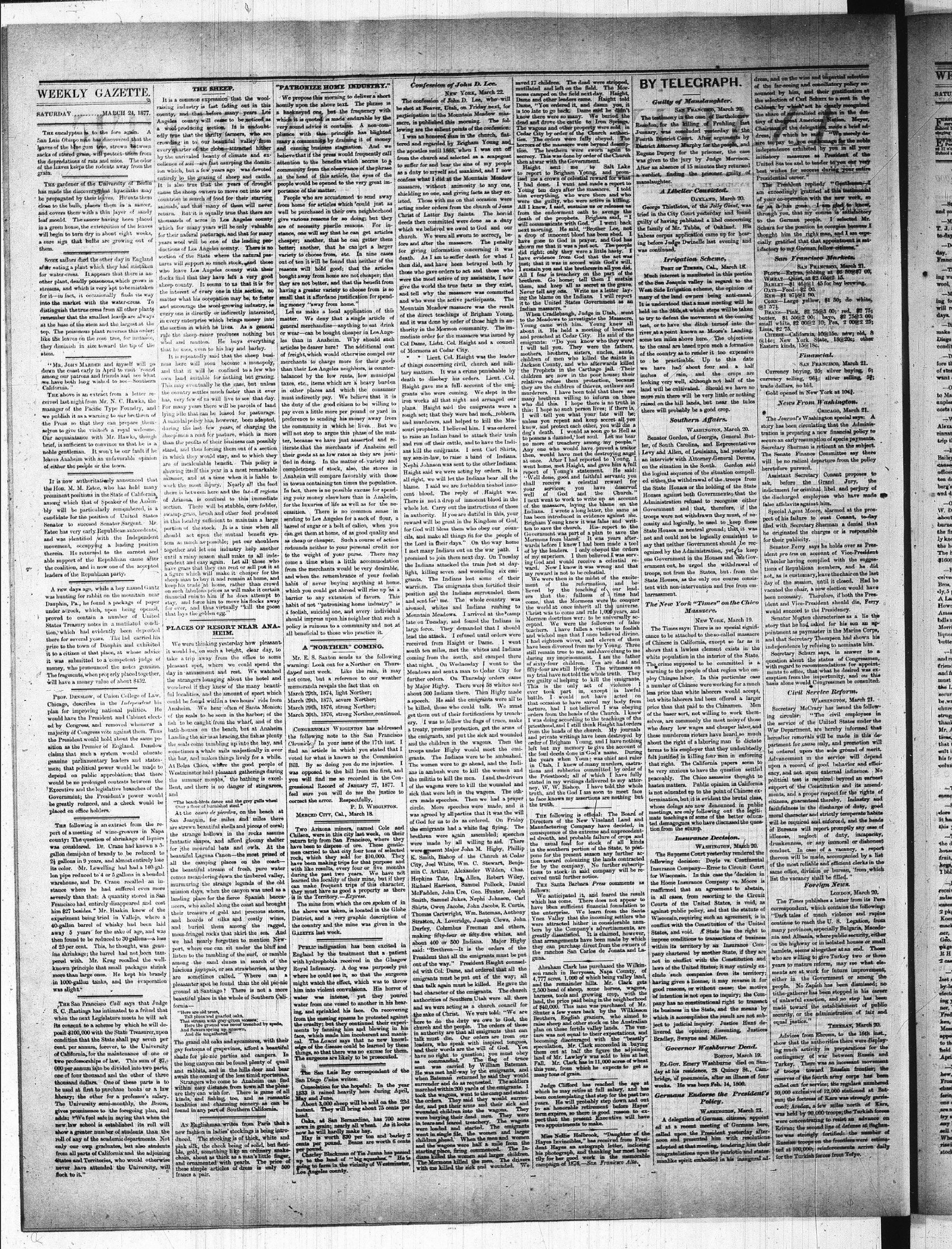
Searchable text
WEEKLY GAZETTE.
SATURDAY MARCH 24, 1877.
The eucalyptus is to the fore again. A San Luis Obispo man has discovered that the leaves of the blue gum tree, strewn between sacks of stored grain, will protect them from the depredations of rats and mice. The color of the leaves keeps the rodents away from the grain.
The gardener of the University of Berlin has made the discovery that hyacinths may be propagated by their leaves. He puts them close to the bulb, places them in a saucer, and covers them with a thin layer of sandy leaf mould. The saunter having been placed in a green house, the extremities of the leaves will begin to turn dry in about eight weeks, a sure sign that bulbs are growing out of them.
Some sailors died the other day in England after eating a plant which they had mistaken for water-cress. It appears that there is another plant, deadly poisonous, which grows in streams, and which is very apt to be mistaken for it—in fact, it occasionally finds its way into the market with the water-cress. To distinguish the true cress from all other plants remember that the smallest leaves are always at the base of the stem and the largest at the top. The poisonous plant reverses this order; like the leaves on the rose tree, for instance, they diminish in size toward the tip of the stem.
"Mr. John Marder and myself will go down the coast early in April to visit round among our patrons and friends and see what we have both long wished to see—Southern California."
The above is an extract from a letter received last night from Mr. N. C. Hawks, the manager of the Pacific Type Foundry, and we publish it as a warning to our brethren of the Press so that they can prepare themselves to give the visitor's a royal welcome. Our acquaintance with Mr. Hawks, though brief, is sufficient to convince us that he is a noble gentleman. It won't be our fault if he leaves Anaheim with an unfavorable opinion of either the people or the town.
THE SHEEP.
It is a common expression that the wool-raising industry is fast fading out in this county, and that before many years Los Angeles county will come to be noticed as a wool-producing section. It is undoubtedly true that the thrifty farmers, who are crowding in to our beautiful valley from every quarter of the globe—attracted hither by the unrivaled beauty of climate and excellence of soil—are thus usurping the dominion which, but a few years ago was devoted entirely to the grazing of sheep and cattle.
It is also true that the years of drought cause the sheep owners to move out into new countries in search of food for their starving animals, and that many of them will never return. But it is equally true that there are thousands of acres in Los Angeles county which for many years will be only valuable for their natural pasturage, and that for many years wool will be one of the leading productions of Los Angeles county. There is no section of the State where the natural pastures will support so much stock, and those who leave Los Angeles county with their flocks find that they have left a very good sheep county. It seems to us that it is for the interest of every one in this section, no matter what his occupation may be, to foster and encourage the wool-growing industry, as every one is directly or indirectly interested in every enterprise which brings money into the section in which he lives. As a general rule the sheep-raiser produces nothing but wool and mutton. He buys everything that he uses, even to his hay and barley.
It is repeatedly said that the sheep business here will soon become a monopoly, and that it will be confined to a few who own land suitable for nothing but grazing. This may eventually be the case, but unless the country settles much faster than it ever has, very few of us will live to see that day. For many years there will be parcels of land lying idle that can be leased for pasturage. A suicidal policy has, however, been adopted during the last few years, of charging the sheep-men a rent for pasture, which is more than the profits of their business can possibly stand, and thus forcing them out of a section in which they would stay, and to which they are of incalculable benefit. This policy is
PATRONIZE HOME INDUSTRIES.
We propose this morning to call homily upon the above text. "A hackneyed one, but the fright which it is quoted is made enduring very sound advice it contains." Pliance with this principle makes many a community by draining and causing business stagnation believe that if the press would attention to the benefits which community from the observance at the head of this article, the people would be opened to the importance of the matter.
People who are accustomed from home for articles which well be purchased in their own give various reasons for so do are of necessity puerile reasonance, one will say that he can cheaper; another, that he can better; another, that he can variety to choose from, etc. Out-of ten it will be found that reasons will hold good; that bought away from home are not better, and that having a greater variety to choose small that it affords no justification money "away from home.
Let us make a local applause. We deny that a single general merchandise—anything or wear—can be bought cheap less than in Anaheim. What articles be dearer here? The duty of freight, which would otherwise merchants to charge more than their Los Angeles neighbor balanced by the low rents, taxes, etc., items which are not in other places and which must indirectly pay. We boast the duty of the good citizen pay even a little more per person preference to sending his mobile community in which he will not stop to argue this point because we have just asked iterate that the merchants their goods at as low rates are tied in doing. In the matter
It is now authoritatively announced that the Hon. M. M. Eatee, who has held many prominent positions in the State of California among which that of Speaker of the Assembly will be particularly remembered, is a candidate for the position of United States Senator to succeed Senator Sargent. Mr. Eatee has very early Republican antecedents, and was identified with the Independent movement, occupying a leading position therein. He returned to the earnest and able support of the Republican cause after the coalition, and is now one of the accepted leaders of the Republican party.
A few days ago, while a boy named Gantz was hunting for rabbit on the mountain near Dauphin, Pa., he found a package of paper under a rock, which, upon being opened, proved to contain a number of United States Treasury notes in a mutilated condition, which had evidently been deposited there for several years. The lad carried his prize to the town of Dauphin and exhibited it to a citizen of that place, at whose advice it was submitted to a competent judge of money, who pronounced the notes genuine. The fragments, when properly placed together, will have a money value of about $452.
Prov. Denslow, of Union College of Law, Chicago, describes in the Independent his plan for improving national politics. He would have the President and Cabinet elected by Congress, and removed whenever a majority of Congress vote against them. Thus the President would hold about the same position as the Premier of England. Denslow claims that such a system would educate genuine parliamentary leaders and statesmen; that political power would be made to depend on public approbation; that there would be no prolonged contests between the Executive and legislative branches of the Government; the President’s power would be greatly reduced, and a check would be placed on office holders.
The following is an extract from the report of a meeting of wine-growers in Napa county: The question of shrinkage of liquors was considered. Dr. Crane had known a 5-gallon demijohn of brandy to be reduced to 2½ gallons in 9 years, and almost entirely lose its color. Mr. Lewelling had had a 140-gallon pipe reduced to 4 or 5 gallons in a bonded warehouse and Dr. Crane recalled an in-
and that it will be confined to a few who own land suitable for nothing but grazing. This may eventually be the case, but unless the country settles much faster than it ever has, very few of us will live to see that day. For many years there will be parcels of land lying idle that can be leased for pasturage. A suicide policy has, however, been adopted, during the last few years, of charging the sheep-men a rent for pasture, which is more than the profits of their business can possibly stand, and thus forcing them out of a section in which they would stay, and to which they are of mecaluable benefit. This policy is showing itself this year in a most remarkable manner, and at a time when it is liable to work the most injury. Nearly all the feed there is between here and the far-off regions of Arizona, is confined to this immediate section. There will be stubble, corn-fodder, swamp-grass, brush and other feed produced in this locality sufficient to maintain a large portion of the stock. It is a time when all should act upon the mutual benefit system as much as possible; put our shoulders together and let one industry help another until a rainy season shall make us all independent and easy again. Let all those who have grass that they can rent or sell put it at a figure which will make it cheaper for the sheep man to buy it and remain at home, and keep his trade at home, rather than crowd on such fabulous prices as will make it certain financial ruin to him if he does attempt to stay, and force him to move his flocks away for ever, and thus virtually "kill the goose that lays the golden egg."
PLACES OF RESORT NEAR ANAHEIM.
We were thinking yesterday how pleasant it would be, on such a bright, clear day, to take a trip away from the office to some pleasant spot, where we could spend the day in amusement and rest. We watched the strangers lounging about the hotel and wondered if they knew of the many beautiful localities, and the amount of sport which could be found within a two hours’ ride from Anaheim. We hear often of Santa Monica; of the seals to be seen in the harbor; of the fish ‘to be caught from the wharf; and of the bath-houses on the beach; but at Anaheim Landing the air is as bracing, the fish as plenty the seals come tumbling up into the bay, and sometimes a whale sails majestically in over the bar, and makes things lively for a while. At Bolsa Chica, where the good people of Westminster hold pleasant gatherings during the summer months, the bathing is excellent, and there is no danger of stingarees,
"The beach-birds dance and the grey gulls wheel Over a floor of burnished steel."
At the casas de pierda, on the beach at San Joaquin, for miles and miles there are strewn beautiful shells and pieces of coral; the strange hollows in the rocks assume fantastic shapes, and afford gloomy shelter for the monstrful bats and owls. At the beautiful Laguna Canon—the most prized of all the camping places on the coast—the beautiful stream of fresh, pure water comes meandering down the timbered valley, and that it will be confined to a few who own land suitable for nothing but grazing. This may eventually be the case, but unless the country settles much faster than it ever has, very few of us will live to see that day. For many years there will be parcels of land lying idle that can be leased for pasturage. A suicide policy has, however, been adapted, during the last few years, of charging the sheep-men a rent for pasture, which is more than the profits of their business can possibly stand, and thus forcing them out of a section in which they would stay, and to which they are of mecaluable benefit. This policy is showing itself this year in a most remarkable manner, and at a time when it is liable to work the most injury. Nearly all the feed there is between here and the far-off regions of Arizona, is confined to this immediate section. There will be stubble, corn-fodder, swamp-grass, brush and other feed produced in this locality sufficient to maintain a large portion of the stock. It is a time when all should act upon the mutual benefit system as much as possible; put our shoulders together and let one industry help another until a rainy season shall make us all independent and easy again. Let all those who have grass that they can rent or sell put it at a figure which will make it cheaper for the sheep man to buy it and remain at home, and keep his trade at home, rather than crowd on such fabulous prices as will make it certain financial ruin to him if he does attempt to stay, and force him to move his flocks away for ever, and thus virtually “kill the goose that lays the golden egg.”
PLACES OF RESORT NEAR ANAHEIM.
We were thinking yesterday how pleasant it would be, on such a bright, clear day, to take a trip away from the office to some pleasant spot, where we could spend the day in amusement and rest. We watched the strangers lounging about the hotel and wondered if they knew of the many beautiful localities, and the amount of sport which could be found within a two hours’ ride from Anaheim. We hear often of Santa Monica; of the seals to be seen in the harbor; of the fish ‘to be caught from the wharf; and of the bath-houses on the beach; but at Anaheim Landing the air is as bracing,the fish as plenty the seals come tumbling up into the bay,and sometimes a whale sails majestically in over the bar,and makes things lively for a while. At Bolsa Chica,where the good people of Westminster hold pleasant gatherings during the summer months,the bathing is excellent,and there is no danger of stingarees,
"The beach-birds dance and the grey gulls wheel Over a floor of burnished steel."
At the casas de pierda, on the beach at San Joaquin, for miles and miles there are strewn beautiful shells and pieces of coral;the strange hollows in the rocks assume fantastic shapes,and afford gloomy shelter forthe monstrful bats and owls.AtthebeautifulLagunaCanon—themostprizedofallthecampingplacesonthecoast—thebeautifulstreamoffresh,purewatercomesmeanderingdownthetimberedvalley,andthatitwillbeconfinedtoafewwhoownlandsuitablefornothingbutgrazingThismayeventuallybeethecasebutunlessthecountrysettlesmuchfasterthaneverhasveryfewofuswilllivetowethisdayFormanyyearstherewillbeparcelsoflandlyingililethatcanbeleasedforpasturage.Ausidicalpolicyhasshowever,benedefinitelytoworkthemostinjury.NearlyallthefeedthereisbetweenhereandfaroffregionsofArizonaisconfinedtothisimmediatesectionTherewillbestubble,corn-fodder,aussimpgrassbrushandotherfeedproducedinthislocalysufficienttomaintainalargeportionofthestock。它isatimewhenallshouldactuponthemutualbenefitsystemasmuchaspossible;putourshoulderstogetherandletoneindustryhelpanotheruntilarainyseasonshallmakeusallindependentandeasyagain.Letallthosewhohavegrassthattheycanrentor sellputitatfigurewhichwillmakeitcheaperforthesheepmantobuyitandremainathome,andkeephistradeathome,ratherthancrowdonsuchfabulouspricesaswillmakeitcertainfinancialruintohimifhedoesattempttostay,andforcehimtomovehisflocksawayforever,andthisvirtually“killthegoosethatlaysthegoldegg.”
A "NORTHER" CITY.
Mr.E.S.Saxton sends warning:LookoutforaNewdayofnextweek.Like not come,但areferencememorandarevealsthefactMarch29th,1874,lightNoMarch29th,1875,severeMarch29th,1876,strongMarch30th,1876,strongNORTHER"CITY.Mr.E.S.Saxton sends warning:LookoutforaNewdayofnextweek.Like not come,但areferencememorandarevealsthefactMarch29th,1874,lightNoMarch29th,1875,severeMarch29th,1876,strongNORTHER"CITY.Mr.E.S.Saxton sends warning:LookoutforaNewdayofnextweek.Like not come,但areferencememorandarevealsthefactMarch29th,1874,lightNoMarch29th,1875,severeMarch29th,1876,strongNORTHER"CITY.Mr.E.S.Saxton sends warning:LookoutforaNewdayofnextweek.Like not come,但areferencememorandarevealsthefactMarch29th,1874,lightNoMarch29th,1875,severeMarch29th,1876,strongNORTHER"CITY.Mr.E.S.Saxton sends warning:LookoutforaNewdayofnextweek.Like not come但areferencememorandarevealsthefactMarch29th,1874,lightNoMarch29th,1875,severeMarch29th,1876,strongNORTHER"CITY.Mr.E.S.Saxton sends warning:LookoutforaNewdayofnextweek.Like not come但areferencememorandarevealsthefactMarch29th,1874,lightNoMarch29th,1875,severeMarch29th,1876,strongNORTHER"CITY.Mr.E.S.Saxton sends warning:LookoutforaNewdayofnextweek.Like not come但areferencememorandarevealsthefactMarch29th,1874,lightNoMarch29th,1875,severeMarch29th,1876,strongNORTHER"CITY.Mr.E.S.Saxton sends warning:LookoutforaNewdayofnextweek.Like not come但areferencememorandarevealsthefactMarch29th,1874,lightNoMarch29th,1875,severeMarch29th,1876,strongNORTHER"CITY.Mr.E.S.Saxton sends warning:LookoutforaNewdayofnextweek.Like not come但areferencememorandarevealsthefactMarch29th,1874,lightNoMarch29th,1875,severeMarch29th,1876,strongNORTHER"CITY.Mr.E.S.Saxton sends warning:LookoutforaNewdayofnextweek.Like not come但areferencememorandarevealsthefactMarch29th,1874,lightNo March29th,1875,severeMarch29th,1876,strongNORTHER"CITY.Mr.E.S.Saxton sends warning:LookoutforaNewdayofnextweek.Like not come但areferencememorandarevealsthefactMarch29th,1874,lightNo March29th,1875,severeMarch29th,1876,strongNORTHER"CITY.Mr.E.S.Saxton sends warning:LookoutforaNewdayofnextweek.Like not come但areferencememorandarevealsthefactMarch29th,1874,lightNo March29th,1875,severeMarch29th,1876,strongNORTHER"CITY.Mr.E.S.Saxton sends warning:LookoutforaNewdayofnextweek.Like not come但areferencememorandarevealsthefactMarch29th,1874,lightNo March29th,1875,severeMarch29th,1876,strongNORTHER"CITY.Mr.E.S.Saxton sends warning:LookoutforaNewdayofnextweek.Like not come但areferencememorandarevealsthefactMarch29th,1874,lightNo March29th,1875,severeMarch29th,1876,strongNORTHER"CITY.Mr.E.S.Saxton sends warning:LookoutforaNewdayofnextweek.Like not come但areferencememorandarevealsthefactMarch29th,1874,lightNo March29th,1875,severeMarch29th,1876,strongNORTHER"CITY.Mr.E.S.Saxton sends warning:LookoutforaNewdayofnextweek.Like not come但areferencememorandarevealsthefactMarch29th,1874,lightNo March29th,1875,severeMarch29th,1876,strongNORTHER"CITY.Mr.E.S.Saxton sends warning:LookoutforaNewdayofnextweek.Like not come但areferencememorandarevealsthefactMarch29th,1874,lightNo March29th,1875,severeMarch29th,1876,strongNORTHER"CITY.Mr.E.S.Saxton sends warning:LookoutforaNewdayofnextweek.Like not come但areferencememorandarevealsthefactMarch29th,1874,lightNo March29th,1875,severeMarch29th,1876,strongNORTHER"CITY.Mr.E.S.Saxton sends warning:LookoutforaNewdayofnextweek.Like not come但areferencememorandarevealsthefactMarch29th,1874,lightNo March29th,1875,severeMarch29th,1876、strongNORTHER"CITY.Mr.E.S.Saxton sends warning:LookoutforaNewdayofnextweek.Like not come但areferencememorandarevealsthefactMarch29th、1874、lightNo March29th、1875、severeMarch29th、1876、strongNORTHER"CITY.Mr.E.S.Saxton sends warning:LookoutforaNewdayofnextweek.Like not come但areferencememorandarevealsthefactMarch29th、1874、lightNo March29th、1875、severeMarch29th、1876、strongNORTHER"CITY.Mr.E.S.Saxton sends warning:LookoutforaNewdayofnextweek.Like not come但areferencememorandarevealsthefactMarch29th、1874、lightNo March29th、1875、severeMarch29th、1876、strongNORTHER"CITY.Mr.E.S.Saxton sends warning:LookoutforaNewdayofnextweek.Like not come但areferencememorandarevealsthefactMarch29th、1874、lightNo March29th、1875、severeMarch29th、1876、strongNORTHER"CITY.Mr.E.S.Saxton sends warning:LookoutforaNewdayofnextweek.Like not come但areferencememorandarevealsthefactMarch29th、1874、lightNo March29th、1875、severeMarch29th、1876、strongNORTHER"CITY.Mr.E.S.Saxton sends warning:LookoutforaNewdayofnextweek.Like not come但areferencememorandarevealsthefactMarch29th、1874、lightNo March29th、1875、severeMarch29th、1876、strongNORTHER"CITY.Mr.E.S.Saxton sends warning:LookoutforaNewdayofnextweek.Like not come但areferencememorandarevealsthefactMarch29th、1874、lightNo March29th、1875、severeMarch29th、1876、strongNORTHER"CITY.Mr.E.S.Saxton sends warning:LookoutforaNewdayofnextweek.Like not come但areferencememorandarevealsthefactMarch29th、1874、lightNo March29th、1875、severeMarketingRecordOfJamaicafeel sure you will do correct the error.RespectThe.Participant.Participant.Participant.Participant.Participant.Participant.Participant.Participant.Participant.Participant.Participant.Participant.Participant.Participant.Participant.Participant.Participant.Participant.Participant.Participant.Participant.Participant.Participant.Participant.Participant.Participant.Participant.Participant.Participant.Participant.Participant.Participant.Participant.Participant.Participant.Participant.Participant.Participant.Participant.Participant.Participant.Participant.Participant.Participant.Participant.Participant.Participant.Participant.Participant.Participant.Participant.Participant.Participant.Participant.Participant.Participant.Participant.Participant.Participant.Participant.Participant.Participant.Participant.Participant.Participant.Participant.Participant.Participant.Participant.Participant.Participant,PARTICIPANT.FEELINGTHELOCALITIESOFWESTMINSTERHOLDINGLIBERALLIBRATIONTHELOCALITIESOFWESTMINSTERHOLDINGLIBERALLIBRATIONTHELOCALITIESOFWESTMINSTERHOLDINGLIBERALLIBRATIONTHELOCALITIESOFWESTMINSTERHOLDINGLIBERALLIBRATIONTHELOCALITIESOFWESTMINSTERHOLDINGLIBERALLIBRATIONTHELOCALITIESOFWESTMINSTERHOLDINGLIBERALLIBRATIONTHELOCALITIESOFWESTMINSTERHOLDINGLIBERALLIBRATIONTHELOCALITIESOFWESTMINSTERHOLDINGLIBERALLIBRATIONTHELOCALITIESOFWESTMINSTERHOLDINGLIBERALLIBRATIONTHELOCALITIESOFWESTMINSTERHOLDINGLIBERALLIBRATIONTHELOCALITIESOFWESTMINSTERHOLDINGLIBERALLIBRATIONTHELOCALITIESOFWESTMINSTERHOLDINGLIBERALLIBRATIONTHELOCALITIESOFWESTMINSTERHOLDINGLIBERALLIBRATIONTHELOCALITIESOFWESTMINSTERHOLDINGLIBERALLIBRATIONTHELOCALITIESOFWESTMINSTERHOLDINGLIBERALLIBRATIONTHELOCALITIESOFWESTMINSTERHOLDINGLIBERALLIBRATIONTHELOCALITIESOFWESTMINSTERHOLDINGLIBERALLIBRATIONTHELOCALITIESOFWESTMINSTERHOLDINGLIBERALLIBRATIONTHELOCALITIESOFWESTMINSTERHOLDINGLIBERALLIBRATIONTHELOCALITIESOFWESTMINSTERHOLDINGLIBERALLIBRATIONTHELOCALITIESOFWESTMINSTERHOLDINGLIBERALLIBRATIONTHELOCALITIESOFWESTMINSTERHOLDINGLIBERALLIBRATIONTHELOCALITIESOFWESTMINSTERHOLDINGLIBERALLIBRATIONTHELOCALITIESOFWESTMINSTERHOLDINGLIBERALLIBRATIONTHELOCALITIESOFWESTMINSTERHOLDINGLIBERALLIBRATIONTHELOCALITIESOFWESTMINSTERHOLDINGLIBERALLIBRATIONTHELOCALITIESOFWESTMINSTERHOLDINGLIBERALLIBRATIONTHELOCALITIESOFWESTMINSTERHOLDINGLIBERALLIBRATIONTHELOCALITIESOFWESTMINSTERHOLDINGLIBERALLIBRATIONTHELOCALITIESOFWESTMINSTERHOLDINGLIBERALLIBRATIONTHELOCALITIESOFWESTMINSTERHOLDINGLIBERALLIBRATIONTHELOCALITIESOFWESTMINSTERHOLDINGLIBERALLIBRATIONTHELOCALITIESOFWESTMINSTERHOLDINGLIBERALLIBRATIONTHELOCALITIESOFWESTMINSTERHOLDINGLIBERALLIBRATIONTHELOCALITIESOFWESTMINSTERHOLDINGLIBERALLIBRATIONTHELOCALITIESOFWESTMINSTERHOLDINGLIBERALLIBRATIONTHELOCALITIESOFWESTMINSTERHOLDINGLIBERALLIBRATION THELOCALITIESOFWESTMINSTERHOLDINGLIBERALLIBRATION THELOCALITIESOFWESTMINSTERHOLDINGLIBERALLIBRATION THELOCALITIESOFWESTMINSTERHOLDINGLIBERALLIEDNESSINFORMATIONSANDRESOURCESINFORMATIONSANDRESOURCESINFORMATIONSANDRESOURCESINFORMATIONSANDRESOURCESINFORMATIONSANDRESOURCESINFORMATIONSANDRESOURCESINFORMATIONSANDRESOURCESINFORMATIONSANDRESOURCESINFORMATIONSANDRESOURCESINFORMATIONSANDRESOURCESINFORMATIONSANDRESOURCESINFORMATIONSANDRESOURCESINFORMATIONSANDRESOURCESINFORMATIONSANDRESOURCESINFORMATIONSANDRESOURCESINFORMATIONSANDRESOURCESINFORMATIONSANDRESOURCESINFORMATIONSANDRESOURCESINFORMATIONSANDRESOURCESINFORMATIONSANDRESOURCESINFORMATIONSANDRESOURCESINFORMATIONSANDRESOURCESINFORMATIONSANDRESOURCESINFORMATIONSANDRESOURCESINFORMATIONSANDRESOURCESINFORMATIONSANDRESOURCESINFORMATIONSANDRESOURCESINFORMATIONS ANDRESOURCESINFORMATIONS ANDRESOURCESINFORMATIONS ANDRESOURCESINFORMATIONS ANDRESOURCESINFORMATIONS ANDRESOURCESINFORMATIONS ANDRESOURCESINFORMATIONS ANDRESOURCESINFORMATIONS ANDRESOURCESINFORMATIONS ANDRESOURCESINFORMATIONS ANDRESOURCESINFORMATIONS ANDRESOURCESINFORMATIONS ANDRESOURCESINFORMATIONS ANDRESOURCESINFORMATIONS ANDRESOURCESINFORMICATIONS ANDRESOURCEFINANCEFORANOTHERCOMMUNICATIONS ANDRESOURCEFINANCEFORANOTHERCOMMUNICATIONS ANDRESOURCEFINANCEFORANOTHERCOMMUNICATIONS ANDRESOURCEFINANCEFORANOTHERCOMMUNICATIONS ANDRESOURCEFINANCEFORANOTHERCOMMUNICATIONS ANDRESOURCEFINANCEFORANOTHERCOMMUNICATIONS ANDRESOURCEFINANCEFORANOTHERCOMMUNICATIONS ANDRESOURCEFINANCEFORANOTHERCOMMUNICATIONS ANDRESOURCEFINANCEFORANOTHERCOMMUNICATIONS ANDRESOURCEFINANCEFORANOTHERCOMMUNICATIONS ANDRESOURCEFINANCEFORANOTHERCOMMUNICATIONS ANDRESOURCEFINANCEFORANOTHERCOMMUNICATIONS ANDRESOURCEFINANCEFORANOTHERCOMMUNICATIONS ANDRESOURCEFINANCEFORANOTHERCOMMUNICATIONSANDRESOURCEFINANCEFORANOTHERCOMMUNICATIONSANDRESOURCEFINANCEFORANOTHERCOMMUNICATIONSANDRESOURCEFINANCEFORANOTHERCOMMUNICATIONSANDRESOURCEFINANCEFORANOTHERCOMMUNICATIONSANDRESOURCEFINANCEFORANOTHERCOMMUNICATIONSANDRESOURCEFINANCEFORANOTHERCOMMUNICATIONSANDRESOURCEFINANCEFORANOTHERCOMMUNICATIONSANDRESOURCEFINANCEFORANOTHERCOMMUNICATIONSANDRESOURCEFINANCEFORANOTHERCOMMUNICATIONSANDRESOURCEFINANCEFORANOTHERCOMMUNICATIONSANDREGIONFINANCEMENTOUGHLESSNESS INTERNATIVELYREGIONAL FINANCEMENTOUGHLESSNESS INTERNATIVELYREGIONAL FINANCEMENTOUGHLESSNESS INTERNATIVELYREGIONAL FINANCEMENTOUGHLESSNESS INTERNATIVELYREGIONAL FINANCEMENTOUGHLESSNESS INTERNATIVELYREGIONAL FINANCEMENTOUGHLESSNESS INTERNATIVELYREGIONAL FINANCEMENTOUGHLESSNESS INTERNATIVELYREGIONAL FINANCEMENTOUGHLESSNESS INTERNATIVELYREGIONAL FINANCEMENTOUGHLESSNESS INTERNATIVELYREGIONAL FINANCEMENTOUGH
The following is an extract from the report of a meeting of wine-growers in Napa county: The question of shrinkage of liquors was considered. Dr. Crane had known a 5-gallon demijohn of brandy to be reduced to 2½ gallons in 9 years, and almost entirely lose its color. Mr. Lewelling had had a 140-gallon pipe reduced to 4 or 5 gallons in a bonded warehouse, and Dr. Crane recalled an instance where he had suffered even more severely than that: A quantity stored in San Francisco had entirely disappeared and cost him $27 besides. Mr. Haskin knew of the experiment being tried in Vallejo, where a 40-gallon barrel of whisky had been laid away 5 years for the sake of age, and was then found to be reduced to 30 gallons—a loss of 25 per cent. This, he thought, was genuine shrinkage; the barrel had not been tampered with. Mr. Krug recalled the well-known principle that small packages shrink more than large ones. He kept his brandy in 1000-gallon tanks, and the evaporation was slight.
The San Francisco Call says that Judge S. C. Hastings has intimated to a friend that when the next Legislature meets he will ask its consent to a scheme by which he will deposit $100,000 with the State Treasurer, upon condition that the State shall pay seven per cent per annum, forever, to the University of California, for the maintenance of one or two professorships of law. This sum of $7,000 per annum is to be divided into two parts, one of four thousand and the other of three thousand dollars. One of these parts is to be used at first to purchase books' or a law library; the other for a professor's salary. The University semi-monthly, the Besom, gives prominence to the foregoing plan, and adds: "We feel safe in saying that when the new law school is established its roll will show a greater number of students than the roll of any of the academic departments. Not only our own graduates, but also students from all parts of California and the adjoining states and Territories, who would otherwise never have attended the University, will flock to it."
At the casas de pierdra, on the beach at San Joaquin, for miles and miles there are strewn beautiful shells and pieces of coral; the strange hollows in the rocks assume fantastic shapes, and afford gloomy shelter for jj the mournful bats and owls. At the beautiful Laguna Canon—the most prized of all the camping places on the coast—the beautiful stream of fresh, pure water comes meandering down the timbered valley, murmuring the strange legends of the old mission days, when the canyon was used as a landing place for the fierce Spanish buccaneers, who sailed along the coast and brought their treasure of gold and precious stones, and hoards of silks and costly wines, and buried them among the ragged, moss-fringed rocks that skirt the sea. And we had nearly forgotten to mention Newport, where one can sit under the bluff and listen to the tumbling of the surf, or ramble among the sand dunes in search of the luscious jaguais, or sea strawberries, as they are sometimes called. Where can a pleasant spot be found than the old picnic ground at Santiago? There is not a more beautiful place in the whole of Southern California—
"Here are old trees,
Tall paces and guarded oaks,
That stream with grey-green mosses;
Here the ground was never trenched by spades,
And flowers spring up unseen,
And die ungathered."
The grand old oaks and sycamores, with their gay festoons of grapevines, afford a beautiful shade for picnic parties and campers. In the long canyon can be found plenty of quail and rabbits, and in the hills deer and bear await the coming of the less timid sportsman.
Strangers who come to Anaheim can find within easy distance from town all the pleasure they can wish for. There is game of all kinds, and fishing too, and as romantic localities and charming scenery as can be found in any part of Southern California.
An Englishman writes from Paris that a new fashion in ladies' stockings is being introduced. The stocking is of thick, white and pink silk; the check being of solid, but flexible, gold, something like an ordinary snakechain, about as thick as a man's little finger, and ornamented with pearls. The price of these simple articles of dress is only $20 francs a pair.
"PATRONIZE HOME INDUSTRY."
"We propose this morning to deliver a short commily upon the above text. The phrase is haackneyed one, but the frequency with which it is quoted is made endurable by the very sound advice it contains. A non-compliance with this principle has blighted many a community by draining it of money and canning business stagnation. And we believe that if the press would frequently call attention to the benefits which accrue to a community from the observance of the phrase at the head of this article, the eyes of the people would be opened to the very great importance of the matter.
People who are accustomed to send away from home for articles which could just as well be purchased in their own neighborhood give various reasons for so doing; but they are of necessity puerile reasons. For instance, one will say that he can get articles cheaper; another, that he can get them better; another, that he can get a larger variety to choose from, etc. In nine cases out of ten it will be found that neither of the reasons will hold good; that the articles bought away from home are not cheaper; that they are not better, and that the benefit from having a greater variety to choose from is so small that it affords no justification for spending money "away from home."
Let us make a local application of this matter. We deny that a single article of general merchandise—anything to eat drink or wear—can be bought cheaper in Los Angeles than in Anaheim. Why should such articles be dearer here? The additional cost of freight, which would otherwise compel our merchants to charge more for their goods than their Los Angeles neighbors, is counterbalanced by the low rents, low municipal taxes, etc., items which are a heavy burden in other places and which the consumer must indirectly pay. We believe that it is the duty of the good citizen to be willing to pay even a little more per pound or yard in preference to sending his money away from the community in which he lives. But we will not stop to argue this phase of the matter, because we have just asserted and reiterate that the merchants of Anaheim sell their goods at as low rates as they are justified in doing. In the matter of variety and Confession of John D. Lee.
New York, March 22.
The confession of John D. Lee, who will be shot at Heaver, Utah, on Friday next, for participation in the Mountain Meadow massacre, is published this morning. The following are the salient points of the confession:
I was an honored man in the church, flattered and regarded by Brigham Young and the apostles until 1868, when I was cut off from the church and selected as a scapegoat to suffer for and bear the sins of my people as a duty to myself and mankind, and I now confess what I did at the Mountain Meadow massacre, without animosity to any one, shielding no one, and giving facts as they existed. Those with me on that occasion were acting under orders from the church of Jesus Christ of Latter Day Saints. The horrid deeds then committed were done as a duty which we believed we owed to God and our church. We were all sworn to secrecy, before and after the massacre. The penalty for giving information concerning it was death. As I am to suffer death for what I then did, and have been betrayed both by those who gave orders to act and those who were the most active of my assistants, I now give the world the true facts as they exist, and tell why the massacre was committed and who were the active participants. The Mountain Meadow massacre was the result of the direct teachings of Brigham Young, and it was done by order of those high in authority in the Mormon community. The immediate order for the massacre was issued by Col Dame, Lieut. Col. Haight and a council of Mormons at Cedar City.
* Lieut. Col. Haight was the leader of things concerning civil, church and military matters. It was a crime punishable by death to disobey his orders. Lieut. Col. Haight gave me a full account of the emigrants who were coming. We slept in the iron works all that night and arranged our plans. Haight said the emigrants were a rough set; that they were bad men, robbers, and murderers, and helped to kill the Missouri prophets. I believed him. I was ordered to raise an Indian band to attack their train and run off their cattle, and to have the Indians kill the emigrants. I sent Carl Shirta, my son-in-law, to raise a band of Indians. Nephi Johnson was sent to the other Indians.
moved 17 children. The dead were stripped, mutilated and left on the field. The Mormons camped on the field next day. Haight, Dame and other leaders came. Haight told Dame, "You ordered it, and damn you, it is too late to go back. Dame said he didn't know there were so many. We buried the dead and drove the cattle to Iron Springs. The wagons and other property were sold in Cedar City by order of the Church authorities. The orders were fully obeyed. The horrors of the massacre were beyond description. This was done by order of the Church then at war with the Government.
Haight sent me to Salt Lake to report to Brigham Young, and promised me a crown of celestial reward for what I had done. I went and made a report to Young ten days after the massacre. I told him everything, who were there and who were the guilty, who were active in killing. All I knew, I said, sustains us or releases us from the endowment oath to avenge the death of the prophets. Brigham said, "I will communicate with God." I went back next morning. He said, "Brother Lee, not a drop of innocent blood has been shed. I have gone to God in prayer, and God has shown me that it was a just act. The people did right; only they were a little hasty. I have evidence from God that the act was just; that it was in accord with God's will. I sustain you and the brethren in all you did. All I fear is treachery on the part of the brethren. Go home; tell them I sustain them, and keep all as secret as the grave. Never tell any one. Write me a letter laying the blame on the Indians. I will report it to the United States Government as an Indian massacre."
When Craddlebaugh, Judge in Utah, went to the Meadows to investigate the Massacre, Young came with him. Young knew all about it. He held a meeting of brethren and preached at Cedar City. He said of the emigrants: "Do you know who they were? I will tell you. They were the fathers, mothers, brothers, sisters, uncles, children of men who killed the saints in Jackson County, and who afterwards killed the Prophets in the Carthage jail. Their children are now in the poor house; their relatives refuse their protection, because they are the children of thieves, outlaws and murderers. I have been told that there are many brethren willing to inform on those who did this. I hope there is no truth in this: I hope no such person lives; if there is, I will tell you what your fate will be; unless you repent and keep secret all you know, and protect each other, you will die a dog's death. I would as soon go to Hell as possess a damned,' lost soul. Let me hear no more of treachery among my people." Any one who would have proved a traitor then would have met the destroying angel at once. After I had reported to Young, I went home met Haight, and gave him a full
than their Los Angeles neighbors, is counter-balanced by the low rents, low municipal taxes, etc., items which are a heavy burden in other places and which the consumer must indirectly pay. We believe that it is the duty of the good citizen to be willing to pay even a little more per pound or yard in preference to sending his money away from the community in which he lives. But we will not stop to argue this phase of the matter, because we have just assorted and reiterate that the merchants of Anaheim sell their goods at as low rates as they are justified in doing. In the matter of variety and completeness of stock, also, the stores in Anaheim will compare favorably with those in towns containing ten times the population. In fact, there is no possible excuse for spending your money elsewhere than in Anaheim, for the luxuries of life as well as for the necessities. There is no common sense in sending to Los Angeles for a sack of flour, a barrel of sugar or a bolt of calico, when you can get them at home, of as good quality and as cheap or cheaper. Such a course of action redounds neither to your personal credit nor to the weight of your purse. There may come a time when a little accommodation from the merchants would be very desirable, and when the remembrance of your foolish habit of never buying anything at home, which you could get abroad will rise up as a barrier to any extension of favors. This habit of not "patronising home industry" is a foolish, suicidal one, and every individual should impress upon his neighbor that such a policy is ruinous to a community and not at all beneficial to those who practice it.
A "NORTHER" COMING.
Mr. E. S. Saxton sends us the following warning: Look out for a Norther on Thursday of next week. Like the rain, it may not come, but a reference to our weather memoranda reveals the fact that on March 29th, 1874, light Norther; March 29th, 1875, severe Norther; March 29th, 1876, strong Norther; March 30th, 1876, strong Norther, continued.
CONGRESSMAN WIGGINTON has addressed the following note to the San Francisco Chronicle: In your issue of the 17th inst. I find an article in which you stated that I voted for what is known as the Commission Bill. By so doing you do me injustice. I was opposed to the bill from the first, and you will find me so recorded in the Congressional Record of January 27, 1877. I feel sure you will do me the justice to correct the error. Respectfully,
P. D. WIGGINTON.
MERCED CITY, Cal., March 18.
Two Arizona miners, named Cole and Chilson, were in this city last week, on their return trip from San Francisco, where they have been to dispose of ore. These gentlemen carried to that city four tons of selected rock, which they sold for $10,000. They have been making trips for that purpose and with like results, every four or five months during the past two years. We have not learned the locality of their mine, but if they were a crime punishable by death to disobey his orders. Lieut. Col. Haight gave me a full account of the emigrants who were coming. We slept in the iron works all that night, and arranged our plans. Haight said the emigrants were a rough set; that they were bad men robbers, and murderers, and helped to kill the Missouri prophets. I believed him. I was ordered to raise an Indian hand to attack their train and run off their cattle, and to have the Indians kill the emigrants. I sent Carl Shirts, my son-in-law, to raise a band of Indians. Nephi Johnson was sent to the other Indians. Haight said we were acting by orders. It is all right, we will let the Indians bear all the blame. I said we are forbidden to shed innocent blood. The reply of Haight was there is not a drop of innocent blood in the whole lot. Carry out the instructions of those in authority. If you are dutiful in this, your reward will be great in the Kingdom of God, for God will bless them who obey our councils, and make all things fit for the people of the Lord in their days." On the way home I met many Indians out on the war path. I promised to join them next day. On Tuesday the Indians attacked the train just at daylight, killing seven and wounding six emigrants. The Indians lost some of their warriors. The emigrants then fortified their position and the Indians surrounded them and sent for me. The whole country was aroused, whites and Indians rushing to Mountain Meadows. I arrived at the camp late on Tuesday, and found the Indians in large force. They demanded that I should lead the attack. I refused until orders were received from Haight or Dame. I went south ten miles, met the whites and Indians coming from the south, and camped there that night. On Wednesday I went to the Meadows and sent a man to Cedar City for further orders. On Thursday orders came by Major Higby. There were 58 whites and about 500 Indians there. Then Higby made a speech. He said the emigrants were all to be killed, those who could talk. We must get them out of their fortifications by treachery. I was to follow the flags of truce, make a treaty, promise protection, get the arms of the emigrants, and put the sick and wounded and the children in the wagons. Then the troops under Higby would meet the emigrants. The Indians were to be ambushed. The women were to go ahead, and the Indians in ambush were to kill the women and the militia to kill the men. And the drivers of the wagons were to kill the wounded and sick that were left in the wagons. The others made speeches. Then we had a prayer circle. More speeches were made, and it was agreed by all parties that it was the will of God for us to do as ordered. On Friday the emigrants had a white flag flying. The brethren were again assembled; speeches were made by all willing to aid. There were present Major John M. Higby, Phillip K. Smith, Bishop of the Church at Cedar City, Joel White, Wm. C. Stewart, Benjamín C. Arthur, Alexander Wilden, Chas Hopkins Tate, Irre Allen, Robert Wiley,
The following is official: The Board of Directors of the New Vineland Land and Manufacturing Company have decided, in consequence of the extreme and unprecedented drought, and probable failure of crops and the usual feed for stock of all kinds in the southern portion of the State, to postpone for the present season any further action toward colonizing the lands contracted for by the company. No further subscriptions to stock in said company will be received until further notice.
Senator Gler, of South Levy and All an interview on the situation of logical ed either tha State Houses again Administrate Government troops werecessity and State House not and cannot say that newognized by one Governernment our troops,not State House tent with n barrassment
The New
The Time cance to be of Chinese shows that white popu The crime warning to ploy Ching a number less price but whitese price thanofthe base selves,areshe these murdersaboutthe termsto h felt justifiethright be very an peaceably hasten maisnot edu terminationwhose do meetings,mate teach ted demationfrom
Two Arizona miners, named Cole and Chilson, were in this city last week, on their return trip from San Francisco, where they have been to dispose of ore. These gentlemen carried to that city four tons of selected rock, which they sold for $10,000. They have been making trips for that purpose and with like results, every four or five months during the past two years. We have not learned the locality of their mine, but if they can make frequent trips of this character, they must have as good a property as there is in the Territory.—Express.
The mine from which the ore spoken of in the above was taken, is located in the Globe District, and a very graphic description of the country and the mine was given in the Gazette last week.
Public indignation has been excited in England by the treatment that a patient with hydrophobia received in the Glasgow Royal Infirmary. A dog was purposely put where he could see it, so that the surgeons might watch the effect, which was to throw him into violent convulsions. His horror of water was intense, yet they poured water from one vessel to another in his hearing, and sprinkled his face. On recovering from the ensuing spasms he protested against the cruelty; but they continued their experiments by fanning him and blowing in his face, which made him incoherent and maniacal. The Lancet says that no new knowledge of the disease could be learned by these things, so that there was no excuse for them. The surgeons are likely to be prosecuted.
The San Luis Rey correspondent of the San Diego Union writes:
Consolation for the hopeful: In the year 1833 it rained heavily here during April, May and June.
About 3,000 sheep will be sold on the 23d instant. They will bring about 75 cents per head.
Oaks, at San Bernardino, has 700 acres down in grain; nearly all wheat. As it looks now he will hardly make hay.
Hay is worth $30 per ton and barley 2 cents per pound. Beans are worth 6 cents per pound.
Charley Blackman of Tia Juana has passed up to the hand of "big squash." He is going to farm in the vicinity of Westminster, Los Angeles county.
The following is official: The Board of Directors of the New Vineland Land and Manufacturing Company have decided, in consequence of the extreme and unprecedented drought, and probable failure of crops and the usual feed for stock of all kinds in the southern portion of the State, to postpone for the present season any further action toward colonizing the lands contracted for by the company. No further subscriptions to stock-in said company will be received until further notice.
The Santa Barbara Press comments as follows:
We anticipated it, and feared the result which has come. There does not appear to have been sufficient financial foundation to the enterprise. We learn from the Santa Ynez Valley that the incoming settlers who were attracted hither in considerable numbers by the Company's advertisements, are greatly dissatisfied. It is claimed, however, that arrangements have been made by which they can purchase direct from the owners of the ranchos San Carlos de Jonata and Laguna.
Abraham Clark has purchased the Wilkinson ranch in Berryessa, Napa County, of 4,777 acres, 1,000 of which being valley land, and the remainder hills. Mr. Clark gets 2,500 head of sheep, some horses, wagons, harnesses, tools and growing crop, with the land, the price paid being in the neighborhood of $40,000. This land was purchased of Mr. Shuter a few years back by the Wilkinson Brothers, English graziers, who aimed to raise sheep and other stock on the Australian plan on these fertile valley lands. The venture was not equal to their expectations, and becoming discouraged with the "beastly" speculation, Mr. Clark succeeded in buying them out at half the figure the adjoining land of Mr. Lawley's was sold to him at last Fall. Mr. Clark has in 11,000 acres of wheat this year, from which he expects to get as many tons of grain.
Judge Clifford has reached the age at which he may retire at full salary, and has been contemplating that step for the past two years. He will probably step down and out to an honorable retirement before Hayes' term expires, so there is good reason to expect that the present Executive will have two appointments to make.
Miss Nellie Holbrook, "Daughter of the Hayes Invincibles," has received from President Hayes an autograph letter, including his photograph, and thanking her most heartily for her good work in the memorable campaign of 1876—San Francisco Alta.
BY TELEGRAPH.
Guilty of Manslaughter.
SAN FRANCISCO, March 20.
The testimony in the case of Bartholomew Reardon, for the killing of Frushling last January, was concluded yesterday in the Fourth District Court. After arguments by District Attorney Marphy for the people, and Eugene Duprey for the prisoner, the case was given to the jury by Judge Morrison. After an absence of 15 minutes they returned a verdict, finding the prisoner guilty of manslaughter.
A Libeller Concluded.
OAKLAND, March 20.
George Thistleton, of the Jolly Giant, was tried in the City Court yesterday and found guilty of having published a libel concerning the family of Mr. Tubbs, of Oakland. His habeas corpus application came up for hearing before Judge Dwinelle last evening and was continued.
Irrigation Scheme,
PORT OF TIMBER, Cal., March 18.
Much interest is manifested in this portion of the San Joaquin valley in regard to the West Side Irrigation scheme, the opinion of many of the land owners being anti-canal. It is understood that a mass meeting will be held on the 24th at which steps will be taken to try to defeat the movement at the coming test, or to have the ditch turned into the river at a point known as Moore's Landing. Some ten miles above here. The objections to the canal are based upon such a formation of the country as to render it too expensive to be practicable. Up to this date we have had about four and a half inches of rain, and the crops are looking very well, although not half of the land will be cultivated. Should we have no more rain there will be very little or nothing raised on the hill lands, but near the tules there will probably be a good crop.
Southern Affairs.
WASHINGTON, March 20.
Senator Gordon, of Georgia, General Butler, of South Carolina, and Representatives Levy and Allen, of Louisiana, had yesterday an interview with Attorney-General Devens, on the situation in the South. Gordon said dress, and on the wise and impartial selection of the far-scoring and consiliatory policy announced by him, and their gratification at the selection of Carl Schurz to a seat in the Cabinet, by which act he clearly recognized the share of naturalized citizens in the destiny of the great American Nation. Meyer, Chairman of the delegation, made a brief address, in which he said: "We merely desire to pay to you our mortgage for the noble independence exhibited by you in all your initiatory measures as President of the United States and to tender to you our very best wishes for success during your entire Presidential career."
The President replied: "Gentlemen—I am exceedingly gratified with this testimonial of your co-operation with the new work, so far as it has gone. I am glad to know through you, that my course is satisfactory to the German people. I selected Mr. Schurz for the position he occupies because I thought him the right man, and I am especially gratified that that appointment is satisfactory to my German fellow-citizens."
San Francisco Markets.
SAN FRANCISCO, March 21.
FLOUM—Extra jobbing at $6 50@$7 00; WHEAT—Quint, at $2 00@$2 15.
BARLEY—$1 46@$1 45 for bay browning.
OATS—Feed—$2 00.
RNE—$1 87@$1 90.
CORN—Large yellow, $1 50; do white, @1 57].
BRANS—Pink, $2 75@$3 00; red, $2 75;
butter, $1 50@$2 00; hayo, $2 75@$3 00;
small white, $2 00@$2 10; Pea, $2 00@$2 25;
Linia, $2 75.
CHURSE—California, $10@$15c; new; old, @14c; New York State, $18@$20c; other Eastern kinds, $15@$18c.
Financial.
SAN FRANCISCO, March 21.
Currency buying, 95; silver buying, 6; currency selling, 96}; silver selling, 52; trade dollars, no bid.
Gold opened in New York at 104¢.
News From Washington.
CHICAGO, March 21.
The Journal's Washington special says: A story has been circulating that the Administration is preparing a new financial policy to secure an early resumption of specie payments. Secretary Sherman is reticent on the subject. The Senate Finance Committee say there will be no radical departure from the policy.
Southern Affairs.
WASHINGTON, March 20.
Senator Gordon, of Georgia, General Butler, of South Carolina, and Representatives Levy and Allen, of Louisiana, had yesterday an interview with Attorney-General Devens, on the situation in the South. Gordon said the logical sequence of the situation compelled either the withdrawal of the troops from the State Houses or the holding of the State Houses against both Governments; that the Administration refused to recognize either Government and that, therefore, if the troops were not withdrawn they must, of necessity and logically, be used to keep these State Houses as neutral ground; that it was not and could not be logically consistent to say that neither Government should be recognized by the Administration, yet to keep one Government in the Houses and one Government out, he urged the withdrawal of troops, not from the States, but from the State Houses, as the only one course consistent with non-intervention and free from embarrassment.
The New York "Times" on the Chico Massacre.
NEW YORK, March 19.
The Times says: There is no special significance to be attached to the so-called massacre of Chinese in California, except so far as it shows that a lawless element exists in the white population in the interior of the State. The crime supposed to be committed is a warning to the people of that region who employ Chinese labor. In this particular case a number of Chinese were working for a much less price than white laborers would accept, but white laborers had been offered a larger price than that paid to the Chinamen. Men of the baser sort, not willing to work themselves, are commonly the most noisy of those who desry low wages and cheaper labor, and these murderous rioters have heard so much about the right of a laboring man to dictate terms to his employer that they undoubtedly felt justified in killing four men in enforcing that right. The California papers seem to be very anxious to have the question settled peaceably. The Chico assassins thought to hasten matters. Public opinion in California is not educated up to the point of Chinese extermination, but it is evident the brutal class, whose doings are now denounced in public meetings, are only following out the legitimate teachings of some of the better educated demagogues who have discussed the question from the stump.
Insurance Decision.
WASHINGTON, March 20.
The Supreme Court yesterday rendered the following decision: Doyle vs. Continental Insurance Company—Error to Circuit Court for Wisconsin. In this case the 'decision in the Home Insurance Company vs. Moore is we have had about four inches of rain, and the crops are looking very well, although not half of the land will be cultivated. Should we have no more rain there will be very little or nothing raised on the hill lands, but near the tules there will probably be a good crop.
Currency buying, 95; silver buying, 6; currency selling, 96%; silver selling, 5%; trade dollars, no bid.
Gold opened in New York at 104$.
News From Washington.
CHICAGO, March 21.
The Journal's Washington special says: A story has been circulating that the Administration is preparing a new financial policy to secure an early resumption of specie payments. Secretary Sherman is reticent on the subject. The Senate Finance Committee say there will be no radical departure from the policy heretofore pursued.
Assistant Secretary Conant proposes to ask, before the Grand Jury, the indictment for criminal libel and perjury of the discharged employees who have made false alfidavits against him.
Special Agent Moore, alarmed at the prospect of his failure to oust Conant, to-day filed with Secretary Sherman a denial that he originated the charges or is responsible for their publicity.
Senator Ferry says he holds over as President pro tem on account of Vice-President Wheeler having complied with the suggestions of Republican members, and he did not, as is customary, leave the chairon the last day of the session, until it closed. Had he vacated the chair, a new election would have been necessary. Therefore, if both the President and Vice-President should die, Ferry would succeed to the Presidency.
Senator Morton characterizes as a lie the story that he had asked for his son an appointment as paymaster in the Marine Corps, and that Secretary Thompson had shown his independence by refusing to nominate him.
Secretary Schurz says, in answer to a question about the status of Congressmen, with regard to recommendations for appointments to office, that what he desired was exemption from the importunity, and on this basis alone would Congressmen be consulted.
Civil Service Reform.
WASHINGTON, March 21.
Secretary McCray has issued the following circular: "The civil employees in the service of the United States under the War Department, are hereby informed that hereafter removals will be made in this department for cause only, and promotion will be ordered upon the sols ground of merit. Advancement in the service will depend upon a record of good behavior and efficiency, and not upon external influence. No political test is required beyond an earnest support of the Constitution and its amendments, and a proper respect for the rights of citizens, guaranteed thereby. Industry and faithfulness in the discharge of duty, good moral character and strictly temperate habits will be required and enforced, and the heads of Bureans will report promptly any case of idleness, neglect of duty, incapacity, drunkenness, or any immoral or dishonest conduct. In case of a vacancy, a report thereon will be made, accompanied by a list of the most reliable and efficient clerks in the same office, division or bureau," from which list the vacancy shall be filled."
Insurance Decision.
WASHINGTON, March 20.
The Supreme Court yesterday rendered the following decision: Doyle vs. Continental Insurance Company—Error to Circuit Court for Wisconsin. In this case the 'decision in the Home Insurance Company vs. Moore is reaffirmed that an agreement to abstain, in all cases, from resorting to the Circuit Courts of the United States, is void, as against public policy, and that the statute of Wisconsin, requiring such an agreement, is in conflict with the Constitution of the United States, and void. A State has the right to impose conditions to transactions of business within its territory by an Insurance Company chartered by another State, if they are not in conflict with the Constitution and laws of the United States; it may entirely exclude such companies from its territory; having given a license, it may reverse it for good reasons, or without cause; the motive of intention is not open to inquiry; the Company has no constitutional right to transact its business in the State, and the means by which it accomplishes the result are not subject to judicial inquiry. Justice Hunt delivered the opinion; dissenting, Justices Bradley, Swayne and Miller.
Governor Washburne Dead.
Boston, March 19.
Ex-Gov. Emery Washburne died on Sunday at his residence, 28 Quincy St., Cambridge, of pneumonia, after an illness of four weeks. He was born Feb. 14, 1800.
Germans Endorse the President's Policy.
Washington, March 21.
A delegation of German citizens appointed at a recent meeting of Germans here, called upon the President yesterday afternoon and presented him with resolutions adopted at that meeting, tendering him their congratulations upon the patriotic and state-manlike spirit embodied in his inaugural ad-
support of the Constitution and its amendments, and a proper respect for the rights of citizens, guaranteed thereby. Industry and faithfulness in the discharge of duty, good moral character and strictly temperate habits will be required and enforced, and the heads of Bureaus will report promptly any case of idleness, neglect of duty, incapacity, drunkenness, or any immoral or dishonest conduct. In case of a vacancy, a report thereon will be made, accompanied by a list of the most reliable and efficient clerks in the same office, division or bureau, 'from which list the vacancy shall be filled."
Foreign News.
London, March 20.
The Times publishes a letter from its correspondent, which contains the following:
"Dark tales of much violence and rapine continue to reach the U.S. Legation, from many provinces, especially Bulgaria, Macedonia and Albania, where public security, either on the highway or in isolated houses or small hamlets, seems altogether at an end. Those who are willing to give Turkey two or three years to mature reform, may see what elements are at work for future improvement, either in the Government or among the people. No Zapich has been dismissed; no tithe-gatherer has been stopped in his career of unlawful exaction, and no step has been made toward the establishment of public security, or the administration of fair and equal justice."
TENERAN, March 20.
Advices from Ehromn, to the 16th inst., show that the authorities there were displaying much activity in preparations for the contingency of war between Russia and Turkey. There was an incessant movement of troops toward Russian frontier; the reserves of the fourth army corps has been called out for service; the regulars numbered 50,000 exclusive of 12,000 stationed at Bat-sun; the fortress of Kars was strongly garrisoned; Aredon, a few miles north of Kars, was held by 90,000 troops; the Turkish forces were concentrating to resist an advance on Erivan; the second line of defense at Sighantee was strongly fortified; the number of Russian troops on the frontiers were estimated at 100,000; reinforcements arrive daily for the Turkish forces from Tefyo.