anaheim-gazette 1877-03-24
Scanned page
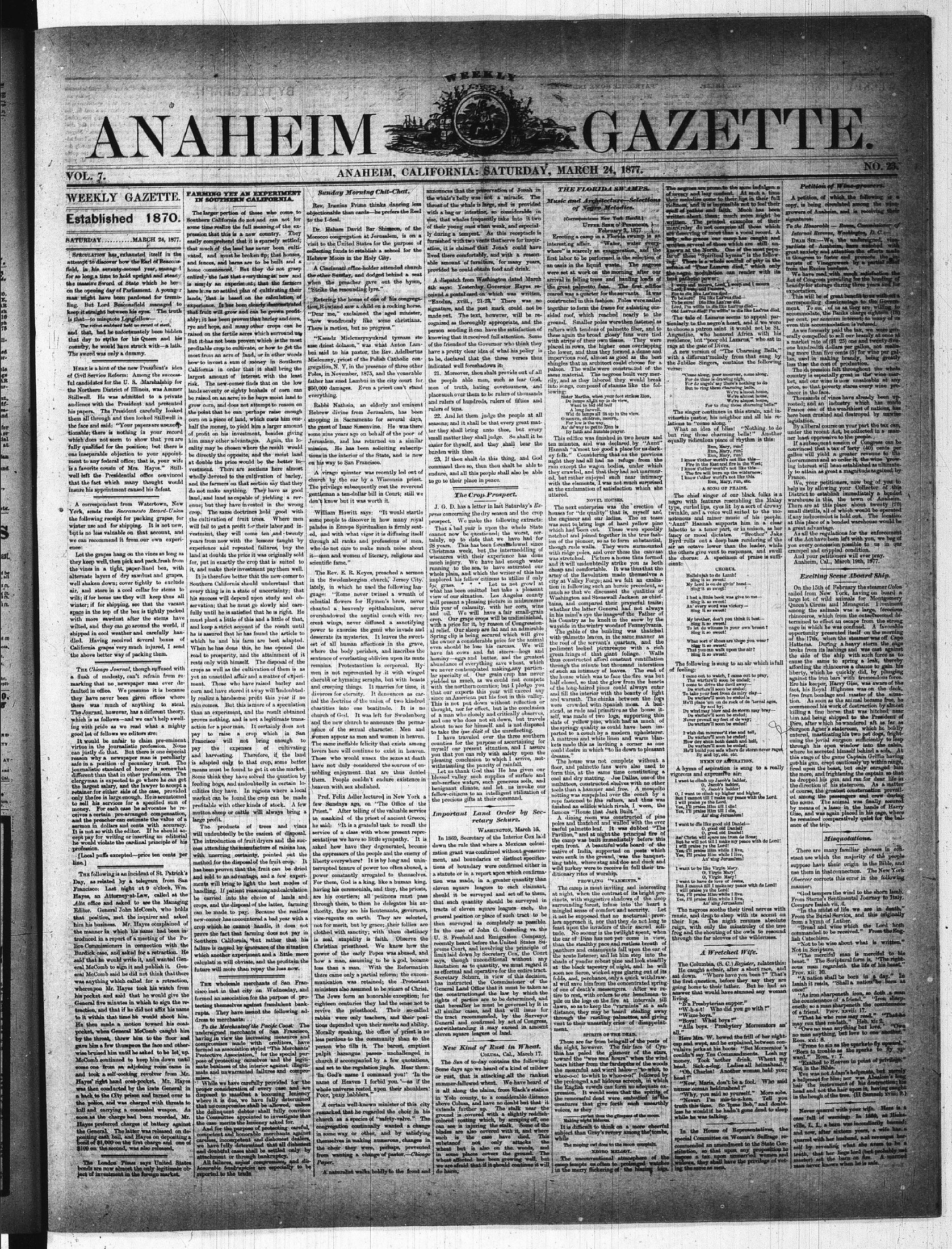
Searchable text
WEEKLY GAZETTE.
Established 1870.
SATURDAY...MARCH 24, 1877.
Speculation has exhausted itself in the attempt to discover how the Earl of Beaconsfield, in his seventy-second year, managed for so long a time to hold upright and steady the massive Sword of State which he borne on the opening day of Parliament. A younger man might have been pardoned for trembling. But Lord Beaconsfield managed to keep it straight between his eyes. The truth is that—to misquote Longfellow—
The velvet sackhard held no sword of steel, and that, had he unfortunately been bidden that day to strike for his Queen and his country, he would have struck with—a lath. The sword was only a dummy.
Here is a hint of the new President's idea of Civil Service Reform: Among the successful candidates for the U.S. Marshalship for the Northern District of Illinois, was Ammer Stillwell. He was admitted to a private audience with the President and presented his papers. The President carefully looked them all through and then looked Stillwell in the face and said: "Your papers are unexceptionable; there is nothing in your record which does not seem to show that you are fully qualified for the position; but there is one inseparable objection to your appointment to any federal office; that is, your wife
FARMING YET AN EXPERIMENT IN SOUTHERN CALIFORNIA.
The larger portion of those who come to Southern California do not and can not for some time realize the full meaning of the expression that this is a new country. They easily comprehend that it is sparsely settled; that much of the land has never been cultivated, and must be broken up; that houses, and fences, and barns are to be built and a home commenced. But they do not grasp entirely the fact that everything is new and is simply an experiment; that the farmers here have no settled plan of cultivating their lands, that is based on the calculation of experience. It has been clearly demonstrated that fruit will grow and can be grown profitably; it has been proven that barley and corn, rye and hope, and many other crops can be raised on the fertile acres which surround us. But it has not been proven which is the most profitable crop to cultivate, or how to get the most from an acre of land, or in other words how to invest a sum of money in Southern California in order that it shall bring the largest amount of interest with the least risk. The new-comer finds that on the low lands seventy or eighty bushels of corn can be raised on an acre; so he buys moist land to grow corn, and does not attempt to reason on the point that he can perhaps raise enough corn on a piece of land, which costs him one-half the money, to yield him a larger amount of profit on his investment, besides giving him many other advantages. Again, the locality may be chosen where the result would be directly the opposite, and the moist land at double the price would be the better in-
Here is a hint of the new President's idea of Civil Service Reform: Among the successful candidates for the U.S. Marshalship for the Northern District of Illinois, was Ammer Stillwell. He was admitted to a private audience with the President and presented his papers. The President carefully looked them all through and then looked Stillwell in the face and said: "Your papers are unexceptionable; there is nothing in your record which does not seem to show that you are fully qualified for the position; but there is one inseparable objection to your appointment to any federal office; that is, your wife is a favorite cousin of Mrs. Hayes." Stillwell left the Presidential office convinced that the fact which many thought would insure his appointment caused his defeat.
A correspondent from Watertown, New York, sends the Sacramento Record-Union the following receipt for packing grapes for winter use and for shipping. It is not new, but is no less valuable on that account, and we can recommend it from our own experience:
Let the grapes hang on the vines so long as they keep well, then pick and pack fresh from the vines in a tight, paper-lined box, with alternate layers of dry sawdust and grapes, well shaken down; cover tightly to exclude air, and store in a cool cellar for stems to wilt; if for home use they will keep thus all winter; if for shipping, see that the vacant space in the top of the box is tightly packed with more sawdust after the stems have wilted, and they can go around the world, if shipped in cool weather and carefully handled. Having received several boxes of California grapes very much injured, I send the above better way of packing them.
The Chicago Journal, though suffused with a flush of modesty, can't refrain from remarking that no newspaper man ever defaulted in office. We presume it is because they have never been given offices where there was much of anything to steal. The Journal, however, has a different theory, which is as follows—and we can't help swelling with pride as we read what a mighty good lot of fellows we editors are:
It would be unfair to claim pre-eminent virtue in the journalistic profession. None can justly do that. But there is one especial reason why a newspaper man is peculiarly safe in a position of pecuniary trust. The journalistic standard of honor is somewhat different than that in other professions. The clergyman is expected to go where he can get the largest salary, and the lawyer to accept a retainer for either side of the case, provided only the fee is large enough. He is accustomed to sell his services for a specified sum of money. For each case he advocates he receives a certain pre-arranged compensation, and the preacher can estimate the value of a sermon in dollars and cents with accuracy. It is not so with the editor. If he should accept pay for writing or inserting an editorial he would violate the cardinal principle of his profession.
[Local puffs excepted—price ten cents per line.]
The following is an incident of St. Patrick's Day, as related by a telegraph from San Francisco in order that it shall bring the largest amount of interest with the least risk. The new comer finds that on the low lands seventy or eighty bushels of corn can be raised on an acre; so he buys moist land to grow corn, and does not attempt to reason on the point that he can perhaps raise enough corn on a piece of land, which costs him one-half the money, to yield him a larger amount of profit on his investment, besides giving him many other advantages. Again, the locality may be chosen where the result would be directly the opposite, and the moist land at double the price would be the better investment. There are sections here almost wholly devoted to the cultivation of barley, and the farmers on that section say that they do not make anything. They have as good land, and land as capable of yielding a revenue; but they have invested in the wrong crop. The same doctrines hold good with the cultivation of fruit trees. Where men will fail to get a profit for their labor and investment, they will come ten and twenty years from now with the lessons taught by experience and repeated failures, buy the land at double the price it was originally sold for, put in exactly the crop that is suited to it, and make their investment pay them well.
It is therefore better that the new-comer to Southern California should understand that everything is in a state of uncertainty; that his success will depend upon study and observation; that he must go slowly and carefully until he is satisfied that he is right. He must plant a little of this and a little of that, and keep a strict account of the result until he is assured that he has found the article to which he and his farm are best adapted. When he has done this, he has opened the road to prosperity, and the attainment of it rests only with himself. The disposal of the crops as well as the cultivation of them is as yet an unsettled affair and a matter of experiment. Those who have raised barley and corn and have stored it away will undoubtedly realize a handsome profit this year if no rain comes. But this is more of a speculation than an experiment, and the result obtained proves nothing, and is not a legitimate transaction for a poor man. It certainly does not pay to raise a crop which in San Francisco will not bring enough to pay the expenses of cultivating and harvesting. Therefore, if the land is adapted only to that crop, some better means must be found to get it on the market. Some think they have solved the question by feeding hogs, and undoubtedly in certain localities they have. In regions where a local market can be found the crop can be made profitable with other kinds of stock. A few mutton sheep or cattle will always bring a large profit.
The products of trees and vines will undoubtedly be the easiest of disposal. The introduction of fruit dryers and the success attending the manufacture of raisins has with unerring certainty, pointed out the method for the disposal of the fruit crop. It has been proven that the fruit can be dried and sold to an advantage, and a few experi-
gations in N.Y., in November father has sued L.L.P.$50,000 damages everything.
Rabbi Nathsinin, Hebrew divine frist stopping in Sacra-the guest of Isaac S some nine years ago Jerusalem, and his mission. He has tended in the interior on his way to San-David.
A virago spinster church by the ea-The privilege subsiste gentleman a ten-don't know but it.
William Howitt some people to dis-palades in Europe ed, and with what through all ranks who do not care t it—men and women scientific fame."
The Rev. E.R. in the Swedenbor lately, in which guage: "Rome n celestial flowers chanted a heav-overshadowed therent wings, nev- power to exorcise desecrate its mystic est of all human where the body sentence of everlast remains. Protest-men is not repre-cherubs or hymnni-and creeping thine divores for etern althe doctrine o chasties into o church of God.
and the new chur-gence of the sex women appear as such.
The same ineffabl-lovers here will co-Those who would have not duly c o nobling enjoyment them. People co-heaven with sex
Prof. Felix Adle few Sundays ag Priest." After t to mankind of he said: "It is a service of a class sentatives we have asked how have he oppressors o liberty everywhere terrupted tenure power constantl-For them God!
the largest salary, and the lawyer to accept a retainer for either side of the case, provided only the fee is large enough. He is accustomed to sell his services for a specified sum of money. For each case he advocates he receives a certain pre-arranged compensation, and the prescriber can estimate the value of a sermon in dollars and cents with accuracy. It is not so with the editor. If he should accept pay for writing or inserting an editorial he would violate the cardinal principle of his profession.
[Local puffs excepted—price ten cents per line.]
The following is an incident of St. Patrick's Day, as related by a telegram from San Francisco: Last night at 9 o'clock, Wm. Hayes, an Attorney-at-Law, called at the Alta office and asked to see the Managing Editor. General John McComb, who holds that position, met the inquirer and asked him his business. Mr. Hayes complained of the manner in which his name had been introduced in a report of a meeting of the Police Commissioners in connection with the Burdick case, and asked for a retraction. He said that he would write it, and wanted General McComb to sign it and publish it. General McComb said he did not think that there was anything which called for a retraction, whereupon Mr. Hayes took his watch from his pocket and said that he would give the General five minutes in which to sign the retraction, and that if he did not affix his name to it within that time he would shoot him. He then made a motion toward his coat-pocket, when General McComb caught him by the throat, threw him to the floor and gave him a few thumps on the face and otherwise bruised him until he asked to be let up. McComb continued to keep him down until some one from an adjoining room came in and took a self-cooking revolver from Mr. Hayes' right hand coat-pocket. Mr. Hayes was then conducted by the irate General in a hack to the City prison and turned over to the police, and was charged with threats to kill and carrying a concealed weapon. As soon as the charge had been recorded, Mr. Hayes preferred charges of battery against the General. The latter was released on depositing cash bail, and Hayes on depositing a bond of $1,000 on the first charge and one of $100 on the second, was also released.
The London Times says United States bonds are now almost the only legitimate object of investment in the foreign market.
The products of trees and vines will undoubtedly be the easiest of disposal. The introduction of fruit dryers and the success attending the manufacture of raisins has, with unerring certainty, pointed out the method for the disposal of the fruit crop. It has been proven that the fruit can be dried and sold to an advantage, and a few experiments will bring to light the best modes of handling. If patient reasoning and calculation be carried into the choice of lands and crops, and the disposal of the latter, farming can be made to pay. Because the restless new-comer has encountered a bad year with a crop which he cannot handle, it does not prove the fact that farming does not pay in Southern California, but rather that his failure is caused by ignorance of the situation which another experiment and a little more calculation will obviate, and the profits in the future will more than repay the loss now.
The wholesale merchants of San Francisco met in that city on Wednesday, and formed an association for the purpose of protecting themselves against fraudulent bankrupts. They have issued the following address to merchants:
To the Merchants of the Pacific Coast: The undersigned merchants of San Francisco, having in view the increasing measures and compromises made with creditors, have formed an association styled "The Merchants' Protective Association," for the special purpose of protecting ourselves and the legitimate business of the interior against illegitimate and unwarranted failures and compromises.
While we have carefully provided for the proper consideration of every case and are disposed to manifest a becoming leniency where it is due, we have fully determined that no compromise shall be allowed, unless the delinquent debtor shall fully convince the Committee appointed to investigate that the case merits the leniency asked for.
And for the purpose of protecting careful, competent and honorable merchants against careless, incompetent and dishonest dealers, we have fully determined that all dishonest and doubtful cases shall be settled only by attachment or through bankruptcy.
All failures, unjust compromises, and dishonorable bankrupts are especially to be reported to the trade.
Prof. Felix Adkins few Sundays again Priest." After this to mankind of he said: "It is a service of a class sentatives we have asked how have the oppressors of liberty everywhere terrupted tenure power constantly. For them, God in having his ceremonies are his courtier through them, to thority, they are vice-regents on not for merit, but clothed with same is zeal, stupid Christian priest power of the earth how a man, assess less than a man there came only munication was ministers also as The Jews form eighteen centuries revive the prerequisites depended Morally speaking less perilous to person who fill pulpit harangement church if accompany set to the re- In God's name name of Heaven whole universe Poor, puny baby
A certain well remarked that church as a space congregation coined in some way on themselves in mills the choir they from wanting Paper.
A naturalist
ANAHEIM, CALIFORNIA: SATURDAY, MARCH 24, 1877.
Sunday Morning Chit-Chat.
Rev. Iranius Prime thinks dancing less objectionable than cards—he prefers the Reel to the I-deal.
Dr. Haham David Bar Shimeon, of the Morocco congregation at Jerusalem, is on a visit to the United States for the purpose of collecting funds to establish a school for the Hebrew Moors in the Holy City.
A Cincinnati office-holder attended church the other Sunday, and dodged behind a seat when the preacher gave out the hymn, "Strike the resounding lyre."
Entering the house of one of his congregation Rowland saw a child on a rocking horse. "Dear me," exclaimed the aged minister, "how wondrously like some christians. There is motion, but no progress."
"Kaealz Mielcuszynyukrad tyznam sto szze dziest dolason," was what Anton Lambui said to his pastor, the Rev. Adelbertus Mielczuzny, priest of the Polish Catholic congregation, N. Y., in the presence of three other Poles, in November, 1875, and the venerable father has sued Lambui in the city court for $50,000 damages. Even a priest can't stand everything.
Rabbi Nathsin, an elderly and eminent Hebrew divine from Jerusalem, has been stopping in Sacramento for several days, the guest of Isaac Sissenvine. He was there some nine years ago on behalf of the poor of Jerusalem, and has returned on a similar mission. He has been soliciting subscriptions in the interior of the State, and is now on his way to San Francisco.
announces that the preservation of Jonah in the whale's belly was not a miracle. The throat of the whale is large, and is provided with a bag or intestine, so considerable in size, that whales frequently take into it two of their young ones when weak, and especially during a tempest. As this receptacle is furnished with two vents that serve for inspiration, it is claimed that Jonah could have lived there comfortably, and with a reasonable amount of furniture, for many years, provided he could obtain food and drink.
A dispatch from Washington dated March 4th says: Yesterday Governor Hayes received a postal card on which was written, "Exodus, xviii., 21-23." There was no signature, and the post mark could not be made out. The text, however, will be recognized as thoroughly appropriate, and the person sending it can have the satisfaction of knowing that it received full attention. Some of the friends of the Governor who think they have a pretty clear idea of what his policy is to be, declared that the three verses thus indicated well foreshadowed it:
21. Moreover, thou shalt provide out of all the people able men, such as fear God, men of truth, hating covetousness, and place such over them to be rulers of thousands and rulers of hundreds, rulers of fifties and rulers of tens.
22. And let them judge the people at all seasons; and it shall be that every great matter they shall bring unto those, but every small matter they shall judge. So shall it be easier for thyself, and they shall bear the burden with thee.
23. If thou shalt do this thing, and God commanded so then thou shalt be able to
THE FLORIDA SWAMPS.
Music and Architecture—Selections of Negro Melodies.
[Correspondence New York Herald]
Upper Sink o' Penhoorka
February 3, 1877.
Erecting a camp in a Florida swamp is an interesting affair. "Water, water everywhere" is scarcely an exaggeration, and the first labor to be performed is the selection of an oasis in the liquid waste. The negroes were set at work on the morning after our arrival in falling trees and hauling loads of the great palmetto fans. The first edifice reared was a quarter for the servants. It was constructed in this fashion: Poles were nailed together to form the frame for sallanting one-sided roof, which reached nearly to the ground. Smaller poles were then fastened as rafters with tendons of palmetto fiber, and to these again the broad glossy fans were tied with strips of their own tissue. They were placed in rows, the higher ones overlapping the lower, and thus they formed a dense and impervious roof, almost as good as the best shingles that an architect could choose for a palace. The walls were constructed of the same material. The negroes built very merily, and as they labored they would break into songs, composed of stanzas like the following:
Sister Martha, when your foot strikes Zion,
De lamps all lit up in de view,
Want to bid old civil
A long farwell,
Wid do lamps all lit up in the view.
O mourn, children,mourn,
For low is the way,
An'de'way to get to Zion is
By faith and humble prayer.
This edifice was finished in two hours and ten minutes, and was declared by "Aunt" Hannah "a'most too good a place for us darkey folk." Considering that on the previous night they had all had no refuge from the present weather conditions under which
The walls were constructed of the same material. The negroes built very merily, and as they labored they would break into songs, composed of stanzas like the following:
Sister Martha, when your foot strikes Zion,
De lamps all sit up in de view,
Want to bld old wall
A long farwell.
Wid do lamps all lit up in the view.
O mourn, children, mourn,
For low is the way.
An'de way to get to Zion is
By faith and humble prayer.
This edifice was finished in two hours and ten minutes, and was declared by "Aunt" Hannah "a most too good a place for us darkey folk." Considering that on the previous night they had all had no refuge from the rain except the wagon bodies, under which they crawled, and that they had not murmured, but rather enjoyed such near intimacy with the elements, I was not much surprised at the exclamation of satisfaction which she uttered.
NOVEL HOUSES.
The next enterprise was the erection of houses for "de quality" that is, myself and the engineer and our ladies. The ox team was sent to bring logs of hard yellow pine which had been cut. These were speedily notched and joined together in the true fashion of the pioneer, so as to form substantial, though rule walls. They were surmounted with ridge poles, and over these the canvass was stretched. Picture a house thus formed and it will undoubtedly strike you as both cheap and comfortable. It was thus that the army of the Revolution made themselves a city at Valley Forge; and we felt an exaltation in following such an heroic precedent, so much that we discussed the qualities of Washington and Stonewall Jackson as chiefs, and compared their prayerful traits; whether the latter General had not always in his mind's eye the image of the Father of his Country as he knelt in the snow by the wayside in the wintry woods of Pennsylvania.
The gable of the building was thatched with palmetto leaves, in the same manner as the roof of the servant's quarters, and the pediment looked picturesque with a rich green fringe of that giant foliage. Walls thus constructed afford constant ventilation through the minute but thousand interstices of such an intimacy of leaves. The end of the house which was to face the fire was but half closed, so that the glow from the hearts of the long-haired pines could always enter and till the interior with the beauty of light and warmth. The chinks between the logs were crowded with Spanish moss. A bedstead, as rude and primitive as the house itself, was made of two logs, supporting thin slats of yellow pine, which had as much of the springy quality as could have been imparted to a couch by a modern upholsterer. A mattress and white linen and warm blankets made this as inviting a corner as one could desire in which "to lie down to pleasant dreams."
The house was not complete without a floor, and palmetto fans were also used to form this, at the same time constituting a cool and dry matting. Joe Dallas, one of the mulattoes, constructed shelves with no other tools than a hammer and free. A mosquito netting was suspended over the couch by a rope fastened to the rafters, and thus was finished an edifice which rivals I ween, the famous "House that Jack Built."
A dining room was constructed of pine poles and thatched and walled with the ever useful palmetto leaf. It was dubbed "The Pavilion," and at night the principal fire of the camp was built immediately before this open front. A beautiful wide board of the native of India, supported on posts which were sunk in the ground, was the banqueting table, where stag and doe and duck and wild turkey were to receive in full their traditional rites of worship.
PROWLING "VARIMINTS."
Prof. Felix Adler lectured in New York a few Sundays ago, on "The Office of the Priest." After telling of the valuable service to mankind of the priest of ancient Greece, he said: "It is a grateful task to recall the service of a class with whose present representatives we have so little sympathy. It is asked how have they degenerated, become the oppressors of the people and the enemy of liberty everywhere? It is by long and uninterrupted tenure of power too often abused, a power constantly arrogated to themselves. For them, God is a king, like a human king, having his ceremonials, and they, the priests, are his courtiers; all petitions must pass through them, to them he delegates his authority, they are his lieutenants, governors, vice-regents on earth. They are selected, not for merit, but by grace; their follies are clothed with sanctity; with them obstinacy is zeal, stupidity is faith. Observe the Christian priesthood. We know how the power of the early Popes was abused, and how a man, assuming to be a god, became less than a man. With the Reformation there came only a partial reform; the excommunication was retained; the Protestant ministers also assumed to be vicars of Christ. The Jews form an honorable exception; for eighteen centuries they had the sense not to revive the priesthood. Their so-called rabbis were only teachers, and their positions depended upon their morals and ability. Morally speaking, the office of priest is no less perilous to the community than to the person who fills it. The barest, emptiest pulpit harangue passes unchallenged in church if accompanied by a few quotations, and set to the regulation jingle. Hear them: 'In God's name I command you!' In the name of Heaven I forbid you.'—as if the whole universe rested upon their shoulders! Poor, puny habblers."
A certain well-known minister of this city remarked that he regarded the choir in his church as a species of "safety-valve." The congregation continually wanted a change in some way or other, and by satisfying themselves in making numerous changes in the choir they were, perhaps, prevented from wanting a change of pastor.—Chicago Paper.
A naturalist walks boldly to the front and
Important Land Order by Secretary Schurz.
WASHINGTON, March 10.
In 1869, Secretary of the Interior Cox laid down the rule that where a Mexican colonization grant was confirmed without measurement, and boundaries or distinct specifications of boundary were confirmed either in a statute or in a report upon which confirmation was made, in a greater quantity than eleven square leagues to each claimant, should it be surveyed and set off to them, that such quantity should be surveyed in tracts of eleven square leagues each, the general position or place of such tract to be then surveyed as completely as possible. In the case of John G. Gameling vs. the U.S. Freehold and Emigration Company, recently heard before the United States Supreme Court, and involving the principle of limit laid down by Secretary Cox, the Court says, though unconditional without any limitation as to quantity, we must regard it as effectual and operative for the entire tract. Secretary Schurz, in view of this decision, has instructed the Commissioner of the General Land Office that it must be taken as the construction of the law by which the rights of parties are to be determined, and that hereafter he must be governed by it in all similar cases, and that will issue for the tract recommended, by the Surveyor General and confirmed by act of Congress, notwithstanding it may exceed in amount eleven square leagues of land.
New Kind of Rust in Wheat.
Colusa, Cal., March 17.
The Sun of to-day contains the following; Some days ago we heard of a kind of mildew or rust, that is attacking all the rankest summer-fallowed wheat. We have heard of it all along the plains, from Black's station in Yolo county, to a considerable distance above Colusa, and have no doubt but that it extends further up. The stalk near the ground is covered with a slightly reddish-colored coating which, by scraping off, one can see is injuring the stalk. Some of the blades are also covered with it, and where such is the case have died. This substance not only attacks the wheat but is also on the weeds, and in some places covers the ground. The wheat affected has been growing well, but we are afraid that if it should continue it will do harm.
Spirits of the Dead.
These are far from being all of the pests of the night, however. The fair face of Cynthia has paled the glamour of the stars toward the "wee sma hours" when the wind bears hither from the far depths of the woods the mournful and wierd haloo—"to whit, to whoo-o-o!" to whit to whoo-o-o!" followed by the prolonged and hideous screech, in which the English vowels can form no adequate expression. It would seem that the spirits of the remorseful dead were embodied in these creatures that give forth such unearthly voices, as they
revient thus the gloomness of the moon.
Making night bideens.
It is difficult to think on a more cheerful subject than Gray's reverry among the tombs,
while
The moping owl does to the moon complaints.
XERO MELODY.
The unconventional atmosphere of the camp lampts us often to prolong watches in the merry flickering of the blaring logs.
GAZETTE.
NO. 23.
The negroes are proud to the same indulgence of luxury and lazy content. At such a time their melodies come to their lips in their full richness, and it is impossible not to feel their spell of pathos and faith. Much has been written about them; much more might be written. The printed examples of their minstrelsy do not comprise all those which are deserving of more than a vocal record. A lady who greets our camp has caught and written several of those which are still unknown at the North. One of the most popular of these "Spiritual hymns" is the following: There is a whole soulful of pity in the admin of "Poor Lazarus died," which only the nage modulation can render with its time pathetic power:
I weep and mourn, Lord, I weep and I mourn,
Lord, I weep and Favour,
For to die like Lazarus died—
To be sure! Die like Lazarus died—
To be sure! Die like Lazarus died—
Lord, I'm willing to die like Lazarus died—
Old Lazarus died! I'm willing to die like Lazarus died.
The tale of Lazarus seems to appeal particularly to the negro's heart, and if we were to choose a patron saint it would not be St. Augustine, who honored Africa with his residence, but "poor old Lazarus," who sat in rags at the gate of Dives.
A new version of "The Charming Bells," with a different melody from that sung by the Jubilee Singers, contains the following verse:
"Come along, poor mourner, come along,
For de time is drawing nigh,
For de angels' say there's nothing to do
But to ring them charming bells.
We're almost home,
We're almost home,
We're almost home,
For to ring those charming bells!"
The singer continues in this strain, and invites his pastor, his neighbor and all his relations to "come along."
What an idea of bliss! "Nothing to do but ring those charming bells!" Another equally ridiculous piece of rhythm is this:
Run, Mary, run!
Run, Mary, run!
Run, Mary, run!
I know 'other world's not like this—
Fire in the East and fire in the West;
Petition of Wine-growers.
A petition, of which the following is a copy, is being circulated among the wine-growers of Anahaim, and is receiving their signatures:
To the Honorable — Rams, Commissioner of Internal Revenue, Washington, D.C.:
DEAR SIR—We, the underigned vineyardists of Anahaim, have watched with great anxiety and attention the efforts made in Congress to foster and promote the interests of Vinagrowers by a partial relief from the Excise burdens.
We have read with much satisfaction the Act of Congress providing for the handling of brandy for storage during three years and for exportation.
This will be of great benefit to us without a corresponding disadvantage to the Government. To succumption of us as they are willing to accommodate, the Banika charge eightion (18) per cent, per annum interest; to many of us even this accommodation is refused.
As we formerly paid the tax, we were generally compelled to sell our brandy at once at a market rate of $(91.25)$ one and twenty-five-one hundredth dollars per gallon, not realizing more than five cents (5) for wine per gallon, used in making brandy, being greatly less than the cost of production.
The depression felt throughout the whalis country is especially great in the wine market, and our wine is now unsalable at any price, so that poverty stares every wine producer in the face.
Thousands of vines have already been uprooted; and an industry which has made France one of the wealthiest nations, has here been crushed and destroyed by unwise legislation.
By aliberal course on your part the tax can, under the recent Act, be collected in a manner least oppressive to the people.
If a subsequent session of Congress can be convinced that a tax of forty (40) cents per gallon will yield a greater revenue to the Government and so order it, the wine grower interest will also be established as ultimate.
The image contains a historical newspaper article with the following text:
"negress built very merboried they would break
of stanzas like the follil lit up in the view.
mourn,
way.
to Zion is
unable prayer.
finished in two hours and
was declared by "Aunt"
to good a place for us darkring that on the previous
had no refuge from the
agon bodies, under which
that they had not murmured such near intimacy
I was not much surprised
of satisfaction which she
EL HOUSES.
rise was the erection of
unity" that is, myself and
our ladies. The ox team
bogs of hard yellow pine
together in the true fashso as to form substantial.
They were speedily
and over these the canvass
picture a house thus formed
totally strike you as both
stable. It was thus that the
mation made themselves a
race; and we felt an exaltwhich an heroic precedent, so
discussed the qualities of
somewall Jackson as chiefled their prayerful traits;
General had not always
the image of the Father of
knelt in the snow by the
berry woods of Pennsylvania.
The building was thatched
lies, in the same manner as
grant's quarters, and the
picturesque with a rich
giant foliage. Walls
afford constant ventilation
but thousand interstices
by of leaves. The end of
as to face the fire was but
the glow from the hearts
pinces could always enter
with the beauty of light
chinks between the logs
in Spanish moss. A bedprimitive as the house it
two logs, supporting thin
line, which had as much of
as could have been imby a modern upholsterer.
white linen and warm blaninviting a corner as one
which 'to lie down to pleasant
not complete without a
fans were also used to
same time constituting a ring. Joe Dallas, one of the
acted shelves with no other
other and free. A mosquito
ended over the couch by a
rafters, and thus was
which rivals, I ween, the
last Jack Built."
It was constructed of pine
and walled with the everaf. It was dubbed "The
night the principal fire of it immediately before this beautiful wide board of the supported on posts which ground, was the banquetstag and doe and duck and to receive in full their traworship.
ING "VARMINTS.""
verse:
"Come along, poor mourner, come along,
For de time is drawing night,
For de angels say there's nothing to do
But to ring them charming bells.
We're almost home,
We're almost home,
We're almost home,
For to ring those charming bells"
The singer continues in this strain, and invites his pastor, his neighbor and all his relations to "come along."
What an idea of bliss! "Nothing to do but ring those charming bells!" Another equally ridiculous place of rhythm is this:
Run, Mary, run!
Run, Mary, run!
Run, Mary, run!
I know t'other world's not like this—Fire in the East and fire in the West;
I know t'other world's not like this—The fire will burn up the wilderness;
I know t'other world's not like this.
Run, Mary, run, etc.
A SONG OF PRAISE.
The chief singer of our black folks is a negro with features resembling the Malay type, curled lips, eyes lit by a sort of drowy twinkle, and a voice well suited to the mottonous and minor music of his people.
"Aunt" Hannah supports him in a clear falsetto to a tenor part, or in unison, as her fancy or mood dictates. "Brother" Jake Byrd rolls out a deep bass rendering of the air an octave lower than the leader, while the others give vent to responses, and swell the chorus: A specimen of praise is sufficient:
CHORUS.
Hallelujah to de Lamb!
Sing it so sweet!
My Lord is on de glivin' hand—
Sing it so sweet!
I had a little book was give to me—Sing it so sweet!
An' every word was victory—Sing it so sweet!
My brother, don't you think it best—Sing it so sweet!
To let do witness in your own breast?
Sing it so sweet!
What sort o' shores are those you wear?
Sing it so sweet!
That you can walk upon the air?
Sing it so sweet!
The following is sung to an air which is full of feeling:
I came out to watch, I came out to pray,
The warfare soon be ended!
I come to drive the devil away—De warfare soon be ended!
To take your feet from de miry clay—De warfare soon be ended!
He'll place 'em on de rock of de 'ternal ages,
By day!
De wind may blow and de storm may bray—De warfare soon be ended!
Never prevail my foot of de way;
De warfare soon be ended!
I wish dat mourner'd rise and tell,
Do warfare soon be ended!
How de shun both death and hall,
De warfare soon be ended!
He'll build you safe where de storm never rages.
By and by, etc. etc.
HYMN OF ASTRIFICATION.
A hymn of aspiration is sung to a really vigorous and expressive air:
I want to climb up Jacob's ladder,
O, Jacob's ladder,
O, Jacob's ladder!
O, I want to climb up higher and higher,
But I cannot till I make my peace with the Lord.
I will praise ye the Lord.
Yes, I'll praise Him till I die!
Yes, I'll praise Him till I die,
An' sing Jerusalem!
I want to die like good old Daniel—O, good old Daniel!
O, good old Daniel!
An' Christ will spare me from de lions;
But he will not till I make my peace with de Lord!
I will praise ye the Lord!
Yes, I'll praise Him while I live,
Yes, I'll praise Him while I live,
An' sing Jerusalem!
The depression felt throughout the whale country is especially great in the wine market, and our wine is now unscalable at any price, so that poverty stares every wine producer in the face.
Thousands of vines have already been uprooted; and an industry which has made France one of the wealthiest nations, has here been crushed and destroyed by unwise legislation.
By aliberal course on your part the tax can, under the recent Act, be collected in a manner least oppressive to the people.
If a subsequent session of Congress can be convinced that a tax of forty (40) cents per gallon will yield a greater revenue to the Government and so order it, the wine growing interest will be so established as ultimately to attain as great a magnitude againged by France.
We, your petitioners, now beg of you to help us by allowing your Collector of this District to establish immediately a bouldered warehouse in this, the town of Anaheim. There are at this place about twenty (20) small distills, all of which would be operated if any inducement is held out. The location at this place of a bouldered warehouse would be a great advantage.
As all the regulations for the enforcement of the Act have been left with you, we beg of you every concession possible to us in our cramped and crippled condition.
And your petitioners will ever pray.
Anaheim, Cal., March 19th, 1877.
Exciting Scene Aboard Ship.
On the 15th of February the steamer Colon sailed from New York, having on board a large lot of wild animals for Montgomery Queen's Cirrus and Menagerie. Frominent among the animals was a large forcious rhinoceros, which from the outsfeemed determined to effect an escape from the strong cage in which he was confined. A favorable opportunity presented itself on the morning of the 17th, when the steamer was off Cape Hatteras. During a heavy storm the cage broke from its lashings and was cast against the side of the ship with such force as to cause the same to spring a leak, thereby affording the rhinoceros a chance to gain his liberty, which he quickly did, by plunging against the iron bars with tremendous force. Ere his keeper, Harry Gise, was aware of the fact, his Royal Highness was on the deck, free from bondage and master of the situation. As soon as the animal became free, he commenced his work of destruction by almost killing a fine horse that was hitched near him and being shipped to the President of Dorn after which he wandered aft as far as Surgeon Agner's statateroom, which he boldly entered, mastering his two pet dogs, frightening the jovial surgeon sufficiently to leap through his open window into the cabin, where he secreted himself behind a sofa. At this stage of the game Captain Griffin having gob his gun, crept cautiously up within range, fired upon the beast, but only enraged him more, and frightening the captain so that he dropped his gun and ran for dear life in the direction of his stateroom. As a matter of course, the greatest consternation prevailed among the passengers and crew during the scene. The animal was finally secured by means of a laeso in the hands of Harry Gise, and was again placed in his cage, where he remained comparatively quiet for the balance of the trip.
Misquotations.
There are many familiar phrases in constant use which the majority of people suppose have their origin in the Bible, and use them in that connection. The New York Observer corrects this error in the following
A Wretched Wife.
The Columbia, (S. C.) Register, relates this:
He caught a chair, after a short race, and sat down. "Where have you been?" That's the first question, before they say they are going home to their father. But he had an answer that would have stunned any woman living.
"Bn Presbyterian supper."
"W-h-a-t! Who did you go with?"
"Wizze boys."
"Boys! What boys?"
"Alla boys. Presbytery Morrerators an all."
Here Mrs. W. bowed the frill of her nightcap and wept, and he explained, between convulsive jerks at his boots: "Bet Morrerator's couldn't say Ten Commandments. Losh my money. Took 'nother drink. Whent my head. Sick-a-dog. Ladies all helmahead." Oh, Charles! Another woman held your head?
Now, Maria, don't be a fool. Who said nuzzer coman held mahead?
Why, you said so yourself." More sobs.
Neven I'm mis-ta-a-ken. Tell you truth this time. So Ipme Bob," and doubtless he would if he hadn't gone dead to sleep while he was talking.
In the House of Representatives, the special Committee on Women's Suffrage recommended an amendment to the State Constitution, so that upon any proposition to impose a tax upon unmarried women and widows, they shall have the privilege of voting the same as men.
Misquotations.
There are many familiar phrases in constant use which the majority of the people suppose have their origin in the Bible, and use them in that connection. The New York Observer corrects this error in the following manner:
"God tempers the wind to the shorn lamb. From Sterne's Sentimental Journey to Italy. Compare Isaiah vii, 6.
"In the midst of life we are in death." From the Burial Service, and this originally from a hymn of Luther.
"Bread and wine which the Lord both commanded to be received." From the English Catechism.
"Not to be wise about what is written." Not in Scripture.
"The merciful man is merciful to his beast." The Scriptural form is, "The righteous man regardeth the life of his beast." Prov. xxvii: 10.
"A nation shall be born in a day." In Isaiah it reads, "Shall a nation be born at once."
"As iron sharpeneth iron, so doth a man the countenance of a friend." Iron sharpeness; so a man sharpeneth the countenance of a friend. Prov. xxvii: 17.
"That he who runs may read." That he may run that readeth." Heb. xi: 2.
"Owe no man anything but love." Owe no man anything, but love to one another. Rom. xxi: 8.
"Prone to sin as the sparkto fly upward." Born to trouble as the sparks to fly upward." Rom. v: 7.
"Exalted to Heaven in point of privilege." Not in the Bible.
Eve was not Adam's helpmate, but merely a helpmeet for him; nor was Abalom's long hair the instrument of his destruction; his head and not the hair upon it, having caught in the bough of the tree. (II Samuel; xviii: 9.)