anaheim-gazette 1877-03-10
Scanned page
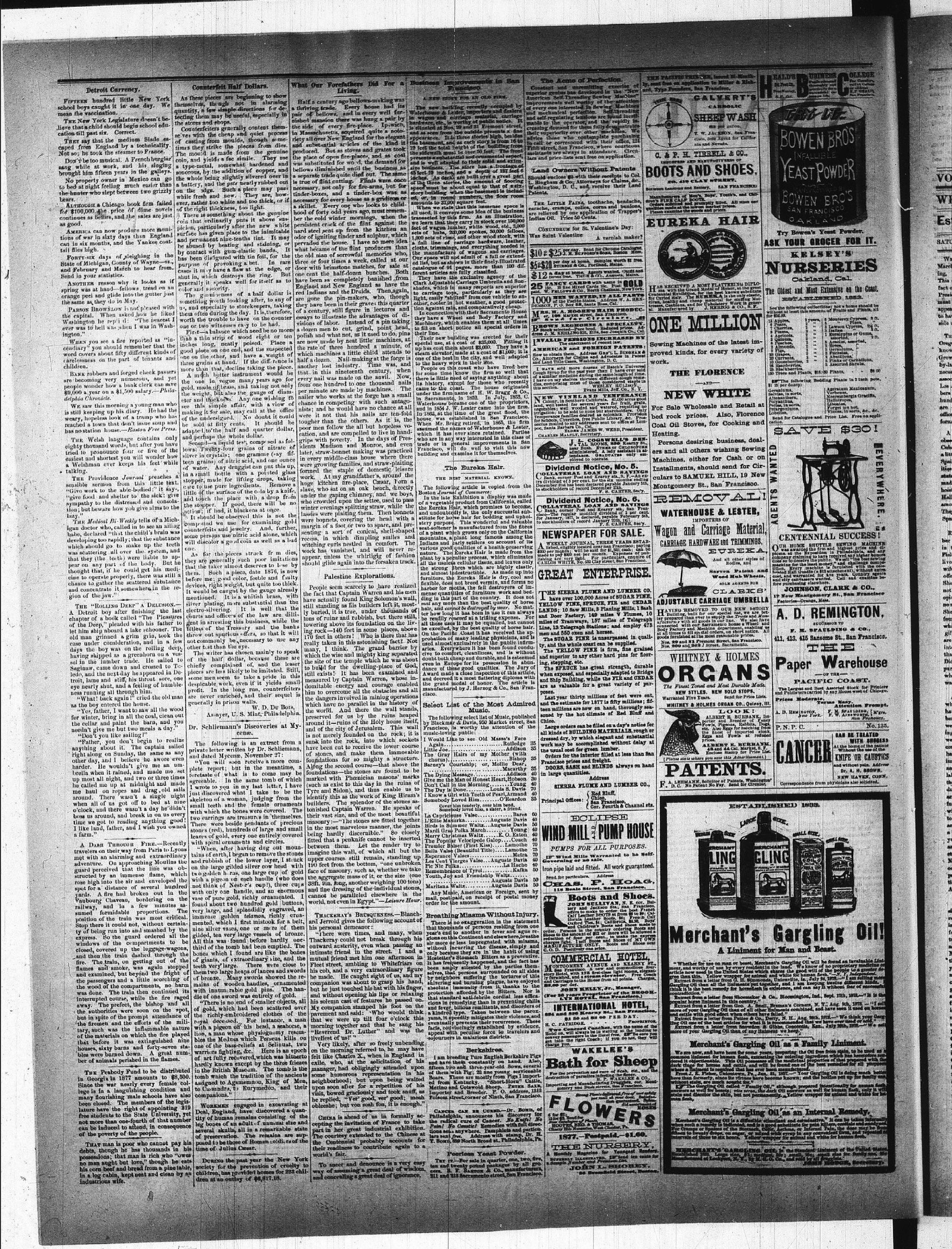
Searchable text
Detroit Currency.
Fifteen hundred little New York school boys caught it in one day. We mean the vaccination.
The New York Legislature doesn't believe that a child should begin school education till past six. Correct.
They say that the medium Slade escaped from England by a technicality. Not so; he took the steamer to France.
Don't be too musical. A French burglar sang while at work, and his singing brought him fifteen years in the galleys.
No property owner in Mexico can go to bed at night feeling much easier than the hunter who slept between two grizzly bears.
Although a Chicago book firm failed for $100,000, the price of dime novels continues as before, and the sales are just as good.
America can now produce more munitions of war in sixty days than England can in six months, and the Yankee coat-tail flies high.
Forty-six days of sleighing in the State of Michigan, County of Wayne—as—and February and March to hear from. Send in your statistics.
Another reason why it looks as if spring was at hand—fellows tread on an orange peel and glide into the gutter just the same as they do in May.
Parson Brownlow is not pleased with the capital. When asked how he liked Washington he replied: "The nearest I ever was to hell was when I was in Washington."
When you see a fire reported as "incendiary" you should remember that the word covers about fifty different kinds of carelessness on the part of tenants and children.
Bank robbers and forged check passers are becoming very numerous, and yet people wonder how a bank clerk can save $9,000 a year on a $1,500 salary. —Philadelphia Chronicle.
We saw this morning a young man who is still keeping up his diary. He had the weary, hopeless look of a tramp who has reached a town that don't issue soup and has no station house. —Easton Free Press.
The Welsh language contains only eighty thousand words, but after you have tried to pronounce four or five of the easiest and shortest you will wonder how a Welshman ever keeps his feet while counterfeit Half Dollars.
As these pieces are beginning to show themselves, though not in alarming quantity, a few simple directions for detecting them may be useful, especially in the stores and shops.
Counterfeiters generally content themselves with the cheap and quiet process of casting from moulds, though sometimes they strike the pieces from dies. The mould is made from the genuine coin, and yields a facsimile. They use a type-metal, somewhat hardened and sonorous, by the addition of copper, and the whole being slightly silvered over in a battery, and the gate neatly rubbed out on the edge. Such a piece may pass while fresh and new. They are, however, rather too white and too thick, or if of the right thickness, too light.
There is something about the genuine coin that ordinarily puts it above suspicion, particularly after the new white surface has given place to the imminitable and permanent nine-tenths tint. It may be abused by heating and staining, or by contact with gum-elastic bands. It has been disfigured with tin foil, for the purpose of provoking a bet. In rare cases it may have a flaw at the edge, or shut in, which destroys the ring. But generally it speaks well for itself as to color and sonority.
The genuineness of a half dollar is something worth looking after, to any of us, and especially to storekeepers, taking them often during the day. It is therefore, worth the trouble to have on the counter one or two witnesses easy to be had.
First—a balance which need be no more than a thin strip of wood eight or ten inches long, neatly poised. Place a good piece on one end, and the suspected one on the other, and have a weight of three grains at hand. If the difference is more than that, decline taking the piece.
A much better instrument would be the one in vogue many years ago for gold, made of brass, and taking not only the weight, but also the gauge of diameter and thickness. Any one wishing to see this simple affair, with a view of making it for sale, may call at the office of the undersigned. No doubt it could be sold at fifty cents. It should be adapted to the half and quarter dollar, and perhaps the whole dollar.
Second—a liquid test, composed as follows: Twenty-four grains of nitrate of silver in crystals; one gramme (say fifteen grains) of nitric acid; and one ounce of water.
What Our Forefather Living
Half a century ago began a thriving trade. Even pair of bellows, and finished mansion there with the side of every fire in Massachusetts, acquired all over New England and substantial articles produced. But as stove placed on open fire-pan was substituted for wool bellows diminished until a separate trade quite did is true of flint cutting necessary, not only for tinder-boxes, and a tinder necessary for every hour a skillet. Every one wood of forty odd years berer the cold winter man persistent crack of the hard steel sent up from odor of igniting tinder pervaded the house. What became of the flint the old man of sorrow three or four times a week door with brimstone made one cent half-dozen have been as complete England and New England Indians and the Dutch are gone the pin-man they have been in their of a century, still figure essays to illustrate their visions of labor. Insta-a dozen men to cut, polish and what not; are now made by nearly the rate of three hours which machines a little half a dozen. Nail-men another lost industry that in nineteenth every nail was made from one hundred to per minute are made nailer who works at chance in competing nists; and he would were not that hit tougher than the other poor men follow the cation, and are compulsive grips with poverty.
Indents Madison and later, straw-bonnet mans in every middle-class were growing familiar
Bank robbers and forged check passers are becoming very numerous, and yet people wonder how a bank clerk can save $0,000 a year on a $1,500 salary.—Philadelphia Chronicle.
We saw this morning a young man who is still keeping up his diary. He had the weary, hopeless look of a tramp who has reached a town that don't issue soup and has no station house.—Easton Free Press.
The Welsh language contains only eighty thousand words, but after you have tried to pronounce four or five of the easiest and shortest you will wonder how a Welshman ever keeps his feet while talking.
The Providence Journal preaches a sensible sermon from this little text. "Give work to the able-bodied;" it says, "give food and shelter to the sick; give sympathy to the distressed and consolation; but beware how you give alms to the lazy."
The Medical Bi-Weekly tells of a Michigan doctor who, called in to see an ailing babe, declared "that the child's brain was developing too rapidly; that the substance which should go to make up the teeth was scattering all over the system, and that they (the teeth) were liable to appear on any part of the body. But he thought that, if he could get his medicine to operate properly, there was still a chance to gather the scattered substance and concentrate it somewhere in the region of the jaw."
The "Rolling Deep" A Delusion.—A Detroit boy after finishing the last chapter of a book called "The Pleasures of the Deep," pleaded with his father to let him ship aboard a lake schooner. The old man grinned a grim grin, took the case under consideration, and in a few days the boy was on the rolling deep, having shipped as a greenhorn on a vessel in the lumber trade. He sailed to Saginaw, came down and crossed to Teledo, and the next day he appeared in Detroit, lame and stiff, his throat sore, one eye nearly shut, and a feeling of humbleness running all through him.
"What! back again!" cried the old man as the boy entered the house.
"Yes, father, I want to saw all the wood for winter, bring in all the coal, clean out the cellar and paint the barn, and you needn't give me but two meals a day."
"Don't you like sailing?"
"Father, you don't begin to realize anything about it. The captain sailed right along on Sunday, the same as any other day, and I believe he swore even harder. He wouldn't give me an umbrella when it rained, and made me set up most all night, and two or three times he called me up at midnight and made me haul on ropes and drag, old sailors around. There wasn't a single night when all of us got off to bed at nine o'clock, and there wasn't a day he didn't boss us around, and break in on us every time we got to reading anything good! I like land, father, and I wish you owned a farm."
A Dash Throough Fire.—Recently travelers on their way from Paris to Lyons met with an alarming and extraordinary adventure. On approaching Moulins the guard perceived that the line was obstructed by an immense flame, which rose high into the air and enveloped the more than that decline taking the piece.
A much better instrument would be the one in vogue many years ago for gold, made of brass, and taking not only the weight, but also the gauge of diameter and thickness. Any one wishing to see this simple affair, with a view of making it for sale, may call at the office of the undersigned. No doubt it could be sold at fifty cents. It should be adapted to the half and quarter dollar, and perhaps the whole dollar.
Second—a liquid test, composed as follows: Twenty-four grains of nitrate of silver in crystals; one gramme (say fifteen grains) of nitric acid, and one ounce of water. Any druggist can put this up in a small bottle with a pointed glass stopper, made for lifting drops, taking care to use pure ingredients. Remove a little of the surface of the coin by a knife, and touch the place with a drop from the stopper. If good, there will be no action; if bad, blacken at once.
It should be observed this is not the compound we use for examining gold counterfeits and jewelry. And further, some persons use nitric acid alone, which will discolor a good coin as well as a bad one.
As for the pieces struck from dies, they are generally such poor imitations that the taker almost deserves to lose by them. Such a piece, date 1876, is now before me; good color, feeble and faulty devices, right weight, but quite too thick. It would be caught by the gauge already mentioned. It is a whitish brass, with silver plating, more substantial than the electro-silvering. It is well that the courts and officers of the law are diligent in arresting this business, while the fellows of the Treasury and the banks throw out spurious offers, so that it will not commonly be necessary to use any other test than the eye.
The writer has chosen mainly to speak of the half dollar because these are chiefly complained of, and the lesser pieces are less likely to be imitated. Still, some men seem to take a pride in this despicable work, even if it yields small profit. In the long run, counterfeiters are never enriched, and their sequel is generally in prison walls.
W. D. Du Bois,
Assayer, U.S.Mint,-Philadelphia.
Dr. Schliemann's Discoveries at Mycenae.
The following is an extract from a private letter written by Dr. Schliemann, and dated Mycenae November 27:
"You will soon receive a more complete report; but in the meantime, a tortaste of what is to come may be agreeable. In the same tomb of which I wrote to you in my last letter, I have just discovered what I take to be the skeleton of a woman, judging from the small teeth and the female ornaments with which the bones were covered. The two earrings are treasures in themselves. There were beside pendants of precious stones (red), hundreds of large and small leaves of gold, every one entirely covered with spiral ornaments and circles.
When, after having dug out mountains of earth, I began to remove the stones and rubbish of the lower layer, I stuck on the large gilded silver cow head with two golden horns, one large cup of gold with a pigeon on each handle (who does more than that decline taking the piece).
A much better instrument would be the one in vogue many years ago for gold, made of brass, and taking not only the weight, but also the gauge of diameter and thickness. Any one wishing to see this simple affair, with a view of making it for sale, may call at the office of the undersigned. No doubt it could be sold at fifty cents. It should be adapted to the half and quarter dollar,
Second—a liquid test, comprised as follows: Twenty-four grains of nitrate of silver in crystals; one gramme (say fifteen grains) of nitric acid, and one ounce of water. Any druggist can put this up in a small bottle with a pointed glass stopper, made for lifting drops, taking care to use pure ingredients. Remove a little of the surface of the coin by a knife, and touch the place with a drop from the stopper. If good, there will be no action; if bad, blacken at once.
It should be observed this is not the compound we use for examining gold counterfeits and jewelry. And further, some persons use nitric acid alone, which will discolor a good coin as well as a bad one.
As for the pieces struck from dies, they are generally such poor imitations that the taker almost deserves to lose by them. Such a piece, date 1876, is now before me; good color, feeble and faulty devices, right weight, but quite too thick. It would be caught by the gauge already mentioned. It is a whitish brass, with silver plating, more substantial than the electro-silvering. It is well that the courts and officers of the law are diligent in arresting this business, while the fellows of the Treasury and the banks throw out spurious offers, so that it will not commonly be necessary to use any other test than the eye.
The writer has chosen mainly to speak of the half dollar because these are chiefly complained of, and the lesser pieces are less likely to be imitated. Still, some men seem to take a pride in this despicable work, even if it yields small profit. In the long run, counterfeiters are never enriched,and their sequel is generally in prison walls.
W. D. Du Bois,
Assayer, U.S.Mint,-Philadelphia.
People seem scarce—the fact that Captain have actually found still standing as firstly buried; it is true tons of ruins and re-towering above its ring rock—140 feet 170 feet in others! really taken in this many; I think... which the wise and site of the tempter build for the dead still exists! It has measured by Captain domitable energy him to overcome all the dangers involved which have no parachute world. And preserved for us around it—ruins oak and of the city of New York is not merely found into the rock have been cut to row of stones,and mounds for sealing Along the second foundation—the marked with Phoca (such as exist to ture Tyre and Sidon), identify this as tha buildings.The spattonished Captain their vast size,and masonry:—"The sea in most marvel being hardly dis fitted that a penknake between them.
Imagine this wall upper courses stilt 190 feet fromthe face of masonry,shethe aggregate ma
A DASH THROUGH FIRE.—Recently travelers on their way from Paris to Lyons met with an alarming and extraordinary adventure. On approaching Moulins the guard perceived that the line was obstructed by an immense flame, which rose high into the air and enveloped the spot for a distance of several hundred yards. A fire had broken out in the Faubourg Chaveau, bordering on the railway, and in a few minutes assumed formidable proportions. The position of the train was most critical. Stop there it could not, without certainty of being run into and smashed by the express. So the guard ordered all the windows of the compartments to be closed, covered up the luggage-wagons, and then the train dashed through the fire. The train, on getting out of the flames and smoke, was again stopped and examined, but beyond the fright of the passengers and a little scorching of the wood of the compartments, no harm was done. The train then continued its interrupted course, while the fire raged away. The prefect, the bishop and all the authorities were soon on the spot, but in spite of the prompt attendance of the firemen and the efforts of the military, such was the inflammable nature of the materials on which the fire played that before it was extinguished nine houses, sixty barns and forty-seven stables were burned down. A great number of animals perished in the flames.
The Peabody Fund to be distributed in Georgia in 1877 amounts to $8,500. Since the war nearly every female college is in a languishing condition and many flourishing male schools have also been closed. The members of the legislature have the right of appointing 210 free students to the State University, yet not more than one-fourth of that number can be induced to attend, in consequence of the poverty of the people.
That man is poor who cannot pay his debts, though he has thousands in his possessions; that man is rich who "owes no man aught but love," though he eats his corn beef and bread from a pine table, in a log cabin, kept neat and clean by an industrious wife.
I wrote to you in my last letter, I have just discovered what I take to be the skeleton of a woman, judging from the small teeth and the female ornaments with which the bones were covered. The two earrings are treasures in themselves. There were beside pendants of precious stones (red), hundreds of large and small leaves of gold, every one entirely covered with spiral ornaments and circles.
"When, after having dug out mountains of earth, I began to remove the stones and rubbish of the lower layer, I struck on the large gilded silver cow head with two golden horns, one large cup of gold with a pigeon on each handle (who does not think of Nestor's cup?), three cups with only one handle, and an enormous vase of pure gold, richly ornamented. I found about two hundred gold buttons, very large, and splendidly engraved, an immense golden telamon, richly cromated, which I first mistook for a belt, nine silver vases, one or more of them gilded, ten very large vessels of bronze. All this was found before hardly one-third of the tomb had been emptied. The bones which I found are like the bones of giants, of extraordinary size, and the teeth very large. There were close to them two large heaps of lances and swords of bronze. Many swords showed the remains of wooden handles, ornamented with innumerable gold pins. The handle of one sword was entirely of gold.
"There is no end of smaller objects, all of gold, which had been scattered over the richly-embroidered clothes of the royal deceased. For instance, a man with a pigeon on his head, a seahorse, a lion, a man whose physiognomy resembles the Medusa which Perseus kills on one of the bass-reliefs at Selinuat, two warriors fighting, &c. Here is an epoch of art fully recovered, which was hitherto hardly known except by the three frizes in the British Museum. The tomb is the tomb which the tradition of the ancients assigned to Agamemnon, King of Men, to Cassandra, to Eurymedon, and their companions."
WORKMEN engaged in excavating at Deal, England, have discovered a quantity of human remains consisting of the leg bones of an adult of unusual size and several skulls, all in a remarkable state of preservation. The remains are supposed to be those of Roman soldiers of the time of Julius Caesar.
During the past year the New York society for the prevention of cruelty to children has provided homes for 223 children at an outlay of $6,817.18.
(such as exist to Tyre and Sidon), identify this as their vast size, and masonry:—"The stone in the most marvelous being hardly dis fitted that a penknife between them. Imagine this wall upper courses still 190 feet from the face of masonry; the aggregate mass 38ft. 9in. Jong, and fine dressing cannot be parallel world, not even in...)
THACKERAY'S ard Jerrold gives his personal demons.
"There were Thackeray could outward austerity intimate friend mutual friend made Fleet street, amble his cob, and a vehe me made. He can companion was sad but he just touch and without open his solemn cast o My companion s pavement and said that we were un morning together "Reverend Dr. livelfest of us?" Very likely, she on the morning felt like Charles exile, who, at manager, had some humorous neighborhood; upon soon after visit bowed grace he replied, "Very obleese; but very..."
CHINA is sheen ceepping the invisit part in her great The courtesy exectthe Centennial their readiness t world's fair.
To sneer and way of assuming and concealing
What Our Forefathers Did For a Living.
Half a century ago bellows-making was a thriving trade. Every house had its pair of bellows, and in every well furnished mansion there was hung a pair by the side of every fireplace. In Pitch, in Massachusetts, acquired quite a notoriety all over New England for the elegant and substantial articles of the kind it produced. But as stoves and grates took the place of open fireplaces, and as coal was substituted for wood, the demand for bellows diminished until the business as a separate trade quite died out. The same is true of flint cutting. Flints were once necessary, not only for fire-arms, but for tinder-boxes, and a tinder-box was as necessary for every house as a gridiron or a skillet. Every one who looks to childhood of forty odd years ago, must remember the cold winter mornings, when the persistent crack of the flint against the hard steel sent up from the kitchen an odor of igniting tinder and solphur, which pervaded the house. I have no mere idea what became of the flint producers than the old man of sorrowful memories who, three or four times a week, called at our door with brimstone matches, for sale at one cent the half-dozen bunches. Both have been as completely banished from England and New England as have the red Indians and the Druids. Then again, gone the pin-makers, who, though they have been in their graves this quarter of a century, still figure in lectures and essays to illustrate the advantages of divisions of labor. Instead of a pin taking a dozen men to cut, grind, point head, polish and what not, as it used to do, pins are now made by neat little machines, at the rate of three hundred a minute, of which machines a little child attends to half a dozen. Nail-making at the forge is another lost industry. Time was, and that in this nineteenth century, when every nail was made on the avil. Now, from one hundred to one thousand nails per minute are made by machines. The mailer who works at the forge has a small chance in competing with such antagonists; and he would have no chance at all were it not that his nails are ten-fold tougher than the others. As it is, the poor men follow the all but hopeless vocation, and are compelled to live in hand-grips with poverty. In the days of Presidents Madison and Monroe, and even later, straw-bonnet making was practiced in every middle-class house where there were growing families, and straw-plaiting
Business Improvements in San Francisco.
A NEW STORE FOR AN OLD FIRE.
The new building recently occupied by Waterhouse & Lester, importers and dealers in wagons and carriage material, carriage hardware, etc., is worthy of public notice. It is situated at No. 20 and St. Fremont street, and as seen from the outside presents a fine appearance. It is three stories high besides the basement, and as each story is from 16 to 19 feet the total height of the building from the sidewalk must be over 50 feet. The front presents an substantial and ornamental aspect, and is well adapted to their solid and extensive business. The store has a frontage of 45 feet 10 inches, and a depth of 187 feet 6 inches. As deck are built over a great part of the three stories, the amount of flooring space must be about equal to that of a six-story building when the basement is included, or, in round numbers, the floor room amounts to 37,000 square feet.
When we state that this immense space is all used, it conveys some idea of the business transacted by this firm. As an illustration, we learn that they carry in stock over 150,000 feet of wagon lumber, white wood, etc., 3,000 sets of hubs, 200,000 spokes, 50,000 fellows, 1,000 sets of rims, and other wood stock, with a full line of carriage hardware, leather, cloths, trimming, and everything needed in the manufacture of wagons and carriages. Our space will not admit of a full or extended list, but as shown in their finely-illustrated catalogue of 91 pages, more than 100 different articles are fully classified.
They have the exclusive agency of the Clark Adjustable Carriage Umbrella and Sunshades, which in many respects are superior to carriage tops, particularly as they are light, easily "slifted" from one vehicle to another, cooler in hot weather, a good protection against rain, and comparatively cheap.
In connection with their Sacramento House they have a Wheel and Body Factory and Machinery, which enables them at all times to fill on short notice all special orders in their line.
Their new building was erected for their special use, at a cost of $35,000. Fitting it up has cost them about $20.000. They have a steam elevator made at a cost of $1,000; it is one of the best in the city, and well adapted to the heavy work in their line.
People on this coast who have lived here for some time know the firm so well that there is little need of saying anything about its history, except for those who recently came to the coast. The house originated under the firm name of H. W. Bragg & Co., in Sacramento, in 1852. In July, 1853, C. Waterhouse became one of the proprietors and in 1854 J. W. Lester came into the firm. In 1862, at the time of the great flood, the house was established in San Francisco. When Mr. Bragg retired, in 1865, the firm assumed the names of Waterhouse & Lester, which it has ever since retained. Parties who are in any way interested in this class of trade or in general improvements in San Francisco will do well to visit this new building and examine it for themselves.
The Acme of Perfection.
Constant and unanimous exercise of superior genius has developed in the "New American Self-Threading Sewing Machine" improvements well worthy of the attention of every one interested in Sewing Machines and mechanical perfection. Self-threading and self-regulating tendons are found inefficient to the operator, and the rapidly increasing demand for them fully dragnstrates their superiority over other machinists. We advise those who contemplate purchasing to call or correspond with their office, 121 Fifth street, San Francisco, where courteous assistants are always in attendance. Circulators and price-lists sent free on application.
Land Owners Without Patents
Should enclose $3 with their receipts to Col. L. Bingham & Co., Attorneys for Claims &c., Washington, D. C., and receive their Land Patents.
THE LITTLE PAINTS TOOACHEA HEARSEA cramps, collisions and corns and bunnies are relieved by one application of Trapper's Indian Oil Price 50 Cents.
CONUNDRUM for St. Valentine's Day: Was Saint Valentine A varnish maker?
$10 ± $251 per day. Bend for Chrome Catalogue.
$5 ± $20 per day at home. Samples worth $1 free. STIMSON & Co., Portland Maine.
$12 day at home. Agents wanted. Outfit and tarmac crew. TRUE & CO., Annapolis Maine.
25 FANCY CARDS with name in GOLD paid W. FALLLOWS & Co., North Charleston, New York.
1000 MEN WANTED IN ALL PARTS OF THE PACIFIC STATES. W.A.HRENSDON, P.O. Box 825, Santa Rosa Cal.
MRS.M.A.MOGRES HAIN PRODUCER,
105 Market Street, San Francisco.
BROWN LEGENDERS SPECIALTY.
Stock selection have bred. Reduced prices. Address J.M.KRILLINGER.Ellis.San Joaquin Co.Cal.
INVALID PERSONS INCREASED BY AMERICAN AND FOREIGN PATENTS:
How to obtain them. Address GENE'S L.BINGHAM & Co., Attorneys for Claims and Advocates in Patent and Land Title Gases.Washington.D.C.
I HAVE sold more dozens of Hatch's Universal Cough Syrup for the past year than ever sold of a similar medicine during this length of time. I have on my shelves thirteen different cough remedies, comprising most of those considered staples in this section.
NEW VINELAND TEMPERANCE
Colony in Southern California.$4,000 acres good land; well tested for several years for fruit; grain; vegetables; well pounded and watered; requiring no irrigation; sold to none but shareholders. Only for people familiar desiring as colonists. Provides mail mailed to any addresses sent to office at Lompoc,Santa Barbara Co.,Cal.
EDDER JAMES W.WEBB President.
CHARLES MAULTY Secretary.
J.C.OGWELL'S DESIGN BOOMS,$299 Kesny St.Pearl Bush.Ethern or Chloroform administered.A lady assistant in attendance.Graduates only employed to operate.
Palestine Explorations.
People seem scarcely to have realized the fact that Captain Warren and his men have actually found King Solomon's wall, still standing as his builders left it, mostly buried, it is true, under thousands of tons of ruins and rubbish, but there still, towering above its foundation on the living rock—140 feet in some places, above 170 feet in others! Who is there that has really taken in this astonishing fact? Not many, I think. The grand barrier by which the wise and mighty king separated the site of the temple which he was about to build for the dwelling-place of God, still exists! It has been examined and measured by Captain Warren, whose indomitable energy and courage enabled him to overcome all the obstacles and all the dangers involved in mining operations which have no parallel in the history of the world. And there the wall stands, preserved for us by the ruins heaped around it—ruins of the Holy house itself, and of the city of Jerusalem. This wall is not merely founded on the rock; it is sunk into the rock, into which sockets have been cut to receive the lower course of stones, and make them immovable foundations for so mighty a structure. Along the second course—that above the foundations—the stones are found to be marked with Phoenician masons' marks (such as exist to this day in the ruins of Tyre and Sidon), and thus enable us to identify this as the work of King Hiram's builders. The splendor of the stones astonished Captain Warren. He speaks of their vast size, and of the most beautiful masonry: "I the stones are fitted together in the most marvelous manner, the joints being hardly discernible." So closely fitted that a penknife cannot be inserted between them. Let the reader try to imagine this wall, of which all but the upper courses still remain, standing up 190 feet from the bottom, "one unbroken face of masonry, such as, whether we take the aggregate mass of it, or the size (one hundred pounds) another weighing 100 tons."
The Eureka Hair.
THE BEST MATERIAL KNOWN.
The following article is copied from the Boston Journal of Commerce:
In the late Exhibition a display was made of a vegetable product from California, called the Eureka Hair, which promises to become, and undoubtedly is, the only successful substitute for horse hair for bedding and upholstery purpose. This wonderful and valuable seat-softener is manufactured from the fibres of a plant which grows only on the California mountains, a plant long famous among the Indians and early settlers on account of its various good qualities of a health-preserving nature. The Eureka Hair is made from the plant by a peculiar process, which eliminates all the useless cellular tissue, and leaves only the strong fibres which are highly elastic and almost indestructible. As made up into furniture, the Eureka Hair is dry, cool and flexible, does not breed vermin, and forms no harbor for moths, the fell destroyers of immense quantities of furniture work and bedding in this part of the country. It does not mat any more than the best quality of horse hair, and cannot be destroyed by near. No matter how long it has been in use it can always be readily remitted at a trifling expense. For all these uses it may be equalled, but cannot be excelled, by the best quality of horse hair. On the Pacific Coast it has received the approbation of many leading physicians, and is used almost exclusively in the public infirmaries. Everywhere it has been found conducive to comfort, cleanliness, and is without doubt both cheap and durable, and is esteemed even in Europe for its possession in abundance of these good qualities. The Jury of Award made a close inspection of this article, and decreed it a most flattering diploma with the grand medal of honor. The article is manufactured by J. Herzog & Co., San Francisco.
Select List of the Most Admired Music.
The following select list of Music, published by Blackmar & Davis, 950 Market street, San Francisco, is worthy of attention of the music-loving public:
I Would Like to see Old Massa's Face Again
Little Joe
Addison
The Gray Hairs of my Mother (with chorus)
Bishop Barney's Courtship; or, Mollie Dear,
Macarthy
The Dying Message
Addison
Give me the Man of Honest Heart, Hobson
Don't Call in the Morning,
Young
The Day IsDone
Louis S. Davis
I Know a Girl with Teeth of Pearl, Armand Somebody Loved Him
O'Reardon
Cover him tenderly, over him bend,
Somebody loved him, a sister, a friend.
La Capricleuse Valse
Bares
J'Elite Mazurka
Auguste Davis
Birds in Summer Waltz
Auguste Davis
Mardi Gras Polk March
Young
Merry Christmas Waltz
E. O. Eaton
The Popular Velocipede Galop
Coach Premier Balser (First Kiss)
Lamothe Esperance Valses
Metra
Les Cent Vierges Valse
Auguste Davis Pic Nic Polka
La Hache Remembrance of Tyrol
Kafka Youth Joy and Friendship Waltz
Auguste Davis
THACKERAY'S BRUSQUENESS.—Blanchard Jerrold gives the following account of his personal demeanor:
"There were times, and many, when Thackery could not break through his outward austerity, even when passing an intimate friend in the street. I and a mutual friend met him one afternoon in Fleet street, ambling to Whitefriars on his cob, and a very extraordinary figure he made. He caught sight of us, and my companion was about to grasp his hand, but he just touched his hat with his finger, and without opening his lips or relaxing his solennel cast of features he passed on. My companion stamped his foot on the pavement and said: 'Who would think that we were up till four o'clock this morning together and that he sang his "Reverend Dr. Luther" and was the liveliest of us?'"
Very likely, after so freely unbending on the morning referred to, he may have felt like Charles X., when in England in exile, who, at the solicitation of his manager, had obligingly attended upon some humorous representation in his neighborhood; but upon being waited upon soon after for a repetition of his visit, bowed graciously and took snuff, as he replied, "Ver good, ver good; mosh obleshe; but von sosh fon, it is enough."
China is ahead of us in formally accepting the invitation of France to take part in her great industrial exhibition. The courtesy extended to the Chinese at the Centennial probably accounts for their readiness to contribute again to a world's fair.
To sneer and denounce is a very easy way of assuming a great deal of wisdom, and concealing a great deal of ignorance.
THE PACIFIC PRINTER, issued 11-Monthly, sent free on application to Miller & Richard, Type Presses, San Francisco.
CALVERT'S CARBOLIC SHEEP WASH
20 per gallon,
Y. W. JACKSON, San Francisco, Soils Agent for California and Nevada.
C. & P. H. TIRRELL & CO., IMPORTED AND MANUFACTURERS OF BOOTS AND SHOES,
NO. 419 CLAY STREET.
Between San Jose and Battery, San Francisco.
EUREKA HAIR
HAS RECRIVED A MOST FLATTERING DIPLOMA with the Grand Medal of Honor, at the great Centennial Exhibition, for the best known substitute for Curled Hair. The EUREKA is the only elastic, clean, healthy and cheap material for stupping Mattresses, Cashiers, and for Unhappiness. Work in general. Manufactured by J. HERZOG & CO., S.F.
ONE MILLION
Sewing Machines of the latest improved kinds, for every variety of work.
THE FLORENCE
AND
NEW WHITE
For Sale Wholesale and Retail at bed rock prices. Also, Florence Coal Oil Stoves, for Cooking and Heating.
Persons desiring business, dealers and all others wishing Sewing Machines, either for Cash or on demand.
SAVE $301
THE FLORENCE
AND
NEW WHITE
For Sale Wholesale and Retail at bed rock prices. Also, Florence Coal Oil Stoves, for Cooking and Heating.
Persons desiring business, dealers and all others wishing Sewing Machines, either for Cash or on Installments, should send for Circulars to SAMUEL HILL, 19 New Montgomery St., San Francisco.
REMOVALI
WATERHOUSE & LESTER,
IMPORTERS OF Wagon and Carriage Material,
CARRIAGE HARDWARE and TRIMMINGS.
EUREKA,
And all other styles of Bodies, and Sarven Patent and Weed Hub Wheels.
CLARK'S
ADJUSTABLE CARRIAGE UMBRELLA
HAVING REMOVED TO OUR NEW STORY Building, built for our special use, we are better prepared than ever to supply the Trails and Manufactures with all goods in our lines. We also have connected with our Sarvenimento house a Wheel and Body Factory and Machine department, enabling us at all times to fill special orders, on short notice. All goods furnished at the most reasonable prices.
Nos. 20 and 31 Fremont Street, San Francisco.
Nos. 200 and 202 J Street, Sacramento.
WHITNEY & HOLMES ORGANS
The Finest Toned and Most Durable Made.
NEW STyles. NEW SOLO STOPS.
Warranted Five Years.
Send for Price Lists.
WHITNEY & HOLMES ORGAN CO., Quincy, Ill.
LOOK!
ALBERT E. BURBANK, Importer and Breeder of Keeps, Pigeons and Habitats, Dogs etc.
Also Eggs foratching from the finest of imported stock, Eggs and Fowls at reduced prices.
ALBERT E. BURBANK.
48 and 44 Cal. Market, S. F.
Enclosure Stamp for Price List.
(Please state where you saw this Advertisement!)
PATENTS.
F. A. LEHMANN, Solicitor of Patents, Washington' D.C. No Patent No Pay. Send for Circulation.
AGENTS WANTED
CENTENNIAL SUCCESS!
Our Home Shuttle Sewing Machine was awarded the first and highest prize and diploma at the Expoideas in Philadelphia, and any company purchasing it has received any higher honors due to deceive the public. We sell "the best sewing machine for the least money," and challenge competition. Every machine is furnished with the latest heat-treated Hall treadle (a $13 attachment) without extra cost, and warranted for five years. Country agents and city warehouse wanted. Call and examine before purchasing elsewhere.
JOHNSON, CLARK & CO..
17 New Montgomery St., San Francisco Factories—Orange, Mass.
A. D. REMINGTON,
successor to
F. M. SPAULDING & CO., 411, 413, 415 Sansome St., San Francisco.
THE
Paper Warehouse
OF THE
PACIFIC COAST.
The Largest and Best Assorted Stock for Printers and Publishers carried by any House west of Chicago.
Prices Moderate.
Terms Easy.
Attention Prompt.
A. D. REMINGTON,
New York.
F. M. SPAULDING,
M'gr.
San Francisco.
P.N.P.C.
No.135.
CANCER
Can be Treated With Success
At the home of the patients Without the use of the KNIPE OR CAUSTIGS
and without pain. Address Dr. A. H. Brown, New Haven, Conn.
Correspondence from physicians also solicited.
ESTABLISHED 1833.
Merchant's Gargling Oil!
A Liniment for Man and Beast.
"Whether for use on man or beast, Merchant's Gargling Oil will be found an invaluable linkment, and worthy of use by every resident in the land. We know of no proprietary medicine or article now used in the United States which shares the goodwill of the people to a greater degree than this. Yellow wrapper for animal and white for human flesh." — N.Y. Independent.
Extract from a letter from G.H. Simmons, Unionville, Ia., July 24, 1873.— "I am selling merchant's Gargling Oil than all the liniments put together, and I am keeping twelve different kinds. Think it is the best remedy for horseflesh in existence, and can say it without fear of successful contradiction."
Extract from a letter from Shoemaker & Co., Bloomington, Ind., Sept. 17th, 1872.— "It is the popular home liniment in this country."
Extract from a letter from Geo. A. Snell, Braman's Corners, N.Y., Aug. 9th, 1873.— "I sell more of your Gargling Oil than of all other liniments combined, and have seen it used on horses and cattle with good effect when others have failed."
Extract from a letter from Pattee & Co., Derry, N.H., Aug. 29th, 1873.— "We think your Gargling Oil one of the best articles for what it is recommended that we have ever used or sold."
Extract from a letter from Snowdon & Gibbs, Concordia, Kan., July 28th, 1872.— "We sell more of your Gargling Oil than of any liniment we keep."
Merchant's Gargling Oil as a Family Liniment.
We are now, and have been for some years, preparing the oil free from algae, extracting the coloring ingredient which has heptadiened it objectionable. This oil possesses all the medicinal properties of that prepared with the dark tinge for homes and cattle, and will be found one of the best remedies for all purposes where a liniment is required that has ever been manufactured.
From J.K.Fisher, Uniontown, Pa., Jan. 21, 1871.— "Your Gargling Oil is doing much better here than formerly, since its virtues have become known; and the bedline put up for family use without state, are much sought for."
The Gargling Oil called "Family Oil," although prepared intentionally for human flesh answers as well for humans; vice versa, the dark Oil answers as well for human flesh, only it will stain and discolor the skin, but not permanently. Yellow wrapper for animal and white for human flesh.
Merchant's Gargling Oil as an Internal Remedy.
Merchant's Gargling Oil is a diffuse stimulant and exudative. It can be taken internally when such a remedy is infused, and is a good substitute for pain killers, colds and sore muscles. For Crampus or Spasm of the Hemosthenic, Beltfle, Asthma, or Internal Pain, the dose may be increased to twenty drops on sugar, or mixed with syrup in any convenient form, and repeated in intervals of three to six hours. Yellow wrapper for animal and white for human flesh.
MERCHANTS' GARGLING OIL is the Standard Liniment of the United States established in Lindenport, N.Y., by K.G.O.C., Co., and sold by all proprits.