anaheim-gazette 1877-03-10
Scanned page
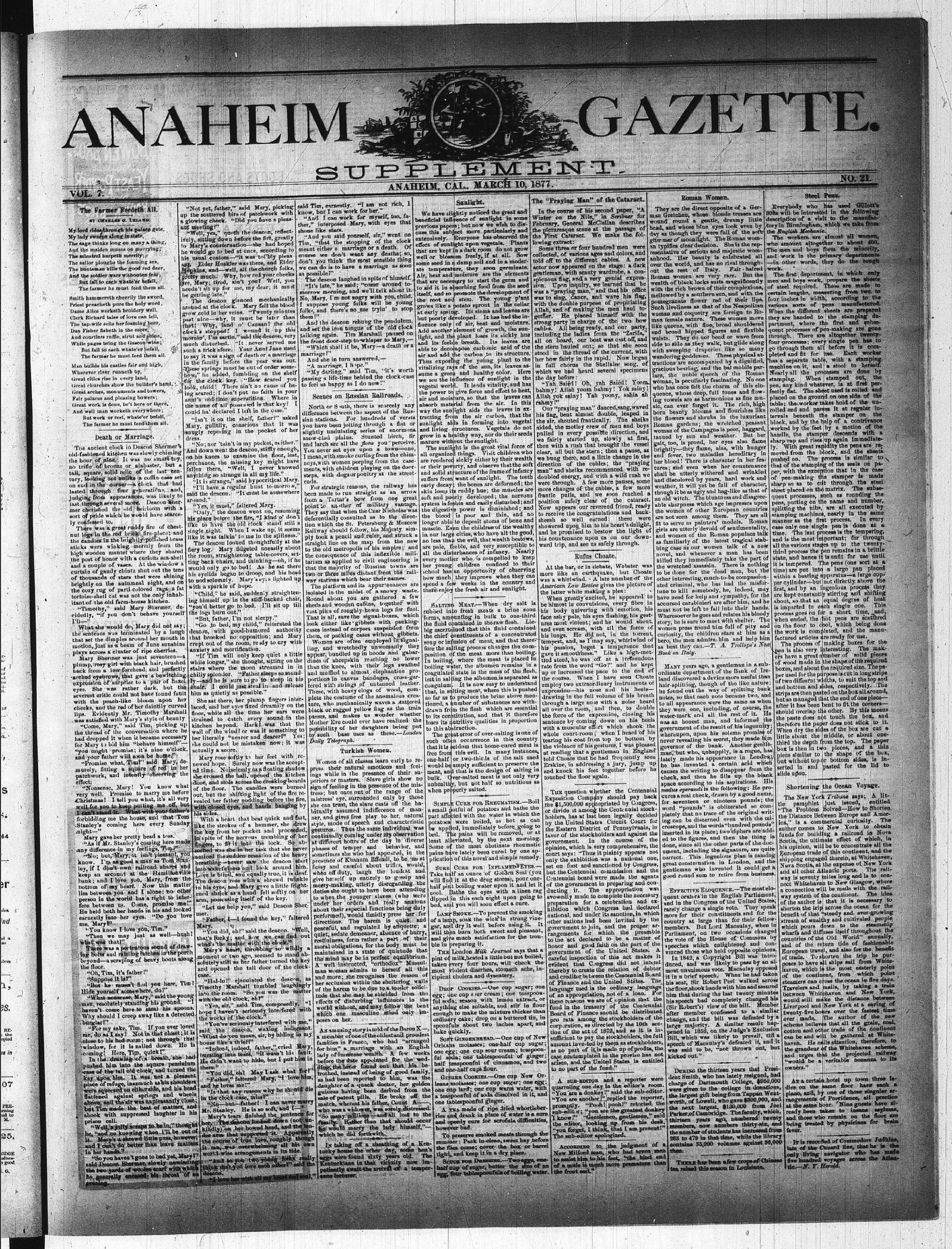
Searchable text
The Farmer Feedeth All.
BY CHARLES G. LELAND.
My lord rides through his palace gate,
My lady sweeps along in slate.
The sage thinks long on many a thing,
And the maiden muses on marrying;
The minstrel harpeth merrily;
The sailor ploughs the foaming sea,
The huntman kills the good red deer,
And the soldier wars without fear;
But fall to each whate'er befall,
The farmer he must feed them all.
Smith hammereth cheerily the sword,
Priest preacheth pure the holy word,
Dame Alice worketh broidery well,
Clerk Richard tales of love can tell,
The tap-wife sells her foaming beer,
Dan Fisher fisheth in the mere,
And courtlers ruffle, strut and shine,
While pages bring the Gascon wine;
But fall to each whate'er befall,
The farmer he must feed them all.
Man builds his castles fair and high,
Wherever river runneth by,
Great cities rise in every land,
Great churches show the builder's hand,
Great arches, monuments and towers,
Fair palaces and pleasing bowers;
Great work is done, be't here or there,
And well man worketh everywhere;
But work or rest, whate'er befall,
The farmer he must feed them all.
Death or Marriage.
The ancient clock in Deacon Shermer's old-fashioned kitchen was slowly chiming the hour of nine. It was no smart toy, a traif of bronze or alabaster, but a
"Not yet, father," said Mary, picking up the scattered bits of patchwork with a glowing cheek. "Did you have a pleasant meeting?"
"Well, yes," quoth the deacon, reflectively, sitting down before the fire, greatly to Mary's consternation—she had hoped he would go to bed at once, according to his usual custom—"it was toll'by pleas an. Elder Huskler was there, and Elder Hopkins, and—well, all the church folks, pretty much. Why, how red your cheeks are, Mary; tired, ain't you? Well, you needn't sit up for me, my dear; it must be getting late."
The deacon glanced mechanically around at the clock. Mary felt the blood grow cold in her veins. "Twenty minutes past nine—why, it must be later than that! Why, land o' Canaan! the old clock's stopped! I wound it up this morning, I'm sartin." said the deacon, very much disturbed. "It never served me such a trick afore. Your Aunt Jane used to say it was a sign of death or a marriage in the family before the year was out. These springs must be out of order somehow," he added, fumbling on the shelf for the clock key. "How scared you look, child! There ain't no cause of being scared; I don't put no faith in your aunt's old-time superstition. Where in the name of all possessed is that key? I could has' declared I left in the case."
"Isn't it on the shelf, father?" asked Mary, guiltily, conscious that it was snugly reposing in the pocket of her dress.
"No; nor 'taint' in my pocket, neither." And down went the deacon, stiffly enough, on his knees to examine the floor, least perchance, the missing key might have said Tim, earnestly. know, but I can work it. "And I can work ther," interposed Mr. shone like stars.
"And you said you Tim, 'that the stop meant either a marry course we don't want you think they we can do is to have as possible?"
The deacon laughed. "It's late," he said morrow morning, and No, Mary, I'm not sure I suppose young folk, and there's no them!" And the deacon ran and set the iron tong talking again. Time the front door-step to "Which shall it be marriage?"
And she in turn said "A marriage, I hove My darling," sai passing a life-time b to feel as happy as
Scenes on Rus.
North or South, difference between their stations. For you have been joltily slightly undulating snow-clad plains. and larch are all tha You never set eyes I mean, with smoke neys, with women p
Death or Marriage.
The ancient clock in Deacon Shermer's old-fashioned kitchen was slowly chiming the hour of nine. It was no smart toy, no trifle of bronze or alabaster, but a tall, square, solid relic of the last century, looking not unlike a coffin-case set on end in the corner—a clock that had lasted through four generations, and judging from appearances, was likely to last through several more. Deacon Shermer cherished the old heirloom with a sort of pride which he would have scarcely confessed to.
There was a great ruddy fire of chestnut logs in the red brick fire-place; and the candles in the brightly polished brass sticks were winking-merrily from the high wooden mantel where they shared the post of honor with a curious sea-shell and a couple of vases. At the window a curtain of gaudy chintz shut out the tens of thousands of stars that were shining brightly on the autumnal night, and on the cozy rug of part-colored rags a fat tortoise-shell cat was not the only inhabitant of the old farm-house kitchen.
"Timothy," said Mary Shermer, decidedly, "if you don't behave yourself I'll—
What she would do, Mary did not say; the sentence was terminated by a laugh that set the dimples around her mouth in motion, just as a beam of June sunshine plays across a cluster of ripe cherries.
Mary Shermer was just seventeen—a plump, rosy girl with black hair, brushed back from a low forehead, and perfectly arched eyebrows, that gave a bewitching expression of surprise to a pair of hazel eyes. She was rather dark, but the severest critic could not have found fault with the peach-like bloom upon her cheeks, and the red of her daintily curved lips. Evidently Mr. Timothy Marshall was satisfied with Mary's style of beauty.
"Come, Mary," said Tim, picking up the thread of the conversation where he had dropped it when it became necessary for Mary to bid him "behave himself"—"you might promise; it's nine o'clock, and your father will soon be home."
"Promise what, Tim?" said Mary, demurely, fitting a square of red in her patchwork, and intently observing the effect;
"Nonsense, Mary! You know what very well. Promise to marry me before Christmas! I tell you what, it's all very well for you to keep putting me off, but I can't stand it. What with your father's forbidding me the house, and that Tom Stanley's coming here every Sunday night—"
Mary gave her pretty head a toss.
"As if Mr. Stanley's coming here made any difference in my feelings, Timmy."
No; but, Mary, it isn't pleasant, you know. I'm as good a man as Tom Stanley, if I don't own railroad shares and keep an account at the Hamiltonville bank; and I love you, Mary, from the These springs must be out of order somehow," he added, fumbling on the shelf for the clock key. "How scared you look, child! There ain't no cause of being scared; I don't put no faith in your annn's old-time superstition. Where in the name of all possessed is that key? I could ha' declared I left in the case."
"It isn't on the shelf, father?" asked Mary, guiltily, conscious that it was snugly reposing in the pocket of her dress.
"No; nor 'tain't in my pocket, neither." And down went the deacon, stiffly enough, on his knees to examine the floor, lest perchance, the missing key might have fallen there. "Well, I never known anything so strange in all my life."
"It is strange," said hypocritical Mary. "I'll have a regular hunt to-morrow," said the deacon. "It must be somewhere around."
"Yes, it must," faltered Mary.
"Only," the deacon went on, resuming his place before the fire. "I kind o' don't like to have the old clock stand still a single night. When I wake up, it seems like it was talkin' to me in the stillness."
The deacon looked thoughtfully at the fiery log. Mary tidged uneasily about the room, straightening table-covers, setting back chairs, and thinking—oh, if he would only go to bed! As he sat there his eyelids began to droop, and his head to nod solemnly. Mary's eyes lighted up with a sparkle of hope.
"Child," he said, suddenly straightening himself up in the stiff-backed chair, "you'd better go to bed. I'll sit up till the logs burn out."
"But, father, I'm not sleepy."
"Go to bed, my child," reiterated the deacon, with good-humored authority that brooked no opposition; and Mary crept out of the room, ready to cry with anxiety and mortification.
"If Tim will only keep quiet a little while longer," she thought, sitting on the stairs where the moon streamed in in chilly splendor. "Father sleeps so soundly—and he is sure to go to sleep in his chair. I could just steal in and release him as quietly as possible."
She sat there her plump fingers interlaced, and her eyes fixed dreamily on the floor, while all the time her ears were strained to catch every sound in the kitchen beyond. Hark! was that the wall of the wind? or was it something to her literally "nearer and dearer!" Yes; she could not be mistaken now; it was actually a snore.
Mary rose softly to her feet with renewed hope. Surely now was the accepted time. Noiselessly as a floating shadow she crossed the hall, opened the kitchen door, and stole across the creaking boards of the floor. The candles were burned out, but the shifting light of the fire revealed her father nodding before the fire, with closed eyes, and hands hanging by his sides.
With a heart that beat quick and fast, like the strokes of a hammer, she drew the key from her pocket and proceeded, in spite of the nervous trembling of her fingers, to fit it into the lock. So absorbed was she in her task that she never noticed the sudden cessation of the heavy breathing—never saw the deacon start into wakefulness and look around him. Love is blind, and equally true, it is deaf. The deacon rose with a shrewd twinkle
North or South, this difference between their sinn stations. For you have been joltingly undulating snow-clad plains and larch are all thine. You never set eyes I mean, with smoke nays with women pains with children steps, with dogs or ends.
For strategic readiness been made to run from a Tartar's point to another point They say that when deferentially consultion which St. Railway should follow they took a pencil straight line on them to the old metropolis consequence of tarism as applied to that majority two or three miles away stations which The platform and isolated in the mid Round about your sheds and wooden vast piles of rough That is all, save that look either like cases instead of coats them, or packing them Women are offering and wretching appear bundled up dines of sheepskin than the knee, whiand muffled to all portions in canvas tered with strings These, with heavy plete the costume ture, who mechanic black or ragged y passes,and make Mother Eve could possibility of health to such base u Daily Telegraph.
Turk
Women of all press their natureings while in their periors or master signs of feeling in tress; but once a mistress' eye,sun she can trust,the bitually assume ner,and gives frie style,mode of sp gestures. Thus continually comes at different hometimes of temp sometimes she w presence of Khan fussy and caree when off duty,give herself up
"Nonsense, Mary! You know what very well. Promise to marry me before Christmas! I tell you what, it's all very well for you to keep putting me off, but I can't stand it. What with your father's forbidding me the house, and that Tom Stanley's coming here every Sunday night—"
Mary gave her pretty head a toss.
"As if Mr. Stanley's coming here made any difference in my feelings, Tim!"
"No; but, Mary, it isn't pleasant, you know. I'm as good a man as Tom Stanley, if I don't own railroad shares and keep an account at the Hamiltonville bank; and I love you, Mary, from the bottom of my heart. Now this matter lies between you and I alone; no other person in the world has a right to interfere between us. Come, promise me!" He held both her hands in his and looked earnestly into her eyes. "Do you love me, Mary?"
"You know I love you, Tim."
"Then we may just as well—hush! what was that!"
There was a portentous sound of drawing bolts and rattling latches in the porch beyond—a scraping of heavy boots along the floor.
"Oh, Tim, it's father!"
"Suppose it is!"
But he mustn't find you here, Tim! Hide yourself somewhere, do!
What nonsense, Mary? said the young man, resolutely standing his ground. "I haven't come here to steal his spoons. Why should I creep away like a detected burglar!"
For my sake, Tim. If you ever loved me, do as I say! Not in that closet; it is close to his bed-room; not through that window, for it is nailed down. He is coming! Here, Tim, quick!"
In the drawing of a breath, she had pushed him into the square pendulum case of the tall old clock, and turned the key upon him. It was not a pleasant place of refuge, inasmuch as his shoulders were squeezed on either side, and his head flattened against springs and wheels above, and the air was unpleasantly close; but Tim made the beat of matters, and shook with suppressed laughter in his prison cell.
"Well, a jolly scraps to be in," thought he, "and no knowing when I'll be out of it. Mary's a shrewd little pusa, however, and I can't do better than leave matters in her hands."
So you haven't gone to bed yet, Mary? said Deacon Sharman slowly unwinding the two yards of wooden scarf with which he generally encased his throat of an evening.
The candles were burned out, but the shifting light of the fire revealed her father nodding before the fire, with closed eyes, and hands hanging by his sides.
With a heart that beat quick and fast, like the strokes of a hammer, she drew the key from her pocket and proceeded, in spite of the nervous trembling of her fingers, to fit it into the lock. So absorbed was she in her task that she never noticed the sudden cessation of the heavy breathing—never saw the deacon start into wakefulness and look around him. Love is blind, and equally true, it is deaf. The deacon rose with a shrewd twinkle in his eyes, and Mary gave a little frightened shriek as a hand fell softly on her arm, possessing itself of the key.
"Let me help you," said Deacon Shermer.
"Father, I—I found the key," faltered Mary.
"You did, eh?" said the deacon. "Well, that's lucky; and now we can find out what's the matter with the clock."
Mary's heart throbbing so wildly a moment or two ago, seemed to stand absolutely still as her father turned the key and opened the tall door of the clock-case.
"Hal-lo!" ejaculated the deacon, as Timothy Marshall tumbled laughingly into the room. "So you was the matter with the old clock, eh?"
Yes, sir," said Tim, composedly. "I hope I haven't seriously interfered with the works of the clock."
"You've seriously interfered with me," said the deacon, waxing indignant. "What do you mean, sir, by hiding in my house like a thief?"
Indeed, indeed, father," cried Mary, bursting into tears. "It wasn't his fault. He didn't want to hide, but I put him in there."
"You did, eh! May I ask what for?"
"Father," faltered Mary, "I love him, and he loves me!"
"Is that any reason why he should die in the clock-case, mis?"
No—but—father! I can never marry Mr. Stanley. He is so soft, and I—
Mary's tears finished the sentence for her. The deacon looked down (not kindly) on her bowed head, and the tender arm that supported it. Apparently the course of true love, roughly though it ran was overwhelming all his own world-wise arrangements in its tide.
And so you two young folks really think that you love each other!" said the deacon.
"I love her with all my heart and soul," sign of feeling in stress; but once a mistress' eye, she can trust; thus bitually assumes her, and gives free style of spright gestures. Thus continually comes at different hours sometimes she will presence of Kunz fussy and careless when off duty; give herself up merry-making; duties she ought to when the year under her order about their especial performed), word directions. The peaceful, and quiet sedate dearestfulness, for moral obligation maintained in the mind may A well instruct man woman sad and more; she her seclusion wof the harem to tude that she may effects of distress world without which one poses on her.
An amusing story a member of our families in France for him'a m lady of immense before the date ding,the loven trotted insteem as had been re daughter of a guineae having sale of patent match, where who was a widow." So many milk family. Rath he would make which he did.
In taking a tucky house eggs were four Kentackians patiently awake
IM GAZ
SUPPLEMENT
ANAHEIM, CAL., MARCH 10, 1877.
said Tim, earnestly. "I am not rich, I know, but I can work for her."
"And I can work for myself, too, father," interposed Mary, with eyes that shone like stars.
"And you said yourself, sir," went on Tim, "that the stopping of the clock meant either a marriage or a death. Of course we don't want any deaths; so, don't you think the most sensible thing we can do is to have a marriage as soon as possible?"
The deacon laughed in spite of himself.
"It's late," he said; "come around tomorrow morning, and we'll talk about it. No, Mary, I'm not angry with you, child. I suppose young folks will be young folks, and there's no use tryin' to stop them!"
And the deacon rehung the pendulum, and set the iron tongue of the old clock talking again. Tim Marshall paused on the front door-step to whisper to Mary, "Which shall it be, Mary—a death or a marriage?"
And she in turn answered,—
"A marriage, I hope."
My darling," said Tim, "it's worth passing a life-time behind the clock-case to feel as happy as I do now!"
Scenes on Russian Railroads.
North or South, there is scarcely any difference between the aspect of the Russian stations. For hundreds of versts you have been jolting through a flat or slightly undulating series of enormous snow-clad plains. Stunted birch, fir and larch are all the flora you perceive. You never set eyes upon a town—one, I mean, with smoke curling from the chimneys, with women peeping from the case-
Sunlight.
We have slightly noticed the great and beneficial influence of sunlight in some previous papers; but now we wish to discuss this subject more particularly and extensively. Everyone has observed the effect of sunlight upon vegetals. Plants that are kept in a dark room do not grow well or blossom freely, if at all. Sow some seed in a damp soil and in a moderate temperature, they soon germinate. Air, heat and moisture are the elements that are necessary to start the germ and to aid it in absorbing food from the seed itself, and so promote the development of the root and stem. The young plant grows like a potato sprout in the cellar at early spring. Its stems and leaves are but poorly developed. It has had the influence only of air, heat and moisture. Add another element of growth, the sunlight, and the plant loses its sickly hue and its feeble breath. Its leaves are able to decompose carbonic acid of the air and add the carbon to its structure. Thus exposing the young plant to the vitalizing rays of the sun, its leaves assume a green and healthy color. Here we see the influence of sunlight in the vegetal world. It lends vitality, and has the power to give force and effect to heat, air and moisture, so that the leaves can absorb material from the air. In this way the sunlight aids the leaves in extracting from the air carbon, that the sunlight aids in forming into vegetal and living structures. Vegetals do not grow in a healthy way, nor do their seeds mature without the sunlight.
The sunlight is the great vital force of all organized things. Visit children who are rendered sickly either by their wealth on their parents and observe that the soft
The "Praying Man" of the Cataract.
In the course of his second paper, "A Winter on the Nile," in Scrubner for February, General McClellan describes the picturesque scene at the passage of the First Cataract. We make the following extract:
Some three or four hundred men were collected, of various ages and colors, and told off to the different cables. A new actor now appeared on the stage: a dark gentleman, with scaury wardrobe, a conspicuous flag, and a very genial expression. Upon inquiry, we learned that he was a "praying man," and that his office was to sing, dance, and wave his flag, with the double purpose of propitiating Allah, and of making the men haul together. He placed himself with the strong party in charge of the two bow cables. All being ready, and our party, including the ladies from the "Zarifa," all on board, our boat was cast off, and the stern hauled out; so that she soon stood in the thread of the current, with her bow fairly in the rapid. Now began in full chorus the Shellalee song, of which we had heard several specimens the day before:
"Yah Saiéd! Oh, yah Saiéd! Yoom bahmy! Allah yoom bahmy! Yok sainy! Allah yok sainy! Yah yoony, sahla ah rahmy!"
Our "praying man" danced,sang,waved his flag,bent almost double, leaped in the air, shouted frantically. The sheiks aided,the motley crew of man and boys pulled in every possible direction,and we fairly started up,slowly at first, then with a rush that brought the vessel clear, all but the stern; then a pause, as we hung there,and a little change in the direction of the cables;the "praying woman who has quenched ing vow sic,corn born by flow Roman woman tanned gait,tou brightly and fled her bloo
"My darling," said Tim, "it's worth passing a life-time behind the clock-case to feel as happy as I do now!"
Scenes on Russian Railroads.
North or South, there is scarcely any difference between the aspect of the Russian stations. For hundreds of verbs you have been jolting through a flat or slightly undulating series of enormous snow-clad plains. Stunted birch, fir and larch are all the flora you perceive. You never set eyes upon a town—one, I mean, with smoke curling from the chimneys, with women peeping from the casements, with children playing on the doorsteps, with dogs or poultry at the street ends.
For strategic reasons, the railway has been made to run straight as an arrow from a Tartar's bow from one great point to another of military vantage. They say that when the Czar Nicholas was deferentially consulted as to the direction which the St. Petersburg & Moscow Railway should follow, his Majesty took a pencil and ruler, and struck a straight line on the map from the new to the old metropolis of his empire; and the consequence of this inflexible militarism as applied to civil engineering is that the majority of Russian towns are two or three miles distant from the railway stations which bear their names.
The platform and its appurtenances are isolated in the midst of a snowy waste. Round about you are gathered a few sheds and wooden cabins, together with vast piles of roughly-hewn logs for fuel. That is all, save signal-boxes, which look either like gibbets with packing cases instead of corpses suspended from them, or packing cases without gibbets.
Women are often employed in signaling, and wretchedly unwomanly they appear, bundled up in hoods and gabardines of sheepskin reaching no lower than the knee, with their legs swathed and muffled to almost elephantine proportions in canvas bandages, cross-gartered with strings of untanned leather. These, with heavy clogs of wood, complete the costume of the anemalous creature, who mechanically waves a tattered black or ragged yellow flag as the train passes, and makes us wonder whether Mother Eve could ever have realized the possibility of her daughters being put to such base uses as these.—London Daily Telegraph.
Turkish Women.
Women of all classes learn early to repress their natural emotions and feelings while in the presence of their superiors or masters. Slave girls show no sign of feeling in the presence of the mistress; but once out of the range of the mistress' eye, surrounded only by those she can trust, the slave casts off the habitually assumed indifference of manner, and gives free play to her, natural style, mode of speech and characteristic gestures.
Thus the same individual was continually coming under my observation at different hours of the day in diverse phases of temper and behavior, and sometimes she who had appeared, in the presence of Khanum Biffendi, to be most fussy and careful about trifles, would, when off duty, laugh the loudest and give herself up entirely to gossip and vitalizing rays of the sun, its sume a green and healthy color. Here we see the influence of sunlight in the vegetal world. It lends vitality, and has the power to give force and effect to heat, air and moisture, so that the leaves can absorb material from the air. In this way the sunlight aids the leaves in extracting from the air carbon, that the sunlight aids in forming into vegetal and living structures. Vegetals do not grow in a healthy way, nor do their seeds mature without the sunlight.
The sunlight is the great vital force of all organized things. Visit children who are rendered sickly either by their wealth or their poverty, and observe that the soft and solid structure of the frame of infancy suffers from want of sunlight. The teeth early decay; the bones are deformed; the skin loses its ruddy hue; the muscles are soft and poorly developed; the nervous system is feeble and easily disturbed; and the digestive power is diminished; and the blood is poor and thin, and no longer able to deposit atoms of bone and muscle. Even the children of the wealthy in our large cities, who have all the good, no less than the evil, that wealth bestows, are pale, feeble, and very susceptible to all the disturbances of infancy. Nearly every mother who is compelled to keep her young children confined to their school has an opportunity of observing how much they improve when they can spend a few weeks in the country and there enjoy the fresh air and sunlight.
SALTING MEAT.—When dry salt is rubbed into fresh meats a brine soon forms, amounting in bulk to one-third the fluid contained in theraw flesh. Liebig ascertained that this fluid contained the chief constituents of a concentrated soup or infusion of meat, and that therefore the salting process changes the composition of the meat more than boiling. In boiling water, where the meat is placed in boiling water, the albumen remains in a coagulated state in the mass of the flesh, but in salting the albumen is separated as coagulum. It is now easy to understand that, in salting meat, where this is pushed so far as to produce the brine above mentioned, a number of substances are withdrawn from the flesh which are essential to its constitution, and that it therefore loses its nutritive qualities in proportion to this abstraction.
The great error of over-salting is one of such often occurrence in this country that it is seldom that home-cured meat is free from this evil. In many instances, one-half or two-thirds of the salt used would be amply sufficient to preserve the meat, and that is the design of salting in bulk. Over-salted meat is not only very unhealthy, but not half so nutritious as when properly salted.
SIMPLE CURE FOR RHEumatism.—Boil a small potful of potatoes and bathe the part affected with the water in which the potatoes were boiled, as hot as can be applied, immediately before going to bed. The pains will be removed, or at least alleviated, by the next morning. Some of the most obstinate rheumatic pains have lately been cured by one application of this novel and simple remedy.
SURE CURE FOR INFLAMED EYES.—Take half an ounce of Golden Seal (you will find it at the drug stores), pour one-half cupful of potatoes and bathe the part affected with the water in which the potatoes were boiled, as hot as can be applied, immediately before going to bed. The pains will be removed, or at least alleviated by the next morning. Some of the most obstinate rheumatic pains have lately been cured by one application of this novel and simple remedy.
Yah Saied! Ob, yah Saied! Yoom bahmy! Allah yoom bahmy! Yok sainy! Allah yok sainy! Yah yoony, sahla ah rahym!
Our "praying man" danced,sang,waved his flag,bent almost double, leaped in the air, shouted frantically. The sheiks aided,the motley crew of men and boys pulled in every possible direction,and we fairly started up,slowly at first then with a rush that brought the vessel clear,a but the stern;then a pause.as we hung there,and a little change in direction of the cables;the "praying man" and sheiks recommenced,with doubled energy,and with a wild rush we were through.A few more pauses,more changes of the cables,a few more frantic pulls,and we soon reached a position safely clear of the cataract.Now appears our reverend friend,ready to receive the congratulations and back-sheesh so well earned: these were showered upon him to his heart's delight,and he promised to beatow light of his countenance upon us on our downward trip,and use us safely through.
Rufus Choate.
At the bar,或in debate.Webster was more like an earthquake,Bucharest was a whirlwind.A late number of the American Law Review gives the picture of latter while making a plea.
When greatly excited,他 appeared to be almost in convulsions,every fibre in his body quivering with emotion,his face ashy pale,his eyes flashing,his gestures most violent;and he would shout,and even scream,以all the force of his lungs。他 did not,在the torrent,tempest,and,作为may say,whirwind his passion,被get a temperance that gave it smoothness."Like a high-metted steer,他 was off at a tremendous rate from word "Go!"and he kept up or increased the pace to end of course。当I have seen Choate employ two extraordinary instruments of expression—his nose and his heels—drawing inthe full volumeof his breath through a large nose with a noise heard all overthe room,and then,toublingthe forceoftheexpression,closinghis sentencebycomingdownonhisbeelswitha muscular effortwhichshookthe whole court-room;whenI heardof his tearinghis coatfromtoptobottombytheviolenceofhisgestures.IwaspleasedatreadingthatagentlemaninEnglandtoldChoatethathehadfrequentlyseenErskine,在addressinga jury,jumpupandknockhisfeettogetherbeforehe touchedtheflooragain.
The question whetherthe Centennial Exposition Companyshouldpaybackthe $1,500,000appropriatedbyCongressordivideitamongtheCentennialstockholders,hasatlastbe legallydecidedbytheUnitedStatesCircuitCourtfortheEasternDistrictofPennsylvania.in favorofthestockholdersandagainthegovernment.Inthecourseoftheopinionwhichisverycomprehensive,thecourt says:"Thusitplainlyappearsnotonlytheexhibitionwasanationalone.setonfootand sanctionedbyCongressbuttheCentennialcommissionandtheCentennialboardweremadetheagentsgraciouslate,thewomanwhohasquiredvowingthougholdableshieldsohewaitedthewooliestnotfitstoysgatesandwasfamousbingcoconturespacemoderatecuriefortormentofbeautifulingesthingingtothekitchenengagementareburnedthefirerangingbyandfast,shedrawproceeded,givingherinterviewofthekitchenengagementareburnedthefirerangingbyandfast,shedrawproceeding,givingherinterviewofthekitchenengagementareburnedthefirerangingbyandfast,shedrawproceeding,givingherinterviewofthekitchenengagementareburnedthefirerangingbyandfast,shedrawproceeding,givingherinterviewofthekitchenengagementareburnedthefirerangingbyandfast,shedrawproceeding,givingherinterviewofthekitchenengagementareburnedthefirerangingbyandfast,shedrawproceeding,givingherinterviewofthekitchenengagementareburnedthefirerangingbyandfast,shedrawproceeding,givingherinterviewofthekitchenengagementareburnedthefirerangingbyandfast,shedrawproceeding,givingherinterviewofthekitchenengagementareburnedthefirerangingbyandfast,shedrawproceeding,givingherinterviewofthekitchenengagementareburnedthefirerangingbyandfast,shedrawproceeding,givingherinterviewofthekitchenengagementareburnedthefirerangingbyandfast,shedrawproceeding,givingherinterviewofthekitchenengagementareburnedthefirerangingbyandfast,shedrawproceeding,givingherinterviewofthekitchenengagementareburnedthefirerangingbyandfast,shedrawproceeding,givingherinterviewofthekitchenengagementareburnedthefirerangingbyandfast,shedrawproceeding,givingherinterviewofthekitchenengagementareburnedthefirerangingbyandfast,shedrawproceeding,givingherinterviewofthekitchenengagementareburnedthefirerangingbyandfast,shedrawproceeding,givingherinterviewofthekitchenengagementareburnedthefirerangingbyandfast,shedrawproceeding,givingherinterviewofthekitchenengagementareburnedthefirer rangingbyandfast,shedrawproceeding,givingherinterviewofthekitchenengagementareburnedthefirer rangingbyandfast,shedrawproceeding,givingherinterviewofthekitchenengagementareburnedthefirer rangingbyandfast,shedrawproceeding,givingherinterviewofthekitchenengagementareburnedthefirer rangingbyandfast,shedrawproceeding,givingherinterviewofthekitchenengagementareburnedthefirer rangingbyandfast,shedrawproceeding,givingherinterviewofthekitchenengagementareburnedthefirer rangingbyandfast,shedrawproceeding,givingherinterviewofthekitchenengagementareburnedthefirer rangingbyandfast,shedrawproceeding,givingherinterviewofthekitchenengagementareburnedthefirer rangingbyandfast,shedrawproceeding,givingherinterviewofthekitchenengagementareburnedthefirer rangingbyandfast,shedrawproceeding,givingherinterviewofthekitchenengagementareburnedthefirer rangingbyandfast,shedrawproceeding,givingherinterviewofthekitchenengagementareburnedthefirer rangingbyandfast,shedrawproceeding,givingherinterviewofthekitchenengagementareburnedthefirer rangingbyandfast,shedrawproceeding,givingherinterviewofthekitchenengagementareburnedthefirer rangingbyandfast,shedrawproceeding,givingherinterviewofthekitchenengagementareburnedthefirer rangingbyandfast,shedrawproceeding,givingherinterviewofthekitchenengagementareburnedthefirer rangingbyandfast,shedrawproceeding,givingherinterviewofthekitchenengagementareburnedthefirer rangingbyandfast,shedrawproceeding,givingherinterviewofthekitchenengagementareburnedthefirer rangingbyandfast,shedrawproceeding,givingherinterviewofthekitchenengagementareburnedthefirer rangingbyandfast,shedrawproceeding,givingherinterviewofthekitchenengagementareburnedthefirer rangingbyandfast,shedrawproceeding,givingherinterviewofthekitchenengagementareburnedthefirer rangingbyandfast,shedrawproceeding,givingherinterviewofthekitchenengagementareburnedthefirer rangingbyandfast,shedrawproceeding,givingherinterviewofthekitchenengagementareburnedthefirer rangingbyandfast,sche.drawproceeding,giveninthiscase,thesewillbeusedtopreventanyofunexpectedeventsfromhavinganimportanteventfromhavinganimportanteventfromhavinganimportanteventfromhavinganimportanteventfromhavinganimportanteventfromhavinganimportanteventfromhavinganimportanteventfromhavinganimportanteventfromhavinganimportanteventfromhavingan importanteventfromhavingan importanteventfromhavingan importanteventfromhavingan importanteventfromhavingan importanteventfromhavingan importanteventfromhavingan importanteventfromhavingan importanteventfromhavingan importanteventfromhavingan importanteventfromhavingan importanteventfromhavingan importanteventfromhavingan importanteventfromhavingan importanteventfromhavingan importanteventfromhavingan importanteventfromhavingan important eventfromhavingan important eventfromhavingan important eventfromhavingan important eventfromhavingan important eventfromhavingan important eventfromhavingan important eventfromhavingan important eventfromhavingan important eventfromhavingan important eventfromhavingan important eventfromhavingan important eventfromhavingan important eventfromhavingan important eventfromhavingan important eventfromhavingan important eventfromhavingan important eventfromhavingan important eventfromhavingan important eventfromhavingan important eventfromhavingan important eventfromhavingan important eventfromhavingan important eventfromhavingan important eventfromhavingan important eventfromhavingan important event fromhavingan important eventfromhavingan important eventfromhavingan important eventfromhavingan important eventfromhavingan重要事件从你知道的最重要的事件中你知道的最重要的事件中你知道的最重要的事件中你知道的最重要的事件中你知道的最重要的事件中你知道的最重要的事件中你知道的最重要的事件中你知道的最重要的事件中你知道的最重要的事件中你知道的最重要的事件中你知道的最重要的事件中你知道的最重要的事件中你知道的最重要的事件中你知道的最重要的事件中你知道的最重要的事件中你知道的最重要的事件中你知道的最重要的事件中你知道的最重要的事件中你知道的最重要的事件中你知道的最重要的事件中最重要的是最重要的事件中最重要的是最重要的事件中最重要的是最重要的事件中最重要的是最重要的事件中最重要的是最重要的事件中最重要的是最重要的事件中最重要的是最重要的事件中最重要的是最重要的事件中最重要的是最重要的事件中最重要的是最重要的事件中最重要的是最重要的事件中最重要的是最重要的事件中最重要的是最重要的事件中最重要的是最重要的事件中最重要的是最重要的事件中最重要的是最重要的事件中最重要的是最重要的事件中最重要的是最重要的事件中最重要的是最重要的事件中最重要的是最重要的事件中最重要的是最重要的因素中最重要的是最重要的因素中最注意的是最重要的因素中最注意的是最重要的因素中最注意的是最重要的因素中最注意的是最新的因素中最注意的是最新的因素中最注意的是最新的因素中最注意的是最新的因素中最注意的是最新的因素中最注意的是最新的因素中最注意的是最新的因素中最注意的是最新的因素中最注意的是最新的因素中最注意的是最新的因素中最注意的是最新的因素中最注意的是最新的因素中最注意的是最新的因素中最注意的是最新的因素中最注意的是最新的因素中最注意的是最新的因素中最注意的是最新的因素中最注意的是最新的因素中最注意的是最新的因素中最注意的是最新的因素中最值得注意的是最新的因素最可能是最新的因素最可能是最新的因素最可能是最新的因素最可能是最新的因素最可能是最新的因素最可能是最新的因素最可能是最新的因素最可能是最新的因素最可能是最新的因素最可能是最新的因素最可能是最新的因素最可能是最新的因素最可能是最新的因素最可能是最新的因素最可能是最新的因素最可能是最新的因素最可能是最新的因素最可能是最新的因素最可能是最新的因素最可能是最新的因素最可能是最新的因素最可能是最新的因素最可能是最新的因素最可能是最新的因素最可能是最正确的因素最可能是最正确的因素最可能是最正确的因素最可能是最正确的因素最可能是最正确的因素最可能是最正确的因素最可能是最正确的因素最可能是最正确的因素最可能是最正确的因素最可能是最正确的因素最可能是最正确的因素最可能是最正确的因素最可能是最正确的因素最可能是最正确的因素最可能是最正确的因素最可能是最正确的因素最可能是最正确的因素最可能是最正确的因素最可能是最正确的因素最可能是最正确的因素最可能是最正确的因素的因果最为重要且不可或缺的要素最为重要且不可或缺的要素最为重要且不可或缺的要素最为重要且不可或缺的要素最为重要且不可或缺的要素最为重要且不可或缺的要素最为重要且不可或缺的要素最为重要且不可或缺的要素最为重要且不可或缺的要素最为重要且不可或缺的要素最为重要且不可或缺的要素最为重要且不可或缺的要素最为重要且不可或缺的要素最为重要且不可或缺的要素最为重要且不可或缺的要素最为完整的要素最为完整且不可或缺的要素最为完整且不可或缺的要素最为完整且不可或缺的要素最为完整且不可或缺的要素最为完整且不可缺损的要素最为完整且不可缺损的要素最为完整且不可缺损的要素最为完整且不可缺损的要素最为完整且不可缺损的要素更为完整且不可缺损的要素更为完整且不可缺损的要素更为完整且不可缺损的要素更为完整且不可缺损的要素更为完整且不可缺损的要素更为完整且不可缺损的要素更为完整且不可缺损的要素更为完整且不可缺损的要素更为完整且不可缺损的要素更为完整且不可缺损的要素最为完整的要素最为完整的要素最为完整的要素最为完整的要素最为完整的要素最为完整的要素最为完整的要素最为完整的要素最为完整的要素最为完整的要素最为完整的要素最为完整的要素最为完整的要素最为完整的要素最为完整的要素最为完整的要素最为完整的要素最为完整的要素最为完整的要素最为完整的要素最为完整的要素最为完整的元素最为完整的元素最为完整的元素极为完整的元素极为完整的元素极为完整的元素极为完整的元素极为完整的元素极为完整的元素极为完整的元素极为完整的元素极为完整的元素极为完整的元素极为完整的元素极为完整的元素极为完整的元素极为完整的元素极为完整的元素极为完整的元素极为完整的元素极为完整的元素极为准确的元素极为准确的元素极为准确的元素极为准确的元素极为准确的元素极为准确的元素极为准确的元素极为准确的元素极为准确的元素极为准确的元素极为准确的元素极为准确的元素极为准确的元素尤为准确的元素极为准确的元素尤为准确的元素尤为准确的元素尤为准确的元素尤为准确的元素尤为准确的元素尤为准确的元素尤为准确的元素尤为准确的元素尤为准确的元素尤为准确的元素尤为准确的元素尤为准确的元素尤为准确的元素尤为准确的元素尤为准确的元素的准确性为最高的准确性为最高的准确性为最高的准确性为最高的准确性为最高的准确性为最高的准确性为最高的准确性为最高的准确性为最高的准确性为最高的准确性为最高的准确性为最高的准确性为最高的准确性为最高的准确性为更高的准确性为更高的准确性为更高的准确性为更高的准确性为更高的准确性为更高的准确性为更高的准确性为更高的准确性为更高的准确性为更高的准确性为更高的准确性为更高的准确性为更高的准确性为更高的准确性为更高的准确性为更高的准确性为更高的准确性
Rufus Choate.
At the bar,或在 debate.Webster was more like an earthquake,Bucharest was a whirlwind.A late number of theAmericanLawReview gives the pictureof latterwhile makinga plea
When I have seen Choate employ two extraordinary instrumentsofexpression--his nose和his heels--drawingin-thefullvolumeofhisbreaththroughalarge nosewitha noise heardalloverthe room,and then,toublingtheforceoftheexpression,closinghissentencebycomingdownonhisbeelswitha musculareffortwhichshookthistwoleggedsteeltowhethernevergovergowedmankindlatestdeemedthedocumentbeforehelonedflooragain.
The question whetherthe CentennialExpositionCompanyshouldpayback$1,$500,000appropriatedbyCongressordivideitamongtheCentennialstockholders,hasatlastbe legallydecidedbytheUnitedStatesCircuitCourtfortheEasternDistrictofPennsylvania.in favorofthestockholders和 againstthe government.InThecourseofthe opinionwhichisverycomprehensive,thecourt says:"Thusitplainlyappearsnotonlythe exhibitionwasa nationalone.setonfoot和 sanctionenedBy Congress,但the Centennial commission和the Centennial boardweremade.theagentsgraciouslate,thewomanwhosehapecouldingtheselfstartoundhim.itisdefiantheartstartoundhim.itisdefiantheartstartoundhim.itisdefiantheartstartoundhim.itisdefiantheartstartoundhim.itisdefiantheartstartoundhim.itisdefiantheartstartoundhim.itisdefiantheartstartoundhim.itisdefiantheartstartoundhim.itisdefiantheartstartoundhim.itisdefiantheartstartoundhim.itisdefiantheartstartoundhim.itisdefiantheartstartoundhim.itisdefiantheartstartoundhim.itisdefiantheartstartoundhim.itisdefiantheartstartoundhim.itisdefiantheartstartoundhim.itisdefiantheartstartoundhim.itisdefiantheartstartoundhim.itisdefiantheartstartoundhim.itisdefiantheartstartoundhim.itisdefiantheartstartoundhim.itisdefiantheartstartoundhim.itisdefiantheartstartoundhemian.startoundhemian.startOUNDhemian.startOUNDhemian.startOUNDhemian.startOUNDhemian.startOUNDhemian.startOUNDhemian.startOUNDhemian.startOUNDhemian.startOUNDhemian.startOUNDhemian.startOUNDhemian.startOUNDhemian.startOUNDhemian.startOUNDhemian.startOUNDhemian.startOUNDhemian.startOUNDhemian.startOUNDhemian.startOUNDhemian.startOUNDhemian.startOUNDhemian.startOUNDhemian.startOUNDhemian.startOUNDhemian.startOUNDhemian.startOUNDhemian.startOUNDhemian.startOUNDhemian.startOUNDhemian.startOUNDhemian.startOUNDhemian.startOUNDhemian.startOUNDhemian.startOUNDhemian.startOUNDhemian.startOUNDhemian.startOUNDhemian.startOUNDhemian.startOUNDhemian.startOUNDhemian.startOUNDhemian.startOUNDhemian.startOUNDhemian.startOUNDhemian.startOUNDhemian.startOUNDhemian.startOUNDhemian.startOUNDhemian.startOUNDhemian.startOUNDhemian.startOUND hemian.startOUND hemian.startOUND hemian.startOUND hemian.startOUND hemian.startOUND hemian.startOUND hemian.startOUND hemian.startOUND hemian.startOUND hemien startoundshellshellshellshellshellshellshellshellshellshellshellshellshellshellshellshellshellshellshellshellshellshellshellshellshellshellshellshellshellshellshellshellshellshellshellshellshellshellshellshell shell shell shell shell shell shell shell shell shell shell shell shell shell shell shell shell shell shell shell shell shell shell shell shell shell shell shell shell shell shell shell shell shell shell shell shell shell shell shell shell shell shell shell shell shell shell shell shell shell shell shell shell shell shell shell shell shell shell shell Shell Shell Shell Shell Shell Shell Shell Shell Shell Shell Shell Shell Shell Shell Shell Shell Shell Shell Shell Shell Shell Shell Shell Shell Shell Shell Shell Shell Shell Shell Shell Shell Shell Shell Shell Shell Shell Shell Shell Shell Shell Shell Shell Shell Shell Shell Shell Shell Shell ShellShellShellShellShellShellShellShellShellShellShellShellShellShellShellShellShellShellShellShellShellShellShellShellShellShellShellShellShellShellShellShellShellShellShellShellShellShellShellShellShellShellShellShellShellShellShellShellShellShellShellShellShellShellShellShellShellShellShellShellShellShellShellShellShellShellShellShellShellShellShellShellShellShellShellShellShellShellShellShellShellShellShellShellShellShellShellShellShellShellShellShellShellShellShellShellShell
Rufus Choate.
At the bar,或在 debate.Webster was more like an earthquake,Bucharest was a whirlwind.A late number of theAmericanLawReview gives the pictureof latterwhile makinga plea
When I have seen Choate employ two extraordinary instrumentsofexpression--his nose和his heels--drawingin-thefullvolumeofhisbreaththroughalarge nosewitha noise heardalloverthe room,and then,toublingtheforceoftheexpression,closinghissentencebycomingdownonhisbeelswitha musculareffortwhichshootthistwoleggedsteel steel steel steel steel steel steel steel steel steel steel steel steel steel steel steel steel steel steel steel steel steel steel steel steel steel steel steel steel steel steel steel steel steel steel steel steel steel steel steel steel steel steel steel steel steel steel steel steel steel steel steel steel steel steel steel steel steel steel steel Steel Steel Steel Steel Steel Steel Steel Steel Steel Steel Steel Steel Steel Steel Steel Steel Steel Steel Steel Steel Steel Steel Steel Steel Steel Steel Steel Steel Steel Steel Steel Steel Steel Steel Steel Steel Steel Steel Steel Steel Steel Steel Steel Steel Steel Steel Steel Steel Steel Steel Steel Steel Steel Steel Steel Steel Steel Steel Steel Steel Steel Steel Steel Steel Steel Steel Steel Steel Steel Steel Steel Steel Metal Metal Metal Metal Metal Metal Metal Metal Metal Metal Metal Metal Metal Metal Metal Metal Metal Metal Metal Metal Metal Metal Metal Metal Metal Metal Metal Metal Metal Metal Metal Metal Metal Metal Metal Metal Metal Metal Metal Metal Metal Metal Metal Metal Metal Metal Metal Metal Metal Metal Metal Metal Metal Metal Metal Metal Metal Metal Metal Metal Metal Metal Metal Metal Metal Metallic metal metal metal metal metal metal metal metal metal metal metal metal metal metal metal metal metal metal metal metal metal metal metal metal metal metal metal metal metal metal metal metal metal metal metal metal metal metal metal metal metal metal metal metal metal metal metal metal metal metal金属金属金属金属金属金属金属金属金属金属金属金属金属金属金属
sign of feeling in the presence of the mistress; but once out of the range of the mistress' eye, surrounded only by those she can trust, the slave casts off the habitually assumed indifference of manner, and gives free play to her natural style, mode of speech and characteristic gestures. Thus the same individual was continually coming under my observation at different hours of the day in diverse phases of temper and behavior, and sometimes she who had appeared, in the presence of Khanum Biffendi, to be most fussy and careful about trifles, would, when off duty, laugh the loudest and give herself up entirely to gossip and merry-making, utterly disregarding the duties she ought to have been attending to when the younger slaves (who were under her orders and really anxious about their especial functions being duly performed), would timidly press her for directions. The harem is quiet and peaceful, and regulated by etiquette; a quiet, sedate demeanor, absence of hurry, restfulness, form rather a part of their obligations, for the body must be maintained in a state of quietude that the mind may be in perfect equilibrium. A well instructed, "orthodox" Mussulman woman admits to herself all this and more; she recognises the reason of her seclusion within the sheltering walls of the harem to be due to a tender solicitude that she may be shielded from the effects of disturbing influences in the world without, and may follow the bent which one masculine mind only imposes on her.
An amusing story is told of the Baron X—a member of one of the oldest and proudest families in France, who had "arranged for him" a marriage with an English lady of immense wealth. A few weeks before the date appointed for the wedding, the lover found out that his brother instead of being good family, as had been reported to him, was the daughter of a quack doctor, her golden guinea having been derived from the sale of patent pills. He broke off the match, whereas his father, Count A—who was a widower, was sorely distressed. "So many millions—and all lost to the family." Rather than that should occur he would marry the lady himself," which he did forthwith.
In taking off a sheathing of a Kentucky house the other day, some hen's eggs were found sixty years old. The Keatuckians in that vicinity now impatiently await the arrival of a temperance lecturer.
SIMPLE CURE FOR RHEUMATISM.—Boil a small potful of potatoes and bathe the part affected with the water in which the potatoes were boiled, as hot as can be applied, immediately before going to bed. The pains will be removed, or at least alleviated, by the next morning. Some of the most obstinate rheumatic pains have lately been cured by one application of this novel and simple remedy.
SURE CURE FOR INFLAMED EYES.—Take half an ounce of Golden Seal (you will find it at the drug stores), pour one-half pint boiling water upon it and let it cool. Bathe the eyes with a linen rag dipped in this each night upon going to bed, and you will soon effect a cure.
LAMP SMOKE.—To prevent the smoking of a lamp, soak the wick in strong vinegar, and dry it well before using it. It will then burn both sweet and pleasant, and give much satisfaction for the trouble in preparing it.
THE London Milk Journal says that a pint of milk, heated a little but not boiled, taken every four hours, will check the most violent diarrhea, stomach ache, incipient cholera and dysentery.
DROP COOKIES.—One cup sugar; one egg; one cup sour cream; one teaspoonful soda; season with lemon extract, or anything else suitable, and stir in flour enough to make the mixture thicker than ordinary cake; drop on a buttered tin, in spoonfuls about two inches apart; and bake quickly.
SOFT GINGERBREAD.—One cup of New Orleans molasses; one-half cup sugar; one egg; one cup sour cream; teaspoonful soda; one tablespoonful of ginger; half teaspoonful of cinnamon, and two and one-half cups flour.
GINGER COOKIES.—One cup New Orleans molasses; one cup sugar; one egg; one cup lard; one cup warm water, with a teaspoonful of soda dissolved in it, and one tablespoonful ginger.
A tea made of ripe dried whortleberries and drank in place of water is a sure and speedy cure for scrofaula difficulties, however bad.
To preserve smoked meats through the summer: Pack in clean, sweet hay before the flies come; cover the box or barrel tight, and keep it in a dry place.
Sauce non Dessertain—Two eggs, one-half cup of sugar, butter the size of an egg, four tablespoonfuls of boiling water.
The question whether the Centennial Exposition Company should pay back the $1,500,000 appropriated by Congress, or divide it among the Centennial stockholders, has at last been legally decided by the United States Circuit Court for the Eastern District of Pennsylvania, in favor of the stockholders and against the government. In the course of the opinion, which is very comprehensive, the court says: "Thus it plainly appears not only the exhibition was a national one, set on foot and sanctioned by Congress, but the Centennial commission and the Centennial board were made the agents of the government in preparing and conducting it. The appropriation was avowedly made to complete the necessary preparation for a celebration and exhibition which Congress had declared national, and under its sanction, in which other nations had been invited by the government to join, and the proper arrangements for which the preamble to the act declared to be a matter of honor and good faith on the part of the government of the United States. A careful inspection of this act makes it evident that Congress did not intend thereby to create the relation of debtor and creditor between the Centennial Board of Finance and the United States. The language used is the ordinary language of an appropriation, not of a loan. For these reasons we are of opinion that the fund in the treasury of the Centennial Board of Finance should be distributed pro rata among the stockholders of the corporation, as directed by the 10th section of the act of 1872, and as it is insufficient to pay the stockholders, the full amount invested by them as stockholders, as no part of it is made up profits, the case contemplated in the proviso has not arisen, and the United States is entitled to no part of the fund."
A sub-editor and a reporter were quarrelling one day in the editor's room. "You are a donkey!" said the sub-editor. "You are another!" replied the reporter, promptly. "Pooch! pooch!" retorted the sub-editor; "you are the greatest donkey I know!" "Gentlemen, gentlemen," said the editor, looking up from his desk; "you forget I think that I am present!" The sub-editor apologized.
According to the judgment of a New Milford man, who had seven men to assist him to his feet, "the blind end of a mole is much more premature than the front end."
GAZETTE.
NO. 21.
of the Cataract.
second paper, "A in Scribner for Clellan describes the passage of We make the followd men were ties and colors, and cables. A new stage: a dark wardrobe, a con- genial expressive learned that he and that his office and wave his flag, use of propitiating the men haul to himself with the of the two bow ly, and our party, from the "Zarifa," that was cast off, and so that she soon of the current, with rapid. Now began Shellalee song, of several specimens
Roman Women.
They are the direct opposite of a German Gretchen, whose blonde tresses are wound round a gentle, dreamy little head, and whose blue eyes look even by day as though they were full of the soft glimmer of moonlight. The Roman woman typifies clear decision. She is the representative of serious and majestic womanhood. Her beauty is celebrated all over the world, and has no rival throughout the rest of Italy. Fair-haired Roman women are very rare. But the wealth of black locks suits magnificently with the rich brown of their complexions, mellowed by a southern sun, and with the pomegranate flower red of their lips. Such liveliness as that of the Neapolitan woman and coquetry are foreign to Roman female nature. These women move like queens, with fine, broad shouldered and broad hipped figures and flexible waists. They do not bend or wave from side to side as they walk, but glide along with sweeping draperies like so many wandering goddesses. These physical attractions are accompanied by a dignified, gracious bearing, and the bal mobile parlare, the noble speech of the Roman woman, is peculiarly fascinating. No one who has once felt the charm of this eloquence, whose deep, full tones and flowing vowels are as harmonious as fine music, can ever forget it. The rich, high born beauty blooms and flourishes like the flowers and shrubs in the luxuriant Roman gardens; the wretched peasant woman of the Campagna is poor, haggard, tanned by sun and weather. But her gait, too, is proud, her eyes also flame brightly—they flame, alas, with hunger and fever, two maladies hereditary in her blood! There is character in her fea- there is character in her countenance
Steel Pens.
Everybody who has used Gillott's 308a will be interested in the following description of a visit to the manufactory in Birmingham, which we take from the English Mechanic.
The workers are almost all women, who amount altogether to about 400. The men and boys form the minority, and work in the primary departments—in other words, they do the rough work.
The first department, in which only men and boys work, prepare the sheets of steel required. These are made to certain lengths, measuring from two to four inches in width, according to the various sorts of pens manufactured. When the different sheets are prepared they are handed to the stamping department, where the first and subsequent processes of pen-making are gone through. There are altogether twenty-four processes; every single pen has to go through them all before it is completed and fit for use. Each worker has a separate table, with a stamping machine on it, and a stool to herself. Nearly all the processes are done by stamping. When stamped out, the pen, any kind whatever, is at first perfectly flat. The sheet used is rolled and placed on the ground on one side of the table; the worker takes hold of the unrolled end and passes it at regular intervals beneath the stamper on the block, and by the help of a contrivance worked by the feet by a motion of the handle, the stamper descends with a sharp rap and rises up again immediately. With great rapidity the pens are removed from the block, and the sheets pushed on. The process is similar to that of the stamping of the seals on pa-
The Centennial may should pay back appropriated by Congress, the Centennial stockade been legally decided in Circuit Court for most of Pennsylvania, in holders and against the course of the very comprehensive, the it plainly appears not was a national one, functioned by Congress, the commission and the were made the agents in preparing and congracious bearing, and the bal mobile parlare, the noble speech of the Roman woman, is peculiarly fascinating. No one who has once felt the charm of this eloquence, whose deep, full tones and flowing vowels are as harmonious as fine music, can ever forget it. The rich, high born beauty blooms and flourishes like the flowers and shrubs in the luxuriant Roman gardens; the wretched peasant woman of the Campagna is poor, haggard, tainted by sun and weather. But her gait, too, is proud, her eyes also flame brightly—they flame, alas, with hunger and fever, two maladies hereditary in her blood! There is character in her features; and even when her countenance shall be utterly withered and wrinkled and discolored by years, hard work and weather, it will yet be full of character, though it be as ugly and hag-like as that of an old witch. The bluntness and disagreeable sharpness which age impresses upon the women of other European countries are not seen among them. They are all fit to serve as painters' models. Roman girls are utterly devoid of sentimentality, and women of the Roman populace talk as familiarly of the latest tragical stabbing case as our women talk of a new novel, and whenever a man has been killed they immediately take the part of the wretched assassin. There is nothing to be done for the dead man, but the other interesting, much-to-be compassionated criminal, who has had the misfortune to kill somebody, he, indeed, may have need for help and sympathy, for the accursed carabinieri are after him, and he must not be left to fall into their hands. Wheresoever he goes and relates his bloody story, he is sure to meet with shelter. The women press round him full of pity and curiosity, the children stare at him as a hero, the men admire him and help him as best they can.—T. A. Trollope's New Book on Italy.
Many years ago, a gentleman in a subordinate department of the Bank of Ireland discovered a device more useful than hair-splitting, though of the like nature; he found out the way of splitting bank notes, so that each note became two, and to all appearance were the same as when they were one, including, of course, the water-mark and all the rest of it. He was an honest man, and informed the government of the result of his ingenuity; whereupon, upon his solemn promise of never revealing his secret, they made him governor of the bank. Another gentleman, but who, unhappily, is a rogue, has lately made his appearance in London; he has invented a certain acid which causes the writing to disappear from the check, and then he fills up the blank space according to his aspirations. His modus operandis is the following: He procures a real check, drawn by a good name, for seventeen or nineteen pounds; the word "pounds" is obliterated so completely that no trace of the original writing can be discerned even with the microscope, and the words "hundred pounds" inserted in its place; two ciphers are added to the figures, and then the thing is done, since all the other parts of the document, including the signature, are quite correct. This ingenious plan is causing great consternation in London, and the gentleman who invented it could get a good round sum to retire from business.
Nearly all the processes are done by stamping. When stamped out, the pen, any kind whatever, is at first perfectly flat. The sheet used is rolled and placed on the ground on one side of the table; the worker takes hold of the unrolled end and passes it at regular intervals beneath the stamper on the block, and by the help of a contrivance worked by the feet by a motion of the handle, the stamper descends with a sharp rap and rises up again immediately. With great rapidity the pens are removed from the block, and the sheets pushed on. The process is similar to that of the stamping of the seals on paper, with the exception that in the case of pen-making the stamper is made sharp so as to cut through the steel sheet placed on the matrix. The subsequent processes such as rounding the pens, putting on the name and number, splitting the nibs, are all executed by stamping machines nearly in the same manner as the first process. In every case only one single pen is done at a time. The last process is the tempering, and is the most important; for through all various stages up to the twenty-third process the pen remains in a brittle state, and hence it is unfit for use until it is tempered. The pens (one sort at a time) are put into a large pan placed within a heating apparatus—a large copper cylinder—but not directly above the first, and by an ingenious process they are kept constantly stirring and shifting about, so that an equal degree of heat is imparted to each single one. This process goes on for a short time, and when ended, the hot pens are scattered on the floor to cool, which being done the work is completed, and the manufactured articles are ready for use.
The process of making boxes for the pen is also very interesting. The makers have a great number of solid pieces of wood made in the shape of the required boxes, and about the required size. The paper used for the purpose is cut in long strips of two different widths, to suit the top and bottom and sides, respectively. The strips are then pasted on the box all around, but so managed that the end of one piece—after it has been bent to fit the corners—should overlap the other. By this means the paste does not touch the box, and therefore the paper does not stick to it. When dry the sides of the box are cut a little about the middle, or about one-third the depth from the top. The paper box is then in two pieces, and a thin piece similar to the shape of the box, but without top or bottom sides, is inserted in and pasted for the lid to slide upon.
Shortening the Ocean Voyage.
The New York Tribune says; A little pamphlet just issued, entitled "The Problem Solved—How to Shorten the Distance Between Europe and America," is a commercial curiosity. The author comes to New York to obtain funds for building a railroad in Nova Scotia, the ultimate effect of which, in his opinion, will be to concentrate allthe European trade of this continent,andthe shipping engaged therein.at Whitehaven,Nova Scotia,the expense of New Yorkand all other Atlantic ports.The railwayis seventy miles long and is to con-
Effective Eloquence.—The most eloquent orators in the English Parliament, and in the Congress of the United States, rarely change a single vote. They speak more for their constituents and for the country at large than for their fellow-members. But Lord Macaulay, when in Parliament, on two occasions changed the vote of the House of Commons by speeches which enlightened and convinced those who held opposite opinions.
In 1842, a Copyright Bill was introduced, and was likely to pass by an almost unanimous vote. Macaulay opposed it in a brief speech. When he had taken his seat, Sir Robert Peel walked across the floor, shook hands with him and assured him that during the last twenty minutes his speech had completely changed his (Sir Robert's) view of the bill. Member after member confessed to a similar change, and the bill was defeated by a large majority. A similar result happened in 1853, on the Judge's Exclusion Bill, which was likely to prevail, till a speech of Macaulay's defeated it, and it was said to be, "not thrown out, but kicked out."
During the thirteen years that President Smith, who has lately resigned, had charge of Dartmouth College, $960,000 were given to the college in donations, the largest gift being from Tappan Wentworth, of Lowell, who gave $500,000, and the next largest, $130,000 from Joel Parker, of Cambridge. The faculty, which thirteen years ago, numbered twenty members, now numbers thirty-six, and the number of students has increased from 263 to 479 in that time, while the library contains 55,000 volumes against 36,000 then.
There has been a few crops of Chinese tea raised this season in Louisiana.
The New York Tribune says; A little pamphlet just issued, entitled "The Problem Solved—How to Shorten the Distance Between Europe and America," is a commercial curiosity. The author comes to New York to obtain funds for building a railroad in Nova Scotia, the ultimate effect of which, in his opinion, will be to concentrate all the European trade of this continent, and the shipping engaged therein, at Whitehaven, Nava Scotis, at the expense of New York and all other Atlantic ports. The railway is seventy miles long and is to connect Whitehaven to New Glasgow, where a connection will be made with the railway system of the continent. The idea of the author is that it is necessary to shorten the trip across the ocean for the benefit of that "steady and ever-growing stream of wealthy and cultivated people which pours down to the steamship wharfs and diffuses itself throughout the countries of the Old World" annually, and of the return tide of fashionable European travel, and also for the benefit of trade. To shorten the trip he purposes to have all ships sail from Whitehaven, which is the most easterly point of the continent, from which point steamers can cross the ocean in five days. Travelers and mails, by taking a train between Whitehaven and New York, would still make the distance between Liverpool and New York at a saving of twenty-five hours over the fastest time ever made. The author of the new scheme believes that all the grain, coal, cotton and other trade of the continent can be and will be gathered at Whitehaven. He calls attention, therefore, to the grandeur of the Whitehaven scheme, and urges that the projected railway "would be a veritable bonanza to its owners."
At a certain hotel up town three ladies on the same floor have each a piano, and, by one of those singular arrangements of Providence, all practice at the same hour. Nine guests have already been taken to insane asylums, and those who remain on the floor are being treated by physicians for brain fever.
It is recorded of Commodore Judkins, late of the Cunard line, that he is the only living navigator who has made five hundred voyages across the Atlantic—N.Y.Herold.