anaheim-gazette 1877-02-24
Scanned page
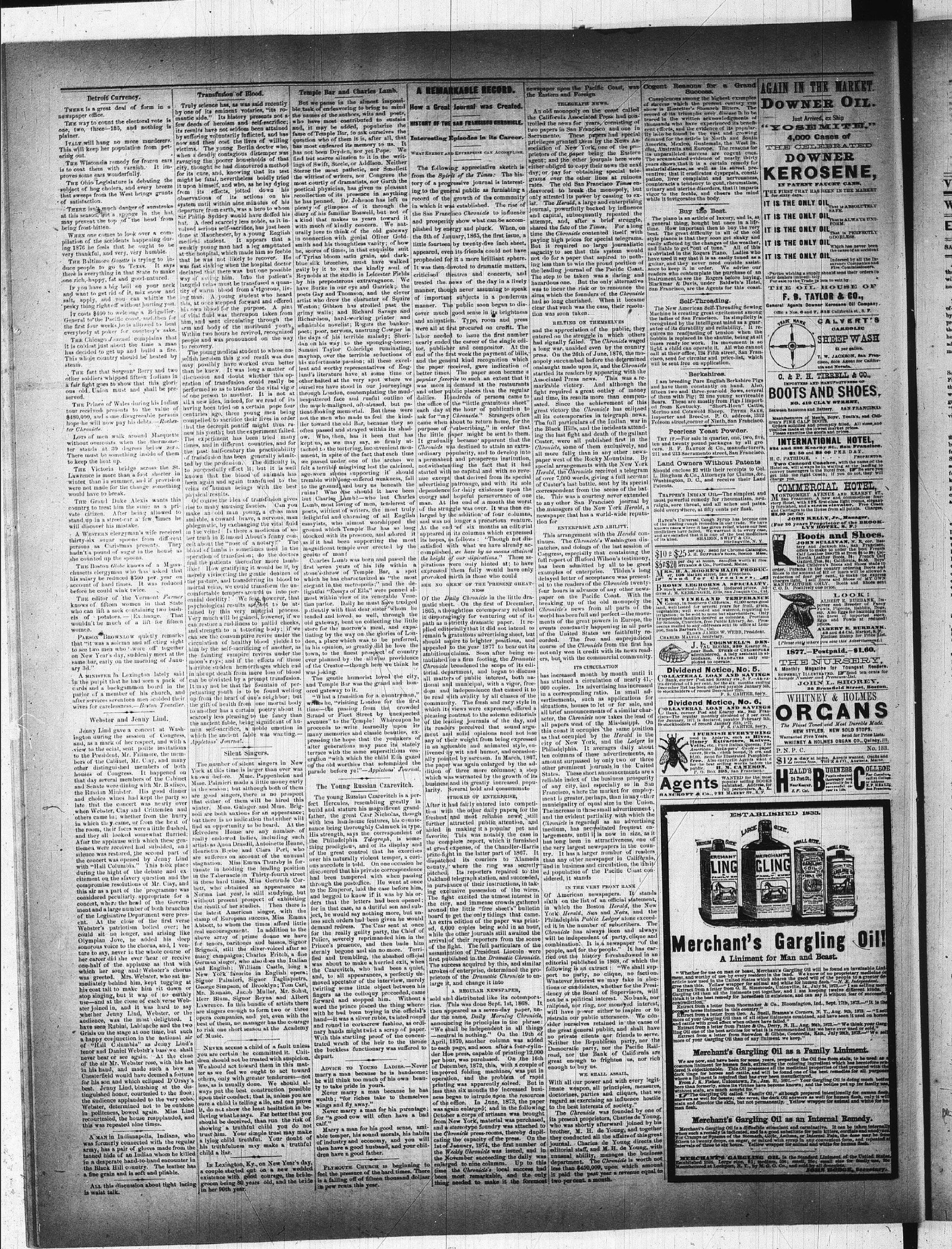
Searchable text
Detroit Currency.
There is a great deal of form in a newspaper office.
The way to count the electoral vote is one, two, three—185, and nothing is plainer.
Italy will hang no more murderers. This will keep her population from petering out.
The Wisconsin remedy for frozen ears is to coat them with varnish. It improves some ears wonderfully.
The Ohio Legislature is debating the subject of hog cholera, and every breeze that sweeps from the West brings grunts of satisfaction.
There isn't much danger of sunstroke at this season; but a sponge in the hat may prevent the top of the head from being frost-bitten.
When one comes to look over a compilation of the accidents happening during 1876 he feels that he ought to be very thankful, and very, very humble.
The Baltimore Gazette is trying to induce people to go to Texas. It says there is everything in that State to make one rich, happy, fat and good-natured.
If you have a big boil on your neck and want to get rid of it, mix snow and salt, apply, and you can whittle the pesky thing right off without hurting you.
It costs $400 to welcome a Brigadier-General to the Pacific coast, and then for the first four weeks he is allowed to beat everybody at poker for courtesy's sake.
The Chicago Journal complains that it is coldest just about the time a man has decided to get up and build a fire. This whole country should be heated by steam.
The fact that Sergeant Berry and two other soldiers whipped fifteen Indians in a fair fight goes to show that this glorious old Union must and shall be preserved.
The Prince of Wales during his Indian tour received presents to the value of $480,000, and some disagreeable persons hope he will now pay his debts. —Rochester Chronicle.
Lots of men walk around Marquette without overcoats when the thermometer stands at 30 degrees below zero. There must be something inside of them to keep the heat up.
Transfusion of Blood.
Truly science has, as was said recently by one of its eminent volatiles, "its romantic side." Its history presents not a few deeds of heroism and self-sacrifice; its results have not seldom been attained by suffering voluntarily inflicted, and has now and then cost the lives of willing victims. The young Berlin doctor who, when a deadly contagious distemper was ravaging the poorer households of that city, thought he had discovered a method for its cure, and, knowing that its test might be fatal, nevertheless boldly tried it upon himself, and who, as he lay dying from its effects, jotted down his observations of its actions on his system until within nine minutes of his departure from earth, was a hero to whom Sir Philip Sydney would have doffed his hat. A deed scarcely less noble, as it involved serious self-sacrifice, has just been done at Manchester, by a young English medical student. It appears that a weekly young man had a leg amputated at the hospital, which made him so feeble that he was not likely to recover. He was fast sinking when the hospital doctor declared that there was but one possible way of saving him. Into the patient's languid veins must be transfused a quantity of warm blood from a vigorous living man. A young student who heard this, at once stepped forward and offered his own blood for the purpose. A pint of vital fluid was thereupon taken from him, and sent circulating through the arm and body of the moribund youth. Within two hours he revived, recognized people and was pronounced on the way to recovery.
The young medical student to whose unselfish heroism this good result was due may possibly have worked even better than he knew. It was long a matter of discussion and doubt whether this operation of transfusion could really be performed so as to transfer the vital vigor of one person to another. It is not at all a new idea, indeed, for we read of its having been tried on a certain pope four centuries ago, three young men being compelled to sacrifice their lives in order that the decrepit pontififf might thus renew his youth; but the experiment failed.
The experiment has been tried many times, and in different countries, and for the past half-century the practicability of transfusion has been generally admitted by the profession. The difficulty is,
Temple Bar and Gate
But we pause in that bleak task of endeavoring the names of the authors who have most contributed and, it may be added, fame of Temple Bar, to question who of them it has most endeared its name to has not been Dryden, nor find but scarce allusions of Swift, Steele, or Sterne the most pathless the wittiest of writers, most courtly of drama poetical physician, has recollection of its presence he has penned. Dr. J. plenty of glimpses on diary of his familiar B. kind that makes us with much of kindly or naturally love to think of in connection with ge Smith and his thoughts he, scores of times, in of Tyrian bloom satirizing blue silk breeches, maily by it to vex Reynolds at the studio by his preposterous desire Burke in our eye poets Gay and Thomson artist who drew the o'Weston; Gibbon has grimy walls; and R. Richardson, hard-woman admirable novelist; J. poet; poor, neryous, the days of his terrific dan on his way to Samuel Taylor Colley may hap, over the ten his unfortunate passient and worthy reprent hand's literature have other halted at the view ourselves have stood through London, con bespattered face and the much-maligned patient-looking memory not the men who maylier toward the old D often passed and strutow. Who, then, has kept us, as we may tached to the toteringiment, in spite of the we passed under on
The fact that Sergeant Berry and two other soldiers whipped fifteen Indians in a fair fight goes to show that this glorious old Union must and shall be preserved.
The Prince of Wales during his Indian tour received presents to the value of $480,000, and some disagreeable persons hope he will now pay his debts. —Rochester Chronicle
Lots of men walk around Marquette without overcoats when the thermometer stands at 30 degrees below zero. There must be something inside of them to keep the heat up.
The Victoria bridge across the St. Lawrence is more than a foot shorter in winter than in summer, and if provision were not made for the change something would have to break.
The Grand Duke Alexis wants this country to treat him the same as a private citizen. After being allowed to stand up in a street car a few times he will discover his mistake.
A Western clergyman’s wife received thirty-six sugar spoons from different persons as Christmas presents. They hadn’t a pound of sugar in the house as she counted up the spoons.
The Boston Globe knows of a Massachusetts clergyman who has asked that his salary be reduced $500 per year on account of hard times. It was reduced before he could wink twice.
The editor of the Vermont Farmer knows of fifteen women in that State who can lift a sack containing two bushels of potatoes. —Exchange. That wouldn’t be much of a lift for fifteen women.
Parson Brownlow quietly remarks that “it was a solemn and affecting sight to see two men who wore off together on New Year’s day, suddenly meet at the same bar, early on the morning of January 3d.”
A minister in Lexington lately said in the pulpit that he had seen a pack of cards and a backgammon board in the parlor of a member of his church, and after services seventeen men scolded their wives for carelessness. —Boston Traveller.
Webster and Jenny Lind.
Jenny Lind gave a concert at Washington during the session of Congress, and, as a mark of her respect, and with a view to the ecstat, sent polite invitations to the President, Mr. Filtmore, the members of the Cabinet, Mr. Clay, and many other distinguished members of both houses of Congress. It happened on that day several members of the Cabinet and Senate were dining with Mr. Bodisco, the Russian Minister. His good dinner and choice wines had kept the party so late that the concert was nearly over when Webster, Clay and Crittenden and others came in; whether from the hurry in which they came, or from the heat of the room, their faces were a little flushed, and they all looked somewhat flurried: After the applause with which these gentlemen were received had subsided, and silence was restored, the second part of the concert was opened by Jenny Lind with “Hail Columbia.” This took place during the hight of the debate and excitement on the slavery question and the tabernacle in Thirty-fourth street in these hard times. Miss Gertrude Correnton knew it long a matter of discussion and doubt whether this operation of transfusion could really be performed so as to transfer the vital vigor of one person to another. It is not at all a new idea, indeed, for we read of its having been tried on a certain pope four centuries ago, three young men being compelled to sacrifice their lives in order that the decrepit pontiff might thus renew his youth; but the experiment failed. The experiment has been tried many times, and in different countries, and for the past half-century the practicability of transfusion has been generally admitted by the profession. The difficulty is, to successfully effect it; but it is well known that the blood of animals has been again and again transfused to the veins of human beings with the best physical results.
Of course the idea of transfusion gives rise to many amusing fancies. Can you make an old man young, a cross man amiable, a coward brave, a nervous man phlegmatic, by exchanging the vital fluid in the veins? Is there a modicum of sober truth in Elmond About’s fanny concept about the “nose of a notary?” The blood of lambs is sometimes used in the operation of transfusion; do the doctors and the patients thereafter more lamblike? How gratifying it would be if, by merely vivisectioning the gentle denizen of the pasture, and transferring its blood to mortal veins, we could transform the uncomfortable tempers around us into perennial docility! We feel however, that psychological results are not to be attained by this very material process. Very much will be gained, however, if we can restore a rudiness to pallid cheeks, and strength to a tottering body; if we can see the consumptive revive under the circulation of healthy blood yielded to him by the self-sacrifice of another, as the fainting vampire revives under the moon’s rays; and if the effects of those horrible sudden hemorrhages which end in abrupt death from mere loss of blood can be obviated by a prompt transfusion. It may not be that the fountain of perpetuating youth is to be found welling up from the heart of one’s neighbor; but the gift of health from one mortal body to another has a certain poetry about it scarcely less pleasing to the fancy than the ancient fable, being significant of human self-sacrifice, a noble emotion in which the ancient fable was wanting.—Appletons’ Journal.
Silent Singers.
The number of silent singers in New York at this time is larger than ever was known before. Mine. Pappenheim and Mine. Palmieri made a little money early in the season; but although both of them are good singers, there is no prospect that either of them will be hired this winter. Mine. Gulager and Mine. Brigoli are both anxious for an appearance; but there is no indication that either will find an opportunity to be heard. At the felvedere House are any number of really endowed ladies, including such artists as Anna Drascal, Antoinette Henne, Henrietta Beebe and Clara Perl, who are sufferers on account of the unusual stagnation. Miss Emma Thursby is fortunate in holding the leading position in the Tabernacle in Thirty-fourth street in these hard times. Miss Gertrude Correnton knew it long a matter of discussion and doubt whether this operation of transfusion could really be performed so as to transfer the vital vigor of one person to another. It is not at all a new idea, indeed, for we read of its having been tried on a certain pope four centuries ago, three young men being compelled to sacrifice their lives in order that the decrepit pontiff might thus renew his youth; but the experiment failed. The experiment has been tried many times, and in different countries, and for the past half-century the practicability of transfusion has been generally admitted by the profession. The difficulty is, to successfully effect it; but it is well known that the blood of animals has been again and again transfused to the veins of human beings with the best physical results.
Of course the idea of transfusion gives rise to many amusing fancies. Can you make an old man young, a cross man amiable, a coward brave, a nervous man phlegmatic, by exchanging the vital fluid in the veins? Is there a modicum of sober truth in Elmond About’s fanny concet about the “nose of a notary?” The blood of lambs is sometimes used in the operation of transfusion; do the doctors and the patients thereafter more lamblike? How gratifying it would be if, by merely vivisectioning the gentle denizen of the pasture, and transferring its blood to mortal veins, we could transform the uncomfortable tempers around us into perennial docility! We feel however, that psychological results are not to be attained by this very material process. Very much will be gained, however, if we can restore a rudiness to pallid cheeks, and strength to a tottering body; if we can see the consumptive revive under the circulation of healthy blood yielded to him by self-sacrifice of another, as the fainting vampire revives under the moon’s rays; and if the effects of those horrible sudden hemorrhages which end in abrupt death from mere loss of blood can be obviated by a prompt transfusion. It may not be that the fountain of perpetuating youth is to be found welling up from the heart of one’s neighbor; but the gift of health from one mortal body to another has a certain poetry about it scarcely less pleasing to the fancy than the ancient fable, being significant of human self-sacrifice, a noble emotion in which the ancient fable was wanting.—Appletons’ Journal.
The gentle hum and Temple Bar were oared gateway to it.
“What a transit writes he,” visiting time—the passing Strand or Fleet avenues” to the TPC proceeds to write many memories as pressing after generations terrace with the service “with which off the old worthwhile parade before you.”
The Young Hunt
The young Russet Hercules, build and stature father, the greatest with less handsome nance being thorne His strength says, saythe Philadelphia thing prodigiousofofofofofofofofofofofofofofofofofofofofofofofofofofofofofofofofofofofofofofofofofofofofofofofofofofofofofofofofofofofofofofofofofofofofofofofofofofOF OF OF OF OF OF OF OF OF OF OF OF OF OF OF OF OF OF OF OF OF OF OF OF OF OF OF OF OF OF OF OF OF OF OF OF OF OF OF OF OF OF OF OF OF OF OF OF OF OF OF OF OF OF OF OF OF OF OF Of Of Of Of Of Of Of Of Of Of Of Of Of Of Of Of Of Of Of Of Of Of Of Of Of Of Of Of Of Of Of Of Of Of Of Of Of Of Of Of Of Of Of Of Of Of Of Of Of Of Of Of Of Of Of Of Of Of Of Of Of Of Of Of Of Of Of Of Of Of Of Of Of Of Of Of Of Of Of Of OffOfOffOffOffOffOffOffOffOffOffOffOffOffOffOffOffOffOffOffOffOffOffOffOffOffOffOffOffOffOffOffOffOffOffOffOffOffOffOffOffOffOffOffOffOffOffOffOffOffOffOffOffOffOffOffOffOffOffOffOffOffOffOffOffOffOffOffOffOffOffOffOffOFFOFFOFFOFFOFFOFFOFFOFFOFFOFFOFFOFFOFFOFFOFFOFFOFFOFFOFFOFFOFFOFFOFFOFFOFFOFFOFFOFFOFFOFFOFFOFFOFFOFFOFFOFFOFFOFFOFFOFFOFFOFFOFFOFFOFF OFFOFFOFFOFFOFFOFFOFFOFFOFFOFFOFFOFFOFFOFFOFFOFFOFFOFFOFFOFFOFFOFFOFFOFFOFFOFFOFFOFFOFFOFFOFF OFF OFF OFF OFF OFF OFF OFF OFF OFF OFF OFF OFF OFF OFF OFF OFF OFF OFF OFF OFF OFF OFF OFF OFF OFF OFF OFF OFF OFF OFF OFF OFF OFF OFF OFF OFF OFF OFF OFF OFF OFF OFF OFF OFF OFF OFF OFF OFF OFF OFF OFF OFF OFF OFF OFF OFF OFF OFF OFF OFF OFF OFF OFF OFF OFF OFF OFF OFF OFF OFF OFF OFF OFF OFF OFF OFF OFF OFF Off Off Off Off Off Off Off Off Off Off Off Off Off Off Off Off Off Off Off Off Off Off Off Off Off Off Off Off Off Off Off Off Off Off Off Off Off Off Off Off Off Off Off Off Off Off Off Off Off Off Off Off Off Off Off Off Off Off Off Off Off Off Off Off Off Off Off Off Off Off Off Off Off Off Off Off Off Off OffsetOffsetOffsetOffsetOffsetOffsetOffsetOffsetOffsetOffsetOffsetOffsetOffsetOffsetOffsetOffsetOffsetOffsetOffsetOffsetOffsetOffsetOffsetOffsetOffsetOffsetOffsetOffsetOffsetOffsetOffsetOffsetOffsetOffsetOffsetOffsetOffsetOffsetOffsetOffsetOffsetOffsetOffsetOffsetOffsetOffsetOffsetOffsetOffsetOffsetOffsetOffsetOffsetOffsetOffsetOffsetOffsetOffsetOffsetOffsetOffsetOffset offsetoffsetoffsetoffsetoffsetoffsetoffsetoffsetoffsetoffsetoffsetoffsetoffsetoffsetoffsetoffsetoffsetoffsetoffsetoffsetoffsetoffsetoffsetoffsetoffsetoffsetoffsetoffsetoffsetoffsetoffsetoffset.offsetoffsetoffsetoffsetoffsetoffsetoffsetoffsetoffsetoffsetoffsetoffsetoffsetoffsetoffsetoffsetoffsetoffsetoffsetoffsetoffsetoffset.offsetoffset.offset.offset.offset.offset.offset.offset.offset.offset.offset.offset.offset.offset.offset.offset.offset.offset.offset.offset.offset.offset.offset.offset.offset.offset.offset.offset.offset.offset.offset.offset.offset.offset.offset.offset.offset.offset.offset.offset.offset.offset.offset.offset.offset.offset.offset.offset.offset.offset.offset.offset.offset.offset.offset.offset.offset.offset.offset.offset.offset.offset.offset.offset.offset.offset.offset.offset.offset.offset.offset.offset.offset.offset offset offset offset offset offset offset offset offset offset offset offset offset offset offset offset offset offset offset offset offset offset offset offset offset offset offset offset offset offset offset offset offset offset offset offset offset offset offset offset offset offset offset offset offset offset offset offset offset offset offset_offset_offset_offset_offset_offset_offset_offset_offset_offset_offset_offset_offset_offset_offset_offset_offset_offset_offset_offset_offset_offset_offset_offset_offset_offset_offset_offset_offset_offset_offset_offset_offset_offset_offset_offset_offset_offset_offset_offset_offset_offset_offset_offset_offset_offset_offset_offset_offset_offset_offset_offset_offset_offset_offset_offset_offset_offset_offset_offset_offset_offset_offset_offset_offset_OFFSET_OFFSET_OFFSET_OFFSET_OFFSET_OFFSET_OFFSET_OFFSET_OFFSET_OFFSET_OFFSET_OFFSET_OFFSET_OFFSET_OFFSET_OFFSET_OFFSET_OFFSET_OFFSET_OFFSET_OFFSET_OFFSET_OFFSET_OFFSET_OFFSET_OFFSET_OFFSET_OFFSET_OFFSET_OFFSET_OFFSET_OFFSET_OFFSET_OFFSET_OFFSET_OFFSET_OFFSET_OFFSET_OFFSET_OFFSET_OFFSET_OFFSET_OFFSET_OFFSET_OFFSET_OFFSET_OFFSET_OFFSET_OFFSET_OFFSET_OFFSET_OFFSET_OFFSET_OFFSET_OFFSET_OFFSET_ADDRESS_ADDRESS_ADDRESS_ADDRESS_ADDRESS_ADDRESS_ADDRESS_ADDRESS_ADDRESS_ADDRESS_ADDRESS_ADDRESS_ADDRESS_ADDRESS_ADDRESS_ADDRESS_ADDRESS_ADDRESS_ADDRESS_ADDRESS_ADDRESS_ADDRESS_ADDRESS_ADDRESS_ADDRESS_ADDRESS_ADDRESS_ADDRESS_ADDRESS_ADDRESS_ADDRESS_ADDRESS_ADDRESS_ADDRESS_ADDRESS_ADDRESS_ADDRESS_ADDRESS_ADDRESS_ADDRESS_ADDRESS_ADDRESS_ADDRESS_ADDRESS_ADDRESS_ADDRESS_ADDRESS_ADDRESS_ADDRESS_ADDRESS_ADDRESS_ADDRESS_ADDRESS_ADDRESS_ADDRESS_ADDRESS_ADDRESS_ADDRESS_ADDRESSAddressAddressAddressAddressAddressAddressAddressAddressAddressAddressAddressAddressAddressAddressAddressAddressAddressAddressAddressAddressAddressAddressAddressAddressAddressAddressAddressAddressAddressAddressAddressAddressAddressAddressAddressAddressAddressAddressAddressAddressAddressAddressAddressAddressAddressAddressAddress_address Address Address Address Address Address Address Address Address Address Address Address Address Address Address Address Address Address Address Address Address Address Address Address Address Address Address Address Address Address Address Address Address Address Address Address Address Address Address Address Address Address Address Address Address Address Address Address Address Address Address Address Address Address Address Address Address Address Address Address Address Address Address Address Address Address Address Address Address Address Address Address Address Address Address Address Address Address Address Address Address Address Address Address Address Address Address Address Address Address Address Address Address Address Address Address Address address address address address address address address address address address address address address address address address address address address address address address address address address address address address address address address address address address address address address address address address address address address address address address address address address address address address address地址地址地址地址地址地址地址地址地址地址地址地址地址地址地址地址地址地址地址地址地址地址地址地址地址地址地址地址地址地址地址地址地址地址地址地址地址地址地址地址地址地址地址地址地址地址地址地址地址地址地址地址地址地址地址地址地址地址地址地址地址地址地址地址地址地址地址地址地址 地址 地址 地址 地址 地址 地址 地址 地址 地址 地址 地址 地址 地址 地址 地址 地址 地址 地址 地址 地址 地址 地址 地址 地址 地址 地址 地址 地址 地址 地址 地址 地址 地址 地址 地址 地址 地址 地址 地址 地址 地址 地址 地址 地址 地址 地址 地址 地址 地址 地址 地址 地址 地址 地址 地址 地址 地址 地址 地址 地址 地址 地址 地址 地址 地址 地址 地址 地址 地 地 地 地 地 地 地 地 地 地 地 地 地 地 地 地 地 地 地 地 地 地 地 地 地 地 地 地 地 地 地 地 地 地 地 地地地地地地地地地地地地地地地地地地地地地地地地地地地地地地地地地地地地地地地地地地地地地地地地地地地地地地地地地地地地地地地地地地地地地地地地地地地地地地地地地地地地地地地地,地、地、地、地、地、地、地、地、地、地、地、地、地、地、地、地、地、地、地、地、地、地、地、地、地、地、地、地、地、地、地、地、地、地、地、地、地、地、地、地、地、地、地、地、地、地、地、地、地、地、地、
and Senate were dining with Mr. Bodisco,
the Russian Minister. His good dinner
and choice wines had kept the party so
late that the concert was nearly over
when Webster, Clay and Crittenden and
others came in; whether from the hurry
in which they came, or from the heat of
the room, their faces were a little flushed,
and they all looked somewhat blurred;
After the applause with which these gentlemen were received had subsided, and silence was restored, the second part of the concert was opened by Jenny Lind with "Hail Columbia." This took place during the hight of the debate and excitement on the slavery question and the compromise resolutions of Mr. Clay, and this air as a part of the programme was considered peculiarly appropriate for a concert, where the head of the Government and a large number of both branches of the Legislative Department were present. At the close of the first verse Webster's patriotism boiled over; he could sit no longer, and arising like Olympian Jove, he added his deep sonorous voice to the chorus, and, I venture to say, never in the whole course of her career did she ever hear or receive one-half of the applause as that with which her song and Webster's chorus was greeted. Mrs. Webster, who sat immediately behind him, kept tugging at his coat tail to make him sit down or stop singing, but it was of no earthly use—and at the close of each verse Webster joined in, and it was hard to say whether Jenny Lind, Webster, or the audience, was the most delighted. I have seen Rubini, Lablanche and the two Grisis on the stage at one time, but such a happy conjunction in the national air of "Hail Columbia" as Jenny Lind's tenor and Daniel Webster's bass we shall never hear or see again. At the close of the air Mr. Webster rose, with his hat in his hand, and made such a bow as Chesterfield would have deemed a fortune for his son and which eclipse D'Orsay's best. Jenny Lind, blushing at the distinguished honor, courtesied to the floor; the audience applauded to the very echo. Webster, determined not to be outdone in politeness, bowed again. Miss Lind recountesied, the house reapplauded, and this was repeated nine times.
A man in Indianapolis, Indiana, who was formerly connected with the regular army, has a pair of gloves made from the tanned hide of an Indian whom he killed in a desperate hand-to-hand encounter in the Black Hill country. The leather has a fine grain and is soft and pliable.
All this discussion about tight lacing is waist talk.
Never accuse a child of a fault unless you are certain he committed it. Children should not be treated with suspicion. We should act toward them in this matter as we feel we ought to act toward others, only with greater tenderness—not less, as is usually done. We should always put the best construction possible upon their conduct; that is, unless you are sure a child is telling a lie, and can prove it, do not show the least hesitation in believing what he says. Far better that you should be deceived, than run the risk of showing a truthful child you do not trust him. Your simple trust may make a lying child truthful. Your doubt of his truthfulness may make a truthful child a liar.
In Lexington, Ky., on New Year's day, a couple started out on a new wedded existence with good courage, the bride-groom being 80 years old, and the bride in her 90th year.
The young Russofect Hercules, to build and stature father, the great with less hands-on nance being thorny. His strength, says the Philadelphia thing prodigious of the great connoisseur over his naturally anecdote is to discover that he had been tampered through the post to the Emperor, and begged to keep that the lion for in that case, jeet, he would seize less such orders in demand redress. For the really gil Police, severely Prince's presence sternly begone fled and trembled was about to me the Czarevitch, and, to all apply moved spectator twirling some fingers as the c forward and s word the prince with he had been hand—it was a and round in c nary hands might With this start treated wrath o the luckless f depart.
Advice to marry a man he will think to take pride. Never marry wealth; "for m wings and fly. Never marry for "a good co calf."
Marry a man able temper, b of industry and then have a go dren have a go
PLYMOUTH feel the pressure is a falling off in pew rents t
Temple Bar and Charles Lamb.
But we pause in the almost impossible task of endeavoring to bring to mind the names of the authors, wits and poets, who have most contributed to sustain and, it may be added, popularize the fame of Temple Bar, to ask ourselves the question who of them it is, after all, that has most endeard its memory to us. It has not been Dryden, nor yet Pope. We find but scarce allusion to it in the writings of Swift, Steele, or Addison. Neither Sterne the most pathetic, nor Smollett the witiest of writers, nor Congreve the most courtly of dramatists, nor Garth the poetical physician, has given us pleasant recollection of its presence in anything he penned. Dr. Johnson has left us plenty of glimpses of it through the diary of his familiar Boswell, but not of a kind that makes us yearn toward it with much of kindly concern. We naturally love to think of the old gateway in connection with genial Oliver Goldsmith and his thoughtless vanity; of how he, scores of times, in that exquisite suit of Tyrian bloom satin grain, and dark-blue silk breeches, must have walked gaily by it to vex the kindly soul of Reynolds at the studio in Leicester Fields by his preposterous extravagance. We have Burke in our eye and Garrick; the poets Gay and Thomson, and the clever artist who drew the character of Squire Weston; Gibbon has strolled past the grimy walls; and Richard Savage and Richardson, hard-working printer and admirable novelist; Rogers the banker-poet; poor, nervous, unstrung Cowper in the days of his terrible malady; Sheridan on his way to the sponging-house; Samuel Taylor Coleridge ruminating, mayphe, over the terrible seductions of his unfortunate passion; all these excellent and worthy representatives of England's literature have at some time or other halted at the very spot where we ourselves have stood in our journeys through London, contemplating the mud-bespattered face and rueful outline of the much-maligned, oft-abused, but patient-looking memorial. But these were not the men who made us feel the kindlier toward the old Bar, because they so often passed and strayed within its shadow. Who, then, has it been that has kept us, as we may say, so firmly attached to the toterting, inconvenient monument, in spite of the fact that each time we passed under one of the arches we naturally proclaimed just what we saw.
A REMARKABLE RECORD.
How a Great Journal was Created.
HISTORY OF THE SAN FRANCISCO CHRONICLE.
Interesting Episodes in Its Career.
WHAT ENERGY AND ENTERPRISE CAN ACCOMPLISH.
The following appreciative sketch is from the Spirit of the Times: The history of a progressive journal is interesting to the general public as furnishing a record of the growth of the community in which it was established. The rise of the San Francisco Chronicle to influence and prosperity show what can be accomplished by energy and pluck. When, on the 6th of January, 1865, the first issue, a little fourteen by twenty-five inch sheet, appeared, even its friends could not have prophesied for it a more brilliant sphere. It was then devoted to dramatic matters, criticised theatre and concerts, and treated the news of the day in a lively manner, though never assuming to speak of important subjects in a ponderous manner. The public soon began to discover much good sense in its brightness and animation. Type, room and press were all at first procured on credit. The labor needed to issue the first number nearly ended the career of the single editor, publisher and compositor. At the end of the first week the payment of bills, and the general kind recognition which the paper received, gave indication of better times. The paper soon became a popular favorite to such an extent that it was more in demand at the restaurants and other public places than the regular dailies. Hundreds of persons came to the office of the "little gratuitous sheet" each day at the hour of publication to ask for "my Chronicle." Strangers often came when about to return home, for the purpose of "subscribing," in order that the little paper might be sent to them. It gradually became apparent that the Chronicle was destined to attain an extraordinary popularity, and to develop into a permanent and prosperous institution, notwithstanding the fact that it had newspaper upon the Pacific Coast, was the Eastern and Foreign
TELEGRAPH NEWS.
An old monopoly on the coast called the California Associated Press had controlled the news for years, consisting of two papers in San Francisco and one in Sacramento. These papers had special privileges granted them by the News Association of New York, one of the proprietors of the paper being the Eastern agent; and the other journals here were either obliged to copy their news next day; or pay for obtaining special telegrams over the other lines at ruinous rates. The old San Francisco Times endeavored to break the monopoly, but only attested its power by ceasing to exist. The Herald, a large and enterprising journal, powerfully backed by influence and capital, subsequently repeated the attempt, and, after a brief struggle, shared the fate of the Times. For a long time the Chronicle contented itself with paying high prices for special telegrams. But it required no large journalistic sagacity to see that this system would not do for a paper that aspired to nothing less than to win the proud position of the leading journal of the Pacific Coast. The step to be taken was a daring and hazardous one. But the only alternative was to incur the risk or to renounce the aims which the founders of the Chronicle had so long cherished. When it became clear that such was the case, their resolution was soon taken.
RELITING ON THEMSELVES
and the appreciation of the public, they entered on the struggle in which others had signally failed. The Chronicle waged a long war, unaided even by the country press. On the 26th of June, 1876, the monopoly succumbed before the determined onslaught made upon it, and the Chronicle startled its readers by appearing with the Associated Press news. This was a remarkable victory. And although the fight required a great outlay of money and time, its results more than compensated. Since the achievement of this great victory the Chronicle has eclipsed all its cotemporaries in telegraph news. The full particulars of the Indian war in Black Hills, and the incidents attending the last fight and death of the gallant Custer, were all published first in the Chronicle, some of them exclusively, and all more fully than in any other newspaper west of the Rocky Mountains. By special arrangements with the New York
The Young Russian Czarevitch.
The young Russian Czarevitch is a perfect Hercules, resembling greatly in build and stature his magnificent grandfather, the great Czar Nicholas, though with less handsome features, his countenance being thoroughly Calmuck in type. His strength, says the correspondent of the Philadelphia Telegraph, is something prodigious, and of its display and of the great control that he exercises over his naturally violent temper, a curious anecdote is told. On one occasion he discovered that his private correspondence had been tampered with when passing the paper received, gave mistakenly lent and worthy representatives of England's literature have at some time or other halted at the very spot where we ourselves have stood in our journeyings through London, contemplating the mud-bespattered face and rueful outline of the much-maligned, oft-abused, but patient-looking memorial. But these were not the men who made us feel the kindier toward the old Bar, because they so often passed and strayed within its shadow. Who, then, has it been that has kept us, as we may say, so firmly attached to the toterting, inconvenient monument, in spite of the fact that each time we passed under one of the arches we felt a terrible misgiving lest the calcined, age-worn stones supporting it should tremble with long-suffered weakness, fall to the ground, and bury us beneath the ruins? Who else should it have been but Charles Lamb?—who but Charles Lamb, most loving of men, tenderest of poets, witiest of writers, the most truly delightful and charming of all English essayists, who almost worshipped the ground which Temple Bar has so long blocked with its presence, and adored it as if it had been supporting the most magnificent temple ever erected by the genius of man?
Charles Lamb was born and passed the first seven years of his life within a stone's throw of Temple Bar, a spot which he has characterized as "the most elegant in the metropolis;" and the delightful "Essays of Ella" were penned almost within view of its venerable Venetian parlor. Daily he must have trudged patiently with that dear sister whom he tended and loved so well, through the old gateway, bent on collecting the little store for the morrow's meal, and expatiating by the way on the glories of London, a place which was to be preferred in his opinion, so greatly did he love the town, to the finest prospect of country ever planned by the all wise providence of the Creator—though here we think he was joking.
The gentle humorist loved the city, and Temple Bar was the grand and honored gateway to it.
"What a transition for a countryman," writes he, "visiting London for the first time—the passing from the crowded Strand or Fleet Street by unexpected avenues" to the Temple! Whereupon he proceeds to write learnedly upon its many memories and classic beauties, expressing the hope that the younkers of after generations may pace its stately terrace with the same superstitious veneration "with which the child Ella gazed on the old worthiness that solemnized the parade before ye!"—Appletons' Journal.
The Young Russian Czarevitch.
The young Russian Czarevitch is a perfect Hercules, resembling greatly in build and stature his magnificent grandfather, the great Czar Nicholas, though with less handsome features, his countenance being thoroughly Calmuck in type. His strength, says the correspondent of the Philadelphia Telegraph, is something prodigious, and of its display and of the great control that he exercises over his naturally violent temper, a curious anecdote is told. On one occasion he discovered that his private correspondence had been tampered with when passing the paper received, gave mistakenly lent at the very spot where we ourselves have stood in our journeyings through London, contemplating the mud-bespattered face and rueful outline of the much-maligned, oft-abused, but patient-looking memorial. But these were not the men who made us feel the kindier toward the old Bar, because they so often passed and strayed within its shadow. Who, then, has it been that has kept us, as we may say, so firmly attached to the totering, inconvenient monument, in spite of the fact that each time we passed under one of the arches we felt a terrible misgiving lest the calcined, age-worn stones supporting it should tremble with long-suffered weakness, fall to the ground, and bury us beneath the ruins? Who else should it have been but Charles Lamb?—who but Charles Lamb, most loving of men, tenderest of poets, witiest of writers, the most truly delightful and charming of all English essayists, who almost worshipped the ground which Temple Bar has so long blocked with its presence, and adored it as if it had been supporting the most magnificent temple ever erected by the genius of man?
Charles Lamb was born and passed the first seven years of his life within a stone's throw of Temple Bar, a spot which he has characterized as "the most elegant in the metropolis;" and the delightful "Essays of Ella" were penned almost within view of its venerable Venetian parlor. Daily he must have trudged patiently with that dear sister whom he tended and loved so well, through the old gateway, bent on collecting the little store for the morrow's meal, and expatiating by the way on the glories of London, a place which was to be preferred in his opinion, so greatly did he love the town, to the finest prospect of country ever planned by the all wise providence of the Creator—though here we think he was joking.
The gentle humorist loved the city, and Temple Bar was the grand and honored gateway to it.
"What a transition for a countryman," writes he, "visiting London for the first time—the passing from the crowded Strand or Fleet Street by unexpected avenues" to the Temple! Whereupon he proceeds to write learnedly upon its many memories and classic beauties, expressing the hope that the younkers of after generations may pace its stately terrace with the same superstitious veneration "with which the child Ella gazed on the old worthiness that solemnized the parade before ye!"—Appletons' Journal.
The Young Russian Czarevitch.
The young Russian Czarevitch is a perfect Hercules, resembling greatly in build and stature his magnificent grandfather, the great Czar Nicholas, though with less handsome features, his countenance being thoroughly Calmuck in type. His strength, says the correspondent of the Philadelphia Telegraph, is something prodigious, and of its display and of the great control that he exercises over his naturally violent temper, a curious anecdote is told. On one occasion he discovered that his private correspondence had been tampered with when passing the paper received, gave mistakenly lent at the very spot where we ourselves have stood in our journeyings through London, contemplating the mud-bespattered face and rueful outline of the much-maligned, oft-abused, but patient-looking memorial. But these were not the men who made us feel the kindier toward the old Bar, because they so often passed under one of the arches we felt a terrible misgiving lest the calcined, age-worn stones supporting it should tremble with long-suffered weakness, fall to the ground, and bury us beneath the ruins? Who else should it have been but Charles Lamb?—who but Charles Lamb, most loving of men, tenderest of poets, witiest of writers, the most truly delightful and charming of all English essayists, who almost worshipped the ground which Temple Bar has so long blocked with its presence, and adored it as if it had been supporting the most magnificent temple ever erected by the genius of man?
Charles Lamb was born and passed the first seven years of his life within a stone's throw of Temple Bar, a spot which he has characterized as "the most elegant in the metropolis;" and the delightful "Essays of Ella" were penned almost within view of its venerable Venetian parlor. Daily he must have trudged patiently with that dear sister whom he tended and loved so well, through the old gateway, bent on collecting the little store for the morrow's meal, and expatiating by the way on the glories of London, a place which was to be preferred in his opinion, so greatly did he love the town, to the finest prospect of country ever planned by the all wise providence of the Creator—though here we think he was joking.
The gentle humorist loved the city, and Temple Bar was the grand and honored gateway to it.
"What a transition for a countryman," writes he, "visiting London for the first time—the passing from the crowded Strand or Fleet Street by unexpected avenues" to the Temple! Whereupon he proceeds to write learnedly upon its many memories and classic beauties, expressing the hope that the younkers of after generations may pace its stately terrace with the same superstitious veneration "with which the child Ella gazed on the old worthiness that solemnized the parade before ye!"—Appletons' Journal.
The Young Russian Czarevitch.
The young Russian Czarevitch is a perfect Hercules, resembling greatly in build and stature his magnificent grandfather, the great Czar Nicholas, though with less handsome features, his countenance being thoroughly Calmuck in type. His strength, says the correspondent of the Philadelphia Telegraph, is something prodigious, and of its display and of the great control that he exercises over his naturally violent temper, a curious anecdote is told. On one occasion he discovered that his private correspondence had been tampered with when passing the paper received, gave mistakenly lent at the very spot where we ourselves have stood in our journeyings through London, contemplating the mud-bespattered face and rueful outline of the much-maligned,oft-abused,but patient-looking memorial. But these were not the men who made us feel the kindier toward the old Bar,because they so often passed under one of the arches we felt a terrible misgiving lest the calcined,age-worn stones supporting it should tremble with long-suffered weakness,fall to the ground,and bury us beneath the ruins? Who else should it have been but Charles Lamb?—who but Charles Lamb,most loving of men,tenderest of poets,witiest of writers,the most truly delightful and charming of all English essayists,who almost worshippedthe ground which Temple Bar has so long blocked with its presence,and adored it as if it had been supportingthe most magnificent temple ever erected bythe geniusofman!
Charles Lamb was born and passedthe first seven years of his life withina stone's throwof TempleBar,a spotwhichhehascharacterizedas“themostelegantinmetropolis;”andthedelightful“EssaysofElla”werepennededalmostwithviewofitsvenerableVenetianparlor.Dailyhemusthavetrudgedpatientlywiththatdearssisterwhomhetendedandlovedsowell,troughtheoldgateway,bentoncoblectingthelittlestoreforthemorrow'smeal,andexpatiatingbythewayonthegloriesofLondon,aplacewhichwastobepreferredinhisopinion,sоoughdidhelovethetown,tothefinestprospectofcountryeverplannedbytheallwiseprovidenceoftheCreator—thoughherewethinkhewasjoking.
The gentle humorist lovedthecity,andTempleBarwasthegrandandhonored Gatewaytoit.
"Whatatransitionforacountryman,"writeshe,“visitingLondonforthefirsttime—thepassingfromthecrowdedStrandorfleetStreetbyunexpectedavenues”toTheTemple!Whereuponheproceedstowritelearnedlyuponitsmanymemoriesandclassicbeauties,expressingthehopethattheyounkersofaftergenerationsmaypaceitsstatelyterracewiththesamesuperstitiousveneration“withwhichthechildEllagazedontheoldworthinessthatsolemnizedparadebeforeye!”—Appletons’Journal.
The Young Russian Czarevitch.
The young Russian Czarevitch is a perfect Hercules,resembling greatly in build和statuehis magnificentgrandfather,theGreatCzarNicholasthoughwithlesshandsomefeatures,hiscountenancebeingthoroughCalmuckintype.Hisstrength,saysthecorrespondentofthePhiladelphiaTelegraphis somethingprodigious,andofitsdisplayandofthegreatcontrolthatheexercisesoverhisnaturallyviolenttemper,acuriousanecdoteis told.Ononeoccasionhediscoveredthathisprivatecorrespondencehadbeentamperedwithwhenpassingthepaperreceived,gavemistakenly lentattheveryspotwhereweusernewsreadersbutwiththecommercialcommunity.
OftheDailyChronicleinthelittle dramatic sheet.OnthefirstofDecember1865,a thoughtlesscontemporaryrebukeditdisparaginglyforventuringoutofitspathasa strictlydramaticpaperItrepliededitoriallythatit didnotintendtomainasagrutiousadvertisingsheet,但shouldaspiretobrighterpositions,andappealedtoheryear1877tobearoutsitsambitionclaims.Soonafterbeingestablishedonafirmfooting,theDramaticChroniclebroadenedthescopeitseditorialdepartment,andbeguntodiscussallmattorsofpublicinterest,bothnationalandmunicipal,vwitha vigor,freedomandindependencethatcausedittobereadwithaviditybyallclassesofthecommunity.Thefreshandracystyleinwhichitsviewswereexpressedoffa pleasingcontrasttothesolemneditorialsofleadingjournsoftheday,anditsreadersperceivedthat soundargumentandsolidopinionsneednotloseanyof theirweightfrombeingexpressedinanagreableandanimatedstyle,eulivenbywildhumor,andoccasionallypointedbysarcasm.InMarch1867,thepaperwasagain enlargedbytheadditionofthreemorecolumns;astepwhichwaswarrantedbythegrowthofitsbusinessanditsgreaterisedpopularity.SeveralboldandconsummateSTROKESOFENTERRISE,
Afterithadfairlyenteredintocompetitionwithotherdailypapersforthefreshestandmostreliablenews stillfurtherattractedpublicattention,andaidedinmakingitapopularpetandfavoriteThiswasnotablythecaseinthiscompletereport,theit furnishedatgreatexpense.of,theChandler-Harrisprince-flightintherartpart1867。它dispatcheditscourierstoAlameda county。ItaveragedonlyabouttwoorthreeotherprominentjournersintheUnitedStates。这些shortannouncementsarea reliableindexofthebusinessprosperityofanycity,andespeciallysoinSanFrancisco,themarketforemploymentisgreater,p perhaps thaninanyothermunicipalityofequalsizeintheUnion.Theincreaseinthosesmalladvertisement,andtheevidentpartialitywiththeChronicleisregardedasanadvertisingmedium,hassensecuredfrequentengagementuntilitisnowinsize.asithaslongbeeninattractiveness,一oftheverylargestnewpapersinthecountry.它Hasa largernumberofreadersthananyothernewpaperinCalifornia,andinbusinessandcirculation,thelimitedpopulationofthePacificCoastconsidered.itstands
The young Russian Czarevitch is a perfect Hercules, resembling greatly in build and stature his magnificent grandfather, the great Czar Nicholas, though with less handsome features, his countenance being thoroughly Calmuck in type. His strength, says the correspondent of the Philadelphia Telegraph, is something prodigious, and of its display and of the great control that he exercises over his naturally violent temper, a curious anecdote is told. On one occasion he discovered that his private correspondence had been tampered with when passing through the postoffice. He went at once to the Emperor, laid the case before him, and begged to know if it was by his orders that the letters had been opened; for in that case, as a dutiful son and subject, he would say nothing more, but unless such orders had been given he would demand redress. The Czar sent at once for the really guilty party, the Chief of Police, severely reprimanded him in the Prince's presence, and then bade him sternly begone and sin no more. Terrified and trembling, the abashed official was about to make a hurried exit, when the Czarevitch, who had been a quiet, and to all appearances, a perfectly unmodulated spectator of the interview, merely twirling some little object between his fingers as the colloquy proceeded, came forward and stopped him. Without a word the prince placed the thing wherewith he had been toying in the official's hand—it was a silver ruble, twisted round and round in corkscrew fashion, as ordinary hands might twist a scrap of paper. With this startling proof of the concentrated wrath of the heir to the throne the luckless functionary was suffered to depart.
ADVICE TO YOUNG LADIES.—Never marry a man because he is handsome; he will think too much of his own beauty to take pride in yours.
Never marry a man because he has wealth; "for riches take to themselves wings and fly away."
Never marry a man for his parentage; for "a good cow will often have a bad calf."
Marry a man for his good sense, amiable temper, his sound morals, his habits of industry and economy, and you will then have a good husband, and your children have a good father.
Plymouth Church is beginning to feel the pressure of the hard times. There is a falling off of fifteen thousand dollars in pew rents this year.
After it had fairly entered into competition with the other daily papers for the freshest and most reliable news, still further attracted public attention, and aided in making it a popular pet and favorite. This was notably the case in the complete report, which it furnished at great expense, of the Chandler-Harris prize-fight in the latter part of 1867. It dispatched its couriers to Alameda county, where the ring was secretly pitched. Its reporters repaired to the Oakland telegraph station, and succeeded, in pursuance of their instructions, in taking exclusive possession of the wires. The fight excited the utmost interest in the city, and immense crowds gathered around the little "free sheet's" bulletin board to get the only tidings that came. An extra edition of the paper was printed, 6,000 copies being sold in an hour, while the other journals still awaited the arrival of their reporters from the scene of the fight. The full particulars of the assassination of President Lincoln were first published in the Dramatic Chronicle. The success acquired by this, and similar strokes of enterprise, determined the proprietors of the Dramatic Chronicle to enlarge it, and change it into
A REGULAR NEWSPAPER,
sold and distributed like its cotemporaries. This was done Sept. 1st, 1868. It then appeared as a seven-day paper, under the name, Daily Morning Chronicle, announcing its principles in the phrase: "We shall be independent in all things—neutral in nothing." On the 19th of April, 1870, another column was added to each page, and soon after a four-cylinder Hoe press, capable of printing 12,000 per hour, was purchased. On the 16th of December, 1872, this, with a couple of improved folding machines, was put in operation, and the problem of rapid printing was apparently solved. In less than six months the increased business began to intrude upon the resources of the office. In June, 1873, the paper was again enlarged; and in the following October a corps of artisans was brought from New York, material was purchased, and a stereotype foundry was attached to the Chronicle press-rooms, thereby duplicating the capacity of the press. On the 1st of January, 1874, the first number of the Weekly Chronicle was issued, and in the November succeeding the daily was enlarged to nine columns. Up to this time the Chronicle's local success had been most remarkable, and the only thing needed to make it the foremost of any city, and especially so in San Francisco, where the market for employment is greater perhaps, than in any other municipality of equal size in the Union. The increase in these small advertisements, and the evident partiality with which the Chronicle is regarded as an advertising medium, has necessitated frequent enlargements, until it is now in size; as it has long been in attractiveness, one of the very largest newspapers in the country. It has a larger number of readers than any other newspaper in California, and in business circulation, the limited population of the Pacific Coast considered, it stands
IN THE VERY FRONT BANK
Of American newspapers. It stands sixth on the list of an official statement, in which the Boston Herald, the New York Herald, Sun and News, and the Philadelphia Public Ledger alone exceeded it in the number of subscribers. The Chronicle has always been and always will be independent of party, clique and combination. It is a newspaper "of the people," and for the people." It has carried out the history foreshadowed in an editorial published in 1868, of which the following is an extract: "We shall support no party, no clique, no faction. Whatever interest we may take in elections or candidates, whether for the Presidency or the Board of Supervisors, will not be a political interest. No bank nor railroad, nor ring, nor moneyed interest will have power either to inspire or to restrain our public utterances. We consider ourselves retained in the cause of the great general public, and shall have no private clients nor friends to serve. Neither the Republican party, nor the Democratic party, nor the Pacific Railroad, nor the Bank of California are great enough to frighten us, nor rich enough to buy us.
WE SHALL ASSAIL,
With all our power and with every legitimate weapon, all principles measures doctorines parties and cliques that we regard as exercising an influence hostile to the best interests of society.
The Chronicle was founded by one of its present proprietors, Charles de Young, who was shortly afterward joined by his brother, M. H. de Young, and together they conducted all the affairs of this great journal. Charles de Young directs the editorial staff, and M. H. de Young, with unusual ability manages the business department. The Chronicle is worth not less than $450,000 upon which amount it paid the past year a revenue equal to two percent a month.
Cogent Reasons for a Grand Success.
Conspicuous among the highest examples of success which the present century can show is Hostetter's Stomach Blitters. The record of its triumphs over disease is to be traced in the written acknowledgments of thousands who have experienced its beneficial effects, and the evidence of its popularity is to be found in the rest and growing demand for the article in North and South America, Mexico, Guatemala, the West Indies, Australia and Europe. The reasons for its unparalleled success are cogent ones. The accumulated evidence of nearly thirty years shows that it is a certain remedy for malarial disease, as well as its surest preventive; that it eradicates dyspepsia, constipation, liver complaint and nervousness, counteracts a tendency to gout, rheumatism, urinary and uterine disorders, that it imparts vigor to the feeble, and cheers the mind while it invigorates the body.
Buy the Best.
The plano is an article of luxury, and is, as a general thing, bought but once in a lifetime. How important then to buy the very best. The great difficulty in all of the old style pianos is that they soon get skaky and easily affected by the changes of the weather, and liable to get "out of tune." All of this is obviated in the Rogers Piano. Ladles who have used it say that it is as easily tuned as a guitar, and they never need outside assistance to keep it in order. We advise our readers who contemplate the purchase of an instrument to see the Rogers before buying. Blackmar & Davis, under Baldwin's Hotel, San Francisco, are the Agents for this coast.
Self-Threading.
The New American Self-Threading Sewing Machine is creating great excitement among the ladies of San Francisco. Its simplicity is recognized by the intelligent mind as a guarantee of its durability and reliability. It requires no readjusting of tension when the bobbin is replaced in the shuttle, being at all times ready for work. Its movement is so light a child can operate it. All who cannot call at their office, 124 Fifth street, San Francisco, send for circular and price-list, which will be sent free on application.
Berkshires.
I am breeding Pure English Berkshire Pigs and have them constantly on hand. Also, fifteen two and three-year-old Sows, several of them with Pig: 22 fine young serviceable Boars. These are mostly from Pigs I imported from Kentucky. "Short-Horn" Cattle, Merino and Cotswold Sheep. Peter Saxn, Importer and Breeder. P. O. address, 1312 Folsom street, corner of Ninth, San Francisco.
Peerless Yeast Powder.
Try it.—For sale in quarter, one, two, five, ten and twenty pound packages by all grocers. B. F. Barton & Co., manufacturers, 211 and 213 Sacramento street, San Francisco.
Land Owners Without Patents
AGAIN IN THE MARKET.
DOWNER OIL.
Just Arrived, ex Ship
"YOSEMITE."
4,000 Cases of
THE CELEBRATED
DOWNER
KEROSENE,
IN PATENT FAUCET CANS.
THE FIRST THAT HAS BEEN IN THE MARKET
for sixty days.
IT IS THE ONLY OIL
That is ABSOLUTELY SAFE.
IT IS THE ONLY OIL
That is ALWAYS UNIFORM.
IT IS THE ONLY OIL
That is PERFECTLY ODORLESS.
IT IS THE ONLY OIL
Which has never been the cause of an accident.
Indarned by all the Insurance Companies and Fire Commissioners.
Parties wishing a supply should send their orders to their dealers immediately.
For sale to the Trade In lots to suit by
THE OIL HOUSE OF
F. B. TAYLOR & CO., General Agents Downer Kerosene Oil Company.
Office s No. G and 7, 815 California st., S. F.
CALVERT'S CARPOLICHE SHEEP WASH
82 per gallon.
T. W. JACKSON, San Francisco, sole Agent for California and Nevada.
C. & P. H. TIRRELL & CO., IMPORTERS AND MANUFACTURERS OF BOOTS AND SHOES,
NO. 419 CLAY STREET,
Between Sansome and Battery.
San Francisco.
Manufacturers of Men's Boy's Youth's, and Children's Fine GALF BOOTS.
Orders solicited and promptly filled. All sizes and qualities made at the lowest market prices.
Please examine the scoops and prices.
INTERNATIONAL NOTEL,
524 and 526 Kearny St., San Francisco.
81 50 and 82 00 PER DAY.
H. C. PATHIDGE.
Two Cancord Coaches, with the names of the
Berkshires.
I am breeding Pure English Berkshire Pigs and have them constantly on hand. Also, fifteen two and three-year-old Sows, several of them with Pig; 22 fine young serviceable Boars. These are mostly from Pigs Imported from Kentucky. "Short-Horn" Cattle, Merino and Cotswold Sheep. Peter Saxe, Importer and Breeger. P.O. address, 1312 Folsom street, corner of Ninth, San Francisco.
Peerless Yeast Powder.
Try it—For sale in quarter, one, two, five, ten and twenty pound packages by all grocers. B. F. Barton & Co., manufacturers, 211 and 213 Sacramento street, San Francisco.
Land Owners Without Patents
Should enclose $2 with their receipts to Col. L. Bingham & Co., Attorneys for Claims, & Washington, D.C., and receive their Land Patents.
Trapper's Indian Oil—the simplest and most powerful remedy for rheumatism, neuralgia, sore throat, and all aches and pain. Sold everywhere, at fifty cents per flask.
Hatton's Universal Cough Syrup has become one of the leading cough remedies in our trade. We have known cases where it has given relief, where our best medicines have failed. We warrant it in every case, and are satisfied that it is one of the best medicines of its kind.
SHAIRON, SWIFT & CO., Stirlingville, N.Y.
$10 = $25 per day. Send for Chromo Catalogue. J. H. BUFFORD'S BONS, Boston Maine.
$5 = $20 per day at home. Sauplies worth $1 free. BIMSON & Co., Portland, Maine.
MRS. H. A. MOORE'S MAIR PRODUCTION 105 Market街, San Francisco.
Nend for Circulars.
BROWN LEGORHNS A SPECIALTY. Stock selected for pure bred. Reduced prices. Address J. M. KERRINGER, Ellis, San Joaquin Co., Cal.
NEW VINELAND TEMPERANCE Colony, In Southern California, 61,000 acres good land, with heather for several years for fruit, grain, vegetables well wooded and watered, requiring no irrigation; to be sold to none but shareholders. Only Temperature families desired as colonists. Provision for Schools, Churches, Free Public Library, & Prospectus mailed to any addresses sent to office at Lompoc, Santa Barbara Co., Cal.
ELDER JAMES W. WEIB, President. CHARLES MALTLY, Secretary.
J. L. COGSWELL'S DENTAL ROOMS, 289 Kearny St., near Bush, ETHER or CHLOEOPORM administered. A lady assistant in attendance. GRADUATES only employed to operate.
Dividend Notice, No. 5.
COLLATERAL LOAN AND SAVINGS Bank, corner Post and Kearney St., S.F.-An extra dividend of $4 per cent, for the six months ending December 31st has been declared payable January 5th, to stockholders of record December 27th.
P. S. CARTEIER, Secy.
Dividend Notice, No. 6.
COLLATERAL LOAN AND SAVINGS Bank, corner Post and Kearney St., S.F.-The regular monthly dividend of $2 per cent, for January 19th is declared payable February 5th, to stockholders of record January 27th, 1977.
F. S. CARTEIER, Secy.
I PURNISH EVERYTHING med in Apilays, such as Hives, Honey Extractors, Knives, Vells, etc.; Pure Italian Queens. The American Beekeeper's Guide—a paper cover: 30 sheets; cloth illustrated pamphlet—40 sheets; also energetic Agents want d for the best selling works before the public.
H. M. CAMERON.
P.O. Box 395, San Francisco.
Agents
WANTED for the most popular selling BOOKS published. Address for full particulars, A. L. BANCROFT & Co., 721 Market St., N.P.
C.E.P.H.TIRRELL & CO.
IMPORTERS AND MANUFACTURERS OF BOOTS AND SHOES,
NO. 410 CLAY STREET.
Between Saussone and Battery.
SAN FRANCISCO:
Manufacturers of Men's, Boy's, Youth's, and Children's FINE GALLE BOOTS.
Oral products and promptly filled. All stamps and qualities made at the lowest market price.
Please examine the scoops and prices.
INTERNATIONAL NOTEL,
524 and 526 Kearney St., San Francisco.
$150 and $20 PER DAY.
H.C. PATHIDOK.
PROPRIETOR.
Two Concord Coaches with the name of the Hotel on will always be waiting at the landing to convey passengers to the hotel free.
If he sure you get into the right Coach; if you do not, they will charge you.
COMMERCIAL HOTEL,
MONTGOMERY AVENUE AND KEARNY ST.
San Francisco. A law and commensious fourteen-liter light rooms, elegantly furnished, and a steam elevator. Free Coach and Carriages to the House at all points. Charges $2.00 per day.
JOHN KELLY Jr., Manager.
(For 20 years Proprietor of the Brooklyn Hotel, S.F.)
Boots and Shoes.
JOHN SULLIVAN, N.E. cor., Battery and Jackson St., San Francisco,
offers to make to order the best French Calf Leather Boots at from New York to California. A 175 first-class light rooms, elegantly furnished and a steam elevator. Free Coach and Carriages to the House at all points. Charges $2.00 per day.
JOHN KELLY Jr., Manager.
(For 20 years Proprietor of the Brooklyn Hotel, S.F.)
LOOK!
ALBERT E. BUILDANK, Importer and Breeder of Pancy Powls, Pigeons, Habitats Dogs et. Also Eggs for handling from the nest of imported stock. Eggs and Powls at reduced prices.
ALBERT E. BUILDANK,
48 and 44 Cal., Market, S.F.
Enclose Stamp for Price List.
[Please state where you saw this Advertisement.].
1877.-Postpaid,-$1.60.
THE NURSERY,
A Monthly Magazine for Youngest Readers.
SUPERBLY ILLUSTRATED.
Send ten cents for a Sample Number and Premium List.
JOHN SHEORY,
26 Bromfield Street, Boston.
WHITNEY & HOLMES ORGANS
The Finest Toned and Most Durable Made.
NEW STYLES. NEW SOLO STOPS.
Warranted Five Years.
Send for Price Lists.
WHITNEY & HOLMES ORGAN CO., Quincy, Ill.
P.N.P.C.
No.183.
$12 a day at home. Agents wanted. Outfit and terms free. THIE & CO., Augmentation Marine.
HEALD'S
24 Post St., Nash Kearney,
E.P.C.Alt.
BUSINESS
Pupils educated practically for a successful career in life.
ESTABLISHED 1833.
Merchant's Gargling Oil!
A Liniment for Man and Beast.
Whether for use on man or beast, Merchant's Gargling Oil will be found an invainable Liniment, and worthy of use by every resident in the land. We know of no proprietary medicine or article now used in the United States which shares the goodwill of the people to a greater degree than this. Yellow wrapper for animal and white for human flesh."—N. E. Independent.
Extract from a letter from G. H. Simmonds, Unionville, Ia., July 24, 1873.—I am selling more Gargling Oil than all the liniments put together, and I am keeping twelve different kinds. I think it is the best remedy for horrificness in existence, and can say it without fear of successful contradiction!
Extract from a letter from Shoemaker & Co., Bloomington, Ind., Sept. 17th, 1872.—"It is the popular horse liniment in this country."
Extract from a letter from Geo. A. Snell, Braman's Corners, N. Y., Aug. 9th, 1873.—"I sell more of your Gargling Oil than of all other liniments combined, and have seen it used on horses and cattle with good effect when others have failed."
Extract from a letter from Pattee & Co., Derry, N. H., Aug. 20th, 1873.—"We think your Gargling Oil one of the best articles for what it is recommended that we have ever used or sold."
Extract from a letter from Snowdon & Gibbs, Concordia, Kan., July 26th, 1873.—"We sell more of your Gargling Oil than of any liniment we keep."
Merchant's Gargling Oil as a Family Liniment.
We are now, and have been for some years, preparing the Oil free from stain, to be used as a common liniment for human flesh, extracting the coloring ingredient which has heretofore rendered it objectionable. This Oil possesses all the medicinal properties of that prepared with the dark tinge for horses and cattle, and will be found one of the best remedies for all purposes where a liniment is required that has ever been manufactured.
From J. E. Fisher, Uniontown, Pa., Jan. 21, 1877.—"Your Gargling Oil is doing much better here than formerly, since its virtues have become known; and the bottles put up for family use without stain, are much sought for."
The Gargling Oil called "Family Oil," although prepared intentionally for human flesh answers as well for beasts; size varies; the dark Oil answers as well for human flesh, only it will stain and discolor the skin, but not permanently. Yellow wrapper for animal and white for human flesh.
Merchant's Gargling Oil as an Internal Remedy.
Merchant's Gargling Oil is a diffusible stimulant and carminative. It can be taken internally when such a remedy is indicated, and is a good substitute for pain killers, cordials and uneductives. For Crampes or Lipomas of the Stomach, Goitre, Asthma, or Internal Pain, the dose may be fifteen to twenty drops, on sugar, or mixed with syrup in any convenient form, and repeated at intervals of three to six hours. Yellow wrapper for animal and white for human flesh.
MERCHANT'S GARGLING OIL Is the Standard Liniment of the United States.
Established 1850. Large size, 81; medium, 52; small, 32; small size for family use. Measured at Lockport, M. Y., by M. G. O. Co., and sold by all dealers.
SENIOR SECRETARY.