anaheim-gazette 1877-02-24
Scanned page
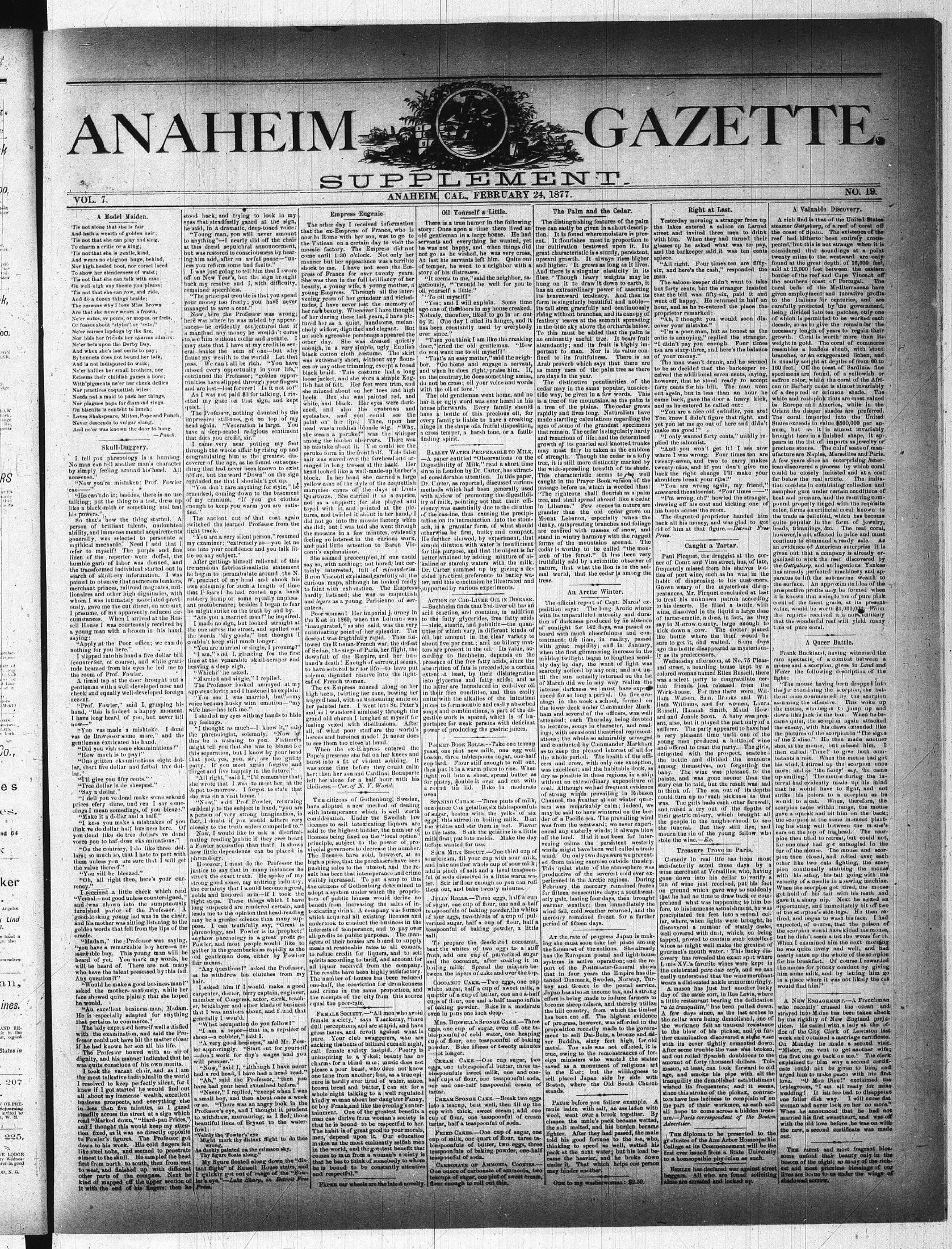
Searchable text
ANAHEIM
VOL. 7.
A Model Maiden.
Tis not alone that she is fair
And hath a wealth of golden hair;
Tis not that she can play and sing.
To charm a critic or a king;
Tis not that she is gentle, kind,
And wears no chignon huge, behind,
Nor high-heeled boot, nor corset laced
To show her slenderness of waist;
Tis not that she can talk with ease
On well-nigh any theme you please;
Tis not that she can row, and ride,
And do a dozen things beside;
The reasons why I love Miss Brown
Are that she never wears a frown,
Ne'er sulks, or pouts, or mopes, or frets,
Or fusses about "styles" or "sets";
Ne'er nurses lapdogs by the fire,
Nor bids her friends her charms admire;
Ne'er bets upon the Derby Day,
And when she's lost omits to pay;
By bonnets does not bound her talk,
And is not indisposed to walk;
Ne'er bullies her small brothers, nor
Esteems their childish games a bore;
With pigments ne'er her cheek defiles
Nor practices coquettish wiles;
Needs not a maid to pack her things,
Nor plagues papa for diamond rings.
On biscuits is content to lunch;
Loves Shakespeare, Milton, Pope and Punch,
Never descends to vulgar slang.
And ne'er was known the door to bang.
—Punch.
Skull-Duggery.
I tell you phrenology is a humbug.
No man can tell another man's character
stood back, and trying to look in my eyes that steadfastly gazed at the sign, he said, in a dramatic, deep-toned voice:
"Young man, you will never amount to anything"—I nearly slid off the chair at this dread sepulchral announcement, but was restored to consciousness by hearing him add, after an awful pause—"unless you reform some bad faults."
I was just going to tell him that I swore off on New Year's, but the sign brought back my resolve and I, with difficulty, remained speechless.
"The principal trouble is that you spend your money too freely; you have never managed to save a cent."
Now here the Professor was wrong; here was where he was misled by appearances—he evidently conjectured that if a man had any money he wouldn't come to see him without collar and necktie. I may state that I have at my credit in several banks the sum of one—but why flaunt my wealth to the world? Let that pass. We can't all be rich. "You have missed every opportunity in your life," continued the Professor; "golden opportunities have slipped through your fingers and are lost—lost forever! Is it not so?"
As I was not paid $3 for talking, I riveted my gaze on that sign, and kept quiet.
The Professor, nothing daunted by the impressive stillness, got on top of my head again. "Veneration is large. You have a deep-seated religious sentiment that does you credit, sir."
I came very near putting my foot through the whole affair by rising up and congratulating him as the greatest discoverer of the age, as he found out some-
Skull-Duggery.
I tell you phrenology is a humbug. No man can tell another man's character by simply feeling around his head. All nonsense."
"Now you're mistaken; Prof. Fowler can——"
"He can't do it; besides, there is no use talking; put the thing to a test, dress up like a blacksmith or something and test his powers."
So that's how the thing started. A person of brilliant talents, undoubted ability, and immense mental acquirements generally, was selected to personate a mythical mechanic. Need I add that I refer to myself? The purple and fine liden of the reporter were doffed, the humble garb of labor was donned, and the transformed individual started out in search of skull-ery information. I was pained to observe that numerous bankers, merchant princes, railroad magnates, millionaires and other high dignitaries, with whom I was intimately associated previously, gave me the cut direct, on account, I presume, of my apparently reduced circumstances. When I arrived at the Russell House I was courteously received by a young man with a broom in his hand, saying:
"Apply at the Poor office; we can do nothing for you here."
I slipped into his hand a five dollar bill (counterfeit, of course), and while gratitude beamed from his eyes he led me to the room of Prof. Fowler.
A timid tap at the door brought out a gentleman with a well-developed nose and cheek and equally well-developed foreign accent.
"Prof. Fowler," said I, grasping his hand, "this is indeed a happy moment. I have long heard of you, but never till now—"
"You vas made a mishtake. I dond vas de Brovessor some more," and the gentleman extricated his hand.
"Did you visit some eksaminations?"
"How much is to pay?"
"One gritten eksaminations eight dollar, short five dollar and ferbal tree dollar."
"I'll give you fifty cents."
"Tree dollar is de sheepest."
"Say a dollar."
"I dell you ve dond make some second prices every dime, und ven I say some-dings I mean somedings, of you bleaze."
"Make it a dollar and a half."
"I kess you make a mishtakes of you dink ve do dollar half business here. Of you dond like de tree dollars ve dond voree you to haf dose eksaminations."
"On the contrary, I do like three dollars; so much so, that I hate to part with them unless you are sure that I will get the value thereof."
"You vill be blenzed."
"Oh, all right then, here's your cur-missed every opportunity in your life," continued the Professor; "golden opportunities have slipped through your fingers and are lost—lost forever! Is it not so?"
As I was not paid $3 for talking, I rivetted my gaze on that sign, and kept quiet.
The Professor, nothing daunted by the impressive stillness, got on top of my head again. "Veneration is large. You have a deep-seated religious sentiment that does you credit, sir."
I came very near putting my foot through the whole affair by rising up and congratulating him as the greatest discoverer of the age, as he found out something that had never been known to exist before, but the word "Down" on the sign reminded me that I shouldn't get up.
"You don't care anything for style," he remarked, coming down to the basement of my cranium. "If you get clothes enough to keep you warm you are satisfied."
The ancient cut of that coat again switched the learned Professor from the right track.
"You are a very silent person," resumed my examiner; "extremely so—you let no one into your confidence and you talk little on any subject."
After getting himself relieved of this tremendous fabricationalistic statement he began to perambulate around the N. W. precinct of my head and shook his own solemnly for such a length of time that I feared he had rooted up a bank robbery bump or some equally unpleasant protuberance; besides I began to fear he might strike on the truth by and by.
"Are you a married man?" he inquired.
I made no sign, but looked straight at the one across the street, and spelled out the words "dry goods," but thought I couldn't keep still much longer.
"You are married or single, I presume?"
"I am," said I, glancing for the first time at the venerable skull-scraper and heaving a deep sigh.
"Which?" he asked.
"Married and single," I replied.
The Professor looked annoyed at my apparent levity and I hastened to explain:
"You see I was married, but—my voice became husky with emotion—'my wife has—has left me.'"
I shaded my eyes with my hands to hide my feelings.
"I thought as much—I knew it," said the phrenologist, solemnly. "Now let this be a warning to you. Flatterers might tell you that she was to blame for this separation, but I know by your head that you, yes, you, sir, are the guilty party. If you meet again forgive and forget and live happily in the future."
"All right," said I, "I'll remember that; she wrote that I was to meet her at the depot to morrow. I forgot to state that she was on a visit home."
Now," said Prof. Fowler, returning suddenly to the subject in hand," you are a person of very strong imagination, in fact, I doubt if you would adhere very closely to the truth unless compelled to."
Now, I would like to ask a discriminating reading public if they ever heard a Fowler accusation than that. It shows how little dependence can be placed in phrenology.
However, I must do the Professor the justice to say that in many instances he struck the exact truth. He spoke of my strong sense of nurturing industry...
"Tree dollar is de sheepest."
"Say a dollar."
"I dell you voud do make some sekond prices efery dime, und ven I say somedings I mean somedings, of you bleaze."
"Make it a dollar and a half."
"I kess you make a misstakes of you dink ve do dollar half business here. Of you dond like de tree dollars ve dond vorce you to haf dose eksaminations."
"On the contrary, I do like three dollars; so much so, that I hate to part with them unless you are sure that I will get the value thereof."
"You vill be blenzed."
"Oh, all right then, here's your currency."
I received a little check which read "Verbal—not good unless countersigned," and was shown into the sumptuously furnished parlor of the Professor. A good-looking young lad was in the chair, and his mother was sitting listening to the golden words that fell from the lips of the oracle.
"Madam," the Professor was saying, "you have a remarkable boy here—a remarkable boy. This young man will be heard of yet. You mark my words, he will be heard of. There are not many who have the talent possessed by this lad. Any questions?"
"Would he make a good business man?" asked the mother anxiously, while her face showed quite plainly that she hoped he would.
"An excellent business man, Madam. He is especially adapted for anything that pertains to commerce."
The lady expressed herself well satisfied with the examination, and said the Professor could not have hit the matter closer if he had known her son all his life.
The Professor bowed with an air of dignity, and his manner indicated that he was quite conscious of his own merits.
I took the vacant chair, and as I am the most talkative individual in the world I resolved to keep perfectly silent, for I knew if I got started he would find out all about my immense wealth, excellent business prospects, and everything else in less than five minutes, so I gazed steadily across the street at a sign which read "Marked down," "Hard-pan Prices," and I thought this would keep my attention fixed, as it was so directly opposite to Fowler's figures. The Professor got down to his work. His cold fingers felt like steel nobs, and seemed to penetrate almost to the skull. He sampled the head first from north to south, then from east to west, and finished up with different other parts of the compass. Next he kind of mapped off the upper section of it with the end of his fingers; then he wrote that I was to meet her at the depot to-morrow. I forgot to state that she was on a visit home."
Now," said Prof. Fowler, returning suddenly to the subject in hand, "you are a person of very strong imagination, in fact, I doubt if you would adhere very closely to the truth unless compelled to."
Now, I would like to ask a discriminating reading public if they ever heard a Fowler accusation than that? It shows how little dependence can be placed in phrenology.
However, I must do the Professor the justice to say that in many instances he struck the exact truth. He spoke of my strong good sense, my untiring industry, the certainty that I would become a great noble and honored man—if I took the right steps. These things which I have long suspected are rendered certain, and leads me to the opinion that head-reading may be a greater science than many suppose. I can truthfully say, "Great is phrenology, and Fowler is its prophet;" anyhow phrenology is a great profit go Fowler, and most people would like to gather in the greenbacks as rapidly as the old gentleman does, either by Fowler fair means.
"Any questions?" asked the Professor, as he withdrew his clutches from my hair.
I asked him if I would make a good carpenter, doctor, ferry captain, engineer, member of Congress, actor, clerk, teacher, bricklayer and other kinds of business that I was anxious about, and found that generally I wouldn't.
"What occupation do you follow?"
"I am a reporter—that is, a repairer of shoes—a cobbler," said I.
"A very good business," said Mr. Fowler approvingly. "Start out for yours-if don't work for day's wages and you will prosper."
"Now," said I, "although I have never had a red head, I have had a head read."
"Ah," said the Professor, "then you have had your head examined before."
"Never," replied "except when I was a small boy, and then about once a week or so." "There was an angry look in the Professor's eye, and I thought it prudent to withdraw, murmuring, as I fled; those beautiful lines of Bryant to the water-fowl:"
"Vainly the 'Fowler's' eye"
"Might mark thy distant flight to do these wrong."
As darkly painted on the crimson sky.
Thy figure floats along.
My figure floated along down the "distant flight" of Russell House stairs, and I quickly got out of range of the "Fowler's" eye."—Luke Sharp, in Detroit Free Press.
The citizens of have adopted a new with intemperance consideration. U licenses to sell in sold to the highest licenses being fixed principle, subject viacial governors. The licenses have high a price, that pushing sales to the sult has been that visibly increased. The citizens of Go adopt a system u tors of public h benefit from inc toxicating drink-which acquired an undertook to count interests of temp all profits to pub agers of their hour meals at reasonable to refuse credit spirits according all liquor receive. The results have been The number of one-half, the co and crime in tha receipts of th equal the poor-r-
FEMALE SOCIETY female society," dull perceptions gross tastes, and pure. Your club sucking the butts call female soc uninspiring to charms for a blink please a poor be one tune from an cure is hardly even brown bread and whole night talk kindly woman as or boy Frank,and attainment. One man can derive that he is bound The habit is of g men, depend us makes us the m in the world,and comes to m fin that he has to th he is bound to and respectful."
EMPRESS GAS
SUPPLEMENT.
ANAHEIM, CAL., FEBRUARY 24, 1877.
Empress Engenie.
The other day I received information that the ex-Empress of France, who is now in Rome with her son, was to go to the Vatican on a certain day to visit the mosaic factory. The Empress did not come until 1:30 o'clock. Not only her manner but her appearance was a terrible shock to me. I have not seen the Empress of France for over twenty years. She was then in the full brilliancy of her beauty, a young wife, a young mother, a young Empress. Through all the intervening years of her grandeur and vicissitudes, I have never lost the memory of her rare beauty. Whenever I have thought of her during these last years, I have pictured her as a quiet, handsome, melanoholy widow, dignified and elegant. But no such agreeable personage appeared the other day. She was dressed quietly enough, in a very simple, ugly English black cotton cloth costume. The skirt was extremely short, without any flounces or any other trimming, except a broad black braid. This costume had a long loose jacket, and she wore a simple English hat of felt. Her feet were trim, and she minced about on her toes and high heels. But she was painted red, and white, and black. Her eyes were darkened, and also the eyebrows and eyelashes, and you could see the paint on her lips. Then, upon her head was a reddish blonde wig. "Why, she wears a peraka!" was the whisper among the hidden observers. There was no mistake about it. You could see the peruke form in the front half. This false hair was waved over the forehead and arranged in long tresses at the back. Her
Oil Yourself a Little.
There is a true humer in the following story: Once upon a time there lived an old gentleman in a large house. He had servants and everything he wanted, yet he was not happy, and when things did not go as he wished, he was very cross. At last his servants left him. Quite out of temper, he went to a neighbor with a story of his distresses.
"It seems to me," said the neighbor, sagaciously, "twould be well for you to oil yourself a little."
"To oil myself?"
"Yes; and I will explain. Some time ago one of the doors in my house creaked. Nobody, therefore, liked to go in or out by it. One day I oiled its hinges, and it has been constantly used by everybody ever since."
"The you think I am like the creaking door," cried the old gentleman. "How do you want me to oil myself?"
"That's an easy matter," said the neighbor. "Go home and engage a servant, and when he does right, praise him. If, on the contrary, he does something amiss, do not be cross; oil your voice and words with the oil of love."
The old gentleman went home, and no harbor or ugly word was ever heard in his house afterwards. Every family should have a bottle of this precious oil, for every family is liable to have a creaking binge in the shape of a frotful disposition, a cross temper, a harsh tone, or a fault-finding spirit.
BARLEY WATER PREFERABLE TO MILK.
—A paper entitled "Observations on the Digestibility of Milk," read a short time
The Palm and the Cedar.
The distinguishing features of the palm tree can easily be given in a short description. It is found where moisture is present. It flourishes most in proportion to the cultivation bestowed upon it. Its great characteristic is a sturdy, persistent, upward growth. It always rises higher and higher. It grows as long as it lives. And there is a singular elasticity in its fibre. Though heavy weights may be hung on it to draw it down to earth, it has an extraordinary power of asserting its heavenward tendency. And then its form is singularly beautiful and noble—its tall stem gracefully and continuously rising without branches, and its canopy of feathery leaves at the summit spreading in the blue sky above the orchards below. To this must be added that the palm is an eminently useful tree. It bears fruit abundantly; and its fruit is highly important to man. Nor is its value confined to its fruitfulness. There is an Arab proverb which says that there are as many uses of the palm tree as there are days in the year.
The distinctive peculiarities of the cedar may in the same popular, unscientific way, be given in a few words. This is a tree of the mountains, as the palm is a tree of the plains. The cedar grows rapidly and lives long. Naturalists have made startling calculations regarding the ages of some of the grandest specimens that remain. The cedar is singularly hardy and tenacious of life; and the determined growth of its guarled and knotted trunks may most fitly be taken as the emblem of strength. Though the cedar is a lofty tree, it is still more distinctly marked by
life, opporporters not so?
I rivke kept
by the foot up and dist some to exist the sign up.
le, he ensemined let no talk lit it.
of this statement in the N. book his of time a bank ample pleas to fear by acquired, sight at called out caught I resuming? the first poor and hide it, said Now let matter's name for your head the guilty drive and cure."
ber that; at the state that returning you are intention, in very called to. discrimin-er heard It shows placed in pressor the chances he take of my habit, in Gothenburg, Sweden, have adopted a new method of dealing with intemperance which is well worth consideration. Under the Swedish law licenses to sell intoxicating liquors are sold to the highest bidder, the number of licenses being fixed on the "local option" principle, subject to the power of provincial governors to decrease the number. The licenses have sold, however, at so high a price, that the purchasers have been pushing sales to the utmost, and the result has been that intemperance and crime visibly increased. To put a stop to this ces of any black braid. This costume had a long loose jacket, and she wore a simple English hat of felt. Her feet were trim, and she minced about on her toes and high heels. But she was painted red, and white, and black. Her eyes were darkened, and also the eyebrows and eyelashes, and you could see the paint on her tips. Then, upon her head was a reddish blonde wig. "Why, she wears a peruke!" was the whisper among the hidden observers. There was no mistake about it. You could see the peruke form in the front half. This false hair was waved over the forehead and arranged in long tresses at the back. Her head looked like a well-made-up barber's block. In her hand she carried a large yellow cane of the style of the coquettish marquise canes of the days of Louis Quartorze. She carried it as a caprice, not as a support; for she played and toyed with it, and pointed at the pictures, and twirled it about in her hand. I did not go into the mosaic factory when she did; but I was told she went through the mosaics in a few minutes, evidently feeling no interest in the curious work, and paid little attention to Baron Visconti's explanations.
She seemed preoccupied, if one could say so, with nothing; not bored, but certainly interested, full of minuderies. Baron Visconti explained carefully all the curious maps, although he looked ready to faint with exhaustion. The Empress hardly listened; she was as coquettish and legere as a young Parisienne of seventeen.
Poor woman! Her imperial journey in the East in 1869, when the Latham was "inaugurated," as she said, was the very culminating point of her splendar. The descent was frightfully rapid. Then followed the Russian-French war, the defeat of Sedan, the siege of Paris, her flight, the downfall of the Empire, and her husband's death! Enough of sorrow, it seems to have sobered her for life—to have put solennl, dignified reserve into the lightest of French women.
The ex-Empress minced along on her high beets, twirting her cane, bowing her wigged head, with an unmeaning smile on her painted face. I went into St. Peter's and as I wandered aimlessly through the grand old church I laughed at myself for feeling vexed with disillusions. After all, of what poor stuff are the world's heroes and heroines made! It never does to see them too close at hand.
When the ex-Empress entered the Pope's presence she fell on her knees and burst into a fit of violent sobbing. It was some time before they could calm her; then her son and Cardinal Bonaparte left her alone for a half hour with his Holiness. —Cor. of N. Y. World.
The citizens of Gothenburg, Sweden, have adopted a new method of dealing with intemperance which is well worth consideration. Under the Swedish law licenses to sell intoxicating liquors are sold to the highest bidder, the number of licenses being fixed on the "local option" principle, subject to the power of provincial governors to decrease the number. The licenses have sold, however, at so high a price, that the purchasers have been pushing sales to the utmost, and the result has been that intemperance and crime visibly increased. To put a stop to this ces of any black braid. This costume had a long loose jacket, and she wore a simple English hat of felt. Her feet were trim, and she minced about on her toes and high heels. But she was painted red, and white, and black. Her eyes were darkened, and also the eyebrows and eyelashes, and you could see the paint on her tips. Then, upon her head was a reddish blonde wig. "Why, she wears a peruke!" was the whisper among the hidden observers. There was no mistake about it. You could see the peruke form in the front half. This false hair was waved over the forehead and arranged in long tresses at the back. Her head looked like a well-made-up barber's block. In her hand she carried a large yellow cane of the style of the coquettish marquise canes of the days of Louis Quartorze. She carried it as a caprice, not as a support; for she played and toyed with it, and pointed at the pictures, and twirled it about in her hand. I did not go into the mosaic factory when she did; but I was told she went through the mosaics in a few minutes, evidently feeling no interest in the curious work, and paid little attention to Baron Visconti's explanations.
She seemed preoccupied, if one could say so, with nothing; not bored, but certainly interested, full of minuderies. Barron Visconti explained carefully all the curious maps, although he looked ready to faint with exhaustion. The Empress hardly listened; she was as coquettish and legere as a young Parisienne of seventeen.
ACTION OF COD-LIVER OIL IN DISEASE: —Buchheim finds that Cod-liver oil has an acid reaction, and contains, in addition to the fatty glycerides, free fatty acids—oleic, stearic, and palmitic—the quantities of which vary in different kinds of oil, but amount in the clear variety to about five per cent.; and no biliary matters are present in the oil. Its value, according to Buchheim, depends on the presence of the free fatty acids, since the absorption of fats is preceded to a certain extent at least, by their disintegration into glycerine and fatty acids; and as the latter are introduced in cod-liver oil in their free condition, and thus easily unite with the alkalies of the intestinal juices to form soluble and easily absorbed soaps and combinations, a part of the digestive work is spared, which is of importance for weak persons with deficient power of producing the gastric juices.
POCKET-BOOK ROLLS: —Take one teacup yeast, one pint new milk, one egg well boaten, three tablespoons sugar, one-half cup hard. Flour stiff enough to roll out, then put it in a warm place to rise. When light roll into a sheet, spread butter as for pastry, double it over and cut with a round tin lid. Bake in moderate oven.
SPANISH CREAM: —Three pints of milk, one ounce COX gelatine,six tablespoonfuls of sugar, beaten with the yelks' six eggs; this stirred-in boiling milk. Beat the whites and stir them in last. Flavor to the taste. Soak the gelatine in a little milk first; put into molds. Make the day before wanted for use.
SOUR MILK BISCUIT: —One-third cup of sour cream, fill your cup with sour milk; take another whole cup of sour milk; add a pinch of salt and a level teaspoonful of soda dissolved in a little warm water. Sip it flour enough so you can roll as many uses of the palm tree as there are days in the year.
The distinctive peculiarities of the cedar may in the same popular, unscientific way, be given in a few words. This is a tree of the mountains, as the palm is a tree of the plains. The cedar grows rapidly and lives long. Naturalists have made startling calculations regarding the ages of some of the grandest specimens that remain. The cedar is singularly hardy and tenacious of life; and determined growth of its gnarled and knotted trunks may most fitly be taken as the emblem of strength. Though the cedar is a lofty tree, it is still more distinctly marked by the wide-spreading breadth of its shade. This characteristic seems to well caught in the Prayer Book version of the passage before us, which is worded thus: "The righteous shall flourish as a palm tree,and shall spread abroad like a cedar in Libanus." Few scenes in nature are grander than the old cedar grove on Mount Lebanon, especially when the dusky, outspreading branches and foliage are covered with masses of snow,and stand in wintry harmony with the rugged forms of the mountains around.The cedar is worthy to be called "the monarch of the forest." It has been very truthfully said by a scientific observer of nature, that what the lion is in the animal world, that the cedar is among the trees.
An Arctic Winter.
The official report of Capt. Naros' expedition says: The long Arctic winter with its unparalleled intensity and duration of darkness produced by an absence of sunlight for 142 days, was passed on board with much cheerfulness and contentment;the time,int reality,passed with great rapidity;and in January,the first glimmering increase in midday twilight begun to lengthen sensibly day by day,the want of light was scarcely noticed by any one;and not until the sun actually returned on the 1st March did we in any way realize the intense darkness we must have experienced for so long a period.On five evenings in the deck a school,f formed on lower deck under Commander Markham and several of the officerswas well attended;each Thursday being devoted to lectures,songs in character,and readingswith occasional theoretical representations;the whole so admirably arrangedand conducted by Commander Markhamas to keepthe pleased interestof all forthe whole period.The health ofthe officersand crew.with only one exceptionwas excellent;andthe habitable dock.as dryas possible in these regions,a ship without an extraordinary expenditureof coal.Although we had frequent evidenceof strong winds prevailing in Robeson Channel,the weather at our winter quarters was remarkably calm;indeedwe may be said to have wintered onthe borderofa Pacific sea.The prevailing windwas fromthe westward;we never experienced any easterly winds;it always blewoffthe land.Had it not been for intervening calmsthe persistent westerly winds might have been well calleda trade wind.On only two days were we preventedfrom taking exercise outsidethe ship.The quiet stateofthe atmospherewas productiveofthe severest cold everexperiencedinthe Arctic regions.During
The citizens of Gothenburg, Sweden, have adapted a new method of dealing with intemperance which is well worth consideration. Under the Swedish law licenses to sell intoxicating liquors are sold to the highest bidder, the number of licenses being fixed on the "local option" principle, subject to the power of provincial governors to decrease the number. The licenses have sold, however, at so high a price, that the purchasers have been pushing sales to the utmost, and the result has been that intemperance and crime visibly increased. To put a stop to this the citizens of Gothenburg determined to adopt a system under which the proprietors of public houses would derive no benefit from increasing the sales of intoxicating drink. A company was formed which acquired all existing licenses and undertook to conduct the business in the interests of temperance, and to pay over all profits to public purposes. The managers of their houses are bound to supply meals at reasonable rates to all conurers, to refuse credit for liquors, and to sell spirits according to tariff, and account for all liquor received from the company. The results have been highly satisfactory. The number of houses has been reduced one-half, the conviction for drunkenness and crime in the same proportion, and the receipts of the city from this source equal the poor-rate.
FEMALE SOCIETY.—"All men who avoid female society," says Tauckeray, "have dull perceptions, and are stupid, and have gross tastes, and revolt against what is pure. Your club swaggerers, who are sucking the butts of billiard cues all night, call female society insipid." Poetry is uninspiring to a yokel; beauty has no charms for a blind man; music does not please a poor beast, who does not know one tune from another; but, as a true epiphure is hardly ever tired of water, sauce, brown bread and butter, I can sit for a whole night talking to a well regulated kindly woman about her daughter Fanny, or boy Frank, and like the evening's entertainment. One of the greatest benefits a man can derive from woman's society is that he is bound to be respectful to her. The habit is of great good to your morals, men, depend upon it. Our education makes us the most eminently selfish men in the world, and the greatest benefit that comes to man from a woman's society is that he has to think of somebody to whom he is bound to be constantly attentive and respectful."
PAPER car wheels are the latest novelty.
SPANISH CREAM.—Three pints of milk, one ounce Cox gelatine, six tablespoonfuls of sugar, beaten with the yolks of six eggs; this stirred in boiling milk. Beat the whites and stir them in last. Flavor to the taste. Soak the gelatine in a little milk first; put into molds. Make the day before wanted for use.
SOUR MILK BISCUIT.—One-third cup of sour cream, fill your cup with sour milk, and take another whole cup of sour milk; add a pinch of salt and a level teaspoonful of soda dissolved in a little warm water. Stir in flour enough so you can roll out them, and bake twenty minutes.
JELLY ROLLS.—Three eggs, half a cup of sugar, one cup of flour, one and a half teaspoonfuls of baking powder, the whites of four eggs, two-thirds of a cup of pulverized sugar, half a cup of flour, half a teaspoonful of baking powder, a little salt.
To prepare the dessicated coconutnut, beat the whites of two eggs to a stiff froth, add one cup of pulverized sugar and the coconutut, after soaking it in boiling milk. Spread the mixture between the layers of cake and over the top.
COCONUT CAKE.—Two eggs, one cup white sugar, half a cup of sweet milk, a quarter of a cup of butter, one and a half cups of flour, one and a half teaspoonfuls of baking powder. Bake in a moderate oven in pans one inch deep.
MRS. BIDWELL'S SPONGE CAKE.—Three eggs, one cup of sugar, even off one tablespoonful of cold water, one heaping cup of flour, one teaspoonful of baking powder. Bake fifteen or twenty minutes—not longer.
CREAM CAKE.—One cup sugar, two eggs, one tablespoonful butter, three tablespoonfuls sweet milk, one and one-half cups of flour, one teaspoonful soda, one and one-half teaspoonful cream of tartar.
CREAM SPONGE CAKE.—Break two eggs into a teacup, beat well, then fill up the cup with thick, sweet cream; add one cup of flour, one teaspoonful of cream tartar, half a teaspoonful of soda.
FRIED CAKES.—One cup of sugar, one cup of milk, one quart of flour, three tablespoonfuls of butter, two eggs, three teaspoonfuls of baking powder, one-half teaspoonful of soda.
CARBONATE OF AMMONIA COOKIES.—One ounce of carbonate of ammonia, two teascups of sugar, one pink of sweet cream, flour enough to roll out thin.
Although we had frequent evidence of strong winds prevailing in Robeson Channel, the weather at our winter quarters was remarkably calm; indeed we may be said to have wintered on the border of a Pacific sea. The prevailing wind was from the westward; we never experienced any easterly winds; it always blew off the land. Had it not been for intervening calms the persistent westerly winds might have been well called a trade wind. On only two days were we prevented from taking exercise outside the ship. This quiet state of the atmosphere was productive of the severest cold ever experienced in the Arctic regions. During February the mercury remained frozen for fifteen consecutive days; a southwestly gale, lasting four days, then brought warmer weather; then immediately the wind fell, cold weather returned, and the mercury remained frozen for a further period of fifteen days.
At the rate of progress Japan is making she must soon take her place among the foremost of the nations. She already has the European postal and light-house systems in active operation; and the report of the Postmaster-General shows that in four years the Empire has distanced Denmark, Sweden, Norway, Turkey and Greece in the postal service. Japan has also an income tax; and a strong effort is being made to induce farmers to become sheep-raisers; and thereby utilize the hill country, from which the timber has been cut off. The highest evidence of progress, however, was afforded in the proposition recently made to the government to sell Dai-Butz, a bronze and silver Buddha, sixty feet high, for old metal. The sale was not effected; it is true, owing to the remonstrances of foreign ministers who wanted the statue saved as a monument of religious art in the East; but the willingness to sell placed Japan side by side with Boston, where the Old South Church stands.
PAUSE before you follow example. A mule laden with salt, an ass laden with wool, went over a brook together. By chance the mule's pack became wetted, the salt melted; and his burden became lighter. After they had passed, the mule told his good fortune to the ass, who thinking to speed as well, wetted his pack at the next water; but his load became the heavier; and he broke down under it. That which helps one person may hinder another.
One to my washerwoman: $2.50.$
GAZETTE.
NO. 19.
In the Cedar.
Features of the palm tree in a short description; moisture is present in proportion to snow upon it. Its sturdy, persistent, always rises higher as long as it lives. For elasticity in its weighty weights may be it down to earth, it power of asserting agency. And then its beautiful and noble—by and continuously less, and its canopy of summit spreading the orchards below. Added that the palm is frosty. It bears fruit fruit is highly imminent is its value connec-ness. There is an easy way that there are the palm tree as there peculiarities of the most popular, unscientific few words. This mains, as the palm is. The cedar grows naturally. Naturalists have observations regarding the grandest specimens of is singularly hardy and determined and knotted trunks taken as the emblem of the cedar is a lofty distinctly marked by peculiarities of the palm tree in a short description; moisture is present in proportion to snow upon it. Its sturdy, persistent, always rises higher as long as it lives. For elasticity in its weighty weights may be it down to earth, it power of asserting agency. And then its beautiful and noble—by and continuously less, and its canopy of summit spreading the orchards below. Added that the palm is frosty. It bears fruit fruit is highly imminent is its value connec-ness. There is an easy way that there are the palm tree as there peculiarities of the palm tree in a short description; moisture is present in proportion to snow upon it. Its sturdy, persistent, always rises higher as long as it lives. For elasticity in its weighty weights may be it down to earth, it power of asserting agency. And then its beautiful and noble—by and continuously less, and its canopy of summit spreading the orchards below. Added that the palm is frosty. It bears fruit fruit is highly imminent is its value connec-ness. There is an easy way that there are the palm tree as there peculiarities of the palm tree in a short description; moisture is present in proportion to snow upon it. Its sturdy, persistent, always rises higher as long as it lives. For elasticity in its weighty weights may be it down to earth, it power of asserting agency. And then its beautiful and noble—by and continuously less, and its canopy of summit spreading the orchards below. Added that the palm is frosty. It bears fruit fruit is highly imminent is its value connec-ness. There is an easy way that there are the palm tree as there peculiarities of the palm tree in a short description; moisture is present in proportion to snow upon it. Its sturdy, persistent, always rises higher as long as it lives. For elasticity in its weighty weights may be it down to earth, it power of asserting agency. And then its beautiful and noble—by and continuously less, and its canopy of summit spreading the orchards below. Added that the palm is frosty. It bears fruit fruit is highly imminent is its value connec-ness. There is an easy way that there are the palm tree as there peculiarities of the palm tree in a short description; moisture is present in proportion to snow upon it. Its sturdy, persistent, always rises higher as long as it lives. For elasticity in its weighty weights may be it down to earth, it power of asserting agency. And then its beautiful and noble—by and continuously less, and its canopy of summit spreading the orchards below. Added that the palm is frosty. It bears fruit fruit is highly imminent is its value connec-ness. There is an easy way that there are the palm tree as there peculiarities of the palm tree in a short description; moisture is present in proportion to snow upon it. Its sturdy, persistent, always rises higher as long as it lives. For elasticity in its weighty weights may be it down to earth, it power of asserting agency. And then its beautiful and noble—by and continuously less, and its canopy of summit spreading the orchards below. Added that the palm is frosty. It bears fruit fruit is highly imminent is its value connec-ness. There is an easy way that there are the palm tree as there peculiarities of the palm tree in a short description; moisture is present in proportion to snow upon it. Its sturdy, persistent, always rises higher as long as it lives. For elasticity in its weighty weights may be it down to earth, it power of asserting agency. And then its beautiful and noble—by and continuously less, and its canopy of summit spreading the orchards below. Added that the palm is frosty. It bears fruit fruit is highly imminent is its value connec-ness. There is an easy way that there are the palm tree as there peculiarities of the palm tree in a short description; moisture is present in proportion to snow upon it. Its sturdy, persistent, always rises higher as long as it lives. For elasticity in its weighty weights may be it down to earth, it power of asserting agency. And then its beautiful and noble—by and continuously less, and its canopy of summit spreading the orchards below. Added that the palm is frosty. It bears fruit fruit is highly imminent is its value connec-ness. There is an easy way that there are the palm tree as there peculiarities of the palm tree in a short description; moisture is present in proportion to snow upon it. Its sturdy, persistent, always rises higher as long as it lives. For elasticity in its weighty weights may be it down to earth, it power of asserting agency. And then its beautiful and noble—by and continuously less, and its canopy of summit spreading the orchards below. Added that the palm is frosty. It bears fruit fruit is highly imminent is its value connec-ness. There is an easy way that there are the palm tree as there peculiarities of the palm tree in a short description; moisture is present in proportion to snow upon它。Its sturdy, persistent, always rises higher as long as it lives.
A Valuable Discovery.
A rich find is that of the United States steamer Gettyburg, of a reef of coral off the coast of Spain. The existence of the reef had hitherto been entirely unsuspected, but this is not strange when it is considered that soundings at a point twenty miles to the westward are only found at the great depth of 16,500 feet, and at 12,000 feet between the eastern border of the reef and Cape Vincent off the southern coast of Portugal.
The coral beds of the Mediterranean have given employment and lucrative profits to the Italians for centuries, and are carefully protected by 'the government, being divided into ten patches, only one of which is permitted to be worked each decade, so as to give the remainder the necessary length of years to regain their growth. Coral is worth more than its-weightin gold.
The coral of commerce resembles a leafless shrub, with stout branches, or an exaggerated lichen, and is usually sought at depths of from 60 to 160 feet.
Off the coast of Sardinia fine specimens are found, of a yellowish or saffron color, while the coral of the African or Barbary coast is almost invariably of a deep red or crimson shade.
The white and rose-pink tints are most valued in Europe and America, while in the Orient the deeper shades are preferred.
The coral imported into the United States exceeds in value $500,000 per annum, but as it is almost invariably brought here in a finished shape, it appears in the list of imports as jewelry or precious stones.
The chief seats of manufacture are Naples, Marseilles and Paris.
A few years since an enterprising American
The palm tree as there
secularities of the
popular, unscientific
few words. This
ains, as the palm is
The cedar grows
Naturalists have
nations regarding the
grandest specimens
is singularly hardy
and the determined
and knotted trunks
taken as the emblem
of the cedar is a lofty
distinctly marked by
breath of its shade.
seems to the well
Book version of the
which is worded thus:
flourish as a palm
abroad like a cedar
scenes in nature are
old cedar grove on
especially when the
branches and foliage
passes of snow, and
any with the rugged
mains around. The
called "the monscientific observer of
the lion is in the anicedar is among the
Winter.
of Capt. Nares' exlong Arctic winter
intensity and duraduced by an absence
days, was passed on
perseverance and conin reality, passed;
and in January,
bringing increase in the
man to lengthen sensition want of light was
any one; and not unreturned on the 1st
day way realize the
must have experiperiod. On five everschool, formed on
Commander Markhe officers, was well
resterday being devoted
character, and readtheatrical representation admirably arranged
Commander Markham
had interest of all for
The health of the offionly one exception,
the habitable dock, as
these regions, in a ship
annary expenditure of
had frequent evidence
revailing in Robeson
at our winter quary calm; indeed, we
wintered on the borThe prevailing wind
card; we never experiwinds; it always blew
not been for interpersistent westerly
seen well called a trade
days were we preventcise outside the ship.
of the atmosphere was severest cold ever ex-teric regions. During
Caught a Tartar.
Paul Ficquet, the druggist at the corner of Court and Vine street, has, of late,
frequently missed from his shelves bottles of port wine, such as he was in the habit of dispensing to his customers.
Grown weary of the mysterious disappearance, Mr. Ficquet concluded at last to treat his unknown patron according to his deserts. He filled a bottle with wine, dissolved in the liquid a large dose of tartar-emetic, a dose, in fact, as they say in Morrow county, large enough to kick down a cow. The doctor placed the bottle where the thief would be sure to get it, and waited. Some days ago the bottle disappeared as mysteriously as its predecessors.
Wednesday afternoon, at No. 75 Pleas-and street, a boarding house kept by a colored woman named Ellen Russell, there was a select party to congratulate certain friends just released from the Work-house. For men there were William Watson, Sam Brooks and William Williams, and for women, Laura Russell, Hannah Smith, Maud Howard and Jennie Scott. A baby was present, also, but it played the part only of a sufferer. The party appeared to have had a very pleasant time until one of the young men produced a bottle of wine and offered to treat the party. The girls delighted with the prospect, snatched the bottle and divided the contents among themselves, not forgetting the baby. The wine was pleasant to the palate, and was gone sooner than the story can be told, but the result was sad to think of. The sea out of its depths could turn up no such sickness as that was. The girls bade each other farewell, and raised a cry out of the depths of their gastric misery, which brought all the people in the neighborhood to see the funeral. But they still live, and mourn the sin of the young fellow who stole the wine.—Ex.
Treasure Trove in Paris,
Comedy in real life has been most satisfactorily acted these days by a wine merchant at Versailles, who having gone down into his cellar to verify a peculiar item put into his foot.
On the coast of Sardinia the specimens are found, of a yellowish or saffron color, while the coral of the African or Barbary coast is almost invariably of a deep red or crimson shade. The white and rose-pink tints are most valued in Europe and America, while in the Orient the deeper shades are preferred. The coral imported into the United States exceeds in value $500,000 per annum, but as it is almost invariably brought here in a finished shape, it appears in the list of imports as jewelry or precious stones. The chief seats of manufacture are Naples, Marselles and Paris. A few years since an enterprising American discovered a process by which coral could be closely limited and at a cost far below the real article. The imitation consists in combining collision and camphor gum under certain conditions of heat and pressure, and the resulting compound properly tinged with the requisite color, forms an artificial coral known to the trade as celluloid, which has become quite popular in the form of jewelry, beads, trimming, &c. The real coral, however, is not affected in price and must continue to command a ready sale. As an evidence of American enterprise it is given out that a company is already organized to work the reef discovered by the Gettysburg, and an ingenious Yankee has already perfected machinery and apparatus to lift the submarine wealth to the surface. An approximate idea of the prospective profits may be formed when it is known that a single ton of pure pink coral of the finest grade, at its present value, would be worth $1,000,000. From the reports received it is more unlikely that the wonderful reef will yield many tons of pure coral.
A Queer Battle.
Frank Buckland, having witnessed the rare spectacle of a combat between a mouse and a scorpion, gives in Land and Water the following description of the fight:
"The mouse having been dropped into the jar containing the scorpion, the battle at once commenced by the scorpion assuming the offensive. This woke up the mouse, who began to jump up and down like jack in the box. When he became quiet, the scorpion again attacked the enemy, with his claws extended like the pictures of the scorpion in "The signs of the Zodiac." He then made another shot at the mouse, but missed him. I then called 'Time!' to give both combatants a rest. When the mouse had got his wind, I stirred up the scorpion once more; and as 'the fancy' say, 'the came up smiling.' The mouse during the interval had evidently made up his mind that he would have to fight, and not strike his colors to a scorpion as he would to a cat. When therefore, the scorpion came within range, the mouse gave a squeak and bit him on the back; the scorpion at the same moment planting his sting well between the mouse's ears on the top of his head. The scorpion then tried to retreat, but could not, for one claw had got entangled in the fur of the mouse. The mouse and scorpion then closed, and rolled over each other like two cats fighting, the scorpion continually stabbing the mouse with his sting, his tail going with the velocity of a needle in a sewing machine.
Treasure Trove in Paris.
Comedy in real life has been most satisfactorily acted these days by a wine merchant at Versailles, who, having gone down into his cellar to verify a tun of wine just received, put his foot on ground which gave way so suddenly that he had no time to draw back or comprehend what was happening to him before, to his immense astonishment, he was precipitated ten feet into a second cellar, where, when lights were brought, he discovered a number of stately casks, well covered with dust, which, on being tapped, proved to contain such excellent wines as might well make the greatest of gourmet's mouth water. This lucky discovery has revealed the exact spot where Louis XV's favorite wines were kept in the celebrated parc aux cerfs, and we can easily understand that the wine merchant wears a dislocated ankle unmurmuringly.
A mason has just had another lucky day of the same sort, in Rue Levis, where a little restaurant bearing the dedication "a la tranquilite," has been pulled down. A few days since, as the last arches in the cellar were being demolished, one of the workmen felt unusual resistance to the blow of his pickax, and on further examination discovered a stone vase with its cover tightly cemented down. After some trouble the vase was broken, and out rolled Spanish doubloons to the amount of forty thousand dollars. This mason, at least, can look forward to old age, and smoke his pipe with all the tranquility the demolished establishment wished its frequenters; and it seems, since this stroke of the pickax, contractors have less laziness to complain of on the part of their workmen, as each and all hope to come across a hidden treasure.—Paris correspondent of the Boston Advertiser.
The diploma to be presented to the graduates of the Ann Arbor Homeopathic College at its Commencement will be the first ever issued from a State University to a homeopathic physician as such.
Berlin has declared war against street beggars. All who are found soliciting alms are arrested and locked up.
Their hat would have to fight, and not strike his colors to a scorpion as he would to a cat. When therefore, the scorpion came within range, the mouse gave a squeak and bit him on the back; the scorpion at the same moment planting his sting well between the mouse's ears on the top of his head. The scorpion then tried to retreat, but could not, for one claw had got entangled in the fur of the mouse. The mouse and scorpion then closed, and rolled over each other like two cats fighting, the scorpion continually stabbing the mouse with his sling, his tail going with the velocity of a needle in a sewing machine. When the scorpion got tired, the mouse got hold of his tail with his teeth and gave it a sharp nip. Next he seized an opportunity, and immediately bit off two of the scorpion's side legs. He then retired, and began to wash his face. I had expected, of course, that the poison of the scorpion would have killed the mouse, but he didn't seem a bit worse for it. When I examined him the next morning he was quite lively and well, and had nearly eaten up the whole of the scorpion for his breakfast. Of course I rewarded the mouse for plucky conduct by giving him some milk, and by letting him go in a place where it was not likely the cat would find him."
A New Engagement.—A Frenchman who recently crossed the ocean and strayed into Maine has been taken aback by the rigidity of New England prejudices. He called with a lady at the office of the City Clerk of Lewiston last week and obtained a marriage certificate. On Monday he made a second visit. "Mister, me want to get another wife; the first one go back on me." The clerk explained to him why a second certificate could not be given to him, and urged him to make peace with his first love. "O Mon Dieu!" exclaimed the bridegroom. "I am all ready for mine wedding! It is too bad to disappoint one feller dish way. I will curse dat woman and never look on her no more." When he announced that he had not married his first sweetheart, and was off with the old love before he was on with the new, a second certificate was made out.
The rarest and most fragrant blossoms unfold their beauty only in the bosom of the night; so many of the richest and most priceless blessings of our lives are born to us under the wings of shadowed sorrow.