anaheim-gazette 1877-02-10
Scanned page
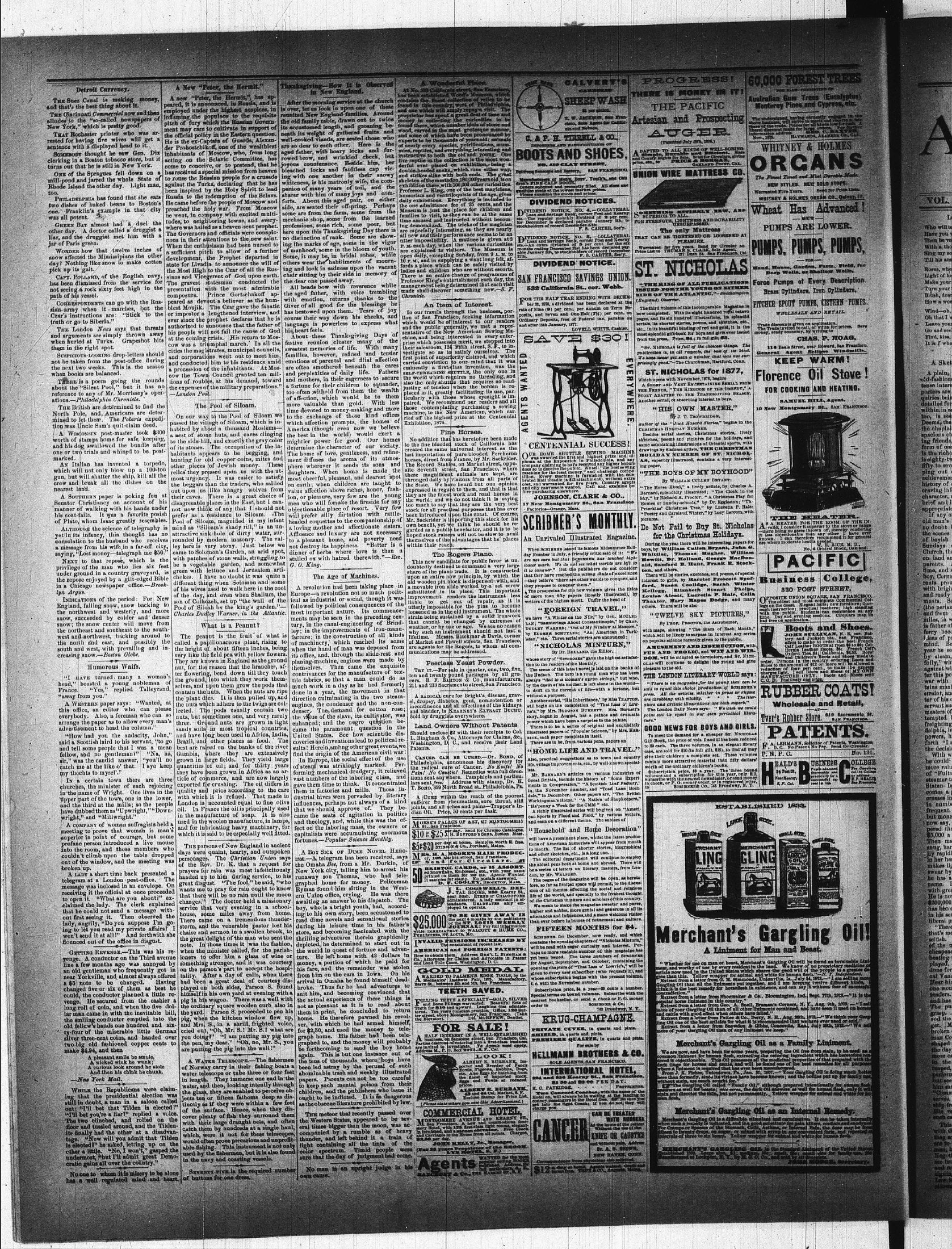
Searchable text
Detroit Currency.
The Suez Canal is making money, and that's the best thing about it.
The Cincinnati Commercial now and then alludes to the "no-called newspapers of New York," which is pretty good.
That Rochester printer who was arrested for having five wives will get a sentence with a displayed head to it.
Somebody thought he saw Gen. Dix clerking in a Boston tobacco store, but it turns out that he is still in New York.
One of the Spragues fell down on a mill-pond and jarred the whole State of Rhode Island the other day. Light man, too.
Philadelphia has found that she eats two dishes of baked beans to Boston's one. Franklin's example in that city was all potent.
Green Bay almost had a duel the other day. A doctor called a druggist a liar, and the druggist met him with a jar of Paris green.
Wonder how that twelve inches of snow affected the Mississippiians the other day? Nothing like snow to make cotton pick up its gait.
Capt. Pollard, of the English navy, has been dismissed from the service for not seeing a rock sixty feet high in the path of his vessel.
Correspondents can go with the Russian army when it marches, but the Czar's instructions are: "Stick to the truth or go to Siberia."
The London News says that threats and arguments are simply thrown away when hurled at Turks. Grapeshot hits them in the right spot.
Suspicious-looking drop-letters should not be taken from the post-office during the next two weeks. This is the season when books are balanced.
There is a poem going the rounds about the "Silent Pool," but it has no reference to any of Mr. Morrissey's operations.—Philadelphia Chronicle.
The British are determined to find the North Pole, and Americans are determined to let them. The Polaris expedition was Uncle Sam's quit-claim deed.
A Wisconsin post-master took $300 worth of stamps home for safe keeping, and his dog swallowed the bundle after one or two trials and whined to be post-marked.
An Italian has invented a torpedo,
A New "Peter, the Hermit."
A new "Peter, the Hermit," has appeared, it is announced, in Russia, and is employed under the highest snipes, in inflaming the populace to the requisite pitch of fury which the Russian Government may care to cultivate in support of the official policy in the Eastern question. He is the ex-Captain of Guards, Alexander Prohostchikoff, one of the wealthiest inhabitants of Moscow, who, from long acting on the Sclavic Committee, has come to conceive, or to pretend, that he has received a special mission from heaven to rouse the Russian people for a crusade against the Turks, declaring that he has been inspired by the Holy Spirit to lead Russia to the redemption of the Slavs. He came before the people of Moscow and preached the holy war. From Moscow he went, in company with excited multitudes, to neighboring towns, and everywhere was hailed as a heaven-sent prophet. The Governors and officials were conspicuous in their attentions to the new saint. When the enthusiasm had been nursed to a sufficient pitch to allow of a further development, the Prophet departed in state for Livadia to announce the will of the Most High to the Czar of all the Russians and Vicegerent of God upon earth. The gravest statesman conducted the presentation with the most admirable composure. Prince Gortschakoff appeared as devout a believer as the humble Monjik. The Czar gave the fanatic or impostor a lengthened interview, and ever since the prophet declares that he is authorized to announce that the father of his people will not fail the cause of God at the coming crisis. His return to Moscow was a triumphal march. In all the cities the magistrates, municipal councils, and corporations went out to meet him, and conducted him to his residence amid a procession of the inhabitants. At Moscow Town Council granted ten millions of roubles, at his demand, toward the expenses of the military preparations."—London Post.
The Pool of Siloam.
On our way to the Pool of Siloam we passed the village of Siloam, which is inhabited by about a thousand Moslems—a nest of stone huts, and caves clinging to the side-hill, and exactly the gray color of its stones. The occupation of the inhabitants appears to be begging, and hunting for old copper coins, mites and other pieces of Jewish money. These Thanksgiving—How Is It In New England?
After the morning services is over, let us look in upon a reunited New England family—the old family table, drawn its accustomed length, and beneath its weight of gatherers well-cooked viands, are so dear to each other. Aged father, with hoary loose brow, and wrinkled joyous countenance. Best bleached locks and faulting with one another in whiteness, is his matronly panion of many years of sharer with him of many joys. About this aged pair side, are seated their offspring some are from the farm, so mechanic shop, some from professions, some rich, some here upon this Thanksgiving no distinction of rank. So ing the marks of age, some of manhood, some in the bush. Some it may be, in bridal others wear the habilimenting and look in sadness upon chair sitting by their side in the dear one passed away.
All heads bow with relief; aged father, with voice with emotion; returns to Giver of all good for them has bestowed upon them. course their way down his language is powerless to his heart feels.
About these Thanksgiving reunion cluster sweetest memories of life families; however, refined emotions of parental and are often smothered benevolent and perplexities of daily and mothers, in their eager a fortune for their children too often withheld from their affection, which would more valuable than good time devoted to money-money to the exchange of those which affection prompts America (though even ripe for best in the world) mightier power for good determine the character The home of love, gentle ment diffuses the aroma where wherever it sends...
There is a poem going the rounds about the "Silent Pool," but it has no reference to any of Mr. Morrissey's operations—Philadelphia Chronicle.
The British are determined to find the North Pole, and Americans are determined to let them. The Polaris expedition was Uncle Sam's quit-claim deed.
A Wisconsin post-master took $300 worth of stamps home for safe keeping, and his dog swallowed the bundle after one or two trials and whined to be post-marked.
An Italian has invented a torpedo, which will not only blow up a 100-ton gun, but will shatter the ship, kill all the crew and break all the dishes on the nearest land.
A Southern paper is poking fun at Senator Christiancy on account of his manner of walking with his hands under his coat-tails. It was a favorite posish of Plato, whom Isaac greatly resembles.
Although the science of telegraphy is yet in its infancy, this thought has no consolation to the husband who receives a message from his wife in a far-off city, saying, "Lost money—telegraph me $50."
Next to that repose, which is the privilege of the man who lies six feet under ground in a country graveyard, is the repose enjoyed by a gilt-edged Bible in a Chicago newspaper office.—Brooklyn Argus.
Indications of the period: For New England, falling snow, snow backing to the northwest and westerly, and more snow, succeeded by colder and denser snow; the snow center will move from the northeast and southeast to the south-west and northwest, backing around to the north and east, and possibly the south and west, with prevailing and increasing snow.—Boston Globe.
Humorous Waifs.
"I have turned many a woman's head," boasted a young nobleman of France. "Yes," replied Talleyrand, "away from you."
A Western paper says: "Wanted, at this office, an editor who can please everybody. Also, a foreman who can so arrange the paper as to allow every man's advertisement to head the column."
"How had you the audacity, John," said a Scottish laird to his servant, "to go and tell some people that I was a mean fellow, and no gentleman!" "Na, na, sir," was the candid answer, "you'll no catch me at the like o' that. I aye keep my thochts to mysel'."
In a certain town there are three churches, the minister of each rejoicing in the name of Wright. One lives in the upper part of the town, one in the lower, and the third at the mills; so the people have dubbed them as "Upwright," "Downwright," and "Millwright."
A company of woman suffragists held a meeting to prove that woman is man's superior in point of courage, but some profane person introduced a live mouse into the room, and those members who couldn't climb upon the table dropped out of the window, and the meeting was broken up.
A lady a short time back presented a telegram at a London post-office. The procession of the inhabitants. At Moscow Town Council granted ten millions of roubles, at his demand, toward the expenses of the military preparations."—London Post.
The Pool of Siloam.
On our way to the Pool of Siloam we passed the village of Siloam, which is inhabited by about a thousand Moslems—a best of stone huts, and caves clinging to the side-hill, and exactly the gray color of its stones. The occupation of the inhabitants appears to be begging, and hunting for old copper coins, mites and other pieces of Jewish money. These relics they pressed upon us with the utmost urgency. It was easier to satisfy the beggars than the traders, who salied upon us like hungry wolves from their caves. There is a great choice of disagreeable places in the East, but I cannot think of any that I should not prefer as a residence to Siloam. The Pool of Siloam, magnified in my infant mind as "Siloam's shady rill," is an unattractive sink-hole of dirty water, surrounded by modern masonry. The valley here is very stony. Just below we came to Solomon's Garden, an arid spot, with patches of stone walls, struggling to be a vegetable garden, and somewhat green with lettuce and Jerusalem artichokes. I have no doubt it was quite a different thing when Solomon and some of his wives used to walk here in the cool of the day, and even when Shallium, the son of Colhozach, set up "the wall of the Pool of Siloah by the king's garden."—Charles Dudley Warner, in the Atlantic.
What is a Peanut?
The peanut is the fruit of what is called a papillionaceous plant, rising to the height of about fifteen inches, being very like the field pea with yellow flowers. They are known in England as the ground nut, for the reason that the branches, after flowering, bend down till they touch the ground, into which they work themselves, and upon them grow the pods that contain the nuts. When the nuts are ripe the plant dies. It is then pulled up, and the nuts which adhere to the twigs are collected. The pods usually contain two nuts, but sometimes one, and very rarely three. Ground nuts are grown in light sandy soils in most tropical countries, and have long been used in Africa, India, Brazil, and other places as food. The best are raised on the banks of the river Gambia, where they are extensively grown in large fields. They yield large quantities of oil; and for thirty years they have been grown in Africa as an article of commerce, and are now largely exported for crushing. The oil differs in quality and price according to the care with which it is refined. That made in London is accounted equal to fine olive oil. In France the oil is principally used in manufacture of soap. It is also used in the woolen manufacture, in lamps, and for lubricating heavy machinery, for which it is said to be especially well fitted.
The parsons of New England in ancient days were quaint, hearty, and outspoken personages. The Christian Union says of the Rev. Dr. K. that a request for prayers for rain was most infelicitously handed up to him during service, to his great disgust. "The fool" he said "who
churches, the minister of each rejoicing in the name of Wright. One lives in the upper part of the town, one in the lower, and the third at the mills; so the people have dubbed them as "Upwright," "Downwright," and "Millwright."
A company of woman suffragists held a meeting to prove that woman is man's superior in point of courage, but some profane person introduced a live mouse into the room, and those members who couldn't climb upon the table dropped out of the window, and the meeting was broken up.
A lady a short time back presented a telegram at a London post-office. The message was inclosed in an envelope. On receiving it the official at once proceeded to open it. "What are you about?" exclaimed the lady. The clerk explained that he could not send a message without first seeing it. Then observed the lady, angrily, "Do you suppose I'm going to let you read my private affairs? I won't send it at all!" And forthwith she flounced out of the office in disgust.
GETTING REVENGE.—This was his revenge. A conductor on the Third avenue line a few months ago was annoyed by an old gentleman who frequently got in near Yorkville, and almost always offered a $5 note to be changed. Having changed five or six of them as best he could, the conductor planned a little revenge. He secured from the cashier a long roll of coin, and when the five dollar man came in with the inevitable bill, the smiling conductor emptied into the old fellow's hands one hundred and sixty-four of the miserable little German silver three-cent coins, and handed over two big old fashioned copper cents to make $4.94, and then
A pleasant smile he amole,
A wicked wink he wunk;
A curious look around he stole
And then his chink he chunk.
New York Mail.
While the Republicans were claiming that the presidential election was still in doubt, a man in a saloon called out: "I'll bet that Tilden is elected!" "I'll bet you're a liar!" replied a voice. The two clinched, and rolled on the floor and tussled around, and the Tildenite finally had the other at a disadvantage. "Now will you admit that Tilden is elected?" he asked, letting up on the other a little. "No, I won't," gasped the undermost, "but I'll admit great Democratic gains all over the country."
No one to whom it is misery to be alone has a well regulated mind and heart.
The parsons of New England in ancient days were quaint, hearty, and outspoken personages. The Christian Union says of the Rev. Dr. K. that a request for prayers for rain was most infelicitously handed up to him during service, to his great disgust. "The fool," he said, "who wants me to pray for rain ought to know that there will be no rain until the moon changes." The doctor held a missionary service that very evening in a schoolhouse, some miles away from home. There came on a tremendous thunderstorm, and the venerable pastor lost his chaise and sermon in a swollen brook, to the great delight of the man who sent the note. In those times it was the fashion, when the minister called, for the parishioners to offer him a glass of wine or something stronger, and it was courtesy on the parson's part to accept the hospitality. After a day of calls, when there had been a great deal of courtesy displayed on both sides, Parson S. found himself in his own yard at evening with a pig in his wagon. There was a well with the ordinary square wooden curb also in the yard. Parson S. proceeded to pen his pig, when the kitchen window flew up, and Mrs. S., in a shrill, frightened voice, cried out, "Oh, Mr. S! Mr. S! what are you doing?" "I am putting my pig into the pen, my dear." "Oh, no, Mr. S., you are putting the pig into the well!"
A WATER TELESCOPE.—The fishermen of Norway carry in their fishing boats a water telescope or tube three or four feet in length. They immerse one end in the water, and then, looking intently through the glass, they are enabled to perceive objects ten or fifteen fathoms deep as distinctly as if they were within a few feet of the surface. Hence, when they discover plenty of fish they surround them with their large draught nets, and often catch them by hundreds at a single haul, which, were it not for these telescopes, would often prove precarious and unprofitable fishing. This instrument is not only used by the fishermen, but it is also found in the navy and coasting vessels.
SEVENTY-FIVE is the required number of buttons for one dress.
Thanksgiving—How It is Observed in New England.
After the morning service at the church is over, let us look in upon one of these reunited New England families. Around the old family table, drawn out to twice its accustomed length, and groaning beneath its weight of gathered fruits and well-cooked viands, are seated those who are so dear to each other. Here is the aged father, with hoary locks and furrowed brow, and wrinkled cheek, but joyous countenance. Beside him, her bleached locks and faultless cap vying with one another in their snowy whiteness, is his matronly wife, the companion of many years of toil, and the sharer with him of many joys and comforts. About this aged pair, on either side, are seated their offspring. Perhaps some are from the farm, some from the mechanic shop, some from the learned professions, some rich, some poor, but here upon this Thanksgiving Day there is no distinction of rank. Some are showing the marks of age, some in the vigor of manhood, some in the bloom of youth. Some it may be, in bridal robes, while others wear the habilitiments of mourning and look in sadness upon the vacant chair sitting by their side in memory of the dear one passed away.
All heads bow with reverence while the aged father, with voice trembling with emotion, returns thanks to the Giver of all good for the blessings he has bestowed upon them. Tears of joy course their way down his cheeks, and language is powerless to express what his heart feels.
About these Thanksgiving Days of festive reunion cluster many of the sweetest memories of life: With many families, however, refined and tender emotions of parental and filial affection are often smothered beneath the cares and perplexities of daily life. Fathers and mothers, in their eagerness to secure a fortune for their children to squander, too often withhold from them the wealth of affection, which would be to them more valuable than gold. With less time devoted to money-making and more to the exchange of those kind offices which affection prompts, the homes of America (though even now we believe the best in the world) would exert a mightier power for good. Our homes determine the character of our society. The home of love, gentleness, and refinement diffuses the aroma of its atmosphere wherever it sends its sons and daughters.
A Wonderful Place.
At No. 532 California street, San Francisco, has been established World's Museum, which contains the finest collection of reliefs to be found in this country; west of Philadelphia, and one which will simply repay a visit. The proprietor has spent a great deal of time and money in collecting the curiosities to be found there, which number idols of stone and wood, carved in the most grotesque manner, and some of which have been pronounced by experts to be thousands of years old; animals of nearly every species, petrifications, mammals, reptiles, and everything interesting and instructive to both the old and young. One live reptile in the collection is the most wonderful ever placed on exhibition, being a double-headed snake, which runs either way, and strikes alike with both ends. The great skeleton of the mastodon, 180,000 years old, is on exhibition there, with 100,000 other curiosities. Professor L. King, one of the best magicians, humorists and ventriloquists of the age, gives daily exhibitions. Everything is included in the one admittance fee of 25 cents, and the Museum is just the place for children and families to visit, as they can be at the same time amused and instructed without becoming demoralized. The tricks of the magician are especially interesting, as they are nearly all new and their performance seems to be an utter impossibility. A matinee is given at 2 P.M. each day, when the various curiousities are explained to visitors. The Museum is open daily, excepting Sunday, from 9 A.M. to 10 P.M., and in supplying a want long felt, affords a place which can be safely visited by ladies and children who are without escorts. There is an entire change of programme of Professor King's entertainment each day, the management being determined that each visit made shall discover something new.—S. F. Chronicle.
An Item of Interest.
In our travels through the business portion of San Francisco, seeking information which would be of interest to our readers and the public generally, we met a representative of the New American Sewing Machine, and being interested in every enterprise which possesses merit, we stepped into their salesroom, 124 Fifth Street, S.F., to investigate so as to satisfy ourselves. The first point of superiority claimed, and which carried conviction to our mind that it was eminently a first-class invention, was the self-threading shuttle, the only one in the world which requires no threading, and also the only shuttle that requires no readjusting of tension when the bobbin is replaced in it, greatly facilitating its use, particularly with those whose eyeight is impaired. We recommend our readers and all those contemplating purchasing a sewing machine, to the New American, which carried off the highest prize at the Centennial Exhibition, 1876.
Fine Horses.
No addition that has heretofore been made to the fine blooded stock of California has created the same universal interest as the last importation of pure blooded Percheron horses, direct from France, by Mr. Sackrider. The Record Stables, on Market street, oppose
The Age of Machines.
A revolution had been taking place in Europe—a revolution not so much political as industrial or social, though it was followed by political consequences of the most important nature. Its commencements may be seen in the preceding century, in the canal-engineering of Brindley; in the improvements of iron-manufacture; in the construction of all kinds of machinery, which reached its acme when the hand of man was deposed from its office, and through the slide-rest and planing-machine, engines made by themselves. Then came the exquisite contrivances for the manufacture of textile fabrics, so that a man could do as much work in a day as he had formerly done in a year, the movement in that direction culminating in the two steam-engines, the condenser and the non-condenser. The demand for cotton rose; the value of the slave, its cultivator, was enhanced; and the negro question became the paramount question in the United States. See how scientific discoveries and inventions lead to political results! Herein, ambling other great events, we find the origin of the American civil war!
In Europe, the social effect of the use of steam was strikingly marked. Performing mechanical drudgery, it relieved vast numbers of the laboring class, and gave them time to think. It concentrated them in factories and mills. Those industrial hives were pervaded by literary influences, perhaps not always of a kind that we should approve of. They became the seats of agitation in politics and theology, and, while this was the effect on the laboring mass, the owners or capitalists were accumulating enormous fortunes.—Popular Science Monthly.
A Box Sick of Dime Novel Heroism.—A telegram has been received, says the Omaha Bee, from a Mr. Durkin, of New York city, telling him to arrest his runaway son Thomas, who hadTelegram home for money. Policeman
Fine Horses.
No addition that has heretofore been made to the fine blooded stock of California has created the same universal interest as the last importation of pure blooded Percheron horses, direct from France, by Mr. Sackrider. The Record Stables, on Market Street, opposite Seventh street, San Francisco, where these magnificent animals are kept, are thronged daily by visitors from all parts of the State. We have heard but one opinion expressed in regard to them, and that is that they are the finest work and road horses in the world; and we do not think it is saying too much to say that they are the very best stock for all practical purposes that has ever been introduced upon this const. Of course, Mr. Sackrider is importing this stock for his own benefit, yet we think he should be regarded as a public benefactor, and it is to hoped stock raisers will not be slow to avail themselves of the advantages that he places within their reach.
The Rogers Piano.
This new candidate for public favor is undoubtedly destined to command a very large share of the piano trade. It is constructed upon an entire new principle, by which the old wooden pin block is dispensed with, and a movable iron slide worked by a set screw substituted in its place. This important improvement renders the instrument less liable to get out of repair, as it is utterly impossible for the pins to become loosened as in the old instrument. The whole strain being sustained by a solid ironwork that cannot be changed by extremes of weather, or by use or age. We see no reason why such an instrument should not last a lifetime. Messrs. Blackmar & Davis, corner of Market and Powell streets, San Francisco, are agents for the Rogers, to whom all communications may be addressed.
Peerless Yeast Powder.
Try it.—For sale in quarter, one, two, five ten and twenty pound packages by all grocers. B. F. BARTON & Co., manufacturers 211 and 213 Sacramento street, San Francisco.
A radical cure for Bright's disease, gravel, drops, diabetes, gout, non-retention or incontinence and all affections of the kidneys and bladder. Kearney's Extract Buchu Sold by druggists everywhere.
Land Owners Without Patents
Should enclose $2 with their receipts to Col. L.Bingham & Co., Attorneys for Claims, &c., Washington, D.C., and receive their Land Patents.
Cancer CAN BE CURED.—Dr. Bond, of Philadelphia, announces his discovery for the radical cure of Cancer. No Knife! No Pain! No Quotient! Remedies with full directions sent anywhere. Pamphlets and particular sent free. Address with stamp, Dr. H.T.Bond, 859 North Broad st., Philadelphia, Pa.
A Curse within the reach of the poorest sufferer from rheumatism, sore throat, stiff joints, and all achs and pains—Trapper's Indian Oil. Price: 50 cents per flask.
MOUSES PALACK OF ART, 417 MONTGOMERY ST., San Francisco.
$10 @ $25 per day. Send for Chromo Catalogue.
$5 @ $20 per day at home. Samples worth $1 free. Birmingham & Co., Portland, Maine.
MRS. H. A. MOORE'S HAIR PRODUcer, 106 Market street, San Francisco.
Send For Circulators.
BRISTOL CARDS, or 5 ASSORTED Snowflakes, Embossed, etc., with your name printed on them for 20 cts. Agents Wanted.
I samples for them for 20 cts. Agents Wanted.
We recommend our readers and all those contemplating purchasing a sewing machine, to the New American, which carried off the highest prize at the Centennial Exhibition, 1876.
AGENTS WANTED
CENTENNIAL SUCCESS!
OUR HOME SHUTTLE SEWING MACHINE at the Exposition in Philadelphia, and any company claiming to have received any higher honors does so to deceive the public. We sell "the heat sewing machine for the least money," and challenge tittion. Every machine (a 23 attachment), without extra cost and warranted for five years. Country agents and city canvassers wanted. Call and examine be fore purchasing elsewhere.
JOHNSON, CLARK & CO., 17 New Montgomery St., San Francisco-Factories-Orange-Mass.
SCRIBNER'S MONTHLY.
An Unrivaled Illustrated Magazine.
When Schirner issued its famous Midsummer Holiday Number in July, a friendly critic said of it: "We are not sure but that Schirner has touched high-water mark." We do not see what worlds are left to it to conquer." But the publishers do not consider that they have reached the ultima thula of excellence—they believe "there are other worlds to conquer,and they propose to conquer them."
The prospectus for the new volume gives the titles of more than fifty papers (mostly illustrated), by writers of the highest merit. Under head of
"FOREIGN TRAVEL,"
we have "A Winter on the Nile," by Gen. McClellan; "Baumterings About Constantinople," by Chas.Dudley WARNER; "Out of My Window at Moscow," by Eugene SCHUYLENE; "An American in Turkistan," etc. Three serial stories are announced:
"NICHOLAS MINTURN,"
By Dr. Holland, the Editor,
whose story of "Sevenoaks" gave the highest satisfaction to the readers of the Monthly.
The scene of this latest novel is laid on the banks of Hudson. The hero is a young man who has been always "died to a woman's apron strings," but who, by the death of his mother, is left alone in the world to drift on the current of life with a fortune, but without a purpose.
Another serial,"His Inheritance," by Miss Trapton will begin on the completion of "That Loss o' Lowris," by Mrs. Honoupson Burnett. Mrs. Burnett, begun in August, has a pathos and dramatic power which have been a surprise to the public.
There is to be a series of original and exquisitely illustrated papers of "Popular Science," by Mrs. Herzickx, each paper complete in itself.
There are to be, from various pens, papers on
"HOME LIFE AND TRAVEL."
Also, practical suggestions as to town and country life,village improvements,ect.,by well-known specialists.
Mr. Barnard's articles on various industries of Great Britain include the history of "Home Experiments in Co-operation," "A Scottish Loaf Factory," in the November number,and "Toad Lane Roth dale," in December. Other papers are,"The British Workingman's Home," "A Nation of Shopkeepers," "Ha penny a Week for the Child," etc.
A richly illustrated series will be given on "American Sports by Plood and Field," by various writers,and each on a different theme.The subject of
"Household and Home Decoration"
will have a prominent place, whilst the latest productions of American humorists will appear from month to month.The list of shorter stories,bibliographical and other sketches,ect.,is a long one.
The editorial department will continue to employ the ablest pens both at home and abroad. There will be a series of letters on literary matters from London,由Mr.WELFORD。
The pages of the magazine will be open as hereto
A Boy Sick of Dime Novel Heroism.—A telegram has been received, says the Omaha Bee, from a Mr. Durkin, of New York city, telling him to arrest his runaway son Thomas, who had telegraphed home for money. Policeman Ryman found him sitting in the Western Union office, crying. He was there awaiting an answer to his dispatch. The boy, who is a bright youth, had, according to his own story, been accustomed to read dime novels and sensational stories during his leisure time in his father's store, and becoming fascinated with the thrilling adventures therein graphically depicted, he determined to start out in the world in quest of fortune and adventure. He left home with 42 dollars in money, a portion of which he paid for his fare, and the remainder was stolen from him on the cars in Iowa. On his arrival in Omaha he found himself dead-broke. Thus far he had adventures to suit him, and becoming convinced that the actual experience of these things is not as pleasant as it is to read about them in print, he concluded to return home. He therefore pawned his revolver, with which he had armed himself, for $2,50, and used the money to telegraph home. His father had been telegraphed to, and the money will probably be forthcoming to send the boy home again. This is but one instance out of the tens of thousands where boys have been led astray by the perusal of such abominable trash and weekly illustrated papers. Parents can not be too careful to keep such mental poison from their children, and the publishers who issue it ought to be indicted. It is as dangerous as the obscene literature prohibited by law.
The meteor that recently passed over the Western States, appeared to be several times bigger than the moon, was accompanied by a rumble as of heavy thunder, and left behind it a train of light containing all the tints of the color spectrum. Timid people were sure that the day of judgment had come.
No man is an upright judge in his own cause.
MORSE'S PALACE OF ART, 417 MONTGOMERY ST., San Francisco.
$10 e $25 per day. Send for Chromo Catalogue.
$5 e $20 per day at home. Samples worth $1 free.
STIMSON & CO., Portland, Maine.
MRS. M. A. MOORE HAIR PRODUCER, 100 market street, San Francisco.
Send for Circulars.
50 BRISTOL CARDS, or 35 ASSORTED SNOWFLAKES, Embroidered, etc., with your name printed on them for 20 cents. Agents Written.
D. F. COOGLEY, Brookton, Mass.
J. L. COOGLEWELL BEN-TAL ROOMS, 280 Kearny St., near Bush. ETHERE OR CHLOROPORES administered. Alys assistant (in residence). GRAVATES only employed to operate.
$25,000 TO BE GIVEN AWAY IN THE next 6 months by the publishers of the ST. LOUIS WEEKLY JOURNAL! For full information write immediately to WALCOTT & HUME CO., PUBLISHERS, ST. LOUIS, Mo.
INVALID PENSIONS INCREASED BY AMERICAN AND FOREIGN PATENTS: How to obtain them. Address GEN'L B. BINGHAM & Co., Attorneys for Claims and Advocates in Patent and Land Title Cases, Washington, D.C.
GOLD MEIDAL AWARDED TO PALMEN'S EDGE TOOLS, by the Mechanical Institute Fair, 1875. Manufacturer, Berry St., between 4th and 5th San Francisco.
TEETH SAVED.
FILLING TITHE A SPECIALITY—GOLD, SILVER and Brown Williams warranted. Beautiful Sets of Trust for $10 and upward. Laughing Gas administrated. Ten years constant practice. Office: 120 Sutter street, above Montgomery, San Francisco. (Take the Elevator).
FOR SALE!
A HALF INTEREST IN A WELL-ESTABLISHED business, on Sansome street, San Francisco. Cal. Parties destined entering into a first-class business are invited to investigate. No Agents need apply. Address M., P.D. Box 2974-S.F. Cal.
LOOK!
ALBERT E. BURBANK, Importer and Breeder of Pancy Powls, Plemena, Rabbit Dogs, etc. Also large for hatching from the nest of imported stock eggs and poults at reduced prices.
ALBERT E. BURBANK,
43 and 44 Cal. Market, S.P.
Excuse Stamp for Price List.
[Please state where you see this Advertisement.].
COMMERCIAL HOTEL,
MONTGOMERY AVENUE AND KEARNY ST., San Francisco. A new and commensious fountain Hotel, with 125 first-class light rooms, elegantly furnished, and a staircase elevador. Free Couch and Carriages to the House from all points. Charges: $2.60 per day.
JOHN KELLY, Jr., Manager.
(For 28 years Preprior of the BRONX-LYN MOVIE.)
Agents
WAITED for the most senior selling BOOKS published for all agricultural agents. A.E.BURBANK & CO., THI MARKET ST., N.Y.
Correspondence from physicians also solicited.
$12 a day at home. Agents wanted. Good and honest deals.
Household' and Home Decoration" will have a prominent place, whilst the latest productions of American humorists will appear from month to month. The list of shorter stories, biographical and other sketches, etc., is a long one.
The editorial department will continue to employ the ablest pens both at home and abroad. There will be a series of letters on literary matters from London, by Mr. Welford.
The pages of the magazine will be open, as heretofore so far as limited space will permit, to the discussion of all themes affecting the social and religious life of the world, and specially to the freshest thought of the Christian thinkers and scholars of this country.
We mean to make the magazine sweeter and purer, higher and nobler; more genial and generous in all its utterances and influences; and a more welcome visitor than ever before in homes of refinement and culture.
FIFTEEN MONTHS for $4.
Schriner for December, now ready, and which contains the opening chapters of "Nicholas Minurn," will be read with eager curiosity and interest. Perhaps no more readable number of this magazine has yet been issued. The three numbers of Schriner for August, September, and October, containing the opening chapters of "That Loss o' Lowrie's," will be given to every new subscriber (who request it), and whose subscription begins with the present volume, I.e., with the November number.
Subscription price, $4 a year—35 cents a number. Special terms on bound volumes. Subscribe with the nearest bookseller, or send a check or P.O. money order to
738 Broadway, N.Y.
KRUG-CHAMPAGNE.
PRIVATE CUVERE, in quartz and pinks.
SHIELD, in quartz and pinks.
PREMIERE QUALITE, in quartz and pinks.
For sale by
HELLMANN BROTHERS & CO.
SOLE AGENTS, SAN FRANCISCO.
INTERNATIONAL HOTEL,
824 and 826 Kearney St., San Francisco.
8:00 & 8:30 PER DAY.
H.C. PATHDGE.
Prairie Morton.
Two Concord Coaches, with the names of the Hotel on; will always be waiting at the landing to convey passengers to the Hotel on; if you do not they will charge you.
CANCER
MAN BE TRAYED WITH SHOCKERS WITHOUT THE USE OF THE KNIFE OR CAUSTIES AND WITHOUT PAINT.
Address Dr. A.S.GROWN.
NEW HAVEN,COME.
Correspondence from physicians also solicited.
$12 a day at home. Agents wanted. Good and honest deals.
A Scottish Lion Factory,
in the November number," and "Toad Lane Hochdale," in December. Other papers are,"The British Workingman's Home,""A Nation of Shopkeepers,""Ha'penny a Week for the Child." etc.
A richly illustrated series will be begiven on "American Sports by Flood and Field," by various writers,and each on a different theme.The subject of
"Household' and Home Decoration" will have a prominent place, whilst the latest productions of American humorists will appear from month to month.The list of shorter stories,biographical and other sketches,ect., is a long one.
The editorial department will continue to employ the ablest pens both at home and abroadThere will be a series of letters on literary matters from London,bby Mr.Welford.
The pages of the magazine will be open,aheretofore so far as limited space will permit,tothe discussion of all themes affecting the social and religious life of the world,and specially to the freshest thought ofthe Christian thinkersand scholarsofthiscountry.
We mean to make the magazine sweeter and purer,higher and nobler;more genialand generousinallits utterancesandinfluences,anda more welcomevisitor thaneverbeforeinhomesofrefinementandculture.
FIFTEEN MONTHS for $4.
Schriner for December,now ready,andwhich containstheopeningchaptersof"NicholasMinurn,"willbereadwithsagercuriosityandinterest.Perhapsnomorereadablenumberofthemagazinehasyetbeenissued.ThethreenumbersofSchrinerforAugustSeptember,andOctobercontainingtheopeningchaptersof"ThatLosso'Lowrie's,"willbegiventoeverynewsubscriber(whorequestit),andwhosesubscriptionbeginswiththepresentvolume,i.e.withtheNovembernumber."
Subscriptionprice,$4ayear—35centasnumber.Mpecialtermsonboundvolumes.Subscriptwiththenearestbookseller.orsendacheckorP.O.moneyorderto
738Broadway,N.Y.
KRUG-CHAMPAGNE.
PRIVATECUVERE.inquartzandpinks.
SHIELD.inquartzandpinks.
PREMIEREQUAUTE.inquartzandpinks.
For saleby
HELLMANNBROTHERS&CO.
SOLEAGENTS,SANFRANCISCO.
INTERNATIONALHOTEL,
824and826KearneySt.,SanFrancisco.
8:00&8:30PERDAY.
H.C.PATHDGE.
PrairieMorton.
TwoConcordCoaches.withthenamesoftheHotelon;willalwaysbewaitingatthelandingtoconsveypassengerstotheHotelon;ifyoudonot,theywillchargeyou.
CANCER
MANBETRAYEDWITHSHOCKERSWithoutTheUseOfTheKNIFEOrCAUSTIESAndWithoutPaINT.AddressDr.A.S.GROWN.NewHavengemechanismfromphysiciansalso solicited.$12adayathome.Agentswanted.Goodandhonestdeals."
PROGRESS!
THERE IS MONEY IN IT!
THE PACIFIC
Artesian and Prospecting
AUGER.
(Patented July 30th, 1874.)
ADAPTED TO ALL KINDS OF WELL-BORING
STAMP, A REWARDABLE AND MEMORIAL.
State and County Rights for Sale. Send for Circulation, giving price, etc., to PRICE & MONGAR.
OAKLAND POINT, CAL.
UNION WINE MATTRESS CO.
SOMETHING INTELLECTLY NEW, AND SUPERIOR TO ALL FOR STRENGTH, LIGHTNESS AND DURABILITY UNSURPASSED.
The only Mattress THAT CAN BE TIGHTENED OR LOOSENED AT PLEASURE.
Warranted for five years. Send for Circular as Price List to TRUMAN S. CLARK, Sole Agent, AT BUSH ST. San Francisco, Cal.
ST. NICHOLAS
"THE KING OF ALL PUBLICATIONS INSURED FOR THE YOUNG ON KITCHEN MIDE OF THE ATLANTIC."—Southampton (England) Observer.
The third volume of this incomparable Magazine is now completed. With its eight hundred royal octavo pages, and its six hundred illustrations, its splendid serials, its shorter stories, poems, and sketches, etc., in its beautiful binding of red and gold, it is the most splendid gift-book for boys and girls ever issued from the press. Price: $4; in full gilt, $8.
"St. Nicholas is full of the choicest things. The publication is in all respects, the best of its kind. We hope never yet seen a number that was not surprisingly good."—The Churchman, Hartford, Conn.
ST. NICHOLAS for 1877,
Which opens with November, 1876, begins.
A SHORT AND VERY ENTERTAINING SERIAL FROM THE FRENCH, "THE KINGDOM OF THE GREedy," A STORY ADAPTED TO THE THANKSGIVING SEASON.
Another serial, or absorbing interest to boys,
"HIS OWN MASTER,"
By J. T. TROWBRIDGE,
author of the "Jack Hasard Stories," begins in the CHRISTMAS HOLIDAY NUMBER.
Beautiful serial stories, Christmas stories, lively sketches, poems and pictures for the holidays, and some astonishing illustrations of Oriental sports, with drawings by Siamese artists. THE CHRISTMAS HOLIDAY NUMBER OF ST. NICHOLAS, superbly illustrated, contains a very interesting paper.
60,000 FOREST TREES
THE SAIR-CONSTANT OF
Australian Gum Trees (Eucalyptus)
Monterey Pines and Cypress, etc.
The undergirded having currently mounted in the shore business will survive in retail and service as fair shares of the trade. Times will keep low for cash. A liberal discount means for bargain orders. For further information address:
GORD C. MARTEN,
Nov., 1874.
HAWKARDS, ABABINA CO., CA.
WHITNEY & HOLMES
ORCANS
The Finest Towel and Most Durable Made.
NEW STYLES. NEW SOLO STOPS.
Warranted Five Years.
WHITNEY & HOLMES ORCAN CO., Quincy, Ill.
Wheat Has Advanced!
BUT
PUMPS ARE LOWER.
PUMPS, PUMPS, PUMPS,
FOR
Hand, House, Garden, Farm, Field, for Deep Wells, or Shallow Wells.
Force Pumps of Every Description.
Brass Cylinders, Iron Cylinders,
PITCHER SPOUT PUMPS, CUSTERN PUMPS
WHOLESALE AND RETAIL.
Trade discounts given on application.
The Trade invited to call, or write for prices. Save money, study economy, by writing to
CHAS. P. HOAG,
119 Beale Street, near Howard, San Francisco.
General Agent Eclipse Windmills.
KEEP WARM!
Florence Oil Stove!
FOR COOKING AND HEATING.
SAMUEL HILL, Agent.
19 New Montgomery St., San Francisco.
ST. NICHOLAS for 1877,
Which opens with November, 1876, begins
A SHORT AND VERY ENTERTAINING SERIAL FROM
THE FRENCH, "THE KINDSOM OF THE GREEDY," A
STORY ADAPTED TO THE THANKSGIVING SEASON.
Another serial, or absorbing interest to boys.
"HIS OWN MASTER,"
By J. T. TROWBRIDGE,
author of the "Jack Hasard Stories," begins in the
CHRISTMAS HOLIDAY NUMBER.
Besides serial stories, Christmas stories, lively
sketches, poems and pictures for the holidays, and
some astonishing illustrations of Oriental sports, with
drawings by Slames artists, THE CHRISTMAS
HOLIDAY NUMBER OF ST. NICHOLAS,
superbly illustrated, contains a very interesting
paper.
"The BOYS OF MY BOYHOOD"
By WILLIAM CULLEN BRYANT;
"The Horse Rush," a lively article, by Charles A.
Barnard, splendidly illustrated; "The Clock in the
Sky," by Richard A. Proctor; "A Christmas Play for
Homes or Sunday-schools," by Dr. Eggleston; "ThPeterkins' Christmas Tree," by Lucretia P. Hale;
"Poetry and Carols of Winter," by Lucy Larcom, with
pictures.
Do Not Fail to Buy St. Nicholas for the Christmas Holidays.
During the year there will be interesting papers for
boys, by William Callen Bryant, John G.
Whittier, Thomas Hughes, William
Howitt, Dr. Holland, George MacBenald,
Sanford B. Hunt, Frank R. Stockton,
and others.
There will be stories, sketches, and poems, of special
interest to girls, by Marriet Prescott Spafford,
Susan Coolidge, Sarah Winter
Kellogg, Elizabeth Stuart Phelps,
Louisa Alcott, Lucretia P. Hale, Calla
Thaxter, Mary Mapes Dodge, and many
others. There will be also
"TWELVE SKY PICTURES,"
By PROF. PROCTOR, the Astronomer,
with maps, showing "The Stars of Each Month," which will be likely to surpass in interest any series on popular science recently given to the public.
AMUSEMENT AND INSTRUCTION, WITH
FUN AND PROLIC, AND WIX AND WINDOM, will be mingled as heretofore, and Sr. NICHOLAS will continue to delight the young and give pleasure to the old.
THE LONDON LITERARY WORLD says:
"There is no magazine for the young that can be said to equal this choice production of SCHIINNER's prize. All the articles, whether in prose or rhyme are throbbing with vitality."
The literature and artistic illustrations are both superb.
The London Daily News says: "We wish we could point out its equal in our given periodical literature."
GOOD NEWS FOR BOYS AND GIRLS.
To meet the demand for a cheaper St. Nicholas Gift-Book, the price of vols. I and II has been reduced to $3 each. The three volumes, in an elegant library case, are sold for $10 (in full gilt), $15), so that all may give their children a complete set. These volumes contain more attractive material than fifty dollars' worth of the ordinary children's books.
Subscription price, $8 a year. The 'three bound volumes and a subscription for this year only $12.
Subscribe with this latest news dealer, or send money to check, or P.O. money order, or in registered letter, No. 743 Broadway, N.Y.
Florence Oil Stove!
FOR COOKING AND HEATING.
SAMUEL HILL, Agent.
19 New Montgomery St., San Francisco.
THE HEATER.
AS A HEATER FOR THE ROOM OF THE INvalid, I consider it superior to the stove or fireplace—there being no gases throw off from it by wandering it less objectifiable than any other one have ever kept. I can therefore recommend it for general use where moderate heat is needed.
W.H.HICK M.D.
No. 4 Central Block, Oakland.
PACIFIC
Business College,
320 POST STREET,
OPPOSITE UNION SQUARE, SAN FRANCISCO.
The oldest and most complete Commercial College on the coast. Elegant halls; new furniture; thorough instruction; practical teachers; high standing with the public. Students can communicate with time. Day and evening sessions. Circulars may be had free on application.
Boots and Shoes.
JOHN SULLINAN, N.E.KOR, BABY,
AND JACKSON MAE, SAN FRANCISCO,
offers to make to order the best French Calefor Leather BOOTS at from $5 to $9; California Leather Boots, $8; French Childrens Boots, $40; Oxford Tires $1; California Boots and Shoes made in order. Person in the country ordering Boots and Boots to the amount of $12 or more will be allowed a reduction of four per cent.; to make the express charges light. I sell Boots and Shoes of MY OWN MANFACTURE ONLY: Boots and Shoes sent C.O.D. Positively one price.
RUBBER COATS!
Wholesale and Retail,
Tver's Rubber Store.
619 Sacramento St.
SAN FRANCISCO.
PATENTS.
F.A. LEHMANN, Solicitor of Patents, Washington
D.C.C. No Patent No.Fay. Bend for Circular.
P.N.P.C.
No. 131.
HEALD'S BUSINESS COLLEGE
For General calls at Colleas or addresses BEAUTIFY San Francisco.
ESTABLISHED 1833,
LARGE SIZE,
MERCHANT GLING
Merchant's Gargling Oil!
A Liniment for Man and Beast.
Whether for use on man or boast, Merchant's Gargling Oil will be found an invaluable Liniment, and worthy of use by every resident in the land. We know of no proprietary medicine or article now used in the United States which shares the goodwill of the people to a greater degree than this. Yellow wrapper for animal and white for human flesh."—N.Y. Independent.
Extract from a letter from G.H. Simmons, Unionville, Ia., July 24, 1873.—"I am selling more Gargling Oil than all the liniments put together, and I am keeping twelve different kinds, I think it is the best remedy for horseflesh in existence, and can say it without fear of successful contradiction."
Extract from a letter from Shoemaker & Co., Bloomington, Ind., Sept. 17th, 1873.—"It is the popular horse liniment in this country."
Extract from a letter from Goe, A. Small, Braman's Corners, N.Y., Aug. 9th, 1873.—"I sell more of your Gargling Oil than of all other liniments combined, and have seen it used on horses and cattle with good effect when others have failed."
Extract from a letter from Pattee & Co., Derry, N.H., Aug. 20th, 1873.—"We think your Gargling Oil one of the best articles for what is recommended that we have ever used or sold."
Extract from a letter from Snowdon & Gibbs, Concordia, Kan., July 26th, 1873.—"We sell more of your Gargling Oil than of any liniment we keep."
Merchant's Gargling Oil as a Family Liniment.
We are now, and have been for some years, preparing the Oil free from stain, to be used as a common liniment for human flesh, extracting the coloring ingredient which has heretofore remained objectionable. This Oil possesses all the medicinal properties of that prepared with the dark tinge for horses and cattle, and will be found one of the best remedies for all purposes where a liniment is required that has ever been manufactured.
From J.K.Fisher, Uniontown, Pa., Jan. 11, 1877.—"Your Gargling Oil is doing much better here than formerly, since its virtues have become known; and the bottles put up for family use, without stain, are much sought for."
The Gargling Oil called "Family Oil," although prepared intentionally for human flesh, measures as well for horses; nice sense, the dark oil answers as well for human flesh, only it stains and discolor the skin, but not permanently. Yellow wrapper for animal and white for human flesh.
Merchant's Gargling Oil as an Internal Remedy.
Merchant's Gargling Oil is a diffusible stimulant and cornicinate. It can be taken internally when such a remedy is indicated, and in a good substitute for pain killers, condiments and sauces. For Champs or Syrups of the Stomach, Colitis, Asthma, or Internal Pain, the dose may be sufficient to twenty drops on sugar, or mixed with syrup in any convenient form, and repeated at intervals of three to six hours. Yellow wrapper for animal and white for human flesh.
MERCHANT'S GARGLING OIL. In the Standard Liniment of the United States Established 1851. Large size; $1; medium; $50; small size for family use. Manufactured at Loudport, N.Y., by M.G.O.C., and sold by all grocers.