anaheim-gazette 1877-02-10
Scanned page
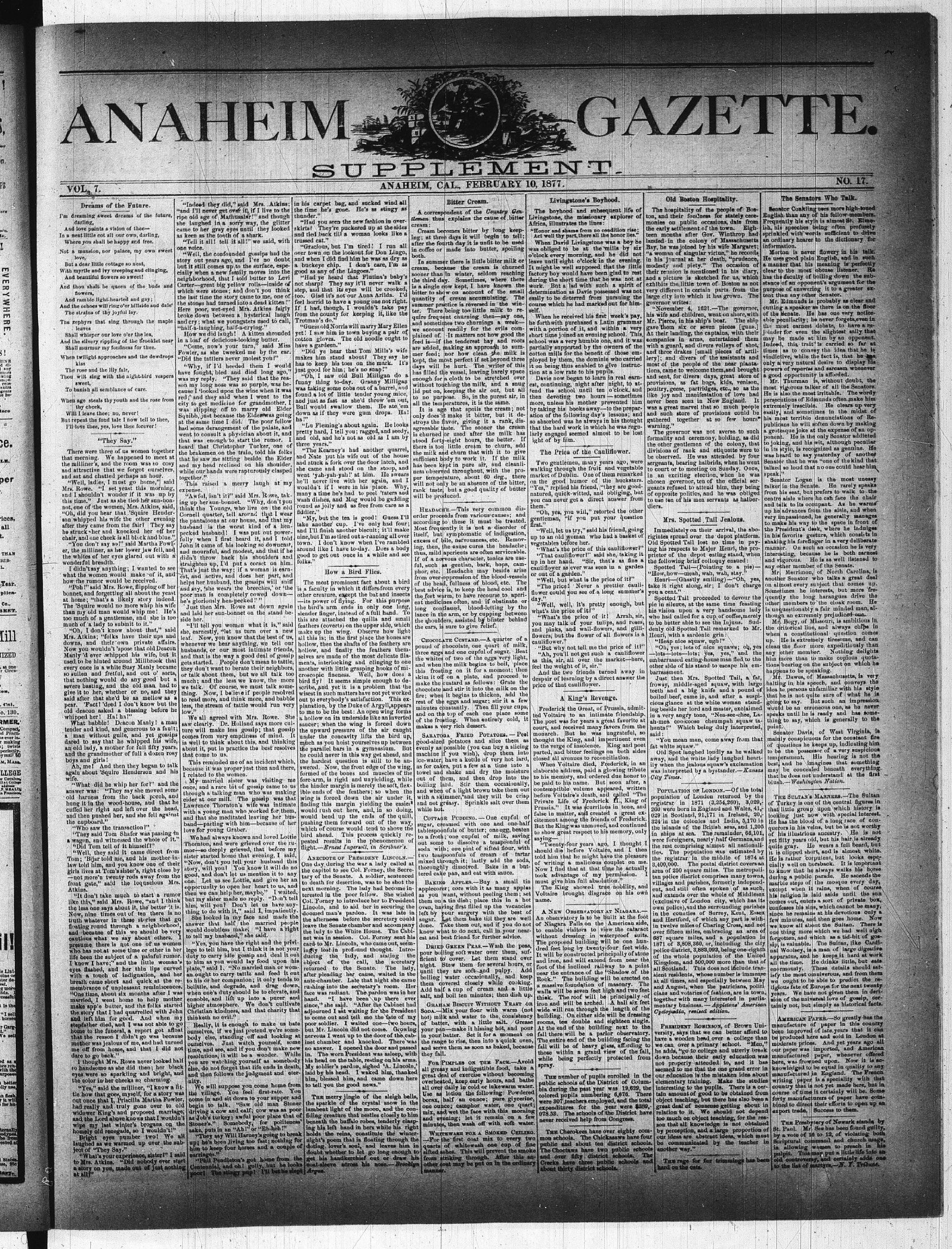
Searchable text
ANAHEIM
VOL. 7.
Dreams of the Future.
I'm dreaming sweet dreams of the future,
darling,
And love paints a vision of thee—
In a neat little cot all our own, darling,
Where you shall be happy and free.
Not a mansion, nor palace, my own sweet love,
But a dear little cottage so neat,
With myrtle and ivy creeping and clinging,
And beautiful flowers so sweet!
And thou shalt be queen of the buds and flowers,
And ramble light-hearted and gay;
And the echoes will ring o'er hillside and dale'
The strains of thy joyful lay.
The zephyrs that sing through the maple leaves
Shall whisper our love o'er the lea,
And the silvery rippling of the brooklet near
Shall murmur my fondness for thee.
When twilight approaches and the dewdrops kiss
The rose and the lily fair,
Thou wilt sing with the night-bird vespers sweet,
To banish all semblance of care.
When age steals thy youth and the rose from thy cheek,
Will I leave thee; no, never!
But repeat the fond tale I now tell to thee,
I'll love thee, yes, love thee forever!
"They Say."
There were three of us women together that morning. We happened to meet at the milliner's, and the room was so cosy
"Indeed they did," said Mrs. Atkins;
"and I'll never get over it, if I live to the ripe old age of Mathusalar!" and though she laughed in a sorry way, the glitter came to her gray eyes until they looked as keen as the tooth of a shark.
"Tell it all! tell it all!" we said, with one voice.
"Well, the confounded gossips had the story out years ago, and I've no doubt but it still comes up to the surface, especially when a new family moves into the neighborhood, that I sold butter to Levi Carter—great big yellow rolls—inside of which were stones; and don't you think the last time the story came to me, one of the stongs had turned into a dead kitten!"
Here poor, wet-eyed Mrs. Atkins fairly broke down between a hysterical laugh and cry; what we youngsters used to call, "half-a-laughing, half-a-crying."
How we did laugh! A kitten shrouded in a loaf of delicious-looking butter.
"Come, now's your turn," said Miss Fowler, as she tweaked me by the ear.
"Did the tattlers never molest you?"
Why, if I'd heeded them I would have fought, bled and died long ago," was my reply. "They said that the reason my long nose was so purple, was because I looked upon the wine when it was red," and they said when I went to the city to get medicine for grandmother, I was slipping off to marry old Elder Squibb, just because the Elder was going at the same time I did. The poor fellow had some derangement of the palate, and went to consult a physician about it, and that was enough to start the rumor. I heard that Christopher Tucker, one of the brakemen on the train, told his folks that he saw me sitting beside the Elder and my head reclined on his shoulder.
in his carpet bag, and the time he's gone. thunder."
"Had you seen the skirts? They're puckered and tied back till a wrist trussed cat."
"Gracious, but I'm over town on the lookout and when I did find him a buckeye chip. I good as any of the Linens."
"Had ye heard that not sharp? They say step, and that its eyes too. Glad it's not our feel horrid to have a yell. If I had, though, I wished from the county for kettle Trotman's do."
"Guess old Norris wi yet! I saw him in town cotton gloves. The o have a gardeen."
"Did ye hear that makes him stand abo has to keep his toes just good for him; he!"
"Oh, I saw old B funny thing to-day. was taking some cobwebs found a lot of little t and just as fast as sh Bull would swallow down as if they were ha!"
"Lu Fleming's about pretty hard, I tell you and old, and he's not three years."
"The Kearney's ha and Nate put his wife and stuck a fork over."
The rose and the lily fair,
Thou wilt sing with the night-bird vespers sweet,
To banish all semblance of care.
When age steals thy youth and the rose from thy cheek,
Will I leave thee; no, never!
But repeat the fond tale I now tell to thee,
I'll love thee, yes, love thee forever!
"They Say."
There were three of us women together that morning. We happened to meet at the milliner's, and the room was so cosy and attractive that we forgot ourselves, and sat and chatted perhaps an hour.
"Well, ladies, I must go home," said Mrs. Rowe. "I set yeast this morning, and I shouldn't wonder if it was up by this time." Just as she tied her sun-bonnet, one of the women, Mrs. Atkins, said, "Oh, did you hear that Squire Henderson whipped his wife the other evening after they came from the fair? They say he struck her and knocked her off her chair, and one cheek is all black and blue."
"You don't say so!" said Martha Fowler, the milliner, as her lower jaw fell, and the whites of her eyes glared out with a wonderful breadth.
I didn't say anything; I wanted to see what the women would make of it, and how the rumor would be received.
"Poh!" said Mrs. Rowe, flipping off her bonnet, and forgetting all about the yeast at home; "that's a likely story indeed. The 'Squire would no more whip his wife than my old man would whip me! He's too much of a gentleman, and she is too much of a lady to submit to it."
"Oh, I don't know about that," said Mrs. Atkins; "folks have their ups and downs, and their own private affairs. Now you wouldn't 'apose that old Deacon Manly'd ever whipped his wife, but it used to be hinted around Millbrook that every once in a while Susy Manly became so sullen and fretful, and out of sorts, that nothing would do any good but a severe basting, and the old man had to give it to her, whether or not, and they said after that she'd be as mellow as a pear. Fact! 'deed I don't know but the old deacon asked a blessing before he whipped her! Ha ha!"
What babble! Deacon Manly! a man tender and kind, and generous to a fault; a man without guile, and yet gossips dared to say that he whipped his wife, an old lady, a mother for full fifty years, and the grandmother of full a dozen rosy boys and girls!
Ah, me! And then they began to talk again about 'Squire Henderson and his wife.
"What did he whip her for?" and the answer was: "They say she moved some old harness from the back porch, and hung it in the wood-house, and that he cuffed her right and left over the head, and then pushed her, and she fell against the cupboard."
"Who saw the transaction?"
"They said Tom Shafer was passing in a wagon, and witnessed the whole of it."
"Did Tom tell of it himself?"
"Well, they said it came direct from Tom; 'Bijar told me, and his mother-in-law told him, and you know one of their girls lives at Tom's sister's, right close by—not more'n twenty rods away from the front door.'"
"The rose and the lily fair,
Thou wilt sing with the night-bird vespers sweet,
To banish all semblance of care.
When age steals thy youth and the rose from thy cheek,
Will I leave thee; no, never!
But repeat the fond tale I now tell to thee,
I'll love thee, yes, love thee forever!
"They Say."
There were three of us women together that morning. We happened to meet at the milliner's, and the room was so cosy and attractive that we forgot ourselves, and sat and chatted perhaps an hour.
"Well, ladies, I must go home," said Mrs. Rowe. "I set yeast this morning, and I shouldn't wonder if it was up by this time." Just as she tied her sun-bonnet, one of the women, Mrs. Atkins, said, "Oh, did you hear that Squire Henderson whipped his wife the other evening after they came from the fair? They say he struck her and knocked her off her chair, and one cheek is all black and blue."
"You don't say so!" said Martha Fowler, the milliner, as her lower jaw fell, and the whites of her eyes glared out with a wonderful breadth.
I didn’t say anything; I wanted to see what the women would make of it, and how the rumor would be received.
"Poh!" said Mrs. Rowe, flipping off her bonnet, and forgetting all about the yeast at home; "that's a likely story indeed. The 'Squire would no more whip his wife than my old man would whip me! He's too much of a gentleman, and she is too much of a lady to submit to it."
"Oh, I don't know about that," said Mrs. Atkins; "folks have their ups and downs, and their own private affairs. Now you wouldn't 'apose that old Deacon Manly'd ever whipped his wife, but it used to be hinted around Millbrook that every once in a while Susy Manly became so sullen and fretful, and out of sorts, that nothing would do any good but a severe basting, and the old man had to give it to her, whether or no, and they said after that she'd be as mellow as a pear. Fact! 'deed I don't know but the old deacon asked a blessing before he whipped her! Ha ha!"
What babble! Deacon Manly! a man tender and kind, and generous to a fault; a man without guile, and yet gossips dared to say that he whipped his wife, an old lady, a mother for full fifty years, and the grandmother of full a dozen rosy boys and girls!
Ah, me! And then they began to talk again about 'Squire Henderson and his wife.
"What did he whip her for?" and the answer was: "They say she moved some old harness from the back porch, and hung it in the wood-house, and that he cuffed her right and left over the head, and then pushed her, and she fell against the cupboard."
"Who saw the transaction?"
"They said Tom Shafer was passing in a wagon, and witnessed the whole of it."
"Did Tom tell of it himself?"
"Well, they said it came direct from Tom; 'Bijar told me, and his mother-in-law told him, and you know one of their girls lives at Tom's sister's, right close by—not more'n twenty rods away from the front door.'"
"The rose and the lily fair,
Thou wilt sing with the night-bird vespers sweet,
To banish all semblance of care.
When age steals thy youth and the rose from thy cheek,
Will I leave thee; no, never!
But repeat the fond tale I now tell to thee,
I'll love thee, yes, love thee forever!
"They Say."
There were three of us women together that morning. We happened to meet at the milliner's, and the room was so cosy and attractive that we forgot ourselves, and sat and chatted perhaps an hour.
"Well, ladies, I must go home," said Mrs. Rowe. "I set yeast this morning, and I shouldn't wonder if it was up by this time." Just as she tied her sun-bonnet, one of the women, Mrs. Atkins, said, "Oh, did you hear that Squire Henderson whipped his wife the other evening after they came from the fair? They say he struck her and knocked her off her chair, and one cheek is all black and blue."
"You don't say so!" said Martha Fowler, the milliner, as her lower jaw fell, and the whites of her eyes glared out with a wonderful breadth.
I didn’t say anything; I wanted to see what the women would make of it, and how the rumor would be received.
"Poh!" said Mrs. Rowe, flipping off her bonnet, and forgetting all about the yeast at home; "that's a likely story indeed. The 'SQUIRE would no more whip his wife than my old man would whip me! He's too much of a gentleman, and she is too much of a lady to submit to it."
"Oh, I don't know about that," said Mrs. Atkins; "folks have their ups和downs,and their own private affairs. Now you wouldn't 'apose that old Deacon Manly'd ever whipping his wife,but it used to be hinted around Millbrook that every once in a while Susy Manly became so sullen和fretful,and out o' sorts,that nothing would do any good but a severe basting,and the old man had to give it to her,whether or no,and they said after that she'd be as mellow as a pear. Fact! 'deed I don't know but the old deacon asked a blessing before he whipped her! Ha ha!"
What babble! Deacon Manly! a man tender和kind,and generous to a fault;a man without guile,and yet gossips dared to say that he whipped his wife,an old lady,a mother for full fifty years,and the grandmother of full a dozen rosy boys和 girls!
Ah,me!And then they began to talk again about 'Squire Henderson和his wife。
"What did he whip her for?"和the answer was: "They say she moved some old harness from the back porch,and hung it in the wood-house,and that he cuffed her right和left overthe head,and then pushed她,and she fell againstthe cupboard."
"Who saw the transaction?"
"They said Tom Shafer was passing in a wagon,and witnessedthe wholeofit."
"Did Tom tell of it himself?"
"Well,they said it came directfromTom;'Bijar told me,and his mother-in-law told him,and you know one of their girls lives atTom's sister's,rightcloseby—notmore'n twentyrodsawayfromthefrontdoor."
"The rose和the lily fair,
Thou wilt sing withthe night-bird vespersweet,
To banishallsemblanceofcare.
When age steals thy youth和the rose from thy cheek,
Will I leavethee;no,never!
But repeatthe fond taleInowtelltothee,
I'llloveyouwomenwhotis,"saidshe,earnestly,"letusturnoveraleaf.Now,youknowthatthebestofuswheneverhehearsanything,tellourhusbandsonorourmostintimatefriends,andthatisthewayagooddealofgossipgetsstarted.Peopledon'tmeantothattle,thedon'twanttoberate theirneighborsor talkaboutthem,butwealltalktomuch;andthelessweknow,themorewe talk.Ofcourse,thewouldtolessomething.Iwouldifpeopleresolvedtoreadmore,andthinkmore,andbabbleless,thestreamoftattlewouldrunverylow."
We all agreedwithMrs.Rowe.She saw clearly.Dr.Hollandsaysmoreculturewillmakelessgossip;thatgossipcomesfromveryemptinessof mind。它welltothinkaboutthis,andthinkingaboutit.putinpracticethebestresolvesthatcometous.
This remindedmeofanincidentwhichbecauseitwasproperjustthenandthere.Irelatedtothewomen.
Mymarriedsisterwasvisitingmeonce,anda rarebitofgossipcame toushroughatalkingmanwhowasmakingcideratourmilliard.ThegossipwasthatLawrenceThornton'swifewasintimatewithayoungmanwhoworkedforthem,andthatshemeditatedleavingherbusband-partingwithhim—becauseofherloveforyoungGraber.
WehadalwaysknownandlovedLottieThornton,andweregrievedovertherum—so deeplygrieved,thatbeforemy sisterstartedhomethatevening.Isaid,Now,dontyou tellyourhusbandthisstorywillyou?Youknowitwilldonogood,anddon'tletusmentionittoanyone.LetusseeLottie,andgiveheranjustgoodforhim;herOh,i sawoldBfunnythingto-day.Was takingsomecobesfounda lotoflittlebullandstowedandstoodyeah-yah-yah-t'yah-yah-yah-yah-yah-yah-yah-yah-yah-yah-yah-yah-yah-yah-yah-yah-yah-yah-yah-yah-yah-yah-yah-yah-yah-yah-yah-yah-yah-yah-yah-yah-yah-yah-yah-yah-yah-yah-yah-yah-yah-yah-yah-yah-yah-yah-yah-yah-yah-YAH Fleming'saboutprettyhard.I tellyououthandoldheywillneverdidifewithmanytimehehadpainshootyouwillneverdidifewithmanytimehehadpainshootyouwillneverdidifewwithmanytimehehadpainshootyouwillneverdidifewwithmanytimehehadpainshootyouwillneverdidifewwithmanytimehehadpainshootyouwillneverdidifewwithmanytimehehadpainshootyouwillneverdidifewwithmanytimehehadpainshootyouwillneverdidifewwithmanytimehehadpainshootyouwillneverdidifewwithmanytimehehadpainshootyouwillneverdidifewwithmanytimehehadpainshootyouwillneverdidifewwithmanytimehehadpainshootyouwillneverdidifewwithmanytimehehadpainshootyou willneverdidifewwithmanytimehehadpainshootyou willneverdidifewwithmanytimehehadpainshoot你 willneverdidifewwithmanytimehehadpainshoot你 willneverdidifewwithmanytimehehadpainshoot你 willneverdidifewwithmanytimehehadpainshoot你 willneverdidifewwithmanytimehehadpainshoot你 willneverdidifewwithmanytimehehadpainshoot你 willneverdidifewwithmanytimehehadpainshoot你 willneverdidifewwithmanytimehehadpainshoot你 willneverdidifewwithmanytimehehadpainshoot你 willneverdidifewwithmanytimehehadpainshoot你 willneverdidifewwithmanytimehehadpainshoot你 willneverdidifewwithmanytimehehadpainshoot你 willneverdidifewwithmanytimehehadpainshoot你 willneverdidifewwithmanytimehehadpainshoot你 willneverdidifewwithmanytimehehadpainshoot你 willneverdidifewwithmanytimehehadpainshoot你 willneverdidifewwithmanytimehe Hadpainshoot你 willneverdidifewwithmanytimehe Hadpainshoot你 willneverdidifewwithmanytimehe Hadpainshoot你 willneverdidifewwithmanytimehe Hadpainshoot你 willneverdidifewwithmanytimehe Hadpainshoot你 willneverdidifewwithmanytimehe Hadpainshoot你 willneverdidifewwithmanytimehe Hadpainshoot你 willneverdidifewwithmanytimehe Hadpainshoot你 willneverdidifewwithmanytimehe Hadpainshoot你 willneverdidifewwithmanytimehe Hadpainshoot你 willneverdidifewwithmanytimehe Hadpainshoot你 willneverdidifewwithmanytimehe Hadpainshoot你 willneverdidifewwithmanytimehe Hadpainshoot你 willneverdidifewwithmanytimehe Hadpainshoot你 willneverdidifewwithmanytimeHe Hadpainshoot你 willneverdidifewwithmanytimeHe Hadpainshoot你 willneverdidifewwithmanytimeHe Hadpainshoot你 willneverdidifewwithmanytimeHe Hadpainshoot你 willneverdidifewwithmanytimeHe Hadpainshoot你 willneverdidifewwithmanytimeHe Hadpainshoot你 willneverdidifewwithmanytimeHe Hadpainshoot你 willneverdidifewwithmanytimeHe Hadpainshoot你 willneverdidifewwithmanytimeHe Hadpainshoot你 willneverdidifewwithmanytimeHe Hadpainshoot你 WillneverdidifewwithmanytimeHe Hashednothingbutnothingbutnothingbutnothingbutnothingbutnothingbutnothingbutnothingbutnothingbutnothingbutnothingbutnothingbutnothingbutnothingbutnothingbutnothingbutnothingbutnothingbutnothingbutnothingbutnothingbutnothingbutnothingbutnothingbutnothingbutnothing但nothing但nothing但nothing但nothing但nothing但nothing但nothing但nothing但nothing但nothing但nothing但nothing但nothing但nothing但nothing但nothing但nothing但nothing但nothing但nothing但nothing但nothing但nothing但nothing但nothing但nothing但nothing但nothing但nothing但nothing但nothing但nothing但nothing但none,但none,但none,但none,但none,但none,但none,但none,但none,但none,但none,但none,但none,但none,但none,但none,但none,但none,但none,但none,但none,但none,但none,但none,但none,但none,但none,但none,但none,但none,但none,但none,但none,但none,但none,但none,但none,但 none,但 none,但 none,但 none,但 none,但 none,但 none,但 none,但 none,但 none,但 none,但 none,但 none,但 none,但 none,但 none,但 none,但 none,但 none,但 none,但 none,但 none,但 none,但 none,但 none,但 none,但 none,但 none,但 none,但 none,但 none,但 none,但 none,但 none,但 none,但 none,但 none,但 none,但 none,但 none,但 none.但 None,但 None,但 None但None但None但None但None但None但None但None但None但None但None但None但None但None但None但None但None但None但None但None但None但None但None但None但None但None但None但None但None但None但None但None但None但None但None但None但None但None但None但None到None到None到None到None到None到None到None到None到None到None到None到 None到 None到 None到 None到 None到 None到 None到 None到 None到 None到 None到 None到 None到 None到 None到 None到 None到 None到 None到 None到 None到 None到 None到 None到 None到 None到 None到 None到 None到 None到 None到 None到 None到 None到 None到 None到 None到 None到 None到 None 到 None 到 None 到 None 到 None 到 None 到 None 到 None 到 None 到 None 到 None 到 None 到 None 到 None 到 None 到 None 到 None 到 None 到 None 到 None 到 None 到 None 到 None 到 None 到 None 到 None 到 None 到 None 到_NONE TO THE CENTRE OF THE CENTRE OF THE CENTRE OF THE CENTRE OF THE CENTRE OF THE CENTRE OF THE CENTRE OF THE CENTRE OF THE CENTRE OF THE CENTRE OF THE CENTRE OF THE CENTRE OF THE CENTRE OF THE CENTRE OF THE CENTRE OF THE CENTRE OF THE CENTRE OF THE CENTRE OF THE CENTRE OF THE CENTRE OFTHE CENTRE OFTHE CENTRE OFTHE CENTRE OFTHE CENTRE OFTHE CENTRE OFTHE CENTRE OFTHE CENTRE OFTHE CENTRE OFTHE CENTRE OFTHE CENTRE OFTHE CENTRE OFTHE CENTRE OFTHE CENTRE OFTHE CENTRE OFTHE CENTRE OFTHE CENTRE OFTHE CENTRE OFTHE CENTRE OFTHE CENTRE OFTHE CENTREOFTHE CENTREOFTHECENTREOFTHECENTREOFTHECENTREOFTHECENTREOFTHECENTREOFTHECENTREOFTHECENTREOFTHECENTREOFTHECENTREOFTHECENTREOFTHECENTREOFTHECENTREOFTHECENTREOFTHECENTREOFTHECENTREOFTHECENTREOFTHECENTREOFTHESCENTRERELATEDTOWHENHEWASTOWHEREWASTOWHEREWASTOWHEREWASTOWHEREWASTOWHEREWASTOWHEREWASTOWHEREWASTOWHEREWASTOWHEREWASTOWHEREWASTOWHEREWASTOWHEREWASTOWHEREWASTOWHEREWASTOWHEREWASTOWHEREWASTOWHEREWASTOWHEREWASTOWHEREWASTOWHEREWASTOWHEREWASTOWHEREWASTOWHEREWASTOWHEREWASTOWHEREWASTOWHEREWASTOWHEREWASTOWHEREWASTOWHEREWASTOWHEREWASTOWHEREWASTOWHEREWASTOWHEREWASTOWHEREWASTOWHEREWASTOWHEREWASTOWHEREWASTOWHERE WASTOWHEREWASTOWHEREWASTOWHEREWASTOWHEREWASTOWHEREWASTOWHEREWASTOWHEREWASTOWHEREWASTOWHEREWASTOWHEREWASTOWHEREWASTOWHEREWASTOWHEREWASTOWHEREWASTOWHEREWASTOWHEREWASTOWHEREWASTOWHEREWASTOWHEREWASTOWHEREWASTOWEREWSITWOWEWSITWOWEWSITWOWEWSITWOWEWSITWOWEWSITWOWEWSITWOWEWSITWOWEWSITWOWEWSITWOWEWSITWOWEWSITWOWEWSITWOWEWSITWOWEWSITWOWEWSITWOWEWSITWOWEWSITWOWEWSITWOWEWSITWOWEWSITWOWEWSITWOWEWSITWOWEWSITWOWEWSITWO WEWSITWO WEWSITWO WEWSITWO WEWSITWO WEWSITWO WEWSITWO WEWSITWO WEWSITWO WEWSITWO WEWSITWO WEWSITWO WEWSITWO WEWSITWO WEWSITWO WEWSITWO WEWSITWO WEWSITWO WEWSITWO WEWSITSITWO WEWSITSITWO WEWSITSITWO WEWSITSITWO WEWSITSITWO WEWSITSITWO WEWSITSITBOWeWSITSITBOWeWSITSITBOWeWSITSITBOWewsITSITBOWewsITSITBOWewsITSITBOWewsITSITBOWewsITSITBOWewsITSITBOWewsITSITBOWewsITSITBOWewsITSITBOWewsITSITBOWewsITSItBOWewsITSItBOWewsITSItBOWewsITSItBOWewsITSItBOWewsITSItBOWewsITSItBOWewsITSItBOWewsITSItBOWewsITSItBOWewsITSItBOWewsITSItBOWewsITSItBOWewsITSItBOWewsITSItBOWewsITSItBOWewsITSItBOWewsITSItBOWewsITSItBOWewsITSItBoWewsITSItBOWewsITSItBOWewsITSItBOWewsITSItBOWewsITSItBOWewsITSItBOWewsITSItBOWewsITSItBOWewsITSItBOWewsITSItBOWewsITSItBOWewsITSItBOWewsITSItBOWewsITSItBOWewsITSItBOWewsITSItBOWewsITSItBOWewsISTSitBOWewsISTSitBOWewsISTSitBOWewsISTSitBOWewsISTSitBOWewsISTSitBOWewsISTSitBOWewsISTSitBOWewsISTSitBOWewsISTSitBOWewsISTSitBOWewsISTSitBOWewsISTSitBOWewsISTSitBOWewsISTSitBOWewsISTSitBOWewsISTSitBOWewsISTSitBOWewsISTSitBO We wsISTSit BO We wsISTSit BO We wsISTSit BO We wsISTSit BO We wsISTSit BO We wsISTSit BO We wsISTSit BO We wsISTSit BO We wsISTSit BO We wsISTSit BO We wsISTSit BO We wsISTSit BO We wsISTSit BO We wsISTSit BO We wsISTSit BO We wsISTSit BO We wsISTSit BO We wsISTSit BO We wsISTSit BO We wsISTSit BO We wsISTSit BO We wsISTSiti BO We wsISTSiti BO We wsISTSiti BO We wsISTSiti BO We wsISTSiti BO We wsISTSiti BO We wsISTSiti BO We wsISTSiti BO We wsISTSiti BO We wsISTSiti BO We wsISTSiti BO We wsISTSiti BO We wsISTSiti BO We wsISTSiti BO We wsISTSiti BO We wsISTSiti BO We wsISTSiti BO We wsISTSiti BO We wsISTSiti Bo We wsistsiti Bo We wsistsiti Bo We wsistsiti Bo We wsistsiti Bo We wsistsiti Bo We wsistsiti Bo We wsistsiti Bo We wsistsiti Bo We wsistsiti Bo We wsistsiti Bo We wsistsiti Bo We wsistsiti Bo We wsistsiti Bo We wsistsiti Bo We wsistsiti Bo We wsistsiti Bo We wsistsiti Bo We wsistsiti Bo We wsistsiti Bo We wsistsiti B Owewsistsiti B Owewsistsiti B Owewwsistsiti B Owewwsistsitti B Owewwsistsitti B Owewwsistsitti B Owewwsistsitti B Owewwsistsitti B Owewwsistsitti B Owewwsistsitti B Owewwsistsitti B Owewwsistasitti B Owewwsistastti B Owewwsistastti B Owewwsistastti B Owewwsistastti B Owewwsistastti B Owewwsistastti B Owewwsistastti B Owewwsistastti B Owewwsistastti B Owewwsistastti B Owewwsistastti B Owewwsistastti B Owewwsistastti B O
"What did he whip her lord?" and the answer was: "They say she moved some old harness from the back porch, and hung it in the wood-house, and that he cuffed her right and left over the head, and then pushed her, and she fell against the cupboard."
"Who saw the transaction?"
"They said Tom Shafer was passing in a wagon, and witnessed the whole of it."
"Did Tom tell of it himself?"
"Well, they said it came direct from Tom; 'Bijar told me, and his mother-in-law told him, and you know one of their girls lives at Tom's sister's, right close by—not more'n twenty rods away from the front gate,' said the loquacious Mrs. Atkins.
"It don't take much to start a rumor like this," said Mrs. Rowe, "and I think the less one says about it, the better 'it is. Now, nine times out of ten there is no truth whatever in these stories that go floating round through a neighborhood, and because of this we should be very cautious what we say about others. I presume there is not one of us women who has not at some time or other in her life been the subject of a painful rumor. I know I have;" and the little woman's eyes flashed, and her thin lips curved with a touch of indignation, and her breath came short and quick at the remembrance of unpleasant reminiscences.
"One time, about six months after I was married, I went home to help mother make apple butter, and the folks started the story that I had quarrelled with John and left him for good. And when my stepfather died, and I was not able to go home to the funeral, a report got affloat that the reason I didn't go was because mother was jealous of me, and had turned me off from home, and that I did not dare to go back."
I thought Mrs. Rowe never looked half so handsome as she did then; her black eyes were so sparkling and bright, and the color in her cheeks so charming.
"Yes," said the milliner, "I know a little how that goes, myself, for a story was out once that I, Priscilla Martha Fowler, had really and truly gone over to old widower King's and proposed marriage; and the Lord above knows that I wouldn't wipe my last winter's brogans on the homely old renegade, so I wouldn't!"
Bright eyes number two! We all laughed as we warmed up over the subject of "They Say."
"What's your experience, sister?" I said to Mrs. Atkins. "Did nobody ever start a story on you, made out of just nothing at all?"
We had always known and loved Lottie Thornton, and were grieved over the rumor—so deeply grieved, that before my sister started home that evening, I said, "Now, don't you tell your husband this story, will you? You know it will do no good, and don't lot us mention it to any one. Let us see Lottie, and give her an opportunity to open her heart to us, and then we can help her, maybe." I waited, but my sister made no reply. "Don't tell him, will you? Don't let us have anything to do with it," said I, impatiently.
She looked in my face and made the answer that half the married people would doubtless make: "I have a right to tell my hnsband," she said.
"Yes, you have the right and the privilege to tell him, but I think it is not your duty to carry idle gossip and deal it out to him as you would lay food upon his plate," said I. "No married man or woman ought to carry tattle and feed it out to his or her companion; it only tends to belittle, and degrade, and drag down, when one's duty should be to elevate, and ennoble, and lift up into a purer and higher atmosphere. We don't cultivate Christian kindness, and that charity that thinketh no evil."
Really, it is enough to make us hate ourselves, if we just pretend we're somebody else, standing off and looking at ourselves. Just watch yourself, some time, and see, and if you don't make new resolutions, it will be a wonder. While you are watching yourself as somebody else, do not forget that life ends in death, and then follows the judgment and eternity.
We will suppose you come home from the village. You feel first-rate. You come in and sit down to your supper and begin to talk. "Saw old man Stoner driving a cow and calf; cow was as poor as Job's turkey; awful poor place that of Stoner's." Somebody, for politeness' sake, puts in an "Ah!" or "Eh-heh!"
"They say Will Harney's going to break up; he's been living too fast; nothing for him to keep four horses and a couple of carriages."
"Phil Pendleton's got home from the Centennial, and oh! golly, but he looks poor! The stingy pup! I'll bet he sleeps
the hinder margin is visible ends of the feather is forced down finding this margin would rush out here would bend up thus pushing them forward which of course would bird ahead. This peated results in flight.—Ernest Ingel"
ANECDOTE OF PRINT One day during the capitol to see Cary of the Senate to death for desertion next morning. The terested in the poor Col. Forney to introduce Lincoln, and to aid doomed man's parade the afternoon before leave the Senate chaise the lady to the White net was in session. card-to Mr. Lincolningly lost in profusion ducing the lady object of the returned to the after pleading her ante-chamber. Last rushing into the seaface was radiant hand. "I have since," she said. "adjourned I sat waist to come out and tee poor soldier. I w but Mr. Lincoln di nervous I went up inet chamber and no answer. I open in. The worn Press his head on the tab My soldier's pardon laid by his head him, blessed him to tell you the good
The merry jingle of the sparkle of the lambent light of the fiding creature thine beneath the buffalo ing his left hand holds the reins night's poem that doting lover's so doubt whether to get his handkerchief coat-sleeve across Argus.
IM GAZ SUPPLEMENT.
ANAHEIM, CAL., FEBRUARY 10, 1877.
in his carpet bag, and sucked wind all the time he’s gone. He’s as stingy as thunder.”
“Had you seen the new fashion in overskirts? They’re puckered up at the sides and tied back till a woman looks like a trussed cat.”
“Gracious, but I’m tired! I run all over town on the lookout for Don Lingo, and when I did find him he was as dry as a buckeye chip. I don’t care, I’m as good as any of the Lingoes.”
“Had ye heard that Flutina’s baby’s not sharp? They say it’ll never walk a step, and that its eyes will be crooked, too. Glad it’s not our Anna Arilda. I’d feel horrid to have a young one not right. If I had, though, I wouldn’t pay from the county for keeping it, like the Trotman’s do.”
“Guess old Norris will marry Mary Ellen yet! I saw him in town buying a pair of cotton gloves. The old noodle ought to have a gardeen.”
“Did ye hear that Tom Mills’s wife makes him stand about? They say he has to keep his toes on the mark. It’s just good for him; he’s no snap!”
“Oh, I saw old Bull Milligan do a funny thing to-day. Granny Milligan was taking some cobs out of a barrel, and found a lot of little tender young mice, and just as fast as she’d throw ’em out, Bull would swallow them. He ate ’em down as if they were gum drops. Ha! ha!”
“Lu Fleming’s about again. He looks pretty hard, I tell you; ragged, and seedy, and old, and he’s not as old as I am by three years.”
“The Kearney’s had another quarrel, and Nate put his wife out of the house and stuck a fork over the door latch, and
Bitter Cream.
A correspondent of the Country Gentleman thus explains the cause of bitter cream:
Cream becomes bitter by long keeping; at three days it will begin to tell; after the fourth day it is unfit to be used in coffee or made into butter, spoiling both.
In summer there is little bitter milk or cream, because the cream is churned sooner than in winter, seldom reaching the third day. Sometimes, where there is a single cow kept, I have known the bitter to show on account of the small quantity of cream accumulating. The summer practice is reversed in the winter. There being too little milk to require frequent churning then—say one, and sometimes two churnings a week—we account readily for the evils complained of. It matters not how good the feed is—if the tenderest hay and roots are added, making an approach to summer feed; nor how clean the milk is kept, the most perfect if set beyond three days will be hurt. The writer of this has filled the vessel, leaving barely space enough for a cloth to be stretched over without touching the milk, and a snug lid put on, keeping the air out, but all to no purpose. So, in the purest air, in all the temperatures, it is the same.
It is age that spoils the cream; not only does it make it bitter, but it destroys the flavor, giving it a rank, disagreeable taste. The sooner the cream is churned or used after the milk has stood forty-eight hours, the better. If there is too little cream to churn, add the milk and churn that with it to give sufficient body to work it. If the milk has been kept in pure air and cleanli-
Livingstone’s Boyhood.
The boyhood and subsequent life of Livingstone, the missionary explorer of Africa, illustrates the lines:
“Honor and shame from no condition rise; Act well thy part, there all the honor lies.”
When David Livingstone was a boy he was obliged to be at the mills by six o’clock every morning, and he did not leave until eight o’clock in the evening. It might be well supposed that the little factory boy would have been glad to rest during the short time that he was not at work. But a lad with such a spirit of determination as Davie possessed was not easily to be deterred from pursuing the course which he had marked out for himself.
When he received his first week’s pay, he forthwith purchased a Latin grammar with a portion of it, and within a very short time joined an evening school. This school was a very humble one, and it was partially supported by the owners of the cotton mills for the benefit of those employed by them, the dominie who carried it on being thus enabled to give instruction at a low rate to his pupils.
Davie now began to learn in real earnest, continuing, night after night, to attend the school until ten o’clock, and then devoting two hours—sometimes more, unless his mother prevented him by taking his books away—the preparation of the following day’s lessons; and so absorbed was he always in his thought that the hard work in which he was regularly engaged seemed almost to be lost sight of by him.
The Price of the Cauliflower.
Two gentlemen, many years ago, were
just good for him; he’s no snap.”
“Oh, I saw old Bull Milligan do a funny thing to-day. Granny Milligan was taking some cobs out of a barrel, and found a lot of little tender young mice, and just as fast as she’d throw ‘em out, Bull would swallow them. He ate ’em down as if they were gum drops. Ha! ha!”
“Lu Fleming’s about again. He looks pretty hard, I tell you; ragged, and seedy, and old, and he’s not as old as I am by three years.”
“The Kearney’s had another quarrel, and Nate put his wife out of the house and stuck a fork over the door latch, and she came and stood on the stoop, and went ‘yah-yah-yah’ at him. He swears he’ll never live with her again, and I wouldn’t if I were in his place. Why, many a time he’s had to peel ’taters and wash dishes, and Mag would be gadding round as jolly and as free from care as a fiddler.”
“My, but the tea is good! Guess I’ll take another cup. I've only had four; and I'll finish another biscuit; it'll make nine, but I'm so tired out a-running all over town. I don't know when I've rambled around like I have to-day. Does a body good to get out once in a while and see folks.”
How a Bird Flies.
The most prominent fact about a bird is a faculty in which it differs from every other creature, except the bat and insects—its power of flying. For this purpose the bird's arm ends in only one long, slender finger, instead of a full hand. To this are attached the quills and small feathers (coverts) on the upper side, which make up the wing. Observe how light all this is; in the first place the bones are hollow, then the shafts of the feathers are hollow, and finally the feathers themselves are made of the most delicate filaments, interlocking and clinging to one another with little grasping hooks of microscopic fineness. Well, how does a bird fly? It seems simple enough to describe, and yet it is a problem that the wisest in such matters have not yet worked out to everybody's satisfaction. This explanation, by the Duke of Argyll, appears to me to be the best: An open wing forms a hollow on its underside like an inverted saucer; when the wing is forced down the upward pressure of the air caught under the concavity lifts the bird up, much as you hoist yourselves up between the parallel bars in a gymnasium. But he could never in this way get ahead, and the hardest question is still to be answered. Now, the front edge of the wing, formed of the bones and muscles of the fore-arm, is rigid and unyielding, while the hinder margin is merely the soft, flexible ends of the feathers; so when the wing is forced down the air under it, finding this margin yielding the easier would rush out here, and, in so doing, would bend up the ends of the quill, pushing them forward out of the way, which of course would tend to shove the bird ahead. This process quickly repeated results in the phenomenon of flight. — Ernest Ingersoll, in Scribner's.
ANECOTE OF PRESIDENT LINCOLN.
One day during the war a lady called at the capitol to see Col. Forney, the Secretary of the Senate. A soldier, sentenced to death for desertion was to be shot the
has filled the vessel, leaving barely space enough for a cloth to be stretched over without touching the milk, and a snug lid put on, keeping the air out, but all to no purpose. So, in the purest air, in all the temperatures, it is the same.
It is age that spoils the cream; not only does it make it bitter, but it destroys the flavor, giving it a rank, disagreeable taste. The sooner the cream is churned or used after the milk has stood forty-eight hours, the better. If there is too little cream to churn, add the milk and churn that with it to give sufficient body to work it. If the milk has been kept in pure air, and cleanliness observed throughout, with the proper temperature, about 60 deg., there will not only be an absence of the bitter, rank taste, but a good quality of butter will be produced.
HEADACHE.—This very common disorder proceeds from various causes; and according to these it must be treated. Most frequently it is not a disorder of itself, but symptomatic of indigestion, excess of bile, nervousness, etc. Removing, then, the cause cures the headache; thus mild aperients are often serviceable. If of a nervous character, tonics are useful, such as gentian, bark, hops, camphor, etc. Headache may beside arise from over-opression of the blood-vessels of the head, fullness of blood, etc. The best advice is, to keep the head cool and the feet warm, to have recourse to aperient medicines often, and if obstinate or long continued, blood-letting by the lance in the arm, or by cupping between the shoulders, assisted by blister behind the ears, is sure to give relief.
CHOCOLATE CUSTARD.—A quarter of a pound of chocolate, one quart of milk, three eggs and one cupful of sugar. Beat the whites of two of the eggs very light, and when the milk begins to boil, place this frosting on it for a moment; then skim it off on a plate, and proceed to make the custard as follows: Grate the chocolate and stir it into the milk on the fire; when it begins to thicken, add the rest of the eggs and sugar; stir it a few minutes constantly. Then fill your cups, and on top of each one place some of the frosting. When entirely cold, it makes a very rich dessert.
SABATOGA FRIED POTATOES.—Peel good-sized potatoes and slice them as evenly as possible (you can buy a slicing machine if you wish), drop them into ice-water, have a kettle of very hot lard, as for cakes, put a few at a time into a towel and shake and dry the moisture out of them, and then drop into the boiling lard. Stir them occasionally, and when of a light brown take them out with a skimmer; and they will be crisp and not greasy. Sprinkle salt over them while hot.
COTTAGE PUDDING.—One cupful of sugar, creamed with one and one-half tablespoonfuls of butter; one egg, beaten to a froth; one cupful of milk, saving out some to dissolve a teaspoonful of soda with; one pint of sifted flour, with two teaspoonsfuls of cream of tartar mixed through it; lastly add the soda, thoroughly dissolved. Bake in a buttered cake pan, and eat with sauce.
BAKING APPLES—Buy a small tin has filled the vessel, leaving barely space enough for a cloth to be stretched over without touching the milk, and a snug lid put on, keeping the air out, but all to no purpose. So, in the purest air, in all the temperatures, it is the same.
It is age that spoils the cream; not only does it make it bitter, but it destroys the flavor, giving it a rank, disagreeable taste. The sooner the cream is churned or used after the milk has stood forty-eight hours, the better. If there is too little cream to churn, add the milk and churn that with it to give sufficient body to work it. If the milk has been kept in pure air, and cleanliness observed throughout with the proper temperature, about 60 deg., there will not only be an absence of the bitter, rank taste, but a good quality of butter will be produced.
HEADACHE.—This very common disorder proceeds from various causes; and according to these it must be treated. Most frequently it is not a disorder of itself but symptomatic of indigestion, excess of bile, nervousness, etc. Removing, then,the cause curesthe headache; thus mild aperients are often serviceable. If of a nervous character,tonics are useful,such as gentian,bark,hops,camphor,eTC. Headache may beside arise from over-opression ofthe blood-vesselsofthehead,fullnessofblood,eTC.Thebestadviceis,tokeehenthecoolandthefeetwarm,tohaverecoursetoaperientmedicinesofthe,andifobstinateorlongcontinued,blood-lettingbythelanceinthearm.orbycuppingbetweentheshoulders,assistedbyblisterbehindtheears,suretogiveaidreactionthepriceofthatcauliflower.
A King's Revenge.
FredericktheGreat.ofPrussia.admittedVoltairetoanintimatefriendship.Thepoetwasforyearsa greatfavoriteat court,andreceivedmanyfavorsfromthemonarch.Buthewasungrateful,sothoughttheKing,andimpertinenteventothevergeofinsolence.Kingandpoetparted,andbitterfeelingsonbothsideclosedallavenuestocorrection.
When Voltaire died,Frederick.inan elaborateaddress,paida glowingtributetohismemory,andorderedduehonortobepaidtohisname.Butsoonafter,acontemptiblevolumeappeared,writtenbeforeVoltaire'sdeath,andcalled"ThePrivateLifeofFrederickII.,KingofPrussia."Itwasscurrilousin tone,andfalsein matter,andcreateda greatexcitementamongthefriendsOfFrederick.Buthekwasunmoved,andcontinuedtoshowgreatrespecttohismemoryonlysaying—
Twenty-fouryearsago.I thoughtIshoulddiebeforeVoltaire,andIthen toldhimthathe mighthavethepleasureofwritingamaliciouscoupletonme.NowIfindthatatthattimeheactually took advantageofmy permission.Imustgivehimfullabsolution."
the hinder margin is merely the soft, flexible ends of the feathers; so when the wing is forced down the air under it, finding this margin yielding the easier would rush out here, and, in so doing, would bend up the ends of the quill, pushing them forward out of the way, which of course would tend to shove the bird ahead. This process quickly repeated results in the phenomenon of flight.
Ernest Ingersoll, in Scribner's.
ANECDOTE OF PRESIDENT LINCOLN.
One day during the war a lady called at the capitol to see Col. Forney, the Secretary of the Senate. A soldier, sentenced to death for desertion, was to be shot the next morning. The lady had become interested in the poor fellow. She wished Col. Forney to introduce her to President Lincoln, and to aid her in securing the doomed man's pardon. It was late in the afternoon before the secretary could leave the Senate chamber and accompany the lady to the White House. The Cabinet was in session. Col. Forney sent his card to Mr. Lincoln, who came out, seemingly lost in profound thought. Introducing the lady, and stating the object of the call, the secretary returned to the Senate. The lady, after pleading her cause, waited in the ante-chamber. Late that night she came rushing into the secretary's room. Her face was radiant. The pardon was in her hand. "I have been up there ever since," she said. "After the Cabinet had adjourned I sat waiting for the President to come out and tell me the fate of my poor soldier. I waited one-two hours, but Mr. Lincoln did not come. Growing nervous I went up to the door of the cabinet chamber and knocked. There was no answer. I opened the door and passed in. The worn President was asleep, with his head on the table, resting on his arms. My soldier's pardon, sighed 'A. Lincoln,' laid by his head. I waked him, thanked him, blessed him, and came down here to tell you the good news."
The merry jingle of the sleigh bells, the sparkle of the crystal snow in the lambent light of the moon, and the confiding creature that nestles closely to him beneath the buffalo robes, tenderly clasping his left hand in hers while his right holds the reins, constitute the winter-night's poem that is floating through the doting lover's soul, and leaves him in doubt whether to let go long enough to get his handkerchief out or draw his coat-sleeve across his nose—Brooklyn Argus.
COTTAGE PUDDING. — One cupful of sugar, creamed with one and one-half tablespoonfuls of butter; one egg, beaten to a froth; one cupful of milk, saving out some to dissolve a teaspoonful of soda with; one pint of sifted flour, with two teaspoonfuls of cream of tartar mixed through it; lastly add the soda, thoroughly dissolved. Bake in a buttered cake pan, and eat with sauce.
BAKING APPLES. — Buy a small tin applecorer; core with it as many apples as you want, without peeling them; set them on a tin dish; place this in a hot oven, having first filled up the vacancies left by your surgery with the best of sugar. Let them bake till they are well done. Take them out, and if you do not know what to do next, call in your nearest and best friend for further advice.
DRIED GREEN PEAS. — Wash the peas, pour boiling soft water over them, sufficient to cover. Let them stand over night. Stew them for several hours, or until they are soft and pulpy. Add boiling water occasionally, and keep them covered closely while cooking. Add half a cup of cream and a little salt, and boil ten minutes; then dish up.
GRAHAM BISCUIT WITHOUT YEAST OR SODA. — Mix your flour with warm (not hot) milk and water to the consistency of batter, with a little salt. Grease your pan—make it hissing hot, and pour in your batter. Set it for a moment on the range to rise, then into a quick oven, and serve them as soon as baked, because they fall.
FOR PIMPLES ON THE FACE. — Avoid all greasy and indigestible food, take a great deal of exercise without becoming overheated, keep early hours, and bathe all over daily in cold or lukewarm water. Use as lotion the following: Powdered borax, half an ounce; pure glycerine, one ounce; camphor water, one quart; mix, and wet the face with this morning and evening; let it remain on a few minutes, then wash off with soft water.
WHITEWASH FOR A SMOKED CHILKING. — For the first coat mix to every two quarts of whitewash one cup of fine sifted sauses. This will prevent the smoke from striking through. After this another coat may be put on in the ordinary manner.
A NEW OBSERVATORY AT NIAGARA.
An observatory is to be built at the foot of Niagara Falls on the American side, to enable visitors to view the cataract without dressing in waterproof suits. The proposed building will be one hundred feet long by twenty-four feet wide. It will be constructed principally of stone and iron, and will extend from near the foot of the inclined railway to a point near the entrance of the 'Shadow of the Rock.' The building will be erected on a massive foundation of masonry. The walls will be seven feet high and two feet thick. The roof will be principally of iron and will be arched. A hall six feet wide will run through the length of the building. On either side will be dressing rooms, ten double and eighteen single. At the end of the building next to the fall there will be a parlor observatory. The entire end of the building facing the fall will be of heavy glass, affording to those within a grand view of the fall, while being perfectly protected from spray.
The number of pupils enrolled in the public schools of the District of Columbia during the past year was 19,629, there were 307 teachers employed, and the total expenditures for the year were $289,-078.53. The schools of the District have never received help from Congress.
The Charokees have over eighty common schools. The Chickasaws have four public and about ten district schools. The Choctaws have two public schools and over fifty district schools. The Creeks have three public schools and about thirty district schools.
POPULATION REGISTRATION
200 were 029 in Scribner's area of 3400,000 police officers for tan police villages; and extra (exclusive own pooled) population registration 200 were 029 in Scribner's area of 3400,000 police officers for tan police villages; and extra (exclusive own pooled) population registration 200 were 029 in Scribner's area of 3400,000 police officers for tan police villages; and extra (exclusive own pooled) population registration 200 were 029 in Scribner's area of 3400,000 police officers for tan police villages; and extra (exclusive own pooled) population registration 200 were 029 in Scribner's area of 3400,000 police officers for tan police villages; and extra (exclusive own pooled) population registration 200 were 029 in Scribner's area of 3400,000 police officers for tan police villages; and extra (exclusive own pooled) population registration 200 were 029 in Scribner's area of 3400,000 police officers for tan police villages; and extra (exclusive own pooled) population registration 200 were 029 in Scribner's area of 3400,000 police officers for tan police villages; and extra (exclusive own pooled) population registration 200 were 029 in Scribner's area of 3400,000 police officers for tan police villages; and extra (exclusive own pooled) population registration 200 were 029 in Scribner's area of 3400,
GAZETTE.
NO. 17.
Boyhood.
Subsequent life of literary explorer of times:
No condition rise; all the honor lies."
One was a boy he one mills by six and he did not in the evening.
And that the little been glad to rest at he was not at such a spirit of possessed was not him pursuing the sked out for him first week's pay, Latin grammar within a very big school. This, he one, and it was the owners of the fit of those eminence who carried to give instructu-pupils.
Learn in real earn-ter night, to atten-ten o'clock, and thus — sometimes prevented him — to the prepar-y's lessons; and days in his thought which he was regu-most to be lost Cauliflower.
Years ago, were
Old Boston Hospitality.
The hospitality of the people of Boston, and their fondness for stately ceremonies on public occasions, date from the early settlement of the town. Eighteen months after Gov. Winthrop had landed in the colony of Massachusetts Bay, he was joined by his wife Margaret; "a woman of singular virtue," he records in his journal at her death, "prudence, modesty and piety." The occasion of their reunion is mentioned in his diary, and a picture is sketched for us, which exhibits the little town of Boston as not very different in certain parts from the large city into which it has grown. The governor writes:
"November 4, 1621.—The governor, his wife and children, went on shore, with Mr. Pierce, in his ship's boat. The ship gave them six or seven pieces [guns]. At their landing, the captains, with their companies in arms, entertained them with a guard, and divers volleys of shot, and three drakes [small pieces of artillery]; and divers of the assistants and most of the people of the near plantations, came to welcome them, and brought and sent, for divers days, great store of provisions, as fat hogs, kids, venison, poultry, greese, partridges, etc., so as the like joy and manifestation of love had never been seen in New England. It was a great marvel that so much people and such store of provisions could be gathered together at so few hours warning."
The governor was not averse to such formality and ceremony, holding, as did the other gentlemen of the colony, that divisions of rank and etiquette were to be observed. He was attended by four sergeants, bearing halbrids, when he went
The Senators Who Talk.
Senator Conkling uses more high-toned English than any of his fellow-members. Frequently his style is almost St. Elmoish, his speeches being often profusely sprinkled with words sufficient to drive an ordinary hearer to the dictionary for information.
Morton is never flowery in his talk. He uses good plain English, and in such a manner that his meaning is perfectly clear to the most obtuse listener. He has the faculty of boiling down the substance of an opponent's argument for the purpose of answering it to a greater extent than any other Senator.
Mr. Edmunds is probably as clear and cutting a speaker as there is on the floor of the Senate. He has one very noticeable peculiarity; he never forgets, even in the most earnest debate, to have a rejoinder for even the slightest sally that may be made at him by an opponent. Indeed, this trait is carried so far at times as to convey the idea that he is vindictive, while the fact is, that he has only a very natural desire to display his powers of repartee and sarcasm whenever a good opportunity is afforded.
Mr. Thurman is without doubt, the most vigorous talker of all the Senators. He is also the most irritable. The wordy persecutions of Edmunds often make him extremely irascible. He clears up easily, and sometimes in the midst of his most terrible denunciations of Republicans he will soften down by making a grotesque joke at the expense of an opponent. He is the only Senator addicted to joking, and his wit, although peculiar in its style, is recognized as genuine. He was heard to say yesterday of another Senator that he was "one of the kind that
earn in real earnest night, to attest o'clock, and hours—sometimes prevented him by the preparer's lessons; and days in his thought which he was regumost to be lost.
Cauliflower.
years ago, were it and vegetable of them remarked of the hucksters, "they are good and obliging, but direct answer from this cauliflower?" said she, taking it that's as fine a seen in a garden
price of it?" a prettior cauliflower a long summer's utility enough, but if it Arrah, sir, tulips, and roses, flowers, and gillions of all flowers is a price of it?" such a cauliflower the market—here, turned away in direct answer the revenge.
of Prussia, admit-imate friendship. a great favorite at many favors from the ungrateful, so impertinent even me. King and poet songs on both sides conciliation.
Frederick, in a glowing tribute offered due honor to But soon after, a appeared, written and called "The Brick II., King of villains in tone, and animated a great exponents of Frederick. lived, and continued to his memory, only ago, I thought I maitreire, and I then have the pleasure was couplet on me. But time he actually permission. I solution."
Mrs. Spotted Tail Jealous.
Immediately on their arrival, the aborigines spread over the depot platform. Old Spotted Tail lost no time in paying his respects to Major Henri, the proprietor of the depot eating stand, when the following brief colloquy ensued:
Spotted Tail—(Pointing to a pie)—"How, how—meah, wah, wah, stay."
Henri—(Ghastly smiling)—"Oh, yes, take it right along, sir; I don't charge you a cent."
Spotted Tail proceeded to devour the pie in silence, at the same time feasting his vision upon a very handsome lady who had called for a cup of coffee, merely to be batter able to see the Injus. Suddenly old Spotted Tail remarked to Mr. Henri, with a sardonic grin:
"Heap nice squaw, ugh!"
"Oh, yes; lots of nice squaws; oh, yes—lots—lots; yes, yes," and the embarrassed eating-house man fled to the other side of his stand to escape his embarrassment.
Just then Mrs. Spotted Tail, a fat, frowsy, middle-aged squaw, with large teeth and a big knife and a pound of boiled beef, came in, and after a suspicious glance at the white woman standing beside her lord and master, exclaimed in a very angry tone, "Nea-see-chee, Laah-mea coo-coose cheumpah squaw tahunta!" Which being duly interpreted, said:
"You mean man, come away from that fat white aquaw."
Old Spot laughed loudly as he walked away, and the white lady laughed heartily when the jealous squaw's exclamation was interpreted by a bystander.—Kansas City Times.
POPULATION OF LONDON. Of the total population of London returned by the registrar in 1871 (3,254,260), 3,029,-260 were born in England and Wales, 41,-029 in Scotland, 91,171 in Ireland, 20,-324 in the colonies and India, 5,170 in the islands of the British seas, and 1,205 in ships at sea. The remainder, 66,101, were foreigners, nearly half Germans, and the rest comprising almost all nationalities. The population was estimated by the registrar in the middle of 1874 at 3,400,000. The postal district covers an area of 250 square miles. The metropolitan police district comprises many towns, villages and parishes formerly indemnified.
powers of repartee and sarcasm whenever a good opportunity is afforded.
Mr. Thurman is without doubt, the most vigorous talker of all the Senators. He is also the most irritable. The wordy persecutions of Edmunds often make him extremely irascible. He clears up easily and sometimes in the midst of his most terrible denunciations of Republicans he will soften down by making a grotesque joke at the expense of an opponent. He is the only Senator addicted to joking, and his wit, although peculiar in its style, is recognized as genuine. He was heard to say yesterday of another Senator that he was "one of the kind that talked so loud that no one could hear him speak."
Senator Logan is the most uneasy talker in the Senate. He rarely speaks from his seat, but prefers to walk to the centre aisle where he can face the chair and talk to its occupant. As he warms up he advances from the aisle, and when very impassioned, he generally manages to make his way to the space in front of the President's desk, where he indulges in his favorite gesture, which consists in shaking his forefinger in a very deliberate manner. On such an occasion he is very interesting, because he is both earnest and vigorous. He is as well listened to any other member of the Senate.
Mr. Merrimon of North Carolina is another Senator who talks a great deal on almost every subject that comes up. Sometimes he interests, but more frequently the long harangues drive the other members to the closet room. He is unquestionably a fair minded man, although an extremely prejudiced one.
Mr. Boggy of Missouri is ambitious in the oratorical line, and always chills in when a constitutional question comes up. He is extremely tiresome, and can clean the floor more expeditiously than any other member. Nothing delights him more than to make copious quotations bearing on the subject on which he happens to be speaking.
Mr. Dawes of Massachusetts is very halting in his speech, and conveys the idea to persons unfamiliar with his style that he is not quite sure of what he is going to say. But such an impression would be an erroneous one, as he never speaks until he is ready and has something to say, which is generally to the point.
Senator Davis of West Virginia is mainly conspicuous for the constant fire of questions he keeps up indicating him to be the possessor of a very suspicious temperament. His hearing is not the best, and he imagines that something may be concealed beneath everything that he does not understand at the first blush.—Washington Nation.
THE SULTAN'S MANNERS.—The Sultan of Turkey is one of the central figures in that little group upon which history is looking just now with special interest. He has the blood of a long race of conquerors in his veins, but he is not worthy of his illustrious ancestry. He is not yet fifty years old, but his hair is already quite gray. He wears a full beard, but it is clipped short, and is almost white. He is rather corpulent, but looks especially well on horsback. It is important to know that he always walks his horse during a public parade. He ascends the mobile steps of the mosque every day.
POPULATION OF LONDON.—Of the total population of London returned by the registrar in 1871 (3,254,260), 3,029,260 were born in England and Wales, 41,029 in Scotland, 91,171 in Ireland, 20,324 in the colonies and India, 5,170 in the islands of the British seas, and 1,205 in ships at sea. The remainder, 66,101, were foreigners, nearly half Germans, and the rest comprising almost all nationalities. The population was estimated by the registrar in the middle of 1874 at 3,400,000. The postal district covers an area of 250 square miles. The metropolitan police district comprises many towns, villages and parishes, formerly independent, and still often spoken of as such, and extends over the whole of Middlesex (exclusive of London city, which has its own police), and the surrounding parishes in the counties of Surrey, Kent, Essex and Hertford, of which any part is within twelve miles of Charing Cross, and not over fifteen miles, embracing an area of 687 square miles, and a population in 1871 of 3,808,360, or, including the city police district, 3,883,092, being one-eighth of the whole population of the United Kingdom, and 500,000 more than that of all Scotland. This does not include transient residents, whose number is immense at all times, and especially between May and August, when the patricians, politicians and votaries of fashion, are in town together with many interested in parliamentary business. — Appletons’ American Cyclopaedia, revised edition.
PRESIDENT ROBINSON, of Brown University, says that we can better afford to have a wooden head over a college than we can over a primary school. “Men,” he adds, “go to college and utterly break down because their early education was not properly attended to, and it has seemed to me that the one grand error in our education is the mistaken idea about elementary training. Make the studies interesting to the pupils. There is a certain amount of good to be obtained from object teaching; but there has also been a great deal of nonsense getting about in relation to it. We should not depend too much on object teaching, for the reason that all knowledge is not obtained by perception, and a large proportion of our ideas are abstract ideas, which must be communicated by the teacher in another way.”
The rage for fur trimmings has been hard on the cats.
THE SULTAN’S MANNERS.—The Sultan of Turkey is one of the central figures in that little group upon which history is looking just now with special interest. He has the blood of a long race of conquerors in his veins, but he is not worthy of his illustrious ancestry. He is not yet fifty years old, but his hair is already quite gray. He wears a full beard, but it is clipped short, and is almost white. He is rather corpulent, but looks especially well on horseback. It is important to know that he always walks his horse during a public parade. He ascends the marble steps of the mosque every day, except when it rains, when of course his religion is laid aside until the sun comes out, enters a sort of private box, confesses his sins, which cannot be many, since he remains at his devotions only a few minutes, and then goes home. Now we know all about the Sultan. There is one thing more which we had well nigh forgotten, and which as a tid-bit of gossip is valuable. The Sultan, like Cardinal Woolsey, is a man of large digestive apparatus, and he keeps it hard at work all the time. He drinks little, but eats enormously. These details should satisfy the most omnivorous, and from them we ought to be able to predict the religious fate of Europe for the next twenty years. We have not given them in derision of the universal love of gossip, certainly not, but simply as historical facts.
AMERICAN PAPER.—So greatly has the manufacture of paper in this country been improved of late years that it can be produced here and sold in London at moderate prices. And yet years ago all our paper was imported, and American manufactured paper, whenever offered here, was frowned upon. Now it is acknowledged to be equal in quality to any manufactured in England. The French writing paper is a specialty with that country that is not yet made here, but in course of time it certainly will be. Some forty manufacturers of paper have combined to direct their efforts to open up an export trade. Success to them.
THE Presbytery of Newark stands by St. Paul. Mr See has been found guilty by a vote of 16 to 12, of violating both Scriptural command and church usage, in allowing women to preach in his pulpit. This may put a little life into an old controversy, and certainly adds one to the list of martyrs.—N. Y. Tribune.