anaheim-gazette 1876-12-30
Scanned page
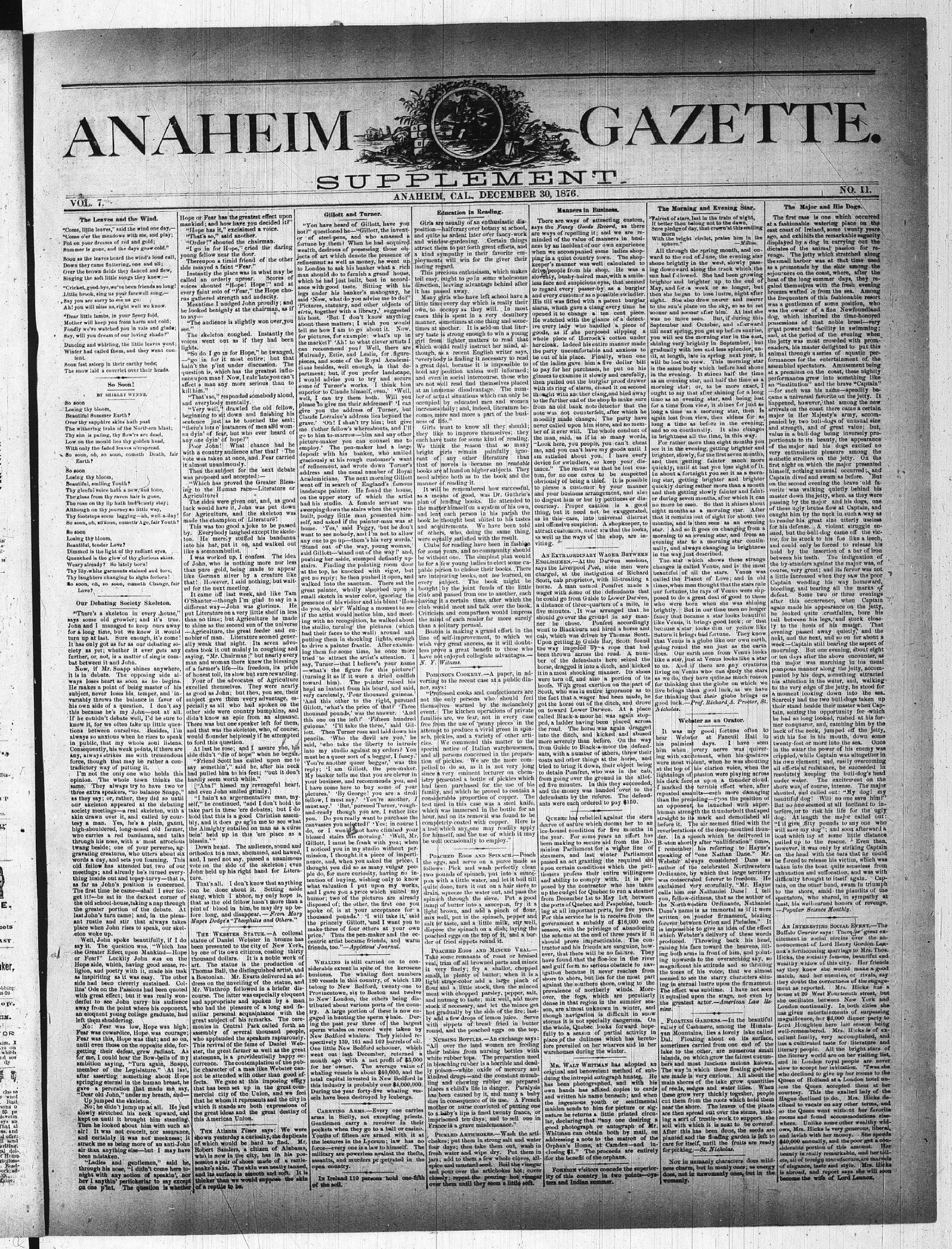
Searchable text
ANAHEIM
VOL. 7.
The Leaves and the Wind.
"Come, little leaves," said the wind one day,
"Come o'er the meadows with me, and play;
Put on your dresses of red and gold;
Summer is gone, and the days grow cold."
Soon as the leaves heard the wind's loud call,
Down they came fluttering, one and all;
Over the brown fields they danced and flew,
Singing the soft little songs they knew:
"Cricket, good-bye, we've been friends so long!
Little brook, sing us your farewell song,
Say you are sorry to see us go:
Ah! you will miss us, right well we know.
Dear little lambs, in your fleecy fold,
Mother will keep you from harm and cold;
Pondly we've watched you in vale and glade;
Say, will you dream of our loving shade?
Dancing and whirling, the little leaves went;
Winter had called them, and they went content.
Soon fast asleep in their earthy beds,
The snow laid a coverlet over their heads.
So Soon!
BY SHIRLEY WYNNE.
So soon
Losing thy bloom,
Beautiful Summer Earth?
Over thy sapphire skies hath past
The withering train of the Northern blast;
Thysin is paling, thy flow'rs are dead,
Low on the mould lies thy golden head,
With only the faded leaves o'erspread.
So soon, oh, so soon, cometh Death, fair Earth?
Hope or Fear has the greatest effect upon mankind; and how have you decided it?
"Hope has it," exclaimed a voice.
"That's so," said another.
"Order!" shouted the chairman.
"I go in for Hope," cried the daring young fellow near the door.
Thereupon a timid friend of the other side essayed a faint "Fear."
Instantly the place was in what may be called an orderly uproar. Scores of voices shouted "Hope! Hope!" and at every faint solo of "Fear," the Hope chorus gathered strength and audacity.
Meantime I nudged John proudly; and he looked benignly at the chairman, as if to say—
"The audience is slightly won over, you see."
The skeleton coughed. Instantly the voices went out as if they had been lights.
"So do I go in for Hope," he twanged,
—"go in for it most entire; but that hain't the pint under discussion. The question is, which has the greatest influence upon man? Now, I call late you can't affect a man any more serious than kill him."
"That's so," responded somebody aloud, and everybody mentally.
"Very well," drawled the old fellow, beginning to sit down and finishing his sentence just as he touched the seat; "there's lots of instances of men and women dyin' of fear, but who ever heard of any one dyin' of hope!"
Poor John! What chance had he with a country audience after that? The vote was taken at once, and Fear carried it almost unanimously.
Gillott and
"You have heard of not?" questioned he—or of steel-pens, and fortune by them! Wh wealth, desirous of projects of art which de refinement as well as to London to ask his man should do to fur- which he had just buiance with good taste legs under his bank said 'Now, what do yu Pictures, statuary, and sirtu, together with a his host. 'But I do about these matters; tell me how I am to for pictures, for exam the market?' 'Ah! to can recommend yo Mulready, Ettie, and pieces, and some of t clians besides, well e partment; but, if you I would advise you some of Turner's w superior to Claude hi well, I can try tha please to give me tha give you the address Claude Lorraine's ad grave.' 'Oh! I shan me t'other fellow's w go to him to-marrow picture-maker you employ. The pen-deposit with his b graciously at his rou-
No Soon!
BY SHIRLEY WYNNE
So soon
Losing thy bloom,
Beautiful Summer Earth?
Over thy sapphire skies hath past
The withering train of the Northern blast;
Thy sun is paling, thy flow's are dead,
Low on the mould lies thy golden head,
With only the faded leaves o'erspread.
So soon, oh, so soon, cometh Death, fair Earth?
So soon
Losing thy bloom,
Beautiful, smiling Youth?
Thy gleeful voice hath a new, sad tone,
The gloss from thy raven hair is gone,
The rose on thy lip hath had 'scanty stay;
Although on thy journey so little way,
Thy footsteps seem lagging—ah, well-a-day!
So soon, oh, so soon, cometh Age, fair Youth?
So soon
Losing thy bloom,
Beautiful, tender Love?
Dimmed is the light of thy radiant eyes,
Quenched is the glow of thy glorious skies.
Weary already? So lately born!
Thy lily-white garments stained and torn,
Thy laughers changing to sighs forlorn!
So soon, oh, so soon, cometh Change, fair Love?
Our Debating Society Skeleton.
"There's a skeleton in every house," says some old growler; and it's true. John and I managed to keep our away for a long time, but we knew it would turn up at last. Sure enough, it's come! It has only got as far as our debating society as yet; whether it ever gets any further, or not, is a matter of single combat between it and John.
Now, if Mr. Suapp shines anywhere, it is in debate. The opposing side always loses heart as soon as he begins. He makes a point of being master of his subject, never loses his temper, and invariably throws the balance in favor of his own side of a question. I don't say this because he's my John—not at all. If he couldn't debate well, I'd be sure to know it, for we often take up little questions between ourselves. Besides, I'm always so anxious when he rises to speak in public, that my whole soul listens. Consequently, his weak points, if there are any, always strikes me with tremendous force, though that may be rather a contradictory way of putting it.
I'm not the only one who holds this opinion. The whole town thinks the same. They always try to have two or three extra speakers, "to balance Snapp," as they say; or, rather, they did so until our skeleton appeared at the debating society meetings—a real skeleton, with a skin drawn over it, and called by courtesy a man. Yes, he's a plain, gaunt, high-shouldered, long-nosed old farmer, who carries a red bandanna, and talks through his nose, with a most atrocious twang beside; one of your perverse, ag-gravating creatures, who utters about six words a day, and sets you foaming. This old fellow has attended but two of our meetings; and already he's turned everything inside out and topsy-turvy—that is,
"I came off last week, and like Tam O'Shanter—though I'm glad to say in a different way—John was glorious. He put Literature on a very little shelf in less than no time; but Agriculture he made to shine as the second sun of the universe—Agriculture, the great feeder and ennobler of man. Literature seemed generally weak that night. Its seven advocates took it out mainly in coughing and saying, "Mr. Chairman;" but nearly every man and woman there knew the blessings of a farmer's life—its freedom, its pride of honest toil, its slow but sure rewarding.
Four of the advocates of Agriculture excelled themselves. They were nearly as good as John; but then, you see, their subject gave them every advantage, especially as all who had spoken on the other side were country bumpkins, and didn't know an epic from an almanac. There was but one speaker left for them, and that was the skeleton, who, of course, would flounder helplessly if he attempted to ford this question.
At last he rose; and I assure you, his side didn't "die of hope" when he began.
"Friend Scott has called upon me to say somethin'," said he, after his neck had pulled him to his feet; "but it don't hardly seem worth while."
["Aha!" hissed my revengeful heart, and even John smiled grimly.
"I haint an argementative man, myself," he continued, "and I don't hold to take part in these 'ere debates; but I do hold that this is a good Christian assembly, and it does go again in me to see what the Almighty entailed on man as a curse bein' held up in this 'ere place as a blessin.'"
Down he sat. The audience, sound and orthodox to a man, ahemmed, and hawed, and I need not say, passed a unanimous vote on the side of the skeleton; even John held up his right hand for Literature.
"That's so," responded somebody aloud, and everybody mentally.
"Very well," drawled the old fellow, beginning to sit down and finishing his sentence just as he touched the seat; "there's lots of instances of men and women dyin' of fear, but who ever heard of any one dyin' of hope?"
Poor John! What chance had he with a country audience after that? The vote was taken at once, and Fear carried it almost unanimously.
Then the subject for the next debate was proposed and accepted:
"Which has proved the Greater Blessing to the Human race—Literature or Agriculture?
The sides were given out, and as good luck would have it, John was put down for Agriculture, and the skeleton was made the champion of Literature!
This was too good a joke to be passed by. Everybody laughed except the skeleton. He merely stuffed his bandanna into his hat, put it on, and walked out like a somnambulist.
I was worked up, I confess. The idea of John, who is nothing more nor less than pure gold, being made to appear like German silver by a creature like that! However, I said nothing, but waited for the next meeting.
It came off last week, and like Tam O'Shanter—though I'm glad to say in a different way—John was glorious. He put Literature on a very little shelf in less than no time; but Agriculture he made to shine as the second sun of the universe—Agriculture,the great feeder and ennobler of man.Literature seemed generally weak that night.Its seven advocates took it out mainly in coughing and saying,"Mr. Chairman;" but nearly every man and woman there knew the blessings of a farmer's life—its freedom,its pride of honest toil,its slow but sure rewarding.
Four of the advocates of Agriculture excelled themselves. They were nearly as good as John; but then,you see,their subject gave them every advantage,especially as all who had spoken on the other side were country bumpkins,and didn't know an epic from an almanac.There was but one speaker left for them,and that was the skeleton,who,of course,would flounder helplessly if he attempted to ford this question.
At last he rose; and I assure you,his side didn't "die of hope" when he began.
"Friend Scott has called upon me to say somethin'," said he,after his neck had pulled him to his feet; "but it doesn't hardly seem worth while."
["Aha!" hissed my revengeful heart,and even John smiled grimly.
"I haint an argementative man,myself," he continued,"and I don't hold to take part in these 'ere debates;but I do hold that this is a good Christian assembly,and it does go agin me to see what the Almighty entailed on man as a curse bein' held up in this 'ere place as a blessin.'"
Down he sat. The audience,sound and orthodox to a man,ahemmed,and hawed,and I need not say,passed a unanimous vote on the side of the skeleton; even John held up his right hand for Literature.
"I don't know that anything
They always try to have two or three extra speakers, "to balance Snapp," as they say; or, rather, they did so until our skeleton appeared at the debating society meetings—a real skeleton, with a skin drawn over it, and called by courtesy a man. Yes, he's a plain, gaunt, high-shouldered, long-nosed old farmer, who carries a red bandanna, and talks through his nose, with a most atrocious twang beside; one of your perverse, aggrivating creatures, who utters about six words a day, and sets you foaming. This old fellow has attended but two of our meetings; and already he's turned everything inside out and topsy-turvy—that is, as far as John's position is concerned. The first time he came—shall I ever forget it?—he sat in the darkest corner of the old school-house, taking a nap through the greater portion of the debate. At last John's turn came; and, in the pleasant rustle and stir that always takes place when John rises to speak, our skeleton woke up.
Well, John spoke beautifully, if I do say it. The question was, "Which has the Greater Effect upon Mankind—Hope or Fear?" Luckily John was on the Hope side, which having good sense, religion, and poetry with it, made his task as inspiriting as it was easy. The other side had been cleverly sustained. Collins' Ode on the Passions had been quoted with great effect; but it was really wonderful to see John carry his audience away from the point where his opponent, an eloquent young college graduate, had left them shuddering.
No: Fear was low, Hope was high; Fear was cowardice, Hope was courage; Fear was this, Hope was that; and so on, until even those on the opposite side, forgetting their defeat, grew radiant. As for me, I could hear the Bow-bells of my ambition saying, "Turn again, Snapp, member of the Legislature." At last, after asserting something about Hope springing eternal in the human breast, he gave a peroration that made me say, "Dear old John," under my breath, and—Up jumped the skeleton.
No; he didn't jump up at all. He just slowly stretched his neck upward, and kept on until it brought him standing. Then he looked about him with such an air! It was not conceit, nor assurance, and certainly it was not meekness; it strack me as being more of an anti-John air than anything else—but I may have been mistaken.
"Ladies and gentlemen," said he, through his nose, "I didn't come here tonight with any notion of speakin', norhew I anythin' pertickerlar to say except on one pint. The question is whether
"Aha!" hissed my revengeful heart, and even John smiled grimly.
"I hain't an argumentative man, myself," he continued, "and I don't hold to take part in these 'ere debates; but I do hold that this is a good Christian assembly, and it does go again in me to see what the Almighty entailed on man as a curse bein' held up in this 'ere place as a blessin.'"
Down he sat. The audience, sound and orthodox to a man, ahemmed, and hawed, and I need not say, passed a unanimous vote on the side of the skeleton; even John held up his right hand for Literature.
That's all. I don't know that anything can be done about it. Setting aside slang, which I abhor, my only hope is, that as the old fellow hasn't more than a pint of blood in him, he may dry up before long, and disappear. — From Mary Mapes Dodge's "Theophilis and Others."
THE WEBSTER STATUE.—A colossal statue of Daniel Webster in bronze has been presented to the city of New York, by one of its own citizens, costing thirty thousand dollars. It is a noble work of art. The statue is the production of Thomas Ball, the distinguished artist, and a Bostonian. Mr. Evarts delivered an address on the unveiling of the statue, and Mr. Winthrop followed in a briefer discourse. The latter was especially eloquent and appropriate and spoken by a man who had the pleasure of a long and familiar personal acquaintance with the great subject of his remarks. The ceremonies in Central Park called forth an assembly of several thousand people, who applauded the speakers rapturously. This revival of the fame of Daniel Webster, the great farmer as well as the great statesman, is a providentially happy occurrence. The contemplation of the public character of a man like Webster cannot be attended with other than good effects. We gaze at this imposing effigy that has been set up in the great commercial city of the Union, and we feel that he whom it represents and the city in which it stands are both expressions of the great ideas and the great destiny of this American Union.
The Atlanta Times says: We were shown yesterday a curiosity; the duplicate of which would be hard to find. Mr. Robert Sanders, a citizen of Alabama, who is now in the city, has in his possession a pair of shoes made of a rattle-snake's skin. The skin was neatly tanned, and its surface is smooth and soft. It is thicker than we would suppose the skin of a reptile to be.
WHALING is still siderable extent in business. The 180 vessels in this belong to New Provincetown, six to New London; tributed about vairty. A large porch gaged in hunting ing the past year sperm whales on New Bedford which spectively 159, 160 One little New E went out last month ago with for her owner. Whaling vessels in total capital invite this industry is p During the year sels have been de
CARRYING ARMS in Sicily; Gentlemen carry pockets when they Youths of fifteen; the lectures in the force—every one military are power assants; and many open country.
In Ireland 111 of the soil.
GILLOTT and Turner.
"You have heard of Gillott, have you not?" questioned he—"Gillott, the inventor of steel-pens, and who amassed a fortune by them? When he had acquired wealth, desirous of possessing those objects of art which denote the presence of refinement as well as money, he went up to London to ask his banker what a rich man should do to furnish a grand house, which he had just built, best in accordance with good taste. Sitting with his legs under his banker's mahogany, he said 'Now, what do you advise me to do?' 'Pictures, statuary, and other objects of virtu, together with a library,' suggested his host. 'But I don't know anything about these matters; I wish you would tell me how I am to go about it. Now, for pictures, for example: what's up in the market?' 'Ah! to what clever artists I can recommend you? Well, there are Mulready, Ettie, and Leslie, for figure-pieces, and some of the Royal Academicians besides, well enough, in that department; but, if you prefer landscape, I would advise you to try and secure some of Turner's works. I think him superior to Claude himself, even.' 'Well, well, I can try them both. Will you please to give me their addresses?' 'I can give you the address of Turner, but Claude Lorraine's address lies beyond the grave.' 'Oh! I shan't try him; but give me t'other fellow's whereabouts, and I'll go to him to marrow—him and any other picture-maker you can counsel me to employ.' The pen-maker had a large deposit with his banker, who smiled graciously at his rough customer's want of refinement and wrote down Turner's
Education in Reading.
Girls are usually of an enthusiastic disposition—half crazy over botany at school, and quite as ardent later over fancy-work and window-gardening. Certain things attract them to put forth great efforts, and a kind sympathy in their favorite employments will win for the giver their lasting regard.
This precious enthusiasm, which makes toil easy, ought to go in some wholesome direction, leaving advantage after it has passed away.
Many girls who have left school have a little time every day which is really their own, to occupy as they will. In most cases this is spent in a very desultory manner, sometimes at one thing and sometimes at another. It is seldom that literary taste is strong enough to win a young girl from lighter matters to read that which would really instruct her mind, although, as a recent English writer says, "everybody is finding it necessary to read a great deal, because it is impossible to hold any position unless well informed; and even in social intercourse, those who are not well read find themselves placed at an immense disadvantage. The number of actual situations which can only be occupied by educated men and women increases daily; and, indeed, literature becomes more and more a part of the business of life."
Girls want to know all they should; they like to improve themselves; they each have taste for some kind of reading. We think the reason that so many bright girls remain painfully ignorant of any other literature than that of novels is because no readable
Manners in Business.
There are ways of attracting custom, says the Fancy Goods Record, as there are ways of repelling it; and we are reminded of the value of manners in business by an incident of our own experience when we accompanied some ladies shopping in a quiet country town. The shopkeeper's manner was well calculated to drive people from his shop. He was a slovenly, bushy-haired man, with a smileless face and suspicious eyes, that seemed to regard every passer-by as a burglar and every customer as a possible swindler. His till was fitted with a patent burglar alarm, which gave a clang every time he opened it to change a ten cent piece. He watched with the glance of a detective every lady who handled a piece of goods, as if she purposed slipping a whole piece of Horrock's cotton under her cloak. Indeed his entire manner made the party uncomfortable and anxious to be out of his place. Finally, when one of the ladies gave him a five dollar bill to pay for her purchases, he put on his glasses to examine it slowly and carefully, then pulled out the burglar proof drawer with its ring of alarm, closed it on second thought with another clang, and hied away to the further end of the shop to make sure from an old bank note detector that the note was not counterfeit, after which he moodily made change. The party have never called upon him since, and no member of it ever will. The whole conduct of the man said, as if in so many words,
"Look here, you people, you can't cheat me, and you can't have my goods until I am satisfied about you. I have every device for swindlers, so keep your dis-
In the image, there is a section of a newspaper article discussing the importance of education and personal development in society. The headline reads: "AN EXTRAORDINARY WAGER BETWEEN ENGLISHMEN." Below this, there is a paragraph that discusses the role of education in fostering personal growth and social interaction.
The text is written in English and appears to be from a newspaper or magazine. It includes several paragraphs with varied content, including discussions on education, personal development, and societal issues. There are also references to specific individuals and events, such as the Turner family and their relationship with art.
The layout of the text is typical of a newspaper, with columns of text separated by horizontal lines. The font is a standard serif typeface, likely Times New Roman or a similar style. The text is organized into paragraphs, each with a clear heading and body content.
Here is the transcription of the text:
AN EXTRAORDINARY WAGER BETWEEN ENGLISHMEN.-At the Darwen sessions, says the Liverpool Post, nine men were charged, at the instigation of Richard Scott, cab proprietor, with ill-treating a horse. A man named Pomfret made a wager with some of the defendants that he could go from Guide to Lower Darwen, a distance of three-quarters of a mile, in five minutes. It was arranged that he should go over the ground in any manner he chose. Pomfret accordingly went to Blackburn and hired a horse and cab, which was driven by Thomas Scott. Upon getting to Guide Bar, Scott found the way imaged by a rope that had been thrown across the road. A number of the defendants here seized the horse, dragged it into a ditch, and kicked it in a most shocking manner. Its shoes were torn off, and also a portion of its hoops. With great exertion on the part of Scott, who was in entire ignorance as to the fact that a wager had been made, he got the horse out of the ditch, and drove on toward Lower Darwen. At a place called Black-a-moor he was again stopped, a ladder having been placed across the road. The horse was again dragged into the ditch, and kicked and abused more severely than before. On the way from Guide to Black-a-moor the defendants, with a number of others, threw their coats and other things at the horse, and tried to bring it down, their object being to detain Pomfret, who was in the cab, from going over the ground in the allotted five minutes. In this they succeeded, and the money was handed over to the defendants by the referee. The defendants were each ordered to pay $150.
QUEBEC has rebelled against the stern decree of nature which dooms her to an ice-bound condition for five months in the year. For some years an effort has been making to secure aid from the Dominion Parliament for a winter line of steamers, and last winter Parliament passed an act granting the required aid upon certain conditions which the petitioners profess their entire willingness and ability to comply with. It is pro-
```markdown
clans besides well enough in that clan partment; but if you prefer landscape, I would advise you to try and secure some of Turner's works. I think him superior to Claude himself, even,’ Well, well, I can try them both. Will you please to give me their addresses?’ I can give you the address of Turner, but Claude Lorraine's address lies beyond the grave.’ Oh! I shan't try him; but give me 'tother fellow's whereabouts, and I'll go to him-marrow—him and any other picture-maker you can counsel me to employ.’ The pen-maker had a large deposit with his banker, who smiled graciously at his rough customer's want of refinement, and wrote down Turner's address and the usual number of Royal Academicians. The next morning Gillott went off in search of England's famous landscape painter. He found the house, on the upper story of which the artist had his studio. A female servant was sweeping down the stairs when the square-built, podgy little man presented himself, and asked if the painter-man was at home.’ Yes,’ said Peggy, ‘but he don't want to see nobody, and I'm not to allow any one to go up—them's his very words.’ 'Stand out of the way, young woman,' said Gillott—'stand out of the way!' and pushing her aside, stumped defiantly upstairs. Finding the painting room door at the top, he knocked with vigor, but got no reply; he then pushed it open, and walked into the sanctum. There sat the great painter, wholly absorbed upon a small sketch in water color, ignoring the presence of his visitor and his blunt 'How do you do, sir?' Waiting a moment to see if the artist would notice him, and meeting with no recognition, he walked about the studio, turning the pictures (which had their faces to the wall) around and putting them in shocking lights, enough to drive a painter frantic. After examining them for some time, he once more tried to attract the artist's attention. I say, Turner—that I believe your name —what's the figure for this picture? (turning it as if it were a dried codfish toward him). The painter raised his head an instant from his board, and said, very carelessly, 'Four thousand guineas.' And this other to the right, pursued Gillott, 'what's the price of that?' Three thousand pounds,' was the answer. 'And this one on the left?' Fifteen hundred guineas.' 'I'll take the three,' said Gillott. Then Turner rose and laid down his pencils. 'Who the devil are you,' he said, 'who take the liberty to intrude into my studio against my orders? You must be a queer sort of a beggar, I fancy.' 'You're another queer beggar,' was the reply; 'I am Gillott, the pen-maker. My banker tells me that you are clever in your business, and recommends you, and I have come here to buy some of your pictures.' 'By George! you are a troll fellow, I must say,' 'You're another,' I must say.’ 'But, pursued Turner, rough-and-ready though you are, I rather like you. Do you really want to purchase the canvasses you selected?' 'Yes; in course I do, or I would not have climbed your blessed stairs this morning.' 'Well, Mr. Gillott, I must be frank with you; when I noticed you in my studio without permission, I thought it a piece of imperience, and when you asked the prices, I thought you did so as many vulgar people do, for mere curiosity, having no intention of buying, wishing only to know hold any position unless well informed; and even in social intercourse, those who are not well read find themselves placed at an immense disadvantage. The number of actual situations which can only be occupied by educated men and women increases daily; and indeed, literature becomes more and more a part of the business of life."
Girls want to know all they should; they like to improve themselves; they each have taste for some kind of reading. We think the reason that so many bright girls remain painfully ignorant of any other literature than that of novels is because no readable books are at hand on higher subjects. They need advice both as to the book and the manner of reading it.
It will be remembered how successful as a means of good, was Dr. Guthrie's plan of lending books. He attended to the matter himself on a system of his own,and lent each person in his parish the book he thought best suited to his tastes and requirements. We have been told of others who, doing the same thing,都 equally satisfied with the result.
Clubs for reading have been in fashion for some years,and no community should be without one.The simplest plan would be for a few young ladies to elect some capable person to choose their books. There are interesting books,not too learned.on every subject.The book might be bought by the joint funds of the little club and passed from one to another,each having it a certain time,after which the club would meet and talk over the book.Criticism and comparison would impressthe mind of each reader far more surely than a solitary perusal.
Boston is making a grand effort in the line of self-improvement,toward which we wish very great success.as it will doubtless prove a great benefit to those who have not enjoyed collegiate advantages.
N.Y.Witness.
POISONOUS COOKERY.-A paper.in advertising to the recent case at a public dinner,says:
"Profess cooks and confectioners are not only persons who should feel themselves warned by the melancholy event. The kitchen operations of private families are ,we fear ,not in any case free from the use of 'penny pieces' in the attempt to produce a vivid green in spinach,pickles,and a variety of other articles.
We commend this matter to the special notice of Italian warehousemen,and all persons concerned in the preparation of pickles. We are more compelled to do so ,as it is not very long since a very eminent lecturer on chemistry presented a bottle of pickles which had been purchased for the use of his family,and which he proved to contain a considerable proportion of copper.The test used in this case was a steel knife,the was immersed in the bottle for an hour,and on its removal was found to be completely coated with copper.Here is a test which any one may readily apply for himself,and the use of which it may be well occasionally to employ."
An Extraordinary Wager Between Englishmen.-At the Darwen sessions,says the Liverpool Post,nine men were charged.at the instigation of Richard Scott,cab proprietor,vith-treating a horse.A man named Pomfret made a wager with some of the defendants that he could go from Guide to Lower Darwen,a distance of three-quarters of a mile,five minutes.它was arranged that he should go over the ground in any mannerhe chose.Pomfret accordinglywent to Blackburn and hired a horseand cabwhichwas drivenbyThomasScott.UpongettingtoGuideBar,Scottfoundthewayimpededbyaropethathadbeenthrownacrosstheroad.Anumberofthedefendantshereseizedthehorse,draggeditintoaditch,andkickedandabusedmoreseverelythanbefore.OnthewayfromGuidetoBlack-a-moorthedefendantswithanumberofothers.threwtheicoatsandotherthingsatthehorse,andtriedtobringitdown,theirobjectbeingdetainPomfret,howinthecabFROMgoingoverthegroundintheallottedfiveminutes.Inthistheysucceeded,andthemoneywashandedoverthedefendantsbythereferee.Thedefendantswereeachorderedtopay$150.
QUEBEChasrebelledagainstthesterndecreeofnaturewhichdoomshertoanice-boundconditionforfivemonthsintheyear.ForesomeyearsanefforthasbeenmakingtosecureaidfromtheDominionParliamentforawinterlinemethodpassanactgrantingtherequiredaidupon certainconditionswhichthepetitionsprofessientwhitenewilityandabilitytocomplywith.itispro-
```
I have come here to buy some of your pictures.' 'By George! you are a droll fellow, I must say.' 'You're another, I must say,' 'But, pursued Turner, rough-and-ready though you are, I rather like you. Do you really want to purchase the canvasses you selected?' 'Yes; in course I do, or I would not have climbed your blessed stairs this morning.' 'Well, Mr. Gillott, I must be frank with you; when I noticed you in my studio without permission, I thought it a piece of impertinence, and, when you asked the prices, I thought you did so as many vulgar people do, for mere curiosity, having no intention of buying, wishing only to know what valuation I put upon my works, and I gave you a price which suited my humor; two of the pictures are already disposed of; the other, the first one you spoke of, is at your acceptance for a thousand pounds.' 'I will take it,' said the princely Gillott, 'and I want you to make three of four others at your own price.' Thus the pen-maker and the eccentric artist became friends, and warm friends, too."—Appletons Journal.
Whaling is still carried on to considerable extent in spite of the kerosene business. The whaling fleet numbers 180 vessels in this country, of which 130 belong to New Bedford, twenty-one to Provincetown, six to Boston and twelve to New London, the others being distributed about various ports of the country. A large portion of these is now engaged in hunting the sperm whale. During the past year three of the largest sperm whales on record were taken by New Bedford whalers. They yielded respectively 159, 161 and 162 barrels of oil. One little New Bedford schooner, which went out last December, returned a month ago with a net profit of $5,000 for her owner. The average value of whaling vessels is about $40,000, and the total capital invested in New Bedford in this industry is probably over $4,000,000. During the year forty-five whaling vessels have been destroyed by icebergs.
Carrying Arms. Every one carries arms in Sicily, not excepting priests. Gentlemen carry a revolver in their pockets when they go to a ball or casino. Youths of fifteen are armed with it at the lectures in the Lyceum; law has no force—every one is a law to himself. The military are powerless against the thefts, assaults, and murders perpetrated in the open country.
In Ireland 110 persons hold one-fifth of the soil.
Poached Eggs and Spinach. Poach the eggs, and serve on a puree made as follows: Pick and wash perfectly clean two pounds of spinach, put into a saucepan with a little water, and let it boil till quite done, turn it out on a hair sieve to drain, squeeze the water out, and pass the spinach through the sieve. Put a good lump of butter into a saucepan, fry it a light brown, and add a pinch of flour, mix well, put in the spinach, pepper and salt to taste, and a little milk, stir well, dispose the spinach on a dish; laying the poached eggs on the top of it, and a border of fried sippets round it.
Nursing Bottles. An exchange says: "All over the land women are feeding their babies from nursing bottles with white rubber tops. The preparation used in bleaching rubber is horrible and deadly poison—white oxide of mercury and kindred drugs—and the constant mummbling and chewing rubber so prepared places a child's life in danger. Paralysis has been caused by it, and many a baby dies in consequence of its use. A French mother or nurse convicted of putting one to a baby's lips is fined twenty francs, or imprisoned ten days; and to sell one in France is a grave misdemeanor."
Pickled Artichokes. Wash the artichokes; put them in strong salt and water four days; then take them out, wash in fresh water and wipe dry. Put them in jars; add to them a few whole cloves, all spice and mustard seed. Boil the vinegar and pour over the artichokes hot; cover closely; repeat the pouring hot vinegar over them until they seem a little soft.
Quebec has rebelled against the stern decree of nature which dooms her to an ice-bound condition for five months in the year. For some years an effort has been making to secure aid from the Dominion Parliament for a winter line of steamers, and last winter Parliament passed an act granting the required aid upon certain conditions which the petitioners profess their entire willingness and ability to comply with. It is proposed by the contractor who has taken up the cudgel for Quebec to run a steamer from December 1st to May 1st, between the ports of Quebec and Paspebiac, touching at all important ports, for five years. For this service he is to receive from the government a subsidy of $16,000 each season, with the privilege of abandoning the scheme at the end of three years if should prove impracticable. The contractor and his friends are sanguine, however that there will be no failure. They have found that the flue-ice in the river and gulf form no serious obstacle to navigation because it never reaches from shore to shore, but lies for the most part against the southern shore, owing to the prevalence of northerly winds. Moreover, the fogs, which are peculiarly dense in that region in the summer season, are almost unknown in winter, and though navigation is difficult in snow storms it is not specially dangerous. On the whole, Quebec looks forward hopefully to a season of partial activity in place of the dullness which has heretofore prevailed on her wharves and in her warehouses during the winter.
Mr. Walt Whitman has adopted an original and benovelent method of subduing the intrepid antograph hunter. He has been photographed, and with his own hands has affixed copies to cards and written his name beneath; and when the ingenuous youth or sentimental maiden sends to him for picture or signature he returns a little printed circular, declaring that "any one desiring a good photograph or antograph of Mr. Whitman can obtain both by mail, on addressing a note to the matron of the Orphan's Home, at Camden—and inclosing $1." The proceeds are entirely for the benefit of the orphans.
For foreign visitors concede the superiority of this country in two points—oysters and Indian summer.
GAZETTE.
NO. 11.
business.
extracting custom,
Record, as there
and we are remanners in busisur own experience
some ladies shoptown. The shopcell calculated to
shop. He was a
man, with a smileeyes, that seemed
by as a burglar
possible swindler.
A patent burglar
gives every time he
ten cent piece.
ance of a detectdied a piece of
closed slipping a
k's cotton under
stire manner made
e and anxious to
anly, when one
a five dollar bill
is, he put on his
newly and carefully,
burglar proof drawer
closed it on second
ang, and hied away
shop to make sure
detector that the
eit, after which he
The party have
since, and no memwhole conduct of
so many words,
you can't cheat
my goods until I
I have every
to keep your dis-
The Morning and Evening Star.
"Falrest of stars, last in the train of night,
If better thou belong not to the dawn,
Sure pledge of day, that crown'st this smiling
morn
With the bright circlet, praise him in the
sphere."
All through the spring month, and onward to the end of June, the evening star shone brightly in the west, slowly passing downward along the track which the sun had followed. She had been growing brighter and brighter up to the end of May, and for a week or so longer, but then she began to lose lustre, night after night. She also drew nearer and nearer to the sun's place on the sky, so as to set sooner and sooner after him. At last she was no more seen. But, if during this September and October, and afterward till next spring, you get up before sunrise, you will see the morning star in the east, shining very brightly in September, but gradually with less and less splendor, until at length, late in spring next year, it will be lost to view. This morning star is the same body which before had shone in the evening. It shines half the time as an evening star, and half the time as a morning star; or, to be more exact, I ought to say that after shining for a long time as an evening star, and being lost for a time from view, it shines for just as long a time as a morning star, then is again lost from view, then shines for as long a time as before in the evening; and so on continually. It also changes in brightness all the time, in this way.
For rather more than eight months you see it in the evening, getting brighter and brighter, slowly, for the first seven months, and then getting fainter much more
The Major and His Dogs.
The first case is one which occurred at a fashionable watering place on the east coast of Ireland, some twenty years ago, and exhibits the remarkable sagacity displayed by a dog in carrying out the dictates of the animal passion for revenge. The jetty which stretched along the small harbor was at that time used as a promenade by the elite among the sojourners on the coast, where, after the heat of the long summer days, they regaled themselves with the fresh evening breezes wafted in from the sea. Among the frequenters of this fashionable resort was a gentleman of some position, who was the owner of a fine Newfoundland dog, which inherited the time-honored possessions of that noble breed—very great power and facility in swimming; and, at the period of the evening when the jetty was most crowded with promenaders, his master delighted to put this animal through a series of aquatic performances for the entertainment of the assembled spectators. Amusement being at a premium on the coast, these nightly performances grew into something like an "institution" and the brave "Captain"—for such was his name—speedily became a universal favorite on the jetty. It happened, however, that among the new arrivals on the coast there came a certain major in Her Majesty's army, accompanied by two bull-dogs of unusual size and strength, and of great value; but, value in a bull-dog being inversely proportionate to its beauty, the appearance of the major and his dogs excited no very enthusiastic pleasure among the aesthetic strollers on the jetty. On the first night on which the major presented
WAGER BETWEEN Darwen sessions,
nine men were negotiation of Richard with ill-treating a Pomfret made a defence defendants that to Lower Darwen, starters of a mile, in arranged that he found in any man-confref accordingly hired a horse and by Thomas Scott. The Bar, Scott found a rope that had the road. A num-pts here seized the ditch, and kicked manner. Its shoes to a portion of its portion on the part of mere ignorance as to had been made, he the ditch, and drove Darwen. At a place one was again stop-been placed across was again dragged kicked and abused before. On the way a-moor the defend-ful others, threw their ass at the horse, and their object being who was in the cab, ground in the allot-this they succeeded, handed over to the defence. The defend-ed to pay $150.
against the stern dochos her to an for five months in years an effort has been aid from the Doctor a wister line of winter Parliament requiring aid persons which the peti-er entire willingness with. It is pro-
Webster as an Orator.
It was my good fortune often to hear Webster at Fancueil Hall in his palmest days. I have seen him when every nerve was quivering with excitement, when his gestures were most violent, when he was shouting at the top of his clarion voice, when the lightnings of passion were playing across his dark face as upon a thunder cloud. I marked the terrible effect when, after repeated assaults—each more damaging than the preceding—upon the position of an opponent, he launched with superhuman strength the thunderbolt that sped straight to its mark and demolished all before it. The air seemed filled with the reverberations of the deep-mouthed thunder. In a speech which he delivered in Boston shortly after "nullification" times, I remember his referring to Hayne's speaking of "one Nathan Dane." Mr. Webster always considered Dane as author of the celebrated Northwestern Ordinance, by which that large territory was consecrated forever to freedom. He is the same body which before had shone in the evening. It shines half the time as an evening star, and half the time as a morning star; or, to be more exact, I ought to say that after shining for a long time as an evening star, and being lost for a time from view, it shines for just as long a time as a morning star, then is again lost from view, then shines for as long a time as before in the evening; and so on continually. It also changes in brightness all the time, in this way.
For rather more than eight months you see it in the evening, getting brighter and brighter, slowly, for the first seven months, and then getting fainter much more quickly, until at last you lose sight of it. In about a fortnight you see it as a morning star, getting brighter and brighter quickly during rather more than a month and then getting slowly fainter and fainter during seven months, after which it can no more be seen. So that it shines about eight months as a morning star. After that it remains out of sight for about two months, and is then seen as an evening star. And so it goes on changing from a morning to an evening star, and from an evening star to a morning star continually, and always changing in brightness in the way just described.
The star which shows these strange changes is called Venus, and is the most beautiful of all the stars. Venus was called the Planet of Love; and in old times, when men thought that the stars rule our fortunes, the rays of Venus were supposed to do a great deal of good to those who were born when she was shining brightly. But in our time men no longer fancy that because a star looks beautiful like Venus, it brings good luck; or that because a star looks dim or yellow like Saturn it brings bad fortune. They know that Venus is a globe like our own earth, going round the sun just as the earth does. Our earth seen from Venus looks like a star, just at Venus looks like a star to us. And if there are any creatures living on Venus who can study the stars as we do, they have quite as much reason for thinking that the globe on which we live brings them good luck, as we have for thinking that their globe brings us good luck.—Prof. Richard A. Proctor, St. Nicholas.
The indignation of the by-standers against the major was, of course, very great; and its fervor was not a little increased when they saw the poor Captain wending his way homeward, bleeding, and bearing all the marks of defeat. Some two or three evenings after this occurrence, when Captain again made his appearance on the jetty, he looked quite crestfallen, bore his tail between his legs, and stuck closely to the heels of his master. That evening passed away quietly, and the next, and the next, and so on for about a week—Captain still bearing the aspect of mourning. But one evening, about eight or ten days after the above encounter, as the major was marching in his usual pompous manner along the jetty, accompanied by his dogs, something attracted his attention in the water, and, walking to the very edge of the jetty, he stood for a moment looking down into the sea. Scarcely had the two bull-dogs taken up their stand beside their master when Captain, seizing the opportunity for which he had so long looked, rushed at his former conqueror, and, catching him by the back of the neck, jumped off the jetty, with his foe in his mouth, down some twenty-feet or more into the sea. Once in the water the power of his enemy was crippled, while Captain was altogether in his own element; and easily overcoming all efforts at resistance, he succeeded in resolutely keeping the bull-dog's head under water. The excitement on the shore was of course intense. The major shouted, and called out: "My dog! my beautiful dog!" Will no one save him? But no one seemed at all inclined to interfere, or to risk his life for the ugly dog. At length the major called out: "I'll give fifty pounds to any one who will save my dog"; and soon afterward a boat which lay at some little distance pulled up to the rescue. Even then, however, it was only by striking Captain on the head with the oars that he could be forced to release his victim, which was taken into the boat quite senseless from exhaustion and suffocation, and was with difficulty brought to itself again. Cap-
against the stern
which dooms her to an
for five months in
years an effort has
reared from the Dotor a winter line of
winter Parliament
the required aid
consists which the petier entire willingness
with. It is protector who has taken
Mebec to run a steamer
to May 1st, between
and Paspebiac, touchports, for five years.
It is receive from the
body of $16,000 each
village of abandoning
of three years if it
acticable. The considers are sanguine, howbe no failure. They
foose-ice in the river
very obstacle to navnever reaches from
ties for the most part
in shore, owing to
the merely winds. Morewhich are peculiarly
in the summer seanown in winter, and
is difficult in snow
especially dangerous. On
books forward hopeof partial activity in
which has heretower wharves and in her
the winter.
MAN has adopted an
silent method of subautograph hunter. He
raphed, and with his
fixed copies to cards
one beneath; and when
south or sentimental
him for picture or signature little printed circulary one desiring a
por antograph of Mr.
in both by mail, on
the matron of the
at Camden—and inproceeds are entirely
orphans.
CONCEDE THE superiority in two points—oysummer.
FLOATING GARDENS.—In the beautiful valley of Cashmere, among the Himalayan Mountains, lies a lovely lake called Dal. Floating about its surface,
sometimes carried from one end of the lake to the other, are numerous small islands, on which grow the fairest cucumbers and most jujousic melons known. The way in which these floating gardens are made is very curious. All about the main shores of the lake grow quantities of reeds, sedges and water lilies. When these grow very thickly together, people cut them from the roots which hold them near the shore. The leaves of the plants are then spread out over the stems, making a sort of trestle-work to support the soil with which it is next to be covered. After this has been done, the seeds are planted and the floating garden is left to care for itself, until the fruits are ready for picking.—St. Nicholas.
Not in manly characters does mildness charm, but in manly ones; as energy does, not in unwomanly ones, but in the womanly.
shore was, of course, intense. The major shouted, and called out: "My dog! my beautiful dog!" With no one save him? But no one seemed at all inclined to interfere, or to risk his life for the ugly dog. At length the major called out: "I'll give fifty pounds to any one who will save my dog"; and soon afterward a boat which lay at some little distance pulled up to the rescue. Even then, however, it was only by striking Captain on the head with the oars that he could be forced to release his victim, which was taken into the boat quite senseless from exhaustion and suffocation, and was with difficulty brought to itself again. Captain, on the other hand, swam in triumph to the shore, amid-the plaudits of the spectators, who shared, in sympathy at least, his well-earned honors of revenge.
Popular Science Monthly.
AN INTERESTING SOCIAL EVENT.—The Buffalo Courier says: There is great excitement in social circles over the announcement of Lord Henry Gordon Lannox's forthcoming marriage to Mrs. Thos. Hicks, the socially famous, beautiful and wealthy widow of this city. Her friends say they knew she would make a good match, and her enemies, or rivals, say they doubt the correctness of the engagement as reported. Mrs. Hicks has a house at 20 West Fourteenth street, but she oscillates between New York and London continually. In both cities she has given entertainments of surpassing magnificence, her $3,000 dinner party to Lord Houghton here last season being well-remembered. Mrs. Hicks is of excellent family, very accomplished, and has a cultivated taste for literature and literary people. All the bright stars of the literary world are on her visiting list, and in London royal people are never slow to accept her invitation. Twas she who declined to give up her rooms to the Queen of Holland at a London hotel unless the Queen accepted them at her courtesy. This exalted lady of the Hague declined to do. Mrs. Hicks declined to vacate on any other terms, and so the Queen went without her favorite rooms and found accommodations elsewhere. Unlike some other wealthy widows, Mrs. Hicks is very generous, liberal, and lavish with her money. She spends $40,000 annually, and the poor get a considerable portion of this amount. Her beauty is really remarkable, and her tolls, all of foreign manufacture, are marvels of elegance, taste and style. Mrs. Hicks is abroad, and report says she will soon become the wife of Lord Lannox.