anaheim-gazette 1876-12-23
Scanned page
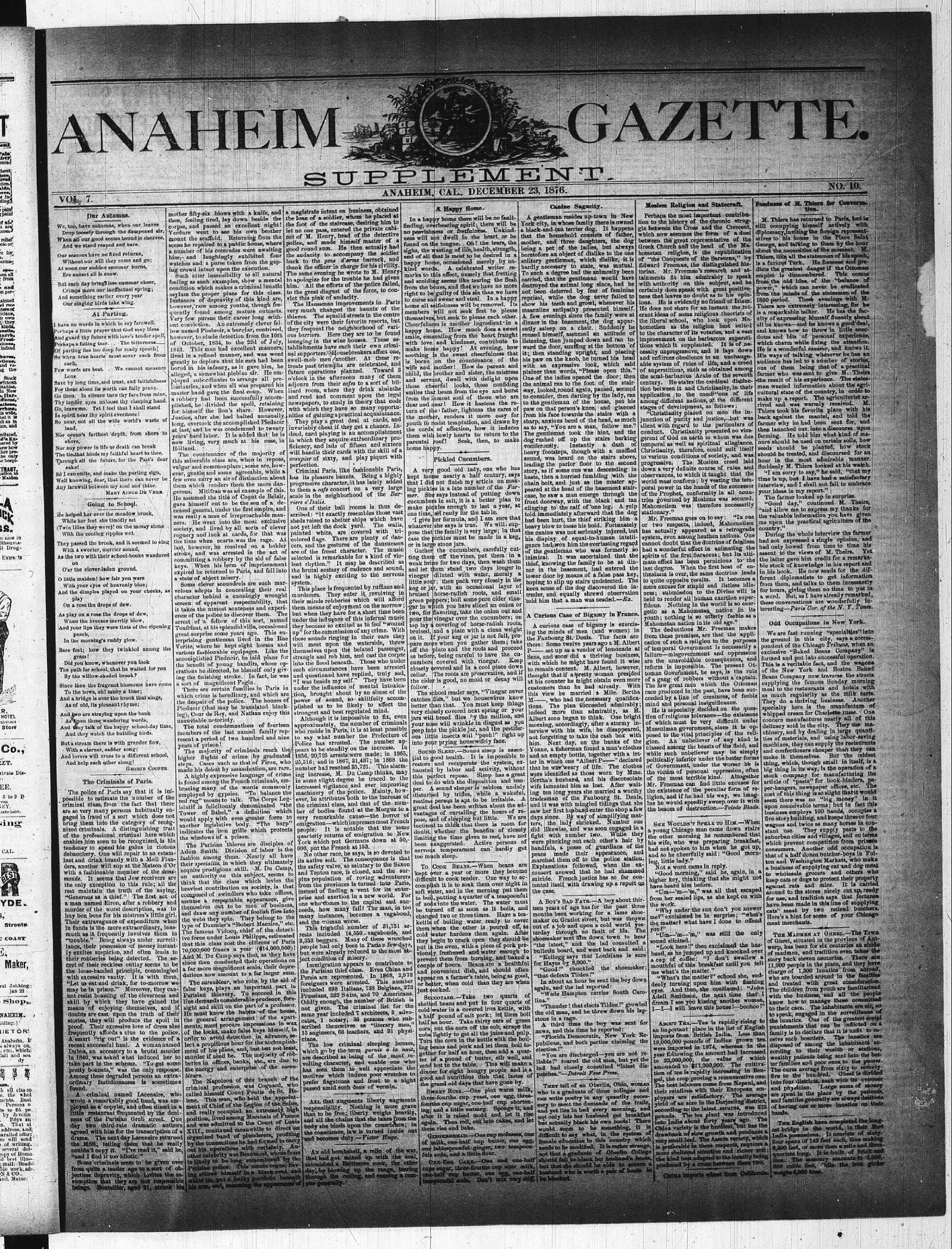
Searchable text
ANAHEIM
VOL. 7.
Our Autumns.
We, too, have autumns, when our leaves
Drop loosely through the dampened air,
When all our good seems bound in sheaves,
And we stand reaped and bare.
Our seasons have no fixed returns,
Without our will they come and go;
At noon our sudden summer burns,
Ere sunset all is snow.
But each day bring less summer cheer,
Crimps more our ineffectual spring;
And something earlier every year
Our singing birds take wing.
At Parting.
I have no words in which to say farewell.
Perhaps a little prayer that God may bless
And guard thy future with love's tender spell,
Perhaps a failing tear... The bitterness
Of parting lies too deep for ready speech!
So when true hearts must sever each from each,
Few words are best. We cannot measure Love
Save by long time, and trust, and faithfulness
For these alone its worth can fully prove.
Go thou. In silence turn thy face from mine,
Thy tender eyes unloose thy clasping hand.
Go, leave me. Yet I feel that I shall stand
In spirit near thy spirit evermore!
So near, not all the wide world's waste of land,
Nor ocean's farthest depth, from shore to shore,
Nor any power in life or death can break
The tie that binds my faithful heart to thee,
Through all the future, for the Past's dear mother fifty-six blows with a knife, and then, feeling tired, lay down beside the corpse, and passed an excellent night! Verdure went to see his own brother mount the scaffold. Returning from the scene he repaired to a public house, where a number of his comrades were awaiting him, and laughingly exhibited four watches and a purse taken from the gaping crowd intent upon the execution.
Such utter insensibility to all natural feeling as such examples, show a mental condition which makes a criminal lunatic naylum the proper place for this class. Instances of depravity of this kind are, however, rare among youths, though frequently found among mature outcasts. Very few pursue their career long without conviction. An extremely clever fellow named Piednoir, a burglar, contrived, however, to elude detection from the 10th of October, 1834, to the 22d of July, 1843. This man had excellent manners, lived in a refined manner, and was wont greatly to deplore that his ears had been bored in his infancy, as it gave him, he alleged, a somewhat plebian air. He employed subordinates to arrange all preliminaries, and when all was prepared his master hand gave the final coup. When a robbery had been successfully accomplished, he divided the spoil, retaining for himself the lion's share. However, Justice, after she had halted unusually long, overtook the accomplished Piednoir at last, and he was condemned to twenty years' hard labor. It is added that he is now living, very much at his ease, in Holland.
The countenance of the majority of this miserable class are, when in repose, a magistrate intent on buiding the loan of a soldier, who the foot of the staircase, let no one pass, entered the net of M. Henry, head of police, and made himself good round sum. He threw the audacity to accompany back to the gens d'armes thank the officer in charge. The same evening he wrote to apologize for the trouble him. All the efforts of the great disgust of the victor this pink of audacity.
The Haussman improves very much changed their thieves. The squalid strife of the city were their favorite they frequent the neighboring barriers. Here they lounging in the wine room establishments have each terminal supporters. Housebreaking swell-mob men another treats past triumphs are future operations planned o'clock in the afternoon adjourn from their eafest liard room, where they read and comment newspapers, to study in with which they have so numerous of gaining a practice.
They play a great deal invariably cheat if they deed, card playing is an in which they acquire efficiency, and lads of fifth will handle their cards with oropier of sixty, and
Going to School.
He helped her over the meadow brook,
While her feet she timidly set
(Twin lilies they were!) on the mossy stone
With the cooling ripples wet.
They passed the brook, and it seemed to sing
With a sweeter, merrier sound,
As the two with their school-books wandered on
O'er the clover-laden ground.
O little maiden! how fair you were
With your eyes of heavenly blue;
And the dimples played on your cheeks, as play
On a rose the drops of dew.
As play on a rose the drops of dew,
When the breezes merrily blow,
And your lips they were tints of the ripening peach,
In the morning's ruddy glow.
Bare feet; how they twinkled among the grass!
Did you know, whenever you took
The path for school, that he waited for you
By the willow-shaded brook?
Since then the fragrant blossoms have come To the bows, ah! many a time;
And a bridge is over the brook that sings,
As of old, its pleasant rhyme;
And two are straying upon the bank As open these wandering words,
And they talk of the happy school-day time,
And they watch the building birds.
But a stream there is with grander flow,
With a sterner, sadder song;
And lovers will cross to a different school,
And help each other along!
George Cooper.
The Criminals of Paris.
The police of Paris say that it is impossible to estimate the number of the criminal class, from the fact that there are so very many persons habitually engaged in fraud of a sort which does not bring them into the category of recognized criminals. A distinguishing trait of the professional criminal here which enables him soon to be recognized, is his tendency to spend his gains in riotous debauchery. One will repair to an estamnet and drink brandy with a Moll Flanders, another will sup at the Matson d'Or with a fashionable member of the demi-monde. It seems that Jew receivers are
Pew words are best. We cannot measure Love
Save by long time, and trust, and faithfulness For these alone its worth can fully prove.
Go thou. In silence turn thy face from mine, Thy tender eyes unloose thy clasping hand.
Go, leave me. Yet I feel that I shall stand In spirit near thy spirit evermore!
So near, not all the wide world's waste of land,
Nor ocean's farthest depth, from shore to shore,
Nor any power in life or death can break The tie that binds my faithful heart to thee, Through all the future, for the Past's dear sake!
So I can smile, and make the parting sign, Well knowing, dear, that there can never be Any farewell between my soul and thine.
MARY ALNOR DE VERR.
Going to School.
He helped her over the meadow brook,
While her feet she timidly set
(Twin lilies they were!) on the mossy stone
With the cooling ripples wet.
They passed the brook, and it seemed to sing With a sweeter, merrier sound,
As the two with their school-books wandered on O'er the clover-laden ground.
O little maiden! how fair you were
With your eyes of heavenly blue;
And the dimples played on your cheeks, as play On a rose the drops of dew.
As play on a rose the drops of dew,
When the breezes merrily blow,
And your lips they were tints of the ripening peach,
In the morning's ruddy glow.
Bare feet; how they twinkled among the grass!
Did you know, whenever you took The path for school, that he waited for you By the willow-shaded brook?
Since then the fragrant blossoms have come To the bows, ah! many a time;
And a bridge is over the brook that sings,
As of old, its pleasant rhyme;
And two are straying upon the bank As open these wandering words,
And they talk of the happy school-day time,
And they watch the building birds.
But a stream there is with grander flow,
With a sterner, sadder song;
And lovers will cross to a different school,
And help each other along!
GEORGE COOPER.
The Criminals of Paris.
The police of Paris say that it is impossible to estimate the number of the criminal class, from the fact that there are so very many persons habitually engaged in fraud of a sort which does not bring them into the category of recognized criminals. A distinguishing trait of the professional criminal here which enables him soon to be recognized, is his tendency to spend his gains in riotous debauchery. One will repair to an estamnet and drink brandy with a Moll Flanders, another will sup at the Matson d'Or with a fashionable member of the demi-monde. It seems that Jew receivers are
Pew words are best. We cannot measure Love
Save by long time, and trust, and faithfulness For these alone its worth can fully prove.
Go thou. In silence turn thy face from mine, Thy tender eyes unloose thy clasping hand.
Go, leave me. Yet I feel that I shall stand In spirit near thy spirit overmore!
So near, not all the wide world's waste of land,
Nor ocean's farthest depth, from shore to shore,
Nor any power in life or death can break The tie that binds my faithful heart to thee, Through all the future, for the Past's dear sake!
So I can smile, and make the parting sign, Well knowing, dear, that there can never be Any farewell between my soul and thine.
MARY ALNOR DE VERR.
Going to School.
He helped her over the meadow brook,
While her feet she timidly set
(Twin lilies they were!) on the mossy stone
With the cooling ripples wet.
They passed the brook, and it seemed to sing With a sweeter, merrier sound,
As the two with their school-books wandered on O'er the clover-laden ground.
O little maiden! how fair you were
With your eyes of heavenly blue;
And the dimples played on your cheeks, as play On a rose the drops of dew.
As play on a rose the drops of dew,
When the breezes merrily blow,
And your lips they were tints of the ripening peach,
In the morning's ruddy glow.
Bare feet; how they twinkled among the grass!
Did you know, whenever you took The path for school, that he waited for you By the willow-shaded brook?
Since then the fragrant blossoms have come To the bows, ah! many a time;
And a bridge is over the brook that sings,
As of old, its pleasant rhyme;
And two are straying upon the bank As open these wandering words,
And they talk of the happy school-day time,
And they watch the building birds.
But a stream there is with grander flow,
With a sterner, sadder song;
And lovers will cross to a different school,
And help each other along!
GEORGE COOPER.
The Criminals of Paris.
The police of Paris say that it is impossible to estimate the number of the criminal class, from the fact that there are so very many persons habitually engaged in fraud of a sort which does not bring them into the category of recognized criminals. A distinguishing trait of the professional criminal here which enables him soon to be recognized, is his tendency to spend his gains in riotous debauchery. One will repair to an estamnet and drink brandy with a Moll Flanders, another will sup at the Matson d'Or with a fashionable member of the demi-monde. It seems that Jew receivers are
Pew words are best. We cannot measure Love
Save by long time, and trust, and faithfulness For these alone its worth can fully prove.
Go thou. In silence turn thy face from mine, Thy tender eyes unloose thy clasping hand.
Go, leave me. Yet I feel that I shall stand In spirit near thy spirit overmore!
So near, not all the wide world's waste of land,
Nor ocean's farthest depth, from shore to shore,
Nor any power in life or death can break The tie that binds my faithful heart to thee, Through all the future, for the Past's dear sake!
So I can smile, and make the parting sign, Well knowing, dear, that there can never be Any farewell between my soul and thine.
MARY ALNOR DE VERR.
Going to School.
He helped her over the meadow brook,
While her feet she timidly set
(Twin lilies they were!) on the mossy stone
With the cooling ripples wet.
They passed the brook, and it seemed to sing With a sweeter, merrier sound,
As the two with their school-books wandered on O'er the clover-laden ground.
O little maiden! how fair you were
With your eyes of heavenly blue;
And the dimples played on your cheeks, as play On a rose the drops of dew.
As play on a rose the drops of dew,
When the breezes merrily blow,
And your lips they were tints of the ripening peach,
In the morning's ruddy glow.
Bare feet; how they twinkled among the grass!
Did you know, whenever you took The path for school, that he waited for you By the willow-shaded brook?
Since then the fragrant blossoms have come To the bows, ah! many a time;
And a bridge is over the brook that sings,
As of old, its pleasant rhyme;
And two are straying upon the bank As open these wandering words,
And they talk of the happy school-day time,
And they watch the building birds.
But a stream there is with grander flow,
With a sterner, sadder song;
And lovers will cross to a different school,
And help each other along!
GEORGE COOPER.
The Criminals of Paris.
The police of Paris say that it is impossible to estimate the number of the criminal class, from the fact that there are so very many persons habitually engaged in fraud of a sort which does not bring them into the category of recognized criminals. A distinguishing trait of the professional criminal here which enables him soon to be recognized, is his tendency to spend his gains in riotous debauchery. One will repair to an estamnet and drink brandy with a Moll Flanders, another will sup at the Matson d'Or with a fashionable member of the demi-monde. It seems that Jew receivers are
Pew words are best. We cannot measure Love
Save by long time, and trust, and faithfulness For these alone its worth can fully prove.
Go thou. In silence turn thy face from mine, Thy tender eyes unloose thy clasping hand.
Go, leave me. Yet I feel that I shall stand In spirit near thy spirit overmore!
So near, not all the wide world's waste of land,
Nor ocean's farthest depth, from shore to shore,
Nor any power in life or death can break The tie that binds my faithful heart tothee, Through all the future, for the Past's dear sake!
So I can smile, and make the parting sign, Well knowing, dear, that there can never be Any farewell between my soul and thine.
MARY ALNOR DEVERR.
Going to School.
He helped her over the meadow brook,
While her feet she timidly set
(Twin lilies they were!) on the mossy stone
With the cooling ripples wet.
They passed the brook, and it seemed to sing With a sweeter, merrier sound,
As the two with their school-books wandered on O'er the clover-laden ground.
O little maiden! how fair you were
With your eyes of heavenly blue;
And this dimples played on your cheeks, as play On a rose-the drops of dew,
As play on a rose-the drops of dew,
When the breezes merrily blow,
And your lips they were tints of the ripening peach,
In the morning's ruddy glow.
Bare feet; how they twinkled among the grass!
Did you know, whenever you took The path for school, that he waited for you By the willow-shaded brook?
Since then the fragrant blossoms have come To the bows, ah! many a time;
And a bridge is over the brook that sings,
As of old, its pleasant rhyme;
And two are straying upon the bank As open these wandering words,
And they talk ofthe happy school-day time,
And they watchthe buildingbirds.
But a stream there is with grander flow,
With a sterner,sadder song;
And lovers will cross to a different school,
And help each other along!
GEORGE COOPER.
The Criminals of Paris.
The police of Paris say that it is impossible to estimatethe numberofthecriminalclassfromthefactthattherearesoverymanypersonshabituallyengagedinfraudofa sortwhichdoesnotbringtheminthecategoryofrecognizedcriminals.A distinguishingtraitoftheprofessionalcriminalherewhichenableshimsoontoberecognizedishistenendayspendinghisgainsinriotousdebaucancheryOnewillrepairtoanestamnetanddrinkbrandywithaMollFlandersanotherwillsupatattheMatsond'Orwithafashionablememberofthedemi-mondeItseemsthatJewreceiversare
Pew words are best. We cannot measure Love
Save by long time, and trust,and faithfulness For these alone its worth can fully prove.
Go thou. In silence turn thy face from mine,Thy tender eyes unloose thy clasping hand,
Go,leave me。Yet I feel that I shall stand In spirit near thy facial and enjoyment but when they have forunderthe influenceoftheybecomeso excitedupforthecommissionandthese sounds ringing inwill meet uponthebstrangleandrobhim,togintoetheflood beneathsuch circumstanceshauldquestionedhave re“Iwasbesidemyself.Undertheinfluenceoftheion,broughtaboutbypowerofsound,solishedasto贝likronghythm.”Itmaythebrutalecstasyofcarmainandishighexcitementsystem.
This place is frequentmurders.Theeyenterethirms robberieswaismeansofjoymentbutwhentheyhaveforundertheinfluenceoftheybecomeso excitedupforthecommissionandthese sounds ringing inwill meet uponthebstrangleandrobhim,togintoetheflood beneathsuch circumstanceshauldquestionedhave re“Iwasbesidemyself.Undertheinfluenceoftheion,broughtaboutbypowerofsound,solishedasto贝likronghythm.”Itmaythebrutalecstasyofcarmainandishighexcitementsystem.
This place is frequentmurders.Theeyenterethirms robberieswaismeansofjoymentbutwhentheyhaveforundertheinfluenceoftheybecomeso excitedupforthecommissionandthese sounds ringing inwill meet uponthebstrangleandrobhim,togintoetheflood beneathsuch circumstanceshauldquestionedhave re“Iwasbesidemyself.Undertheinfluenceoftheion,broughtaboutbypowerofsound,solishedasto贝likronghythm.”Itmaythebrutalecstasyofcarmainandishighexcitementsystem.
This place is frequentmurders.Theeyenterethirms robberieswaismeansofjoymentbutwhentheyhaveforundertheinfluenceoftheybecomeso excitedupforthecommissionandthese sounds ringing inwill meet uponthebstrangleandrobhim,togintoetheflood beneathsuch circumstanceshauldquestionedhave re“Iwasbesidemyself.Undertheinfluenceoftheion,broughtaboutbypowerofsound,solishedasto贝likronghythm.”Itmaythebrutalecstasyofcarmainandishighexcitementsystem.
This place is frequentmurders.Theeyenterethirms robberieswaismeansofjoymentbutwhentheyhaveforundertheinfluenceoftheybecomeso excitedupforthecommissionandthese sounds ringing inwill meet uponthebstrangleandrobhim,togintoetheflood beneathsuch circumstanceshauldquestionedhave re“Iwasbesidemyself.Undertheinfluenceoftheion,broughtaboutbypowerofsound,solishedasto贝likronghythm.”Itmaythebrutalecstasyofcarmainandishighexcitementsystem.
This place is frequentmurders.Theeyenterethirms robberieswaismeansofjoymentbutwhentheyhaveforundertheinfluenceoftheybecomeso excitedupforthecommissionandthese sounds ringing inwill meet uponthebstrangleandrobhim,togintoetheflood beneathsuch circumstanceshauldquestionedhave re“Iwasbesidemyself.Undertheinfluenceoftheion,broughtaboutbypowerofsound,solishedasto贝likronghythm.”It maythebrutalecstasyofcarmainandishighexcitementsystem.
This place is frequentmurders.Theeyenterethirms robberieswaismeansofjoymentbutwhentheyhaveforundertheinfluenceoftheybecomeso excitedupforthecommission和these sounds ringing inwill meet uponthebstrangleandrobhim,togintoetheflood beneathsuch circumstanceshauldquestionedhave re“Iwasbesidemyself.Undertheinfluenceoftheion,broughtaboutbypowerofsound,solishedasto贝likronghythm.”It maythebrutalecstasyofcarmainandishighexcitement系统。
This place is frequentmurders.Theeyenterethirms robberieswaismeansofjoymentbutwhentheyhaveforundertheinfluenceoftheybecomeso excitedupforthecommission和these sounds ringing inwill meet uponthebstrangleandrobhim,togintoetheflood beneathsuch circumstanceshauldquestionedhave re“Iwasbesidemyself.Undertheinfluenceoftheion,broughtaboutbypowerofsound,solishedasto贝likronghythm.”It maythebrutalecstasyofcarmainandishighexcitement系统。
This place is frequentmurders.Theeyenterethirms robberieswaismeansofjoymentbutwhentheyhaveforundertheinfluenceOftheybecomeso excitedupforthecommission和these sounds ringing inwill meet uponthebstrangleandrobhim,togintoetheflood beneathsuch circumstanceshauldquestionedhave re“Iwasbesidemyself.UndertheinfluenceOf,theion,broughtaboutbypowerOfsound,solishedasto贝likronghythm.”It maythebrutalecstasyOfcarmainandishighexcitement系统。
This place is frequentmurders.Theeyenterethirms robberieswaismeans Ofjoyment,basedonthisinstagramming system。
This place is frequentmurders.Theeyenterethirms robberieswaismeansOfjoyment,basedonthisinstagramming system。
This place is frequentmurders.Theeyenterethirms robberieswaismeansOfjoyment,basedonthisinstagramming system。
This place is frequentmurders.Theeyenterethirms robberieswaismeansOfjoyment,basedonthisinstagramming system。
This place is frequentmurders.Theeyenterethirms robberieswaismeansOfjoyment,basedonthisinstagramming system。
This place is frequentmurders.Theeyenterethirms robberieswaismeansOfjoyment,basedonthisinstagramming system。
This place is frequentmurders.Theeyenterethirms robberieswaismeansOfjoyment,basedonthisinstagramming system。
This place is frequentmurders.Theeyenterethirms robberieswaismeansOfjoyment,basedonthisinstagramming system。
This place is frequentmurders.Theeyenterethirms robberieswaismeansOfjoyment,basedonthisinstagramming system。
This place is frequentmurders.Theeyenterethirms robberieswaismeansOfjoyment,basedonthisinstagramming system。
This place is frequentmurders.Theeyenterethirms robberieswaismeansOfjoyment,basedonthisinstagramming system。
This place is frequentmurders.Theeyenterethirms robberieswaismeansOfjoyment,basedonthisinstagramming system。
This place is frequentmurders.Theeyenterethirms robberieswaismeansOfjoyment,basedonthisinstagramming system。
This place is frequentmurders.Theeyenterethirms robberieswaismeansOfjoyment,basedonthisinstagramming system。
This place is frequentmurders.Theeyenterethirms robberieswaismeansOfjoyment,basedonthisinstagramming system。
This place is frequentmurders.Theeyenterethirms robberieswaismeansOfjoyment,basedonthisinstagramming system。
This place is frequentmurders.Theeyenterethirms robberieswaismeansOfjoyment,basedonthisinstagramming system)。
This place is frequentmurders.Theeyenterethirms robberieswaismeansOfjoyment,basedonthisinstagramming system)。
This place is frequentmurders.Theeyenterethirms robberieswaismeansOfjoyment,basedonthisinstagramming system)。
This place is frequentmurders.Theeyenterethirms robberieswaismeansOfjoyment,basedonthisinstagramming system)。
This place is frequentmurders.Theeyenterethirms robberieswaismeansOfjoyment,basedonthisinstagramming system)。
This place is frequentmurders.Theeyenterethirms robberieswaismeansOfjoyment,basedonthisinstagramming system)。
This place is frequentmurders.Theeyenterethirms robberieswaismeansOfjoyment,basedonthisinstagramming system)。
This place is frequentmurders.Theeyenterethirms robberieswaismeansOfjoyment,basedonthisinstagramming system)。
This place is frequentmurders.Theeyenterethirms robberieswaismeansOfjoyment,basedonthisinstagramming system)。
This place is frequentmurders.Theeyenterethirms robberieswaismeansOfjoyment,basedonthisinstagramming system)。
This place is frequentmurders.Theeyenterethirms robberieswaismeansOF joyment,basedonthisinstagramming system)。
This place is frequentmurders.Theeyenterethirms robberieswaismeansOF joyment,basedonthisinstagramming system)。
This place is frequentmurders.Theeyenterethirms robberieswaismeansOF joyment,basedonthisinstagramming system)。
This place is frequentmurders.Theeyenterethirms robberieswaismeansOF joyment,Basedonthisinstagramming system)。
This place is frequentmurders.Theeyenterethirms robberieswaismeansOF joyment,Basedonthisinstagramming system)。
This place is frequentmurders.Theeyenterethirms robberieswaismeansOF joyment,Basedonthisinstagramming system)。
This place is frequentmurders.Theeyenterethirms robberieswaismeansOF joyment,Basedonthisinstagramming system)。
This place is frequentmurders.Theey enterthiermesrobberieswaismeansOF joyment,Basedonthis instagramming system)。
This place is frequentmurders.Theey enterthiermesrobberieswaismeansOF joyment,Basedonthis instagramming system)。
This place is frequentmurders.Theey enterthiermesrobberIESWaismeansOF joyment,Basedonthis instagramming system)。
This place is frequentmurders.Theey enterthiermesrobberIESWaismeansOF joyment,Basedonthis instagramning system)。
This place is frequentmurders.Theey enterthiermesrobberIESWaismeansOF joyment,Basedonthis instagramning system)。
This place is frequentmurders.Theey enterthiermesrobberIESWaismeansOF joyment,Basedonthis instagramning system)。
This place is frequentmurders.Theey enterthiermesrobberIESWaismeansOF joyment,Basedonthis instagramning system)。
This place is frequentmurderTheory)。 Thisplaceisfreefromitsownperfectness。 Nootherrace,hassaithe safety valve,sosailandTeun race,cispluspopulationoften。 Nootherrace,hassaithe safety valve,sosailandTeun race,cispluspopulationoften。 Nootherrace,hassaithe safety valve,sosailandTeun race,cispluspopulationoften。 Nootherrace,hassaithe safety valve,sosailandTeun race,cispluspopulationoften。 Nootherrace,hassaithe safety valve,sosailandTeun race,cispluspopulationoften。 Nootherrace,hassaithe safety valve,sosailandTeun race,cispluspopulationoften。 Nootherrace,hassaithe safety valve,sosailandTeun race,cispluspopulationoften。 Nootherrace,hassaithe safety valve,sosailandTeun race,cispluspopulationoften。 Nootherrace,hassaithe safety valve,sosailandTeun race,cispluspopulationoften。 Nootherrace,hassaithe safety valve,sosailandTeun race,cispluspopulationoften。 Nootherrace,hassaithe safety valve,sosailandTeun race,cispluspopulationoften。 Nootherrace,hassaithe safety valve,sosailandTeun race,cispluspopulationoften。 Nootherrace,hassaithe safety valve,sosailandTeun race,cispluspopulationoften。 Nootherrace,hassaithe safety valve,sosailandTeun race,cispluspopulationoften。 Nootherrace,hassaithe safety valve,sosailandTeun race,cispluspopulationoften。 Nootherrace,hassaithe safety valve,sosailandTeun race,cispluspopulationoften。 Nootherrace,hassaithe safety valve,sosailandTeun race,cispluspopulationoften。 Nootherrace,hassaithe safety valve,sosailandTeun race,cispluspopulationoften。 Nootherrace,hassaithe safety valve,sosailandTeun race,cispluspopulationoften。 Nootherrace,hassaithe safety valve,sosailandTeun race,cispluspopulationoften。 Nootherrace,hassaithe safety valve,sosailandTeun race,cispluspopulationoften。 Nootherrace,hassaithe safety valve,sosailandTeun race,cispluspopulationoften。 Nootherrace,hassaithe safety valve,sosailandTeun race,cispluspopulationoften。 Nootherrace,hassaithe safety valve,sosailandTeun race
The police of Paris say that it is impossible to estimate the number of the criminal class, from the fact that there are so very many persons habitually engaged in fraud of a sort which does not bring them into the category of recognized criminals. A distinguishing trait of the professional criminal here which enables him soon to be recognized, is his tendency to spend his gains in riotous debauchery. One will repair to an estaminer and drink brandy with a Moll Flanders, another will sup at the Matson d'Or with a fashionable member of the demimonde. It seems that Jew receivers are the only exception to this rule; all the rest maintain the truth of the saying, "Generous as a thief." The first act of a man named Eiron, after a robbery and murder of the worst description, was to buy bon bons for his mistress's little girl. Their extravagance of expenditure when in funds is the more extraordinary, inasmuch as it frequently involves them in "trouble." Being always under surveillance, their possession of money instantly excites suspicion, and often leads to their robberies being detected. The secret of their reckless outlay seems to be the loose-handed principle, commingled with excessive vanity. It is with them, "Let us eat and drink, for to-morrow we may be in prison." Moreover, they cannot resist boasting of the cleverness and skill by which they have gained the means of enjoying themselves, and if doubts are cast upon the truth of their stories, they will produce the spoil in proof. Their excessive love of dress also frequently affords a clue to the police. A smart "rig out" is the evidence of a recent successful haul. A woman named Dubos, an accessory to a brutal murder in 1846, was asked what induced her to take part in the scheme. "To get some pretty bonnets," was the only response. Among these degraded persons an extraordinary fastidiousness is sometimes found.
A criminal named Lacenaire, who wrote a remarkably good hand, was employed as a copyist, and often dined in a little restaurant frequented by the denizens of the Parisian Grub street. One day two third-rate dramatic authors agreed with him for the transcription of a drama. The next day Lacenaire returned the MSS, telling them that he really couldn't copy it. "I've read it," said he, "and I find it too idiotic."
Some criminals seem to be given over from quite a tender age to a sort of objectless depravity, which invites the assumption that they are not responsible beings. Boutullier, aged 21, struck his braving many of the words commonly employed by gypsies. "To balance the red rag" means to talk. The Corps Legislatif is felicitously denominated "the Tower of Babel," a definition which would apply with even greater force to another legislative body. "The barp" indicates the iron grille which protects the windows of a prison.
The Parisian thieves are disciples of Adam Smith. Division of labor is the fashion among them. Nearly all have their specialite, in which they ultimately acquire prodigious skill. M. Du Camp, an authority on this subject, seems to think that the class which levies the heaviest contribution on society, is that composed of swindlers who take offices, assume a respectable appearance, give themselves out to be men of business, and draw any number of foolish flies into the webs they spin. They belong to the type of Daumier's "Robert Macaire," etc. The famous Vidoq, chief of the detective force under Louis Philippe, estimated that this class cost the citizens of Paris 70,000,000 francs a year ($14,000,000). And M. Du Camp says that, as they have since then conducted their operations on a far more magnificent scale, their deprections now amount to a far larger sum.
The carouleur, who robs by the aid of false keys, plays an important part in Parisian thievery. To succeed in this line demands considerable prudence, fore sight and skill on the part of a professor. He must know the habits of the house, the general arrangement of the apartments, must procure impressions in wax of the locks, make false keys himself, in order to avoid detection in advance, select a propitious hour for the accomplishment of his plans, and, last but not least, murder if need be. The majority of robberies in offices, banks, etc., are due to the energy and enterprise of the carouleurs.
The Napoleon of this branch of the criminal profession was Cognard, who called himself Count Pontis de St. Helene. This man, who held the appointment of Chief of the Legion of the Seine, and really occupied an extremely high position, lived among Marshals of France and was admitted to the Court of Louis XIII., continued meanwhile to direct an organized band of plunderers, profiting by the connections he had formed to carry out his operations with certainty. Another celebrity was Beaumont, whose fame is likely to be long remembered by the Parisian police. This astute rogue having attired himself in a black coat and white tie, put a bulky portfolio beneath his arm, and assuming the appearance of increased vigilance and machinery of the police ever, he attributes both to the criminal class and berer of bodies found very remarkable case emigration—which imminent people. It is not usual quarterly returns of York which put Gerrard 000, put the French army No other race, he seizes its native soil. The safety valve, so sailed and Teuton race, is capped population of from the provinces is instead of finding a prize and exertion in one who comes to these creeds, how many few many instances, beet and the woman worsens.
This frightful numb rests included 14,583 beggars. Many people had only been but were already red-ject condition of misfit Immigration appealed for Parisian thief clans Persia are represent foreigners were arrested included 698 Italian Prussians, 232 Swiss Oddly enough, the not given. The same year included cates, 1 notary, 3 scribed themselves 15 engineers, 66 team cians.
The low criminia which go by the term are described as being volting character has seen them to motives which include prefer flagstones passed amid such dares.
All that augmente responsibility. Not than to be free; lily and all the chains body she binds up the conscience law and becomes duty.
An old bombbasket that had got mixed astonished a Battalion day; by blowing through the cellar pus generally.
a magistrate intent on business, obtained the loan of a soldier, whom he placed at the foot of the staircase, desiring him to let no one pass, entered the private cabinet of M. Henry, head of the detective police, and made himself master of a good round sum. He then actually had the audacity to accompany the soldier back to the gens d'orme barrack, and thank the officer in charge for his civility. The same evening he wrote to M. Henry to apologize for the trouble he had given him. All the efforts of the police failed, to the great disgust of the force, to convict this pink of audacity.
The Haussman improvements in Paris very much changed the haunts of the thieves. The squalid streets in the centre of the city were their favorite resorts, but they frequent the neighborhood of various barriers. Here they are to be found lounging in the wine houses. These establishments have each their own criminal supporters. Housebreakers affect one, swell-mob men another. At these retreats past triumphs are celebrated, and future operations planned. Toward 3 o'clock in the afternoon many of them adjourn from their eaves to a sort of billiard room, where they drink absinthe and read and comment upon the legal newspapers, to study in theory that code with which they have so many opportunities of gaining a practical acquaintance.
They play a great deal at cards, and invariably cheat if they get a chance. Indeed, card playing is an accomplishment in which they acquire extraordinary proficiency, and lads of fifteen and sixteen will handle their cards with the skill of a grouper of sixty, and play piquet with perfection.
A Happy Home.
In a happy home there will be no fault finding, overbearing spirit; there will be no peevishness or frettfulness. Unkindness will not dwell in the heart or be found on the tongue. Oh! the tears, the sighs, the wasting of life, health, strength, and of all that is most to be desired in a happy home, occasioned merely by unkind words. A celebrated writer remarks to this effect, namely that fretting and scolding seems like tearing the flesh from the bones, and that we have no more right to be guilty of this sin than we have to curse and swear and steal. In a happy home all selfishness will be removed. Its members will not seek first to please themselves, but seek to please each other. Cheerfulness is another ingredient in a happy home. How much does a sweet smile, emanating from the heart fraught with love and kindness, contribute to make home happy! At evening, how soothing is the sweet cheerfulness that is borne on the countenance of the wife and mother! How do parent and child, the brother and sister, the mistress and servant, dwell with delight upon those cheerful looks, those confiding smiles that beam from the eye and burst from the immost soul of those who are dear and near! How it hastens the return of the father, lightens the cares of the mother, renders it more easy for youth to resist temptation, and drawn by the cords of affection, how it induces them with lowly hearts to return to the parental roof! Seek, then, to make home happy.
Pickled Cucumbers.
Canine Sagacity.
A gentleman resides up-town in New York city, in whose family there is owned a black-and-tan terrier dog. It happens that the household consists of father, mother, and three daughters, the dog being a pet of the ladies, but always heretofore an object of dislike to the one solitary gentleman, which dislike, it is hardly necessary to state, was mutual. To such a degree had the animosity been carried, that the gentleman would have destroyed the animal long since, had he not been deterred by fear of feminine reptisal, while the dog never failed to show his teeth and growl, whenever his masculine antipathy presented himself. A few evenings since the family were at dinner in the basement, the dog apparently asleep on a chair. Suddenly he roused himself, assumed an attitude of listening, then jumped down and ran toward the door, sauiling at the bottom of it; then standing upright, and placing his paw on the knob, he turned his head with an expressive look, which said plainer than words, "Please open this." One of the ladies opened the door; then the animal ran to the foot of the stairway, looked round again, paused, seemed to consider, then darting by the lady, ran to the gentleman of the house, put his paw on that person's knee, and glanced from his face towards the stairs with a sharp, anxious bend of the head, as much as to say, "You are a man, follow me." The gentleman took the hint, and the dog rushed off up the stairs barking vociferously. Instantly a dash of heavy footsteps, though with a muffled sound, was heard on the stairs above, leading the parlor floor to the second Moslem H.
Perhaps this tion to the hiale between which now adhere that Greek Church hometan rest of "the Conde Edward Freeman." Mr. tainments fit with authoritative certainty does not leapions. He is He does not erant ideas on the liberal se hometism ad to the charac improvement which ceasity unprepared enforced able system of superstition the semi-bank century. His tion between application among different stages of dee "Christian junction of silent with no conduct. O gerent of Ge temporal ass Christianity to various o progressive.
future operations planned. Toward 3 o'clock in the afternoon many of them adjourn from their cafes to a sort of billiard room, where they drink absinthe and read comment upon the legal newspapers, to study in theory that code with which they have so many opportunities of gaining a practical acquaintance.
They play a great deal at cards, and invariably cheat if they get a chance. Indeed, card playing is an accomplishment in which they acquire extraordinary proficiency, and lads of fifteen and sixteen will handle their cards with the skill of a oropier of sixty, and play piquet with perfection.
Criminal Paris, like fashionable Paris, has its pleasure haunts. Being a highly progressive character, it has lately added to them a café concert on a very large scale in the neighborhood of the Barriere o'Italie.
One of their ball rooms is thus described: "It exactly resembles those vast sheds raised to shelter ships which have not yet left the dock yard. The walls, painted white, are covered with tri-colored flags. There are plenty of dancers, and the gestures of the dansuesses are of the freest character. The music selected is remarkable for a kind of violent rhythm." It may be described as the brutal ecstasy of cadence and sound, and is highly exciting to the nervous system.
This place is frequented by ruffians and murderers. They enter it revolving in their minds robberies which will afford them means of enjoyment on the morrow; but when they have for a short time been under the influence of this infernal music they become so excited as to feel "wound up" for the commission of any crime. With these sounds ringing in their ears they will meet upon the waterside, throw themselves upon the belated passenger, strangle and rob him, and cast the corpse into the flood beneath. Those who under such circumstances have been arrested and questioned have replied, truly sad, "I was beside my self." They have been under the influence of mental intoxication, brought about by an abuse of the power of sound, so skillfully accomplished as to be likely to affect the strongest and best regulated mind.
Although it is impossible to fix, even approximately, the number of criminals who reside in Paris, it is at least possible to say what number the Prefecture of Police has arrested. The number appears to be steadily on the increase. In 1856, 20,725 arrests were made; in 1865, 25,516; and in 1867, 31,437; in 1868 the number had reached 35,721. This alarming increase, M. Du Camp thinks, may in some slight degree be traced to the increased vigilance and ever improving machinery of the police. Mainly, however, he attributes both to the increase of the criminal class, and that of the number of bodies found at the Morgue to a very remarkable cause—the horror of emigration—which impresses most French people. It is notable that the same quarterly returns of emigration to New York which put Germans down at 50,000, put the French at 153.
No other race, he says, is so devoted to its native soil. The consequence is that the safety valve, so salutary to the Saxon and Teuton race, is closed, and the surplus population of roving adventurers into Paris
Pickled Cucumbers.
A very good old lady, one who has kept house nearly a half century, says that I did not finish my article on making pickles in a late number of the Farmer. She says instead of putting down cucumbers in salt, it is a better plan to make pickles enough to last a year, at one time, all ready for the table.
I give her formula, and I am sure that whatever she says is true. We will suppose that the family is very large; in that case the pickles must be made in a keg, or in large stone jars.
Gather the cucumbers, carefully cutting them off the vines, put them in a weak brine for two days, then wash them and let them stand two days longer in vinegar diluted with water, merely a little sour; then pack very closely in the keg or jar, with an occasional layer of bruised horse-radish roots, and small green peppers; boil some pure cider vinegar in which you have sliced an onion or two, for flavoring; take the onion out and pour the vinegar over the cucumbers; on top lay a covering of horse-radish roots, bruised, and a plate with a clean weight on it. If your keg or jar is not full, prepare more when you gather them; take off the plate and the roots and proceed as before, being careful to have the cucumbers covered with vinegar. Keep closely covered and in a cool place down cellar. The roots are preservative, and if the cider is good, no mold or decay will follow.
The school reader says, "Vinegar never catches flies," but we housewives know better than that. You must keep things very closely covered next spring or your jars will breed flies by the million, and your nose will wrinkle in disgust as you peep into the pickle jar, and the pestiferous little insects will "pooh!" right up into your prying housewifely face.
Sound Sleep. Sound sleep is essential to good health. It is impossible to restore and recuperate the system, exhausted by labor and activity, without this perfect repose. Sleep has a great deal to do with the disposition and temper. A sound sleeper is seldom unduly disturbed by trifles, while a wakeful, restless person is apt to be irritable. A great deal has been written about the advantages of curtailing the hours of repose, and of sleeping but little. We are inclined to think that there is room for doubt whether the benefits of closely limiting the time given to rest have not been exaggerated. Active persons of nervous temperament can hardly get too much sleep.
To Cook Beans. When beans are kept over a year or more they become difficult to cook tender. One way to acclimate child, brother and sister, the mistress and servant, dwell with delight upon those cheerful looks, those confiding smiles that beam from the eye and burst from the immost soul of those who are dear and near! How it hastens the return of the father, lightens the cares of the mother, renders it more easy for youth to resist temptation, and drawn by the cords of affection, how it induces them with lowly hearts to return to the parental roof! Seek, then, to make home happy.
A curious Case of Bigamy in France.
A curious case of bigamy is exercising the minds of men (and women) in the Fauburg St. Denis. The facts are: Some twelve years ago a M. Albert P——set up as a vendor of lemonade at Sens, and soon did a thriving business, with which he might have found it wise to remain content. M. Albert, however thought that if a pretty woman presided at his counter he might obtain even more customers than he had already. With this view he married a Mile. Bertha M——who had the necessary qualifications. The plan succeeded admirably; indeed more than admirably, as M. Albert soon began to think. One bright morning, accordingly, after a stormy interview with his wife, he disappeared, not forgetting to take the cash box with him. Next day, on the banks of the Yonne, a fisherman found a man's clothes and an empty bottle, together with a letter in which one "Albert P——declared that he was weary of life. The clothes were identified as those worn by Mme. Bertha's husband, and his disconsolate wife lamented him as lost. After waiting ten long years she married a worthy tradesman of the Fauburg St. Denis, and it was with mingled tidings that she saw her first husband enter the shop a few days since. By way of simplifying matters,the lady shrieked. Number one did likewise,and was soon engaged in a fight with number two. While they were plucking out each other's hair by handfuls,a posse of guardians of the peace made their appearance,and marched them off to the police station.Explanations followed,当the ex consort avowed that he had shamed suicide.French justice has so far conceived this silent with no conduct.O gerent of Gothic temporal as Christianity to various progressive down a very observances world must poral power of the Prophet tries govern Mahometist stationary."
Mr. Freecor or two reals has actually system,eve cannot doubhdad a wound spirits of tha mate effect last degree.thusiusism isto quite oppose mere excuse ness; subheld held to renufluous.Negetic as ya youth;not Mahometal.The deed from these cation of sa systemof temporalfailure-mare arethe un reformisitoman Govougofa gang.The few grace producceedbymindandhemeHe is ectionof rel.ofwhichMussulmanposedtogion.GlassandwhilepoliticallyofGovernthevictimofthemMr.Freecorexistedligion,andnehewothebesome
increased vigilance and ever improving machinery of the police. Mainly, however, he attributes both to the increase of the criminal class, and that of the number of bodies found at the Morgue to a very remarkable cause—the horror of emigration—which impresses most French people. It is notable that the same quarterly returns of emigration to New York which put Germans down at 50,-000, put the French at 153.
No other race, he says, is so devoted to its native soil. The consequence is that the safety valve, so salutary to the Saxon and Teuton race, is closed, and the surplus population of roving adventurers from the provinces is turned into Paris, instead of finding a vent for its enterprise and exertion in a new world. For one who comes to the capital and succeeds, how many fail? The man, in too many instances, becomes a vagabond, and the woman worse.
This frightful number of 31,751 arrests included 14,550 vagabonds, and 8,353 beggars. Many of these wretched people had only been in Paris a few days, but were already reduced to the most abject condition of misery.
Immigration appears to contribute to the Parisian thief class. Even China and Persia are represented. In 1868, 2,978 foreigners were arrested. This number included 698 Italians, 738 Belgians, 273 Prussians, 232 Swiss, and 70 Americans. Oddly enough, the number of British is not given. The criminal list for the same year included 7 architects, 3 advocates, 1 notary, 36 persons who subscribed themselves as "literary men," 15 engineers, 66 teachers, and 21 physicians.
The low criminal sleeping houses, which go by the term garnis a la nuit, are described as being of the most revolting character, and enable one who has seen them to well appreciate the motives which induce poor wretches to prefer flagstones and frost to a night passed amid such dens of vermin.
All that augments liberty augments responsibility. Nothing is more grave than to be free; liberty weighs heavily, and all the chains that she takes from the body she binds upon the conscience; in the conscience, law is turned inside out and becomes duty.—Victor Huge.
An old bombshell, a relic of the war, that had got mixed up with the coal, asminished a Baltimore cook, the other day, by blowing up the range, tearing through the ceiling, and causing a rumple generally.
A sound sleeper is seldom unduly disturbed by trifles, while a wakeful, restless person is apt to be irritable. A great deal has been written about the advantages of curtailing the hours of repose, and of sleeping but little. We are inclined to think that there is room for doubt whether the benefits of closely limiting the time given to rest have not been exaggerated. Active persons of nervous temperament can hardly get too much sleep.
To Cook Beans.—When beans are kept over a year or more they become difficult to cook tender. One way to accomplish it is to soak them overnight in soft water, and in the morning put them to boil, putting a quarter of a teaspoonful of soda into the water. The water must be turned off as soon as it boils, and changed two or three times. Have a teakettle of boiling water ready to cover them when the other is poured off, as cold water hardens them again. After they begin to crack open they should be put in the oven, with a piece of pork previously freshened and water enough to prevent them from burning, and baked a couple of hours. Beans are a healthful and convenient dish, and should often appear on a farmer's table, being as good, or better, when cold than they are when just cooked.
Succotash.—Take two quarts of shelled beans and put in four quarts of cold water in a covered iron kettle, with a half pound of salt pork; let them boil half an hour. Take thirty ears of green corn, cut the corn off the cob, scrape the cobs lightly to get all the juice and pulp. Turn the corn in the kettle with the boiling beans and pork and let them boil together for half an hour, then add a quarter of a pound of butter, stir well, and send hot to the table. This will make a dinner for eight hungry people and is a good and nutritious dish that tastes of the grand old days that have gone by.
Sweet Rusk.—One pint warm milk, three-fourths cup yeast, one egg, three-fourths cup sugar, one-half cup shortening; and a little nutmeg. Sponge it, and after it is raised mold and let it rise again. Then roll, cut into cakes, and let them rise and bake.
Gingerbread.—One cup molasses, one of milk, one-half cup butter, one egg, one tablespoonful ginger; two teaspoonful soda. Don't mix very stiff.
Wife lamented him as lost. After waiting ten long years she married a worthy tradesman of the Faubourg St. Denis, and it was with mingled tidings that she saw her first husband enter the shop a few days since. By way of simplifying matters, the lady shrieked. Number one did likewise, and was soon engaged in a fight with number two. While they were plucking out each other's hair by handfuls, a posse of guardians of the peace made their appearance; and marched them off to the police station. Explanations followed, when the consort avowed that he had shammed suicide. French justice has so far contented itself with drawing up a report on the case.
A Boy's Sad Fate.—A boy about thirteen years of age has for the past three months been working for a lame shoe-maker on Gratiot street, but was thrown out of a job and upon a cold world yesterday through no fault of his. The shoe-maker sent him down town to hear "the latest," and the lad consulted a bulletin board, and went back and said: "Kellogg says that Louisiana is sure for Hayes by 8,000."
"Good!" chuckled the shoe-maker; "that defeats Tilden!"
In about an hour he sent the boy down again, and the lad reported:
"Wade Hampton carries South Carolina."
"Thunder! that elects Tilden!" growled the old man, and he threw down his lapstone in a rage.
A third time the boy was sent for news, and this time he reported:
"Florida Democratic, New York Republican, and both parties claiming the election!"
"You are discharged—you are not reliable!" roared the old man, but yet the lad had closely consulted "latest dispatches."—Detroit Free Press.
They tell of an Oberlin, Ohio woman who is a graduate of three colleges and can write poetry in any quantity necessary to meet the demands of the trade, and yet lies in bed every morning, and not only lets her husband get breakfast but actually black his own boots! There would seem to be something, it is difficult to say what. In the system of female education in this country which needs to be modified. It is rather strange not that a graduate of Oberlin College should fall to black her husband's boots, but that she should be able to secure a husband who is worth a pair of boots in be blacked.
GAZETTE.
NO. 10.
Moslem Religion and Statecraft.
Perhaps the most important contribution to the history of the chronic struggle between the Cross and the Crescent, which now assumes the form of a duel between the great representative of the Greek Church and the head of the Mahometan religion, is the republication of "the Conquests of the Saracens," by Edward Freeman, the distinguished historian. Mr. Freeman's research and attainments fit him admirably to speak with authority on this subject, and he certainly does speak with great positiveness that leaves no doubt as to his opinions. He is evidently no friend of Islam. He does not share for an instant the tolerant ideas of some religious theorists of the liberal school, who look upon Mahometism as the religion best suited to the character of its votaries, and a vast improvement on the barbarous superstitions which it supplanted. It is of necessity unprogressive, and it lays down and enforces obedience to an unchangeable system of rules of life, and a creed of superstitions, such as obtained among the semi-barbarous Arabs of the seventh century. He states the cardinal distinction between it and Christianity, in their application to the conditions of life among different nations, at the different stages of development, as follows:
"Christianity placed on men the injunction of purity and justice, but was silent with regard to the particulars of conduct. Christianity presented no vicegent of God on earth to whom was due temporal as well as spiritual allegiance. Christianity, therefore, could suit itself to various conditions of society, and was progressive. The Moslem creed laid
Pondness of M. Thiers for Conversation.
M. Thiers has returned to Paris, but is still occupying himself actively with diplomacy, inviting the foreign representatives to his house in the Place Saint George, and talking to them by the hour about the necessities of the moment. M. Thiers, like all the statesmen of his epoch, is a furious Turk. He foresees and predicts the greatest danger if the Ottoman empire is dismembered. This comes from the old idea of the "balance of power," which can never be eradicated from the minds of the statesmen of the 1830 period. These evenings with M. Thiers are extremely interesting; for he is a remarkable talker. He has the faculty of expressing himself fluently about all he knows—and he knows a good deal, and knows how to throw in little anecdotes and bits of personal experience, which charm while fixing the attention. He is a wonderful causeur, and knows it. His ways of talking whenever he has an audience has led to a number of stories, one of them being that of a practical farmer who was sent to give M. Thiers the result of his experience. The statesman wanted information about the agricultural state of the country, in order to make up a report. The agriculturist arrived and was warmly received. M. Thiers took his favorite place with his back against the mantel, and told the farmer why he had been sent for, and then launched out into a discourse upon farming. He told him what kind of manure should be used on certain soils, how seeds should be planted, how stock should be treated, and discoursed for an hour in the most admirable manner.
Suddenly M. Thiers looked at his watch.
The open this.” the door; then the staircase, sewn by the lady, ran down and glanced at stairs with a head, as much follow me.” hint, and the stairs barking at a dash of with a muffled stairs above, to the second descending in rolling with the master appasement staircase through the black and tan leg. A yelp said that the dog striking him a bad. Fortunately only injured, but human intelligence lasting regard was formerly so maintained that he be at dinad entered the false pass key, detected. The covered the inward observation needed.—Ex.
Family in France, family is exercised women) in The facts areago a M. Albert of lemonade at driving business, he found it wise albert, however, woman presided obtain even more already. With a Mile. Bertha necessary qualified admirably; amirably, as M. Mark. One bright after a stormy in the disappeared, the cash box with the banks of the man's clothes together with a let-up——" declared life. The clothes worn by Mme. his disconsolate rest. After wait-married a worthy Bourg St. Denis, tidings that she after the shop a few simplifying material. Number one soon engaged in a co. While they other's hair by guardians of the appearance, and the police station, when the ex-chee had shammed has so far con-
of superstitions, such as obtained among the semi-barbarous Arabs of the seventh century. He states the cardinal distinction between it and Christianity, in their application to the conditions of life among different nations, of the different stages of development, as follows:
“Christianity placed on men the injunction of purity and justice, but was silent with regard to the particulars of conduct. Christianity presented no vicegerent of God on earth to whom was due temporal as well as spiritual allegiance. Christianity, therefore, could suit itself to various conditions of society, and was progressive. The Moslem creed laid down a very definite course of rules and observances, to which it taught that the world must conform; by vesting the temporal power in the hands of the successor of the Prophet, conformity in all countries governed by Mosleons was secured. Mahometism was therefore necessarily stationary."
Mr. Freeman goes on to say: “In one or two respects, indeed, Mahometism has actually appeared as a retrograde system, even among heaten nations. One cannot doubt that the doctrine of fatalism had a wonderful effect in animating the spirits of the first Saracens; but its ultimate effect has been pernicious to the last degree. When the first heat of enthusiasm is over, the same doctrine leads to quite opposite results. It becomes a mere excuse for stupid and listless idleness; submission to the Divine will is held to render all human exertion superfluous. Nothing in the world is so energetic as a Mahometan nation in its youth; nothing is so utterly feeble as a Mahometan nation in its old age."
The deductions Mr. Freeman makes from these premises, are that the application of such a religion to the purposes of temporal Government is necessarily a failure—misgovernment and oppression are the unavoidable consequences, and reform is impossible. The present Ottoman Government, he says, is the rule of a gang of robbers without a captain. The few great men which the Ottoman race produced in the past, have been succeeded by a line of creatures, of feeble mind and personal insignificance.
He is especially decided on the question of religious tolerance—the existence of which must be very difficult under Mussulman government, since it is opposed to the vital principles of the religion. An unbeliever of any kind is classed among the beasts of the field, and while such unbeliever may be simply politically inferior under the better forms of Government, under the worser he is the victim of personal oppression, often of the most terrible kind. Altogether Mr. Freeman can find little excuses for the existence of the peculiar form of religion, and if he had his way, we imagine he would speedily sweep over it with the besom of destruction.—Toledo Blade.
She wouldn't speak to Him.—When a young Chicago man came down stairs the other morning he remembered that his wife, who was preparing breakfast, had not spoken to him when he got up, and so he cheerfully said: "Good morning, little lady."
Not a word came in reply.
“Good morning,” said he, again, in a higher key, thinking that she might not one of them being that of a prairie farmer who was sent to give M. Theirs the result of his experience. The statesman wanted information about the agricultural state of the country, in order to make up a report. The agriculturist arrived and was warmly received. M. Thiers took his favorite place with his back against the mantel, and told the farmer why he had been sent for, and then launched out into a discourse upon farming. He told him what kind of manure should be used on certain solls, how seeds should be planted, how stock should be treated, and discoursed for an hour in the most admirable manner. Suddenly M. Thiers looked at his watch.
“I am sorry to say,” he said, “that my time is up, but I have had a satisfactory interview, and I shall not fail to embrace your ideas in my report.”
The farmer looked up in surprise.
“好 day,” continued M. Theirs,
“and allow me to express my thanks for the valuable information you have given me upon the practical agriculture of the country.”
During the whole interview the farmer had not expressed a single opinion, and had only bowed from time to time his assent to the views of M. Theirs. Yet the latter gave him credit for a remarkable stock of knowledge in his report and in his book. He now sends for the different diplomats to get information from them, and talks to them incessantly for hours, giving them no time to put in a word. But, as I have already remarked, these conversations are wonderfully interesting—Paris Corr. of the N.Y.Times.
Odd Occupations in New York.
We are fast running "specialties" into the ground in this city, says a correspondent of the Chicago Tribune, when an exclusive "Baked Beans Company" is formed and put into successful operation. This is a veritable fact, and the wagons of the New York and Boston Baked Beans Company now traverse the streets supplying the famous Sunday morning meal to the restaurants and hotels with as much regularity as the milk carts. They do a thriving business. Another specialty here is the manufacture of whipped cream for Charlotte russe. One concern manufactures nearly all of this delicacy sold in the city. They use machinery, and by dealing in large quantities of materials, and using labor-saving machines, they can supply the restaurants and confectioners cheaper than they can make it themselves. But the oldest thing, which though small in itself, is a big thing in its way, is the operation of a stock company for manufacturing the article of "paste" for book-binders, paper-hangers, newspaper offices, etc. The cost of this thing is so slight that it would seem there was no "big money" in it upon conceivable terms; but in fact this business employs 100 hands, occupies a five-story building, and keeps three or four wagons and twice as many horses in constant use. They supply paste to the suburban cities and villages, and on terms which prevent competition from private consumers. Another odd occupation is that of a half dozen butcher-boys in Fulton and Washington Markets, who make a business of supplying cat and dog meat to wholesale grocers and others who keep cats or dogs to protect their property
She wouldn't speak to him. When a young Chicago man came down stairs the other morning he remembered that his wife, who was preparing breakfast, had not spoken to him when he got up, and so he cheerfully said: "Good morning, little lady."
Not a word came in reply.
"Good morning," said he, again, in a higher key, thinking that she might not have heard him before.
"Um—'m—'m," was all that escaped from her sealed lips, as she kept on with the work.
"Why under the sun don't you answer me?" exclaimed he in surprise; "what's the matter? what have I done to offend you?"
"Um—'m—'m," was still the only sound elicited.
"Look here!" then exclaimed the husband, as he jumped up and knocked over a cup of coffee: "I don't swallow a mouthful of this breakfast until you tell me what's the matter."
"What's the matter?" echoed she, suddenly turning upon him with flashing eyes. And then, she continued: "John Adell Smithson, the next time that I dream I see you kissing another woman, I—I will leave this house!—boohoo!"
About tea — Tea is rapidly rising to an important place in the list of English imports from British India. Less than 18,000,000 pounds of Indian grown tea were imported in 1874, whereas in the year following the amount had increased to 25,000,000, the value of which amounted to $11,000,000. The cultivation of tea is rapidly increasing in Bengal, the crop proving a remunerative one. The best laborers come from Nepal, and their relations with their European employers are satisfactory. The average yield of an acre in the Darjeeling district, according to the latest returns, was 225 pounds. The tea plant was introduced into India about forty years ago. The China variety is the hardest, but has the drawback of slow growth and produces a very small leaf. The Assam variety, which is preferable in these respects, requires a more sheltered situation and richer soil; the kind best adapted to the locality being produced by a cross between these two.
China imports wheat from California.
The Madmen at Gheel. — The Town of Gheel, situated in the province of Antwerp, has been for six centuries an abode of madmen, and tradition even takes the story back eleven centuries. There are 11,000 people in the place, and they have charge of 1,300 lunatics from abroad, who are boarded around in the families and treated with great consideration. The children from youth are familiarized with the business, and all the people know how to manage those committed to their care. The inhabitants are all, so to speak, engaged in the surveillance of the lunatics. One of the greatest social punishments that can be inflicted on a family is to declare that it is unfit to receive such boarders. The lunatics are disposed of among the inhabitants according to their wealth or stations, wealthy patients being sent into the better families and poor ones to the poorer. The cures average from sixty to seventy-five to the hundred. Gheel is divided into four districts, each with its overseer and physician. Large sums of money are spent in the place by the patients, and families generally are always desirous of having one or more lunatics on their hands.
The English have completed the longest bridge in the world, in their East India possessions. It consists of sixty-four spans of 142 feet each, thus making 9,200 feet, or more than a mile and three-quarters long. It is built of brick and iron. The masonry amounts to 5,000-100 cubic feet. Whila the iron girder weighs 6,000 tons.