anaheim-gazette 1876-11-25
Scanned page
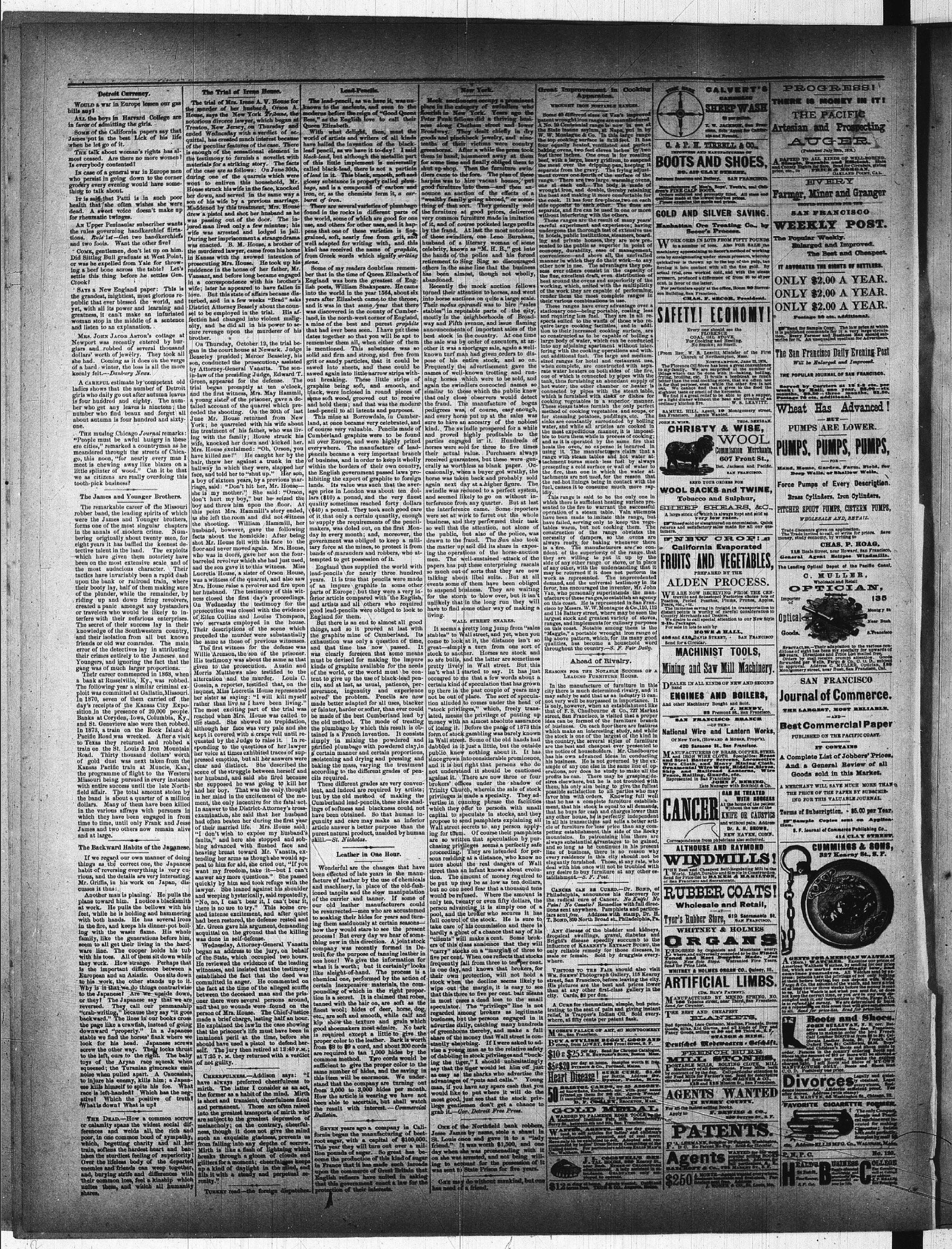
Searchable text
Detroit Currency.
Would a war in Europe lessen our gas bills any?
All the boys in Harvard College are in favor of admitting the girls.
Some of the California papers say that James put in the best Lick of his life when he let go of it.
The talk about woman's rights has almost ceased. Are there no more women? Is everybody contented?
In case of a general war in Europe men who persist in going down to the corner grocery every evening would have something to talk about.
It is said that Patti is in such poor health that she often wishes she were dead. A sweet voice doesn't make up for rheumatic twinges.
An Upper Peninsular subscriber wants the rules governing handkerchief flirtations. Rule 1st—Get two handkerchiefs and two fools. Want the other five?
Come, gentlemen, don't let up on him. Did Sitting Bull graduate at West Point, or was he expelled from Yale for throwing a beef bone across the table? Let's settle this thing before he settles Gen. Crook?
Says a New England paper: This is the grandest, mightiest, most glorious republic that ever blessed the world, and yet, with all its power and learning and greatness, it can't make an infuriated woman stop in the middle of a sentence and listen to an explanation.
Mrs. John Jacob Astor's cottage at Newport was recently entered by burglars and robbed of several thousand dollars' worth of jewelry. They took all she had. Coming as it does on the verge of a hard winter, the loss is all the more keenly felt.—Danbury News.
A careful estimate by competent old ladies shows that the number of Detroit girls who daily go out after autumn leaves is four hundred and eighty. The number who get any leaves is nineteen; the number who find beaux and forget all about autumn is four hundred and sixty-one.
The musing Chicago Journal remarks: "People must be awful hungry in these cities," remarked a countryman as he meandered through the streets of Chicago, this noon, "for nearly every man I meet is chewing away like blazes on a
The Trial of Irwin House.
The trial of Mrs. Irwin A.V. House for the murder of her husband, Orson A. House, says the New York Tribune, the notorious divorce lawyer, which began at Trenton, New Jersey, on Thursday and ended Wednesday with a verdict of acquittal, has created much interest because of the peculiar features of the case. There is enough of the sensational element in the testimony to furnish a novelist with materials for a striking story. The facts of the case are as follows: On June 20th, during one of the quarrels which were wont to enliven this household, Mr. House struck his wife in the face, knocked her down, and served in the same way a son of his wife by a previous marriage. Muddened by this treatment, Mrs. House drew a pistol and shot her husband as he was passing out of the door. The injured man lived only a few minutes; his wife was arrested and lodged in jail. During her imprisonment a strangled rama was enacted. B.M. House, a brother of the murdered lawyer, came from his home in Kansas with the avowed intention of prosecuting Mrs. House. He took up his residence in the house of her father, Mr. Vansant, and before long became engaged in a correspondence with his brother's wife; later he appeared to have fallen in love. But this state of affairs became disturbed, and in a few weeks "Brad" asks District Attorney Beasely about the counsel to be employed in the trial. His affection had changed into violent malignity, and he did all in his power to secure revenge upon the murderer of his brother.
On Thursday, October 12, the trial began in the court house at Newark. Judge Beaseley presided; Mercer Beaseley, his son, conducted the prosecution; assisted by Attorney-General Vanatta. The son-in-law of the presiding Judge, Edward T. Green, appeared for the defense. The trial began promptly at ten o'clock, and the first witness, Mrs. May Hammil, a young sister of the prisoner, gave a detailed account of the quarrel which preceded the shooting. On the 30th of last June Mr. House returned from New York; he quarreled with his wife about the treatment of his father, who was living with the family; House struck his wife, knocked her down and kicked her. Mrs. House exclaimed: "Oh, Orson, you have killed me!" He caught her by the hair, threw her against a trunk in the lead-pencil, known to the ancients moderns before them. Bess," as the English Queen Elizabeth.
With what delicacy world of artists and have hailed the invaded pencil, as we have black-lead, but althoof this little impaled black-lead, to lead in it. This glossy substance is baga, and is a comin iron, or, as the chieftain of iron.
There are several found in the rocky world, some of them use, and others for pens that one of them grained, soft, nearly well adapted for writing has received from Greek words stone.
Some of my readers that in time England was born lish poets, William into the world in years after Elizabeth and it was in that was discovered in land, in the north-a mine of the best dates together so that had ever been seen them also mentioned. The solid and firm and grit or sandy part sawed into sheets sawed again into out breaking. The graphite being black, were included some soft wood, grit and hold them; a lead-pencil to all.
This mine at Bland land, at once became course very valiant Cumberland grape all over Europe everywhere. The pencils became a business, and in
A careful estimate by competent old ladies shows that the number of Detroit girls who daily go out after autumn leaves is four hundred and eighty. The number who get any leaves is nineteen; the number who find beaux and forget all about autumn is four hundred and sixty-one.
The musing Chicago Journal remarks: "People must be awful hungry in these ere cities," remarked a countryman as he meandered through the streets of Chicago, this noon, "for nearly every man I meet is chewing away like blazes on a little splinter of wood." Can it be that we as citizens are really overdoing this tooth-pick business?
The James and Younger Brothers.
The remarkable career of the Missouri robber band, the leading spirits of which were the James and Younger brothers, forms one of the most singular chapters in the annals of modern crime. Numbering originally about twenty men, for eight years it has baffled the keenest detective talent in the land. The exploits which have given them notoriety have been on the most extensive scale and of the most audacious character. Their tactics have invariably been a rapid dash upon the bank or railroad train, where their booty lay, half of them making sure of the plunder, while the remainder, by riding up and down firing revolvers, created a panic amongst any bystanders or travelers who would be likely to interfere with their nefarious enterprises. The secret of their success lay in their knowledge of the Southwestern country, and their isolation from all but known friends or old war comrades. The main error of the detectives lay in attributing their crimes entirely to the Jameses and Youngers, and ignoring the fact that the gang was of much larger proportions.
Their career commenced in 1868, when a bank at Russelville, Ky., was robbed. The following year a similar criminal exploit was committed at Gallatin, Missouri. In 1870, seven of them carried off the day's receipts of the Kansas City Exposition in the presence of 20,000 people. Banks at Coryden, Iowa, Columbia, Ky., and St. Genevieve also were then robbed. In 1873, a train on the Rock Island & Pacific Road was wrecked. After a visit to Texas they returned and robbed a train on the St. Louis & Iron Mountain Road. Thirty thousand dollars' worth of gold dust was next taken from the Kansas Pacific train at Muncie, Kan., the programme of flight to the Western Missouri being pursued in every instance with entire success until the late Northfield affair. The total amount stolen by the band is about a quarter of a million dollars. Many of them have been killed in the various affrays with pursuers in which they have been engaged in from time to time, until only Frank and Jesse James and two others now remain alive and at large.
The Backward Habits of the Japanese.
If we regard our own manner of doing things as the correct one, the Japanese habit of reversing everything is very curious, and the details are very interesting. Mr. Griffin in his work on Japan discusby Attorney-General Vanatta. The son-in-law of the presiding Judge, Edward T. Green, appeared for the defense. The trial began promptly at ten o'clock, and the first witness, Mrs. May Hammil, a young sister of the prisoner, gave a detailed account of the quarrel which preceded the shooting. On the 30th of last June Mr. House returned from New York; he quarreled with his wife about the treatment of his father, who was living with the family; House struck his wife, knocked her down and kicked her. Mrs. House exclaimed: "Oh, Orson, you have killed me!" He caught her by the hair, threw her against a trunk in the hallway in which they were, slapped her face, and told her to "shut up." Her son, a boy of sixteen years, by a previous marriage, said: "Don't hit her, Mr. House—she is my mother." She said: "Orson, don't hurt my boy," but he seized the boy and threw him upon the floor. At this point Mrs. Hammill's story ended, as she left the room and did not witness the shooting. William Hammill, her husband, however, gave the following facts about the homicide: After being shot Mr. House fell with his face to the floor and never moved again. Mrs. House, who was in doors, gave her son the four-barreled revolver which she had just used, and the son gave it to this witness. Miss Lucretia House, a sister of Orson House, was a witness of the quarrel, and also saw Mrs. House raise a revolver and fire upon her husband. The testimony of this witness closed the first day's proceedings. On Wednesday the testimony for the prosecution was closed with the evidence of Ellen Collins and Louise Thompson, two servants employed in the house. Their descriptions of the scene which preceded the murder were substantially the same as those of previous witnesses.
The first witness for the defense was Willie Arenson, the son of the prisoner. His testimony was about the same as that given to the prosecution. Austin and Morris Matthews also testified to the altercation and the murder. Louis C. Gossin, a reporter, testified that, on the inquest, Miss Lucretia House represented her sister as saying: "I will kill myself rather than live as I have been living." The most exciting part of the trial was reached when Mrs. House was called to the stand. She showed no trepidation, although her face was very pale and she kept it covered with a crape veil until requested by the Judge to raise it. In responding to the questions of her lawyer her voice at times exhibited traces of suppressed emotion, but all her answers were clear and distinct. She described the scene of the struggle between herself and her husband, and said she fired because she supposed he was going to kill her and her boy. That was the only thought in her mind in the excitement of the moment, the only incentive for the fatal act. In answer to the District-Attorney's cross-examination, she said that her husband had often beaten her during the first year of their married life. Mrs. House said: "I don't wish to expose my husband's faults," and here she stopped and sobbing advanced with flushed face and heaving breast toward Mr. Vanatta, extending her arms as though she would appeal to him for aid, she cried out, "If you want my freedom, take it—but I can't answer any more questions." She passed slightly by him and took refuge with the
son-in-law of the presiding Judge, Edward T. Green, appeared for the defense. The trial began promptly at ten o'clock, and the first witness, Mrs. May Hammil, a young sister of the prisoner, gave a detailed account of the quarrel which preceded the shooting. On the 30th of last June Mr. House returned from New York; he quarreled with his wife about the treatment of his father, who was living with the family; House struck his wife, knocked her down and kicked her. Mrs. House exclaimed: "Oh, Orson, you have killed me!" He caught her by the hair, threw her against a trunk in the hallway in which they were, slapped her face, and told her to "shut up." Her son, a boy of sixteen years, by a previous marriage, said: "Don't hit her, Mr. House—she is my mother." She said: "Orson, don't hurt my boy," but he seized the boy and threw him upon the floor. At this point Mrs. Hammill's story ended,
as she left the room and did not witness the shooting. William Hammill, her husband, however, gave the following facts about the homicide: After being shot Mr. House fell with his face to the floor and never moved again. Mrs. House,
who was in doors, gave her son the four-barreled revolver which she had just used,
and the son gave it to this witness. Miss Lucretia House, a sister of Orson House,
was a witness of the quarrel, and also saw Mrs. House raise a revolver and fire upon her husband. The testimony of this witness closed the first day's proceedings. On Wednesday the testimony for the prosecution was closed with the evidence of Ellen Collins and Louise Thompson,
two servants employed in the house.
Their descriptions of the scene which preceded the murder were substantially the same as those of previous witnesses.
The first witness for the defense was Willie Arenson,the son ofthe prisoner.His testimony was aboutthe same as that given tothe prosecution.AustinandMorrisMatthewsalsotestifiedtothealtercationandthemurder.LouisC.Gossin,a报orter,testifiedthat.ontheinquest,MissLucretiaHouserepresentedhersisteras Saying:"IwillkillmyselfratherthanliveasIhavebeenliving."ThemostexistingpartofthetrialwasreachedwhenMrs.Housewascalledtothestand.SheshowednotrepidationalthoughherfacewerverypaleandshekeptitcoveredwithacrapeveiluntilrequestedbytheJudgetoraiseit.Inrespondingtothequestionsofherlawyerhervoiceattimesexhibitedtracesofsuppressedemotion,bullardotheoldmethod.Theplumbagobytainedisimplyinmixpurifiedplumbaftera certainmanne moisteneningandbakingthemassaccordingtochestilsrequired.
These differentent,andindeedbutbytheoldmCumberlandleaingsofsoftnessashavebeenobtaingenuityandcanarticleanswera purelynaturalprinciple.-St.Nicholas
Leathe
Wonderful arsenic been effected off fracture of leather
The Backward Habits of the Japanese.
If we regard our own manner of doing things as the correct one, the Japanese habit of reversing everything is very curious, and the details are very interesting. Mr. Griffis, in his work on Japan, discusses it thus:
Another man is planing. He pulls the plane toward him. I notice a blacksmith at work. He pulls the bellows with his feet, while he is holding and hammering with both hands. He has several irons in the fire, and keeps his dinner-pot boiling with the waste flame. His whole family, like the generations before him, seem to all get their living in the hardware line. The cooper holds his tub with his toes. All of them sit down while they work. How strange. Perhaps that is the important difference between a European and an Asiatic. One sits down to his work, the other stands up to it. Why is it that we do things contrariwise to the Japanese? Are we upside down, or they! The Japanese say that we are reversed. They call our penmanship "crab-writing," because they say "it goes backward." The lines in our books cross the page like a crawfish, instead of going downward "properly." In a Japanese stable we find the horses' flank where we look for his head. Japanese screws screw the other way. Their locks thrust to the left, ours to the right. The baby toys of the Aryan race squeak when squeezed; the Turanian gimcracks emit noise when pulled apart. A Caucasian, to injure his enemy, kills him; a Japanese kills himself to spite his foe. What race is left-handed! Which has the negative! Which the positive of truth! What is up!
THE DEAD—How a common sorrow or calamity spans the widest social differences and welds all, the rich and poor, in one common bond of sympathy, which, begetting charity and all her train, softens the hardest heart and banishes the sturdiest feeling of superiority! Over the lifeless body of the departed enemies and friends can weep together, and, burying strife and differences with their common loss, feel a kinship which unites them, and which all humanity shares.
CHEERFULNESS—Addison says: "I have always preferred cheerfulness to mirth. The latter I consider as an act, the former as a habit of the mind. Mirth is short and transient, cheerfulness fixed and permanent. Those are often raised into the greatest transports of mirth who are subject to the greatest depression of melancholy; on the contrary, cheerfulness, though it does not give the mind such an exquisite gladness, prevents us from falling into any depths of sorrow. Mirth is like a flash of lightning which breaks through a gloom of clouds and glitters for a moment; cheerfulness keeps up a kind of daylight in the mind, and fills it with a steady and perpetual serenity."
TURKEY read—the foreign dispatches she supposed he was going to kill her and her boy. That was the only thought in her mind in the excitement of the moment, the only incentive for the fatal act. In answer to the District-Attorney's cross-examination, she said that her husband had often beaten her during the first year of their married life. Mrs. House said: "I don't wish to expose my husband's faults," and here she stopped and sobbing advanced with flushed face and heaving breast toward Mr. Vanatta, extending her arms as though she would appeal to him for aid, she cried out, "If you want my freedom, take it—but I can't answer any more questions." She passed quickly by him and took refuge with the lawyer. She leaned against his shoulder and weeping hysterically, said repeatedly, "No, no, I can't bear it, there is no use to try." This scene created intense excitement, and after quiet had been restored, the defense rested and Mr. Green gave his argument, demanding acquittal on the ground that the killing was done in self-defense.
Wednesday, Attorney-General Vanatta began an address to the jury, on behalf of the State, which occupied two hours. He reviewed the evidence of the leading witnesses, and insisted that the testimony established the fact that the deed was committed in anger. He commented on the fact at the time of the alleged scuffle between the deceased man and the prisoner there were several persons around, and that no wounds were found on the person of Mrs. House. The Chief-Justice made a brief charge, lasting half an hour. He explained the law in the case showing that the prisoner's life must have been in imminent peril at the time, before she should have used a pistol to defend herself. The jury then retired at 12:40 P.M.; at 7:25 P.M. they returned with a verdict of not guilty.
CHERRFULNESS—Addison says: "I have always preferred cheerfulness to mirth. The latter I consider as an act, the former as a habit of the mind. Mirth is short and transient, cheerfulness fixed and permanent. Those are often raised into the greatest transports of mirth who are subject to the greatest depression of melancholy; on the contrary, cheerfulness, though it does not give the mind such an exquisite gladness, prevents us from falling into any depths of sorrow. Mirth is like a flash of lightning which breaks through a gloom of clouds and glitters for a moment; cheerfulness keeps up a kind of daylight in the mind, and fills it with a steady and perpetual serenity."
SEVEN years formula began this root sugar, with this year they lion pounds of come the product in France that upon the comm English refiner that this govern protection of t
House for
mon A.
one, the
began at
way and
of acbecause
There
ment in
with
the facts
ne 20th,
which were
Mr. knocked
the way a
marriage.
House
and as he
The intates; his
in jail;
re drama
other of
his home
mention of
sk up his
other, Mr.
engaged brother's
fallen in
name disaid" asks
His afmaliger to ser of his
trial beJudge Jude
hey, his
assisted
The son almalig-er to ser of his
New trial beJudge Jude
hey, his
assisted
The son almalig-er to ser of his
New York.
Mock auctioneers occupy a prominent place in the category of swindlers who flourish in New York. Years ago the Peter Funk fellows did a thriving business along Chutham street and lower Broadway. They dealt chiefly in dry goods and pinchbeck jewelry, and nineteenth of their victims were country greenhorns. After a while the press took them in hand, hammered away at them for some time and finally obliged them to shut up shop. Then the furniture swindlers came to the fore. The plan of these harpies was to hire vacant houses, put good furniture into them—and then announce an auction of the effects of a "wealthy family going abroad," or something of that sort. They generally sold the furniture at good prices, delivered very common furniture made in imitation of it, and of course pocketed large profits by the fraud. At last the most notorious of these swindlers, one Leno Burnham, husband of a literary woman of some celebrity, known as "M. H. B.," got into the hands of the police and his forced retirement to Sing Sing so discouraged others in the same line that the business has been almost, though not wholly, abandoned.
Recently the mock auction fellows turned their attention to horses, and went into horse auctions on quite a large scale. Their modus operandi was to hire "sales stables" in reputable parts of the city, mostly in the neighborhoods of Broadway and Fifth Avenue, and issue flaming announcements of important sales of the best stock in the country. At one time the sale was by order of executors, at another it was a mortgage sale, again a well-known turf man had given orders to dispose of his entire stock, and so on. Frequently the advertisement gave the names of well-known trotting and running horses which were to be sold, and again the swindlers concocted names so similar to those which the public knew that only close observers would detect the fraud. The manufacture of bogus pedigrees was of course, easy enough, and every horse put up at the sales was sure to have an ancestry of the noblest kind. The swindle prospered for a while and proved highly profitable to the parties engaged in it. Hundreds of horses were sold for three to five times their actual value. Purchasers always received guarantees, but these were generally as worthless as blank paper.
Great Improvement in Cooking Apparatus.
WROUGHT IRON PORTABLE RANKS.
Some 40 different sizes of Van's improved patent wrought iron ranges are manufactured. A No. 10 Centennial range is now in use at the Stale Insane Asylum, at Napa just in W. W. Monaghan & Co. In this large range the top cooking surface is 8x10 feet. It has four equally heated, ventilated, and perfect baking ovens, two feet eleven inches by two feet three inches. One oven is for roasting beef, with a large, heavy grillron, to suspend the meat over the dripping pan, keeping it separate from the gravity. The frying adjustment covers one-fourth of the surface of the range. There are two large warming ovens, one at each end. The body is made of wrought iron, and double, thereby retaining the heat and making it more comfortable for the cook. It has four fire-places, two on each side opposite to each other. The flues are separate, and fire can be used in one or more without interfering with the others.
These ranges are the result of many years' careful experiment and experience; having undergone the thorough test of extensive use in hotels, public institutions, steamers, boarding and private houses, they are now presented to the public as superior in point of economy, durability, ease of management, convenience—and above all, the unrivalled manner in which they do their work—to any other now in use. The advantages they possess ever others consist in the capacity of the flue, excellent draft, even distribution of heat around the ovens and superiority of the working, which united with the multiplexity of the work they are capable of performing, render them the most complete ranges in their various combinations in use.
These ranges have every advantage over a stationary one—being portable, coating less and requiring less fuel. They are in all respects suited to the wants of those who require large cooking facilities, and in addition to their increased cooking surface, are so constructed as to be capable of boiling a large body of water, which can be conducted into any adjoining apartment without interfering with the cooking operations and without additional fuel. The large and medium-sized ranges for hotel and restaurant use when complete are constructed with separate water heaters on both sides of the fire, one of which is connected by pipes with the tank, thus furnishing an abundant supply of hot water; the other chamber or heater is connected by pipes with the steam table, which is furnished with sinks or dishes for cooking vegetables in a superior manner. These steam tables furnish the only perfect method of cooking vegetables and soups, or for steaming potatoes, puddings, etc.
The sinks are constantly surrounded by boiling water, and while all articles are cooked in the most expeditious manner, it is impossible to burn them while in process of cooking; and as it is operated by the same fire that heats the oven, no expense is incurred in using it. The manufacturers claim that a range with steam tables and hot water attachment burns much less fuel by always...
The son of Edward T. O'clock, Hammil, have a depth which prevents him from New life about it was livruck his likekind her. Person, you by the
sk in theapped her
his son, his cousin marhouse—"Orson,
recognized the
door. At end, not witness
smill, her following
letter being to the
rss. House, the four
just used,
miss. Miss
House, also saw fire upon this witpreceedings.
for the evidence thompson,
one house, one which instantiatly witnesses.
defense is a prisoner.
some as that Austin and
the Louis C. at, on the represented ill myself in living."
trial was called to explidation,
and she until recalled to explidation,
and she until recalled to explidation,
and she until recalled to explidation,
and she until recalled to explidation,
and she until recalled to explidation,
and she until recalled to explidation,
and she until recalled to explidation,
and she until recalled to explidation,
and she until recalled to explidation,
and she until recalled to explidation,
and she until recalled to explidation,
and she until recalled to explidation,
and she until recalled to explidation,
and she until recalled to explidation,
and she until recalled to explidation,
and she until recalled to explidation,
and she until recalled to explidation,
and she until recalled to explidation,
and she until recalled to explidation,
and she until recalled to explidation,
and she until recalled to explidation,
and she until recalled to explidation,
and she until recalled to explidation,
and she until recalled to explidation,
and she until recalled to explidation,
and she until recalled to explidation,
and she until recalled to explidation,
and she until recalled to explidation,
and she until recalled to explidation,
and she until recalled to explidation,
and she until recalled to explidation,
and she until recalled to explidation,
and she until recalled to explidation,
and she until recalled to explidation,
and she until recalled to explidation,
and she until recalled to explidation,
and she until recalled to explidation,
and she until recalled to explidation,
and she until recalled to explidation,
and she until recalled to explidation,
and she until recalled to explidation,
and she until recalled to explidation,
and she until recalled to explidation,
and she until recalled to explidation,
and she until recalled to explidation,
and she until recalled to explidation,
and she until recalled to explidation,
and she until recalled to explidation,
and she until recalled to explidation,
and sheUntil re-
Leather in One Hour.
Wonderful are the changes that have been effected of late years in the manufacture of leather by the use of chemicals
Frequently the advertisement gave names of well-known trotting and running horses which were to be sold, and again the swindlers concocted names so similar to those which the public knew that only close observers would detect the fraud. The manufacture of bogus pedigrees was of course, easy enough, and every horse put up at the sales was sure to have an ancestry of the noblest kind. The swindle prospered for a while and proved highly profitable to the parties engaged in it. Hundreds of horses were sold for three to five times their actual value. Purchasers always received guarantees, but these were generally as worthless as blank paper. Occasionally, when a buyer got wrath, the horse was taken back and probably sold again next day at a higher figure. The swindle was reduced to a perfect system, and seemed likely to go on without interference from any quarter. But at last the interference came. Some reporters were set at work to ferret out the whole business, and they performed their task so well that the attention, not alone of the public, but also of the police, was drawn to the fraud. The Sun also took the matter up and did its share in exposing the operations of the horse-auction men. The well-sustained attack of the papers has put these enterprising rascals so much out of sorts that they are now talking about libel suits. But at all events some of them have been obliged to suspend business. They are waiting for the storm to blow over, but it isn't unlikely that in the long run they will have to find some other way of making a living.
WALL STREET SNARES.
It seems a pretty long jump from "sales stables" to Wall street, and yet, when you come to look at it, the distance isn't so great—simply a turn from one sort of stock to another. Horses are stock and so are bulls, and the latter are sometimes pretty lively in Wall street. But this isn't what I started to say. It has just occurred to me that a few words about a certain kind of speculation that has grown up there in the past couple of years may not be out of place. The sort of speculation alluded to comes under the head of "stock privileges," which freely translated means the privilege of putting up money with an almost absolute assurance of losing it. Before the pane of 1873 this form of stock gambling was barely known in Wall street. Some of the old hands had dabbled in it just a little, but the outside public knew nothing about it. It has since grown into considerable prominence, and it is but right that persons who do not understand it should be cautioned against it. There are now three or four brokers' offices under the shadow of Trinity Church, wherein the sale of stock privileges is made a specialty. They advertise in cunning phrase the facilities which they offer to persons with small capital to speculate in stocks, and they propose to send pamphlets explaining all Wall street secrets to any person applying for them. Of course their pamphlets are so written that speculation by purchasing privileges seems a perfectly safe proceeding. They are intended for persons residing at a distance, who know no more about the real dangers of Wall street than an infant knows about evolution. The amount of money required to put up may be as low as ten dollars.
rate water heaters on both sides of the fire, one of which is connected by pipes with the tank, thus furnishing an abundant supply of hot water; the other chamber or heater is connected by pipes with the steam table, which is furnished with sinks or dishes for cooking vegetables in a superior manner. These steam tables furnish the only perfect method of cooking vegetables and soup, or for steaming potatoes, puddings, etc. The sinks are constantly surrounded by boiling water, and while all articles are cooked in the most expedilious manner, it is impossible to burn them while in process of cooking; and as it is operated by the same fire that heats the oven, no expense is incurred in using it. The manufacturers claim that a range with steam tables and hot water attachment burns much less fuel by always presenting a cold surface or wall of water to the fire, than one in which the water attachments are not used, for the reason that the red-hot linings being in contact with the fuel causes it to consume much more rapidly.
This range is said to be the only one in which there is sufficient heating surface presented to the fire to warrant the successful operation of a steam table. Vain attempts have been made to imitate this range, but have failed, serving only to keep the vegetables warm, but not cooking them. The construction of the range obviates the necessity of dampers, so the ovens are always ready for baking whenever there is a fire. The manufacturers are so confident of the superiority of the range that they are willing to put it up by side of any other range or stove, or in place of any other, with the understanding that it may be returned if it does not perform its work as represented. The unprecedented demand, and the universal testimony in its favor, has encouraged the inventor, Mr John Van, who personally superintends the manufacture of these ranges, to establish an agency on this coast. He is represented in San Francisco by Messrs. W. W. Montague & Co., 110, 112 and 114 Battery street, where may be seen the largest stock and greatest variety of stoves, ranges, and implements for culinary purposes on this coast. Notable among them is the "Maggie," a portable wrought iron range of the above pattern, which for its many good qualities, has become a household word throughout the country.
Ahead of Rivalry.
REASONS FOR THE NOTABLE SUCCESS OF A LEADING FURNITURE HOUSE.
In the manufacture of furniture in this city there is much determined rivalry, and it may safely be said that as an industry it cannot very well be surpassed in importance. It is only however, when an establishment like that of F.S. Chadbourne & Co., 727 Market街 San Francisco is visited that a proper idea can be formed of the furniture branch of business. On each floor there are features which make an interesting study, and while the stock is one of the largest of the kind in the country, the several styles of furniture are the best and cheapest ever presented to the notice of households. Mr. Chadbourne has his own advanced ideas in conducting his business. He is not governed by the example of any one else in the same line of operations, nor does he study to make all the profits he can. There may be grasping desires elsewhere, but he is not troubled with them, his only aim being to give the fullest possible satisfaction to all parties who may favor him with orders. Knowing full well that he has a complete furniture establishment, that his stock is equal to all demands, that he buys for cash and charges lower than any other house, he is perfectly independent in all his transactions and sells a better article of furniture for less price than any competing establishment this side of Rocky mountains.
In patronizing him there are always substantial advantages to be gained, and so long as he continues in his present line of business, there is no reason why every residence in this city should not be elegantly furnished. Those at any rate, who deal with him once will not be troubled with any desire to buy furniture at any other establishment—S.F. Post.
Leather in One Hour.
Wonderful are the changes that have been effected of late years in the manufacture of leather by the use of chemicals and machinery, in place of the old-fashioned tanpits and the slow manipulation of the currier and tanner. If some of our old leather manufacturers could be resurrected—men who are accustomed to soaking their hides for years and turning them asiduously at certain seasons—how they would stare to see the present process! But every day we hear of something new in this direction. A joint stock company was recently formed in Detroit for the purpose of tanning leather in one hour! We give the information for what it is worth; but it certainly looks like sleight-of-hand. The process is a chemical one, performed by the action of certain inexpensive materials, the compounding of which in the right proportion is a secret. It is claimed that robes, tanned with the hair on, are soft as the finest wool; hides of deer, horse, dog, etc., are soft and smooth, while calf and kip show the texture and grain which good shoemakers most admire. No bark is required except a little to give the proper color to the leather. Bark is worth from $8 to $9 a cord, and about 200 cords are required to tan 1,000 hides by the common method. Two cords would be sufficient to give the proper color to the same number of hides, and the saving in this item will be enormous. We understand that the company are turning out from 2,000 to 3,000 hides per month. How the article is wearing we have not been able to ascertain, but shall watch the result with interest. — Commercial Bulletin.
Seven years ago a company in California began the manufacturing of beetroot sugar, with a capital of $100,000. This year they will turn out over a million pounds of sugar. So great has become the production of this kind of sugar in France that it has made such inroads upon the commerce of Great Britain that English refiners have united in asking that this government enact a law for the protection of their interests.
One of the Northfield bank robbers, Jesse James by name, stole a shawl in St. Louis once and gave it to a "lady friend." It was worth $1,500, and one day when she was promenading with it on she was arrested, and not being willing to account for the possession of it was sent to State Prison for five years.
One may do without mankind, but one has need of a friend.
CALVENT'S SHEEP WASH
60 per gallon.
W. W. JACKSON, the President,
51st Agent for Calverson and Nevada.
Q & P. H. TIRRELL & CO.
IMPORTERS AND MANUFACTURERS OF BOOTS AND SHOES,
NO. 419 CLAY STREET,
BETWEEN SEAMONDS and BATTERY.
SAN FRANCISCO.
Manufactures of Mesh, Rope, Youth's, and Children's FINE CALF BOOT.
Orders submitted and promptly filled. All sizes and qualities made at the lowest market prices.
Please examine the goods and prices.
GOLD AND SILVER SAVING.
Manhattan Ore Treating Co., by Secor's Process.
WORK ORES IN LOTS FROM FIFTY POUNDS to a number of tons. Also FOR SALE the machinery appertainting to Secor's method of working ores by amalgamating under steam pressure, whereby quicksilver is thrown up to the top of the pulp, ten forcing it into contact with all the fine gold. By actual trial, ores worked cold, and with the steam pressure, produced a difference of from 30 to 40 per cent. in favor of the latter.
For particulars apply at the office, Room 20 Stevenson Building, San Francisco.
CHAS. H. SECOR, President.
SAFETY! ECONOMY!
Every one should see the LOOK UP
COAL OIL STOVE
For Cooking and Heating.
No Smoke; no Smell.
[From Rev. W. S. Leavitt, Minister of the First Church of Northampton, Mass.
NORTHEAST, June 22, 1876.
The Florence Oil Stove has been a great convenience to my family. We are surprised at the number of things which can be done with it—baking, boiling, frying, broiling, etc. It broils a beefsteak as much better than the coal cooking stove, that we often use it for that purpose, even while the other fire is not out. We cannot and that it gives to the food the slightest taste or smell of the keeper.
We find it is great willed for us to get a supper, or a light dinner without the heat and trouble of an ordinary kitchen fire.
W. S. LEAVITT.
SAMUEL HILL, Agent, 19 Montgomery street, San Francisco. Agents Wanted.
PROGRESS!
THERE IS MONEY IN IT!
THE PACIFIC Artesian and Prospecting AUGER.
(Patented July 29th, 1874).
ADAPTED TO ALL KINDS OF WELL-BOMING,
Mining, Boilers and Embankment. Shares and Company Rights for Sale. Seed for Circulation, giving print, etc., to
OAKLAND POINT, CAL.
EVERY Farmer, Miner and Granger
SAN FRANCISCO
WEEKLY POST.
The Popular Weekly.
Enlarged and Improved.
The Best and Cheapest.
IT ADVOCATES THE RIGHTS OF SETTLERS.
ONLY $2.00 A YEAR.
ONLY $2.00 A YEAR.
ONLY $2.00 A YEAR.
Pastage 20 ets. additional.
Read for Sample Copy. The low price at which it is published commands for it a very large circulation. Every Farmer and Business Man should subscribe for it. An unequalled medium for Advertisers.
The San Francisco Daily Evening Post
Will be Enlarged and Improved.
THE POPULAR JOURNAL OF SAN FRANCISCO.
Served by Carriers at 12'-1-8 ets. per week; by Mail one year. $0.00-- six months. $0.50-- three months. $0.50-Pastage 70 ets. additional.
Wheat Has Advanced!
BUT
PUMPS ARE LOWER.
PUMPS, PUMPS, PUMPS,
FOR
both sides of the fire,
an abundant supply of
chamber or heater is
with the steam table,
sinks or dishes for
a superior manner,
ornish the only perfect
vegetables and soups, or
puddings, etc.
surrounded by boiling
articles are cooked in
manner, it is impossible in process of cooking;
by the same fire that
expense is incurred in
facturers claim that a
less fuel by always
place or wall of water to
which the purpose even while the other fire is not
out. We cannot and that it gives to the food the
slightest taste or smell of the kerosene.
We find it a great relief to be able to get a supper,
or a light dinner without the heat and trouble of an
ordinary kitchen fire.
SAMUEL HILL, Agent, 19 Montgomery street,
San Francisco. Agents Wanted.
JOHN H. WIRE.
CHRISTY & WISE,
WOOL
Commission Merchants,
607 Front St.,
Bet. Jackson and Pacific.
San Francisco.
SEND YOUR ORDERS FOR
WOOL SACKS and TWINE,
Tobacco and Sulphur,
SHEEP SHEARS, & C.,
A large stock of which is always kept and sold at
very low rates.
Sheep sold or slaughtered on commission. Quick
returns and satisfactory sales made for all our customers.
NEW CORPORATION
California Evaporated
FRUITS AND VEGETABLES,
PREPARED BY THE
ALDEN PROCESS.
WE ARE NOW RECIVING FROM THE CENTRVILLE AND SEBASTOPOL FACTories choose lots of Peaches, Peeled Peaches, Plums, Prunes, Apples, Pears, etc., etc.
The immense saving in freight in transportation to distant points is worth of careful consideration to Company Merchants. We desire to call special attention to our New Style 2-18. Packages.
For sale in lots to suit by HOWE & HALL,
408 and 410 Davin Street, San Francisco.
Send for a Circular.
MACHINIST TOOLS,
Mining and Saw Mill Machinery.
DEALER IN ALL KINDS OF NEW AND SECOND
hand
ENGINES AND BOILERS,
And other Machinery Bought and Sold.
J. MENBY,
83 Fremont St. San Francisco.
SAN FRANCISCO BRANCH
OF THE:
National Wire and Lantern Works,
Of New York (Howard & Moses, Propr's).
420 Sansome St. San Francisco.
MANUFACTURERS OF BRASS, CORPER, STEEL
and IRON CLOTH. Specializes: Brass and Steel Hastory Screens, Lecomotive Wire Cloth, and Heavy Mining Cloth.
Ornamental Wire Work, Riddles, Slaves, Ship and Railroad Lanterns, Wire France, Railing Gear, Wire Represented in San Francisco by JOHN P. BERING.
Late Manager with Eckfeldt & Co.
CANCER
SAN BE TREATED WITH SUCCESS
At the home of the patient Without the use of the KNIFE OR CAUSTICS and without pain. Address Dr. A. H. BROWS.
NEW HAVEN, CONN.
ALTHOUSE AND RAYMOND WINDMILLS!
THE Best and Cheapest Self-Regulating Mill in the World. Light, Durable and Simple in Construction. Send for Price-list to MAKER & HARILTON, of San Francisco and Sacramento.
THE POPULAR JOURNAL OF SAN FRANCISCO.
Served by Carrier at 12 1/2 ets. per week by mail; every week $0.00—etx.
Postage 70 ets. additional.
Wheat Has Advanced!
BUT
PUMPS ARE LOWER.
PUMPS, PUMPS, PUMPS,
FOR Hand, House, Garden, Farm, Field, for Deep Wells; or Shallow Wells.
Force Pumps of Every Description.
Brass Cylinders, Iron Cylinders.
PITCHER SPOUT PUMPS, CUSTOM PUMPS,
WHOLESALE AND RETAIL.
Trade discounts given on application.
The Trade invited to call, or write for prices. Save money, study economy, by writing to CHAS. P. HOAG,
115 Beale Street, near Howard, San Francisco.
General Agent Eclipse Windmills.
The Leading Optical Depot of the Pacific Coast.
C. MULLER,
Wholesale and Retail OPTICIAN,
Importer of
Optical Goods.
SPROTACLES—Their adaptation to the various conditions of light has been my specialty for upwards of 20 years. Directions and Price List mailed free.
Orders by mail receive prompt attention. Goods forwarded per Wells, Fargo & Co., C.I.D., subject to approval. Address C. MULLER, Optician, 188 Monigomery street, near Bush, San Francisco, Cal.
SAN FRANCISCO Journal of Commerce.
THE LARGEST, MOST RELIABLE,
AND
Best Commercial Paper
PUBLISHED ON THE PACIFIC COAST.
IT CONTAINS
A Complete List of Jobbers' Prices,
And a General Review of all Goods sold in this Market.
A MERCHANT WILL SAVE MUCH MORE THAN
THE PRICE OF THE PAPER BY SUBSCRIBING FOR THIS VALUABLE JOURNAL.
Terms of Subscription, - $5.00 per Year.
Sample Copies sent on Application.
S. F. Journal of Commerce Publishing Co., 414 CLAY STREET.
CUMMINGS & SONS,
327 Kernny St., S.F.
CANCER
CAN BE TREATED WITH SUCCESS
At the home of the patient without the use of the KNIFE OR CAUSTICS and without pain. Address Dr. A. H. GROWN, NEW HAVEN, CONN.
Correspondence from physicians also solicited.
ALTHOUSE AND RAYMOND
WINDMILLS!
The Best and Cheapest Self-Kegulating Mill in the World. Light, Durable and Simple in Construction. Send for Price-list to MAKER & HAMILTON, of San Francisco and Sacramento.
RUBBER COATS!
Wholesale and Retail,
ATTyer's Rubber Store, 619 Sacramento St., SAN FRANCISCO.
WHITNEY & HOLMES
ORGANS
Endorsed by Organists and Musicians everywhere, and universally considered to be the Winslet Machine and Waste Machine Made. New Styles. New Solo Steps. Warranted Five Years. Send for Price Lists.
WHITNEY & HOLMES ORGAN CO., Quincy, III.
ARTIFICIAL LIMBS.
(Dr. BLY'S PATENT).
Manufactured by MENZON SPRING, NO. 1807 Tebuta street, near Third, San Francisco. Send for Circular.
THE BEST AND CHEAPEST
BLANKETS.
Bed Spreads, Lace Curtains, Muslin, Flannel, Dress Goods, Silks, Kid Gloves, and all kinds of Dry and Fancy Goods, selling at $30 and $38 third st., A.F. STANGE & MINK.
DEUTSFÖL WOBEMARKS - OFAßFT.
FRENCH BURR
MILL STONES,
PORTABLE MILLS, BOLTING CLUTH, MILL Machinery of all descriptions. Please Mills built by contract or by the day. Call particular attention to our Feed Mills for Partner's use. Send for descriptive stimulator and price-list.
JOB: AGNER & CO.
KRS and KRS Mission St., San Francisco.
AGENTS WANTED
IN EVERY COUNTY.
For all the fastest selling Books.
W. BREWING & Co., 200 Sutton St., S.A.F.
PATENTS.
F.A. LEHMANN, Secretary of Patents, Washington, D.C. No Patent No Pay. Send for Grater.
Agents
$250
A MERCHANT WILL SAVE MUCH MORE THAN THE PRICE OF THE PAPER BY SUBSCRIBING FOR THIS VALUABLE JOURNAL.
Terms of Subscription, - $5.00 per Year.
Sample Copy sent on Applicant.
S.F. Journal of Commerce Publishing Co., 414 CLAY STREET.
CUMMINGS & SONS,
327 Keenny St., S.F.
AGENTS FOR AMERICAN WALTMAN (Jones), WATCHERS. Examine our prices of Agent Waltman Watches, by sending for our price list, which are marked exceedingly low; and examine gemstones. All Watches sent by express; persons have the privilege of not only holding at them before buying, but can deposit with a trial of at least two or three weeks before the money is sent to us. If the Watch is issued and used within time, you are in any way disqualified with it; our instructions to Walk, Parage & Co. is to refund the money. We are determined to build us a reputation on this coast that will give satisfaction to all. Send for price-list.
Boots and Shoes.
JOHN BULLRYAN, N.E. cur., Battery and Jacket Stores, San Francisco. Go to market to order the best French Caldic Leather Boots, 99; French Caldic Oxford Tim, 97; California Boots, 97; Boye and Children's Boots and shoes made to order. Person in the country ordering Boots and Shoes to the amount of $12 or more will be silenced reduction of four per cent; to make my charges light. I sell Boots and shoes of MY OWN MANUFACTURE ONLY. Heads and shoes sent C.O.D. Postively one price.
Divorces
Legally and quietly obtained. Legal everywham. Handmade immaterials. All divorce sufficient proof. You after decree. Address (with stamp)
K.A.MARVYN, Washington St., Chicago, Ill.
FAVORITE CIGARETTES FORMER.
The only Company Simple and Practical machine invented for making cigarettes; twelve bills made perfectly Sampler by small Co. Addison ELLIIS MFG. Co., Walnau, Mass.
P.N.P.C.
No. 120.
HEALDS BUSINESS COLLEGE
St Paul St., San Francisco.
S.F. Courthouse and Institutional building no longer in use.