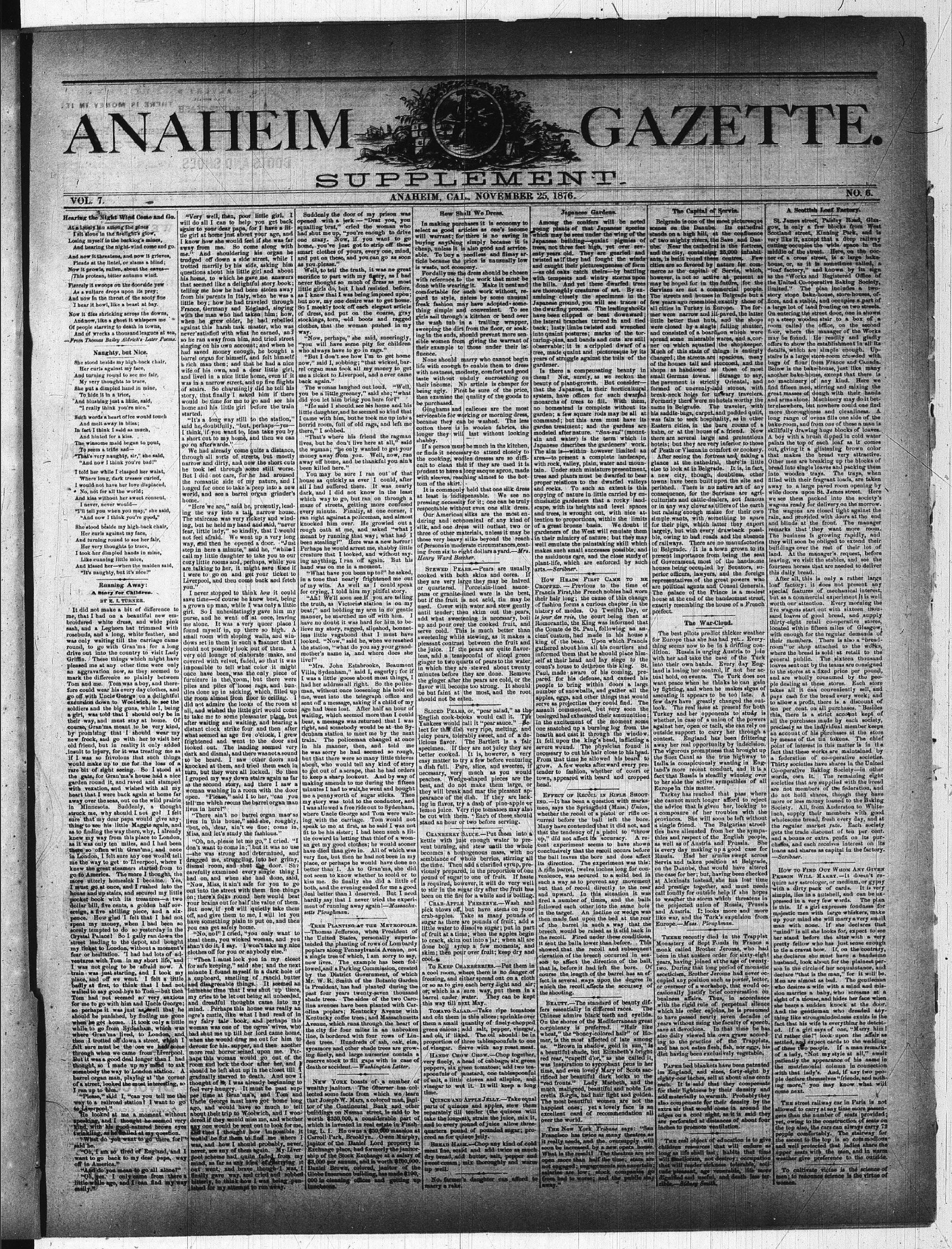
anaheim-gazette 1876-11-25
Scanned page
Searchable text
ANAHEIM
VOL. 7.
Hearing the Night Wind Come and Go.
At a lonely inn among the pines
I sit alone in the firelight's glow,
Losing myself in the backlog's mines,
And hearing the night-wind come and go.
And now it threatens, and now it grieves,
Pleads at the lintel, or slams a blind;
Now it prowls, sullen, about the eaves—
This protean, bitter autumn wind.
Fiercely it swoops on the doorside yew
As a vulture drops upon its prey;
And now in the throat of the sooty fuse
I hear it howl, like a beast at bay.
Now it files shrieking across the downs,
And now, like a ghost it whispers me
Of people starving to death in towns,
And of wrecks a thousand leagues at sea,
—From Thomas Bailey Aldrick's Later Poems.
Naughty, but Nice.
She stood beside my high-back chair,
Her curls against my face,
And turning round to see me fair,
My very thoughts to trace,
She put a dimpled hand in mine,
To hide it in a trice,
And blushing just a little, said,
"I really think you're nice."
Such words a heart of ice would touch
And melt away in bliss;
In fact I think I said as much,
And hinted for a kiss.
The winsome maid began to pout,
To seem a trifle sad—
"That's very naughty, sir," she said,
"And now I think you're bad!"
"Very well, then, poor little girl. I will do all I can to help you get back again to your dear papa, for I have a little girl at home just about your age, and I know how she would feel if she was far away from me. So come along with me." And shouldering his organ he trudged off down a side street, while I trotted merrily by his side, asking him questions about his little girl and about his home, to which he gave me answers that seemed like a delightful story book; telling me how he had been stolen away from his parents in Italy, when he was a little boy; how he had traveled through France, Germany and England, singing with the man who had taken him; how, when he grew older, he had rebelled against this harsh task master, who was never satisfied with what he earned, and so he ran away from him, and tried street singing on his own account; and when he had saved money enough, he bought a barrel organ for himself, and felt himself a rich man then; and that he had a nice wife of his own, and a dear little girl, and lived in a nice little home, even if it was in a narrow street, and up five flights of stairs. So charmingly did he tell his story, that finally I asked him if there would be time for me to go and see his home and his little girl before the train started.
"It's a long way still to the station," said he, doubtfully, "but, perhaps—yes—I think, if you want to, I can take you by a short cut to my home, and then we can go on afterwards."
We had already come quite a distance, through all sorts of streets, but mostly narrow and dirty, and now the short cuts Suddenly the door opened with a jerk squalling brat," cried had shut me up, "you one crazy. Now, in home, you've just got smart clothes of you and put on these, and as you please."
Well, to tell the truth sacrifice to part with never thought so much little girls do, but I as I knew that I was but now, my one desire. So I meekly took off of dress, and put on stockings, torn, old clothes, that the woody.
"Now, perhaps," said "you will have some who always have to go."
"But I don't see him now," said I, sobbing rel organ man took me a ticket to Liverpool back again.
The woman laughed you be a little green did you let him bring.
"He said I should little daughter,and he came with him, but horrid room, full of there," I sobbed.
"That's where his lives, but he don't live the woman; "he only money away from you away off home, and
Her curls against my face,
And turning round to see me fair,
My very thoughts to trace,
She put a dimpled hand in mine,
To hide it in a trice,
And blushing just a little, said,
"I really think you're nice."
Such words a heart of ice would touch
And melt away in bliss;
In fact I think I said as much,
And hinted for a kiss.
The winsome maid began to pout,
To seem a trifle sad—
"That's very naughty, sir," she said,
"And now I think you're bad!"
I told her while I clasped her waist,
Where long, dark tresses curled,
I would not have her love displaced,
No, not for all the world;
And kiss without her sweet consent,
I never, never would—
"I'll tell you when you may," she said,
"And now I think you're good."
She stood beside my high-back chair,
Her curls against my face,
And turning round to see her fair,
Her very thoughts to trace.
I took her dimpled hands in mine,
Like cunning little mice,
And kissed her—when the maiden said,
"It's naughty, but it's nice!"
Running Away:
A Story for Children.
BY E. L TURNER.
It did not make a bit of difference to me, that I had on a beautiful new embroidered white dress, and wide pink sash, and a Leghorn hat trimmed with rosebuds, and a long, white feather, and was only waiting till the carriage came round, to go with Gran'ma for a long drive out into the country to visit Lady Griffin. These things which might have pleased me at any other time were only an aggravation now, as they seemed to mark the difference so plainly between Tom and me. Tom was a boy, and therefore could wear his every day clothes, and go off with Uncle George on a delightful excursion down to Woolwich, to see the soldiers and the big guns, while I, being a girl, was told that I should only be in their way, and must stay at home. Of course, Gran'ma meant to be very kind, by promising that I should wear my new frock, and go with her to visit her old friend, but in reality it only added insult to injury, for it was treating me as if I was so frivolous that such things would make up to me for the loss of a rare bit of sight seeing. So I stood at the gate, for Gran'ma's house had a nice garden round it, and raved and stamped with vexation, and wished with all my heart that I were back again at home far away over the seas, out on the wild prairie in Minnesota. Suddenly, a thought struck me, why should I not go? I felt sure that my dear papa would give anything to see his little Maggie again, and as to finding the way there, why, I already knew my way from this place to London, as it was only ten miles, and I had been there so often with Gran'ma; and once in London, I felt sure any one would tell me the way to get to Liverpool, where I knew the great steamers started from to go to America. The more I thought, the more utterly homesick I became. Yes,
wife of his own, and a dear little girl, and lived in a nice little home, even if it was in a narrow street, and up five flights of stairs. So charmingly did he tell his story, that finally I asked him if there would be time for me to go and see his home and his little girl before the train started.
“It’s a long way still to the station,” said he, doubtfully, “but perhaps—yes—I think, if you want to, I can take you by a short cut to my home, and then we can go on afterwards.”
We had already come quite a distance through all sorts of streets, but mostly narrow and dirty, and now the short cuts he took led through some still worse. But I did not care, for he had aroused the romantic side of my nature, and I longed for once to take a peep into a new world, and see a barrel organ grinder's home.
“Here we are,” said he, presently leading the way into a tall narrow house. The staircase was very rickety and winding, but he held my hand and said, “never fear, little lady,” so kindly, that I would not feel afraid. We went up a very long way, and then he opened a door. “Just step in here a minute,” said he, “while I call my little daughter to take you to our cozy little rooms and, perhaps, while you are talking to her, it might save time if I were to go on and get your ticket to Liverpool, and then come back and fetch you.”
I never stopped to think how it could save time—of course he knew best, being a grown up man, while I was only a little girl. So I unhesitatingly gave him my purse, and he went off at once, leaving me alone. It was a very queer place I found myself in, up there so high. A small room with sloping walls, and windows set in them in such a manner that I could not possibly look out of them. A very old lounge of elaborate make, and covered with velvet, faded, so that it was impossible to tell what color it might once have been was the only piece of furniture in the room, but there were piles and piles of loose rags, and bundles done up in sickling, which filled up the room almost from floor to ceiling. I did not admire the looks of the room at all, and wished the little girl would come to take me to some pleasant place, but after waiting and waiting, and hearing a distant clock strike four and then after what seemed an age five o'clock, I grew frightened and went to the door and looked out. The landing seemed very dark and dismal, and there was not a sound to be heard. I saw other doors and knocked at them, and tried them each in turn, but they were all locked. So then I groped my way down stairs again as far as the second story, and there I saw a woman washing in a room with the door open. “Please,” said I to her, “can you tell me which rooms the barrel organ man lives in here?”
“There ain't no barrel organ man as lives in this house,” said she, roughly,“but oh, dear, ain't we fine; come in,Miss,and let's study the fashions.”
“Oh no,- please let me go,” I cried. “I don't want to come in;” but it was no use—she was strong and determined, and dragged me, struggling into her grimy,dismal room,and shut the door. She carefully examined every single thing I had on,and when she had done,said,
rel organ man took a gift me a ticket to Liverpool back again.”
The woman laughter you be a little green; did you let him bring “He said I should little daughter,and he I came with him,but horrid room,full of there,”I sobbed.
“That's where his lives,但他 don't live the woman;“he only money away from you away off home,and he been killed here.”
You may be sure house as quickly as all I had suffered the dark,and I did not which way to go,buy maze of streets,give every minute.Final ran right against a pair knocked him over.Rough oath at me,mantent by running thine been stealing?” He Perhaps he would ar creature that I looking anything,i ran hand on me in s
“What have you b in a tone that nearly of my wits. As well for crying.I told him
“啊! We'll soon say the truth.as Victor beat;”and holding him,manner,他 marched have no doubt it was lieve my story,ragg less little vagabone looked.“Now,”said the station,“what de mother's name is,a live?”
Mrs. John Es Villa,Sydneyham,"I was a little goose,had her address all r man without once lie me went into the sent off a message,a age had been lost.waitingwhich seem bear,a message was right,and somebody denham station to train.The policeman in his manner,t he was sorry he had but that there were about who would tryto get out of a scrapeto keep a sharp look making amends to 0 minutesI had to waitme a pennyworth of my storywas toldI was alloweda freewhere Uncle George ingwiththecarriar speaktomeatfirstfittobehis sister;te coward in lettingan getmygood clo havedied than givevery fine,bbut then place,或 perhaps better than I.As not seem to knoww kiss me."
with vexation, and wished with all my heart that I were back again at home far away over the seas, out on the wild prairie in Minnesota. Suddenly, a thought struck me, why should I not go? I felt sure that my dear papa would give anything to see his little Maggie again, and as to finding the way there, why, I already knew my way from this place to London, as it was only ten miles, and I had been there so often with Gran'ma; and once in London, I felt sure any one would tell me the way to get to Liverpool, where I knew the great steamers started from to go to America. The more I thought, the more utterly homesick I became. Yes, I must go at once, and I rushed into the house and up stairs, and secured my little pocket book with its treasures—a two dollar bill, five cents, a golden half sovereign, a five shilling piece, and a sixpence. How glad I felt that I had not spent my money, when I had been so sorely tempted to do so yesterday in the Crystal Palace! So I gaily ran down the street leading to the depot, and bought my ticket to London, without a moment's fear or hesitation. "I had bad lots of adventures with Tom in my short life, and I was not going to be afraid now. A train was just starting, and I took my place, and off we went. I felt a little badly at first, to think that I had not walked to say good-bye to Tom—but then Tom had not seemed so very anxious for me to go with him and Uncle George; so perhaps it was just as well that he should be punished, by finding me gone when he got home. It took only a little while to go from Sydenham, which was where Gran'ma lived, to London, and then I trotted off down a street, which I felt sure must be the one we had come through when we came from Liverpool. But it was a good deal longer than I had thought, so I made up my mind to ask somebody the way to London station. A barrel organ man, playing at the corner of a street, looked the most interesting, so I ran up to him.
"Please," said I, "can you tell me the way to a railroad station? I want to go to Liverpool."
He looked at me a moment without speaking, and I thought he seemed very kind with his good-natured brown eyes twinkling, as he talked at my question.
"What do you want to go there for?" said he.
"Oh, I am so tired of England; and I want to go back to my dear papa, way off in America."
"And do you mean to go all alone?"
"Oh yes. I only came from there a little while ago, and I can find my way easily."
There ain't no barrel organ man as lives in this house," said she, roughly, "but oh, dear, ain't we fine; come in, Miss, and let's study the fashious."
"Oh, no, please let me go," I cried. "I don't want to come in;" but it was no use—she was strong and determined, and dragged me, struggling into her grimy, dismal room, and shut the door. She carefully examined every single thing I had on, and when she had done, said, "Now, Miss, it ain't safe for you to go out into the street with them fine things on; there's folks round here would beat your brains out for half the value of them. But now, if you will quietly take them off, and give them to me, I will let you have something plain to put on, and then you can get safely home.
"No, no!" I cried, "you only want to steal them, you wicked woman, and you shouldn't do it. I say. I won't take my nice clothes off for you or anybody else."
"Then I must lock you in my closet for safe keeping," said she; and the next minute I found myself in a dark hole of a cupboard, smelling of rancid butter and disagreeable things. It seemed an immense time that I was shut up there, my cries to be let out being all unheeded, and dreadful thoughts came into my mind. Perhaps this house was really an ogre's castle, like what I had read of in my fairy tale book; and perhaps this woman was one of the ogres' wives who had shut me up till her lord came home, when she would drag me out for him to devour for his supper, and then another more real horror seized upon me. Perhaps this woman would go out of the room and lock the door after her, and should be left shut up in the closet till I gradually starved to death. And now I thought of it: I was already beginning to feel very hungry. It must be past supper time at Gran'ma's, and Tom and Uncle George must have got home long ago, and would have so much to tell about their trip to Woolwich, and I wondered if they would miss me, and whether any one would be sent out to look for me, and then I thought how impossible it would be for them to find me where I was, and how I should probably never see any of them again. My Liverpool scheme had quite faded from my mind; as far as any idea of carrying it out went, and brave though I was finally gave way, and cried and sobbed bitterly; in think how I was being punished for my attempts to run away.
There ain't no barrel organ man as lives in this house," said she, roughly, "but oh, dear, ain't we fine; come in, Miss, and let's study the fashious."
"Oh no, please let me go," I cried. "I don't want to come in;" but it was no use—she was strong and determined, and dragged me, struggling into her grimy, dismal room, and shut the door. She carefully examined every single thing I had on, and when she had done, said, "Now, Miss, it ain't safe for you to go out into the street with them fine things on; there's folks round here would beat your brains out for half the value of them. But now, if you will quietly take them off, and give them to me, I will let you have something plain to put on, and then you can get safely home.
"No, no!" I cried, "you only want to steal them, you wicked woman,and you shouldn't do it.I say.I won't take my nice clothes off for you or anybody else."
"Then I must lock you in my closet for safe keeping," said she; and the next minute I found myself in a dark hole of a cupboard,smelling of rancid butter and disagreeable things. It seemed an immense time that I was shut up there,my cries to be let out being all unheeded,and dreadful thoughts came into my mind. Perhaps this house was really an ogre's castle,like what I had read of in my fairy tale book;and perhaps this woman was one of the ogres' wives,who had shut me up till her lord came home,when she would drag me out for him to devour for his supper,and then another more real horror seized upon me. Perhaps this woman would go out of the room and lock the door after her,and should be left shut up in the closet till I gradually starved to death.And now I thought of it:I was already beginning to feel very hungry.It must be past supper time at Gran'ma's,and Tom和Uncle George must have got home long ago,and would have so much to tell about their trip to Woolwich,and I wondered if they would miss me,and whether any one would be sent out to look for me,and then I thought how impossible it would be for them to find me where I was,and how I should probably never see any of them again.My Liverpool scheme had quite faded from my mind;as far as any idea of carrying it out went,and brave though I was finally gave way,and cried and sobbed bitterly;in think how I was being punished for my attempts to run away."
IM GATE
SUPPLEMENT.
ANAHEIM, CAL., NOVEMBER 25, 1876.
Suddenly the door of my prison was opened with a jerk — "Drat you, you squalling brat," cried the woman who had shut me up, "you're enough to drive one crazy. Now, if you want to go home, you've just got to strip off those smart clothes of yours, every one, mind, and put on these, and you can go as soon as you please."
Well, to tell the truth, it was no great sacrifice to part with my filery, as I had never thought so much of dress as most little girls do, but I had resisted before, as I knew that I was being imposed upon; but now, my one desire was to get home. So I meekly took off each elegant article of dress, and put on the coarse, gray stockings, torn, old boots and ragged clothes, that the woman pushed in my way.
"Now, perhaps," she said, sneeringly, "you will have some pity for children who always have to go in rags."
But I don't see how I'm to get home now," said I, sobbing; "that wicked, barrel organ man took all my money to get me a ticket to Liverpool, and never came back again."
The woman laughed out loud. "Well, you be a little greeney," said she; "what did you let him bring you here for?"
He said I should see his home and his little daughter, and he seemed so kind that I came with him, but he took me up into a horrid room, full of old rags, and left me there," I sobbed.
"That's where his friend the ragman lives, but he don't live here at all," said the woman; "he only wanted to get your money away from you. Well, now, run away off home, and be thankful you ain't cuts."
How Shall We Dress.
In making purchases it is economy to select as good articles as one's income will warrant; for there is no saving in buying anything simply because it is cheap, unless it is also good and serviceable. To buy a needless and flimy article because the price is unusually low is waste, not economy.
For daily use the dress should be chosen with reference to the work that must be done while wearing it. Make it neat and comfortable for such work without regard to style, unless by some unusual freak fashion may have adopted something simple and convenient. To see girls sail through a kitchen or bend over the wash tub in a trailing wrapper, sweeping the dirt from the floor, or soaking in the suds, should prevent more sensible women from giving the warrant of their example to those under their influence.
None should marry who cannot begin life with enough to enable them to dress with neatness, modesty, comfort and good taste without unduly encroaching on their income. No article is cheaper for being ugly. First be sure of the price, then examine the quality of the goods to be purchased.
Ginghams and calicoes are the most serviceable for working or morning dress, because they can be washed. The less cotton there is in woolen fabrics, the longer they will last without looking shabby.
If a person must be much in the kitchen, or finds it necessary to attend closely to the cooking, woolen dresses are so difficult to clean that if they are used it is
Japanese Gardens.
Among the conifers will be noted young plants of that Japanese species which may be seen under the wing of the Japanese building—quaint pigmies of trees, not three feet high, yet over seventy years old. They are gnarled and twisted as if they had fought the winds and caught their picturesqueness of form—as old oaks catch theirs—by battling with tempests and wintry storms upon the hills. And yet these dwarfed trees are thoroughly creatures of art. By examining closely the specimens in the Japanese ground, you will see traces of the dwarfing process. The leading shoots have been clipped or bent downward; the lateral branches turned in and tied back; lusty limbs twisted and wrenched into quaint postures; marks of the torturing-pins, and bands and cuts are still observable; it is a crippled dwarf of a tree, made quintet and picturesque by its years of struggle against the toils of the gardener.
Is there a compensating beauty in them? Not surely, as we reckon the beauty of plant-growth. But consider—that the Japanese, in their horticultural system, have offices for such dwarfed monarchs of trees to fill. With them, no homestead is complete without its garden; a few square rods may be all command; but this area must have its garden treatment; and the gardens are modeled after nature. "San-sui" (mountain and water) is the term which in Japanese describes the gardeners' work. The aim is—within however limited an area—to present a complete landscape, with rock, valley, plain, water and moun-
Belgra scenes of stands on two mute ube. New and the antants is in cities are however may be b Servians. The street few years all cities mer were little be were close and common spread ner on Much of changed of the shops are small Gea formed break-neck Formerl name in his saddl was fair Eastern kahn, or there are hotels; of Peatha
The organ man took all my money to get me a ticket to Liverpool, and never came back again.
The woman laughed out loud. "Well, you be a little greency," said she: "what did you let him bring you here for?"
"He said I should see his home and his little daughter, and he seemed so kind that I came with him, but he took me up into a horrid room, full of old rags, and left me there," I sobbed.
"That's where his friend the ragman lives, but he don't live here at all," said the woman; "he only wanted to get your money away from you. Well, now, run away off home, and be thankful you ain't been killed here."
You may be sure I ran out of that house as quickly as ever I could, after all I had suffered there. It was nearly dark, and I did not know in the least which way to go, but ran on through a maze of streets, getting more confused every minute. Finally, at one corner, I ran right against a policeman, and almost knocked him over. He growled out a rough oath at me, and asked "what I meant by running that way; what had I been stealing?" Here was a new horror! Perhaps he would arrest me, shabby little creature that I looked, and without saying anything, I ran off again. But his hand was on me in a moment.
"What have you been up to?" he asked, in a tone that nearly frightened me out of my wits. As well as I could speak for crying. I told him my pitiful story.
"Ah! We'll soon see if you are telling the truth, as Victoria station is on my beat;" and holding my arm in no gentle manner, he marched me off with him. I have no doubt it was hard for him to believe my story, ragged, slipshod, bonnetless little vagabond that I must have looked. "Now," said he, when we reached the station, "what do you say your grandmother's name is, and where does she live?"
"Mrs. John Estabrooke, Beaumont Villa, Sydenham," said I, eagerly; for if I was a little goose about most things, I had her address all right. So the policeman, without once loosening his hold on me, wont into the telegraph office and sent off a message, asking if a child of my age had been lost. After half an hour of waiting, which seemed more than I could bear, a message was returned that I was right, and somebody would be at the Sydenham station to meet me by the next train. The policeman changed at once in his manner, then, and told me he was sorry he had seemed so rough, but that there were so many little thieves about, who would tell any kind of story to get out of a scrape, that he had orders to keep a sharp lookout. And by way of making amends to me during the fifteen minutes I had to wait, went and bought me a pennyworth of sugar sticks. Then my story was told to the conductor, and I was allowed a free ride out to Sydenham, where Uncle George and Tom were waiting with the carriage. Tom would not speak to me at first, as he said I was not fit to be his sister; I had been such a little coward in letting that thief of a woman get my good clothes; he would sooner have died than give in. All of which was very fine, but then he had not been in my place, or perhaps he would have done no better than I. As to Gran'ma, she did not seem to know whether to scold or to kiss me. So finally she did a little of
Stewed Pearls—Pears are usually cooked with both skins and cores. If they are very large they may be halved or quartered. Porcelain-lined sauce-pans or granite-lined ware is the best, but if the fruit is not acid, tin may be used. Cover with water and stew gently until tender; then skim out the pears, add what sweetening is necessary, boil up and pour over the cooked fruit, and serve cold. This is much better than sweetening while stewing, as it makes a pleasant contrast between the fruit and the juice. If the pears are quite flavorless, add a teaspoonful of sliced green ginger to two quarts of pears to the water in which they are stewed about twenty minutes before they are done. Remove the ginger after the pears are cold, or the flavor will become too strong. It should be faint at the most, and the root should not be eaten.
Sliced Pearls, or "pear salad," as the English cook-books would call it. The Yankees would call it "pear sauce." Select for the dish very ripe, melting, and juicy pears, tolerably sweet, and of a delicious flavor. The Bartlett is a fair specimen. If they are not juicy they are better cooked. It is, however, a very easy matter to try a few before venturing a dish full. Pare, slice, and sweeten, if necessary, very much as you would peaches. Wedge-shaped pieces are the best, and do not make them large, or they will break and mar the pleasant appearance of the dish. If they are lacking in flavor, try a dash of pineapple or lemon juice. Very ripe tomatoes may also be cut with them.* Each of these should stand an hour or two before serving.
Cranberry Sauce—Put them into a kettle with just enough water to prevent burning, and stew until the whole becomes a homogenous mass, with no semblance of whole berries, stirring all the time. Then add a clarified syrup, previously prepared in the proportion of one pound of sugar to one of fruit. If haste is required here it will do very well.
Is there a compensating beauty in them? Not surely, as we reckon the beauty of plant-growth. But consider—that the Japanese, in their horticultural system, have offices for such dwarfed monarchs of trees to fill. With them, no homestead is complete without its garden; a few square rods may be all at command; but this area must have its garden treatment; and the gardens are modeled after nature. "San-sui" (mountain and water) is the term which in Japanese describes the gardeners' work. The aim is—within however limited an area—to present a complete landscape, with rock, valley, plain, water and mountain. Under such miniature presentation trees and plants must be dwarfed to bear proper relations to the dwarfed valleys and rocks. To such an extent is this copying of nature in little carried by enthusiastic gardeners that a rocky landscape, with its heights and level spaces and trees, is wrought out, with nice attention to proportions within the limits of a great bronze basin. We doubt if gardeners of the West will emulate them in their mimicry of nature; but they may well emulate the painstaking skill which makes such small successes possible, and the assiduous care, and the close study of plant-life, which are enforced by such arts.
Scribner.
How Heads First Came to Be Cropped. Previous to the time of Francis First, the French nobles had worn their hair long; the cause of this change of fashion forms a curious chapter in the history of modes. On Twelfth Day, or le jour des rois, the court being then at Romorantin, the King was informed that Comte de St. Paul, following an ancient custom, had made in his house a king of the bean. Upon which Francis gathered about him all his courtiers and informed them that he should place himself at their head and lay siege to the count's house to dethrone this king. St Paul made aware of his coming, prepared for his defense,and caused his people to bring within doors a large number of snowballs,and gather all the apples,eggs,and other things that would serve as projectiles they could find.The assault commenced,bbut very soon the besieged had exhausted their ammunition;在the excitement of the moment some one snatched up a burning log from the hearth and cast it through the window.I fell upon the king's head,inflicting a severe wound.The physician found it necessary to cut his hair close to his head.From that time he allowed his beard to grow.A few weeks afterward every pretender to fashion,thewhether of court or town,appeared with beard and cropped head.
Effect Of Recoil In Rifle Shooting.-It has been a question with marksmen,says the Springdeild (Mass.) Union whether the recoil of a pistol or rifle occurred before the ball left the bore.Many have contended that it did not,and that the tendency of a pistol to "throw up," did not affect its accuracy.A recent experiment seems to have shown conclusively that the recoil occurs before the ball leaves the bore and does affect its direction.The experiment was this:A rifle barrel,twelve inches long for convenience,a secured to a solid bed in such a way as to prevent any movement
TREE PLANTING AT THE METROPOLIS.
Thomas Jefferson, when President of the United States, personally superintended the planting of rows of Lombardy poplars along Pennsylvania Avenue, not a single tree of which, I am sorry to say, now lives. The example has been followed, and a Parking Commission, created by the District Government, of which Mr. W. R. Smith of the Botanic Garden is President, has had planted during the past four years twenty-seven thousand shade trees. The sides of the two Carolina avenues have been planted with Carolina poplars; Kentucky Avenue with Kentucky coffee trees; and Massachusetts Avenue, which runs through the heart of the city for four miles in an unbroken line, is bordered with four rows of Linden trees. Hundreds of ash, oak, elm, sycamore and other shade trees are growing finely, and large nurseries contain a reserve stock to fill gaps with in case of death or accident.
NEW YORK boasts of a number of wealthy janitors. The Observer has collected some facts from which we learn that Joseph W. Mars, a colored man, janitor of the Continental Bank and other buildings on Nassau street, is said to be worth $250,000, a considerable part of which is invested in real estate in Flushing, L.I. He owns a $50,000 mansion at Carroll Park, Brooklyn. Owen Murphy, janitor of the Daniel Lord property in Exchange place, had formerly the janitorship of the Stock Exchange at a salary of $3,000 per annum, and in worth $100,000. Daniel Brown, colored janitor of the Globe Insurance building, has made $100,000 in cleaning offices and getting up lunchmen.
CRANBERRY SAUCE.—Put them into a kettle with just enough water to prevent burning, and stew until the whole becomes a homogenous mass, with no semblance of whole berries, stirring all the time. Then add a clarified syrup, previously prepared, in the proportion of one pound of sugar to one of fruit. If haste is required, however, it will do very well to stir in the sugar dry after the fruit has been on the fire for a while and is boiling.
CRAB-APPLE PRESERVE.—Wash and pick blows off, but have stems on your crab-apples. Take as many pounds of sugar as there are pounds of fruit; add a little water to dissolve sugar; put in part of fruit at a time; when the apples begin to crack, skim out into a jar; when all are done boil syrup a few moments; and skim; then pour over fruit; keep dry and cool.
TO KEEP CRANBERRIES.—Put them in a cool room, where there is no danger of freezing, and either spread out on a cloth or so as to give each berry light and air; or, which is a sure way, put them in a barrel under water. They can be kept this way till next May.
TOMATO SALAD.—Take ripe tomatoes and cut them in thin slices; sprinkle over them a small quantity of finely-chopped green onions; add salt, pepper, vinegar, and oil, if liked. The oil should be in proportion of three tablespoonfuls to one of vinegar. Serve with any roast meat.
HANDY CHOW CHOW.—Chop together, very finely, a head of cabbage, six green peppers, six green tomatoes; add two teaspoonfuls of mustard, one tablespoonful of salt, a little cloves and allspice, and vinegar to wot it. It will keep a long time.
QUINCE AND APPLE JELLY.—Take equal parts of quinces and apples, stew them separately till tender (the quinces will take the longest), strain the juice, mix it, and to every pound of juice allow three-quarter pounds of pounded sugar; proceed as for quince jelly.
BREAD HAWK.—Chop any kind of cold meat fine, scald and add twice as much dry bread, add butter, salt, pepper and sweet cream; mix thoroughly and warm up well.
No farmer's daughter can afford to marry a rake.
EFFECT OF RECOIL IN RIFLE SHooting.—It has been a question with marksmen, says the Springfield (Mass.) Union, whether the recoil of a pistol or rifle occurred before the ball left the bore. Many have contended that it did not, and that the tendency of a pistol to "throw up," did not affect its accuracy. A recent experiment seems to have shown conclusively that the recoil occurs before the ball leaves the bore and does affect its direction. The experiment was this: A rifle barrel, twelve inches long for convenience, was secured to a solid bed in such a way as to prevent any movement but that of recoil directly to the rear and upward. In this situation it was fired a number of times, and the balls followed each other into the same hole in the target. An incline or wedge was then made fast upon the bed at the rear of the barrel in such a way that the breech would be raised as it slid back in the recoil. Fired under these conditions, it sent the balla lower than before. This showed that the recoil and subsequent elevation of the breech occurred in season to affect the direction of the ball, that is, before it had left the bore. Of course the length of the barrel has an effect in several ways upon the degree in which the recoil affects the accuracy of the shooting.
BEAUTY.—The standard of beauty differs essentially in different races. The Chinese admire black teeth and eyelids. On the shores of the Mediterranean great corpulency is preferred. "Hair like wheat," the "honey-colored hair" of Homer is the most affected late among us. "Brown in shadow, gold in sun," is a beautiful shade, but Elizabeth's bright red rear, "capelli d'or," as she called it, was inspiration to sycophant pens in her time, and even lovely Mary of Scotts sacrificed her beautiful dark locks to the "red fronts." Lady Macbeth, and the much maligned, beautiful and noble Lucretia Borgin, had hair light and golden. The most beautiful women are not the happiest ones; yet a lovely face is an excellent card of recommendation all over the world.
THE NEW York Tribune says: "San Francisco has twice as many theatreas it really needs, and the oversupply will soon be increased by a new opera house. What is the result! The剧院are not open more than half the time; states are not engaged; engagements are uncertain; salaries are low; stock companies go from bad to worse; and the public stay away."
GAZETTE.
NO. 6.
Gardens.
It will be noted Japanese species over the wing of theaint pigmies ofh, yet over seavare guarded and fought the windsrequeness of formmeils—by battlingentry storms uponuse dwarfed treesas of art. By ex-specimens in thewill see traces ofThe leading shootsbeent downward;armed in and tiedand wrenchedmarks of the tor-land cuts are stillapplied dwarf of a picturesque by itsatt the toils of theeating beauty inwe reckon theBut consider—their horticulturalfor such dwarfedfill. With them,plete without itsgoods may be allatsea must have itsthe gardens are"San-sul" (mount-the term which ingardeners' work,however limited ancomplete landscape,a water and mount-
The Capital of Servia.
Belgrade is one of the most picturesquescenes on the Danube. Its cathedralstands on a high hill, at the confluenceof two mighty rivers, the Save and Danube. Near the cathedral is the fortress,and the city, containing 25,000inhabitants, is built round these centres. Fewcities are so favored by nature forcommerce as the capital of Servia,which,however, is not so active at present asmay be hoped for in the future, for theServians are not a commercial people.The streets and houses in Belgrade but a few years ago resembled exactly thoseof all cities in Turkey in Europe. Theformer were narrow and ill-paved, the latterlittle better than huts, and the shopswere closed by a single falling shatter,and consisted of a board, on which werespread some miserable wares, and a corneron which squatted the shopkeeper.Much of this state of things is entirelychanged; the streets are spacious,manyof the houses tall and staccord, andtheshops as handsome as those ofmostsmall German towns. Strange to say,the pavement is strictly Oriental,andformed of unavenly-laid stones,withbreak-neck holes for unwary travelers.Formerly there were no hotels worthythename in Belgrade. The traveler,withhis saddle-bags, carpet,and padded quilt,was fain to seek hospitality, as in otherEastern cities, in the bare rooms ofa kahn, or at the house of a friend.Nowthere are several large and pretentioushotels; but they are very inferior to thoseof Peath or Vienna in comfort or cookery.
After seeing the fortress and takinga glance at the cathedral, there is little
A Scottish Loaf Factory.
St. James street, Paisley Road, Glasgow, is only a few blocks from WestScotland street, Kinning Park, and isvery like it, except that a deep railwaycutting occupies the wide space in themiddle of the street. Here, on thecorner of a cross street, is a large bake-house,or, as it is sometimes called,a "loaf factory," and known by its signas the "Works and Registered Office ofthe United Co-operative Baking Society,limited." The plan includes a two-story store bake-house, store-houses,offices,and a stable,and occupies a partofa large lot of land fronting on two streets.On entering the street door, one is shownup a steep wooden stair to a box ofa room called the office, on the secondfloor, where the manager of the Worksmay be found. He readily and gladlyoffers to show the establishment in allitsdetails, which are simple enough.Uptairs is a large store-room crowded withbags of flour from France and Canada.Below is the bake-house, just like manyanother bake-house, except that thereisno machinery of any kind. Here wefind fifteen men, stirring and mixingthe great masses of dough with theirhands and arms alone. Machinery may do itbetter elsewhere, but nowhere could one findmore thoroughness and cleanliness.Along range of ovens fills one side ofthe bake-room, and from one of these a manis skillfully drawing huge blocks of loaves.A boy with a brush dipped in cold waterpaints the top of each loaf as it comesout, giving it a glistening brown colorthat makes the bread very attractive.Other men are breaking up the blocks of
In Rifle Shooting question with marks held (Mass.) Union, a pistol or rifle oculi left the bore that it did not, and a pistol to "throw accuracy. A re-arms to have shown recoil occurs before fire and does affect experiment was this: unches long for control to a solid bed in front any movement shops as handsome as those of most small German towns. Strange to say, the pavement is strictly Oriental, and formed of unavenly laid stones, with break-neck holes for military travelers. Formerly there were no hotels worthy the name in Belgrade. The traveler, with his saddle-bags, carpet, and padded quilt, was fain to seek hospitality, as in other Eastern cities, in the bare rooms of a kahn, or at the house of a friend. Now there are several large and pretentious hotels; but they are very inferior to those of Peath or Vianna in comfort or cookery.
After seeing the fortress and taking a glance at the cathedral, there is little else to look at in Belgrade. It is, in fact, a new city, though, doubtless, other towns have been built upon the site and perished. There is no native art of any consequence, for the Servians are agriculturists and cattle-dealers, not famous or in any way clever as tillers of the earth but raising enough maize for their own simple wants, with something to spare for their pigs, which latter they export largely, but with every drawback possible, owing to bad roads and the absence of railways. There are no manufactories in Belgrade. It is a town grown to its present importance from being the seat of Government, most of the handsome houses being occupied by Senators, superior officers, lawyers, and the foreign representatives of the great powers who are political agents and Consul Generals. The palace of the Prince is a modest house at the end of the handsomest street, exactly resembling the house of a French prefect.
The War-Cloud.
The best pilots predict thicker weather for Europe than she has had yet... Everything seems now to be in a drifting condition. Russia is urging Austria to join with her and take the case of the Turk into their own hands. Every day England is losing her control, if not her actual hold, on events. The Turk does not want peace when he thinks he can gain by fighting, and when he makes signs of associating it appears to be too late. A few days have greatly changed the outlook. The real issue at present for both Turkey and her opponents to study is whether, in case of a union of the powers against her, open or tacit, she can rely on outside support to carry her through a contest. England has been frittering away her real opportunity by indecision. The vigorous promptness that brought up the Suez Canal as the true highway to India is conspicuously wanting in England's more recent conduct, and it is a fact that Russia is steadily winning over to her side the active sympathies of all Europe in this matter.
Turkey has reached that pass where she cannot much longer afford to reject the advice that is given her, looking to a composure of her troubles with the provinces. She will soon be left without a single friend. The Bulgarian strocities have alienated from her the sympathies and respect of the English people, as well as of Austria and Prussia. She is every day making up a good case for Russia. Had her armies swept across Servia and taken position at Belgrade, on the Danube, that would have altered the case for her; but, having been checked at Alexinatz instead, she has lost time
Below is the bake-house, just like many another bake-house, except that there is no machinery of any kind. Here we find fifteen men, stirring and mixing the great masses of dough with their hands and arms alone. Machinery may do it better elsewhere, but nowhere could one find more thoroughness and cleanliness. A long range of ovens fills one side of the bake-room, and from one of these a man is skillfully drawing huge blocks of loaves. A boy with a brush dipped in cold water paints the top of each loaf as it comes out, giving it a glistening brown color that makes the bread very attractive. Other men are breaking up the blocks of bread into single loaves and packing them into wooden trays. The trays, when filled with their fragrant loads, are taken away to a large paved room opening by wide doors upon St. James street. Here we see them packed into the society's wagons ready for delivery on the morrow. The wagons are closed tight against the rain, and provided with doors at the end and blinds at the front. The manager remarks that they want more room. The business is growing rapidly, and they will soon be obliged to extend their buildings over the rest of their lot of land. At the manager's request, before leaving, we visit the stables, and see the fourteen horses that are needed to deliver this daily bread.
After all, this is only a rather large loaf factory; it does not present any special features of mechanical interest, but as a commercial experiment it is well worth our attention. Every morning the five wagons start out with sixteen thousand loaves of good bread, and supply thirty-eight retail co-operative stores located within fifteen miles of Glasgow, with enough for the regular demands of their members. There is also a "bread-room" or shop attached to the works, where the bread is sold at retail to the general public. The sixteen thousand loaves sent out by the teams are consigned to the stores at a fixed price per pound, and are wholly consumed by the people dealing at these stores. Each store takes all it can conveniently sell, and pays cash for the bread every week; and to allow a profit, there is a discount of ten per cent on all purchases. Besides this, there is a strict account kept of all the purchases made by each society, precisely as the individual member keeps an account of his purchases at the store by means of the tin tokens. The chief point of interest in this matter is in the fact that these works are maintained by a federation of co-operative societies. Thirty societies have shares in the United Co-operative Baking Society—in other words, own it. The remaining eight societies that are supplied with the bread are not members of the federation, and do not hold shares, though they have more or less money loaned to the Baking Society. All, from Anderson to Whiteinch, supply their members with good wholesome bread, fresh every day, and at the regular market rate. Each society gets the trade discount of ten per cent and a bonus or extra profit on its purchases, and each receives interest on its loans and shares as capital in the factory.
Scribner.
IN RIFLE SHOOT-QUESTION with marks held (Mass.) Union,
a pistol or rifle oculi left the bore.
that it did not, and a pistol to "throw accuracy."
A reams to have shown recoil occurs before fire and does affect experiment was this: inches long for control to a solid bed in present any movement directly to the rear is situation it was times, and the balls into the same hole incline or wedge was the bed at the rear such a way that the need as it slid back in under these conditions, more than before. This soil and subsequent occurrence in sea-direction of the ball, left the bore. Of the barrel has an e-foupon the degree in acts the accuracy of standard of beauty different races. The kink teeth and eyelids Mediterranean great erred. "Hair like colored hair" of Ho-elected of late among low, gold in sun;" is at Elizabeth's bright ear," as she called it, epiphant pens in her Mary of Scots sack-dark locks to the Macbeth, and the useful and noble Luair light and golden women are not the lovely face is an recommendation all.
Tribune says: "San as many theatres as the oversupply will be a new opera house. The剧院 are not of the time; stars are elements are uncertain; stock companies go and the public stay
Turkey has reached that pass where she cannot much longer afford to reject the advice that is given her, looking to a composure of her troubles with the provinces. She will soon be left without a single friend. The Bulgarian atrocities have alienated from her sympathies and respect of the English people, as well as of Austria and Prussia. She is every day making up a good case for Russia. Had her armies swept across Servia and taken position at Belgrade, on the Danube, that would have altered the case for her; but, having been checked at Alexinz lustead, she has lost time and prestige together, and must needs call loudly for outside help if she hopes to weather the storm which threatens in the projected union of Russia, Prussia and Austria. It looks more and more like war, and the Turk's expulsion from Europe.—Mass. Ploughman.
There recently died in the Trappist Monastery of Sept Fonds in France a monk called Brother Jerome, who had been in that austere order for sixty-eight years, having joined at the age of twenty-two. During that long period of monastic asceticism, Brother Jerome had never occupied any position such as porter, lector, or overseer of a workshop, that would occasionally justify brief conversation on business affairs. Thus, in accordance with the rigid rule of perpetual silence which his order enjoins, he is presumed to have passed nearly seven decades of years without using the faculty of speech, save at devotions. In that time he has also daily viewed his own grave according to the practice of the Trappists, and has not eaten flesh, fish, nor egg, his diet having been exclusively vegetable.
Paper bed blankets have been patented im England, and sizes forty-eight by eighty-one inches, sell at about nine cents each. It is said that they compensate for their lightness by their density and add materially to warmth. Probably they also compensate for their density by the extra air that would come in around the edges on a cool night, as it is said they are perforated at distances of about four inches to promote ventilation.
The real object of education is to give children resources that will endure as long as life shall last; habits that time will snellrate, not destroy; occupation that will render sickness tolerable, solitude pleasant, age vulnerable, life more dignified and useful, and death less terrible.—Sidney Smith.
HOW TO FIND OUT WHOM ANY GIVEN PERSON WILL MARRY.—It doesn't require any astrologer, or medium, or gypsy with a dirty pack of cards. It is very simple, lies in a nutshell, and can be expressed in a very few words. The plan is this. If a girl expresses fondness for majestic men with large whiskers, make up your mind she will marry a very small man with none. If she declares that "mind" is all she looks for, expect to see her stand before the altar with a very pretty fellow who has just sense enough to tie a cravat bow. If, on the contrary, she declares she must have a handsome husband, look about for the plainest person in the circle of her acquaintance, and declare "that is the man," for it will be Men are almost as bad. The gentleman who desires a wife with a mind and mission marries a baby, who screams at a sight of a mouse, and hides her face when she bears a sudden knock at the door. And the gentleman who dreaded anything like strong-mindedness exults in the fact that his wife is everything he detested. If a girl says of one, "Marry him! I'd rather die!" look upon the affair as settled, and expect cards to the wedding of these two people. If a man remarks of a lady, "Not my style at all," await patiently the appearance of his name in the matrimonial column in connection with that lady's. And, if any two people declare themselves "friends," and nothing more," you may know what will come next.
The street railway car in Paris is not allowed to carry at any time more passengers than the number of seats provided; yet, owing to the construction of seats on the top also, the cars can always carry 73 people comfortably. The stairway for the ascent to the top is so commodious and well protected that ladies share the upper seats with the men, and in warm weather give preference to the outside.
To cultivate virtue is the science of men; to resource science is the virtue of women.