anaheim-gazette 1876-09-23
Scanned page
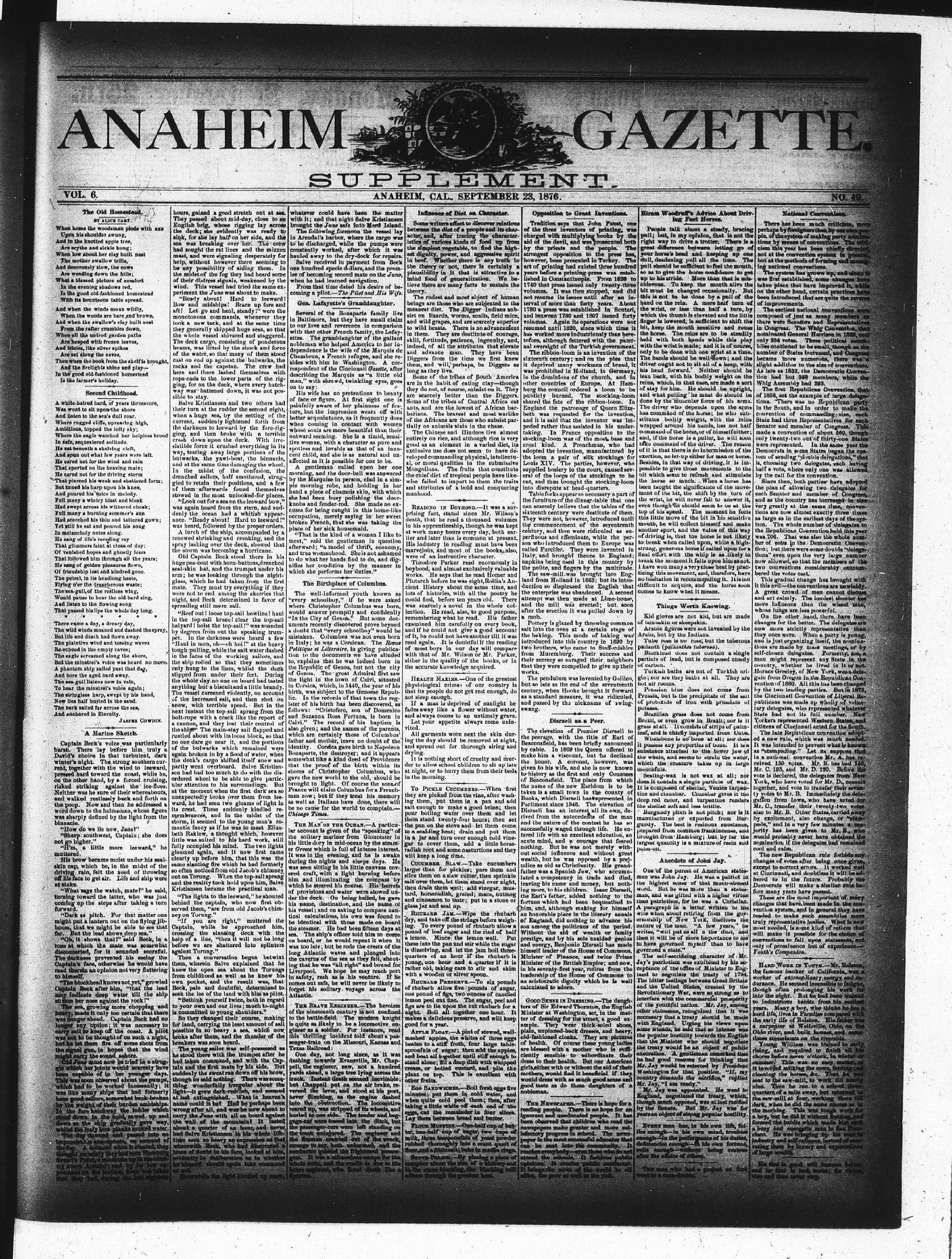
Searchable text
The Old Homestead.
BY ALICE CARY.
When home the woodsman plods with axe
Upon his shoulder swung,
And in the knotted apple tree,
Are scythe and sickle hung;
When low about her clay built nest
The mother swallow trills,
And decorously slow, the cows
Are wending down the hills;
What a blessed picture of comfort
In the evening shadows red,
Is the good old-fashioned homestead
With its bountiful table spread.
And when the winds moan wildly,
When the woods are bare and brown,
And when the swallow's clay built nest
From the rafter crumbles down,
When all the unfrood garden paths
Are heaped with frozen leaves,
And icicles, like silver spikes
Are set along the eaves,
Then when the book from the shelf is brought,
And the firelights shine and play—
In the good old-fashioned homestead
Is the farmer's holiday.
Second Childhood.
A white-haired bard, of years threescore,
Was wont to sit upon the shore
And listen to the sea's dull roar.
Where rugged cliffs, uprearing high,
Ambitious, topped the lofty sky;
Where the eagle watched her helpless brood
In safe, sequestered solitude.
He sat beneath a shelving cleft,
And spun out what few years were left.
He cared not for the wind and rain
That sported on the heaving main;
hours, gained a good stretch out at sea.
They passed about mid-day, close to an English brig, whose rigging lay across the deck; she evidently was ready to sink, for she lay half on her side, and the sea was breaking over her. The crew had sought the rat lines and the mizzen mast, and were signaling desperately for help, without however there seeming to be any possibility of aiding them. In the midst of the fog they had heard some of their distress signals, weakened by the wind. This vessel had tried the same experiment the Juno was about to make.
"Ready about! Hard to leeward!
Bow and midships! Brace up fore and aft! Let go and haul, steady!" were the monotonous commands, whenever they took a new tack, and at the same time they generally shipped huge seas, so that the whole vessel shivered and staggered. The deck cargo, consisting of ponderous beams, was lifted by the shock and force of the water, so that many of them stood cast on end up against the bulwarks, the racks and the capstan. The crew had here and there lashed themselves with rope-cords to the lower parts of the rigging, for on the deck, where every hatchway was batttened down, it was not possible to stay.
Salve Kristiansen and two others had their turn at the rudder the second night, when a huge sea, by the setting of the current, suddenly lightened forth from the darkness to leeward by the fore-rigging, and then broke with a terrible crash down upon the deck. With irresistible force it crushed everything in its way, tearing away large portions of the bulwarks, the yawl-boat, the binnacle, and at the same time damaging the wheel.
whatever could have with it; and that night brought the Juno safe in.
The following fornoom in Arendal's harbor, which to be discharged, while constantly worked, after hauled away to the dry-land.
Salve received in pay one hundred specie dollars of becoming second in when he had learned naïf.
From that time dated coming a pilot.—The P
Gen. Lafayette's Grief.
Several of the Bonaparte in Baltimore, but they lied to our love and reverence with that other French settlers. The granddaughter nobleman who helped A. dependence is the wife of Chambrun, a French rebel sides with him in Wash. respondent of the Cincinnati describing the Marquis de man," with shrewd, twin on to say:
His wife has no pretense of face or figure. At first painfully aware of her picture, but the impression better acquaintance, as if when coming in contact whose souls are more bear outward seeming. She is a vivid woman, with a charm spotless and lovable as a cent child, and she is as affected as it is possible.
A gentleman called
In the good old-fashioned homestead
Is the farmer's holiday.
Second Childhood.
A white-haired bard, of years threescore,
Was wont to sit upon the shore
And listen to the sea's dull roar.
Where rugged cliffs, uprearing high,
Ambitious, topped the lofty sky;
Where the eagle watched her helpless brood
In safe, sequestered solitude.
He sat beneath a shelving cleft,
And spun out what few years were left.
He cared not for the wind and rain
That sported on the heaving main;
He cared not for the driving storm
That pierced his weak and shattered form;
But tuned his harp upon his knee,
And poured his voice in melody.
Full many a wintry blast and bleak
Had swept across his withered cheek;
Full many a burning summer's sun
Had scorched his thin and tattered gown;
Yet still he sat and poured his song
In melancholy notes along.
He sang of life's receding ray
That glummer faint at close of day:
Of vanished hopes and ghostly fears
That followed him through all the years;
He sang of golden pleasures flown,
Of friendship lost and kindred gone.
The petrel, in its headlong haste,
Flying o'er the treacherous waste;
The sea-gull, of the realless wing,
Would pause to hear the old bard sing,
And listen to the flowing song
That passed his lips the whole day long.
There came a day, a dreary day,
The wild winds moaned and dashed the spray,
But life and death had flown away.
The plaintive wind and tossing waves
Re-echoed in the empty caves;
The eagle screamed along the shore,
But the minstrel's voice was heard no more.
A phantom ship sailed past that day,
And bore the aged bard away.
The sea-gull listens now in vain,
To hear the minstrel's voice again;
The stringless harp, swept by his hand,
Now lies half buried in the sand.
The bark sailed far across the sea,
And anchored in Eternity.
JASPER COWDIN.
A Marine Sketch.
Captain Beck's voice was particularly harsh. There lay before him truly a David's choice in that turbulent, dark winter's night. The strong southern current, together with the wind to leeward, pressed hard toward the coast, while he, on the other hand, by a forced cruising, risked striking against the ice-floes. Neither was he sure of their whereabouts, and walked restlessly back and forth on the poop. Now and then he addressed a word down to the helmaman, whose figure was sharply defined by the light from the binnacle.
"How do we lie now, Jens?"
"Sharp southwest, Captain; she does not go higher."
"H'm, a little more leeward," he muttered.
His brow became moist under his seal-skin cap, which he, in the midst of the driving rain, felt the seed of throwing off his face to get air. Life and ship were at stake.
Salve Kristiansen and two others had their turn at the rudder the second night, when a huge sea, by the setting of the current, suddenly lightened forth from the darkness to leeward by the fore-rigging, and then broke with a terrible crash down upon the deck. With irresistible force it crushed everything in its way, tearing away large portions of the bulwarks, the yawl-boat, the binnacle, and at the same time damaging the wheel. In the midst of the confusion, the drenched sailors, half smothered, struggled to retain their positions, and a few of them afterwards found themselves stowed in the most unlooked-for places.
"Look out for a sea on the leeward bow," was again heard from the stern, and suddenly the ocean had a whitish appearance. "Ready about! Hard to leeward!" was heard, followed by the proper orders.
A lurch of the ship, accompanied by a renewed shrieking and creaking, and the spray lashing over the deck, showed that the storm was becoming a hurricane.
Old Captain Beck stood there in his huge pea-coat with horn-buttonts,drenched seal-skin hat, and the trumpet under his arm; he was looking through the nightglass, which he had taken from the first mate. They must try everything if they were not to end among the skerries that night, and Beck determined in favor of spreading still more sail.
"Reef out! loose top-sail bowline! haul in the top-sail brace! clear the top-sail halyard! holst the top-sail!!" was sounded by degrees from out the speaking trumpet. In the darkness were heard a few "Haul in men, oh—oh hoil!" at the heavy tough pulling, while the salt water dashed in the faces of the working sailors, and the ship rolled so that they sometimes only hung to the lines, whilst the deck slipped from under their feet. During the whole day no one on board had tasted anything but a biscuit and a little brandy. The vessel careened violently, on account of the increased sail, and then shot on anew, with terrible speed. But in the next instant the top-sail sprang from the bolt-rope with a crack like the report of a cannon, and they lost their control of the ship. The main-stay sail flapped and rustled about with its loose block, so that no one dare go near it, and the portions of the bulwarks which remained were again broken in by a flood of water, when the deck's cargo shifted itself anew and partly went overboard. Salve Kristiansen had had too much to do with the disordered wheel to be able to give particular attention to his surroundings. But at the moment when the first dark sea so unexpectedly broke over them from leeward, he had seen two gleams of light in its crest. These suddenly kindled remembrances, and in the midst of the storm, it seemed to the young man's romantic fancy as if he was to meet Elizabeth Raklew, a thought which, however little was suited to his hard work, still fully occupied his mind. The two lights gleamed again, and it now first came clearly up before him, that this was the same slanting fire which he had formerly so often noticed from old Jacob's chimney out on Torung. When the top-sail sprang and the reality took hold upon him, Salve Kristiansen became the practical man.
Here and there lashed themselves with rope-ends to the lower parts of the rigging, for on the deck, where every hatchway was battened down, it was not possible to stay.
His wife has no pretense of face or figure. At first painfully aware of her picture butthe impression better acquaintance,as if when coming in contact whose souls are more bear outward seeming.She is a vive woman with a charm spotless and lovable as a cent child,and she is as affected as it is possible.
A gentleman called morning,andthe door-behindbythe Marquise in person ple morning robe,andhanda pieceof chamoisshehadbeenbusypollinknobsandfender-rod.cusesforbeing caughtinoccupation,merey sayi broken French,thethatsheplaceofhersickhouse
"The kind of a meet," saidthegentlerafterward;"a modelofaandtruewomanhood.Sheto dowhatherhandsfindnifiesherconditionbywhichsheperformsherme"
The Birthplace of
The well-informed boy "every schoolboy,"ifwhere Christopher Colu would answer promptly "IntheCityofGenoa."umentsrecentlydiscover达a doubt "everyschoolmistaken.ColumbuswasinItaly;hewasaCorsicaPolitiqueetLitteraire.intuitiontothedocumentswato,t explainsthathewasaRepublicofGenoa.bofGenoa.ThegreatAlightinthetownoninCorsicawhichin1440birth.wassubjecttothelic.Intherecordsoftheisterofhisbirthhasfollows:"Cristofero,sociandSuzannaRosaFortCalvi."Therecordoffalsogiven;andthenamewhicharecertainthosefatherandmother.leavetheidentity.Cordca gavebBonaparte,thedestroyersomewhatlikeakinddeattheproofoftheshoresofChristophergavethenewworldtotherought.tolight.OcfrancewillclaimColumbusmannow;butiftheytrustaswellasItalianshavebeeno causefortheworldChicagoTimes."
THE MAN ON THE OCEAN
laraccountisgivenofthesolitarymarinerfromhislittledoryinmid-oceaneGreecewhichisfullofItwasintheevening,a duringthenightsandaswasseen sittinginhislivedcraft.withalightthesteeredhiscountwhichhesteeredhiscount
Neither was he sure of their whereabouts, and walked restlessly back and forth on the poop. Now and then he addressed a word down to the helmsman, whose figure was sharply defined by the light from the binnacle.
"How do we lie now, Jens?"
"Sharp southwest, Captain; she does not go higher."
"Him, a little more leeward," he muttered.
His brow became moist under his seal-skin cap, which he, in the midst of the driving rain, felt the seed of throwing off his face to get air. Life and ship were at stake.
"What says the watch, mate?" he said, turning toward the latter, who was just coming up the steps after taking a turn forward.
"Dark as pitch. For that matter one might put a lantern out on the flying jib-boom, that we might be able to see that far. But the lead shows deep sea."
"Oh, it shows that!" said Beck, in a tone at which the mate was somewhat disconcerted, for it sounded scornful. The darkness prevented his seeing the Captain's face, otherwise he would have read therein an opinion not very flattering to himself.
"The blockhead knows not yet," growled Captain Beck after him, "that the lead may indicate deep water till the ship stalks her nose against the rock!"
The sea, growing more chopping and heavy, made it only too certain that there was danger ahead. Captain Beck had no longer any option; it was necessary to carry sail to keep off the coast. A pilot was not to be thought of on such a night, but he let them fire off some shots from the signal gun, in hopes that the wind might carry the sound ashore.
Old James must now be tried in a struggle which her joints would scarcely have been capable of in her younger days. This was soon observed about the pumps, which had to be worked incessantly; it was like many ships that had formerly been good sailors, somewhat bank-broken by the weight of their burden amidships. In the fore hatchway the ladder which stood down in the hold, sawed up and down as the ship gradually gave way, whilst the leafy how-planks sucked water.
The day dawned and passed into an impassable atmosphere, on account of the fog. A moment when it cleared, they thought narsily they had seen Hamburg Sound's Point, a mountain up in the countryside above Arendal; and by its low appearance on the harbour, here was taken that they had, during the last eight hours, at the moment when the first dark sea so unexpectedly broke over them from leeward, he had seen two gleams of light in its crest. These suddenly kindled remembrances, and in the midst of the storm, it seemed to the young man's romantic fancy as if he was to meet Elizabeth Raklew, a thought which, however little was suited to his hard work, still fully occupied his mind. The two lights gleamed again, and it now first came clearly up before him, that this was the same slanting fire which he had formerly so often noticed from old Jacob's chimney, out on Torung. When the top-sail sprang and the reality took hold upon him, Salve Kristiansen became the practical man.
"The lights to the leeward," he shouted behind the captain, who now first observed them, "are from old Jacob's chimney on Torung."
"If you are right," muttered the Captain, while he approached him, crossing the slanding deck with the help of a line, "then it will not be long before we are shattered into splinters against Torung."
Then a conversation began betwixt them, wherein Salve explained that he knew the open sea about the Torungs from childhood as well as he knew his own pocket, and the result was that Beck, pale and doubtful, determined to seek the lee of the land with him as pilot.
Bethink yourself twice, both in regard to your own and our lives; much to-night is committed to young shoulders.
So they changed their course, making for land, carrying the least amount of sail possible in so heavy a sea, which now broke after them, and the thunder of the breakers was soon heard.
The young sailor was self-possessed as he stood there with the trumpet after he had taken command, and with the Captain and the first mate by his side. But suddenly the sweat ran down off his brow, though he said nothing. There was something wonderfully irregular about the light—it grew dark-reddish, and seemed at last extinguished. What in heaven's name could be be? Had he perhaps been wrong after all, and was he now about to carry the June with all on board against the wall of the mountain! It lasted about a quarter of an hour, and never had Salve Kristiansen in his whole lifetime seen so heavy an expression as that wherewith Beck, who had discovered a treas of doubt in his face, looked at him, evidently in deliberation as to whether he himself should again take command or not.
Meanwhile the light kindled up more...
IM GAZ
SUPPLEMENT.
ANAHEIM, CAL., SEPTEMBER 23, 1876.
whatever could have been the matter with it; and that night Salve Kristiansen brought the Juno safe into Merd Island.
The following forenoon the vessel lay in Arendal's harbor, where the cargo was to be discharged, while the pumps were constantly worked, after which it was hauled away to the dry-dock for repairs.
Salve received in payment from Beck one hundred specie dollars, and the promise of becoming second mate on the Juno, when he had learned navigation.
From that time dated his desire of becoming a pilot.—The Pilot and His Wife.
Gen. Lafayette's Granddaughter.
Several of the Bonaparte family live in Baltimore, but they have small claim to our love and reverence in comparison with that other French family, the Lafayettes. The granddaughter of the gallant nobleman who helped America to her independence is the wife of the Marquis de Chambrun, a French refugee, and she resides with him in Washington. A correspondent of the Cincinnati Gazette, after describing the Marquis as "a little old man," with shrewd, twinkling eyes, goes on to say:
His wife has no pretensions to beauty of face or figure. At first sight one is painfully aware of her plainness of feature, but the impression wears off with better acquaintance, as it frequently does when coming in contact with women whose souls are more beautiful than their outward seeming. She is a timid, sensitive woman, with a character as pure and spotless and lovable as that of an innocent child, and she is as natural and unaffected as it is possible for one to be.
A gentleman called upon her one
Influence of Diet on Character.
Some writers affect to discover relations between the diet of a people and its character, and, after tracing the characteristics of various kinds of food up from the simplest vegetable, to find the highest dignity, power, and aggressive spirit in beef. Whether there is any truth in the theory or not, there is certainly a planability in it that is attractive to a mind fond of generalization. We believe there are many facts to sustain the theory.
The rudest and most abject of human beings are those who are subjected to the meanest diet. The Digger Indians subsist on lizards, worms, snails, field mice, and wild grapes, and are scarcely superior to wild beasts. There is no advancement in them. They are destitute of courage, skill, fortitude, patience, ingenuity, and indeed, of all the attributes that elevate and advance man. They have been Diggers from the time we first knew them, and will, perhaps, be Diggers as long as they live.
Some of the tribes of South America are in the habit of eating clay—though they do not, of course, subsist on it. They are scarcely better than the Diggers. Some of the tribes of Central Africa eat ants, and are the lowest of African barbarians. The bravest and most warlike of the Africans are those who subsist partially on animals slain in the chase.
The Chinese and Hindoos live almost entirely on rice, and although rice is very good as an element in a varied diet, its exclusive use does not seem to have developed commanding physical, intellectual, or moral qualities in the submissive Mongolians. The fruits that constitute
Opposition to Great Inventions.
Tradition says that John Paust, one of the three inventors of printing, was charged with multiplying books by the aid of the devil, and was prosecuted both by the priests and the people. The strongest opposition to the press has, however, been presented in Turkey. The art of printing had existed three hundred years before a printing-press was established in Constantinople. From 1620 to 1740 that press issued only twenty-three volumes. It was then stopped, and did not resume its issues until after an interval of more than forty years. About 1780 a press was established in Scutari, and between 1780 and 1807 issued forty volumes. Again its operations were not resumed until 1820, since which time it has worked more industriously than here-tofore, although fettered with the paternal oversight of the Turkish government.
The ribbon-loom is an invention of the sixteenth century; and on the pleas that it deprived many workmen of bread, it was prohibited in Holland, in Germany, in the dominions of the church, and in other countries of Europe. At Hamburg the council ordered a loom to be publicly burned. The stocking-loom shared the fate of the ribbon-loom. In England the patronage of Queen Elizabeth was requested for the invention, and it is said that the inventor was impeded rather than assisted in his undertaking. In France opposition to the stocking-loom was of the most base and cruel kind. A Frenchman, who had adopted the invention, manufactured by the loom a pair of silk stockings for Louis XIV. The parties, however, who supplied baskets to the court caused sergey.
Hiram Wood
People try pull; but right way great difference your horse's dull, deaden pull should so as to give up to his stright chievous. "Bit must be this is not hand on the wrist, which the finger is low bit, keep tha' horse." Hold with hand with wrinkle only to be done. The hands are driver ought his head for lean back; we reins which of stay for hood what put done by thy Driver we has commandeers attutes bush wrapped arm command of it; if he take commandeers it of it that exertion; no Beeside; in this possible to be
The Birthplace of Columbus.
The well-informed youth known as "every schoolboy," if he were asked where Christopher Columbus was born, would answer promptly and confidently "In the City of Genoa." But some documents recently discovered prove beyond a doubt that "every schoolboy" would be mistaken. Columbus was not even born in Italy; he was a Corsican. The Revue Politique et Litteraire, in giving publication to the documents we have alluded to, explains that he was indeed born in the Republic of Genoa, but not the city of Genoa. The great Admiral first saw the light in the town of Calvi, situated in Corsica, which, in 1440, the year of his birth, was subject to the Genoese Republic. In the records of that town the register of his birth has been discovered, as follows: "Cristofero, son of Domenico and Suzanna Rosa Fortuna, is born in Calvi." The record of his baptism is also given; and the names of the parents, which are certainly those of Columbus' father and mother, leave no doubt of the identity. Corsica gave birth to Napoleon Bonaparte, the destroyer; and it appears somewhat like a kind deed of Providence that the proof of the birth within its shores of Christopher Columbus, who gave the new world to the old, should be brought to light. Of course the sons of France will claim Columbus for a Frenchman now; but if they treat his memory as well as Italians have done, there will be no cause for the world to complain.
Chicago Times.
The Man on the Ocean. A particular account is given of the "speaking" of the solitary mariner from Gloucester in his little dory in mid-ocean by the steamer Greece which is full of intense interest. It was in the evening, and he is awake during the nights and sleeps days. He was seen sitting in his little canvass covered craft, with a light burning before him and illuminating the compass by which he steered his course. His barrels
Cucumber Slaw. Take cucumbers larger than for pickles; pare them and slice them on a slaw cutter, then sprinkle salt over them, let them stand over night, then drain them well; add vinegar, muscled as old as Christianity. His grandfather was a Spanish Jew, who accumulated a competency in trade and died, leaving his name and money, but nothing more to his children.
Disraeli as a Peer.
The elevation of Premier Disraeli to the peerage, with the title of Earl of Beaconsfield, has been briefly announced by cable. In 1869 the Queen offered to make him a viscount, but she declined the honor. A coronet, however, was given to his wife, and she is now known to history as the first and only Countess of Beaconsfield. The place from which the name of the new Earldom is to be taken is a small town in the county of Buoks, which Disraeli has presented in Parliament since 1846. The elevation of Disraeli has an interest all its own, derived from the antecedents of the man and the nature of the contest he has so successfully waged through life. He entered life with an excellent education, an acute mind, and a courage that feared nothing. But he was not merely without social influence and without great wealth, but he was opposed by a prejudice as old as Christianity. His grandfather was a Spanish Jew, who accumulated a competency in trade and died, leaving his name and money, but nothing more to his children.
One of the men was John the highest...
THE MAN ON THE OCEAN.—A particular account is given of the "speaking" of the solitary mariner from Gloucester in his little dory in mid-ocean by the steamer Greece which is full of intense interest. It was in the evening, and he is awake during the nights and sleeps days. He was seen sitting in his little canvass covered craft, with a light burning before him and illuminating the compass by which he steered his course. His barrels of provisions and water were stowed under the deck. On being hailed, he gave his name, destination, and the name of his vessel; and on asking to compare nautical calculations, his own was found to be identical with those made on board the steamer. He had been fifteen days at sea. The ship's officer told him to come on board, or he would repent it when it was too late; but he rode the crests of the long Atlantic waves and plunged into the caverns of the sea as they fell, shouting that he was "all right" and bound for Liverpool. We hope he may reach port in safety, rash as is his venture. If he comes out safe, he will never be likely to forget his solitary voyage across the Atlantic.
THE BRAVE ENGINEER.—The heroism of the nineteenth century is not confined to the battle-field. The modern knight is quite as likely to be a locomotive engineer as a soldier. For instance, read this thrilling incident told about a passenger-train on the Missouri, Kansas and Texas Railroad:
One day, not long since, as it was dashing towards Evansville, Mr. Chappell, the engineer, saw, not a hundred yards ahead, a large tree lying across the track. Instant death seemed inevitable; but Chappell put on the air brake, reversed the lever, and stood at his post, never flinching, as the engine dashed into the obstruction. The locomotive reared up, was stripped of its wheels, and hurled to one side. The tender and baggage-car were tossed into the ditch, but the passenger-cars were left standing on the track unlurred. The engineer and the fireman marveled out of the wreck, strange to say, both unharmed, and the conductor quilted the brightened man-gun. It was a miserable escape for the whole train, and the credit is due to the horse engineer, who fixed death like a figurine.
GOOD SENSE IN DRESSING.—The daughters of Sir Edward Thornton, the English Minister at Washington, set, in the master of dressing for the street, a good example. They wear thick-soled shoes, plain, unpinned-back dresses, and heavy, old-fashioned cloaks. They are pictures of health. Of course these young ladies are blessed with a mother who is sufficiently sensible to subordinate their dress to their health. But our American girls, either with or without the aid of their mothers, would find it beneficial if they would dress with as much good sense and good taste as do these daughters of a nobleman.
THE NEWSPAPER.—There is hope for a reading people. There is no hope for an ignorant and uneducated people. It has been observed that children who read the newspapers make greater and more satisfactory progress in school. The newspaper is the most successful ednuder that can be sent into the community. It machines roughly even those who do not attend the schools. It fashion public opinions. It creates public sentiment. It brings the news of the world to all alike, the poor as well as the rich.
GAZETTE.
NO. 49.
Inventions.
An Faust, one printing, was books by the prosecuted both people. The press has, Turkey. The three hundred was established after an in-years. About and in Scutari, issued forty dons were not which time it easily than here with the paternal government. Invention of the plea that men of bread, it in Germany, church, and in At Ham loom to be stocking-loom bon-loom. In Queen Eliza the invention, mentor was imminent in his under-sition to the most base and man, who had manufactured by stockings for however, who caused ser
Hiram Woodruff's Advice About Driving Fast Horses.
People talk about a steady, bracing pull; but, in my opinion, that is not the right way to drive a trotter. There is a great difference between letting go of your horse's head and keeping up one dull, deadening pull all the time. The pull should be sufficient to feel the mouth, so as to give the horse confidence to get up to his stride. More than that is mischievous. To keep the mouth alive the bit must be changed occasionally. But this is not to be done by a pull of the hand on the rein. A mere half turn of the wrist, or less than half a turn, by which the thumb is elevated and the little finger is lowered; is sufficient to shift the bit, keep the mouth sensitive and rouse the horse. The reins are to be steadily held with both hands while this play with the wrist is made; and it is of course, only to be done with one wrist at a time. The hands should be well down; and the driver ought not to sit all of a heap, with his head forward.' Neither should he lean back, with his bodily weight on the reins, which, in that case, are made a sort of stay for him. He should be upright, and what pulling he must do should be done by the muscular force of his arms. The driver who depends upon the arms has command of the horse; he who substitutes bodily weight, with the reins wrapped around his hands, has not half command of the horse, or of himself either; and, if the horse is a puller, he will soon take command of the driver. The reason of it is that there is no intermission of the exertion, no let-up either for man or horse. Besides, in that way of driving, it is impossible to give those movements to the
National Conventions.
There has been much criticism, more perhaps by foreigners than by our own people, of the system of making party nominations by means of conventions. The criticism this year has been chiefly directed not at the convention system in general, but at the methods of forming and managing national conventions.
The system has grown up, and since it was first established, some changes have taken place that have improved it, while on the other hand, certain practices have been introduced that are quite the reverse of improvements.
The earliest national conventions were composed of just as many members as there were Senators and Representatives in Congress. The Whig Convention, that nominated General Harrison in 1820, cast only 254 votes. These political assemblies continued to be small, though as the number of States increased, and Congress became more numerous, there was a slight addition to the size of conventions. As late as 1852, the Democratic Convention had but 280 members, while the Whig Assembly had 293.
The first Republican Convention, that of 1856, set the example of large delegations. There was no Republican party in the South, and in order to make the convention of commanding size, each State had three Representatives for each Senator and member of Congress. This made a convention of about 560, though only twenty-two out of thirty-one States were represented. In the same year the Democrats in some States began the custom of sending "double delegations," that is, choosing two delegates each having half a vote where only one was allowed.
In Germany, in the church, and in the state of stocking-loom loom-loom.
At Hammong, he loom to be stocking-loom loom-loom.
In Queen Elizabeth II's invention, the loom was imitated by his under-sition to the most base and man who had manufactured by stockings for however, who hurt, caused sestockings to be stocking-loom loom-loom.
Assess a part of the table that one of the tables of the institute of them. Produced until the seventeenth century as suphile the perEurope was invented in England; is country by multitude. Right into Engbut its introduction English that ended. A second Lime-house,
but soon filled down by
wing common strain stage of baking was in 1890 by Staffordshire success and their neighbors give up their
seventeenth right it forward was ridiculed, one of swingwer.
Mr Disnelli to sons of Earl of Earl of newly announced offered to the declined however, was now known only Countess from which town is to be county of represented in elevation of its own, deof the man that he has so life. He enreducation, an idea that feared merely without great difficulty with by a prejHis grand-who accumuble died, but notothDisnelli.
One of the purest of American statesmen was John Jay. He was a patriot in the highest sense of that much abused word. But he was more than a statesman.
As late as 1832, the Democratic Convention had but 288 members, while the Whig Assembly had 293.
The first Republican Convention, that of 1856, set the example of large delegations. There was no Republican party in the South, and in order to make the convention of commanding size, each State had three Representatives for each Senator and member of Congress. This made a convention of about 660, though only twenty-two out of thirty-one States were represented. In the same year the Democrats in some States began the custom of sending "double delegations," that is, choosing two delegates, each having half a vote, where only one was allowed by the call for the convention.
Since then, both parties have adopted the plan of allowing two delegates for each Senator and member of Congress, and as the country has increased in size greatly at the same time, conventions are now almost exactly three times as large as in the earliest days of the system. The whole number of delegates to the Republican Convention held this year was 706. That was also the whole number of votes in the Democratic Convention; but there were some double "delegations" even upon the very large number now allowed, so that the members of the two conventions considerably outnumbered the votes cast.
This gradual change has brought with it this evil—the conventions are unwieldy. A great crowd of men cannot discuss and act calmly. The loudest shouter has more influence than the wisest man, whose lungs are less powerful.
On the other hand, there have been changes for the better. The delegates are now more strictly representative than they once were. When a party is young, and is just organizing itself, the nominations are made by mass meetings, or by self-chosen delegates. Formerly, too, a man might represent any State in the country, whether he lived in it or not. Horace Greeley, of New York, was a delegate from Oregon in the Republican Convention of 1860. All this has been changed by the two leading parties. But in 1872, the Cincinnati Convention of Liberal Republicans was made up wholly of voluntary delegates, who represented whatever State had not its full number. New Yorkers represented Western States, and citizens of Clucknail acted for the South.
The late Republican convention adopted a new rule, which was much needed. It was intended to prevent what is known as "stampeding." Let no suppose that in a national convention Mr. A has received 150 votes. Mr. B has had 140, Mr. C. 135, and Mr. D. 120. Before the vote is declared, the delegates from New York, who have voted for Mr. D., consult together, and vote to transfer their seventy votes to Mr. B. Immediately the delegation from Iowa, who have voted for Mr. C., transfer their twenty-two votes also to Mr. B. Other States carried away by excitement, also change, or "stampede," and in a very few minutes a majority has been given to Mr. B., who would probably never have obtained the nomination if the delegates had remained cool and calm.
The new Republican rule forbids any changes of votes after being once given except to correct errors. It worked well at Cincinnati, and doubtless it will be adhered to in the future. Probably the Democrats will make a similar rule la-
Anecdote of John Jay.
One of the purest of American statesmen was John Jay. He was a patriot in the highest sense of that much abused word. But he was more than a statesman, and was gifted with a higher virtue than patriotism, for he was a Christian. A paragraph in a letter written to his wife when about retiring from the governorship of New York, discloses the nature of the man. "A few years," he writes, "will put us all in the dust, and then it will be of more importance to me to have governed myself than to have governed a state."
The self-sacrificing character of Mr. Jay's patriotism was exhibited by his acceptance of the office of Minister to England to negotiate the treaty of 1794. The bitter feelings between Great Britain and the United States, created by the Revolutionary War, were so strong as to interfere with the commercial prosperity of the youthful nation. Mr. Jay, among other statesmen, recognized that it was necessary that a treaty should be made with England. Urging his views upon some friends, he said that so intense was the popular hostility towards the English that the Minister who should negotiate the treaty would be an object of public execution. A gentleman remarked that he had good reasons for thinking that Mr. Jay would be selected by President Washington for that position. "If, my country demands the sacrifice," replied Mr. Jay, "I am ready."
Mr. Jay was appointed. He went to England, negotiated the treaty, which, though much opposed, was last ratified by the Senate. But Mr. Jay was for years an object of strong popular hostility.
Every man has, in his own life, follies enough—in his own mind, troubles enough—in the performance of his duties, deficiencies enough—in his own fortune, evils enough—without being curious after the affairs of others.
The man who had a project on foot went to a corn-doctor.
The new Republican rule forbide any changes of votes after being once given except to correct errors. It worked well at Cincinnati, and doubtless it will be adhered to in the future. Probably the Democrats will make a similar rule before many years have passed.
These are the most important of many changes that have been made in the convention system, and in general they have tended to make such assemblies more truly representative bodies. What is now most needed, is some kind of reform that will make it possible for the choice of conventions to fall upon statesmen, not only of prominence but of experience—Youth's Companion.
HARD WORK IN YOUTH—Mr. Ralston, the famous banker of California, was a worker of extraordinary energy and endurance. He seemed insensible to fatigue, though often prolonging his work far into the night. But he had been trained to industrious habits from his earliest years. Many a boy, who thinks he has a hard life, lives in Paradise compared with the early life of Ralston. His father was a carpenter at Wellsville, Ohio, on the Ohio river, and built houses, and sometimes steamboats on the riverside.
Young William was trained to early rising, and required to finish all his chores before seven o'clock, in winter or summer. This was no easy matter, as it involved milking the cows, feeding and cleaning the horses, &c. Then he was sent to the saw-mill, to work till nearly nine. Then he ran to a school three-quarters of a mile away, but returned to the saw-mill at four working there till dark, when he did the same chores as in the morning. This was tough work for a boy, but he did it without fratting, and formed the habits which made him such a busy and energetic man in San Francisco. He was bringing up his son to industry and self-reliance instead of encouraging them by luxury and expatriations of large wealth.
He that is good will become better, and her that is bad worse; for virtue vice and time never stop.