anaheim-gazette 1876-09-23
Scanned page
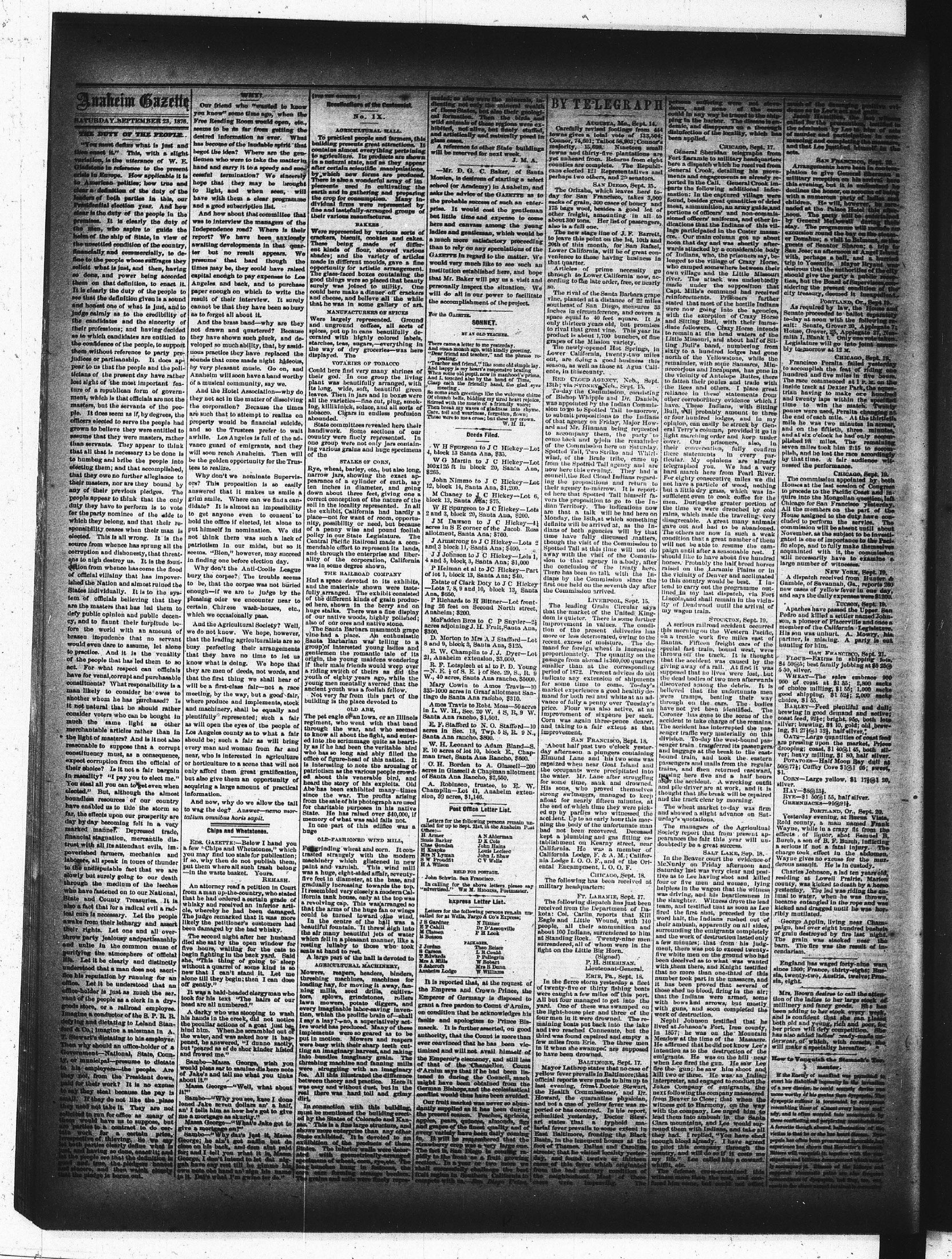
Searchable text
INAKEIM GAZETTE
SATURDAY SEPTEMBER 23, 1876.
THE DUTY OF THE PEOPLE.
"You must define what is just and then enact it." This, with a slight variation, is the utterance of W. E. Gladstone in reference to the present crisis in Europe. How applicable it is to American politics; how true and clear a definition of the duty of the leaders of both parties in this, our Presidential election year. And how clear is the duty of the people in the premises. It is clearly the duty of the men, who aspire to guide the helm of the ship of State, in view of the unsettled condition of the country, financially and commercially, to define to the people whose suffrages they solicit what is just, and then, having so done, and power being accorded them on that definition, to enact it. It is clearly the duty of the people to see that the definition given is a sound and honest one of what is just, and to judge calmly as to the credibility of the candidates and the sincerity of their professions; and having decided as to which candidates are entitled to the confidence of the people, to support them without reference to party prejudices or partisanship. It does appear to us that the people and the politicians of the present day have rather lost sight of the most important feature of a republican form of government, which is that officials are not the masters, but the servants of the people. It does seem as if, by degrees, the officers elected to serve the people had grown to believe they were entitled to assume that they were masters, rather than servants. They appear to think that all that is necessary to be done is to humbug and bribe the people into electing them; and that accomplished.
WHY?
Our friend who "wanted to know you know" some time ago, when the Free Reading Room would open, etc., seems to be far from getting the desired information as ever. What has become of the landable spirit that begot the idea? Where are the gentlemen who were to take the matter in hand and carry it to a speedy and successful termination? We sincerely hope that they may be brought to light, and when seen, will have with them a clear programme and a good subscription list.
And how about that committee that was to interview the managers of the Independence road? Where is their report? We have been anxiously awaiting developments in that quarter but no result appears. We presume that hard though the times may be, they could have raised capital enough to pay expenses to Los Angeles and back, and to purchase paper enough on which to write the result of their interview. It surely cannot be that they have been so busy as to forget all about it.
And the brass band—why are they not drawn and quartered? Because they have shown such pluck, and developed so much ability, that, by assiduous practice they have replaced the sounds that once made night hideous, by very pleasant music. Go on, and Anaheim will soon have a band worthy of a musical community, say we.
And the Hotel Association—why do they not act in the matter of dissolving the corporation? Because the times are such that to attempt to realize on property would be financial suicide, and so the Trustees prefer to wait awhile. Los Angeles is full of the advance guard of emigrants, and they will soon reach Anaheim. Then will be the golden opportunity for the Trustees to realize.
WERE REPRESENTED CRACKERS, BLADEES AND AHADES; AND THE MADE IN DIFFERENT OPPORTUNITY FOR THE GLASS-FACED GOOD THINGS WE SURELY WAS JOB CULLED HERE MAKING AND CHEESE, AND THAT HE WAS IN MANUFACTURE.
WERE LARGELY AND UNGROUND SPLICES, PUT UP IN CORRATED WITH STARCHEES, TEAS, SUCH THE WAY OF DRIVING DISPLAYED.
VOTARIUM
Could here find their god. In a plant was beautiful its long, wide leaves. Then in all the varieties ing, killikinick, tobacco. Cigars abounded.
State committee handiwork. So country were fine one group were ing various grains of the
STALKER.
Rye, wheat barley.
citizens of the present day have rather lost sight of the most important feature of a republican form of government, which is that officials are not the masters, but the servants of the people. It does seem as if, by degrees, the officers elected to serve the people had grown to believe they were entitled to assume that they were masters, rather than servants. They appear to think that all that is necessary to be done is to humbug and bribe the people into electing them; and that accomplished, that they owe no further allegiance to their masters, nor are they bound by any of their previous pledges. The people appear to think that the only duty they have to perform is to vote for the party nominee of the side to which they belong, and that their responsibility ceases when their man is elected. This is all wrong. It is the source from whence has sprung all the corruption and dishonesty, that threatens to nigh destroy us. It is the foundation from whence has come the flood of official villainy that has impoverished the Nation and almost ruined the States individually. It is to the system of officials believing that they are the masters that has led them to defy public opinion and public decency, and to flaunt their turpitude before the world with an amount of brazen impudence that no servant would even dare to assume, let alone to practice. And it is the venality of the people that has led them to so act. For what respect can officials have for venal, corrupt and purchasable constituents? What responsibility is a man likely to consider he owes to another whom he has purchased? Is it not natural that he should rather consider voters who can be bought in much the same light as other merchantable articles rather than in the light of masters? And is it not also reasonable to suppose that a corrupt constituency must, as a consequence, expect corruption from the official of their choice? Is it not a fair bargain in rascallity? "I pay you to elect me." You steal all you can to get even when elected." But, although the almost boundless resources of our country have enabled us to tide the storm so far, the effects upon our prosperity are day by day becoming felt in a very marked manner. Depressed trade, financial stagnation, mercantile distrust with all its attendant evils, impoverished farmers, mechanics and laborers, all speak in tones of thunder to the undisputable fact that we are slowly but surely going to our death through the medium of the leeches.
And the Hotel Association—why do they not act in the matter of dissolving the corporation? Because the times are such that to attempt to realize on property would be financial suicide, and so the Trustees prefer to wait awhile. Los Angeles is full of the advance guard of emigrants, and they will soon reach Anaheim. Then will be the golden opportunity for the Trustees to realize.
Why don’t we nominate Supervisors? This proposition is so easily answered that it makes us smile a grim smile. Where can we find a candidate? It is almost an impossibility to get anyone even to consent to hold the office if elected, let alone put himself in nomination. We did not think there was such a lack of patriotism in our midst, but so it seems. "Bion," however, may succeed in finding one before election day.
Why don't we Anti-Coolie League bury the corpse? The trouble seems to be, that the corpse was not buried enough—if we are to judge by the pleasing odor we encounter near to certain Chir ese wash-houses, etc., which we occasionally pass.
And the Agricultural Society? Well, we do not know. We hope, however, that the leading agriculturalists are so busy perfecting their arrangements that they have no time to let us know what is doing. We hope that they are men of deeds, not words, and that the first thing we shall hear of will be a first-class fair—not a race meeting, by the way, but a good fair, where produce and implements, stock and machinery, shall be equally and plentifully represented; such a fair as will open the eyes of the people of Los Angeles county as to what a fair should be; such a fair as will bring every man and woman from far and near, who is interested in agriculture or horticulture to a scene that will not only afford them great gratification, but also give them an opportunity of acquiring a large amount of practical information.
And now, why do we allow the tail to wag the dog? Answer—nemo mortalium omnibus horis sapit.
Chips and Whetstones.
EDS. GAZETTE:—Below I hand you a few "Chips and Whetstones," which you may find too stale for publication; if so, why then do not publish them, put them where all such trash belong—in the waste basket. Yours.
REHASH.
An attorney read a petition in Court Anaheim will soon have a hand worthy of a musical community, say we.
And the Hotel Association—why do they not act in the matter of dissolving the corporation? Because the times are such that to attempt to realize on property would be financial suicide, and so the Trustees prefer to wait awhile. Los Angeles is full of the advance guard of emigrants, and they will soon reach Anaheim. Then will be the golden opportunity for the Trustees to realize.
Why don’t we nominate Supervisors? This proposition is so easily answered that it makes us smile a grim smile. Where can we find a candidate? It is almost an impossibility to get anyone even to consent to hold the office if elected, let alone put himself in nomination. We did not think there was such a lack of patriotism in our midst, but so it seems. "Bion," however, may succeed in finding one before election day.
Why don’t we nominate Supervisors? This proposition is so easily answered that it makes us smile a grim smile. Where can we find a candidate? It is almost an impossibility to get anyone even to consent to hold the office if elected, let alone put himself in nomination. We did not think there was such a lack of patriotism in our midst, but so it seems. "Bion," however, may succeed in finding one before election day.
The pet eagle of an regiment, who went through the war to know all about his duties as if he had been who has so long as office of figure-heart is interesting to our patriotism as he heard the story of Abe has been exiled since the war from the sale of his for charitable purge State. He has rushed memory of what we In one part of huge
OLD-FASHION
For grinding where trasted strangely by machinery which paint and varnish was a huge, eight-feet in diameter gradually increased
But, although the almost boundless resources of our country have enabled us to tide the storm so far, the effects upon our prosperity are day by day becoming felt in a very marked mannef. Depressed trade, financial stagnation, mercantile distrust with all its attendant evils, impoverished farmers, mechanics and laborers, all speak in tones of thunder to the undisputable fact that we are slowly but surely going to our death through the medium of the leeches who have fastened on to our National, State and County Treasuries. It is also a fact that for a radical evil a radical cure is necessary. Let the people awake from their lethargy and assert their rights. Let one and all overthrow party jealousy and partisanship and unite in the common cause of purifying the atmosphere of official life. Let it be clearly and distinctly understood that a man does not sacrifice his reputation by running for an office. Let it be understood that an office-holder is just as much the servant of the people as a clerk in a dry goods store, or a railroad employee. Imagine a conductor of the S. P. R. R. defying and dictating to Leland Stanford & Co.; imagine a salesman in A. T. Steward's dictating to his employer. Then why should an office-holder of a Government—National, State, County, or municipal—presume to dictate to his employers—the people. Are they not, from the President down, paid for their work? It is no excuse to say they steal because the pay is small. If they do not like the place they used not take it. They are not solicited to run for office as many of them would have us to suppose, but are parties to a contract to do certain work for a certain price, irrespective of thriving, do we say let both parties clearly define what is just, and having so done, enact it; and let the people see that the definition is good and true, the pladges honest and sincere, and then waith closely that the pledge is borne out.
And now, why do we allow the tail to wag the dog? Answer—nemo mortalium omnibus horis sapit.
Chips and Whetstones.
EDS. GAZETTE:—Below I hand you a few "Chips and Whetstones," which you may find too stale for publication; if so, why then do not publish them, put them where all such trash belong—in the waste basket. Yours.
REHASH.
An attorney read a petition in Court from a man up-the-country, who stated that he had ordered a certain grade of whisky and received an inferior article, whereby he had been damaged. The judge remarked that it was more likely the petitioner's customers had been damaged by the bad whisky.
The second night after her husband died she sat by the open window for five hours, waiting for the cats to begin fighting in the back yard. Said she, "This thing of going to sleep without a quarrel of some kind is so new that I can't stand it. Let me alone till they begin; then I can dose off gently."
It was a bald-headed clergyman who took for his text "The hairs of our head are all numbered."
A darky who was stooping to wash his hands in the creek, did not notice the peculiar actions of a goat just behind him. When he scrambled out of the water, and was asked how it happened, he answered, "I dunno zactly, but 'peared as if de shor kinder histed and frowed me."
Samba—Massa George, wish you would pleas ear to sanine dis here note of Jake's and tell me what you tinks about it."
Massa George—"Well, what about it?"
Samba—"Why you see, kase I done lone Jake seven dollars an' a half, an' I tells him as how he's got to give me a mortgage as skurity."
Massa George—"What's Jake got to give a mortgage an?"
Samba—"Why dai's Just it, Massa George; he ain't got nuffin but do close on his back, and denaint paid far; and I tell you what it is, Massa George; I don't intend to let dat nigah have any rest till he gimme his own name she hand an' sign his name to it. Daï's what I'm gwine ter da."
RECENTATIONS OF THE CONTINUAL.
NO. IX.
AGRICULTURAL HALL.
To practical people and farmers, this building presents great attractions. It contains almost everything pertaining to agriculture. Its products are shown in a natural state, and as they appear after certain scientific manipulations, by which new forms are produced. There is also a wonderful array of implements used in cultivating the earth and in gathering and preparing the crop for consumption. Many individual firms were represented by fine and tastefully-arranged groups of their various manufactures.
BAKERS.
Were represented by various sorts of crackers, biscuit, cookies and cakes. These being made of different kinds of flour, showed various shades; and the variety of articles made in different moulds, gave a fine opportunity for artistic arrangement. The glass-faced boxes containing the good things were so placed that beauty surely was joined to utility. One could here make a dinner off crackers and cheese, and believe all the while that he was in some gallery of art.
MANUFACTURERS OF SPICES
Were largely represented. Ground and unground coffees, all sorts of spices, put up in cans beautifully decorated with highly colored labels, starches, teas, sugars—everything in the way of dry groceries—was here displayed. The VOTARIES OF TODACCO
Could here find very many shrines of their god. In one group the living plant was beautifully arranged, with its long, wide, soft, beautiful green leaves. Then in jars and in boxes were all the varieties—fine cut, plug, smoking, killikinick, solace, and all sorts of tobacco. Cigars in endless profusion abounded.
State committees revealed here their handiwork. Some sections of our country were flucely represented. In one group were not only jars containing various grains and huge specimens of the STALKS OF CORN,
Rye, wheat barley, etc., but also long sanded; so also were the minerals, indicating not only the mineral wealth of these States, but also their geological formation. Then the birds and wild animals of these regions were exhibited, not alive, but finally stuffed, and artistically and naturally posed in glass cases.
A reference to other State buildings will be reserved for next week.
J. M. A.
Mr. D. G. C. Baker, of Santa Monica, is dairous of starting a select school (or Academy) in Anaheim, and asks the advice of the GAZETTE as to the probable success of such an enterprise. It would cost the gentleman but little time and expense to come here and canvass among the young ladies and gentleman, which would be a much more satisfactory proceeding than to rely on any speculations of the GAZETTE in regard to the matter. We would very much like to see such an institution established here, and hope that Mr. Baker will pay us a visit and personally inspect the situation. We will do all in our power to facilitate the accomplishment of the project.
FOR THE GAZETTE.
SONNET.
BY AN OLD TEACHER.
There came a letter to me yesterday,
And on a month ago, with kindly greeting,
"Dear friend and teacher," and the phrase repeating,
"Teacher and friend," like some old simple lay.
And happy is my heart's responsive beating
When some old pupil now in manhood's prime,
And I touched also by the hand of Time,
Clasp each the friendly hand, the glad eyes meeting.
So come auch greetings like the welcome chime Of church bells, bidding my tired heart rejoice,
Stirred with the music of a friendly voice;
Then break my waves of gladness into rhyme.
Care, toll and weariness, forgotten, flown;
Those were to me a cross; but these my crown.
W. H. H.
Deeds Filed.
W H Spurgeon to J C Hickey—Lot 4, block 13 Santa Ana, $35.
W G Martin to J C Hickey—Lot 100x125 ft in block 20, Santa Ana.
RED CLOUD ADNNCY, Neb., Sept. 13th; via SYDNEY, Neb., Sept. 15.
To-day the Commission, consisting of Bishop Whipple and Dr. Daniels, was appointed by the Indian Commission to go to Spotted Tail to-morrow, to submit propositions to the Indians of that agency on Friday, Major Howard and Mr. Hinman being requested to accompany them, the party to come back and rejoin the remainder of the Commission here on Saturday. Spotted Tail, Two Striko and Whirlwind, of the Brule tribe, came up from the Spotted Tail agency and are now here this evening. They had a council, the Red Cloud Indians regarding the propositions and return to their agency to-morrow. It is reported here that Spotted Tail himself favors the proposition to go to the Indian Territory. The indications now are that a talk will be had on Monday, the 18th, at which something definite will be arrived at, as the Indians of both agencies will by that time have fully discussed matters, though the visit of the Commission to Spotted Tail at this time will not do away with the visit of the Commission to that agency in a body, after the conclusion of the treaty here. There has been no talk with the Indians by the Commission since the first one held on the seventh day after the Commission arrived.
LIVERPOOL, Sept. 15.
The leading Grain Circular says that the market of the United Kingdom is quieter. There is some further improvement in values. The condition of the present deliveries has more or less deteriorated, owing to the recent, excess of moisture. The demand for foreign wheat is increasing proportionately. The quantity on the passage from abroad is 360,000 quarters smaller than at the corresponding period of 1872. Present advice does not indicate any extension of shipments for some time to come. To-day's market experiences a good healthy demand for both red and white at an advance of fully a penny over Tuesday's price. Flour was also active, at an improvement of sixpence per sack. Corn was again three-pence dearer, and taking to a fair extent at that improvement.
SAN FRANCISCO, Sept. 18.
About half past two o'clock yesterday afternoon a plungers containing Elmund Lane and his two sons was capsized when near Goat Island and the occupants were precipitated into the water. Mr. Lane after struggling for some time, snaked and drowned. His sons, who proved themselves strong swimmers, managed to keep afloat for nearly fifteen minutes, at the end of which time they were picked up by parlies who witnessed the accident. Up to an early hour this morning the body of the unfortunate man had not been recovered. Decased kept a plumbing and gas fitting establishment on Kearny street, near California. He was a member of California Lodge, F. & A. M.; California Lodge I. O. O. F., and of the Oriental Encampment, I. O. O. F.
CHICAGO, Sept. 18.
The following has been received at military headquarters:
OLD-FASHIONED WIND MILL,
For grinding wheat and corn. It contrasted strangely with the modern machinery which glistened in new paint and varnish. This wind mill was a huge, eight-sided affair, seventy-five feet in diameter, at the base, and gradually increasing towards the top. It resembled very closely a modern California tank house, only at the top was a revolving cap. This was arranged so that the arms of the huge fan or wings could be turned toward the wind.
In the centre of the hall was a beautiful fountain. It threw algh into the air many beautiful jets of water which fell in a pleasant manner, like a resting lullaby to those who took seats at hand to rest.
A large part of the hall is devoted to AGRICULTURAL MACHINERY,
Mowers, reapers, headers, binders, threshing machines, machines for loading hay, for moving it away, fanning mills, seed drills, cultivators, splows, grindstones, rollers lawn mowers, potato diggers, and every imaginable labor-saving invention, which the prolific brain of—shall I say a lazy?—no, a superlatively active world has produced. Many of these implements were so geared as to be put in motion. Mowers and reapers were busy with their sharp teeth cutting an imaginary harvest, and raking into bundles imaginary grain. The threshing machine and fanning mills were struggling with an imaginary foe. All this illustrated the difference between theory and practice. Here it was easy and without dust, but in the real there was hard toll and grimy dirt.
In connection with this building, must be mentioned the building erected by the States of Colorado and Kansas. This is a fine large structure, and shows more enterprise than any other State exhibited. It is devoted to an exhibition of the products of these States. The interior walls were decorated with geometrically-arranged specimens of wheat, corn, rye, etc. The long hunches hang in latitudes, the corn ears forming strange beams. The grains and units were finally represented.
It is reported that, at the request of the Empress and Crown Prince, the Emperor of Germany is disposed to grant a free pardon to Count d'Arnim, on condition that he acknowledges his faults and apologizes to Prince Bismarck. It is further asserted, on good authority, that the Count is more than ever convinced that he has been victimized and will not avail himself of the Emperor's clemency, and still less of that of the Chancellor. Count d'Arnim says that if he had been listened to during the Council, much might have been obtained from the German Bishop, and the ecclesiastical conflict would thus have been avoided.
Our fruit market was never so abundantly supplied as it has been during the present season. Punches, apricots, apples, pears, quinces, almonds, figs and grapes of the finest quality and of every variety have been daily coming in. It will be remembered that the strawberry crop was a very large one. The fact is, San Diego is coming rapidly to the front as a fruit growing section. In a year or two more we shall successfully challenge the best fruit region in Southern California to compete with us—San Diego Fresno.
Post Office Letter List.
Letters for the following persons remain uncalled for up to Sept. 21st, in the Anaheim Post Office:
H Armer A N Alderman
Susie Barker D K Cole
Chas Gondan John Hains
H Knapke Louis Leclerc
Mra N Lyman John L Shaw
S W Proudfit C V Wells
H A Wilson
RELD FOR POSTAGE.
John Schwin. San Francisco.
In calling for the above letters please say "advertised." WM M. Higgins, Postmaster.
Express Letter List.
Letters for the following persons remain uncalled for at Wells, Fargo & Co's Express;
J S Gardner N Bittner
E P Cahill Dr D'Assonville
M Classen P H Look
K Boisson
PACKAGES.
J Jordan Thao Reiser
S Carson L R Conld
T Edwards P Pullegrin
Mrs A Mills W Bobart
S Ashcroft Mrs B Dunn
Anaheim Lodge W Williams
It is reported that, at the request of the Empress and Crown Prince, the Emperor of Germany is disposed to grant a free pardon to Count d'Arnim, on condition that he acknowledges his faults and apologizes to Prince Bismarck. It is further asserted, on good authority, that the Count is more than ever convinced that he has been victimized and will not avail himself of the Emperor's clemency, and still less of that of the Chancellor. Count d'Arnim says that if he had been listened to during the Council, much might have been obtained from the German Bishop, and the ecclesiastical conflict would thus have been avoided.
Baltimore, Sept. 17.
Mayor Lathrop states that no case of yellow fever prevails in Baltimore; that official reports were made to him up to last evening, from Doctor Stewart, the Health Commissioner, and Dr. Howard, the quarantine physician, and not a case of yellow fever was reported or has occurred. In his report, submitted yesterday, Doctor Stewart states that a typhoid malarial fever prevails to some extent in East Baltimore, fronting the Black Basin, in the tenement houses at the foot of Thomas Dallas and Carolina streets; that he visited locality yesterday, and found twelve or thirteen cases of this fever which originated from the bad military condition of the neighborhood. Most of these cases were improving.
CHICAGO, Sept. 18.
The following has been received at military headquarters:
Fr. LARAMIE, Sept. 17.
The following dispatch has just been received from the Department of Dakota: Col. Carlin reports that Kill Eagle and Little Wound, with 140 people, all their ammunition and about 100 Indians, surrendered to him at Standing Rock. Twenty-nine men surrendered, all of whom were in the fight on the Little Big Horn.
(Signed)
P. H. SHERINAN.
Lleutenant-General.
ERIB, Pa., Sept. 18.
In the fierce storm yesterday a fleet of twenty-five or thirty fishing boats were caught a few miles off this port. All but four managed to get into the yard. One of these was swamped on the light-house pier and three of the four men in it were drowned. The remaining boats put back into the lake and two reached Conneaute, but the third was found capsized and empty a few miles from Erie. The three men in it when she swamped are supposed to have drowned.
BALTIMORE, Sept. 17.
Mayor Lathrop states that no case of yellow fever prevails in Baltimore; that official reports were made to him up to last evening, from Doctor Stewart, the Health Commissioner, and Dr. Howard, the quarantine physician, and not a case of yellow fever was reported or has occurred. In his report, submitted yesterday, Doctor Stewart states that a typhoid malarial fever prevails to some extent in East Baltimore, fronting the Black Basin, in the tenement houses at the foot of Thomas Dallas and Carolina streets; that he visited locality yesterday, and found twelve or thirteen cases of this fever which originated from the bad military condition of the neighborhood. Most of these cases were improving.
The
LEGRAPH
MUNTA, Ma., Sept. 14. And footings from 444 total vote of 132,504; Talbot 68,903; Connor's 88. Nineteen small five plantations are in. Returns from eight complete. The Republi-Representatives and senators.
SAN DIEGO, Sept. 15. Which leaves here to Francisco, takes 3,000 cases of honey and besides a good lot of mounting in all to Her list of passengers, line of J.F. Barrett, at on the 1st, 10th and ninth, for San Rafael, will be of great convenience having business in prime necessity go over California now, acute order, free, or nearly.
The Santa Barbara grape is distance of 22 miles Diego, measures 33 reference, and covers a 700 feet square. It is ears old, but promises at vine. This year its 1,700 bunches, of fine session variety.
Annual Hot Springs, in Iowa, twenty-two miles good business this those at Agua Cali-ty.
DONCY, Neb., Sept. 15. Commission, consisting mole and Dr. Daniels, the Indian Commis-tered Tail to-morrow, relations to the Indians Friday, Major Howman being requested them, the party to join the remainder here on Saturday: Strike and Whirl-ule tribe, came up Tail agency and are persons suffering were not stevedares, and none of the ones could in any way be traced to the shipping in the harbor. The disease is endemic, and disappears on a thorough disinfection of the locality, which has been applied.
CHICAGO, Sept. 17. General Sheridan telegraphs from Fort Laramie to military headquarters here a dispatch which he received from General Crook, detailing his movements and engagements as already reported in the Call. General Crook imparts the following additional information: In the captured village were found, besides great quantities of dried meat, ammunition, an army guide, and portions of officers' uniforms, and other indications that the Indians of this village participated in the Custer massacre. Our main column got up about noon that day and was shortly afterwards attacked by a considerable body of Indians, who, the prisoners say, belonged to the village of Crazy Horse, who camped somewhere between their own village and the Little Missouri river. The attack was undoubtedly made under the supposition that Capt. Mills's command had received reinforcements. Prisoners further stated that most of the hostile Indians were now going into the agencies, with the exception of Crazy Horse and Sitting Bull, with their immediate followers. Crazy Horse intends to remain at the head waters of the Little Missouri, and about half of Sitting Bull's band, numbering from sixty to a hundred lodges had gone north of the Yellowstone, while the remainder, with some Sansarcus, Minnecorjous and Incapapas, has gone in the vicinity of Antelope Buttes, there to fatten their ponies and trade with the Rees and others. I place great reliance in these statements from other corroboratory evidence which I have. These Indians, with Sitting Bull, will probably amount to three or four hundred lodges, and in my opinion can easily be struck by General Terry's column, provided it go in light marching order and keep under cover. Our prisoners also, in their conversation, fully confirm these statements in every particular. My opinions are already telegraphed you. We had a very much of the damaging positive odours as to Lee's act and guilt.
Jamestown, the last witness called for the presentation, insisted to the admission by Lee to him of sale of murder and participation in commencing and completing the murders, and that Lee justified himself in the acts.
SAN FRANCISCO, Sept. 20. Arrangements have been in contemplation to give General Sherman a military reception on his arrival here this evening, but it is unadvised he declines the honor on account of living with a numerous party of ladies and children. He will, however, be surrounded at the Palace Hotel this afternoon. The party will be entertained by General McDowell during their stay. The programme will include an excursion round the bay on the pioneer Donahue; a visit to Belmont; as guests of Senator Sharon; a trip for San Jose; an afternoon at Angel Island with perhaps a ball, and a hurried trip to Yosemite. Mayor Bryant was desirous that the authorities of the city should give the party a public acceptance, but the Board of Supervisors considering the present condition of the city treasury, deemed it insufficient.
PORTLAND, Or., Sept. 19. As required by law, the House and Senate proceeded to ballot separately to-day at noon with the following result: Senate, Grover 20, Applegate 7; House, Grover, 25, Applegate 27; Neumith 1, Blank 1. Only one vote taken. Legislature will go into joint assembly to morrow at 12 M.
CHICAGO, Sept. 19. Francisco Peralta failed yesterday to accomplish the feat of riding one hundred and five miles in five hours. The race commenced at 1 P.M. on the inside track at Dexter Park, the equatorian having to make one hundred and twenty laps within the specified time to win the match. Twenty ponies were used; Peralta changing at the end of each mile. At the thirtieth mile he was two minutes in arrest, and on the fifteenth three minutes, and at six o'clock he had only accomplished 98 miles. The remaining seven miles took him 2:15 to accomplish, and he lost the race accordingly by that time. A fair audience witnessed the performance.
The commission appointed by both Houses at the last session of Congress to proceed to the Pacific Coast and inquire into the Mongolian question, left Chicago for San Francisco yesterday. All the members on the part of the House assigned to the duty have concluded to perform the service. The commission will be absent until about November, as the subject to be investigated is one of importance to the Pacific slope, and to fully make themselves acquainted with it, the commission will necessarily have to examine a large number of witnesses.
New York, Sept. 19.
A dispatch received from Hunter & Gamble, of Savannah, Ga., reports 260 new cases of yellow fever in one day; and says the daily expenses were $1200.
Tucson, Sept. 19.
Apaches have passed the Upper San Pedro and killed a settler named Johnson, a pioneer of Placerville and once a member of the California Legislature. His son was unhurt. A Mowry, his partner, is missing. A party is out hunting for him.
San Francisco, Sept. 21.
FLOUR—Extras in shipment, $450@5; best family jobbing at $525@5 silver.
WHEAT—The sales embrace 900 900 of coast at $135; 2,800 snacks of choice milling, $155; 1,000 snacks good shipping, $152; 2,000 snacks choice, $155.
BARLEY—Feed plentiful and dull; brewing in good demand and active; coast feed, 92½c; bright, 950, both lots silver; brewing, $110, gold; old brewing, $127½@132½, half silver.
OATS—Large quantities of coast feed are pressing upon the market. Prices drooping; coast, $140@145, both silver; heavy milling, $180, half silver.
POTATOES—Half Moon Bay dull at 50@77½; Cuffey Cove $1@105; sweet, $1.
CORN—Large yellow, $117½@120, silver.
HAY—$8@13½.
RYE—$150@155, half silver.
GREENBACKS—91@91½.
PORTLAND, Or., Sept. 20.
Yesterday evening, at Burma Vista, Rold county, a man named Frank Wayne, while in a crazy fit from the effects of liquor, shot Samuel B. Burch, a son of B. F. Burgh, inflicting a serious if not a fatal injury. The charge took effect in the abdomen. Wayne gives no excuse for the murderous assault. He is in custody.
Charles Johnson, a lad ten years old, residing at Lowell Prairie, Marion county, was kicked to death by a homo yesterday. The law was widened after the treaty here on Saturday. No Strike and Whirl-mule tribe, came up Tail agency and are mining. They had a cloud Indians regardless and return to borrow. It is reported Tail himself fawn to go to the Inland Indies now will be had here on that which something arrived at, as the Innocies will by that discussed matters, of the Commission to its time will not do visit of the Commissory in a body, after the treaty here on talk with the Commission since the seventh day after arrived.
VERPOOL, Sept. 15.
Rain Circular says "the United King" there is some further values. The condition deliveries has corrupted, owing to the moisture. The dewheat is increasing. The quantity on the land is 360,000 quarters the corresponding present advises do not envision of shipments so come. To-day's is a good healthy demand and white at an advenary over Tuesday's also active, at an sixpence per sack. Three-pence dearer, their extent at that
FRANCISCO, Sept. 18.
Two o'clock yesterdays containing all his two sons was near Goat Island and he precipitated into one after struggling break and drowned. Proved themselves managed to keep fifteen minutes, at time they were pick-up who witnessed this morning this morale fortunate man covered. Decased and gas fitting esearny street, near was a member of T. & A. M.; Califor- f., and of the Oriental I. O. O. F.
CHICAGO, Sept. 18.
Has been received at arms:
In the Beaver court the evidence of McNurdy on Friday afternoon and Saturday last was very clear and positive as to Lee having shot and killed four or five men and women, lying helpless in the wagon that the witness was driving, and his heartlessness in the slaughter. Witness drove the lead team, and testified that as soon as Lee fired the first shot, preceded by the word halt, the Indians rushed out of their ambush, apparently on all sides, surrounding the emigrants completely and the work of destruction lasted only a few minutes; that from his judgment, there was not to exceed twenty-five white men on the ground who had been deceived as to what was wanted with them there, and Knight testified that no more than one-third of this number took part in the massacre, and it has been proved that several of those shed no blood, firing in the air; that the Indians were armed, some with bows and arrows, but mostly with guns, and soon completed the work of destruction.
Nephi Johnson testified that he lived at Johnson's Fort, Iron county, in 1857; he was on the Mountain Meadow at the time of the Massacre. He affirmed that he did not know Lee's intention as to the destruction of the emigrants. He was on the hill near when Lee fired the gun. He saw Lee fire the gun; he saw him shoot and kill two or three. He was an Indian interpreter, and engaged to conduct the Jukes Company of emigrants, the next following the company massacred from Beaver to Close; that when the witness got to Harmony, on the way with the company, Lee urged him to lead them into ambush in the Santa Clara mountains, and Lee would surround them with Indians, and take all they had. I replied, "You have shed enough blood already. I have agreed to pilot this company through the country, and will do so if it costs me my life." Las called him a coward, whiffit, etc.
The defense crum-examined this witness more than the rest, and confused him some, but could not effect
Yesterday evening, at Buena Vista, Rold county, a man named Frank Wayne, while in a crazy fit from the effects of liquor, shot Samuel B. Burch, a son of B. F. Burgh, inflicting a serious if not a fatal injury. The charge took effect in the abdomen, Wayne gives no excuse for the murderous assault. He is in custody.
Charles Johnson, a lad ten years old, residing at Lowell Prairie, Marion county, was kicked to death by a horse yesterday. The lad was riding the animal to water, when he was thrown, became entangled in the rope and was kicked and dragged until he was horribly mutilated.
George Applin, living near Champaign, had over eight hundred bushels of grain destroyed by fire last night. The grain was stacked near the barn. The fire was the result of incendiarism.
England has waged forty-nine wars since 1300; France, thirty-eight; Russia, twenty-two; Austria, twelve; Prussia, eight.
Mrs. Brown desires to call the attention of the ladies to her large stock of millinery and fancy goods. She has been adding to her stock every week, and is confident that she can please both old and young, rich and poor, for her prices will defy competition. She has also added ladies' ready-made underwear, of which, with corns, she will make a speciality hereafter.
How to Vanguard the Stormman's Tent-master.
If the Eunice of mankind was permitted to exert his diabolical ingenuity in the invention of a new disinfectant, he could severely devise more worthy of his genius than dysplasia. This dysplastic suffix is formed by syngeneic resembling three of almost every known malady, and is often mixed into mannishs by these conflicting and perplexing manifestations. A favorite though almost hallucination of this victim is that he or she has heart disease. Syngeneia has often been pronounced incurable but experience has shown that Hester's Stimulus Hillers will vanquish it together with the stimulation and billions documented which mainly accompany it. Distance of the hills may supposed viminalis points are also frequent constituents of dysplasia but they too are much to the shame named for similar circumstances.