anaheim-gazette 1876-09-23
Scanned page
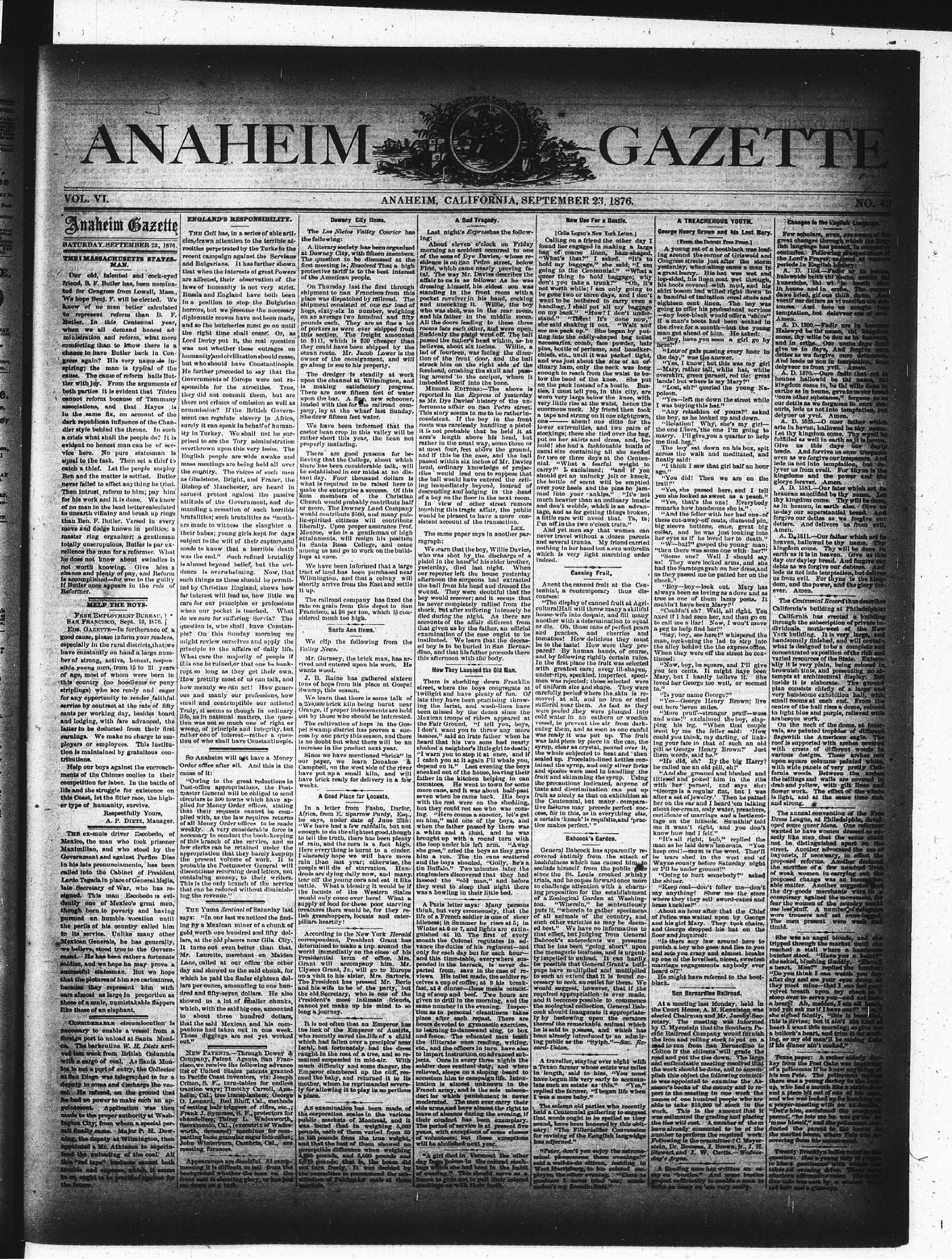
Searchable text
ANAHEIM
VOL. VI.
Anaheim Gazette
SATURDAY SEPTEMBER 23, 1876.
THE MASSACHUSETTS STATESMAN.
Our old, talented and cock-eyed friend, B. F. Butler has, been nominated for Congress from Lowell, Mass., We hope Benj. F. will be elected. We know of no man better calculated to represent reform than B. F. Butler. In this Centennial year, when we all demand honest administration and reform, what more comforting than to know there is a chance to have Butler back in Congress again? His very name inspiring; the man is typical of the cause. The cause of reform balls Butler with joy. From the arguments of both parties it is evident that Tilden cannot reform because of Tammany associations, and that Hayes is in the same fix, on account of the dark republican influence of the Chandler style behind the throne. In such a crisis what shall the people do? It is evident no honest man can be of service here. No pure statesman is equal to the fask. Then set a thief to catch a thief. Let the people employ ENGLAND'S RESPONSIBILITY.
The Call has, in a series of able articles, drawn attention to the terrible atrocities perpetrated by the Turks in the recent campaign against the Servians and Bulgarians. It has further shown that when the interests of great Powers are affected, their observation of the laws of humanity is not very strict. Russia and England have both been in a position to stop the Bulgarian horrors, but we presume the necessary diplomatic moves have not been made, and so the butcheries must go on until the right time shall come. Or, as Lord Derby put it, the real question was not whether these outrages on humanity and civilization should cease, but who should have Constantinople. He further proceeded to say that the Governments of Europe were not responsible for the atrocities. True, they did not commit them, but are there not crimes of omission as well as commission? If the British Government can regulate slavery in Africa, surely it can speak in behalf of humanity in Turkey. We shall not be surprised to see the Tory administration overthrown upon this very issue. The English people are wide awake and mass meetings are being held all over Downey.
The Los Nietos following:
A literary society at Downey City, where the question to first meeting is: Is protective tariff of the American people?
On Thursday last shipment to San Francisco was dispatched shipment consisted hogs, sixty-six in on an average two pounds each. The of porkers as were this section. They to $141, which is they could have been ocean route. Mr. owner of the company go along to see to help.
The dredger is upon the channel it is making sate! There are now filled upon the bar. A loaded with ties for pany, lay at the v She drew fifteen feet.
We have been castor bean crop in rather short this year properly maturing.
There are good lieving that the Co
The cause of reform halls Butter with joy. From the arguments of both parties it is evident that Tilden cannot reform because of Tammany associations, and that Hayes is in the same fix, on account of the dark republican influence of the Chandler style behind the throne. In such a crisis what shall the people do? It is evident no honest man can be of service here. No pure statesman is equal to the task. Then set a thief to catch a thief. Let the people employ Ben and the matter is settled. Butler never failed to effect anything he tried. Then intrust reform to him; pay him for his work and it is done. We know of no man in the land better calculated to unearth villainy and break up rings than Ben. F. Butler. Versed in every move and dodge known in politics; a master ring organizer; a gentleman totally unscrupulous, Butler is par excellence the man for a reformer. What he does not know about swindles is not worth knowing. Give him a chance and plenty of pay, and Reform is accomplished—for woe to the guilty if Butler once appears in the role of Reformer.
HELP THE BOYS.
FREE EMPLOYMENT BUREAU,
SAN FRANCISCO, Sept. 13, 1876.
EDS. GAZETTE—In furtherance of a good cause, please inform your readers, especially in the rural districts, that we have constantly on hand a large number of strong, active, honest, responsible young men, from 15 to 21 years of age, most of whom were born in this country (no hoodlums or puny striplings) who are ready and eager for any opportunity to render faithful service by contract at the rate of fifty cents per working day, besides board and lodging, with fare advanced, the latter to be deducted from their first earnings. We make no charge to employers or employees. This institution is maintained by gratuitous contributions.
Help our boys against the encroachments of the Chinese coolies in their competition for labor. In the battle of life and the struggle for existence on this Coast, let the fitter race, the higher type of humanity, survive.
Respectfully Yours,
A. P. DIETZ, Manager.
The ex-mule driver Escobedo, of Mexico, the man who took prisoner Maximillian, and who stood by the Government and against Porfiro Dias in his late pronunciation, has been called into the Cabinet of President Lordo Tegada in place of General Mejia, late Secretary of War, who has re-
So Anaheim will not have a Money Order office after all. And this is the cause of it:
"Owing to the great reductions in Post-office appropriations, the Postmaster General will be obliged to send circulars to 300 towns which have applied for Money Order offices, stating that their requests cannot be complied with, as the law requires returns of all Money Order offices to be made weekly. A very considerable force is necessary to conduct the book-keeping of this branch of the service, and so few clerks can be retained under the appropriation that they barely keep up the present volume of work. It is probable the Postmaster General will discontinue returning dead letters, not containing money, to their writers. This is the only branch of the service that can be reduced without diminishing He further proceeded to say that the Governments of Europe were not responsible for the atrocities. True, they did not commit them, but are there not crimes of omission as well as commission? If the British Government can regulate slavery in Africa, surely it can speak in behalf of humanity in Turkey. We shall not be surprised to see the Tory administration overthrown upon this very issue. The English people are wide awake and mass meetings are being held all over the country. The voices of such men as Gladstone, Bright, and Frazer, the Bishop of Manchester, are heard in earnest protest against the passive attitude of the Government, and demanding a cessation of such horrible brutalities; such brutalities as "mothers made to witness the slaughter or their babes; young girls kept for days subject to the will of their captors,and made to know that a horrible death was the end." Such refined brutality is almost beyond belief, but the evidence is overwhelming. Now, that such things as these should be permitted by Christian England, shows how far interest will lead us, how little we care for our principles or professions when our pocket is touched. What do we care for suffering? Servia? The question is, who shall have Constanple? On this Sunday morning we might review ourselves and apply the principle to the affairs of daily life. What care the majority of people if this one be ruined;or that one be bankrupt so long as they get their own. How prettily most of us can talk, and how meanly we can act! How generous and manly our professions, how small and contemptible our actions! Truly, it seems as though in ordinary life, as in national matters,the question was not so much one of right or wrong, of principle and integrity, but rather one of interest—rather a question of who shall have Constantinople.
Since we have met our paper, we lea Campbell, on the we have put up a small have brick ready for weeks.
A Good Place
In a letter from Africa, from E. Spade he says, under d: "We have had a few enough to do the sill to tell the truth,the of rain,and the cost Here everything is I sincerely hope we rain than last ye people will die of dreds are dying daily off the young cattle. What a bleu
Respectfully Yours,
A. P. DIETZ, Manager.
The ex-mule driver Escobedo, of Mexico, the man who took prisoner Maximillan, and who stood by the Government and against Porfiro Dias in his late pronunciation, has been called into the Cabinet of President Lerdo Tegada in place of General Mejia, late Secretary of War, who has resigned. This man Escobedo is evidently one of Mexico's great men, though born to poverty and having pursued an humble vocation until the perils of his country called him to its service. Unlike many other Mexican Generals, he has generally, we believe, stood true to the Government. He has been rather a fortunate soldier, and we hope he may prove a successful statesman. But we hope that the pictures of him are caricatures, because they represent him with ears almost as large in proportion as those of a mule, unmistakable flappers like those of an elephant.
Considerable circumlocution is necessary to enable a vessel from a foreign port to unload at Santa Monica. The barkeutine W. H. Dietz arrived last week from British Columbia with a cargo of coal. As Santa Monica is not a port of entry, the Collector at San Diego was telegraphed to for a deputy to come and discharge the vessel. He refused, on the ground that he had no power to make such an appointment. Application was then made to the proper authority at Washington City, from whom a special permit finally came. Major P. H. Downing, the deputy at Wilmington, then appolated a Mr. Atkinson to superintend the unloading of the coal. All this "red tape" business caused both trouble and expense, which it seems to us, ought to be provided against for the future.
THE Yuma Sentinel of Saturday last says: "In our last we noticed the finding by a Mexican miner of a chunk of gold worth one hundred and fifty dollars, at the old placers near Gila City. It turns out even better than that. Mr. Laurette, merchant on Malden Lane, called at our office the other day and showed us the said chunk, for which he paid the finder eighteen dollars per ounce, amounting to one hundred and fifty-seven dollars. He also showed us a lot of smaller chunks, which, with the said big one, amounted to about three hundred dollars, that the said Mexican and his companions had taken out in one week. Those diggings are not yet worked out."
NEW PATENTS—Through Dowey & Company, Patent Agents, San Francisco, we receive the following advance list of United States patents granted to Pacific Coast inventors, viz: Joseph Criton, S. F., turn-tables for endless traction ways; Timothy Carroll, Anaheim, Cal., tree transplants; George O. Leonard, Red Bluff, Cal., methods of setting hair triggers of rifles, etc.; Frank J. Symmes, S. F., protectors for chandeliers; Thiray L. Wadesworth, Sacramento, Cal., (executrix of Wadesworth), deceased) machines for compacting loose granular sugar into cubes; John Winterburn, Cambria, Cal., ore roasting furnaces.
Apparitions are decalful. At camp-meeting it is difficult to tell from the background whether the man on the front seat is shouting glory, or has just sat down on a task.
In a letter from Africa, from E. Spartanhe says, under dais: "We have had a few enough to do the sliding to tell the truth, the rain, and the corn Here everything is I sincerely hope we rain than last year people will die of dreads are dying daily tear off the young or cattle. What a bleed the locusts of the would only come over supply of food for these creatures there would lash grasshoppers, pillars heartily!"
According to the correspondent, Prudential determined to make world immediately Presidential term Grant will account Ulysses Grant, Jr., on-a visit to his sister The President has and his wife to be the old Secretary, President's most cannot yet make up long a journey.
It is not often that the luck of the Envoy who recently saved which had fallen over Ischl, but fortunately caught in the root of malned suspended much difficulty and Emperor clambered cued the baby, and mother, whom he really for allowing it to a place.
An examination led the corporation sent public markets of was found that 150 pounds each of them to 150 pounds from and that the best of perceptible difference 4,800 pounds and 5,010 pounds; that not turn freely. The committee to re-stitution of Fairbairn markets.
ANAHEIM, CALIFORNIA, SEPTEMBER 23, 1876.
Downey City Items.
The Los Nietos Valley Courier has the following:
A literary society has been organized at Downey City, with fifteen members. The question to be discussed at the first meeting is: Resolved That a high protective tariff is to the best interest of the American people.
On Thursday last the first through shipment to San Francisco from this place was dispatched by railroad. The shipment consisted of one car load of hogs, sixty-six in number, weighing on an average two hundred and fifty pounds each. They are as fine a lot of porkers as were ever shipped from this section. The freight amounted to $141, which is $30 cheaper than they could have been shipped by the ocean route. Mr. Jacob Lower is the owner of the consignment, and will go along to see to his property.
The dredger is steadily at work upon the channel at Wilmington, and is making satisfactory progress. There are now fifteen feet of water upon the bar. A fine, new schooner, loaded with ties for the railroad company, lay at the wharf last Sunday. She drew fifteen feet water.
We have been informed that the castor bean crop in this valley will be rather short this year, the bean not properly maturing.
There are good reasons for believing that the College, about which there has been considerable talk, will
A Sad Tragedy.
Last night's Express has the following:
About eleven o'clock on Friday morning an accident occurred to one of the sons of Dye Davies, whose residence is on San Pedro street, below First, which came nearly proving fatal. The way Mr. Davies describes the affair to us is as follows: As he was dressing himself, his eldest son was standing in the front room with a pocket revolver in his hand, cocking and uncocking it. Willie, the boy who was shot, was in the rear room, and his father in the middle room. All the doors leading to these three rooms face each other, and were open. Suddenly the platoi went off. The ball passed the father's head within, as he believes, about six inches. Willie, a lail of fourteen, was facing the direction of the front door, and the ball struck him on the right side of the forehead, crushing the skull and passing around to the occiput, where it imbedded itself into the bone.
MESSRS. EDITORS:—The above is reported in the Express of yesterday as Mr. Dye Davies' history of the fortunate affair on San Pedro street: This story seems to me to be rather inconsistent. If the boy in the front room was carelessly handling a pistol it is not probable that he held it at arm's length above his head, but rather in the usual way, some three or at most four, feet above the ground, and if this be the case, and the ball passed within six inches of Mr. Davies head, ordinary knowledge of prolapse.
New Use For a Bustle.
[Cella Logan's New York Letter.] Calling on a friend the other day I found her engaged in making a large bag of coarse linen, ham-shaped. "What's that?" I asked. "It's to hold my baggage," she said; "I am going to the Centennial." "What a queer thing to hold baggage; why don't you take a trunk?" "Oh, it's not worth while; I am only going to be gone two or three days, and I don't want to be bothered to carry even a handbag, I shall put all my baggage on my back." "How? I don't understand." "There! It's done now," she said shaking it out. "Walt and see me pack up." She began by putting into the oddly-shaped bag toilet necessaries, comb, face powder, hair pins, bottle of perfume, and handkerchiefs, etc., until it was packed tight, and was just about the size of an ordinary ham, only the neck was long enough to reach from the waist to below the bend of the knee. She put on the pack instead of a bustle. Bustles, I must tell you, in this city, are worn very large below the knee, with very little rise at the waist, hence the enormous neck. My friend then took a tape and strung on it one nightgown, one _____ ahem! one ditto for the lower extremities, and two pairs of stockings; these she tied over the bag, put on her skirts and dress, and, behold! she had a fashionable bustle of usual size containing all she needed for two or three days at the Centennial." "What a fearful weight to carry!" I exclaimed; 'stand! you won.'
The dredger is steadily at work upon the channel at Wilmington, and is making satisfactory progress. There are now fifteen feet of water upon the bar. A fine, new schooner, loaded with ties for the railroad company, lay at the wharf last Sunday. She drew fifteen feet water.
We have been informed that the castor bean crop in this valley will be rather short this year, the bean not properly maturing.
There are good reasons for believing that the College, about which there has been considerable talk, will be established in our midst at no distant day. Four thousand dollars is what is required to be raised here to make the enterprise a success. Of this sum members of the Christian Church would probably contribute half or more. The Downey Land Company would contribute $500, and many public-spirited citizens will contribute liberally. Upon proper assurance Prof. Monroe, who is a gentleman of high attainments, will resign his position in Santa Rosa College, and come among us and go to work on the buildings at once.
We have been informed that a large tract of land has been purchased near Wilmington, and that a colony will shortly arrive from the East and settle it up.
The railroad company has fixed the rate on grain from this depot to San Francisco, at $6 per ton, which is considered much too high.
Santa Ana Items.
We clip the following from the Valley News.
Mr. Gurnsey, the brick man, has arrived and entered upon his work. He wants wood.
J. B. Raine has gathered sixteen tons of hops from his place at Gospel Swamp, this season.
We learn that there is some talk of a 250,000 brick kiln being burnt near Orange, if proper inducements are held out by those who should be interested.
The cultivation of hops in the Gospel Swamp district has proven a success by one party this season, and there is no doubt but what there will be an increase in the product next year.
Since we have mentioned "brick" in our paper, we learn Donahoe & Campbell, on the west side of the river have put up a small kiln, and will have brick ready for delivery in a few weeks.
A Good Place for Locusts.
In a letter from Fashu, Darfor, Africa, from E. Sparrow Purdy, Esq., he says, under date of June 25th: "We have had a few rainfalls, but not enough to do the slightest good, though to tell the truth, there has been plenty of rain, and the corn is a foot high. Here everything is burnt to a cinder. I shoerearly hope we will have more rain than last year; otherwise, the people will die of starvation. Hundreds are dying daily now, and many tear off the young cora and eat it like cattle. What a blessing it would be if
MESSRS. EDITORS:—The above is reported in the Express of yesterday as Mr. Dye Davies' history of the unfortunate affair on San Pedro street: This story seems to me to be rather inconsistent. If the boy in the front room was carelessly handling a pistol it is not probable that he held it at arm's length above his head, but rather in the usual way, some three or at most four, feet above the ground, and if this be the case, and the ball passed within six inches of Mr. Davies head, ordinary knowledge of projectiles would lead one to suppose that the ball would have entered the ceiling immediately beyond, instead of descending and lodging in the head of a boy on the floor in the next room.
In view of other street rumors touching this tragic affair, the public would be pleased to have a more consistent account of the transaction.
LEX.
The same paper says in another paragraph:
We earn that the boy, Willie Davies, who was shot by the discharge of a pistol in the hand of his elder brother, yesterday, died last night. When our reporter left the house yesterday afternoon the surgeons had extracted the ball from his head and dressed the wound. They were doubtful that the boy would recover; and it seems that he never completely rallied from the shock, but after suffering intensely he died during the night. As there are accounts of the affair different from that given us by the father, an official examination of the case ought to be instituted.
We learn that the deceased boy is to be buried in San Bernardino, and that his father proceeds there this afternoon with the body.
How They Lassoed the Old Man.
There is shedding down Franklin street, where the boys congregate at twilight and have plenty of fun. Of late they have been practising throwing the lariat, and wash-lines have been missed by the dozen since the Mexican troupe of riders appeared at the Fair Ground. "I tell you, boys, I don't want you to throw any more lassoes," said an irate father when he heard that his two sons had nearly choked a neighbor's little girl to death; "I warn you to stop it at once, and if I catch you at it again Pill whale you, depend on it." Last evening the boys sneaked out of the house, leaving their father in the kitchen helping to can tomatoes. He went to town for some more cans, and it was about half-past seven when he came back. His boys with the rest were on the shedding, but they could not see who was coming. "Here comes a snoozer, let's get on him," said one of the boys, and when the father passed by there was a whizz and a thud, and he was brought up with a round turn with the loop under his left arm. "Away she goes," cried the boys as they gave him a run. The tin cans scattered and the boys shouted, "Golly, he's a tin Buffalo." Two minutes later the ringleaders discovered that they had lashed the "old man," and before they went to sleep that night there enough to reach from the waist to below the bend of the knee. She put on the pack instead of a bustle. Bustles, I must tell you, in this city, are worn very large below the knee, with very little rise at the waist, hence the enormous neck. My friend then took a tape and strung on it one nightgown, one—ahem! one ditto for the lower extremities, and two pairs of stockings; these she tied over the bag, put on her skirts and dress, and behold! she had a fashionable bustle of usual size containing all she needed for two or three days at the Centennial. "What a fearful weight to carry!" L exclaimed; "and if you should get an unlucky jolt or knock, the bottle of scent will be emptied over your heels and the pins be jammed into yourankles." "It's not much heavier than an ordinary bustle and don't wobble, while it is an advantage, and as for getting things broken, a little care will avoid that. Ta; ta; I'm off in the two o'clock train."
And yet men say that women can never travel without a dozen parcels and several trunks. My friend carried nothing in her hand but a sun umbrella which is very light marching order indeed.
Canning Fruit.
Anent the canned fruit at the Centennial, a contemporary thus discourses:
"The display of canned fruit at Agricultural Hall will throw many a skillful house-wife into despair, and fill many another with a determination to equal or die. Oh, those cans of perfect pears and peaches, and cherries and tomatoes! How delicious they must be to the taste! How were they prepared? By human hands, of course, and by following rigidly certain rules. In first place the fruit was selected with greatest care; every ill-shapen, under-ripe, speckled, imperfect specimen was rejected; those selected were of uniform size and shape. They were carefully peeled where the skin is removed at all, and no iron or steel suffered near them. As fast as they were peeled they were plunged into cold water in an eathern or wooden vessel, to prevent the air from darkening them, and as soon as one canful was ready it was put up. The fruit was laid piece by piece in the can, the syrup, clear as crystal, poured over it; the whole subjected to heat and then sealed up. Procelain-lined kettles contained the syrup, and only silver forks and spoons were used in handling the fruit and skimming the syrup. Using the precautions indicated anyone of taste and discrimination can put up fruit as nicely as that on exhibition at the Centennial, but many comparative failures may precede perfect success; for in this, as in everything else, a certain 'knack' is requisite,and 'practice makes perfect.'"
Baboock's Garden.
General Baboock has apparently recovered entirely from the attack of bashfulness which has caused him to seclude himself from the public gate since the St. Louis crooked whisky trials, and he copes forward once more to challenge attention with a charm-
A Good Place for Locusts.
In a letter from Fashu, Darfor, Africa, from E. Sparrow Purdy, Esq., he says, under date of June 25th: "We have had a few rainfalls, but not enough to do the slightest good, though to tell the truth, there has been plenty of rain, and the corn is a foot high. Here everything is burnt to a cinder. I sheerely hope we will have more rain than last year; otherwise, the people will die of starvation. Hundreds are dying daily now, and many tear off the young corn and eat it like cattle. What a blessing it would be if the locusts of the Western Stales would only come over here! What a supply of food for these poor starving creatures there would be, for they relish grasshoppers, locusts and caterpillars heartily!
According to the New York Herald correspondent, President Grant has determined to make a trip around the world immediately on the close of his Presidential term of office. Mrs. Grant will accompany him. Mr. Ulysses Grant, Jr., will go to Europe on a visit to his sister, Mrs. Sartoris. The President has pressed Mr. Borie and his wife to be of the party, but the old Secretary, who is one of the President's most intimate friends, cannot yet make up his mind to so long a journey.
It is not often that an Emperor has the luck of the Emperor of Austria, who recently saved the life of a child which had fallen over a precipice near Ischl, but fortunately had the dress caught in the root of a tree, and so remained suspended in mid-air. With much difficulty and some danger, the Emperor clambered up the cliff, rescued the baby, and returned it to its mother, whom he reprimanded severely for allowing it to play in so perilous a place.
An examination has been made of the corporation scales in the various public markets of Montreal, and it was found that in weighing 5,000 pounds, each of them varied from 30 to 150 pounds from the true weight, and that the best of them showed no perceptible difference when weighing 4,000 pounds and 5,010 pounds; that is, the beam did not turn freely. It was decided by the committee to recommend the substitution of Fairbanks' scale at three markets.
"A girl died in Vermont the other day from poison in the colored stockings which she had been in the habit of wearing." This should serve as a lesson to girls not to pull their colored stockings on with their faith.
General Babcock has apparently recovered entirely from the attack of bashfulness which has caused him to seclude himself from the public since the St. Louis crooked whisky trials, and he copes forward once more to challenge attention with a charming proposition for the establishment of a Zoological Garden at Washington. "Wherein," he sententiously puts it, "wherein to gather specimens of all animals of the country, and such other varieties as may be deemed best." We have no information to that effect, but judging from General Babcock's antecedents we presume that he has been "going short" upon the managerle business, and is urgently impelled to unload. It can hardly be possible that General Grant's bull-pups have multiplied and multiplied to such an extent that it is found necessary to seek an outlet for them. We would suggest, however, that if the required appropriation is ever made, and it becomes possible to commence the zoological collection, General Babcock should inaugurate it appropriately by bestowing upon the curators thereof the remarkable animal which he is said to possess, and which has been already introduced to an admiring public as the "Sylph."—Sac. Record-Union.
A traveller, staying over night with a Texan farmer whose estate was miles in length, said to him: "You must have begun life very early to accumulate such an estate as this." "Yes," replied the farmer, "I began life when I was a mere baby."
The solemn old parties who recently held a Centennial gathering to suggest that words ought to be spelled as they sound, have been honored by this obituary: "The Fillerdelfer Conversion for revising of the English langwidge has adjourned."
"Peter, don't you enjoy the astronomical phenomena these evenings?" said a well-to-do citizen, reading in West Hartshaug, to his colleague, the other evening. "Clare to guests I never tried 'em; manmade's my favorite fruit."
GAZETTE
23, 1876.
A TREACHEROUS YOUTH.
George Henry Brown and his Lost Mary.
[From the Detroit Free Press.]
A young rat of a bootblack was loafing around the corner of Griswold and Congress streets just after the storm yesterday, when along came a man in a great hurry. His hat was wet and lop-sided, his linen coat wet through, his boots covered with mud, and his shirt bosom had wilted right down to a handful of imitation coral studs and eighteen cent linen. The boy was going to offer his professional services—any boot-black would offer "shine" if a man's boots had been soaked in the river for a month—but the young man got ahead of him. He asked:
"Boy, have you seen a girl go by here?"
"Lots of gals passing every hour in the day," was the answer.
"Yes, I know; but this was my girl—Mary, rather tall, white hat, white overskirt, green parasol, red tie; great lands! but where is my Mary?"
"Lost, eh?" queried the young Napoleon.
"Yes—left me down the street while I was buying this hat."
"Any relashion of yours?" asked the boy, as he looked up and down.
"Relation! Why, she's my girl—the one I love, the one I'm going to marry. I'll give you a quarter to help me find her."
The boy sat down on his box, spit across the walk and meditated, and finally said:
"I think I saw that girl half an hour"
Changes in the English Language.
Few scholars, even, are aware of the great changes through which the English language has passed, in successive centuries. Following developments of the Lord's Prayer, as used at various periods in English history:
A. D. 1158.—Fadir ur in behene halewolde belth thi nane, ousin thi kuneriche, thi wi la beeth idea in haune and in erda. The curse dawe brled, gif ous thilk dawn. And vorzif uer detters as vf vorzifen ure detours. And lense us sought into temptation, bot delayver eus of ovel-Amen.
A. D. 1900.—Fadir ur in behene Halewyd be thi name, thi kingdom come, thy will be don as in heavens and in erdas. Our urze days hand give us to days. And forgive our dettes as we forgive our dettures. And leade us non in temptation, but delyveor us from yvll. Amen.
A. D. 1870.—Oure fadir that art in heunes hallowid be thi name, thi kingdom come, be thi will done in earthes as in heune, gave to us our brand "oure other substance," forgone in us our dettles as we forgamen to our delouris, lede us not into temptation, but delyveor us yvol. Amen.
A. D. 1625.—O ouer father which arte in heven, hallowed be thy name. Let thy kingdom come. Thy wyoll be fulfilled as well in earth as it is heaven. Give us this daye our dayly brede. And forvive us our trespasses even as we forgive our trespasses. And leade us not into temptation, but delyveor us yvol. For there is the
Fruit.
fruit at the Centennial thus discerned fruit at Agrinow many a skillful
air, and fill many
mimination to equal
tons of perfect pears
cherries and
inclous they must
new were they prehands, of course,
did certain rules.
fruit was selected
every ill-shapen,
imperfect speciose selected were
shape. They were
are the skin is reno iron or steel
As fast as they
were plunged into
sthern or wooden
air from darkmoon as one canfu
up. The fruit
in the can, the
lil., poured over it,
to heat and then
lined kettles cononly silver forks
in handling the
syrup. Using
located, anyone of
tion can put up
on exhibition at
many, comparaccede perfect success everything else,
quisite,and 'pracGarden.
as apparently rem the attack of
caused him to
the public gaze
crooked whisky
forward once more
with a charm-
A. D. 1370.—Oure fadir that art in heuines hallowid be thi name, thi kingdom come to, be thi will done in earth as in heune, gave to us our breed "oure other substance," forgene to us our dettis as we forgamen to our deuris, lede us not into temptation, but delyuer us yvel. Amen.
A. D. 1525.—Ourer father which arte in hevon, hallowed be thy name. Let thy kingdom come. Thy wyoll be fulfilled as well in earth as it is heaven. Give us this daye our dayly brede. And forgive us oure trespasses even as we forgive our trespasses. And lede us not into temptation, but delyver us from evell. For thyne is the kingdome and the power and the glory forever. Amen.
A. D. 1581.—Our fater which art in heaucean sanctified be thy name. Let thy kingdom come. Thy will be done as in heuen, in earth also. Give us to-day our superantial bread. And forgive our dettes as we forgive our detters. And deliver us from evil. Amen.
A. D. 1611.—Our father which art in heaven, hallowed be thy name. Thy kingdom come. Thy will be done in earth as it is heaven. Give us this day our dayley bread. And forgive our debts as we forgive our debtors. And lede us not into temptation, but deliver us from evil. Amen.
The Centennial Record thus describes California's building at Philadelphia:
California has erected a building through the subscription of private individuals, north-west of the New York building. It is very large, and handsomely finished, and will contain what is designed to be a complete and concentrated exposition of the rich and varied resources of the State. Externally it is very plain, being colored in brownish tints, and presenting no attempts at architectural display. But inside it is elaborate. The ground plan consists chiefly of a large and very handsome exhibition hall, with small rooms at each end. From the centre of the hall rises a dome, colored in light blue and purple, relieved with arabesque work.
On the neck of the dome, at intervals, are painted trophies of different flags with the American eagle. The roof is supported with arches covered with crests of different woods in various designs. These arches rest upon square columns painted white, with wide panels of very pretty California woods. Between the arches the cellings and walls are covered in drab and yellow, with gilt lines and flower work. The effect of the whole is light, and at the same time rich and strong.
The annual convention of the Fruz Dress League, at Philadelphia, developed some queer ideas. One reformer wanted to have women dressed so nately like men that the sexes could not be distinguished apart on the street. Another advocated the use of bayonets, if necessary, to effect the proposed reforms. Another declared the sacrifice of a few hundred lives of weak women in carrying out the proposed change was an inconsiderable matter. Another suggested that
George is a regular flat, but I was after a set of jewelry. Then he patted her on the ear and I heard 'em talking about ice-cream, sody water, preachers, certificate of marriage and a leetle cottage on the hillside. Sumthin' told me it wasn't right, and you don't know how bad I felt.
It's all right, bub," replied the man as he laid down ten cents. "You keep cool!—mum is the word. Ther'll be tears shed in the west end of Wayne county before Saturday night or I'll be under ground!"
"Going to hurt somebody?" asked the shiner.
"Keep cool—don't foller me—don't say anything! Show me the store where they sell sword-canes and brass kuckles!"
About an hour after that the Chief of Police was waited upon by George and his girl Mary. They took chairs, and George dropped his hat on the floor and inquired:
"Is there any law around here to punish a boy who goes and lies to you and sets you crazy and almost breaks up one of the loveliest, nicest, sweetest marriage engagements anybody ever heard of?"
He might have referred to the boot-black.
San Bernardino Railroad.
At a meeting last Monday, held in the Court House, A. M. Kenniston was elected Chairman and Mr. Jacoby Secretary. The meeting was informed by C. Myerselp that the Southern Pacific Railroad Company would furnish the iron and rolling stock to put on a road to run from San Bernardino to Colton if the citizens will grade the road and put the ties down. The large and enthusiastic meeting resolved that the work should be done, and to accomplish this object the following committee was appointed to examine the Assessor's books of the county and to report to the meeting in one week the names of one hundred people who are able to take $15,000 of stock in the work. This is the amount that it was estimated the grading and placing the ties will cost. A number of them have already consented to be of the number to perform the required work. Following is the committee: C. Myerselp, Dr. Bousman, J. Brown Jr., J. H. Stewart and J. W. Curtis.
A Reading man has written an essay on "boston." And some bustles project sufficiently to enable a man to write an easy on 'em very easily.
The annual convention of the Prussia Dress League, at Philadelphia, developed some queer ideas. One reformer wanted to have women dressed so exactly like men that the sexes could not be distinguished apart on the street. Another advocated the use of bayonets, if necessary, to effect the proposed reforms. Another declared the sacrifice of a few hundred lives of weak women in carrying out the proposed change was an inconsiderable matter. Another suggested that the dry-goods merchants were in a conspiracy against the movement; for fear the women of the country would use less stuff. A number of delegates wore trousers and sat cross-legged. The men present were weak and timid.
She was an angel blonde, and she tripped through the market until she reached a stall where a handgun butcher stood. "Have you a burrito? She asked, blushing timidly." "Have I a heart? Miss?" replied the butcher. "Do you think I can watch you day after day and see your eyes droop on they meet mine—that I can feel your velvet breath upon my cheek as I stoop over to serve you—and not harm a heart? Ah, maiden, I am all heart, and you ask me if I have one?" "No," she sighed faintly, "this is beautiful; this is lively; but it ain't this kind of heart I want this morning; no give me a bullock's heart, and trim it for stiffening, or my old man'll be raising Calm if his dinner ain't cooked."
Texas paper: A rather alderly key from the Post Oaka was inquiring of a policeman if he knew anything of his son Pete. The policeman realized there was a young darkey in the back-up, who had a mouth like a stable door and a piece bit out of one of his arms, and who was locked up for breaking up a prayer-meeting with an ox-handler. "Outa him, examined the overjoyed parent," he told me he was gwine by 'muse himself,' and the policeman conducted the parent to the house in the market house, where Pete was recovering from his amusement.
Twenty-four Brooklyn ladies voted on the question: How a young lady rides to kiss a gentleman with whom she takes an evening drive. There were almost three affirmative votes. The twelve tales was cash by a woman with red hair and a glass eye.