anaheim-gazette 1876-09-09
Scanned page
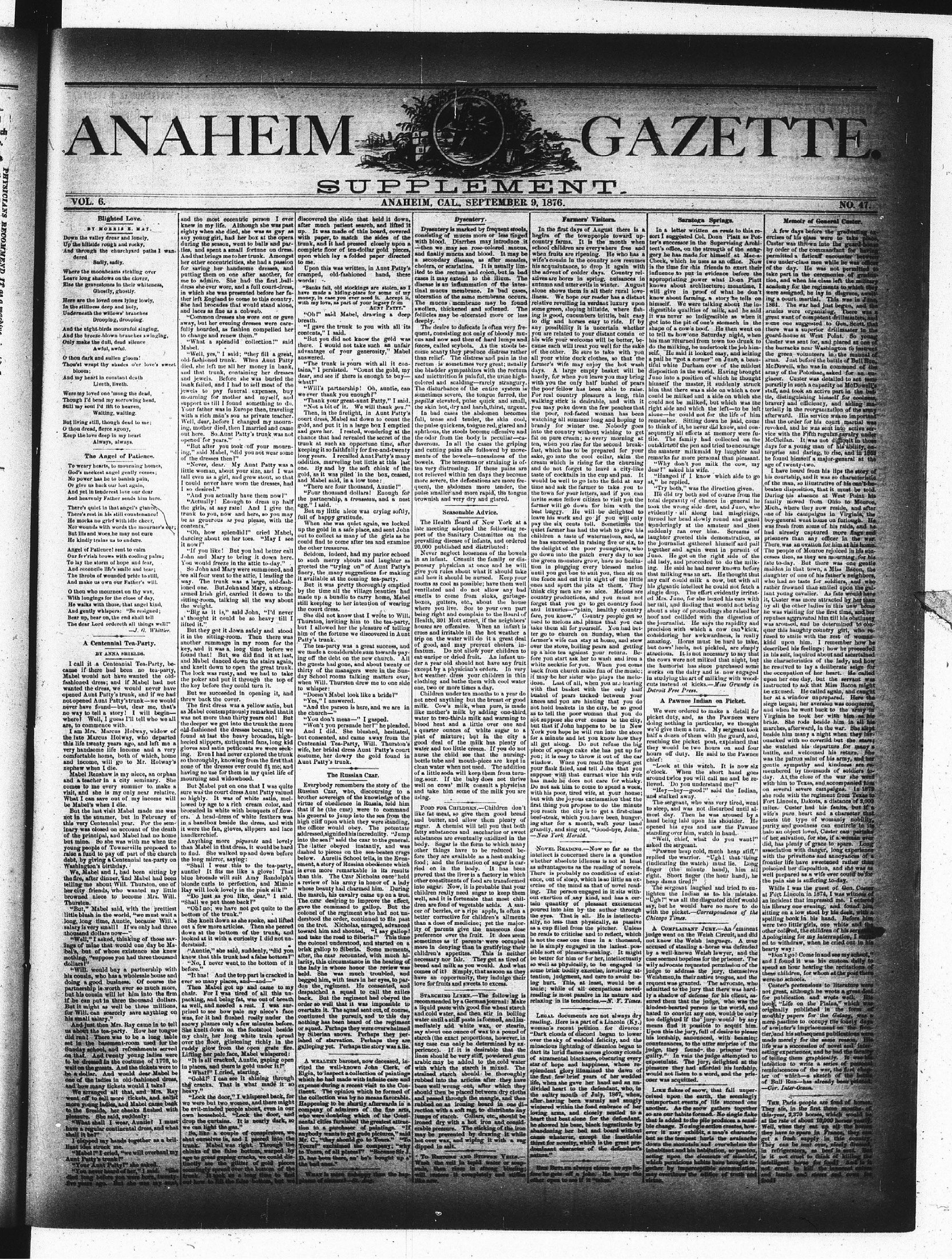
Searchable text
ANAHEIM
VOL. 6.
Blighted Love.
BY MORRIS E. MAY.
Down the valley drear and lonely,
Up the hillside rough and rocky,
And through the churchyard paths I wandered
Sadly, sadly.
Where the moonbeams stealing over
Leave long shadows on the clover,
Rise the grave stones in their whiteness,
Ghostly, ghostly.
Here are the loved ones lying lowly,
In the stillness deep and holy,
Underneath the willows' branches
Drooping, drooping.
And the night-birds mournful singing,
And the breeze-blown branches swinging,
Only make the dull, dead silence
Awful, awful.
O thou dark and sullen gloom!
Thou'st wrapt thy shades o'er love's sweet bloom;
And my heart in constant death
Liveth, liveth.
Were my loved one 'mong the dead,
Though I'd bend my sorrowing head,
Still my soul I'd lift to heaven,
Waiting, waiting.
But living still, though dead to me;
O thou dread, fierce agony,
Keep the love deep in my heart
Always, always.
The Angel of Patience.
To weary hearts, to mourning homes,
and the most eccentric person I ever knew in my life. Although she was past eighty when she died, she was as gay as any young girl, had her box at the opera during the season, went to balls and parties, and spent a small fortune on dress. And that brings me to her trunk. Amongst her other eccentricities, she had a passion for saving her handsome dresses, and putting them on one after another, for me to admire. She had the first ball-dress she ever wore, and a full court-dress, in which she was presented before her father left England to come to this country. She had brocades that would stand alone, and laces as fine as a cobweb.
"Common dresses she wore out or gave away, but her evening dresses were carefully hoarded, as fashion compelled her to change and renew them."
"What a splendid collection!" said Mabel.
"Weell, yes," I said; "they fill a great, old-fashioned trunk. When Aunt Patty died, she left me all her money in bank, and that trunk, containing her dresses and jewels. Before she was buried the bank failed, and I had to sell most of the jewels to pay funeral expenses, buy mourning for mother and myself, and support us till I found something to do. Your father was in Europe then, traveling with a rich man's son as private teacher. Well, dear, before I changed my mourning, mother died, then I married and came out here. So Aunt Patty's trunk was not opened for years."
"But after you took off your mourning," said Mabel, "did you not wear some of the dresses then?"
"Never, dear. My Aunt Patty was a discovered the slide after much patient up. It was made of with paper, to match trunk, and it had pre-complete floor of ten upon which lay a fold to me.
Upon this was written cramped, old-fashioned words:
"Banks fall, old stock have made a hiding-pocket money, in case you even with my love, as part of "Oh!" said Mabel breath.
"I gave the trunk contents," I said.
"But you did not there. I would not take advantage of your answered.
"The trunk is your tains," I persisted.
"Dear, and see if there what!"
"Will's partnership we ever thank you etc."
"Thank your great-great-aunt," I persisted.
Then, in the firelight court dress, Mabel sailed gold, and put it in a sauded gave her. I rested chance that had revealed trunk at such an open keeping it so faithfully long years. I recalled oddities, marveling by one. By and by the..."
And my heart in constant death
Liveth, liveth.
Were my loved one 'mong the dead,
Though I'd bend my sorrowing head,
Still my soul I'd lift to heaven,
Waiting, waiting.
But living still, though dead to me;
O thou dread, fierce agony,
Keep the love deep in my heart
Always, always.
The Angel of Patience.
To weary hearts, to mourning homes,
God's meekest angel gently comes;
No power has he to banish pain,
Or give us back our lost again,
And yet in tenderest love our dear
And heavenly Father sends him here.
There's quiet in that angel's glance,
There's rest in his still countenance!
He mocks no grief with idle cheer,
Nor wounds with words the mourner's ear;
But ills and woes he may not cure
He kindly trains us to endure.
Angel of Patience! sent to calm
Our fev'rish brows with cooling palm;
To lay the storm of hope and fear,
And reconcile life's smile and tear;
The throbs of wounded pride to still,
And make us own our Father's will.
O thou who mournest on thy way,
With longings for the close of day,
He walks with those, that angel kind,
And gently whispers: "Be resigned;
Bear up, bear on, the end shall tell
The dear Lord ordereth all things well!"
—J. G. Whittler.
A Centennial Tea-Party.
BY ANNA SHIELDS.
I call it a Centennial Tea-Party, because if there had been no tea-party, Mabel would not have wanted the old-fashioned dress; and if Mabel had not wanted the dress, we would never have opened Aunt Patty's trunk, and if we had not opened Aunt Patty's trunk—we would never have found—but, dear me, that's no way to tell a story! I will begin—where? Well, I guess I'll tell who we all are, to commence with.
I am Mrs. Marcus Holway, widow of the late Marcus Holway, who departed this life twenty years ago, and left me a very handsome life income and a very comfortable home, both of which, home and income, will go to Mr. Holway's nephew when I die.
Mabel Renshaw is my niece, an orphan and a teacher in a city seminary. She comes to me every summer to make a visit, and she is my only near relative. What I can save out of my income will be Mabel's when I die.
But the last visit Mabel made me was not in the summer, but in February of this very Centennial year. For the seminar was closed on account of the death of the principal, and Mabel had no home but mine. So she was with me when the young people of Towzerville proposed to raise a fund to pay off part of the church debt, by giving a Centennial tea-party on Washington's birthday.
We, Mabel and I, had been sitting by the fire after dinner, and Mabel had been telling me about Will. Thurston, one of her sister's friends, who little
and that trunk, containing her dresses and jewels. Before she was buried the bank failed, and I had to sell most of the jewels to pay funeral expenses, buy mourning for mother and myself, and support us till I found something to do. Your father was in Europe then, traveling with a rich man's son as private teacher. Well, dear, before I changed my mourning, mother died, then I married and came out here. So Aunt Patty's trunk was not opened for years."
"But after you took off your mourning," said Mabel, "did you not wear some of the dresses then?
"Never, dear. My Aunt Patty was a little woman about your size, and I was tall even as a girl, and grew stout, so that I could never have worn the dresses, had I so desired."
"And you actually have them now?"
"Actually! Enough to dress up half the girls, at any rate! And I give the trunk to you, now and here, so you may be as generous as you please, with the contents."
"Oh, how splendid!" cried Mabel, dancing about on her toes. "May I see it now?"
"If you like! But you had better call John and Mary to bring it down here. You would freeze in the attic to-day."
So John and Mary were summoned, and we all four went to the attic, leading the way. The trunk was a large, old-fashioned one. But John and Mary, a strong-armed Irish girl, carried it down to the sitting-room, talking all the way about the weight.
"Big as it is," said John, "I'd never thought it could be so heavy till I lifted it."
But they got it down safely and stood it in the sitting-room. Then there was another rummage in my room for the key, and it was a long time before we found that! But we did find it at last, and Mabel danced down the stairs again, and knelt down to open the great trunk. The lock was rusty, and we had to take the poker and put it through the top of the key before they could turn it.
But we succeeded in opening it, and threw back the cover.
The first dress was a yellow satin, but as Mabel contemptuously remarked that it was not more than thirty years old! But the deeper we got into the trunk the more old-fashioned the dresses became, till we found at last the heavy brocades, high-heeled slippers, antiquated fans, long kid gloves and satin petticoats we were seeking. Even I had never explored the trunk so thoroughly knowing from the first that none of the dresses ever could fit me; and having no use for them in my quiet life of mourning and widowhood.
But Mabel put on one that I was quite sure was the court dress Aunt Patty valued so highly. It was of white satin, mellowed by age to a rich cream color, and brocaded in white with bouquets of flowers. A head-dress of white feathers was in a bandbox beside the dress, and with it were the fan, gloves, slippers and lace handkerchief.
Anything more piquante and lovely than Mabel in that dress, it would be hard to find. She walked up and down before the long mirror, saying:
"Shall I wear this to the tea-party,auntie? It fits me like a glove! That blue brocade will suit Amy Randolph's blonde curls to perfection, and Minnie Pan will look lovely in the pink silk!!"
And that trunk, containing her dresses and jewels. Before she was buried the bank failed, and I had to sell most of the jewels to pay funeral expenses, buy mourning for mother and myself, and support us till I found something to do. Your father was in Europe then, traveling with a rich man's son as private teacher. Well, dear, before I changed my mourning, mother died, then I married and came out here. So Aunt Patty's trunk was not opened for years."
"But after you took off your mourning," said Mabel, "did you not wear some of the dresses then?
"Never, dear. My Aunt Patty was a little woman about your size, and I was tall even as a girl, and grew stout, so that I could never have worn the dresses, had I so desired."
"And you actually have them now?"
"Actually! Enough to dress up half the girls, at any rate! And I give the trunk to you, now and here, so you may be as generous as you please, with the contents."
"Oh how splendid!" cried Mabel, dancing about on her toes. "May I see it now?"
"If you like! But you had better call John and Mary to bring it down here. You would freeze in the attic to-day."
So John and Mary were summoned, and we all four went to the attic, leading the way. The trunk was a large, old-fashioned one. But John和玛丽,a strong-armed Irish girl,carryt down to the sitting-room,talking all the way about the weight.
"Big as it is," said John,"I'd never thought it could be so heavy till I lifted it."
But they got it down safely and stood it in the sitting-room. Then there was another rummage in my room for the key,and it was a long time before we found that! But we did find it at last,and Mabel danced down the stairs again,and knelt down to open the great trunk.The lock was rusty,and we had to take the poker and put it through the top of the key before they could turn it.
But we succeeded in opening it,and threw back the cover.
The first dress was a yellow satin,但 as Mabel contemptuously remarked that it was not more than thirty years old! But the deeper we got into the trunkthe more old-fashioned the dresses became,till we found at last,the heavy brocades,高heeled slippers,抗iquated fans,长 kid gloves和satin petticoatswe were seeki ng.Even I had never exploredthe trunkso thoroughly,knowingfromthefirstthatnoneofthedressesevercouldfitme;andhavingnouseforkineminyquietlifeofmourningandwidowhood.
But Mabel put on one that I was quite sure was the court dress Aunt Patty valued so highly. It was of white satin,mellowed by age to a rich cream color,and brocaded in white with bouquets of flowers.A head-dress of white featherswas in a bandbox besidethe dress,andwithitwerethefan,gloves,slippersandlacehandkerchief.
AnythingmorepiquanteandlovelythanMabelinthatdressitwouldbehardtofind.Shewalkedupanddownbeforethelongmirror,saying:
"ShallIwearthistotheteaparty,auntie?Itfitsmelikeaglove!ThatbluebrocadewillsuitAmyRandolph'sblondecurlstoperfection,andMinniePanwilllooklovelyintheninkliciousnessoftheseasonoftheyearofthemonthoftheweekofthedayofthemonthoftheweekofthedayofthemonthoftheweekofthedayofthemonthoftheweekofthedayofthemonthoftheweekofthedayofthemonthoftheweekofthedayofthemonthoftheweekofthedayofthemonthoftheweekofthedayofthemonthoftheweekofthedayofthemonthoftheweekofthedayofthemonthoftheweekofthedayofthemonthoftheweekofthedayofthemonthoftheweekofthedayofthemonthoftheweekofthedayofthemonthoftheweekofthedayofthemonthoftheweek ofthedayofthemonth oftheday oftthemonth oftheday oftthemonth oftheday oftthemonth oftheday oftthemonth oftheday oftthemonth oftheday oftthemonth oftheday oftthemonth oftheday oftthemonth oftheday oftthemonth oftheday oftthemonth oftheday oftthemonth oftheday oftthemonth oftheday oftthemonth oftheday oftthemonth oftheday oftthemonth oftheday oftthemonth oftheday oftthemonth oftheday oftthemonth oftheday oftthemonth oftheday oftthemonth ofthedayottehthemonthotthemonthotthemonthotthemonthotthemonthotthemonthotthemonthotthemonthotthemonthotthemonthotthemonthotthemonthotthemonthotthemonthotthemonthotthemonthotthemonthotthemonthotthemonthotthemonthotthemonthotthemonthotthemonthotthemonthotthemonthotthemonthotthemonthotthemonthotthemonthotthemonthotthemonthotthemonthotthemonthotthemonthotthemonthotthemonthotthemonthotthemonthotthemonthotthemonthotthemonthotthemonthotthemonthotthemonthotthemonthotthemonthotthem月ottomhen月ottomhen月ottomhen月ottomhen月ottomhen月ottomhen月ottomhen月ottomhen月ottomhen月ottomhen月ottomhen月ottomhen月ottomhen月ottomhen月ottomhen月ottomhen月ottomhen月ottomhen月ottomhen月ottomhen月bottomhen月Bottom月Bottom月Bottom月Bottom月Bottom月Bottom月Bottom月Bottom月Bottom月Bottom月Bottom月Bottom月Bottom月Bottom月Bottom月Bottom月Bottom月Bottom月Bottom月Bottom月Bottom月Bottom月Bottom月Bottom月Bottom月Bottom月Bottom月Bottom月Bottom月Bottom月Bottom月Bottom月Bottom月Bottom月Bottom月Bottom月Bottom月Bottom月Bottom月Bottom月Bottom月Bottom月Bottom月Bottom月Bottom月Bottom月Bottom月 bottom 月 bottom 月 bottom 月 bottom 月 bottom 月 bottom 月 bottom 月 bottom 月 bottom 月 bottom 月 bottom 月 bottom 月 bottom 月 bottom 月 bottom 月 bottom 月 bottom 月 bottom 月 bottom 月 bottom 月 bottom 月 bottom 月 bottom 月 bottom 月 bottom 月 bottom 月 bottom 月 bottom 月 bottom 月 bottom 月 bottom 月 bottom 月 bottom 月 bottom 月 bottom 月 bottom 月 bottom 月 bottom 月 bottom 月 bottom 月 bottom 月 bottom 月 bottom 月 bottom 月 bottom 月 bottom 月 bottom 月 bottom 月 bottom 月bottom月亮bottom月亮bottom月亮bottom月亮bottom月亮bottom月亮bottom月亮bottom月亮bottom月亮bottom月亮bottom月亮bottom月亮bottom月亮bottom月亮bottom月亮bottom月亮bottom月亮bottom月亮bottom月亮bottom月亮bottom月亮bottom月亮bottom月亮bottom月亮bottom月亮bottom月亮bottom月亮bottom月亮bottom月亮bottom月亮bottom月亮bottom月亮bottom月亮bottom月亮bottom月亮bottom月亮bottom月亮bottom月亮bottom月亮bottom月亮bottom月亮bottom月亮bottom月亮底部底部底部底部底部底部底部底部底部底部底部底部底部底部底部底部底部底部底部底部底部底部底部底部底部底部底部底部底部底部底部底部底部底部底部底部底部底部底部底部底部底部底部底部底部底部底部底部底部底层底部底层底层底层底层底层底层底层底层底层底层底层底层底层底层底层底层底层底层底层层面层面层面层面层面层面层面层面层面层面层面层面层面层面层面层面层面层面层面层面层面层面层面层面层面层面层面层面层面层面层面层面层面层面层面层面层面层面层面层面层面层面层面层面层面层面层面层面层面层面层面层面层面层面层面层面层面层面层面画面画面画面画面画面画面画面画面画面画面画面画面画面画面画面画面画面画面画面画面画面画面画面画面画面画面画面画面画面画面画面画面画面画面画面画面画面画面画面画面画面画面画面画面画面画面画面画面画面画面画面画面画面画面画面画面画面画面画面画面画面画像画像画像画像画像画像画像画像画像画像画像画像画像画像画像画像画像画像画像画像画像画像画像画像画像画像画像画像画像画像画像画像画像画像画像画像画像画像画像画像画像画像画像画像画像画像画像画像画像画像图像图像图像图像图像图像图像图像图像图像图像图像图像图像图像图像图像图像图像图像图像图像图像图像图像图像图像图像图像图像图像图像图像图像图像图像图像图像图像图像图像图像图像图像图像图像图像图像图像图像图像图像图像图像图像图像图像图像图像图像图像图像图像图像图像图像图像图像图像图像图像图像图像图像图像图像图像图像图像图像图像图像图像imageimageimageimageimageimageimageimageimageimageimageimageimageimageimageimageimageimageimageimageimageimageimageimageimageimageimageimageimageimageimageimageimageimageimageimageimageimageimageimageimageimageimageimageimageimageimageimageimageimageimageimageimageimageimageimageimageimageimageimageimageimageimageimageimage image image image image image image image image image image image image image image image image image image image image image image image image image image image image image image image image image image image image image image image image image image image image image image image image image image image image image image image image image Image Image Image Image Image Image Image Image Image Image Image Image Image Image Image Image Image Image Image Image Image Image Image Image Image Image Image Image Image Image Image Image Image Image Image Image Image Image Image Image Image Image Image Image Image Image Image Image Image Image Image Image Image Image Image Image Image Image Image Image Image Image Image Image Image Image Image Image Image Image Image Image Image Image Image Image ImageImageImageImageImageImageImageImageImageImageImageImageImageImageImageImageImageImageImageImageImageImageImageImageImageImageImageImageImageImageImageImageImageImageImageImageImageImageImageImageImageImageImageImageImageImageImageImageImageImageImageImageImageImageImageImageImageImageImageImageImageImageImageImageImageImageImage.Image.Image.Image.Image.Image.Image.Image.Image.Image.Image.Image.Image.Image.Image.Image.Image.Image.Image.Image.Image.Image.Image.Image.Image.Image.Image.Image.Image.Image.Image.Image.Image.Image.Image.Image.Image.Image.Image.Image.Image.Image.Image.Image.Image.Image.Image.Image.Image.Image.Image.Image.Image.Image.Image.Image.Image.Image.Image.Image.Image.Image.Image.image.image.image.image.image.image.image.image.image.image.image.image.image.image.image.image.image.image.image.image.image.image.image.image.image.image.image.image.image.image.image.image.image.image.image.image.image.image.image.image.image.image.image.image.image.image.image.image.image.image.image.image.image.image.image.image.image.image.image.image.image.image.image.image/image.image/image/image/image/image/image/image/image/image/image/image/image/image/image/image/image/image/image/image/image/image/image/image/image/image/image/image/image/image/image/image/image/image/image/image/image/image/image/image/image/image/image/image/image/image/image/image/image/image/image/image/image/image/name/name/name/name/name/name/name/name/name/name/name/name/name/name/name/name/name/name/name/name/name/name/name/name/name/name/name/name/name/name/name/name/name/name/name/name/name/name/name/name/name/name/name/name/name/name/name/name/name/ name/ name/ name/ name/ name/ name/ name/ name/ name/ name/ name/ name/ name/ name/ name/ name/ name/ name/ name/ name/ name/ name/ name/ name/ name/ name/ name/ name/ name/ name/ name/ name/ name/ name/ name/ name/ name/ name/ name/ name/ name/ name/ name/ name/ name/ name/ name/ name/
Name Name Name Name Name Name Name Name Name Name Name Name Name Name Name Name Name Name Name Name Name Name Name Name Name Name Name Name Name Name Name Name Name Name Name Name Name Name Name Name Name Name Name Name Name Name Name Name Name Name Name Name Name Name Name Name Name Name Name Name Name Name Name Name Name Name Name Name Name Name Name NameNameNameNameNameNameNameNameNameNameNameNameNameNameNameNameNameNameNameNameNameNameNameNameNameNameNameNameNameNameNameNameNameNameNameNameNameNameNameNameNameNameNameNameNameNameNameNameNameNameNameNameNameNameNameNameNameNameNameNameNameNameNameNameNameNameNameName名称名称名称名称名称名称名称名称名称名称名称名称名称名称名称名称名称名称名称名称名称名称名称名称名称名称名称名称名称名称名称名称名称名称名称名称名称名称名称名称名称名称名称名称名称名称名称名称名称名称名称名称名称名称名称名称名称名称名称名称名称名称名称名称名称名称名称名称名称名称名称名称名称名称名称名称名称名称名称名称名称名称名称名称名称名称名称名称名称名称名称名称名称名称名称名名名名名名名名名名名名名名名名名名名名名名名名名名名名名名名名名名名名名名名名名名名名名名名名名名名名名名名名名名名名名名名名名名名名名名名名名名名名名名名名名名名名名名名名名,名 名 名 名 名 名 名 名 名 名 名 名 名 名 名 名 名 名 名 名 名 名 名 名 名 名 名 名 名 名 名 名 名 名 名 名 名 名 名 名 名 名 名 名 名 名 名 名 名 名 名 名 名 名 名 名 名 名 名 名 名 名 名 名 名 NAME NAME NAME NAME NAME NAME NAME NAME NAME NAME NAME NAME NAME NAME NAME NAME NAME NAME NAME NAME NAME NAME NAME NAME NAMENAMENAMENAMENAMENAMENAMENAMENAMENAMENAMENAMENAMENAMENAMENAMENAMENAMENAMENAMENAMENAMENAMENAMENAMENAMENAMENAMENAMENAMENAMENAMENAMENAMENAMENAMENAMENAMENAMENAMENAMENAMENAMENAMENAMENAMENAMENAMENAMENAMENAMENAMENAMENAMENAMENAMENAMENAMENAMENAMENAMENAMENAMENAMENAMENAMENAMENAMENAMENAMENAMENAMENAMENAMENAMENAME
Everybody remember Russian Czar who broke his brother sovereign of virtue of obedience that if he (the czar) his general to jump in high cliff upon which he officer would obey addressed signified signified into the sea!" said The latter obeyed dashes two hundred miles tall when Will Thurston to whisper:
"We,Mabel and I,had been sitting by the fire after dinner,and Mabel had been telling me about Will Thurston one time."
We,Mabel and I,had been sitting by the fire after dinner,and Mabel had been telling me about Will Thurston one time."
We,Mabel and I,had been sitting by the fire after dinner,and Mabel had been telling me about Will Thurston one time."
We,Mabel and I,had been sitting by the fire after dinner,and Mabel had been telling me about Will Thurston one time."
We,Mabel and I,had been sitting by the fire after dinner,and Mabel had been telling me about Will Thurston one time."
We,Mabel and I,had been sitting by the fire after dinner,and Mabel had been telling me about Will Thurston one time."
We,Mabel and I,had been sitting by the fire after dinner,and Mabel had been telling me about Will Thurston one time."
We,Mabel and I,had been sitting by the fire after dinner,and Mabel had been telling me about Will Thurston one time."
We,Mabel和I,had been sitting by the fire after dinner,and Mabel had been telling me about Will Thurston one time."
We,Mabel和I,had been sitting by the fire after dinner,and Mabel had been telling me about Will Thurston one time."
We,Mabel和I,had been sitting by the fire after dinner,and Mabel had been telling me about Will Thurston one time."
We,Mabel和I,had been sitting by the fire after dinner,and Mabel had been telling me about Will Thurston one time."
We,MABELANDIHADISSEDHEIGHTS OFTHESEMANY WERECLASSIFIEDTOPARTIALITYSOUTHWESTERNATIONALCHRISTMASWHEREONLYAMERICANTEACHINGTOWHEREONLYAMERICANTEACHINGTOWHEREONLYAMERICANTEACHINGTOWHEREONLYAMERICANTEACHINGTOWHEREONLYAMERICANTEACHINGTOWHEREONLYAMERICANTEACHINGTOWHEREONLYAMERICANTEACHINGTOWHEREONLYAMERICANTEACHINGTOWHEREONLYAMERICANTEACHINGTOWHEREONLYAMERICANTEACHINGTOWHEREONLYAMERICANTEACHINGTOWHEREONLYAMERICANTEACHINGTOWHEREONLYAMERICANTEACHINGTOWHEREONLYAMERICANTEACHINGTOWHEREONLYAMERICANTEACHINGTOWHEREONLYAMERICANTEACHINGTOWHEREONLYAMERICANTEACHINGTOWHEREONLYAMERICANTEACHINGTOWHEREONLYAMERICANTEACHINGTOWHEREONLYAMERICANTEACHINGTOWHEREONLYAMERICANTEACHINGTOWHEREONLYAMERICANTEACHINGTOWHEREONLYAMERICANTEACHINGTOWHEREONLYAMERICANTEACHINGTOWHEREONLYAMERICANTEACHINGTOWHEREONLYAMERICANTEACHINGTOWHEREONLYAMERICANTEACHINGTOWHEREONLYAMERICANTEACHINGTOWHEREONLYAMERICANTEACHINGTOWHEREONLYAMERICANTEACHINGTOWHEREONLYAMERICANTEACHINGTOWHEREONLYAMERICANTEACHINGTOWHEREONLYAMERICANTEACHINGTOWHEREONLYAMERICANTEACHINGTOWHEREONLYAMERICANTEACHINGTOWHEREONLYAMERICANTEACHINGTOWHEREONLYAMERICANTEACHINGTOWHEREONLYAMERICANTEACHINGTOWHEREONLYAMERICANTEACHINGTOWHEREONLYAMERICANTEACHINGTOWHEREONLYAMERICANTEACHINGTOWHEREONLYAMERICANTEACHINGTOWHEREONLYAMERICANTEACHINGTOWHEREONLYAMERICANTEACHINGTOWHEREONLYAMERICANTEACHINGTOWHEREONLYAMERICANTEACHINGTOWHEREONLYAMERICANTEACHINGTOWHEREONLYAMERICANTEACHINGTOWHEREONLYAMERICANTEACHINGTOWHEREONLYAMERICANTEACHINGTOWHEREONLYAMERICANTEACHINGTOWHEREONLYAMERICANТЕACHINGTOWHEREONLYAMERICANТЕATCHINGTOWHEREONLYAMERICANТЕATCHINGTOWHEREONLYAMERICANТЕATCHINGTOWHEREONLYAMERICANТЕATCHINGTOWHEREONLYAMERICANТЕATCHINGTOWHEREONLYAMERICANТЕATCHINGTOWHEREONLYAMERICANТЕATCHINGTOWHEREONLYAMERICANТЕATCHINGTOWHEREONLYAMERICANТЕATCHINGTOWHEREONLYAMERICANТЕATCHINGTOWHEREONLYAMERICIANТЕATCHINGТОТРЯНЕТТОТРЯНЕТТОТРЯНЕТТОТРЯНЕТТОТРЯНЕТТОТРЯНЕТТОТРЯНЕТТОТРЯНЕТТОТРЯНЕТТОТРЯНЕТТОТРЯНЕТТОТРЯНЕТТОТРЯНЕТТОТРЯНЕТТОТРЯНЕТТОТРЯНЕТТОТРЯНЕТТОТРЯНЕТТОТРЯНЕТТОТРЯНЕТТОТРЯНЕТТОТРЯНЕТТОТРЯНЕтотототототототототототототототототототототототототототототототототототототототототототототототототототототпототипототипототипототипотottiпотottiпотottiпотottiпотottiпотottiпотottiпотottiпотottiпотottiпотottiпотottiпотottiпотotti投机投机投机投机投机投机投机投机投机投机投机投机投机投机投机投机投机投机投机投机投机投机投机投机投机投机投机投机投机投机投机投机投机投机投机投机投机投机投机投机投机投机投机投机投机投机投机投机投机投机投机投机投机投机投机投机投机投机投机投机投机投机投机投机投机投机投机投机投机投机投机投机投机投机投机投机投机投机投机机器人机器人机器人机器人机器人机器人机器人机器人机器人机器人机器人机器人机器人机器人机器人机器人机器人机器人机器人机器人机器人机器人机器人机器人机器人机器人机器人机器人机器人机器人机器人机器人机器人机器人机器人机器人机器人机器人机器人机器人机器人机器人机器人机器人机器人机器人机器人机器人机器人机器人机器人机器人机器人机器人机器人机器人机器人机器人 robot robot robot
visit, and she is my only near relative. What I can save out of my income will be Mabel's when I die.
But the last visit Mabel made me was not in the summer, but in February of this very Centennial year. For the seminar was closed on account of the death of the principal, and Mabel had no home but mine. So she was with me when the young people of Towzerville proposed to raise a fund to pay off part of the church debt, by giving a Centennial tea-party on Washington's birthday.
We, Mabel and I, had been sitting by the fire, after dinner, and Mabel had been telling me about Will. Thurston, one of her city friends, who wanted my little browned niece to become Mrs. Will. Thurston.
"But," Mabel said, with the prettiest little blush in the world, "we must wait a long, long time, Auntie, because Will's salary is very small! If we only had three thousand dollars now—"
"Well," I asked, thinking of those savings of mine that would one day be Mabel's, but of whose existence she knew nothing, "suppose you had three thousand dollars!"
"Will. would buy a partnership with his cousin, who has a wholesale house and doing a good business. Of course the partnership is worth ever so much more, but his cousin will let him into the firm if he can put in three thousand dollars. But it might as well be three millions, for Will. can scarcely save anything on his small salary."
And just then Mrs. Ray came in to tell us about the tea-party. How her tongue did run! There was to be a long table set in the basement-room used for the Sunday school, and refreshments served on that. And twenty young ladies were to be dressed in the costume of 1770, to wait on the guests. And the tickets were to be a dollar. And would dear Mabel be one of the ladies in old-fashioned dress, and how many tickets would I take!
We arranged all that, and Mrs. Ray went off to sell more tickets, and enlist more young ladies, and Mabel came back to the fireside, her cheeks flushed with pleasure. She said, suddenly:
"What shall I wear, Auntie! I must have a regular continental dress, and what shall it be!"
I clipped my hands together as a brilliant idea struck me.
"Mabel!" I cried, "we will overhaul my Aunt Patty's trunk!"
"Your Aunt Patty!" she asked.
"You never heard of her," I said: "She died long before you were born, twenty-five years ago. But she was my sister."
sure was the court dress Aunt Patty valued so highly. It was of white satin, mellowed by age to a rich cream color, and brocaded in white with bouquets of flowers. A head-dress of white feathers was in a band-brace beside the dress, and with it were the fan, gloves, slippers and lace handkerchief.
Anything more piquante and lovely than Mabel in that dress, it would be hard to find. She walked up and down before the long mirror, saying:
"Shall I wear this to the tea-party, auntie? It fits me like a glove! That blue brocade will suit Amy Randolph's blonde curls to perfection, and Minnie Ray will look lovely in the pink silk!"
"Do just as you like, dear," I said.
"Shall we put these back!"
"Oh! no; we have not got quite to the bottom of the trunk."
She knelt down as she spoke, and lifted out a few more articles. Then she peered down at the bottom of the trunk, and looked at it with curiosity I did not understand.
"Auntie," she said, suddenly, "did you know that this trunk had a false bottom?"
"No, I never went to the bottom of it before."
"It has! And the top part is cracked in ever so many places,—and—"
Then Mabel got up and came to my chair. For I was tired of all this packing, and being fat, was out of breath as well, and needed a rest. I was surprised to see how pale my niece's face was, for it had flushed rosily under the snowy plumes only a few minutes before. She knelt down on the footstool beside my chair, her long white train spread over the floor, glistening richly in the ruddy glow from the open grate fire. Lifting her pale face, Mabel whispered:
"It is all cracked, Auntie, gaping open in places, and there is gold under it!"
"What!" I cried, starting.
"Gold!" I can see it shining through the cracks. That is what made it so heavy."
"Lock the door," I whispered back, for we were but two women, and there might be evil-minded people about, even in our own household. "Lock the door, and drop the curtains. It is nearly dark, so we can light the gas."
So, like a couple of conspirators, we shut ourselves in, and I peered into the trunk. Mabel was right. Through the chinks of the false bottom, warped by age to great gaping cracks, we could distinctly see the glitter of gold pieces seemingly spread over the bottom of the trunk. It took us a long time to find out how to lift the false bottom, but we
Russian Czar who brother sovereign of the virtue of obedience that if he (the czar) his general to jump in high cliff upon which the officer would obey addressed,signed his into the sea!" said the latter obeyed dashed to pieces on the below. Aurelia Schoenment,a story of Russia is even more remarkable than this. The Czar a review of his army whose beauty had changed the march,his cavalry.The czar desiring to give the command to colonel of the regiment derstood the order,coupon on the trot.Nicholas toward him and shouted and take the road to the colonel understood brisk gallop to Siberia after,the czar recounted larity,tthis circumstance,the lady in whose hold.She was misbegged him with tears don't regiment.despached a squadback.But the regime order so well that it overtake it.The squair continued the pursuit nothing has been heard or squad.Perhaps they by Siberian anows.ished of starvation.galloping yet.Perhaps
A wealthy baron vited the well-known Elgin,to inspect a coat which he had made with expense during a recent visit.The opinion of the collection was by Happening to be shown company of admirers who were doubting wontal cities furnishion to a purchaser anybody wants to get Mr.C.,"they should tour?" exclaimed to Toura,f all place.D.has been there,andthe bad ones."
IM GAS
SUPPLEMENT.
ANAHEIM, CAL., SEPTEMBER 9, 1876.
discovered the slide that held it down, after much patient search, and lifted it up. It was made of thin board, covered with paper, to match the sides of the trunk, and it had pressed closely upon a complete floor of ten-dollar gold pieces, upon which lay a folded paper directed to me.
Upon this was written, in Aunt Patty's cramped, old-fashioned hand, these words:
"Banks fall, old stockings are stolen, so I have made a hiding-place for some of my money, in case you ever need it. Accept it with my love, as part of your legacy from AUNT PATTY."
"Oh!" said Mabel, drawing a deep breath.
"I gave the trunk to you with all its contents," I said.
"But you did not know the gold was there. I would not take such an unfair advantage of your generosity," Mabel answered.
"The trunk is yours with all it contains," I persisted. "Count the gold, my dear, and see if there is enough to buy what?"
"Will's partnership! Oh, auntie, can we ever thank you enough?"
"Thank your great-aunt Patty," I said.
"Not a bit of it. We will thank you!"
Then, in the firelight, in Aunt Patty's court dress, Mabel sat down to count the gold, and put it in a large box I emptied and gave her. I rested, wondering at the chance that had revealed the secret of the trunk at such an opportune time, after keeping it so faithfully for five-and-twenty long years. I recalled Aunt Patty's many oddities, marveling but little at this last one. By and by the soft chink of the
Dysentery.
Dysentery is marked by frequent stools, consisting of mucus more or less finged with blood. Diarrhea may introduce it—then we may see rose-colored mucus, and finally mucus and blood. It may be a secondary disease, as after measles, cholera, or scarlatina. It is usually limited to the rectum and colon, but in bad cases it may extend to the ilium. The disease is an inflammation of the intestinal mucus membrane. In bad cases, ulceration of the same membrane occurs. The mucus membrane may be found swollen, thickened and softened. The follicles may be ulcerated more or less deeply.
The desire to defecate is often very frequent, consisting not only of bloody mucus and now and then of hard lumps and forces, called scybola. As the stools become scanty they produce distress rather than relief. The distress and pain in the rectum is sometimes very great; usually the bladder sympathizes with the rectum and micturition is painful, the urine high-colored and scalding—rarely strangury. The disturbance of the entire system is sometimes severe, the tongue furred, the papillae elevated, pulse quick and small, the skin hot, dry and harsh, thirst, urgent.
In bad cases the abdomen becomes full, tense and tender, the skin cool, the pulse quickens, tongue red, glared and aphthous, the stools become offensive and the odor from the body is peculiar—a daverous. In all the cases the griping and cutting pains are followed by movements of the bowels—unneasiness of the bowels. The tenesmus or straining is often very distressing. If these pains are
Farmers' Visitors.
In the first days of August there is a hegira of the townpeople toward up-country farms. It is the month when school children are everywhere free and when fruits are ripening. He who has a wife's cousin in the country now resumes his acquaintance, to drop it again with the advent of colder days. Country relatives are bores in spring, nuisances in autumn and utter evils in winter. August alone shows them in all their rural loveliness. We hope our reader has a distant relative revelling in verdant luxury upon some green, sloping hillside, where fishing is good, cucumbers brittle, bait easy to dig and horses easy to ride. If by any possibility it is uncertain whether you are related to your distant cousin or his wife your welcome will be better because each will treat you well for the sake of the other. Be sure to take with you all your white duck clothes, so that the farmer's wife may enjoy the hot wash days. A large empty basket will be handy, for when you leave you may bring with you the only half bushel of pears the poor fellow has been able to raise. For real country pleasure a long, thin walking stick is desirable, and with it you may poke down the few peaches that the poor, red-faced woman has been watching all summer long and hoping to brandy for winter use. Nobody goes into the country without wishing to get fat on pure cream; so every morning at ten, when you rise for the second breakfast, which has to be prepared for your sake, go into the cool cellar, skim the cream which is rising for the churning and do not forget to leave a city-like shape of it to tell us his man do the most self. He a pail be full while disposition Juno intends himself him that could be right side alone—he remembered to think of sequentially tile. The outskirts of the amateur remarks:
"Why do you keep your hands out?"
"Count the gold, my dear, and see if there is enough to buy—what!"
"Will's partnership! Oh, auntie, can we ever thank you enough?"
"Thank your great-aunt Patty," I said.
"Not a bit of it. We will thank you!"
Then, in the firelight, in Aunt Patty's court dress, Mabel sat down to count the gold, and put it in a large box I emptied and gave her. I rested, wondering at the chance that had revealed the secret of the trunk at such an opportune time, after keeping it so faithfully for five-and-twenty long years. I recalled Aunt Patty's many oddities, marveling but little at this last one. By and by the soft chink of the gold, as it was piled in the box, ceased, and Mabel said, in a low tone:
"There are four thousand, Auntie!"
"Four thousand dollars! Enough for the partnership, a trousseau, and a nest egg," I said.
But my little niece was crying softly, full of happy gratitude.
When she was quiet again, we locked up the gold in a safe place, and sent John out to collect as many of the girls as he could find to come after tea and examine the other treasures.
Seldom, indeed, had my parlor echoed to such merry shouts and laughter as greeted the "trying on" of Aunt Patty's finery, the many suggestions for making it available at the coming tea-party.
But it was pretty thoroughly emptied by the time all the village beauties had made up a bundle to carry home, Mabel still keeping to her intention of wearing the court dress.
She did not know that I wrote to Will. Thurston, inviting him to the tea-party, but I allowed her the pleasure of telling him of the fortune we discovered in Aunt Patty's trunk.
The tea-party was a great success, and we made a considerable sum towards paying off the debt on the new church. All the guests had gone, and about twenty or thirty of the managers were in the Sunday School rooms talking matters over, when Will. Thurston drew me to one side to whisper:
"Doesn't Mabel look like a bride?"
"Yes," I answered.
And the parson is here, and we are in the church—
"You don't mean—" I gasped.
"Won't you persuade her?" he pleaded.
And I did. She blushed, hesitated, but consented, and came away from the Centennial Tea-Party. Will. Thurston's wife, her bridal dress Aunt Patty's court costume, her dowry the gold found in Aunt Patty's trunk.
The Russian Czar.
Everybody remembers the story of the Russian Czar, who, discoursing to a brother sovereign of the knowledge of the virtue of obedience in Russia, told him that if he (the czar) were to command his general to jump into the sea from the high cliff upon which they were standing, the officer would obey. The potentate addressed, signified his incredulity. "Jump into the sea!" said the czar to the general.
The latter obeyed instantly, and was dashed to pieces on the sea-beaten crabs below. Aurelia School tells, in the Event—a story of Russian obedience which is even more remarkable in its results than this. The Czar Nicholas once held a review of his army in honor of a lady whose beauty had charmed him. During
Seasonable Advice.
The Health Board of New York at a late meeting adopted the following report of the Sanitary Committee on the prevailing disease of infants, and ordered 20,000 published and distributed:
Never neglect looseness of the bowels in an infant. Consult the family or dispensary physician at once and he will give you rules about what it should take and how it should be nursed. Keep your rooms as cool as possible; have them well ventilated and do not allow any bad smells to come from sinks, garbage boxes, gutters, etc., about the house where you live. See to your own part being right and complain to the Board of Health, 301 Mott street, if the neighbors' houses are offensive. When an infant is cross and irritable in the hot weather a trip on the water will do it a great deal of good, and may prevent cholera infantum. Do not allow your children to eat unripe or dried fruit. An infant under a year old should not have any fruit except by a physician's orders. In very hot weather dress your children in thin clothing and bathe them with cool water one, two or more times a day.
Children under ten months to a year do not need anything but the breast or milk. Cow's milk, when pure, is made like mother's milk by adding one-third water to two-thirds milk and warming to blood heat and a little over one and a quarter ounces of white sugar to a pint of mixture; but in the city a good deal of the milk has plenty of water and too little cream. If you do not nurse the child see that the nursing bottle tube and mouth-piece are kept in clean water when not used. The addition of a little soda will keep them from turning sour. If the baby does not thrive well on cows' milk consult a physician and take him some of the milk you are using.
Food for Children.—Children don't like fat meat, so give them good bread and butter, and allow them plenty of sugar. A chemist will tell you that both fatty substances and saccharine or sweet substances are eventually oxidized in the body. Sugar is the form to which many other things have to be reduced before they are available as a heat-making food; and the formation of sugar is carried on in the body. It has been proved that the liver is a factory in which other constituents of food are transformed into sugar. Now, it is probable that your bladder sympathesizes with the rectum and mixturation is painful, the urine high-colored and scalding—rarely strangury. The disturbance of the entire system is sometimes severe, the tongue furred, the papiller elevated, pulse quick and small, the skin hot, dry and harsh, thirst, urgent.
In bad cases the abdomen becomes full, tense and tender, the skin cool, the pulse quickens, tongue red, glared and aphthousus, the stools become offensive and the odor from the body is peculiar—caverous. In all the cases the gripping and cutting pains are followed by movements of the bowels—unseasiness of the bowels. The tenesmus or strainning is often very distressing. If these pains are not relieved within ten days they become more severe, the defecations are more frequent, the abdomen more tender, the pulse smaller and more rapid, the tongue brownish and very dry and glared.
Seasonable Advice.
The Health Board of New York at a late meeting adopted the following report of the Sanitary Committee on the prevailing disease of infants, and ordered 20,000 published and distributed:
Never neglect looseness of the bowels in an infant. Consult the family or dispensary physician at once and he will give you rules about what it should take and how it should be nursed. Keep your rooms as cool as possible; have them well ventilated and do not allow any bad smells to come from sinks, garbage boxes, gutters, etc., about the house where you live. See to your own part being right and complain to the Board of Health, 301 Mott street, if the neighbors' houses are offensive. When an infant is cross and irritable in the hot weather a trip on the water will do it a great deal of good, and may prevent cholera infantum. Do not allow your children to eat unripe or dried fruit. An infant under a year old should not have any fruit except by a physician's orders. In very hot weather dress your children in thin clothing and bathe them with cool water one, two or more times a day.
A large empty basket will be handy, for when you leave you may bring with you you only half bushel of pears—the poor fellow has been able to raise For real country pleasure a long, thin walking stick is desirable, and with it you may poke down the few peaches that the poor, red-faced woman has been watching all summer long and hoping to brandy for winter use. Nobody goes into the country without wishing to get fat on pure cream; so every morning at ten, when you rise for the second breakfast, which has to be prepared for your sake, go into the cool cellar, skim the cream which is rising for the churning and do not forget to leave a city-like taste of cocktails in the cup and pan. It would be well to go into the field at any time and ask the farmer to take you to the town for your letters, and if you can invite some fellow citizen to visit you the farm will go down for him with best buggy. He will be delighted to leave his work and go if you will only pay six cents toll. Sometimes the quiet farmer has had the wish to give his children a taste of watermelons, and, as he has succeeded in raising five or six, to delight of the poor youngsters, who go down into the patch every day to see green monsters grow; have no hesitation in plugging every blessed melon until you get one to suit you; then sit on the fence and eat it in sight of the little ones and spurt the pits at them. They think city men are so nice. Melons are country productions, and you must not forget that you go to get country food and luxuries—"plain, healthy country fare," you know."
Country people get so used to melons and plums that you can take them all for yourself. You had better go to church on Sunday; when farther your wife can stay at home, and stew over the stove, boiling pears and getting up a nice tea against your return. Before you start ask her to wash and iron a white necktie for you. When you come back from church make fun of the music; it may be her sister who plays the melo-leon. Last of all, when you are leaving with that basket with the only half bushel of pears tucked-between your knees and you are hinting that you do not hold baskets in the city; be so good as to tell the poor woman that you do not suppose she ever comes to the city; but that if John happens to be in New York you hope he will run into the store for a minute and let you know how they all get along. Do not refuse the big piece of sponge cake she has put up for you; it is easy to throw it out of the car window. When you reach the depot get your flask filled, and tell John that you suppose with that currant wine his wife has made he does not care for whisky. Do not ask him to come to spend a week with his poor tired wite; at your house; but with the joyous exclamation that the first thing you propose to do the minute you reach the city is to get a first-class beef-steak, which you have been hunger-ing after for a month; waft your hand grandly, and sing out," Good-bye, John."—New York Herald.
Novel Reading.—Now so far as the intellect is concerned there is a question whether absolute idleness is not at least as advantageous as the reading of novels. There is probably no condition of existence, out of sleep which is so little an exercise of mind as that of novel read-
A P
We were picket duck doing nothing half a dozen reaching their way through openings on study tables hand being opened on standing on Detroit Park.
P
We were picket duck doing nothing half a dozen reaching their way through openings on study tables hand being opened on standing on Detroit Park.
P
We were picket duck doing nothing half a dozen reaching their way through openings on study tables hand being opened on standing on Detroit Park.
P
We were picket duck doing nothing half a dozen reaching their way through openings on study tables hand being opened on standing on Detroit Park.
P
We were picket duck doing nothing half a dozen reaching their way through openings on study tables hand being opened on standing on Detroit Park.
P
We were picket duck doing nothing half a dozen reaching their way through openings on study tables hand being opened on standing on Detroit Park.
P
We were picket duck doing nothing half a dozen reaching their way through openings on study tables hand being opened on standing on Detroit Park.
P
We were picket duck doing nothing half a dozen reaching their way through openings on study tables hand being opened on standing on Detroit Park.
P
We were picket duck doing nothing half a dozen reaching their way through openings on study tables hand being opened on standing on Detroit Park.
P
We were picket duck doing nothing half a dozen reaching their way through openings on study tables hand being opened on standing on Detroit Park.
P
We were picket duck doing nothing half a dozen reaching their way through openings on study tables hand being opened on standing on Detroit Park.
P
We were picket duck doing nothing half a dozen reaching their way through openings on study tables hand being opened on standing on Detroit Park.
P
We were picket duck doing nothing half a dozen reaching their way through openings on study tables hand being opened on standing on Detroit Park.
P
We were picket duck doing nothing half a dozen reaching their way through openings on study tables hand being opened on standing on Detroit Park.
P
We were picket duck doing nothing half a dozen reaching their way through openings on study tables hand being opened on standing on Detroit Park.
P
We were picket duck doing nothing half a dozen reaching their way through openings on study tables hand being opened on standing on Detroit Park.
P
We were picket duck doing nothing半数到达的地点,可能是因为某种原因导致无法找到目标。可能的原因包括:天气太冷、食物短缺、时间过长、噪音过大、人为干扰等。
The Russian Czar,
who discoursing to a brother sovereign of knowledge of the virtue of obedience in Russia,
told him that if he (the czar) were to command his general to jump into the sea from high cliff upon which they were standing,
the officer would obey. The potentate addressed signified his incredulity "Jump into the sea!" said the czar to the general.
The latter obeyed instantly,and was dashed to pieces onthe sea-beaten crabs below.Aurelia School tells,thein Event,a storyofRussianobediencewhichisevenmoreremarkableinitsresultthanthis.TheCzarNicholasonceheldareviewofhisarminhonorofa ladywhosebeautyhadcharmhim.During
Russian Czar, who, discoursing to a brother sovereign of the knowledge of the virtue of obedience in Russia, told him that if he (the czar) were to command his general to jump into the sea from the high cliff upon which they were standing, the officer would obey. The potentate addressed, signified his incredulity. "Jump into the sea!" said the czar to the general. The latter obeyed instantly, and was dashed to pieces on the sea-beaten crags below. Aurelia School tells, in the Eventement, a story of Russian obedience which is even more remarkable in its results than this. The Czar Nicholas once held a review of his army in honor of a lady whose beauty had charmed him. During the march, his cavalry came up on a trot. The czar desiring to improve the effect, gave the command to gallop. But the colonel of the regiment who had not understood the order, continued to file past on the trot. Nicholas, enraged, advanced toward him and shouted, "I say gallop! and take the road to Siberia!" This time the colonel understood, and started on a brisk gallop to Siberia. Some moments after, the czar recounted, with much hilarity, this circumstance in the hearing of the lady in whose honor the review was held. She was much troubled, and begged him, with tears in her eyes, to paron the regiment. He consented, and despatched a squad to call the exiles back. But the regiment had obeyed the order so well that it was impossible to overtake it. The squad sent out, of course, continued the pursuit, and to this day nothing has been heard of the regiment or squad. Perhaps they were overwhelmed by Siberian snows. Perhaps they perished of starvation. Perhaps they are galloping yet. Perhaps the story was a lie.
A wealthy baronet, now deceased, invited the well-known John Clerk, of Elgin, to inspect a collection of paintings which he had made with infinite care and expense during a recent visit to the Continent. The opinion which he formed of the collection was by no means favorable. Happening to be shortly afterwards in a company of admirers of the fine arts, who were doubting which of the Continental cities furnished the greatest attraction to a purchaser of paintings. "If anybody wants to get gude pictures," said Mr. C., "they should go to Toura." "To Toura," exclaimed the company, "why to Toura, of all places?" "Because Sir J.D. has been there, an' he's bought up a' the bad man."
What is more unhappy than the hypocrisy of mankind—dog.
FOOD FOR CHILDREN.—Children don't like fat meat, so give them good bread and butter, and allow them plenty of sugar. A chemist will tell you that both fatty substances and saccharine or sweet substances are eventually oxidized in the body. Sugar is the form to which many other things have to be reduced before they are available as a heat-making food; and the formation of sugar is carried on in the body. It has been proved that the liver is a factory in which other constituents of food are transformed into sugar. Now, it is probable that your children really need sugar to keep them well, and it is fortunate that most children are fond of vegetable acids. A saucer of berries, or a ripe apple, is often a better corrective for children's ailments than a dose of medicine; yet the majority of parents give the nauseous dose preference over the fruit. It does seem sometimes as if parents were occupied more in denying than in gratifying their children's appetites. This is neither necessary nor fair. They get as tired of bread and milk as you would. And what comes of it? Simply, that as soon as they have an opportunity, they indulge their love for fruits and sweets to excess.
STARCHING LINEN.—The following is recommended by a German journal: Make a liquid paste with good fine wheat starch and cold water, and then stir in boiling water until a stiff paste is formed, and immediately add white wax, or stearin, say about one ounce of wax to a pound of starch (the exact proportions, however, in any case can only be determined by experience). If it is desirable that the linen should be very stiff, powdered gum Arabic may be added to the cold water with which the starch is mixed. The strained starch should be thoroughly rubbed into the articles after they have been well wrung out, after which they should then be placed between dry cloths and passed through the mangle, and then rubbed on an ironing board in one direction with a soft rug, to distribute any lumps of starch. Collars, etc., should be ironed dry with a hot iron and considerable pressure. The sticking of the iron may be prevented by drawing it while hot over wax, and wiping it with a rug dipped in salt.
TO RESTORMS AND STIRTEN VEILS.—Wash the well in tapid water or soap suds, then rinse in strong blending; will restore it completely and stills like new.
NOVEL READING.—Now so far as the intellect is concerned there is a question whether absolute idleness is not at least as advantageous as the reading of novels. There is probably no condition of existence, out of sleep, which is so little an exercise of the mind as that of novel reading. The person engaged in it sits without exertion of any kind, and has a certain quantity of pleasant excitement poured into him by the author through the eyes. That is all. He is intellectually, no less than physically, as passive as a cup filled from the pitcher. Unless he reads to criticise and to reflect, which is not the case one time in a thousand, he is simply engaged in the laziest possible sort of pleasure-seeking. It might be better for him or for her, intellectually so well as physically, to be engaged in some brisk bodily exercise involving attention, judgment, and care to avoid being hurt. This, at least, would be a tonic; while of all occupations novel-reading is most passive in its nature and relaxing in its tendencies.
LEGAL documents are not always dry reading. Here is a part of a Lincoln (Ky.) woman's recent petition for divorce: "Dark clouds of discord begin to lower over the sky of wedded felicity, and the minacious lightning of disunion began to dart its lurid flames across gloomy clouds of attramental blackness, obscuring every star of hope and happiness, whose replendent glory illuminated the dawn of the first few brief years of her wedded life when she gave her hand and an undivided heart to the defendant, who, in the salty month of July, 1867, when after having been warmly and singly wintarded within the fond embrace of her loving arms, and closely nestled to a heart that beat alone for the defendant, he showed his base, black ingratitude by abandoning her bed and board without cause whatever, except the insatiable thirst for novelty, which is the great predominant character of the defendant's nature."
Hus Burram always cleans one eye before he gets off a joke. He keeps the other open to see if it "false."
GAZETTE.
NO. 47.
Visitors.
August there is a people toward up the month when anywhere free and he who has a country now resumes stop it again with days. Country relating, nuisances in the winter. August and their rural love-reader has a distant luxury upon side, where fish-brittle, bait easy to ride. If by uncertain whether distant cousin or will be better, be well for the sake to take with you clothes, so that the hot wash basket will have you may bring bushel of pears able to raise. Sure a long, thinable, and with it few peaches that woman has been living and hoping to. Nobody goes wishing to get every morning at the second break-repared for your cellar, skim the for the churning leave a city-like
Saratoga Springs.
In a letter written en route to this resort I suggested Col. Donn Piatt as Potter's successor in the Supervising Architect's office, on the strength of the sanguage he has made for himself at Mac-a-Cheek, which he uses as an office. Now is the time for his friends to exert their influence to put in evidence before the appropriating power what Donn Piatt knows about architecture; meantime, I will give in proof of what he don't know about farming. A story he tells on himself. We were talking about the indigestible qualities of milk, and he said it was never so indigestible as when it got into the pit of one's stomach in the shape of a cow's hoof. He then went on to tell us how one Saturday night, when his man returned from town too drunk to do the milking, he undertook the job himself. He said it looked easy, and seizing a pail he "got a corner" on June, a beautiful white Durham cow of the mildest disposition in the world. Having brought Juno into a position of which he thought himself the master, it suddenly struck him that there was a side on which a cow could be milked and a side on which she could not be milked, but which was the right side and which the left—to be left alone—he could not for the life of him remember. Sitting down he said, come to think of it, he never did know, and consequently all efforts at memory were futile. The family had collected on the outskirts of the pen and tried to encourage the amateur milkmaid by laughter and remarks far more personal than pleasant.
"Why don't you milk the cow, my dear!" asked his wife.
Memoir of General Custer.
A few days before the graduating exercises of his class were to take place, Custer was thrown into the guard-house by order of the commandant for having permitted a flatcuff encounter between two under-class men while he was officer of the day. He was not permitted to take part in the ceremonies of graduation, and when his class left the military academy for the regiments to which they were assigned, he lay in disgrace, awaiting a court martial. This was in June, 1861. The war had just begun, and the armies were organizing. There was a great want of competent drillmasters, and some one suggested to Gen. Scott that there was a superior drillmaster in the guard-house at West Point. So young Custer was sent for, and placed at one of the barracks near Washington to instruct the green volunteers in the manual of arms. Just before the battle of Bull Run, McDowell, who was in command of the army of the Potothac, asked for an engineer. Custer was detailed to act temporarily in such a capacity on McDowell's staff, and took an active part in the battle, distinguishing himself for coolness, bravery and efficiency, and aiding materially in the reorganization of the army afterward. His service was so important that the order for his court martial was revoked, and he was sent into active service with the Fifth regular cavalry under McClellan. It was not difficult in those days for a young man of his ability, enterprise and daring, to rise, and in 1863 he found himself a major-general at the age of twenty-two.
how so far as the here is a question was not at least reading of novels. condition of exist-
A Pawnee Indian on Picket.
We were ordered to make a detail for picket duty, and, as the Pawnees were doing nothing in particular, we thought we'd give them a turn. My sergeant took half a dozen of them with the guard, and, reaching the picket post, explained that they would be two hours on and four hours off duty. He said to the Pawnee chief:
"Look at this watch. It is now six o'clock. When the short hand goes around twice you will call me and be relieved. Do you understand me?"
"Hey—hey—good!" said the Indian, and stalked away.
The sergeant, who was very tired, went to sleep, and was not disturbed until almost day. Then he was aroused by a hand being laid upon his shoulder. He opened his eyes and saw the Pawnee standing over him, watch in hand.
"Weil, chief, what do you want?" asked the sergeant.
"Pawnee heap cold, much heap stiff," replied the warrior. "Ugh! that thing (indicating the watch) must lie. Long finger (the minute hand), him all right. Short finger (the hour hand), he heap damn tired."
The sergeant laughed and tried to en-
army of the Potomac, asked for an engineer. Custer was detailed to act temporarily in such a capacity on McDowell's staff, and took an active part in the battle, distinguishing himself for coolness, bravery and efficiency, and aiding materially in the reorganization of the army afterward. His service was so important that the order for his court martial was revoked, and he was sent into active service with the Fifth regular cavalry under McClellan. It was not difficult in those days for a young man of his ability, enterprise and daring, to rise, and in 1863 he found himself a major-general at the age of twenty-two.
I have heard from his lips the story of his courtship, and it was so characteristic of the man, so illustrative of his can't-beaten disposition, that it must be told. During his absence at West Point his family moved from Ohio to Monroe, Mich., where they now reside, and after one of his campaigns in Virginia, the boy-general went home on furlough. He was fresh from some of his raids, and he had already captured more flags and prisoners than any officer in the war. There was an ovation for him at his home. The people of Monroe rejoiced in his successes then, as they are mourning for his fate to-day. But there was one gentle maiden in that town, a Miss Bacon, the daughter of one of his father's neighbors, who had no taste for soldiers, and who rather frowned than smiled upon the galant young cavalier. As fate would have it, Custer was more attracted by her than by all the other ladies in this new home he was visiting for the first time, and her repulses aggravated him till his obstinacy was aroused, and he determined to conquer this haughty country girl, who refused to smile with the rest of womankind upon him. I remember how he described his feelings; how he proceeded in his suit, inquired about and ascertained the characteristics of the lady, and how he resolved to lay a deliberate seige for the occupation of her heart. He called upon her one day, but the servant was instructed to ask that Miss Bacon might be excused. He called again, and caught her at a window unprepared. Here she sieged began; her aversion was conquered, and when he went back to the army in Virginia he took her with him as his bride. She rode beside him in all his marches, afterward, in the war. She slept beside him many a night when they hirouacked with no coverid but the stars; she watched his departure for many a battle, and welcomed his return. She was the patron salut of his army, and her gentle sympathy and kindness are remembered by thousands of soldiers today. At the close of the war she went with him to Texas, and accompanied him on several severe campaigns. In 1872 she rode with the regiment from Texas to Fort Lincoln, Dakota, a distance of 2,000 miles. Custer had his faunts, but if a wife's pure heart and a character that meets the type of womanly nobility, purity and goodness can encircle in its halo an object loved, Custer cast parts of her salvation; for she, if a woman ever did, has plenty of grace to spare. Long association with danger, long experience with the privations and annoyances of a frontier life have sweetened rather than poisoned her disposition, and she was as well prepared as a wife ever could be for the pain she is suffering to-day.
While I was the guest of Gen. Custer
so far as the there is a question is not at least reading of novels. condition of exist- is so little an ex- hat of novel read- in it sits with- and has a cer-asant excitement author through He is intellectu- tically, as passive pitcher. Unless to reflect, which in a thousand, the laziest pos- king. It might utter, intellectually be engaged in case, involving at- care to avoid be- rest, would be a compa- pitions novel- its nature and N.Y.Times.
not always dry of a Lincoln (Ky.) for divorce: began to lower felicity, and the disunion began to gloomy clouds obscuring everyness, whose re- dawn of her wedded hand and an un- defendant, who, in July, 1867, when, finally and sanguily embrace of her newly nestled to a the defendant, took ingratitude by board without the insatiable is the great par- the defendant's
one eye leas- He keeps the lakes."
The sergeant, who was very tired, went to sleep, and was not disturbed until almost day. Then he was aroused by a hand being laid upon his shoulder. He opened his eyes and saw the Pawnee standing over him, watch in hand.
"Well, chief, what do you want?" asked the sergeant.
"Pawnee heap cold, much heap stiff," replied the warrior. "Ugh! that thing (indicating the watch) must lie. Long finger (the minute hand), him all right. Short finger (the hour hand), he heap damn tired!""
The sergeant laughed and tried to enlighten the Indian as to his mistake. "Ugh!" was all the disgusted chief would say, but he would have no more to do with the picket.—Correspondence of the Chicago Times.
A COMPLAISANT JURY.—An eminent judge went on the Welsh Circuit, and did not know the Welsh language. A man accused of stealing a horse was defended by a well-known Welsh lawyer, and the case seemed hopeless for the prisoner. The wily advocate requested permission of the judge to address the jury, themselves Welshmen, in their native tongue, and the request was granted. The advocate, who admitted to the jury that there was hardly a shadow of defense for his client, assured them that the judge, who was the kindest-hearted person in the world, and hated to convict any one, would be only too delighted if the jury would by any means find it possible to acquit him. Upon this the jury, full of desire to please his lordship, announced, with beaming countenances, to the utter surprise of the judge, they found—the prisoner "not guilty." In vain the judge attempted to expostulate. The jury, delighted at the pleasure they had afforded his lordship, would not listen to a word, and the prisoner was acquitted.
LIKE flakes of snow, that fall unperceived upon the earth, the seemingly unimportant events of life succeed one another. As the snow gathers together so are our habits formed. No single flake that is added to the pile produces a sensible change. No single action creates, however it may exhibit, a man's character, but as the tempest harles the avalanche down the mountain and overwhelms the inhabitant and his habitation, so passion, acting upon the elements of mischief, which pernicious habits have brought together by imperceptible accumulation, may overthrow the silence of truth and virtue.
The Paris people are fond of horses. They are, in the first three months of this year, 2,370 horses, which would be at the rate of about 10,000 horses yearly. Well, when they eat up all the houses they have to spare in France, they can get a fresh supply in this country. They can be sent over, nicely drunk, in refrigerators, as beef is sent. But it is not cruel to think of killing the intelligent horse for food! And is it not cruel to kill the lamented valens and lambs and sterns and corn for flesh?