anaheim-gazette 1876-09-02
Scanned page
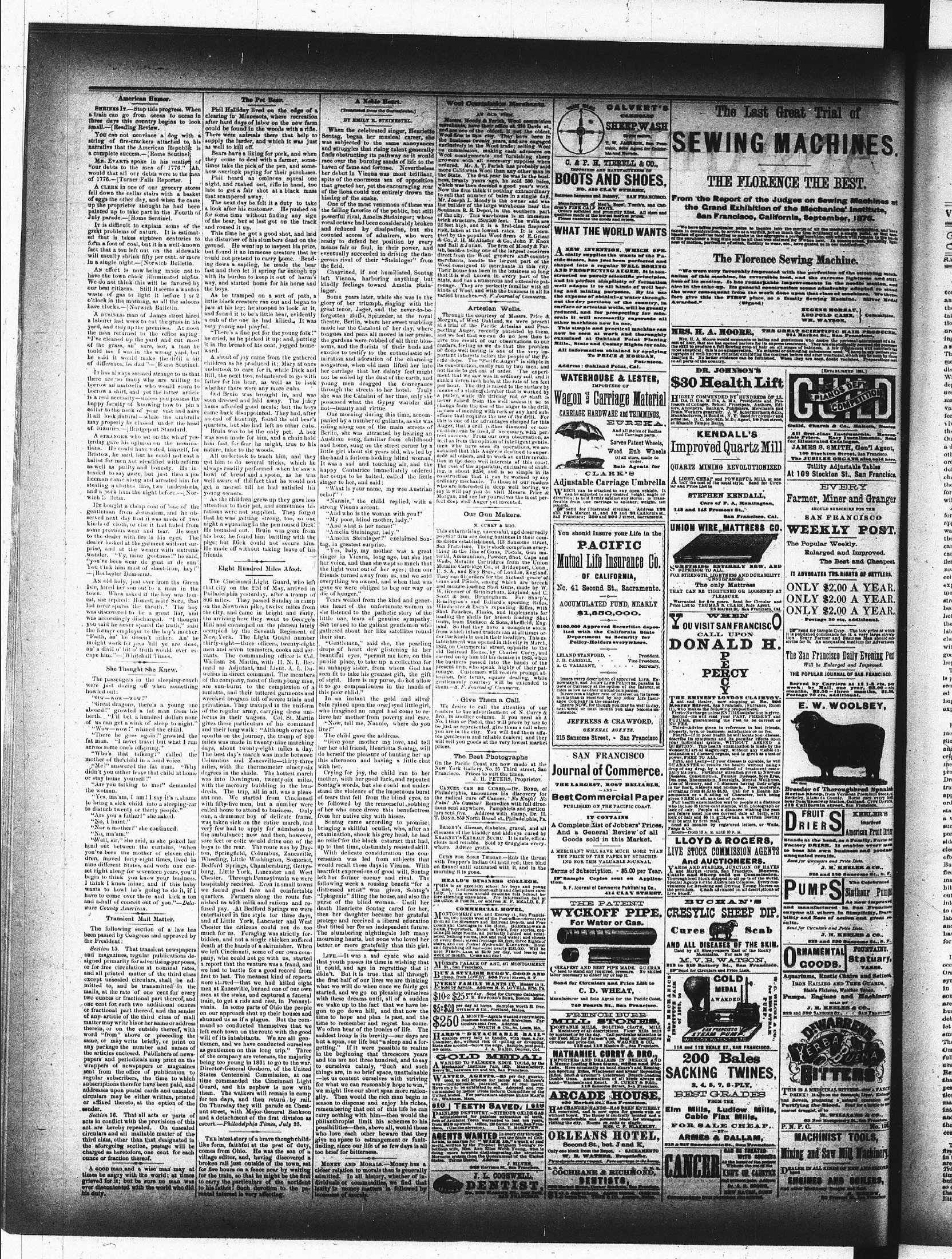
Searchable text
American Humer.
Shrinks It—Stop this progress. When a train can go from ocean to ocean in three days this country begins to look small. [Reading Review.
You cannot convince a dog with a string of fire-crackers attached to his narrative that the American Republic is a complete success. [Rome Sentinel]
Mr. Evarts spoke in his oration of "our debts to the men of 1778." Ah, would that all our debts were to the men of 1776. [Turner Falls Reporter]
A clerk in one of our grocery stores fell down the cellar stairs with a basket of eggs the other day, and when he came up the proprietor thought he had been painted up to take part in the Fourth of July parade. [Rome Sentinel]
It is difficult to explain some of the great problems of nature. It is estimated that it takes eighteen centuries to form a foot of coal, but it is a well-known fact that a ton left out on the sidewalk will usually shrink fifty per cent. or more in a single night. [Norwich Bulletin]
An effort is now being made not to have the town clock illuminated nights. We do not think this will be favored by our best citizens. Still it seems a wanton waste of gas to light it before 1 or 2 o'clock in the morning, as all the saloons have clocks. [Norwich Bulletin]
A business man of James street hired a laborer last week to cut the grass in his yard, and tidy up the premises. At noon the man returned to the office saying: "I've cleaned up the yard and cut most of the grass, an' sure, sor, a man he told me I was in the wrong yard, but he said it would make the divil a bit of difference, be dad." [Rome Sentinel]
It has always seemed strange to us that there are so many who are willing to borrow an umbrella who would scorn to borrow a shirt, and yet the latter article is a real necessity—unless you possess the happy faculty of knowing how to pin a collar to the neck of your vest and have it all look natural—while the umbrella may properly be classed under the head of luxuries. [Bridgeport Standard]
A stranger who sat on the wharf yesterday gave his opinion on the nominations. He could have voted himself, for Bristow, he said, but he could not cast a ballot for men not identified with reform as well as purity and honesty. He in-
The Pet Bear.
Phil Halliday lived on the edge of a clearing in Minnesota, where recreation after hard days of labor on the new farm could be found in the woods with a rifle. There were animals there that help to supply the larder, and which it was just as well to kill off.
Bears have a liking for pork, and when they come to deal with a farmer, sometimes take the pick of the pen, and somehow overlook paying for their purchases.
Phil heard an omineous squeal one night, and rushed out, rifle in hand, too late to get a fair shot at a black mass that scampered away.
The next day he felt it a duty to take a look after his customer. He pushed on for some time without finding any sign of the bear, but at last got on the track and roused it up.
This time he got a good shot, and laid the disturber of his slumbers dead on the ground. He went up to inspect his prize, but found it an immense creature that he could not pretend to carry home. Bending down a sapling, he made the bear fast and then let it spring far enough up with its burden to keep it out of harm's way, and started home for his horse and the boys.
As he tramped on a sort of path, a little black creature ran out and began to paw at his leg; he stooped to look at it, and found it to be a little bear, evidently a cub of the one he had killed. It was very young and playful.
"There’s a fine pet for the young folk!" he cried, as he picked it up; and putting it in the breast of his coat, jogged homeward.
A shout of joy came from the gathered children as he produced it; Mary at once undertook to care for it, while Dick and Bill, the next two, volunteered to go with father for his bear, as well as to look whether there were any more cubs.
Old Bruin was brought in, and was soon dressed and laid away. The juicy hams afforded good meals; but the boys came back disappointed. They had, after no end of hunting, found the old bear's quarters, but she had left no other cubs.
Bruin was to be the only pet. A box was soon made for him, and a chain held him fast, for fear he might, true to his nature, take to the woods.
All undertook to teach him, and they got him to do several tricks, which he always readily performed, when he saw
It has always seemed strange to us that there are so many who are willing to borrow an umbrella who would scorn to borrow a shirt, and yet the latter article is a real necessity—unless you possess the happy faculty of knowing how to pin a collar to the neck of your vest and have it all look natural—while the umbrella may properly be classed under the head of luxuries.—[Bridgeport Standard.
A STRANGER who sat on the wharf yesterday gave his opinion on the nominations. He could have voted, himself, for Bristow, he said, but he could not cast a ballot for men not identified with reform as well as purity and honesty. He intended to say more, but just then a policeman came along and arrested him for stealing a clothes line, two undershirts, and a pork ham the night before.—[Norwich Lletin.
He bought a cheap coat of one of the gentleman from Jerusalem, and he observed next day that it was made of two kinds of cloth, or else it had laded from some previous wear and tear. He went to the dealer with fire in his eyes. The dealer looked at the garment without surprise, and at the wearer with extreme wonder. "Vy, mine gootness!" he said, "you've been wear de goat in de sun! You tink him mast of sheet-iron, hey?"—[Rochester Democrat.
An old lady, just over from the Green Isle, hired her son out to a man in the town. When asked if the boy was honest, she replied: Honest, is it? Sure, that lad never spares the thruth." The boy was discovered to be a great liar, and was accordingly discharged. "I thought you said he never spared the truth," said the former employer to the boy's mother. "Faith, an' he dosen't aither. An' he might work for yees 'till ye are dead, an' a divil o' bit o' truth would ever escape him."—[Whitehall Times.
She Thought She Knew.
The passengers in the sleeping-coach were just dozing off when something howled out:
"Ow—wow—wow!"
"Great dragons, there's a young one aboard!" growled a fat man from his berth. "I'll bet a hundred dollars none of us can get a wink of sleep to-night."
"Wow—wow!" whined the child.
There he goes again!" growled the fat man. "I never travel but what I run across some one's offspring."
"Who's that talking?" called the mother of the child in a loud voice.
"Me!" answered the fat man. "Why didn't you either leave that child at home or stay home yourself?"
"Are you talking to me?" demanded the woman.
"Yes, ma'am, I am! I say it's a shame to bring a sick child into a sleeping-car to disturb twenty or thirty people."
"Are you a father?" she asked.
"No, I haint."
"Nor a mother?" she continued.
"No, ma'am."
"Well, sir," she said, as she poked her head out between the curtains, "when you've been the mother of eleven children, moved forty-eight times, lived in nine different States, and worn one corse right along for seventeen years, you'll begin to think you know your business. I think I know mine; and if this baby wants to help me," going to do it if I
Old Bruin was brought in, and was soon dressed and laid away. The juicy hams afforded good meals; but the boys came back disappointed. They had, after no end of hunting, found the old bear's quarters, but she had left no other cubs.
Bruin was to be the only pet. A box was soon made for him, and a chain held him fast, for fear he might, true to his nature, take to the woods.
All undertook to teach him, and they got him to do several tricks, which he always readily performed when he saw a bowl of bread and a spoon, as he was well aware of the fact that he would not get a morsel till he had satisfied his young owners.
As the children grew up they gave less attention to their pet, and sometimes his rations were not supplied. They forgot that he was getting strong, too, so one night a squealing in the pen roused Dick! He bounded out. Bruin was gone from his box; he found him battling with the pigs; but Dick could not secure him. He made off without taking leave of his friends.
Eight Hundred Miles Afoot.
The Cincinnati Light Guard, who left that city on the 22d of May, arrived in Philadelphia yesterday, after a tramp of 800 miles. They passed Sunday in camp on the Newtown pike, twelve miles from the city, and came in bright and early. On arriving here they went to George's Hill and encamped on the plateau later occupied by the Seventh Regiment of New York. The Light Guard number thirty-eight—three officers, twenty-eight men and seven teamsters, cooks and servants. The commanding officer is Col. William St. Martin, with H. N. L. Bernard as Adjutant, and Lieut. A. L. Duwelius in direct command. The members of the company, most of them young men, are sun-burnt to the complexion of a mulatto, and their tattered garments and wrecked brogans tell of severe trials and privations. They trumped in the uniform of the regular army, carrying dress uniforms in their wagons. Col. St. Martin gives these particulars of his command and their long walk: "Although over two months on the journey, the tramp of 800 miles was made in twenty-nine marching days, about twenty-eight miles a day. The best day's march was made between Columbus and Zanesville-thirty-three miles, with the thermometer ninety-six degrees in the shade. The hottest march was into Dowington, twenty-six miles, with the mercury bubbling in the hundreds. The trip, all in all, was a pleasant one. We started from Cincinnati with fifty-five men, but a number were called home to attend to business. Only one, a drummer boy of delicate frame, was taken sick on the entire march, and very few had to apply for admission to the ambulance; now and then, however, sore feet or colic would drive one of the boys to the rear. The route was by Dayton, Springfield, Columbus, Zanesville, Wheeling, Little Washington, Somerset, Bedford Springs, Chambersburg, Gettysburg, Little York, Lancaster and West Chester. Through Pennsylvania we were hospitably received. Even in small towns her carriage did not be soiled young men through the head she was the Gossipess who not—beautifully riding along Berlin, she wore Austrian shoes and home; she little girl about the hand a for it was a sad happy Canton her coupe to her singer to her. "What is yoe echof?"
"Nannie," strong Vienna.
"And who o"
"My poor,
"And what
"Amelia S
"Amelia S tag, in greater
"Yes, lady singer in Vi
her voice,and
the light wen friends turne
everything we were die of hunger
Tears well ous heart of o she listened to little one,tc She turned to gathered about their star.
"Gentlemen drops of hear beautiful eye public place,
an unhappy s seen fit to tak of sight.H e it to go com this poor chil
In an inst coin rained up who imagined lie her mot
"Now,tell live?
The child g
"Give your her her old frie do herself tha this afternoon with her.
Crying for mother,with Sontag's word stand the viole of tears f that be followed b of her who on from her native
Sontag can bringing a ski examination,s no relief for th up to that time
With delica versation was would recall t heartfelt expres left her forme following wee distressed art
"Yes, ma'am, I am! I say it's a shame to bring a sick child into a sleeping-car to disturb twenty or thirty people."
"Are you a father?" she asked.
"No, I haint."
"Nor a mother!" she continued.
"No, ma'am."
Well, sir," she said, as she poked her head out between the curtains, "when you've been the mother of eleven children, moved forty-eight times, lived in nine different States, and worn one corse right along for seventeen years, you'll begin to think you know your business. I think I know mine; and if this baby wants to howl he's going to do it, if I have to come over there and kick a ton and a half of conceit out of you."—Delaware County American.
Transient Mail Matter.
The following section of a law has been passed by Congress and approved by the President:
Section 15. That transient newspapers and magazines, regular publications designed primarily for advertising purposes, or for free circulation at nominal rates, and all printed matter of the third class except unsealed circulars, shall be admitted to, and be transmitted in the mails, at the rate of one cent for every two ounces or fractional part thereof, and one cent for each two additional ounces or fractional part thereof, and the sender of any article of the third class of mail matter may write his or her name or address therein, or on the outside thereof, with word "from" above or preceding the same, or may write briefly, or print on any package the number and names of the articles enclosed. Publishers of newspapers and periodicals may print on the wrappers of newspapers or magazines sent from the office of publication to regular subscribers, the time to which subscriptions therefor have been paid, and addresses upon postal cards and unsealed circulars may be either written, printed or affixed thereto, at the option of the sender.
Section 16. That all acts or parts of acts in conflict with the provisions of this act are hereby repealed. On unsealed circulars and all mailable matter of the third class, other than that designated in the foregoing section, postage will be charged as heretofore, one cent for each ounce or fraction thereof.
A good man and a wise man may at times be angry with the world; at times grieved for it; but be sure no man was ever discontented with the world who did his duty.
The trip, all in all, was a pleasant one. We started from Cincinnati with fifty-five men, but a number were called home to attend to business. Only one, a drummer boy of delicate frame, was taken sick on the entire march, and very few had to apply for admission to the ambulance; now and then, however, sore feet or colic would drive one of the boys to the rear. The route was by Dayton, Springfield, Columbus, Zanesville, Wheeling, Little Washington, Somerset, Bedford Springs, Chambersburg, Gettysburg, Little York, Lancaster and West Chester. Through Pennsylvania we were hospitably received. Even in small towns we found good fare and comfortable quarters. Farmers along the route furnished us with milk and rations and refused pay. At Bedford Springs we were entertained in fine style for three days, and at Little York, Lancaster and West Chester the citizens could not do too much for us. Foraging was strictly forbidden, and not a single chicken suffered death at the hands of a skirmisher. When we left Cincinnati, some of our own company, who could not go with us, started a report that the venture was a fraud, and we had to battle for a good record from first to last. The meanest kind of reports were started—that we had killed eight men at Zanesville, burned one of our own men at the stake, and captured a funeral train, to get a ride and rest, in Pennsylvania. In some parts of Ohio the people on our approach shut up their houses and shunned us as if a plague. But the command so conducted themselves that we left each town on the route with the good will of its inhabitants. We are all gentlemen, and we have conducted ourselves as gentlemen on this long trip.” Three of the company are veterans, the majority being too young in 1861 to go to the war. Director-General Goshorn, of the United States Centennial Commission, at one time commanded the Cincinnati Light Guard, and his nephew is now with them. The walkers will remain in camp for ten days, and then return by rail. On Thursday they will parade on Chestnut street, with Major-General Bankson and a detachment of the first division as escort.—Philadelphia Times, July 25.
The latest story of a brave though child-like form, faithful at the post of duty, comes from Ohio. He was the son of a village editor, and having discovered a broken rail just outside of the town, sat for five hours on a fence near by waiting for the train, so that he might be the first to carry the particulars of the accident to his father! Such devotion to the parental interest is very affecting.
Sontag can bring a ski examination; she no relief for those up to that time.
With delicacyversation was would recall the heartfelt expression left her former distressed art “Iphigenie” film purse of the death Henrietta then her daughte protege and reel that fitted here. The slumbering mourning heart better or more.
LIFE.—It was that youth pass it could,and didn't. But it is the first half o' what we will o started,and we with these dreewe wake up to gun to go down time to hope time to remembeWe often hear saddest irony but a span,nourgetting.” If l in the beginning and ten are no to ourselves things are,sin—let us contenfer for what we can we might live ally. Then we season to dispense remembering t carry nothing o philanthropist possibilities—the who love each give no space f finding,since o too brief for bi
MONEY AND CLOSER RELATION ADMITTED. In dividends or cash liability in monies inconsistent of me
A Noble Heart.
[Amended from the Garrisonation.]
BY EMILY H. STEINESTEL.
When the celebrated singer, Henriette Sontag, began her musical career, she was subjected to the same annoyances and struggles that rising talent generally finds obstructing its pathway as it would race over the burning sands of life to the haven of fame and fortune. Nevertheless her debut in Vienna was most brilliant, spite of the enormous sea of opposition that greeted her, yet the encouraging roar of the lions could not entirely drown the hissing of the snake.
One of the most venomous of these was the failing favorite of the public, but still powerful rival, Amelia Steininger; whose vocal octave had been considerably broken and reduced by dissipation, but she counted scores of admirers, who were ready to defend her position by every means fair or foul, in their power, and eventually succeeded in driving the dangerous rival of their "Steininger" from the field.
Chagrined, if not humiliated, Sontag left Vienna, harboring anything but kindly feelings toward Amelia Steininger.
Some years later, while she was in the glory of her triumph, singing with the great tenor, Jager, and the never-to-beforegone Buffo, Spitzeder, at the royal theatre, Berlin, where her sweet warbling made her the Cataloni of her day, where tongues and pens all moved in her praise, the gardens were robbed of all their blossoms, and the florists of their buds and exotics to testify to the enthusiastic admiration and adoration of the charming songstress, when old men lifted her into her carriage that her dainty feet might not be soiled by the dust of the earth, and young men dragged the conveyance through the streets to her hotel. Truly she was the Catalini of her time, only she possessed what the Gypsy warbler did not—beauty and virtue.
One morning during this time, accompanied by a number of gallants, as she was riding along one of the main streets of Berlin, she was attracted by hearing an Austrian song, familiar from childhood and home, sung on the street corner by a little girl about six years old, who led by the hand-a forlorn-looking blind woman. It was a sad and touching air, and the hazy. Cantatrice immediately ordered.
Wool Commission Merchants.
AN OLD TIME.
Menns Moody & Parish, Wool commission merchants, have their office at 210 Davis st., and are one of the oldest. If not the oldest, Wool firm is this city. They have been in the luminous twenty years, and are engaged exclusively in the Wool trade; selling Wool on commission, making cash advances on Wool consignments and furnishing sheep growers with all necessary supplies when ordered. Mr. A. T. Farish has probably sold more California Wool than any other man in the State. The first year he was in the business, twenty years ago, he sold 500 bales, which was then deemed a good year's work. Now the firm think it nothing extraordinary to sell that number of bales in a single day. Mr. Joseph L. Moody is the owner and was the builder of the large warehouse near the Southern R. R. Depot, in the southern part of the city. This warehouse is an immense brick structure, 250x500 feet. The walls are 22 feet high, and it is a first-class fireproof risk, taken at the lowest rates. It is occupied by the popular Wool firms of E. Grisair & Co., J. H. McAllister & Co., John F. Knox and Ball & Julian. The firm of Moody & Parish, besides being one of the largest receivers direct from the Wool growers and country merchants, handle the largest part of the Wool consigned to merchants in this city. Their house has been in the business so long that it is well known in every part of the State, and has a numerous and extensive patronage. They are perfectly familiar with all kinds of Wool, and with the business in all its varied branches.-S. P. Journal of Commerce.
Artesian Wells.
Through the courtesy of Messrs. Price & Morgan, of West Oakland, we were present at a trial of the Pacific Artesian and Prospecting Auger, recently patented by them, and we feel that we can do no less than to give the result of our observations to our readers, feeling as we do that the problem of deep well boring is one of the very important interests before the people of the Pacific slope. The "Pacific Auger" is simple in its construction, easily run by two men, and not liable to get out of order. The experiment that we saw was in ordinary soil, and it sunk a seven-inch hole, at the rate of ten feet per hour. The dirt is raised to the surface by means of a shipling elevator that is worked by a pulley, while the driving rod or shaft is never raised from the well unless it be to change from the use of the auger to the drill, in case of meeting with rock or any hard substance that requires the use of the drill. For this is one of the advantages claimed for this Auger, that a drill (either diamond or concussion) can be used, if necessary, with perfect success. From our own observation, as well as from the opinion of intelligent gentlemen who have seen its operations, we are satisfied that this Auger is destined to supersede all others, and to work an entire revolution in the deep well interests of this coast. The cost of the apparatus, exclusive of shaft-
her carriage that her dainty feet might not be soiled by the dust of the earth, and young men dragged the conveyance through the streets to her hotel. Truly she was the Catalini of her time, only she possessed what the Gypsy warbler did not—beauty and virtue.
One morning during this time, accompanied by a number of gallants, as she was riding along one of the main streets of Berlin, she was attracted by hearing an Austrian song, familiar from childhood and home, sung on the street corner by a little girl about six years old, who led by the hand a forlorn-looking blind woman. It was a sad and touching air, and the happy Cantatrice immediately ordered her coupe to be halted, called the little singer to her, and said:
"What is your name, my wee Austrian echof."
"Nannie," the child replied, with a strong Vienna accent.
"And who is the woman with you!" "My poor, blind mother, lady." "And what is her name?" "Amelia Steininger, lady." "Amelia Steininger!" exclaimed Son-tag, in greatest surprise.
"Yes, lady, my mother was a great singer in Vienna, long ago, but she lost her voice, and then she wept so much that the light went out of her eyes; then our friends turned away from us, and we sold everything we owned, and when that was gone we were obliged to beg our way or die of hunger."
Tears welled from the kind and generous heart of the unfortunate woman as she listened to the pathetic story of the little one, tears of genuine sympathy. She turned to the gallant gentlemen who gathered about her like satellites round their star.
"Gentlemen," said she, the pearling drops of heart dew glistening in her beautiful eyes, "permit me here, on this public place, to take up a collection for an unhappy sister, from whom God has seen fit to take his greatest gift, the gift of sight. Here is my purse, do not allow it to go companionless in the hands of this poor child."
In an instant the gold and silver coin rained upon the overjoyed little girl, who imagined an angel had come to relieve her mother from poverty and care.
"Now, tell me, Nannie, where do you live!"
The child gave the address.
"Give your mother my love, and tell her her old friend, Henrietta Sontag, will do herself the pleasure of hunting her up this afternoon and having a little chat with her.
Crying for joy, the child ran to her mother with her good luck, and repeated Sontag's words, but she could not understand the violence of the impetuous burst of tears that fell from the blind eyes, to be followed by the remorseful sobbing of her who once drove this benefactress from her native city with hisses.
Sontag came according to promise; bringing a skillful oculist, who, after an examination, shook his grey head, he had no relief for the black cataract that had up to that time, obstinately resisted skill.
With delicate consideration the conversation was led from subjects that would recall those days in Vienna. With heartfelt expressions of good will, Sontag left her former enemy and rival. The following week a rousing benefit "for a distressed artist," was given Sontag.
Our Gun Makers.
N. CURBY & BRO.
This enterprising, successful, and deservedly popular firm are doing business in their commodious establishment, 113 Sansome street, San Francisco. Their stock comprises everything in the line of Guns, Pistols, Gun material, Ammunition, Powder, Shot, Caps and Wads, Metallic Cartridges from the Union Metallic Cartridge Co., of Bridgeport, Conn., U.S.A., and Eley Bros., of London, England. They can fill orders for the highest grade of Guns and Pistols, among which are breech and muzzle-loading Shot Guns, made by W. W. Greener of Birmingham, England, and C. Scott & Son, Birmingham. For Sharp's Remington's and Ballard's sporting Rides, Winchester & Even's repeating Rifles, with Shot Pouches, Flasks, and implements for loading the shells for breech loading Shot Guns, from Dickson & Sons, Sheffield, England. So that they have a complete stock from which inland traders can atil times order the kinds in use in their localities. This establishment was opened in this city in March, 1852, on Commercial street, opposite to the old Railroad House, by Charles Carry, and carried on by him till his demise in 1863, when the business passed into the hands of the present firm, who speak highly of their patronage. Customers will receive prompt attention, fair terms, square dealing, while gentlemanly courtesy will be extended to them—S. P. Journal of Commerce.
Give Them a Call.
We desire to call the attention of our readers to the advertisement of N. Curry & Bro., in another column. If you need an A No.1 Gun or Pistol, that will prove by use to be just as represented, give them a call when you are in the city. You will find them affable gentlemen and reliable dealers; and they will sell you goods at the very lowest market prices.
The Best Photographs
On the Pacific Coast are now made at the New York Gallery, No.25 Third street, San Francisco. Prices to suit the times.
J. H. PETERS, Propietor.
CANCER CAN BE CURED—Dr. Bond of Philadelphia announces his discovery for the radical cure of Cancer. No Knife! No Pain! No Castie! Remedies with full directions sent anywhere. Pamphlets and partiars lans free. Address with stamp, Dr. H. T. Bond,$99 North Broad st., Philadelphia, Pa.
Bright's disease, diabetes, gravel, and all diseases of the bladder and kidneys cured by Kearney's Extract Buchu. It is safe, efficacious and reliable. Sold by druggists everywhere. Advice gratis.
CURE FOR SORE THROAT—Rub the throat with Trapper's Indian Oil until red; then bind on channel until saturated with it; and in the morning it is gone.
HEALTH'S HUMANNESS COLLEGE.
This is an excellent school for boys and young students in an educational soil, and it sinks a seven-inch hole at the rate of ten feet per hour. The dirt is raised to the surface by means of a sliding elevator that is worked by a pulley, while the driving rod or shaft is never raised from the well unless it be changed from the use of the auger to the drill, in case of meeting with rock or any hard substance that requires the use of the drill. For this is one of the advantages claimed for this Auger; that a drill (either diamond or concussion) can be used, if necessary, with perfect success. From our own observation as well as from the opinion of intelligent gentlemen who have seen its operations, we are satisfied that this Auger is destined to super-sede all others, and to work an entire revolution in the deep well interests of this coast. The cost of the apparatus, exclusive of shafting, is about $250, and is so simple in its construction that it can be worked by any ordinary mechanic. To those of our readers who are interested in deep well boring, we say it will pay you to visit Messrs. Price & Morgan,and see for yourselves the most perfect deep well Auger yet invented.
You should Insure your Life in the PACIFIC Mutual Life Insurance Co. OF CALIFORNIA,
No.41 Second St., Sacramento.
ACOUMULATED FUND,NEARLY
$1,BUO.OOO.
$100.OOO Approved Securities deposited with the California State Department as Security for Polloy-Holders everywhere.
LELAND STANFORD,
President.
J.H.CARHOLL,
Vice-President.
A.C.VALLIANT,
Secretary.
Insures every description of approved Life Expenditure and Joint Life Policies,payable in Gold or currency at any interest in its investments than is received by any other Life Insurance Company in the country.
Insure Now,forth you may be well to-day,next week or next month you may become uninsurable.
JEFFRESS & CRAWFORD,
GENERAL AGENTS.
215 Sansome Street,-San Francisco.
SAN FRANCISCO
Journal of Commerce.
THE LARGEST,MOST RELIABLE,
AND
Best Commercial Paper
PUBLISHED ON THE PACIFIC COAST.
IT CONTAINS
A Complete List of Jobbers' Prices,
And a General Review of all Goods sold in this Market.
A MERCHANT WILL SAVE MUCH MORE THAN THE PRICE OF THE PAPER BY SUBSCRIBING FOR THIS VALUABLE JOURNAL.
Terms of Subscription,- $5.00 per Year.
Sample Copies sent on Appliciation.
S.F. Journal of Commerce Publishing Co..
It was a sad cynic who said that youth passes its time in wishing that it could, and age in regretting that it didn't. But it is true that all through the first half of our lives we are thinking what we will do when once we fairly get started, and we go on pleasing ourselves with these dreams until, all of a sudden we wake up to the fact that we have begun to go down hill, and that now the time to hope and plan is past, and the time to remember and regret has come. We often hear of the ironies of life. The saddest irony is its brevity—our days are but a span, our life but "a sleep and a forgetting." If it were possible to realize in the beginning that threescore years and ten are not three hundred, and to say to ourselves calmly, "Such and such things are, in so brief space, unattainable—let us content ourselves with striving for what we can reasonably hope to win," we might live our short span more rationally. Then would the rich man begin in season to dispense and enjoy his riches, remembering that out of this life he can carry nothing with him—then would the philanthropist limit his schemes to his possibilities—then, above all, would those who love each other beware that they give no space to estrangement or fault-finding, since our life of so few days is all too brief for bitterness.
Money and Morals. Money has a clear relation to morals than is generally admitted. In all history, whether of individuals or communities, we find that laxity in money matters is followed by laxness of morale.
The Last Great Trial of SEWING MACHINES.
THE FLORENCE THE BEST.
From the Report of the Judges on Sewing Machines at the Grand Exhibition of the Mechanics Institute, San Francisco, California, September, 1878.
"We have taken particular points to inquire into the merits of all the machines in exhibition, and have taken in consideration, to arrive at a verdict, just so much the first brilliance of a single point, so that simultaneous questioning may make in the aggregate a perfect machine; one which will remain in the hands of the purchaser a long time before it when next. In connexion with certain lightness of motion, perfection of finish, liability to wear, etc., have guided us in our conclusions."
The Florence Sewing Machine.
"We were very favourably impressed with the perfection of the attaching mechanism of this machine, its reversible feed, and the extreme lightness and stillness of its motion. It has remarkable improvements in the needle mould, and also in the take-up. Its general construction seems admirably adapted to stand the wear consequent from the work done upon that class of machines. We therefore give this the FIRST place, as a family Sewing Machine. Silver Medal Awarded."
[Signed]
MRS. H. A. MOORE, THE GREAT SCIENTIFIC HAIR PRODUCER,
914 Market St., San Francisco.
Mrs. H. A. Moore would announce to ladies and gentlemen who desire the personal endorsement of a suit of hair, that she has opened parlors for its express treatment. They are emphatically assured she promises the skill to produce a full flowing crop of hair on all stages of baldness. A few treatments will continue the most original; this is no argumentation. No warrant or damaging substances used. I have in my partys photographs of well-known citizens exhibiting the contract before and after treatment, which can be seen by those watching it. No better evidence can be furnished. When they are seen, doubt vanishes. Preparations sent to all parts of the country.
DR. JOHNSON'S $30 Health Lift
HIGHLY COMWENDED BY HUNDREDS OF LL.D.A.D.D.A.M.D.A.M.A.Presidents and Professors of Colleges, School Principals, Authors, Editors, Attorneys, Bankers, Publishers, Merchants and Brain Workers generally. J.W. Schermerhars & Co., Manufacturers, 14 Bond st., N.Y. Sand for circular and price list. D.C. MOORE, M.D. Agent, 16 Post street, at Magnetic Temple Baths.
KENDALL'S Improved Quartz Mill
QUARTZ MINING REVOLUTIONIZED
GIUDD, Church & Co., Mahon, Boston
All first-class Instruments. Reasonable Prices. Easy Installments. Send for Illustrated Catalogues.
JAMES S. SMITH, Gen'l Agent,
100 Stockton Street, San Francisco.
The JUBILEE ORGANS also sold here.
Utility Adjustable Tables
USE & LESTER,
CARRIAGE MATERIAL
WARE AND TRIMMINGS,
EUREKA.
And all styles of Bodies and Carriage parts.
Sarven Patent Wheels,
Wood Hub Wheels
Of all sizes, made to order.
Sole Agents for
LARK'S
Carriage Umbrella
Attached to any open vehicle. It is not to any desired height, angle or family against any storm; is trans-arranged to another, weight, ten litrated circular. Address 132 and 19 and 21 California st., and 203 J street, Sacramento.
Sure your Life in the Pacific Insurance Co.
CALIFORNIA,
and St., Sacramento.
TED FUND, NEARLY $50,000.
Secured Securities depose the California State at as Security for holders everywhere.
RD. President.
Vice-President.
Secretary.
Receipt of approved Life, Ex-ant Life Policies, payable in the option of the Insurer, at the mutual companies. Rate of interest on its investment by any other Life Insurance country.
OBS & CRAWFORD,
PERAL AGENTE.
STREET, - San Francisco.
FRANCISCO
of Commerce.
T. MOST RELIABLE,
AND
Commercial Paper
IN THE PACIFIC COAST.
CONTAINS list of Jobers' Prices, general Review of all ed in this Market.
SAVE MUCH MORE THAN THE PAPER BY SUBSCRIBE VALUABLE JOURNAL.
option, - $5.00 per Year.
please sent on AppliCommerce Publishing Co.
DR. JOHNSON'S
$30 Health Lift
HIGHLY COMMENDED BY HUNDREDS OF LL.D.A, D.D.A, M.D.A, A.M.A. Presidents and Professors of Colleges, School Principals, Authors, Editors, Attorneys, Bankers, Publishers, Merchants and Brain Workers generally. J.W. Schermerhorn & Co., Manufacturers, 14 Booths, N.Y. Send for circular and personal D.C. MOORE, M.D. Agent, 10 Post street, at Masonic Temple Bath.
KENDALL'S Improved Quartz Mill
QUARTZ MINING REVOLUTIONIZED
A LIGHT, CHEAP and POWERFUL MILL at one half the cost of the usual style. Bend for Circular and Price List to STEPHEN KENDALL,
Care of F. A. Huntington,
148 and 145 Premont St..
San Francisco, Cal.
UNION WIRE MATTRESS CO.
SOMETHING INTIMELY NEW. AND SUPERIOR TO ALL FOR STRENGTH, LIGHTNESS AND DURABILITY UNSURPASSED.
The only Mattress THAT CAN BE TIGHTENED OR LOOSENED AT PLEASURE.
Warranted for five years. Bend for Circular and Price List to TRUMAN S. CLARK, Bole Agent,
919 Market St. San Francisco, Cal.
WHEN YOU VISIT SAN FRANCISCO
CALL UPON DONALD H.
PERCY CY
THE EMINENT LONDON CLAIRVOYANT and Healer, now stopping at No. 206 Kearny Street, San Francisco (Entrance Room 11), who makes the following propositions:
First—No charge unless ENTIRE satisfaction is given. Second—He will read your PART, PRESENT, and FUTURE, guaranteeing the Past to be correct or NO FEEL.
Third—Advice given in reference to lost friends, property, love, or business; satisfaction or no fee. In people he might locate you disease, describe his symptoms and its peculiar effects upon your individual system, WITHOUT ASKING A QUESTION. This health examination is made by the wonderful art of Magcology, without any visible examination of diseased organs, and is given as a test of power FREE TO ALL.
Fifth and Lastly—If your disease is curable, he will GUARANTEE to restore the health without using a drop of any drug by a method of treatment essentially his own. Particular attention given to Nervous Disposition, Funnel Disease, Neurasia, Depression, Rheumatism, Neuralgia, Mental Weakness Loss of Memory, and ill diseases having their origin in the backs, kidneys and stomach. Feas moderate, averaging from $1.50 to $5.50. Call for a Health Examination for a riding of a character, both being given FREE to all as last resort.
Full health examination sent to people at a distance who include 35 three-cent stamps, with photograph or lock of hair. People at a distance wishing the past and future must lose correct date of birth, with lock of hair when a written Deastiny will be sent by first man.
Send all monies by registered letters, or Wells, Fargo & Co.
LLOYD & ROGERS,
LIVE STOCK COMMISSION AGENTS
And AUCTIONEERS.
YARDES AND STABLES, JUNCTION OF HAYES and Market streets, San Francisco. Horse-Cattle and Sheep sold on Commission. Thoroughbred Stock shipped to all parts of the world. Special Agents for the Australian Colonies. Every convenience for Breaking and Driving Young horses on Masonic Temple Bath.
PIANOS DEPOT COMPETITION
Guild, Church & Co., Makeen, Boston
All guest-class Instruments. Reasonable Prices. Easy Installments. Send for Illustrated Catalogue.
JAMES S. SMITH, Gen'l Agent,
100 Stockton Street, San Francisco.
The JUBILEE ORGANS also sold here.
Utility Adjustable Tables At 109 Stockton St., San Francisco.
EVERY Farmer, Miner and Granger
SHOULD SUBSCRIBE FOR THE SAN FRANCISCO WEEKLY POST.
The Popular Weekly.
Enlarged and Improved.
The Best and Cheapest IT ADVOCATES THE RIGHTS OF SETTLERS.
ONLY $2.00 A YEAR.
ONLY $2.00 A YEAR.
ONLY $2.00 A YEAR.
Postage 30 cts. additional.
Send for Sample Copy. The low price at which it is published commensals for it! Admission: Every Farmer and Business Man should subscribe for it. An unequalled medium for Advertisement.
The San Francisco Daily Evening Post Will be Enlarged and Improved.
THE POPULAR JOURNAL OF SAN FRANCISCO.
Served by Carriers at 12 1-2 cts. per week; by Mail, one year; $5.00 - six months; $3.50 - three months; $1.54 Postage 70 cts. additional.
E. W. WOOLSEY,
Breeder of Thoroughbred Spanish Marine Sheep from Temporal Premium Stock in Berkeley, Alamda County. Horse care every hour from Broadway Station, Oakland City Orchard 415 California street, San Francisco.
DFRUIT DRIER'S
Improved American Fruit Drink
Stands at the head, as a Family Farm of Factory DRIER. It enables every man to be his own business and produce unequal results.
Send for Circuits and Price List.
J. M. KHELER & Co...
325 and 330 Sansome St., S.F.
DUMPS
The Callected Billboard
LLOYD & ROGERS,
LIVE STOCK COMMISSION AGENTS
And AUCTIONEERS.
YARDS AND STABLES, JUNCTION OF HAYES
and Market streets, San Francisco.
State House and Railway Company.
Thoroughbred Stock shipped to all parts of the world.
Special Agents for the Australian Colonies. Every convenience for Breaking and Driving Young Horse on the premises. Cash advanced on all descriptions of Live Stock.
BUCHAN'S
CRESYLIC SHEEP DIP.
Cures Scab
AND ALL DISEASES OF THE SKIM.
Used by all Sheep-trainers East of the Rocky Mountains. For sale by M.V.B. WATSON,
818 to 819 BAELE ST., San Francisco.
EF Send for Circulars and Price Lists.
GOLD
MEDAL
AWARDED
BY THE FROM ANTIOCH INSTITUTE OF 1852.
SAN FRANCISCO
STEAM PUMP.
WILCOX PAINTING COMPANY
200 Bales
SACKING TWINES,
3,4,5,7,8-PLY,
BEST GRADES
FROM THE
Elm Mills, Ludlow Mills,
Cable Flax Mills,
FOR SALE CHEAP.
BYARMES & DALLAM,
CANCER
SAD ME TREATED WITH SOGENA AT the home of the patient. Within the one of the KNITE OR CASTICE and without gain. Address St. A. B. BRONEL NEW MACHINE, CO.
FRUIT DRIERS
KNEHLER'S
Improved American Fruit Drier
Stands as the head, so family, Farm or Factory DRIER. It enables every man to be his own business and produces unequaled results.
Send for Circulators and Price Lists.
J. M. KNEHLER & Co.
828 and 830 Sansome St., N. F.
PUMPS
The Celebrated Sluthour Pump
As new improved and manufactured in San Francisco surpass all others in Simplicity, Durability and Ease of action and great results.
Send for Circulators and Price Lists.
J. M. KNEHLER & Co.
828 and 830 Sansome St., N. F.
ORNAMENTAL GOODS.
FOUNTAINS,
Statuary,
Vases.
Aquariums, Hustic Chairs and Settees,
Iron RAILING AND TREE GUARD,
Stable Fixures, Weather Vases,
Pumps, Engines and Machinery.
GOLD BY
J. M. KNEHLER & Co.
828 and 830 Sansome St., N. F.
DEWARRED
HERB AQUARE BITTERS
THIS IS A MEDICAL MITTEN—NOT A PANCY DRINK!
It helps on the Humphrey, Livre, Kilkenny and Bowls, producing a natural opulence and Partifying the Blood. Send for a bottle to the nearest druggist, of to:
M. WILLIAMS & Co.
63 New Montgomery St., San Francisco.
P.N.P.C.
No. 106
MACHINIST TOOLS,
Mining and Saw Mill Machinery.
Dealer in all kinds of New and Second Hand ENGINES AND BOILERS,
And other Machinery Tread and Seat.
No Framed St. San Francisco.