anaheim-gazette 1876-09-02
Scanned page
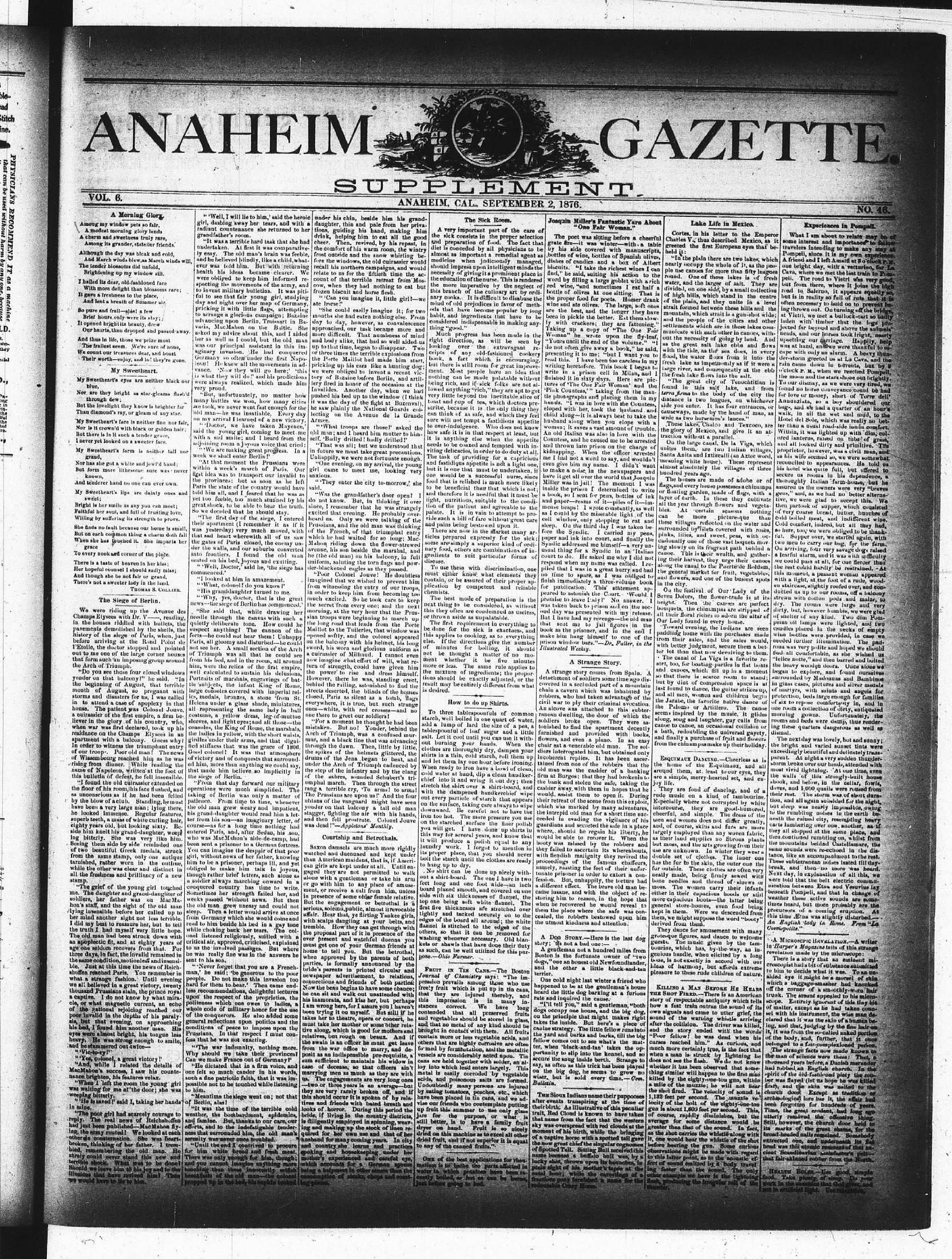
Searchable text
ANAHEIM
VOL. 6.
A Morning Glory
Among my window pets so fair,
A modest morning glory lends
A charm and sweetness truly rare,
Among its grander, statelier friends.
Although the day was bleak and cold,
And March winds blew, as March winds will,
The tender blossoms did unfold,
Brightening up my window sill.
I hailed its dear, old-fashioned face
With more delight than blossoms rare;
It gave a freshness to the place,
And lent a breath of Summer air.
So pure and frail—alas! a few
Brief hours only were its stay;
It opened bright its beauty, drew
Our hearts, then drooped and passed away.
And thus in life, those we prize most
The frailest seem. We're sure of none,
We count our treasures dear, and boast
Their worth—enjoy, and lo! they're gone.
My Sweetheart.
My Sweetheart's eyes are neither black nor blue,
Nor are they bright as star-gleams flash'd through dew;
But the lovelight they know is brighter far Than diamond's ray, or gleam of any star.
My Sweetheart's face is neither fine nor fair,
Nor is it crown'd with black or golden hair;
But there is in it such a tender grace,
I never yet looked on a sweeter face.
My Sweetheart's form is neither tall nor grand,
Nor has she got a white and jewel'd hand;
"Well, I will lie to him," said the heroic girl, dashing away her tears, and with a radiant countenance she returned to her grandfather's room.
"It was a terrible hard task that she had undertaken. At first it was comparatively easy. The old man's brain was feeble, and he believed blindly, like a child, whatever was told him. But with returning health his ideas became clearer. We were obliged to keep him informed respecting the movements of the army, and to invent military bulletins. It was pitiful to see that fair young girl, studying day and night over her map of Germany, pricking it with little flags, attempting to arrange a glorious campaign; Bazaine advancing upon Berlin, Troissart in Bavaria, MacMahon on the Baltic. She asked my advice about this, and I aided her as well as I could, but the old man was our principal assistant in this imaginary invasion. He had conquered Germany so often under the first Napoleon! He knew all the movements in advance. 'Now they will go here,' 'this is what they will do,' and his predictions were always realized, which made him very proud.
"But, unfortunately, no matter how many battles we won, how many cities we took, we never went fast enough for the old man—he was insatiable. Every day on my arrival I learned of a new victory."
"Doctor, we have taken Mayence," said the young girl, coming to meet me with a sad smile; and I heard from the adjoining room a joyous voice that cried:
"We are making great progress. In a week we shall enter Berlin!
At that moment the Prussians were within a week's march of Paris. Our under his chin daughter, thin nitions, guiding drink, helping cheer. Then, the comfort of his frost outside and fore the windows recall his north relate to us for a count of that to cow, when they frozen biscuit at "Can you imitate horse!"
"She could eat months she had day to day, he approached, our more difficult, and body alike, up to that time, or three times thereto Porte Maillard pricking up his we were obliged tory of Bazaine lery fired in homo Invalides. Anou pushed his bed u it was the day o he saw plainly the lecting on the Armee.
"What troop old man; and I self, Badly drilled "That was all; in future we must Unlappily, we wi "One evening, girl came to..."
My Sweetheart's eyes are neither black nor blue,
Nor are they bright as star-gleams flash'd through dew;
But the lovelight they know is brighter far than diamond's ray, or gleam of any star.
My Sweetheart's face is neither fine nor fair, Nor is it crown'd with black or golden hair; But there is in it such a tender grace, I never yet looked on a sweeter face.
My Sweetheart's form is neither tall nor grand, Nor has she got a white and jewl'd hand; But form more lithesome sure was never known, And tenderer hand no one can ever own.
My Sweetheart's lips are dainty ones and sweet; Bright is her smile as any you can meet; Faithful her soul, and full of trusting love, Willing by suffering its strength to prove.
She finds no fault because our home is small, But on each common thing a charm doth fall When she has touched it. She imparts her grace To every nook and corner of the place.
There is a taste of heaven in her kiss; Her hopeful counsel I should sadly miss; And though she be not fair or grand, There's not a sweeter lady in the land.
THOMAS S. COLLIER.
The Siege of Berlin.
We were riding up the Avenue des Champs Elysées with Dr. V——, reading, in the houses riddled with bullets, the pavements demolished by the shells, the history of the siege of Paris, when, just before arriving at the Rond Point de l'Etoile, the doctor stopped and pointed out to me one of the large corner nouses that form such an imposing group around the Arch of Triumph.
"Do you see those four closed windows yonder on that balcony?" he said. "In the beginning of August, that terrible month of August, so pregnant with storms and disasters for us, I was called in to attend a case of apoplexy in that house. The patient was Colonel Jouve, a cuirassier of the first empire, a firm believer in the glory of his country, who, when war was first declared, took up his residence on the Champs Elysées in an apartment with a balcony. Guess why! In order to witness the triumphant entry of our troop. Poor old man! The news of Wissembourg reached him as he was rising from dinner. While reading the name of Napoleon, written at the foot of this bulletin of defeat, he fell insensible.
"I found the old cuirassier extended on the floor of his room, his face flushed, and as unconscious as if he had been felled by the blow of a club. Standing, he must have been a very large man; lying there, he looked immense. Regular features, superb teeth, a mass of white curling hair, eighty years old, but looking sixty. Beside him knelt his grand-daughter, weeping bitterly. She was very like him. Seeing them side by side reminded one of two beautiful Greek medals, struck from the same stamp, only one antique tarnished, rather worn in the outline, while the other was clear and distinct in all the freshness and brilliancy of a new stamp.
"The grief of the young girl touched what they will go here; 'this is what they will do' and his predictions were always realized, which made him very proud.
"But, unfortunately, no matter how many battles we won, how many cities we took, we never went fast enough for the old man—he was insatiable. Every day on my arrival I learned of a new victory.
"Doctor, we have taken Mayence,' said the young girl, coming to meet me with a sad smile; and I heard from the adjoining room a joyous voice that cried:
"We are making great progress. In a week we shall enter Berlin!
"At that moment the Prussians were within a week's march of Paris. Our first idea was to transport our invalid to the provinces; but as soon as he left Paris the state of the country would have told him all, and I feared that he was as yet too feeble, too much stuined by his great shock, to be able to bear the truth. So we decided that he should stay.
"The first day of the siege, I entered their apartment (I remember it as if it was yesterday) very much moved, with that sad heart wherewith all of us saw the gates of Paris closed, the enemy under the walls, and our suburbs converted into frontiers. I found the old man seated on his bed, joyous and exulting.
"Well, Doctor,' said he, 'the siege has commenced.'
"I looked at him in amazement.
"What, colonel? do you know?
"His granddaughter turned to me.
"Why, yes, doctor, that is the great news—the siege of Berlin has commenced."
"She said that, while drawing her needle through the canvas with such a quietly deliberate tone. How could he suspect anything? The cannon of the forts—he could not hear them! Unhappy Paris, all gloomy and disturbed—he could not see her. A small section of the Arch of Triumph was all that he could see from his bed, and in the room, all around him, were the relics of the first empire, well calculated to sustain his delusions. Portraits of marshals, engravings of battle subjects, the infant King of Rome: large consoles covered with imperial relics, medals, bronzes, a stone from St. Helena under a glass shade, miniatures, all representing the same lady in ball costume, a yellow dress, leg-of-mutton sleeves, and light eyes; and all those—the consoles, the King of Rome, the marshals, the ladies in yellow, with the short waists, girdles under their arms, and that dignified stiffness that was the grace of 1800. Good colonel! It was that atmosphere of victory and of conquests that surrounded him; more than anything we could say, that made him believe so implicitly in the siege of Berlin.
"From that day forward our military operations were much simplified. The taking of Berlin was only a matter of patience. From time to time, whenever the old man grew weary and impatient, his grand-daughter would read him a letter from his son—an imaginary letter, of course—as for a long time nothing had entered Paris, and after Sedan his son, who was MacMahon's side-de-camp, had been sent a prisoner to a German fortress. You can imagine the despair of that poor girl, without news of her father knowing him to be a prisoner, perhaps ill, and yet obliged to make him talk in joyous, though rather brief letters, such alone as a soldier always marching onward in a conquered country has time to write."
"The grief of the young girl touched me. The daughter and grand-daughter of soldiers, her father was on MacMahon's staff, and the sight of the old man lying insensible before her called up to her mind another sight not less terrible. I did my best to reassure her, but to tell the truth I had myself very little hope. The old man had been struck down with an agoplectic fit, and at eighty years of age one soldier recovers from that. For three days, in fact, the invalid remained in the same condition, motionless and insensible. Just at this time the news of Reichshoffen reached Paris. You remember in what a strange fashion. Until evening we all believed in a great victory, twenty thousand Prussians slain, the prince royal captive. I do not know by what miracle, or what magnetic current, an echo of the national rejoicing reached our poor invalid in the depths of his paralysis, but that evening, on approaching his bed, I found him another man. His eyes were almost bright, his tongue less heavy. He was strong enough to smile, and he stammered out twice—
"Vic-to-try!"
"Yes, colonel, a great victory!"
"And, while I related the details of MacMahon's success, I saw his countenance brighten, his features relax."
"When I left the room the young girl was waiting for me at the door; she was weeping bitterly."
"He is saved!" said I, taking her hands in mine.
"The poor girl had scarcely courage to reply. The real news of Reichshoffen had just been published—MacMahon flying, the army routed! We looked at each other in consternation. She was heartbroken, thinking of her father. I trembled, remembering the old man. He shrely could never stand this new and terrible shock. What was to be done! Should we leave him to his joy and to the illusions that have revived him? Then we would have to lie to him."
Operations were much simplified. The taking of Berlin was only a matter of patience. From time to time, whenever the old man grew weary and impatient, his grand-daughter would read him a letter from his son—an imaginary letter, of course—as for a long time nothing had entered Paris, and, after Sedan, his son, who was MacMahon's side-de-camp, had been sent a prisoner to a German fortress. You can imagine the despair of that poor girl, without news of her father, knowing him to be a prisoner, perhaps ill, and yet obliged to make him talk in joyous, though rather brief letters, such alone as a soldier always marching onward in a conquered country has time to write. Sometimes her strength failed her, and weeks passed without news. But then the old man grew uneasy and could not sleep. Then a letter would arrive at once from Germany which she would come and read to him beside his bed in a gay tone while choking back her tears. The colonel listened religiously, smiled with a critical air, approved, criticised, explained to us the involved passages. But where he was really fine was in the answers he sent to his son.
"Never forget that you are a Frenchman," he said; "be generous to the poor people. Do not make this invasion too hard for them to bear." Then came endless recommendations, delightful lectures upon the respect of the proprieties, the politeness which one owes to ladies, a whole code of military honor for the use of the conquerors. He also added some general reflections upon politics and the conditions of peace to impose upon the Prussians. In that respect I must confess that he was not exacting.
"The war indemnity, nothing more. Why should we take their provinces! Can we make France out of Germany?"
"He dictated that in a firm voice, and one felt so much candor in his words, such a fine patriotic faith, that it was impossible not to be touched while listening to him."
"Meantime the siege went on; not that of Berlin, alas!
"It was the time of the terrible cold weather, the bombardment, epidemics, and famine. But thanks to our care, our efforts, and to the indefatigable tenderness that surrounded him, the old man's serenity was never once troubled."
Until the end I contrived to procure for him white bread and fresh meat. There was only enough for him, though; and you cannot imagine anything more touching than these innocently selfish breakfasts of the old man—the colonel propped up in the bad, his napkin tacked.
Courtship and Saxon damsels watched and duenn than American maid can girls are kept gaged they are not alone with a gentle or go with him to moment, or receive a in presence of someone. But the engagement serious, solemn, public affair. Hear that, yewith scalps dangling tremble. How theythe proposal part o ever present and wmust get one of you home to tell you when approved by parties is formally bride's parents in newspapers advertise connections and frieNow the beau beginshe can sit and walkhis inamorata,andI am wrong here,forgone being trying it onmakes her to theatre,must take her mothertive along which relatives,but roughthe swain is an officefrom the war officeposit as an indispenssum sufficient to case of decease,smarrying men as mus.us.The engagementtwo or three yearsthey are very rarelythis should occur ittives and friendsw looks of horror.Dbride if living inis diligently employ ing and making upquired for her ownhusband for many coand country she le speaking and bounmother's experiencewhich accounts for being a helpmeet in consumption of slings-placees."
EIM GA
SUPPLEMENT.
ANAHEIM, CAL., SEPTEMBER 2, 1876.
and the heroic hand with a wren to her that she had comparative feeble child, what returning scarer. We formed rearmy, and it was pitiless, studying Germany, attempting to Bazaine part in Baulistic. She and I aided the old man in this inconquered first Napoleon's inadvertence; 'this predictions made him matter how many cities might for the Every day war victory. Mayence,' meet me from the that cried; less. In aana were Paris.
under his chin, beside him his grand-daughter, thin and pale from her privations, guiding his hand, making him drink, helping him to eat all the good cheer. Then, revived, by his repast, in the comfort of his warm room, the wintry frost outside and the snow whirling before the windows, the old cuirassier would recall his northern campaigns, and would relate to us for the fiftieth time the account of that terrible retreat from Moscow, when they had nothing to eat but frozen biscuit and horse flesh.
"Can you imagine it, little girl?—we ate horse."
"She could easily imagine it; for two months she had eaten nothing else. From day to day, however, as convalescence approached, our task became more and more difficult. That numbness of mind and body alike, that had so well aided us up to that time, began to disappear. Two or three times the terrible explosions from the Porte Maillot had made him start, pricking up his ears like a hunting dog; we were obliged to invent a recent victory of Bazaine before Berlin, and artillery fired in honor of the occasion at the Invalides. Another day, when we had pushed his bed up to the window (I think it was the day of the fight at Buzenval), he saw plainly the National Guards collecting on the Avenue de la Grande Armee.
"What troops are those?" asked the old man; and I heard him mutter to himself, "Badly drilled! badly drilled!"
"That was all; but we understood that in future we must take great precautions. Unhappily, we were not fortunate enough."
"One evening, on my arrival, the young girl came to meet me."
The Sick Room.
A very important part of the care of the sick consists in the proper selection and preparation of food. The fact that diet is conceded by all physicians to be almost as important a remedial agent as medicine when judiciously managed, should impress upon intelligent minds the necessity of giving it a prominent place in the education of the nurse. This is rendered the more imperative by the neglect of this branch of the culinary art by ordinary cooks. It is difficult to disabuse the mind of old prejudices in favor of methods that have become popular by long habit, and ingredients that have to be considered indispensable in making anything "good."
Much progress has been made in the right direction, as will be seen by looking over the extravagant receipts of any old-fashioned cookery book, a fact which is encouraging. But there is still room for great improvement. Most people have an idea that nothing can be made palatable without being rich, and if sick folks are not allowed anything "rich," they are apt to get very little beyond the inevitable slice of toast and cup of tea, which doctors prescribe, because it is the only thing they can think of as safe, and which they feel sure will not tempt a fastidious appetite to over-indulgence. Who does not know how safe it is in that respect at least, but it is anything else when the appetite needs to be coaxed and tempted with inviting delicacies, in order to do duty at all. The task of providing for a capricious and fastidious appetite is not a light one, but it is one that must be undertaken.
Jonaqain Miller's Fantastic Yarn About "One Fair Woman."
The poet was sitting before a cheerful grate fire—it was winter—with a table by his side covered with manuscripts, bottles of wine, bottles of Spanish olives, dishes of candies and a box of Albert biscuits. "I take the richest wines I can find," he said, suiting his action to the word by filling a large goblet with a rich red wine, "and sometimes I eat half a bottle of olives at one sitting. That is the proper food for poets. Homer drank wine and ate olives. The large, soft ones are the best, and the longer they have been in pickle the better. Eat them slowly with crackers; they are fattening." Taking up a copy of "The One Fair Woman" he wrote upon the fly-leaf, "Yours until the end of the volume." "I do not often give away a book," he said, presenting it to me; "but I want you to read this. I have been too careless in my writing heretofore. This book I began to write in a prison cell in Milan, and I finished it in sixty days. Here are pictures of 'The One Fair Woman' and the 'Pink Countess,' taking from the mante photographs and placing them in my hands. "I was in love with she Countess, eloped with her, took the husband and child along—it is always best to take the husband along when you elope with a woman; it saves a vast amount of trouble. An old Italian was also in love with the Countess, and he caused me to be arrested and thrown into prison on the charge of kidnapping. When the officer arrested me I had not a word to say, and wouldn't even give him my name. I didn't want..."
we were obliged to invent a recent victory of Buzaine before Berlin, and artillery fired in honor of the occasion at the Invalides. Another day, when we had pushed his bed up to the window (I think it was the day of the fight at Buzenval), he saw plainly the National Guards collecting on the Avenue de la Grande Armee.
"What troops are those?" asked the old man; and I heard him mutter to himself, 'Badly drilled! badly drilled!'
"That was all; but we understood that in future we must take great precautions. Unliappily, we were not fortunate enough."
"One evening, on my arrival, the young girl came to meet me, looking very anxious.
"They enter the city to-morrow," she said.
"Was the grandfather's door open? I do not know. But, in thinking it over since, I remember that he was strangely excited that evening. He probably overheard us. Only we were talking of the Prussians, and the old man was thinking of the French, of that triumphal entry which he had waited for so long; MacMahon riding down the flower-strewed avenue, his son beside the marshal, and he (the old man) on his balcony, in full uniform, saluting the torn flags and powder-blackened eagles as they passed.
"Poor Colonel Jouve! He doubtless imagined that we wished to prevent him from witnessing the entry of our troops, in order to keep him from becoming too much excited. So he took care to keep the secret from every one; and the next morning, at the very hour that the Prussian troops were beginning to march up the long road that leads from the Porte Maillot to the Tuileries, that window was opened softly, and the colonel appeared on the balcony with his helmet, his long sword, his worn and glorious uniform as a cuirassier of Milhaud. I cannot even now imagine what effort of will, what return of strength, could have given him the power to rise and dress himself. However, there he was, standing erect, behind the railing, astonished to find the streets deserted, the blinds of the houses closed, Paris as silent as a tomb, flags everywhere, it is true, but such strange ones—white, with red crosses—and no one there to greet our soldiers!
"For a moment he thought he had been mistaken. But no! Yonder, behind the Arch of Triumph, was a confused murmur, and a black line that was advancing through the dawn. Then, little by little, the spikes of the helmets glittered, the drums of the Jena began to beat, and under the Arch of Triumph cadenced by the step of the infantry and by the clang of the sabres, sounded Schubert's triumphal march. Then through the street rang a terrible cry, 'To arms! to armal The Prussians are upon us!' And the four uhlans of the vanguard might have seen yonder on that balcony a tall old man stagger, fighting the air with his hands, and then fell prostrate. Colonel Jouve was dead!" —Appletons' Monthly.
Courtship and Betrothals.
Saxon damsels are much more rigidly watched and duennaad and kept under than American maidens, that is, if American girls are kept under at all. Until engaged they are not permitted to walk alone with a gentleman or take his arm or go with him to any place of amusement or require them to sit down.
Most people have an idea that nothing can be made palatable without being rich, and if sick folks are not allowed anything "rich," they are apt to get very little beyond the inevitable slice of tooth and cup of tea, which doctors prescribe, because it is the only thing they can think of as safe, and which they feel sure will not tempt a fastidious appetite to over-indulgence. Who does not know how safe it is in that respect at least, but it is anything else when the appetite needs to be coaxed and tempted with inviting delicacies, in order to do duty at all. The task of providing for a capricious and fastidious appetite is not a light one, but it is one that must be undertaken, if one would be a successful nurse, since food that is relished is much more likely to be beneficial than that which is not; and therefore it is needful that it must be light, nutritious, suitable to the condition of the patient and agreeable to the palate. It is in vain to attempt to provide such a bill of fare without great care and pains being bestowed upon it.
There are now in the market many articles prepared expressly for the sick; some are simply a superior kind of ordinary food, others are combinations of ingredients to suit particular forms of disease.
To use these with discrimination, one must either know what elements they contain, or be assured of their proper application by competent and reliable chemists.
The best mode of preparation is the next thing to be considered, as without this they often are condemned as useless or thrown aside as unpalatable.
The first requirement in everything to be done for the sick is exactness, and this applies to cooking, as to everything else. If the directions give the number of minutes for boiling, it should not be thought a matter of no moment whether it be five minutes more or less. The same rule applies to the mixture of ingredients; the proportions should be exactly adjusted, or the result may be entirely different from what is desired.
How to do up Shirts.
To three tablespoonfuls of common starch, well boiled in one quart of water, add a lump of lard the size of a pea, a tablespoonful of loaf sugar and a little salt. Let it cool until you can use it without burning your hands. When the clothes are thoroughly dry, dampen your shirts in a thin, cold starch, roll them up and let them lay one hour before ironing. When ready to iron have a bowl of clean cold water at hand, dip a clean haukerchief into it and wring it out dry; then stretch the shirt over a shirt-board, and with the dampened haukerchief wipe out every particle of starch that appears on the surface, taking care always to wipe downward. Be careful not to have the iron too hot. The more pressure you use on the starched surface the finer polish you will get. I have done up shirts in this way for several years, and know that it will produce a polish equal to any laundry work. I forgot to mention in its proper place, that you should never boil the starch until the clothes are ready to hang up to dry.
No shirt can be done up nicely without a shirt-board. The one I have is two feet long and one foot wide—an inch board planed smooth—and can write in a prison cell in Milan, and I finished it in sixty days. Here are pictures of 'The One Fair Woman,' and the 'Pink Countess,' taking from the man's photographs and placing them in my hands. "I was in love with the Countess, eloped with her, took the husband and child along—it is always best to take the husband along when you elope with a woman; it saves a vast amount of trouble. An old Italian was also in love with the Countess, and he caused me to be arrested and thrown into prison on the charge of kidnapping. When the officer arrested me I had not a word to say, and wouldn't even give him my name. I didn't want to make a noise in the newspapers and have it get all over the world that Joquin Miller was in jail! The moment I was inside the prison I determined to write a book, so I sent for pens, bottles of ink and paper—reams of it—imense heaps! I wrote constantly, as well as I could by the miserable light of the cell window, only stopping to eat and sleep. On the third day I was taken before the Syndic. I carried my pens, paper and ink into court, and finally the Syndic addressed me himself—a very unusual thing for a Syndic in an Italian court to do. He asked me why I did not respond when my name was called. I replied that I was in a great hurry and had no time to spare, as I was obliged to finish immediately a three-volume book for publication: This statement appeared to astonish the Court. Would I promise to leave Italy? No answer. I was taken back to prison and on the second day was presented with my release. But I have had my revenge—the old man that sent me to jail figures in the book as the prisoner, and in the end I make him hang himself to one of the prison window bars." —Dr. Fuller, in The Illustrated Weekly.
A Strange Story.
A strange story comes from Spain. A detachment of soldiers some time ago discovered in a secluded part of a mountain chain a cavern which was inhabited by robbers, who had taken advantage of the civil war to ply their criminal avocation. An alcove was attached to this subterranean dwelling, the door of which soldiers broke open. They were astonished to find the apartment decently furnished and provided with books, flowers, and even a piano. In an easy chair sat a venerable old man. The soldiers interrogated him, but obtained only incoherent replies. It has been ascertained from one of the robbers that the old man was the cashier of a banking firm at Burgos; that they had broken into the bank and stolen the safe, taking the cashier away with them in hopes that he would assist them to open it. During their retreat of the scene from this exploit, which was marked by many adventures,the intrepid old man for a short time succeeded in evading the vigilance of his guardians and secreted the safe in a place where,she should regain his liberty,here would be able to recover it. When the booty was missed by the robbers and they failed to ascertain its whereabouts,以 fiendish majignity they revived the proceedings of the famous chauffeurs,namely,rostering the feet of their unfortunate prisoner in order to extort a confession. But, unhappily,the torture had a different effect.The brave old man be
Courtship and Betrothals.
Saxon damsels are much more rigidly watched and duennaead and kept under than American maidens, that is, if American girls are kept under at all. Until engaged they are not permitted to walk alone with a gentleman or take his arm or go with him to any place of amusement, or receive a call from him, unless in presence of some older female relative. But the engagement or betrothal is a serious, solemn, public, almost irrevocable affair. Hear that, ye distirng Yankee girls, with scalps dangling at your belts, and tremble. How they can get through with the proposal part of it in presence of the ever present and watchful duenna you must get one of your German friends at home to tell you. But the betrothal, when approved by the parents of both parties, is formally announced by the bride's parents in printed circular and newspaper advertisement, to relations, connections and friends of both parties: Now the beau begins to have some chance; he can sit and walk out unattended with his inamorata, and kiss her, but perhaps I am wrong here, for I assure you I haven't been trying it on myself. But still if he takes her to theatre, opera or concert, he must take her mother or some other relative along, which is good for mothers and relatives, but rough on beaux. And if the swain is an officer he must get leave from the war office to marry, and deposit as an indispensible pre-requisite, a sum sufficient to maintain his widow in case of decease, so that officers ain't marrying men as much as they are with us. The engagements are very long ones—two or three years is an average—but they are very rarely broken off, and if this should occur it is spoken of by relatives and friends with bated breath and looks of horror. During this period the bride, if living in the country districts, is diligently employed in spinning, weaving and making up the stock of linen required for her own use and that of her husband for many coming years. In city and country she learns and practices cooking and housekeeping under her mother's experienced and careful eye, which accounts for a German spouse being a helpmeet in other cases than the consumption of snakes, chops and roasting-plants.
Fruit in Tin Cans.—The Boston Journal of Chemistry says: "The impression prevails among those who use freely fruit which is put up in tin cans, that they are injured thereby, and this impression is in many instances correct. We have long contended that all preserved fruits and vegetables should be stored in glass, and that no metal of any kind should be brought in contact with them. All fruits contain more or less vegetable acids, and others that are highly corrosive are often formed by fermentation, and the metallic vessels are considerably acted upon. Tin cans are held together with solder, an aloy into which lead enters largely. This metal is easily corroded by vegetable acids, and poisonous salts are formed. Undoubtedly many persons are injured by eating tomatoes, peaches, etc., which have been placed in tin cans, and we advise our friends who contemplate putting up fruit this summer to use only glass jars for the purpose, or what is still better, is to have a family fruit dryer on hand. Fruit is so nicely dried on this machine as to excel all other dried fruit, and if not superior it is equal to any of the canned fruits."
One of the best applications for rheumatism is to bathe the parts affected in water in which potatoes have been recently boiled, so hot as can be burnt just before going to bed.
A Dog Story.—Here is the last dog story; 'its not a bad one:—
A gentleman not a hundred miles from Boston is the fortunate owner of "two dogs," one an honest old Newfoundlander, and the other a little black-and-tan terrier.
One cold night last winter a friend who happened to be at the gentleman's house heard the little dog barking at a furious rate and inquired the cause.
"I'll tell you," said a gentleman, "both dogs occupy one house, and the big dog, on the principle that might make right takes the inside. But here's a piece of canine strategy. The little fellow runs into the yard and barks and barks, till the big fellow comes out to see what's the matter, when 'black-and-tan' takes the opportunity to slip into the kennel, and so secure the snug inside berth. Strange to say, as often as this trick has been played on the big dog, he seems to grow no wiser, but is sold every time."—Com. Bulletin.
The Sioux Indians name their pappooses after events transpiring at the time of their birth. As illustrative of this peculiar trait, Red Cloud is known to have taken that name from the fact that the western sky was overspread with red clouds at the moment of his birth, while the bringing of a captive horse with a spotted tail gave the now great chief the singular cognomen of Spotted Tail. Sitting Bull received this name because a buffalo bull was, by a lucky shot, thrown upon its haunches, in plain sight of his mother's tapestry at the metal hour; while the cavortings of a fraction pony furnished a name for the vulcanizable Canyon Home.
FANTASTIC YARN ABOUT FAIR WOMAN."
Lake Life in Mexico.
Cortes, in his letter to the Emperor Charles V., thus described Mexico, as it greeted the first European eyes that beheld it:
"In the plain there are two lakes, which nearly occupy the whole of it, as the people use canoes for more than fifty leagues round. One of these lakes is of fresh water, and the larger of salt. They are divided, on one side, by a small collection of high hills, which stand in the centre of the plain, and they unite in a level strait formed between these hills and the mountain, which strait is a gun-shot wide; and the people of the cities and other settlements which are in these lakes communicate with each other in canoes, without the necessity of going by land. And as the great salt lake ebbs and flows with the tide, as the sea does, in every flood, the water flows from it into the fresh lake as impenetronously as if it were a large river, and consequently at the ebb the fresh lake flows into the salt.
The great city of Tenochtitlan is found in this salt lake, and from terra firma to the body of the city the distance is two leagues, on whichever side you enter. It has four entrances, or causeways, made by the hand of man, as wide as two horsemen's lauces."
These lakes, Chalco and Texcoco, are the glory of Mexico, and give it an attraction without a parallel.
On the large canal, De la Viga, which unites them, are two Indian villages, Santa Anita and Ixtlacalli (an Aztec word, meaning white house). These represent almost absolutely the villages of three
Experiences in Pompeii.
What I am about to relate may be of some interest and importance to follow travelers intending to make any stay at Pompeii, since it is my own experience. A friend and I left Amalfi at 8 o'clock P.M. one bright day, with a retturino, for La Cava, where we met the last train to Pompeii. The road to Vistri was very good, but from there, where it joins the high road to Salerno, it appears equally so, but in reality so full of ruts that it is often necessary to hold on to prevent being thrown out. On turning off the bridge at Vistri, we met a bullock-cart so badly laden with timber that the logs projected far beyond and above the animals' heads, and our horses took fright, nearly upsetting our carriage. Happily, help was at hand, and we were thankful to escape with only an alarm. A heavy thunder-storm greeted us at La Cava, and the rain came down in torrents, but by 9 o'clock P.M., when we reached Pompeii, the moon and the stars shone out brightly.
To our dismay, as we were very tired, we found no horse conveyance could be had for love or money, short of Torre dell'Annunziata, so a boy shouldered our bags, and we had a quarter of an hour's walk, in all the wet and mud, to the Hotel del Sole, which was really no better than a usual road-side inn comfort. Within it was lighted up with dim, colored lanterns, raised on tubes of grass, and all looked dirty and primitive. The proprietor, however, was a civil man, and as his wife seemed so, we were somewhat reconciled to appearances. He told us his hotel was quite full, but...
The great city of Tenochtitlan is found in this salt lake, and from terra firma to the body of the city the distance is two leagues, on whichever side you enter. It has four entrances, or causeways, made by the hand of man, as wide as two horsemen's lances.
These lakes, Chalco and Texcoco, are the glory of Mexico, and give it an attraction without a parallel.
On the large canal, De la Viga, which unites them, are two Indian villages, Santa Anita and Ixtlacalli (an Aztec word, meaning white house). These represent almost absolutely the villages of three hundred years ago.
The houses are made of adobe or of flags, and every house possesses a chinampa or floating garden, made of flags, with a layer of earth. In these they cultivate all the year through flowers and vegetables. At certain seasons nothing can be more picturesque than these villages reflected on the water and surrounded by islets covered with roses, pinks, lilies, and sweet peas, with occasionally one of those vast boquets moving slowly on its fragrant path behind a canoe. This is their wealth, and gathering their harvest, they urge their canoes along the canal to the Puertorde Roldam, the general market for fruit, vegetables, and flowers, and one of the busiest spots in the city.
On the festival of Our Lady of the Seven Dolors, the flower-trade is at its height. Then the canoes are perfect bouquets, the chinampas are stripped of all their floral riches to adorn the altar of Our Lady found in every house.
Toward evening, the ladjans are seen paddling home with the purchases made from their sales, and the sales would, with better judgment, secure them a better lot than that now devolving to them.
The canal of La Viga is a favorite resort, too, for boating-parties in flat boats and canoes, which fill up in a moment so that there is scarce room to stand; but by dint of compression space is at last found to dance, the guitar strikes up, and all men, women and children begin the Jarabe, the favorite native dance of the Palomo or Artillero. The canoe seems inspired by the music, it glides along, song and laughter, gay calls from canoe to canoe, an occasional collision or a bath, redoubling the universal gayety, and finally a purchase of fruit and flowers from the chinampas make up their holiday.
Esquimaux Dancing.—Cheerless as is the home of the Esquimaux, and all around them, at least to our eyes, they are a simple merry-hearted set, and enjoy life.
They are fond of dancing, and of a rude music on a kind of tambourine. Especially where not corrupted by white intercourse, they are good-humored, cheerful, and simple. The dress of the men and women does not differ greatly, and, of course, skins and furs are more largely employed than any woven fabric, as their land supplies no fibrous plants but moss, and the arts growing from their use are unknown. In winter they wear a double set of clothes. The inner one has the fur to the skin, the outer one the fur outside. These clothes are often very neatly made, being firmly sewed with bone needles and thread of sinews or moss. The women carry their infants on clock P.M., when we reached Pompallia, the moon and the stars shone out brightly.
To our dismay, as we were very tired, we found no horse conveyance could be had for love or money, short of Torre dell'Annunziata, so a boy shouldered our bags, and we had a quarter of an hour's walk, in all the wet and mud, to the Hotel del Sole, which was really no better than a usual road-side inn in comfort. Within it was lighted up with dim, colored lanterns, raised on tubs of grass, and all looked dirty and primitive. The proprietor, however, was a civil man, and as his wife seemed so, we were somewhat reconciled to appearances. He told us his hotel was quite full, but offered to secure us rooms in his dependence, a thoroughly Italian farm-house; but he assured us the owners were very "braves gens," and as we had no better alternative, we were glad to accept this. We then partook of supper, which consisted of very coarse bread, butter, bunches of cold boiled meat, and indifferent wine. Cold comfort, indeed, but all they had, so here too, we were obliged to be thankful. Supper over, we started again with two men to carry our bag for the farm.
On arriving, four very savage dogs raised a fearful alarm, and it was with difficulty we could pass at all; for one flever than the rest could hardly be restrained. At this moment, a peasant woman appeared with a light, at the foot of a rude, wooden staircase slightly roofed over, and conducted us up to our rooms off a balcony strewn with cotton pods and malzee to dry. The rooms were large and very dirty; but however humble, we were glad of shelter of any kind. Two dim Pompeian oil lamps were lighted, and two candles placed in the necks of empty wine bottles were provided; in case we needed further illumination. The padrona was very polite and hoped we should find all comfortable; as she wishful us "delice notte," and then barred and bolted the heavy wooden doors. Once alone we began to explore, and found ourselves surrounded by Madonna and Bambino in glass cases, pictures and silver medals of martyrrs with saints and angels for protection; beds large enough for families of six to repose comfortably in; and in one room a collection of dirty antiquated morning gowns. Unfortunately,the rooms and beds were damp thus rendering these quarters dangerous as well as dismal.
The next day was lovely,hot and sunny;the bright and varied sunset tints were exceedingly beautiful and delicately transparent.At night a very sudden thunderstorm broke over our heads,t attended with most vivid lightning."At one time,even the walls of this strongly-built house shook,and below,在the cellar,fowl,doves,and 1000 quails were roused from their rest.The storm was of short duration,and all again subsided for the night,best眠 was nearly impossible; owing to the rumbling noises in the earth beneath the rained city,reresembling heavy carts lumbering over one another.as if they all stopped at the same place,and then continued rumbling on whilst from the mountains behind Castellamare,the same sounds were re-echoed in the distance.like an accompaniment to the rest.These subterranean noises lasted till daybreak,and then no more was heard.Next day.in explanation of all thiswe were told that the belt electric communication between Etna and Vasuvius lay
During this exploit many adventures were taken in a short time to ensure the safety of his place in his liberty, he moved it. When the robbers and its whereabouts they revived the famous chasseurs set of their unforgettable to extort a conspiracy, the torture had brave old man beaten in the hope that would reveal to the safe was constained upon him and attention.
There is the last dog bite: hundred miles from the owner of "two Newfoundlander black-and-tan winter friend who gentleman's house king at a furious cause." Gentleman, both, and the big dog, might make right here's a piece of the fellow runs into barks, till the big thing's the matten takes the opener kennel, and so forth. Strange to think has been played items to grow no more every time.—Conn.
near their pappooses at the time of one of this peculiar town to have taken that the western red clouds at the mile the bringing spotted tail gave singular cognomen Bull received this bull was, by a Its haunches, its tape at the coverings of a name for the rude music on a kind of tambourine. Especially where not corrupted by white intercourse, they are good-humored, cheerful, and simple. The dress of the men and women does not differ greatly, and, of course, skins and furs are more largely employed than any woven fabric, as their land supplies no fibrous plants but moss, and the arts growing from their use are unknown. In winter they wear a double set of clothes. The inner-one has the fur to the skin, the outer-one the fur outside. These clothes are often very neatly made, being firmly sewed with bone needles and thread of sinews or moss. The women carry their infants either in their capacious hoods or still more capacious boots—the latter being general store-houses, even food being kept in them. Were we descended from them, we might suppose the word "booty" derived from them.
They dance for amusement with many grotesque figures, and dance to welcome guests. The music given by the tambourine, which has, by-the-way, an ingenious handle, when elicited by a long bone, is not exactly in accord with our ideas of harmony, but affords extreme pleasure to these rude children of nature.
KILLING A MAN BEFORE HE HEARS THE SHOT FIRED. There is an American story of respectable antiquity which tells how a fast train outran the sound of its own signals and came to utter grief, the sound of the warning whistle arriving after the collision. The driver was killed, and the story ended with the words "Poor fellow! he was dead when his curses reached him." As curious, and much more certainly true, is the fact that when a man is struck by lightning he does not see the flash. We do not know whether it has been observed that something similar will happen to the first man killed by the eighty-one-tou gun, within a mile of the muzzle; he will not hear the shot fired. The velocity of sound is 1,132 feet per second. The muzzle velocity of the holt of the eighty-one-ton gun is about 1,600 feet per second. This, of course, rapidly diminishes, but the average for some distance would be greater than that of the sound. In fact, as the shot carries the whistle along with it, one would hear the whistle of the shot before hearing the gun. Some curious observations might be made with regard to this latter point, as to the acoustic effect of sound emitted by a body traveling faster than the sound. The only other example we have is the lightning flash, producing the irregular roll of the thunder.
A MICROSCOPIC REVELATION.—A writer in Harper's Magazine tells of this strange revelation made by the microscope:
There is a story that an eminent microscopist had a bit of substance submitted to him to decide what it was. To an unaided eye it might be a morsel of skin which a baggage-smacher had knocked off the corner of a smoothly-worn hair trunk. The savant appealed to his microscope. Entirely ignorant of this tiny bit of matter, except as he had taken counsel with his instrument, the wise man declared that it was the skin of a human being, and that, judging by the fine hair on it, it was from the so-called naked portion of the body, and further, that it once belonged to a fair-complexioned person.
The strange facts now made known to the man of science were these: That, a thousand years before, a Danish mariner had robbed an English church. In the spirit of the old-fashioned platythe robber was flayed (let us hope he was killed first), and the skin was nailed to the church door. Except as tradition or archaeological lore has it, the affair had been forgotten for hundreds of years. Time, the great erodent, had long ago utterly removed the offensive thing. Still, however, the church door held to its marks of the great shamra; for the broad-headed nails remained. Somebody extracted one, and underneath its flat head was this atomic remnant of that ancient Scandinavian massacre's pit—that fair-skinned rubber from the North.
HEALTH RULES—Use good, simple food. Take plenty of sleep. Do your work in the sunshine that God gives, and not in artificial light. Use medication.