anaheim-gazette 1876-08-26
Scanned page
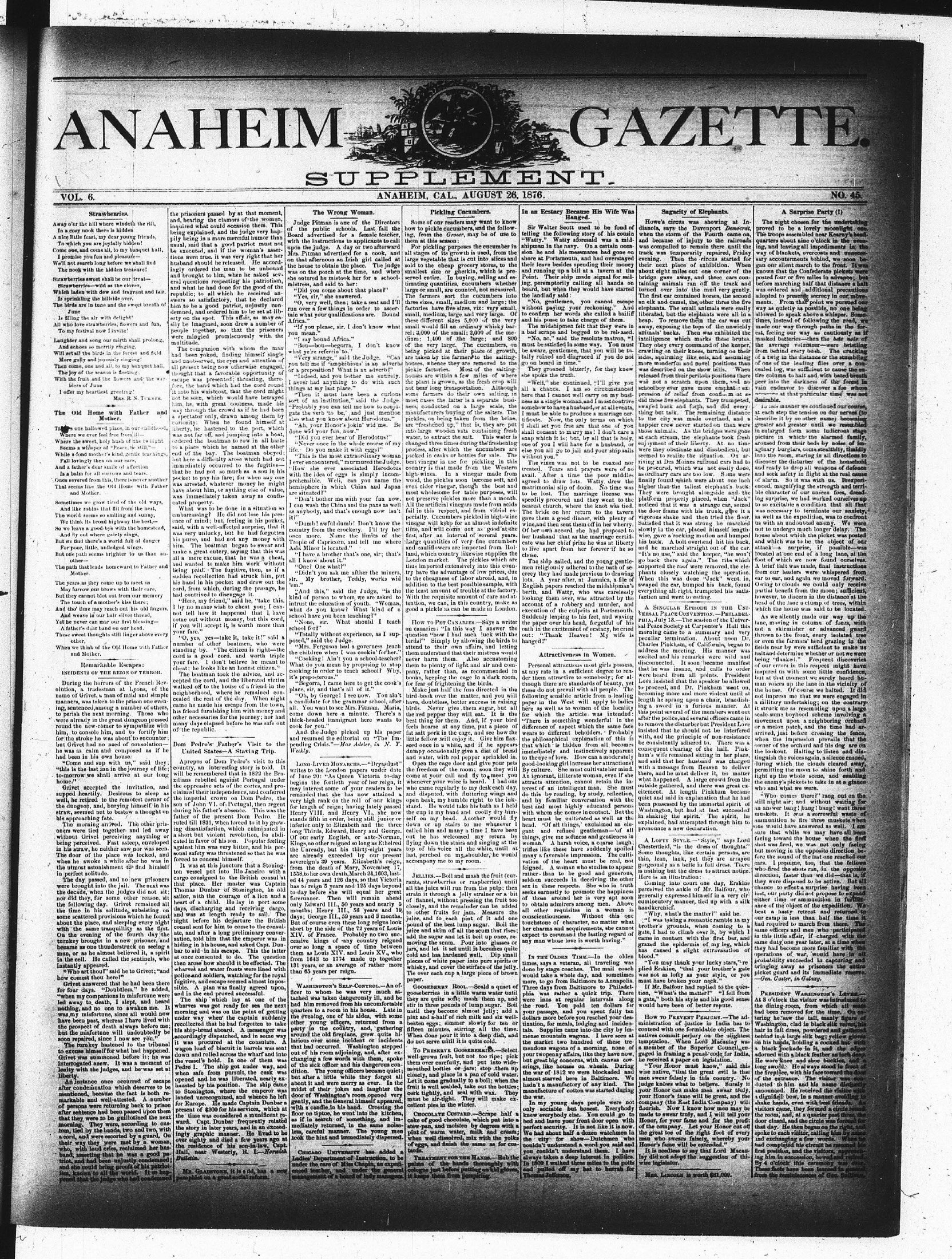
Searchable text
ANAHEIM
SU
VOL. 6.
Strawberries.
Away o'er the hill where windeth the rill,
In a cozy nook there is hidden
A nice little feast, my dear young friends,
To which you are joyfully bidden!
Come one, and come all, to my banquet hall,
I promise you fun and pleasure—
We'll not search long before we shall find
The nook with the hidden treasure!
Strawberries sweet shall be our treat—
Strawberries—wild as the clover,
Which laden with dew and fragrant and fair,
Is sprinkling the hillside over.
The birds are in tune and the sweet breath of June
Is filling the air with delight!
All who love strawberries, flowers and fun,
To my festival now I invite!
Laughter and song our mirth shall prolong,
And echoes so merrily ringing,
Will set all the birds in the forest and field
More gaily and joyously singing!
Then come, one and all, to my banquet hall,
The joy of the season is fleeting;
With the fruit and the flowers and the warblers of June
I offer my heartiest greeting!
MRS. K. N. TURNER.
The Old Home with Father and Mother.
There is one hollowed place, in our childhood,
Where we ever feel free from ill—
Where the sweet, holy hush of the twilight
Seems a whisper of "Peace, be still,"—
While a fond mother's kind, gentle teachings,
Fall lovingly then on our ears,
And a father's dear smile of affection
the prisoners passed by at that moment,
and hearing the clamors of the woman,
inquired what could occasion them. This being explained, and the judge very happily being in a more merciful humor than usual, said that a good patriot must not be executed, and if the woman's assertions were true, it was very right that her husband should be released. He accordingly ordered the man to be unbound and brought to him, when he asked several questions respecting his patriotism, and what he had done for the good of the republic; to all which he received answers so satisfactory, that he declared him to be a good patriot, unjustly condemned, and ordered him to be set at liberty on the spot. This affair, as may easily be imagined, soon drew a number of people together, so that the prisoners were mingled promiscuously with the multitude.
The companion with whom the man had been yoked, finding himself single and unobserved, the eyes and attention of all present being now otherwise engaged, thought that a favorable opportunity of escape was presented; thrusting, therefore, the hand which had the cord round it into his waistcoat, that the cord might not be seen, which would have betrayed him, he, with great coolness, made his way through the crowd as if he had been a spectator only, drawn among them by curiosity. When he found himself at liberty, he hastened to the port, which was not far off, and jumping into a boat, ordered the boatman to row in all haste to a place which he named at the other end of the bay. The boatman obeyed; but here a difficulty arose which had not immediately occurred to the fugitive—
The Wrong Woman
Judge Pitman is one of the public schools.
Board advertised for a day with the instructions to adhere upon the judge. A day Mrs. Pitman advertised for on that afternoon an Irish house to obtain the plumage she entered he mistook her mistress, and said to her:
"Did you come about me?"
"Yes, sir," she answered.
"O, very well, then; take run over a few things in vain what your qualification Africa."
"If you please, sir, I do you mean."
"I say bound Africa."
"Bou—bou—begorra, what ye're referrin't to."
"Very strange," said she tell me if "amphibious or a preposition! What is it?"
"Indeed, and you both I never had anything to things at my last place."
"Then it must have sort of an institution."
"Probably you can tell me gate the verb 'to be,' as also what you know about it."
"Ah, your Honor's job done wid your fun, now."
"Did you ever hear of it?"
"Never once in the life life. Do you make it work?"
"This is the most extra I ever encountered," murmured.
"How she ever associates."
The Old Home with Father and Mother.
Sometimes we grow tired of the old ways,
And like robins that flit from the nest,
The world seems so smiling and sunny,
We think its broad highway the best—
So we leave a good-bye with the homestead,
And fly out where galley sings,
But we find there's a world full of danger
For poor, little, unfledged wings.
But one path seems brighter to us than another—
The path that leads homeward to Father and Mother.
The years as they come up to meet us
May furrow our brows with their care,
But they cannot blot out from our memory
The touch of a mother's kiss there;
And tho' time may reach out his old fingers,
And weave in our hair silver thread,
Yet he never can mar our first blessing—
A father's dear hand on our head.
These sweet thoughts still linger above every other,
When we think of the Old Home with Father and Mother.
Remarkable Escapes:
INCIDENTS OF THE REIGN OF TERROR.
During the horrors of the French Revolution, a tradesman at Lyons, of the name of Grivet, a man of mild and simple manners, was taken to the prison one evening, sentenced, among a number of others, to perish the next morning. Those who were already in the great dungeon pressed round the new-comer to sympathize with him, to console him, and to fortify him for the stroke he was about to encounter; but Grivet had no need of consolation—he was as calm and composed as if he had been in his own house.
"Come and sup with us," said they; "this is the last inn in the journey of life; to-morrow we shall arrive at our long home."
Grivet accepted the invitation, and supped heartily. Desirous to sleep as well, he retired to the remotest corner of the dungeon, and, burying himself in his straw, seemed not to bestow a thought on his approaching fate.
The morning arrived. The other prisoners were tied together and led away without Grivet perceiving anything or being perceived. Fast asleep, enveloped in his straw, he neither saw nor was seen. The door of the place was locked, and when he awoke a while after he was in the utmost astonishment to find himself in perfect solitude.
The day passed, and no new prisoners were brought into the jail. The next was thought that a favorable opportunity of escape was presented; thrasting, therefore, the hand which had the cord round it into his waistcoat, that the cord might not be seen, which would have betrayed him, he, with great coolness, made his way through the crowd as if he had been a spectator only, drawn among them by curiosity. When he found himself at liberty, he hastened to the port, which was not far off, and jumping into a boat, ordered the boatman to row in all haste to a place which he named at the other end of the bay. The boatman obeyed; but here a difficulty arose which had not immediately occurred to the fugitive—that he had not so much as a sou in his pocket to pay his fare; for when any one was arrested, whatever money he might have about him, or anything else of value, was immediately taken away as confiscated property.
What was to be done in a situation so embarrassing? He did not lose his presence of mind; but, feeling in his pocket, said, with a well-affected surprise, that it was very unlucky, but he had forgotten his purse, and had not any money with him. The boatman began to swear and make a great outcry, saying that this was all a mere excuse, that he was a cheat, and wanted to make him work without being paid: The fugitive, then, as if a sudden recollection had struck him, put his hand in his pocket and drew out the cord, from which, during the passage, he had contrived to disengage it.
"Here, my friend," said he, "take this. I by no means wish to cheat you; I cannot tell how it happened that I have come out without money, but this cord, if you will accept it, is worth more than your fare."
"O, yes, yes—take it, take it!" said a number of other boatmen, who were standing by. "The citizen is right—the cord is a good cord, and worth triple your fare. I don't believe he meant to cheat; he looks like an honest citizen."
The boatman took the advice, and accepted the cord, and the liberated victim walked off to the house of a friend in the neighborhood, where he remained concealed the rest of the day. When night came he made his escape from the town, his friend furnishing him with money and other necessaries for the journey; nor had many days elapsed before he was safe out of the republic.
Dom Pedro's Father's Visit to the United States—A Staving Trip.
Apropos of Dom Pedro's visit to this country, an interesting story is told. It will be remembered that in 1822 the Brazilians rebelled against Portugal under the oppressive acts of the cortes, and proclaimed their independence, and conferred the imperial crown on Dom Pedro, the son of John VI. of Portugal, then regent during his father's absence. This was the father of the present Dom Pedro. He ruled till 1831, when forced to it by growing dissatisfaction, which culminated in a short but violent revolution, he abdicated in favor of his son. Popular feeling against him was very bitter, and his personal safety was threatened so that he was forced to conceal himself.
It was at this juncture that a Stonington vessel put into Rio Janeiro with a cargo consigned to the British consul at that place. Her master Captain Thomas Dunhoun of Stonington in old or a preposition! What is it?
"Indeed, and you both I never had anything to things at my last place." Then it must have sort of an institution," Probably you can tell me gate the verb 'to be,' also what you know about "Ah, your Honor's job wid your fun now," Did you ever hear of "Never once in the whirl life. Do you make it wilt "This is the most extra I ever encountered," murre "How she ever associates with the idea of eggs is prehensible. Well, can hemisphere in which C are situated?" "Don't bother me with I can wash the China and as anybody, and that's en it?" "Dumb! awful dumb! country from the crockery once more. Name the Tropic of Capricorn, and Asia Minor is located." "I have a brother that all I know about it." "One? One what?" "Didn't you ask me sir. My brother, Teem.'em."
"And this," said the kind of person to whom intrust the education of you what do you know? W school have you been taught? None. sir. What school for? "Totally without experience posed," said the Judge.
"Mrs. Ferguson had a child children when I was Cooking! Ain't you u What do you mean by p cooking in order to teach it's preporous."
"Begorra, I came here place, sir, and that's all Oh; by George! I see a candidate for the gram all. You want to see Mrs come down here a mi thick-headed immigrant cook for you."
And the Judge picked and resumed the editorial pending Crisis." — Max A Weekly.
supped heartily. Desirous to sleep as well, he retired to the remotest corner of the dungeon, and, burying himself in his straw, seemed not to bestow a thought on his approaching fate.
The morning arrived. The other prisoners were tied together and led away without Grivel perceiving anything or being perceived. Fast asleep, enveloped in his straw, he neither saw nor was seen. The door of the place was locked, and when he awoke a while after he was in the utmost astonishment to find himself in perfect solitude.
The day passed, and no new prisoners were brought into the jail. The next was the decade, when the judges did not sit; nor did they, for some other reason, sit the following day. Grivel remained all the time in his solitude, subsisting on some scattered provisions which he found about the place, and sleeping every night with the same tranquillity as the first. On the evening of the fourth day the turnkey brought in a new prisoner, and became as one thunderstruck on seeing a man, or as he almost believed it, a spirit in the cell. He called the sentinels, who instantly appeared.
"Who art thou?" said he to Grivel; "and how comest thou here?"
Grivel answered that he had been there for four days. "Doubtless," he added, "when my companions in misfortune were led away to death, I slept, and heard nothing, and no one to awaken me. It was my misfortune, since all would now have been past, whereas I have lived with the prospect of death always before me; but the misfortune will undoubtedly be soon repaired, since I now see you."
The turnkey hastened to the tribunal to exonerate himself for what had happened. Grivel was summoned before it; he was interrogated anew. It was a moment of lenity with the judges, and he was set at liberty.
An instance once occurred of escape after condemnation which deserves to be mentioned, because the fact is both remarkable and well-attested. A number of persons were returning back to prison after sentence had been passed upon them that they were to be guillotined the next morning. They were, according to custom, tied by the hands, two and two, with a cord, and were escorted by a guard. On their way they were met by a woman, who, with loud cries, reclaimed her husband, asserting that he was a good patriot, and had been unjustly condemned; and she could bring proofs of his patriotism, known to all the world. It so happened that the judge who had condemned them claimed their independence, and conferred the imperial crown on Dom Pedro, the son of John VI. of Portugal, then regent during his father's absence. This was the father of the present Dom Pedro. He ruled till 1831, when forced to it by growing dissatisfaction, which culminated in a short but violent revolution, he abdicated in favor of his son. Popular feeling against him was very bitter, and his personal safety was threatened so that he was forced to conceal himself.
It was at this juncture that a Stonington vessel put into Rio Janeiro with a cargo consigned to the British consul at that place. Her master was Captain Thomas Dunbar of Stonington, an old sailor, with the courage of a lion and a heart of a child. He lay in port some days, discharging and receiving cargo, and was at length ready to sail. The night before his departure the British consul sent for him to come to the consultate, and after a long preliminary conversation, told him that the emperor was hiding in his house, and asked Capt. Dunbar to aid in his escape. This latter at once consented to do. The question then arose how should it be effected. The wharves and water fronts were lined with police and soldiers, watching for the royal fugitive, and escape seemed almost impossible. A plan was finally agreed upon, and in the end proved successful.
The ship which lay at one of the wharves was got ready for sea the next morning and was on the point of getting under way when the captain suddenly recollected that he had forgotten to take his ship-bread aboard. A messenger was accordingly dispatched, and in some way it was procured at the consulate. A wagon load of biscuit in barrels was sent down and rolled across the wharf and into the vessel's hold. In one of them was Pedro I. The ship got under way, and when safe from pursuit, the cask was opened and he was liberated, nearly exhausted by his position. The ship came to Stonington, where the emperor was landed unrecognized, and whence he left for Europe. He made Captain Dunbar a present of $200 for his services, which at the time was considered a munificent reward. Capt. Dunbar frequently related the story in later years, and in an exceedingly graphic manner. He lived to be over eighty and died a few years ago at the residence of his son-in-law, Capt. Hall, near Wexterly, R. L.-Norwich Bulletin.
Mr. Gladstonek, it is said, has a new pamphlet on a great social reform.
WASHINGTON'S SELF-OFFICER TO WHOM HE TAKES TAKEN DANGEROUS HAD HIM REMOVED FROM HIS QUARTERS TO A ROOM IN HIS EVENING ONE OF HIS OTHER YOUNG OFFICERS PART IN THE COUNTRY AROUND THE OLD FIREPLACE LARIOUS OVER SOME INCIDENTS THAT HAD OCCURRED. WAIT OUT OF HIS ROOM ADJUSTING A FEW WORDS OF THE SICK OFFICER AND HIS DITION. THE Young OFFICER BUT A LITTLE WHILE BETWEEN IT AND WERE MERRY MIDST OF THEIR JOKES ABOUT DOOR OF WASHINGTON'S REAGENTLY AND THE GENERAL WITH A CANDLE IN HIS HAND FLOOR ON TIPTOE HE WENT AS IF IN SEARCH OF SOME MEDIATELY RETURNED IN LESS CAREful Manner TO KEEK THE HINT AND IMAGE
CHICAGO UNIVENABLE LADIES' DEPARTMENT OF UNDER THE CARE OF Miss Enced teacher, and management of a board
The Wrong Woman.
Judge Pitman is one of the Directors of the public schools. Last fall the Board advertised for a female teacher, with the instructions to applicants to call upon the judge. A day or two afterward Mrs. Pitman advertised for a cook, and on that afternoon an Irish girl called at the house to obtain the place. The judge was on the porch at the time, and when she entered he mistook her for a schoolmistress, and said to her:
"Did you come about that place?"
"Yes, sir," she answered.
"O, very well, then; take a seat and I'll run over a few things in order to ascertain what your qualifications are. Bound Africa."
"If you please, sir, I don't know what you mean."
"I say bound Africa."
"Bou—bon—begorra, I don't know what ye're referrin' to."
"Very strange," said the Judge. "Can you tell me if 'amphibious' is an adverb or a preposition! What is an adverb?"
"Indeed, and you bother me entirely. I never had anything to do with such things at my last place."
"Then it must have been a curious sort of an institution," said the Judge. "Probably you can tell me how to conjugate the verb 'to be,' and just mention also what you know about Herodotus."
"Ah, your Honor's jokin' wid me. Be done wid your fun, now."
"Did you ever hear of Herodotus?"
"Never once in the whole coarse of my life. Do you make it with eggs!"
"This is the most extraordinary woman I ever encountered," murmured the Judge. "How she ever associated Herodotus"
Pickling Cucumbers.
Some of our readers may want to know how to pickle cucumbers, and the following, from the Grocer, may be of use to them at this season:
For pickling purposes the cucumber in all stages of its growth is used, from the large vegetable that is cut into slices and sold to the cheap grocery stores, to the smallest size or gherkin, which is preserved entire. In buying, selling and estimating quantities, cucumbers whether large or small, are counted, not measured. The farmers sort the cucumbers into three sizes, small, medium and large; the factories have five sizes, viz: very small, small, medium, large and very large. Of these different sizes 5,000 of the very small would fill an ordinary whisky barrel; 3,000 of the small; 2,000 of the medium; 1,400 of the large; and 800 of the very large. The cucumbers, on being picked at their place of growth, are taken by the farmers to the salting-houses, whence they are removed to the pickle factories. Most of the salting-houses are within a few miles of where the plant is grown, as the fresh crop will not bear long transportation. Although some farmers do their own salting, in most cases the latter is a separate business, conducted on a large scale, the manufacturers buying of the salters. The pickles, on being taken from the brine, are "freshened up," that is, they are put into large wooden vats containing fresh water, to extract the salt. This water is changed three times during the freshening process, after which the cucumbers are packed in casks or bottles for sale. The best vinegar in use for pickling in this country is made from the Western
In an Ecstacy Because His Wife Was Hanged.
Sir Walter Scott used to be fond of telling the following story of his cousin "Watty." Watty aforesaid was a midshipman in the navy. On a certain occasion he and his messmates had gone on shore at Portsmouth, and had overstayed their leave besides spending their money and running up a bill at a tavern at the Point. Their ship made signal for sailing, peremptorily calling all hands on board, but when they would have started the landlady said:
"No, gentlemen, you cannot escape without paying your reckoning." And to confirm her words she called a bailiff and his posse to take charge of them.
The midshipmen felt that they were in a bad scrape and begged to be relased.
"No, no," said the resolute matron, "I must be satisfied in some way. You must be aware, gentlemen, that you will be totally ruined and disgraced if you do not go on board in time."
They groaned bitterly, for they knew she spoke the truth.
"Well," she continued, "I'll give you all a chance. I am so circumstanced here that I cannot well carry on my business as a single woman, and I must contrive somehow to have a husband, or at all events, I must be able to produce a marriage certificate. Now, the only terms on which I shall set you free are that one of you shall consent to marry me! I don't care a snap which it is; but, by all that is holy, one of you I will have for a husband, or else you all go to jail and your ship sails without you."
The vixen was not to be coaxed nor treated. Tears and prayers were of no
"Indeed, and you bother me entirely. I never had anything to do with such things at my last place."
Then it must have been a curious sort of an institution," said the Judge. "Probably you can tell me how to conjugate the verb 'to be,' and just mention also what you know about Herodotus."
Ah, your Honor's jokin' wid me. Be done wid your fun, now.
"Did you ever hear of Herodotus?"
Never once in the whole coarse of my life. Do you make it with eggs?
This is the most extraordinary woman I ever encountered," murmured the Judge. "How she ever associated Herodotus with the idea of eggs is simply incomprehensible. Well, can you name the hemisphere in which China and Japan are situated?"
Don't bother me with your fun now. I can wash the China and the pans as well as anybody, and that's enough now isn't it?
"Dumb! awful dumb! Don't know the country from the crockery. I'll try her once more. Name the limits of the Tropic of Capricorn, and tell me where Asia Minor is located."
"I have a brother that's one, sir; that's all I know about it."
"One? One what?"
"Didn't you ask me afther the miners, sir. My brother, Teddy, works wid 'em."
And this," said the Judge, "is the kind of person to whom we are asked to intrust the education of youth. "Woman, what do you know? What kind of a school have you been teaching?"
"None, sir. What should I teach school for?"
Totally without experience, as I supposed," said the Judge.
Mrs. Ferguson had a governess teach the children when I was cookin' for her.
Cooking! Ain't you a school-teacher? What do you mean by proposing to stop cooking in order to teach school? Why, it's preposterous.
Begorra, I came here to get the cook's place, sir, and that's all of it.
Oh, by George! I see now. You ain't a candidate for the grammar school, after all. You want to see Mrs. Pitman. Maria, come down here a minute. There's a thick-headed immigrant here wants to cook for you.
And the Judge picked up his paper and resumed the editorial on "The Impending Crisis." — Max Adeler, in N. Y. Weekly.
LONG-LIVED MONARCHS.—"Dryasdust" writes to the London papers under date of June 29: "As Queen Victoria to-day begins the fortieth year of her reign, it may interest some of your readers to be reminded that she has now attained a very high rank on the roll of our kings for length of reign; having lately passed Henry VIII. and Henry VI., she now stands fifth in order, being still junior or inferior only to Elizabeth and the three long Thirds, Edward, Henry and George. Of our early English, or ante-Norman, Kings, no other reigned so long as Ethelred the Unready, but his thirty-eight years are already exceeded by our present sovereign's 39 years. Elizabeth's reign, from the death of Mary, November 17, 1558, to her own death, March 24, 1603, lasted 44 years and 126 days, so that Victoria has to reign 5 years and 125 days beyond
JELLIES.—Boll and mash the fruit (currants, strawberries or raspberries) until all the juice will run from the pulp; then pickle houses are within a few miles of where the plant is grown, as the fresh crop will not bear long transportation. Although some farmers do their own salting, in most cases the latter is a separate business, conducted on a large scale, the manufacturers buying of the salters. The pickles, on being taken from the brine, are "freshened up," that is, they are put into large wooden vats containing fresh water, to extract the salt. This water is changed three times during the freshening process, after which the encumbranes are packed in casks or bottles for sale. The best vinegar in use for pickling in this country is that made from the Western high-wines. In a vinegar made from wood, the pickles soon become soft, and even cider vinegar, though the best and most wholesome for table purposes, will not preserve pickles more than a month. All the artificial vinegars made from acids fail in this respect, and from vitriol especially. Cucumbers pickled in high-wine vinegar will keep for an almost indefinite time, and will come out as good at the first, after an interval of several years. Large quantities of very fine cucumbers and cauliflowers are imported from Holland, which country likewise supplies the London market. The pickles which are thus imported extensively into this country have the advantage of low prices, due to the cheapness of labor abroad, and in addition to the best possible sample, with the least amount of trouble at the factory. With the requisite amount of care and attention, we can, in this country, make as good a pickle as can be made in London.
HOW TO PET CANARIES.—Says a writer on canaries: "In this way I answer the question 'how I had such luck with the birds?' Simply by allowing the birds to attend to their own affairs, and letting them understand that their mistress would never harm them. Also accustoming them to plenty of light and air company, rather than, as recommended in books, keeping the cage in a dark room, for fear of frightening the birds.
Make just half the fuss directed in the bird book over the matter, and you will have doubtless better success in raising birds. Never give them sugar, but all the red pepper they will eat. It is the best thing for them. And, if your bird feels hoarse at any time, put a piece of fat salt pork in the cage, and see how the little fellow will enjoy it. Give him flax-seed once in a white, and if he appearsumpy occasionally give a diet of bread and water, with red pepper sprinkled in.
Open the cage door and give your pets the freedom of the room; soon they will come at your call and fly to meet you whenever your voice is heard. I had one who came regularly to my desk each day, and disputed, with fluttering wings and open beak, my humble right to the inkstand. He would take his bath as I held the cup in my hand and coolly dry himself on my head. Another would fly down or up stairs to me whenever I called him and many a time I have been out he has welcomed my return by flying down the stairs and singing at the top of his voice all the white, until at last, perched on my shoulder; he would accompany me to my room.
ATTractiveness in Women.
Personal attractions most girls possess at any rate in a sufficient degree to render them attractive to somebody; for although there are standards of beauty, yet these do not prevail with all people. The following sensible article from a leading paper in the West will apply to ladies here as well as to women of the locality for which the article was intended: "There is something wonderful in the difference of aspect which the same face wears to different beholders." Probably the philosophical explanation of this is that which is hidden from all becomes immediately apparent to the eye of love. How can a moderately good-looking girl increase her attractions? By culture. She must cultivate her mind. An ignorant, illiterate woman, even if she attracts attention, cannot retain the interest of an intelligent man. She must do this by reading, by study, reflection, and by familiar conversation with the best and most highly educated persons with whom she comes in contact. But the heart must be cultivated as well as the head. "Of all things," exclaimed an elegant and refluent gentleman—of all things, give me softness and gentleness in woman." A harsh voice, a coarse laugh; trifles like these have suddenly spoiled many a favorable impression. The cultivation of the heart must be real, not feigned. A woman who studies to appear rather-than to be good and generous, seldom succeeds in deceiving the other sex in these respects. She who in truth released from was not a schoolboy even did those five swayed back but took to the city happier crew those animals at each stream enjoyment of them were only seemed to receive at Desert be procured, as ordinary finally found higher than that They were platform praised that they door frame vigorous shape Satisfied that slowly in their wise gave a his back. And he marveled "It's no use," go back thereto supported their plants close When this swayed her everything all faction and w
A SINGULAR VERSALE PHIA, July 18 sal Peace Society morning campe peculiar term Charles Pink address the excited and disconnected that he was here Love insisted to proceed more length he spends here as well as to women of the locality for which the article was intended: "There is something wonderful in the difference of aspect which the same face wears to different beholders." Probably the philosophical explanation of this is that which is hidden from all becomes immediately apparent to the eye of love. How can a moderately good-looking girl increase her attractions? By culture. She must cultivate her mind. An ignorant, illiterate woman, even if she attracts attention, cannot retain the interest of an intelligent man. She must do this by reading, by study, reflection, and by familiar conversation with the best and most highly educated persons with whom she comes in contact. But the heart must be cultivated as well as the head. "Of all things," exclaimed an elegant and refluent gentleman—of all things, give me softness and gentleness in woman." A harsh voice, a coarse laugh; trifles like these have suddenly spoiled many a favorable impression. The cultivation of the heart must be real, not feigned. A woman who studies to appear rather-than to be good and generous,seldom succeeds in deceiving the other sex in these respects.She who in truth released from was not a schoolboy even did those five swayed back but took to the city happier crew those animals at each stream enjoyment of them were only seemed to receive at Desert be procured,as ordinary finally found higher than that They were platform praised that they door frame vigorous shape Satisfied that slowly in their wise gave a his back.And he marveled "It's no use," go back thereto supported their plants close When this swayed her everything all faction and w
A LOFTY Chesterfield,Some thought thin,lean,gorgeously as nothing but Here is an ill coming into its presence
reminded that she has now attained a very high rank on the roll of our kings for length of reign; having lately passed Henry VIII. and Henry VI., she now stands fifth in order, being still junior or inferior only to Elizabeth and the three long Thirds, Edward, Henry and George. Of our early English, or ante-Norman, Kings, no other reigned so long as Ethelred the Unready, but his thirty-eight years are already exceeded by our present sovereign's 39 years. Elizabeth's reign, from the death of Mary, November 17, 1558, to her own death, March 24, 1603, lasted 44 years and 126 days, so that Victoria has to reign 5 years and 125 days beyond today before she will equal her great forerunner. Then will remain ahead only Edward III., 50 years and nearly 5 months; Henry III., 56 years and 19 days; George III., 59 years and 3 months. But of course even these long reigns look short by the side of the 72 years of Louis XIV. of France. Probably no two successive kings of any country reigned over so long a space of time between them as Louis XIV. and Louis XV., who from 1643 to 1774 made up together 131 years, or an average of rather more than 65 years per reign.
WASHINGTON'S SELF-CONTROL.—An officer to whom he was very much attached was taken dangerously ill, and he had him removed from his uncomfortable quarters to a room in his house. Late in the evening, one of his aides, with some other young officers, returned from a party in the country, and, gathering around the old fireplace, grew quite hilarious over some incident or incidents that had occurred. Washington stepped out of his room adjoining, and after exchanging a few words with them, spoke of the sick officer and his dangerous condition. The young officers became quiet; but after a little while they forgot all about it and were merry as ever. In the midst of their jokes and laughter the door of Washington's room opened very gently, and the General himself appeared, with a candle in his hand. Crossing the floor on tiptoe, he went into the kitchen, as if in search of something, and immediately returned, in the same noiseless, careful manner. The young men took the hint and immediately dispersed.
CHICAGO UNIVENIRTY has added a Ladies' Department of Instruction, to be under the care of Miss Chapin, an experienced teacher, and under the general management of a board of lady managers.
JEILIES.—Boll and mash the fruit (currants, strawberries or raspberries) until all the juice will run from the pulp; then strain it through a jelly strainer or a bit flannel, without pressing the fruit too closely, and the remainder can be added to other fruits for jam. Measure the juice, and to each pint of it add one pound of the best lump sugar. Boil the juice and skim off all the scum that rises; add the sugar and let it boil up once, removing the scum. Pour into glasses or jars, and let it set until it becomes quite cold and has hardened well. Dip small pieces of white paper into pure spirits or whisky, and cover the surface of the jelly. Tie over each cup a large piece of brown paper.
GOOSEBERRY ROOL.—Scald a quart of gooseberries in a little warm water until they are quite soft; mash them up, and stir in three pounds of lump sugar. Boil until they become almost jelly; add a pint and a half of rich milk and six well-beaten eggs; simmer slowly for ten or fifteen minutes, stirring all the time. When done pour it into a deep dish, and do not serve until it is quite cold.
To PRESERVE GOOSEBERRIES.—Select well-grown fruit, but not too ripe; pick them over carefully, and put into wide-mouthed bottles or jars; stop them up closely, and place in a pan of cold water. Let it come gradually to a boil; when the fruit is well scalded, take out the bottles; cork tightly, and seal with wax. They must be air-tight. They will make excellent pies in the winter.
CHOCOLATE CUSTARD.—Scrape half a cake of good chocolate, which put into a stew-pan, and moisten by degrees with a pint of warm water, milk and cream; when well dissolved, mix with the yolks of eggs, and finish the same as for custards.
TREATMENT FOR THE HANDS.—Rub the palms of the hands thoroughly with cologne just before putting on kid gloves, it keeps them from perspiring.
IN THE OLDEN TIME.—In the olden times, says a veteran, all traveling was done by stage coaches. The mail coach would take a whole day, and sometimes more, to go from Baltimore to Annapolis. Three days from Baltimore to Philadelphia was rather a quick trip. There were inns at regular intervals along the road. You paid ten dollars for your passage, and you spent fully ten dollars more before you reached your destination, for meals, lodging and incidentals. Supplies came into-the city by immense mountain wagons. I have seen at the market two hundred of these tremendous wagons of a morning, none of your twopenny affairs, like they have now, but great big concerns, with canvas coverings, like houses on wheels. During the war of 1812 we were blockaded and almost starved here in Baltimore. We hadn’t a manufactory of any kind. The manufacture of cotton was started during the war.
In my young days people were not only sociable but honest. Everybody knew everybody else. You could go to bed and leave your front door open with perfect security. It is not like it is now. We had about half a dozen watchmen in the city for show—Dutchmen who couldn’t understand a word you said and you couldn’t understand them. I have always taken a deep interest in politics. In 1800 I walked three miles to the polls and pulled off my hat to hurrah for Thomas Jefferson.
A LOFTY Chesterfield. Some thought thin, lean, gorgeous as is nothing but Here is an ilike Coming in perceived that generally expelled cumlocutory handkerchiefs "Why, why" "I was taken brother’s gree gate," I had came in confluent grazed the has caused blood." "You may plied Erskine was not as bad must have been If Mr.Ballition," "What a gate," both would have how How to Pministration contend with natives commemtation.a member of gaged he received he "Your Honor wise native,men swear far judge knowsyour Honor your Honor's company(the flourish.No made to sweet Honor,for yof the compassthe great toe manwho honor's famiIt is needling lay did not awise legislature.Miss.Lanc
GAZETTE.
No. 45.
Sagacity of Elephants.
Howe's circus was showing at Indianola, says the Davenport Democrat, when the storm of the Fourth came on, and because of injury to the railroads was compelled to remain there until the track was temporarily repaired, Friday evening. Then the circus started for their next place of exhibition. When about eight miles out one corner of the bridge gave away, and three cars containing animals ran off the track and turned over into the mud very gently. The first car contained horses, the second an elk and camel, the other three five elephants. The small animals were easily liberated, but the elephants were all in a heap. To remove them the car was cut away, exposing the tops of the unwieldy animals' backs. Then was exhibited the intelligence which marks these brutes. They obey every command of the keeper, crawling on their knees, turning on their sides, squirming like eels, and assuming more wonderful and novel positions than was described on the show bills. When released from their perilous positions there was not a scratch upon them, and no schoolboy ever gave more emphatic expression of relief from confinement as did those five elephants. They trumpeted, swayed back and forth, and did everything but talk. The remaining distance to the city was made overland, and a happier crew never started on than were those animals. As the bridges were gone at each stream, the elephants took fresh enjoyment of their liberty. At no time were they obstinate and disobedient, but seemed to realize the situation. On arriving at Des Moines railroad cars had to be procured, which was not easily done.
A Surprise Party (!)
The night chosen for the undertaking proved to be a lovely moonlight one. The troops assembled near Kearny's headquarters about nine o'clock in the evening, and leaving all impediments in the way of blankets, overcoats and unnecessary accountments behind, we soon began our silent march to the front. It was known that the Confederate pickets were posted four or five miles in advance; but before marching half that distance a halt was ordered and additional precautions adopted to preserve secrecy in our movements. From that point we pursued our way as quietly as possible, no one being allowed to speak above a whisper. Sometimes, instead of following the road, we made our way through paths in the forest, feeling our way as cautiously as if masked batteries—then the bate naut of the average volunteer—were bristling from behind every bush. The cracking of a twig in the distance or the stumbling of one of the leading files over a concealed log, was sufficient to cause the entire column to halt and with bated breath peer into the darkness of the forest in vain endeavor to discover a fox whose presence at that particular time was not desirable.
In this manner we continued our course, at each step the tension on our nerves (to describe it by no other name) becoming greater and greater until we resumed in enlarged form some ludicrous stage picture in which the alarmed family, aroused from their beds by noise of imaginary burglars, come stealthily, timidly into the room, staring in all directions to discover the disturber of the household and ready to drop all weapons of defence.
I'll give you information on my business must continue at all events, marriage certifications on which one of you I don't care that is holy, husband, or your ship sails.
The coaxed nor were of no poor middies drew the No time was the license was my weat to the knot was tied. To the tavern with plenty of in her wherry. I proposed to marriage certifi- was at liberty never if he so young gentle- the bath of se- us to drawing manica, a file of midshipman's was carelessly attracted by the murder, and at Portsmouth, it and waving getful of his stacy, he cried My wife is
A SINGULAR EPISODE IN THE UNIVERSAL PEACE CONVENTION.—PHILADELPHIA, July 13. The session of the Universal Peace Society at Carpenter's Hall this morning came to a summary and very peculiar termination. About noon Dr. Charles Pinkham, of California, began to address the meeting. His manner was excited and his remarks were wild and disconnected. It soon became manifest that he was insane, and calls to order were heard from all points. President Love insisted that the speaker be allowed to proceed, and Dr. Pinkham went on, becoming more and more violent until at length he sprang upon a chair, brandishing a sword in a furious manner. At this point several of the members went out after the police, and several officers came in to remove the disturber but President Love insisted that he should not be interfered with, and the principle of non-resistance be consistently adhered to. There was a consequent clearing of the hall. Pinkham's wife remained sitting in her place, and said that her husband was charged with a message from Heaven to deliver there, and he must deliver it, no matter what happened. A large crowd from the outside gathered, and there was great excitement. At length Pinkham became quiet and said in explanation that he had been possessed by the immortal spirit of Washington, but had at last succeeded in shaking the spirit. The spirit, he explained, had attempted through him to pronounce a new declaration.
A LOFTY STYLE.—"Style," says Lord Chesterfield, "is the dress of thoughts." Some thoughts, like certain persons, are thin, lean, lank, yet they are arrayed gorgeously as a belle in full dress. There is nothing but the dress to attract notice. Here is an illustration:
Coming into court one day, Erskine perceived the ankle of Mr Balfour who released from their perilous positions there was not a scratch upon them, and no schoolboy ever gave more emphatic expression of relief from confinement as did those five elephants. They trumpeted, swayed back and forth, and did everything but talk. The remaining distance to the city was made overland, and a happier crew never started on than were those animals. As the bridges were gone at each stream, the elephants took fresh enjoyment of their liberty. At no time were they obstinate and disobedient, but seemed to realize the situation. On arriving at Des Moines railroad cars had to be procured, which was not easily done, as ordinary cars are too low. Some were finally found which were about one inch higher than the tallest elephant's back. They were brought alongside and the platform properly placed, when "Jack" noticed that it was a strange car, seized the door frame with his trunk, gave it a vigorous shake and then tried the floor. Satisfied that it was strong he marched slowly in the car, placed himself lengthwise, gave a rocking motion and humped his back. A bolt overhead hit his back, and he marched straight out of the car. "It's no use," said the keeper, "he won't go back there again." The ribs which supported the roof were removed, the elephants closely watching the operation. When this was done "Jack" went in, swayed the car, humped his back, found everything all right, trumpeted his satisfaction and went to eating.
As we silently made our way up the lane, moving in column of fours, with not a skirmisher or advanced guard thrown to the front, every isolated tree or even the farmers' herd grazing in the fields near by were sufficient to make us halt and determine whether or not we were being "flanked." Frequent discoveries of our errors in this respect might have inspired us with some little confidence, but at that moment we surely heard human voices up the lane in the vicinity of the house. Of course we halted. It did not impress me that we were engaged in a military undertaking; on the contrary it struck me as resembling upon a large scale some boyhood scheme involving a movement upon a neighboring orchard or a melon patch, and the time had arrived, just before crossing the fence, when the impression prevails that the owner of the orchard and his dog are on the lookout. Halting to listen and distinguish the voices again, a silence ensued during which the clouds cleared away, permitting the moon to shine forth and light up the whole scene, and enabling the enemy's pickets to take in at a glance who and what we were.
"Who comes there?" rang out on the still night air; and without waiting for an answer bang! bang! bang! went three muskets. It was a sorrowful waste of ammunition to fire three muskets when one would have answered as well. I assure that while we may have all been facing toward the house when the first shot was fired, we was not only facing but moving in the opposite direction before the sound of the last one reached our ears. I presume, too, that the fellows who fired the shots ran, in the opposite direction faster than we did—that is, if they were disposed to be active. But all chance to effect a surprise having been
A LOFTY STYLE.—"Style," says Lord Chesterfield, "is the dress of thoughts." Some thoughts, like certain persons, are thin, lean, lank, yet they are arrayed gorgeously as a belle in full dress. There is nothing but the dress to attract notice. Here is an illustration:
Coming into court one day, Erskine perceived the ankle of Mr. Balfour, who generally expressed himself in a very ciliumlocutory manner, tied up with a silk handkerchief.
"Why, what's the matter?" said he.
"I was taking a romantic ramble in my brother's grounds, when coming to a gate, I had to climb over it, by which I came in contact with the first bar, and grazed the epidermis of my leg, which has caused a slight extravasation of blood."
"You may thank your lucky stars," replied Erskine, "that your brother's gate was not as lofty as your style, or you must have broken your neck."
If Mr. Balfour had replied to the question, "What's the matter?" "I fell from a gate," both his style and his good sense would have been of better repute.
HOW TO PREVENT PERJURY.—The administration of justice in India has to contend with one formidable object. The natives commit perjury on the slightest temptation. When Lord Macaulay was a member of the Superior Council, engaged in framing a penal code for India, he received a paper on legislation.
"Your Honor must know," said this wise native, "that the great evil is that men swear falsely in this country. No judge knows what to believe. Surely if your Honor can make men swear truly, your Honor's fame will be great, and the company (the East India Company) will flourish. Now I know how men may be made to swear truly, and I will tell your Honor, for your fame and for the profit of the company. Let your Honor cut off the great toe of the right foot of every man who swears falsely, whereby your Honor's fame will be extended."
It is needless to say that Lord Macaulay did not adopt the suggestion of this wise legislator.
MRS. LINCOLN is worth $81,000.
PRESIDENT WASHINGTON'S LEADER — At 8 o'clock the visitor was introduced to the dining-room, from which all seats had been removed for the time. On entering he saw the tall, manly figure of Washington, clad in black silk velvet, his hair in full dress, powdered and gathered behind in a large silk bag; yellow gloves on his hands, holding a cocked hat with a black cockade in it, and the edges adorned with a black feather on each deep. He wore knee and shoe buckles, and a long sword: He always stood in front of the fireplace, with his face toward the door of the entrance. The visitor was conducted to him and his name distinctly announced. He received the visitor with a dignified bow, in a manner suggesting to shake hands, even with best friends. As visitors came, they formed a circle around the room, and, at a quarter past three, the door closed, and the circle was formed for that day. He then began on the right, and spoke to each visitor, calling him by name and exchanging a few words. When he had completed his circuit he resumed his first position, and the visitors, approaching him in succession, bowed and retreated. By 4 o'clock this ceremony was over. These facts have been learned in general from the reminiscence of Gen. Sullivan.