anaheim-gazette 1876-08-12
Scanned page
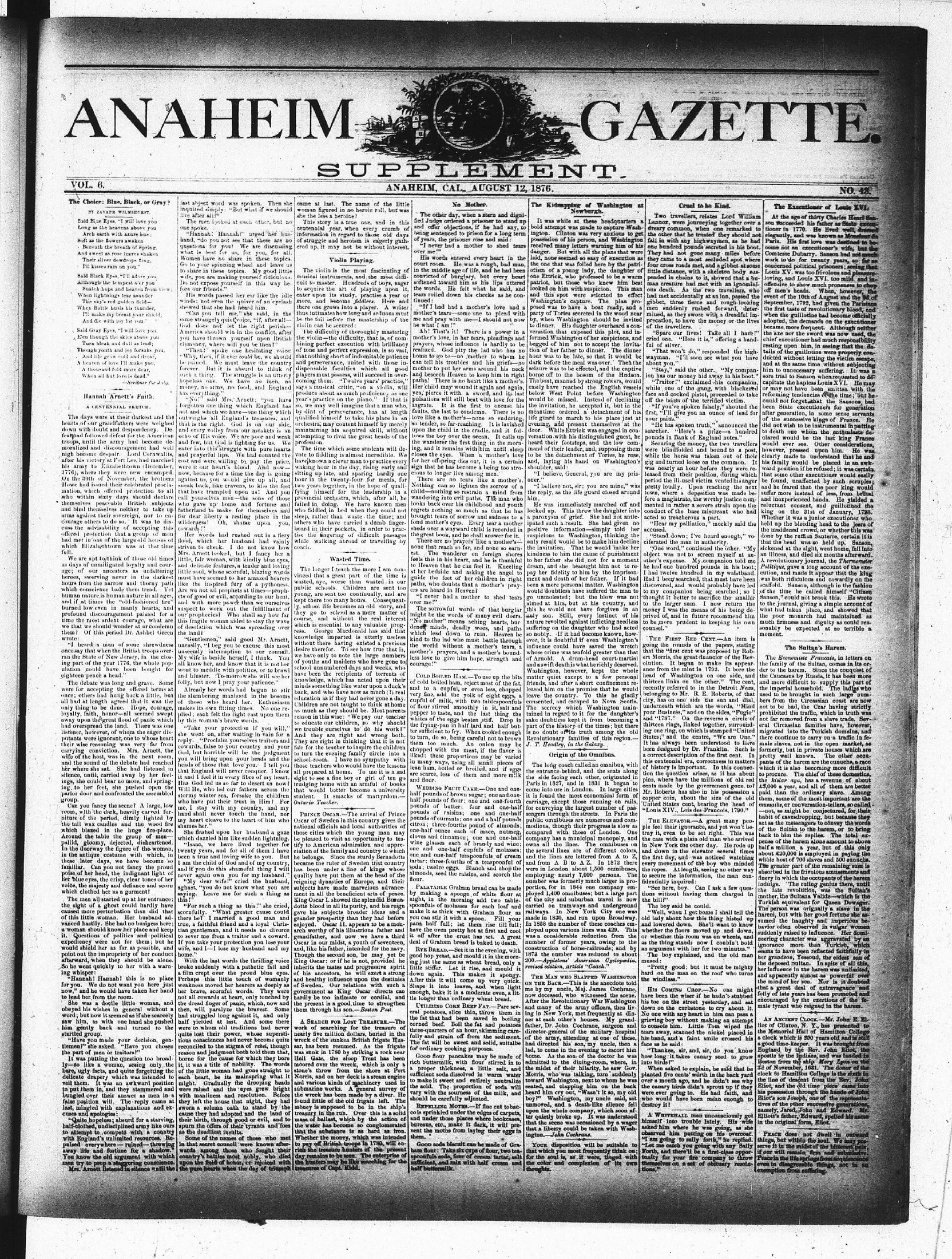
Searchable text
The Choice: Blue, Black, or Gray?
BY ZAVARR WILMSHURST.
Said Blue Eyes, "I will love you
Long as the heavens above you
Arch earth with azure hue;
Soft as the flowers awaken
Beneath the breath of Spring,
And sweet as rose leaves shaken
Their silver dewdrops fling,
I'll kisses rain on you."
Said Black Eyes, "I'll adore you,
Although the tempest o'er you
Snatch hope and heaven from view;
When lightnings tear asunder
The sky's red golden field—
When Battle hurls his thunder,
I'll make my breast your shield,
And die with joy for you."
Said Gray Eyes, "I will love you,
Even though the skies above you
Turn bleak and dull as lead;
Though youth and joy forsake you,
And life grow cold and drear,
A heaven of love I'll make you,
A thousand fold more dear,
When all but love is dead."
—Scribner for July.
Hannah Arnett's Faith.
A CENTENNIAL SKETCH.
The days were at their darkest and the hearts of our grandfathers were weighed down with doubt and despondency. Defeat had followed defeat for the American troops, until the army had become demoralized and discouragement had well nigh become despair. Lord Cornwallis, after his victory at Fort Lee, had marched his army to Elizabethtown (December,
last object word was spoken. Then she inquired simply: "But what if we should live after all?"
The men looked at each other, but no one spoke.
"Hannah! Hannah!" urged her husband, "do you not see that these are no questions for you? We are discussing what is best for us, for you, for all. Women have no share in these topics. Go to your spinning wheel and leave us to share in these topics. My good little wife, you are making yourself ridiculous. Do not expose yourself in this way before our friends."
His words passed her ear like the idle winds; not even the quiver of an eyelash showed that she had heard him.
"Can you tell me," she said, in the same strangely quiet voice, "if, after all—God does not let the right perish—America should win in the conflict, after you have thrown yourself upon British clemency, where will you be then?"
"Then?" spoke one hesitating voice:
"Why, then, if it ever could be, we should be ruined. We must leave the country forever. But it is absurd to think of such a thing. The struggle is an utterly hopeless one. We have no men, no money, no arms, no food, and England has everything."
"No!" said Mrs. Arnett; "you have forgotten one thing which England has not and which we have—one thing which outweighs all England's treasures, and that is the right. God is on our side, and every volley from our muskets is an echo of His voice. We are poor and weak and few, but God is fighting for us. We enter into this struggle with pure hearts and prayerful lips. We had counted the cost and were willing to pay the price, were it heart's blood. And now—
came at last. The woman figured in no way she less a heroine.
This story is a true centennial year, when information in regard to struggle and heroism ered up, it may not.
Violin Piano
The violin is the musical instrument, cult to master. Hunts to acquire the art of entering upon its study more, and become jure there one grows into it thus intimates how long be the toil before the violin can be secured.
The difficulty of the violin—the difficult bining perfect execution of tone and perfect exertion that nothing short of infidelity and perseverance, unfit dispensable faculties players must possess, would come them." Twelve says a musical critic, produce about as much year's practice on the so, we may well imagine by dint of perseverance qualified himself to tour orchestra, may content maintain his acquaintance attempting to rival the profession.
The time which some vote to fiddling is almighty have known a clever man waking hour in the day.
Hannah Arnett's Faith.
A CENTENNIAL SKETCH.
The days were at their darkest and the hearts of our grandfathers were weighed down with doubt and despondency. Defeated followed defeat for the American troops, until the army had become demoralized and discouragement had well nigh become despair. Lord Cornwallis, after his victory at Fort Lee, had marched his army to Elizabethtown (December, 1776), where they were now encamped. On the 30th of November, the brothers Howe had issued their celebrated proclamation, which offered protection to all who within sixty days should declare themselves peaceable British subjects and bind themselves neither to take up arms against their sovereign, nor to encourage others to do so. It was to discuss the advisability of accepting this offered protection that a group of men had met in one of the large old houses of which Elizabethtown was at that time full.
We are apt to think of those old times as days of unmitigated loyalty and courage; of our ancestors as unfaltering heroes, swerving never in the darkest hours from the narrow and thorny path which conscience bade them tread. Yet human nature is human nature in all ages, and if at times the "old-fashioned fire" burned low even in manly hearts, and profound discouragement palsied for a time the most ardent courage, what are we that we should wonder at or condemn them? Of this period Dr. Ashbel Green wrote:
"I heard a man of some shrewdness once say that when the British troops overran the State of New Jersey, in the closing part of the year 1776, the whole population could have been bought for eighteen pence a head."
The debate was long and grave. Some were for accepting the offered terms at once; others had hung back a little, but all had at length agreed that it was the only thing to be done. Hope, courage, loyalty, faith, honor—all seemed swept away upon the great flood of panic which had overspread the land. There was one listener, however, of whom the eager disputants were ignorant, one to whose heart their wise reasoning was very far from carrying conviction. Mrs. Arnett, the wife of the host, was in the next room, and the sound of the debate had reached her where she sat. She had listened in silence, until, carried away by her feelings, she could bear no more, and springing to her feet, she pushed open the parlor door and confronted the assembled group.
Can you fancy the scene? A large, low room, with the dark, heavily carved furniture of the period, dimly lighted by the tall wax candles and the wood fire which blazed in the huge fire-place. Around the table the group of men—pallid, gloomy, dejected, disheartened. In the doorway the figure of the woman, in the antique costume with which, in these later days, we have become so familiar. Can you not fancy the proud police of her head, the indignant light of her blue eyes, the crisp, clear tones of her voice, the majesty and defiance and scorn
The struggle is an utterly hopeless one. We have no men, no money, no arms, no food, and England has everything."
No!" said Mrs. Arnett; "you have forgotten one thing which England has not and which we have—one thing which outweighs all England's treasures, and that is the right. God is on our side, and every volley from our muskets is an echo of His voice. We are poor and weak and few, but God is fighting for us. We enter into this struggle with pure hearts and prayerful lips. We had counted the cost and were willing to pay the price; were it our heart's blood. And now—now, because for a time the day is going against us, you would give up all, and sneak back, like cavens, to kiss the feet that have trampled upon us! And you call yourselves men—the sons of those who gave up home and fortune and fatherland to make for themselves and for dear liberty a resting place in the wilderness! Oh, shame upon you, cowards!"
Her words had rushed out in a fiery flood, which her husband had vainly striven to check. I do not know how Mrs. Arnett looked, but I fancy her a little, fair woman, with kindly blue eyes, and delicate features, a tender and loving little soul, whose scornful, blazing words must have seemed to her amazed hearers like the inspired fury of a pythoness. Are we not all prophets at times—prophetics of good or evil, according to our bent, and with more power than our ourselves suspect to work out the fulfillment of our prophecies? Who shall say how far this fragile woman aided to stay the wave of desolation which was spreading over the land?
"Gentlemen," said good Mr. Arnett, uneasily, "I beg you to excuse this most unseemly interruption to our counsell. My wife is beside herself, I think. You all know her, and know that it is not her wont to meddle with politics, or to brawl and bluster. To-morrow she will see her folly, but now I pray your patience."
Already her words had begun to stir the slumbering manhood in the bosoms of those who heard her. Enthusiasm makes its own fitting times. No one replied; each felt the light cast upon them by this woman's brave words.
"Take your protection if you will," she went on; after waiting in vain for a reply. "Proclaim yourselves traitors and cowards, false to your country and your God, but horrible will be the judgment you will bring upon your heads and the heads of those that love you." I tell you that England will never conquer. I know it and I feel it in every fibre of my heart. Has God led us so far to desert us now? Will He, who led our fathers across the stormy winter sea, forsake the children who have put their trust in Him? For me, I stay with my country, and my hand shall never touch the hand, nor my heart cleave to the heart of him who shames her."
She flashed upon her husband a gaze which dazzled him like sudden lightning.
"Isaac, we have lived together for twenty years, and for all of them I have been a true and loving wife to you. But I am the child of God and of my country, and if you do this shameful thing I will never again own you for my husband." "My dear wife!" cried the husband, aghast, "you do not know what you are
Wasted
The longer I teach thevinced that a great pawwasted, aye, worse th public schools. Child young, are sent too coek kept there too many hely school life becomes they go to school as course, and without which is essential to aress. George Macdon knowledge imparted without there having desire therefore. To see we have only to note tof youths and maideness school unnumbered day have been the recipient knowledge, which has minds something like w back,and who have no education as if they had Children are not taught as much as they should reason in this wise: "Wto educate our children we trouble ourselves taAnd they are right They are right in think fair for the teacher to iTo turn the evening far school-room. I have n those teachers who wouAll prepared at home,sight to see a fine boy trudging home with arthat would better be student. It smacks' Ontario Teacher.
PRINCE OSCAR.-The Oscar of Sweden in this national officials and loThose cities which thBe pleased to visit an oTify to American admini citation of the family anHe belongs. Since then became the ruler of Sw has been under a line quality have put them reigning dynasties of Lsubjects have made m
Can you fancy the scene? A large, low room, with the dark, heavily carved furniture of the period, dimly lighted by the tall wax candles and the wood fire which blazed in the huge fireplace. Around the table the group of men—pallid, gloomy, dejected, disheartened. In the doorway the figure of the woman, in the antique costume with which, in these later days, we have become so familiar. Can you not fancy the proud poise of her head, the indignant light of her blue eyes, the crisp, clear tones of her voice, the majesty and defiance and scorn which clothed her as a garment?
The men all started up at her entrance; the sight of a ghost could hardly have caused more perturbation than did that of this little woman. Her husband advanced hastily. She had no business here; a woman should know her place and keep it. Questions of politics and political expediency were not for them; but he would shield her as far as possible, and point out the impropriety of her conduct afterward, when they should be alone. So he went quickly to her with a warning whisper:
"Hannah! Hannah! this is no place for you. We do not want you here just now," and he would have taken her hand to lead her from the room.
She was a docile little woman, and obeyed his wishes in general without a word; but now it seemed as if she scarcely saw him, as with one hand she pushed him gently back and turned to the startled group.
"Have you made your decision, gentlemen!" she asked. "Have you chosen the part of men or traitors!"
It was putting the question too broadly—so like a woman, seeing only the bare, ugly facts, and quite forgetting the delicate drapery which was intended to veil them. It was an awkward position to put them in, and they stammered and bungled over their answer as men in a false position will. The reply came at last, mingled with explanations and excuses and apologies:
"Quite hopeless; absurd for a starving, half-clothed, undisciplined army like ours to attempt to compete with a country with England's unlimited resources. Repulsed everywhere—ruined—throwing away life and fortune for a shadow. You know the old argument with which man try to prop a staggering conscience.
Mrs. Arnett listened in silence until the
She flashed upon her husband a gaze which dazzled him like sudden lightning.
"Isaac, we have lived together for twenty years, and for all of them I have been a true and loving wife to you. But I am the child of God and of my country, and if you do this shameful thing I will never again own you for my husband."
"My dear wife!" cried the husband, aggest, "you do not know what you are saying. Leave me for such a thing as this!"
"For such a thing as this!" she cried, scornfully. "What greater cause could there be? I married a good man and true, a faithful friend and a loyal Christian gentleman, and it needs no divorce to sever me from a traitor and a coward. If you take your protection you lose your wife, and I—I lose my husband and my home."
With the last words the thrilling voice broke suddenly with a pathetic fall and a film crept over the proud blue eyes. Perhaps this little touch of womanly weakness moved her hearers as deeply as her brave, scornful words. They were not all cowards at heart, only touched by the dread finger of panic, which now and then will paralyze the bravest. Some had struggled long against it, and only half yielded at last. And some there were to whom old traditions had never quite lost their power, whose superstitions consciences had never become quite reconciled to the stigma of rebel though reason and judgment both told them that, borne for the cause for which they bore it, it was a title of nobility. The words of the little woman had gone straight to each heart, be its mainspring what it might. Gradually the drooping heads were raised and the eyes grew bright with manliness and resolution. Before they left the house that night, they had sworn a solemn oath to stand by the cause they had adopted and the land of their birth, through good or evil, and to spurn the offers of their tyrants and foes as the deadliest insults.
Some of the names of those who met in that secret council were known afterwards among those who fought their country's battles most nobly, who died upon the field of honor, or rejoiced with the pure hearts when the day of triumph
PRINCE OSCAR.—The Oscar of Sweden in this national officials and local cities which they be pleased to visit an official to American administration of the family and he belongs. Since then became the ruler of Sweden has been under a line quality have put them on reigning dynasties of British subjects have made movement in all the beneficiaries King Oscar I. showed that dotte blood in all its pups gave his subjects brighter prosperity than enjoyed. Oscar II. applaud worthy of his illustrious grandfather, and now Oscar in our midst, yea and like his father, inta Though the second son King Oscar; or if he is inherits the tastes and of his ancestors, he and healthy influence of Sweden. Our relative government as King hardly be too intimate to present is a good thing them through his son.
A SEARCH FOR LOST WORK OF SEARCHING FOR NEarly five million dollars wreck of the sunken Bassar has been resumed was sunk in 1780 by ship Hell Gate, the slow moored over the wreck stone's throw from Norris, and on her deck and various kinds of submarine works. After the wreck has been found little of the old money is supposed to treasury in the run. On mass of ballast, which the water has become that the substance is Whether the money was to pay off British troops rich the treasure hunt day remains to be seen the hunters may be like treasures of Capt. Kidd-
LIM GAZ
SUPPLEMENT.
ANAHEIM, CAL., AUGUST 12, 1876.
came at last. The name of the little woman figured in no heroic roll, but was she the less a heroine!
This story is a true one, and in this centennial year, when every crumb of information in regard to those old days of struggle and heroism is eagerly gathered up, it may not be without interest.
Violin Playing.
The violin is the most fascinating of musical instruments, and the most difficult to master. Hundreds of boys, eager to acquire the art of playing upon it, enter upon its study, practise a year or more, and become fiddlers. Here and there one grows into a player. A writer thus intimates how long and arduous must be the toll before the mastership of the violin can be secured:
The difficulty of thoroughly mastering the violin—the difficulty, that is, of combining perfect execution with brilliancy of tone and perfect expression, is so vast, that nothing short of indomitable patience and perseverance, united with those indispensable faculties which all good players must possess, will succeed in overcoming them. "Twelve years' practice," says a musical critic, "on a violin, will produce about as much proficiency as one year's practice on the piano." If that is so, we may well imagine that a man who, by dint of perseverance, has at length qualified himself to take his place in an orchestra, may content himself by merely maintaining his acquired skill, without attempting to rival the great heads of the profession.
The time which some students will devote to fiddling is almost incredible. We have known a clever man to practice every waking hour in the day, rising early and
No Mother.
The other day, when a stern and dignified Judge ordered a prisoner to stand up and offer objections, if he had any, to being sentenced to prison for a long term of years, the prisoner rose and said:
"I never had a mother to shed tears over me!"
His words entered every heart in the court room. He was a rough, bad man, in the middle age of life, and he had been convicted of burglary, but every heart softened toward him as his lips uttered the words. He felt what he said, and tears rolled down his cheeks as he continued:
"If I had had a mother's love and a mother's tears—some one to plead with me and pray with me—I should not now be what I am!"
Ah! That's it! There is a power in a mother's love, in her tears, pleadings and prayers, whose influence is hardly to be realized. God pity the lad who has no home to go to—no mother to whom he can tell his troubles and his griefs—no mother to put her arms around his neck and beseech Heaven to keep him in right paths! There is no heart like a mother's. Her child may wound it again and again, yea; pierce it with a sword, and its last pulsations will still beat with love for the ingrate. It is the first to excuse his faults, the last to condemn. There is no love like a mother's—none so enduring, so tender, so far-reaching. It is lavished upon the child in the cradle, and it follows the boy over the ocean. It calls up the wanderer the first thing in the morning, and it remains with him until sleep closes the eyes. When a mother's love for her offspring dies out, it is a certain sign that he has become a being too atrocious.
The Kidnapping of Washington at Newburgh.
It was while at these headquarters a bold attempt was made to capture Washington. Clinton was very anxious to get possession of his person, and Washington received many letters warning him of his danger. But with all the plans that were laid, none seemed so easy of execution as the one that was foiled here by the patriotism of a young lady, the daughter of one Ettrick, who professed to be a warm patriot, but those who knew him best looked on him with suspicion. This man and this spot were selected to effect Washington's capture. The plan proposed was to have a boat ready, and a party of Tories secreted in the wood near by, when Washington should be invited to dinner. His daughter overheard a conversation that exposed this plot, and informed Washington of her suspicions, and begged of him not to accept the invitation of her father to dinner. The dinner hour was to be late, so that it would be dark before the meal was over. Then the seizure was to be effected, and the captive borne off to the bosom of the Hudson. The boat, manned by strong rowers, would easily have reached the English vessels below West Point before Washington would be missed. Instead of declining the invitation, he accepted it, but in the meantime ordered a detachment of his life guard to march to his place just at evening, and present themselves at the door. While Ettrick was engaged in conversation with his distinguished guest, he heard their footsteps, and the low command of their leader, and, supposing them to be the detachment of Tories, he rose, and laying his hand on Washington's shoulder, said:
The longer I teach the more I am convinced that a great part of the time is wasted, age, worse than wasted in our public schools. Children are sent too young, are sent too continually, and are kept there too many hours. Consequently, school life becomes an old story, and they go to school as a mere matter of course, and without the real interest which is essential to any valuable progress. George Macdonald has said that knowledge imparted is utterly useless without there having existed a previous desire therefor. To see how true that is, we have only to note the large numbers of youths and maidens who have gone to school unnumbered days and weeks, who have been the recipients of torrents of knowledge, which has acted upon their mind something like water upon a duck’s back, and who have now as much (?) real education as if they had never gone a day. Children are not taught to think at home as much as they should be. Most parents reason in this wise: “We pay our teacher to educate our children, so why should we trouble ourselves to do his work?” And they are right and wrong both. They are right in thinking that it is not fair for the teacher to inspire the children to turn the evening family circle into a school-room. I have no sympathy with those teachers who would have the lessons all prepared at home. To me it is a sad sight to see a fine boy or girl of ten trudging home with an armful of books that would better become a university student. It smacks of martyrdom.
Prince Oscar.—The arrival of Prince Oscar of Sweden in this country gives the national officials and local authorities of those cities which the young man may be pleased to visit an opportunity to testify to American admiration and appreciation of the family and country to which he belongs. Since the sturdy Bernadotte became the ruler of Sweden that country has been under a line of kings whose quality have put them at the head of the reigning dynasties of Europe, and their subjects have made marvelous advancements in player must possess, will succeed in overcoming them.
“Twelve years’ practice,” says a musical critic, “on a violin, will produce about as much proficiency as one year’s practice on the piano.” If that is so, we may well imagine that a man who, by dint of perseverance, has at length qualified himself to take his place in an orchestra; may content himself by merely maintaining his acquired skill, without attempting to rival the great heads of the profession.
The time which some students will devote to fiddling is almost incredible. We have known a clever man to practice every waking hour in the day, rising early and sitting up late, and sparing hardly one hour in the twenty-four for meals, for two years together, in the hope of qualifying himself for the leadership in a provincial orchestra, which, after all, he failed in doing. We have known men who fiddled in bed when they could not sleep, rather than waste the time; and others who have carried a dumb fingerboard in their pockets, in order to practise the singing of difficult passages while walking abroad or travelling by coach.
Wasted Time.
The longer I teach the more I am convinced that a great part of the time is wasted, age, worse than wasted in our public schools. Children are sent too young, are sent too continually, and are kept there too many hours. Consequently, school life becomes an old story, and they go to school as a mere matter of course, and without the real interest which is essential to any valuable progress. George Macdonald has said that knowledge imparted is utterly useless without there having existed a previous desire therefor. To see how true that is, we have only to note the large numbers of youths and maidens who have gone to school unnumbered days and weeks, who have been the recipients of torrents of knowledge, which has acted upon their mind something like water upon a duck’s back, and who have now as much (?) real education as if they had never gone a day. Children are not taught to think at home as much as they should be. Most parents reason in this wise: “We pay our teacher to educate our children, so why should we trouble ourselves to do his work?” And they are right and wrong both. They are right in thinking that it is not fair for the teacher to inspire the children to turn the evening family circle into a school-room. I have no sympathy with those teachers who would have the lessons all prepared at home. To me it is a sad sight to see a fine boy or girl of ten trudging home with an armful of books that would better become a university student. It smacks of martyrdom.
Ontario Teacher.
Prince Oscar.—The arrival of Prince Oscar of Sweden in this country gives the national officials and local authorities of those cities which the young man may be pleased to visit an opportunity to testify to American admiration and appreciation of the family and country to which he belongs. Since the sturdy Bernadotte became the ruler of Sweden that country has been under a line of kings whose quality have put them at the head of the reigning dynasties of Europe, and their subjects have made marvelous advances in player must possess, will succeed in overcoming them.
“Twelve years’ practice,” says a musical critic, “on a violin, will produce about as much proficiency as one year’s practice on the piano.” If that is so, we may well imagine that a man who, by dint of perseverance, has at length qualified himself to take his place in an orchestra; may content himself by merely maintaining his acquired skill, without attempting to rival the great heads of the profession.
The time which some students will devote to fiddling is almost incredible. We have known a clever man to practice every waking hour in the day, rising early and sitting up late, and sparing hardly one hour in the twenty-four for meals, for two years together, in the hope of qualifying himself for the leadership in a provincial orchestra, which, after all, he failed in doing. We have known men who fiddled in bed when they could not sleep, rather than waste the time; and others who have carried a dumb fingerboard in their pockets, in order to practise the singering of difficult passages while walking abroad or travelling by coach.
There are no tears like a mother’s. Nothing can so lighten the sorrow of a child—nothing so restrain a mind from wandering into evil paths. The man who looks back over his childhood and youth regrets nothing so much as that he has brought tears of sorrow and sadness to a fond mother’s eyes. Every tear a mother sheds over a wayward child is recorded in the great book, and he shall answer for it.
There are no prayers like a mother’s—none that reach so far, and none so earnest. The wanderer on foreign shores feels this in his heart, and he is thankful to Heaven that he can feel it. Kneeling at her bedside and asking the angel to guide the feet of her children in right paths, who doubts that a mother’s prayers are heard in Heaven?
“I never had a mother to shed tears over me!”
The sorrowful words of that burglar might be the words of many evil doers. “No mother” means aching hearts, burdened minds, deadly woes, and paths which lead down to ruin. Heaven be kind to the lad who must battle through the world without a mother’s tears, a mother’s prayers, and a mother’s boundless love to give him hope, strength and courage.”
Cold Boiled Ham.—To use up the bits of cold boiled ham, reject most of the fat, and to a cupful, or even less, chopped very fine, add the yolk of eight eggs, a cupful of milk, with two tablespoonfuls of flour stirred smoothly in it, salt and pepper to taste, and the last thing the whites of the eggs beaten stiff. Drop in the frying-pan in half lard and half butter sufficient to fry. When cooked enough to turn do so, being careful not to brown them too much. An onion may be chopped with the meat; if the flavor is liked; these proportions may be varied in many ways, using all small pieces of lean ham, boiled or broiled, and if eggs are scarce, less of them and more milk and flour.
Wedding Fruit Cake.—One and one-half pounds of brown sugar; one and one-half pounds of flour; one and one-fourth pounds of butter; four and one-half pounds of raisins; one and one-half pounds of currants; one and a half pounds citron; three-fourths pound of almonds; one-half ounce each of mace, nutmeg, cloves and cinnamon; one and one-half wine glasses each of brandy and wine; one and one-half teaspoonfuls of cream tartar; three-fourths of a teaspoonful of soda; twelve eggs. Blanch and chop the almonds, seed the raisins, and scorch the flour.
Palatable Graham bread can be made
PRINCE OSCAR.—The arrival of Prince Oscar of Sweden in this country gives the national officials and local authorities of those cities which the young man may be pleased to visit an opportunity to testify to American admiration and appreciation of the family and country to which he belongs. Since the sturdy Bernadotte became the ruler of Sweden that country has been under a line of kings whose quality have put them at the head of the reigning dynasties of Europe, and their subjects have made marvelous advancement in all the beneficient arts of peace. King Oscar I showed the splendid Bunna-dotte blood in all its purity, and his reign gave his subjects broader ideas and a grander prosperity than they had before enjoyed. Oscar II appears to be a monarch worthy of his illustrious father and grandfather, and now we have a third Oscar in our midst, a youth of seventeen, and like his father, intended for the navy. Though the second son, he may yet be King Oscar; or if he is not, provided he inherits the tastes and progressive spirit of his ancestors, he will exert a strong and healthy influence upon the destinies of Sweden. Our relations with such a government as King Oscar directs can hardly be too intimate or cordial, and the present is a good time to strengthen them through his son.—Boston Post.
A SEARCH FOR LOST TREASURE.—The work of searching for the treasure of nearly five million dollars, buried in the wreck of the sunken British frigate Hussar, has been resumed. As the frigate was sunk in 1780 by striking a rock near Hell Gate, the sloop Trent has been moored over the wreck, which is only a stone's throw from the shore at Port Norris, and on her deck is a steam engine and various kinds of machinery used in submarine works. A general survey of the wreck has been made by a diver. He found little of the old frigate left. The money is supposed to be in the ship's treasury in the run. Over this is a solid mass of ballast, which by the action of the water has become so conglomerated that the substance is as hard as iron. Whether the money, which was intended to pay off British troops in 1780, will enrich the treasure hunters of the present day remains to be seen. The enterprise of the hunters may be like searching for the treasures of Capt. Kidd.
PALATABLE Graham bread can be made by making a sponge of white flour at night, in the morning add two table-spoonfuls of molasses for each loaf and make it as thick with Graham flour as you can stir it with a spoon. Fill your pans half full; let them rise till full; have the oven pretty hot at first and cool it off after the crust has set. A great deal of Graham bread is baked to death.
RYE BREAD.—Set it in the evening, with good hop yeast, and mould it in the morning just the same as wheat bread, only a little stiffer. Let it rise, and mould it down again. This makes it spongy. After this it will come up very quick. Shape it into loaves, and when light enough, bake it in a moderate oven, a little longer than ordinary wheat bread.
UTILIZING CORN BEER FAT.—Pare several potatoes, slice thin, throw them in the fat that had been saved in boiling corned beef. Boil the fat and potatoes three-quarters of an hour, skimming carefully and strain off from the sediment. The fat will be sweet and solid, suitable for ordinary cooking purposes.
GOOD flour pancakes may be made of rich buttermilk, with flour stirred in to a proper thickness, a little salt, and sufficient soda dissolved in warm water to make it sweet and entirely neutralize the acid. The proportion of soda will vary with the sourness of the milk, and should be carefully adjusted.
REFELLING MOTHS.—If fine cnt tobacco is sprinkled under the edges of carpets, and under those places where bookcases, bureaus, etc., make it dark, it will prevent the moths from laying their eggs in them.
GOOD soda biscuit can be made of Graham flour: Take six cups of flour, two teaspoonfuls soda, four of cream tartar, salt sufficient, mix with half cream and half buttermilk.
THE MAN WHO SLAPPED WASHINGTON ON THE BACK.—This is the anecdote told me by my uncle, Maj. James Cochrane, now deceased, who witnessed the scene. After the Revolutionary War Washington and many of the army officers, then living in New York, met frequently at dinner at other's houses. My grandfather, Dr. John Cochrane, surgeon and director-general of the military hospital of the army, attending at one of these, had directed his son, my uncle, then a lad, to come in the evening to escort him home. As the son of the doctor he was admitted to the dining-room, where, in the midst of their hilarity, he saw Gov. Morris, who was talking, turn suddenly toward Washington, next to whom he was seated, and clapping him on the back heard him cry out, "Wasn't it so, my old boy!" Washington, my uncle said, sat unmoved, and a death-like silence fell upon the whole company, which soon after quietly broke up. It was understood that the scene was occasioned by a wager that a liberty could be taken with Washington.—John Cochrane.
Your disposition will be suitable to that which you most frequently think on; for the soul is, as it were, tinged with the color and complexion of its own thoughts.
Mr. Robertson copper coin United States "Louis XIV"
The ELEPHANT feel tha tray it, even the case wife in New York and down to first day every ropes to secure tha fidelity in "See here tions without tho bill?"
The boy said "Well, well old lady abe lowed whether tha or whether as tho thing an argument."
The boy mused:
"Pretty hard on tha windlass."
His Comfort have been tha his toe on tha down on tha No one wit grieving boy to console bhe tears away his hand an face as he sai
"Thankee how long lint into birds?"
When asked planted five over a month tha cannary were ever gw who would destroy it?
A WRITER himself inta asked him o observed hw "I am going" "Let me carry Forth, and innity for themselves."
GAZETTE.
Washington at
headquarters a
to capture Washington
anxious to get
and Washington
warning him of his
plans that were
of execution as
here by the patrithe daughter of
used to be a warm
knew him best
cition. This man
selected to effect
The plan probat ready, and a
in the wood near
should be invited
overheard a conhis plot, and insuspicious, and
accept the invitaner. The dinner
that it would be
over. Then the
and the captive
of the Hudson.
long rowers, would
English vessels
more Washington
head of declining
ed it, but in the
attachment of his
this place just at
selves at the engaged in connquished guest, he
did the low comsupposing them
Tories, he rose,
in Washington's
Cruel to be Kind.
Two travellers, relates Lord William Lennox, were journeying together over a dreary common, when one remarked to the other that he trusted they should not fall in with any highwaymen, as he had one hundred pounds secreted in his boot. They had not gone many miles before they came to a most secluded spot where four cross roads met, and a gibbet at some little distance, with a skeleton body suspended in chains to it, showed that a human creature had met with an ignominious death. As the two travellers, who had met accidentally at an inn, passed the gibbet, three fierce and rough-looking men suddenly rushed forward, determined, as they swore with a dreadful imprecation, to have the money or the lives of the travellers.
"Spare our lives! Take all I have!" cried one. "Here it is," offering a handful of silver.
"That won't do," responded the highwayman. "I'll soon see what you have about you."
"Stay," said the other. "My companion has our money hid away in his boot."
"Traitor!" exclaimed his companion, while one of the gang, with blackened face and cocked pistol, proceeded to take off the boots of the terrified victim.
"If you've spoken falsely," shouted the first, "I'll give you an ounce of lead for your pains."
"He has spoken truth," announced the searcher. "Here's a prize—a hundred pounds in Bank of England notes."
Securing the money, the two travellers were blindfolded and bound to a post, while the horse was taken out of their gig and turned loose on the common. It was nearly an hour before they were re-
The Executioner of Louis XVI.
At the age of thirty Charles Henry Sanson succeeded his father as State executioner in 1770. He lived well, dressed elegantly, and was known as Mondeaux de Paris. His first love was destined to become not an executioner's wife, but the Comtesse Dubarry. Sanson had not much work to do for twenty years, so for as concerned political prisoners; seeing that Louis XV. was too frivolous and pleasure-loving, and Louis XVI. too mild and infensive to show much proneness to chop off men's heads. When, however, the event of the 10th of August and the 2d of September, 1792, had given the Parisians the first taste of revolutionary blood, and when the guillotine had become officially adopted, the demands on the executioner became more frequent. Although neither the axe nor the sword was now used, the chief executioner had much responsibility resting upon him, in seeing that the details of the guillotine were properly conducted without letting the victim escape, and at the same time without subjecting him to unnecessary suffering. It was a sore trial to Sanson when requested to decapitate the hapless Louis XVI. He may or may not have been smitten with the reforming tendencies of the time; but he could not forget that the Sausons had been State executioners for generation after generation, in some sense servants of the successive kings of France. He did not wish to be instrumental in putting to death one whom the enthusiasts declared would be the last king France would ever see. Other considerations, however, pressed upon him. He was clearly made to understand that he and his family would be placed in an awkward position if he refused; it was certain
Stay, said the other. "My companion has our money hid away in his boot."
"Traitor!" exclaimed his companion, while one of the gang, with blackened face and cocked pistol, proceeded to take off the boots of the terrified victim.
"If you've spoken falsely," shouted the first, "I'll give you an ounce of lead for your pains."
"He has spoken truth," announced the searcher. "Here's a prize—a hundred pounds in Bank of England notes."
Securing the money, the two travellers were blindfolded and bound to a post, while the horse was taken out of their gig and turned loose on the common. It was nearly an hour before they were released from their position, during which period the ill-used victim vented his anger pretty loudly. Upon reaching the next town, where a deposition was made before a magistrate, the worthy justice commented in rather a severe strain upon the conduct of the base miscreant who had acted so treacherous a part.
"Hear my palliation," meekly said the accused.
"Stand down; I've heard enough," vociferated the man in authority.
"One word," continued the other. "My object was not to screen myself at another's expense. My companion told me he had one hundred pounds in his boot; I had twelve hundred in my waistband. Had I been searched, that must have been discovered, and would probably have led to my companion being searched; so I thought it better to sacrifice the smaller to the larger sum. I now return the money I was the means of his being deprived of, and in future recommend him to be more prudent in keeping his own counsel."
The First Red Cent.—An item is going the rounds of the papers, stating that the "first cent was proposed by Robert Morris, the great financier of the Revolution. It began to make its appearance from the mint in 1792. It bore the head of Washington on one side, and thirteen links on the other." The cent, recently referred to in the Detroit News, belonging to Mr. R. E. Roberts, of that city, has on one side the sun and dial, underneath which are the words, "Mind your Business," and on the sides, "Fugio" and "1787." On the reverse a circle of thirteen rings, linked together, surrounding one ring, on which is stamped "United States," and the centre, "We are One." It has always been understood to have been designed by Dr. Franklin. Such is a correct description of the first cent. In this centennial era, correctness in matters of history is important. In this connection the question arises, as it has about pins, where have the millions of old red cents made by the government gone? Mr. Roberts has also in his possession a copper coin, about the size of the old United States cent, bearing the head of "Louis XIV., Lois des Francois, 1790."
The Elevator.—A great many people feel their ignorance, and yet won't betray it, even to be set right. This was the case with a plain old man who arrived in New York the other day. He rode up and down in the elevator several times the first day, and was noticed watching every movement of the boy minded the ropes. At length, seeing no other way to secure the information, the man confidentially inquired:
"See here, boy. Can I ask a few questions."
It was a sore trial to Sanson when requested to decapitate the hapless Louis XVI. He may or may not have been smitten with the reforming tendencies of the time; but he could not forget what the Sansons had been State executioners for generation after generation, in some sense servants of the successive kings of France. He did not wish to be instrumental in putting to death one whom the enthusiasts declared would be the last king France would ever see. Other considerations, however, pressed upon him. He was clearly made to understand that he and his family would be placed in an awkward position if he refused; it was certain that some other executioner would easily be found, unaffected by such scruples; and he feared that the poor king would suffer more instead of less, from brutal and inexperienced hands. He yielded a reluctant consent, and guillotined the king on the 21st of January, 1793. Whether it was a junior executioner who held up the bleeding head to the jeers of the maddened crowd, or whether this was done by the ruffian Santerre, certain it is that the head was so held up. Sanson, sickened at the sight, went home, fell into an illness, and died six months afterward. A revolutionary journal, the Thermometer Politique, gave a long account of the execution, and made it appear that the king was both ridiculous and cowardly on the scaffold. Sanson, although in the fashion of the time he called himself "Citizen Sanson," could not brook this. He wrote to the journal, giving a simple account of what had taken place, and showed that the poor monarch had maintained as much firmness and dignity as could reasonably be expected at so terrible a moment.
The Sultan's Harem.
The Economiste Francais, in letters on the family of the Sultan, comes in its order to the harem. Since the conquest of the Caucasus by Russia, it has been more and more difficult to supply this part of the imperial household. The ladies who used to be brought in such large numbers from the Circassian coast are now not to be had, the Czar having strictly prohibited the traffic, which in truth was not far removed from a slave trade. Several Circassian families have, however, migrated into the Turkish domains, and there continue to carry on a traffic in female slaves, not in the open market, as formerly, but in private houses which are pretty well known. The other occupants of the harem are the eunuchs, a race which it is also becoming more difficult to procure. The chief of these domestics, the kislar agu, has a revenue of about £5,000 a year, and all of them are better paid than the ordinary slave. Among them, some of the most important are the mussaibs, or conversation-tellers, so called—not as might be conjectured, for their habit of eavesdropping, but because they act as the messengers to convey the words of the Sultan to the harem, or to bring back to him the replies. The total expense of the harem alone amount to above half a million a year, but of this only about £20,000 is employed in paying the whole host of 700 slaves and 500 eunuchs. The greater part of the remaining sum is absorbed in the frivolous amusements and finery in which the occupants of the harem indulge. The ruling genius there, until late revolution there...
Mr. Roberts has also in his possession a copper coin, about the size of the old United States cent, bearing the head of "Louis XIV., Lois des Francois, 1790."
The ELEVATOR.—A great many people feel their ignorance, and yet won't betray it, even to be set right. This was the case with a plain old man who arrived in New York the other day. He rode up and down in the elevator several times the first day, and was noticed watching every movement of the boy who minded the ropes. At length, seeing no other way to secure the information, the man confidentially inquired:
"See here, boy. Can I ask a few questions without having them charged in the bill?"
The boy said he could.
"Well, when I get home I shall tell the old lady about how this thing histed up and lowered down. She'll want to know whether the floors moved up and down, or whether this room was on wheels, and as the thing stands now I couldn't hold an argument with her for two minutes."
The boy explained, and the old man mused:
"Pretty good; but it must be mighty hard on the man on the roof who turns the windlass."
His COMING CROSS.—No one might have been the wiser if he hadn't stubbed his toe on the street yesterday, and sat down on the curbstone to cry about it. No one with any heart in him can pass a grieving boy without making an attempt to console him. Little Tom wiped the tears away, scanned the nickel placed in his hand, and a faint smile crossed his face as he said:
"Thankee, sir, and sir, do you know how long it takes canary seed to grow into birds?"
When asked to explain, he said that he planted five cents' worth in the back yard over a month ago, and he didn't see why the canary birds didn't sprout up if they were ever going to. He had faith, and who would have been mean enough to destroy it?
A WHITEHALL man unconsciously got himself into trouble lately. His wife asked him where he was going, as she observed him putting on his overcoat.
"I am going to sally forth," he replied.
"Let me catch you going with any Sally Forth, and there'll be a first-class opportunity for your fire company to throw themselves on a set of obituary resolutions."
PEACE does not dwell in outward things, but within the soul. We may preserve it in the midst of the bitterest pain, if our will remains firm and submissive. Peace in the life springs from acquiescence even in disagreeable things, not in an exemption from suffering.