anaheim-gazette 1876-07-29
Scanned page
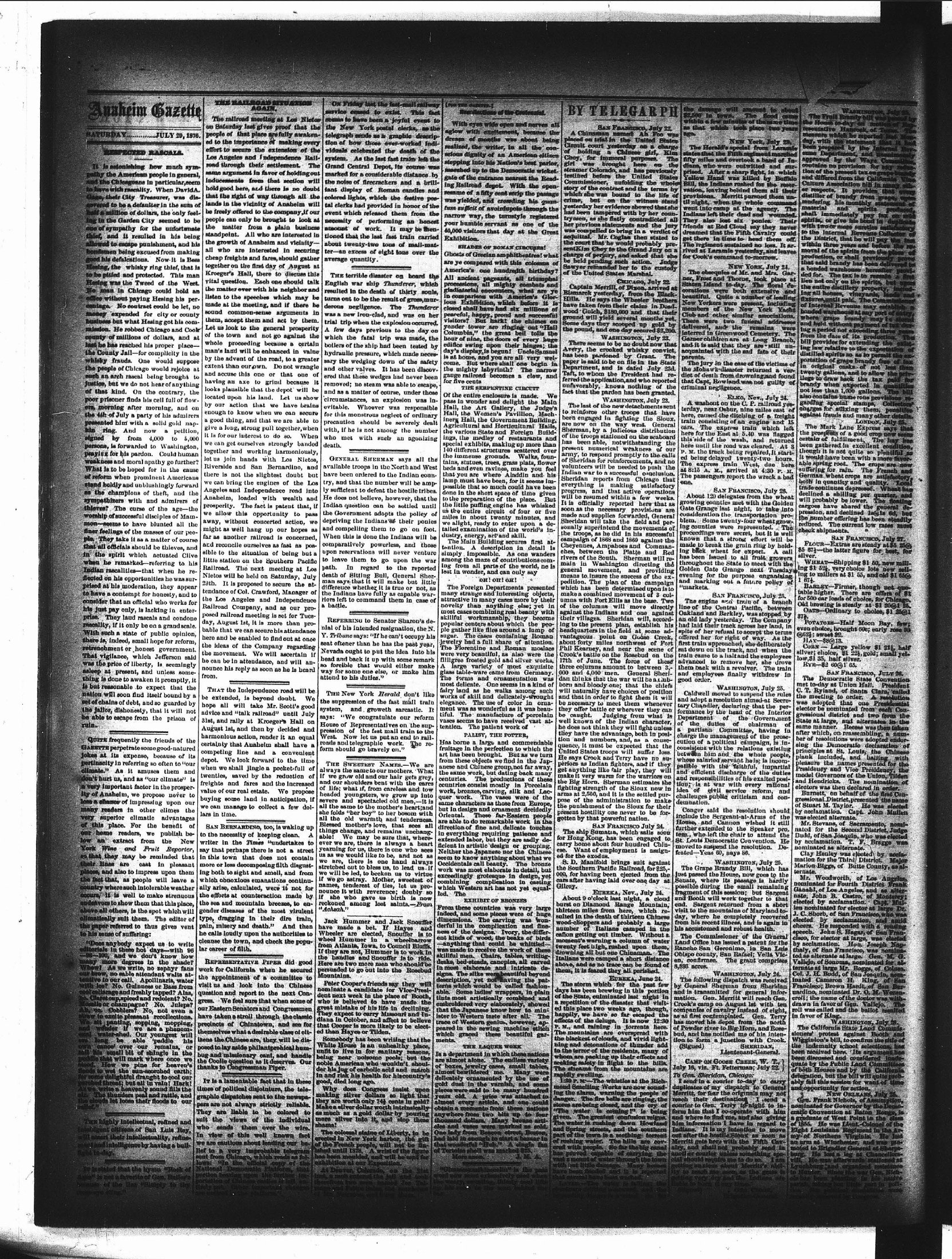
Searchable text
SATURDAY JULY 29, 1876.
IMPECCED RASCALS.
It is astonishing how much sympathy the American people in general, and the Chicagoans in particular, seem to have with rascality. When David A. Gage, their City Treasurer, was discovered to be a defaulter in the sum of half a million of dollars, the only feeling in the Garden City seemed to be one of sympathy for the unfortunate thief, and it resulted in his being allowed to escape punishment, and his beatenmen being excused from making good his defalcations. Now it is Bess Hesing, the whisky ring thief, that is to be pitted and protected. This man Hesing was the Tweed of the West. No man in Chicago could hold an office without paying Hesing his percentage. No contract could be let, no money expended for city or county business but what Hesing got his commission. He robbed Chicago and Cook County of millions of dollars, and at last he has reached his proper place—the County Jail—for complicity in the whisky frauds. One would suppose the people of Chicago would rejoice at such an arch rascal being brought to justice, but we do not hear of anything of that kind. On the contrary, the poor prisoner finds his cell full of flowers, morning after morning, and on the 4th of July a party of his admirers presented him with a solid gold napkin ring. And now a petition, signed by from 4,000 to 5,000 persons, is forwarded to Washington, praying for his pardon. Could human weakness and moral apathy go further? What is to be hoped for in the cause
THE RAILROAD SITUATION AGAIN.
The railroad meeting at Los Nietos on Saturday last gives proof that the people of that place are fully awakened to the importance of making every effort to secure the extension of the Los Angeles and Independence Railroad through their settlement. The same argument in favor of holding out inducements from that section will hold good here, and there is no doubt that the right of way through all the lands in the vicinity of Anaheim will be freely offered to the company, if our people can only be brought to look at the matter from a plain business standpoint. All who are interested in the growth of Anaheim and vicinity—all who are interested in securing cheap freights and fares, should gather together on the first day of August at Kroeger's Hall, there to discuss this vital question. Each one should talk the matter over with his neighbor and listen to the speeches which may be made at the meeting, and if there be sound common-sense arguments in them, accept them and act by them. Let us look to the general prosperity of the town and not go against the whole proceeding because a certain man's land will be enhanced in value by the advent of the road, to a greater extent than our own. Do not wrangle and accuse this one or that one of having an axe to grind because it looks plausible that the depot will be located upon his land. Let us show by our action that we have brains enough to know when we can secure a good thing, and that we are able to give a long, strong pull together, when it is for our interest to do so. When we can get ourselves strongly banded together and working harmoniously, let us join hands with Los Nietos, Riverside and San Bernardino, and
an arch rascal being brought to justice, but we do not hear of anything of that kind. On the contrary, the poor prisoner finds his cell full of flowers, morning after morning, and on the 4th of July a party of his admirers presented him with a solid gold napkin ring. And now a petition, signed by from 4,000 to 5,000 persons, is forwarded to Washington, praying for his pardon. Could human weakness and moral apathy go further? What is to be hoped for in the cause of reform when prominent Americans stand boldly and unblushingly forward as the champions of theft, and the sympathizers with and admirers of thieves? The curse of the age—the worship of successful disciples of Mammon—seems to have blunted all the finer feelings of the masses of our people. They take it as a matter of course that all officials should be thieves, and in the spirit which actuated Clive when he remarked—referring to his Indian rascalities—that when he reflected on his opportunities he was surprised at his moderation, they appear to have a contempt for honesty, and to consider that an official who works for his just pay only, is lacking in enterprise. They laud rascals and condone rascality, if it only be on a grand scale. With such a state of public opinion, there is, indeed, small hope for reform, retrenchment or honest government. That vigilance, which Jefferson said was the price of liberty, is seemingly asleep at present, and unless something is done to awaken it promptly, it is but reasonable to expect that the nation will soon find itself bound by a set of chains of debt, and so guarded by the jallor, dishonesty, that it will not be able to escape from the prison of ruin.
Quite frequently the friends of the Garterte perpetrate some good-natured jokes at its expense, because of its pertinacity in referring so often to "our climate." As it amuses them and don't hurt us, and as "our climate" is a very important factor in the prosperity of Anaheim, we propose never to lose a chance of impressing upon our many readers in other climes the very superior climatic advantages of this place. For the benefit of our home readers, we publish below an extract from the New York Wine and Fruit Reporter, so that they may be reminded that their lines are cast in pleasant places, and also to impress upon them the fact that, as people will leave a country where such intolerable weather and accuse this one or that one of having an axe to grind because it looks plausible that the depot will be located upon his land. Let us show by our action that we have brains enough to know when we can secure a good thing, and that we are able to give a long, strong pull together, when it is for our interest to do so. When we can get ourselves strongly banded together and working harmoniously, let us join hands with Los Nietos, Riverside and San Bernardino, and there is not the slightest doubt but we can bring the engines of the Los Angeles and Independence road into Anaheim, loaded with wealth and prosperity. The fact is patent that, if we allow this opportunity to pass away, without concerted action, we might as well hang up our hopes as far as another railroad is concerned, and reconcile ourselves as fast as possible to the situation of being but a little station on the Southern Pacific Railroad. The next meeting at Los Nietos will be held on Saturday, July 29th. It is proposed to secure the attendance of Col. Crawford, Manager of the Los Angeles and Independence Railroad Company, and as our proposed railroad meeting is set for Tuesday, August 1st, it is more than probable that we can secure his attendance here and be enabled to find out at once the ideas of the Company regarding the movement. We will ascertain if he can be in attendance, and will announce his reply as soon as he is heard from.
That the Independence road will be extended, is beyond doubt. We hope all will take Mr. Scott's good advice and "talk railroad" until July 31st, and rally at Kroeger's Hall on August 1st, and then by decided and harmonious action, render it an equal certainty that Anaheim shall have a competing line and a convenient depot. We look forward to the time when we shall jingle a pocket-full of twenties, saved by the reduction of freights and fares and the increased value of our real estate. We propose buying some land in anticipation, if we can manage to collect a few dollars in time.
SAN BERNARDINO, too, is waking up to the necessity of keeping clean. A writer in the Times "undertakes to say that perhaps there is not a street in this town that does not contain more or less decomposing filth disgusting both to sight and smell, and from which obnoxious emanations continually arise, calculated," were it not for
City of Anaheim, we propose never to lose a chance of impressing upon our many readers in other climes the very superior climatic advantages of this place. For the benefit of our home readers, we publish below an extract from the New York Wine and Fruit Reporter, so that they may be reminded that their lines are cast in pleasant places, and also to impress upon them the fact that, as people will leave a country where such intolerable weather occurs, it is well to make strenuous endeavors to show them that this place, above all others, is the spot which will climatically suit them. The editor of the paper referred to thus gives vent to his sense of suffering:
"Does anybody expect us to write editorials in these hot days—with 96—100, and we don't know how many more degrees in the shade? Whaw! As we write, no zephyr fans our brow, no sable attendant waits attentive to our call. Apollinaris, water with ice? No. Guinness or Bass from cool cellarage and freshly tapped? Alas, no Glacier cup, spiced and redolent? No. Monsalle or champagne? No. Juleps? Ah, no. Cobbler? No, not even a shrew to exalt pleasant recollections. We sit panting, sopping, mopping, and wonder if we are a phenomenal water-shed. Our youngest will are long be able 'paddle his own canoe' over our remains, or call his small bit of shingle in the puddle that will mark where once we stand. How we pine for heaven's floods to wet the sun-scorched earth; for some delightful draught to cool our patched throat; but all in vain! Hark! As we write a heavenly sound fills the air. The thunders peal and rattle, and the clouds let loose their floods to our relief."
The highly intellectual, refined and intelligent citizens of San Luis Ray, will assert their intellectuality, refinement and intelligence by having a bullhead today.
It is stated that the hymn "Rock of Ages" is not a favorite of Gan. Butterfly because of the line "Simply in thy new creeping."
SAN BERNARDINO, too, is waking up to the necessity of keeping clean. A writer in the Times "undertakes to say that perhaps there is not a street in this town that does not contain more or less decomposing filth disgusting both to sight and smell, and from which obnoxious emanations continually arise, calculated, were it not for the efforts at counteraction made by the sea and mountain breezes, to engender diseases of the most virulent type, dragging in their dire train, pain, misery and death." And then he calls loudly upon the authorities to cleanse the town, and check the popular career of filth.
REPRESENTATIVE PIER did good work for California when he secured the appointment of a committee to visit us and look into the Chinese question and report to the next Congress. We feel sure that when some of our Eastern Senators and Congressmen have taken a stroll through the classic precincts of Chinatown, and see for themselves what a desirable class of citizens the Chinese are, they will be disposed to lay aside philanthropical humbug and missionary cant, and handle the Coolie question as it deserves. Our thanks to Congressman Piper.
It is a lamentable fact that in these times of political disjointure, the telegraphic dispatches sent to the newspapers are not always strictly reliable. They are liable to be colored to suit the views of the individual who sends them over the wire. In view of this well known fact we are cautious about lending our helpless to a very improbable telegram sent from Chicago, which reads as follows: "In the official copy of the National Democratic Platform, that portion hearing upon the suffrage importation of Chinese soldiers is full and timely." Other important statements are included here.
Jack Hum have made Wheeler and wheel Hum from Atlanta If they are not the handles Here are two persuaded to Mountains.
Peter Cooper nominate a student next week who is belle great mistake They expect diana in October that Cooper led than Hayes.
Somebody White House unfit to live being near noble America der his jug off in and risk his good, died lonely.
Why does making alive they are worth Make a silver as much as a more silver shama!
The colossal erected in New of the French blind until 18 has been more exhibition at At Denver link a rush on this immense museum.
NOTUARIOUS
At Los Nietos proof that the fully awaken-making every occasion of the incidence Rail-element. The of holding out section will is no doubt through all the Anaheim will company, if our light to look at main business be interested in and vicinity—in securing should gather of August at to discuss this we should talk neighbor and which may be argument in fact by them. Total prosperity so against the use a certain proceed in value, to a greater not wrangle that one of because it depot will be Let us show have brains can secure are able to together, when so. When strongly banded harmoniously, Los Nietos, hardino, and
On Friday last the fast-mail railway service ceased to exist. This fast seems to have been a joyful event to the New York postal clerks, as the telegraph sends a graphic description of how those ever-worked individuals celebrated the death of the system. As the last fast train left the Grand Central Depot, its course was marked for a considerable distance by the noise of firecrackers and a brilliant display of Roman candles and colored lights, which the festive postal clerks had provided in honor of the event which released them from the necessity of performing an honest amount of work. It may be mentioned that the last fast train carried about twenty-two tons of mail-matter—an excess of eight tons over the average quantity.
The terrible disaster on board the English war ship Thunderer, which resulted in the death of thirty souls, turns out to be the result of gross, murderous negligence. The Thunderer was a new iron-clad, and was on her trial trip when the explosion occurred. A few days previous to the day on which the fatal trip was made, the boilers of the ship had been tested by hydraulic pressure, which made necessary the wedging down of the safety and other valves. It has been discovered that these wedges had never been removed; no steam was able to escape, and as a matter of course, under those circumstances, an explosion was inevitable. Whoever was responsible for this monstrous neglect of ordinary precaution should be severely dealt with, if he is not among the number who met with such an agonizing death.
GENERAL SHERMAN says all the available troops in the North and West
[for two cameras]
Rentations of the Confessional.
With eyes wide open and nerves all aglow with excitement, because the dream of months was about being realized, the writer, in all the conscious dignity of an American citizen stepping into his Nation's best parlor, marched up to the Democratic wicketgate of the entrance nearest the Reading Railroad depot. With the open name of a fifty cent strip the passage was yielded, and crowding his quantum sufflict of avoidupolis through the narrow way, the turnstyle registered your humble servant as one of the 40,000 visitors that day at the Great Exhibition.
SHADES OF ROMAN CIRCUMS!
Ghosts of Grecian amphitheatre! what are ye compared with this colossus of America's one hundredth birthday? All ancient pagants, all triumphal processions, all mighty combats and gladiatorial encounters, what are ye in comparison with America's Glorious Exhibition, which before it closed shall have had six millions of peaceful, happy, proud and successful visitors? But harh! the chimes on yonder tower are ringing out "Hall Columbia," the great bell tolls the hour of nine, the doors of every huge edifice swing upon their hinges; the day's display is begun! Uncle Samuel is at home, and you are all very welcome. But where shall one begin in the mighty labyrinth? The narrow gauge railroad becomes a clew, and for five cents
THE SERPENTINE CIRCUIT
Of the entire enclosure is made. We pass in wonder and delight the Main Hall, the Art Gallery, the Judge's Hall, the Women's Pavillion, Machinery Hall, the Government Building, Agricultural and Horticultural Halls, the various State and Foreign Buildings, the medley of restaurants and special exhibits, making up more than 140 different structures scattered over the immense grounds. Walks, fountains, statues, trees, grass plats, flower beds and even ravines make you feel
BY TELEGAR PRESS
SAN FRANCISCO, July 22.
A Chinaman named Ah Foo was placed on trial in the United States Circuit court yesterday on a charge of holding a Chinese girl, Kiki Choy, for immoral purposes. The girl was brought here on the steamer Colorado, and has previously testified before the United States Commissioner, unfolding the whole story of the contract and the terms by which she was bound to the life crime, but on the witness stand yesterday her evidence showed that she had been tampered with by her contrymen, as she flatly contradicted her previous statements and the jury was compelled to bring in a verdict.
Mr. Coghan then stated to the court that he would probably present Kim Choy to the Grand Jury once charged of perjury, and asked that she be held pending such action. Judge Sawyer remanded her to the custody of the United States Marshal.
CHICAGO, July 22.
Captain Merrill, of Bismarck yesterday, from the Black Hills. He says the Wheeler brother have taken from their claims in Deadwood Gulch $180,000 and that their ground will yield several months yet. Some days they scooped up gold by the pound, and one day secured $2,900.
WASHINGTON, July 23.
There seems to be no doubt now that Avery, the crooked whisky convict has been pardoned by Grant. The paper is said to be on file in the State Department, and is dated July 23rd Taft, to whom the President had referred the application,and who reported unfavorably,knows nothing of this fact that the pardon has been granted.
WASHINGTON, July 23.
The last of the new detachments sent to reinforce other troops that have been engaged in fighting the Sloux are now on the way west. General Sherman,by a judicious distribution of the troops stationed on the seaboard has been able,不withstanding tha present numerical weakness of our army,t to respond promptly to the call of Sheridan for reinforcements,and no volunteers will be needed to push tha
It has been discovered that these wedges had never been removed; no steam was able to escape, and as a matter of course, under those circumstances, an explosion was inevitable. Whoever was responsible for this monstrous neglect of ordinary precaution should be severely dealt with, if he is not among the number who met with such an agonizing death.
General Sherman says all the available troops in the North and West have been ordered to the Indian country, and that the number will be amply sufficient to defeat the hostile tribes. He does not believe, however, that the Indian question can be settled until the Government adopts the policy of depriving the Indians of their ponies and compelling them to go on foot. When this is done the Indians will be comparatively powerless, and those upon reservations will never venture to leave them to go upon the war path. In regard to the reported death of Sitting Bull, General Sherman says that it will make but little difference whether it is true or not, as the Indians have fully as capable warriors left to command them in case of a battle.
Referring to Senator Sharon's denial of his intended resignation, the N.Y. Tribune says: "If he can't occupy his seat oftener than he has the past year, Nevada ought to put the idea into his head and back it up with some remark so forebide that would either make way for some one else, or make him attend to his duties."
The New York Herald don't like the suppression of the fast mail train system, and growth sarcastic. It says: "We congratulate our reform House of Representatives on the suppression of the fast mail train to the West. Now let us put an end to railroads and telegraphic work. The reform should go bravely on."
The Sweetest Names—We are always the same to our mothers. What if we grow old and our hair gets grey, and our shoulders bent with the cares of life; what if, from careless and tow-headed youngsters, we grow up into severe and spectacled old men,—it is all the same to the mother's heart; and she folds "her boy" to her bosom with all the old warmth and tenderness. Blessed mother's love, that sees all things change, and remains unchanging! We may be sure that, wherever we are, there is always a heart yearning for us, there is one who sees us as we would like to be, and not as we are, there is one hand always stretched out to bless us, to lead us if we will be led, to beckon us to virtue if we go astray. Mother, sweetest names, tenderest of ties, let us proof the entire enclosure is made. We pass in wonder and delight the Main Hall, the Art Gallery, the Judge's Hall, the Women's Pavillion, Machinery Hall, the Government Building, Agricultural and Horticultural Halls, the various State and Foreign Buildings, the medley of restaurants and special exhibits, making up more than 140 different structures scattered over the immense grounds. Walks, fountains, statues, trees, grass plats, flower beds and even ravines, make you feel that you are where Aladdin and his lamp must have been, for it seems impossible that so much could have been done in the short space of time given to the preparation of the place. But the little puffing engine has whisked us the entire circuit of four or five miles in about twenty minutes, and we alight, ready to enter upon a detailed examination of the world's industry, energy, art and skill.
The Main Building secures first attention. A description in detail is simply impossible. As one wanders among the maze of contributions coming from all parts of the world, he is lost in wonder, and can only say
OH! OH! OH!
The Foreign Departments presented many strange and interesting objects, attractive in many cases more by their novelty than anything else; yet in most cases combining real beauty with skillful workmanship, they become popular centers about which the people gather like files around a lump of sugar. The cases containing Roman jewelry had a full share of attention. The Florentine and Roman mosques were very beautiful, as also were the filigree frosted gold and silver works. A large variety of most exquisite glass table-ware came from Germany. The forms and ornamentation was most delicate. One seems in a kind of fairy land as he walks among such works of skill and delicately-wrought elegance. The use of color in ornament was as wonderful as it was beautiful. The manufacture of porcelain vases seems to have received vast attention. The patient work of
PALISY, THE POTTER,
Has borne a large and commendable fruitage in the perfection to which the art has been brought. But as we turn from these objects we find in the Japanese and Chinese group, not far away, the same work, but dating back many centuries. The productions of these countries consist mostly in Porcelain work, bronzes, carving, silk and Lacquer work. The vases were of the same characters as those from Europe, but in design and ornament decidedly Oriental. These far-Eastern people are able to do remarkable work in the direction of fine and delicate touches in everything requiring patience and extended labor, but they are sadly deficient in artistic design or grouping. Neither the Japanese nor the Chinese seem to know anything about what we Occidentals call beauty. The bronze work was most elaborate in detail, but exceedingly grotesque in design, yet combining complication in casting which Western art has not yet equal.
THE SERPENTINE CIRCUIT
Of the entire enclosure is made. We pass in wonder and delight the Main Hall, the Art Gallery, the Judge's Hall, the Women's Pavillion, Machinery Hall, the Government Building, Agricultural and Horticultural Halls, the various State and Foreign Buildings, the medley of restaurants and special exhibits, making up more than 140 different structures scattered over the immense grounds. Walks, fountains, statues, trees, grass plats, flower beds and even ravines, make you feel that you are where Aladdin and his lamp must have been, for it seems impossible that so much could have been done in the short space of time given to the preparation of the place. But the little puffing engine has whisked us the entire circuit of four or five miles in about twenty minutes, and we alight, ready to enter upon a detailed examination of the world's industry, energy, art and skill.
The Main Building secures first attention. A description in detail is simply impossible. As one wanders among the maze of contributions coming from all parts of the world, he is lost in wonder, and can only say
OH! OH! OH!
The Foreign Departments presented many strange and interesting objects, attractive in many cases more by their novelty than anything else; yet in most cases combining real beauty with skillful workmanship, they become popular centers about which the people gather like files around a lump of sugar. The cases containing Roman jewelry had a full share of attention. The Florentine and Roman mosques were very beautiful, as also were the filigree frosted gold and silver works. A large variety of most exquisite glass table-ware came from Germany. The forms and ornamentation was most delicate. One seems in a kind of fairy land as he walks among such works of skill and delicately-wrought elegance. The use of color in ornament was as wonderful as it was beautiful. The manufacture of porcelain vases seems to have received vast attention. The patient work of
PALISY, THE POTTER,
Has borne a large and commendable fruitage in the perfection to which the art has been brought. But as we turn from these objects we find in the Japanese and Chinese group, not far away, the same work, but dating back many centuries. The productions of these countries consist mostly in Porcelain work, bronzes, carving, silk and Lacquer work. The vases were of the same characters as those from Europe, but in design and ornament decidedly Oriental. These far-Eastern people are able to do remarkable work in the direction of fine and delicate touches in everything requiring patience and extended labor, but they are sadly deficient in artistic design or grouping. Neither the Japanese nor the Chinese seem to know anything about what we Occidentals call beauty. The bronze work was most elaborate in detail, but exceedingly grotesque in design, yet combining complication in casting which Western art has not yet equal.
TASHINGTON, July 23.
The last of the new detachments sent to reinforce other troops that have been engaged in fighting the Sioux are now on way west. Generals Sherman, by a judicious distribution of the troops stationed on the seaboard has been able, notwithstanding this present numerical weakness of our army, to respond promptly to the calls of Sheridan for reinforcements, and no volunteers will be needed to push the Indian war to a successful conclusion Sheridan reports from Chicago that everything is making satisfactory progress, and that active operations will be resumed within a few weeks. It is officially reported here that as soon as the necessary provisions are made and supplies forwarded, Generals Sheridan will take the field and personally superintend the movements of the troops, as he did in his successful campaign of 1868 and 1869 against the Cheyennes, Arapahoes and Commances between the Platte and Red rivers of the South. Sherman will remain in Washington directing this general movement, and providing means to insure the success of the expedition. The plan of the campaign which has been determined upon is to make a combined movement of 3 columns with Fort Ellis as the base. Two of the columns will move directly against the Indians and one against their villages. Sheridan will according to the present plan establish his headquarters in the field at some advantageous point on Guose Creek, about forty miles northwest of Fort Phil Kearney, and near the scene of Crook's battle on the Rosebud on the 17th of June. The force of those three columns amount to between 3-000 and 4-000 men. General Sheridan thinks that war will be a stubborn and bloody one; that the chiefs will naturally have choices of position and that in order to fight them it will be necessary to meet them whenever they offer battle or wherever they can be caught. Judging from what is well known of the Indian character, he does not think they will fight unless they have the advantage both in position and numbers,and as a consequence it must be expected that the United States troops will suffer loss. He says Crook and Terry have no superiors as Indian fighters,and if they get anything like fair play,they will make it very warm for the warriors on the Big Horn.Sherman estimatesthe fighting strength of the Sioux now in arms at 2,500,and it isthe settled purpose ofthe administrationto makethe punishmentofthe Siouxfor their present hostilityone never to be forgottenbythat powerful nation.
SAN FRANCISCO July 24.
The ship Sumatua which sails soon for Hong Kong has been engaged to carry home about four hundred Chinese.Want of employment is assigned for the exodus.
S.D.Manifold brings suit againstthe Southern Pacific Railroad,for $25,-000,for having been ejectedfromthe cars after having laid over one day at Gilroy.
Jack Hummer and Jack Snouffer have made a bet. If Hayes and Wheeler are elected, Snouffer is to wheel Hummer in a wheelbarrow from Atlanta, Iowa, to Council Bluffs. If they are not, Hummer is to work in the handles and Snouffer is to ride. Here are two more men who should be persuaded to go out into the Rosebud Mountains.
Peter Cooper's friends say they will nominate a candidate for Vice-President next week in the place of Booth, who is believed to have made the great mistake of his life in declining. They expect to carry Missouri and Indiana in October, and affect to believe that Cooper is more likely to be elected than Hayes or Tilden.
Somebody has been writing that the White House is an unhealthy place, unfit to live in for sanitary reasons, being near noisome pools; but the noble American who wouldn't shoulder his jug of carbolic acid and marsh in and risk his health for his country's good, died long ago.
Why does Congress insist upon making silver dollars so light that they are worth only 74 cents in gold? Make a silver dollar worth intrinsically as much as a gold dollar by pouring more silver into it, and stop these shama!
The colossal statue of Liberty, to be erected in New York harbor, the gift of the French people, will not be limited until 1878. A wrist of the figure has been mounted, and will be sent for exhibition at our Exposition.
At Denver, Colorado, on the first day, a new cultural hall and coat threshers have been set up there. The old coat threshers were used when the mills produced woollen yarn.
"Glimpsauntinella" in the past would now have extensively used what the mills produced silk and linen.
The vases were of the same characters as those from Europe, but in design and ornament decidedly Oriental. These far-Eastern people are able to do remarkable work in the direction of fine and delicate touches in everything requiring patience and extended labor, but they are sadly deficient in artistic design or grouping. Neither the Japanese nor the Chinese seem to know anything about what we Occidentals call beauty. The bronze work was most elaborate in detail, but exceedingly grotesque in design, yet combining complication in casting which Western art has not yet equalled. The
EXHIBIT OF BRONZES
From these countries was very large indeed, and some pieces were of huge dimensions. The carving was wonderful in the complication and fineness of the design. Ivory, the different kinds of wood, the beaks of birds—anything that could be whittled—a made to receive the work of these skillful men. Chairs, tables, writing-decks, bed-steads, canopies, all carved in most elaborate and intricate designs. The silks were beautiful beyond description, yet not having the patterns which would be called fashionable. Some ladies' wrappers, in plain tints most artistically combined and embroidered very elaborately, showed that the Japanese know how to minister to Western taste after all. The trace of Western genius, however, appeared in the sewing machine stitch which graced these beautiful garments.
THE LAQUER WORK
Is a department in which these nations are almost alone. The endless variety of boxes, jewelry cases, small tables, almost bewildered me. Many were delicately ornamented by the use of gold dust in the varnish, and some pieces were said to be many hundred years old. A price was attached to almost every article, and one could obtain a moment from these nations anywhere from two bits up to four thousand dollars. Many bronze articles and vases were marked as sold. One lady from Beacon street, Boston, had laid in enough to start a hanaar in that wonderful "Hub." A single fan of Turtilla shell was marked $10.
More areas.
J.M.A.
"Glimpsauntinella" in the past would now have extensively used what the mills produced silk and linen.
The vases were of the same characters as those from Europe, but in design and ornament decidedly Oriental. These far-Eastern people are able to do remarkable work in the direction of fine and delicate touches in everything requiring patience and extended labor, but they are sadly deficient in artistic design or grouping. Neither the Japanese nor the Chinese seem to know anything about what we Occidentals call beauty. The bronze work was most elaborate in detail, but exceedingly grotesque in design, yet combining complication in casting which Western art has not yet equalled. The
EXHIBIT OF BRONZES
From these countries was very large indeed, and some pieces were of huge dimensions. The carving was wonderful in the complication and fineness of the design. Ivory, the different kinds of wood, the beaks of birds—anything that could be whittled—a made to receive the work of these skillful men. Chairs, tables, writing-decks, bed-steads, canopies, all carved in most elaborate and intricate designs. The silks were beautiful beyond description, yet not having the patterns which would be called fashionable. Some ladies' wrappers, in plain tints most artistically combined and embroidered very elaborately, showed that the Japanese know how to minister to Western taste after all. The trace of Western genius, however, appeared in the sewing machine stitch which graced these beautiful garments.
THE LAQUER WORK
Is a department in which these nations are almost alone. The endless variety of boxes, jewelry cases, small tables, almost bewildered me. Many were delicately ornamented by the use of gold dust in the varnish, and some pieces were said to be many hundred years old. A price was attached to almost every article, and one could obtain a moment from these nations anywhere from two bits up to four thousand dollars. Many bronze articles and vases were marked as sold. One lady from Beacon street, Boston, had laid in enough to start a hanaar in that wonderful "Hub." A single fan of Turtilla shell was marked $10.
More areas.
J.M.A.
"Glimpsauntinella" in the past would now have extensively used what the mills produced silk and linen.
The vases were of the same characters as those from Europe, but in design and ornament decidedly Oriental. These far-Eastern people are able to do remarkable work in the direction of fine and delicate touches in everything requiring patience and extended labor, but they are sadly deficient in artistic design or grouping. Neither the Japanese nor the Chinese seem to know anything about what we Occidentals call beauty. The bronze work was most elaborate in detail, but exceedingly grotesque in design, yet combining complication in casting which Western art has not yet equalled. The
ELEGARPH
SAN FRANCISCO, July 22.
Man named Ah Foo was arrested in the United States court yesterday on a charge of a Chinese girl, Klim immoral purposes. The brought here on the Colorado, and has previously before the United States attorney, unfolding the whole contract and the terms by which took place two years ago.
NEW YORK, July 23.
The Herald's special from Laramie states that the Fifth regiment marched fifty miles and overtook a band of Indians, who were outwitted and surprised. After a sharp fight, in which Yellow Hand was killed by Buffalo Bill, the Indians rushed for the reservation, leaving behind them all their provisions. Merritt pursued them until night, when the whole command went into camp at the agency. The Indians left their dead and wounded. They also lost six ponies. Their friends at Red Cloud say they never dreamed that the Fifth Cavalry could get there in time to head them off. The regiment sustained no loss. It arrived at Laramie yesterday, and leaves for Cook's command to morrow.
NEW YORK, July 24.
The obsequies of Mr. and Mrs. Garner, Frent and Thorne, took place at Staten Island to-day. The floral decorations were both extensive and beautiful. Quite a number of leading New Yorkers were present, including members of the New York Yacht Club and other similar associations. There were two funeral addresses delivered, and the remains were interred in Greenwood Cemetery. The Garner children are at Long Branch, and it is said that they are still unacquainted with the sad fate of their parents.
The jury in the case of the victims of the Mohawk disaster returned a verdict from drowning and found that Capt. Rowland was not guilty of criminal negligence.
ELKO, Nev., July 24.
A washout on the C.P. railroad yesterday, near Osburgh, nine miles east of here, caused the ditching of a freight train consisting of an engine and 15 cars. The express train which left here for the East at 5:40 was flagged this side of the wash, and returned here until the road was cleared. At 8:15 A.M. the track being repaired, it started being delayed twenty-two hours. The express train West, due here at 8:15 A.M. arrived at 6:00 P.M.
WASHINGTON, July 25.
The Fruit Brandy bill was passed by the House to-day on motion of Representative Hannah, of Texas. The measure which he reported last Monday, with the statement that it had been prepared by the Internal Revenue Department, and immediately approved by the Ways Commission contains no provision for any mention of the present tax on grape brandy and differed from the California Vine Culture Association bill in many respects. It provides that every distiller of brandy from grapes upon tendering his monthly statement of material and spirits produced shall immediately pay tax on wild spirits, or give his bond in duplicate with two or more sureties testimony to the Internal Revenue Collector of the District, that he will pay him within three years and before the removal of the spirits from the place of production, or shall previously prove that sold brandy has been delivered in a bonded warehouse herein provided for. The tax is to remain a fact lien not only on the spirits, but upon the entire distillery property, including all homes, vineyards, lands and fixtures; until paid. The Commission of Internal Revenue may establish a bonded warehouse at any port of entry where grape brandy may be stored and held without payment of tax during a period not exceeding three years from the date of its production. The bill provides for extending the existing law relative to the exportation of distilled spirits so as to permit the importation of grape brandy free of tax in original cases of not less than twenty gallons, and to allow the privilege to draw back the tax paid for brandy when exported in quantities not less than 1,000 gallons. The bill also contains numerous provisions regarding special stamps, Collections charges for auxiliary them, penalties against frauds and many other details.
LONDON, July 25.
The Mark Lane Express says that the prospect of a good crop now certain of fulfillment. The hay has been gathered in excellent condition, though it is not quite so pleniful as it would have been with a more favorable spring root. The crops are now suffering for rain.
WASHINGTON, July 23. Of the new detachments sent to other troops that have been in fighting the Sioux, the way west. General Ulysses a Judicious distribution is stationed on the seaboard table, notwithstanding the numerical weakness of our respond promptly to the calls for reinforcements, and no will be needed to push the to a successful conclusion. Reports from Chicago that it is making satisfactory and that active operations aimed within a few weeks. Daily reported here that as necessary provisions are supplied forwarded, General Will take the field and perimeter the movements of as he did in his successful 1888 and 1889 against the Arapahoes and Commanders the Platte and Red South. Sherman will re-washington directing the movement, and providing secure the success of the exercise plan of the campaign been determined upon is to oblined movement of 3 colony Ellis as the base. Two trains will move directly Indians and one against S. Sheridan will, according to plan, establish his in the field at some point on Goose Creek, miles northwest of Fort Henry, and near the scene of fire on the Rosebud on the ridge. The force of these was amount to between 300 men. General Sheridan that the war will be a subbody one; that the chiefs may have choices of position order to fight them it will meet them whenever little or wherever they can Judging from what is of the Indian character, think they will fight unless the advantage, both in positions, and as a consequence be expected that the troops will suffer loss. Kirk and Terry have no sudden fighters, and if they like fair play, they will warm for the warriors on S. Sherman estimates the length of the Sioux now in and it is the settled puradministration to make out of the Sioux for their city one never to be fortified powerful nation.
SAN FRANCISCO July 24. Armada, which sails soon long been ejected from the ring laid over one day at Cold brings suit against Pacific Railroad, for $25,-long been ejected from the ring laid over one day at Washington, July 25. The Grape Brandy Bill, which has just passed the House, now goes to the Senate, where its passage is hardly possible during the small remaining district of death from drowning and found that Capt. Rowland was not guilty of criminal negligence.
ELKO, Nev., July 24. A washout on the C. P. railroad yesterday, near Osbur, nine miles east of here, caused the ditching of a freight train consisting of an engine and 15 cars. The express train which left here for the East at 5:40 was flagged this side of the wash, and returned here until the road was cleared. At 3 p.m. the track being repaired, it started being delayed twenty-two hours. The express train West, due here at 8:15 A.M., arrived at 4:30 P.M. The passengers report the wreck a bad one.
SAN FRANCISCO, July 26. About 120 delegates from the wheat growing counties met with the Golden Gate Grange last night, to take into consideration the transportation problem. Some twenty-four wheat-growing counties were represented. The proceedings were secret, but it is well known that a strong effort will be made to break the grain ring by holding black wheat for export. A call has been issued to all fruit growers throughout the State to meet with the Golden Gate Grange next Tuesday evening for the purpose organizing and marking out a future policy of "markets."
SAN FRANCISCO, July 25. The engine and train of a branch line of the Central Pacific, between Oakland and Berkley, was stopped by an old lady yesterday. The Company had laid their track across her land, in spite of her refusal to accept the terms offered her for right of way. As the first train approached, she deliberately sat down on the track, and when the train came to a halt and the employeee advanced to remove her, she drove them back with a revolver. The train and employees finally withdrew in good order.
WASHINGTON, July 25. Caldwell moved to suspend the rules and adopt a resolution aimed at Secretary Chandler, declaring that the performance by the head of the Interior Department of the duties of chairman of a partisan Committee, having in charge the management of the prosecution of a political campaign, is inconsistent with the relations existing between him and the whole people whose salaried servant heIs; incompatible with the faithful, impartial and efficient discharge of the duties and responsibilities of his exalted position; is at war with every rational idea of civil service reform, and challenges public criticism and condemnation.
Conger said the resolution should include the Sergeant-at-Arms of the House, and Cannon wished it still further extended to the Speaker pro tem., who left the chair to attend the St. Louis Democratic Convention. He moved to suspend the resolution. Defeated—Yeas 60, nays 86.
WASHINGTON, July 25. The Grape Brandy Bill, which has just passed the House, now goes to the Senate, where its passage is hardly possible during the small remaining district of death from drowning and found that Capt. Rowland was not guilty of criminal negligence.
ELKO, Nev., July 24. A washout on the C. P. railroad yesterday, near Osbur, nine miles east of here, caused the ditching of a freight train consisting of an engine and 15 cars. The express train which left here for the East at 5:40 was flagged this side of the wash, and returned here until the road was cleared. At 3 p.m. the track being repaired, it started being delayed twenty-two hours. The express train West, due here at 8:15 A.M., arrived at 4:30 P.M. The passengers report the wreck a bad one.
SAN FRANCISCO, July 26. About 120 delegates from the wheat growing counties met with the Golden Gate Grange last night, to take into consideration the transportation problem. Some twenty-four wheat-growing counties were represented. The proceedings were secret, but it is well known that a strong effort will be made to break the grain ring by holding black wheat for export. A call has been issued to all fruit growers throughout the State to meet with the Golden Gate Grange next Tuesday evening for the purpose organizing and marking out a future policy of "markets."
SAN FRANCISCO, July 27. Flour—Extras are steady at $5 25@$5 67—the latter figure for best, for silver.
Wheat—Shipping $1 50, new milling $1 52], very choice lots now selling to millers at $1 55, and old $1 65@1 67].
BARLEY—Firmer, though not quotable higher. There are offers of $1 for 500 car loads of choice, for Chicago. Old browning is steady at $1 20@1 25.
OATS—Ordinary to choice,$1 25@1 37].
POTATOES—Half Moon Bay, few; even choice,brought 60c; early rose 60@62]; sweet $2.
HAY—$8@13.
CORN—Large yellow $1 21], half silver; choice,$1 22], gold; small yellow,$1 35,half silver.
RVE—$2 60@1 65].
SAN FRANCISCO, July 26. The Democrat State Convention met to-day at Union Hall. President C.T.Ryland, of Santa Clara, called the meeting to order. A resolution was adopted that one Presidential elector be nominated from each Congressional district and two from the State at large,and alternates in the same manner.Recess was then taken after which.on reassembling,a number of resolutions were adopted enduringthe Democratic declaration of principles at St.Louis,the Chinese plank included,and hailing with pleasurethe names presented forthe Presideney and Vice Presideney,the model Governors ofthe Union,Tildenand Hendricks.The nominationof electors was then declared in order.
Burnett,on behalf ofthe first Congressional District,presentedthe name of Stuart M.Taylor.Hew was electedby acclamation.Capt.John Mullanwas elected alternate.
Mr.Stevans.of Sacramento,nominatedforthe SecondDistrictJudge Budd.ofSan Joaquinwho was electedby acclamation.T.F.Braggewas nominatedas alternate.
Clay Henley was elected by acclamation forthe ThirdDistrictMajor Marion-Biggs.of Butte County.as alternate.
Mr.Woodworth.of Los Angeles,nominatedforFourthDistrictFrank Genaldo.ofLos Angeles,and as alternate.
EUREKA, Nev., July 24. Rock last night, a cloud mound Range Mountain; is from here, which reeath of thirteen Chinese and probably a large Italian camped in the out timber. Without a turning a column of water high, rushed upon them, but one Chinaman. The camped a short distance no trace can be found of red they all perished.
EUREKA, June 24. Which for the past few brewing in this portion eliminated last night in the disaster that visit two weeks ago, though, have so far escaped the deluge. It is now 12:30 morning in torrents here are overspread with clouds, and vivid light-nations of thunder add to the residents, many of taking up their effects and in flight to the hills from the mountains are ringing.
The whistles at the Richie Works are now sound warning the people of fire bells are ringing, the closed, and the cry of its coming!" is being greatest confusion reigns, washing down Howland coast, and the southern coast is a nothing torrent near. The hills are awake. So far the big canal capable of carrying the water through the town damage. Many houses and it is reported has been washed.
WASHINGTON, July 25. The Grape Brandy Bill, which has just passed the House, now goes to the Senate, where its passage is hardly possible during the small remaining fragment of this session; but Sargent and Booth will work together to that end. Sargent returned from a short visit to the mountains of Maryland today, where he completely recovered from his recent illness, and is again in his accustomed and robust health.
The Commissioner of the General Land Office has issued a patent for the Rancho San Geronimo, in San Luis Obispo county, San Rafael; Vella Viena, confirmee. The grant comprises 8,893 acres.
WASHINGTON, July 24. The following dispatch was received by General Sherman from Sheridan and is transmitted for general information. Gen. Merritt will reach Gen. Crook's camp on August 1st with ten companies of cavalry instead of eight, as at first contemplated. Gen. Terry has moved his depot from the north of Powder river to Big-Horn, and Rosebud, and has notified me of his intention to form a junction with Crook.
(Signed)
SHERIDAN,
Llentenant-General.
CAMP ON GOOSE CREEK, W. T. July 16, viz. Ft. Fetterman; July 22.
To Gen. Sheridan, Chicago:
I send in a courier to-day to carry duplicates of my dispatch to General Merritt, for fear the originals may not reach their destinations. I send a courier to Gen. Terry to night to inform him that I co-operate with him and where to find me, and also giving him information I have in regard to Indians. It is my intention to move out after the hostile Sloux as soon as Merritt gets here with the Fifth Cavalry, and shall not probably send in another carrier unless something special should require me to do no. I am getting anxious about Merritt's ability to reach me soon, as the grass is getting very dry and the Indiana are liable to burn it any time.
Burnett, on behalf of the first Congressional District, presented the name of Stuart M. Taylor. He was elected by acclamation. Capt. John Mullen was elected alternate.
Mr. Stevans, of Sacramento, nominated for the Second District, Judge Budd, of San Joaquin, who was elected by acclamation. T. F. Bragge was nominated as alternate.
Clay Henley was elected by acclamation for the Third District, Major Marion-Biggs, of Butte County, as alternate.
Mr. Woodworth, of Los Angeles, nominated for Fourth District Frank Ganahl, of Los Angeles, and as alternate; John B. Castro, of Monterey; elected by acclamation. Capt. Mullen nominated for elector at large Dr. J. C. Shorb, of San Francisco, who was elected by acclamation, and amid cheers. He responded with a rousing speech. John S. Hagar, of San Francisco, for elector at large was elected by acclamation. Hon. Joseph Naphtaly, of San Francisco, was nominated as alternate at large. Gen. M. G. Vallejo, of Sonoma, nominated for alternate at large Mr. Boggs, of Colusa. Col. J. H. Budd, of San Joaquin, nominated Cameron H. King, of San Francisco; Brown Hardt, of San Bernardino, nominated Dr. O. M. Wezencroft; the name of the doctor was withdrawn in favor of Gen. Vallejo. The roll was called and the ballot resulted in favor of King.
WASHINGTON, July 26. The California State Land Commission protest against Booth and Wigginton's bill, to confirm the title of the indemnity school selections, has been received here. Its argument has been discussed and considered inadequate by the Public Land Committee of both Houses and by the California delegation, but the bill will quill probably fall this season for want of time and opportunity for action.
NEW ORLEANS, July 25.
Gen. Frank Nichols, of Assimilation, nominated for Governor by the Democratic Convention at Eaton Roughs, is a graduate of West Point in the class of 1855. He was Lieut.-Colonel of the Eight Louisiana Regiment in the Army of Northern Virginia. He lost an arm at Winchester, and was promoted to Brigadier General at Sharpburg. He lost a leg at Chancellorville. He was afterwards stationed at Lynchburg and organized resistance to Hunter. Since war Gen. Nichols has been planting in his native peculiarly slender little pines in polluted areas throughout New York City...