anaheim-gazette 1876-07-29
Scanned page
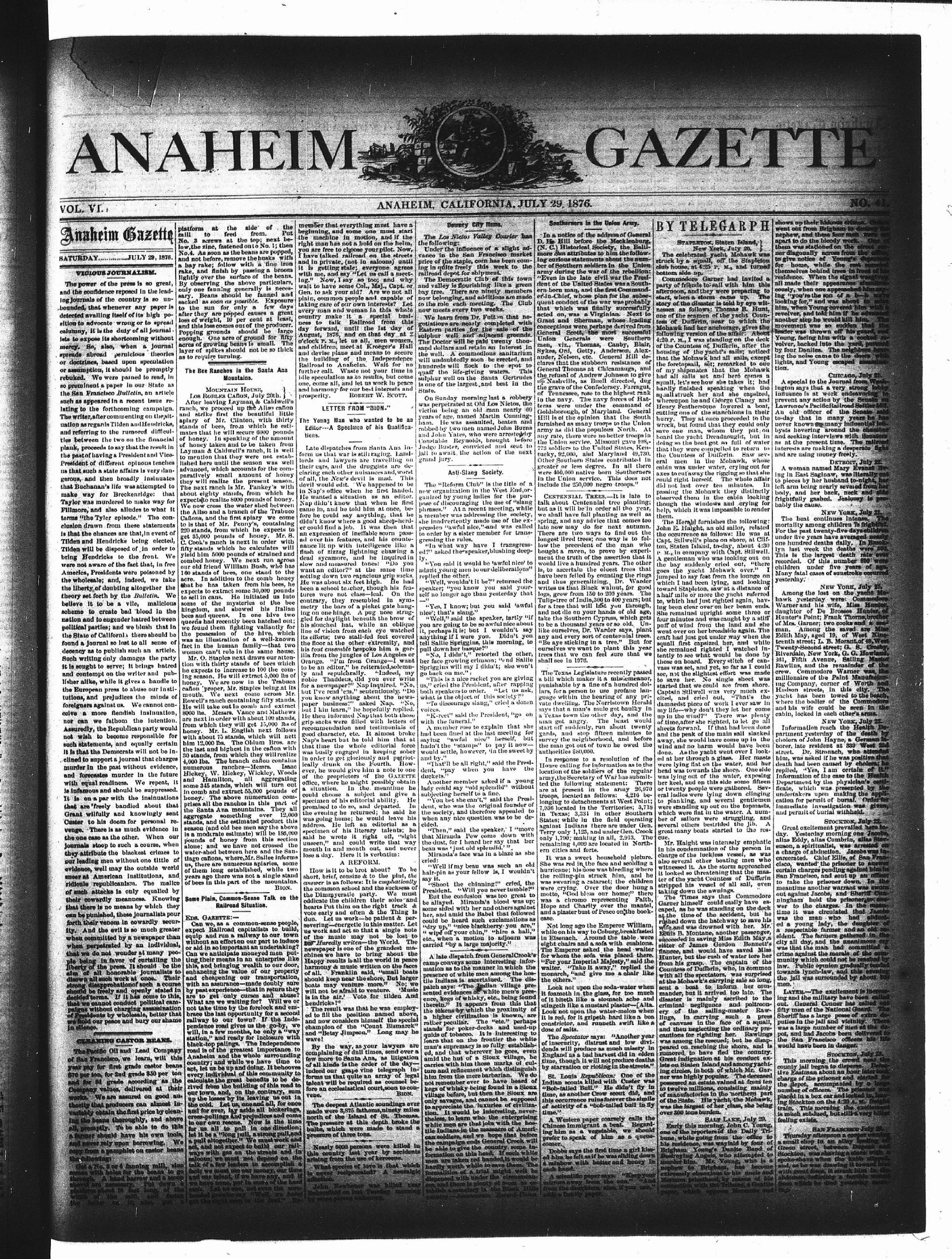
Searchable text
ANAHEIM
VOL. VI.
Anaheim Gazette
SATURDAY...JULY 29, 1876.
VIGIOUS JOURNALISM.
The power of the press is so great,
and the confidence reposed in the leading journals of the country is so unbounded,
that whenever any paper is detected availing itself of its high position to advocate wrong or to spread calumny, it is the duty of all journalists to expose its shortcoming without mercy. So, also, when a journal spreads abroad pernicious theories or doctrines, based upon speculation or assumption, it should be promptly rebuked. We were pained to read, in so prominent a paper in our State as the San Francisco Bulletin, an article such as appeared in a recent issue relating to the forthcoming campaign. The writer, after commenting on the situation as regards Tilden and Hendricks, and referring to the rumored difficulties between the two on the financial plank, proceeds to say that the result in the past of having a President and Vice-President of different opinions teaches that much state officialism was present at the side of the mill to feed from. Put No. 3 screws at the top; next below, the zine, fastened onto No. 1; then No.4. As soon as the beans are popped, and not before, remove the husks with a hay rake; follow with a fine iron rake, and finish by passing a broom lightly over the surface of the beans. By observing the above particulars, only one fanning generally is necessary. Beans should be fanned and sacked as soon as possible. Exposure to the sun for only a few days after they are popped causes a great loss of weight, 10 per cent at least, and this loss comes out of the producer. Popping grounds should be large enough. One acre of ground for fifty acres of growing beans is small. The layer of spikes should not be so thick as to require turning.
The Bee Ranchos in the Santa Ana Mountains.
MOUNTAIN HOUSE,
LOS ROBLES CAIFON, July 20th.
After leaving Layman & Caldwell's ranch, we proceed up the Alisa cafion and strike first the beautiful little apiary of Mr. Clinton, with thirty stands of bees, from which he estimates that he will secure 6000 pounds of honey. In speaking of the amount of honey taken and to be taken from Layman & Caldwell's ranch, it is well to mention that they were not established here until the season was well advanced, which accounts for the member that every beginning, and some right man has not yet you are free to choose I have talked railroad and in private, (not it is getting stale with me, and saying "Now, I say wait to have some Gen. to ask your alpine, common people taking care of our every man and woman country make it less to talk Ra day forward, until August, 1876, and o'clock P.M., let us and children meet and devise plans and the building of Railroad to Anaheim further call. Was little speculation as one, come all, and and harmony for our prosperity.
LETTER FR
The Young Man who Editor---A Specifications.
Late dispatches form us that war is lords and lawyers their cars, and the
We were pained to read, in so prominent a paper in our State as the San Francisco Bulletin, an article such as appeared in a recent issue relating to the forthcoming campaign. The writer, after commenting on the situation as regards Tilden and Hendricks, and referring to the rumored difficulties between the two on the financial plank, proceeds to say that the result in the past of having a President and Vice-President of different opinions teaches us that such a state affairs is very dangerous, and then broadly insinuates that Buchanan's life was attempted to make way for Breckenridge: that Taylor was murdered to make way for Fillmore, and also alludes to what it terms "the Tyler episode." The conclusion drawn from these statements is that the chances are that, in event of Tilden and Hendricks being elected, Tilden will be disposed of in order to bring Hendricks to the front. We were not aware of the fact that, in free America, Presidents were poisoned by the wholesale; and, indeed, we take the liberty of doubting altogether the theory set forth by the Bulletin. We believe it to be a vile, malicious scheme to create bad blood in the nation and to engender hatred between political parties; and we blush that in the State of California there should be found a journal so lost to all sense of decency as to publish such an article. Such writing only damages the party it is sought to serve; it brings hatred and contempt on the writer and publisher alike, while it gives a handle to the European press to abuse our institutions, and prejudices the minds of foreigners against us. We cannot conceive a more flendish insinuation, nor can we fathom the intention. Assuredly, the Republican party would not wish to become responsible for such statements, and equally certain it is that the Democrats will not be inclined to support a journal that charges murder in the past without evidence, and forecasts murder in the future with equal readiness. We repeat, it is infamous and should be suppressed. It is on a par with the insinuations that are freely bandled about that Grant willfully and knowingly sent Custer to his doom for personal revenge. There is as much evidence in the one case as the other. When our journals stoop to such a course, when they attribute the blackest crimes to our leading men without one little of evidence, well may the outside world anser at American institutions, and ridicule republicanism. The malice or misapplause, it should be promptly rebuked. We were pained to read, in so prominent a paper in our State as the San Francisco Bulletin, an article such as appeared in a recent issue relating to the forthcoming campaign. The writer, after commenting on the situation as regards Tilden and Hendricks, and referring to the rumored difficulties between the two on the financial plank, proceeds to say that the result in the past of having a President and Vice-President of different opinions teaches us that such a state affairs is very dangerous, and then broadly insinuates that Buchanan's life was attempted to make way for Breckenridge: that Taylor was murdered to make way for Fillmore, and also alludes to what it terms "the Tyler episode." The conclusion drawn from these statements is that the chances are that, in event of Tilden and Hendricks being elected, Tilden will be disposed of in order to bring Hendricks to the front. We were not aware of the fact that, in free America, Presidents were poisoned by the wholesale; and, indeed, we take the liberty of doubting altogether the theory set forth by the Bulletin. We believe it to be a vile, malicious scheme to create bad blood in the nation and to engender hatred between political parties; and we blush that in the State of California there should be found a journal so lost to all sense of decency as to publish such an article. Such writing only damages the party it is sought to serve; it brings hatred and contempt on the writer and publisher alike, while it gives a handle to the European press to abuse our institutions, and prejudices the minds of foreigners against us. We cannot conceive a more flendish insinuation, nor can we fathom the intention. Assuredly, the Republican party would not wish to become responsible for such statements, and equally certain it is that the Democrats will not be inclined to support a journal that charges murder in the past without evidence, and forecasts murder in the future with equal readiness. We repeat, it is infamous and should be suppressed. It is on a par with the insinuations that are freely bandled about that Grant willfully and knowingly sent Custer to his doom for personal revenge. There is as much evidence in the one case as the other. When our journals stoop to such a course, when they attribute the blackest crimes to our leading men without one little of evidence, well may the outside world anser at American institutions, and ridicule republicanism. The malice or misapplause, it should be promptly rebuked. We were pained to read, in so prominent a paper in our State as the San Francisco Bulletin, an article such as appeared in a recent issue relating to the forthcoming campaign. The writer, after commenting on the situation as regards Tilden and Hendricks, and referring to the rumored difficulties between the two on the financial plank, proceeds to say that the result in the past of having a President and Vice-President of different opinions teaches us that such a state affairs is very dangerous, and then broadly insinuates that Buchanan's life was attempted to make way for Breckenridge: that Taylor was murdered to make way for Fillmore, and also alludes to what it terms "the Tyler episode." The conclusion drawn from these statements is that the chances are that, in event of Tilden and Hendricks being elected, Tilden will be disposed of in order to bring Hendricks to the front. We were not aware of the fact that, in free America, Presidents were poisoned by the wholesale; and Indeed, we take the liberty of doubting altogether the theory set forth by the Bulletin. We believe it to be a vile, malicious scheme to create bad blood in the nation and to engender hatred between political parties; and we blush that in the State of California there should be found a journal so lost to all sense of decency as to publish such an article. Such writing only damages the party it is sought to serve; it brings hatred and contempt on the writer and publisher alike, while it gives a handle to the European press to abuse our institutions, and prejudices the minds of foreigners against us. We cannot conceive a more flendish insinuation, nor can we fathom the intention. Assuredly, the Republican party would not wish to become responsible for such statements, and equally certain it is that the Democrats will not be inclined to support a journal that charges murder in the past without evidence, and forecasts murder in the future with equal readiness. We repeat, it is infamous and should be suppressed. It is on a par with the insinuations that are freely bandled about that Grant willfully and knowingly sent Custer to his doom for personal revenge. There is as much evidence in the one case as the other. When our journals stoop to such a course, when they attribute the blackest crimes to our leading men without one little of evidence, well may the outside world anser at American institutions, and ridicule republicanism. The malice or misapplause, it should be promptly rebuked. We were pained to read, in so prominent a paper in our State as the San Francisco Bulletin, an article such as appeared in a recent issue relating to the forthcoming campaign. The writer, after commenting on the situation as regards Tilden and Hendricks, and referring to the rumored difficulties between the two on the financial plank, proceeds to say that the result in the past of having a President and Vice-President of different opinions teaches us that such a state affairs is very dangerous, and then broadly insinuates that Buchanan's life was attempted to make way for Breckenridge: that Taylor was murdered to make way for Fillmore, and also alludes to what it terms "the Tyler episode." The conclusion drawn from these statements is that the chances are that, in event of Tilden and Hendricks being elected, Tilden will be disposed of in order to bring Hendricks to the front. We were not aware of the fact that, in free America, Presidents were poisoned by the wholesale; and Indeed, we take the liberty of doubting altogether the theory set forth by the Bulletin. We believe it to be a vile, malicious scheme to create bad blood in the nation and to engender hatred between political parties; and we blush that in Tilden and Hendricks being elected, Tilden will be disposed of in order to bring Hendricks to the front. We were not aware of the fact that, in free America, Presidents were poisoned by the wholesale; and Indeed, we take the liberty of doubting altogether the theory set forth by the Bulletin. We believe it to be a vile, malicious scheme to create bad blood in the nation and to engender hatred between political parties; and we blush that in Tilden and Hendricks being elected, Tilden will be disposed of in order to bring Hendricks to the front. We were not aware of the fact that, in free America, Presidents were poisoned by the wholesale; and Indeed, we take the liberty of doubting altogether the theory set forth by the Bulletin. We believe it to be a vile, malicious scheme to create bad blood in the nation and to engender hatred between political parties; and we blush that in Tilden and Hendricks being elected, Tilden will be disposed of in order to bring Hendricks to the front.
We were not aware of the fact that, in free America, Presidents were poisoned by the wholesale; and Indeed, we take the liberty of doubting altogether the theory set forth by the Bulletin. We believe it to be a vile, malicious scheme to create bad blood in the nation and to engender hatred between political parties; and we blush that in Tilden and Hendricks being elected, Tilden will be disposed of in order to bring Hendricks to the front.
We were not aware of the fact that, in free America, Presidents were poisoned by the wholesale; and Indeed, we take the liberty of doubting altogether the theory set forth by the Bulletin. We believe it to be a vile, malicious scheme to create bad blood in this part of Santa Ana mountains. They all aggregate something over 12,000 stands, and they estimate product this season (and old bee men say they above is a moderate estimate) will be 188,000 pounds of honey from this section alone; and we have not crossed water-shed between here and Santiago caffons, where Mr.Sallee informs us there are numerous apiaries some of them long established, while two years ago there was not a single stand of bees in this part of Santa Ana mountains.
MOUNTAIN HOUSE,
LOS ROBLES CAFION,
July 20th.
After leaving Layman & Caldwell's ranch, we proceed upthe Allso cafion ofthe Trabuco Caftions,and he first aplary we come is that of Mr.Penny's,cataloging 220 stands from which he expectsto get 35,000 pounds of honey. Mr.S.C.Cook's ranch is next order with fifty stands which he calculateswill yield him 5000 pounds of strainedand combed honey. We next run acrossour old friend William Bush,his 160 stands of bees,一standtotheacre.In additiontothecombhoneythathehas takenfromhis bees,theexpectstoextractsome30000 poundsto sellin cans.Her initiatedus into someofthemysteriesofthebeekingdom,andshowedhisItalianbeesandqueens.Inonehivetwoqueenshad recently been hatched out;wefoundthemfighringvalliantlyforthepossessionofthehivewhichwasanillustrationofawell-knownfactinthehumanfamily—thattwowomencan'truleinthesamehouse.
Mr.O. Staples next draws our attentionwith thirtystandsofbeeswhichheexpectstoincreaseto100the comingseason.Hewill extract5,000lbsof honey.Ware nowintheTrabucocaftionsbeingatitsmouth.WerenextacrossMr.Rowell'sranchcontainingfiftystands.Hewwilltakeoutincombandextract8000lbsofmoney.Theabovenumerationcomprisesalltheranchesinthispartofthesanta Anamountains.
I am frightenedbygrip sackswerefiredrecommendationetgoodcharacter,eitherNap'sheartbuthatethattimethewhosebusilyengagedinordergetglossallydrunkoneverhewouldgiveofftheproprietortofficewherehemaya situation.Incouldchooseasspecimenofhiseditiontodoso,theeveningherewasgoinghome;addressHeleftspecimenofhislefthowhewroteitunseen,"andcoundmonthinandmooselosea day.Here
A REAL
How is ittobea short,basicanswerisasfollowthecommonschool
It is on a par with the insinuations that are freely bandied about that Grant willfully and knowingly sent Custer to his doom for personal revenge. There is as much evidence in the one case as the other. When our journals stoop to such a course, when they attribute the blackest crimes to our leading men without one tittle of evidence, well may the outside world answer at American institutions, and ridicule republicanism. The malice of such attacks is only equalled by their cowardly meanness. Knowing that there is no means by which they can be punished, these journalists pour forth their venom in cowardly security. And the evil is so much greater when committed by a newspaper than when persecuted by an individual, that we do not wonder at many people being in favor of curtailing the liberty of the press. It should be the aim of all honorable journalists to disown all such work at once. Their strong disapprobation of such a course should be freely and openly stated in decided terms. If it has come to this, that we cannot conduct political campaigns without charging assassination of Presidents by wholesale, better that we hold our peace and bury our shame in silence.
CLEANING CASTOR BEANS
The Pacific Oil and Lead Company of San Francisco, we learn, will this year pay for first grade castor beans 870 per ton, for 2nd grade $30 per ton and for 3rd grade according as the Company values, delivered at their works. We are assured on good authority that producers can almost invariably obtain the first price by cleaning the beans thoroughly, and above all, promptly. To be able to do this a farmer should have his own tools, and never rely upon borrowing. We copy from a pamphlet on castor beans the following:
Get a No. 2 or 4 fanning mill, nine scream with holes for the beans to go through. A hand harrow and a scoop above are necessary. Put down a platform plant is fast long of the whisk of the mill, and faster the handle on it; also, put a comb and extract 55,000 pounds of honey. The above numeration comprises all the ranches in this part of the Santa Ana mountains. They all aggregate something over 12,000 stands, and the estimated product this season (and old bee men say the above is a moderate estimate) will be 188,000 pounds of honey from this section alone; and we have not crossed the water-shed between here and the Santiago caffons, where Mr. Sallee informs us, there are numerous apiaries, some of them long established, while two years ago there was not a single stand of bees in this part of the mountains.
BION.
Some Plain, Common-Sense Talk on the Railroad Situation.
EDS. GAZETTE:
Can we, as a common-sense people, expect Railroad capitalists to build, equip and run a railway to our town without an effort on our part to induce or aid in so important an undertaking? Can we anticipate moneyed men putting their means in an enterprise like this, and bringing wealth to our door, enhancing the value of our property and cheapening our transportation, with an assurance—made doubly sure by past experience—that in return they are to get only curses and abuse? What are we waiting for? Will we or not take time by the forelock and embrace the last opportunity for a second railway to our town? If the Independence road gives us the go-by, we will, in a few months, be only a "way station," and ready for inclosure with black-top palings. The Independence road is of the greatest importance to Anaheim and the whole surrounding country; and while we have time to act, let us be up and doing. It behooves every individual of this community to calculate the great benefits to be derived from the building of this road to our town, and, on the contrary, sum up the losses by its leaving us out in the cold. Let us, one and all, for once and for ever, lay aside all blickerings, cross-pullings and prejudices and come to our own rescue. Now is the time for us all to pull in one direction; let it be a "long jail," a strong pull, and a pull altogether." We must work and act, and not expect to build our railways with gas on the streets and in saloons; we must not depend on the talk of a few leaders to accomplish a fact; we must use our money, our time and our talent, if we have any, and if we have none, put in more of the hard cash. Let no one, not even the more backward growers say "Wall, we Assist out the most men in the lead."
How is it to be short, brief, consider answer is as follow: the common school Dimmyeratic eddicate the children Put thim o vote early and off dun. Let us work severing—energetic us work—and act s of the music m Huredly write newspaper is one chines we have Happy results is a harmony & music of all. Franklin should keep near boats may venture will not be afraid is in the air.' Wendricks!"
The result was ed to fill the post and now consider champion of the "Betsy Jimmy wave!
By the way, complaining of de few more to San of all kinds is th indeed our grape forms us that quiet talent will be recor an ecclesiast vene.
The deepest Al made were 3,875 north of the Isle The pressure at bulbs which we pressure of three Nearly 6000 p this country last arising from th What species is never repre affection.
John Newborn Bakerfield on h by some person
ANAHEIM, CALIFORNIA, JULY 29, 1876.
member that everything must have a beginning, and some one must start the machine in motion, and if the right man has not a hold on the helm, you are free to choose your pilot. Now, I have talked railroad on the streets and in private, (not in saloons) until it is getting stale; everyone agrees with me, and say "Let us call a meeting." Now, I say so too; and why wait to have some Col., Maj., Capt. or Gen. to ask your aid? Are we not all plain, common people and capable of taking care of our own interests? Let every man and woman in this whole country make it a special business to talk Railroad from this day forward, until the 1st day of August, 1876, and on that day at 2 o'clock P.M., let us all, men women, and children, meet at Kroeger's Hall and devise plans and means to secure the building of the Independence Railroad to Anaheim. Wait for no further call. Waste not your time in little speculation as to results, but come one, come all, and let us work in peace and harmony for our best interests and prosperity. ROBERT W. SCOTT.
LETTER FROM "BION."
The Young Man who wanted to be an Editor---A Specimen of his Qualifications.
Late dispatches from Santa Ana inform us that war is still raging. Land-lords and lawyers are travelling on their cars, and the druggists are de-
Downey City News.
The Los Nietos Valley Courier has the following:
Under the influence of a slight advance in the San Francisco market price of the staple, corn has been coming in quite freely this week to the railroad depot for shipment.
The Democratic Club of this town and valley is flourishing: like a green bay tree. There are ninety members now belonging, and additions are made to the role each meeting. The Club now meets every two weeks.
We learn from Dr. Fulton that negotiations are nearly completed with Eastern parties for the sale of the sulphur well and adjacent grounds. The Doctor will be paid twenty thousand dollars and retain an interest in the well. A commodious sanitarium will undoubtedly soon be erected, and hundreds will flock to the spot to quaff the life-giving waters. This sulphur well on the Santa Gertrudes is one of the largest and best in the State.
On Sunday morning last a robbery was perpetrated at Old Los Nietos, the victim being an old man nearly 60 years of age, named Martin Cunningham. He was assaulted, beaten and robbed by two men named John Burns and John Yates, who were arrested by Constable Reynolds, brought before Judge Buster, convicted and sent to jail to await the action of the next grand jury.
Southerners in the Union Army.
In a notice of the address of General D. H. Hill before the Mackenburg (N.C.) Historical Society, the Baltimore Sun attributes to him the following curious statements about the number of Southern soldiers in the Union army during the war of the rebellion:
"Even in the late civil war the President of the United States was a Southern born man, and the first Commander-in-Chief, whose plan for the subsequent conduct of the war was probably that which was finally successfully acted on, was a Virginian. Next to Grant and Sherman, whose leading conceptions were perhaps derived from General Scott, the most successful Union Generals were Southern men, viz., Thomas Canby, Blair, Sykes, Ord, Getty, Anderson, Alexander, Nelson, etc. General Hill declares that the stubborn resistance of General Thomas at Chicamauga, and the refusal of Andrew Johnson to give up Nashville, as Buell directed, dug the grave of the Confederacy. Farragut, of Tennessee, rose to the highest rank in the navy. The navy forces of Hatteras were under the command of Goldsborough, of Maryland. General Hill is of the opinion that the South furnished as many troops to the Union army as did the populous North. At any rate, there were no better troops in the Union service. Missouri gave 108,-773 soldiers to the United States, Kentucky, 92,000, and Maryland 49,730. Other Southern States contributed in greater or less degree. In all there
LETTER FROM "BION."
The Young Man who wanted to be an Editor---A Specimen of his Qualifications.
Late dispatches from Santa Ana inform us that war is still raging. Landlords and lawyers are travelling on their cars, and the druggists are declaring each other nuisances and worst of all, the New's devil is mad. This devil would edit. We happened to be in Nap's office when he first landed. He wanted a situation as an editor. Nap didn't know that when he first came in, and he told him at once, before he could say anything, that he didn't know where a good sheep-herder could find a job. It was then that an expression of ineffable scorn passad over his features, and his countenance lit up with intelligence like a flash of zizzag lightning chawing a dead sycamore, and he inquired in slow and measured tones: "Do you want an editor?" at the same time setting down two capacious grip sacks. He was about six feet high. He had been a school teacher, though his features were not class—legal. On the contrary, they resembled in symmetry the bars of a picket gate hanging on one hinge. A pug nose struggled for daylight beneath the brow of his slonched hat, while an oblique line of vision from each eye watched its efforts; two stall-fed feet covered the floor at the other extremity, and his tout ensemble bespoke him a gorilla from the jungles of Los Angeles or Orange. "I'm from Orange—I want to be an editor," he reiterated, solemnly and sepulchrally. "Indeed, my noble Thaddeus, did you ever write for a newspaper?" Nap inquired. "No, but I've read 'em." sententiously. "Do you know anything about the newspaper?" asked Nap. "No, but I kin learn," he hopefully replied. He then informed Nap that both those grip sacks were filled with letters of recommendation and testimonials of good character, etc. It almost broke Nap's heart but he told him that at that time the whole editorial force was busily engaged in keeping sober in order to get gloriously and patriotically drunk on the Fourth. However, he would give him a note to one of the proprietors of the Gazette office, where he might possibly obtain a situation. In the meantime he could choose a subject and give a specimen of his editorial ability. He promised to do so, and departed. In the evening he returned; he said he was going home; he would leave his address. He left an editorial as a specimen of his literary talents; he said he wrote it right off, "sight unseen," and could write that way month in and month out, and never lose a day. Here it is verbatim:
A REFORM.
How is it to be brot about? To be short, brief, consize & to the pint, the answer is as follows: It is emphatically the common school and the suckess of
On Sunday morning last a robbery was perpetrated at Old Los Nietos, the victim being an old man nearly 80 years of age, named Martin Cunningham. He was assaulted, beaten and robbed by two men named John Burns and John Yates, who were arrested by Constable Reynolds, brought before Judge Buster, convicted and sent to jail to await the action of the next grand jury.
Anti-Siang Society.
The "Reform Club" is the title of a new organization in the West End, organized by young ladies for the purpose of discouraging the use of "slang phrases." At a recent meeting, while a member was addressing the society, she inadvertently made use of the expression "awful nice," and was called to order by a sister member for transgressing the rules.
"In what way have I transgressed?" asked the speaker, blushing deeply.
"You said it would be 'awful nice' to admit young men to our deliberations" replied the other.
"Well, wouldn't it be?" returned the speaker; "you know you said yourself no longer ago than yesterday that—"
"Yes, I know; but you said 'awful nice'; that's slang."
"Well," said the speaker, tartly "if you are going to be so awful nice about it, perhaps it is; but I wouldn't say anything if I were you. Didn't you tell Sallie Spriggins, this morning, to pull down her basque?"
"No, I didn't," retorted the other, her face growing crimson; "and Sallie Spriggins will say I didn't; she won't go back on me."
"This is a nice racket you are giving us," cried the President, after rapping both speakers to order. "Let us ask, what is the object of this society?"
"To discourage slang," cried a dozen voices.
"K-rect" said the President, "go on with the funeral."
A member rose to explain that she had been finned at the last meeting for saying "awful nice" herself, but hadn't the "stamps" to pay it now—would settle, however, in the sweet by and by."
"That'll be all right," said the President, "pay when you have the duckets."
Another member asked if a young lady could say "old splendid" without subjecting herself to a fine.
"You bet she can't," said the President, who was the original founder of the society, and therefore appealed to when any nice question was to be decided.
"Then," said the speaker, "I move that Miranda Pew come down with the dust, for I heard her say that her bean was 'just old splendid.'"
Miranda's face was in a blaze as she cried:
"We well if my bean was such an old hair-pin as your fellow is, I wouldn't say it."
"Shoot the chinning!" cried the President.
"Will you never tumble?"
CENTENNIAL TREES. —It is late to talk about Centennial tree planting; but as it will be in order all the year, we shall have fall planting as well spring, and any advice that comes too late now may do for next autumn. There are two ways to find out the longest lived trees; one way is to follow the precedent of the man who bought a raven, to prove by experiment the truth of the assertion that it would live a hundred years. The other is, to ascertain the oldest trees that have been felled by counting the rings and thus generalizing. Dr. Warder writes us that Black walnut, for good logs, grow from 150 to 200 years. The Tulip-tree of India,300 to 400 years; but for a tree that will last you through, and not die on your hands of old age, take the Southern Cypress, which gets to be a thousand years or so old. Unlike ourselves, Dr. Warder says, plant any and every sort of centennial trees.
"Be aye sticking in a tree." But for ourselves we want to plant this year trees that we can feel sure that we shall see in 1976.
The Texas Legislature recently passed a bill which maker it a misdemeanor, punishable by a fine of a hundred dollars, for a person to use profane language within the hearing of any private dwelling. The Norristown Herald says that a man's mule got baulk in a Texas town the other day, and the man got angry. The beast would start off suddenly, run about twenty yards, and stop fifteen minutes to survey the neighborhood, and before the man got out of town he owed the authorities $80,000.
In response to a resolution of the House calling for information as to the location of the soldiers of the regular army,the Secretary of War has submitted the following statement: There are at present in the army 20,970 troops, located as follows: 4,210 belonging to detachments at West Point; 7,936 located in the Territories; 3,718 in Texas; 3,334 in other Southern States; while in the field operating against Indians there are under Gen Terry only 1,123,and under Gen Crook only 1,790; making in all,2,913.The remaining 4,000 are located in Northern cities and forts.
It was a sweet household picture. She was red in the face and scolding a hurricane; his nose was bleeding where the rolling-pin struck him,and he was swearing a cataract;the children were crying.Over the door hung a
How is it to be brot about? To be short, brief, consize & to the pint, the answer is as follows: It is emphatically the common school and the suckess of the Dimmyeratic party. We must eddicate the children their soles and hearts Put him on the right track & vote early and often & the Thing is dun. Let us work—be patient & persevering—energetic in this matter. Let us work and act so that a single note of the music may not be lost to Huredly written—the World. The newspaper is one of the grandest machines we have to bring about the Happy results is all the world in peace harmony & music written on the faces of all. Franklin said, "small boats should keep near the shore. But larger boats may venture more." No; we will not be afraid to venture. 'Music is in the air.' Vote for tilden And hendricks!"
The result was that he was employed to fill the position named above, and now considers himself the special champion of the "Count Bismarck" and "Betsy Jimpson." Long may he wave!
By the way, as your lawyers are complaining of dull times, send over a few more to Santa Ana, as litigation of all kinds is the order of the day—indeed our grape vine telegraph informs us that quite an array of legal talent will be required as counsel before an ecclesiastical court, soon to convene.
The deepest Atlantic soundings ever made were 3,875 fathoms,ninety miles north of the Island of St. Thomas. The pressure at this depth broke the bulbs, which were made to stand a pressure of three tons.
Nearly 6000 persons were killed in this country last year by accidents arising from the use of kerosene.
What species of love is that which is never reciprocal? A neuralgic affection.
John Newborer was killed near Balsamfield on Tuesday morning by some serious unknown.
"You bet she can't," said the President, who was the original founder of the society, and therefore appealed to when any nice question was to be decided.
"Then," said the speaker, I "move that Miranda Pew come down with the dust, for I heard her say that her bean was 'just old splendid.'"
Miranda's face was in a blaze as she cried:
"Well if my bean was such an old hair-pin as your fellow is, I wouldn't say it.
"Shoot the chinning!" cried the President. "Will you never tumble?"
But the confusion was too great to be allayed. Miranda's blood was up; some sided with her and others against her, and amid the Babel that followed could be heard such exclamations as "dry up," "nice blackberry you are," "wipe off your chin," "hire a hall," etc., when a motion to adjourn was carried "by a large majority."
A late dispatch from General Crook's camp conveys some interesting information as to the manner in which the presence of white men among the hostile Indians is acertained. The dispatch says: "The Indian village presented evidences of white men's presence, keys of whisky, etc., being found therein." It appears from this that the tokens by which the proximity of a higher civilization is known, are rather peculiar. The "etc." perhaps stands for poker-decks and used-up quills of tobacco. It is interesting to learn that on the frontier the white man's supremacy is so fully established, and that wherever he goes, even amid the hut of a Sioux village, he carries with him those marks of culture and refinement which distinguish him from the mere barbarian. We do not remember ever to have heard of keys of whisky being found in a Sioux village before, but then the Sioux are only savages, and cannot be supposed to appreciate the luxuries of civilization. It would be interesting, nevertheless, to learn who the enterprising white men are that join with the hostile Indians in the massacre of American soldiers, and we hope that before the campaign ends General Crook will be able to give the country some information on this head. If each white man are taken red handed, it would be hardly worth while to save them. The formalities of a trial might well be dispensed with under the circumstances, and there is plenty of room to establish a sanctuary in the Black Hills country—Government Record-Gloss.
It was a sweet household picture. She was red in the face and scolding a hurricane; his nose was bleeding where the rolling-pin struck him, and he was swearing a cataract; the children were crying. Over the door hung a motto, "God bless our home;" there was a chromo representing Faith, Hope and Charity over the mantel, and a plaster bust of Peace on the bookcase.
Not long ago the Emperor William, while on his way to Coburg, breakfasted in Eisenach. Around the table were eight chairs and a sofa with cushions. The Emperor asked the head waiter for whom the sofa was placed there. "For your Imperial Majesty," said the waiter. "Take it away," replied the monarch, "and give me a chair like the others."
Look not upon the soda-water when it foameth in the glass, for too much of it biteth like a stomach ache and stingeth like a mustard plaster—[Alta. Look not upon the water-melon when it is red, for it gripeth hard like a boa constrictor, and runneth swift like a dose of salts.
The Spectator says: "Another year of insecurity, distrust and low dividends will produce as much misery in England as a bad harvest did in older time, though it will not produce deaths by starvation or rioting in the streets."
St. Louis Republican: One of the Indian scouts killed with Custer was "Bob-tailed Bull." He didn't fly in time, as another Crow scout did, and this occurrence rules forever the simile of activity of a "bob-tailed bull in fly time."
A Western paper coarsely calls the Chinese immigrant a beak. Regarding him as a vegetable, we should prefer to speak of him as a quenecomer.
Dobbs says the first time a girl kissed him he felt as if he was sliding down a rainbow with butter and honey in each hand.
A scientific paper says: "Keep your mirrors away from the sun." And from the daughter also, if you can, add a family paper.
GAZETTE
NO. 41
BY TELEGARPH
STAPLETON, Staten Island,
New York, July 20.
The celebrated yacht Mohawk was struck by a squall, off the Stapleton club house, at 4:25 P.M., and turned bottom side up.
Commodore Garner had invited a party of friends to sail with him this afternoon, and they were preparing to start, when a storm came up. The story of the disaster is told by eye witnesses as follows: Thomas B. Hunt, one of the seamen of the yacht Countess of Dufferin, near to which the Mohawk had her anchorage, gives the following version of the affair: About 4:20 P.M., I was standing on the deck of the Countess of Dufferin, after the housing of the yacht's sails; noticed that the Mohawk had all sails, except the foretopsail, set; remarked to one of my shipmates that the Mohawk had all sails set and here comes a squall, let's see how she takes it; had hardly finished speaking when the squall struck her and she capsized, whereupon he and George Claney and Henry Featherstone lowered a boat, cutting one of the stanchions in their hurry. They at once proceeded to the wreck, but found that they could only save one man, whom they put on board the yacht Dreadnought, but in doing so the boat got so full of water that they were compelled to return to the Countess of Dufferin. Saw several men in the Mohawk, whose cabin was under water, crying out for shows up their hideous crimes. Others went out from Brigham to destroy the nephew, and these four men were apart to do the bloody work. One of them was stationed on the street corner diagonally across from the office to give notice of Young's departure for home, while the rest sent themselves behind trees in front of his residence. When the signal wagging all made their appearance simultaneously, when one approached him saying "you're the son of a b—k wife looking for," and was about to make him, when Young covered him with a revolver, and told him if he advanced another step he would kill him. The movement was so sudden that the leader was thrown off his guard, and Young, facing him with a cocked revolver, backed into the yard, pursued by four Danites. The neighbors hearing the noise came to the doors with lights, and Young escaped assimilation.
CHICAGO, July 21.
A special to the Journal from Washington says that a very strong lobby influence is at work endeavoring to prevent any action by the Senate on Lawrence's Pacific Railroad Settler bill. An old officer of the Senate said to-day that in many years he has never known many influential lobbyists hovering around the chamber and seeking interviews with Senators as at the present time. The railroad interests are making a desperate fight and are using money freely.
DETROIT, July 22.
A woman named Mary Evans lives
Johnson to give well directed, dug fidelity. Farngut, to the highest rank heavy forces of Hathe command of Maryland. General in that the South troops to the Unionulous North. At no better troops in Missouri gave 108, United States, Ken-Maryland 49,730. Contributed in force. In all there born Southerners. This does not negro troops."
The Herald furnishes the following: John E. Haight, an old sailor, related the occurrence as follows: He was at Capt. Stillwell's place on shore, Clifton, Staten Island, to-day, about 4:30 p.m., in company with Capt. Stillwell. A gentleman who was looking out on the bay suddenly cried out, "there goes the yacht Mohawk over." I jumped to my feet from the lounge on which I had been lying, and looking toward Stapleton, saw at a distance of a half mile or more the yacht referred to, which had just righted again, having been clear over on her beam three or four minutes and was caught by a stiff puff of wind from the land and she went over on her broadside again. The craft had just got under way when the squall first capsized her, and while she remained righted I watched intently to see what would be done by those on board. Every stitch of canvas was set, and yet, so far as I could see, not the slightest effort was made to save her. No single sheet was started that we could see from shore. Captain Stillwell was very much excited, and cried out, "That's the damnedst piece of work I ever saw in my life—why don't they let her come up in the wind?" There was plenty of time after she righted, to let go all sheets forward. If that had been done and the peak of the main sail slacked away, she would have come up in the wind and no harm would have been done. As the yacht went over I looked at her through a glass. Her masts were lying flat on the water, and her head was towards the shore. One side was lying out of the water, exposing her keel, and on this side some fifteen or twenty people were gathered. Several ladles were lying down clinging to planking, and several gentlemen were standing up on the topmasts, which were flat in the water. A number of sailors were struggling, and several others bestrided the jib. A great many boats started to the rescue.
Mr. Haight was intensely emphatic in his condemnation of the person in charge of the luckless vessel, as was also several other boating men who witnessed it. As the storm approached it looked so threatening that the master of the yacht Countess of Dufferin stripped his vessel of all sail, even my shipmates that the Mohawk had all sails set and hero comes a squall, let's see how she takes it; had hardly finished speaking when the squall struck her and she capsized, whereupon he and George Clancy and Henry Featherstone lowered a boat, cutting one of the stanchions in their burry. They at once proceeded to the wreck, but found that they could only save one man, whom they put on board the yacht Dreadnought, but in doing so the boat got so full of water that they were compelled to return to the Countess of Dufferin. Saw several men in the Mohawk, whose cabin was under water, crying out for axes to cut away the rigging so that she could right herself. The whole affair did not last over ten minutes. In passing the Mohawk they distinctly observed them in the cabin looking though the windows and crying for help, which it was impossible to render them.
The Herald furnishes the following: John E. Haight, an old sailor, related the occurrence as follows: He was at Capt. Stillwell's place on shore, Clifton, Staten Island, to-day, about 4:30 p.m., in company with Capt. Stillwell. A gentleman who was looking out on the bay suddenly cried out, "there goes the yacht Mohawk over." I jumped to my feet from the lounge on which I had been lying, and looking toward Stapleton, saw at a distance of a half mile or more the yacht referred to, which had just righted again, having been clear over on her beam three or four minutes and was caught by a stiff puff of wind from the land and she went over on her broadside again. The craft had just got under way when the squall first capsized her, and while she remained righted I watched intently to see what would be done by those on board. Every stitch of canvas was set, and yet, so far as I could see, not the slightest effort was made to save her. No single sheet was started that we could see from shore. Captain Stillwell was very much excited, and cried out, "That's the damnedst piece of work I ever saw in my life—why don't they let her come up in the wind?" There was plenty of time after she righted, to let go all sheets forward. If that had been done and the peak of the main sail slacked away, she would have come up in the wind and no harm would have been done. As the yacht went over I looked at her through a glass. Her masts were lying flat on the water, and her head was towards the shore. One side was lying out of the water, exposing her keel, and on this side some fifteen or twenty people were gathered. Several ladles were lying down clinging to planking, and several gentlemen were standing up on the topmasts, which were flat in the water. A number of sailors were struggling, and several others bestrided the jib. A great many boats started to the rescue.
Mr. Haight was intensely emphatic in his condemnation of the person in charge of the luckless vessel, as was also several other boating men who witnessed it. As the storm approached it looked so threatening that the master of the yacht Countess of Dufferin stripped his vessel of all sail, even my shipmates that the Mohawk had all sails set and hero comes a squall, let's see how she takes it; had hardly finished speaking when the squall struck her and she capsized, whereupon he and George Clancy and Henry Featherstone lowered a boat, cutting one of the stanchions in their burry. They at once proceeded to the wreck, but found that they could only save one man, whom they put on board the yacht Dreadnought, but in doing so the boat got so full of water that they were compelled to return to the Countess of Dufferin. Saw several men in the Mohawk, whose cabin was under water, crying out for axes to cut away the rigging so that she could right herself. The whole affair did not last over ten minutes. In passing the Mohawk they distinctly observed them in the cabin looking though the windows and crying for help, which it was impossible to render them.
The Herald furnishes the following: John E. Haight, an old sailor, related the occurrence as follows: He was at Capt. Stillwell's place on shore, Clifton, Staten Island, to-day, about 4:30 p.m., in company with Capt. Stillwell. A gentleman who was looking out on the bay suddenly cried out, "there goes the yacht Mohawk over." I jumped to my feet from the lounge on which I had been lying, and looking toward Stapleton, saw at a distance of a half mile or more the yacht referred to, which had just righted again, having been clear over on her beam three or four minutes and was caught by a stiff puff of wind from the land and she went over on her broadside again. The craft had just got under way when the squall first capsized her, and while she remained righted I watched intently to see what would be done by those on board. Every stitch of canvas was set, and yet, so far as I could see, not the slightest effort was made to save her. No single sheet was started that we could see from shore. Captain Stillwell was very much excited, and cried out, "That's the damnedst piece of work I ever saw in my life—why don't they let her come up in the wind?" There was plenty of time after she righted, to let go all sheets forward. If that had been done and the peak of the main sail slacked away, she would have come up in the wind and no harm would have been done. As the yacht went over I looked at her through a glass. Her masts were lying flat on the water, and her head was towards the shore. One side was lying out of the water, exposing her keel, and on this side some fifteen or twenty people were gathered. Several ladles were lying down clinging to planking, and several gentlemen were standing up on the topmasts, which were flat in the water. A number of sailors were struggling, and several others bestrided the jib. A great many boats started to the rescue.
Mr. Haight was intensely emphatic in his condemnation of the person in charge of the luckless vessel, as was also several other boating men who witnessed it. As the storm approached it looked so threatening that the master of the yacht Countess of Dufferin stripped his vessel of all sail, even my shipmates that the Mohawk had all sails set and hero comes a squall, let's see how she takes it; had hardly finished speaking when the squall struck her and she capsized, whereupon he and George Clancy and Henry Featherstone lowered a boat, cutting one of the stanchions in their burry. They at once proceeded to the wreck, but found that they could only save one man, whom they put on board the yacht Dreadnought, but in doing so the boat got so full of water that they were compelled to return to the Countess of Dufferin. Saw several men in the Mohawk, whose cabin was under water, crying out for axes to cut away the rigging so that she could right herself. The whole affair did not last over ten minutes. In passing the Mohawk they distinctly observed them in the cabin looking through these windows and crying for help, which it was impossible to render them.
The Herald furnishes the following: John E. Haight, an old sailor, related the occurrence as follows: He was at Capt. Stillwell's place on shore, Clifton, Staten Island, to-day, about 4:30 p.m., in company with Capt. Stillwell. A gentleman who was looking out on the bay suddenly cried out,"there goes the yacht Mohawk over." I jumped to my feet from the lounge on which I had been lying, and looking toward Stapleton, saw at a distance of a half mile or more the yacht referred to, which had just righted again, having been clear over on her beam three or four minutes and was caught by a stiff puff of wind from the land and she went over on her broadside again. The craft had just got under way when the squall first capsized her,and while she remained righted I watched intently to see what would be done by those on board. Every stitch of canvas was set,and yet,s far as I could see,notthe slightest effortwasmadetosaveher.Nosinglesheetwassstartedthatwecouldseefromshore.CaptainStillwellwasverymuchexcited,andcriedout,"That’sdamnedstpieceofworkIeversawInmylife—whydon’ttheylethercomeupinthewind?”Therewasplentyoftimeaftersherighted,toletgoallssheetsforward.Ifthathadbeendoneandthepeakofthemainsailsl Jackson,thewholeaffairdidnotlastovertenminuteshouldbeaveredsinthepresenttime.Ofthisnumber890werechildrenunderfiveyearsofage.Manyfatalcasesofsunstrokeoccurredyesterday:
New York July 21.
AmongthelostontheyachtMohawk yesterdaywere:CommodoreWarnerandhis wife,MissHunter,daughterofDeBrossesHunter.ofHunter’sPoint;FrankThorne,brotherofMrs.Garner;twocooksandaman.AmongthesavedareMissEdithMay,aged19,ofWestNineenthstreet;L.B.Morant,of49.WestTwenty-Secondstreet;G.S.Crushy,Riverdale,NewYork,G.G.Howland,301,FifthAvenue,SailingMasterRawlins,andtheremainderofthecrew.CommodoreWarnerwasthemillionaireofthePaintManufacturingCompany,cornerofWorthandHudsonstreets,inthecity.TheyhavethenewtowedtothebeachwherethebodiesoftheCommodoreandhiswifecouldbeseeninthecabin lockedineachother’sarm.
New York July 22.
InformationreachtheHealthDepartmentyesterdayofthedeathbycholeraOfJohnHayne,a Germanhabor,Late residentat399West21st Street.Dr.Stronach,hattestedhim.wasaskiedifhewaspositivethatdeathhadbeencausedbycholera;hasreplied,"Yes,iamcertainit!"InformationofthecasetotheHealthDepartmentbythephysician’scertificatewhichwaspresentedbytheundertakersuponmakingtheapplicationforpermitofburial。Orderforimmediate investigationwasgiven,andpermitofburialwithheld.
StocktonJuly 22.
Greatexcitementprevaluedhere today.YesterdaymorningoneJacobsaliasEddy aliasCumbrin aliasStevenson,a spiritualist,was arrestedoncashcaretedChiefEllis,ofSanFrancisco wanted'theprisonertoanswercertainchargespendingagainthimSanFrancisco,andsentupanofficertotaketheprisonerdown.Inthemeantimeanotherwarrantwassworn
Great excitement prevailed here today. Yesterday morning one Jacob allas Eddy, alias Cumbrin, alias Hareenson, a spiritualist, was arrested on a charge of abduction. Jacob was incarcerated. Chief Ellis, of San Francisco, wanted the prisoner to answer certain charges pending against him in San Francisco, and sent up an officer to take the prisoner down. In the meantime another warrant was sworn out against Jacobs, and Sheriff Cunningham held the prisoner answer to the charges. In the meantime it was circulated that Jacob was the man who had abducted a young lady, the daughter of a respectable farmer and an old resident. The farmers gathered in the city all day, and the unanimous cry was that the man had committed a crime against the morals of the community which could not be reached by law. Public opinion gradually fumed towards lynch-law, and this evening the jail was surrounded by about 100 men.
LATER—The excitement is increasing and the military have been called out. General Conner has called off fifty men of the National Guard. The Sheriff has a large posses of extra deputies in the jail and vicinity. There was a large number of men at the depot, and had Jacobs been delivered to the San Francisco officers his life would have been in danger.
STOCKTON, July 22.
Great excitement prevailed here today. Yesterday morning one Jacob allas Eddy, alias Cumbrin, alias Hareenson, a spiritualist, was arrested on a charge of abduction. Jacob was incarcerated. Chief Ellis, of San Francisco, wanted the prisoner to answer certain charges pending against him in San Francisco, and sent up an officer to take the prisoner down. In the meantime another warrant was sworn out against Jacobs, and Sheriff Cunningham held the prisoner answer to the charges. In the meantime it was circulated that Jacob was the man who had abducted a young lady, the daughter of a respectable farmer and an old resident. The farmers gathered in the city all day, and the unanimous cry was that the man had committed a crime against the morals of the community which could not be reached by law. Public opinion gradually fumed towards lynch-law, and this evening the jail was surrounded by about 100 men.
LATER—The excitement is increasing and the military have been called out. General Conner has called off fifty men of the National Guard. The Sheriff has a large posses of extra deputies in the jail and vicinity. There was a large number of men at the depot, and had Jacobs been delivered to the San Francisco officers his life would have been in danger.
STOCKTON, July 23.
This morning the crowd near the county jail began to dispers. Defensive Eastman about an hour later took charge of the prisoner and started for the depot, accompanied by a large number of officers. The prisoner was placed in a box car and looked in, leaving stockton on the 4:20 A.M. freight train. This morning the excitement is much subdued, but still a very bitter feeling exists.
SAN FRANCISCO July 25.
Thursday afternoon a cooper owned a small shop in an alley leading on Green street, between Dupont and Stockton, was shaving a state with a spoke-shave when the knife slipped, and as he was drawing it tended him with great force. It struck him in the alley, inflicting a terrible wound from which he died yesterday morning.